Wrong, LA Times, There is No Evidence โ€˜Climate Change Boosts Risk of Explosive Wildfire Growth in Californiaโ€™

An article inย The Los Angeles Timesย (LA Times)ย published on September 4, 2023 makes the claimย that a study by a Berkeley think tank proves โ€œClimate change has ratcheted up the risk of explosive wildfire growth in California by 25%.โ€ This is false.

From ClimateRealism

ByAnthony Watts

An article in The Los Angeles Times (LA Times) published on September 4, 2023 makes the claim that a study by a Berkeley think tank proves โ€œClimate change has ratcheted up the risk of explosive wildfire growth in California by 25%.โ€ This is false. The study ignores other more important factors, and real-world data shows the moisture in the regions of California most affected by wildfires has actually increased, rather than decreased as the study claims.

The LA Times cites a Nature study titled โ€œClimate warming increases extreme daily wildfire growth risk in California.โ€ In the abstract of the paper the authors make an important admission: โ€œSome portion of the change in wildfire behavior is attributable to anthropogenic climate warming, but formally quantifying this contribution is difficult because of numerous confounding factors and because wildfires are below the grid scale of global climate models.โ€

They also say: โ€œWe find that the influence of anthropogenic warming on the risk of extreme daily wildfire growth varies appreciably on a fire-by-fire and day-by-day basis, depending on whether or not climate warming pushes conditions over certain thresholds of aridity, such as 1.5โ€‰kPa of vapor-pressure deficit and 10% dead fuel moisture.โ€

The study fails on these two points because later in the study they cite global climate models using Artificial Intelligence (AI) to tease out relationships that canโ€™t be accounted for in the grid-scale climate models to produce predictions. Models, and especially AI enhanced results are not actual data โ€“ they are projections based on the assumptions built into the models and the AI.

The models fail to account for the myriad confounding factors the authors themselves previously acknowledged, such as the increase in arson caused wildfires. In fact, the word โ€œarsonโ€ is not mentioned anywhere in the study nor is there any detailed discussion of the actual contributions to increased wildfires of the so-called โ€œconfounding factorsโ€ in the study.

Ironically, the answer lies in an LA Times article from 2021 which stated: โ€œElectrical equipment accounted for about 12% and lightning 6%. But arson was also a factor, sparking about 9% of fires in 2019, and roughly 8% to 10% of the stateโ€™s wildfires in any given year.โ€

The authors also ignored a 2017 study in the Proceedings of the National Academy of Science (PNAS) which looked at actual data instead of computer models and concluded that in the United States, humans accounted for 84% of wildfires:

Our analysis of two decades of government agency wildfire records highlights the fundamental role of human ignitions. Human-started wildfires accounted for 84% of all wildfires, tripled the length of the fire season, dominated an area seven times greater than that affected by lightning fires, and were responsible for nearly half of all area burned.

A second problematic aspect of the study relates to their use of, โ€œvapor-pressure deficit and 10% dead fuel moisture.โ€ Leaving aside the studyโ€™s use of AI enhanced modeling to sift for correlations between small scale moisture changes and wildfire, the researchers also used a novel and little-known approach to link the so-called drought and heat to fossil fuel emissions: Vapor Pressure Deficit (VPD). The VPD is similar to, but not the same as, the more commonly known relative humidity seen in daily weather reports.  In laymanโ€™s terms, VPD measures how much water is in the air versus the maximum amount of water vapor that can exist in that air. This atmospheric metric is hardly ever used. Climate Realism has refuted the use of VPD to understand drought and wildfire previously.

Most egregious of all, theย Natureย study itself ignored actual published data about VPD drying. The 2020 paper,ย Plant responses to rising vapor pressure deficit, examines actual data for the western U.S., specifically in the mountains of California, and shows VPD hasย decreased,ย indicating more moisture. These areas show VPD values that indicate more moisture, rather than less, andย completely contradictย the claims of drying made in theย Natureย study. This is seen in Figure 1 below, with both the U.S. and an expanded magnified panel showing the western area of the study. The green colors indicate wetter conditions.

Figure 1 โ€“ Figure 1A from the paper Plant responses to rising vapor pressure deficit, magnified and annotated by A. Watts to show the Western U.S. and Canada regions cited in the Nature paper. Green areas in California and Western Canada indicate wetter conditions, yet these are areas where the biggest wildfires occurred.

Not only are the authors of the Nature study ignoring the easily available and contradictory VPD evidence in their paper, but they also used global scale climate models to support their assertion that climate change induced VPD deficits are driving wildfires in California, while at the same time admitting the models arenโ€™t suitable for purpose at that scale. Instead, they use AI to tease out fire projections they believe are there but really arenโ€™t.

This is a classic example of the overreliance on models (and now AI) in climate research, instead of actual data. Models are not data, nor do they define reality as actual data does. It is shameful that science and theย LA Timesย present model outputs as such.

Anthony Watts

Anthony Watts is a senior fellow for environment and climate at The Heartland Institute. Watts has been in the weather business both in front of, and behind the camera as an on-air television meteorologist since 1978, and currently does daily radio forecasts.

He has created weather graphics presentation systems for television, specialized weather instrumentation, as well as co-authored peer-reviewed papers on climate issues. He operates the most viewed website in the world on climate, the award-winning website wattsupwiththat.com.

Following Californiaโ€™s Renewable Energy Lead Guarantees Rocketing Power Prices &ย Blackouts

In their sillier moments, the wind and sun cult point to places like California or Germany as prime examples of energy Nirvana. Then come the facts. California and Germany have most certainly led the charge in backing heavily subsidised and chaotically intermittent wind and solar, but theyโ€™ve also led the charge on rocketing power prices and power rationing.

From STOP THESE THINGS

In their sillier moments, the wind and sun cult point to places like California or Germany as prime examples of energy Nirvana. Then come the facts. California and Germany have most certainly led the charge in backing heavily subsidised and chaotically intermittent wind and solar, but theyโ€™ve also led the charge on rocketing power prices and power rationing.

California suffers the highest power prices in the Lower 48 (excluding Alaska and Hawaii): US 30 cents/per kWh, which compares rather unfavourably with the prices enjoyed in Utah, which average US 12 cents/per kWh. Utahโ€™s cheap prices and consistently reliable supply are no mystery: 61.8% is generated using coal, 24.7% using natural gas; a trivial 8.1% is generated (on average) by solar and a minuscule 1.9% is generated (on average) using wind.

Likewise, there is no mystery as to why California suffers the highest prices and routine load shedding and blackouts: in 2018, California had 80 GW of installed generation capacity encompassing more than 1,500 power plants; with 41 GW of natural gas, 26.5 GW of โ€˜renewablesโ€™ (12 GW solar, 6 GW wind), 12 GW of large hydroelectric, and 2.4 GW nuclear. Since then, Californiaโ€™s continued to add even more wind and solar capacity, with inevitable results.

The Australianโ€™s Nick Cater showers a little more rain onthe wind and sun cultโ€™s parade, below.

Why California dreaminโ€™ is a renewables nightmare
The Australian
Nick Cater
21 August 2023

There was little comfort for price-conscious electricity consumers following the news that Australia is partnering with California to drive action to fight global warming.

Global collaboration was critical to deal with โ€œthe biggest threat faced by the Indo-Pacific regionโ€, Foreign Minister Penny Wong said last week, making it clear she regards the climate crisis to be at least as dangerous as the emergence of a hostile superpower.

Energy Minister Chris Bowen told ABC Radio National listeners the partnership began with his meeting with California Governor Gavin Newsom a year ago.

California and Australia share a lot in common, he said. About half of Californiaโ€™s energy came from renewables. โ€œTheir EV policy is very advanced,โ€ he said. โ€œGovernor Newsom made clear to me that he was keen to collaborate on things like EV charging and joint learning.โ€ There are indeed many things we can learn from California about energy policy. The first is that wind and solar power are punishingly costly.

California has the countryโ€™s fourth-most expensive electricity, according to the latest data from US Energy Information Administration. California residents pay US30 cents per kilowatt hour โ€“ almost three times more than customers in Utah.

A second lesson is that California has some of the least reliable electricity in the US. The California Independent System Operator, which oversees the stateโ€™s power grid, was forced to issue an emergency alert during a hot spell last September, pleading with customers to turn off their appliances to stop the grid crashing.

A third โ€œjoint learningโ€, as Bowen called it, is that transmission lines should be kept as short as possible. A recent California auditorโ€™s report cited power lines as the cause of six of the stateโ€™s 20 most destructive wildfires since 2015.

And joint learning number four is that Australia needs nuclear power.

Seven years ago, Newsom predicted that Diablo Canyon, the stateโ€™s last nuclear power station, would close by 2025. Last year he signed a bill committing $US1.4bn to keep it open.

A fifth lesson is that expensive, unreliable electricity is a great way to kill jobs.

A Hoover Institution study found that companies left California at the rate of seven a month between 2018 and 2021. They included American Airlines, Chevron, Uber, Tesla, Kaiser Aluminium, Hewlett Packard and Oracle.

California used to be where the nationโ€™s downtrodden fled to find work. Today it has the nationโ€™s third-highest unemployment rate.

Bowenโ€™s claim on the ABC that โ€œabout halfโ€ of Californiaโ€™s electricity comes from renewables โ€“ including 27 per cent from solar energy โ€“ should have been fact-checked. Over the past 30 days, solar has generated 20 per cent of CISOโ€™s power. Natural gas generated 48 per cent and nuclear 8 per cent. Californiaโ€™s much-hyped batteries, which renewable energy tragics insist will be the answer to our prayers, contributed 0.1 per cent. That was only marginally higher than the amount provided by solar panels at night.

Itโ€™s not that thereโ€™s been any shortage of investment. Generous subsidies have attracted corporates because thatโ€™s what subsidies do.

Yet there is no viable means of reducing the current emission intensity of its grid from the current level of around 270g COโ‚‚eq/kWh to anything close to the worldโ€™s best practice of less than 30g COโ‚‚eq/kWh.

Australia has even more work to do. Carbon emissions from electricity generation have been running at around 500g COโ‚‚eq/kWh for the past 12 months. Yet Bowen insists weโ€™ll be up among the worldโ€™s leaders by 2030 on the road to becoming โ€œa renewable energy superpowerโ€.

He may well have been referring to this column on the radio last week when he noted that โ€œitโ€™s pretty fashionable for the column inches of a couple of newspapers in Australia at the moment to say our targets are too ambitious, that we wonโ€™t get to 82 per cent renewablesโ€.

However, he insisted: โ€œI disagree with that. It is ambitious, but itโ€™s also achievable.โ€

Bowenโ€™s target is achievable, if not by 2030 then at least by 2035, providing he picks a better role model than California.

His opposite number, Coalition energy spokesman Ted Oโ€™Brien, turned to Wyoming for inspiration in a well-informed article in The Australian last week.

Wyoming, a coal state, has a population about the size of Tasmania and produces almost 12 times more energy than it consumes.

Itโ€™s the second-biggest net energy supplier after Texas. Wyoming has been the top coal-producing state since 1986, accounting for about two-fifths of all coal mined in the US. The state holds nearly two-fifths of US coal reserves at producing mines.

Wyoming was the eighth-largest crude oil-producing state in the nation and the 10th-largest natural gas producer.

The Wyoming state government read the writing on the wall some time ago, and has sought to diversify the energy economy to reduce its reliance on fossil fuels. It leaned heavily into wind but, even as a sparsely populated state, the dream of being powered by wind turbines soon collided with the reality of energy density. The competition for land with farming and nature has provoked a widespread backlash, as in Australia.

Wyoming has jumped ahead of the pack, becoming an early adopter of the latest generation of nuclear small modular reactors. A demonstration unit will be built at a retiring coal power plant in Kemmerer, with the assistance of $US2bn from the Biden administration.

It will be the first Natrium reactor to be commercially deployed, storing heat in molten salt to boost its power from 345 MWe to 500 MWe for as long as 5.5 hours to serve peak demand or fill in for times of lower renewable generation.

It is on track to be completed by 2030, when Snowy Hydro 2.0 is due to come online, and some years before any likely completion of offshore wind generators in Australia.

Wyoming is set on a course to transition from coal straight to nuclear, a journey jurisdictions such as Ontario and Finland have already completed. The good people of Wyoming are unlikely to suffer from Power Bill Stress Disorder, a form of anxiety now commonplace in California and Australia.

They will be free to indulge, should they wish, in reverse virtue-signalling, knowing they have achieved what the great woke state in the West could only promise.
The Australian

The sensible Swedes are all in on nuclear generation, too.

Support for offshore wind sinks as costs soar

Bad news for the industry is coming in daily, so there is too much to report. Here are just a few samples to give the flavor of the debacle in progress.

ย From CFACT

Byย David Wojickย 

Vertical axis wind turbines generator farm for renewable sustainable and alternative energy production along coast baltic sea near Denmark. Eco power, ecology.

Things are looking bad for offshore wind in America (which makes me happy). On one hand, opposition is growing. On the other, the cost crisis is driving prices way up. Whether the offshore US boom will bust remains to be seen, but it is certainly possible. Hereโ€™s hoping.

Bad news for the industry is coming in daily, so there is too much to report. Here are just a few samples to give the flavor of the debacle in progress.

In New Jersey, we get this dramatic report of a poll: โ€œSupport for Wind Energy Plungesโ€.

Here is their summary: โ€œA majority of New Jerseyans continue to favor the development of offshore wind energy, but the current level of support is far below the widespread backing it has received in polls over the prior 15 years. The Monmouth University Poll finds that 4 in 10 residents think wind farms could hurt the stateโ€™s summer tourism economy, and just under half see a connection between wind energy development and the recent spate of whales washing up on New Jersey beaches. Few see wind energy leading to major job growth in the state.โ€

The number of New Jersey residents who support offshore wind fell by more than 20 percent since 2019, from 76 percent four years ago to just over half (54 percent) now, and the number of those opposing offshore wind has climbed from 15 percent to 40 percent since 2019.

New Jersey is one of the two states that hold statewide elections in off-years, so theirs is coming in November. Offshore wind has now become an election issue. CFACT has been very active there.

Of course, the developers say we opponents of wind are lying. What else can they say, since they have no real defense? Here is a good example: โ€œSupport for Offshore Wind in New Jersey Drops, Industry Points to Effect of Misinformationโ€.

It is the usual nonsense. We opponents of offshore wind technology are all shills of big oil; these monsters are needed to stop global warming; we donโ€™t understand that the technology is harmless, etc. Pure rhetorical junk.

Further north, the entire Fishermanโ€™s Advisory Board has resigned from the Rhode Island offshore approval decision process. This is a big deal because the Rhode Island Fishermanโ€™s Advisory Board is an integral part of the Rhode Island Ocean Special Area Management Plan (SAMP), which is a State process hailed as the โ€œgold standard for offshore wind developmentโ€. Rhode Island is allowed to apply this process to certain offshore wind projects in federal waters that impact Rhode Island residents and industries, most importantly the fishing industry. It falls under the Coastal Zone Management Act through a process called โ€œconsistency reviewโ€, where a state can have a say in projects in federal waters if they affect the state. In that case, the state can require that the project be held to certain state CZMA standards.

Here is the scathing first paragraph of the โ€œWe quitโ€ letter: โ€œWe, the undersigned members of the Rhode Island Fishermanโ€™s Advisory Board (FAB), hereby resign and refuse to participate any longer in the Rhode Island Ocean SAMP process. It has become abundantly clear that the Rhode Island CRMC (Coastal Resources Management Council) has made deference to offshore wind developers its top priority regardless of the requirements of the Ocean SAMP, the cost to the environment, or the impacts to Rhode Islandโ€™s fishing industry. In staffโ€™s own words, the purpose of the FAB/CRMC review process of offshore wind projects is to move the permits forward. We as members of the FAB thought that the purpose of FAB/CRMC review was to ensure that offshore wind projects conformed to the requirements and restrictions of the Ocean SAMP. We were wrong. The Ocean SAMP process has been reduced to mere political theater, to which we refuse to lend any further credence by our presence.โ€

For the full letter, see โ€œFishermenโ€™s Advisory Board Done Playing Role in CRMCโ€™s Political Theaterโ€.

In between Rhode Island and New Jersey, Equinor and BP are seeking a whopping 54% hike in New York offshore wind power payments. The price hike for Empire Wind 1 would be $159.64 per Megawatt-hour  (MWh) from $118.56; for Empire Wind 2, the bump would be $177.84 per MWh from $107.50, and for Beacon Wind, the enhanced price would be $190.82 from $118.00. These are huge increases.

Back in New Jersey, the biggest Atlantic wind developer โ€” ร˜rsted โ€” is suing Cape May County and Atlantic City for not issuing permits they have vowed not to do. Speaking of ร˜rsted:

โ€œOrsted (stock price) plunges 20% on risk of $2.3 billion in US impairmentsโ€.

https://www.reuters.com/business/energy/denmarks-orsted-anticipates-730-mln-impact-us-portfolio-2023-08-29/?mc_cid=281223b22f&mc_eid=7f17b09564

โ€œOrsted delays 1st New Jersey wind farm until 2026; not ready to โ€˜walk awayโ€™ from projectโ€.

https://apnews.com/article/orsted-offshore-wind-new-jersey-delayed-turbines-cd3080ca747c8e3124e3f9f8db6cfc04

They state that, given huge increases in costs, they canโ€™t make money on the project.  For now, they are not walking away from their numerous US projects but will reconsider long-term plans by the end of the year.

Back in Rhode Island: โ€œSecond Revolution Wind Project Rejected by Rhode Island Energyโ€.

Utility says higher interest rates, increased costs of capital, and supply chain expenses made the project unattractiveโ€.

The utility does not want to pay the increased price. Imagine that!

The wind bubble may be bursting. We need to keep the pressure on (to mix metaphors). That the industry is struggling is now clear to the financial community. When stock prices sink or product prices soar, that triggers various adverse actions.

Hereโ€™s hoping for a cascade of grief for offshore wind development. It serves no useful purpose, is environmentally destructive, and costs a growing fortune.

Stay tuned to CFACT as this hopeful drama unfolds.

Author


David Wojick

David Wojick, Ph.D. is an independent analyst working at the intersection of science, technology and policy.

For origins see http://www.stemed.info/engineer_tackles_confusion.html For over 100 prior articles for CFACT see http://www.cfact.org/author/david-wojick-ph-d/ Available for confidential research and consulting.

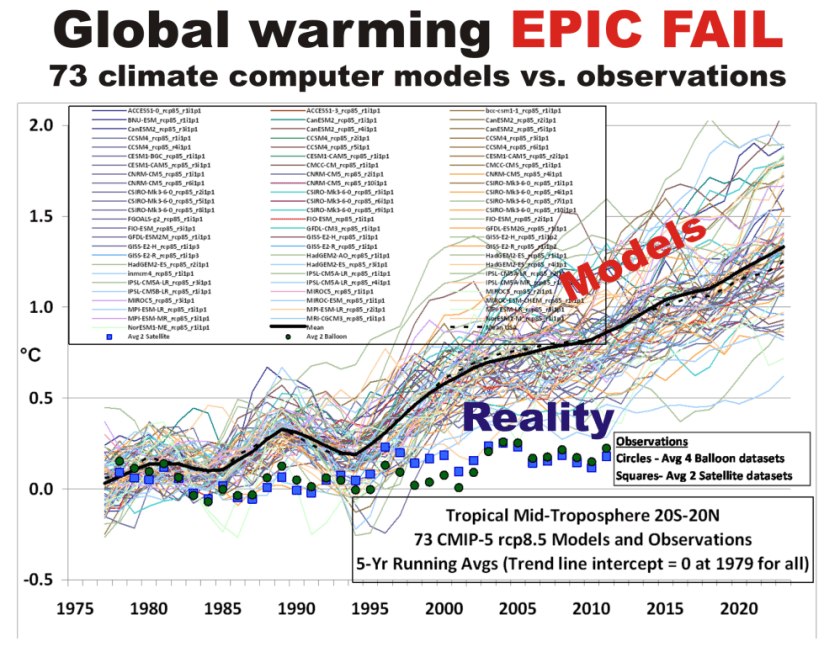
Do CMIP5 models skillfully match actual warming?

The CLINTEL Declaration states that the world has warmed โ€œsignificantly less than predicted by (the) IPCCโ€. Yet, a simple check of the models versus observed warming demonstrates that โ€œclimate models published since 1973 have generally been quite skillful predicting future warmingโ€, as Zeke Hausfatherโ€™s team at Berkeley Earth recently analysed.

From Climate Etc.

by Nic Lewis

Why matching of CMIP5 model-simulated to observed warming does not indicate model skill

A well-known Dutch journalist, Maarten Keulemans ofย De Volkskrant, recentlyย tweetedย an open letter to the Nobel-prizewinning physicist Professor Clauser in response to his signing of theย Clintel World Climate Declarationย that โ€œThere is no climate emergencyโ€, asking for his response to various questions. One of these was:

The CLINTEL Declaration states that the world has warmed โ€œsignificantly less than predicted by (the) IPCCโ€. Yet, a simple check of the models versus observed warming demonstrates that โ€œclimate models published since 1973 have generally been quite skillful predicting future warmingโ€, as Zeke Hausfatherโ€™s team at Berkeley Earth recently analysed.

The most recent such analysis appears to be that shown for CMIP5 models in aย tweetย by Zeke Hausfather, reproduced in Figure 1. While the agreement between modeled and observed global mean surface temperature (GMST) warming over 1970โ€“2020 shown in the Figure 1 looks impressive, it is perhaps unsurprising given that modelers knew when developing and tuning their models what the observed warming had been over most of this period.

Figure 1. Zeke Hausfatherโ€™s comparison of global surface temperature warming in CMIP5 climate models with observational records. Simulations based on the intermediate mitigation RCP4.5 scenario of global human influence on ERF through emissions of greenhouse gases, etc. were used to extend the CMIP5 Historical simulations beyond 2005.

It is well-known that climate models have a higher climate sensitivity than observations indicate. Figure 2 compares equilibrium climate sensitivity (ECS) diagnosed in CMIP5 models and in the latest generation, CMIP6, models with the corresponding observational estimate on the same basis inย Lewis (2022)ย of 2.16ยฐC and (likely range 1.75โ€“2.7ยฐC). Only one model has an ECS below the estimate in Lewis (2022), and most models have ECS values exceeding the upper bound of its likely range. CMIP6 models are generally even more sensitive than CMIP5 models, with half of them having ECS values above the top of the 2.5โ€“4ยฐC likely range given in the IPCCโ€™s 2021 Sixth Assessment Report: The Physical Science Basis (AR6 WG1).

Figure 2.ย  Red bars: equilibrium climate sensitivity in CMIP5 and CMIP6 models perย Zelinka et al. (2020)ย Tables S1 & S2 estimated by the standard method (ordinary least squares regression over years 1โ€“150 of abrupt4xCO2 simulations). Blue line and blue shaded band: best estimate and likely (17%-83% probability) range for ECS in Lewis (2022), derived from observational evidence over the ~150 year historical period but adjusted to correspond to that estimated using the aforementioned standard methodย  for models.

So, how is it possible that Hausfather gets an apparently good match between models and observations in the period 1970-2020? Does it imply that the models correctly represent the effects of changes in โ€œclimate forcersโ€, such as the atmospheric concentration of greenhouse gases and aerosols, on GMST, and accordingly that their climate sensitivities are correct?

The key question is this. Matching by CMIP5 climate models, in aggregate, with observed GMST changes would only be evidence that models correctly represent the effects of changes in โ€œclimate forcersโ€, such as the atmospheric concentration of greenhouse gases and aerosols, on GMST if resulting changes in their combined strength in models matched best estimates of the actual changes in those forcers. The standard measure of strength of changes in climate forcers, in terms of their effect on GMST, is their โ€œeffective radiative forcingโ€ (ERF), which measures the effect on global radiative flux at the top of the Earthโ€™s atmosphere once it and the land surface have adjusted to the changes in climate forcers (see IPCC AR6 WG1 Chapter 7, section 7.3)

It is therefore important to compare changes in total ERF as diagnosed in CMIP5 models during their Historical and RCP4.5 scenario simulations over 1970โ€“2020 with the current best estimates of their actual changes, which I will take to be those per IPCC AR6 WG1 Annex III, extended from 2019 to 2020 using the almost identical Climate Indicator Project ERF time series.

Historical and RCP4.5 ERF (referred to as โ€œadjusted forcingโ€) in CMIP5 models was diagnosed in Forster at al. (2013), for the 20 models with the necessary data. I take the mean ERF for that ensemble of models[1] as representing the ERF in the CMIP5 models used in Figure 1.

Figure 3 compares the foregoing estimates of mean ERF in CMIP5 models with the best estimates given in IPCC AR6. Between the early 1980s and the late 2000s CMIP5 and AR6 ERF estimates agreed quite closely, but they diverged both before and (particularly) after that period. The main reason for their divergence since 2007 appears to be that aerosol ERF, which is negative, is now estimated to have become much smaller over that period than was projected under the RCP4.5 scenario. Updated estimates of aerosol ERF also appears likely to account for about half of their lesser divergence prior to 1983, with the remainder mainly attributable to differences in ERF changes for land use and various other forcing agents.

Figure 3. Effective radiative forcing (ERF) over 1970โ€“2020 as estimated in CMIP5 models (mean across 19 models) and the best estimate given in the IPCC Sixth Assessment Scientific Report (AR6 WG1). The ERF values are relative to their 1860โ€“79 means.

The IPCC AR6 best estimate of the actual  ERF change between 1970 and 2020 is 2.53 Wmโˆ’2. The linear trend change over 1970โ€“2020 given by ordinary least squares regression is 2.66 Wmโˆ’2, while the change between the means of the first and last decades in the period, scaled to the full 50 year period, is 2.59 Wmโˆ’2.

By comparison, the mean ERF change for CMIP5 models between 1970 and 2020 is 1.67 Wmโˆ’2. The linear trend change over 1970โ€“2020 is 1.92 Wmโˆ’2, and the scaled change between the first to last decadesโ€™ means is 1.76 Wmโˆ’2.

It is evident that the AR6 estimate of the actual 1970โ€“2020 ERF change is far greater than that in CMIP5 models. Based on the single years 1970 and 2020, the AR6-to-CMIP5 model ERF change ratio is 1.51. Based on linear trends that ratio is 1.39, while based on first and last decadesโ€™ means it is 1.46. The last of these measures is arguably the most reliable, since single year ERF estimates may be somewhat unrepresentative, and due to intermittent volcanism the ERF has large deviations from a linear relationship to time. As there is some uncertainty I will take the ratio as being in the range 1.4 to 1.5.

So, CMIP5 models matched the observed 1970โ€“2020 warming trend, but the estimated actual change in ERF was 1.4 to 1.5 times greater than that in CMIP5 models. On the assumption that both the CMIP5 model ERF estimates and the IPCC AR6 best estimates of ERFs are accurate, it follows that:

  • CMIP5 models are on average 1.4 to 1.5 times as sensitive as the real climate system was to greenhouse gas and other forcings over 1970โ€“2020[2]; and
  • CMIP5 models would have over-warmed by 40โ€“50% if their ERF change over that period had  been in line with reality.

It seems clear that the ERF change in CMIP5 models over 1970โ€“2020 was substantially less than the IPCC AR6 best estimate, and that CMIP5 models substantially overestimated the sensitivity of the climate system during that period to changes in ERF. Moreover, the divergence is increasing: the ratio of AR6 to CMIP5 model ERF changes is slightly higher if the comparison is extended to 2022.

In conclusion, Maarten Keulemansโ€™ claim that โ€œa simple check of the models versus observed warming demonstrates that โ€œclimate models published since 1973 have generally been quite skillful predicting future warmingโ€ is false.

Contrary to the impression given by Zeke Hausfatherโ€™s rather misleading graph, CMIP5 models have not been at all skillful in predicting future warming; they have matched the illustrated 1970โ€“2020 observed warming (which was past rather than future warming until the late 2000s, when CMIP5 models were still being tuned) due to their over-sensitivity being cancelled out by their use of ERF that increased much less than the IPCCโ€™s latest best estimates of the actual ERF increase.

Nic Lewis               5 September 2023


[1] ex FGOALS-s2, the Historical and RCP simulations of which were subsequently withdrawn from the CMIP5 archive.

[2] There are some caveats to the conclusion that CMIP5 models were oversensitive by a factor of 1.4 to 1.5 times:

  • the ensemble of CMIP5 models used in Forster et al. (2013) might not have been a representative subset of the entire set of CMIP5 model. However, there appears to be little or no evidence suggesting that is the case;
  • despite their careful compilation, the AR6 best estimates of the evolution of ERF might be inaccurate;
  • the CMIP5 model forcings derived by Forster et al. (2013) might be inaccurate. There are reasons to suspect that their method might produce ERF estimates that are up to about 10% lower than the methods used for IPCC AR6. However, Forster et al. present some evidence in favour of the accuracy of their method. Moreover, the agreement in Figure 2 between the CMIP5 and AR6 ERF time series between 1983 and 2007 (with divergences before and after then largely attributed to differences in particular forcing agents) is further evidence suggesting that the Forster et al. (2013) CMIP5 ERF estimates are fairly accurate; and
  • due to the heat capacity of the ocean mixed layer, GMST is more closely related to average ERF exponentially-decayed over a few years rather than to ERF in the same year. Using exponentially-decayed ERFs would somewhat reduce the 1.4 low end estimate given above for the ratio of AR6 to CMIP5 model ERF 1970โ€“2020 increase estimates, perhaps by ~10%.

Do These 12 THINGS First If You Want a BRIGHT FUTURE | Bjorn Lomborg

This conversation draws attention to the importance for a rational, data-inspired response to global issues. As a successful entrepreneur, I say often, data is the most information rich data stream. Every decision you make and in every approach to solving novel problems, data must be at the center of the decision, otherwise youโ€™re speculating and relying on emotion.

Tom Bilyeu

I hope youโ€™re ready for a truly thought-provoking conversation with Bjorn Lomborg, a globally recognized author and thought-leader renowned for his innovative perspectives on addressing global issues. If global warming and climate change has you feeling a bit panicked, by the end of this episode youโ€™ll see the picture behind the panic and understand exactly what Bjorn thinks is a bigger problem to solve than climate change.

Bjorn Lomborg has published multiple bestselling books such as โ€˜False Alarm,โ€™ โ€˜Skeptical Environmentalist.โ€™ and his latest book, โ€˜First Things First.โ€™ with a mission to help people discover the most effective solutions to the worldโ€™s greatest challenges, from disease and hunger to climate and education.

This conversation draws attention to the importance for a rational, data-inspired response to global issues. As a successful entrepreneur, I say often, data is the most information rich data stream. Every decision you make and in every approach to solving novel problems, data must be at the center of the decision, otherwise youโ€™re speculating and relying on emotion.

Lomborg emphasizes the need to prioritize spending in various sectors, the role of education, and poverty reduction in improving societal outcomes. We also explore the potential implications of automation and the need for innovation in tackling climate change.

Together, we tackle topics such as global warming, automation in elder care, and the need for data-driven decision-making. Hear Lomborg’s fresh insights on channeling spending into prioritized sectors and the role education and poverty reduction play in societal outcomes. There’s so much to discover, don’t miss out on this enlightening episode!

BJORN QUOTES:

“Panic is not any kind of mode to be in if you want to solve issues.โ€


โ€œWhen it comes to global warming, itโ€™s a problem. Itโ€™s not the end of the world.โ€


โ€œI tend to see the world very much as a marginalized conversation, and Iโ€™m simply trying to set out some unpanicked advise that in a pretty panicked world can help us be a little smarter.โ€

โ€œWe donโ€™t have enough resources to deliver everything to everyone.โ€

โ€œIf you take a look at the last 25 years, each and every day, the world has lifted 138,000 people out of poverty.โ€


โ€œWe donโ€™t have enough resources to deliver everything to everyone.โ€

โ€œWe used to have a very strong understanding from the elite in the world that more trade was actually good. We also used to neglect the fact that itโ€™s not good for everyone.โ€

Follow Bjorn Lomborg:

Website: https://lomborg.com/

Twitter: https://twitter.com/BjornLomborg

Facebook: https://www.facebook.com/bjornlomborg

Investment Advisor CEO: Why Value Investors Should Doubt โ€œClimate Scienceโ€

Chris Leithner, Joint Managing Director of Leithner & Company Ltd, on why going with the crowd on climate change violates the basic principles of sound investment.

From Watts Up With That?

Essay by Eric Worrall

Chris Leithner, Joint Managing Director of Leithner & Company Ltd, on why going with the crowd on climate change violates the basic principles of sound investment.

Why value investors should doubt โ€œclimate scienceโ€

By nature theyโ€™re sceptics, and at key junctures become contrarians. I show why they should disbelieve the orthodoxy โ€“ and why it matters.

CHRIS LEITHNER
Leithner & Company Ltd

In this article, I answer these crucial questions. I proceed from four premises: 

  1. Value investors are naturally sceptical, and always think for themselves.
  2. They donโ€™t let conventional wisdom sway them โ€“ whether in the form of crowds, a โ€œconsensusโ€ of academic and other โ€œexpertsโ€ or stampeding mobs led by jet-setting UN Secretaries General, Australian billionaires, etc. 
  3. In key respects and at crucial junctures value investors are bold contrarians.
  4. They think independently, but theyโ€™re also humble. In particular, when necessary they heed competent external views and research.

Applying these principles to an assessment of โ€œclimate science,โ€ itโ€™s clear that climate change isnโ€™t a systemic risk: itโ€™s a mass hysteria. Like all manias, it will collapse when people โ€“ above all, energy consumers and taxpayers โ€“ recover their senses.

โ€œWhen everybody is on one side of a market,โ€ reckons Jim Rogers, the consensus โ€œhas nearly always proven to be wrong. We human beings have not changed in hundreds of years, so we are still guided by the same fears and aspirations.โ€ Howard Marks concurs: โ€œWhatโ€™s clear to the broad consensus of investors is almost always wrong.โ€ Carl Icahn is less categorical: โ€œThe consensus โ€ฆ is generally wrong โ€ฆโ€

In conversations over the years, Iโ€™ve come to realise that climate zealots, Net Zero nutters, etc. โ€“ including those who claim that theyโ€™re scientists โ€“ fundamentally misunderstand science. The tell-tale sign is their use of the phrase โ€œthe scienceโ€ (note the insertion of the definite article). They falsely regard science as a body of knowledge at a given point in time. Furthermore, they arrogantly believe that todayโ€™s โ€œclimate scienceโ€ is 100% correct โ€“ and therefore that it always will be.ย 

So-called โ€œclimate scienceโ€ rests not upon credible theories and valid and reliable data, โ€œbut rather political opinions and speculative models that have consistently proven to be wrong.โ€ Moreover, โ€œthe Unscientific Method โ€ฆ, relying on consensus, peer review, government opinion, models that do not work, cherry-picking data and omitting voluminous contradictory data, is commonly employed in these studies.โ€ย 

Read more:ย https://www.livewiremarkets.com/wires/why-value-investors-should-doubt-climate-science

Itโ€™s difficult to do Chris Leithnerโ€™s piece justice in just a few short quoted paragraphs. He has most definitely done his research, with multiple quotes from scientists ranging from William Happer, Steven Koonin, and a star cast of other leading skeptics.

And you donโ€™t have to look far to see companies and individuals who are only just starting to feel the hurt from their rash green investment decisions.

Consider automobile companies: Companies whose CEOs rushed headlong into massive electric vehicle investments, perhaps over-confident that governments would force ordinary people to buy their unwanted product, only to see politicians hesitating in the face of electoral backlash and public anger.

In my opinion we have not seen a proper reckoning yet for what could turn out to be a major automobile industry financial disaster. So long as politicians maintain the fiction that fossil fuel vehicles will definitely be phased out in the near future, automobile companies donโ€™t have to mark down their failing EV investments. Automobile company CEOs can maintain the fiction that multi-billion dollar EV manufacturing outlays are valuable strategic investments in the future. Donโ€™t look at the large unsold inventories piling up, think about how wonderful it will all seem next year.

Or not.

Every major crash is preceded by a handful of investment visionaries pointing out the obvious, shouted down by the outrage of those who have committed their fortunes to folly. Perhaps it is Chris Leithnerโ€™s turn to be that visionary.

Climate scientist whistleblower Patrick Brown reveals how the mediaโ€™s obsession with global warming manipulates the truth about wildfires โ€“ 80% are ignited by humans

Much reporting of the wildfires in Maui has said climate change contributed to the disaster by contributing to conditions that helped the fires to spark and spread quickly.
The fires, which killed at least 115 people, are believed to have beenย started by a downed electricity line, but observers have said rising temperatures caused extremely dry conditions on the Hawaiian island.

The hall of historic Waiola Church in Lahaina and nearby Lahaina Hongwanji Mission are engulfed in flames along Wainee Street on Tuesday, Aug. 8, 2023, in Lahaina, Hawaii. (Matthew Thayer/The Maui News via AP)

From ClimateDepot.com

Byย Marc Morano

https://www.dailymail.co.uk/news/article-12482921/climate-scientist-patrick-brown-wildfires-started-people.html

By LEWIS PENNOCK FOR DAILYMAIL.COM

  • Patrick T. Brown, a lecturer at Johns Hopkins University, claimed the worldโ€™s leading academic journals reject papers which donโ€™t โ€˜support certain narrativesโ€™
  • He also took aim at the media for focusing โ€˜intently on climate change as the root causeโ€™ of wildfires, including the recent devastating fires in Hawaii
  • The approach โ€˜distorts a great deal of climate science researchโ€™, Brown wrote in a piece for The Free Press

Aย climate changeย scientist has claimed the worldโ€™s leading academic journals reject papers which donโ€™t โ€˜support certain narrativesโ€™ about the issue and instead favor โ€˜distortedโ€™ research which hypes up dangers rather than solutions.

Patrick T. Brown, a lecturer at Johns Hopkins University and doctor of earth and climate sciences, said editors at Nature and Science โ€“ two of the most prestigious scientific journals โ€“ select โ€˜climate papers that support certain preapproved narrativesโ€™.

In an article for The Free Press, Brown likened the approach to the way โ€˜the press focus so intently on climate change as the root causeโ€™ of wildfires, including the recent devastating fires in Hawaii. He pointed out research that said 80 percent of wildfires are ignited by humans.

Brown gave the example of a paper he recently authored titled โ€˜Climate warming increases extreme daily wildfire growth risk in Californiaโ€˜. Brown said the paper, published in Nature last week, โ€˜focuses exclusively on how climate change has affected extreme wildfire behaviorโ€™ and ignored other key factors.

Brown laid out his claims in an article titled โ€˜I Left Out the Full Truth to Get My Climate Change Paper Publishedโ€™. โ€˜I just got published in Nature because I stuck to a narrative I knew the editors would like. Thatโ€™s not the way science should work,โ€™ the article begins.

Patrick T. Brown, a lecturer at Johns Hopkins University with a PhD in earth and climate sciences, said editors at Nature and Science โ€“ two of the most prestigious scientific journals โ€“ โ€˜want climate papers that support certain preapproved narrativesโ€™

Brown said one of his studies on the subject was published by Nature โ€˜because I stuck to a narrative I knew the editors would likeโ€™

He also took aim at the media for focusing โ€˜intently on climate change as the root causeโ€™ of wildfires, including the recent devastating fires in Hawaii. Pictured: A search, rescue and recovery member conducts search operations of areas damaged by Maui wildfires in Lahaina

โ€˜I knew not to try to quantify key aspects other than climate change in my research because it would dilute the story that prestigious journals like Nature and its rival, Science, want to tell,โ€™ he wrote of his recently-published work.

โ€˜This matters because it is critically important for scientists to be published in high-profile journals; in many ways, they are the gatekeepers for career success in academia. And the editors of these journals have made it abundantly clear, both by what they publish and what they reject, that they want climate papers that support certain preapproved narrativesโ€”even when those narratives come at the expense of broader knowledge for society.

โ€˜To put it bluntly, climate science has become less about understanding the complexities of the world and more about serving as a kind of Cassandra, urgently warning the public about the dangers of climate change. However understandable this instinct may be, it distorts a great deal of climate science research, misinforms the public, and most importantly, makes practical solutions more difficult to achieve.โ€™

The journals Science and Nature were approached for comment.

Brown opened his missive with links to stories by AP, PBS NewsHour, The New York Times and Bloomberg which he said give the impression global wildfires are โ€˜mostly the result of climate changeโ€™.

He said that โ€˜climate change is an important factorโ€™ but โ€˜isnโ€™t close to the only factor that deserves our sole focusโ€™.

Much reporting of the wildfires in Maui has said climate change contributed to the disaster by contributing to conditions that helped the fires to spark and spread quickly.

The fires, which killed at least 115 people, are believed to have been started by a downed electricity line, but observers have said rising temperatures caused extremely dry conditions on the Hawaiian island.

BBCโ€™s Extreme Summer Weatherย Propaganda

As for the hysterical nonsense about flooding, both the El Cordonazo in 1939, and Hurricane Kathleen in 1976, which both followed similar tracks to Hilary, dumped much more rain on Southern California.
Every year there are floods, heatwaves, droughts, hurricanes and wildfires. There is no evidence whatsoever that this yearโ€™s batch is any worse then before.

From NOT A LOT OF PEOPLE KNOW THAT

By Paul Homewood

h/t Ian Magness

Apparently this is what the BBC call factual reporting!

Heat. Wildfires. Torrential rain. Typhoons and hurricanes. Much of the northern hemisphere has been battered by extreme weather this summer.

Not all these events can be immediately linked to climate change. It can take a while for scientists to untangle what exactly is going on โ€“ plus, the planetโ€™s natural weather and climate systems are powerful and also affect the weather.

But in the past few weeks, significant meteorological records have been broken in quick succession, to the concern of climate change experts.

As the summer draws to a close, letโ€™s look back at what on earth happened โ€“ and how it is connected to climate change.

https://www.bbc.co.uk/news/resources/idt-8f0357f9-9013-4567-8407-be938c8c70cf

The BBC must be getting really desperate now to sell its Net Zero agenda, which is increasingly turning off the public.

This article is the usual list of bad weather events, which could have been cherry picked from any year in the past. For each one, as we shall see, they accept that natural factors are at play, but then try to pin the blame on climate change anyway.

Hottest June Evah

They conveniently ignore the fact that  June 1846 was much hotter, not to mention 1676, 1822 and 1826.

Heatwaves In Europe

Heatwaves in the Mediterranean are not exactly new, and temperatures of 40C in Rome are hardly unheard of:

Wildfires in Greece

Forests are always tinder boxes in summer in Greece; but it takes a spark to start them, and most of this yearโ€™s fires were caused by arson, not climate change:

Meanwhile, the long term trend for wildfire acreage around the Mediterranean is clearly downwards.

https://www.eea.europa.eu/data-and-maps/daviz/burnt-forest-area-in-five-4#tab-chart_5

Even this yearโ€™s burnt area in Greece is about a third lower than in 2007.

Confusing Computer Models With Actual Data

The BBC omitted to mention that global hurricane activity has been close to record lows during the last 12 months:

https://climatlas.com/tropical/

Maui Wildfires

Climate change MAY have contributed? Why even mention it then, if you donโ€™t know, BBC?

The BBC are an utter disgrace for not acknowledging that Maui is always hot and dry in summer. Or the fact that the fire spread so quickly because of the unmanaged growth of savanna type grasses in recent years, which have invaded abandoned plantations.

Wildfires in Canada

No mention then that the long term trend in Canadian wildfires is actually down.

Nor that fires this year in the US are the lowest for more than a decade for the time of year.

Tropical Storm Hilary

Although it is rare for tropical storms to hit California, it is not unheard of, and has zero to do with climate change.

As for the hysterical nonsense about flooding, both the El Cordonazo in 1939, and Hurricane Kathleen in 1976, which both followed similar tracks to Hilary, dumped much more rain on Southern California.

Every year there are floods, heatwaves, droughts, hurricanes and wildfires. There is no evidence whatsoever that this yearโ€™s batch is any worse then before.

Which of course brings us back to the BBCโ€™s real agenda:

Why Your Local Newspaper and TV Station Get Climate Facts Wrong

Besides, even using the scientifically (technically) suspect present-day measures of tropospheric warming, such as all the Global Average Surface Temperature metrics, ย Earth isย not overheating. In fact, the global average surface temperature for 2022 was 1.90 หšF (1.06 หšC) warmer than the pre-industrial period (1880-1900). [ย climate.govย ] The pre-industrial average temperature was 13.7 ยฐC โ€“ that plus 1.06 ยฐC makes 14.76 ยฐC โ€“ย aboutย ยผ degree too coolย โ€” less thanย the 15ยฐC expectationย for the Earth to be considered an โ€œEarth-likeโ€ planet.ย 

From Watts Up With That?

Essay by Kip Hansen โ€” 25 August 2023

I get emails and comments from readers wondering how it is that their local/national newspaper or television news outlet can get even the very basics about climate and climate change so totally wrong.  These people ask โ€œHow can they get away with such outright lies?โ€ and โ€œWhere do they get this nonsense?โ€

Iโ€™m going to tell you: It is through the intentional efforts of climate news cabals providing them with propaganda talking points and even complete stories.   I know that that sounds like a โ€œconspiracy theoryโ€โ€ฆ but it is not a conspiracy theory if it is true and if those involved in the act of conspiring together not only do so openly but  proudly publicize their actions.

The lesson today comes from an email I received from Covering Climate Now which characterizes itself this way:  โ€œCCNow collaborates with journalists and newsrooms to produce more informed and urgent climate stories, to make climate a part of every beat in the newsroom โ€” from politics and weather to business and cultureโ€  and when they say โ€œurgentโ€ climate stories, they mean the more alarming and frightening, the better. 

Who are the participants?  

โ€œCo-founded by theย Columbia Journalism Reviewย andย The Nationย in association withย The Guardianย andย WNYCย in 2019, CCNowโ€™s 460-plus partners include some of the biggest names in news, and some of the smallest, because this story needs everyone. In addition to three of the worldโ€™s biggest news agencies โ€” Reuters, Bloomberg, and Agence France Presseย [AFP]ย โ€” each of which provides content to thousands of other newsrooms, our partners include CBS News, NBC and MSNBC News, Noticias Telemundo, PBS NewsHour, Univision, Al Jazeera; most of the biggest public radio stations in the US; many flagship newspapers and TV networks in the Americas, Europe, and Asia; and dozens of leading magazines and journals, including Nature, Scientific American, Rolling Stone, HuffPost, Teen Vogue, and Mother Jones.โ€ย ย [ย CCNow About pageย ]

I urge you to actually read the list above, but it is not complete, for the complete list  see here.   Is your local public broadcasting station on the list, your local paper, does your local paper print stories from the major press agencies (AFP, Reuters, Bloomberg) or reprint stories from other newspapers or news agencies on that list? 

 And what does CCNow tell them to help make their stories โ€œmore informed and urgentโ€?  CCNow posted a page on their site on 16 August called โ€œ10 Climate Change Myths Debunkedโ€.  

Quoting from the introduction:

โ€œScientists the world over agree that climate change is real, itโ€™s happening now, and itโ€™s caused by the burning of fossil fuels. Still, there are a lot of myths being repeated about climate change, and even journalists can get taken in.

Most climate change myths have been perpetuated by fossil fuel companies, their political allies, and others with vested interests in the status quo. For decades, theyโ€™ve spent millions of dollars on advertising, think tank โ€œstudies,โ€ and lobbying to confuse the public, policymakers, and the press and thereby forestall climate action.

This has led some journalists to soften their coverage โ€” for example, by not connecting climate change to extreme weather โ€” leaving the public misinformed. This guide equips journalists to recognize and refute these myths and report the truth.โ€

It would be a whole essay just to expose the mis- and dis-information in the introduction, but that wouldnโ€™t leave room for the main course! Letโ€™s take a collective look at the so-called myths by looking at screen shots of their 10 โ€˜mythsโ€™ one at a time.ย  Here is Myth 1:

Before you askโ€ฆ.yes, all ten are like that.

This so-called โ€˜mythโ€™ is a simple fact.  99% of scientists do not agree about climate change (that is an absurd thing to say)  or that  that human activity is overheating the planet, not even 99% of IPCC associated scientists agree about that.  Nowhere does the IPCC even claim that we (or Climate Change) are โ€œoverheating the planetโ€ .  An Advanced Google Search restricted to the IPCC domain returns โ€œNo results found for โ€œoverheating the planetโ€ site:https://www.ipcc.ch.โ€ The IPCC  never says that, not once, anywhere on its website nor in AR6.

The IPCC AR6 Summary for Policy Makers uses this wording:

โ€œIt is very likely that well-mixed GHGs were the main driver of tropospheric warming since 1979โ€ฆโ€  AR6 SPM A.1.3

The number of skeptical declarations, statements, proclamations signed by scientists skeptical about climate change around the world are legion.  The CO2 Coalition is made up of about 150 scientists from all fields of study, including some of the worldโ€™s leading physicists and the 2022 Nobel Prize winner in physics, John Clauser, all of whom disagree with the IPCC view of climate change and do not endorse that human activity is โ€œoverheating the planetโ€.

It is notable that the IPCC no longer even says โ€œdominant cause of the observed warming since the mid-20th centuryโ€ (AR5) but rather, in AR6,   20th century warming doesnโ€™t really get going until 1978/79 or so โ€“ not 1950 (mid-20th Century) as many still claim, and certainly not since 1880-1890.

CCNow, seemingly well aware of the scientific ignorance of the average journalist, gives them the wording to use in their climate propaganda stories:

โ€œLANGUAGE FOR JOURNALISTS:  Scientists overwhelmingly agree that burning oil, coal and gas is overheating the planet.โ€

Besides, even using the scientifically (technically) suspect present-day measures of tropospheric warming, such as all the Global Average Surface Temperature metrics,  Earth is not overheating. In fact, the global average surface temperature for 2022 was 1.90 หšF (1.06 หšC) warmer than the pre-industrial period (1880-1900). [ climate.gov ] The pre-industrial average temperature was 13.7 ยฐC โ€“ that plus 1.06 ยฐC makes 14.76 ยฐC โ€“ about ยผ degree too cool โ€” less than the 15ยฐC expectation for the Earth to be considered an โ€œEarth-likeโ€ planet. 

How are the propagandists doing?

Try a web search like this for the exact phrase: โ€œoverheating the planetโ€.  I got over 58,000 returns, mostly from the climate alarm mass media.

โ€“ โ€“ โ€“ โ€“ โ€“

Here all ten of the  propaganda talking points from CCNow as a slide show.  You should be able to click on the left and right arrows to move through the whole set:

This nonsense is repeated and amplified by more than 500 media outlets in 57 countries, with a cumulative reach of over 2 BILLION people.

I want to be clear โ€“ CCNow is not the only group doing this. You also have Inside Climate News, which has a convenient Inside Climate News Newsletter that it sends weekly to journalists (and anyone else) who want copy โ€˜ready-to-printโ€ (requires partnership or permission) or to re-write.  There are others, many national or language-specific. 

Bottom Lines:

The Climate News โ€“ found on the front pages and  in the climate/environment sections of your newspaper, magazines, news broadcasts, and the push feed from your social media sites is not news.  It is climate alarm propaganada carefully manufactured and shared by professional climate propaganda cabals like Covering Climate Now (CCNow) โ€“ they may be โ€œtrue believersโ€ but they are intentional in their knowing creation of propaganda.

# # # # #

Authorโ€™s Comment:

I have been writing about CCNow for years.  Anthony Watts alerted us to  their upcoming  Massive Collusion-fest to โ€œGet their Stories Straightโ€ on Climate Change.  When they say โ€œget stories straightโ€ they mean agree on the propaganda lines to be used in all their stories.  Think how many time you have heard a TV or movie detective worrying about allowing suspects time get together to โ€œget their stories straightโ€.

It is hard to blame home town newspapers and under-funded local TV stations for taking advantage of this sort of journalism-free instant copy. They have to have copy and they donโ€™t have the people to even write it โ€“ no less actually do informed research for a third page story.

I encourage readers to take which ever one of the CCNowโ€™s ten propaganda points best aligns with their expertise and tell us just how twisted it is.

With my apologies, I may not be available to reply to your comments, I will be away for a couple of days.  Please be civil to one another.

Thanks for reading.

The Giant Science Lie that Underpins the Entire Collectivist Net Zero Political Project

The false notion that the climate is collapsing due to human activity lies at the heart of the drive to collectivise human populations under a Net Zero global agenda. Everything about it is a lie. The science is not โ€˜settledโ€™, it is an unproven hypothesis, and stating otherwise is giving credence to an obvious political construct.

From The Daily Sceptic

Byย CHRIS MORRISON

The false notion that the climate is collapsing due to human activity lies at the heart of the drive to collectivise human populations under a Net Zero global agenda. Everything about it is a lie. The science is not โ€˜settledโ€™, it is an unproven hypothesis, and stating otherwise is giving credence to an obvious political construct. There is no way that scientists can calculate how much of the gentle rise in temperature seen over the last 200 years is caused by humans burning fossil fuel rather than natural influences. The idea that there is a 97% โ€˜consensusโ€™ among scientists that humans cause the majority of warming is a whopper as big as they come, not least because holding that view is beyond current scientific knowledge.

This latter ubiquitous claim was recently revisited in a short essay published by the CO2 Coalition. It arose from a 2013 paper published by John Cook and asserted that 97% of 11,944 peer-reviewed science papers explicitly endorsed the opinion that humans had caused the majority of the warming of the last 150 years. Alas, 7,930 of those papers took no position on anthropogenic change and were excluded from the 97% claim. It was subsequently revealed that only about 0.5%, of the papers explicitly stated that recent warming was mostly human caused.

The authors of the CO2ย Coalition essay quote Professor Richard Tolโ€™s comment at the time:

Cookโ€™s 97% nonsensus [sic] paper shows that the climate community still has a long way to go in weeding out bad research and bad behaviour. If you want to believe that climate researchers are incompetent, biased and secretive, Cookโ€™s paper is an excellent case in point.

Science has three levels to judge the way the natural world operates โ€“ laws, theories and hypotheses. An apple falling from a tree hitting the ground demonstrates clearly the law of gravity. If it suddenly flew off into space, we would have to reconsider, but until then it is a given fact. A theory is an explanation that has been ruthlessly tested and is widely accepted as fact. Hypotheses covers the rest โ€“ mere suggestions that only gain credence with rigorous scientific testing and believable proof. Anthropogenic climate change is an unproven hypothesis, without a single credible peer-reviewed paper proving its proposition. And this is after at least 50 years of intense, money-no-object, scientific effort, all to no avail.

As the noted Australian geologist Dr. Ian Plimer is fond of pointing out: if there was such a paper, you would never hear the last of it. The common response to this is that the UNโ€™s Intergovernmental Panel on Climate Change provides the proof, but, again, no paper exists within that body of work to prove the hypothesis to any reasonable extent. As Dr. Plimer goes on to observe, when proof is sought, there is just โ€œobfuscation and deafening silenceโ€. A silence, it could be noted, disturbed only by the deafening pseudoscientific roar of computer models pumping out constant clickbait forecasts of climate Armageddon.

Anthropogenic climate change fails on almost every count. In particular, it cannot explain a vast body of observations available in the historic, near-historic and 600-million-year paleological record. In all that time, rarely do temperatures rise following rising carbon dioxide levels. In the near-historic period, ice core records going back about 500,000 years suggest that rising temperature preceded, and likely caused, CO2 levels to follow suit as natural processes such as ocean degassing come into play. Across the paleological period, CO2 levels have been up to 20 times higher with no evidence of a climate fireball. Over the last 120 years, temperatures have risen (1910-40, 1980-98), fallen (1940-75) and paused (2000-14, 2016-23), all at a time when CO2 showed a continuous rise.

As often happens in the human condition, the bad drives out the good. Plausible alternative explanations surrounding the effect of rising levels of CO2 in the atmosphere have been more or less suppressed in the recent past. The hypothesis that CO2 โ€˜saturatesโ€™ after a certain level, and its warming properties fall away dramatically, has been around for many years. The gas absorbs heat only within narrow bands of the infrared spectrum. There is debate at what level the absorption work is mainly done, with some scientists suggesting from observations that  โ€˜saturationโ€™ sets in around 300 parts per million, 100 ppm lower than current levels. The big advantage of this hypothesis is that it provides a convincing explanation for much if not all the temperature and gas observations in the past.

The CO2 Coalition provides a timely reminder that science, unlike religion, is not a belief system. Like everyone else, scientists will say things for social convenience, political expediency or financial profit. For reasons such as this, science is not founded on the beliefs โ€“ in other words hypotheses โ€“ of scientists. It is a disciplined method of inquiry by which scientists apply pre-existing theory to observation and measurement to arrive at โ€œthat which is, and that which is notโ€, as the authors put it.

The CO2 Coalition concludes:

The long and hard road to scientific truth cannot be followed by the trivial expedient of a mere head-count among those who make their livings from Government funding. Therefore, the mere fact that climate activists find themselves so often appealing to an imagined โ€˜consensusโ€™ is a red flag. They are far less sure of the supposed scientific truths to which they cling than they would like us to believe. โ€˜Consensusโ€™ here is a crutch for lame science.

Chris Morrison is the Daily Scepticโ€™s Environment Editor.