Fritz Vahrenholt: The Heat Island Effect

37 scientists from 17 countries report new findings on the causes of global warming

Fromย KlimaNachrichten Redakteur

Monthly newsletter from Fritz Vahrenholt

Dear Ladies and Gentlemen,

As usual, you will receive my monitor on the actual global temperature rise. After that, these are my topics today:

  • the heat island effect
  • the influence of solar radiation on temperature development
  • the further development of CO2 emissions in the G20 countries
  • nature’s contribution to stabilising CO2 concentrations

In August 2023, the deviation of global temperature from the 30-year average of satellite-based measurements from the University of Alabama (UAH) continued to increase slightly compared to July. The value is 0.69 degrees Celsius and represents the second highest deviation from the long-term average since 1979. The average temperature increase per decade since 1979 is 0.14 degrees Celsius. A further increase at this level is not a cause for concern, certainly not for panic. The increase in the temperature of the seas was 0.12 degrees Celsius per decade; the increase in temperature on land was 0.19 degrees per decade. Why temperatures rise more sharply on land, we will explain below.

37 scientists from 17 countries report new findings on the causes of global warming

At the end of August, the renowned climate science journal Climate published a paper by 37 scientists from 17 countries on new findings on the causes of global warming on land. The IPCC had blamed 100% of the increased CO2 concentration in the atmosphere as the cause of warming both on land and in the oceans. The 37 scientists come to the different conclusion that there are other causes of the measured temperature increase that are not attributable to the increased CO2 concentration in the atmosphere. I’m proud to announce that I’m one of the 37 scientists who published this.

What did this group of scientists investigate?

In order to identify the main causes of warming from 1850 to 2018, two sources of warming neglected by the IPCC were statistically investigated:

1. The so-called urban heat islands effect, which reflects the influence of growing cities on measurement results and temperature increases.

2. The influence of solar activity as another cause of temperature increases that are not caused by CO2.

To the heat island effect

The heat island effect is that measuring stations that used to be located in purely rural areas are now surrounded by urbanization of populated areas. One example is the measuring station at Frankfurt Airport, which 80 years ago had rural areas as its environment, but is now influenced by heat-storing and heat-emitting runways, motorways, buildings and traffic.

The study concludes that 65% of the measuring stations located in rural areas between 1850 and 1900 are now fully urbanized. Why is this important? The difference in temperature between urban and rural areas is significant; if rural areas are urbanized over time, the respective local measuring stations record the higher temperature of the urbanized environment. Accordingly, the locations of the measuring stations play a more important role in the assessment of global temperature rise than previously thought.

Source : Lรผning/Vahrenholt Undesirable Truths 2021

Since the ratio of measuring stations in rural and urban areas has shifted by 65% in favour of cities due to growing cities, this also has an influence on the causes of global temperature development.

Therefore, part of the warming of the last 150 years in Europe, the USA and especially China is due to the change in the environment and not only to the rising CO2 concentration. The study concludes that the effect is 0.34 degrees Celsius per century. This does not exempt CO2, but the degree of warming on land would be almost 40% lower without the heat island effect.

On the influence of solar radiation

The influence of changing solar radiation on global warming is given by the IPCC as close to zero. I had already referred to my publication in the last August newsletter, according to which, especially in the last 20 years, the influence of solar radiation by thinning the clouds has been of greater importance than the so-called greenhouse effect. The study by the 37 scientists also comes to a greater solar influence for the period before that: according to this, up to 70% of the warming is due to solar irradiation conditions.

Why are the results different compared to those of the IPPC? The IPCC relies on data from the Physical-Meteorological Observatory in Davos (PMOD) to reconstruct the solar cycles. The above-mentioned study is based on data from the Californian Institute of Technology (ACRIM) for the reconstruction of the solar cycles. There are good reasons for each of these two satellite measurement systems. The differences in the measurement results appear to be very small. But if one opts for the measurements of the Californian Institute of Technology (ACRIM), the influence of the sun is greater than the influence of CO2 on warming in the reconstruction of the solar cycles of ACRIM.

In any case, the publication shows one thing: the uncertainties in determining the temperature increase not caused by CO2 are much greater than it seems in the public perception. While scientists are “doing their job”, politicians are acting as if CO2 is the sole cause of climate change. Under the narrative of “saving the climate”, politicians pursue their very own socio-political goals, no matter what the cost to society.

Important G20 countries reject CO2 reduction

At the G20 summit in India from September 9-10, 2023, the USA and some European countries tried to persuade other countries such as China, India, Russia, Saudi Arabia and Brazil to agree to a CO2 reduction of 60% by 2035.ย The attempt failed, as none of the BRICS countries followed the West.ย If you take the emissions of Western countries (USA, Europe, Japan, South Korea, Canada and Australia) together, you get 27.1% of global emissions. The remaining countries, which account for 73% of global CO2 emissions, are not thinking about reducing their CO2 emissions for economic reasons for the time being.

In particular, the host of the G20 summit, India, stood in the way and had its energy minister Singh declare: “If the economy grows by 7%, electricity generation from coal will also grow”. The inconvenient truth is that renewables are not a realistic alternative to fossil fuels. He also emphasized that the need for backup for wind and solar batteries increases costs almost fivefold. In addition, the cost of lithium batteries rose by 2022% for the first time since 7 due to higher raw material prices. We have been trying to convey this insight to our federal government for some time – so far without success.

A few weeks earlier, the U.S. government’s climate envoy, John Kerry, had to realize during his visit to China that China has now even said goodbye to its own CO2 reduction targets. As recently as 2015, China had declared that it wanted to reach its CO2030 emission maximum in 2. President Xi has now declared that China will not replace coal-fired power plants with renewable energies as long as it is not economical. In addition, China will build more coal-fired power plants.

In 2022, 106 GW (gigawatts = 1000 megawatts) of coal-fired power plants were approved in China. A coal-fired power plant has an average capacity of 1 GW. In the first half of 2023, additional coal-fired power plants with a total capacity of 52 GW were approved in China. That’s 2 power plants per week. Coal-fired power plants with a total capacity of 136 GW are under construction in China. This increase alone corresponds to 4 times the capacity of all German coal-fired power plants (35 GW), which are supposed to be zeroed out by 2038 at the latest.

What does China’s expansion of coal-fired power plants mean?

The 136 GW of new coal-fired power plants will emit an additional 700 million tonnes of CO2. This corresponds to about 70 times the CO2 savings that the German government wants to achieve through the Heat Pump Act. This law is expected to save around 2030.10 million tonnes of CO4 in 2. The cost of this is expected to be around โ‚ฌ130 billion. This corresponds to public and private expenditure of around โ‚ฌ12,500 per tonne of CO2 saved.

This makes this law probably one of the most expensive CO2 reduction measures in the world โ€“ without even bringing about an effective, global CO2 reduction. Obviously, our federal government does not make any cost-benefit considerations for your “climate protection measures”. As a result, it has completely lost sight of the proportionality of its policy.

Is it bad if China and India rely on coal? 

The UN target of net zero CO2 in 2050 has finally disappeared into smoke and mirrors after the G20 summit. After all, the power plants that are now being built around the world will certainly still be connected to the grid. Much would be achieved if emissions could be almost halved by 2050. The good news is that this reduction would be enough to stop an increase in CO2 concentrations. Already today, 29% of emissions are absorbed by plants and 26% by the oceans, i.e. a total of 55% of all CO2 emissions worldwide. Prof. Gantefรถr from Konstanz has now joined this position and refers โ€“ like me โ€“ to the long version of the IPCC (Working Group 1, FAQ 5.3, p.32).

Why is a 2% reduction in CO45 emissions enough? Plants and oceans are unaware of CO2 emissions from chimneys. They absorb the CO2 from the air depending on the CO2 concentration in the surrounding air. If you halve the emission, plants and oceans still absorb the same amount of CO2 that corresponds to the emission. The increase in CO2 levels in the atmosphere is stopped.

The effect of halving CO2 is based on the IPCC’s computational models. If one also takes into account the results of the above-mentioned study by the 37 scientists, the effect of CO2 on temperature development is even lower: then it would not even be necessary to halve the CO2.

But even if we only strive to halve CO2 emissions, we can do without the biggest nonsense of the energy transition: heat pumps in old houses, a ban on diesel and gasoline engines, burdening industry with CO2 costs that drive it out of the country. Deindustrialization could be stopped and millions of citizens would not have to endure a destructive destruction of the value of their property as a retirement provision.

But why do politicians take the suicidal course to the bitter end without consideration, so that even foreign newspapers such as the British Telegraph headline : How Olaf Scholz turned Germany into the sick man of the world. Why do politicians oppose the continued operation of coal-fired power plants with CO2 capture, renounce nuclear energy or shale gas production without need? She believes that this “government is the last one that can still actively influence the climate crisis” (Baerbock). It will not be able to sustain this religious war against its own citizens, companies and employees.

Reason will prevail.

With best wishes
,
Fritz Vahrenholt

L A Times Article Falsely Asserts U.S. Had โ€œRecordโ€ High Summer Temperatures in 2023

The L A Times ran an articleย addressing the year 2023 Northern Hemisphere summer temperaturesย which falsely claimed that: โ€œBut in Britain and the United States, global records go back to the mid-1800s, and the two countriesโ€™ weather and science agencies are expected to concur that this summer has been a record breaker.โ€

From Watts Up With That?

Guest essay by Larry Hamlin

The L A Times ran an article addressing the year 2023 Northern Hemisphere summer temperatures which falsely claimed that:

โ€œBut in Britain and the United States, global records go back to the mid-1800s, and the two countriesโ€™ weather and science agencies are expected to concur that this summer has been a record breaker.โ€

Despite all the climate alarmist politically driven ignorance-based hype about โ€œrecordโ€ year summer 2023 temperatures the reality of the year 2023 summer temperatures in the U.S. and other global locations are, in fact, disputed by NOAAโ€™s measured data.         

NOAAโ€™s year 2023 U.S. temperature data records covering the NOAA defined 3-month summer June through August period actually shows that U.S. 2023 summer temperatures were far below โ€œrecordโ€ summer maximum temperature levels regardless of whether one is looking at NOAAโ€™s national, regional, state, county or city summer temperature data.

Looking first atย NOAAโ€™s National Contiguous U.S. Maximum Temperatureย for year 2023 (shown below) we see a maximum temperature of 85.72 F which represents the 109th highest maximum summer temperature of the 129 maximum summer temperatures identified. There are 20 years in which the Contiguous U.S. Maximum Temperature was higher than in 2023 with the highest ever being in 1936 at 87.92 F.

The year 2023 is not even close to being a โ€œrecordโ€ maximum highest summer temperature for the Contiguous U.S.

Looking next atย NOAAโ€™s West Regional Time Seriesย for year 2023 (shown below for the West Region) we see a maximum temperature of 86.6 F which represents the 73rd highest maximum temperature of the 129 maximum summer temperatures identified. There are 56 years in which the West Regional Maximum Temperature was higher than 2023 with the highest ever being in 2021 at 91.2 F.

There are 7 other NOAA Regional Areas which are the Ohio Valley, Upper Midwest, Northeast, Northwest, South, Southeast, Southwest and Northern Rockies Plains of the U.S. with each of these showing that the year 2023 maximum summer temperature is not the โ€œrecordโ€ highest with these โ€œrecordโ€ highest maximum years being 1936, 1988, 1949, 2021, 2011, 2020 and 1936 respectively.

The year 2023 is not even close to a โ€œrecordโ€ maximum highest summer temperature for any of NOAAโ€™s U.S. Regions.

Looking next at theย NOAAโ€™s Statewide Time Series Maximum Temperatureย for year 2023 (shown below California) we see a maximum temperature of 87.9 F which represents the 77th highest maximum temperature out of the 129 maximum summer temperatures identified. There are 52 years in which Californiaโ€™s Statewide Maximum Temperature was higher than in year 2023 with the highest ever being in 2021 at 91.9 F.

Of the 48 States in the Contiguous U.S. 47 did not see a โ€œrecordโ€ maximum highest summer temperature in 2023. Only Louisiana has a โ€œrecordโ€ maximum highest summer temperature in year 2023.

Californiaโ€™s year 2023 summer temperature was not even close to a โ€œrecordโ€ maximum summer temperature.

47 of the 48 Contiguous U.S. States did not have a โ€œrecordโ€ maximum summer temperature.      

Looking next atย NOAAโ€™s County Time Series Maximum Temperatureย for year 2023 (shown below for Los Angeles County) we see a maximum temperature of 85.0 F which represents the 49th highest out of 129 maximum summer temperatures identified. There are 80 years in which the Los Angeles County Maximum Temperature was higher than in year 2023 with the highest ever being in 2006 at 89.7 F.

There are 58 California counties listed in NOAAโ€™s County Time Series and none these counties had a โ€œrecordโ€ maximum highest summer temperature in 2023. 

Looking next atย NOAAโ€™s City Time Series Maximum Temperatureย for year 2023 (shown below for Los Angeles) we see a maximum temperature of 72.8 F which represents the 47th highest summer temperature out of the 79 identified. There are 32 years in which the Los Angeles City Maximum Temperature was higher than in year 2023 with the highest being in 2006 at 76.8 F.

There are 9 California cities (including Death Valley) listed in NOAAโ€™s City Time Series and none of these cities had a โ€œrecordโ€ maximum highest summer temperatures in 2023.

NOAAโ€™s temperature data as identified and addressed in the above discussion for year 2023 clearly indicates that the U.S did not have โ€œrecordโ€ breaking summer temperatures in year 2023 โ€“ not at the national level, not at the nations regional level, not at the nations state level, not at the level of Californiaโ€™s 58 counties, and not at the level of 9 major California cities. 

Despite these outcomes in California and the U.S. climate incompetent alarmist politicians and news media will continue to falsely hype โ€œrecord breaking heatโ€ as being present across the nation and its states, regions, counties, and cities based on the grossly and completely invalid misapplication of a global wide temperature averaging outcome that cannot define temperature outcomes at specific global regional, national, country, state, county, or city locals. 

Additionally, given the 2023 summer temperature outcomes of the U.S. addressed above it seems unlikely that the Global Region of North American had โ€œrecordโ€ summer temperature outcomes as hyped by the propaganda driven alarmist media. This outcome is further addressed below.

Alaska highest Maximum Summer Temperatures Peakย was 65.3 F in 2004 with the year 2023 maximum summer temperature being only 60.6 F in 2023ย making it the 85th out of 99 total yearly maximums as shown below.

The highest reported temperature measured in Canada this year was 41.4 C in British Columbiaโ€™s South Coast on August 14, 2023.

Canadaโ€™sย highest ever reported temperaturesย are shown below.

This data clearly supports that Canada did not have โ€œrecordโ€ high maximum summer temperatures in year 2023 which is consistent with the same outcome for Alaska whose territories occupy the same Northern Hemisphere global latitudes as Canada.  

Given that neither the U.S., Alaska nor Canada had โ€œrecordโ€ high maximum summer temperatures in 2023 it seems extremely probable that neither did the entire North America Global Region.  

But despite this reality in the inane ignorant based climate alarmist political propaganda world the alarmism hype will continue unabated. ย 

Brazilโ€™s big cats latest victims of wind turbines

To the well-documented slaughter of birds and bats by wind turbines and the growing threat to marine life posed by the proliferation of offshore wind power, we can add the jaguars and pumas of northeastern Brazil being wantonly sacrificed in the name of โ€œclean,โ€ โ€œclimate friendlyโ€ renewable energy.

From ย CFACT

Byย Bonner Cohen, Ph. D.

To the well-documented slaughter of birds and bats by wind turbines and the growing threat to marine life posed by the proliferation of offshore wind power, we can add the jaguars and pumas of northeastern Brazil being wantonly sacrificed in the name of โ€œclean,โ€ โ€œclimate friendlyโ€ renewable energy.

The hot, semi-arid, wind-swept Caatinga is a far cry from the steamy, dense jungles of Brazilโ€™s Amazon region to the south. Pumas and Jaguars have adapted to the Caatingaโ€™s harsh environment and thrived there as apex predators since time immemorial. But they are now facing extinction thanks to Chinese and European wind-power developers who are making the region uninhabitable for the big cats. The spinning, 150-foot-long blades atop the outsidersโ€™ wind turbines are scaring the pumas and jaguars away from the areaโ€™s scarce sources of water, forcing them to abandon their lairs and roam vast distances across dusty plains in search of life-sustaining rivers and streams.

โ€œThe weaker perish along the way. Others venture closer to villages, where locals have started laying traps to protect their small herds of goats and sheep, often their only form of survival in this impoverished region,โ€ The Wall Street Journal reported (Sept. 18).

Environmental Costs

Brazil is expected to become the worldโ€™s fourth-largest wind-power producer by 2027, behind China, the U.S., and Germany, according to the Brazilian Wind Power Association. But the countryโ€™s embrace of renewable energy is coming with a steep environmental cost. The wind turbines being installed on compacted sand dunes along the countryโ€™s northern coast pose a threat to underground reservoirs. Conservationists, many of whom welcomed wind-energy development, are now having second thoughts. And indigenous groups are holding nationwide protests against the installation of wind turbines on lands they claim as their own.

People convicted of killing jaguars, pumas, and other wild animals in Brazil can land in jail for up to 18 months, but enforcement of the law is lax. Wind developers are indirectly killing lots of big cats by driving them out of their habitat, but there have been no prosecutions to date. As for the villagers setting traps for jaguars and pumas trying to escape the wind turbines, they quickly bury or burn the dead animals, and wildlife rangers are none the wiser. Meanwhile, the number of pumas and jaguars in the Caatinga continues to drop.

โ€œWhile the big cats are still plentiful in the Amazon and in Brazilโ€™s Pantanal wetlands, those in the Caatinga are unique, having adapted to cope with the intense heat,โ€ the Journal notes. โ€œThe disappearance of the felines would throw the regionโ€™s ecosystem out of whack, leading to a proliferation of animals that serve as prey, such as the wild boar, deer, and armadillos, said Felipe Melo, a researcher at the Federal University of Pernambuco who has studied the impact of the wind-power industry on the Caatinga.โ€

Eyes Wide Shut

The notion that installing industrial-scale wind-power facilities along Brazilโ€™s northeastern coast โ€“ or any place else, for that matter โ€“ will have any effect on the worldโ€™s climate is absurd. But the monstrosities, along with their solar-array equivalents, are having a profound and harmful effect on wildlife. All of this is far removed from the posh c suites of wind-power developers in Europe and China who, unlike the big cats and villagers in the Caatinga, have the luxury of closing their eyes to the havoc they are wreaking.

Author


Bonner Cohen, Ph. D.

Bonner R. Cohen, Ph. D., is a senior policy analyst with CFACT, where he focuses on natural resources, energy, property rights, and geopolitical developments.

Articles by Dr. Cohen have appeared in The Wall Street Journal, Forbes, Investorโ€™s Busines Daily, The New York Post, The Washington Examiner, The Washington Times, The Hill, The Epoch Times, The Philadelphia Inquirer, The Atlanta Journal-Constitution, The Miami Herald, and dozens of other newspapers around the country.

He has been interviewed on Fox News, Fox Business Network, CNN, NBC News, NPR, BBC, BBC Worldwide Television, N24 (German-language news network), and scores of radio stations in the U.S. and Canada.

He has testified before the U.S. Senate Energy and Natural Resources Committee, the U.S. Senate Environment and Public Works Committee, the U.S. House Judiciary Committee, and the U.S. House Natural Resources Committee. Dr. Cohen has addressed conferences in the United States, United Kingdom, Germany, and Bangladesh.

He has a B.A. from the University of Georgia and a Ph. D. โ€“ summa cum laude โ€“ from the University of Munich.

New Study: Earth Will Cool By 1ยฐC Over The Next Decades Due To The Upcoming Grand Solar Minimum

โ€œThe first modern GSM1 [Grand Solar Minimum] occurs in 2020 โ€“ 2053 with the cycle amplitudes reduction to 80% in cycle 25, to 30% in cycle 26 and to 70% in cycle 27 from the maximum amplitude of cycle 24.โ€ โˆ’ Zharkova et al., 2023

From NoTricksZone

Byย Kenneth Richardย onย 22. September 2023

โ€œThe first modern GSM1 [Grand Solar Minimum] occurs in 2020 โ€“ 2053 with the cycle amplitudes reduction to 80% in cycle 25, to 30% in cycle 26 and to 70% in cycle 27 from the maximum amplitude of cycle 24.โ€ โˆ’ Zharkova et al., 2023

Per a new study, Earthโ€™s Total Solar Irradiance (TSI) has increased by about 1 to 1.5 W/mยฒ from its depths in 1700 to its โ€œmaximum amplitudeโ€ in cycle 24 (2020). This resulted in a global temperature increase of about 1.5ยฐC during this span.

โ€œ[T]he monthly TSI variations (case a) show the increase of TSI by about 1 โ€“ 1.3 W/mยฒ in 2020 compared to 1700. This TSI increase found from the S-E distance ephemeris is close to the magnitude of 1 โ€“ 1.5 W/mยฒ reported from the current TSI observations.โ€

But over the next 30 years (2020-2053) Earth will experience a period of significantly reduced solar activity and a consequent โ€œmini ice ageโ€ climate that is โ€œsimilar to the Maunder Minimumโ€ (1645-1715 CE) that characterized the much-colder-than-today Little Ice Age period.

Temperatures will be reduced by about 1ยฐC during the next few decades; Earth will then be only 0.5ยฐC warmer than it was in 1700.

โ€œBecause solar irradiance and the terrestrial temperature already increased since the MM [Maunder Minimum] as is clearly recorded from the terrestrial temperature variations, the terrestrial temperature during the first modern GSM1 is expected to drop by about 1.0หšC to become just 0.5ยฐC higher than it was in 1700.โ€

Image Source:ย Zharkova et al., 2023

In the study, no anthropogenic or carbon dioxide concentration contribution to terrestrial temperature change is mentioned.


Idea of green growth losing traction among climate policy researchers, survey of nearly 800 academics reveals

When she took to the floor to give herย State of the Union speechย on 13 September, European Commission president Ursula von der Leyen largely stood by the script. Describing her vision of an economically buoyant and sustainable Europe in the era of climate change, she called on the EU to accelerate the development of the clean-tech sector, “from wind to steel, from batteries to electric vehicles.” “When it comes to the European Green Deal, we stick to our growth strategy,” von der Leyen said.

From Phys.org

by Ivan Savin and Lewis King,ย The Conversation

Subsidies of taxpayers hard worked money for green fantasies

The chart shows the school of thought espoused by 789 global researchers, according to geographical origin and scientific discipline. Credit: Credit: Nature Sustainability (2023). DOI: 10.1038/s41893-023-01198-2; Author provided

When she took to the floor to give herย State of the Union speechย on 13 September, European Commission president Ursula von der Leyen largely stood by the script. Describing her vision of an economically buoyant and sustainable Europe in the era of climate change, she called on the EU to accelerate the development of the clean-tech sector, “from wind to steel, from batteries to electric vehicles.” “When it comes to the European Green Deal, we stick to our growth strategy,” von der Leyen said.

Her plans were hardly idiosyncratic. The notion of green growthโ€”the idea thatย environmental goalsย can be aligned with continued economic growthโ€”is still the common economic orthodoxy for major institutions like theย World Bankย and theย Organization for Economic Co-operation and Developmentย (OECD).

The OECD has promised to “strengthen their efforts to pursue green growth strategies [โ€ฆ], acknowledging that green and growth can go hand-in-hand,” while the World Bank has called for “inclusive green growth” where “greening growth is necessary, efficient, and affordable.” Meanwhile, the EU has framed green growth as “a basis to sustain employment levels and secure the resources needed to increase public welfare [โ€ฆ] transforming production and consumption in ways that reconcile increasing GDP with environmental limits.”

However, a survey of nearly 800 climate policy researchers from around the world reveals widespread skepticism toward the concept in high-income countries, amid mounting literature arguing that the principle may neither be viable nor desirable. Instead, alternative post-growth paradigms including “degrowth” and “agrowth” are gaining traction.

Differentiating green growth from agrowth and degrowth

But what do these terms signify?

The “degrowth” school of thought proposes a planned reduction in material consumption in affluent nations to achieve more sustainable and equitable societies. Meanwhile, supporters of “agrowth” adopt a neutral view of economic growth, focusing on achieving sustainability irrespective of GDP fluctuations. Essentially, both positions represent skepticism toward the predominant “green growth” paradigm with degrowth representing a more critical view.

Much of the debate centers around the concept of decouplingโ€”whether the economy can grow without corresponding increases in environmental degradation or greenhouse gas emissions. Essentially, it signifies a separation of the historical linkage between GDP growth and its adverse environmental effects. Importantly, absolute decoupling rather than relative decoupling is necessary for green growth to succeed. In other words, emissions should decrease during economic growth, and not just grow more slowly.

Green growth proponents assert that absolute decoupling is achievable in the long term, although there is a division regarding whether there will be a short-term hit to economic growth. The degrowth perspective is critical that absolute decoupling is feasible at the global scale and can be achieved at the rapid rate required to stay within Paris climate targets. A recent study found that current rates of decoupling in high-income are falling far short of what is needed to limit global heating to well below 2ยฐC as set out by the Paris Agreement.

The agrowth position covers more mixed, middle-ground views on the decoupling debate.ย Some argueย that decoupling is potentially plausible under the right policies, however, the focus should be on policies rather than targets as this is confusing means and ends. Others may argue that the debate is largely irrelevant as GDP is a poor indicator of societal progressโ€”aย “GDP paradox”ย exists, where the indicator continues to be dominant in economics and politics despite its widely recognized failings.

7 out of 10 climate experts skeptical of green growth

How prevalent are degrowth and agrowth views among experts? As part of a recent survey completed by 789 global researchers who have published on climate change mitigation policies, we asked questions to assess the respondents’ positions on the growth debate. Strikingly, 73% of all respondents expressed views aligned with “agrowth” or “degrowth” positions, with the former being the most popular. We found that the opinions varied based on the respondent’s country and discipline (see the figure below).

While the OECD itself strongly advocates for green growth, researchers from the EU and other OECD nations demonstrated high levels of skepticism. In contrast, over half of the researchers from non-OECD nations, especially in emerging economies like the BRICS nations, were more supportive of green growth.

Disciplinary rifts

Furthermore, a disciplinary divide exists. Environmental and other social scientists, excluding orthodox economists, were the most skeptical of green growth. In contrast, economists and engineers showed the highest preference for green growth, possibly indicative of trust in technological progress and conventional economic models that suggest economic growth and climate goals are compatible.

Our analysis also examined the link between the growth positions and the GDP per capita of a respondent’s country of origin. A discernible trend emerged: as national income rises, there is increased skepticism toward green growth. At higher income levels, experts increasingly supported the post-growth argument that beyond a point, the socio-environmental costs of growth may outweigh the benefits.

The results were even more pronounced when we factored in the Inequality-adjusted Human Development Index (IHDI), suggesting that aspects beyond income, such as inequality and overall development, might influence these views.

In a world grappling with climate change and socio-economic disparities, these findings should not simply be dismissed. They underline the need for a more holistic dialog on sustainable development, extending beyond the conventional green growth paradigm.

Post-growth thought no longer a fringe position

Although von der Leyen firmly stood in the green growth camp, this academic shift is increasingly reflected in the political debate. In May 2023, the European Parliament hosted a conference on the topic of “Beyond Growth” as an initiative of 20 MEPs from five different political groups and supported by over 50 partner organizations. Its main objective was to discuss policy proposals to move beyond the approach of national GDP growth being the primary measure of success.

Six national and regional governmentsโ€”Scotland, New Zealand, Iceland, Wales, Finland, and Canadaโ€”have joined the Wellbeing Economy Governments (WEGo) partnership. The primary aim of the movement is to transition to “an economy designed to serve people and planet, not the other way around.”

Clearly, post-growth thought is no longer a fringe, radical position within those working on solutions to climate change. Greater attention needs to be given to why some experts are doubtful that green growth can be achieved as well as potential alternatives focused on wider concepts of societal well-being rather than limited thinking in terms of GDP growth.

Provided by The Conversation 

This article is republished from The Conversation under a Creative Commons license. Read the original article.

Mining for electric-powering minerals has left 23 million people exposed to toxicย waste

Tens of millions of people โ€” more than live in the entire state ofย Floridaย โ€” are now exposed to toxic water runoff from metal mining, a new study has found.

From NOT A LOT OF PEOPLE KNOW THAT

By Paul Homewood

Tens of millions of people โ€” more than live in the entire state of Florida โ€” are now exposed to toxic water runoff from metal mining, a new study has found.

The report lays bare the devastating impacts that can follow a reckless transition to โ€˜greenโ€™ energy, compounding the ecological damage wrought by over 150 years of drilling and mining for fossil fuels.

The researchers found that 23 million people worldwide, as well as 5.72 million in livestock, over 16 million acres of irrigated farmland and over 297,800 miles worth of rivers have been contaminated by miningโ€™s toxic byproducts seeping into the water.

This metal mining includes many so-called โ€˜rare earth elementsโ€™ essential to the manufacture of high-tech electronics, solar cells, wind turbines and all the batteries needed to store sustainable โ€˜greenโ€™ energy (and power electric cars and iPhones).

While the new study focuses on environmental impacts, global metals mining has recently faced shocking lawsuits against major tech firms, including Apple, Google, Microsoft and Tesla, over child slavery in the Congo, where 70 percent of the industryโ€™s cobalt is sourced.

Researchers found that over 297,800 miles worth of rivers have been contaminated by toxic mining byproducts.

https://www.dailymail.co.uk/sciencetech/article-12545855/Devastating-transition-green-energy-metal-mining-23-million-people-toxic-waste-rivers-polluted-farmland.html

Researchers found that over 297,800 miles worth of rivers have been contaminated by toxic mining byproducts. Above, a March 27, 2021 aerial view of an area contaminated with toxic waste generated by mining companies that have polluted the Tagarete river in Bolivia

The Impossibility of Net Zero

Rishi Sunakโ€™s โ€˜watering downโ€™ of certain Net Zero targets is the first time that the green policy agenda has had ANY scrutiny of any consequence, despite many failures, starting with the ruinously expensive Renewable Obligation, extending into the totally failed CfDs that allowed wind farm developers to lie to achieve planning consent over rival generators and technologies. Not one part of the green policy agenda has lived up to any promise to deliver good to the British public.

From Net Zero Watch

By Ben Pile

This is a guest post by Ben Pile

Rishi Sunakโ€™s โ€˜watering downโ€™ of certain Net Zero targets is the first time that the green policy agenda has had ANY scrutiny of any consequence, despite many failures, starting with the ruinously expensive Renewable Obligation, extending into the totally failed CfDs that allowed wind farm developers to lie to achieve planning consent over rival generators and technologies. Not one part of the green policy agenda has lived up to any promise to deliver good to the British public.

It was the mildest possible reversal. It is in fact an attempt to save Net Zero, not roll it back.

Complaints that it has left Britain without an โ€˜industrial policyโ€™ or has left โ€˜investorsโ€™ without โ€˜confidenceโ€™ are for the birds. It has put the UK in the same policy position as the EU (more on which in a bit), and there is no evidence of green policies having delivered any significant industrial development to these shores. No green jobs. No green growth. No green industrial revolution. Not even a BritishVolt. It is a farce.

Politicians, who know nothing of the subject in fact, have been misled into believing that strong climate targets encourage domestic manufacturing. That is a lie. The main beneficiary of UK & EU climate laws has been China, of course, which benefits from cheaper energy prices (among other things) precisely because China does not have energy policies like ours. Strict targets are not industrial policy. Nobody was looking to develop โ€˜Gigafactoriesโ€™ in the UK for the fact of the UK having the earliest ICE car sales ban. Itโ€™s a nonsense.

Sunak has taken stock of the simplest elements of green policy failure:

1. No politician has any clue how to realise Net Zero targets. To understand this, you need to drill down into the Climate Change Committeeโ€™s (CCC) advice to Parliament, and advice from wonks and academics to the CCC itself. They speak more candidly the deeper you investigate. The promises of upsides are simply lies. There are no drop-in replacements for the things that make our lifestyles today. That is why the CCC told Parliament that up to 62% of emissions reduction is going to come from โ€˜behaviour changeโ€™, which is to say that Net Zero requires government to use the criminal law and price mechanisms to regulate what people can do. That is what Sunak means when he says that previous governments have not been straight with the public. It is fact.

2. The green lobby has LONG promised lower prices and greater energy security but has failed to deliver. There have been many claims that the costs of wind power have fallen based on low โ€˜strike pricesโ€™ offered by wind farm developers since the Contracts for Difference (CfD) scheme was introduced in 2017. None of those miraculous strike prices have been achieved. The wind farm developers simply reneged on them. They were never going to take them up. They calculated that they would never have to. This came to crunch in the latest auction, when the government removed the wind farm operatorsโ€™ ability to walk away from the contract โ€” they called the wind sectorโ€™s bluff. No bids were offered. The major promise of renewable energy has been utterly debunked by the green lobbyโ€™s own actions.

3. Behind the scenes, the failure of both global and national climate policy has been known for a long time โ€” since the Paris Agreement (PA) at the latest. The PA is not in fact a โ€˜global agreementโ€™; it allows countries to determine their own commitment. And all that has done in turn is reignite the talking point that beset global climate policymaking in the 1990s and 2000s: the โ€˜free riderโ€™ problem. Some emerging one-time โ€˜developingโ€™ economies, are now booming, whereas much of the West/G7 is stagnant and facing deindustrialisation, precisely as critics of climate policy had argued, decades ago. This is why there has been so much emphasis since the PA on LOCAL government, such as LTNs/ULEZ/CAZs, using โ€˜air pollutionโ€™ as a proxy battle in the climate war. This was encouraged by central government, which accelerated this fake โ€˜localismโ€™ during lockdowns by making large grants available to local authorities to restrict private car use. Sunak has seen the robust response to this in London, in Wales, and in cities that have adopted them, and has realised that the public has been setting down its own red lines. The green agenda is now visible to all and politically toxic.

4. Despite claims that other countries are steaming ahead with boiler bans, car bans, heat pumps, and championing Net Zero policies, especially in Europe, they are in fact creating deep schisms between and within EU member states. Auto manufacturers in Germany are warning that they cannot compete with Chinese rivals. Germany, struggling to find energy, itself is racing towards deindustrialisation, threatening the economic foundations of the Union. Its boiler ban, advanced by psychopathic Greens threatens to destabilise its own political centre of gravity, with a huge surge of interest in the AfD, now biting on the heels of the CDU in the polls. This risks not only the destabilisation of Europe, but geopolitical schism that could ultimately undermine NATO. Poland is pushing back against EU climate targets. The Netherlands, having overextended its green agenda looks set to oust its political establishment at the November election following the growth of the BBB movement, and the even newer New Social Contract party. There is the obvious polarisation of French politics, which needs no repetition here. And there is the case of Swedenโ€™s new right-of-centre government abandoning its Net Zero targets in favour of a technology-first approach. Sunak can see all this green policy failure everywhere that green blobbers point to, while claiming such chaos is success..

5. ESG is failing. Former BoE governor Mark Carney, who just this week ranted against Liz Truss, disgraced his former office. Carney was appointed by Johnson to lead The Glasgow Financial Alliance for Net Zero (GFANZ), which claimed to have aligned financial institutions with $130 trillion AUM. Vanguard and BlackRock seem to be reversing out of the Alliance. And a number of major insurance firms, including Munich Re and Zurich too, have joined the backlash. And Sunak knows about markets.

6. Ukraine, Russia, and the realignment of geopolitics. Who really believes that Western diplomats now have any chance of bringing Russia, China, and India into the Net Zero suicide pact? The drawbridge is up. And the G20 meeting saw Modi humiliate the entire green movement. Sunak offered the climate fund ยฃ1.6 billion โ€” roughly speaking a quid per Indian. And as many Indians said โ€œWhat?!! Weโ€™re going to the Moon, mate!โ€

Sunak can see all of these problems. And none of them are going to be solved by banning petrol and diesel car sales in 2030, or by banning boilers. The world is a fundamentally different place now, post-Brexit, post-covid, post-Russia-Ukraine, after 15 years of Climate Change Act failures, and the deindustrialisation of the West. All that carrying on with Net Zero as usual is going to do is, far from strengthening Britainโ€™s position on the โ€˜world stageโ€™, is further undermine our economy and industries, and political stability. Nobody else, except countries facing equivalent problems, perhaps, cares about our degenerate political classโ€™s ideological fantasies. Global climate policy is collapsing as global politics shifts, whereas the basis for the UKโ€™s draconian domestic climate policy agenda was ALWAYS global political institutions: the EU & UN etc, not domestic popular support. Itโ€™s not 2008 any more. Neither the ROW nor the UK public are as tolerant of being pushed around. And utopian, technocratic, supranational political ambitions look like so much cynical build-back-better bullshit that simply do not wash.

The histrionics that are now the counterpoint to Sunaks mildest possible Net-Zero flip-flop are the chorus of an extremely small, but extremely noisy and over-indulged part of British society that has got far to used to not being slapped down by reality, and, like spoilt infants, they are determined to find the boundaries of their behaviour. They are utterly deranged by ideology, and incapable of allowing their claims to be tested by simple arithmetic. They speak glibly in the most superficial terms about things they know nothing about: how the world must be organised; how the entire economy will be powered; how ordinary peopleโ€™s lives will be managed. They lie. They try to tell people that banning things and imposing expensive restrictions will make them better off, make them safer and โ€˜create jobsโ€™. From bottomless bank accounts, they commission idiot wonks at remote think tanks to produce glossy ideological bunk.

Sunak could not have done less to correct this mess. But what he has done is a good thing. And it includes setting a trap for the eco-catastrophists. The more they howl and wail, the more they will expose their utter contempt for ordinary people. It is not in Sunakโ€™s gift, even if he wanted it, to reverse the entire sorry policy agenda. Too much stands in his way. But every scream and tantrum from the blobbers will bring that possibility closer to him or a successor. Because no person with a functioning brain believes that banning the boiler earlier, rather than later, is a good thing. And so the blobbers are set to out themselves, for the duration of this controversy, as brainless ideological zombies. Long may it continue.

Ben Pile is on Twitter at @clim8resistance

Climate of Alarm

Many people take the connection between climate change and extreme weather events โ€” wildfires, hurricanes, tornadoes, etc. โ€” for granted. But the actual scientific data โ€ฆ tells a more complicated story.

Kite & Key Media

Many people take the connection between climate change and extreme weather events โ€” wildfires, hurricanes, tornadoes, etc. โ€” for granted. But the actual scientific data โ€ฆ tells a more complicated story.

Extreme weather events are everywhere and their connection to climate change is obvious.


At least โ€ฆ according to the media.

Many climate science researchers, however, make a more subtle claim: Climate change is real and humans are contributing to it โ€” but there hasnโ€™t been any corresponding explosion in extreme weather.

The result: scenarios like the media rushing to blame the 2023 Canadian wildfires on climate change โ€” despite the fact that the research shows no evidence of Canada being at elevated risk for climate-related fires.

These misperceptions have real-world consequences: Attributing every bout of extreme weather to forces outside of our control can leave us feeling powerless. But there is a wide array of tools we can use to mitigate the consequences of the most dangerous kinds of weather events.

Will Happer IPA Speech Brisbane โ€“ Climate Physics in Understandable Bites

Following a rousing introduction by Dr. Peter Ridd, Dr Will (Donโ€™t call me a climate scientist) Happer presented a dazzling speech, in which he explained in simple terms why CO2 claims donโ€™t make sense.

From Watts Up With That?

Essay by Eric Worrall

Some guy in a blue shirt, Dr. Will Happer, Dr Peter Ridd, and John Abbot, who is putting a huge effort into convincing Australia’s government meteorologists to surrender their state secret temperature records. And some random other people I don’t remember sorry.

Following a rousing introduction by Dr. Peter Ridd, Dr Will (Donโ€™t call me a climate scientist) Happer presented a dazzling speech, in which he explained in simple terms why CO2 claims donโ€™t make sense.

Will Happer spoke about his work creating reference stars โ€“ he pioneered the concept. Light from stars crosses the universe to finally land in our telescopes, only to be mangled by the last few miles of its journey through our atmosphere. Willโ€™s brilliant idea was to use lasers to create a reference light source at the top of our atmosphere, which can be used to untangle the damage the atmosphere does to the incoming light signal.

Dr. Will Happer is a guy who understands atmospheric physics so well, he was able to confidently predict, just from theory, that it would be possible to artificially create an entirely new atmospheric state, which would help Astronomers use adaptive optics to correct defects in their photos.

To appreciate Will Happerโ€™s genius, it is important to note that the reference star is not the laser beam itself, Happer is not just randomly shining a laser into the sky. The laser causes a small patch of a layer of the atmosphere to glow, just like a bright star. Will Happer figured out how to make that happen, by delivering the right laser frequency and intensity to trigger a predictable glow.

I think from this you can reasonably conclude that Happer is someone who seriously understands the atmosphere and radiation physics at a level few others can approach โ€“ key concepts for analysing the Greenhouse Effect.

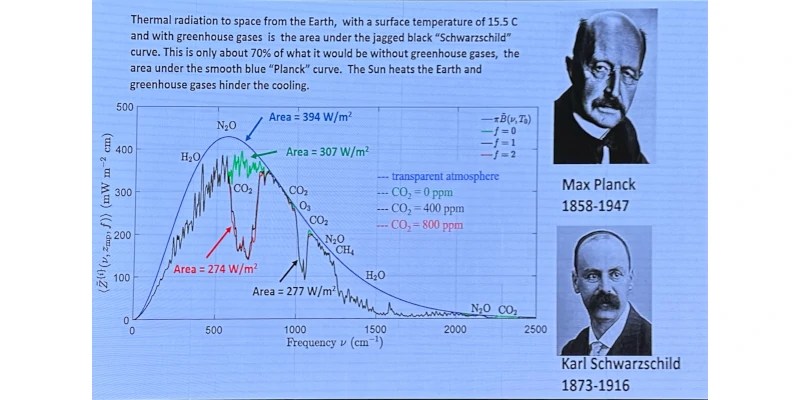
One of Happerโ€™s most powerful slides was this one, which showsย the insignificant impact of doubling CO2 on the level of outgoing radiation.

Take your time looking at the image above, because it took me a few seconds to get it the first time I saw this type of diagram. What the slide is showing is how atmospheric gasses affect thermal radiation escaping the Earth. The blue line is what radiation would be emitted by the Earth at its current temperature if Earth had no atmosphere. The Jagged line underneath the blue line shows the effect of atmospheric gasses partially blocking outgoing radiation at specific frequencies โ€“ the greenhouse effect. The reference to the area in the text, is because the area under the curves shows the total amount of energy escaping into space.

If you look carefully, youโ€™ll see two lines sitting almost on top of each other, a dark brown line and a red line. You canโ€™t really see most of the red line, because the red and dark brown lines are intermingled, they almost sit on top of each other. The brown line is how much radiation is trapped by current CO2 levels (around 400ppm). The almost identical red line is how much radiation would be trapped if CO2 levels were raised to 800ppm.

So what is the impact of raising CO2 to 800ppm, over todayโ€™s value of approx. 400ppm?

The impact of doubling CO2 from 400ppm to 800ppm, according to basic physics, is 0.71C of warming.

How can anyone possibly still think the CO2 greenhouse effect is a problem, after seeing this diagram and calculation?

The reality is almost all the radiation which CO2 can trap, is already being trapped. Adding more CO2 has almost no impact on outgoing atmospheric radiation.

So how do alarmist climate scientists turn this trivial nothing into a global climate panic? How do they turn 0.7C of warming into 3C, 4C, 12C, whatever the latest panic figure is?

According to Dr. Will Happer, they achieve this by adding unphysical, hypothetical positive feedbacks, which amplify the almost non-existent impact of adding additional CO2 to the atmosphere. But there is no proof significant positive feedbacks which amplify the minuscule CO2 effect actually exist.

The rest of Dr. Will Happerโ€™s presentation was just as powerful.

If only we could photocopy this guy, and get him into all the classrooms of the world, the climate panic would disappear overnight. Which is probably why the left worked so hard to cancel him, when Dr. Happer was given a climate science oversight position under President Trump, and served a year on the America First team.

Weโ€™d all love to know what Dr. Happer could have achieved, had he received a little extra time. Letโ€™s hope Dr. Will Happer finds a letter from the White House in his mailbox in early 2024.

A huge thankyou to the Institute of Public Affairs for making the Will Happer speeches happen. And a big shoutout to Raj and Vijay, who over a few beers before the event entertained me with some interesting insights into the murky political games being played in the Aussie state of Victoria and elsewhere, details of which have somehow slipped beneath the radar of Australiaโ€™s mainstream media.

Correction (EW): h/t MarkW โ€“ 400ppm to 800ppm, not 400C to 800C!

Update (EW): h/tย GCย โ€“ย There is no proof significant positive feedbacks which amplify the minuscule CO2 effect actually exist.ย But Will Happer went further than this, he spent a bit of time discussing why there is significant evidence such feedbacks donโ€™t exist โ€“ namely the observed stability of the global climate over geological timescales. Large feedbacks are not compatible with stability.

Update (EW): For more background read Explaining The Physics Of Carbon Dioxide โ€“ Will Happerโ€™s Tour Down Under written by Jennifer Marohasy.

UN climate science now at โ€œGates of Hellโ€ level

The UN is morphing into the New World Eco-Cathedral and the first commandment is โ€œGive Us Your Moneyโ€

From JoNova

By Jo Nova

The UN is morphing into the New World Eco-Cathedral and the first commandment is โ€œGive Us Your Moneyโ€

Antonio Guterres opened the Working Group Chapter on Fire and Brimstone and dug deep:

[AP News] โ€œHumanity has opened the gates to hell,โ€ U.N. Secretary-General Antรณnio Guterres said Wednesday, opening a special climate ambition summit with yet another plea for action. โ€œ Horrendous heat is having horrendous effects. Distraught farmers watching crops carried away by floods. Sweltering temperatures spawning disease. And thousands fleeing in fear as historic fires rage.โ€

In a reversion to the medieval era of microbiology, apparently heat itself spawns disease from the ether. We know heat is the devil itself, the source of all evil, as the IPCC has not found one single good thing that might happen with more hotness.

No one is even pretending this is science anymore, are they?

Once equilibrium climate sensitivity is at the Gates of Hell level, where can it go next? Magma level? And is that better or worse?

United Nations Command Logo

The developed world was put in the naughty corner, and not allowed to speak, so they didnโ€™t turn up, or perhaps it was the other way around.

Those [major emitting] nations remained silent. They werenโ€™t allowed to speak because, organizers said, they had no new actions to take.

Heads of state from China, the United States, India, Russia, the United Kingdom and France all skipped the summit.

The 32 national leaders who did qualify represent only 11% of the worldโ€™s carbon dioxide pollution.

Guterres was apparently performing for a different crowd โ€” whipping up the poor brethren nations to ask God for money, or failing that, the European Commission, or John Kerry which is nearly the same thing.

Guterres called on โ€œmajor emitters โ€” who have benefited most from fossil fuels โ€” to make extra efforts to cut emissions, and on wealthy countries to support emerging economies to do so.โ€ They were silent.

Thereโ€™s some ceremonial ritual at work here, where rich nations are banned from talking then blamed for not saying anything.

Ultimately, the main point of the summit was to feed from the trough:

He called on wealthy nations to fulfill their $100 billion pledges to help poorer countries deal with climate change. The United States is one of the countries that hasnโ€™t done so. The U.N. chief also pushed for countries to spend even more than theyโ€™ve promised and put in money to a โ€œloss and damageโ€ fund agreed upon last year that are sort of payments to help nations harmed by extreme weather from global warming.

There was a call to the promised land:

Africa โ€œcan leapfrog into a fully green industrial paradigm,โ€™โ€™ Kenyan President William Ruto said. โ€œYet we cannot and must not do this on our own.โ€

Little does the Kenyan President know that if Kenya gets there, to the green industrial paradigm, they will be on their own, because no one else has made it. The promised land doesnโ€™t exist. The Green Industrial Paradigm is a the place where modern economies go to die.

Photos from David Neuvere and the EU mixed by Jo Nova, and UN logo by Sshu94