Global warming, climate change, all these things are just a dream come true for politicians. I deal with evidence and not with frightening computer models because the seeker after truth does not put his faith in any consensus. The road to the truth is long and hard, but this is the road we must follow. People who describe the unprecedented comfort and ease of modern life as a climate disaster, in my opinion have no idea what a real problem is.
AT least 64 people were killed and 81 arrested as 2,500 heavily armed police and soldiers stormed Rio de Janeiro’s favelas in the city’s largest-ever anti-gang operation.
Gun battles raged for hours on Tuesday across the Alemão and Penha complexes, the strongholds of the powerful Red Command (Comando Vermelho) gang.
The conflict has left “bodies strewn all over the streets,” according to a community leader quoted by O Globo.
Governor Cláudio Castro said the city was “at war,” calling it “the biggest operation in the history of Rio de Janeiro.”
Rio De Janeiro is around 1300 miles from Belém, the city which is hosting COP30 in just over a week. Nevertheless, with open gun battles in the streets of Rio, the Comando Vermelho narco terrorists might see COP30 as a golden opportunity to grab some high value hostages to leverage Rio de Janeiro authorities into backing down, or to force the release of arrested gang leaders.
Comando Vermelho have a long track record of hijacking and kidnapping for ransom, in addition to being significant regional narco traffickers.
Between the risk of attack from powerful narco terrorist kidnappers, deadly street battles in one of Brazil’s premier cities, an accommodation crisis and a local risk of Typhoid fever, and a large contingent of wealthy celebrities who are keen to show they care, who knows, this could end up being the most interesting COP yet.
Lenin’s aphorism — “there are decades when nothing happens, and weeks when decades happen” — has seldom felt more apt. Since the Trump-Putin summit in Alaska three months ago, global energy geopolitics has convulsed in a series of dizzying turns that have left analysts and investors alike struggling to keep pace. The meeting that was hailed as a bold attempt to initiate peace in Europe, ‘reset’ US-Russia relations and stabilise energy markets has instead opened a Pandora’s box of further US sanctions on Russia and recriminations of Putin by Trump.
Lenin’s aphorism — “there are decades when nothing happens, and weeks when decades happen” — has seldom felt more apt. Since the Trump-Putin summit in Alaska three months ago, global energy geopolitics has convulsed in a series of dizzying turns that have left analysts and investors alike struggling to keep pace. The meeting that was hailed as a bold attempt to initiate peace in Europe, ‘reset’ US-Russia relations and stabilise energy markets has instead opened a Pandora’s box of further US sanctions on Russia and recriminations of Putin by Trump.
After raising hopes of possible peace for Ukraine when President Trump announced that he would soon be meeting his Russian counterpart President Vladimir Putin in Budapest, he then announced just a few days later that work on a second summit had halted. The abrupt cancellation of the proposed Budapest meeting suggests that US-Russia diplomacy has collapsed for the foreseeable future. Instead, the US seems to have adopted the maximalist demands of its European allies and is once again calling for immediate unconditional ceasefire. The US-Russia confrontational temperature was raised another notch by the ramping up of US sanctions on Russia that went well beyond what the previous Biden administration had invoked.
The Alaska Gambit
At the Alaska summit, Donald Trump and Vladimir Putin struck what appeared to be a pragmatic understanding. Trump, reverting to his businessman instincts, signalled that Washington would support negotiations to end the Ukraine conflict on terms acknowledging battlefield realities. This meant, in plain language, that Kyiv would have to cede territory to Moscow and remain a non-NATO neutral country. The “unconditional ceasefire” demanded by European leaders and the Biden-era foreign-policy establishment was, Trump argued, “unrealistic given the battlefield situation” and hinted at land-swap ideas as the way forward to a negotiated peace.
Putin, for his part, floated the prospect of joint US-Russian ventures to explore the immense oil and gas reserves of Russia’s Arctic. The Wall Street Journalreported that senior ExxonMobil executives were in secret talks with Rosneft to return to the massive Sakhalin project – a joint venture which was abandoned after Russia’s invasion in 2022 – after having been given the green light by US authorities as part of the Ukraine peace process. President Putin also offered US businesses an opportunity to launch joint ventures to exploit Russia’s vast reserves of critical minerals and rare earth metals.
For a moment, the global energy markets exhaled. Oil prices softened a little in the immediate aftermath of the Trump-Putin Alaska summit on August 15th 2025, with Brent crude and WTI futures declining by 1-2% over the following day or two. This dip was attributed in part to optimistic signals about potential US-Russia energy collaborations, including joint ventures in the Arctic. The mood was one of cautious optimism — until it wasn’t.
From Alaska to Budapest — and Back to Sanctions
Within weeks, Washington’s mood soured. Reports emerged of new Russian offensives near Pokrov, with Western media framing them as proof that Putin had used the Alaska talks as a smokescreen. Russia hawks in the Trump administration – Secretary of State and (acting) National Security Advisor Marco Rubio and Special Envoy Keith Kellogg and Republican congressmen such as Senator Lindsey Graham – seemed to have little time for negotiations on terms outlined in the Alaska summit.
The White House leaked plans to supply Kyiv with Tomahawk nuclear-capable cruise missiles, a move possibly designed to placate the hawks in Washington DC and Brussels but guaranteed to provoke Moscow. Predictably, Putin said that it would constitute a severe escalation requiring direct participation of US military personnel — implying it would cross a red line akin to direct aggression.
In response, Trump, in a characteristic burst of frustration, told reporters he was “disappointed” with Putin and was “re-evaluating” the entire diplomatic process. Then came the Budapest debacle. Trump cancelled what was to have been a follow-up summit — one he had personally proposed just a few days before — and, in a twist of theatrical self-contradiction, imposed sweeping new sanctions on Russia’s two major oil producers, Rosneft and Lukoil. According to Bloomberg, it was Rubio who finally convinced President Trump to take “ownership” of the US proxy war on Russia and place the sanctions on Russia’s oil companies. Henceforth, President Trump can no longer call it “Biden’s war” with any shred of credibility.
Treasury Secretary Scott Bessent said that: “Given President Putin’s refusal to end this senseless war, Treasury is sanctioning Russia’s two largest oil companies that fund the Kremlin’s war machine. We encourage our allies to join us in and adhere to these sanctions.” It was as if the Alaska summit which had initially signalled a tentative meeting of minds between Trump and Putin to step away from the maximalist position of ‘immediate unconditional ceasefire’ – pushed by Ukraine’s Zelensky and Brussels – was scrubbed from memory. The same administration that had, only weeks earlier, promised a new era of pragmatic engagement had reignited the sanctions war with a vengeance.
From the Kremlin point of view, this was a familiar pattern: Western flirtation followed by betrayal, as in the affair over the Minsk accords which Angela Merkel later admitted was a ruse to buy time for Ukraine to be armed by NATO. For the rest of the world — particularly the Global South — it was confirmation that the so-called ‘rules-based order’ had become a synonym for Western hypocrisy and chaos in global energy markets.
Rosneft is Russia’s largest oil company by production (40% of national output), followed by Lukoil (15-20%). Together they account for a significant 5% of global output. At the limit, using broad estimates of demand elasticity for oil, a complete stop to oil production by the two companies would lead to a price shock of 25- 30% in the short run. Brent at around $65 per barrel currently would jump up to $80-$85, a major shock. In the event, markets reacted to the US sanctions with initial jitters but quickly stabilised, as traders anticipated ‘workarounds’.
The continued use of Russia’s so-called ‘shadow fleet’ (i.e., those vessels not insured by Lloyds of London) and use of non-dollar settlements by Indian and Chinese oil companies working via proxies has evidently obviated the EU’s 19 sanctions packages over the past three years, resulting in relatively limited impact on the Russian economy or its energy exports. A full cessation of oil exports by Russia’s two major oil companies is unlikely and ‘limited flows’ via non-direct channels will persist, balancing energy security with compliance risks.
Europe’s Moral Grandstanding — and Energy Suicide
While Washington swung from conciliation to confrontation with Russia, Brussels marched steadfastly towards self-harm as it has over the past two decades in pursuit of its delusions of eco-socialism. While US big tech firms are looking at reviving dormant nuclear units at Three Mile Island and elsewhere in the country for their datacentre needs, Germany’s green-obsessed government is imploding mothballed nuclear plants to ensure that they can never be revived. On October 25th, two cooling towers at the former Gundremmingen nuclear power plant in Bavaria were demolished, almost four years after the last reactor was shut down.
With electricity prices at triple the US level and the highest in Europe, Germany’s de-industrialisation is gathering terminal velocity. Following essentially zero GDP growth since 2018, corporate bankruptcies in Germany have reached their highest level in a decade, with 11,900 insolvencies recorded in the first half of 2025, a 9.4% increase compared to the same period in 2024.
Europe’s economic powerhouse now has automakers – one of its core sectors – on their knees. Its most iconic car manufacturers are collapsing. Porsche’s operating profit has dropped by 99% in 2025, falling from approximately €4 billion to just €40 million. Its parent company, Volkswagen AG, has no money to produce new car models due to cash flow problems and a shortfall of €11 billion for next year. By August 2025, Germany’s industrial production was over a fifth smaller than the trend over 1997-2017 would have predicted.
Germany’s latest public embarrassment, and a sign of its increasing geopolitical irrelevance, was paraded when German Foreign Minister Johann Wadephul on Friday postponed an imminent diplomatic trip to China, over “a dearth of meetings” on his schedule. China is now Germany’s largest trading partner. In plain English, the Chinese said, ‘don’t bother coming’, after being subject to hectoring by bumptious German leaders on the Taiwan issue, economic relations with Russia and other matters such as China’s ‘blocking of semiconductor shipments to Europe’. In August, Wadephul had proclaimed that China was providing “crucial” support to Russia, enabling President Vladimir Putin’s ongoing war against Ukraine.
Yet another arrow in Europe’s moral quiver concerns ‘corporate social responsibility’ or ESG. The European Commission’s latest proposal for corporate-responsibility codes contained in its Corporate Sustainability Due Diligence Directive would require all firms operating in the EU to document the “human-rights” and “climate-impact” credentials of their entire global supply chains. In practice, this meant that energy companies would have to disclose not just emissions data but political affiliations and labour practices across multiple jurisdictions.
The reaction from producers was swift and scathing. In an extraordinary joint communiqué issued last week, the US Department of Energy and Qatar’s Energy Ministry warned that they could “reconsider LNG supply commitments” if the EU persisted with its intrusive regulatory regime. The world’s two largest natural gas producers were on the same page — defending the sanctity of commerce against Brussels’s moral imperialism.
Yet the EU seems determined to press on. European Commission President Ursula von der Leyen, invoking the “strategic autonomy” mantra, has pledged to end all dependence on Russian oil and gas by end 2027 — a goal that is as unlikely as it is self-defeating. Despite 19 rounds of sanctions and a significant decline in trade volumes since 2022, the bloc remained Russia’s third-largest trading partner in 2024, after China and India.
Even sympathetic observers now admit that Europe’s decarbonisation zeal has outpaced its economic common sense. The ‘Green Deal’, conceived in the salons of Brussels, is meeting the cold reality of physics and finance. Energy cannot be legislated into existence; it must be produced, transported and consumed — and for that, hydrocarbons, the substrate of civilisation, remain indispensable.
The BRICS Counter
While the Atlantic powers engage in the escalation of war rhetoric against Russia à la Zbigniew Brzeziński’s “grand chessboard” of American primacy and its geostrategic imperatives, the rest of the world is starting to decouple from the Western alliance. Russia, China and India have accelerated their energy integration, trading crude and LNG in yuan, rupees and dirhams rather than dollars. BRICS nations have been discussing a basket-based settlement currency to bypass the Western financial system since 2022, having witnessed the total economic war that the Western alliance had unleashed on Moscow including the freezing of its foreign exchange assets worth over $300 billion. For Russia, this is both necessity and opportunity: sanctions and the seizing of its financial assets in Western capitals have forced deep import substitution, re-direction of trade flows and innovation. With the shift to multipolarity, the de-dollarisation trend has gained momentum.
India’s Energy Minister, Hardeep Puri, recently dismissed Washington’s threat of secondary sanctions as “coercive unilateralism”. New Delhi continues to buy discounted Russian oil, refine it and re-export the products — often to the same European markets that claim to boycott Russia. With the latest US sanctions, however, Indian refiners are adjusting their volumes of Russian purchases to avoid the risk of retribution by US authorities.
Beijing, meanwhile, has become Moscow’s indispensable partner. Bilateral trade is now dominated by energy and technology exchanges settled in yuan. When asked to comment on the Trump administration’s move to impose sanctions on two major Russian oil companies, Chinese Foreign Ministry spokesperson Guo Jiakun said on Thursday that China opposes unilateral sanctions, which lack a basis in international law and UN Security Council authorisation. There is no credible scenario where China kowtows to imperious American demands on the shape of its political and economic relations with Russia.
This Eurasian realignment underscores the central paradox of Western sanctions: the more they are deployed, the less effective they become, as warned by Gita Gopinath, the IMF’s Chief Economist. Each new sanctions package merely accelerates the fragmentation of the global economy into competing blocs and chips away at US dollar dominance. What was once a unipolar system anchored by the Bretton Woods system, the dollar and NATO is morphing into a multipolar order driven by resource pragmatism and regional resilience.
For President Donald Trump, the consequences are immediate and personal. With mid-term congressional elections looming, rising fuel prices could prove politically fatal. American motorists are unforgiving: $5 gasoline at the pump has sunk Presidencies before. Trump’s own base — the working-class voters who rallied to his promise of “energy dominance” and no more “forever wars” — now watch in dismay as the administration’s erratic sanctions and mixed signals destabilise markets and risk escalating wars.
The irony is stark. By sanctioning Russian oil companies and flirting with punitive tariffs on Chinese imports, President Trump risks replicating the inflationary spiral that he blamed his predecessor for. The Federal Reserve can do little to offset supply shocks driven by geopolitics. A tightening of global oil supply by US sanctions, compounded by Europe’s moralistic policies and OPEC’s cautious output stance, could send prices soaring into the 2026 election season.
The Long Arc of Energy Realpolitik
The events since the Alaska summit encapsulate the contradictions that have enveloped President Trump’s nine months in power in his second term. European and UK leaders insist on their moral posturing, unable to reconcile their rhetoric of ‘climate justice’ with the material realities of industrial civilisation. Simultaneously, they claim the imperative to ‘defeat’ Russia. Trump’s instinct to pursue pragmatic engagement with Russia was sound in principle — economic and energy cooperation is the surest path to peace — but his execution was undone by domestic politics and war hawks in his own administration as well as by US allies in Europe (with significant exceptions like Hungary and Slovakia which refuse to dance to Brussels’s globalist tune).
President Putin plays the long game. He knows that Europe’s pledge to wean itself off Russian energy has boomeranged on its executioners. Geography and thermodynamics are on his side. Even if Brussels cuts direct imports, Russian molecules in a fungible trade will continue to flow through intermediaries — refined, rebranded, relabelled but ultimately Russian.
As the proposed Budapest summit collapsed in recrimination and sanctions tighten once more, the world confronts a hard truth: there can be no stable global energy order without cooperation among its major producers. Trump’s Alaska initiative, for all its flaws, at least recognised this. His subsequent retreat — under pressure from Washington’s hawkish foreign-policy establishment and Brussels— marks yet another missed opportunity to bridge the East-West divide through shared material interests.
Europe’s bureaucrats, meanwhile, continue to legislate against physics, demanding energy without emissions and growth without natural resources. The result is predictable: industrial decline, political unrest, establishment attacks on increasingly popular ‘far Right’ conservative opposition parties and a steady erosion of global influence. For those who still believe that the West can dictate the terms of global energy exchanges, the past three months offer a stark reminder. The world has changed; in a multipolar world, power now resides where the resources are and what battlefield realities determine, not where the moralistic lectures come from.
Lenin’s decades have indeed happened in months if not weeks — and unless Western leaders rediscover the virtues of realism over rhetoric, of realpolitik over hypocritical moralism, the next few weeks and months may bring decades more of continued Western decline.
Dr Tilak K. Doshi is the Daily Sceptic‘s Energy Editor. He is an economist, a member of the CO2 Coalition and a former contributor to Forbes. Follow him on Substack and X.
Alex Epstein reports regarding Bill Gates latest statement downplaying climate doomsterism, and reminds us that he hasn’t changed his mind so much as he is now able to speak freely. For example, watch this short video of Bill Gates in 2019.
Joining us now to continue this conversation is the founder of Center for Industrial Progress, it’s Alex Epstein. Alex, great to see you here today.
I think that, first of all, we should celebrate that Bill Gates has seen the light, has now understood the truth, but that does lead to the question: Why?
Alex Epstein:
It’s a good question, and actually I don’t think Bill’s views have changed much.
I think he’s held the view that he’s saying now, and I think he’s even less of a climate catastrophist and anti-fossil fuel person than he’s letting on now. I think what’s changed—and this is good news—is the cultural, economic, and political environment.
And in particular what we see are, one, the rise of AI and people recognizing that you’re going to need more fossil fuels to provide the reliable electricity—key: reliable electricity—that AI requires.
Number two, you’ve got a government right now that is pro-fossil fuel and very anti-climate catastrophist.
And number three, to the extent I and some others can take credit, I think we’ve advanced the pro-fossil fuel argument that shows that, hey, we do have impact on climate, but the net effect of fossil fuel use is incredibly positive, including on the livability of climate, or safety from climate.
I think those three factors have created an environment where Bill Gates—who I admire in many ways, but is a very calculating guy—where he feels like it’s in his interest to tell more of the truth about this issue than he has in recent years.
Will Cain:
All right, let’s take your three potential explanations for the change of heart for Bill Gates.
Let’s set aside your personal advocacy and persuasion, which I find compelling. And it’s not just you alone, Alex. It’s really most of the thoughtful scientists and thinkers through the last several hundred years have understood the power of fossil fuels and economic growth in helping the vast majority of people across the world.
Maybe that finally broke through to Bill Gates. Maybe he just sees the writing on the wall and understands what’s happening in modern America under President Donald Trump.
But the first is quite interesting: AI and the rise of AI. Does Gates not have significant investment in AI?
Alex Epstein:
Well, he obviously has investments. I mean, every major tech company is taking into account AI, I think validly, whether their current investment level is right or not. It’s key to their future.
But it’s not even that it’s just of interest to his company, although that’s surely a factor. He thinks it’s a big interest to humanity.
But most importantly, all these things, it’s more okay to talk about it. We already knew that the world needed way more energy, but now it’s okay to talk about it.
That’s why all these tech companies who made net zero pledges are suddenly saying, “No, we don’t need net zero”. Nothing changed really in the information environment, but the cultural environment did change.
Will Cain:
Well, I guess I’m just a little skeptical on the sincerity today and yesterday, and when I notice he can mingle his own personal net worth and benefit with that of what is best for humanity.
And if he convinces himself that AI is what’s best for humanity, and AI needs energy to grow, and therefore AI needs fossil fuels, he can convince himself that using fossil fuels is what’s best for humanity. And I think that is a little more in line with what I would suspect to be the motivation of Bill Gates.
Alex Epstein:
It’s definitely true with the broader tech industry. Again, they made “net zero” commitments just a few years ago when Biden was president, when everyone was on to ESG, and then suddenly their views changed and they never really acknowledged it.
Now I’m grateful, guys. Welcome to the party. I’m glad Zuckerberg is here. I’m glad Bezos is here. I’m glad Gates is here. These are people I admire a lot in many ways. I’m glad they’re changing their views.
But maybe stick to the truth this time instead of being so opportunistic and not really explaining how one day you’re “net zero” and then when it conflicts with your business interests, then you’re suddenly, “hey, yeah, let’s use more fossil fuels, we need it for AI”.
I thought you were worried about a climate catastrophe. It turns out there was never a climate catastrophe.
Will Cain:
I’m glad they’re here too, Alex. I just wouldn’t issue them permanent membership yet in the Club of Truth. Alex Epstein, it’s great to have you here on the show today.
In Episode #180 of The Climate Realism Show, hosts Anthony Watts, Linnea Lueken, and Jim Lakely break down what Gates’ reversal means for climate policy, science, and the green tech industry. They also cover the Crazy Climate News of the Week, including a new study showing wind turbines are even worse for birds than previously believed, claims that climate change is to blame for higher Halloween candy prices, and why attributing the intensity of Hurricane Melissa to global warming is misguided.
After years of funding and fueling climate panic, Bill Gates has done an about-face. In a new 17-page memo released ahead of COP-30 in Brazil, Gates admits that rising temperatures will “not lead to humanity’s demise” and urges the climate community to drop its “doomsday outlook.” This marks a stunning shift for one of the world’s most prominent climate influencers and could signal a long-overdue return to honest, fact-based climate discussion.
In Episode #180 of The Climate Realism Show, hosts Anthony Watts, Linnea Lueken, and Jim Lakely break down what Gates’ reversal means for climate policy, science, and the green tech industry. They also cover the Crazy Climate News of the Week, including a new study showing wind turbines are even worse for birds than previously believed, claims that climate change is to blame for higher Halloween candy prices, and why attributing the intensity of Hurricane Melissa to global warming is misguided.
In a widely published Associated Press (AP) article, “Climate change fuels Hurricane Melissa’s rapid intensification to Category 5,” reporter Sibi Arasu claims that “the warming of the world’s oceans caused by climate change helped double Hurricane Melissa’s wind speed in less than 24 hours.” This is highly misleading if not outright false. Scientific data refute claims that climate change is causing more severe or frequent hurricanes.
In a widely published Associated Press (AP) article, “Climate change fuels Hurricane Melissa’s rapid intensification to Category 5,” reporter Sibi Arasu claims that “the warming of the world’s oceans caused by climate change helped double Hurricane Melissa’s wind speed in less than 24 hours.” This is highly misleading if not outright false. Scientific data refute claims that climate change is causing more severe or frequent hurricanes.
The story cites the climate advocacy group Climate Central, which claims that climate change is making hurricanes “more likely to intensify quickly, especially near coastlines.” While it is true that warm water fuels hurricanes—meteorologists have known that for more than a century—long-term climate change cannot be blamed for the specifics of a single storm.
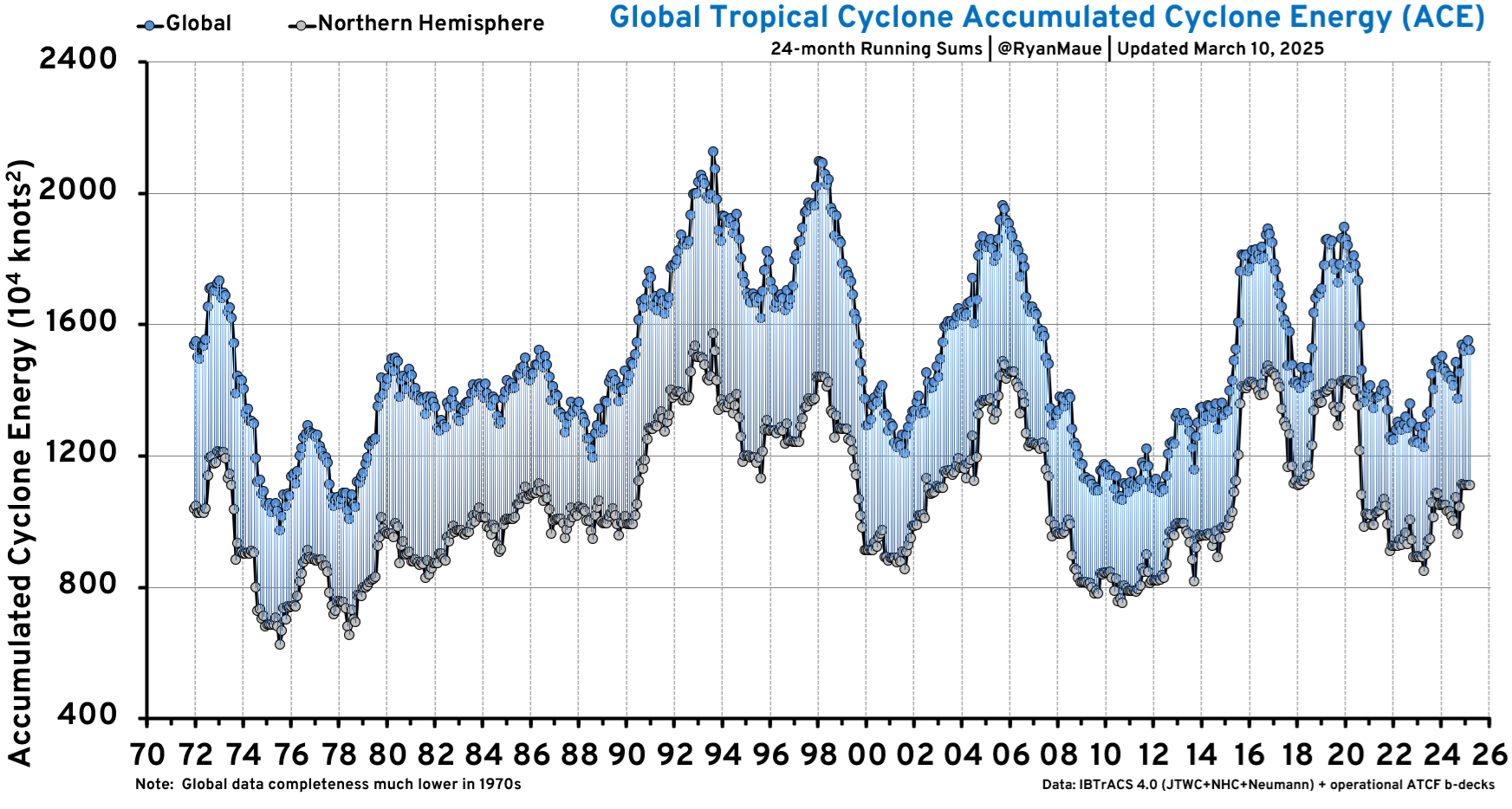
Contrary to what the AP says, as Climate at a Glance: Hurricanes explains, there has been no increase in the frequency or intensity of hurricanes over the past century, even as carbon dioxide concentrations have risen. For example, Figure 1 below shows the Accumulated Cyclone Energy, a measure of intensity, over more than 50 years, and there is no increase.
Figure 1: Last 50-years+ of Global and Northern Hemisphere Accumulated Cyclone Energy: 24 month running sums. Note that the year indicated represents the value of ACE through the previous 24-months for the Northern Hemisphere (bottom line/gray boxes) and the entire global (top line/blue boxes). The area in between represents the Southern Hemisphere total ACE. Source: Ryan N. Maue, “Global Tropical Cyclone Activity,” Climate Atlas, https://climatlas.com/tropical/global_running_ace.png
The National Oceanic and Atmospheric Administration’s Historical Hurricane Tracks database shows that hurricane activity fluctuates naturally, with the 1940s through 1960s being among the most active periods on record—long before modern fossil fuel emissions were significant.
Even the Intergovernmental Panel on Climate Change (IPCC) acknowledges that there is “low confidence in any long-term trends in hurricane activity.” The IPCC’s Sixth Assessment Report found no detectable increase in either global tropical cyclone frequency or landfall intensity. See the table below from the IPCC report and note the highlighted section on tropical cyclones:
Figure 2. Table 12.12 from Page 90 – Chapter 12 of the UN IPCC Sixth Assessment Report. Emergence of Climate Impact Drivers (CIDs) in time periods. The color corresponds to the confidence of the region with the highest confidence: white colors indicate where evidence of a climate change signal is lacking or the signal is not present, leading to overall low confidence of an emerging signal. See the key at the bottom for the meaning of all colors.
In plain English, data show the number of hurricanes are not increasing, nor are they demonstrably stronger.
Hurricanes need a lot more than just warm ocean water to form. Atmospheric conditions—such as vertical wind shear, mid-level humidity, the difference between air and water temperatures, and steering patterns—determine whether a storm strengthens or weakens. These are chaotic, short-term variables, not predictable climate trends. Also, there is no evidence that climate change impacts any of those other variables. Hurricane Melissa’s rapid intensification was a weather event, not evidence of a new climate regime.
The AP’s article claims that “Atlantic hurricanes are now more than twice as likely to intensify rapidly from minor storms to powerful and catastrophic events,” referencing a Scientific Reports paper. This statistic, when scrutinized, is questionable because it relies on satellite-era observations that began only in the 1970s. Earlier storm intensification rates were harder to measure, making today’s apparent “increase” partly a result of better weather detection technology such as satellites, radar, and continuous monitoring. The statistic also doesn’t account for other factors that impact water temperatures, like El Nino events that warm waters, and reductions in ship emissions that research suggests has contributed to hotter measured ocean temperatures.
The AP uncritically quotes a Climate Central meteorologist who says, “[w]e can’t stop hurricanes, but we can reduce the risk by cutting emissions.” That statement has no basis in science—it’s advocacy. Reducing CO₂ will not meaningfully change hurricane formation in the Atlantic, where natural cycles like the Atlantic Multidecadal Oscillation (AMO) play a far greater role in modulating storm activity.
The fact that Hurricane Melissa reached Category 5 intensity hardly makes it unique. Historical records show similar or stronger storms in the past—such as the 1935 Labor Day Hurricane, which struck the Florida Keys with estimated winds of 185 mph. That storm occurred during a much cooler global climate period, which disproves both the idea that powerful hurricanes are a modern phenomenon and that they are caused by global warming.
The AP also ignores the fact that surface temperatures in the tropical Atlantic naturally vary by several degrees Celsius over multidecadal cycles. The recent warming period that fueled Melissa is part of a recurring oceanic pattern, not proof of an unprecedented climate trend driving hurricane intensity.
The article concludes by invoking moral urgency—quoting island-nation negotiators who say storms like Melissa “make it more urgent for countries to act on climate change.” But this is emotional rhetoric, not evidence. Hurricanes have battered the Caribbean for millennia. The only thing “unprecedented” is how newsrooms now attribute every storm to climate change while ignoring the long, cyclical record of similar events.
In short, the AP story is a red herring. Warm water helps hurricanes, but that has always been true. There’s no credible long-term evidence of more frequent or intense storms, and no justification for tying one hurricane to global climate change. The data say otherwise.
By turning a single weather event into a climate morality tale, The Associated Press misleads its readers and betrays journalistic objectivity. Hurricanes, even powerful hurricanes like Melissa are meteorology, not ideology. It is long past time for reporters to acknowledge the difference.
Anthony Watts is a senior fellow for environment and climate at The Heartland Institute. Watts has been in the weather business both in front of, and behind the camera as an on-air television meteorologist since 1978 and currently does daily radio forecasts. He has created weather graphics presentation systems for television, specialized weather instrumentation, as well as co-authored peer-reviewed papers on climate issues. He operates the most viewed website in the world on climate, the award-winning website wattsupwiththat.com.
OpenAI wants the Trump administration to build 100 gigawatts of additional electricity generation capacity per annum to avoid the US being overtaken by China in the AI arms race.
The highly-valued generative AI biz says electricity is “a strategic asset” critical to building the AI infrastructure that will secure US leadership on “the most consequential technology since electricity itself.”
However, China is outstripping America in constructing new capacity, adding 429 GW in 2024 compared with just 51 GW achieved by the land of the free.
…
“We believe the Trump Administration should work with the private sector on an ambitious national project to build 100 gigawatts a year of new energy capacity,” OpenAI says.
…
In related news, Google signed a deal with NextEra Energy to restart Iowa’s Duane Arnold Energy Center, the state’s only nuclear plant. Once operational — expected in early 2029 — Google will purchase power from the 615 MW facility as a carbon-free energy source for its cloud and AI infrastructure. The company says the move may also strengthen local grid reliability.
This is nothing short of a Silicon Valley capitulation to the MAGA agenda. To save their skins, big tech traded their climate virtue for continued global relevance.
The remnants of their former green allegiance are still showing through, for now at least they are restarting old nuclear plants when they can, and flinging money at speculative nuclear fusion startups, rather than focusing all their resources on coal and gas. But fusion is still decades away, and they are running out of old nuclear plants to recommission.
One thing is clear, we are now in a new winner takes all AI cold war with China, with battle fronts in commerce, industry, political influence and military technology. The AI Military Industrial Complex is rapidly dominating the global agenda. The green movement is finished, along with any political party or group which promotes green virtue over easy access to cheap energy.
For years big tech social media gatekeepers punished conservatives and climate skeptics and did their best to bury any narrative which undermined radical left wing causes like climate action, but for now that situation is reversed. Big tech needs us to secure their affordable energy supply lines. I can’t imagine big tech search and social media allowing the rise of any narrative which impedes their dash for energy, which they desperately need to fend off Asian AI rivals.
It seems we get a storm or flood of the century nearly every year!
Melissa may well be the most powerful hurricane to hit Jamaica in recent times. But is this significant in itself?
Jamaica is a relatively tiny speck in the Caribbean. Hurricanes barrel across the Caribbean every year. What are the odds of a Cat 5 one making a direct hit on Jamaica? Most would just bypass the island.
So, let’s take a dispassionate look at the facts.
First, and most importantly of all, the death toll in Jamaica at the moment stands at four. This will likely increase over the next few days but is a remarkably low number at this stage.
Secondly, there is no evidence at all that Melissa made landfall with winds of 185 mph, something which has been widely reported across the media as fact. Let me repeat – NO EVIDENCE AT ALL.
Let me explain.
The claim is derived from wind speeds estimated from hurricane hunter aircraft data sometime prior to 11.00 AM EDT. Sustained winds were calculated at 160 kts, or 184 mph.
The previous advisory was six hours earlier, so the aircraft data would have been collected sometime during that six-hour period.
Melissa made landfall at 1.00 PM, at least two hours after the aircraft data had been collected, when Melissa would still have been maybe 50 miles or more out at sea. However, there were no further measurements during that time, or at landfall itself. Therefore, the figure of 185 mph was retained as the official “landfall speed”:
Hurricanes invariably weaken as they near land, because the sea becomes shallower and the coastline interferes with atmospheric airflow.
The satellite data confirms this weakening, and shows that even before landfall winds were lower than claimed at 155 kts, 178 mph.
What the windspeeds actually were at landfall, we simply do not know. Nobody measured them. This may sound like I am splitting hairs, but this is, of course, precisely the situation we would have been in prior to the satellite/hurricane hunter era began forty years or so ago. That is why we simply cannot directly compare today’s hurricanes with those of the past.
To put windspeeds into perspective, the highest sustained speed recorded was from Hurricane Allen in 1980, which measured 190 mph.
How does Melissa match up historically? I recently came across this NOAA study from 1983, long before hurricanes were looked at through the lens of global warming.
Was Melissa any worse than Galveston? Or Okechobee? Or the Great Miami hurricane which wiped out Miami in 1926.
Or the strongest US hurricane of the lot, the Labor Day storm in 1935? Or the second most powerful, Camille in 1969?
These, of course, are purely US hurricanes. Many more more wreaked havoc across the Caribbean and elsewhere. The worst of all was the Great Hurricane of 1780, which is estimated to killed 27500 dead in Martinique, Barbados and elsewhere. This is an astonishing number by any account. Winds have since been estimated at over 200 mph.
A closer look at Camille exemplifies well just how observation methods have changed over the years.
In 1969, satellite technology was pretty much useless as far as monitoring hurricanes were concerned, other than for tracking purposes. Hurricane hunter aircraft tended to be pot luck as well, unable to fly inside hurricanes for hours on end in order to find the peak winds, which they routinely do nowadays.
The official report stated that hurricane hunters had estimated sustained winds of 190 mph, based on dropsonde data. But this was ten hours before landfall and no further flights were made.
The official data for Camille states that winds at landfall were 175 mph. These were derived from two land based recordings of barometric pressure, both of which were close to the eyewall and both instruments were inspected later and confirmed as reliable.
Comparing Camille and Melissa then is comparing chalk and cheese. Wind speeds for the former are accurate at landfall but Melissa’s are not at landfall at all but 50 or so miles out at sea, when they would have been higher.
Whatever the wind speeds were, there can be mistaking the devastation wrought in August 1969, as the before and after photos of the Richelieu Apartment block show:
Let me be clear. I am not in any way trying to minimise how powerful and damaging Melissa was. It was a terrible storm and a historic one.
But it is a sad fact of life that hurricanes like Melissa have always brought death and destruction to the Caribbean, Gulf and Atlantic coasts of America, and they always will.
Always wrong but never in doubt. Welcome to the-end-is-always-near world of Paul R. Ehrlich, where humans are the problem–or at least everyone that does not see what the neo-Malthusians warn against. The land of the living dead–something to think about this Halloween.
Always wrong but never in doubt. Welcome to the-end-is-always-near world of Paul R. Ehrlich, where humans are the problem–or at least everyone that does not see what the neo-Malthusians warn against. The land of the living dead–something to think about this Halloween.
“Fifty years after the publication of his controversial book The Population Bomb, biologist Paul Ehrlich warns overpopulation and overconsumption are driving us over the edge,” the subtitle of Damian Carrington article states. She continues:
A shattering collapse of civilisation is a “near certainty” in the next few decades due to humanity’s continuing destruction of the natural world that sustains all life on Earth, according to biologist Prof Paul Ehrlich.
But Ehrlich remains as outspoken as ever. The world’s optimum population is less than two billion people – 5.6 billion fewer than on the planet today, he argues, and there is an increasing toxification of the entire planet by synthetic chemicals that may be more dangerous to people and wildlife than climate change….
The Population Bomb, written with his wife Anne Ehrlich in 1968, predicted “hundreds of millions of people are going to starve to death” in the 1970s – a fate that was avoided by the green revolution in intensive agriculture.
Ehrich admits his errors (Julian Simon creamed him decades ago on the facts and theory explaining the facts). Continues Carrington:
Many details and timings of events were wrong, Paul Ehrlich acknowledges today, but he says the book was correct overall. “Population growth, along with over-consumption per capita, is driving civilisation over the edge: billions of people are now hungry or micronutrient malnourished, and climate disruption is killing people.”….
“It is a near certainty in the next few decades, and the risk is increasing continually as long as perpetual growth of the human enterprise remains the goal of economic and political systems,” he says. “As I’ve said many times, ‘perpetual growth is the creed of the cancer cell’.”
“Sustainable” population is his goal. [Ehrlich] estimates an optimum global population size at roughly 1.5 to two billion, “But the longer humanity pursues business as usual, the smaller the sustainable society is likely to prove to be. We’re continuously harvesting the low-hanging fruit, for example by driving fisheries stocks to extinction.”
Carrington quotes Ehrlich:
No scientist would hold exactly the same views after a half century of further experience, but Anne and I are still proud of our book…. Its weaknesses were not enough on overconsumption and equity issues. It needed more on women’s rights, and explicit countering of racism – which I’ve spent much of my career and activism trying to counter. Too many rich people in the world is a major threat to the human future, and cultural and genetic diversity are great human resources.
Dr. Wrong. The Population Bomb is the stuff of jokes as obesity has overtaken famine in the developed (non-statist) world–thanks to more, not less, people. Game, set, and match to Paul Ehlich’s intellectual foe, Julian Simon.
The Department of Energy has asked the Federal Energy Regulatory Commission to federalize and streamline the connection of large data centers to the interstate transmission grid. DOE last week (Oct. 23) sent FERC a 16-page draft notice of proposed rule making, asking the commission to enact the new, unprecedented rule by the end of April, which is unlikely.
“Ideas have consequences. Even new pathbreaking ones that are shaking the foundations of the Federal Power Act of 1935 and state public utility regulation.”
The Department of Energy has asked the Federal Energy Regulatory Commission to federalize and streamline the connection of large data centers to the interstate transmission grid. DOE last week (Oct. 23) sent FERC a 16-page draft notice of proposed rule making, asking the commission to enact the new, unprecedented rule by the end of April, which is unlikely.
Under the DOE proposal, FERC would take over interconnection decisions for “large load” data centers, defined as those with a load of 20 MW or greater. These decisions are now made by regional transmission organizations, such as the PJM Interconnection, or by state regulatory agencies.
The DOE proposed rule states:
In light of the unprecedented current and expected growth of large loads seeking to interconnect to the transmission system, and to provide open access and non discriminatory access to the transmission system, it has become necessary to standardize interconnection procedures and agreements for such loads, including those seeking to share a point of interconnection with new or existing generation facilities (hybrid facilities).
In a cover letter, Energy Secretary Chris Wright linked his plan for FERC to make the interconnections to the Trump administration’s ambitions for artificial intelligence. Wright wrote, “This Administration is committed to revitalizing domestic manufacturing/ and driving American AI innovation, both of which will require unprecedented and extraordinary quantities of electricity and substantial investment in the Nation’s interstate transmission system.”
Reactions
DOE’s action quickly generated some head-scratching and skepticism as well as qualified and sometimes lukewarm support. Mark Christie, former FERC member and chairman until last summer — when the White House nominated former FERC staffer Laura Swett to the commission with the intent to name her chairman (which occurred on Oct. 23, the same day as the Wright plan) — posted an analysis of the DOE data center proposal on Linkedin.
Christie, who now heads the new Center for Energy Law and Policy at the William and Mary Law School, commenting that “the evil is always in the details,” raised three “core questions” about the Wright proposal:
“1. Will reliable power service be threatened by FERC-mandated interconnection of large load customers without sufficient generation capacity available to the grid operator?”
“2. Will residential and other customers be forced to bear the costs of FERC-mandated large-load interconnections?”
“3. Does this proposal represent an unprecedented expansion of federal control and intrusion on the states’ historic retail regulatory authority?”
Christie’s final advice on the proposed rule: “Stay tuned.”
On Twitter, Travis Kavulla, independent power producer NRG’s regulatory guru and former Montana utility regulator, commented, “Utilities will oppose this & they’ll seek to make it a dead letter by saying there is always *some* part of interconnection that is ‘distribution’ (not ‘transmission’), thus retaining a parochial claim to their gatekeeper status. If DOE/FERC are serious, pay attention thereto!”
Kavulla also parenthetically said of Wright’s proposal: “(And fwiw, that is probably not the worst idea!)” The call for a final rule by April 30 is “light speed as far as that agency’s regulatory process,” he said.
In response to an email request for comment from The Quad Report, Drew Maloney, president and CEO of the Edison Electric Institute, offered an anodyne comment, “We share the Administration’s commitment to American energy dominance and appreciate their leadership to accelerate energy to win the AI race and fuel our economy. We look forward to working with FERC to strengthen the grid, drive down costs for customers, and improve reliability across our country.” EEI is the Washington lobbying group for the nation’s investor-owned utilities.
In a Twitter post, Chris Wright made clear that the administration supports co-location. He said, “The proposed rule allows load and generation to be built together, instead of waiting years for sequential approvals for critical infrastructure. By co-locating energy generation with large loads, this order could slash interconnection timelines and fast-track the next wave of AI and energy growth, boosting American competitiveness.”
An alternative way to prevent the apparent collision of data center power demand and an already stressed interstate grid is to keep new data center power supplies off the grid. Houston-based Advocates for Consumer Regulated Electricity (ACRE, lead by Travis Fisher and Glen Lyons) has been pushing the idea of data centers contracting directly for power supply, not connected to the grid.
That concept has been getting some momentum. In August, New Hampshire Gov. Kelly Ayote signed legislation to exempt from complex state utility regulation off-grid power supplies for data centers in the state. A Wall Street Journal op-ed by Fisher and Lyons commented:
New suppliers can start projects unencumbered by decades of heavily regulated business practices. Off-grid suppliers can consider innovation in all aspects of the business, beyond the usual choice of generation types.
Ideas have consequences. Even new pathbreaking ones that are shaking the foundations of the Federal Power Act of 1935 and state public utility regulation.
————————–
This is an edited and slightly expanded version of this post published by Kennedy Maize at Quad Report. A Washington, D.C.-based journalist, Maize has covered energy and environmental topics for more than 40 years.
At first sight the news that the British Government is reducing forecasts for the amount of energy produced by wind turbines is another nail in the coffin of Net Zero. The Telegraph reports that as a result of “updated modelling” the predicted efficiency of wind turbines is being reduced by more than a quarter. The sceptical might observe a political game being played ahead of the latest annual round of subsidy handouts for future renewable projects.
At first sight the news that the British Government is reducing forecasts for the amount of energy produced by wind turbines is another nail in the coffin of Net Zero. The Telegraph reports that as a result of “updated modelling” the predicted efficiency of wind turbines is being reduced by more than a quarter. The sceptical might observe a political game being played ahead of the latest annual round of subsidy handouts for future renewable projects.
Andrew Montford of Net Zero Watch describes it as “unbelievably deceptive”. The game is one of bumping up the enormous subsidies needed to achieve the Government’s clean power capacity ambitions by 2030 while leaving it to fellow zealots in the media to explain away the future eye-watering electricity costs. Expect therefore organised climate fearmongering to be ramped up, and the large Parliamentary majority currently enjoyed for the next four years by the Labour Government to be utilised to ensure there is no turning back from the Net Zero fantasy.
How can such a plan possibly fail when you have trusted messengers still claiming wind is nine times cheaper than gas? All hope is surely not lost when Fiona Harvey of the Guardian can write a recent story headlined: ‘Wind power has cut £104 billion from UK energy costs since 2010, study finds.’ It might not be a complete surprise that this veteran Guardian headbanger is reporting on statistical modelling from UCL, an academic institution that hardly covered itself in mathematical glory during the Covid pandemic.
In the real world, of course, the further dismal downplaying of wind power is a nail in the Net Zero coffin. It means much higher electricity bills for UK consumers, further deindustrialisation and loss of currently well-paid jobs, increasing likelihood of blackouts and runaway public finances. Nine times cheaper than gas was a Green Blob-funded Carbon Brief hilarity, so how we laughed when a group of top British energy executives told a recent Parliamentary committee that future electricity prices in Britain would not fall even if the price of gas fell to zero.
Chris Norbury, CEO of E.ON UK, laid it on the line for often deluded Parliamentarians. “If I look at the non-commodity costs – policy costs, network costs – then certainly some of the modelling that we have suggests that you could get to a position by 2030 where if the wholesale price was zero, bills would still be the same as they are today because of the increase in those non-commodity costs.” Simone Rossi, Director of Economics at Octopus Energy, highlighted a lack of budgetary control over policy-driven expenses, an obvious reference to £15 billion of renewable subsidies and expenses loaded straight onto UK electricity bills every year without legislative oversight.
By 2030, the hated gas turbines will be running down with no immediate prospect of replacement, while nuclear will also be in short supply until the opening of Sizewell C. Do Edward Miliband and his band of weird wonks at the Energy Department care? Probably not – if your ultimate political aim is command-and-control of the heights of the economy, what are a few blackouts when an elite-ordered socialist nirvana is the ultimate prize? Is it not time to stop routinely calling him ‘Mad’ Miliband, a dismissive insult from his enemies he probably enjoys and even promotes, and start treating his sinister plot with the serious attention it deserves?
Needless to say, the news that energy from wind turbines is nothing like as powerful and plentiful as originally though has been known for some time. In March 2023, the Daily Sceptic reported on a paper published by the Global Warming Policy Foundation (GWPF) noting that “wind power fails on every count”. Even at the time it was charged that governments are ignoring “overwhelming evidence” of the inadequacies of wind power “and resorting to bluster rather than reasoned analysis”.
Written by Oxford University mathematician and physicist Professor Wade Allison – who is also a researcher at CERN and Fellow of Keble College – the short paper concentrates on working out the sums behind natural fluctuations in wind speed. At 20 mph, calculated Professor Allison, the power produced by a wind turbine was 600 watts per square metre at full efficiency. If only the wind stayed at 20 mph all day and night, power generation would be a lot easier. Alas it does not: if the wind speed drops by half, the power available drops by a factor of eight. Conversely, and almost worse, notes Allison, if the wind speed doubles, the power delivered goes up eight times, and the turbines have to be turned off for their own protection.
Want to know why the Miliband zealots are going hell for leather to connect as much wind capacity as they can at whatever price is necessary? Consider the graph below, published in the GWPF paper.
The brown dashed line shows the installed nominated generating capacity in the EU and UK in 2021. This was 236 GW but the highest daily output was only 103 GW, recorded on March 26th. Most other days it was substantially lower.
Professor Allison was doing the sums a couple of years ago and they are the same today since they were based on physics and freely-available information. “Whichever way you look at it, wind power is inadequate. It is intermittent and unreliable; it is exposed and vulnerable; it is weak with a short life-span,” he concludes.
Chris Morrison is the Daily Sceptic’s Environment Editor. Follow him on X.





You must be logged in to post a comment.