Global warming, climate change, all these things are just a dream come true for politicians. I deal with evidence and not with frightening computer models because the seeker after truth does not put his faith in any consensus. The road to the truth is long and hard, but this is the road we must follow. People who describe the unprecedented comfort and ease of modern life as a climate disaster, in my opinion have no idea what a real problem is.
A recent article posted at the Santa Fe New Mexican (SFNM), “Climate change and the coming real estate calamity,” claims that climate change is causing an increase in extreme and damaging weather, which then causes homes to be uninsurable. This is false. There has been no increase in extreme weather alongside the modest warming of the past century.
A recent article posted at the Santa Fe New Mexican (SFNM), “Climate change and the coming real estate calamity,” claims that climate change is causing an increase in extreme and damaging weather, which then causes homes to be uninsurable. This is false. There has been no increase in extreme weather alongside the modest warming of the past century.
The SFNM warns ominously that climate change could cause so much damage to property and so many loan defaults, that the banking system will suffer worse than it did during the 2008 crisis. The cause of this housing calamity: climate change will make “millions of homes uninsurable or unfinanceable,” because global warming “is causing a rapid increase in extreme weather.”
As evidence of this alleged scientific claim, the post points to the devastating fires in Los Angeles this past January which destroyed 18,000 homes, and Hurricane Helene, which caused destruction across multiple states.
While it is true that weather events like massive wildfires and hurricanes are highly destructive to life and property, it is not true that climate change is making them more severe or frequent.
In the case of the Los Angeles fires, a man was just arrested on arson charges for having intentionally started the blaze. So the origin of the fire was not natural. Local weather conditions did not help any—dry grasses and high Santa Ana winds created a perfect storm for spreading fire quickly. That dryness was not part of any long term trend, as explained in this Climate Realism post, here, but rather was a reflection of a single natural unseasonably dry winter. Los Angeles has actually seen an increase in precipitation for their winter season over time, this past year was an anomaly that cannot be attributed to long term climate change.
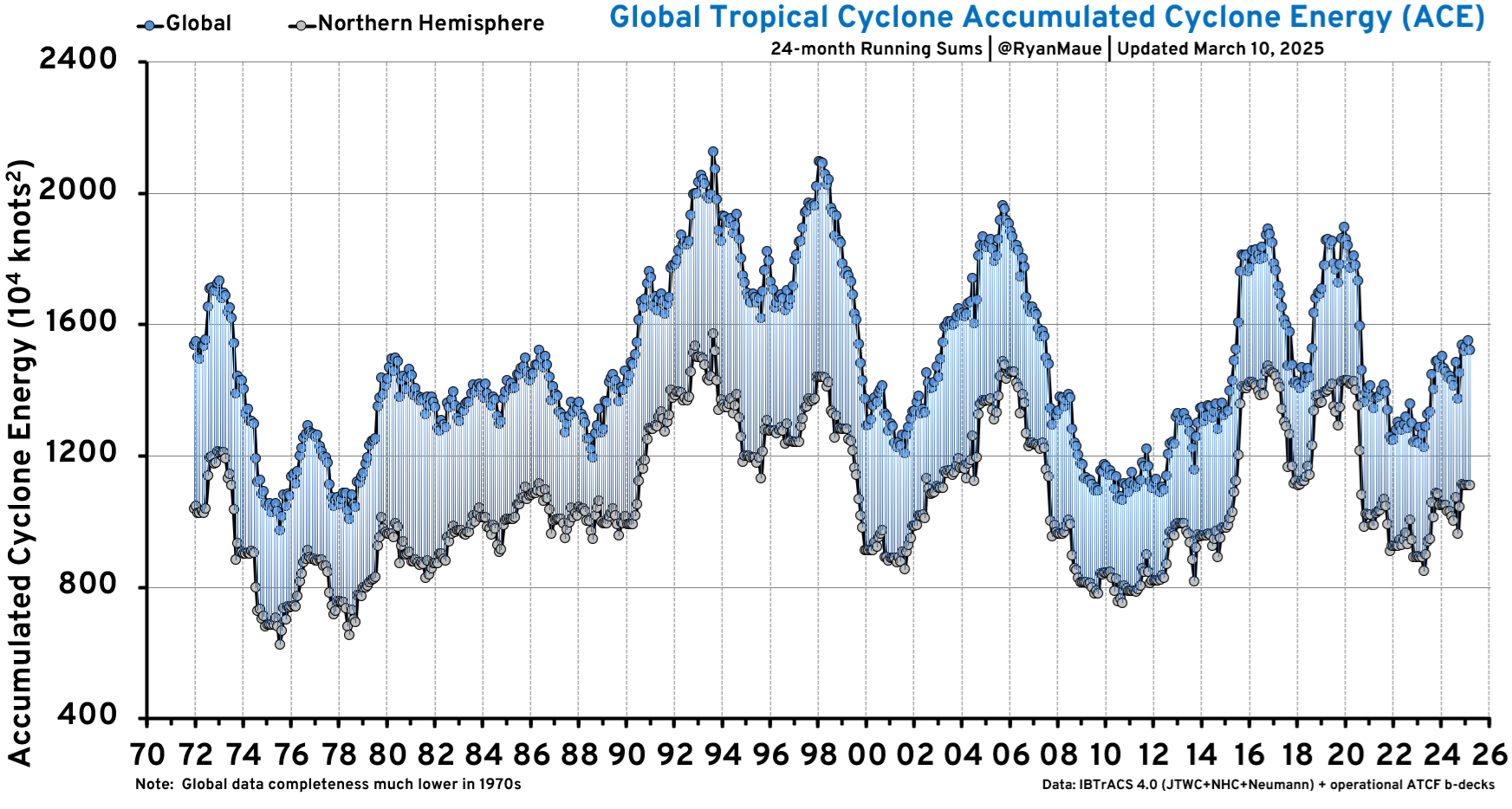
Similarly, Hurricane Helene was not unprecedented, nor was it part of a long-term trend of worsening hurricanes. Climate Realism has covered the hurricane issue many times, including several posts on Helene alone, which was unquestionably devastating especially for North Carolina. But again, as with those previous analyses, hurricanes have not experienced long-term trend of more frequent or powerful hurricanes that could be attributed to the warming of the past hundred-plus years. Actual data on hurricanes, such as the global tropical cyclone accumulated cyclone energy (ACE) data, presented below by Dr. Ryan Maue, show no persistent trend in hurricane severity either globally or in the northern hemisphere. (See figure below)
Figure 1: Last 50-years+ of Global and Northern Hemisphere Accumulated Cyclone Energy: 24 month running sums. Note that the year indicated represents the value of ACE through the previous 24-months for the Northern Hemisphere (bottom line/gray boxes) and the entire global (top line/blue boxes). The area in between represents the Southern Hemisphere total ACE. Source: Ryan N. Maue, “Global Tropical Cyclone Activity,” Climate Atlas, accessed October 10, 2024, https://climatlas.com/tropical/global_running_ace.png
Storms and wildfires today are doing more damage and are costing more than storms or wildfires in the past did, not due to worsening storms or wildfires, but rather as a result of population growth in areas prone to hurricanes and wildfires, accompanied by more, more expensive, homes and structures being built there. When there is more to destroy and the property involved is more valuable, when hurricanes strike or wildfires start burning, the destruction is naturally more costly.
Despite this fact, global weather losses as a percent of GDP have declined over time, with economic growth exceeding losses when adjusted for inflation. (see figure below)
If extreme weather is not getting worse, insurance premiums can’t be increasing as a result of worsening weather, nor can insurer withdrawals from certain neighborhoods be blamed on imaginary more severe storms.
Increasing populations in naturally disaster prone areas, inflation, and government policies towards insurance companies and subsidies are the real factors driving rising insurance costs and insurers dropping out of some areas. It is convenient for insurance companies to blame climate change, because it is forever just over the horizon and can be used to intimidate customers into not complaining about higher rates. The SFNM business section should not be carrying water for these profiteers. The data simply doesn’t support a climate change connection to the actions of the insurance industry.
Practitioners of rigorous scientific methodology — from the 17th century’s Galileo to 1965’s winner of the Nobel Prize in Physics, Richard Feynman — would consider today’s climate research an embarrassment, shaped by uncritical orthodoxy and zealotry rather than genuine testing of hypotheses.
Practitioners of rigorous scientific methodology — from the 17th century’s Galileo to 1965’s winner of the Nobel Prize in Physics, Richard Feynman — would consider today’s climate research an embarrassment, shaped by uncritical orthodoxy and zealotry rather than genuine testing of hypotheses.
Classical science welcomes skepticism. It thrives in an environment where debate and revision are encouraged. Today’s climate conformists declare the debate “settled” and label those with questions as deniers, effectively outlawing the skepticism that drives scientific progress.
Plenty of 21st-century scientists have objected to this travesty. Dr. Matthew Wielicki, formerly of the University of Alabama, put it bluntly: “Science should be self-correcting. Climate science isn’t. It’s self-preserving.”
Dr. Richard Lindzen of the Massachusetts Institute of Technology notes that climate dogma has little to do with evidence: “The narrative is a quasi-religious movement predicated on an absurd scientific narrative.”
In essence, modern climate science has been transformed into a political apparatus dominated by campaign-style advocacy, subverting the foundational principles of evidence-based inquiry.
Climate cultists treat every warming or cooling event as anthropogenic by default, ignoring millennia of natural variation. “While substantial concern has been expressed that emissions may cause significant climate change, measured or reconstructed temperature records indicate that 20th- and 21st-century climate changes are neither exceptional nor persistent, and the historical and geological records show many periods warmer than today,” say scientists writing to the American Physics Society.
Gregory Wrightstone, geologist and best-selling author of A Very Convenient Warming, says that the longer geological record reveals numerous epochs with much higher temperatures and levels of atmospheric CO₂, all predating the influence of modern human activity.
Wrightstone rejects descriptions of current conditions as dangerous, saying that “Earth is growing greener, and temperature-related deaths are declining.” The evidence indicates the planet is not imperiled but flourishing.
Deaths from natural disasters are at historic lows, life expectancy continues to climb, and global crop yields in both advanced and developing economies are at record highs. Rising atmospheric CO2 is associated with improved plant growth, not planetary degradation.
The much-hyped “disappearing islands” of the Pacific continue to exist. Many atolls have grown in size due to coral and sediment accumulation. Arctic sea ice, too, has refused to vanish; the 2025 minimum extent is nearly half a million square kilometers larger than 2007.
Dawn of new renewable energy technologies. Modern, aesthetic and efficient dark solar panel panels, a modular battery energy storage system and a wind turbine system in warm light. 3D rendering.
Yet none of these realities make it into school textbooks or U.N. briefings. The crisis narrative is perpetuated to sustain a trillion-dollar “green” industry dependent on fear, political support and publicly financed subsidies.
Error-riddled computer models that back doomsday predictions violate core tenets of scientific methodology. When tested against known outcomes, they routinely fail.
In 2014, Dr. Roy Spencer compared real-world satellite data with over 90 climate models. Nearly all the models exaggerated warming. Spencer summarized the absurdity: “If 95% of your models disagree with observations, the models are wrong — not reality.”
Dr. William Happer, a physicist at Princeton University and former scientific advisor to the U.S. government, notes: “Observations anchor our understanding and weed out the theories that do not work. This has been the scientific method for more than 300 years… computer models are not meant to replace theory and observation and to serve as an authority of their own.”
Yet these models drive the global policy agenda. The insistence on short time frames and cherry-picked data appear to support catastrophic scenarios; long-term geological records contradict them. Steve Milloy, author of JunkScience.com, described the phenomenon perfectly: “Climate science has become a political enterprise. The conclusion comes first; the data are adjusted later.”
Science belongs to critical thinkers, not to committees. The climate establishment will collapse as its funding dries up or the public stops believing its prophets. Reality will win — as it always does — but the longer the struggle, the higher the human cost of irrational policies.
Reason, empirical investigation and intellectual freedom have been undermined by a politically charged climate movement, which is a threat to science and civilization itself.
This commentary was first published by American Thinker on October 14, 2025.
Vijay Jayaraj is a Science and Research Associate at the CO2 Coalition, Fairfax, Virginia. He holds an M.S. in environmental sciences from the University of East Anglia and a postgraduate degree in energy management from Robert Gordon University, both in the U.K., and a bachelor’s in engineering from Anna University, India.
India’s latest gas discovery in the under-explored Andaman-Nicobar Basin could prove to be a valuable stepping stone towards increased domestic upstream production and greater energy security for the country – but whether the basin can become a significant contributor to India’s domestic gas supply and pull in more long-term national and international oil company interest will hinge on several factors, not least the size of the reserves.
India has made a significant gas discovery in the under-explored Andaman-Nicobar Basin, which is crucial for increasing domestic upstream production and strengthening energy security.
This deepwater find, part of the ‘Samudra Manthan’ mission, validates the hydrocarbon potential of India’s offshore regions and is expected to attract further investments and exploration drilling.
The new gas reserves offer a pathway to enhanced energy security, economic growth, and a smoother transition to a low-carbon future, while also reducing India’s reliance on energy imports.
India’s latest gas discovery in the under-explored Andaman-Nicobar Basin could prove to be a valuable stepping stone towards increased domestic upstream production and greater energy security for the country – but whether the basin can become a significant contributor to India’s domestic gas supply and pull in more long-term national and international oil company interest will hinge on several factors, not least the size of the reserves. The presence of hydrocarbons within the Oil India-led Sri Vijayapuram-2 well in the Andaman deepwater region was confirmed at last week’s Basin Analysis conference in Mumbai.
The well – part of a three-well exploration campaign that Oil India kickstarted last year within Andaman Block AN-OSHP-2018/1, awarded under the Open Acreage Licensing Policy (OALP) Bid Round II in 2019 – was drilled on the east coast of the Andaman Islands at a water depth of 295 meters and to a target depth of 2,650 meters. Hardeep Singh Puri, India’s Minister of Petroleum and Natural Gas, also confirmed that “initial production testing of the well in the range of 2,212 to 2,250 meters has established the presence of natural gas with intermittent flaring, with approximately 87% methane”.
This deepwater discovery and Oil and Natural Gas Corporation’s (ONGC) dual announcement last year – Konark and Utkal in the Mahanadi Basin, off the east coast of India – signal the maturing of India’s offshore exploration efforts, reflect policy success, collaborative efforts from governing bodies such as the Ministry of Petroleum and Natural Gas, the Directorate General of Hydrocarbons (DGH), and the national oil companies (NOC). However, how transformative these discoveries become will depend on the size of the reserves, how fast they can be developed, cost, environmental management, and how they fit within India’s long-term energy-transition strategy.
This new gas discovery in the Andaman basin could be transformative, both for the basin itself and for India’s broader energy strategy, as the country undertakes Prime Minister Narendra Modi’s ‘Samudra Manthan’ (‘Churning of the Ocean’) mission – an initiative to explore the unexplored deepwater oil and gas potential. The Andaman deepwater region, which includes many others such as Krishna-Godaveri and Mahanadi, remains under-explored primarily due to associated costs and technical challenges, and it is significantly crippled by the lack of high-quality deepwater seismic data. Despite its geological promise, and significant discoveries in the analogue basins, the Andaman-Nicobar Basin has seen only a handful of exploration wells over several decades. The sparse drilling activity underscores the historically limited industry interest, with operators reluctant to commit capital in the absence of proven success. This lack of sustained well campaigns highlights the basin’s frontier status and the cautious approach companies have taken toward its exploration.
However, the announcement of this discovery will help validate the hydrocarbon potential of India’s deepwater region and encourage further investments and exploration drilling, likely triggering the development of new offshore infrastructure, including production platforms, pipelines and possibly floating liquefied natural gas (LNG) facilities. This could turn the basin into a significant contributor to India’s domestic gas supply, but it remains to be seen whether the size of the reservoir and its production potential will make it economically viable.
As domestic production continues to slump, new gas discoveries are increasingly critical to India’s energy landscape. They offer a pathway to enhanced energy security, economic growth and a smoother transition to a low-carbon future – but, more importantly, can help move the country transition from its heavy reliance on imports. Moreover, natural gas serves as a relatively cleaner fossil fuel, supporting the country’s climate goals by enabling a shift away from coal in power generation and industrial use. Additionally, for a nation heavily dependent on its NOCs, the establishment of deepwater potential combined with relevant fiscal terms could help stimulate investment in infrastructure, technology, and offshore exploration, primarily attracting international oil companies (IOC) to invest in the nation’s under-explored basins.
Deepwater exploration is technologically demanding and capital-intensive, therefore continuous efforts by the NOCs could help attract IOCs with better technologies, which in turn could accelerate discovery and extraction. Additionally, the Andaman find will likely spur more high-quality 3D seismic surveys and exploration drilling, not just in the Andaman-Nicobar Basin but in other under-explored deepwater areas and help ramp up the country’s reserves base. Nonetheless, above-ground risk such as environmental challenges will play a key role as deepwater operations and exploration offshore Andaman-Nicobar will need to carefully manage environmental risks, including impacts on marine ecosystems, potential spill risks and greenhouse gas implications. Hence, beyond a supply of energy, the new gas reserves could provide a strategic buffer, strengthen negotiating power in global markets, and support industrial growth by ensuring stable feedstock for industrial growth and stable domestic supplies, laying the foundation for sustainable, secure and economically efficient energy development.
India continues to see a growing interest from IOCs – showcased by the July 2025 memorandum of understanding (MoU) between ONGC and BP to collaborate on drilling stratigraphic wells in the Indian offshore sedimentary basins of Andaman, Mahanadi, Saurashtra and Bengal – aiming to enhance geological understanding and unlock untapped hydrocarbon potential, thereby strengthening the country’s long-term energy security. As such partnerships continue to mature, announcements of new discoveries could act as a catalyst for an influx of foreign investments. However, India’s dependence on its NOCs, such as ONGC and Oil India, is undeniable and will continue to be a defining feature of its energy sector. Enticing IOCs to actively engage in exploring the nation’s frontier basins will require a significant upgrade in the regulations and transparency in data sharing so, until then, these NOCs will remain indispensable partners in securing the country’s hydrocarbon future, even as collaborations with private and foreign entities expand.
In 1913, a temperature of 134°F (56.7°C) was reported at Greenland Ranch in Death Valley, California — still listed as the hottest air temperature ever recorded on Earth. But this new study by our friends Dr. John Christy and Dr. Roy Spencer argues that the famous record is wrong, and not just by a little. Using more than a century of weather data and historical records, the authors conclude that the 1913 reading was around 14°F too high and should never have been recognized as a world record.
World-record hot temperature may have been incorrectly measured.
In 1913, a temperature of 134°F (56.7°C) was reported at Greenland Ranch in Death Valley, California — still listed as the hottest air temperature ever recorded on Earth. But this new study by our friends Dr. John Christy and Dr. Roy Spencer argues that the famous record is wrong, and not just by a little. Using more than a century of weather data and historical records, the authors conclude that the 1913 reading was around 14°F too high and should never have been recognized as a world record.
Why the Record Is in Question
Death Valley is certainly one of the hottest places on Earth, but even in today’s warmer climate, it has never again reached 134°F. The highest recent temperatures there — in 2020 and 2021 — peaked at 130°F. This alone raises doubts: if the world has warmed since 1913, why hasn’t the record been broken?
Earlier researchers had also questioned the 134°F value. Meteorologist George Willson noted in 1915 that nothing unusual in the regional weather could explain such extreme heat. Later studies in the 1940s and 1950s found that a temperature that high should occur only once every several centuries, if at all.
To evaluate whether the 1913 reading made sense, the researchers used data from nearby weather stations outside Death Valley that have continuous records from 1923 to 2024. These stations are at higher elevations — typically 3,000 to 3,700 feet above sea level — while Greenland Ranch lies 178 feet below sea level.
Temperature normally drops with altitude. This rate of decrease is called the lapse rate. The team calculated lapse rates from 102 years of July temperature data to determine what the Death Valley temperature should have been based on surrounding stations. They found that in July, the air temperature typically falls by about 4.8°F per 1,000 feet of elevation.
Applying this relationship to the 1913 data, they reconstructed what Death Valley’s true temperature probably was. The result: the 134°F reading should have been closer to 120°F, plus or minus 2°F.
The study didn’t just find one bad measurement. The entire first half of July 1913 looks suspicious. For 17 days, the Greenland Ranch station reported temperatures an average of 8°F higher than what nearby stations would predict. On July 13, a second implausible high of 131°F was recorded.
Other years between 1911 and 1922 also showed odd patterns — especially 1914, 1916, 1917, and 1922. In some years, the daily highs often ended in multiples of five (like 105, 110, 115), suggesting they were being estimated or rounded rather than read directly from a thermometer.
The authors also found that day-to-day variations in those early years were unusually large compared to later decades, a sign of inconsistent or fabricated data.
What Might Have Happened
The paper presents historical clues to explain why the 1913 temperatures were exaggerated. Greenland Ranch, established in the late 1800s to support borax mining, was an isolated oasis amid the desert. By 1911, the U.S. Weather Bureau had installed a proper instrument shelter at the ranch, located over an irrigated alfalfa field. This setup provided reliable readings — but cooler than what ranch workers expected.
Locals were convinced Death Valley should reach over 130°F. They had earlier seen higher numbers on non-standard thermometers hung under the veranda of the ranch house. Those “porch thermometers,” exposed to reflected heat and possibly hot air trapped under the double roof, could easily show inflated temperatures.
Letters from that time show the ranch managers were disappointed that the official Weather Bureau thermometer was reporting “cool” values. The researchers suspect that Oscar Denton, the ranch foreman and official observer from 1912 to 1920, may have replaced some of the official readings with hotter values taken from the veranda thermometer.
The paper gives a vivid picture of how difficult it was to live and work in Death Valley a century ago. Observers were left alone in unbearable summer heat, often without oversight from the Weather Bureau. Denton himself was a recluse who distrusted outsiders and endured dangerous conditions while taking daily measurements. The authors note that no federal official visited the site from its installation in 1911 until 1924 — a 13-year gap when any number of observing mistakes or instrument moves could have occurred unnoticed.
Old photographs show the temperature shelter was moved at least once, possibly to a hotter location away from the irrigated field. These unsupervised changes, combined with the strong local belief that Death Valley was the world’s hottest place, likely encouraged Denton to record unrealistically high numbers.
Comparison with Other Early Records
Earlier reliable measurements in Death Valley — for example, by the Wheeler Survey in 1875 and a U.S. Weather Bureau expedition in 1891 — never exceeded 122°F. These readings were made with properly shielded thermometers similar to those used later at Greenland Ranch. This supports the conclusion that the 134°F value was artificially inflated, not a true reflection of the region’s natural climate.
Conclusion and Recommendations
After analyzing both the data and historical evidence, the authors conclude:
The true temperature on July 10, 1913 was probably about 120°F, not 134°F.
The reported value was likely taken from a poorly sited, unstandardized thermometer on the ranch veranda.
Several years of early Greenland Ranch data show similar inconsistencies and should be re-examined.
The World Meteorological Organization should rescind the 134°F record and review early Death Valley data for quality control.
The paper’s title — “Death Valley Illusion” — sums it up well. Just as the valley’s early reputation was built on myths of deadly heat and mirages of wealth, the 134°F world record appears to be another illusion — a product of human error, misplaced expectations, and a lack of oversight.
The world’s largest offshore wind developer, backed by the government of Denmark, is on a deliberate collision course with the Trump Administration.
The battleground is Sunrise Wind, a 924 megawatt (MW) offshore wind project located roughly 30 miles east of Long Island’s Montauk Point. Orsted just raised almost $10 billion, two-thirds of which is reportedly aimed at building Sunrise.
Sunrise has all its federal permits, but offshore construction has yet to begin, or, as the industry puts it, there is no “steel in the water.” The Trump administration has vowed to stop all offshore wind projects that are not already under construction, so Sunrise must be in the federal crosshairs.
One would think Orsted would simply hold off on Sunrise until Trump leaves, but their financial condition looks perilous, so they likely need Sunrise to survive. This makes the looming battle very interesting.
Even more interesting is that Orsted’s majority shareholder is the Government of Denmark. In a very real sense, this is two national governments facing off.
The fundraising exemplifies Orsted’s distress. They basically sold their existing stockholders a bunch of new stock at a hefty discount. TheMaritime Executive puts it this way:
“Danish offshore wind giant Orsted has raised $9.4 billion by selling new shares to existing stockholders at a steeply discounted price. With 99 percent of the new shares sold immediately and the remaining one percent swiftly sold to the public, the firm is now on firmer financial ground as it faces market headwinds and political risk in its core markets.”
“Orsted sold the shares at a price of 66 Danish kroner each ($10.30), a fraction of the stock’s publicly-traded price of about 120 kroner and a third of the most recent peak, 180 kroner, reached in early August. Just five years ago, when Orsted’s prospects seemed brighter and it was expanding into new markets, its stock briefly traded above 600 kroner.”
That the Trump administration will try to stop Sunrise Wind before it begins offshore construction is almost certain. In fact, the administration is already trying to stop Orsted’s $6 billion Revolution Wind project which has a lot of steel in the water. Many of its monopiles have been driven, and a few turbines erected, so it is maybe 50% along (unlike much higher press reports).
The Revolution Wind stoppage is in litigation, which has been widely misreported. A federal judge issued a temporary injunction blocking the administration’s stop work order pending trial, but this has been wrongly reported as the judge having quashed the order.
The judge merely ruled that there was a reasonable possibility of Orsted winning the lawsuit against the stop-work order, so preorder status quo was maintained pending that action. This is standard equity law, so no judgement has been made in the actual stop work lawsuit. Orsted is rushing to get as much built as possible in the interim.
As my CFACT colleague Collister Johnson points out, the Revolution Wind case is basically a federal contract dispute and there is a separate court for hearing these. Thus, the Revolution Wind stoppage case is far from over; in fact, it has yet to begin.
If the administration can stop Revolution Wind, it can certainly stop Sunrise, which has no steel in the water. Revolution and Sunrise, while struggling, look to be Orsted’s best bet for new cash flow, so this issue may be critical for them.
What this $10 billion battle with the Trump administration means for Orsted’s Danish government owner remains to be seen.
Stay tuned to CFACT as this international drama unfolds.
And this is where green ideology longs to be. Consequently, greens have urged us to give up meat, telling us of the harm done to nature by our diets. They have urged us to cut down, to become vegetarian or vegan. Or to switch to other forms of protein. No thanks! Green attempts to control our diets have been met with resistance.
For those who prefer to read, below is a lightly edited transcript from the closed captions with my bolds and added images.
This is a short story about how the BBC and the UK Parliament turned the opinions of just ten people into the single voice of 66 million. At the centre of this story is our favourite food. Meat production has long bothered the environmental movement and climate campaigners, because it is at the centre of culture, and family and social life.
And this is where green ideology longs to be. Consequently, greens have urged us to give up meat, telling us of the harm done to nature by our diets. They have urged us to cut down, to become vegetarian or vegan. Or to switch to other forms of protein. No thanks! Green attempts to control our diets have been met with resistance.
But UK politicians have now decided to tackle the problem of the public’s lack of interest in the green agenda. “Dear resident. Dear resident. Dear resident. You could be one of over 100 people selected to take part in the UK-wide Citizens’ Assembly on how should the UK tackle climate change.” They believe that they can change our behaviour by focusing their interventions on the things which the public will find least unacceptable. Parliament believes that by convening a Climate Assembly, the government, politicians, and civil servants can find out what level of regulation of their lifestyles the wider public will accept.
“The UK government has legally committed to reach Net Zero greenhouse gas emissions by 2050. To help inform how we’re going to reach Net Zero, 108 members of the public were brought together by the UK parliament in our first ever Citizens’ Assembly on climate change. They discussed the impact of what we eat and how we used the land.”
But what recommendations did the Climate Assembly make? Reduce our meat and dairy consumption by 20-40%, but with no bans or taxes.” The Climate Assembly provided Parliament with this information and it has now been used as the basis for policies. “The fact that you’ve given up time to come here and take this seriously is of the greatest importance.” But what really happened in the Climate Assembly? Did it really recommend that the government should find ways to make us eat less meat?
The findings of the Climate Assembly, which met over six weekends, were published in a 500-page report. The reduction of meat and dairy consumption does appear in the key recommendations of the report, in a section on “what we eat and how we use the land”. But this was not the view of the whole Assembly.
On the weekend during which the Assembly discussed this question, it was divided into three groups, only one of which was tasked with a discussion on “what we eat and how we use the land”. Just 35 Assembly members, out of 108, were in this group. They heard from just one academic’s views on meat, Rosie Green:
“We know that red and processed meat is associated with a number of health conditions. So it’s linked to heart disease, it’s linked to strokes, it’s linked to particular types of cancer, like bowel cancer, and it’s also linked to diabetes.Whereas on the other hand, eating fruit and vegetables is linked to prevention of all those conditions. So if you eat the more fruit and vegetables you eat, there’s less likely you are to suffer from those diseases.”
There was no debate or criticism of these questionable scientific claims made by an academic, who has manifestly strayed into political activism. “Meat will never ever be banned. It will never be banned.” “I don’t like the idea of controlling things at all.”
But the Climate Assembly were not fools. When they were asked to vote on what they believed the government should prioritize from a list of eight options available to them, just 29 per cent chose reducing meat as a priority. It was the second least popular option prioritized by the group. And 29% of 35 just people is ten people.
Nonetheless, the report claimed that ‘assembly members tended to express support for” the idea. On the available evidence, that claim simply isn’t true. The report emphasizes reducing meat and dairy in our diets, despite this underwhelming support for it, because the report was not written by the Assembly itself. It was written by the academic activists and green campaigning organizations that ran the event.
The claim has now been used by politicians and civil servants designing the UK’s climate policies, to meet the Net Zero target. They had already decided that changing people’s diets will be part of the Net Zero agenda. In 2019, The Climate Change Committee produced a report on Net Zero, which proposed interventions to produce behaviour change, including the reduction of meat and dairy consumption.
In their new Net Zero policy report launched last week, the Committee claim that they have incorporated the Climate Assembly’s recommendations in their analysis, including the reduction of meat and dairy consumption.
“The Climate Assembly said they would be happy with a 20 to 40 per cent reduction in meat consumption. We’ve looked really carefully at the Climate Assembly’s recommendations, and actually we were quite engaged in the process as well. If you take the time to guide people through this, to explain why the changes are needed, to explain the sorts of things that need to happen, they’re really supportive of action. And actually we were surprised how supportive they were of lots of the things that we were thinking of already. What we’ve done is we’ve taken their advice, and we’ve constructed our scenarios to align to it.”
But though these civil servants seem to have enthusiastically embraced what the public think, as represented by what the Climate Assembly seemed to tell them, they have forgotten that the recommendation came from just ten people. The views of these ten people are now at the centre of the Climate Change Committee’s advice to Parliament, which they are almost certain to adopt.
From the Sixth Carbon Budget–The UK’s path to Net Zero
But what the authors of the Climate Assembly report could not ignore, was the Assembly’s insistence that changes to diets should be voluntary, not compulsory. How will the government legislate for voluntary behavioral change? It has turned to the UK’s defacto state broadcaster, the BBC.
The BBC presents itself as a news broadcaster, but this BBC video on meat consumption and climate change shows that it has a role engineering the social values and behavioral changes that government policy requires.
“The average Brit eats meat twice a day. And we’re eating much more protein than we need. Would more of us change our diet, if we knew it was also better for the planet?”
Rather than investigating the claims seemingly produced by the Climate Assembly, but which were just the views of ten of its members, the BBC uncritically reports them. It shows the views of one Assembly member’s concerns about his own meat consumption, and its damaging effect on the environment: a seventeen-year-old boy, who has decided to give up meat.
“After the second weekend of the Assembly I became pescatarian. When I was able to see right there on the graph that beef had a big proportion of higher CO2 emissions than fish, I knew that if I carried on eating beef then I know I’d be making the wrong sort of choice for the environment”.“So Max decided to give up his beloved beef steak…”
And rather than challenging a young person about how he formed such a view of the world, and asking questions about the ideology and one-sided view that was presented to the Climate Assembly, the BBC uses him, to encourage its audience to change their diets and behaviour.
n this way, the BBC, turns ten into 66 million. It forgets the views that many of us may have about politicians’ and civil servants’ designs for our lives and lifestyles for the next decades. The public has once again been excluded from debates about climate policy.
Beyond Meat’s stock collapsed to near $1 a share on Tuesday after the embattled plant-based meat maker finalized a debt exchange deal that handed bondholders hundreds of millions of new shares — effectively wiping out most existing investors. In the summer of 2019, the stock neared $240 a share — its peak price. Since then, the stock has lost more than 99% of its value.
Hamburg is German’s leading industrial city. Its companies add 20 billion Euros in gross value every year. Much of this economic output is related to Hamburg’s happy location on the Elbe and the fact that the city is home to Europe’s third-largest port.
Hamburg is German’s leading industrial city. Its companies add 20 billion Euros in gross value every year. Much of this economic output is related to Hamburg’s happy location on the Elbe and the fact that the city is home to Europe’s third-largest port. All of this has made Hamburg extremely prosperous, which prosperity has filled it with rafts of clueless virtue-signalling morons who have no idea how anything works, why they find Hamburg attractive in the first place or how their hip urban lifestyles are maintained.
In this photo, published by BILD, you can see some of these unmitigated retards having a happy because they’ve just scored cheap virtue points by voting in their own personal energy apocalypse.
Turnout was pretty low in Hamburg last Sunday, with less than 44% of eligible voters bothering to cast a ballot, most of them by mail. Thus just 23% of the most deranged Hamburgians could take their city hostage and commit its government to destroying all of its industry and most of its economic activity inside the next decade and a half. The biggest joke is that when Hamburg has finally achieved the sacred Net Zero, it will make absolutely zero net difference to anything. Hamburg is responsible for something like 0.022% of CO2 emissions globally. The city is not even a rounding error.
Consider just some of the consequences: All gas and oil heating systems in every last building in Hamburg will have to be changed out in the coming years. The cost to landlords will be reckoned in the billions. Hamburg’s entire natural gas network, constructed over generations and extending to nearly 8,000 kilometers, will soon have to be decommissioned entirely. The city will probably have to impose on all of its streets a strict speed limit of 30 kph (19 mph) and take drastic steps to reduce traffic. Municipal industries must transition from petroleum coke and gas entirely to hydrogen and e-fuels, although there is hardly a market for either of these alternatives or even the hope of one. If this law is not reversed, Hamburg will become a wasteland. First industry will leave, and then all the people will.
Look again at this photo:
It is absolutely imperative to get these sorts of people out of politics. They are crazy and they are doing everything in their power to destroy civilisation. They are insulated from a lot of the economic chaos they wreak because they’re overwhelmingly government bureaucrats, university types and hipsters who are to varying degrees reliant on the state to make their living. They’re renters rather than owners, they live near the city centre rather than in the suburbs, they’re young rather than old (h/t Apollo News for that link) and they think what they’ve done is just fantastic.
For decades, politicians and pundits have told us that “the science is settled.” Those four words have become a shield for power and a sword against dissent. But real science thrives on inquiry and investigation; not the suppression of it. What has emerged instead is not science at all, but a kind of secular faith — one that demands belief in man-made CO2-induced climate catastrophe and punishes heresy. Yet, many scientists, including scientists that have worked within the climate bureaucracy, know how fragile the claim that “climate change is caused by CO2” really is.
For decades, politicians and pundits have told us that “the science is settled.” Those four words have become a shield for power and a sword against dissent. But real science thrives on inquiry and investigation; not the suppression of it. What has emerged instead is not science at all, but a kind of secular faith — one that demands belief in man-made CO2-induced climate catastrophe and punishes heresy. Yet, many scientists, including scientists that have worked within the climate bureaucracy, know how fragile the claim that “climate change is caused by CO2” really is.
As a former scientist with the UK Department of Energy and Climate Change and later a technical expert for United Nations Environment, I saw firsthand how the modern climate narrative was shaped — not by evidence, but by politics. Uncertainty wasn’t treated as a question to investigate; it was treated as a threat to suppress. Entire careers and institutions came to depend on preserving a preordained conclusion: that carbon dioxide, the same gas that feeds plant life, is destroying the planet.
What began as environmental concern has hardened into climate orthodoxy — a moral creed enforced by bureaucrats, bankers, and media alike. It is a belief system that demands faith rather than understanding, obedience rather than inquiry. None of this means the climate isn’t changing. It means that the conversation about why and how has been systematically narrowed — not by discovery, but by decree.
The Rise of Climate Bureaucracy
By the 1990s, climate science had morphed from an academic discipline into a vast global bureaucracy. The Intergovernmental Panel on Climate Change (IPCC), founded in 1988, became the central authority — linking governments, corporations, and NGOs under a single mission: to define and manage “the problem.”
But the IPCC’s reports were never neutral. The “Summary for Policymakers” — the only section most journalists ever read — was often written before the science was finalized. Conclusions drove the evidence, not the other way around. Scientists who emphasized natural climate drivers such as solar cycles or ocean oscillations were quietly pushed aside. The institution that once claimed to study the climate became invested in proving a single narrative.
The Other Consensus
While the UN promotes its “consensus,” thousands of scientists disagree. In 2019, more than 2,000 experts signed the Climate Intelligence (CLINTEL) Declaration, stating bluntly:
“There is no [CO₂-induced] climate emergency. The geological record shows Earth’s climate has always varied naturally.”
CO2 is not pollution — it is plant food, essential for life and photosynthesis. Yet the UN’s focus on carbon rather than true pollutants such as heavy metals or industrial toxins has diverted environmentalism from its original mission into politics.
I witnessed this distortion firsthand while working within the UN system. My role involved servicing the Pollution Release and Transfer Register Protocol — a multinational agreement that monitors pollutants to air, land, and water. Real pollution exists, and it’s severe. But CO2 is not the problem. Confusing the two has served political and financial ends, not ecological ones.
When Science Becomes Statecraft
The line between scientific advice and political advocacy blurred long ago. Governments needed crisis to justify regulation and taxation. NGOs needed fear to justify funding. And so “consensus science” — a contradiction in terms — entered the lexicon and became the new norm.
Real science advances through dissent and enquiry; consensus is a political construct. But once the term took hold, it became a weapon. Questioning it marked one as a heretic. The language of faith — belief, denial, salvation — replaced the language of analysis. What began as environmental concern hardened into a kind of secular theology: the carbon creed.
Complexity was the enemy. Climate models that showed alarming forecasts were amplified, while those showing uncertainty were ignored. What followed was the moralization of data. The language of faith replaced the language of evidence: belief, denial, salvation, catastrophe. Dissenters weren’t debated — they were denounced. What began as environmental concern hardened into an ideology — one that rewards fear over reason.
Scientists Who Broke Ranks
Many respected scientists have spoken out. Professor John R. Christy, Director of Atmospheric and Earth Sciences, University of Alabama, stated: “The established global warming theory significantly misrepresents the impact of extra greenhouse gases.” MIT’s Richard Lindzen observed, “In Earth’s long history, there’s been almost no correlation between climate and CO₂.” Dr. Nils-Axel Mörner, once with the IPCC, called the carbon narrative “a wonderful way to control taxation and people.” Greenpeace co-founder Patrick Moore declared the crisis “fake science” hijacked by ideology.
Such voices are rarely heard in mainstream media, not because their credentials lack merit, but because they challenge the most politically valuable story of the century.
The Money Behind the Mandate
Follow the money, and the picture becomes clearer. The financialization of carbon — through emissions trading, carbon credits, and “green investment” funds — transformed moral urgency into a trillion-dollar industry.
Governments pour billions into renewable subsidies, enriching banks and corporations far more than benefiting the planet. If the climate crisis were truly existential, would its management really be entrusted to those who profit from it?
In my book Climate CO₂ Hoax – How Bankers Hijacked the Environmental Movement, I detail how the 1992 UN Earth Summit in Rio marked the turning point — when financial elites effectively captured global environmental policy. Reports and whistleblower accounts later suggested that key policies adopted at the summit were drafted without open debate — policies that subordinated national sovereignty to global ‘sustainability’ goals.”
Net Zero: The Mirage of Green Energy
The world’s economies are being restructured around “net zero,” but the irony is glaring. Building the infrastructure for so-called “green energy” — from solar panels to EV batteries — requires massive fossil-fuel use and destructive rare-earth mining.
Electric cars rely on lithium and cobalt extracted through environmentally devastating processes. The energy required to mine and refine these materials often exceeds what the vehicles save over their lifetimes.
In Germany, the green energy transition has turned a once-stable, low-cost energy grid into one of the most expensive in the industrial world. In Ireland, plans to close the coal-fired Moneypoint power station were reversed in 2022 as the government quietly converted it to burn oil instead — an unspoken admission that “renewables” can’t power modern economies.
Silencing Dissent
In this new orthodoxy, questioning the narrative is treated as blasphemy. Scientists who deviate from the CO2 script face censorship, ostracism, and blacklisting. The term “denier” — borrowed from the lexicon of moral condemnation — equates disagreement with depravity, and scepticism with sin
Dr. Roger Pielke Jr. of the University of Colorado revealed how the IPCC relies on the RCP 8.5 model — one he described as “fantasy land,” completely detached from real-world data. Yet it remains the foundation of global policy and countless policy papers and media headlines.
When truth becomes heresy, science itself collapses.
The Moralization of Carbon
CO2 has been transformed from a molecule into a moral symbol — the embodiment of human guilt. Citizens are told to measure their “carbon footprint” as if it were a sin ledger, redeemable only through “green” consumption. Yet many of these same products — from electric cars to solar infrastructure — depend on the same industrial extraction that environmentalism once opposed.
This framing serves a purpose. Instead of questioning the powerful institutions that profit from pollution and its supposed cure, individuals are encouraged to internalize blame. The message: You are the problem — not the system. It’s an old strategy of control — rule through guilt rather than force.
The Politics of Fear
No ideology survives without fear. Apocalyptic imagery — burning forests, flooded cities, “ticking clocks” — has replaced empirical evidence as the main instrument of persuasion. Yet forest fires and floods are as old as the Earth itself.
Children now grow up believing the planet will collapse before they reach adulthood. Politicians invoke “existential threat” rhetoric to justify sweeping economic and social controls. What was once a challenge to power has become a tool of it.
The New Creed
Modern climate orthodoxy is not science but ideology — a sociopolitical construct — a fusion of fear, money, and power that rewards conformity and punishes doubt. Science must never serve politics. When data becomes dogma, truth dies — and with it, freedom. If we truly wish to “save the planet,” we must first save science itself.


You must be logged in to post a comment.