Global warming, climate change, all these things are just a dream come true for politicians. I deal with evidence and not with frightening computer models because the seeker after truth does not put his faith in any consensus. The road to the truth is long and hard, but this is the road we must follow. People who describe the unprecedented comfort and ease of modern life as a climate disaster, in my opinion have no idea what a real problem is.
After a preliminary tabulation of data collected from its approx. 2000 stations across the country, the results of Germany’s, DWD national weather service in Offenbach show that earlier dramatic predictions of a “hellish summer” have yet to come true.
After a preliminary tabulation of data collected from its approx. 2000 stations across the country, the results of Germany’s, DWD national weather service in Offenbach show that earlier dramatic predictions of a “hellish summer” have yet to come true.
German annual rainfall anomaly. Germany’s been getting wetter – not drier. Image: DWD.
June in Germany came in near normal, and now according to the DWD, July 2024 has also been “rather variable , with consistent summer weather simply refusing to materialize.”
The brief periods of warm weather quickly got interrupted by showers and thunderstorms.
Slightly warmer than normal
The mean temperature in July 2024 (preliminary) was 18.9°C, or 0.6°C warmer than the 1991 to 2020 reference period mean of 18.3 °C. The start of the month was rather cool and autumnlike.
The peak value was recorded at the Bad Muskau station (Saxony), where it reached 34.8°C on July 10.
On July 30th, temperatures plummeted again at night and the nationwide low of 3.8 °C, recorded in Deutschneudorf-Brüderwiese (Saxony).
Few warm nights
Tropical nights (when lows do not drop below 20.0 °C) were the exception rather than the rule and only occurred in small numbers on the Upper Rhine, in Lower Bavaria, Saxony and the greater Berlin area. Earlier reports warned that German cities like Hamburg would see a sharp increase in warm tropical nights that would make sleep more difficult. So far there hasn’t been one such night in Hamburg this summer.
Average rainfall
“Experts” also warned that Germany would see more drought in the summer as climate warming progresses. But this summer so far has been wetter than normal. According to the DWD, July saw 88 liters of rain per square meter. Compared to the climate reference period from 1991 to 2020 (87 l/m²), July 2024 was practically dead-on average.
More sunshine
In terms of sunshine in July, the country saw a mean of of 237 hours in July, which was only slightly above average compared to the 1991-2020 climate reference period (226 hours). That probably helped to make the month a bit warmer than average.
Sen. John Fetterman has indicated that energy would not be in the forefront of Pennsylvanians’ voting decisions this year, but he may not be accounting for its relation to inflation. Inflation ranks as crucially important, a top concern of the voting public in the 2024 election.
WASHINGTON, DC – NOVEMBER 14: Democratic presidential candidate Sen. Bernie Sanders (I-VT) (L) and Rep. Alexandria Ocasio-Cortez (D-NY) hold a news conference to introduce legislation to transform public housing as part of their Green New Deal proposal outside the U.S. Capitol November 14, 2019 in Washington, DC. The liberal legislators invited affordable housing advocates and climate change activists to join them for the announcement. (Photo by Chip Somodevilla/Getty Images)
Sen. John Fetterman has indicated that energy would not be in the forefront of Pennsylvanians’ voting decisions this year, but he may not be accounting for its relation to inflation. Inflation ranks as crucially important, a top concern of the voting public in the 2024 election.
While the energy issue had a marginal effect in Pennsylvania’s 2020 election cycle, its connection to higher prices could be decisive in 2024. In the spring, a Commonwealth Foundation survey of 800 Pennsylvania registered voters found that more than two-thirds named inflation as an impediment to maintaining their standard of living.
The costly Green New Deal
Meanwhile, by prioritizing a “climate emergency,” the Biden administration has rendered energy production more difficult and costlier and has injected 400 billion of Green New Deal dollars into the economy. Both are inflationary, as seen at the gas pump and in the prices of groceries and manufactured goods.
In any event, the issue isn’t going away, because the Republicans will raise it. Donald Trump will highlight the link between energy policy and inflation.
Likewise, Republican Senate candidate Dave McCormick is attacking Sen. Bob Casey’s acquiescence to Biden energy policies. Casey did make a politically expedient election year exception in objecting to a Biden ban on exports of liquefied natural gas, which was since overturned by a court.
The McCormick campaign refers to suppressed gas production in Pennsylvania as a result of federal policy impeding pipeline construction, saying that “under Biden’s energy policies, rubber-stamped by Bob Casey, we haven’t been able to access clean natural gas. … Casey supports policies that are costing us jobs and driving up energy prices even more.”
Compounding the Biden effect in the Keystone State are the “green” leanings of Josh Shapiro, the Democrat governor. His proposals for a $499 million carbon tax and an expansion of expensive wind and solar energy would add to the already considerable burdens of families and businesses.
Shapiro offers “not just disastrous energy policy” but “expensively disastrous energy policy,” says David Taylor, CEO of the Pennsylvania Manufacturers’ Association, which lobbies on behalf of 550,000 workers in the fifth largest manufacturing state.
The loss of energy
In a state where coal’s share of electric generation has dropped to less than 20% from more than 50%, both state and federal policies have been blamed for the closure of many coal-fired plants. Pennsylvania’s largest such generator at Homer City closed a year ago, and two more have announced early retirements within a few years.
Natural gas now produces more than half of Pennsylvania’s electricity, but gas generation, too, has suffered under government regulation and with he threat of more to come.
In the 10 years prior to 2019, when a carbon tax first was proposed, $14 billion worth of gas-fired plants were built in the state, reported Shawn Steffee, a Boilermakers union business agent. However, none have been built since and two $1 billion proposals were canceled. “It is highly unlikely that we will build another,” he says.
Whether it’s gas plants not being built or coal plants being closed, reliability of the power grid and employment take a hit.
Government and industry overseers of the high-voltage transmission system have warned of energy shortages resulting from ill-timed closures of fossil fuel plants that increase the share of less reliable wind and solar. A significant regional blackout is not out of the question and would dim the electoral outlook of politicians supporting green energy.
As for the effect of job losses, one need only to read a Washington Examiner account of federal officials meeting with Homer City citizens affected by last year’s plant closing: “The vast divide between the government’s understanding of the needs of the people they serve and the people themselves was never more excruciatingly apparent than at the meeting,” the article began.
The rest of the story told of unkept promises to furloughed workers whose lives were “uprooted forever.” The meeting included a slide show extolling the good intentions of federal agencies.
The stakes
The case for redirecting federal policy away from the green agenda and toward more traditional energy production will be made by Trump, particularly in energy states like Pennsylvania, which would be one of the ultimate prizes in November. McCormick will follow suit, adding to the force of Trump’s campaign.
At stake are the House, Senate and Presidency, and the deciding votes, at the margin, could very well come from Pennsylvania energy consumers.
Don Ritter is a former Republican congressman from Pennsylvania’s Lehigh Valley, and later led the National Environmental Policy Institute. His previous article was “The world will not stop burning coal and using oil.”
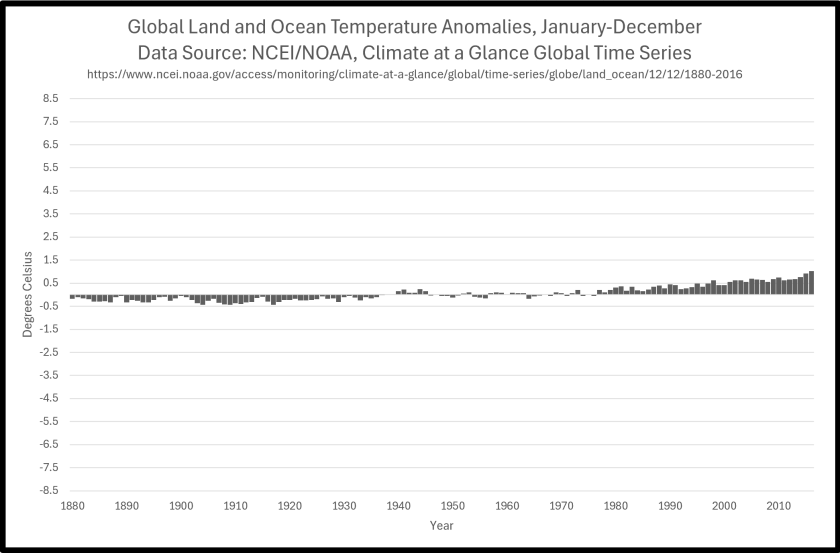
By now practically everyone who follows news and commentary about climate change has seen graphs of global warming over the past century or more. The National Oceanic and Atmospheric Administration (NOAA) produced this one in 2017, covering 1880–2016.
Ever since it first appeared, it’s been one of the most commonly used, whether in scholarly journals or government websites or news media or blogs or social media. More recent data generally are communicated similarly—and it’s not hard to understand why.
Here, solid bars, one for each year, depict the change in global average temperature (depicted as anomalies, i.e., departures, from the 20th-century average), and the psychological impact is predictable: fear.
How? Bars in the early years, below the average, are a comforting blue; later bars, above average, are an alarming red. If all the bars were the same color, the psychological impact of the different colors would be lost.
But the color choices aren’t all. They’re just the most obvious. Another choice is less obvious, and readers unfamiliar with how to interpret graphic representations (or misrepresentations) of data are likely not to notice it.
Ominously, the longest blue bars reach almost to the bottom of the graph, and the longest red ones almost to the top. Why? Because the vertical axis chosen (and note that word—it’s a definite choice) covers only from -0.5°C to +1.0°C (-0.9°F to +1.8°F). A grand total of 1.5°C (2.7°F).
On the one hand, this is quite defensible. Enter the raw numbers into common spreadsheet software, tell it to produce a bar graph, and that, or something very close to it, is what you’ll get. And why not? After all, it accommodates all the numbers, lowest to highest. What more can we ask?
On the other hand—if your intent is to help people think reasonably about changing global temperature, it’s utterly indefensible.
Why? Because it makes a temperature variation of under 1.5°C (2.7°F) look, to the unpracticed eye, far more significant than it is. After all, most people hardly notice if a room’s temperature rises or falls that much. But on this vertical scale, the longest red bars reach almost to the top, as if to say, “We’re about to reach the maximum!” True, the longest blue bars also reach almost to the bottom, which could be interpreted, “Whew! We just barely missed freezing!” (And since cold snaps kill, on average, 10 to 20 times as many people per day as heat waves, that should be really comforting—but I digress.)
But remember, blue’s a comforting color; red routinely means “danger!” That, after all, is why United Nations Secretary-General António Guterrez called the first volume of the Intergovernmental Panel on Climate Change’s Sixth Assessment Report “code red for humanity,” not “code blue” (though, admittedly, in a hospital “code blue” denotes a critical status of a patient—but that’s not common lingo).
And since most people read from left to right, the graph subtly communicates that, whatever risks might have come with those low temperatures, we’ve left them far behind. No need to worry about them now. It’s those high temperatures, marching inexorably upward, that we need to worry about.
Back in the early 1990s, when I was managing editor of the book The State of Humanity, its general editor, the late economist and statistician Julian L. Simon, legendary for his antipathy to misleading statistical graphs, insisted that all graphs of the data provided by the 58 authors (including 8 Nobel Prize winners) use a realistic, objective scale.
For example, graphs of data expressed as percent should have a vertical scale of a full 100 points—otherwise, the result could be highly deceptive. After all, if the vertical scale only went from 80% to 90%, a data point of 86% could appear to depict a quantity twice as high as 83%, when in reality it’s only 3.6% higher.
Another example: Graphs of data that don’t depict percents should have a zero baseline. Or, if they depict both negative and positive data, the vertical axis should stretch equally far below and above zero, so the relative magnitudes would be quickly and easily comprehensible. Or, if they depict data so enormously different that low numbers just disappear, they should be drawn with exponential scales—and that fact should be communicated prominently—or with clearly marked discontinuities along the vertical axis.
There are other examples, but you get the point. One of the basic principles is that the vertical axis should cover a truly significant range.
That’s the bigger problem with NOAA’s famous graph. As we saw above, it makes a very small change in temperature appear much larger and more significant.
A more appropriate, less misleading, way to graph the same temperature data is to use a vertical range that’s fairly typical of the weather people commonly experience. That’s a scale they’ll understand.
In the United States, except when air currents rapidly move a much warmer (or cooler) air mass from one locale to another, diurnal (daytime high to nighttime low) temperature range is typically around 5.6°C (10°F) in humid locales but around 22.2°C to 27.8°C (40°F to 50°F) in arid to semi-arid locales. In other words, people are accustomed to those temperature ranges.
It would seem reasonable, then, to depict global temperature anomaly data on a vertical scale of, say, halfway between the low and high ranges, i.e., 16.7°C (30°F). And, to complete our avoidance of psychological scare tactics, we’ll jettison the color scheme and use a neutral color.
How would NOAA’s data for 1880 to 2016 look depicted that way? Like this:
Remember, this depicts exactly the same data depicted in NOAA’s graph. Does it look scary? No, but it’s a much more honest, objective, non-manipulative depiction of the data. So, now you’re equipped not to be manipulated—and to enlighten your friends and neighbors.
Defenders of the scary way to depict the data could respond, “But the fact is that this apparently slight change in global average temperature will, if it continues at scale, cause devastating changes in weather, sea level, crop production, and other measures—changes that will impoverish humanity and possibly even bring about its extinction. So scary depiction of scary facts is just what we need.”
But the Intergovernmental Panel on Climate Change disagrees—firmly and adamantly. Its 2018 Special Report on Global Warming of 1.8°C concludes that if we do nothing to slow greenhouse gas-induced warming, the warming will make gross world product (GWP) in 2100 will be 2.6 percent lower it otherwise would be.
What would it otherwise be? The Center for Global Development says economic growth through the remainder of this century is most likely to be about 3 percent per year. After factoring in change in population, the result would be GWP per capita 8.8 times what it was in 2018.
When poverty is a far greater threat to human health and life than anything related to climate and weather, can anyone think that’s a catastrophic result?
If you spend much time at all on social media sites on which people often post text or pictures meant to make points about controversial issues, you’re bound to have seen “fact checks” stating that a post conveyed “false or misleading information” because it was “missing context.” (That’s a judgment that’s often subjective and driven by the “fact checker’s” ideology, but we can ignore that for now). What you now know is that, when it comes to “missing context” about climate change, official government agencies can be among the worst offenders, not just on social media but also on agency websites—from which their products, like the NOAA graph evaluated here, regularly make their way into scientific journals and mainstream media.
A Google image search July 11, 2024, found NOAA’s graph at about 100 sites. Where are those “fact checkers” when we need them?
“A more conservative EPA … will prevent unnecessary expenditures by the regulated community [and] … deliver savings to the American taxpayer. Improved transparency will serve as an important check … [to] deliver tangible environmental improvements to the American people in the form of cleaner air, cleaner water, and healthier soils.” ( – Heritage Foundation, Project 2025)
“A more conservative EPA … will prevent unnecessary expenditures by the regulated community [and] … deliver savings to the American taxpayer. Improved transparency will serve as an important check … [to] deliver tangible environmental improvements to the American people in the form of cleaner air, cleaner water, and healthier soils.” ( – Heritage Foundation, Project 2025)
Last week’s post examined the energy section of the Heritage Foundation’s 922-page Mandate for Leadership: 2025. This post reproduces the environmental section of the same document (1,200 words) calling for a return to the basics of clean air and water–and away from the cancer of climate policy as ecological.
As explained below, EPA needs to prioritize achievable, definable environmental improvement, not engage in wasteful, futile climatism and forced energy transformation.
The challenge of creating a conservative EPA will be to balance justified skepticism toward an agency that has long been amenable to being co-opted by the Left for political ends against the need to implement the agency’s true function: protecting public health and the environment in cooperation with states. Further, the EPA needs to be realigned away from attempts to make it an all-powerful energy and land use policymaker and returned to its congressionally sanctioned role as environmental regulator.
Not surprisingly, the EPA under the Biden Administration has returned to the same top-down, coercive approach that defined the Obama Administration. There has been a reinstitution of unachievable standards designed to aid in the “transition” away from politically disfavored industries and technologies and toward the Biden Administration’s preferred alternatives. This approach is most obvious in the Biden Administration’s assault on the energy sector as the Administration uses its regulatory might to make coal, oil, and natural gas operations very expensive and increasingly inaccessible while forcing the economy to build out and rely on unreliable renewables….
As a consequence of this approach, we see the return of costly, job-killing regulations that serve to depress the economy and grow the bureaucracy but do little to address, much less resolve, complex environmental problems. In some instances, these actions even work to undermine environmental efforts as they push industries overseas to countries whose enforcement of pollution-control requirements is seriously deficient—if indeed they have any meaningful requirements at all. Meanwhile, agency costs and staffing have increased significantly….
Compared to the Obama Administration, there is one key difference in the Biden Administration’s approach: In a concerted effort to diminish congressional oversight, the position of EPA Administrator has been overshadowed by the creation of multiple “Climate Czars” at the Biden White House. In effect, current EPA Administrator Michael Regan, who has a reputation as a well-meaning, generally capable former state official, has been left out of the political loop, serving mostly as a pleasant distraction from EPA’s expansive, costly, and economy-destroying agenda.
A Co-opted Mission. The EPA has been a breeding ground for expansion of the federal government’s influence and control across the economy. Embedded activists have sought to evade legal restraints in pursuit of a global, climate-themed agenda, aiming to achieve that agenda by implementing costly policies that otherwise have failed to gain the requisite political traction in Congress. Many EPA actions in liberal Administrations have simply ignored the will of Congress, aligning instead with the goals and wants of politically connected activists.
Pursuit of this globally focused agenda has distracted the agency from fulfilling its core mission, thereby creating a backlog of missed statutory deadlines, and at times has even led to preventable environmental disasters. During the Obama Administration, for example, the U.S. experienced two of the worst environmental Environmental Protection Agency disasters in decades, including the Flint, Michigan, water crisis in 2014 and the Gold King Mine spill in 2015.
Beyond creating such immediate and tangible harm in various communities, an EPA led by activism and a disregard for the law has generated uncertainty in the regulated community, vendetta-driven enforcement, weighted analytics, increased costs, and diminished trust in final agency actions. Although the U.S. environmental story is very positive, there has been a return to fear-based rhetoric within the agency, especially as it pertains to the perceived threat of climate change.
Mischaracterizing the state of our environment generally and the actual harms reasonably attributable to climate change specifically is a favored tool that the Left uses to scare the American public into accepting their ineffective, liberty-crushing regulations, diminished private property rights, and exorbitant costs. In effect, the Biden EPA has once again presented a false choice to the American people: that they have to choose between a healthy environment and a strong, growing economy.
Policy Reform (“Back to Basics”)
EPA’s structure and mission should be greatly circumscribed to reflect the principles of cooperative federalism and limited government. This will require significant restructuring and streamlining of the agency to reflect the following:
State Leadership. EPA should build earnest relationships with state and local officials and assume a more supportive role by sharing resources and expertise, recognizing that the primary role in making choices about the environment belongs to the people who live in it.
Accountable Progress. Regulatory efforts should focus on addressing tangible environmental problems with practical, cost-beneficial, affordable solutions to clean up the air, water, and soil, and the results should be measured and tracked by simple metrics that are available to the public.
Streamlined Process. Duplicative, wasteful, or superfluous programs that do not tangibly support the agency’s mission should be eliminated, and a structured management program should be designed to assist state and local governments in protecting public health and the environment.
Healthy, Thriving Communities. EPA should consider and reduce as much as possible the economic costs of its actions on local communities to help them thrive and prosper.
Compliance Before Enforcement. EPA should foster cooperative relationships with the regulated community, especially small businesses, that encourage compliance over enforcement.
Transparent Science and Regulatory Analysis. EPA should make public and take comment on all scientific studies and analyses that support regulatory decision-making.
Climate Change
Remove the Greenhouse Gas Reporting Program (GHGRP) for any source category that is not currently being regulated. The overall reporting program imposes significant burdens on small businesses and companies that are not being regulated. This is either a pointless burden or a sword-of-Damocles threat of future regulation, neither of which is appropriate.
Establish a system, with an appropriate deadline, to update the 2009 endangerment finding.
Establish a significant emissions rate (SER) for greenhouse gasses (GHGs).
Needed Reforms: Day One Priorities
Notify Congress that EPA will not conduct any ongoing or planned science activity for which there is not clear and current congressional authorization. This priority should be underscored in the President’s first budget request.
The new President’s Inauguration Day regulatory review/freeze directives should avoid exceptions for EPA actions. This freeze should explicitly include quasi-regulatory actions, including assessments, determinations, standards, and guidance, that have failed to go through the notice-and-comment process and may date back years.
Pause for review all contracts above $100,000 with a heavy focus on major external peer reviews and regulatory models.
Call for the public to identify areas where EPA has inconsistently assessed risk, failed to use the best science, or participated in research misconduct.
Eliminate the use of unauthorized regulatory inputs like the social cost of carbon, black box and proprietary models, and unrealistic climate scenarios, including those based on Representative Concentration Pathway (RCP) 8.5.
CONCLUSION A more conservative EPA that aligns with the policies outlined in this chapter will lead to a better environmental future without unintended consequences. It will prevent unnecessary expenditures by the regulated community, allowing for investment in economic development and job creation, which are keys to thriving communities.
Cutting EPA’s size and scope will deliver savings to the American taxpayer. Improved transparency will serve as an important check to ensure that the agency’s mission is not distorted or coopted for political gain. Importantly, a conservative EPA will deliver tangible environmental improvements to the American people in the form of cleaner air, cleaner water, and healthier soils.
Critical Comment
There is much to like in the above reform, but the political document goes easy on cutting the roots of a poisoned tree. Specifically, the new President should end the climate mission from the EPA in its entirety; withdraw the United States from the Paris Climate Accord; and cease funding of and participation in the International Energy Agency. The infamous endangerment finding needs to be revisited and reversed, and the platform’s call to “establish a significant emissions rate (SER) for greenhouse gasses (GHGs)” should be removed.
The organizations responsible for the New York State electricity system transition to net-zero agree that new technologies are necessary to keep the lights on during periods of extended low wind and solar resource availability. This article references six analyses that describe a new category of generating resources called Dispatchable Emissions-Free Resources (DEFR) needed for a future grid that depends upon wind, solar, and energy storage resources.
The organizations responsible for the New York State electricity system transition to net-zero agree that new technologies are necessary to keep the lights on during periods of extended low wind and solar resource availability. This article references six analyses that describe a new category of generating resources called Dispatchable Emissions-Free Resources (DEFR) needed for a future grid that depends upon wind, solar, and energy storage resources.
Compendium of DEFR Analyses
This article summarizes six analyses describing the need for DEFR: the New York Scoping Plan’s Integration Analysis, New York Department of Public Service (DPS) Proceeding 15-E-0302 Technical Conference, NYISO Resource Outlook, Richard Ellenbogen, Cornell Biology and Environmental Engineering, and Nuclear New York. I also include the Jacobson and Howarth work that argues that no new technology is needed.
DEFR is not Required
When the Climate Action Council voted to accept the Scoping Plan draft, council members made statements justifying their positions. The statement of Robert W. Howarth, Ph.D., the David R. Atkinson Professor of Ecology & Environmental Biology at Cornell University argued that no new technologies are needed and was uncritically accepted by some members of the Council. Importantly, the leadership of the Council did not object to the following:
A decade ago, Jacobson, I and others laid out a specific plan for New York (Jacobson et al. 2013). In that peer-reviewed analysis, we demonstrated that our State could rapidly move away from fossil fuels and instead be fueled completely by the power of the wind, the sun, and hydro. We further demonstrated that it could be done completely with technologies available at that time (a decade ago), that it could be cost effective, that it would be hugely beneficial for public health and energy security, and that it would stimulate a large increase in well-paying jobs. I have seen nothing in the past decade that would dissuade me from pushing for the same path forward.
This is the reason I am compiling DEFR analyses because it simply is not consistent with any of the organizations accountable for New York energy policy. The basis of the no new technology claim is the “Wind, Water, and Solar” work of Professor Mark Jacobson of Stanford. In my summary of this belief, I showed that Howarth’s argument that no new technology is needed has been refuted in the peer reviewed literature. In the remainder of this article I describe six other analyses that conclude that DEFR is required.
The Jacobson approach wass described in a widely publicized November 2009 Scientific American article by Mark Jacobson and Mark Delucchi that suggested all electrical generation and ground transportation internationally could be supplied by wind, water and solar resources as early as 2030. However, other contemporary projections were less optimistic, for example two examples disagreed: the 2015 MIT Energy and Climate Outlook has low carbon sources worldwide as only 25% of primary energy by 2050, and renewables only 16% and the International Energy Agency’s two-degree scenario has renewables, including biomass, as less than 50%.
Howarth’s statement cites a specific plan for New York (Jacobson et al. 2013) that he and Jacobson laid out a decade ago. He says that “In that peer- reviewed analysis, we demonstrated that our State could rapidly move away from fossil fuels and instead be fueled completely by the power of the wind, the sun, and hydro.” There was a formal rebuttal paper to this analysis by Nathaniel Gilbraith, Paulina Jaramillo, Fan Tong, and Felipe Faria. The rebuttal paper argued that:
The feasibility analysis performed by Jacobson et al. (2013) is incomplete and scientifically questionable from both the technical and economic perspectives, and it implicitly assumes, without sufficient justification, that social criterion would not produce even larger feasibility barriers.
Jacobson et al. responded to that rebuttal claiming that “The main limitations are social and political, not technical or economic.” Given the significant differences between that analysis and the most recent projections by the organizations responsible for keeping the lights on, I agree with the Gilbraith et al. conclusion cited above. I do not believe that the 2013 WWS analysis includes a defensible feasibility analysis proving that a dispatchable, emissions free resource is not needed during extended periods of low wind and solar resource availability.
Three books include analyses that also refute the Jacobson work. Meredith Angwin’s 2020 book Shorting the Grid: The Hidden Fragility of Our Electric Grid cites academic work rebutting the Jacobson premise. Angwin also describes two other books that directly refute it. Roadmap to Nowhere: The Myth of Powering the Nation With Renewable Energy by Mike Conley and Tim Maloney is available as a free PDF download on the web. Mathijs Beckers, of the Netherlands, wrote The Non-Solutions Project, available as an ebook or paperback.
I conclude that the basis for the influential position that no new technology is needed is not supported by the Jacobson work. More importantly, the following analyses all conclude new technology is needed.
Integration Analysis
The Final Scoping Plan is the “official” Hochul Administration strategy description of the New York Climate Leadership & Community Protection Act (Climate Act) transition. The Scoping Plan directly contradicts the statement that technologies available when the Howarth paper was written and today are sufficient for the transition away from fossil fuels. In particular, the Final Scoping Plan Appendix G, Section I page 49 states:
During a week with persistently low solar and wind generation, additional firm zero-carbon resources, beyond the contributions of existing nuclear, imports, and hydro, are needed to avoid a significant shortfall; Figure 34 demonstrates the system needs during this type of week. During the first day of this week, most of the short-duration battery storage is quickly depleted, and there are still several days in which wind and solar are not sufficient to meet demand. A zero-carbon firm resource becomes essential to maintaining system reliability during such instances. In the modeled pathways, the need for a firm zero-carbon resource is met with hydrogen-based resources; ultimately, this system need could be met by a number of different emerging technologies.
The analysis also recommends technologies for this resource:
Hydrogen effectively provides a form of storage to the system on the order of hundreds of hours. Large quantities of fuel can be produced during the spring and summer and then utilized over the course of the winter provided that there is sufficient fuel storage. In addition to hydrogen-based resources, the analysis also examined the potential to meet reliability needs with a long-duration battery storage solution. In this assessment, the firm zero-carbon capacity, as well as renewable resources needed to produce hydrogen, were removed from the system, and the analysis identified a need for 25 GW of 100-hour battery storage to replace the contributions of 21 GW of a fully dispatchable hydrogen-based resource, along with 14 GW of incremental renewable resources to provide storage charging.40 A 100-hour battery resource can provide firm capacity to meet system needs over several days. However, in contrast to a hydrogen-based resource, if sufficient excess energy is not available to fully recharge the batteries following a challenging stretch, their ability to meet a similar system need in subsequent weeks of the winter is diminished. As a result, a higher amount of 100-hour battery capacity is needed to meet the same level of reliability as hydrogen-based resources.
The analyst for the Integration Analysis reiterated this need at the Zero Emissions by 2040 Technical Conference session Gap Characterization Kevin Steinberger, Director, Energy and Environmental Economics (E3) stated that their modeling consistently showed the need for a new resource that is firm, dispatchable, and has no emissions that can power the system for days without significant recharge from wind and solar resources.
NYISO Resource Outlook
In all the resource analyses prepared by the New York Independent System Operator (NYISO) since Climate Act implementation began, the necessity of DEFR has been mentioned. In the spring of 2024 the Power Trends 2024 report notes:
Renewable energy generation, subject to sudden changes in weather, also provides new challenges to grid operators that must balance supply and demand in real time. These variables highlight the need for new generation technologies that can fill in when weather-dependent resources are unavailable. Such new technologies, collectively referred to as Dispatchable Emission Free Resources (DEFRs), must be dispatchable, emissions free, and able to respond quickly to changing grid conditions. Such technologies do not exist yet on a commercial scale.
DEFRs are a classification of emission- free resources that provide the reliability attributes of synchronous generation and can be dispatched to provide both energy and capacity over long durations. DEFRs must be developed and added to the system at scale to reliably serve demand when intermittent generation is unavailable. The lead time necessary for research, development, permitting, and construction of DEFR supply will require action well in advance of 2040 if state policy mandates under the CLCPA are to be achieved.
I described the presentation by Zachary Smith that gave an overview summary presentation of the DEFR issue. In his first slide (shown below) he gave an overview of the generating resource outlook to make the point that a large amount of new generating resources needs to be developed. The estimates shown are from the 2021-2040 System & Resource Outlook and represent two plausible load projections. He noted that there are “a lot of attributes that fossil fuel resources provide today that wind, solar, and energy storage simply cannot provide”. He also made the point that the DEFR replacements do not have to be a single technology but could be several technologies that in aggregate can replace the fossil generation.
Smith’s presentation lists the attributes of twelve sample technologies in the following slide. This represents the NYISO opinion of the capability of different technologies to meet the attributes necessary to maintain a reliable system. In the future grid the insistence that all fossil fired units must be shut down means that numerous technologies that meet some of the necessary attributes will be required. The added complexity of these technologies does not increase resiliency because wind, solar, battery and demand response are all energy limited. Ancillary support services will be a major consideration because wind, solar and battery do not provide those services. Just from this overview, it is clear that affordability and reliability will be challenges.
I described Richard Ellenbogen’s comments as part of the record for the Department of Public Service Proceeding 15-E-0302 related to the net -zero mandate of the Climate Leadership and Community Protection Act (CLCPA). His comments discuss “a viable, affordable, and rapidly executable Plan B to assist NY State in reducing its carbon footprint using technologies that actually exist at scale, unlike the technologies proposed by the CLCPA which only exist at scale in the fantasies of its proponents.”
Ellenbogen lays out reasons that things have changed as the Climate Act is implemented that could affect the schedule and viability of the Scoping Plan list of control strategies. He concludes that an alternative that does not go to zero provides a better solution. He argues that Interim Combined Cycle Natural Gas Generation phasing to nuclear over time is a far more cost effective and secure way to power the state than what the CLCPA is mandating. Recovering the Combined Cycle emissions in greenhouses will mitigate the negative effect of the carbon emissions. That will also provide energy security that renewables can’t, while simultaneously providing food security as climate change makes food production more challenging.
Cornell Biology and Environmental Engineering
In a post describing the Zero Emissions by 2040 Technical Conference session Gap Characterization I summarized work by Prof. C. Lindsay Anderson, Chair of Department of Biological and Environmental Engineering Cornell. Professor Anderson described an analysis her group did using a model they developed. They made projections for expected loads and potential resources then used 22 years of hourly historical data to model the system. Without considering cost constraints they assessed system vulnerabilities to evaluate periods where there was insufficient generation to meet projected loads. Even with optimistic projections they found there will be periods during the coldest and hottest periods where there will be insufficient generation from wind, solar, and energy storage resources. That gap must be filled with DEFR.
The report describes the results of a new modeling tool that allows an hour-by-hour analysis of electric system behavior. This approach enabled the authors to see details of the hourly operation of each energy source, features not disclosed by existing models. In my opinion, the CAIC analysis treats DEFR differently than the Integration Analysis does. I believe that when the Integration Analysis determines which resources should be applied to meet load for each hour, they use DEFR as a last resort. On the other hand, CAIC uses DEFR much more frequently. That could be due to a difference in the hourly projections of wind, solar, energy storage, and load for the two models or presumptions in the models.
They found that:
Our hour-by-hour analysis shows that the firm dispatchable source has to run two-thirds of the year. The total load has increased from today. The summer peak has been replaced by a much higher winter peak. That greater demand is met by the extended operation of the DEFR which runs during most evenings in the cooler portion of the year. In fact, we find a capacity factor — the fraction of potential output actually used –of 14.4%.
The report concludes:
We have shown, with a modeling tool capable of performing an hour-by-hour analysis, that dispatchable emission-free resources are essential to meeting the goal of a reliable, zero-emission grid. Further, this clean dispatchable source must be able to run a large portion of the year. The only such source likely to be available within the next several decades is nuclear power.
Conclusion
There is extensive evidence that a new category of generating resources is necessary for a future grid that depends upon wind, solar, and energy storage resources. Most analysts of the future New York electric system agree that DEFR is necessary to keep the lights on during periods of extended low wind and solar resource availability. At this point the only questions should be how much, what technologies can be used, and whether any technologies can provide the necessary services affordably. Arguments that DEFR is not needed are questionable at best. I would appreciate references to other studies that argue that this resource is needed.
Roger Caiazza blogs on New York energy and environmental issues at Pragmatic Environmentalist of New York. This represents his opinion and not the opinion of any of his previous employers or any other company with which he has been associated.
Egregious cherry-picking by alarmist climate scientists attempts to delude the public into believing that a slight increase in wildfire burnt acres can be blamed on rising CO2. First, they dishonestly ignore the scientific evidence that far more fires happened before the 1930s when CO2 and global temperatures were much lower than today.
Egregious cherry-picking by alarmist climate scientists attempts to delude the public that a slight increase in wildfire burnt acres can be blamed on rising CO2. First, they dishonestly ignore the scientific evidence that far worse fires happened before the 1930s when CO2 and global temperatures were much lower than today (Graphic A).
Nonetheless, Daniel Swain, click-bait media’s go to “scientist”, myopically sees every negative environmental change as a function of rising CO2 due to his tutelage under alarmists Michael Mann and Noah Diffenbaugh. So, unsurprisingly, Swain falsely pontificates, “Recent work points toward anthropogenic climate change rapidly altering Western United States (WUS) fire regimes to produce overall more extreme wildfires.”
Evidence that heat waves have no significant effect on grassland flammability, but Swain argues, “Any significant heat wave “has been made substantially more likely and warmer than it otherwise would have been as a result of human-caused climate change.” Read: Science of Heat Waves Reveals Blaming CO2 is a Scam! https://x.com/JimSteeleSkepti/status/1799125891731329105…
To push the climate crisis-wildfire connection, dishonest scientists cherry-pick wildfires in California and western USA as proof of a climate crisis, despite the fact that the western USA is naturally drier than the eastern USA (Graphic B) and more prone to more frequent and more widespread fires. People outside the western USA, and southern Europe’s similar climate, are surprised to learn that hardly any rain falls during the summer in California’s Mediterranean climate (Graphic C) resulting in the dryness that supports more fires.
Dishonest scientists, pushing climate change, ignore the effects of natural climates on fire prone vegetation. As seen in California, grasslands (brown color, Graphic D) are the most fire prone vegetation during California’s natural summer drought, and dead grasses and shrubs account for the fastest spreading and most extensive wildfires, (i.e. Park Fire). Forested areas rarely experience wildfires (Graphic E), except when dead grasses and shrubs provide a path for fires into the forest and provide a source of sufficient heat.
Between the lower elevation grasslands and higher elevation forests, grasses carry fire into the open Oak woodlands (dark green, Graphic F) and into the chapparal/shrublands (Graphic G). The current Park Fire has rapidly spread though such grasslands and to date has become California’s 7th biggest fire.
For California, and most of the western USA, annual grasses die by early summer and naturally become highly flammable from June through September, as their fuel moisture content drops below 10%. Summer heat waves do not increase grass flammability further to any significant degree.
Interestingly, the western US has increased the biomass of highly flammable invasive, annual grasses during wet El Nino years. Non-native grasses, like cheatgrass, have invaded increasingly larger expanses of habitat (Graphic H), with cheat grasses (not CO2) accounting for much of the greater burnt areas from wildfires (compare graphics B an H).
Finally in contrast to Swain’s alarmist rants that “Butte County (i.e. Park Fire) has become a “poster child” over the past decade for what can happen when a warming climate triggers extreme summers and winters”, Swain ignored the evidence that northern California’s maximum temperatures were warmer in the 1930s (Graphic I).
Thus Swain’s and other alarmists’ bogus argument that heat waves are made worse due to CO2, and have caused more wildfires is not supported by science. Regions experiencing heat waves have also experienced cooling trends, which falsifies alarmists’ claims that global warming has made heat waves worse! (Read: Science of Heat Waves Reveals Blaming CO2 is a Scam! https://x.com/JimSteeleSkepti/status/1799125891731329105…)
The best news for the EV industry this month is that Ford is only losing $50,000 a car now on its electric vehicles. That’s so much better than the $132,000 it was losing last quarter. But the true economic carnage is deep and widespread. The one sure bet in the world of electric vehicles was Tesla where sales rose two percent in the last quarter but their profits plummeted 45%. The fire-sale shifted cars but it burned the bottom line. Similarly Mercedes Benz profits were down 21%, mostly thanks to EVs. And Ford’s were down 35% (not surprisingly).
It’s hard to keep up with the great EV unravelling
The best news for the EV industry this month is that Ford is only losing $50,000 a car now on its electric vehicles. That’s so much better than the $132,000 it was losing last quarter. But the true economic carnage is deep and widespread. The one sure bet in the world of electric vehicles was Tesla where sales rose two percent in the last quarter but their profits plummeted 45%. The fire-sale shifted cars but it burned the bottom line. Similarly Mercedes Benz profits were down 21%, mostly thanks to EVs. And Ford’s were down 35% (not surprisingly).
There is trouble even in China where shares in Evergrande New Energy Vehicle are down almost 40% so far this year. Apparently some creditors are coming after Evergrande seeking bankruptcy proceedings for two of its EV arms.
Porsche kept their target and dumped it at the same time. They are still (theoretically) aiming to get 80% of its vehicle sales to be electric by 2030. But they added the clause “if the customers support us”. Anything less than 80% will be the customers fault. Porsche off the hook, eh…
Someone is going to write a book about how the top industrial heavyweights of the West virtually all fell for the fantasy that we could toss out a century of engineering and ding, invent new type of car on command. Discovery in aisle nine!
Over the last few days, it has become clear that the EV industry is on the brink of collapse. Hundreds of billions of euros, dollars and pounds have been pumped into this industry by political leaders and the subsidy junkies that surround them – and it is surely time they were held to account for the vast quantities of taxpayer cash that has been wasted.
And it’s not just car makers. It’s bad news for the supply line:
It is even worse for component manufacturers. Shares in Germany’s Varta are down by 70pc over the last month amid reports that the company may have to be rescued from bankruptcy after making heavy losses on batteries for hybrid sports cars. This week, the Belgium chemicals group Umicore announced a €1.6bn (£1.4bn) hit, as manufacturers warned of waning EV demand, and it postponed plans for a battery recycling plant.
As Matthew Lynn says: consumers are increasingly nervous over what may become obsolete technology. That’s got to be the marketing kiss-of-death.
Western governments threw billions of dollars to inflate this bubble
Politicians tried to play God in the car market: In France Macron tossed €700m at a plan to dominate battery production in partnership with Germany. The Germans burned €1bn too. But the EU bragged that it spent €80bn on things to do with EVs, and the US had launched cargo-ships of cash with the Inflation Reduction Act.
In the end, in the biggest transition of them all, from horse to car, Ford didn’t need a government subsidy to invent a Model T. And customers didn’t need to be forced to buy it either.
In Episode 452 of District of Conservation, Gabriella gives a snapshot into VP Kamala’s energy and conservation record from AG to U.S. Senator to VP. Unfortunately, she’ll put climate ahead of true conservation. Tune in to learn more!
“For too long, we have been governed by lawmakers who are beholden to big oil and big coal. They have refused to act on climate change. So it’s on us to speak the truth, rooted in science fact, not science fiction. Here’s the truth: climate change is real, and it is an existential threat to our country, our planet, and our future. With each passing day, the imminent threat of climate change grows — and we see it in everything from more instances of extreme weather to rapidly melting glaciers.” – Kamala Harris on supporting the Green New Deal
In Episode 452 of District of Conservation, Gabriella gives a snapshot into VP Kamala’s energy and conservation record from AG to U.S. Senator to VP. Unfortunately, she’ll put climate ahead of true conservation. Tune in to learn more!
In Episode 579 of District of Conservation, Gabriella discusses the permitting reform bill – aka BAAJA – that is gaining traction in Congress now. The Senate will hold a cloture vote starting at 3:30pm ET in a motion to proceed. Gabriella discusses the status quo without permitting reform, how BAAJA is good for the environment and affordability. Tune in!SHOW NOTESBipartisan Policy Center: BAAJA ExplainerEstimating the US Energy System Impacts of the Bipartisan American Affordability and Jobs Act
The Climate Cult promotes the myth of hydrogen gas as the salvation of the planet from catastrophic global boiling. The billionaire climate rent-seekers tell us that hydrogen power is the answer because the only emissions it puts out are water vapour. Hydrogen fuel cells are cited as an example.
As the grand wind and solar transition unravels, ‘green’ hydrogen is like the last redoubt – acolytes armed with little more than delusional mantras keep telling us that hydrogen gas – produced using nothing but electricity generated (occasionally) by wind turbines and solar panels – will not only solve their hopeless and chaotic intermittency, but lead to a place somewhere between Nirvana and Utopia.
It is, of course, just another piece of cynical and mercenary propaganda pitched up to allow crony capitalists to profit at your expense.
The trouble for cultists is that no amount of wishing and hoping (or indeed subsidies) can overcome the immutable laws of physics.
Those laws have results are come back to bite, such as the inherent difficulty of storing and transporting hydrogen gas – as seen in Norway when the hydrogen gas refuelling station depicted above did its very best’ Hindenburg impression.
In the first piece, John Gideon Hartnett explains how those laws mean that so-called green hydrogen and little more than a climate cultist’s wet dream.
In the second, Graham Lloyd explains how the hopeless economics has rendered that dream out of reach for even the most brazen rent seekers, like Australia’s billionaire iron ore mining magnate, Twiggy Forrest.
Hydrogen Gas: another Climate Cult myth busted The Spectator John Gideon Hartnett 16 July 2024
The Climate Cult promotes the myth of hydrogen gas as the salvation of the planet from catastrophic global boiling. The billionaire climate rent-seekers tell us that hydrogen power is the answer because the only emissions it puts out are water vapour. Hydrogen fuel cells are cited as an example.
In the following, I present a physicist’s examination of hydrogen gas in the context of the cult’s claims.
Before I started my investigation, I was well aware of the futility of their false religious beliefs because the fundamental laws of physics are a barrier that cannot be overcome by feelings, rhetoric, and legislation.
Hydrogen Fuel Cells Fuel cells have been used by Nasa since the mid-1960s to generate power for satellites and space capsules because they are a compact power source. They are also used to provide power in remote or inaccessible areas and in fuel cell powered vehicles, especially submarines.
(L) NASA designed fuel cell. (R) Schematic of fuel cell. Source: Wikipedia
A fuel cell involves an electrochemical reaction with the transfer of electrons between an electrode (cathode and anode) and a chemical species adjacent to the electrode. The fuel cell consumes hydrogen and oxygen, combining them in a controlled manner to produce electricity and water vapour. No carbon dioxide is emitted.
The practical realisation of a fuel cell is not so straightforward. The reaction between hydrogen and oxygen in the cell will not take place spontaneously at ambient temperatures. It is not a thermodynamically favoured reaction. The physics of the universe requires that the reaction must be catalysed in low-temperature fuel cells.
And while the oxygen required by a fuel cell can be obtained from air, there is no natural source of hydrogen today. This means that the hydrogen for a fuel cell must be manufactured and for most fuel cells this is achieved by carrying out some process using natural gas, which is extracted from the crust of the planet.
There are really only two practical methods to produce hydrogen gas – Steam Reforming and Methane Pyrolysis. The other mythical fairy-tale Climate Cult methods I’ll deal with last.
Steam Reforming Hydrogen Steam reforming natural gas produces hydrogen gas but also it generates carbon dioxide and requires a lot of energy. Therefore, the principle benefit of the fuel cell, that it produces only water, is no longer applicable.
Besides, if no carbon dioxide comes out of the tailpipe of the vehicle but is produced elsewhere and the net energy is a debt, how is that green or energy efficient?
It is easy to see that if this process is somehow used to obtain the hydrogen gas, a fuel cell using natural gas cannot be as efficient as one that is fuelled with pure hydrogen.
So… Where do you get pure hydrogen without also generating carbon dioxide?
You can’t because it does not exist on Earth. This is because our planet was providentially endowed with carbon already combined with hydrogen. That is the methane and the other alkanes, comprising natural gas. Read Abiogenic Deep Origin of Hydrocarbons: Not Fossils But Primordial.
The steam-reforming technology produces hydrogen gas from methane gas extracted from natural gas wells. It is widely used in industry but with an energy penalty.
Natural gas, which includes methane (CH4), is converted to hydrogen by thermal processes including steam-methane reformation and partial oxidation. Below is a schematic of that process for those who have to know.
Natural gas is the most cost-effective feedstock compared to other so-called ‘fossil fuels’, partly because it is readily available, simple to handle, and has a high hydrogen-to-carbon ratio that minimises the formation of carbon dioxide (CO2) as a by-product.
Hydrogen gas (H2) is produced by this method in which high-temperature steam (H2O) is used to extract hydrogen from a methane (CH4) source. Steam reforming is endothermic, which means that the process must be heated in order for the reaction to proceed. Temperatures between 700 °C and 1,000 °C are required. The reaction equation is as follows.
CH4 + H2O + heat → CO + 3H2 (endothermic i.e. consumes a lot of heat)
Following that, carbon monoxide (CO) and steam (H2O) are then reacted with a catalyst to create carbon dioxide (CO2) and more hydrogen (H2) in a process known as the water-gas shift reaction.
CO + H2O → CO2+ H2+ heat (slightly exothermic i.e. produces a little heat)
Carbon dioxide and other impurities are separated from the gas stream in a final process stage called pressure-swing adsorption, leaving pure hydrogen.
Other hydrocarbons, such as ethanol, propane, or even diesel, are converted into hydrogen through steam reforming.
Hydrogen produced by steam reforming is termed ‘grey hydrogen’ when the carbon dioxide is released into the atmosphere and ‘blue hydrogen’ when the carbon dioxide is captured and stored in deep wells underground i.e. carbon capture sequestration.
Methane Pyrolysis Hydrogen Methane pyrolysis is an industrial process for hydrogen production from methane by removing solid carbon from natural gas.
The one-step process produces hydrogen in large volumes at a lower cost than steam reforming with carbon sequestration. No greenhouse gases are released to the atmosphere and no deep well injection of carbon dioxide is needed. The process requires high temperatures of around 1,065 °C and that means an enormous energy input.
That is fine if you need to produce hydrogen on a large scale to manufacture nitrogen fertilisers. However, the process is very much defeated by the energy costs if you were trying to use the hydrogen to produce cheap energy without carbon dioxide as a by-product.
It is the same process that the large chemical manufacturers were using in Europe before the Western powers blew up the Nord Stream pipeline severing the supply of natural gas to German fertiliser producers.
Mythical ‘Green’ Hydrogen The Climate Cult wants to find a source of zero carbon dioxide emission energy so that they can produce hydrogen and oxygen by thermochemical water splitting or by electrolysis of water, in order that they can in turn produce energy from reacting those gases together resulting in water vapour as the only by-product. Zero carbon dioxide emissions.
Mythical zero carbon ‘green’ hydrogen is allegedly produced by high-temperature thermochemical water splitting using solar thermal generation, zero-carbon electricity or waste heat. Thermochemical water splitting requires a very high energy input, which is what you are trying to get out of the hydrogen gas you generate.
Water splitting using electrolysis is where an application of an electric current is used to break the water molecules into oxygen and hydrogen. To produce ‘green’ hydrogen this way from zero-carbon electricity is just another green energy myth because of the enormous energy cost to split the water. It is the reverse of what the fuel cell does.
Thermodynamically water splitting makes no sense. The energy inefficiencies of both methods makes them practically impossible. More energy is consumed than is produced in either process. That because of basic physics!
You might object saying zero-carbon electricity can be produced. True, but at what cost? And the cost of zero-carbon electricity being cheap is another myth. For example, if nuclear energy was used to split water by electrolysis you could produce hydrogen without any carbon dioxide. But if you can produce electricity this way, to split the water, why wouldn’t you just use the electricity to power the national grid? That would be a far more efficient method.
But the Climate Cult doesn’t like nuclear. They love solar and wind but no modern baseload power generator can survive on such intermittent and unreliable sources.
Besides, there is only one real process that efficiently uses sunlight, carbon dioxide and water vapour to produce energy (in the form of sugars) and oxygen at 100 per cent efficiency using a quantum mechanical proton-powered engine. And that is photosynthesis in green plants, an invention of the Creator. Read Decarbonise the Planet, Are They Mad?
It is pure fiction to believe you can somehow separate water into its natural component gases and then burn them again to produce energy efficiently. That is, with a positive net energy output. It is equivalent to perpetual motion machines and fairies in the bottom of the garden.
Boiling This Down There is really only one industrial process that produces large amounts of hydrogen gas and that is methane pyrolysis. The only other process, steam reforming with carbon sequestration, costs more energy to produce the same amount of hydrogen gas.
All the other fairy-tale imaginings, like splitting water, are the equivalent to a ‘free lunch’. But there is ‘no free lunch’. You always have to pay.
In physics when some theory is proven to be so utterly bad and we have no better way to describe it, we say it is ‘not even wrong’. In other words, it is way worse than wrong. If it was just wrong it would be far better.
The primordial methane gas the Creator has given us on this planet, as a cheap efficient source of fuel, is in a thermodynamic state most useful to do work. It is easily combined with the abundant atmospheric oxygen producing heat that can be used to produce cheap electricity. And for different reasons, the same can be said of coal. Read Coal, the Creator’s Providential Provision.
Hydrogen gas production from the methane mined from gas wells is foolish beyond belief. And any ideas of splitting water is ‘not even wrong’! Myth busted! The Spectator
Chris Bowen left high and dry by sudden change of direction The Australian Graham Lloyd 18 July 2024
Mining billionaire Andrew Forrest has seen the light on his overblown green hydrogen ambitions and in the process pulled the plug on a centrepiece of Labor’s renewables-only energy transition plan.
Forrest has admitted what should have been obvious from the start. Energy users want cheap energy and hydrogen is not cheap. Having scoured the world for subsidies and customers, Forrest has learnt that any technological advance to lower costs will be hard won.
He has instead launched a sweeping restructure of Fortescue with as many as 700 jobs going and the company’s goal of producing 15 million tonnes of green hydrogen a year by 2030 has been shelved. This leaves Fortescue, a company with one of the nation’s largest carbon emissions footprints, looking for other ways to salve its eco-conscience. But it leaves the federal government with a much bigger hole to fill.
Billions of public subsidy dollars are being directed towards getting hydrogen production down to a reasonable price. In the Albanese government’s mind, it is the nation’s route to being a renewable energy superpower.
In the latest sign of what hydrogen means for the federal government, it has put forward draft plans that, unlike Joe Biden’s hydrogen subsidy scheme, will allow green hydrogen producers to claim a credit for hydrogen that is actually made with fossil fuels.
The US refusal to count gas-fired hydrogen might explain why among the projects shelved as part of Fortescue’s restructure is a hydrogen play in the US state of Washington.
Fortescue has spent hundreds of millions of dollars examining potential green hydrogen and ammonia sites across the world, but has so far delivered just three investment decisions across the would-be green energy portfolio. One of these is a small-scale pilot plant in Gladstone, Queensland.
Without hydrogen, Labor’s renewables-only transition is left looking for a reliable long-term fuel that can firm the grid when wind and solar fail to produce. Grid-scale batteries will get you only so far.
Hydro is the obvious answer, but look at Snowy 2.0. In an address to the National Press Club on Wednesday, Energy Minister Chris Bowen remained full bore on a renewables-only plan. Without hydrogen, Labor has little choice but to go back to gas, something he ironically described as a life insurance policy, and something he and those inside the energy industry know to be true.
The federal government has a lot of work to do persuading states to lift their bans on gas exploration and development.
Gas is also the clash of ideology that the Greens have been most anxious to have with Labor. The big picture is a re-elected Donald Trump as US president will reinvigorate the global energy picture as he strives to restore US energy independence.
Forrest has shown that private capital can quickly change course. Government must show it can do so as well. The Australian
The current green agenda is flawed. I say this as not as a policy wonk or a political partisan but as someone with industry experience as an engineer, management consultant, and interim CTO for a solar company.
“Hubris and corruption have compromised the energy sector and lowered the welfare of its customers (all of us). Only a small subset of people and corporations have gained from their political/lobbying formula of concentrated benefits, diffused costs.”
The current green agenda is flawed. I say this as not as a policy wonk or a political partisan but as someone with industry experience as an engineer, management consultant, and interim CTO for a solar company.
The power grid has been referred to as the world’s largest machine; a complex that has improved our quality of life dramatically. Yet today’s ‘reinvention’ is not from engineering and science from those running it. The grid is being managed by politicians under the influence of lobbyists, not to mention a supporting cast of lawyers, economists, and activists, some well-meaning.
Entrepreneurs are influenced by a “green” agenda turning on convoluted tax policy and other ‘wins’ from lobbying. Consumers are caught in the middle with unsatisfactory results.
What are the qualifications of those supposedly acting as the guardrails? A background search of those serving on committees of our elected officials will find lots of poly-sci majors, some lawyers, and a few who can objectively comprehend what is contained in lobbyist-drafted bills.
Someone who worked on the Hill once commented to me that budgets (salaries) aren’t high enough to hire staffers (experts) who are qualified to actually understand the nuances of any complex issue. So the public is reduced to decision makers who picked a team and (largely) follow the official narrative.
As the energy industry is vast and this column brief – I will present a few examples that I hope reader will objectively researcher further and draw their own conclusions.
The risk and certainty of the California energy crises are well documented. In the name of change, a flawed policy was pushed through by Governor Pete Wilson (R) and then allowed to fester under Governor Grey Davis (D) until it imploded a few years later.
You might be familiar with the concept of levelized cost of energy (LCOE), a concept that is often sited to justify positions. What is not understood by most is how LCOE is calculated and how policy skews the LCOE results. It has been said that noncompetitive policies need studies, not free markets. Look no further that LCOE studies.
Tax Appetite
The first time I heard this phase I had no idea what it meant, once I understood the concept my first reaction was “this is legal”. For those of you not familiar with the concept in a nutshell the government grants (gifts) tax credits to specific “investments” it deems worthy. And the companies that develop said projects are free to use those tax credits as they see fit, which equates to selling them on the open market.
Not sure how many people would be marching in the street under the banner of “Support Tax Breaks for Wall Street” … but Madison Avenue and the mainstream media have rephrased it as “saving the environment.”
My personal experience with tax appetite involved bundling tax shields for well-known finance firms who got the added (PR) bonus of investing in solar energy and “the future.” Which made for much better commercials than a public service announcement explaining how companies are purchasing hundreds of millions of dollars in tax avoidance for 70 cents on the dollar.
As an added bonus, volatile electric supply means the utility company gets to make rate cases to the public commission for additional expenditures, picked up by the ratepayer (you and me). To (mis)quote George Carlin … it’s a big club, but you ain’t in it.
Feed-in tariffs (FIT), Production Tax Credits (PTC), Investment Tax Credits (ITC) are additional mechanisms that distort not only the energy markets but grid operations. Search “frequency regulation” and other related topics for the issues involved with intermittency with a commodity that must be unfailingly reliable.
The American Recovery Reinvestment Act (ARRA) opened the flood gate on numerous billion-dollar projects under the guise that they were positive net present value projects (NPV) to ratepayers. But when those number didn’t pencil out, the guise of soft costs were used, arbitrary values drummed to make the math work.
You would think a decade later that we would force an honest dialog of why the results didn’t pan out as touted. But instead we hear calls to double down – or we didn’t do enough. The makes as much sense as being lectured on the importance of good nutrition and a healthy lifestyle but forced to eat 6,000 calories a day of processed food and with a carton of cigarettes in between. And then being told that the weight gain and health issue were caused because you didn’t exercise enough.
Political Energy
A cynic might say that this is systemic, affecting not just the energy industry but all politically charged (big dollar) industry sectors. Which is further exacerbated by the corruption of scientific research related to the field. We have allowed the scientific method to be replaced with principal investigators chasing funds (grants) demanding preconceived results.
We would be much better off if energy was much more separated from politics. Removal of federal incentives and bringing more control to the local/regional level would to make these expenditures less opaque. This is a reason why co-ops are more efficient or at least better aligned to the priorities of their members.
I vividly recall years ago an event in Washington DC, where a former Public Utility Commission (PUC) stated as a matter of fact that investor owned utilities (IOU) will do just about anything if granted rate recovery. He also added that because they (commissioners) were required to weigh in on so many different things – that they don’t have the time dig into the weeds. So as long what was presented (often by industry and lobbyist grounds) sounded persuasive enough (and was popular), they’d approve it.
He added that as political appointees and lawyers, they could not expected to understand the intricacies of technical industries.
Which reminds me of an utility executive gloating on how they used criticism (and customer advocacy) to gain PUC approval for an $600 million project, including guaranteed profit (I was impressed by that one).
For a decade you would hear speakers touted at conferences how regulation needs to catch up to technology. Which was really just a euphemism for how to force policy change to get funding for what they are selling.
The Climate Industrial Complex is real and exists solely to serve its own interests. No different than the “military-industrial” complex Eisenhower warned about over half a century ago. Big Wind … Big Solar … Big Battery … Big Carbon Offset …
Electric vehicles? The debate over building out public charging stations shows how far this farce has gone. A case where perhaps the most cost effective solution would be for existing utilities to step in. But the green choir changes their tune and promotes the need for ‘free market’ solutions. Is there no limits to the hypocrisy?
Honest comparisons between different energy generation assets require the removal of false incentives and additional tax burdens. Ancillary costs need to be taken in account upfront, for example all additional costs associated with bringing electricity to load centers. Instead, the trick is to burden ratepayers with these additional costs (via rate recovery) after the fact.
Fuel supplies in the transportation section also need to be fairly compared. Burdening one with excise taxes (fuel) while the other is provided incentives equates to more than just a finger on the scale.
Conclusion
I’m just an industry veteran who has directly participated in a lot of this and observed the rest. Hubris and corruption have compromised the energy sector and lowered the welfare of its customers (all of us). Only a small subset of people and corporations have gained from their political/lobbying formula of concentrated benefits, diffused costs.




You must be logged in to post a comment.