Global warming, climate change, all these things are just a dream come true for politicians. I deal with evidence and not with frightening computer models because the seeker after truth does not put his faith in any consensus. The road to the truth is long and hard, but this is the road we must follow. People who describe the unprecedented comfort and ease of modern life as a climate disaster, in my opinion have no idea what a real problem is.
Policymakers have wasted billions chasing a net zero pipe dream. It is time they were held accountable
Policymakers have wasted billions chasing a net zero pipe dream. It is time they were held accountable
Profits at the German auto giant Mercedes plunged on Friday as sales of its slick new range of electric vehicles (EVs) went into freefall. Porsche abandoned its sales targets for battery-powered cars amid waning demand from customers. Ford is losing nearly $50,000 (£39,000) on every EV it sells, while Tesla’s profits dropped 45pc. Meanwhile, battery manufacturers such as Germany’s Varta are getting wiped out. The Telegraph has the story.
Over the last few days, it has become clear that the EV industry is on the brink of collapse. Hundreds of billions of euros, dollars and pounds have been pumped into this industry by political leaders and the subsidy junkies that surround them – and it is surely time they were held to account for the vast quantities of taxpayer cash that has been wasted.
In the last few days alone, there has been a steady stream of bad news from auto manufacturers. Mercedes, the company founded by Gottlieb Daimler that pioneered petrol driven cars, is struggling to replicate that success in the battery version. Group net profits were down 21pc on Friday, mostly on falling sales of its new range of EVs. Earlier in the week, its great rival Porsche watered down plans for its electric models.
Across the Atlantic, Ford reported that profits were down by 35pc in the latest quarter amid losses in its EV unit. And Tesla slashed prices and offered generous financing deals to try and revive flagging demand.
It is even worse for component manufacturers. Shares in Germany’s Varta are down by 70pc over the last month amid reports that the company may have to be rescued from bankruptcy after making heavy losses on batteries for hybrid sports cars. This week, the Belgium chemicals group Umicore announced a €1.6bn (£1.4bn) hit, as manufacturers warned of waning EV demand, and it postponed plans for a battery recycling plant.
The list goes on and on. In reality, the EV balance sheet looks to be awash with red ink. It is not hard to work out why. Costs are too high, as companies such as Ford have discovered, with electric cars much more expensive to produce than their traditional petrol rivals, and with shortages of critical materials pushing prices higher all the time.
There is too much capacity in the industry, with companies over-investing in too many factories and distribution centres. Demand for the end product has started to crumble, with consumers increasingly nervous over what may become obsolete technology. Insurance and maintenance costs are proving far higher than expected for many, once the vehicles are actually on the road.
And all that was before the Chinese entered the market with a new range of slick, cheap vehicles. The word “bloodbath” is used too often in business journalism. But right now, it may be the only one appropriate to describe the state of the Western EV industry.
Surely it is time that political heads started to roll for the catastrophe that is now unfolding. Policymakers, under pressure from industrial and climate change lobby groups, picked this “winner” and spent eye-watering amounts of taxpayer money on it.
In 2019, France’s President Macron grandly announced a Franco-German plan to dominate battery production, with €700m invested by France and another €1bn in Germany. The EU proudly boasts that €80bn has been invested in the “EV value chain” as part of its Green New Deal, but when the books are finally opened it is unlikely they will be good.
This candidate profile was just released by the American Energy Alliance, the advocacy arm of the Institute for Energy Research (IER).
“Kamala Harris has a plan for American energy: make it harder to produce and more expensive to purchase.”
President Biden ended his reelection campaign on Sunday, July 21, under mounting pressure from Democrats following his poorly received debate performance. By endorsing Harris, he has positioned her as the frontrunner to succeed him. However, there is still some degree of uncertainty looming as Democrats hurriedly work to assemble a new 2024 ticket before the party’s convention on August 19-22 in Chicago.
Harris’ stance on energy, both during her tenure as a senator and as a candidate in the 2020 Democratic presidential primary, was to the left of Biden’s, leaning more towards far-left positions that favor government control and political direction of energy production. In her 2019 platform, she outlined climate goals that surpassed those of the current administration, aiming to achieve a renewable reliant economy by 2045. Her plan proposed that new buses, heavy-duty vehicles, and vehicle fleets must be zero-emission by 2030, with all vehicles mandated to be 100 percent zero-emission by 2035.
Fracking Bans
As a candidate for president in 2020, she advocated for a ban on hydraulic fracturing. Furthermore, during her tenure as California’s attorney general, Harris filed a lawsuit against the Obama administration’s Interior Department in 2016, challenging potential fracking activities off the state’s coastline and describing the practice as a “threat to the health and well-being of California communities.”
The shale revolution has profoundly changed American energy production. Through hydraulic fracturing, precise drilling techniques, and private ownership of subsurface resources in strategic regions, the United States has emerged as a global energy leader.
According to a 2015 report by the National Bureau of Economic Research titled “Welfare and Distributional Implications of Shale Gas,” the U.S. shale boom significantly lowered natural gas prices. The report estimated an annual welfare gain of $48 billion from 2007 to 2013, a substantial figure given that retail spending on natural gas totaled around $160 billion in 2013. This economic impact represented approximately one-third of one percent of the gross domestic product, equivalent to about $150 per capita. The reduced prices of natural gas facilitated its displacement of coal in the U.S. energy mix. In 2023, carbon dioxide emissions dropped by 3 percent, continuing a consistent decline in U.S. emissions observed over the past 15 years.
The benefits of the shale boom extend to royalty payments for individuals and families, as well as substantial economic advantages for local and regional economies. For every million dollars of new oil and gas extraction, there is an associated $80,000 increase in wage income, $132,000 in royalty payments and business incomes, and the creation of 0.85 jobs within the local economy. These economic impacts are magnified threefold when considered across the broader region. According to a recent report by the American Petroleum Institute, the oil and natural gas industry supports 0.8 million jobs across all 50 states, both full-time and part-time. This workforce accounts for 5.4 percent of the nation’s total employment and contributes nearly $1.8 trillion to the U.S. economy annually.
Green New Deal
Harris was also an early supporter and original co-sponsor of the Green New Deal, a resolution initially proposed in 2019 by progressive Democrats such as Representative Alexandria Ocasio-Cortez of New York and Senator Ed Markey of Massachusetts. The Green New Deal (GND) comprises a range of policy proposals aimed at addressing what is claimed to be a climate crisis, with a central goal of achieving net zero greenhouse gas (GHG) emissions by 2050 in various iterations.
While proponents of the GND claim it aims to address energy, environmental, and climate concerns, its policies are predicted to bring no economic benefits while imposing significant economic costs. Historical data on energy consumption, economic growth, employment, income levels, and poverty suggest that the GND would have adverse effects across all of these dimensions. In particular, reducing reliance on conventional energy sources will stall economic growth and increase poverty by limiting opportunities in energy production. The estimated annual cost of implementing the GND’s electricity mandate alone is projected at $490.5 billion annually, impacting households unevenly across states.
Transitioning to “clean” electricity is expected to require extensive land use and may increase greenhouse gas emissions from backup power generation. The unreliability of intermittent renewable sources like wind and solar power would jeopardize electricity grid stability and lead to widespread blackouts. Beyond energy concerns, the GND’s broader costs will be approximately $9 trillion per year, excluding costs from shifts in the transportation sector and environmental damages. The proposal to fund the GND through money creation is dismissed as likely to cause inflation and devalue currency, further straining economic stability and reducing investments in environmental protection over time.
Climate Equity
In conjunction with her support for the GND, Harris also supported several pieces of legislation that would expand the federal bureaucracy in the name of advancing “climate equity.” In 2020, Harris proposed the Climate Equity Act, which aimed to create a new independent Office of Climate and Environmental Justice Accountability.
In practice, the current administration’s approach to “equity” consisted of transferring hundreds of millions of taxpayer dollars to President Joe Biden and Vice President Kamala Harris’s own environmental justice advisors. Just days into his presidency in 2021, Biden issued an executive order to create his environmental justice advisory council. This council operates under the EPA, includes four designated federal officers from the agency, and holds authority to advise both the White House Council on Environmental Quality and an interagency council consisting of various Cabinet secretaries.
The Washington Free Beacon reviewed a database of federal grants and found that four prominent environmental justice organizations — WE ACT for Environmental Justice, the Bullard Center for Environmental & Climate Justice at Texas Southern University, the Deep South Center for Environmental Justice, and Kean University’s Center for the Urban Environment — collectively received $229 million in grants from the Environmental Protection Agency.
Additionally, they were designated as partners to recipients of another $200 million in grants. Leaders from these organizations serve on the White House’s Environmental Justice Advisory Council, housed within the EPA, the agency responsible for awarding these grants. According to the White House, the council provides “independent advice and recommendations on how to address current and historic environmental injustice.” Peggy Shepard, executive director of WE ACT for Environmental Justice, chairs the council. Other council members include Robert Bullard from the Bullard Center, Beverly Wright from the Deep South Center, and Nicky Sheats from the Center for the Urban Environment.
Except for the Center for the Urban Environment, all of these organizations are linked to Mike Bloomberg’s Beyond Petrochemicals initiative, an $85 million campaign launched in 2022. They have also received substantial funding from Jeff Bezos’s Earth Fund and other progressive funding channels. Large firms run by people like Bezos and Bloomberg stand to benefit from complex environmental regulations. Regulations often either directly restrict competition, or indirectly imposes a greater burden on smaller businesses as they have fewer resources to comply with new rules.
The Free Beacon’s investigation concluded that these revelations raise concerns about the oversight of the Biden-Harris administration’s allocation of significant environmental grants because of the close ties between the EPA’s environmental justice efforts and these organizations.
In addition to her Environmental Equity Act, then-Senator Harris also introduced legislation titled the Environmental Justice for All Act. This too would have seen hundreds of millions of tax-dollars go to radical foundations and nonprofits aligned with Harris’ politics. However, it goes much further by targeting American energy producers with new taxes and fees. The proceeds of these new punitive taxes would go to further grantmaking for the very organizations attempting to put American energy workers out of jobs.
On top of the traditional spending spree and new taxes, this bill would create new programs seeking to enact “reparations” to communities most “impacted” by climate change. One such program proposed in the bill is to fund the creation of make-up and other cosmetic products exclusively for “women of color” all in the name of fighting climate change.
Electric Vehicle Mandates
Vice President Harris has also been a consistent supporter of the Biden administration’s unpopular EV mandates. During her 2020 presidential campaign, Harris pledged ambitious climate policies. She aimed for 50 percent of all new passenger vehicles sold to be electric vehicles (EVs) by 2030, and a complete transition to 100 percent EVs by 2035. Additionally, she supported a mandate that by 2030, all new vehicle purchases for corporate fleets, transportation networks, and heavy-duty vehicles must be electric.
Back in January 2019, months after announcing her presidential bid, Harris cosponsored the Zero-Emission Vehicles Act. Initially targeting 43 percent of car sales to be electric by 2027, the bill evolved to set a goal of 100 percent electric car sales by 2035. In contrast, the Biden administration’s current approach includes finalized standards that aim for 56 percent of new light-duty car sales to be battery-electric and 13 percent hybrid by 2032. For heavy-duty vehicles under these standards, fewer than half of trucks produced in 2032 are expected to be electric.
A recent poll conducted by the Remington Research Group, commissioned by the American Fuel & Petrochemical Manufacturers, revealed that in key states such as Arizona, Michigan, Nevada, Ohio, Pennsylvania, and Wisconsin — pivotal for determining the election outcome — 59 percent or more of likely voters oppose government bans on gas-powered cars.
Bans on Plastic
Harris has also supported bans on plastic straws and single use plastics even though these policies routinely fail to provide any sort of meaningful benefit to the environment. For example, in 2020, New Jersey enacted legislation prohibiting single-use plastic and paper bags in all stores and food service businesses, which took effect in May 2022 and was applauded by environmental groups. Despite a reduction of over 60 percent in the total number of plastic bags to 894 million, the switch to alternative bags led to a significant increase in the state’s plastic consumption, soaring nearly threefold from 53 million pounds to 151 million pounds.
Most stores in New Jersey adopted heavier, reusable shopping bags made from non-woven polypropylene, which require over 15 times more plastic and generate more than five times the greenhouse gas emissions during production per bag compared to polyethylene plastic bags. Moreover, these alternative bags are not widely recyclable and typically lack post-consumer recycled materials. Greenhouse gas emissions surged by 500 percent compared to the previous bags used in 2015, adding to consumer expenses for reusable bags at a time when economic pressures from inflation were already affecting grocery budgets.
Here’s an overview of Harris’s views and actions related to climate change, sourced from news and White House reports.
She connects extreme weather to climate change.
“Every day, around the world, the impact of the climate crisis is stark and it is vivid. We are seeing it in real time,” she said in a 2023 speech. “Across our nation, we see communities choked by drought, washed out by flood, and decimated by hurricanes.” White House
She has supported the Green New Deal, a carbon fee, and increased government spending on climate change.
As a 2020 presidential candidate, her climate plan “called for a $10 trillion increase in spending over a decade.” New York Times (gift link)
“Harris also called for a ‘climate pollution fee” that would ‘make polluters pay for emitting greenhouse gases into our atmosphere,’ and she indicated that a Harris administration would strengthen its enforcement and prosecution of fossil fuel companies.” ABC News
As a U.S. senator from California, Harris co-sponsored the Green New Deal, which called for an FDR-style overhaul of the economy that would accelerate the transition from fossil fuels to clean technology. The Green New Deal has not been enacted.
She has woven climate change into foreign relations.
Harris attended the 2023 United Nations climate summit in Dubai, where “she announced a U.S. commitment to double energy efficiency and triple renewable energy capacity by 2030. At that same conference, Harris announced a $3 billion commitment to the Green Climate Fund to help developing nations adapt to climate challenges, although Politico reported that the sum was ‘subject to the availability of funds,’ according to the Treasury Department.” Grist
As vice president, “Harris argued for the allocation of $20 billion for the EPA’s Greenhouse Gas Reduction Fund, aimed at aiding disadvantaged communities facing climate impacts.” Grist
She’s a fan of heat pumps. Heat pumps use electricity to heat and cool homes and are seen as a key way to reduce climate pollution.
“I have mad respect for those who are putting them together and installing them,” she said in a 2022 speech. White House
She regularly makes the connection between lower energy costs and renewable energy. Key quotes:
“On average, families that switch to an electric heat pump can save up to $500 a year on their energy bill. And since heat pumps do not burn oil or gas, they also mean cleaner air inside your home.” White House
“In addition to lowering costs and creating jobs, this investment will also help us fight the climate crisis.” White House
“By helping families pay the upfront cost for energy efficiency upgrades to their homes, we are also lowering energy bills, bringing down household costs, creating jobs, and fighting the climate crisis. It’s all connected.” White House
She notes that investments in renewable energy can lead to job creation. Key quotes:
“Across the country, we have created more than 175,000 new clean energy jobs. Just so far. More to go.” White House
Her Women in the Sustainable Economy initiative aims to provide job training for women in climate-smart industries. White House
She says she supports and is inspired by young climate activists.
“These young leaders are guiding our nation in our climate fight. And as they have told me their work is driven by their hope and their determination. Hope, because they know we still have time to make a difference. And their determination is the determination to correct the course,” she said in 2023. White House
She’s been an opponent of fracking.
As a 2020 presidential candidate, “She also favored a ban on hydraulic fracturing, known as fracking, which Mr. Biden said he opposed. Fracking is a technique that injects water and chemicals underground at high pressure to extract oil or gas that is otherwise difficult to access.” New York Times (gift link)
As California’s attorney general, “she investigated whether Exxon Mobil lied to the public and its shareholders about the risks to its business from climate change and whether such actions could amount to securities fraud and violations of environmental laws, but the case did not result in a prosecution.” New York Times (gift link)
“Harris secured an $86 million settlement from Volkswagen for rigging its vehicles with emissions-cheating software and investigated ExxonMobil over its climate change disclosures. She also filed a lawsuit against Phillips 66 and ConocoPhillips for environmental violations at gas stations, which eventually resulted in a $11.5 million settlement. And she conducted a criminal investigation of an oil company over a 2015 spill in Santa Barbara. The company was found guilty and convicted on nine criminal charges.” Grist
As San Francisco’s district attorney, “Harris created an environmental justice unit to address environmental crimes affecting San Francisco’s poorest residents and prosecuted several companies including U-Haul for violation of hazardous waste laws. Harris later touted her environmental justice unit as the first such unit in the country. An investigation found the unit only filed a handful of lawsuits, though, and none of them were against the city’s major industrial polluters.”
Earlier this month William Happer spoke on Radiation Transfer in Clouds at the EIKE conference, and the video is above. For those preferring to read, below is a transcript from the closed captions along with some key exhibits. I left out the most technical section in the latter part of the presentation. Text in italics with my bolds.
William Happer: Radiation Transfer in Clouds
People have been looking at Clouds for a very long time in in a quantitive way. This is one of the first quantitative studies done about 1800. And this is John Leslie, a Scottish physicist who built this gadget. He called it an Aethrioscope, but basically it was designed to figure out how effective the sky was in causing Frost. If you live in Scotland you worry about Frost. So it consisted of two glass bulbs with a very thin capillary attachment between them. And there was a little column of alcohol here.
The bulbs were full of air, and so if one bulb got a little bit warmer it would force the alcohol up through the capillary. If this one got colder it would suck the alcohol up. So he set this device out under the clear sky. And he described that the sensibility of the instrument is very striking. For the liquor incessantly falls and rises in the stem with every passing cloud. in fine weather the aethrioscope will seldom indicate a frigorific impression of less than 30 or more than 80 millesimal degrees. He’s talking about how high this column of alcohol would go up and down if the sky became overclouded. it may be reduced to as low as 15 refers to how much the sky cools or even five degrees when the congregated vapours hover over the hilly tracks. We don’t speak English that way anymore but I I love it.
The point was that even in 1800 Leslie and his colleagues knew very well that clouds have an enormous effect on the cooling of the earth. And of course anyone who has a garden knows that if you have a clear calm night you’re likely to get Frost and lose your crops. So this was a quantitative study of that.
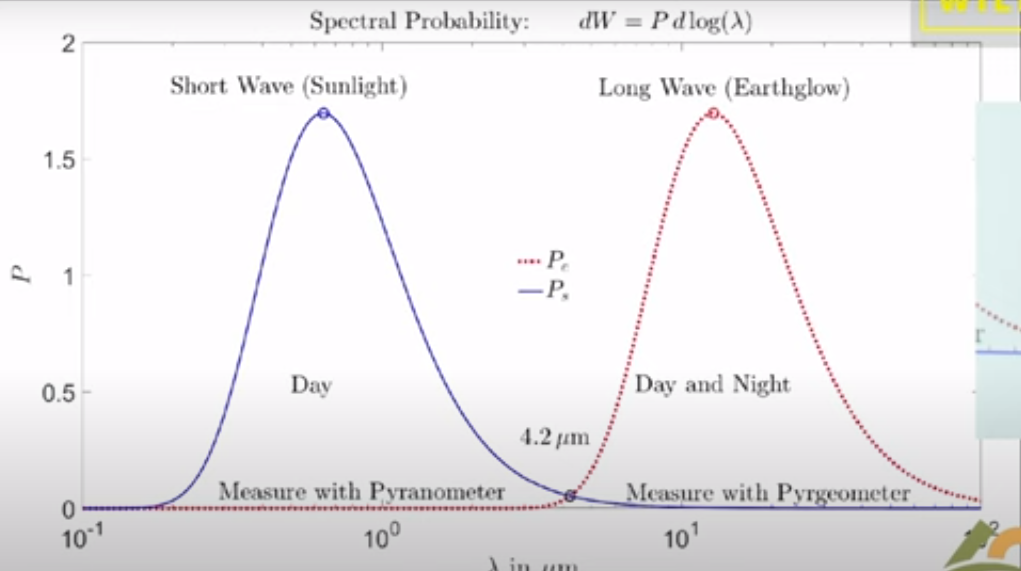
Now it’s important to remember that if you go out today the atmosphere is full of two types of radiation. There’s sunlight which you can see and then there is the thermal radiation that’s generated by greenhouse gases, by clouds and by the surface of the Earth. You can’t see thermal radiation but you you can feel it if it’s intense enough by its warming effect. And these curves practically don’t overlap so we’re really dealing with two completely different types of radiation.
There’s sunlight which scatters very nicely and off of not only clouds but molecules; it’s the blue sky the Rayleigh scattering. Then there’s the thermal radiation which actually doesn’t scatter at all on molecules so greenhouse gases are very good at absorbing thermal radiation but they don’t scatter it. But clouds scatter thermal radiation and plotted here is the probability that you will find Photon of sunlight between you know log of its wavelength and the log of in this interval of the wavelength scale.
Since Leslie’s day two types of instruments have been developed to do what he did more precisely. One of them is called a pyranometer and this is designed to measure sunlight coming down onto the Earth on a day like this. So you put this instrument out there and it would read the flux of sunlight coming down. It’s designed to see sunlight coming in every direction so it doesn’t matter which angle the sun is shining; it’s uh calibrated to see them all.
Let me show you a measurement by a pyranometer. This is a actually a curve from a sales brochure of a company that will sell you one of these devices. It’s comparing two types of detectors and as you can see they’re very good you can hardly tell the difference. The point is that if you look on a clear day with no clouds you see sunlight beginning to increase at dawn it peaks at noon and it goes down to zero and there’s no sunlight at night. So half of the day over most of the Earth there’s no sunlight in the in the atmosphere.
Here’s a day with clouds, it’s just a few days later shown by days of the year going across. You can see every time a cloud goes by the intensity hitting the ground goes down. With a little clear sky it goes up, then down up and so on. On average at this particular day you get a lot less sunlight than you did on the clear day.
But you know nature is surprising.Einstein had this wonderful quote: God is subtle but he’s not malicious. He meant that nature does all of sorts of things you don’t expect, and so let me show you what happens on a partly cloudy day. Here so this is data taken near Munich. The blue curve is the measurement and the red curve is is the intensity on the ground if there were no clouds. This is a partly cloudy day and you can see there are brief periods when the sunlight is much brighter on the detector on a cloudy day than it is on the clear day. And that’s because coming through clouds you get focusing from the edges of the cloud pointing down toward your detector. That means somewhere else there’s less radiation reaching the ground. But this is rather surprising to most people. I was very surprised to learn about it but it just shows that the actual details of climate are a lot more subtle than you might think.
We knnow that visible light only happens during the daytime and stops at night. There’s a second type of important radiation which is the thermal radiation which is measured by a similar divice. You have a silicon window that passes infrared, which is below the band gap of silicon, so it passes through it as though transparent. Then there’s some interference filters here to give you further discrimination against sunlight. So sunlight practically doesn’t go through this at all, so they call it solar solar blind since it doesn’t see the Sun.
But it sees thermal radiation very clearly with a big difference between this device and the sunlight sensing device I showed you. Because actually most of the time this is radiating up not down. Out in the open air this detector normally gets colder than the body of the instrument. And so it’s carefully calibrated for you to compare the balance of down coming radiation with the upcoming radiation. Upcoming is normally greater than downcoming.
I’ll show you some measurements of the downwelling flux here; these are actually in Greenland in Thule and these are are watts per square meter on the vertical axis here. The first thing to notice is that the radiation continues day and night you can you if you look at the output of the pyrgeometer you can’t tell whether it’s day or night because the atmosphere is just as bright at night as it is during the day. However, the big difference is clouds: on a cloudy day you get a lot more downwelling radiation than you do on a clear day. Here’s a a near a full day of clear weather there’s another several days of clear weather. Then suddenly it gets cloudy. Radiation rises because the bottoms of the clouds are relatively warm at least compared to the clear sky. I think if you put the numbers In, this cloud bottom is around 5° Centigrade so it was fairly low Cloud. it was summertime in Greenland and this compares to about minus 5° for the clear sky.
So there’s a lot of data out there and there really is downwelling radiation there no no question about that you measure it routinely. And now you can do the same thing looking down from satellites so this is a picture that I downloaded a few weeks ago to get ready for this talk from Princeton and it was from Princeton at 6 PM so it was already dark in Europe. So this is a picture of the Earth from a geosynchronous satellite that’s parked over Ecuador. You are looking down on the Western Hemisphere and this is a filtered image of the Earth in Blue Light at 47 micrometers. So it’s a nice blue color not so different from the sky and it’s dark where the sun has set. There’s still a fair amount of sunlight over the United States and the further west.
Here is exactly the same time and from the same satellite the infrared radiation coming up at 10.3 which is right in the middle of the infrared window where there’s not much Greenhouse gas absorption; there’s a little bit from water vapor but very little, trivial from CO2.
As you can see, you can’t tell which side is night and which side is day. So even though the sun has set over here it is still glowing nice and bright. There’s sort of a pesky difference here because what you’re looking at here is reflected sunlight over the intertropical Convergence Zone. There are lots of high clouds that have been pushed up by the convection in the tropics and uh so this means more visible light here. You’re looking at emission of the cloud top so this is less thermal light so white here means less light, white there means more light so you have to calibrate your thinking. to
But the Striking thing about all of this: if you can see the Earth is covered with clouds, you have to look hard to find a a clear spot of the earth. Roughly half of the earth maybe is clear at any given time but most of it’s covered with clouds. So if anything governs the climate it is clouds and and so that’s one of the reasons I admire so much the work that Svensmark and Nir Shaviv have done. Because they’re focusing on the most important mechanism of the earth: it’s not Greenhouse Gases, it’s Clouds. You can see that here.
Now this is a single frequency let me show you what happens if you look down from a satellite and do look at the Spectrum. This is the spectrum of light coming up over the Sahara Desert measured from a satellite. And so here is the infrared window; there’s the 10.3 microns I mentioned in the previous slide it’s it’s a clear region. So radiation in this region can get up from the surface of the Sahara right up to outer space.
Notice that the units on these scales are very different; over the Sahara the top unit is 200, 150 over the Mediterranean and it’s only 60 over the South Pole. But at least the Mediterranean and the Sahara are roughly similar so the right side here these three curves on the right are observations from satellites and the three curves on the left are are calculations modeling that we’ve done. The point here is that you can hardly tell the difference between a model calculation and observed radiation.
So it’s really straightforward to calculate radiation transfer. If someone quotes you a number in watts per square centimeter you should take it seriously; that probably a good number. If they tell you a temperature you don’t know what to make about it. Because there’s a big step between going from watts per square centimeter to a temperature change. All the mischief in the whole climate business is going from watts per square centimeter to to Centigrade or Kelvin.
Now I will say just a few words about clear sky because that is the simplest. Then we’ll get on to clouds, the topic of this talk. This is a calculation with the same codes that I showed you in the previous slide which as you saw work very well. It’s worth spending a little time because this is the famous Planck curve that was the birth of quantum mechanics. There is Max Planck who figured out what the formula for that curve is and why it is that way. This is what the Earth would radiate at 15° Centigrade if there were no greenhouse gases. You would get this beautiful smooth curve the Planck curve. If you actually look at the Earth from the satellites you get a raggedy jaggedy black curve. We like to call that the Schwarzchild curve because Carl Schwarzchild was the person who showed how to do that calculation. Tragically he died during World War I, a Big Big loss to science.
There are two colored curves that I want to draw your attention. The green curve is is what Earth would radiate to space if you took away all the CO2 so it only differs from the black curve you know in the CO2 band here this is the bending band of CO2 which is the main greenhouse effect of CO2. There’s a little additional effect here which is the asymmetric stretch but it it doesn’t contribute very much. Then here is a red curve and that’s what happens if you double CO2.
So notice the huge asymmetry. If taking all 400 parts per million of CO2 away from the atmosphere causes this enormous change 30 watts per square meter, the difference between this green 307 and and the black 277, that’s 30 watts per square meter. But if you double CO2 you practically don’t make any change. This is the famous saturation of CO2. At the levels we have now doubling CO2, a 100% Increase of CO2 only changes the radiation to space by 3 watts per square meter. The difference between 274 for the red curve and 277 for the curve for today. So it’s a tiny amount: for 100% increase in CO2 a 1% decrease of radiation to space.
That allows you to estimate the feedback-free climate sensitivity in your head. I’ll talk you through the feedback-free climate free sensitivity. So doubling CO2 is a 1% decrease of radiation to space. If that happens then the Earth will start to warm up. But it will radiate as the fourth power of the temperature. So temperature starts to rise but if you’ve got a fourth power, the temperature only has to rise by one-quarter of a percent absolute temperature. So a 1% forcing in watts per square centimeter is a one-quarter percent of temperature in Kelvin. Since the ambient Kelvin temperature is about 300 Kelvin (actually a little less) a quarter of that is 75 Kelvin. So the feedback free equilibrium climate sensitivity is less than 1 Degree. It’s 0.75 Centigrade. It’s a number you can do in your head.
So when you hear about 3 centigrade instead of .75 C that’s a factor of four, all of which is positive feedback. So how is there really that much positive feedback? Because most feedbacks in nature are negative. The famous Le Chatelier principle which says that if you perturb a system it reacts in a way to to dampen the perturbation not increase it. There are a few positive feedback systems that were’re familiar with for example High explosives have positive feedback. So if the earth’s climate were like other positive feedback systems, all of them are highly explosive, it would have exploded a long time ago. But the climate has never done that, so the empirical observational evidence from geology is that the climate is like any other feedback system it’s probably negative Okay so I leave that thought with you and and let me stress again:
This is clear skies no clouds; if you add clouds all this does is suppress the effects of changes of the greenhouse gas.
So now let’s talk about clouds and the theory of clouds, since we’ve already seen clouds are very important. Here is the formidable equation of transfer which has been around since Schwarzchild’s day. So some of the symbols here relate to the intensity, another represents scattering. If you have a thermal radiation on a greenhouse gas where it comes in and immediately is absorbed, there’s no scattering at all. If you hit a cloud particle it will scatter this way or that way, or some maybe even backwards.
So all of that’s described by this integral so you’ve got incoming light at One Direction and you’ve got outgoing light at a second Direction. And then at the same time you’ve got thermal radiation so the warm particles of the cloud are are emitting radiation creating photons which are coming out and and increasing the Earth glow the and this is represented by two parameters. Even a single cloud particle has an albedo, this is is the fraction ofradiation that hits the cloud that is scattered as opposed to absorbed and being converted to heat. It’s a very important parameter for visible light and white clouds, typically 99% of the encounters are scattered. But for thermal radiation it’s much less. So water scatters thermal radiation only half as efficiently as shorter wavelengths.
The big problem is that in spite of all the billions of dollars that we have spent, these things which should be known and and would have been known if there hadn’t been this crazy fixation on carbon dioxide and greenhouse gases. And so we’ve neglected working on these areas that are really important as opposed to the trivial effects of greenhouse gases. Attenuation in a cloud is both scattering and absorption. Of course you have to solve these equations for every different frequency of the light because especially for molecules, there’s a strong frequency dependence.
In summary, let me show you this photo which was taken by Harrison Schmitt who was a friend of mine on one of the first moonshots. It was taken in December and looking at this you can see that they were south of Madagascar when the photograph was taken. You can see it was Winter because here the Intertropical Convergence Zone is quite a bit south of the Equator; it’s moved Way South of India and Saudi Arabia. By good luck they had the sun behind them so they had the whole earth Irradiated.
There’s a lot of information there and and again let me draw your attention to how much of the Earth is covered with clouds. So only very small parts of the Earth can actually be directly affected by greenhouse gases, of the order of half. The takeaway message is that clouds and water vapor are much more important than greenhouse gases for earth’s climate. The second point is the reason they’re much more important: doubling CO2 as I indicated in the middle of the talk only causes a 1% difference of radiation to space. It is a very tiny effect because of saturation. You know people like to say that’s not so, but you can’t really argue that one, even the IPCC gets the same numbers that we do.
And you also know that covering half of the sky with clouds will decrease solar heating by 50%. So for clouds it’s one to one, for greenhouse gases it’s a 100 to one. If you really want to affect the climate, you want to do something to the clouds. You will have a very hard time making any difference with Net Zero with CO2 if you are alarmed about the warmings that have happened.
So one would hope that with all the money that we’ve spent trying to turn CO2 into a demon that some good science has come out of it. Fom my point of view this is a small part of it, this scattering theory that I think will be here a long time after the craze over greenhouse gases has gone away. I hope there will be other things too. You can point to the better instrumentation that we’ve got, satellite instrumentation as well as ground instrumentation. So that’s been a good investment of money. But the money we’ve spent on supercomputers and modeling has been completely wasted in my view.


You must be logged in to post a comment.