Global warming, climate change, all these things are just a dream come true for politicians. I deal with evidence and not with frightening computer models because the seeker after truth does not put his faith in any consensus. The road to the truth is long and hard, but this is the road we must follow. People who describe the unprecedented comfort and ease of modern life as a climate disaster, in my opinion have no idea what a real problem is.
As state and federal policies mandate the electrification of virtually all end uses to reduce carbon emissions from fossil fuels. For example, 18 states have adopted California’s Advanced Clear Car II rules requiring increasing percentages of new vehicle sales to be EVs, reaching 100% for the 2035 model year. In 2019, New York City enacted Local Law 97, which requires all residential buildings larger than 25,000 square feet to convert to electricity by 2035. Other states, such as New Jersey seek to convert all residential heating to electricity.
As state and federal policies mandate the electrification of virtually all end uses to reduce carbon emissions from fossil fuels. For example, 18 states have adopted California’s Advanced Clear Car II rules requiring increasing percentages of new vehicle sales to be EVs, reaching 100% for the 2035 model year. In 2019, New York City enacted Local Law 97, which requires all residential buildings larger than 25,000 square feet to convert to electricity by 2035. Other states, such as New Jersey seek to convert all residential heating to electricity.
Together, mandates for electric vehicles (EVs) and electrification of space and water heat will likely double electricity consumption and peak demand. Coupled with policies that mandate supplying the nation’s electricity with zero-emissions resources, notably intermittent wind and solar power, not only will electricity prices continue to increase but the ability to meet consumers’ increased demand will become more problematic.
One would assume that mandates requiring consumers to switch to electricity would recognize the need for the additional infrastructure needed to meet increased demand. One would be wrong. Not just the additional generating resources to replace the coal and natural gas plants being shuttered, but also the new transmission lines, transformers, and upgraded distribution lines that will be needed to handle the increased loads, especially when demand peaks, such as in the early evening hours.
That infrastructure will be costly. The infrastructure needed for an all-EV future alone will likely cost between$2 and $4 trillion. Additional infrastructure to handle increased demand from switching space and water heat to electric heat pumps, as policymakers have proposed, will drive costs even higher.
The OPEC oil embargoes of the 1970s clearly demonstrated the link between energy prices and economic growth. By increasing the cost to produce most goods and services, the embargoes exacerbated inflation and caused the U.S. economy to fall into recession. The same relationship holds for electricity, especially as electricity becomes the “fuel” for more end uses: higher electric prices mean reduced economic growth, leading to a lower standard of living and greater economic hardship for consumers.
Among the nation’s electric grid operators, the twin policies of forcing greater electrification and requiring it to be met primarily with intermittent wind and solar generation are creating concerns that reliability will suffer, leading to widescale blackouts. For example, the New York Independent System Operator estimates that it will need almost 30,000 MW – roughly the size of 30 nuclear plants – of “Dispatchable Emissions-free Resources” by 2030. Although NYISO states that DEFRs are “not yet available on a commercial scale,” in fact, they don’t exist. Assuming a non-existent generating technology will be invented, commercialized, and deployed on a large scale in just six years is a technological and economic fantasy.
Hence, to address the lack of needed electric infrastructure, instead policymakers plan to restrict access to the electricity they have decreed consumers must use. The idea is to “manage” electricity demand rather than build the infrastructure necessary to allow consumers access to the electricity they need when they need it.
For residential customers the mechanisms to do so include time-of-use pricing, akin to the “surge” pricing used by Uber, which raises prices when demand is greatest; and direct load control, whereby utilities control when and how much consumers can use their large electric-consuming appliances. Home EV chargers will be the largest electricity users for many households and as they proliferate, they will impose the greatest demand on local grids. Another idea is for local utilities to use EVs as resources – draining EV batteries when the utility requires additional electricity to meet demand.
For large commercial and industrial customers, it includes interruptible contracts, whereby the local utility or grid operator can shut off the customer’s electricity for a specified duration in exchange for a lower electricity price.
Electricity consumption can be “managed” or even reduced by restricting consumers’ access to it or by charging prohibitively high prices when they most want that access. But doing so has a real economic cost, which policymakers have ignored.
The result will be greater consumer inconvenience, higher costs, lower economic growth, and greater economic hardship. While some environmentalists may consider such an outcome a “feature” and not a “bug,” presumably most consumers will not.
Jonathan Lesser is a senior fellow with the National Center for Energy Analytics and the president of Continental Economics. This article is adapted from a forthcoming report on electric planning and infrastructure.
This article was originally published by RealClearEnergy and made available via RealClearWire.
We need to wake up and stop hemorrhaging trillions in self-inflicted climate policies that will mainly benefit Beijing
We need to wake up and stop hemorrhaging trillions in self-inflicted climate policies that will mainly benefit Beijing
Starting in the 1990s, climate change has become a fixation for rich country politicians and elites. It emerged as the world had just seen the end of the Cold War. There was relative peace and trust across the world, broad economic growth, and swift progress being made against poverty. In the capitals of Europe in particular, it felt like most of the planet’s big problems were fixed, so climate change was the final frontier.
These proponents of climate action advocated with relish the goal of ending reliance on the very fossil fuels that had powered two centuries of astonishing growth. Sure, this would cost hundreds of trillions of dollars, but there would always be more growth. The Telegraph has the story.
What a naïve, narrow-minded world view. Time has not been kind to the foolish idea that climate change was humanity’s sole remaining problem – or that the planet would unite to solve it. Geopolitics and economics mean a rapid global transition from fossil fuels is impossible.
As has long been clear for many, the majority of the world never shared this myopic focus on climate change. Despite immense progress, in some countries life remains a battle against poverty, hunger, and disease. In many more countries including India, the top priority is to create more jobs and life-changing growth and development. Outside the most advanced economies, climate change has understandably always been a relatively low voter priority.
Leaders from Europe and the United States talk up “net zero” as though it has global support. But this unity is quickly revealed as a mirage. For one thing, the destabilizing axis of Russia, Iran and North Korea are not about to support western efforts to solve climate change. Indeed, according to McKinsey, achieving the net-zero target would require Russian climate policies costing $273 billion every year – around three-times what Russia spent on its military last year. That won’t happen.
The geopolitical challenges run even deeper. China’s growth has relied on burning ever more coal. It is the world’s preeminent greenhouse gas emitter, with the largest increase of any nation last year. Renewable energy made 40 per cent of China’s primary energy in 1971, reducing to 7 per cent by 2011 as it ramped up coal use. Since then, renewables have inched up to 10 per cent. Strong climate action could cost China nearly a trillion dollars annually, hurting its journey toward becoming a rich nation.
The reality is that most of the world – including powerhouse India and emerging economies – will continue to focus on becoming richer, often with fossil fuels. Russia and its ilk will ignore the fixation on climate change altogether. And China will make money from selling the West solar panels and electric cars, while only modestly curbing its own emissions.
As rich countries irresponsibly attempt to export the cost of climate policy to poor countries through carbon adjustment taxes, they will drive a further wedge into an already fractured world.
Meanwhile, despite all the hype, wealthy countries have ever less money left for the climate fight. Annual growth per person among rich countries declined from 4 per cent in the 1960s to 2 per cent in the 1990s. It now hovers just above one percent. Many of these countries face pressure to spend more on defense, healthcare and infrastructure, as geopolitical pressures and changing demographics make their pathway to stability and growth far less certain.
Yet, across Europe and North America, single-minded zealots who were born of a world of relative calm of the 1990s continue to push for deindustrialization and immiseration to tackle climate change – including for the world’s emerging economies.
The best context for understanding decadal temperature changes comes from the world’s sea surface temperatures (SST), for several reasons:
The ocean covers 71% of the globe and drives average temperatures;
SSTs have a constant water content, (unlike air temperatures), so give a better reading of heat content variations;
Major El Ninos have been the dominant climate feature in recent years.
HadSST is generally regarded as the best of the global SST data sets, and so the temperature story here comes from that source. Previously I used HadSST3 for these reports, but Hadley Centre has made HadSST4 the priority, and v.3 will no longer be updated. HadSST4 is the same as v.3, except that the older data from ship water intake was re-estimated to be generally lower temperatures than shown in v.3. The effect is that v.4 has lower average anomalies for the baseline period 1961-1990, thereby showing higher current anomalies than v.3. This analysis concerns more recent time periods and depends on very similar differentials as those from v.3 despite higher absolute anomaly values in v.4. More on what distinguishes HadSST3 and 4 from other SST products at the end. The user guide for HadSST4 is here.
The Current Context
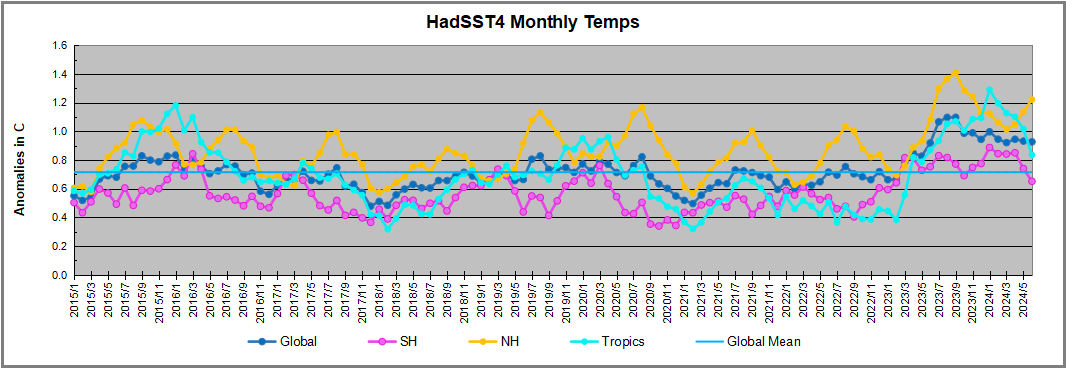
The chart below shows SST monthly anomalies as reported in HadSST4 starting in 2015 through June 2024. A global cooling pattern is seen clearly in the Tropics since its peak in 2016, joined by NH and SH cycling downward since 2016.
Note that in 2015-2016 the Tropics and SH peaked in between two summer NH spikes. That pattern repeated in 2019-2020 with a lesser Tropics peak and SH bump, but with higher NH spikes. By end of 2020, cooler SSTs in all regions took the Global anomaly well below the mean for this period.
Then in 2022, another strong NH summer spike peaked in August, but this time both the Tropic and SH were countervailing, resulting in only slight Global warming, later receding to the mean. Oct./Nov. temps dropped in NH and the Tropics took the Global anomaly below the average for this period. After an uptick in December, temps in January 2023 dropped everywhere, strongest in NH, with the Global anomaly further below the mean since 2015.
Then came El Nino as shown by the upward spike in the Tropics since January 2023, the anomaly nearly tripling from 0.38C to 1.09C. In September 2023, all regions rose, especially NH up from 0.70C to 1.41C, pulling up the global anomaly to a new high for this period. By December, NH cooled to 1.1C and the Global anomaly down to 0.94C from its peak of 1.10C, despite slight warming in SH and Tropics.
In January 2024 both Tropics and SH rose, resulting in Global Anomaly going higher. Since then Tropics have cooled from a peak of 1.29C down to 0.84C. SH also dropped down from 0.89C to 0.65C. NH lost ~0.4C as of March 2024, but has risen 0.2C over the last 3 months Despite that upward NH bump, the Global SST anomaly cooled further. The next months will reveal the strength of 2024 NH warming spike, which could resemble summer 2020, or could rise to the 2023 level.
Comment:
The climatists have seized on this unusual warming as proof their Zero Carbon agenda is needed, without addressing how impossible it would be for CO2 warming the air to raise ocean temperatures. It is the ocean that warms the air, not the other way around. Recently Steven Koonin had this to say about the phonomenon confirmed in the graph above:
El Nino is a phenomenon in the climate system that happens once every four or five years. Heat builds up in the equatorial Pacific to the west of Indonesia and so on. Then when enough of it builds up it surges across the Pacific and changes the currents and the winds. As it surges toward South America it was discovered and named in the 19th century It is well understood at this point that the phenomenon has nothing to do with CO2.
Now people talk about changes in that phenomena as a result of CO2 but it’s there in the climate system already and when it happens it influences weather all over the world. We feel it when it gets rainier in Southern California for example. So for the last 3 years we have been in the opposite of an El Nino, a La Nina, part of the reason people think the West Coast has been in drought.
It has now shifted in the last months to an El Nino condition that warms the globe and is thought to contribute to this Spike we have seen. But there are other contributions as well. One of the most surprising ones is that back in January of 2022 an enormous underwater volcano went off in Tonga and it put up a lot of water vapor into the upper atmosphere. It increased the upper atmosphere of water vapor by about 10 percent, and that’s a warming effect, and it may be that is contributing to why the spike is so high.
A longer view of SSTs
The graph above is noisy, but the density is needed to see the seasonal patterns in the oceanic fluctuations. Previous posts focused on the rise and fall of the last El Nino starting in 2015. This post adds a longer view, encompassing the significant 1998 El Nino and since. The color schemes are retained for Global, Tropics, NH and SH anomalies. Despite the longer time frame, I have kept the monthly data (rather than yearly averages) because of interesting shifts between January and July. 1995 is a reasonable (ENSO neutral) starting point prior to the first El Nino.
The sharp Tropical rise peaking in 1998 is dominant in the record, starting Jan. ’97 to pull up SSTs uniformly before returning to the same level Jan. ’99. There were strong cool periods before and after the 1998 El Nino event. Then SSTs in all regions returned to the mean in 2001-2.
SSTS fluctuate around the mean until 2007, when another, smaller ENSO event occurs. There is cooling 2007-8, a lower peak warming in 2009-10, following by cooling in 2011-12. Again SSTs are average 2013-14.
Now a different pattern appears. The Tropics cooled sharply to Jan 11, then rise steadily for 4 years to Jan 15, at which point the most recent major El Nino takes off. But this time in contrast to ’97-’99, the Northern Hemisphere produces peaks every summer pulling up the Global average. In fact, these NH peaks appear every July starting in 2003, growing stronger to produce 3 massive highs in 2014, 15 and 16. NH July 2017 was only slightly lower, and a fifth NH peak still lower in Sept. 2018.
The highest summer NH peaks came in 2019 and 2020, only this time the Tropics and SH were offsetting rather adding to the warming. (Note: these are high anomalies on top of the highest absolute temps in the NH.) Since 2014 SH has played a moderating role, offsetting the NH warming pulses. After September 2020 temps dropped off down until February 2021. In 2021-22 there were again summer NH spikes, but in 2022 moderated first by cooling Tropics and SH SSTs, then in October to January 2023 by deeper cooling in NH and Tropics.
Then in 2023 the Tropics flipped from below to well above average, while NH produced a summer peak extending into September higher than any previous year. Despite El Nino driving the Tropics January 2024 anomaly higher than 1998 and 2016 peaks, following months cooled in all regions, and the Tropics continued cooling in April, May and June along with SH dropping, suggesting that the peak likely has been reached, though NH warming is the outlier.
What to make of all this? The patterns suggest that in addition to El Ninos in the Pacific driving the Tropic SSTs, something else is going on in the NH. The obvious culprit is the North Atlantic, since I have seen this sort of pulsing before. After reading some papers by David Dilley, I confirmed his observation of Atlantic pulses into the Arctic every 8 to 10 years.
Contemporary AMO Observations
Through January 2023 I depended on the Kaplan AMO Index (not smoothed, not detrended) for N. Atlantic observations. But it is no longer being updated, and NOAA says they don’t know its future. So I find that ERSSTv5 AMO dataset has current data. It differs from Kaplan, which reported average absolute temps measured in N. Atlantic. “ERSST5 AMO follows Trenberth and Shea (2006) proposal to use the NA region EQ-60°N, 0°-80°W and subtract the global rise of SST 60°S-60°N to obtain a measure of the internal variability, arguing that the effect of external forcing on the North Atlantic should be similar to the effect on the other oceans.” So the values represent sst anomaly differences between the N. Atlantic and the Global ocean.
The chart above confirms what Kaplan also showed. As August is the hottest month for the N. Atlantic, its variability, high and low, drives the annual results for this basin. Note also the peaks in 2010, lows after 2014, and a rise in 2021. Now in 2023 the peak was holding at 1.4C before declining. An annual chart below is informative:
Note the difference between blue/green years, beige/brown, and purple/red years. 2010, 2021, 2022 all peaked strongly in August or September. 1998 and 2007 were mildly warm. 2016 and 2018 were matching or cooler than the global average. 2023 started out slightly warm, then rose steadily to an extraordinary peak in July. August to October were only slightly lower, but by December cooled by ~0.4C.
Now in 2024 the AMO anomaly started higher than any previous year, then leveled off for two months declining slightly into April. Remarkably, May shows an upward leap putting this on a higher track than 2023, and rising slightly higher in June. The next months will show us if that warming strengthens or levels off.
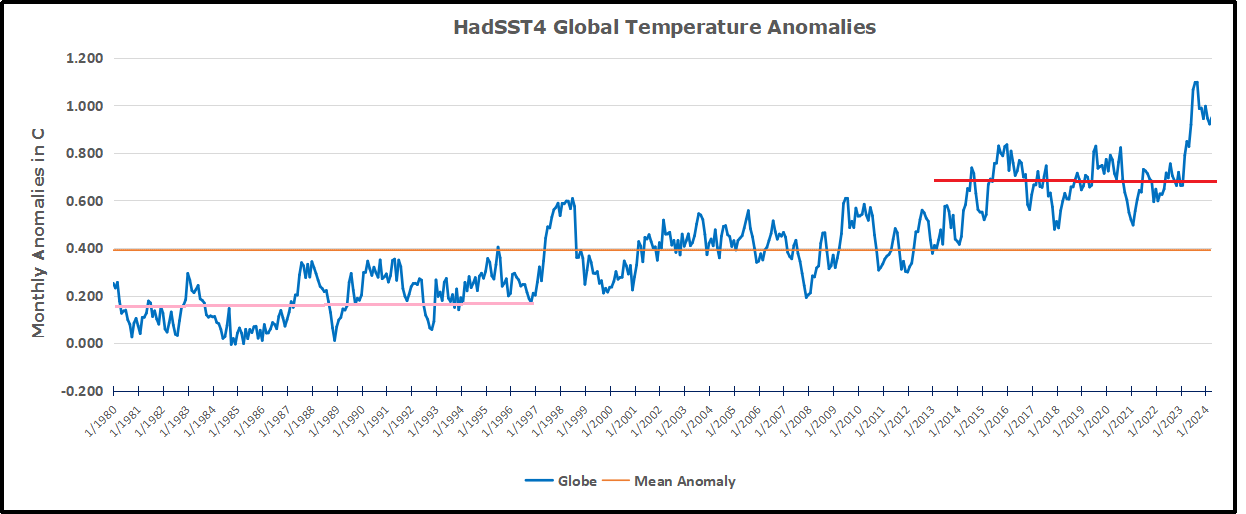
The pattern suggests the ocean may be demonstrating a stairstep pattern like that we have also seen in HadCRUT4.
The purple line is the average anomaly 1980-1996 inclusive, value 0.18. The orange line the average 1980-202404, value 0.39, also for the period 1997-2012. The red line is 2013-202404, value 0.66. As noted above, these rising stages are driven by the combined warming in the Tropics and NH, including both Pacific and Atlantic basins.
The oceans are driving the warming this century. SSTs took a step up with the 1998 El Nino and have stayed there with help from the North Atlantic, and more recently the Pacific northern “Blob.” The ocean surfaces are releasing a lot of energy, warming the air, but eventually will have a cooling effect. The decline after 1937 was rapid by comparison, so one wonders: How long can the oceans keep this up? And is the sun adding forcing to this process?
Space weather impacts the ionosphere in this animation. Credits: NASA/GSFC/CIL/Krystofer Kim
Footnote: Why Rely on HadSST4
HadSST is distinguished from other SST products because HadCRU (Hadley Climatic Research Unit) does not engage in SST interpolation, i.e. infilling estimated anomalies into grid cells lacking sufficient sampling in a given month. From reading the documentation and from queries to Met Office, this is their procedure.
HadSST4 imports data from gridcells containing ocean, excluding land cells. From past records, they have calculated daily and monthly average readings for each grid cell for the period 1961 to 1990. Those temperatures form the baseline from which anomalies are calculated.
In a given month, each gridcell with sufficient sampling is averaged for the month and then the baseline value for that cell and that month is subtracted, resulting in the monthly anomaly for that cell. All cells with monthly anomalies are averaged to produce global, hemispheric and tropical anomalies for the month, based on the cells in those locations. For example, Tropics averages include ocean grid cells lying between latitudes 20N and 20S.
Gridcells lacking sufficient sampling that month are left out of the averaging, and the uncertainty from such missing data is estimated. IMO that is more reasonable than inventing data to infill. And it seems that the Global Drifter Array displayed in the top image is providing more uniform coverage of the oceans than in the past.
USS Pearl Harbor deploys Global Drifter Buoys in Pacific Ocean
For years, particularly in Western Europe, Green activists and left-leaning politicians successfully frightened voters into accepting rising prices and cumbersome lifestyle changes to battle a so-called climate change “crisis.”
For years, particularly in Western Europe, Green activists and left-leaning politicians successfully frightened voters into accepting rising prices and cumbersome lifestyle changes to battle a so-called climate change “crisis.”
But this seems to have abruptly ended in 2024.
The recent EU elections last month suggest that the Green strangulation of jobs and living standards is finally weakening.
Geert Wilders’ Netherlands conservative and farmers alliance won six seats in the EU Parliament, while the leftist Green and Labour Party alliance fell to eight seats.
The conservative Alternative für Deutschland party gained strength to become the second largest in Germany, while Greens lost 17 of the 71 seats they’d won in 2019.
Overall, the Euro elections gave “centrist” parties a majority in the European Parliament, while conservative parties gained significant strength. This likely means a more conservative EU Parliament will not enact any new “ambitious” climate or energy policies, but it will also mean it cannot easily roll back existing laws either. At least this go-round.
The pushback against radical climate policies is encouraging and has been bubbling up more and more in recent times. It started when French protesters in bright yellow vests (Gilets Jaunes) clogged Paris streets, railing against fuel tax hikes and other injustices back in 2019. It was stalled a bit by the COVID pandemic, but then resumed in full force earlier this year when convoys of German, Irish and Dutch farmers dramatized their outrage over “climate action” plans to restrict nitrogen fertilizers, cull cattle herds and close thousands of farms.
British and German voters seethed mostly in their homes and pubs. Brits were incensed that high energy prices are driving industries and jobs overseas and making it impossible for many families to heat homes properly in wintertime, while forests of wind turbines blight rural and ocean areas.
Germans also blew gaskets as their electricity prices became the highest worldwide, and their schizophrenic government bulldozed an ancient village to mine coal, leveled a forest to erect wind turbines, tore down wind turbines to mine more coal, and imported gas because it has banned fracking.
In addition to the insanity noted above, Euro politicians added to the dismay when they decreed that summer Olympics athletes will have no air conditioning; cars can enter London only if they pay outrageous fees; only electric vehicles can be sold after 2035; and lights to be turned off on public buildings and monuments. In Germany, people were actually being urged to take one 5-minute shower per day, and informed that in wintertime public buildings will be no warmer than 66 degrees F, while only one room should be heated in their private homes.
The obsession with climate change and going “Net Zero” also sent average gasoline prices soaring up to $8.24 a gallon in Europe. While average residential electricity costs have risen to 15¢ per kilowatt-hour in the United States (thanks to our own foolish “Net Zero” efforts) – In Europe they’ve already skyrocketed to 31¢ in Britain and 36¢ in Germany. Many European pensioners and families cannot afford to heat their homes properly, and thousands die every winter from hypothermia and diseases they’d survive if they weren’t so cold.
Such developments no doubt played an important role in the EU election results. However, don’t expect the Greens and their liberal allies in the Old World to roll over and play dead. European Commission President Ursula von der Leyen and her allies are already scheming to ignore the voters and freeze conservative leaders such as Mme Le Pen and Italian PM Meloni out of important climate, energy, immigration and taxation matters – and may forge alliances with remaining Greens.
Meanwhile, those on the Left have bounced back, somewhat, in the UK. Disillusioned British voters elected progressive Labour politicians and Prime Minister Keir Starmer. They dumped “conservative” Tories who had mismanaged the economy and drifted so far leftward that they were almost indistinguishable from Tories, especially on energy.
However, the Greens can’t be overly exuberant. Brits also elected Nigel Farage and four of his Reform UK allies. They reject climate-obsessed energy policies – and will erect significant obstacles to Mr. Starmer’s far-left policies.
The Euro elections suggest that US politicians who want to restore America’s freedom and prosperity should never offer “less bad” alternatives to the fundamentally destructive policies the Green Left. Conservative politicians should repeatedly emphasize that unreliable energy systems raise energy and food prices, wreak havoc on the environment, send jobs and factories to China, and ensure more blackouts.
In short, they are a road to a hellish Green serfdom — not to prosperity or a cleaner environment.
Probably very few readers here are old enough to remember China’s “Great Leap Forward.” You’d have to be my age (73 – born in 1950), or close to it, to remember the GLF from reading about it at the time. The name “Great Leap Forward” refers to Mao Zedong’s second Five Year Plan, launched in 1958, and intended to catapult China’s economy from backwardness into modernity. This was to be not just any old central planning project, but a whole new approach designed by the really smart people to correct the mistakes and failures that the Soviet Union had encountered on the road to communism. This time, they were going to get central planning right.
Probably very few readers here are old enough to remember China’s “Great Leap Forward.” You’d have to be my age (73 – born in 1950), or close to it, to remember the GLF from reading about it at the time. The name “Great Leap Forward” refers to Mao Zedong’s second Five Year Plan, launched in 1958, and intended to catapult China’s economy from backwardness into modernity. This was to be not just any old central planning project, but a whole new approach designed by the really smart people to correct the mistakes and failures that the Soviet Union had encountered on the road to communism. This time, they were going to get central planning right.
Yesterday the Biden Administration launched a significant new climate initiative with a design that has some remarkable resemblances to the Great Leap Forward. Since most readers probably don’t know how the Great Leap Forward worked out, I’ll save that for the end of the post.
The new Biden Administrative initiative is called “Community-Driven Solutions to Cut Climate Pollution Across America.” The press release from the EPA is here. Nick Pope covered the new initiative in this post at the Daily Caller, which was then also re-posted at Watts Up With That here.
This new initiative is just one small piece of the vast economic waste of the falsely-named Inflation Reduction Act, with its multi-trillion dollars of subsidies for uneconomic projects. But the “community-driven” tag line here is what brings the memory of the Great Leap Forward. The basic idea is that the new investments and technologies to transform our energy economy are going to come from federal selection and subsidizing of various projects originating out of state and local governments, otherwise known as “communities.” From the EPA release:
Today, July 22, . . . the U.S. Environmental Protection Agency announced selected recipients of over $4.3 billion in Climate Pollution Reduction Grants to implement community-driven solutions that tackle the climate crisis. . . . The grants will fund projects supporting the deployment of technologies and programs to reduce greenhouse gases and other harmful pollution across the country. . . . Together, these selected projects will implement ambitious climate pollution reduction measures designed by states, Tribes and local governments that will achieve significant cumulative GHG reductions by 2030 and beyond.
Enough of the outmoded idea that the way to an efficient and reliable energy system is through profit-driven businesses competing with each other to find the most cost-effective solutions. The new idea is that local governments, aka “communities,” run the economy, directed and supported by some lavish funding from the feds. Here is the quote from Biden Administration “climate czar” John Podesta:
“President Biden’s Climate Pollution Reduction Grants put local governments in the driver’s seat to develop climate solutions that work for their communities.”
Pope gives some examples of the kinds of projects that will be getting the funding:
The projects include electric vehicle (EV) charging station construction, funds to help local governments expedite green energy siting and programs to enhance heat pump adoption.
The unifying aspect of all of these projects is that they are uneconomic and would never be adopted by the people of their own choice with their own money. Thus there must be coercion through the federal funding and mandates from the local governments.
Compare this vision to China’s Great Leap Forward. A decent short history of the GLF can be found at the Association for Asian Studies here. The basic idea was that communes would be formed, of about 5500 households each, to become the main economic units, then taking direction from above as to what businesses to pursue:
The movement bore [Mao’s] characteristic faith in China’s bucolic masses—now unfettered by skeptical intellectuals—to surmount any obstacles and achieve a Communist utopia through unity, physical labor, and sheer willpower. In this final stage of collectivization, communes formed—each with some 5,500 households. . . .
In classic the central planning way, the businesses selected to be pursued were based on an ideological vision of utopia, rather than economic reality. The trendy thinking of the time was that strong and modern economies produced a lot of steel, so therefore making a lot of steel was proof of success. And thus the best-known example of the GLF’s folly in economic development was that every household was to build its own furnace to make steel:
One of the most infamous innovations of the Great Leap involved an industrial revolution in the countryside, where farmers constructed millions of backyard furnaces and then divided their time between tending crops and smelting steel.
This promptly led to myriad unintended consequences. Examples:
Gathering fuel to stoke all these furnaces resulted in the loss of at least 10 percent of China’s forests. . . . Rather than mining the ore to be smelted, everyone contributed iron implements, including tools, utensils, woks, doorknobs, shovels, window frames, and other everyday items, while children scoured the ground for iron nails and other scraps. . . . [T]he campaign essentially converted practical items into useless lumps of pig iron good only for clogging railroad yards. . . .
And as labor got diverted from productive uses to unproductive, the economy collapsed. It only took about a year:
Starvation became a widespread problem with the harvest of 1959. . . . As food reserves in the countryside diminished, peasants began dying in droves by the summer of 1960. They collapsed in fields, on roadsides, and even at home where family members watched their corpses rot, lacking the energy for burial or even to shoo away flies and rats. . . . Estimates of deaths directly related to the famine range from a minimum of twenty-three million to as many as fifty-five million, although the figure most often cited is thirty million.
Well, the good news is that this latest Biden program is a lousy $4.3 billion — big, but still not much more than a rounding error in the federal budget. The Inflation Reduction Act as a whole — touted as $1.5 trillion, but estimated by many to be more like $2-3 trillion — is not a rounding error. Devoting that kind of money to uneconomic and wealth-destroying projects can have disastrous consequences. I expect that we will escape the fate of China in the 1950s, but we can’t be sure until the climate crazies are defeated.
The Independent, a news site out of Southern Utah, ran an article recently titled “Fight Climate Change, Ignore the Poor,” in which writer Howard Sierer claims climate change activism neglects the needs of the poor in favor of their preferred policy goals. This is true. Anti-growth and green policies do far more harm than good for the poorest people in the world by stifling their access to cheap reliable energy.
The Independent, a news site out of Southern Utah, ran an article recently titled “Fight Climate Change, Ignore the Poor,” in which writer Howard Sierer claims climate change activism neglects the needs of the poor in favor of their preferred policy goals. This is true. Anti-growth and green policies do far more harm than good for the poorest people in the world by stifling their access to cheap reliable energy.
Sierer reports that the G-20 organization has called for $3 trillion per year in spending for developing nations, however more than half of that is supposed to be earmarked for climate, sustainability, and related infrastructure, with the rest going towards food and medical technology. Sierer points out that it doesn’t make much sense, “given the realities on the ground in many developing countries, places where opportunity is limited by a lack of the cheap and plentiful energy that allowed rich nations to develop.”
“Climate Change activists try to paper over these realities by arguing that poverty and climate change are inextricably linked,” Sierer continues, noting that time and again studies have shown “spending on core development priorities would help much more and much faster per dollar spent than applying funds to climate.”
He makes the point that investments on things like energy access, clean water, and medical infrastructure would help people right now, and improve weather resilience, but investments focused on cutting emissions “won’t deliver noticeably different outcomes for a generation or more, if ever.”
Sierer’s analysis is completely correct, backed up by research published by the Copenhagen Consensus Center, and by reporting on the ground by farmers in places like Africa, where a large portion of the population across the continent’s various nations live without consistent or reliable energy.
In the Climate Realism post, “Wrong, BBC, the Popular Kenyan Farmer Is Right, There Is No Climate Emergency, Africa Does Need Fossil Fuels,” I take a look at one farmer who has been leading the fight for energy access in his community. The climate activists at the BBC attempted to write a hit piece on him in an attempt to drive attention away from the real issues Kenyan subsistence farmers are facing, and the realistic solutions to their problems. The farmer, Jusper Machogu, lives in a poor area, and advocates for the modernization of farming for his family and neighbors. He is critical of “green” farming practices that lower yields and involve greater labor on the farmers’ part.
Modern synthetic fertilizers and fossil-fuel powered equipment have already begun to help African nations’ food production over time, reducing hunger and malnutrition, as discussed here, here, and here. Similarly, oil exploration and development is gradually increasing in African countries, as discussed here and here. This is despite the efforts of green NGOs and financial institutions which try to discourage development on the dark continent.
Not to mention, electricity and indoor heating that is made possible by fossil fuels drastically reduces the need for cooking and heating fuels like wood, crop waste, and dung, all of which are commonly used in poor nations. The indoor burning of wood, dung, and crop waste produces poor indoor air quality and results lung and heart ailments – leading causes of death in poor countries.
The poor of Africa and in other impoverished, energy-starved areas around the world are not clamoring for decarbonization, they are asking for reliable energy and the products and services and infrastructure it makes possible.
Sierer ends his article by explaining that despite more than $12 trillion spent on renewable worldwide, “global greenhouse gas emissions grew to an all-time high in 2023, with consumption of coal, oil, and natural gas each near record levels as worldwide energy demand continues to grow.”
This means that despite trillions in investments so far, there has been no identifiable benefit. Think what benefits those trillions could have delivered if devoted to traditional development, including modern energy infrastructure, in the world’s poorest countries.
Sierer points out that while getting rid of fossil fuels may result in some nebulous, distant supposed benefits, none of which have been proven, “the costs and disruption of rapid decarbonization are immediate and substantial.”
The Independent should be applauded for running this article. Sierer’s analysis hits the nail on the head that climate activism is more likely to be harming the world’s poor rather than helping them.
“Funny thing. The climate alarmists’ favorite energies–wind and solar–have ruined the margins of nuclear to cause premature retirements and a lack of private funding for new construction. So the fossil-fuel haters in the nuclear camp find themselves victimized by the climate crusade. It sure is hard being ‘nuclear green’.”
“Funny thing. The climate alarmists’ favorite energies–wind and solar–have ruined the margins of nuclear to cause premature retirements and a lack of private funding for new construction. So the fossil-fuel haters in the nuclear camp find themselves victimized by the climate crusade. It sure is hard being ‘nuclear green’.”
Being active on social media with several thousand followers, I actively engage with my critics for fun and profit. I learn much, and those who have chosen to follow me (6,400+) might also. But I have also attracted scorn, some of the worst kind. My foes are typically wed to an energy dependent on special government failure. The ideological, deep-ecology, Church-of-Climate types spare little invective about how I am a threat to the future. Arguments failing, ad hominem often follows,
I employ plenty of analysis and link to a variety of sources. I easily refute the ad hominem that comes my way. I have little to hide and believe that history has been kind to my multi-decade engagement on energy and climate issues. I refer the reader to my 1997 piece, “Renewable Energy: Not Cheap, Not ‘Green’” (commentary here and here) in regard to my views, then and now.
The latest comes from a zealot (bully?) from the nuclear power industry. Note that commercial nuclear has been radically uncompetitive, and government-dependent, from the beginning (the 1950s). The problem remains, whether large scale or “advanced, small” fission or fusion. Kennedy Maize is a reliable source on the latest nuclear news, which is not good.
Simply put, nuclear is the most complicated, fraught, expensive way to boil water to spin the turbines to generate electricity. It is not the cost of the enhanced uranium, the most dense energy of all. It is the cost and time to assemble so many parts with the redundancy and strength to contain an internal nuclear explosion.
Is nuclear safe? It certainly is supposed to be, and backed by a paucity of catastrophes. But why does the industry lobby and receive the (oft extended, never-ending) Price Anderson Act cap on liability in case of an accident? Why this federal law in place of private insurance companies judging each and every reactor for pricing and liability maximums, past which the nuclear-plant owner would risk its capital? I have never gotten a good answer on that, and with $12 billion collected in a utility accident fund, surely a transition is affordable.
The Exchange
The social media discussion began with my comment to a post by U.S. Department of Energy head Jennifer Granholm. “Exit please, DOE,” I said. “Time to stop subsidizing inefficiency.”
Your ad hominem backfires. I fought Enron hard on the company’s climate alarmism, wind/solar rent-seeking, and ‘political capitalism’ in general.
Then a foe of my classical liberal view, one Adam Brown, self-described nuclear business and operations consultant, went nuclear:
You didn’t fight anything Rob. You were a willing participant in robbing Eron employees and retirees of their life savings for personal gain. Now you use a fake charity to earn tax free income promoting your fossil industry.
I wish I was wrong Rob but you came out of the Enron collapse way more than whole while your fellow Enron employees lost their life savings. How’d you manage that? And your charity has no contributions or funding to disadvantaged beneficiaries. Other than being a tax write off for you and your fossil industry donors, how it that “charity”?
I give you credit for surviving the Eron collapse on very questionable financial footing and prospering through use of our nations “charity” loopholes some people take full advantage of. But your “charity” was created to peddle misinformation on behalf of the fossil industry and its investors to the severe economic, environmental, and physical health detriment of the vast majority of people.
I admit the things you’ve done and currently do for personal gain does bother people with higher moral standards. I probably take it to an extreme that I shouldn’t and I do try to temper. If you reduce your trolling and posting of misinformation, I’ll reduce my responding comments.
Your retreat here is not very convincing. How do you know my situation versus other people? I stood up for my convictions while at Enron and paid a price. I risked my job (read the memos). Your ad hominem is specious.
Principles has always come before money with me. A lot more money and reward on the other side, so well-funded by the climate industrial complex.
Note that I do not attack you for being in an industry based on the narrative of climate alarmism, an industry that is wildly uneconomic and dependent on government subsidies.
By the way, it is climate policy that is hurting the masses, not the gas of life, carbon dioxide that greens Planet Earth. Wind, solar, batteries–and nuclear–are not the answer but part of the problem.
Many People in the energy industry have a problem with you Rob. All of your personal claims of what happened at Enron and now your fake charity are countered by people that worked with or engaged with you. Lots of similar story trails. The worst thing you can do in any industry is burn bridges. You stood up alright…to get your piece of the pie and get out while the getting was good. Why was your exit so close to the end?
A person with principles doesn’t misinform people for a living. Like your hypocrisy regarding government subsidies and support. Fossil has received more government support over the span of a century than all other energy technologies combined. It’s not even close. And that doesn’t include the annual Billions the U.S. taxpayer is on the hook for the oil and gas industry.
“Gas of life”…the latest in a long line of fossil industry lies and misinformation. What kind of idiot believes that bullshit? ….
Vague, ignorant argumentation and hate talk make you the suspect character. Having this conversation with you adds to the record that I want to preserve.
[Note: Brown is making things up like “Many People in the energy industry have a problem with you Rob” …. “All of your personal claims of what happened at Enron and now your fake charity are countered by people that worked with or engaged with you.” No documentation, just wild innuendo. And this from a professional?]
Preserve all you want Rob. You can’t hide from your history and current activities nor change history. All you can do is attempt to rectify it which I’m sure you won’t do…there’s no easy tax free money in it.
I’d prefer not to have these engagements with you but you bring it on yourself. Your mission is obvious and that’s for our nation to regress, more of the same that has cost us beyond what we’ll ever fully recover from. Your mission for profit isn’t energy progress.
It’s funny how you never attempt to address my comments of what our countries thirst for oil and fossil fuels, and the associated greed, has cost us as a nation. You just ignore it because you can’t change factual history and the cumulative damage done. Your only solution to the problem of fossil is not to progress to something better or propose corrective actions for how to extract and burn fossil fuels cleaner and more efficiently…like a true “Energy Research” representative would. Your sole purpose is to push for more of the same, be part of the problem, disparage alternative solutions, and profit from it.
At least I envision a future that includes fossil fuels but shares the increasing world energy demand with clean(er) energy technologies.
Eight billion consumers can’t be wrong–and a half-century of Malthusian false alarms against fossil fuels speaks for itself. Ad hominem and hate talk are not very persuasive.
And no, fossil fuels are improving in every way on the technology side to improve economics and the environment. It is nuclear, your energy, that cannot improve but seems to be going backwards. Read the links I have already provided you on these points.
Final Comment
“Hate hurts the hater more than the hated,” the adage goes. Adam Brown has picked a government dependent industry—nuclear power—that has always been a loser. (He claims a 40-year history of success, but can he tell us about the nuclear plants that were completed under budget and ahead of schedule? Maybe none–and just the opposite.)
And being so uneconomic, the nuclear industry has turned to climate alarmism to try to win support for its lack of competitiveness. Thus the current nuclear rush to government and the lack of progressing, viable U.S. projects.
Funny thing. The climate alarmists’ favorite energies–wind and solar–have ruined the margins of nuclear to cause premature retirements and a lack of private-side funding for new construction. So the fossil-fuel haters in the nuclear camp find themselves victimized. It sure is hard being nuclear green.
—————-
Appendix: Further Reading (Bradley and Enron)
In addition to my entry at politicalcapitalism.org, I have authored these articles about my history at Enron and at the Institute for Energy Research.
“… The current findings therefore are no reason to gloss over the harmful effects, let alone see additional nitrogen input as a means of combating global warming. …”
“… The current findings therefore are no reason to gloss over the harmful effects, let alone see additional nitrogen input as a means of combating global warming. …”
JULY 24, 2024 Net effects of man-made nitrogen attenuate global warming, researchers find
Nitrogen fertilizers and nitrogen oxides from fossil fuels are known for their environmental damage: they pollute the air and drinking water, lead to over-fertilization of water and land ecosystems, reduce biodiversity and damage the ozone layer.
As far as climate is concerned, however, they have a net cooling effect. This is the conclusion reached by an international team led by scientists from the Max Planck Institute for Biogeochemistry in Jena in a comprehensive analysis. In it, the scientists take stock of the various climate effects of nitrogen compounds from agricultural and non-agricultural sources.
…
Without man-made nitrogen input, the climate would have heated up even more
The international team, led by Sönke Zaehle and Cheng Gong from the Max Planck Institute for Biogeochemistry, has now summarized the various warming and cooling effects, in a study which has been published in the journal Nature. They found that reactive nitrogen, which enters the Earth system through human activities, cools the climate by an amount of -0.34 watts per square meter—in climate research, this is referred to as a net negative radiative forcing.
…
“This may sound like good news, but you have to bear in mind that nitrogen emissions have many harmful effects, for example on health, biodiversity and the ozone layer,” says Zaehle. “The current findings therefore are no reason to gloss over the harmful effects, let alone see additional nitrogen input as a means of combating global warming.”
Anthropogenic activities have substantially enhanced the loadings of reactive nitrogen (Nr) in the Earth system since pre-industrial times1,2, contributing to widespread eutrophication and air pollution3,4,5,6. Increased Nr can also influence global climate through a variety of effects on atmospheric and land processes but the cumulative net climate effect is yet to be unravelled. Here we show that anthropogenic Nr causes a net negative direct radiative forcing of −0.34 [−0.20, −0.50] W m−2 in the year 2019 relative to the year 1850. This net cooling effect is the result of increased aerosol loading, reduced methane lifetime and increased terrestrial carbon sequestration associated with increases in anthropogenic Nr, which are not offset by the warming effects of enhanced atmospheric nitrous oxide and ozone. Future predictions using three representative scenarios show that this cooling effect may be weakened primarily as a result of reduced aerosol loading and increased lifetime of methane, whereas in particular N2O-induced warming will probably continue to increase under all scenarios. Our results indicate that future reductions in anthropogenic Nr to achieve environmental protection goals need to be accompanied by enhanced efforts to reduce anthropogenic greenhouse gas emissions to achieve climate change mitigation in line with the Paris Agreement.Read more:
If we get much more of this bad good news, people might start asking if it is actually good news, and if claims we are experiencing a global climate crisis are wildly exaggerated.
The Australian Energy Regulator has the data on electricity pricing and possibly a budget $20 million a year but hasn’t yet updated with the last quarter, so I thought I’d help them out. Because surely this is a graph that all Australians need to see?
If Australia gets any more free cheap energy we’ll go broke
The Australian Energy Regulator has the data on electricity pricing and possibly a budget $20 million a year but hasn’t yet updated with the last quarter, so I thought I’d help them out. Because surely this is a graph that all Australians need to see?
This is every state in the National Energy Market, and even though some have more renewables than others, the long term trends are the same. Unreliable generators in one state can vandalize the whole market:
Back in the dinosaur days when Australia had virtually no wind and solar power, the price for wholesale electricity was $30 a megawatt hour year after year. Then Kevin Rudd was elected in 2007, and we started to add the intermittent, unreliable generators which have free fuel, but need thousands of kilometers of wires, batteries, subsidies, schemes, farmland, FCAS markets, and an entire duplicated back up grid that sits around not-earning money for hours, days or five years at a time.
And we wondered why electricity got more expensive:
And again with labels.
The market never did recover from the closure of the Hazelwood coal plant. Costs rose by 85% and it took a pandemic to bring them down again, but only temporarily.
So Australia is close to 30% total wind and solar generation, and aiming with gossamer fairy wings for 82% in five years time.
Luckily, it appears there’s no chance we’ll get there. The solar daytime glut, negative prices and community hatred of high voltage lines is spoiling the market for developers. And not a day too soon….




You must be logged in to post a comment.