Global warming, climate change, all these things are just a dream come true for politicians. I deal with evidence and not with frightening computer models because the seeker after truth does not put his faith in any consensus. The road to the truth is long and hard, but this is the road we must follow. People who describe the unprecedented comfort and ease of modern life as a climate disaster, in my opinion have no idea what a real problem is.
A broad band of sea ice is jammed up against the western shore of Hudson Bay, hanging on despite warm mid-July temperatures. Its unusual thickness suggests it won’t be gone anytime soon, which means most Western Hudson Bay polar bears will likely remain offshore for at least a few more weeks.
Polar bear (Ursus maritimus) on ice covered rocks. Hudson Bay, Manitoba, Canada
A broad band of sea ice is jammed up against the western shore of Hudson Bay, hanging on despite warm mid-July temperatures. Its unusual thickness suggests it won’t be gone anytime soon, which means most Western Hudson Bay polar bears will likely remain offshore for at least a few more weeks.
The dark blue in the “departure from normal” chart below shows just how unusual this phenomenon is for the northern reaches of Hudson Bay:
Sea ice thickness
For the week of 15 July 2024, sea ice on Hudson Bay is still at least 1m thick (medium green) but up to 2m thick in places (dark green). The thickest ice extends into Foxe Basin to the north:
Polar bears on ice
Bears tagged by University of Alberta researchers are almost all still on the ice — only two have come ashore so far:
As I remarked last week, it’s getting harder and harder for polar bear specialists to ignore the fact that their assumptions about sea ice concentration and polar bear behaviour during the ice-melt season was flat-out wrong. This year, some WH bears could again remain on the ice until August, despite what has been, on paper, the earliest breakup year on record for Hudson Bay sea ice.
This guest post by Geologist David Middleton discusses a recent claim in the media that sea level rise is causing longer days by changing the rate of the planet’s rotation. However, Middleton reveals that there are major problems with the theory, not least of which that this is not a new phenomenon. As Climate Realism has covered dozens of times, models are not proof, and these studies certainly lean on modelling.
*Editors’ Note: This guest post by Geologist David Middleton discusses a recent claim in the media that sea level rise is causing longer days by changing the rate of the planet’s rotation. However, Middleton reveals that there are major problems with the theory, not least of which that this is not a new phenomenon. As Climate Realism has covered dozens of times, models are not proof, and these studies certainly lean on modelling.
‘Unprecedented’ Sea Level Rise Is Making Earth’s Days Longer
Our changing climate is impacting our planet in a huge number of ways—ranging from powerful hurricanes and intense droughts to invasive species and ocean acidification—but there might be another bizarre effect that you’ve never heard of.
This is a result of sea levels rising—because of increased temperatures and the melting of the polar ice caps—thereby causing a redistribution of mass from the poles of our planet toward the equator.
The PNAS article is pay-walled. However, the abstract says it all…
Abstract
The melting of ice sheets and global glaciers results in sea-level rise, a pole-to-equator mass transport increasing Earth’s oblateness and resulting in an increase in the length of day (LOD). Here, we use observations and reconstructions of mass variations at the Earth’s surface since 1900 to show that the climate-induced LOD trend hovered between 0.3 and 1.0 ms/cy in the 20th century, but has accelerated to 1.33 ± 0.03 ms/cy since 2000. We further show that surface mass transport fully explains the accelerating trend in the Earth oblateness observed in the past three decades. We derive an independent measure of the decreasing LOD trend induced by Glacial Isostatic Adjustment (GIA) of −0.80 ± 0.10 ms/cy, which provides a constraint for the mantle viscosity. The sum of this GIA rate and lunar tidal friction fully explains the secular LOD trend that is inferred from the eclipse record in the past three millennia prior to the onset of contemporary climate change. Projections of future climate warming under high emission scenarios suggest that the climate-induced LOD rate may reach 2.62 ± 0.79 ms/cy by 2100, overtaking lunar tidal friction as the single most important contributor to the long-term LOD variations.
It’s models all the way down. There’s no way to measure fractions of milliseconds per century (ms/cy) changes in the length of day (LOD) over any time period, much less at a centennial to decadal scale. Might as well try to determine “How many angels can dance on the head of a pin?”
The LOD has been generally increasing over geologic time (Mitchell & Kirscher, 2023). As the Earth has pushed the Moon farther away, the Earth’s rotation has slowed down.
1.33 ms/cy = 0.0000133 s/yr
At a rate of 0.0000133 seconds per year, in 80 million years, the sidereal day will be 18 minutes longer than it currently is.
Back in the Cretaceous Period (~80 mya), when sea level was much higher than it is today and there was little to no polar ice, the days were about 23.5 hours long (de Winter et al., 2020). The rate of LOD change from 80 mya to present (1950 AD) was about 2.25 ms/cy.
Figure 7 from de Winter et al., 2020
Allow this to sink in: The rate of LOD change from 80 mya to 1950 AD was about +2.25 ms/cy. The rate of LOD change since 2000 AD, allegedly driven by “‘unprecedented’ sea level rise is only +1.33 ms/cy.
Of course, there are no Cretaceous measurements of LOD. This is based on reconstructions from rudist shells and models… And the error bars are in days and hours… not milliseconds.
Measuring LOD
Current LOD can be directly measured very precisely. Schreiber et al., 2023 employed “a laser ring gyroscope” to measure changes in the sidereal day. They found that the LOD fluctuated by as much as 6 ms over the 120-day measurement period.
If LOD fluctuates by 6 ms over a two month period a 1.33 ± 0.03 ms/century increase in the LOD is about as relevant as a 1-3 mm/yr rate of sea level rise is to a 1 meter daily tidal range.
References:
de Winter, N.J., Goderis, S., Van Malderen, S.J.M., Sinnesael, M., Vansteenberge, S., Snoeck, C., Belza, J., Vanhaecke, F. and Claeys, P. (2020), Subdaily-Scale Chemical Variability in a Torreites Sanchezi Rudist Shell: Implications for Rudist Paleobiology and the Cretaceous Day-Night Cycle. Paleoceanography and Paleoclimatology, 35: e2019PA003723. https://doi.org/10.1029/2019PA003723
Schreiber, K.U., Kodet, J., Hugentobler, U. et al. Variations in the Earth’s rotation rate measured with a ring laser interferometer. Nat. Photon.17, 1054–1058 (2023). https://doi.org/10.1038/s41566-023-01286-x
Shahvandi MK, Adhikari S, Dumberry M, Mishra S, Soja B. The increasingly dominant role of climate change on length of day variations. Proc Natl Acad Sci U S A. 2024 Jul 23;121(30):e2406930121. doi: 10.1073/pnas.2406930121. Epub 2024 Jul 15. PMID: 39008671.
On July 13, 2024, an offshore wind turbine at the Vineyard Wind 1 project experienced a significant blade failure, leading to debris washing up on Nantucket’s beaches and prompting a federal shutdown of the wind farm. This incident raises obvious questions about the safety and reliability of offshore wind projects, as well as the regulatory framework governing this emerging industry.
On July 13, 2024, an offshore wind turbine at the Vineyard Wind 1 project experienced a significant blade failure, leading to debris washing up on Nantucket’s beaches and prompting a federal shutdown of the wind farm. This incident raises obvious questions about the safety and reliability of offshore wind projects, as well as the regulatory framework governing this emerging industry.
The Incident
Turbine Blade Failure
On Saturday, July 13, 2024, one of the turbines at the Vineyard Wind 1 site, located approximately 15 miles south of Martha’s Vineyard and Nantucket, suffered a blade breakage[1]. According to Vineyard Wind spokesperson Craig Gilvarg,
“The blade experienced a breakage approximately 20 meters out from the root”
The affected turbine was still in its commissioning phase and undergoing testing when the incident occurred.
Debris Washing Ashore
In the days following the incident, debris from the broken turbine blade began washing up on Nantucket’s south shore beaches. Residents reported finding pieces of green and white foam, along with larger pieces of fiberglass, stretching from Madaket to Nobadeer[1]. The debris consisted of non-toxic fiberglass fragments ranging in size from small pieces to larger sections, typically green or white in color[1].
Beach Closures and Safety Concerns
As a result of the debris, six beaches on Nantucket’s south shore were closed to swimming on Tuesday, July 16[7]. Nantucket Harbormaster Sheila Lucey stated,
“The water is closed to swimming on all south shore beaches, due to large floating debris and sharp fiberglass shards”
While walking on the beaches was still permitted, officials strongly recommended wearing footwear due to the presence of sharp fiberglass shards and debris[1].
Regulatory Response
Federal Shutdown
In response to the incident, the federal Bureau of Safety and Environmental Enforcement (BSEE) ordered Vineyard Wind to shut down operations “until further notice”[2]. The BSEE, which oversees offshore energy projects, sent a team of experts to work closely with Vineyard Wind on analyzing the cause of the incident and determining next steps[4].
Investigation and Analysis
Vineyard Wind announced that GE, the project’s turbine and blade manufacturer and installation contractor, would be conducting the analysis into the root cause of the incident[1]. The company stated that it would continue working with federal, state, and locals to ensure the health and safety of its workforce, mariners, and the environment[1].
Vineyard Wind Project Overview
The Vineyard Wind 1 project consists of an array of 62 wind turbines, spaced 1 nautical mile apart on an east-west and north-south orientation[3]. The turbines are General Electric Haliade-X models, each capable of generating 13 megawatts of electricity[3]. The project includes two submarine cables that transmit the generated electricity to shore, with an onshore substation located in Hyannis[3].
Recent Regulatory Changes
In January 2023, regulations governing offshore renewable energy activities, including workplace safety and environmental compliance, were officially transferred from the Bureau of Ocean Energy Management (BOEM) to BSEE[5]. This transfer clarified the roles and responsibilities of BSEE and BOEM in promoting offshore renewable energy production[5].
Industry Implications
Safety Concerns
The Vineyard Wind turbine failure has raised questions about the safety and reliability of offshore wind projects. As the first major incident at a commercial-scale offshore wind farm in the United States, it may lead to increased scrutiny of safety protocols and equipment reliability in the industry.
Environmental Impact
While the debris from the turbine blade was reported to be non-toxic, the incident highlights potential environmental concerns associated with offshore wind development. The impact on marine life and coastal ecosystems will likely be a focus of ongoing discussions and future project assessments.
Economic Considerations
The shutdown of Vineyard Wind operations, even if temporary, could have economic implications for the project and the broader offshore wind industry. Delays in power generation and potential increases in operational costs may affect the project’s financial viability and investor confidence.
Regulatory Scrutiny
This incident may lead to increased regulatory oversight and potentially stricter safety standards for offshore wind projects. Regulators may revisit existing guidelines and consider implementing more rigorous inspection and maintenance requirements.
Public Perception
The visible impact of the turbine failure, with debris washing up on popular beaches, could influence public perception of offshore wind projects. This will likely lead to ramped up propaganda campaigns by project developers and industry advocates.
Paul Craney, a spokesperson for the Massachusetts Fiscal Alliance, expressed concerns about the incident and its timing:
“Not even one offshore wind factory has been completed and we’re already seeing red flags in the mildest of conditions. Now, the House is pushing for new authorization for so-called clean energy procurements, forcing ratepayers to subsidize this costly decision. It’s cronyism at its worst. The people of Massachusetts shouldn’t be forced to spend their hard-earned money on precarious energy sources resulting in environmental cleanups and unreliable, unproven outcomes”
The Vineyard Wind turbine failure serves as a significant test case for the nascent U.S. offshore wind industry. As the sector continues to grow, with the Biden administration setting a goal of deploying 30 gigawatts of offshore wind by 2030[6], the response to this incident and its long-term implications will be closely watched by industry stakeholders, regulators, and the public.
Key areas to monitor in the coming months include:
1. The results of the root cause analysis being conducted by GE and any subsequent recommendations for turbine design or operational changes.
2. Potential updates to safety protocols or regulatory requirements for offshore wind projects.
3. The duration of the Vineyard Wind shutdown and its impact on the project’s timeline and financial performance.
4. Any changes in public sentiment or political support for offshore wind development, particularly in coastal communities.
5. The response of other offshore wind developers and how they may adjust their practices or communication strategies in light of this incident.
As the U.S. offshore wind industry continues to evolve, incidents like the Vineyard Wind turbine failure will likely shape its development, influencing everything from technological innovations to regulatory frameworks and public engagement strategies.
Matt Kean’s first speech since appointment as Climate Change chair
Incoming climate change tsar Matt Kean has called on the clean energy industry to take up the fight to the ‘climate change denialists’.
Jessica Wang July 16, 2024 – 4:29PM
Former NSW Liberal minister Matt Kean has lashed climate change denialists and pro-coal “propaganda”, calling on the industry to “put your mouth where your money is” in his first public speech as the next climate change tsar.
…
“While many here in this room and in this industry remain silent and hopeful, the opponents of the transition are loud and determined,” he told the audience in Sydney.
“It is time for many of you in this room to put your mouth where your money is. The facts, the benefits and the positive outcomes are roaring outside.
“It’s time for you to enter the debate and argue for Australia’s interests, argue for Australia.”
…
“We try and muscle our way into the forefront of global competition … but we will quickly lose our position in the queue if the capital is sitting idle, waiting endlessly for decision by planning authorities,” he said.
Matt Kean tells clean energy industry to speak out against vested interests ‘undermining the transition’
Former NSW Liberal minister calls on renewables sector to ‘put your mouth where your money is’ in first speech as incoming Climate Change Authority chair
Peter Hannam Economics correspondentTue 16 Jul 2024 14.11 AEST
The incoming Climate Change Authority chair Matt Kean has issued a call to arms for the clean energy industry to “enter the arena” and push back against vested interests seeking to erode public confidence in renewable energy.
Kean, a former energy minister in New South Wales and Liberal MP for another three weeks, told the Australian Clean Energy Summit 2024 in Sydney the industry had the science and the financial heft to counter the “propaganda” of vested fossil fuel interests.
“Those whose interest is maintaining the status quo and their own super profits and self-interest at the expense of Australian families and the national interest are hard at work undermining the transition,” Kean told the event in his first major speech since being appointed authority head by the Albanese government last month.
…
“While many here remain silent and hopeful, they are loud and determined,” Kean said, according to a copy of speech. “It is time for many of you in this room to put your mouth where your money is.”
“The facts, the benefits, and the positive outcomes are on your side,” he said. “It’s time for you to enter the debate and argue for Australia.”
…
“Too many projects are being forced to run a tortuous path to approval, bouncing between federal and state and sometimes local approval regimes … dragging on for years, when time is of the essence,” Kean said.
From the AEMO Appendix to the 2024 Integrated System Plan for the National Electricity Market
… As part of the development of this infrastructure, the energy industry will need to establish and maintain social licence in local communities that are being asked to host new generation, storage, and transmission.
Establishing social licence for infrastructure development requires intentional and ongoing relationship building between organisations and communities to foster acceptance and trust. Communities also have their own intrinsic social licence ‘commitments’ to and with each other (for example, the right for farmers to farm, rural communities to function harmoniously, and Aboriginal and Torres Strait Islander people to practice culture) which must be considered. Community acceptance of projects is fostered when organisations prioritise trust and deliver overall positive impact and is granted or withdrawn by the community in line with their social, cultural, and economic conditions …Read more: https://aemo.com.au/-/media/files/major-publications/isp/2024/appendices/a8-social-licence.pdf?la=en
The AEMO does a good job of explaining what social license is, but perhaps they should have made more effort to explain why social license is so important.
No affordable regime of patrols or security systems can possibly keep hundreds of miles of power lines and other sensitive energy infrastructure safe from thieves, without the wholehearted cooperation of locals.
If Matt Keen rams through his fast track planning approvals, brushing aside objections from locals, rural folk in Australia might switch from calling the police to offering metal thieves coffee and refreshments as they work.
But I doubt Matt Kean will listen to anyone offering this kind of advice. Kean seems like the kind of climate change authority chairman who is destined to learn things the hard way.
WUWT does not advocate metal theft or lawbreaking, our preferred resolution to standoffs like this is to promote public support for the cancellation of all Net Zero and climate policies, and the abolition of all climate change ministries, departments and authorities.
Baltimore judge deals blow to left-wing effort to punish oil companies for global warming
A Baltimore judge tossed a landmark climate change lawsuit against more than two dozen oil and gas companies in a sizable defeat for environmental activists and Democrats that have touted the case.
Baltimore Circuit Court judge Videtta Brown—who was appointed to the bench by former Gov. Martin O’Malley (D., Md.)—ruled late Wednesday that the city cannot regulate global emissions and swatted down the city’s arguments that it merely sought climate-related damages from the defendants, not the abatement of their emissions. She further stated that the court does not accept the city’s contention that it does not seek to “directly penalize emitters.”
“Whether the complaint is characterized one way or another, the analysis and answer are the same—the Constitution’s federal structure does not allow the application of state law to claims like those presented by Baltimore,” Brown wrote in her opinion (July 11). “Global pollution-based complaints were never intended by Congress to be handled by individual states,” she added.
In a statement to the Washington Free Beacon, the Baltimore City Department of Law’s chief of affirmative litigation division Sara Gross said the city respectfully disagreed with the opinion and would seek review from a higher court.
The ruling represents the latest setback for a broader left-wing effort to penalize oil companies for allegedly spreading disinformation about the role their products play in causing climate change. Over the past several years, Democratic-led states, cities, and counties—which are home to more than 25 percent of all American citizens—have filed more than a dozen similar lawsuits.
Overall, if plaintiffs were to get their way, oil companies could be forced to pay billions of dollars in climate damages, a potentially catastrophic blow to their ability to stay in business.
Baltimore filed its original complaint in 2018, making it one of the first ever cases of its kind. After it was announced, former Democratic mayor Catherine Pugh said Baltimore was on the “front lines of climate change because melting ice caps, more frequent heat waves, extreme storms, and other climate consequences caused by fossil fuel companies are threatening our city and imposing real costs on our taxpayers.”
“These oil and gas companies knew for decades that their products would harm communities like ours, and we’re going to hold them accountable,” then-Baltimore city solicitor Andre Davis added at the time. “Baltimore’s residents, workers, and businesses shouldn’t have to pay for the damage knowingly caused by these companies.”
BP, Chevron, ExxonMobil, CITGO, ConocoPhillips, Marathon Oil, and Hess were among the 26 entities listed as defendants in the filing.
“The Court’s well-reasoned opinion recognizes that climate policy cannot be advanced by the unconstitutional application of state law to regulate global emissions,” Theodore Boutrous, who serves as counsel for Chevron, said in a written statement to the Free Beacon. “The meritless state tort cases now being orchestrated by a small group of plaintiffs’ lawyers only detract from legitimate progress toward a lower carbon global energy system.”
The majority of the cases filed by Democratic prosecutors against the fossil fuel industry remain pending and are working their way through local courts, even as the oil industry has pushed for them to be litigated in federal courts.
In a ruling similar to the Baltimore court decision issued Wednesday, a Delaware state court in January delivered a setback to the State of Delaware’s lawsuit against oil producers filed in 2020. That court found that alleged injuries stemming from out-of-state or global greenhouse gas emissions are preempted by the federal Clean Air Act.
Delaware, Baltimore, and most other jurisdictions pursuing the climate cases across the U.S. are beingrepresented by the San Francisco-based law firm Sher Edling. The firm was founded to specifically spearhead these novel cases, but has received criticism for its dark money funding.
In 2022 alone, the most recent year with publicly available data, Sher Edling received grants worth a total of $2.5 million from the New Venture Fund, a pass-through fund managed by dark money behemoth Arabella Advisors, according to tax filings analyzed by the Free Beacon. That funding adds to the more than $8 million the firm received in prior years from dark money groups.
Although Sher Edling’s individual donors remain unknown, past funding for the firm has flowed from the Leonardo DiCaprio Foundation, MacArthur Foundation, William and Flora Hewlett Foundation, and Rockefeller Brothers Fund.
Sher Edling didn’t respond to a request for comment.
With CO2 Levels Rising, World’s Drylands Are Turning Green
Despite warnings that climate change would create widespread desertification, many drylands are getting greener because of increased CO2 in the air — a trend that recent studies indicate will continue. But scientists warn this added vegetation may soak up scarce water supplies.
And Australia is far from alone. From Africa’s Sahel to arid western India, and the deserts of northern China to southern Africa, the story is the same. “Greening is happening in most of the drylands globally, despite increasing aridity,” says Jason Evans, a water-cycle researcher at the Climate Change Research Centre of the University of New South Wales in Sydney, Australia.
What is going on? The primary reason, most recent studies conclude, is the 50-percent rise in carbon dioxide concentrations in the atmosphere since preindustrial times. This increased C02 is not just driving climate change, but also fast-tracking photosynthesis in plants. By allowing them to use scarce water more efficiently, the CO2-rich air fertilizes vegetation growth in even some of the driest places.
…
The negative impacts of hotter, drier climates have not gone away; but in most arid lands this CO2 fertilization effect is proving more powerful. This supercharging of plant growth seems unlikely to be short-lived if fossil-fuel burning causes atmospheric concentrations of CO2 to continue rising. A new modeling studypublished last month found that it will, if anything, become more marked in the coming decades. “Most of the global drylands are projected to see an increase in vegetation productivity,” says Evans, a coauthor of the study.
…
Water is not the only potential limiting factor in plant growth in arid lands. The availability of nutrients, particularly nitrogen, is another. That raises questions about whether the benefits of CO2 fertilization will continue to increase. But recent climate modeling suggests that the greening of drylands is unlikely to slow before mid-century and may speed up.
…
So is this all good news? Far from it, ecologists warn. Most obviously, the greening created by agricultural irrigation of fields can play havoc with scarce water reserves and obliterate valuable arid-land ecosystems
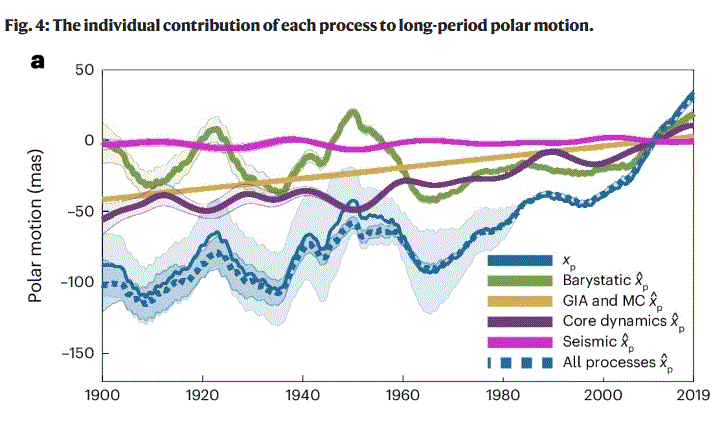
Climate change makes the Earth wobble on its axis. Now, if you shower too long, and enjoy that beefsteak too much, you could affect the tilt Earths axis. Are you feeling guilty yet, or just fed up that modern science is indistinguishable from the prophesies of Neolithic shamen?
Climate change makes the Earth wobble on its axis. Now, if you shower too long, and enjoy that beefsteak too much, you could affect the tilt Earths axis. Are you feeling guilty yet, or just fed up that modern science is indistinguishable from the prophesies of Neolithic shamen?
New studies, which utilized AI to monitor the effects of climate change on Earth’s spin, have shown that our days are getting increasingly longer and that our planet will get more wobbly in the future. These changes could have major implications for humanity’s future.
We’re talking of fractions of a millisecond:
Initially, these changes will be imperceptible to us, but they could have serious knock-on effects, including forcing us to introduce negative leap seconds, interfering with space travel and altering our planet’s inner core, researchers warn.
So it’s probably your air-conditioner in Power Mode, but it could be due to crustal plates shifting:
A day on Earth lasts about 86,400 seconds. But the exact time it takes our planet to complete a single rotation can shift by tiny fractions of milliseconds every year due to a number of factors, such as tectonic plate movements, changes to the inner core’s rotation and gravitational tugging from the moon.
And it might have something to do with the moon, or the inner molten core of Earth, which might be affected by the sun’s magnetic field. I mean, we really have no idea, but let’s remake our electricity grid just in case we lose a millisecond?
When we melt the ice at the poles and the seas rise higher over the equator, the Earth spins slower just like the iceskater who spreads out their arms:
Over the past few decades, the rate of ice loss from Earth’s polar regions, particularly Greenland and Antarctica, has been increasing rapidly due to global warming, leading to rising sea levels.
All those emissions sped the world up, and now all those emissions are slowing us down?
In 2020 scientists made a startling discovery. They found that, instead of slowing down, the Earth has started to spin faster. It is now spinning faster than at any time in the last 50 years. In fact, the shortest 28 days on record all occurred during 2020. — ScienceFocus
At the Guardian they’re afraid the extra millisecond will disrupt internet traffic, or screw up financial transactions and GPS. It’s be like Y2K all over again, and we all know how catastrophic that was.
Look at the language here, these people so want to believe we are Gods:
The phenomenon is a striking demonstration of how humanity’s actions are transforming the Earth, scientists said, rivalling natural processes that have existed for billions of years.
The change in the length of the day is on the scale of milliseconds but this is enough to potentially disrupt internet traffic, financial transactions and GPS navigation, all of which rely on precise timekeeping.
The other thing that’s persisted for billions of years is radical sweeping climate change. Like this (below). Nature has been screwing up our GPS, our financial transactions and our space travel for millions of years and we just didn’t know it.
Wait til you see how solid this research is — like climate modeling but with less data:
I mean, how accurate were the clocks at recording milliseconds in 1901? We didn’t even define what a second was until 1968. and it’s not like we’ve got many measurements of changes in Earths’ core since then either. Ask Jules Verne?
In the new study, published July 15 in the journal PNAS, researchers used an advanced artificial intelligence program that combines real-world data with the laws of physics to predict how the planet’s spin will change over time.
And this is a Nature paper. Yet the whole thing could have been an AI school project from start to finish. An AI awarded an AI a grant, which produced a “paper” which an AI editor thought was worth publishing, and AI journalists turned into nonsense headlines, which an AI audience clapped. And no one anywhere thought to ask whether the researchers knew Antarctica is not melting, and seas are barely rising, and length of day was shrinking only a few years ago.




You must be logged in to post a comment.