The SEC’s Climate Disclosure Rule Is a Dark Cloud Over Energy Abundance

The Securities and Exchange Commission (SEC) climate disclosure rule posts real problems for public companies. The SEC’s mission is to do facilitate capital formation and maintain market efficiency, but for the first time in its 90-year history, the SEC has injected political risk factors into its traditionally principles-based disclosure framework.

From Watts Up With That?

By Stone Washington

The Securities and Exchange Commission (SEC) climate disclosure rule posts real problems for public companies. The SEC’s mission is to do facilitate capital formation and maintain market efficiency, but for the first time in its 90-year history, the SEC has injected political risk factors into its traditionally principles-based disclosure framework.

Leading up to the new rule, the SEC buckled under pressure from left-wing special interests to impose the first environmental disclosure mandate on public companies. If the SEC’s final rule is allowed to go into effect by the courts, it will be a financial disaster for the public markets.

My latest policy report illustrates many of the ways that U.S. firms will suffer under the SEC’s climate rule. The report was published on the same day the RealClearFoundation hosted its 2024 Energy Future Forum, where the SEC’s excessive overreach on climate policy was a point of contention.

The climate rule will require most large and mid-sized public firms to report annual and quarterly disclosures that account for an endless range of climate risk factors. This translates to approximately 3,488 firms spending upwards of $628 million on direct disclosure costs and millions on indirect costs.

Consequentially, firms will need to expend great resources hiring climate scientists, ESG experts, lawyers, and accountants to properly prepare their disclosures for SEC review, neglecting the time normally spent on enhancing their market value.  

Corporate boards will lose much of their discretionary decision making, forced to prioritize environmental risk factors over purely financial concerns. In its place, corporate boards must infuse speculative climate science to determine which climate risks warrant inclusion in their SEC disclosure.

With the SEC’s 12 new climate disclosure categories, investors will be spammed with a flood of confusing and potentially contradictory environmental data. This will undermine the ability of investors to navigate the actual meaningful risks in the markets or assess the health of a company. The doom and gloom of climate risks will imperil sensible financial analysis.

But now the SEC has run headlong into a hostile legal environment, facing multiple lawsuits from a host of disgruntled organizations and concerned investors seeking to prevent the rule’s implementation. As many as 25 state attorneys general have pursued two lawsuits against the SEC for exceeding its statutory authority and violating the major questions doctrine by promulgating climate regulation.

The Eighth Circuit Court of Appeals was chosen by the Judicial Panel on Multidistrict Litigation to consolidate nine challenges into one case against the SEC. Soon after, the SEC halted the rule’s implantation to fend off its legal challenges.

The SEC is in the unenviable position of  trying to defend the indefensible.

The SEC lacks any legislative authority to enforce its climate disclosure rule. In 1976, the SEC provided minimal updates to corporate disclosure requirements to reflect new environmental laws like the 1969 National Environmental Policy Act (NEPA). This was so that companies could adhere to NEPA’s standards in their annual SEC filings and report executive expenditures.

This is in stark contrast with today’s climate rule, which was imposed with no proper regard to the democratic will of Congress.

Proponents of the climate rule rely on loose interpretations of Section 12 of the Securities Act of 1934 and Section 7 of the Securities Act of 1933 to wrongfully assume that Congress granted it broad authority for setting disclosure criteria.

RealClearFoundation’s Energy recent Future Forum challenged the financial shakiness and investor detriment posed by ESG disclosures like the SEC’s.

During the “capital (mis)allocation” session featuring Terrence Keeley (see the video linked at top to see his part), Chairman and CEO of 1PointSix, he raised the issue over how the SEC’s rule is backdoor environmental activism writ large. Mandatory climate disclosures represent an undemocratic form of ESG policymaking that neither Congress nor the U.S. electorate actually approved.

“There are a number of decisions that society needs to make in regard to the environment. Those things need to be made democratically,” Keeley said, “not by some self-appointed elite at the Securities and ‘Emissions’ Commission that has decided in a backway [manner] that we’ve got to do this about Scope 3 emissions. That’s just not the way to make decisions. And it’s going to unfortunately be a road to less abundance, less energy independence, and less energy cleanliness ultimately.”

In response to the notion of the SEC’s serving the best interest of investors by forcing companies to disclose their climate risks, Keeley mentions that most ESG fund disclosures do not justify their purpose or meet their environmental impact. The SEC’s rule would do nothing to rectify the lack of positive environmental impact emanating from ESG funds or ESG-oriented companies.

“None of them [ESG funds] make any claim to have any impact,” Keeley asserts. “All it is trying to do is beat the MSCI index, which by itself, was created to further this ESG industrial complex. And it’s not achieving its goals.”

Keeley and I both make clear that the SEC’s rule will artificially infuse environmental consciousness into the corporate board’s decisions. This undermines their discretion to conduct proper risk management for the company.

Additionally, the greenhouse gas disclosure will provide ample informational ammunition to climate activists, who will use this as leverage to “coerce them into adopting costly decarbonization targets,” Keeley explains.

The SEC’s finalized climate disclosure rule represents the greatest regulatory detriment to corporate freedom in the agency’s history. If the rule were to survive litigation or congressional intervention, many investors would suffer from lower returns and higher prices for goods and services. The last thing investors need is costly climate disclosure spam masquerading as corporate transparency.

Stone Washington is a research fellow at the Competitive Enterprise Institute.

This article was originally published by RealClearEnergy and made available via RealClearWire.

Japanese Scientist Concludes IPCC Is Using “Erroneous” Parameters And Climate Sensitivities

The anthropogenic global warming (AGW) scare was created in part by Japanese scientist Syukuro Manabe using a one dimensional radiative-convective model (1DRCM) having no ocean (1964/1967). He obtained a no-feedback climate sensitivity of 1.3°C for doubling of CO2 using the fixed lapse rate assumption of 6.5°C/km and a radiative forcing of 4(W/m2) at the tropopause, which was further enlarged to 2.4°C with a water vapor feedback.

From NoTricksZone

By P Gosselin

History of the AGW narrative of the IPCC

Kyoji Kimoto, kyoji@mirane.co.jp
Independent climate researcher

Manabe’s model studies debunked by Newell (1979)

The anthropogenic global warming (AGW) scare was created in part by Japanese scientist Syukuro Manabe using a one dimensional radiative-convective model (1DRCM) having no ocean (1964/1967). He obtained a no-feedback climate sensitivity of 1.3°C for doubling of CO2 using the fixed lapse rate assumption of 6.5°C/km and a radiative forcing of 4(W/m2) at the tropopause, which was further enlarged to 2.4°C with a water vapor feedback.

Eminent meteorologist R. Newell from MIT criticized Manabe’s model lacking in ocean cooling. He obtained a No-feedback climate sensitivity of 0.03°C for a doubling of CO2 with a thermal inertia of 30 (W/m2) per 1°C for the surface waters of the ocean using a surface radiative forcing of 1(W/m2) to incorporate the IR spectra overlap between CO2 and water vapor.

Syukuro Manabe

The department of Energy & Dr. R. Cess, however, killed Newell’s ideas to promote nuclear reactors in a difficult time due to the Three Mile Island nuclear accident in 1979.

Manabe continued his model studies to enlarge climate sensitivity (CS) for a doubling of CO2 with introducing various feed backs (FBs) as follows, which is the theoretical basis of IPCC’s AGW narrative.

Fig. 1 History of the CS for 2xCO2 with model studies by Manabe & IPCC

Cess’s erroneous calculation of the Planck feedback parameter

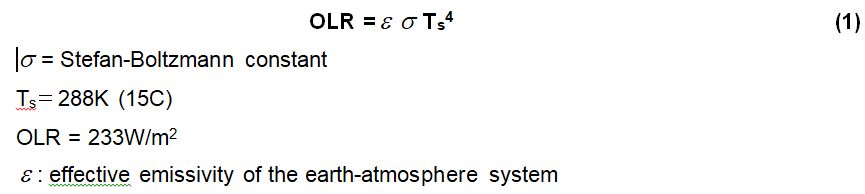
Cess (1976, 1989) expressed the outgoing long wave radiation (OLR) with equation (1) based on the old energy budget of the earth as shown by Fig. 2.

He obtained a Planck feedback parameter0 of -3.3(W/m2)/C with equation (2), giving a No-feedback CS of 1.2°C using a radiative forcing of 4W/m2 for a doubling of CO2 at the tropopause as follows:

Cess’s Planck feedback parameter is used in all GCMs for the IPCC ARs with a slight decrease of the radiative forcing from 4 (W/m2) to 3.7 (W/m2) for a doubling of CO2 by IPCC TAR (2000).

Fig. 3 Feedback parameters of 14 GCMs for the IPCC AR4 by Soden (2006)

Cess’s equation (1) is physically wrong

Cess did not know the atmospheric window because he was caught by the old energy budget of the earth (see Fig.2).

The OLR is expressed by equation (5) based on a modern energy budget of the earth as shown by Fig.4

OLR= Fu (Tu) (83%) + Fw (Ts) (17%)                                             (5)

Equation (5) means the upper troposphere temperature Tu is increased as much as ~1°C with CO2 doubling instead of the surface temperature Ts.

Comparison of no-feedback climate sensitivities

The following list shows the no-feedback climate sensitivities for a doubling of CO2 in the literature:

  • Ramanathan (1979) 0.2°C based on the Stefan-Boltzmann law
  • Newell (1979) 0.03°C based on the ocean thermal inertia of 30 (W/m2)/C
  • Idso (1980) less than 0.26°C based on the natural experiments
  • Ramanathan (1981) 0.17°C based on the Stefan-Boltzmann law
  • Idso (1998) 0.1°C based on the 10 natural experiments
  • Kimoto (2015) 0.15°C based on the Stefan-Boltzmann law
  • Manabe (1964/1967) 1.3°C based on the 1DRCM having no ocean
  • Cess (1976) 1.2°C based on a calculation with a mathematical error
  • Hansen (1981) 1.2°C based on Manabe’s 1DRCM
  • Schlesinger (1986) 1.3°C based on Manabe’s 1DRCM
  • Schlesinger (1986) 1.2°C with a trick concealing Cess’s mathematical error

Conclusion

All green policy is nonsense because it depends on IPCC’s claim that the surface temperature Ts is increased as much as 3°C for CO2 doubling utilizing an erroneous Plank feedback parameter0 of -3.21(W/m2)/C from Cess’s mathematical error.

The Paris climate agreement reads as follows: “To keep the rise in mean global temperature to well below 2°C above pre-industrial levels, and preferably limit the increase to 1.5°C.”

This is based on IPCC’s erroneous climate sensitivity of 3°C for doubling of CO2 discussed above. Therefore the Paris climate agreement is nonsense, though it governs the world politics now.

(References)

Cess, R.D., An appraisal of atmospheric feedback mechanisms employing zonal climatology, J. Atmospheric Sciences, 1976, 33, 1831-1843.

Cess, R.D., Potter, G.L., Blanchet, J.P., Boer, G.J., Ghan, S.J., Kiehl, J.T., Le Treut, H., Li, Z.X., Liang, X.Z., Mitchell, J.F.B., Morcrette, J.J., Randall, D.A., Riches, M.R., Roeckner, E., Schlese, U., Slingo, A., Taylor, K.E., Washington, W.M., Wetherald, R.T. and Yagai, I., Interpretation of cloud-climate feedback as produced by 14 atmospheric general circulation models, Science, 1989, 245, 513-516.

Hansen, J., Johnson, D., Lacis, A., Lebedeff, S., Lee, P., Rind, D. and Russell, G., Climate impact of increasing atmospheric carbon dioxide, Science 1981, 213, 957-966.

Idso, S. B., The climatological significance of a doubling of Earth’s atmospheric carbon dioxide concentration, Science 1980, 207,1462-1463.

Idso, S. B., CO2-induced global warming: a sceptic’s view of potential climate change,

Climate Research,1998, Vol.10, 69-82.

Kimoto, K., On the confusion of Planck feedback parameters, Energy & Environment, 2009, Vol.7, 1057-1066.

Kimoto, K., Will coal save Japan and the world?, Energy & Environment, 2015, 26, 1055~1067.

Manabe, S. and Strickler, R.F., Thermal equilibrium of the atmosphere with a convective adjustment, J. Atmospheric Sciences, 1964, 21, 361~385.

Manabe, S. and Wetherald, R.T., Thermal equilibrium of the atmosphere with a given distribution of relative humidity,  J. Atmospheric Sciences, 1967, 24, 241-259.

Manabe, S and Wetherald, R.T., The effects of doubling the CO2 concentration on the climate of a general circulation model, J. Atmospheric Sciences, 1975, 32, 3~15.

Newell, R.E. and Dopplick, T.G., Questions concerning the possible influence of anthropogenic CO2 on atmospheric temperature, J. Applied Meteorology, 1979, 18, 822-825.

Ramanathan, V., et al., J. Geophysical Research, 84, 4949-4958 (1979)

Ramanathan, V., The role of ocean-atmosphere interactions in the CO2 climate problem, J. Atmospheric Sciences, 1981, 38, 918-930.

Ramanathan, V., The role of earth radiation budget studies in climate and general circulation research, J. Geophysical Research,1987, 92, 4075-4095.

Schlesinger, M.E., Equilibrium and transient climatic warming induced by increased atmospheric CO2, Climate Dynamics, 1986, 1, 35-51.

Soden, B.J. and Held, I.M., An assessment of climate feedbacks in coupled ocean-atmosphere models. J. Climate, 2006, 19, 3354-3360.

In Search of Mega Rays & Manta Rays

I was diving at Wreck Beach Reef, Great Keppel Island, last Friday and I managed to photograph a Blue Spotted Fan Ray (Taeniura lyenma) –a regular stingray in the family Dasyatidae except with blue spots!

The Amazing shot of Manta ray.

From Jennifer Marohasy

By jennifer 

I was diving at Wreck Beach Reef, Great Keppel Island, last Friday and I managed to photograph a Blue Spotted Fan Ray (Taeniura lyenma) –a regular stingray in the family Dasyatidae except with blue spots!

It was my dive buddy Kirsty who spotted it while peering under one of the large boulder corals (the Porites spp.) that are scattered around the perimeter of this reef.   There are usually painted sweetlips (Diagramma pictum) on guard, that move only when you swim right up to them.   I managed to get my camera and myself underneath one of the boulder corals and then inside what turned out to be a reasonable sized cavity.  It was quite an effort, for a very ordinary photograph of a common ray.

I am an amateur photographer.  It is a memory – and a research grade observation now lodged at iNaturalist.

Blue Spotted Fan Rays are magnificent creatures, but not megafauna.  They are small in the scheme of things, as far as rays go.

My amateur effort at photographing a Blue Spotted Fan Ray at Wreck Beach Reef last Friday.

I have photographed a mega ray, specifically a Smalleye stingray, scientific name Megatrygon microps.

That was at sunrise at the SS Yongala wreck dive site on May 6th this year.  It was the most magical encounter, as the Mega-trygon circled with three whiptail stingrays slipping and sliding on-top.   I have described how curious the stingray was in a blog post, CLICK HERE.     

My amateur photographs of the Smalleyed Ray at the SS Yongala wreck at sunrise on May 6th.

We are planning to dive the Yongala wreck – arguably one of the best ten dive sites in the world – as part of the Underwater Megafauna Photographic Competition and Expedition, departing Townsville Breakwater Marina on Monday 2nd September. This photographic competition has a category ‘largest ray, shark or whale’ and ‘largest fish that is not a ray or shark’.

There can be all of these at the Yongala!

I’ve received some fabulous applications from some talented underwater photographers.

Three of the five spots have already been awarded. I will be letting the final two successful megafauna photographers know next Tuesday – that will then make five departing on the MV Sea Esta for four days and five nights, potentially 14 dives in total, with the last two dives at the Yongala, weather permitting.

It’s not too late if you want to apply. But you need to get your application in before 5pm on Monday, July 29th.

Of course, the biggest rays are the Manta Rays (family Myliobatidae, subfamily Mobulinae) that can reach over 6 metres across. That is mega!

There are about 37 species in this family, with their eyes on the side of their head, which is not fattened. I’ve scuba dived with Manta Rays at Lady Elliott Island, and at Shark Alley off Stradbroke Island. I’m hoping that they will be at the Yongala for the Megafauna Expedition.

David Strain describes his experience with a Manta at the Yonga at the PADI blog:

As Manta Rays sat over the wreck in 15 metres of water facing into the strong current, gills open as an invitation to the resident cleaner wrasse before turning down current, gliding away then around to again take up position over the wreck.

At times they would pass so closely that the downdraft from their wings could be felt only inches from my face. On occasions the manta would position itself directly above as if enjoying the bubble massage from my regulator.

In 10 dives over 4 days I have experienced the changing moods, colours, light and amazing marine life of this truly awe inspiring place on earth.

The Yongala.

More information about the expedition and selection criteria for photographers, CLICK HERE.

There is something more interactive at my official Facebook page, especially if you click on the ‘megafauna expedition’ that is pinned as an event at the top, LINK HERE.

East coast wind turbine fiasco in the making

Severe impacts to East Coast beaches (in addition to the habitat of whales) are threatened by the wind turbines being put up off the east coast.

From CFACT

By Joe Bastardi

Severe impacts to East Coast beaches (in addition to the habitat of whales) are threatened by the wind turbines being put up off the east coast. I asked here:

https://www.cfact.org/2024/03/12/where-are-the-true-environmentalists

Where are the true environmentalists with what is going on?

A wind turbine that collapsed closed Nantucket Beaches recently. They are open now, but what makes anyone think the numerous bits and pieces of this are not floating around? Perhaps washing on shore leading to problems with people not only with swimming but also with even walking on the beach?

There has been no strong storm around. So what caused this?

But now let me ask this question as if this is being ignored. If this happens with nothing going on, what do you think will happen if a storm like 1821 runs through these wind fields?

or 1944 comes back

or Carol 1954

Donna 1960

Belle 1976

Gloria 1985

Bob, the last one in 1991.

In a typical two-faced fashion, the people driving the whole climate disaster scenario are also pushing wind turbines in an area where you are asking for trouble. This hurricane drought on the NE coast can’t last forever (nothing in 33 years, when it was once every 7 years from 1938-1991). We hear how bad it is. It’s not, but a return to the “normalcy” that was the East Coast hurricane frequency (of course, if that happens, they will blame man-made climate change) means they have set up a disaster. Suppose 10-15% of the turbines are damaged by a cat 2 going through there. The cleanup of the resort beaches will be in the billions. Given the motives of these people that drive the man-made climate agenda, maybe that is what they want. They pump everything as a result of man-made climate change. A recent WSJ article on how the eastern heat is causing billions in uninsured losses fails to mention the counter. When it gets hot, more people go to the beach, and the resorts prosper.  Of course, if wind turbine parts are washing up on shore, who wants to go to the beach?  My point is in every single thing the left does, from climate to what you are seeing now across the board, they set the whole thing up with deception, distortion, and delusion, create the problem, and then blame something they are targeting for it.

This is no difference. And it’s a fiasco in the making.

I guess if one of these washed up in Barack Obama’s place on Martha’s Vineyard, it would get his attention—no paddle-boarding for a while (sarc).

Nuclear Fusion: More Government Fail

“The fusion propaganda machine has produced a wave of mostly offbeat projects, more than 40 since 2018 by one estimate. The likelihood that any of these fusion pipedreams will produce anything other than red ink is less than slim.”

From Master Resource

By Kennedy Maize

“The fusion propaganda machine has produced a wave of mostly offbeat projects, more than 40 since 2018 by one estimate. The likelihood that any of these fusion pipedreams will produce anything other than red ink is less than slim.”

Harsh reality is again clashing with the fanciful hype of the past several years regarding fusion energy. The only credible attempt to harness the physics of the sun, the International Thermonuclear Experimental Reactor, has again pushed back the date when it will attempt a sustained fusion reaction toward practical energy production.

For the second time in two years, the 35-nation project has announced a snag in the project, although it has reported some better news. At a July 3 press conference at ITER headquarters in France, Director-General Pietro Barabaschi said the new goal is to be able to run the toroidal magnets in the donut-shaped tokomak briefly at full power in 2036. The deuterium-tritium operation phase, where the fusion rubber really begins to meet the road, won’t occur before 2039.

The new timeline will add some $5 billion to the current approximately $20 billion+ cost estimate for the pilot project. Exact costs are difficult to calculate as much of the support comes from in-kind contributions from the 35 member countries: China, the European Union, India, Japan, Russia, South Korea and the United States. The United Kingdom participates through EU‘s Fusion for Energy (F4E), Switzerland participates through Euratom and F4E, and the project has cooperation agreements with Australia, Canada, Kazakhstan and Thailand. Europe provides about 45% of the ITER funding.

What does this mean in terms of the many promises of fusion energy? In surprising candor, Barabaschi said,

“Fusion cannot arrive in time to solve the problems our planet faces today, and investment in other technologies, known and unknown, is absolutely needed. But I expect fusion will make a difference when it arrives, and let’s not forget that there is not just the problem of solving global warming … energy is also needed for life on Earth.”

Science magazine added a caveat to that announcement. ITER’s tokomak machine will run in 2039 “only in short bursts, to satisfy safety concerns of the nuclear regulator in France, where ITER is under construction.” Even if ITER is a complete success, that’s only a first, albeit big, step. It will not generate electricity. That requires solving the gigantic problem of building a plant to convert the energy to electric power.

Barabaschi is far more open than his predecessor, Bernard Bigot, who was fond of fusion enthusiasm and downplayed the problems that have plagued the project throughout its life. Michel Claessens, who was ITER’s communications chief until Bigot fired him upon taking office in 2015, told Science|Business this year that too many fusion researchers and officials have become purveyors of what he terms “fusion propaganda.” Claessens said,

We should be clear with the public. We are still in the research and development phase. We’re still far from commercial applications. I’m really upset, and I don’t think it helps, when people say fusion will be the energy of the future.

The good news is that in April, ITER took delivery of the first of 19 giant toroidal magnets that are the heart of the magnetic confinement tokomak, prompting a July 1 celebration. All 19 of the coils (18 for the machine and one spare, 10 from Europe and 9 from Japan) are due to ITER’s southern France headquarters in Saint-Paul-lès-Durance in three-and-a-half years.

Barabaschi commented that the 17-meter-tall coils “look like science-fiction.” They are 40-times the mass of the magnets at the European nuclear research laboratory CERN, the largest operating magnets in the world today.

A Look Back

ITER had its beginning in 1978 as a modest proposal for an international program to develop a Tokomak fusion project. The project moved forward with little attention beyond technical circles, until it burst upon the public scene during the 1985 Geneva summit between U.S. President Ronald Reagan and Soviet Union General Secretary Mikhail Gorbachev.

In Geneva, the two major world leaders agreed to cooperate on fusion R&D, issuing a statement that “the potential importance of the work aimed at utilizing controlled thermonuclear fusion for peaceful purposes and, in this connection, advocated the widest practicable development of international cooperation in obtaining this source of energy, which is essentially inexhaustible, for the benefit of all mankind.” Reagan touted the collaboration in a joint session of the U.S. Congress.

The U.S. then had an on-again, off-again relationship with the project as it began to put together what became ITER. The U.S. pulled out of the planning in 1998, complaining that the projected $10 billion cost was excessive. When the planners scaled back to effort to $5 billion in 2002, the U.S. rejoined. The original funding was $6 billion, with a 10-year time frame.

Many Hurdles

What are the major obstacles that practical fusion must overcome? Claessens outlines the most significant: “The question of economic sustainability is so open today because these machines are very expensive.”

Tritium. This extremely rare hydrogen isotope is crucial. Fusion optimists are counting on “tritium breeding” to overcome this fundamental problem. The concept is that the fusion machine will create more tritium than it uses. Claessens comments, “It is at least a question mark.”

Economics. The fusion hype artists talk glowingly about “virtually limitless energy,” as if hydrogen is a free fuel. Even if uranium were free, electricity from nuclear fission plants would still be expensive. Claessens: “The question of economic sustainability is so open today because these machines are very expensive.”

Materials. The fusion reaction will involve enormous temperatures, perhaps exceeding those in the sun. Finding materials that can hold these hot plasmas is far from solved. The process will also produce copious neutrons that will irradiate everything in their path. There will be no spent fuel from fusion. There will be plenty of radioactive materials.

Conclusion

Unlike his predecessors, Barabaschi has not tried to paper over fusion’s problem. ITER communications chief Laban Coblentz, who took over upon the firing of Claessens, has said, “With Pietro’s arrival at ITER, there’s been a deliberate effort to look at how we communicate about fusion that is factual, avoids overpromising, and tries to address questions that fusion sceptics have in a fair and realistic way.”

Despite that, the fusion propaganda machine has produced a wave of mostly offbeat projects, more than 40 since 2018 by one estimate. The likelihood that any of these fusion pipedreams will produce anything other than red ink is less than slim.

Natural Gas Industry’s Smear of Coal Is False and Self-Defeating

Smearing coal has become a marketing strategy of a natural gas industry that embraces pseudoscientific views of coal combustion as being hazardous.

From Watts Up With That?

By Gregory Wrightstone

Smearing coal has become a marketing strategy of a natural gas industry that embraces pseudoscientific views of coal combustion as being hazardous.

In so doing, gas supporters give credence to a fallacious regulatory regime of the Environmental Protection Agency (EPA), which erroneously classifies carbon dioxide as a pollutant and assigns health effects to low-level pollution without scientific proof. To boot, a false representation of coal, oil and natural gas as environmental bogeymen is perpetuated.

Perhaps the most enthusiastic user of this foolish ploy is Toby Rice, CEO of Pittsburgh-based EQT Corp., who introduced two years ago a global plan to replace coal with liquefied natural gas. Promoting his product as a “decarbonizing force” in June at a RealClearEnergy conference, the head of the country’s largest gas producer (check the video link above to see his part), said:

“What we would like to do at EQT … is focus people on a really practical solution that will allow us to provide energy security for the world and address people’s concerns over global emissions. And that path is very simple: transition the world from coal to gas.”

Although natural gas emits less carbon dioxide than coal when burned, the underlying premise of Rice’s pitch rests on the popular myth that CO2 emissions will overheat the planet. The organization we lead, the CO2 Coalition, has overwhelming evidence from top scientists showing that increasing atmospheric carbon dioxide not only poses no danger but is beneficial to plant growth and crop production.

We need more CO2 not less. Coal miners could say that replacing their product with gas is a threat to greenery.

Now, the gas industry’s Marcellus Shale Coalition has further demonized coal in claiming that Pennsylvanians have realized up to $1 trillion in health benefits by reducing emissions of nitrogen and sulfur compounds through the replacement coal-fired electricity generation with gas-fueled power plants.

We have no quarrel with the emissions data. However, the link to improved health is based on methodologies of an EPA that has refused for decades to provide evidence for such a connection.

EPA has long trafficked in data manipulation and falsehood about the supposed health effects of particulate matter, which would be the carrier of chemical compounds into people’s lungs, according to Steve Milloy, publisher of JunkScience.com and author of “Scare Pollution: Why and how to fix the EPA.”

“The bottom line is that the claim that particulate matter causes death is the most demonstrable science fraud of our time,” says Milloy, a lawyer with a master’s degree in health sciences and biostatistics. “Despite fearmongering for 30 years about millions of deaths, EPA — and nobody else — has ever presented a single dead body.”

Since the 1990s, Milloy has sparred with the EPA over its assertion that particulate matter measuring 2.5 microns or less (PM2.5) is life threatening. PM2.5 was identified as a dangerous pollutant by EPA’s environmental extremists to shut down the coal industry, he says.

While insisting that PM2.5 kills 8 million people annually, says Milloy, EPA has ignored a contradictory epidemiological study by California researchers as well as the results of its own experiments, which failed to produce symptoms in human subjects intentionally exposed to high levels of particulates.

In 1995, the agency’s own Clean Air Scientific Advisory Council rejected EPA findings of health effects from PM2.5 and was denied raw data to examine the claims. EPA also refused to give the data to congressional investigators.

The absence of support for EPA’s regulation of PM2.5 should not be a surprise. In a 2023 study, Dr. Indur Goklany found that mortality and disease rates improved over a 27-year period even as industrialization and particulate emissions increased in five Asian countries:  India, Bangladesh, Pakistan, Nepal and China.

The gas industry jumps on the bandwagon of demonizing coal to gain the acceptance of the “green” lobby and the politicians who pander to it. However, gas producers are only feeding coal miners to the crocodile that they hope to escape. It’s a fool’s game, as should be evident by the environmental extremists’ regular targeting of gas operations.

A better approach would be for gas and coal interests to stand together for their industries and the immense good that hydrocarbons have done for the world since the beginning of the Industrial Revolution, when coal first fueled steam engines. An alliance of drillers and miners could help defeat a vicious anti-science ideology that seeks to destroy their livelihoods and the civilization they have made possible.

This commentary was first published at Real Clear Energy on July 22, 2024.

Gregory Wrightstone is a geologist; executive director of the CO2 Coalition, Arlington, Va.; author of Inconvenient Facts: The Science That Al Gore Doesn’t Want You to Know and A Very Convenient Warming: How modest warming and more CO2 are benefiting humanity.

Sunday was 0.01 degree hotter than last year, and 1 or 2 degrees cooler than what cavemen lived through. So What?

It’s another outbreak of the Hottest-ever-Day Fever , where buses catch fire, and the worlds top journalists forget to ask anyone anything useful about the last 500 million years.

From JoNova

By Jo Nova

It’s another outbreak of the Hottest-ever-Day Fever , where buses catch fire, and the worlds top journalists forget to ask anyone anything useful about the last 500 million years.

Sunday was the Worlds Hottest Day says the Guardian

The Copernicus data might be fine and dandy but it only goes back as far as 1979. The warm weather we are having now is just a welcome break in a cooling trend that started 7,000 years ago. It not only isn’t a record that means anything, it’s almost certainly a net benefit to warm blooded mammals.

The collective amnesia about the Holocene and most of the history of human civilization is complete. Apparently the world is in uncharted territory, except for thousands of rocks, stones, spears, shells, bits of wood, pollen, diatoms, fossilized plant leaves, and all the ice cores we’ve ever dug up. 4,000 stone-age spears and whatnot that melted out of the Norwegian glaciers in the last few years, must have frozen into them sometime in the last 5,000 years. And all the bones of dogs, rabbits, geese and frogs found inside the Arctic circle suggest our world is too brutally cold now. Likewise the giant oyster shell found on a building site in Taiwan reminds us of a time the oceans were 1 to 2 meters higher than today, and the cavemen survived just fine.

The planet saw its hottest day on record

CNN By Angela Fritz

Sunday was the hottest day in recorded history, according to preliminary data from a climate tracking agency monitoring temperatures since the mid-1900s.

It’s the second consecutive year average global temperatures have crashed through shocking climate records and will not be the last, as planet-warming fossil fuel pollution drives temperatures to shocking new highs.

July 21 clocked in at 17.09 degrees Celsius, or 62.76 Fahrenheit, and was the hottest day on Earth since at least 1940, according to the preliminary data from the European Union’s Copernicus Climate Change Service.

It’s 100,000 years of journalistic negligence:

Despite being based on data from the mid-20th century, the temperature records represent the warmest period the planet has seen in at least 100,000 years, scientists have found from many millennia of climate data extracted from ice cores and coral reefs.

Someone should send Angela Fritz (and most of the world’s journalists) the graphs of the ice cores which she has clearly never seen:

7,000 years of cooling in Greenland. This graph shows the ice-core data up until 1855. The last 150 years (1705 to 1855) are highlighted in red to show the warming as the Earth began coming out of the LIA.

Send them the Vostok Ice Cores too. Send them Brazilian sea levels, and tell them the the Sahara was lush green and wet, and the water near Indonesia was 2 degrees hotter. And 6,000 boreholes drilled around the world agree, along with 700 Pacific Islands that aren’t shrinking. The real science deniers are the ones ignoring half a billion years of evidence.

It’s been hotter for thousands of years during human civilization and it wasn’t caused by our cars.

https://secretsoftheice.com/

REFERENCES

Copernicus media release –they it’s a the hottest day “in recent history” which the media turned into the hottest day in a hundred thousand years.  h/t Gee Aye

Alley, R. B. (2000) The Younger Dryas cold interval as viewed from central Greenland. Quat. Sci. Rev. 19, 213-226

Aurélie Boilard et al, (2024) Ancient DNA and osteological analyses of a unique paleo-archive reveal Early Holocene faunal expansion into the Scandinavian Arctic, Science Advances . DOI: 10.1126/sciadv.adk3032

Fontes et al (2017) The Impacts of the Middle Holocene High Sea-Level Stand and Climatic Changes on Mangroves of the Jucuruçu River, Southern Bahia – Northeastern Brazil, Radiocarbon , Volume 59 , Issue 1 , February 2017 , pp. 215 – 230.  DOI: https://doi.org/10.1017/RDC.2017.6

Huang, S. P., H. N. Pollack, and P.-Y. Shen (2008), A late Quaternary climate reconstruction based on borehole heat flux data, borehole temperature data, and the instrumental record, Geophys. Res. Lett., 35, L13703, doi:10.1029/2008GL034187   [PDF] Long blog discussion on boreholes.

Kench, P.S., Liang, C., Ford, M.R. et al. (2023) Reef islands have continually adjusted to environmental change over the past two millennia. Nat Commun 14, 508  doi.org/10.1038/s41467-023-36171-2

Lewis, S.E., et al., Post-glacial sea-level changes around the Australian margin: a review, Quaternary Science Reviews (2012), http://dx.doi.org/10.1016/j.quascirev.2012.09.006 [abstract]

Li H-C, Mii H-S, Liu T-K, et al. (2024) AMS 14C Dating and Stable Isotope Analysis on an 8 kyr Oyster Shell from Tapei Basin: Sea level and SST changes. Radiocarbon. Published online 2024:1-15. doi:10.1017/RDC.2023.117

Hamish McGowan,Samuel Marx, Patrick Moss, Andrew Hammond (2012): Evidence of ENSO mega-drought triggered collapse of prehistory Aboriginal society in northwest Australia, Geophysical Research Letters, Vol 39, Issue 22.  DOI: 10.1029/2012GL053916 [Abstract]

Rehn, E. et al (2021) A late-Holocene multiproxy fire record from a tropical savanna, eastern Arnhem Land, Northern Territory, Australia [PDF]

Rosenthal, Y., Braddock K. Linsley, Delia W. Oppo (2013) Pacific Ocean Heat Content During the Past 10,000 Years, Science 1 November,Vol. 342 no. 6158 pp. 617-621  DOI: 10.1126/science.1240837 [Sciencemag.org ]

Yacoub et al., (2023), The African Holocene Humid Period in the Tibesti mountains (central Sahara, Chad): Climate reconstruction inferred from fossil diatoms and their oxygen isotope  composition

Kuper and Kropelin, (2006): Climate-controlled holocene occupation in the Sahara: motor of africa’s evolution. Science 313, 803e807. https://doi.org/10.1126/ science.1130989

Guardian: Tackling Climate Change in Films is an Ethical Responsibility, Like Ending Slavery

Greens equating their cause to the role of “Uncle Tom’s Cabin” in the liberation of the slaves.

From Watts Up With That?

Essay by Eric Worrall

Greens equating their cause to the role of “Uncle Tom’s Cabin” in the liberation of the slaves.

‘It affects everything’: why is Hollywood so scared to tackle the climate crisis?

David Smith in Washington
Sat 20 Jul 2024 20.06 AEST

Twisters is the latest in a long line of movies that fail to address the environmental emergency – experts say it’s a missed opportunity.

…

A study published by the nonprofit consultancy Good Energy and Colby College’s Buck Lab for Climate and Environment analysed whether the climate crisis was present in 250 of the top-grossing fictional films between 2013 and 2022. In only 32 of the films (12.8%) was it clear that climate change exists, and in only 24 of them (9.6%) was it clear that a character knows it.

…

“We’re talking about 8 billion people reacting to oil companies destroying the entire livable climate. We need stories in hundreds of different languages, reflecting a thousand times more cultures experiencing varying degrees of awareness and emotional processing.”

He adds: “But if a film-maker is reluctant to let climate be in some way a part of their movie, I always tell them that it’s a guarantee within the next five years their film will play as irrelevant as movies do today about how noble the war against the ‘American Indians’ was.”

…

Asked whether film-makers have an ethical responsibility to tackle the subject, Lipsky identifies a parallel with slavery: “The model is Uncle Tom’s Cabin. That issue had to be addressed and so Harriet Beecher Stowe wrote that novel. When Lincoln had an audience with her at the White House, he said, so you’re the woman who caused this civil war of ours. Sometimes the expression of something can be so astonishing and so direct that it makes people take action.

…Read more: 

https://www.theguardian.com/film/article/2024/jul/20/hollywood-climate-crisis

It is difficult to overstate the cultural and political influence of “Uncle Tom’s Cabin“. The book sold millions of copies. The portrayal of the main character, Uncle Tom, as a decent Christian man who helps his friends and steadfastly lives by his beliefs, in the face of unspeakable cruelty, brutality and betrayal, had a profound impact on people’s attitude towards slavery in the United States.

We’re used to green arrogance, but in my opinion this effort to equate their climate pseudoscience propaganda with such an important historical work is unconscionable.

The Offshore Wind Energy Scandal Is Even Worse Than You Think

These 11 charts show how America’s biggest NGOs are colluding with foreign corporations that want to industrialize our oceans with thousands of turbines that will hurt whales and ratepayers.

Two of Europe’s biggest energy companies are abandoning the SS Offshore Wind.

From The Robert Bryce Substack

By Robert Bryce

These 11 charts show how America’s biggest NGOs are colluding with foreign corporations that want to industrialize our oceans with thousands of turbines that will hurt whales and ratepayers.

This humpback whale washed ashore on Martha’s Vineyard in June 2023. Photo: Abigail Rosen, MV Times.

Two of Europe’s biggest energy companies are abandoning the SS Offshore Wind.

In May, Shell, the UK-based oil and gas giant (2023 revenue: $317 billion), announced that it was cutting staff from its offshore wind business because, according to Bloomberg, the company has decided to focus on markets that “deliver the most value for our investors and customers.” Bloomberg also reported that the staff cuts were made after the departures of top executives in the company’s offshore wind and renewable power businesses.

Last month, Murray Auchincloss, the CEO of oil and gas giant BP, imposed a “hiring freeze and paused new offshore wind projects.” According to Reuters, the new CEO is putting more “emphasis on oil and gas amid investor discontent over its energy transition strategy” and that BP (2023 revenue: $208 billion) was cutting investments in “big budget, low-carbon projects, particularly in offshore wind, that are not expected to generate cash for years.”

The moves by BP and Shell are only the latest examples of the troubles facing the offshore wind sector, which has been foundering on the shoals of higher interest rates, citizen opposition, and ballooning costs. Over the past year, numerous projects on the Eastern Seaboard, including Skipjack Wind in Maryland, Park City Wind in Connecticut, and South Coast Wind in Massachusetts, have been canceled due to bad economics. In all, according to data compiled by Ed O’Donnell, a nuclear engineer and a principal at New Jersey-based Whitestrand Consulting, about 14,700 megawatts of offshore wind capacity has been canceled. For comparison, about 15,500 megawatts of capacity is now in development, under construction, or operational.

Of course, those figures don’t jibe with the tsunami of hype about offshore wind energy that has appeared in major media outlets. But the hard reality is that America’s offshore wind sector is a subsidy-dependent industry that is dominated by foreign companies who are in bed with some of America’s biggest climate NGOs, including the NRDC (gross receipts: $555 million) and Sierra Club (Gross receipts: $184 million).

Those NGOs and others, including the National Wildlife Federation (gross receipts: $142 million) and Conservation Law Foundation (gross receipts: $17.5 million), are leading the most shameful environmental betrayal in modern American history. Rather than seek to protect marine mammals and stop the industrialization of our oceans, they are eagerly promoting the installation of hundreds of offshore wind platforms smack in the middle of the known habitat of the critically endangered North Atlantic Right Whale.

“What is Big Wind going to say when they kill the last whale? ‘Sorry’?” ACK 4 Whales president Vallorie Oliver on the porch of her home in Nantucket, on July 8, 2024. Photo by author.

Last week, I gave public lectures in Nantucket and Newport on the energy transition and offshore wind energy. Those events allowed me to take a deep dive into the cesspool of offshore wind and the entities pushing it. Two small groups, ACK 4 Whales and Green Oceans, sponsored the lectures. (The groups are so new that they haven’t filed Form 990s.) The lectures allowed me to meet dozens of committed and interesting people from all walks of life, income levels, and political beliefs, who are fighting the insanity of offshore wind. Among them was Vallorie Oliver, a native of Nantucket who is the president of ACK 4 Whales. Oliver’s father worked as a carpenter and fisherman on the island. She has been fighting the offshore wind projects since 2019.

Oliver reminds me of the dozens of other Americans I’ve been privileged to meet over the last decade as I’ve reported on the backlash against the encroachment of Big Wind and Big Solar. When we talked at her modest home in Nantucket last Monday, I told Oliver that she’s special, but not unique. Oliver — and the many others I’ve met who are fighting the energy sprawl that inevitably comes with alt-energy — all share a common value. What is it? It’s the desire to protect their homes, neighborhoods, viewsheds, and property values from the climate change carpetbaggers who are only interested in the profits they can make by paving vast swaths of territory with solar panels and wind turbines.

In an email on Sunday afternoon, Oliver told me what keeps her motivated: “There are no do-overs when the last whale is killed off,” she explained. “There are fewer than 350 North Atlantic Right Whales left. What is Big Wind going to say when they kill the last whale? ‘Sorry’?”

These 11 charts show the offshore wind energy scandal is even worse than you think.

Chart 1: About two-thirds of the offshore projects that are operating, under construction, or proposed are owned either entirely, or in part, by foreign companies.
Chart 2: Those foreign companies are feasting on subsidies. As shown below, the foreign corporations pushing for offshore wind in U.S. waters have, according to data from Good Jobs First, collected more than $9 billion in local, state, and federal subsidies, loans, or loan guarantees, and they are eager for more. How lucrative are the offshore wind subsidies? Consider Vineyard Wind, the 800-megawatt offshore project owned by Avangrid, the Spanish company, and Copenhagen Infrastructure Partners. Construction costs on the project will be about $4 billion. With an investment tax credit of about 40%, those two foreign outfits could collect as much as $1.6 billion in federal tax credits on Vineyard Wind alone.   

Chart 3: If there’s a better example of how climate NGOs have sold out to big business — and Big Oil — I can’t name it. Here’s a screenshot from the New York Offshore Wind Alliance website that shows the NGO-corporate-industrial-climate complex at work.

Chart 4: Yup.

Chart 5: Ibid.

Chart 6: I’m old enough to remember when environmental groups cared about whales. Alas, that was a long time ago. On Sunday, the Daily Mail published an article about Apostolos Gerasoulis, a Rutgers professor emeritus of computer science who built a software system to analyze the dozens of whale deaths that have occurred on the Eastern Seaboard over the past few years. Gerasoulis set out to determine if the whale deaths were related to the loud blasts of sonar used by offshore wind survey vessels. His conclusion: “Offshore wind kills whales…The numbers never lie. There is a cause. We have shown that the cause for death of the whales is offshore wind. Period.” (H/t fellow Substack writer David Blackmon.)  

Chart 7: Can we trade the Sierra Club for an environmental group that cares about protecting marine mammals? The text below is from the club’s website.

Chart 8: This bit of bureaucratic mumbo jumbo is buried in the environmental impact statement the Bureau of Ocean Energy Management did on Vineyard Wind. Here’s my plain English translation: “These projects won’t make any difference on climate change. But they are good because they allow state-level bureaucrats to say they met their policy goals.”

Chart 9: The big NGOs claim we must build gigawatts of offshore wind because of climate change. But given the enormous size of the U.S. power grid (1,300 gigawatts), whatever reductions in greenhouse gas emissions that might be achieved with offshore wind will be the equivalent of a fart in a hurricane.

Chart 10: Short of throwing currency into a boiler, offshore wind energy is the most expensive way to generate electricity. The recent announcement that the state of New York will pay $155 per megawatt-hour for the juice from the Empire Wind project proves that point.

Chart 11: The states on the East Coast that are building offshore wind have some of the highest electricity prices in the country. Those rates will go higher due to offshore wind. (California is also planning to spend billions on offshore wind, but that’s a topic for another Substack.)

I will close by repeating W. Edwards Deming’s famous line: “In God we trust, all others must bring data.” The data shows offshore wind energy is a lousy deal for whales and ratepayers.

Climate Criminals

A new organisation called Climate Criminals is calling on the International Criminal Court to bring charges against a large number of businessmen and others from what they call the polluter industrial complex, who they deem to be guilty of various crimes against the climate.

From NOT A LOT OF PEOPLE KNOW THAT

By Paul Homewood

A new organisation called Climate Criminals is calling on the International Criminal Court to bring charges against a large number of businessmen and others from what they call the polluter industrial complex, who they deem to be guilty of various crimes against the climate.

They are clearly a bunch of loons, but it would be interesting to find out who is funding them.

Below is their Press Release.

New York City, United States–A new research project, Climate Criminals, has been launched today in Union Square, New York City, beneath the Climate Clock to charge 24 individuals who bear responsibility for delaying action on climate change and locking the US and planet Earth onto a trajectory to blow past 1.5°C temperature rises.

For its launch moment, 24 dossiers have been released to name each Climate Criminal and their crimes – which range from money laundering to fraud to crimes against future generations and the Earth. In tandem, a public reveal of “wanted posters” has taken place as climate activists gathered to observe the Climate Clock’s Climate Emergency Day 2024, which recognised the passing of the deadline to limit 1.5°C of global warming tick below 5 years for the first time in history. The unveiling will be preceded by a  march to Citibank HQ to serve ‘Calamity Jane’ Fraser a subpoena. The stunt for its launch will focus specifically on two New York-based Climate Criminals, Jane Fraser (CEO of Citibank) and Richard Edelman (Edelman Communications), as well as three other North American climate criminals.

The Climate Criminals campaign, led by the newly-formed Climate Accountability Research Project (CARP), leaned on consultancy with climate organizations and activists, including Climate Clock, Global Center for Climate Justice, Greenpeace, Summer of Heat, and many others.

Together, they profiled and charged 24 ‘enemies of the earth’ who were selected from over 300 different candidates from the polluter industrial complex – a vast and sophisticated power web of ecologically destructive business sectors – and includes leaders of fossil fuel corporations, communication firms, major investors in new fossil fuel infrastructure projects, and think tanks promoting climate denial. The names were then shortlisted to 24 using a combination of exclusive and publicly available databases such as WealthX, Forbes, DeSmog and others to evaluate the severity of existing and previously unreported crimes.

Full list of Climate Criminals, their aliases and charges against them:

  1. Bernard McNamee, Former FERC Commissioner under the Trump Administration; author of energy sections of Project 2025– crimes against future generations and the Earth.
  2. Brian Hooks, President of Charles Koch Foundation & Stand Together Trust – bribery, crimes against citizens, crimes against future generations & the Earth, fraud.
  3. Brian Moynihan, CEO of Bank of America – money laundering, crimes against communities, fraud.
  4. Chet Thompson, (President of American Fuel and Petrochemical Manufacturers (AFPM) – bribery, crimes against future generations & the Earth, fraud.
  5. Darren Woods, CEO of ExxonMobil –bribery, crimes against citizens, crimes against communities, crimes against future generations and the Earth, fraud.
  6. Harold Hamm, Executive Chairman of Continental Resources and Domestic Energy Producers Alliance – bribery, crimes against future generations and the Earth, fraud.
  7. James M. Taylor, President of the Heartland Institute – crimes against future generations and the Earth, fraud.
  8. Jamie Dimon, CEO of JPMorgan Chase – money laundering, crimes against future generations & the Earth.
  9. Jane Fraser, CEO of Citibank – for crimes related to greenwashing, crimes against future generations.
  10. Jay Hooley, board member at Liberty Mutual & director at Exxon – crimes against citizens, crimes against future generations & the Earth, fraud.
  11. Kelcy Warren, Chairman of Energy Transfers – bribery, crimes against citizens, crimes against communities, crimes against future generations & the Earth, crimes against workers, fraud.
  12. Kevin Roberts, president of The Heritage Foundation – crimes against future generations & fraud.
  13. Lawson Bader, CEO of DonorsTrust/Donors Capital Fund – bribery, crimes against communities, fraud.
  14. Mandy Gunasekara, Former Chief of Staff of the U.S. Environmental Protection Agency (EPA) under the Trump Administration – crimes against future generations & the Earth, fraud.
  15. Michael Tipsord, Chairman, CEO of State Farm Insurance – bribery, crimes against communities, crimes against future generations & the Earth, fraud.
  16. Mike Sommers, CEO of American Petroleum Institute – money laundering, crimes against future generations and the Earth, fraud.
  17. Mike Wirth, CEO of Chevron – bribery, crimes against communities, crimes against future generations and the Earth.
  18. Richard Edelman, Edelman PR – Money laundering, Bribery, Crimes against communities, crimes against future generations & the Earth, fraud.
  19. Ryan Lance, CEO of ConocoPhillips and driver of Willow Project – crimes against future generations & the Earth, fraud.
  20. Ted Boutrous, Partner of Gibson Dunn law firm – money laundering, bribery, crimes against citizens, crimes against future generations and the Earth, crimes against workers, fraud.
  21. Thomas Karam, Executive VP of Equitrans/Mountain Valley Pipeline – crimes against citizens, crimes against future generations & the Earth, crimes against workers.
  22. Will Hild, Executive Director of Consumers’ Research – bribery, crimes against future generations and the Earth.
  23. Michelle Bloodworth, CEO, America’s Power – Lobbying for the coal industry.
  24. Jim Grech, CEO, Peabody Coal – bribery, crimes against future generations.

“The Climate Criminals campaign aims to raise awareness of the web of individual offenders who operate behind the scenes, puppeteering the fossil fuel industry’s operation in the shadows—the climate disruption kingpins—instead of the getaway drivers or politicians who do the bidding.

These leading offenders have used their personal wealth, power and position to press the accelerator on climate change by promoting climate disinformation, engaging in greenwashing, lobbying for and implementing new fossil fuel extraction projects, and delaying public action on climate change. These are the top enemies of the earth, and future generations will want to know who was personally responsible.

Our current system fails to recognise the scale of their crimes, and our Climate Criminals campaign is using people power to call for justice.” Chuck Collins, Co-Founder of the Climate Accountability Research Project (CARP).

“This campaign illustrates how certain individuals take advantage of environmental injustice and brings to life the ugly underbelly of capitalism for the benefit of the public. America’s top corporate polluters who are profiled in the campaign influence important climate policies to stall action and are responsible for worsening our climate crisis. They are architects and facilitators of profit over ecological and social welfare and must be held to account.” Daniel Faber, author of Capitalizing on Environmental Justice: The Polluter-Industrial Complex in the Age of Globalization and Professor of Sociology at Northeastern University

Tapping into power structure analysis and uncovering the web that connects the individuals reveals a frightening picture of those in power. There are many sinister connections between the final shortlist of Criminals, such as the Exxon link between Jay Hooley (Exxon Company Director), Darren Woods (Exxon CEO) and Richard Edelman (previous Exxon PR representative). The Climate Criminals campaign has gathered the following statistics exposing the similarities and links between these master networkers:

  • The Climate Criminals have a combined wealth of over $29.6 billion, with an average of $1.66 billion (for those with wealth data).
  • Their combined annual compensation is $232 million, with an average of $11 million.
  • Of the 24 climate criminals, 21 are male and 3 are female; 23 are white; 13 of the Climate Criminals were born before 1965; only one was born after 1980.
  • There are three billionaires among the climate criminals: Kelcy Warren ($7.1 billion), Jamie Dimon ($2.3 billion), and Harold Hamm ($18.4 billion).

Following its launch, the Climate Criminals campaign encourages citizens to take action by learning about the Climate Criminals and protesting against them at public appearances. The campaign invites the public to sign a call for congressional leaders to convene hearings to quiz the criminals on their charges and a petition to the Office of the Prosecutor of the International Criminal Court to charge and prosecute these individuals for their crimes against humanity. 

In addition to the Climate Criminals list, the campaign is accepting public nominations for a Lifetime Hall of Shame, which recognizes lifelong efforts to obfuscate, deny and delay. This could include individuals like Charles Koch, Lee Raymond, Rex Tillerson and others who may have died or are retired but whose historic role in blocking action on climate change should not be forgotten

https://www.climatecriminals.org/press