Global warming, climate change, all these things are just a dream come true for politicians. I deal with evidence and not with frightening computer models because the seeker after truth does not put his faith in any consensus. The road to the truth is long and hard, but this is the road we must follow. People who describe the unprecedented comfort and ease of modern life as a climate disaster, in my opinion have no idea what a real problem is.
The climate emergency poses a “real risk” to Spain’s traditional mass tourist model as rising temperatures and more frequent heatwaves hit the country’s most popular coastal destinations, a senior public health adviser has warned.
Héctor Tejero, the head of health and climate change at Spain’s health ministry, said the increasingly apparent physical impacts of the climate emergency had already led the ministry to begin talks with the British embassy on how best to educate “vulnerable” tourists about coping with the heat.
Asked whether the climate emergency could lead to tourism disappearing from parts of Spain in the future, Tejero said: “It’s a real risk because the big Spanish sol y playa tourist areas – the areas that are most dependent on tourism – are places where the impact of climate change is going to be greatest in Spain; places such as the south and the east of the peninsula – basically the Mediterranean coast. There’s a definite risk that the zones where there’s most tourism will become less habitable because of more heatwaves and much hotter nights.”
…
“I’d say tourism is one of many sectors that’s at risk from climate change,” Tejero said. “Apart from the fact that it’s causing tensions in certain areas, it needs to adapt itself to the climatic reality that’s on the way. That’s why we need to adapt the tourist sector, consider reducing it, and try to mitigate the effects of climate change before they get worse. But Spain is the EU country that’s most vulnerable to climate change and that’s not going to change in the short term.”
How could the “climate emergency” possibly get more absurd?
Spain has this thing called winter, which is cold. Spanish Summers are hot. Somewhere between the hot Spanish summer and the cold Spanish winter is a temperature which is right for everyone. If you don’t like blistering heat, visit a few weeks early. Or if the weather is too hot, pick a beach on the Spanish North coast where the weather is a little cooler.
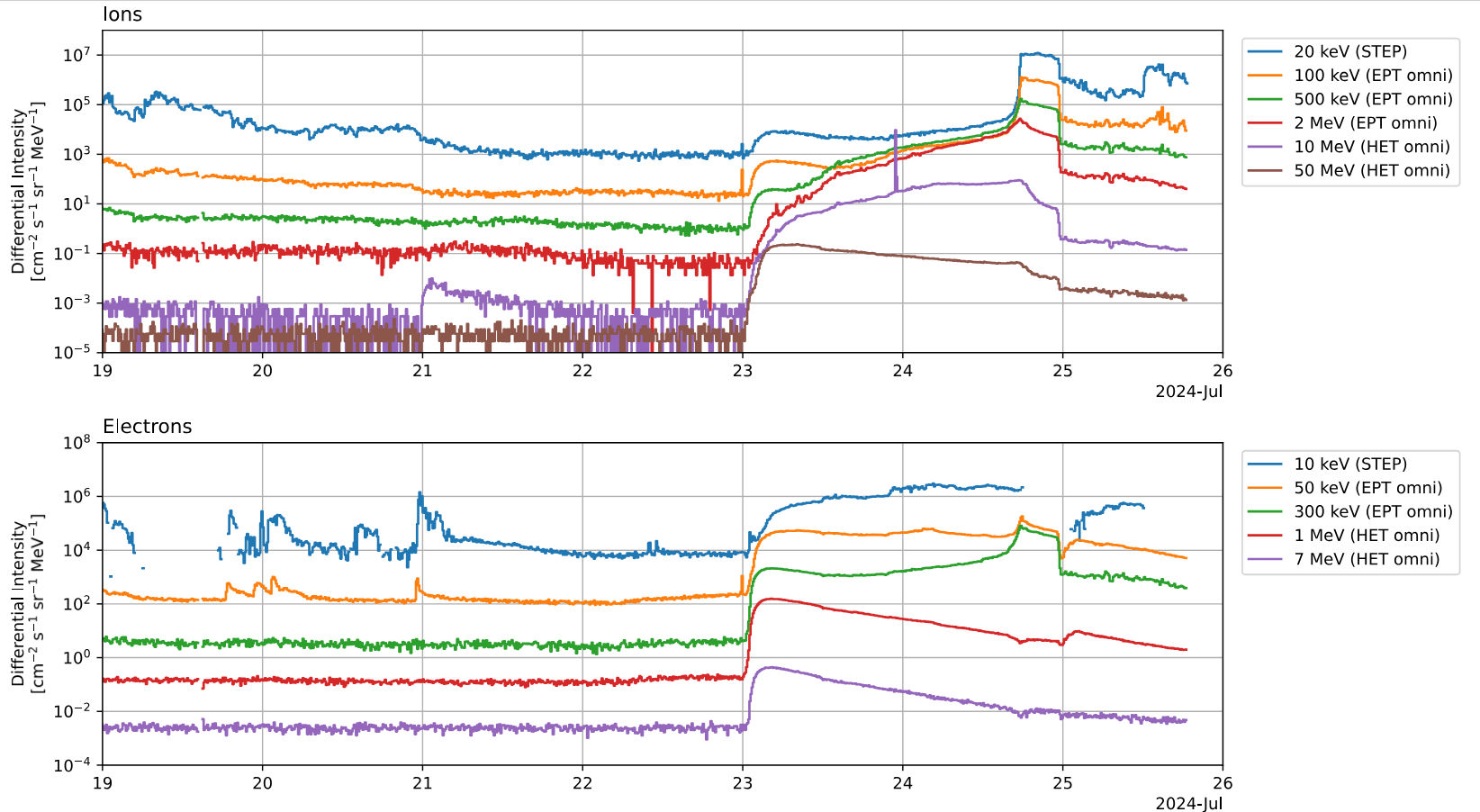
July 25, 2024: The biggest flare of Solar Cycle 25 just exploded from the farside of the sun. X-ray detectors on Europe’s Solar Orbiter (SolO) spacecraft registered an X14 category blast:
Solar Orbiter was over the farside of the sun when the explosion occured on July 23rd, in perfect position to observe a flare otherwise invisible from Earth.
“From the estimated GOES class, it was the largest flare so far,” says Samuel Krucker of UC Berkeley. Krucker is the principal investigator for STIX, an X-ray telescope on SolO which can detect solar flares and classify them on the same scale as NOAA’s GOES satellites. “Other large flares we’ve detected are from May 20, 2024 (X12) and July 17, 2023 (X10). All of these have come from the back side of the sun.”
Meanwhile on the Earthside of the sun, the largest flare so far registered X8.9 on May 14, 2024. SolO has detected at least three larger farside explosions, which means our planet has been dodging a lot of bullets.
The X14 farside flare was indeed a major event. It hurled a massive CME into space, shown here in a coronagraph movie from the Solar and Heliospheric Observatory (SOHO):
he CME sprayed energetic particles all over the solar system. Earth itself was hit by ‘hard’ protons (E > 100 MeV) despite being on the opposite side of the sun.
“This is a big one–a 360 degree event,” says George Ho of the Southwest Research Institute, principal investigator for one of the energetic particle detectors onboard SolO. “It also caused a high dosage at Mars.”
SolO was squarely in the crosshairs of the CME, and on July 24th it experienced a direct hit. In a matter of minutes, particle counts jumped almost a thousand-fold as the spacecraft was peppered by a hail storm energetic ions and electrons.
“This is something we call an ‘Energetic Storm Particle’ (ESP) event,” explains Ho. “It’s when particles are locally accelerated in the CME’s shock front [to energies higher than a typical solar radiation storm]. An ESP event around Earth in March 1989 caused the Great Quebec Blackout.”
So that’s what might have happened if the CME hit Earth instead of SolO. Maybe next time. The source of this blast will rotate around to face our planet a week to 10 days from now, so stay tuned. Solar flare alerts:SMS Text
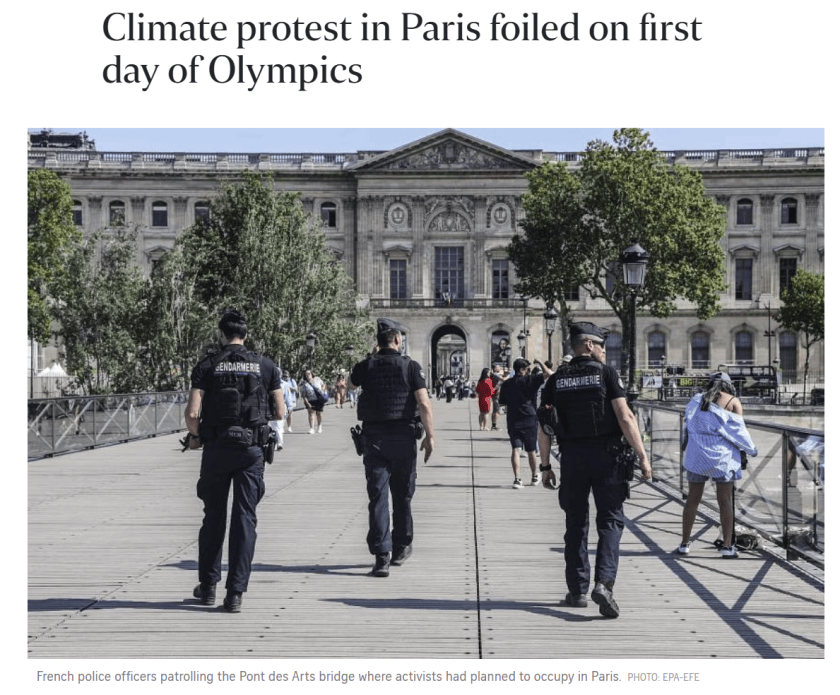
In a recent turn of events that is as predictable as it is tiresome, climate activists attempted to disrupt the first day of the Paris Olympics. This futile display of eco-theatrics was cut short by French authorities. While the incident raises minor concerns about the apparent lack of due process, it serves as yet another example of the overzealous and misguided antics of the climate alarmist brigade.
The activists in question aimed to hijack the global stage provided by the Olympics to propagate their climate change hysteria. According to reports, the protest was swiftly foiled by the police, who removed the activists before they could cause significant disruption. These eco-warriors, with their penchant for melodrama, evidently thought that throwing a tantrum in front of the world’s cameras would somehow translate into meaningful action.
Climate activists are increasingly adopting aggressive tactics to push their agenda. Their modus operandi involves high-profile disruptions designed to generate maximum media coverage. In this case, the protestors likely hoped to overshadow the Olympics.
However, such stunts do little to advance genuine discourse. Instead, they serve to alienate the general public, who might otherwise be sympathetic to reasonable and well-thought-out policies. It’s worth noting that these activists often rely on sensationalism rather than science, preferring to incite panic rather than engage in constructive dialogue.
While the swift action of the French police might be commendable in maintaining order, it does raise some questions about due process.
“Around 30 people were preventively arrested Saturday in Paris, without there being any offence to truly accuse them of,” Ms Alexis Baudelin, one of the group’s lawyers, told AFP.
The balance between maintaining public order and respecting individual rights is delicate, and it’s essential that actions against protestors, no matter how disruptive, are conducted within the bounds of the law.
The foiled protest comes after nine XR activists, including a minor, were preventively arrested on July 26 east of Paris, according to Paris prosecutors.
The lack of transparency and potential for overreach in dealing with such protests could set a troubling precedent. It’s crucial that the authorities operate with a clear mandate and ensure that any actions taken are proportionate and legally sound. This is not to defend the protestors’ actions but to underscore the importance of upholding democratic principles even in the face of idiotically stupid provocation.
Climate activism today mirrors the fervor of a religious crusade. The activists’ unwavering belief in their cause blinds them to the complexities and nuances of environmental policy. They demand immediate and radical changes without considering the economic and social repercussions. Policies like Net Zero and the Green New Deal, often championed by these groups, are fraught with practical challenges and unintended consequences.
The economic burden of such policies is enormous, and the feasibility of achieving these goals within the proposed timelines is highly questionable. The sweeping changes advocated could disrupt entire industries and lead to significant job losses, particularly in sectors like oil and gas, which are still vital to the global economy. Apparently today the protestors are angry with Toyota.
Organisers of the 2024 Paris Olympics promised to take “unprecedented” action for the climate by halving the event’s carbon footprint compared with previous Games.
But academics and campaigners have been sceptical, criticising car giant Toyota’s sponsorship of the Games.
Earlier in July, around 100 scientists signed an open letter arguing that “Toyota’s promotion of a hydrogen car is scientifically misaligned with net-zero and will damage the reputation of the 2024 Games”.
Climate campaigners put up mock adverts in Paris and five other French cities this week highlighting Toyota as a high-emitting company.
The need for a balanced and rational approach to environmental issues cannot be overstated. Sensationalist protests and alarmist rhetoric do little to foster genuine understanding or progress. Instead, they polarize the debate and hinder the development of practical and sustainable solutions.
It’s essential to recognize the fallacies of these alarmist claims without succumbing to hysteria. Environmental policy is a complex issue that requires thoughtful and measured responses. Policies should be based on sound science and a comprehensive understanding of their economic and social impacts. Moreover, public discourse should focus on constructive dialogue rather than sensationalist disruptions.
The recent thwarted protest in Paris is a reminder of the growing intensity of climate activism. While the activists’ intentions might be rooted in their beliefs, their methods often do more harm than good. It’s time for a more mature and reasoned approach to environmental issues—one that prioritizes science over sensationalism and practical solutions over theatrical stunts.
The tide may be turning somewhat on societies tolerance for these actions, as evidenced by the recent convictions and sentencing of Just Stop Oil protestors in the UK.
Although the Paris actions are more likely motivated by simple public relations concerns over the Olympics rather than a sea change in policy.
As we move forward, it’s crucial to maintain a balanced perspective, recognizing the need for policy analysis without undermining the principles of due process and democratic debate. Only then can we hope to achieve meaningful progress in addressing the challenges posed by misguided environmental activism.
For now most companies appear to be trying to avoid putting bad news in their company reports, apparently glossing over the required climate reporting risks, using qualitative language instead of quantitatively applying the latest “science”.
Companies in Australia are being warned they shouldn’t play down climate risks. For once I agree with the green regulators.
Warning to Aussie firms on mandatory climate reporting
By Marion Rae Updated July 26 2024 – 11:16AM, first published 11:12AM
Almost one in five of Australia’s top 200 companies are providing very little reporting on their climate risks ahead of the implementation of mandatory disclosure.
The Australian Council of Superannuation Investors report released on Friday found the majority of ASX200 members have net-zero commitments and most have also set interim targets, which helps investors to gauge the credibility of a company’s plans.
But gaps remain in the depth and scope of climate reporting, with some companies only partially reporting on their climate risks and 18 per cent doing almost nothing.
…
More than 6000 entities will be required to report under new climate-related disclosure requirements in the next few years, with critics concerned about the cost of more green tape for business.
For now most companies appear to be trying to avoid putting bad news in their company reports, apparently glossing over the required climate reporting risks, using qualitative language instead of quantitatively applying the latest “science”.
But what would happen if companies did the opposite? Took the wildest, most extreme IPCC projections, and reported in their prospectus there was nothing they could do to prevent the irreversible destruction of their companies? What if they told investors should be aware in 10 years or (pick a number) the company will no longer exist due to the ravages of climate change? That they intend to take no action to avert this risk, because no meaningful action is possible, due to rising emissions in China, India and Africa?
This would put the spotlight on the scientists making those predictions, not the companies reporting imminent climate catastrophe.
By taking all these wild predictions literally, and putting the scariest possible prognosis in company reports, companies will not only avoid prosecution for non-compliance with absurd climate reporting laws, they will expose the most ridiculously extreme climate predictions to more public scrutiny – and in doing so will do everyone, including themselves, a big service.
Update (EW): The Government got caught by their own climate disclosure push in 2023. Last year a law student won a court case forcing the government to admit in all future debt raising that the debt might not be repaid due to climate change (thanks John the Econ for prompting me to remember this). The government still has no problem raising debt.
The wind would have to be blowing strong and the sun would need to be shining but, as we know, both are frequently missing so bring us blackouts seems to be the theme proposed by those ENGO and our out of touch politicians and bureaucrats!
The chart below uses IESO data for nine (9) July days and clearly demonstrates the vagaries of those IWT (Industrial Wind Turbines) which on their highest generation day operated at 39.7% of their capacity and on their lowest at 2.3%! As the chart also notes, our natural gas plants were available to ramp up or down to ensure we had a stable supply of energy but rest assured IESO would have been busy either selling or buying power from our neighbours to ensure the system didn’t crash. [Independent Electricity System Operator for Ontario, Canada]
The only good news coming out of the review was that IESO did not curtail any wind generation as demand was atypical of Ontario’s summer days with much higher demand then those winter ones.
Days Gone By:
Back and shortly after the McGuinty led Ontario Liberal Party had directed IESO to contract IWT as a generation source; their “Annual Planning Outlook” would suggest/guess those IWT would generate an average of 15% of their capacity during our warmer months (summer) and 45% of their capacity during our colder months (winter). For the full year they would be projecting an average generation of 30% of their capacity and presumably that assumption was based on average annual Ontario winds!
The contracts for those IWT offered the owners $135/MWh so over the nine days contained in the chart below those 125,275 MWh generated revenue for the owners of $16,912,125 even though they only generated an average of 11.8% of their capacity. They are paid despite missing the suggested target IESO used because they rank ahead of most of Ontario’s other generation capacity with the exception of nuclear power due to the “first-to-the-grid” rights contained in their contracts at the expense of us ratepayers/taxpayers!
Should one bother to do the math as to the annual costs based on the 15% summer and 45% winter IESO previously used it would mean annual generation from those IWT in the summer would be about 3.9 TWh and 11.7 TWh in the winter with an annual cost of just over $2.1 billion for serving up frequently unneeded generation which is either sold off at a loss or curtailed!
Replacing Natural Gas Plants with BESS:
Anyone who has followed the perceived solution of ridding the electricity grid of fossil fuels such as natural gas will recognize ENGO [Environmental Non-Governmental Organizations] have convinced politicians that battery energy storage systems are the solution! Well is it, and how much would Ontario have needed over those nine charted July days? One good example is July 9th and 10th and combining the energy generated by natural gas from the chart over those two days is the place to start. To replace that generation of 221,989 MW with BESS units the math is simple as those BESS units are reputed to store four (4) times their rated capacity. Dividing the MWh generated by Ontario’s natural gas generators by four over those two days therefore would mean we would need approximately55,500 MW of BESS to replace what those natural gas plants generated. That 55,500 MW of BESS storage is over 27 times what IESO have already contracted for and add huge costs to electricity generation in the province driving up the costs for all ratepaying classes. The BESS2034 MW IESO already contracted are estimated to cost ratepayers $341 million annually meaning 55,500 MW of BESS to the grid would add over $9 billion annually to our costs to hopefully avoid blackouts!
The other interesting question is how would those 55,500 MW be able to recharge to be ready for future high demand days perhaps driven by EV recharging or those heating and cooling pumps operating? The wind would have to be blowing strong and the sun would need to be shining but, as we know, both are frequently missing so bring us blackouts seems to be the theme proposed by those ENGO and our out of touch politicians and bureaucrats!
Just one simple example as to where we seem to be headed based on the insane push to reach that “net-zero” emissions target!
IESO Ontario Electrical Energy Output by Source in 2023
Extreme Examples of Missing IWT generation:
What the chart doesn’t contain, or highlight is how those 4,900 MW of IWT capacity are undoubtedly consuming more power than they are generating on many occasions and the IESO data for those nine days contained some clear examples but less than a dozen are highlighted here!
To wit:
July 5th at Hour 11 they managed to deliver only 47 MWh!
July 7th at Hours 8, 9, and 10 they respectively generated 17 MWh, 3 MWh and 18 MWh!
July 9th at Hour 9 they delivered 52 MWh!
July 12th at Hours 8, 9, 10 and 11 they respectively generated 33 MWh, 13 MWh, 13 MWh and 35 MWh.
July 13th at Hours 9 and 10 they managed to generate 19 MWh and 39 MWh respectively!
Conclusion:
Why politicians and bureaucrats around the world have been gobsmacked by those peddling the reputed concept of IWT generating cheap, reliable electricity is mind-blowing as the Chart coupled with the facts, clearly shows for just nine days and only looking at Ontario!
Much like the first electric car invented in 1839, by a Scottish inventor named Robert Davidson, the first electricity generated by a wind turbine came from another Scottish inventor, Sir James Blyth who in 1887 did exactly that. Neither of those old “inventions” garnered much global acceptance until those ENGO like Michael Mann and Greta arrived on the scene pontificating about “global warming” being caused by mankind’s use of fossil fuels!
As recent events have demonstrated both EV and IWT are not the panacea to save the world from either “global warming” or “climate change” even though both have “risen from the dead” due to the “net-zero” push by ENGO.
The time has come for our politicians to wake up and recognize they are supporting more then century old technology focused to try and rid the world of CO 2 emissions. They fail to see without CO 2 mankind will be setback to a time when we had trouble surviving!
Stop the push and stop using ratepayer and taxpayer dollars for the fiction created by those pushing the “net-zero” initiative. That initiative is actually generating more CO 2 such as the 250 tons of concrete used for just one 2 MW IWT installation! Reality Bites!
The election is over and we all know Labour has won with a massive majority. New ministers have been appointed to the Department of Energy and Net Zero (DESNZ) and the hard job of Government has begun.
The election is over and we all know Labour has won with a massive majority. New ministers have been appointed to the Department of Energy and Net Zero (DESNZ) and the hard job of Government has begun.
Labour has appointed six ministers to DESNZ. However, analysis of their background and experience (see below) reveals two with PPE degrees, one with a degree in history, another with a degree in political studies and one with a degree in history and politics. There’s also one minister gaining a degree in Russian studies before studying law. Not one of them has a background in science, engineering or maths. Almost all of them have worked in the public sector for their whole lives, so between them, there is precious little experience of the commercial world and no experience of the energy sector. Ed Miliband and Miatta Fahnbulleh have qualifications in economics, but the latter describes herself as a “heterodox economist” and she has advocated “flooding the market with cheaper renewables” and introducing “free basic energy”. It can only be ‘heterodox economists’ who think more expensive, intermittent renewables are cheap and think energy is free.
There are three spads listed for Ed Miliband. Jonty Leibowitz studied history at Cambridge. Tobias Garnett studied law at City and then went to study at the Harvard Kennedy School where his thesis was entitled ‘A Just Transition to a Fairer Economy: Labour’s plan for a Green Industrial Revolution.’ Eleanor Salter is the final spad, shared with DEFRA, and it is unclear what her degree subject was but she writes for the Guardian and apparently she is particularly focused on “integrating nature into the climate offer”. No evidence of STEM backgrounds amongst the spads either.
You might think this does not matter, because ministers simply oversee the department and it is civil servants that really run the show. There are seven senior civil servants listed on the DESNZ website. But when you look at their background a similar picture emerges (see below). There are degrees in modern history, geography and modern languages, but precious little evidence of a STEM background anywhere. Only the Chief Scientific Advisor has any sort of science background and that is in chemistry, with a special focus on astrochemistry. Furthermore, there is no evidence that the senior civil servants have any significant experience outside the public sector. There is no evidence of experience in proper commercial businesses in any sector, let alone energy.
The rot does not stop in DESNZ. The department might turn to advisors like the National Grid Electricity System Operator, who have recently published their future energy pathways. Their Strategy and Policy Director, Claire Dykta, oversaw the work and wrote the foreword to the new document. Claire describes herself as a “leading influencer in the energy industry”, as though she was running a TikTok channel. Claire graduated from Aston with a degree in management, business and law, so no evidence of a STEM background either.
DESNZ ministers might look to the Climate Change Committee for advice or instructions. The CCC is currently without a chairman and CEO, but former chairman Lord Deben has a degree in history and former CEO Chris Stark studied finance and law. Despite never delivering anything more taxing than pizza, Stark has been drafted in to lead mission control to deliver a decarbonised grid by 2030. It is thought that Emma Pinchbeck, CEO of renewables cheerleader Energy U.K., is going to take over as CEO of the CCC. Emma has a classics degree from Oxford and began her career as a climate campaigner for WWF. Again, we find no evidence of any STEM expertise or proper commercial experience. The CCC does have some engineers and scientists on the board, but many of them have drunk the Kool-Aid, have interests in renewable energy or get their funding from billionaire climate activists.
Not only does Mad Emperor Miliband have no clothes, his entire entourage have Net Zero garments. We have the blind leading the blind, advised by clueless cronies who do not have the faintest idea about energy, engineering or the commercial world. They simply don’t know what they don’t know and are totally ill-equipped to challenge the tendentious twaddle put before them. Their idea of delivery is drawing boxes and triangles on PowerPoint presentations. Some of them might even be numerate enough to plug numbers into spreadsheets, but they do not have the faintest idea what their models mean in the real world. This is how we get plans for energy that halve per capita energy use by 2050, and nobody bats an eyelid. The entire energy policy establishment is broken.
The biographies of DESNZ ministers and senior civil servants are reproduced below.
Miatta Fahnbulleh as Parliamentary Under-Secretary
Michael Shanks as Parliamentary Under-Secretary
Let us look at their background and experience.
Ed Miliband
Ed and his brother David are the sons of Ralph Miliband who has been described as “one of the best-known academic Marxists of his generation”. Ed Miliband studied PPE at Corpus Christi College, Oxford, received a master’s in Economics at LSE and was then briefly a researcher for A Week in Politics before he was recruited to work as a researcher and speech writer for Harriet Harman, later becoming a spad for Gordon Brown in 1997. After a brief sabbatical at Harvard, and more advisory work on the Council of Economic Advisors, he became the MP for Doncaster North in 2005. In 2008, he became the Secretary of State for Energy and Climate Change and announced that the U.K. would oblige itself to cut emissions by 80% by 2050, instead of the previously announced 60%.
Since then, he has held various positions, including Leader of the Opposition. However, it is noteworthy, that he has held no job outside of politics and media, and certainly has no first-hand knowledge of energy or engineering.
Sarah Jones MP
Sarah Jones read History at Durham and joined the Labour Party in 1992, and worked for Labour MP Mo Mowlam. She has also worked for Shelter and as the Head of Public Affairs for the NHS Confederation. Sarah served as a senior civil servant helping to deliver the 2012 Olympics and held various other roles, including working for Gatwick Airport. She was elected to Parliament in 2017 and, since then, she has chaired an APPG on knife crime and been a Shadow Minister for Housing and, later, Shadow Minister for the Police and Fire Service. Again, it is difficult to find any specific energy or engineering expertise.
Lord Hunt of Kings Heath
Lord Hunt graduated in 1970 from the University of Leeds with a degree in political studies. His working career was in the healthcare sector, and since being elevated to the Lords, he has held ministerial positions in Health, Department for Work and Pensions, DEFRA and the Department of Energy and Climate Change. It is difficult to find any evidence of him ever working (other than as a minister) in energy or engineering, or indeed outside the public sector.
Kerry McCarthy MP
Kerry McCarthy read Russian Studies at Liverpool University before studying law at the City of London Polytechnic. She has worked as a lawyer for Abbey National and Merrill Lynch and held senior positions at Britain in Europe and the Waterfront Partnership. She was elected to Parliament in 2005 and has held various shadow ministerial positions, becoming Shadow Minister for Climate Change in 2022. Once again, we find no experience in energy, engineering, or STEM.
Miatta Fahnbulleh MP
Miatta Fahnbulleh studied PPE at Lincoln College, Oxford, and then gained a PhD in Economic Development from the LSE. She has described herself as a heterodox economist and, whilst head of the New Economics Foundation (NEF), certainly advocated some, shall we say, unconventional policies. These include “flooding the energy market with cheap renewables and introducing free basic energy”. Miatta and NEF have also advocated an additional windfall tax on oil and gas companies. Miatta was promoted to a ministerial position just a few days after first being elected to Parliament this year. Perhaps she might find these cheap renewables under a magic money tree. Again, no STEM experience and no experience of the private sector.
Michael Shanks MP
Michael Shanks graduated from the University of Glasgow with a degree in History and Politics. He worked in a charity for a while before becoming a teacher. He taught Modern Studies at a school in Scotland. He was elected to Parliament in a by-election in December 2023. Yet another minister without STEM experience and no experience of the commercial world.
Jonathan Mills – Director General Energy and Markets Supply
Ashley Ibbett – Director General of Energy Infrastructure
Lee McDonough – Director General of Net Zero, Nuclear and International
Ben Rimmington – Director General of Net Zero Buildings and Industry
Professor Paul Monks – DESNZ Chief Scientific Advisor
Jeremy Pocklington
Jeremy Pocklington is the senior civil servant in DESNZ. He graduated from Oxford with a degree in Modern History and later gained a master’s in Economics and Social History. His entire career has been in the Civil Service with spells at the Treasury, the Cabinet Office, DECC and MHCLG. He became the Permanent Secretary in DESNZ in February 2023.
Clive Maxwell
Clive Maxwell graduated from Oxford with a degree in geography in 1992. The experience in his LinkedIn profile does not begin until July 2000, when he became the Head of Environmental and Transport Taxes and Savings Incentives in the Treasury. He then worked his way up in the Treasury before moving to the Office of Fair Trading, where he eventually became the Chief Executive. He subsequently returned to the Civil Service, where he held various senior positions in BEIS and DfT, before becoming the Second Permanent Secretary in DESNZ.
Jonathan Mills
It is not clear what subject Jonathan Mills studied at university, but he is listed as having an MA and MPhil in his biography on the website of De Montford University, so we can be reasonably certain that he is not from a STEM background. Since 2017, he has worked in several senior civil service roles. His career before 2017 is not listed in his biography.
Ashley Ibbett
Ashley Ibbett has been a civil servant for over two decades and has worked in a wide range of roles covering trade, science, innovation, competition and energy. It is not known if he had a career before joining the Civil Service, and his degree subject is not listed.
Lee McDonough
Lee McDonough is a career civil servant with an MBA from Imperial College. She has worked in several departments such as DEFRA, Health, BEIS and is now in charge of Net Zero, Nuclear and International at DESNZ. Her original degree is not listed.
Ben Rimmington
Ben Rimmington is a career civil servant with a degree in modern languages from Cambridge. He joined the Civil Service Fast Stream in 1995 and has worked in the Department for Business Enterprise and Regulatory Reform, Business Innovation and Skills, Leeds City Enterprise Partnership, DfT and now DESNZ. There is no evidence of commercial experience, and clearly, he has no STEM background.
Professor Paul Monks
Professor Paul Monks graduated from Warwick University with a degree in Chemistry and went on to gain a doctorate in the same subject from Oxford. His career since then has been in research and academia, including a stretch at the NASA Goddard Space Flight Centre where he worked on astrochemistry. He became Chief Scientific Advisor to BEIS in 2020 and to DESNZ in 2023. At last, we have found someone with a STEM background, although in Chemistry with a special interest in astrochemistry. There is no evidence of experience in the commercial world.
Vice President Kamala Harris is one election away from winning the White House and accelerating America’s climate hysteria that is already well underway thanks to the outgoing President Joe Biden.
Vice President Kamala Harris is one election away from winning the White House and accelerating America’s climate hysteria that is already well underway thanks to the outgoing President Joe Biden.
“There is no question I’m in favor of banning fracking,” then-Sen. Harris said during a CNN-sponsored town hall back in 2019, during her ill-fated run for president.
During Harris’ short-lived campaign for president, which crashed and burned months before the 2020 caucus and primary votes, she called for a climate pollution fee that would “make polluters pay for emitting greenhouse gases into our atmosphere.” Typical of so many climate falsehoods, Harris conflates carbon emissions with “pollution.”
In his letter to the nation last Sunday announcing he was dropping out of the presidential race, President Joe Biden boasted that he had overseen passage of the “most significant climate legislation in the history of the world” — an apparent reference to his misnamed Inflation Reduction Act. This “significant” legislation included hundreds of millions of dollars of corporate welfare for companies to build wind turbines, solar panels and electric vehicles and other climate-related projects.
Because, after all, the U.S. is “the world’s largest historical contributor to climate change – still the second largest today after China’ said a story posted by the climate-rabid media outlet, Yahoo News. Expect a President Harris to double down on such unscientific drivel.
In a modern historical anomaly, Harris is poised to become a major party’s presidential nominee without a single caucus or primary vote, which is a throwback to the old days of party bosses and smoke-filled rooms at convention time.
Still, Harris is among the most privileged Americans to ever become a presidential nominee of a major political party, though not without difficulties. Her parents were both college professors, but they divorced when she was young. Following law school, Harris became a prosecutor in the Alameda County attorney’s office. With the assistance of her politically powerful mentor and very close friend, the charismatic California State Assembly Speaker Willie Brown, she was appointed to several public jobs, elected as San Francisco district attorney, attorney general of California, and then U.S. senator.
After becoming a senator, Harris began running for president. Her 2020 presidential campaign helped reveal her radical positions on climate and a host of other issues and enabled her to get on the short list of vice presidential choices.
With Biden’s mental and physical decline now so obvious, Harris has become the beneficiary of a ninth-inning political coup d’état against the president, engineered by Democratic Party leaders, who pressured him to drop his re-election campaign on the eve of the party’s nominating convention.
Harris is no Scranton-born, working-class pretender, who rode Amtrak. She does not have any record of political centrism, moderation or bipartisanship, which Biden practiced off and on throughout his career and helped him win the presidency in 2020.
By contrast, Harris is a product of the one-party state of California, who supported destructive policies on climate change, energy, crime and welfare that helped spark in California high fuel costs, declining living standards and a population exodus.
The election of 2024 will have climate change on the ballot, as did the 2020 election. The big difference this time is that Americans have experienced more than ever the inflationary and detrimental effects of climate policies with no impact on climate change.
And, it is not a supposed moderate candidate making the climate sale to the public, but a true believer, Kamala Harris.
In his review in the Nebelspalter, Axel Reichmuth lists the arguments of the sociologist Jens Becker, which support his conclusion that under the current conditions all efforts to ward off the “existential threat” of climate change will fail.
Reader’s letter from Otto Glinzer on the blog article from 2.6.2024:
Dear Editors,
In his review in the Nebelspalter, Axel Reichmuth lists the arguments of the sociologist Jens Becker, which support his conclusion that under the current conditions all efforts to ward off the “existential threat” of climate change will fail. According to Becker, the culprits are
– capitalism, which (allegedly) leads to ever greater consumption of resources (the “limits to growth” send their regards), even if the growth is (supposedly) climate-friendly, environmentally friendly and sustainable – the unreasonable people who prefer to live well today, do not think much of renunciation of consumption and do not take seriously dangers that will only threaten in the distant future – the greedy fossil energy industry – the people of the 3rd world (the “global south”), who also want to live in prosperity and are correspondingly hungry for energy– politicians dependent on democratic elections, who must not offend their clientele
Axel Reichmuth summarizes the statements optimistically: “The market economy system is simply too successful for people to be prepared for a rigid war and renunciation economy because of the alleged disadvantages of global warming. They suspect that climate protection is likely to do more harm than good to the world at the end of the day.”
From a pessimistic point of view, however, it is striking that Jens Becker completely ignores a solution to the problems through non-fossil and non-CO2-emitting ways of reliable energy generation – e.g. existing nuclear energy or future nuclear fusion – and instead uses the argument that “Big Oil” has been designed for decades to “prevent, delay, dilute or evade” effective climate protection. Instead, he writes: What is necessary is an “emergency stop”, but this is not in sight.
What could such a “full stop” considered necessary look like? Taking into account the arguments put forward by Jens Becker, in the face of the “existential threat” to the world, it is apparently necessary to abolish the harmful systems of capitalism and democracy and instead introduce a socialist dictatorship of the intelligent, who know the real threats to humanity, know what is good (and what is too much) for the people, and educate and guide them accordingly.
However, systems of this kind have always led to catastrophe in the history of mankind so far, since the “sensible” cannot even know what is good for each individual human being, moreover lose all knowledge about costs and prices through the elimination of the market and offer creative citizens or companies no incentives for innovations and inventions.
As a refresher for Biden’s and Newsom’s passion for pursuing net-zero emissions, wind and solar are not only intermittent and inefficient, they do different things than crude oil.
As a refresher for Biden’s and Newsom’s passion for pursuing net-zero emissions, wind and solar are not only intermittent and inefficient, they do different things than crude oil.
Wind turbines and solar panels only generate occasional electricity but manufacture absolutely NO PRODUCTS for society.
Sadly, others are following the pursuit of ONLY weather-dependent generated electricity, like nongovernmental organizations (NGO), the National Wildlife Federation, the Conservation Law Foundation, and even the Heinz Endowments, the “legacy” of former Senator and Heinz ketchup baron John Heinz.
Crude oil is virtually never used to generate electricity, but when manufactured into petrochemicals, it is the basis for virtually all the products in our materialistic society that did not exist before the 1800s. These products are used in infrastructures such as transportation, airports, hospitals, medical equipment, appliances, electronics, telecommunications, communications systems, space programs, heating and ventilation, and militaries.
Both Biden and Newsom do not comprehend that Teslas are 100% made from crude oil!
EV tires, electronic components, upholstery, etc., are 100% made from oil derivatives manufactured from crude oil.
Further, all the parts and components of EVERY electricity generation system (coal, natural gas, nuclear, hydro, wind, and solar) are also made from the oil derivatives manufactured from oil!
Before the 1800s and before the discovery of oil, we had NO crude oil and, obviously, NO products, NO electricity, and NO Teslas!
Mandating EVs and electricity generation from wind turbines and solar panels is mandating MORE USAGE of crude oil.
Simplistically, to rid the world of oil usage, STOP using products made from oil.
There is no need for the crusade to over-regulate the “suppliers of oil and gas” when there is no known replacement to meet the “demands” of our materialistic world, but Democrats, armed with their LACK of Energy Literacy, continue their pursuit to eliminate the only known sources of the products that are supporting modern lifestyles and economies:
Biden and Newsom are oblivious that without crude oil, there would be nothing that needs electricity! Everything, like iPhones, computers, data centers, and X-ray machines, that need electricity to function, and all the parts of EVs, toilets, spacecraft, and more than 50,000 merchant ships, more than 20,000 commercial aircraft,and more than 50,000 military aircraft are also made from the products based on oil and use the fuels manufactured from crude oil.
Without a replacement, the elephant in the room that no one wants to discuss is that crude oil is the foundation of our materialistic society as it is the basis of all products and fuels demanded by the world that now sustains 8 billion people — ten times the population prior to the Industrial Revolution and thankfully has experienced record crop production. This rapid increase in agricultural output is partially attributable to an increase in atmospheric CO2 since 1940. This rise in CO2 levels alone is linked to major yield increases for corn, soybeans, and wheat.
Biden and Newsom’s delusions are that the end of crude oil would be the end of civilization as “unreliable electricity” from breezes and sunshine cannot manufacture anything.
The world has also experienced significant economic growth and prosperity, benefiting from the more than 6,000 productsthat are derived from fossil fuels. These products support infrastructures that were not around a few centuries ago because they all need components and parts made from fossil fuels that were NOT available in the pre-1800s.
The book discusses the lack of transparency to the world of the green movement’s impact on humanity’s exploitations in the developing countries that are mining for the exotic minerals and metals required to create the batteries needed to store “green energy.” In these developing countries, these mining operations disproportionately impact low-income communities and exploit child labor, and are responsible for the most egregious human rights violations of vulnerable minority populations. These operations are also directly destroying the planet through environmental degradation.
Mandating “net-zero” emissions is frustrating when those “renewable solutions” require the same crude oil to make EVs, wind turbines, and solar panels. Policymakers are oblivious to the fact that electricity came AFTER the discovery of oil 200 years ago.
To reiterate, to rid the world of oil usage, simplistically, STOP using the products made from oil! No need to over-regulate the “suppliers of fossil fuels” when there are no replacements to meet the “demands” of our materialistic world. It’s becoming very obvious that climate policies are the real existential threat to billions across our planet.
It is both unethical, immoral, and hypocritical to continue financially encouraging China and Africa to exploit “their” poor with yellow, brown, and black skin and financially support environmental degradation to “their” landscapes just to reinforce mandated EVs, wind turbines, and solar panels in “our backyards.”
Readers of this site will be more aware than most of the difficulties involved in eliminating greenhouse gas emissions from electricity grids. The policy preference for wind turbines and solar photovoltaic panels renders the objective still more taxing. Those sources’ intermittency is well understood, and is generally regarded as the primary obstacle to large-scale adoption and reliance. However, it is not the only problem that they present for grid operation.
Readers of this site will be more aware than most of the difficulties involved in eliminating greenhouse gas emissions from electricity grids. The policy preference for wind turbines and solar photovoltaic panels renders the objective still more taxing. Those sources’ intermittency is well understood, and is generally regarded as the primary obstacle to large-scale adoption and reliance. However, it is not the only problem that they present for grid operation.
Relatively soon after they were first developed, electricity grids consolidated on alternating current (AC) technology, despite the fact that grid operation would be rather simpler with direct current (DC) systems. The adoption of AC was not a result of eccentricity on the part of physicists and engineers in pursuit of technical thrills: modern grids could not exist without it, and the disadvantages have long been accommodated and managed as a matter of necessity. Whatever might be said of its disadvantages, an AC grid is what we have, and an AC grid there shall be; modern DC transmission lines are a supplement, not a replacement.
Along with a basic requirement for balancing energy supply and demand, AC grid operation requires precise and consistent control of frequency and voltage. Deviation from acceptable values is more than a nuisance: connected equipment can operate improperly, and can be damaged. A grid has a certain highly strung and binary quality, in that it either works correctly or it does not work. Hence the practice of disconnecting portions of a network in response to serious instability; doing so is preferable to a systemic collapse. This unavoidable fact has fundamental implications for the design of generating plant that can safely be connected to a grid.
Grids have developed on a foundation provided by large synchronous alternators driven by a smooth and controllable source of mechanical power (water, steam or combustion gas). These machines produce an alternating voltage in time with their mechanical rotation. They can readily be connected together so as to operate in parallel, with each machine turning in time with the others. Such an arrangement can be a few metres apart, or separated by hundreds of miles. In other words, they can readily form an AC grid.
There are additional qualities that render them ideal for grid formation. They can vary their active power output, i.e. they can vary the amount of energy that flows out and is consumed. This enables the matching of supply and demand, and allows for control of grid frequency. They can vary their reactive power settings, which facilitates control of grid voltage in response to an unavoidable consequence of feeding AC power to and through certain devices. Their nature as large rotating machines turning in time with the grid provides synchronous inertia; a desirable characteristic that slows variations in grid frequency.
All of these qualities enable stable grid operation, and grids, as currently configured, could not function without them.
But what of wind turbines and photovoltaic panels?
They have the substantial disadvantage of being unable to increase their active power output beyond what the weather conditions allow at any given moment. That much is obvious on a time scale ranging from hours to weeks; hence the attention given to intermittency and energy storage. However, it also applies to shorter timescales: maintaining grid stability requires continuous adjustment. With appropriate control arrangements, wind turbines and solar arrays can reduce their output as required, but they cannot necessarily increase it. Furthermore, wind speed and solar irradiance can be volatile, even at short timescales.
Wind turbines use rotating alternators. However, for various reasons, they are unsuited to synchronous operation. Accordingly, irrespective of the variety employed, they must be operated asynchronously. Solar arrays are a DC source, and are therefore not alternators, whether synchronous or otherwise. Inherently, therefore, wind turbines and solar arrays offer no synchronous inertia whatsoever.
That wind turbines and solar arrays can be connected to an AC grid is due principally to the application of modern power electronics, particularly inverters. These devices shape the electrical output of asynchronous generators so as to mimic that of a synchronous alternator. This enables them to connect to a grid. If the conditions permit, they can supply active power. If their specifications and controls permit, they can vary their reactive power settings. However, there is a caveat. Simple mimicry is tolerable at sufficiently small scales, but is a potential liability at larger ones. This is a consequence of the limitations of the inverters currently employed.
Reliance on inverters extends beyond wind turbines and solar arrays. Batteries are the currently favoured technology to compensate for wind and solar intermittency. As with solar arrays, they are a DC source. Similarly, the importing end of a DC transmission line is a DC source that must feed an AC grid. This is an important consideration for the British grid, given that it is becoming festooned with interconnectors. If a battery installation has sufficient charge, or if the exporting end of a DC transmission line has power to spare, active power can be supplied reliably. In that regard, such installations are rather better than wind turbines and solar arrays. Nevertheless, the same inverter limitations apply, with adverse implications for grid stability.
The greater the number of wind turbines, solar arrays, batteries and DC lines connected to a grid, the less it resembles a network of synchronous alternators. It becomes inherently less stable. Attempting to operate a grid using asynchronous sources exclusively, or nearly exclusively, would lead to a swift collapse, irrespective of overall weather conditions. This is an engineering problem that is well understood in the relatively small world of grid operation, but is far less appreciated outside. Unless it is solved, even daydreaming about vast wind, solar and battery installations will be a waste of time.
Some aspects of a possible solution are reasonably plausible. For example, there are specialised devices that can improve synchronous inertia and reactive power compensation. However, a complete solution is currently not assured. The behaviour of inverters is an evident vulnerability. Work is under way to improve them, namely to make them act more like synchronous alternators, but success is not guaranteed. It is a case of a newer technology struggling to catch up with an older and more effective predecessor; perhaps an appropriate metaphor for the pursuit of decarbonisation as a whole.
The simplest way to solve or avoid the problem is to limit the capacity of asynchronous sources, relative to that of synchronous alternators. That, however, places a firm limit on asynchronous capacity addition, thereby undermining the current policy preference. On the other hand, given the vast cost and potential disruption of adding the envisaged asynchronous capacity, a technical limit on the scale of deployment could be seen as a blessing. After all, doing nothing is sometimes best.





You must be logged in to post a comment.