Climate Activists Thwarted in Paris

From Watts Up With That?

By Charles Rotter

In a recent turn of events that is as predictable as it is tiresome, climate activists attempted to disrupt the first day of the Paris Olympics. This futile display of eco-theatrics was cut short by French authorities. While the incident raises minor concerns about the apparent lack of due process, it serves as yet another example of the overzealous and misguided antics of the climate alarmist brigade.
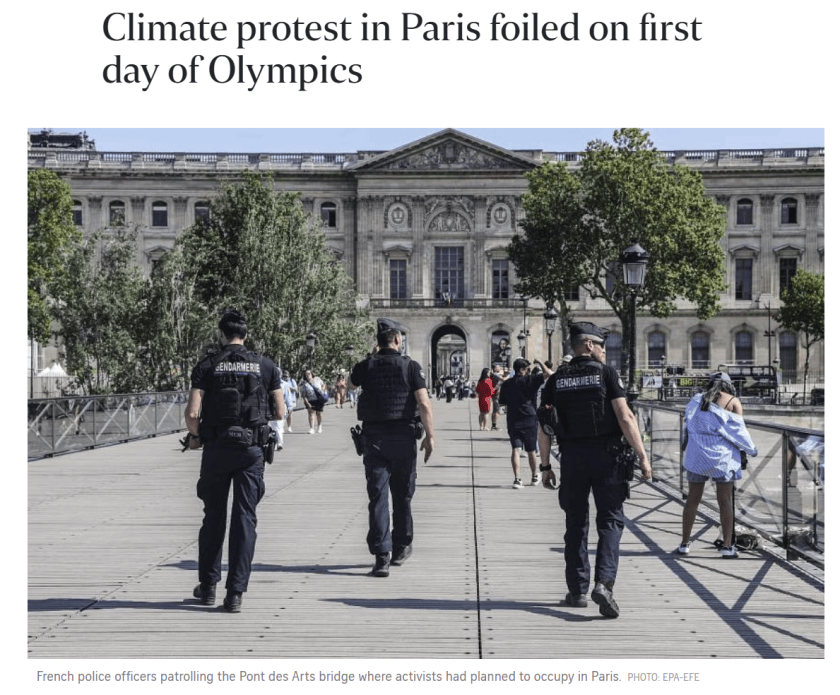
The activists in question aimed to hijack the global stage provided by the Olympics to propagate their climate change hysteria. According to reports, the protest was swiftly foiled by the police, who removed the activists before they could cause significant disruption. These eco-warriors, with their penchant for melodrama, evidently thought that throwing a tantrum in front of the worldโ€™s cameras would somehow translate into meaningful action.

Climate activists are increasingly adopting aggressive tactics to push their agenda. Their modus operandi involves high-profile disruptions designed to generate maximum media coverage. In this case, the protestors likely hoped to overshadow the Olympics.

However, such stunts do little to advance genuine discourse. Instead, they serve to alienate the general public, who might otherwise be sympathetic to reasonable and well-thought-out policies. Itโ€™s worth noting that these activists often rely on sensationalism rather than science, preferring to incite panic rather than engage in constructive dialogue.

While the swift action of the French police might be commendable in maintaining order, it does raise some questions about due process.

โ€œAround 30 people were preventively arrested Saturday in Paris, without there being any offence to truly accuse them of,โ€ Ms Alexis Baudelin, one of the groupโ€™s lawyers, told AFP.

https://www.straitstimes.com/world/europe/climate-protest-in-paris-foiled-on-first-day-of-olympics

The balance between maintaining public order and respecting individual rights is delicate, and itโ€™s essential that actions against protestors, no matter how disruptive, are conducted within the bounds of the law.

The foiled protest comes after nine XR activists, including a minor, were preventively arrested on July 26 east of Paris, according to Paris prosecutors.

https://www.straitstimes.com/world/europe/climate-protest-in-paris-foiled-on-first-day-of-olympics

The lack of transparency and potential for overreach in dealing with such protests could set a troubling precedent. Itโ€™s crucial that the authorities operate with a clear mandate and ensure that any actions taken are proportionate and legally sound. This is not to defend the protestorsโ€™ actions but to underscore the importance of upholding democratic principles even in the face of idiotically stupid provocation.

Climate activism today mirrors the fervor of a religious crusade. The activistsโ€™ unwavering belief in their cause blinds them to the complexities and nuances of environmental policy. They demand immediate and radical changes without considering the economic and social repercussions. Policies like Net Zero and the Green New Deal, often championed by these groups, are fraught with practical challenges and unintended consequences.

The economic burden of such policies is enormous, and the feasibility of achieving these goals within the proposed timelines is highly questionable. The sweeping changes advocated could disrupt entire industries and lead to significant job losses, particularly in sectors like oil and gas, which are still vital to the global economy. Apparently today the protestors are angry with Toyota.

Organisers of the 2024 Paris Olympics promised to take โ€œunprecedentedโ€ action for the climate by halving the eventโ€™s carbon footprint compared with previous Games.

But academics and campaigners have been sceptical, criticising car giant Toyotaโ€™s sponsorship of the Games.

Earlier in July, around 100 scientists signed an open letter arguing that โ€œToyotaโ€™s promotion of a hydrogen car is scientifically misaligned with net-zero and will damage the reputation of the 2024 Gamesโ€.

Climate campaigners put up mock adverts in Paris and five other French cities this week highlighting Toyota as a high-emitting company.

https://www.straitstimes.com/world/europe/climate-protest-in-paris-foiled-on-first-day-of-olympics

The need for a balanced and rational approach to environmental issues cannot be overstated. Sensationalist protests and alarmist rhetoric do little to foster genuine understanding or progress. Instead, they polarize the debate and hinder the development of practical and sustainable solutions.

Itโ€™s essential to recognize the fallacies of these alarmist claims without succumbing to hysteria. Environmental policy is a complex issue that requires thoughtful and measured responses. Policies should be based on sound science and a comprehensive understanding of their economic and social impacts. Moreover, public discourse should focus on constructive dialogue rather than sensationalist disruptions.

The recent thwarted protest in Paris is a reminder of the growing intensity of climate activism. While the activistsโ€™ intentions might be rooted in their beliefs, their methods often do more harm than good. Itโ€™s time for a more mature and reasoned approach to environmental issuesโ€”one that prioritizes science over sensationalism and practical solutions over theatrical stunts.

The tide may be turning somewhat on societies tolerance for these actions, as evidenced by the recent convictions and sentencing of Just Stop Oil protestors in the UK.

Roger Hallam Receives Five Year Sentence, other Just Stop Oil Co-Conspirators Receive Four Years โ€“ Watts Up With That?

Although the Paris actions are more likely motivated by simple public relations concerns over the Olympics rather than a sea change in policy.

As we move forward, itโ€™s crucial to maintain a balanced perspective, recognizing the need for policy analysis without undermining the principles of due process and democratic debate. Only then can we hope to achieve meaningful progress in addressing the challenges posed by misguided environmental activism.

Operation Starve Paris: French farmers begin ‘indefinite’ tractor siege of the capital as it’s warned the city only has THREE DAYS of food, Toulouse is ‘cut off’ and hay bales are used to build blockades

French farmers have today started an ‘indefinite’ tractor siege of Paris, blocking off key routes after threatening to ‘starve’ the city โ€“ amid warnings the capital only has three days of food.

French farmers have today started an ‘indefinite’ tractor siege of Paris, blocking off key routes after threatening to ‘starve’ the city โ€“ amid warnings the capital only has three days of food.

Tractors are clogging major roads bringing traffic to a grinding halt around the city with stacks of hay bales also used to block carriageways as part of a bitter on-running dispute over work conditions. Theย Daily Mail has the story.

Meanwhile, the southern city of Toulouse has nearly been ‘cut off’ in the midst of similar protests in what will be a major test forย France‘s youngest ever PM Gabriel Attal โ€“ just weeks after he was appointed by President Emmanuel Macron aged 34.

In recent weeks there has been a slew of protests in France, a major agricultural producer, by farmers angry about incomes, red tape and environmental policies they say undermine their ability to compete with other countries.

Protesting farmers started the operation by blocking the A13 highway to the west of the capital, the A4 to the east and the A6 on which hundreds of tractors rolled towards Paris from the south. The government in response has deployed some 15,000 police officers.

By mid-afternoon they appeared to have met their objective of establishing eight chokepoints on major roads into Paris, according to Sytadin, a traffic monitoring service.

‘We need answers,’ said Karine Duc, a farmer in the southwestern Lot-et-Garonne department as she joined a convoy of tractors heading for Paris. ‘This is the final battle for farming. It’s a question of survival,’ she added.

A banner on a tractor in the convoy said: ‘We will not die in silence.’

The crippling protests are the first major test for the country’s youngest ever Prime Minister Gabriel Attal who was appointed by President Emmanuel Macron just weeks ago.

The agriculture workers are protesting for more protection against rising production costs and for an end to green net zero policies that they say are putting them out of business.

The government, wary of seeing the protests escalate and with an eye on European Parliament elections in June, has already dropped plans to gradually reduce subsidies on agricultural diesel and promised to ease environmental regulations.

France also said it would push itsย European Unionย peers to agree to ease regulations on fallow farmland. But farmers’ organisation said it was not enough.

Read the full story ย here.


Paris votes to ban rentalย e-scooters

Almost 90% of votes cast on Sunday favoured a ban the battery-powered devices, official results showed.

From NOT A LOT OF PEOPLE KNOW THAT

By Paul Homewood

h/t Paul Kolk

Parisians have voted to ban rental electric scooters in their city, dealing a blow to scooter operators and a triumph for road safety campaigners.

Almost 90% of votes cast on Sunday favoured a ban the battery-powered devices, official results showed.

But under 8% of those eligible turned out to vote.

The referendum was called in response to a rising number of people being injured and killed on e-scooters in the French capital.

Of the 1.38 million people on the cityโ€™s electoral register, just over 103,000 took part, according to official figures. Of these, over 91,300 voted against the scooters.

Paris was one of the first cities to adopt the electric vehicles โ€“ but critics argue they were causing more harm than good.

There was growing concern with the way some people were driving the scooters โ€“ weaving through traffic, dodging pedestrians on pavements, and getting up to speeds of 17mph (27km/h).

Riders often did not wear helmets and children as young as 12 could legally hire the e-scooters.

https://www.bbc.co.uk/news/world-europe-65154854

Nearly 90% of voters in the referendum chose to forbid the electric vehicles

Not a moment too soon. Shame on the politicians who allowed them in the first place.

Bye Bye Paris: Chinese CO2 Emissions are Skyrocketing

China is pumping out carbon emissions as if COVID never happened. Thatโ€™s bad news for the climateย crisis

From Watts Up With That?

Xi Jinping:ย Official website of Ali Khamenei, Supreme leader of Iran,ย CC BY 4.0, via Wikimedia Commons. Globe from NASA (Public Domain). Match:ย Dietmar Rabichย /ย Wikimedia Commonsย /ย โ€œStreichholz — 2021 — 6120โ€ย /ย CCย BY-SAย 4.0

As industries in green nations like Germany struggle with unaffordable green energy, China is boosting coal use.

China is pumping out carbon emissions as if COVID never happened. Thatโ€™s bad news for the climateย crisis

Published: July 10, 2023 6.05am AEST

ย David Stern,ย Crawford School of Public Policy, Australian National University,ย Khalid Ahmed,ย Australian National University

Carbon emissions from China are growing faster now than before COVID-19 struck, data show, dashing hopes the pandemic may have put the worldโ€™s most polluting nation on a new emissions trajectory.

We compared emissions in China over the first four months of 2019 โ€“ before the pandemic โ€“ and 2023. Emissions rose 10% between the two periods, despite the pandemic and Chinaโ€™sย faltering economic recovery. Power generation and industry are driving the increase

Under the Paris Agreement, China has pledged to ensure carbon emissions peak by 2030 and reach net zero emissions by 2060. Our analysis suggests China may struggle to reach these ambitious goals.
ย 
Manyย believedย the economic recovery from COVID would steer global development towards a less carbon-intensive footing. But Chinaโ€™s new path seems to be less sustainable than before. Thatโ€™s bad news for global efforts to tackle climate change.
โ€ฆ
Read more: https://theconversation.com/china-is-pumping-out-carbon-emissions-as-if-covid-never-happened-thats-bad-news-for-the-climate-crisis-207933

I admit I didnโ€™t foresee this, I thought Chinaโ€™s economy is in so much trouble emissions would be stagnant.

But in retrospect the reason for this growth in emissions is obvious.

Last Summerย China experienced a drought so severe one of their largest waterways, the Yangtze River, completely dried up. They also experienced severe power shortages because they had to shut down much of their hydroelectric capacity.

Given China has experienced multiple severe droughts and floods in recent years, it makes complete sense for China to amp up coal burning, to reduce their reliance on hydroelectricity.

The funniest part of this, a renaissance of coal worldwide is exactly what would happen if all the alarmist predicted climate weather disasters actually occurred.

If a superstorm smashes your solar array, or tears up your wind turbines, or if torrential floods or severe droughts wreck your hydro capacity, weather resistant coal and gas would be your only option.

Renewables are a total waste of effort, even if we accept all the absurd global warming disaster predictions weโ€™ve seen over the years.

If China saw extreme conditions, and extreme conditions are predicted, is China actually seeing climate change? Alarmists would certainly like you to believe this, but there is a problem with this hypothesis. Every time the Yangtze dries up, it reveals countless inscriptions written by people who endured previous severe droughts, like the inscription below which was written in the year 1086.

Yangtze River Drought Incription from 1086. (left) โ€œRiver water reaches 5 chi below the fish on 7 February 1086 (Chinese lunar calendar)โ€ and (right) โ€œRiver water goes 4 chi below the fish on 24 January 1074 (Chinese lunar calendar), and this is the sign of auspiciousness.โ€. Sourceย AMS

Bloomberg News: โ€˜South Africa Beats Climate Goal as Blackouts Slash Emissionsโ€™ โ€“ โ€˜Unintentionalโ€ฆpower plant breakdowns are reducing industrial activityโ€™

From Climate Depot

Bloomberg: South Africa is ahead of its target for cutting emissions of greenhouse gases. … Regular breakdowns of the coal-fired power plants that supply more than 80% of South Africaโ€™s electricity mean that less carbon dioxide is being pumped into the atmosphere and daily rotational cuts of more than 10 hours a day are further limiting emissions from factories. 

โ€œItโ€™s unintentional,โ€ Crispian Olver, the executive director of South Africaโ€™s Presidential Climate Commission, said in an interview in Johannesburg on Monday. โ€œWe reckon we are well within the rangeโ€ of meeting the 2030 target, he said. …โ€œItโ€™s very difficult to recommend the decommissioning of power stations in the middle of an energy crisis.โ€

#

Flashback 2011: Weโ€™re All North Koreans Now: โ€˜Era of Constant Electricity at Home is Ending, says UK power chiefโ€™ โ€” โ€˜Families would have to get used to only using power when it was availableโ€™

Swiss president warns nation to prepare for electricity shortages lasting weeks or months

Major British Newspaper Promotes Bringing โ€˜Back Rationingโ€™ to โ€˜Fix Global Warmingโ€™ โ€“ โ€˜Create a scarcity of fossil fuelsโ€™

By: Admin – Climate Depot

https://www.bloomberg.com/news/articles/2023-05-15/south-africa-beats-climate-goal-as-blackouts-slash-emissions#xj4y7vzkg?leadSource=uverify%20wall

South Africa Beats Climate Goal as Blackouts Slash Emissions

  • South Africa emissions are falling, ahead of a 2025 target
  • Power plant breakdowns are reducing industrial activity

A coal-fired power station in Mpumalanga, South Africa.Photographer: Waldo Swiegers/Bloomberg

By Antony Sguazzin

May 15, 2023 at 10:10 AM EDT

South Africa is ahead of its target for cutting emissions of greenhouse gases.

Output of the climate-warming gases from the worldโ€™s 14th-biggest emitter is already falling even though its Nationally Determined Contribution, a target adopted by the cabinet in 2021, only forecast a decline from 2025.

Regular breakdowns of the coal-fired power plants that supply more than 80% of South Africaโ€™s electricity mean that less carbon dioxide is being pumped into the atmosphere and daily rotational cuts of more than 10 hours a day are further limiting emissions from factories.

โ€œItโ€™s unintentional,โ€ Crispian Olver, the executive director of South Africaโ€™s Presidential Climate Commission, said in an interview in Johannesburg on Monday. โ€œWe reckon we are well within the rangeโ€ of meeting the 2030 target, he said.

South Africa aims to reduce its emissions to between 350 and 420 megatons of carbon dioxide equivalent by 2030, bettering a target set in 2015 of emitting between 398 and 614 megatons by that date. The 2021 goal was key to South Africa securing pledges of $8.5 billion in climate finance from some of the worldโ€™s richest nations.

If the decommissioning dates of some coal-fired plants are pushed back it will make little difference to emissions as they produce little electricity in any event, he said.

Keeping them open for another โ€œyear or two is neither here nor there,โ€ Olver said on an earlier webinar. โ€œItโ€™s very difficult to recommend the decommissioning of power stations in the middle of an energy crisis.โ€

#

Flashback: Rutgers U. Professor: โ€˜To Save the Climate, Give Up the Demand for Constant Electricityโ€™โ€“ David McDermott Hughes, Professor of Anthropology at Rutgers University and author of Energy without Conscience: โ€œFor a while, letโ€™s eat a cold dinner here and there. Continuity costs too much. Climate change kills, and it kills vulnerable people first. Intermittency saves lives, and it saves vulnerable people first. Let the pause take its place in continuous climate activismโ€ฆWhat applies in the pandemic also appliesโ€”and also with desperate urgencyโ€”in the climate crisis. We can live with some intermittency and rationingโ€”at least until batteries and other forms of energy storage are up and running everywhere.โ€

Flashback 2011: Weโ€™re All North Koreans Now: โ€˜Era of Constant Electricity at Home is Ending, says UK power chiefโ€™ โ€” โ€˜Families would have to get used to only using power when it was availableโ€™

The Daily Telegraph โ€“ March 2, 2011: โ€˜Era of Constant Electricity at Home is Ending, says UK power chiefโ€™

Excerpt: โ€˜The days of permanently available electricity may be coming to an end, the head of the power network said yesterday. Families would have to get used to only using power when it was available, rather than constantly, said Steve Holliday, chief executive of National Grid. Mr Holliday was challenged over how the country would โ€œkeep the lights onโ€ when it relied more on wind turbines as supplies of gas dwindled. Electricity provided by wind farms will increase six-fold by 2020 but critics complain they only generate on windy days.

โ€ฆ

โ€œWe are going to change our own behaviour and consume it when it is available and available cheaply.โ€

#

Swiss president warns nation to prepare for electricity shortages lasting weeks or months

Major British Newspaper Promotes Bringing โ€˜Back Rationingโ€™ to โ€˜Fix Global Warmingโ€™ โ€“ โ€˜Create a scarcity of fossil fuelsโ€™

British publication The Times ran one of the nuttiest bits of climate change babble in a Feb. 20 story headlined: โ€œHow to fix global warming? Bring back rationing, say scientists.โ€ The first sentence of the piece dripped with brain-melting nonsense: โ€œSecond World War-style rationing of petrol, household energy and meat could help to fight climate change, British scientists have recommended.โ€

The newspaper cited โ€œresearchersโ€ โ€“ whom it does not name until the end of the article โ€“ from the University of Leeds who published climate propaganda disguised as analysis in the journal Ethics, Policy & Environment. The Times quoted the study, which also suggested giving citizens a โ€œcarbon allowanceโ€ and creating a โ€œscarcity of fossil fuels.โ€ โ€ฆ

Of course, what The Times was selling was massive government intervention. โ€œThe researchers argue that, as a first step, governments would need to regulate sectors such as the oil industry, with the importing of fossil fuels โ€˜banned or restrictedโ€™ in certain areas.โ€ In effect, said The Times, โ€œ[t]his would create a scarcity of fossil fuels, with rationing then introduced to โ€˜manage the scarcityโ€™, they explain.โ€