Sceptic on Climate, Conventional on Russia: A Review of ‘The Age of Error and the West’s Undoing’ by Rupert Darwall

Rupert Darwall, previously special adviser to the UK’s then-Chancellor of the Exchequer Norman Lamont and currently Senior Fellow at the National Center for Energy Analytics (NCEA), has spent the better part of two decades doing what few writers on climate policy dare to do: following the money, the meetings and the memoranda behind the West’s great green crusade.

AI generated by Meta

From Tilak´s Substack

By Tilak Doshi

The Age of Error and The West’s Undoing by Rupert Darwall (Encounter Books, 2026)

Rupert Darwall, previously special adviser to the UK’s then-Chancellor of the Exchequer Norman Lamont and currently Senior Fellow at the National Center for Energy Analytics (NCEA), has spent the better part of two decades doing what few writers on climate policy dare to do: following the money, the meetings and the memoranda behind the West’s great green crusade. The Age of Error, newly published, is his most ambitious book (out of three) yet. It attempts nothing less than an explanation of why the West – with the significant exception of Trump’s America – chose to disarm itself economically, energetically and militarily at the very moment big-power geopolitics returned with a vengeance. The book is sweeping in its coverage of world events, learned in its focus on key issues, often brilliant in untangling the machinations that occur in the corridors of power. Yet, in one crucial respect, it is curiously conventional.

From Lehman to L’Aquila

Darwall’s age of error begins with the 2008 financial crisis. Elected politicians lost the authority to govern on their own account. Drawing on Bertrand de Jouvenel, Darwall argues that they recovered it by borrowing the prestige of experts: central bankers, climate scientists and public health officials. The result was what he calls “the co-dependency of politicians and experts with its command to ‘follow the science’”. Decisions migrated from parliaments to unelected committees (quangos in British parlance), and dissent became heresy.

The central bankers went first. Deficit financing and near-zero interest rates were supposed to restore growth; the Bank of England alone bought close to £900 billion of assets. Growth never properly resumed. What came instead were zombie firms, inflated asset prices, stalled productivity and, eventually, the inflation of 2021–22 that the monetary mandarins failed to see coming. Darwall reads this as a Keynesian conceit, the opposite of Schumpeter’s creative destruction of a vibrant capitalism. The real supply-side miracle of the period came not from Threadneedle Street or the Federal Reserve but from the shale fields of Texas and North Dakota, despite the Obama administration’s hostility to fracking.

Easy money had a further consequence. “Easy money begat ESG,” Darwall writes. Cheap capital disguised the true cost of capital-intensive wind and solar, while Wall Street embraced environmental, social and governance investing to buy itself a social licence after the crash. Mark Carney’s campaign to turn central banks into climate regulators, which I criticised at the time, and the fatal combination of central banking and ESG that followed, belong to the same story. Markets killed ESG in 2022, as Darwall wryly observes, although the regulators in the EU have not got the message, as I noted recently.

The intellectual spine of the book is the West’s abandonment of energy realism. Darwall contrasts the St Petersburg G8 of 2006 with the L’Aquila G8 summit of 2009. The 2006 G8 was the last occasion on which Western leaders spoke collectively as members of a fossil-fuelled civilisation focused on energy security. In 2009, the G8 inaugurated “an era of green Keynesianism”, promising emissions cuts of 80% or more by 2050 while claiming that green stimulus would deliver “sustainable growth”. “It was a jumble of policy incoherence,” Darwall writes. It was also a programme to replace efficient energy with inefficient energy, reversing the trajectory of progress since the industrial revolution.

The climate juggernaut, dissected

Darwall is unrivalled in explaining the anatomy of the UN climate process. His account of the small island states as climate ‘martyrs’ is a gem. The poster-child image of the Maldives vanishing beneath the waves served NGOs and island diplomats well. It helped win both the 1.5°C target and the $100 billion climate finance pledge. Yet a 2015 study of a central Pacific atoll that Darwall cites found that “no islands have been lost, the majority have enlarged”. Politics, as he says, “led the science”.

His account of the Paris agreement is equally penetrating. “NGOs turned out to be the most powerful players at the Paris COP.” The formula of Net Zero by 2050 had first been pitched to Obama’s climate envoy, Todd Stern, over an “eye-wateringly expensive tea in London”. “Adopting the goal of Net Zero would be the self-inflicted price the West paid for obtaining a climate agreement at Paris,” Darwall writes. China, meanwhile, kept building coal plants and captured the supply chains of the very ‘green’ industries the West subsidised. Far from liberalising China, WTO membership meant that “America and the West had invited a tiger to eat their lunch”. The belief that climate change poses an existential threat, Darwall concludes, “is an artefact of the Western mind in thrall to an ideology – environmentalism”.

The British chapters will be painful reading for anyone who still believes Westminster governs in the national interest. In June 2019, a lame-duck Theresa May made Net Zero law by statutory instrument, approved after an 88-minute Commons debate without a vote. Her Chancellor Philip Hammond had warned that the cost would be “well in excess of a trillion pounds”. Darwall’s data show a 20.7% increase in British generating capacity producing 24.2% less electricity. “Producing less with more is the essential fact of the energy transition,” he writes. Britain now pays the highest electricity prices in the industrialised world. The folly of ‘climate leadership’ by a country with less than 1% of global emissions is a theme I have covered in these pages.

On the WHO-declared Covid pandemic, Darwall is unsparing. The cover-up of the virus’s origins “has every claim to be the greatest crime in the history of science”, and even the CIA now judges a laboratory origin more likely. His parallels between ‘The Science’ of climate and of the pandemic, from the censorship of dissent to the freezing out of advisers such as William Happer (on climate) and Scott Atlas (on public health), are insightful and right on the mark.

Darwall reads Donald Trump’s election as the populist revolt against all this. “Trump’s re-election killed climate catastrophism as a political force,” he writes. Trump told the UN General Assembly that climate change was “the greatest con job ever perpetrated on the world”. Eleven months after the election, in Darwall’s phrase, “Bill Gates read the funeral rites for climate change”, an epiphanic retreat from doomsday rhetoric.

The Russian blind spot

It is all the more surprising, then, that a writer so alert to the manufactured consensus on climate and Covid accepts the Western consensus on Russia almost wholesale. “Russia today and Germany in the 1920s and 1930s are both revisionist powers,” he writes. “Barack Obama, Angela Merkel and her band of EU appeasers had cleared the way for Europe’s most destructive war since World War II.” He calls the “Washington-backed coup” narrative of 2014, which John Mearsheimer adopted, “spurious”. Yet Mearsheimer’s broader thesis, that NATO expansion lay at the root of the conflict, echoes the warnings of diplomats such as George Kennan and William Burns.

To his credit, Darwall gives the realists a hearing. He quotes William Burns, then US ambassador in Moscow, warning Condoleezza Rice in February 2008 that “Ukrainian entry into NATO is the brightest of all red lines for the Russian elite (not just Putin).” Burns had already cabled that membership could split Ukraine and “force Russia to decide whether to intervene”. He quotes Sir Roderic Lyne, Britain’s former ambassador to Moscow, who called the push to bring Ukraine and Georgia into NATO at Bucharest “stupid on every level”. He even concedes that Western governments “were culpable in ignoring the advice of their diplomats and national security experts”. He names George Kennan, “the architect of Cold War containment”, among the critics but does not quote Kennan’s own 1998 verdict that NATO expansion was “a tragic mistake” and “the beginning of a new cold war”.

Darwall nonetheless dismisses the warnings on three grounds, none of which I find persuasive. First, he cites a 1990 memo by Gorbachev’s adviser Anatoly Chernyaev arguing that Moscow’s security rests on the nuclear balance, so NATO’s advance could not really threaten it. By that logic the United States, with overwhelming nuclear superiority in 1962, had nothing to fear from Soviet missiles in Cuba. It risked nuclear war anyway. Second, he notes that Viktor Yanukovych’s declaration of neutrality in 2010 took NATO membership off the table and that it returned only because of Putin’s aggression. But Yanukovych was driven from office in 2014, and the 2008 Bucharest promise that Ukraine “will become” a member was never withdrawn. Third, he cites Britain’s then Defence Secretary Ben Wallace for the claim that ethnonationalism, not NATO expansion, lies at the heart of Putin’s position. A minister who would soon be sending Ukraine made-in-Britain long-range Storm Shadow cruise missiles is hardly a disinterested witness.

The Norwegian scholar Glenn Diesen put the realist case in a recent interview. The post-Cold War settlement, he argues, was meant to rest on indivisible security, the principle written into the 1990 Charter of Paris that no state should enhance its security at the expense of another’s. Darwall argues that the “not one inch eastward” assurances given to Gorbachev concerned German reunification only and that NATO expansion beyond Germany “was simply not an issue at the time”. Even if that is so, NATO’s march to Russia’s borders replaced indivisible security with the potential for NATO to base nuclear-capable missiles closer to Russia, down to seven to 10 minutes’ flight time to Moscow. In this view a neutral Ukraine was always in everyone’s interest, Ukraine’s above all, as Henry Kissinger argued in 2014.

Darwall’s account contains an unresolved conundrum. Ukraine’s move to the West, he writes, threatened not Russian security but “Putin’s rule”, and he quotes Ambassador Lyne saying the Kremlin’s leaders “know they are not legitimate”. On this telling, Putin is so weak that he cannot afford a free Ukraine moving towards the EU and NATO to be held up as an example for ordinary Russians to emulate. Yet Darwall himself concedes that Ukraine was “poorer, more corrupt, more oligarch-dominated and less politically stable” than Russia, hardly a model Russians were clamouring to follow. A few pages later Putin is Bismarck, a cold calculator bent on redrawing the map of Europe, a revisionist power akin to interwar Germany with “ambitions to re-establish Russian power in the post-Soviet space”. Darwall also cites Angela Stent’s observation that after 1991 Russia’s presence in Europe “had shrunk to its smallest extent since the 17th Century”. A Russia that could not take Kyiv in 2022 is hardly a Wehrmacht poised on the Rhine.

What the appeasement frame leaves out

Darwall sees appeasement in the West’s insistence on the Minsk agreements. He describes Foreign Secretary Philip Hammond urging Kyiv to honour them as “epitomising the prevailing spirit of appeasement”. Yet Merkel herself later admitted that Minsk was “an attempt to give Ukraine time”. The book is silent on the Istanbul talks of spring 2022, which, as Samuel Charap and Sergey Radchenko have documented, came close to a settlement built on Ukrainian neutrality. If there was a failure of Western statecraft, it looks less like appeasement than its opposite.

Darwall notes that Volodymyr Zelensky won 73% of the vote in 2019 by offering “the prospect of peace with Russia through dialogue”, and he concludes that Putin’s subsequent choices “defy reason”. The question not asked is why that mandate was never delivered, and why the Istanbul talks of spring 2022 came so close to a settlement only to collapse after Boris Johnson’s visit to Kyiv. According to Ukrainska Pravda’s sources, Johnson’s message was that Putin “should be pressured, not negotiated with”; Johnson calls the charge that he sank the talks “total nonsense”. By 2024, Zelensky had instead signed a law to ban religious organisations affiliated with the Russian Orthodox Church.

Darwall’s account of the green NGOs in the corridors of power in Western capitals and within the UN and other multilateral agencies is among the most penetrating analyses available in the literature about these amorphous entities. But disappointingly, there is little if any coverage of Washington DC’s ‘democracy promotion’ networks run by the State Department and its grantees and quasi-governmental bodies such as the Congress-funded National Endowment for Democracy.

Darwall notes that Victoria Nuland – the Obama State Department’s point woman on Ukraine – was in Kyiv backing the protesters when she was caught on a leaked call discussing who should form the next government. Darwall casts her – not without reason – as someone who “would acquire an outsize role in the depiction of subsequent events, not least because that’s how she liked to present herself”. In December 2013, three weeks into the Maidan protests, Nuland told a Washington DC audience that since 1991 the United States had “invested over $5 billion” to assist Ukraine’s ‘democratic’ development. Tracking these vast sums through the web of the State Department’s and USAID’s NGO grantees in ‘democracy promotion’ would have been of considerable interest to understanding the events of the Maidan revolution.

At its economic core, Russian-European relations have been based on Soviet and then Russian natural gas, flowing to West Germany since 1973 and a pillar of German industry for half a century. And it was disputes over natural gas trade that created “the first test of wills between the Paper Empire [i.e. the EU] and Vladimir Putin”, as Darwall puts it. Following Thane Gustafson’s account, Darwall casts the EU’s victory over Gazprom on its third energy package as proof that “the Paper Empire had teeth”. An oil and gas industry veteran might see instead gas following oil after the 1986 oil price collapse, from rigid OPEC-based oil-indexed contracts towards liquid spot markets. Darwall charges Gazprom with “softening up” Europe in 2021, while conceding that it “continued to honour its long-term gas contracts”. A supplier that meets its contracts and declines to sell more into a spot market is behaving as the liberalised market Brussels built incentivised it to.

What’s sauce for the goose

Perhaps the deepest omission in many accounts of Russia’s alleged revanchism under President Putin is the Cuban analogy. Darwall’s book offers no mention of the 1962 missile crisis. Glenn Diesen asks us to imagine a Russia helping to topple an elected government in Mexico, installing a hostile regime through ‘democracy promotion’ and arming it to strike the US heartland. No American president would or could accept it. To recognise great powers’ security interests on their borders is not appeasement but the beginning of diplomacy.

Darwall calls the 2014 annexation of Crimea, home to Russia’s Black Sea Fleet and an overwhelmingly Russian-speaking population, “the first forcible redrawing of borders in Europe since 1945”. He relegates Kosovo to a “partial exception”. Yet the Kosovo precedent was created by NATO’s bombing of Yugoslavia in 1999 without UN authorisation. The ‘rules-based order’ Darwall invokes was frayed by Western interventions from Serbia to Iraq and Libya long before 2014.

There is an irony here. Darwall quotes with approval the Trump administration’s 2025 National Security Strategy in rejecting “the disastrous ‘climate change’ and ‘Net Zero’ ideologies”. He urges taking “a hammer” to them. But he balks when the same document calls the outsized influence of larger and stronger nations “a timeless truth of international relations”, dismissing realism as “a species of utilitarianism”. He follows Trump on climate, but not on Russia.

None of this makes Russia an innocent. But Darwall, who exposes better than anyone how elites manufactured an existential climate threat, should recognise the pattern when it recurs. Having wrecked their economies with Net Zero, Europe’s leaders now ask their citizens to prepare for war with Russia. I described that descent from green folly to military mobilisation earlier this month.

Realism or dissolution?

Darwall closes with a warning that if the West does not correct its path, “the age of error” will be followed by “an age of dissolution”. It is an ominous warning. On climate, central banking, ESG and Covid, his prescriptions are compelling: smash the Net Zero ideology, re-carbonise and restore democratic choice over expert diktat across the board. But this counter-revolution cannot stop at the water’s edge. It means taking seriously the perceived security concerns of a neighbouring nuclear-armed superpower, as Kennan, Kissinger and Burns did. On that score Darwall’s otherwise formidable book remains a prisoner of the establishment consensus it demolishes so effectively elsewhere. Whatever one’s view is of the vexed Russia question, Darwall’s tour de force should not be tossed lightly aside – it deserves to be closely read and argued with.

This review was first published in the Daily Sceptic https://dailysceptic.org/2026/11/02/sceptic-on-climate-conventional-on-russia-a-review-of-the-age-of-error-and-the-wests-undoing-by-rupert-darwall/

Dr Tilak K. Doshi is the Daily Sceptic’s Energy Editor. He is an economist, a member of the CO2 Coalition and a former (cancelled) contributor to Forbes. Follow him on Substack and X.

Australia- EU deal with climate shackles is not a free trade agreement

So, the EU wants a free trade agreement but only if they can slap trade sanctions on us if we breach the Net Zero “Paris Agreement” rules. Righto. We only sell about 6% of our saleable stuff to the EU, and for a small gain in that, we’re going to let them lock us into rules about energy production that affect the other 94%?  Worse, we’ve been thinking about this absurd demand for months and no one in the government has figured out how to say, “Not on your life”.

Flags of the European Union and Australia merged together, displaying their blue backgrounds with stars and the Union Jack.
Waving flag of Australia and

From CFACT

By CFACT Ed

Just because the EU calls it a free trade deal doesn’t mean it is one

So, the EU wants a free trade agreement but only if they can slap trade sanctions on us if we breach the Net Zero “Paris Agreement” rules. Righto. We only sell about 6% of our saleable stuff to the EU, and for a small gain in that, we’re going to let them lock us into rules about energy production that affect the other 94%?  Worse, we’ve been thinking about this absurd demand for months and no one in the government has figured out how to say, “Not on your life”.

Half of Australia don’t want to pay a single dollar for Net Zero, we could just as easily turf the Paris agreement tomorrow and the Labor Party want to make it harder to do that?

Free trade supposedly means we can buy and sell goods without taxes, regulations, subsidies, and limits, but the EU’s version comes with requirements that we tax, regulate and limit the emissions that apply not just to our exports to them but in every single export we make to every other country. What kind of Communist mental disorder do they have?

So, we gain a bit more trade with the EU at the expense of paying more for energy which makes all our exports to every other country less competitive? (And our domestic energy more expensive too?)

The EU deal with Climate Shackles is not a Free Trade Agreement. If they wanted to buy our green steel, they would be welcome to, yet they are saying they want to buy our green steel but all the other steel we sell to everyone else has to be greenish too, even if our other customers don’t care. (Obviously this is just a hypothetical example, since almost no one on Earth wants to buy green steel).

And the irony is that while the EU seeks to dragoon us into the Paris Agreement, the largest single export we send to the EU is coal. The EU buys almost 20 million tons of our metallurgical coal to make steel in their last surviving smelters.

Greg Sheridan carries a warning in The Australian that the EU deal on free trade is undemocratic:

Profoundly undemocratic: Coalition warned against ratifying EU free-trade agreement over net zero

It would be a tremendous mistake, seriously against the national interest, if Angus Taylor’s Liberal-Nationals Coalition allows itself to be bullied into voting to ratify the Australia-European Union free-trade agreement.

To do so would undermine its political program, destroy its credibility and contribute to the enfeeblement of Australian government and democracy.

In net-zero targets and industrial relations, the FTA fundamentally undermines our democracy by imposing legally binding commitments on future governments. It’s a profoundly undemocratic agreement, proceeding from two essentially anti-democratic impulses, which are part of the DNA of both the EU and the Albanese government.

This is a question of sovereignty. We could become a little non-voting vassal state of the EU. No control, just punishment if we disobey.

This will mean the EU gets it octopus suckers on our national policy decisions, and we may never get away

This agreement will have all kinds of pacifying caveats about how we can leave anytime, and how they recognize our sovereignty, which will mean nothing. At the end of the day as soon as the trade deal opens a new sliver of market, our farmers and small businesses will take out loans to expand operations and we’re as good as locked in perpetuity, or until the EU shafts us some other way.

Once the money is on the table for machinery, staff, land, and processing plants, the EU can use our small business pain as leverage to make us behave. Nice business you’ve got there. Be a shame if something happened to it. Now, how many Volkswagen ID.4s can we put you down for?

If Australia tried to leave the Net Zero shackles the EU just has to mention adding on trade sanctions again and all these businesses are pushed to the wall. The Labor government probably likes it that way (because small businesses don’t vote for Labor) and Labor wouldn’t back out of a multinational regulatory bomb anyway. But the Liberals and Nationals will feel that pain as their natural voters want them to leave the deal, and their business donors beg them to stay in the whole EU.

The EU might not need to impose a single tariff. The credible possibility of retaliation will influence Australian policy.

And farmers might think they can just ignore the EU market, but the EU market won’t ignore them. Since EU imports will be arriving and competing for market space in Australia, in a sense, Australian farmers will be forced to expand to the EU. Running to stand still…

Fake “Free trade” is a handy disguise for a Globalist move

Even Mathias Cormann, head of the OECD, gets in on the game of lecturing us about “free trade” even though this is patently unfree, and telling us we must choose “openness” which means being open to the EU bossing us around. We supposedly need to run from the poison of “populism”, which sounds a lot like someone in Paris arrogantly dismissing 30% of Australian voters. So much for the OECD “commitment to democracy”?

Our former Minister of Finance has apparently, emigrated from Australia and moved to Blob-Land. As secretary general of the OECD his first allegiance now is the larval One World Government that pays his salary.

Finally, since Malcolm Turnbull wants us to pass the EU free trade deal we know it’s a bomb.

‘Come into my parlour little guy’
Said the E.U. spider to the A.U. fly,
‘ And don’t be afraid,
To join our free trade,
And give our Net Zero a try.’

— Ruairi

This article originally appeared at JoNova

Politicians organize to drive up the cost of electricity

It is called the U.S. Climate Alliance, and while making electricity more costly may not be the goal, it is the certain outcome of their goal, which is to end fossil fuel use.

The 23 members of the Alliance are basically those states with Democrat governors. This is not quite true, as one member has a Republican governor and two states with Democrat governors are not members. It is close enough that we can think of it as the Democrat governors organized to end fossil fuel use.

A businessman reacts dramatically as a hand reaches for a plug connected to an electrical outlet, with a digital-themed background.
Businessman losing energy to work

From CFACT

By David Wojick

It is called the U.S. Climate Alliance, and while making electricity more costly may not be the goal, it is the certain outcome of their goal, which is to end fossil fuel use.

The 23 members of the Alliance are basically those states with Democrat governors. This is not quite true, as one member has a Republican governor and two states with Democrat governors are not members. It is close enough that we can think of it as the Democrat governors organized to end fossil fuel use.

The fundamental goal is clearly stated on their home page:

“Alliance members are committed to achieving the goals of the Paris Agreement.”

What is deeply ironic is that the Democrats are widely running on a platform of affordable electricity which is often simply termed “affordability.” The reality is that the standard steps for reducing fossil fuel use all work to drive up the cost of electricity.

There are four different technologies involved in cutting fossil fuel use. Here is a quick look at how each drives up the cost of electricity.

First is intermittent wind and solar power. Here is problem is that grid reliability requires that reliable generation must always be available, all the way up to peak need. When wind and solar are producing energy this reliable generation stands idle which is very expensive. There may be fuel savings, but these are not the biggest cost, which is the mortgage payments.

Second is grid scale batteries which can reduce intermittency a little, but which are extremely expensive. Net zero would require trillions of dollars’ worth of huge batteries. See my “Constraining Renewables is a National Need” for details.

Third is electric vehicles which cut fossil fuel use in transportation. These greatly increase the need for electricity which means building a lot more reliable generation that will then be made inefficient and expensive with more intermittent wind and solar power. In addition, expensive upgrades to the local distribution system may be needed to supply adequate electricity for charging, even for a small number of EVs.

Fourth is utility funded energy efficiency projects which many Alliance States mandate. These supposedly reduce costs in the long run but are very expensive up front. For example, if a project pays for itself in 20 years, then it initially costs twenty times the annual savings. These costs are typically paid by the ratepayers.

The Climate Alliance states are heavily promoting all four of these very expensive technologies because this is how fossil fuel use is reduced in accordance with the Paris Agreement. All the member states have “Clean electricity standards” and 19 have “100% clean electricity goals.” Many have “energy storage goals” as well and massive efficiency programs.

The Alliance website even has a searchable “Policy Database” that contains numerous state laws and executive orders mandating the use of these expensive technologies to reduce fossil fuel use.

The Climate Alliance states are basically what are called the Blue States. Taken together these expensive policies may well explain a lot of the Blue State electricity cost increases which far exceed the Red State increases. See the “Blue States, High Rates” website for more information.

There have been a number of studies of the cost increases but I have not seen one that looks at all four of these big expense factors. Some will be hard to get good data on, so the cost impact is well hidden.

Washington Lit the Fuse for Africa’s Energy Explosion

Energy access is presented as the route out of poverty (jobs, clinics, schools, factories, cleaner cooking fuels). U.S. Energy Secretary Chris Wright is quoted supporting African energy choices without prescribing systems and calling indoor air pollution from traditional cooking a solvable infrastructure problem.

AI generated by Grok

From The CO2- Coalition- Substack

By Vijay Jayaraj

Four years after TotalEnergies vacated its Afungi site in northern Mozambique amid civil unrest, the company restarted its $20 billion liquefied natural gas project. The gas had not moved. The geology had not improved. What changed sat 8,000 miles away at the U.S. Export-Import Bank, where a newly appointed board reauthorized a $4.7 billion loan that had been gathering dust.

With every day, a surge in oil and gas development is becoming the norm across Africa. Two factors are responsible for the change in the continent’s energy politics. The first came from Washington. The second followed in financial markets, boardrooms, and governments around the world.

U.S. Administration Spurs Energy Proliferation

The unlocking began on January 20, 2025, when the White House issued Executive Order 14154, “Unleashing American Energy.” The order made energy abundance an explicit instrument of American statecraft. It ordered every agency to hunt down and dismantle rules constructed around emissions targets, to weigh affordability ahead of carbon accounting, and to promote the export of American fuels and equipment.

Two further moves compounded the effect. Washington began its exit from the Paris Agreement, which stripped federal agencies of any obligation to screen their financing against treaty targets and demoted the “carbon footprint” from a gatekeeping criterion to a memory.

The same executive order directed the termination and review of American international climate finance pledges, which meant less federal money steered into overseas renewable schemes and far less arm-twisting of poor countries told to abstain from the fuels that built every rich one.

What is the downstream effect? The Export-Import Bank now entertains financing for fossil-energy equipment it once treated as radioactive. The U.S. International Development Finance Corporation no longer treats a hydrocarbon project as automatically ineligible. The U.S. Trade and Development Agency can fund feasibility work for conventional power.

Capital Emerged When Climate Politics Was Sidelined
NJ Ayuk of the African Energy Chamber called the change in Washington “a pivotal moment for Africa’s fossil fuel industry” and argued that with foreign interference removed, the continent can finally pursue gas for export, coal where its own grids demand it, and offshore development at scale.

The African Energy Chamber’s 2026 outlook puts continental upstream spending at roughly $41 billion this year against global exploration and production capital of about $504 billion.

Shell and Equinor have hammered out commercial terms for a $42 billion export hub at Lindi in Tanzania. Egypt locked in a $35 billion regional supply arrangement with Chevron and Israel’s NewMed Energy. ExxonMobil and Azule Energy are drilling Angola’s Namibe and Orange basins, with an expected investment of around $20 billion.

In Mozambique, TotalEnergies, ExxonMobil and Eni have committed close to $41.9 billion to gas, including Eni’s $7.2 billion Coral North floating facility and Exxon’s $30 billion Rovuma scheme. Uganda and Tanzania have mobilized more than $15 billion with TotalEnergies, CNOOC and Alpha MBM. Vitol paid $1.65 billion for a 30% stake in Eni’s Ivorian and Congolese offshore assets. Off Mauritania and Senegal, BP and Kosmos spent between $3 billion and $5 billion.

Energy Ending Generational Poverty

U.S. Energy Secretary Chris Wright has been blunt about why these investments matter. Speaking at the Powering Africa Summit, he told African leaders his government had “no desire to tell you what you should do with your energy system” and dismissed the opposite instinct as a post-colonial reflex he cannot stomach.

He framed the purpose plainly: “The only goal of energy is to expand human opportunity.” He has since pressed the point on cooking fuels, calling African deaths from indoor smoke a solvable problem of pipes, tanks and stoves rather than a tragedy to be endured while the world waits for better batteries.

Every gas terminal, pipeline and power plant translates into welding jobs, apprenticeships, health clinics, functioning schools, and factories that pay wages. The boy in Cabo Delgado and the girl in Rivers State are the first generation with a plausible route out of poverty their grandparents never had, and that pathway runs through the hydrocarbons their economies require.

Originally published at Real Clear Policy, August 17, 2026.

Vijay Jayaraj is a Science and Research Associate at the CO2 Coalition, Fairfax, Virginia. He holds an M.S. in environmental sciences from the University of East Anglia and a postgraduate degree in energy management from Robert Gordon University, both in the U.K., and a bachelor’s in engineering from Anna University, India. He served as a research associate with the Changing Oceans Research Unit at University of British Columbia, Canada.

The Backlash Against Net Zero is Gathering Steam Across Europe

Is the UK Government seeking ‘dynamic alignment’ with the European Union to save its favourite policy agendas, like Net Zero? Despite the Common Understanding achieved in May 2025 to “respect each other’s decision-making autonomy” and despite the June 2016 referendum, some are now warning about the “quiet reversal of Brexit”. That Common Understanding requires “linking” the UK and EU’s carbon emissions trading systems, thereby aligning climate, energy and industrial policies, making them again the prerogative of the ‘rule-maker’ and Britain a ‘rule-taker’.

From The Daily Sceptic

By Ben Pile

This is the fifth in a series of 12 articles challenging climate change orthodoxy commissioned by Professor Gwythian Prins. We will be publishing the articles at a rate of one a week over the next 12 weeks (read the first article here, the second here, the third here and the fourth here). The hope is that they can be collected into a book for Sixth Formers and university students.

Is the UK Government seeking ‘dynamic alignment’ with the European Union to save its favourite policy agendas, like Net Zero? Despite the Common Understanding achieved in May 2025 to “respect each other’s decision-making autonomy” and despite the June 2016 referendum, some are now warning about the “quiet reversal of Brexit”. That Common Understanding requires “linking” the UK and EU’s carbon emissions trading systems, thereby aligning climate, energy and industrial policies, making them again the prerogative of the ‘rule-maker’ and Britain a ‘rule-taker’. Starmer and the other fanatical anti-Brexiteers have cargo-cult like expectations that the EU will fulfil their desires. That fervent faith may soon be dashed by irony. Starmer’s prostration before the EU and capitulation to all its vengeful punishments actually seals Net Zero’s doom, not its salvation. Let me explain. We are prisoners in double bondage.

Rather than some clandestine manoeuvring behind the public’s back, the more credible explanation for Brexit’s reversal is even more humiliating: that those now running the British state are venomously infantilised. Politicians and civil servants alike despise their own people and country and simultaneously defer to superordinate powers in the United Nations and European Union. The 2008 Climate Change Act is one of Blair’s Rings of Power: Five Acts to rule us all and in the darkness bind Britain; Acts that sacrifice the Common Law of England on the altar of ‘international law’ – a perversion of which the Attorney General for England and Wales, Richard (Baron) Hermer is High Priest.

The then Labour government believed that the planet’s first ‘legally-binding’ emissions-reduction policy would lead the world, but there’s a catch. Laws can require emissions reduction, but they cannot compel the wind to blow or the sun to shine. If the rest of the world was watching Britain’s ‘leadership’, then what they have seen since 2008 is deindustrialisation, GDP per capita stagnation and the democratic deficit widening into a traumatic repolarisation of politics.

Rather than demonstrating ‘leadership’, climate unilateralism – making laws that lawmakers have no idea how to implement – is an oath of fealty to institutions not accountable to electorates. Once the global climate apparatus was created, ‘international law’ and ‘Britain’s standing in the international community’ replaced mandates from the public. The Paris Agreement compels prohibitions and diminishes the role of the state in decision-making. This way legitimacy in Britain’s implied social contract dies.

EU Directives, often gold-plated in Westminster, required the closure of coal-fired power stations or the reduction of waste sent to landfill among a blizzard of ex cathedra regulations. These policies increased costs and reduced levels of service. Similarly, acting on the insidious precautionary principle, UN agencies set levels of various substances in the environment with zero democratic mandate and without much by way of discussion about scientific evidence. These limits in turn stoked and validated levels of hysteria among the Believers, evinced in neopuritanism such as veganism or local authorities’ war on cars. They also licensed ‘lawfare’. Through national and supranational courts any sufficiently funded NGO could force government to bend its policies; but it does so at its peril, even when, under Mark Carney’s hand, government made global financial institutions into human shields in the business of carbon governance. And there’s the rub.

In a 2012 interview on the BBC’s Hard Talk, Christopher Huhne, the then secretary of state for energy and climate change in the Conservative-Lib Dem coalition, said this: “All through human political history, you have had governments that have tried to set up particular objectives and have realised they can only go so far so fast without the rest of the world going along with them.” Citing the “bad old days of communism”, almost as Stalin himself had, Huhne concluded: “You can’t have environmentalism in one country.” His deliberate paraphrase unintentionally highlighted their common problem: what if the population doesn’t want these “particular objectives”? It’s a question that advocates of “particular objectives” rarely ask.

Environmentalism’s resonance with communism is dissonant because Stalin at least wanted factories and agriculture, whereas Greens celebrate their destruction. However, there is similarity in that radical policy agendas which, lacking popular legitimation, necessarily require top-down apparatus. Supranational institutions offer political power and cash to force or bribe alignment. But for how long can that hold? The European project’s environmentalism, though seemingly at the core of its agenda and authority, is contingent on public prioritisation of the ‘ecological crisis’. And there are clear signals across the Continent that the green king’s clothes are threadbare.

In France, carbon taxes sparked a year of violent clashes between those demanding Macron’s resignation and the police. Only the intervention of the COVID-19 episode boosted the state’s authority. French politics is left polarised by Macron’s ‘extreme centrism’. Whether or not Marine Le Pen successfully appeals her criminal conviction for embezzlement, polling suggests that a National Rally (RN) candidate will contest the Presidency on a rising wave. According to Le Monde, the RN is ready to exploit the tensions created by climate policy, and last May a vote in the National Assembly repealed the country’s “Zones à faibles émissions” – clean air zones equivalent to London’s Ulez. The decision was, according to the Times, backed by 80% of the public and by Left and Right parties alike. The Green Blob’s hitherto unshakable consensus is already shaken at its Mecca.

If France rejects extreme centrism, it will be following Rightward shifts in Italy and The Netherlands. The aggressive implementation of UN and EU nitrogen limits led directly to the Citizen Farmer Movement (BBB) and caused the repolarisation of Dutch politics. Similarly, Poland recently appointed independent conservative nationalist and defender of coal, Karol Nawrocki, as President. But it is in Germany, the industrial powerhouse, that the growing change of mood against the green agenda may be most significant.

The Energiewende, which made electricity a luxus strom, coincided with waves of immigration. Combined, both have created a sharp counter-wende in politik. A snap federal election last year saw Alternative für Deutschland’s vote share double to nearly 21%. The factors behind this change are varied, but the country’s deindustrialisation is widely cited. The thermodynamic truth of Germany’s wind turbines was revealed in the wake of Covid and Russia’s invasion of Ukraine. Germany’s status as an icon of green industrial growth was fraudulent, dependent as it was on cheap imported gas.

The fallout from this falling out is not only political. Federal Employment Agency figures show that in 2024 120,000 jobs were lost from Germany’s industrial sector. According to Welt, union representatives have called on Chancellor Friedrich Merz to suspend the Energiewende, calling promises of green growth “smoke and mirrors” and stating that: “Never before has our electricity supply been so expensive and uncertain.” Nor are the unions on this in antagonism with their bosses. Welt reports steel giant Arcelor Mittal refusing a 1.3 million Euros bung of subsidies offered by the government for hydrogen-based steel production because it would be uneconomic.

Europe’s political shifts mirror changes in American politics. The USA had been a signatory to the Paris Climate Agreement for barely a year when, in June 2017, Trump explained that that he would “put no other consideration before the wellbeing of American citizens”, and that “the United States will cease all implementation of the non-binding Paris Accord and the draconian financial and economic burdens the agreement imposes on our country”. In anticipation of Trump’s speech, the FT’s Pilita Clark revealed that “China and the EU have forged a green alliance to combat climate change and counteract any retreat from international action by Donald Trump”. This pivot to the east was a “a stark realignment of forces”, which saw the Rose Garden speech coincide with an EU-China summit. “The alliance struck by the EU and China is a concrete expression of international frustration with Mr Trump,” said the adamantly pro-EU and pro-climate Clark. But who benefits?

In interesting symmetry, between 2017 and 2023, China’s CO2 emissions increased by nearly a fifth to just under 12 billion tonnes, while the EU 27’s emissions fell by the same proportion. Meanwhile, the USA’s CO2 emissions fell spontaneously by 6% while drill baby drilling.

From the high point of the Paris Accord in the Obama years, many Left-leaning Establishment and elite preoccupations have been knifed. But the global Blob refused to accept rebuff and sought to use state power to reverse the reversals, ignoring one of the great laws of politics: the more that power has been used, the more it has waned. Blobbish intransigence has summoned up countervailing forces. Europe has discovered that its flagship green agenda, which it wanted to impose on the world, has instead made it impotent in the face of its energy-abundant, industrial powerhouse enemies to the east, on which it remains dependent.

Facing her own crisis of legitimacy, and ahead of a no-confidence vote, Ursula von der Leyen, at an EU Parliament plenary on EU-China relations, all but admitted that, rather than creating opportunities for European manufacturers, her ‘Green Deal’ had undermined them. Blaming China’s “subsidised overcapacity” for trade deficits, the EU President promised to “build a more meaningful partnership with China”. But China aggressively subsidises manufacturing for geostrategic reasons, allowing it to dump on and dominate other markets. The naïve EU and YooKay instead subsidise green self-harm.

European and YooKay governments in thrall to the catastrophist cultists chose to create and sustain comparative disadvantage, putting emissions-reduction targets before consideration of the consequences for domestic industries, employment and consumers. Surely they knew that subsidising domestic green energy production meant subsidising the purchase of goods manufactured in China, using coal?  We know that they knew, because they were complaining about it in the 2000s, but did nothing about it, except to impose tariffs, thereby increasing the cost to consumers, while their destruction of Europe’s coal-fired power stations continued. Expressing this ideological myopia, oxymoronic von der Leyen opined that “Beijing is at once a staunch competitor in the clean tech race, and a vital partner for global decarbonisation”.

No. China is not a competitor. There is no race. There is only China. It is not decarbonising. And its advantages were created in very large part by climate policy which now creates tension within European countries, and between the EU and its members.

I don’t claim that the rise in populist, nationalist and largely conservative movements across the continent and the West that have been summoned up are either stable or committed to an ‘anti-climate’ agenda. But I do claim that such electoral signals in turn make intergovernmental organisations an increasingly unsustainable basis for climate politics. The EU President came to power on an extremely weak mandate, in the wake of the Grand Coalition’s collapse, and her presidency, not unlike Macron’s, has been marked by the continued Rightward and populist shift in European parliamentary arithmetic.

Similarly, Labour won the 2024 election with a massive Parliamentary majority, but with its joint third worst share of the electorate’s support since 1918, including its losses. Despite the most humiliating victory in British electoral history, the Government has pressed ahead with a doomed rhetoric: false promises of ‘lower bills’ and ‘green jobs’ in the face of deindustrialisation, job losses, economic stagnation and rising prices. Polls show that this deafness has at last summoned up in Reform an actual opposition to the climate agenda, to give voters a choice. The Government’s problems thereby mirror the crises in the EU, to which hapless, blinkered Starmer now turns, hoping to ease his dire domestic predicament.

Yet in their obsession to cancel Brexit by following ‘dynamic alignment’, Starmer and his party fail to see that the already collapsing European green policy agenda will take YooKay Net Zero with it, likely sooner than would be the case if the UK tried to maintain climate unilateralism. Starmer leads a zombie party in which Miliband is immensely popular. They will not allow him to dilute climate ‘ambition’. Labour’s living dead want to stumble back into the collapsing EU where they will be hoist with their own petard. What delicious irony indeed in these topsy-turvy times.

Fossil Fuels Shine Light of Hope in Africa

Sub-Saharan Africa still has around 600 million people without electricity access—roughly 85% of the global total lacking power—with progress lagging behind population growth in recent years. Chronic blackouts, reliance on expensive diesel generators or biomass for cooking (causing health issues and deforestation), and limited industrialization keep millions in poverty. Reliable, affordable baseload power is essential for hospitals, schools, factories, refrigeration, and small businesses.

Sub-Saharan Africa still has around 600 million people without electricity access—roughly 85% of the global total lacking power—with progress lagging behind population growth in recent years. Chronic blackouts, reliance on expensive diesel generators or biomass for cooking (causing health issues and deforestation), and limited industrialization keep millions in poverty. Reliable, affordable baseload power is essential for hospitals, schools, factories, refrigeration, and small businesses.

From the CO2 Coalition

By Vijay Jayaraj

My recent conversation on a social media platform with a close friend in Lagos came to an abrupt, silent end. Hours later, he messaged me back with an apology: The phone battery had died, and his neighborhood had been waiting for restoration of electricity service for the better part of the day.

Power interruptions are common for Nigeria’s largest city of more than 13 million people. It took me back to the 1990s in India, where energy production was a chaotic work in progress. Blackouts were a regular feature of our lives. Today, thanks to India’s enthusiastic use of coal, my children do not need candlelight to do homework. Coal-powered plants keep the lights on for 1.4 billion people. Blackouts still occur, but they are an exception.

I want that same simple certainty for African families. For decades, international aid organizations and financial institutions, held hostage by the red tape of the Paris Agreement and net zero fantasies, strangled funding of projects involving fossil fuels. Instead, modest incentives were offered to implement unreliable and expensive wind and solar power.

But the narrative is shifting. A flickering hope of industrial-grade light is appearing across the continent. From West Africa’s natural gas deposits to East Africa’s new pipelines and Southern Africa’s offshore basins, a story of promise is emerging. Africans are refusing to accept permanent impoverishment in the name of climate orthodoxy. They are breaking the shackles of alarmism and choosing abundant hydrocarbons as the only proven path to prosperity.

West Africa’s Energy Renaissance
In West Africa, Ghana secured a fresh $3.5 billion investment to boost oil and gas output. Under the agreements, Jubilee/TEN partners plan to invest $2 billion, while OCTP partners contribute about $1.5 billion. Development will include increased gas supply for power generation.

Senegal has entered a definitive new chapter with Phase 1 of the Greater Tortue Ahmeyim (GTA) project now producing gas. GTA’s resource base supports expansion that can both feed domestic power demand and supply global markets.

Equatorial Guinea Goes Big

In Equatorial Guinea, Malabo and Yaoundé have signed a long-anticipated deal to develop the Yoyo-Yolanda gas fields, which have an estimated 2.5 trillion cubic feet of gas.

Equatorial Guinea also signed an agreement with Italian energy major Eni that will focus on geological analysis and evaluation, setting the stage for a revival in exploration.

The country is preparing for its “EG Ronda” licensing round in April 2026, offering 24 oil and gas blocks to the market and has amended its Hydrocarbon Law to improve fiscal terms, making it clear to the world that Equatorial Guinea is open for extraction of resources.

In Mozambique, the French energy giant TotalEnergies has restarted construction on a massive $20 billion liquefied natural gas (LNG) project. Intended to produce over 13 million metric tons of LNG per year, the project could generate up to $35 billion in revenues for the Mozambican state over its lifetime.

In the East, Uganda and Tanzania are advancing negotiations to construct a pipeline for refined petroleum products. This will ensure these two landlocked nations are not held hostage by supply chain disruptions or global price spikes.

Offshore exploration in Namibia’s Orange Basin has identified an estimated 21 billion barrels of light crude, alongside high‑quality gas that could revive long‑stalled plans key to industrial strategies.

North Africa Wakes Up
Perhaps the most striking turnaround is in North Africa. Libya, a country plagued by instability for years, is making a thunderous return to the energy stage. For the first time since 2007, Tripoli has successfully awarded oil and gas exploration blocks to foreign majors like Chevron, Eni, QatarEnergy and Repsol.

Libya aims to boost oil production by 200,000 barrels per day (bpd) to reach 1.6 million by the end of this year, with a target of 2 million bpd by 2030. For Libya, more production means more jobs and foreign exchange to rebuild infrastructure destroyed by conflict. Crude will flow from the Sirte and Murzuq basins, and the benefits will show up as salaries, roads and power lines.

African policymakers now demand domestic processing, negotiate terms that increase local participation and invest in training and supply chains. Climate cultists may label this as heresy. Rational people recognize it as a response to persistent energy poverty.

By embracing their oil and gas reserves, African leaders are not destroying the planet; they are saving their people.

Originally published in Real Clear Energy on April 7, 2026.

Vijay Jayaraj is a Science and Research Associate at the CO2 Coalition, Fairfax, Virginia. He holds an M.S. in environmental sciences from the University of East Anglia and a postgraduate degree in energy management from Robert Gordon University, both in the U.K., and a bachelor’s in engineering from Anna University, India. He served as a research associate with the Changing Oceans Research Unit at University of British Columbia, Canada

Net Zero Fails Science, Math and People

I think [Net Zero] is insane. It is pointless to pursue it because it will make no difference to the climate or to climate change. The climate will change as it wants to change, no matter how much CO2 we put in the air. So, it’s a pointless thing to do. It is unachievable. And in the end, as always, it’s the poorest among us that will pay the highest price proportionally.

A deserted urban landscape in ruins under a dramatic sunset, featuring the text 'NET ZERO 2050' prominently displayed.

From The Science Matters

By Ron Clutz

A cartoon unicorn silhouette with a rainbow tail, featuring the text '100% renewable?' inside.

In the video above, Ron Barmby joins Angela Wheeler to discuss Sunset on Net Zero and the why green energy schemes fail.  He questions the scientific, economic, and engineering basis of global net-zero policies. Drawing on physics, real-world observations, and decades of experience, he argues that CO2’s warming effect is small and diminishing. He also challenges climate models that rely on unverified assumptions.  Barmby warns that many green energy solutions are impractical and that net-zero policies disproportionately harm the poor.

For those preferring to read, I provide below a lightly edited transcript in italics with added images.  AW refers to Angela Wheeler and RB to Ron Barmby.  H/T Climate Change Dispatch.

I think [Net Zero] is insane. It is pointless to pursue it because it will make no difference to the climate or to climate change. The climate will change as it wants to change, no matter how much CO2 we put in the air. So, it’s a pointless thing to do. It is unachievable. And in the end, as always, it’s the poorest among us that will pay the highest price proportionally.

AW:  This is Climate Debrief, brought to you by the CO2 Coalition. I’m Angela Wheeler. There’s a recently published book, Sunset on Net Zero, a heretics guide to the futile CO2 target.  You’re going to hear from the author, CO2 Coalition member Ron Barmby. Ron is a professional engineer with a master’s degree from the University of Alberta and a four-decade career that’s taken him to over 40 countries across five continents. Ron’s adventures have shown him firsthand how societies really are adaptable to shifting climates.

Thank you for taking the time, Ron. Thank you for having me, Angela. Part one of your recent book is titled How I Learned to Stop Worrying and Love Carbon Dioxide.  Did you have a moment of clarity where this all made sense or did this happen over a period of time?

RB: It sort of happened over a period of time when the Al Gore movie came out. At first, I was impressed with it, and I thought, well, this all makes sense. And then as other writers started pointing out the flaws in that movie, I decided I should look into this more too.

A speaker presenting on stage, with a graph displayed behind showing variations in temperature over time, while an audience observes attentively.
Al Gore with a version of the Hockey Stick graph in the 2006 movie An Inconvenient Truth

And as an engineer, I have a background in physics and I realized that a lot of the physical characteristics that Al Gore was talking about simply aren’t true. So it developed over time. And as it developed over time, some of my friends said, Ron, you should write this down. And so I did. And that was my first book. The second book, the one that you just mentioned, is sort of an update of what’s happened since 2020 when the first book was published.

Political cartoon depicting a character holding a Nobel Prize and pointing out nine scientific errors identified by a British judge in Al Gore's film 'An Inconvenient Truth' related to global warming.

AW: What is your analysis of this global effort to reach net zero?

RB: Well, I think it’s insane. That’s what I think. It is pointless to pursue it because it will make no difference to the climate or to climate change.

I now declare the Paris Agreement for Climate Change open for signature. More than 170 countries signed the Paris Agreement. They are pledging to take steps to limit the rise of global temperatures to well below two degrees Celsius.
–Ban Ki-moon, UN Secretary-General

The climate will change as it wants to change, no matter how much CO2 we put in the air. So, it’s a pointless thing to do. The second part of it, it is unachievable.

A graphic featuring a circular arrow design with a yellow and gray color scheme, alongside the text 'ZERO CO2 SUICIDE' in bold yellow and white letters on a gray background.

And that’s where my engineering background comes in and many of the engineers that are part of the CO2 coalition. What they want to achieve simply can’t be done in a reasonable time frame at a reasonable cost, and it can’t be done globally. And the third thing about it is the whole thing is unfair because it punishes those that are trying to reduce CO2 emissions to the benefit of those who are only paying lip service to CO2 emissions. And in the end, as always, it’s the poorest among us that will pay the highest price proportionally.

A portrait of Steven Koonin with a quote about moral issues related to the treatment of the Developing World and concerns for the younger generation, set against a colorful green background.

AW: Your book sums it up well in stating that warming from future CO2 is too trivial and too gradual to justify drastic policy. Could you explain that?

RB: Well, there was a paper written in 2019 by two coalition members, Dr.  Wijngaarden and Dr. Happer.
That paper explained from physicist to physicist how we can actually measure the amount of CO2 warming that has happened. And by measuring that amount, it confirmed the equations that would predict what would happen if we doubled the CO2 emissions again or came to a complete doubling. And looking into that paper, I tried to explain in everyday terms how valid it is and what it means. And so, in that investigation, I came to the conclusion that this is understandable by many, many people. And if we got the word out, that might help shift the view on the alarmism of carbon dioxide induced global warming.

[From Wijngaarden and Happer study: My synopsis is Climate Change and CO2 Not a Problem

Graph depicting Earth's surface temperature calculation at 60°F without greenhouse gases, showing areas under various gas concentration curves (N2O, H2O, CO2) with corresponding energy values in W/m², accompanied by images of Max Planck and Karl Schwarzschild.
“Right in the middle of these curves, you can see a gap in spectrum. The gap is caused by CO2 absorbing radiation that would otherwise cool the Earth. If you double the amount of CO2, you don’t double the size of that gap. You just go from the black curve to the red curve, and you can barely see the difference. The gap hardly changes.”]

AW: Is it your position that the push for net zero stems from political exaggeration, followed by media amplification and not empirical science? Is that a fair assessment?

RB: I think that’s a fair assessment. And Margaret Thatcher is one person that I like to quote on that. Many people don’t realize that Margaret Thatcher was trained in Oxford as a chemist, as a research chemist. So, she was one of the big people behind pushing for the Paris Agreement. And she wanted to reduce CO2 emissions because she was concerned. But she knew how the scientific method worked because she was trained in it. And when she saw the first reports come out, she changed her mind.

And she said, kind of paraphrasing Hamlet, that there isn’t method in their madness, there is actually madness in their method. And what Margaret Thatcher pointed out was that the desire to control CO2 emissions worldwide is something that would require a worldwide organization to organize and enforce. And so, she saw it in that perspective, that it was a grand multinational global socialist effort to control the economy.

Logos of the International Monetary Fund and World Bank with a headline about Oxfam's report on unaccounted climate funds.

She was not far off. But I do think that on the other end of the spectrum, capitalists have found a way to exploit this energy transition and make money that they would otherwise not be able to make.

AW: Regarding net zero, your compelling argument cites the work of two other CO2 coalition members, our chairman, Dr. William Happer, and Dr. William Don Wingarden. Their work, as you mentioned, initially a series of academic papers by physicists for physicists, focuses on measuring thermal radiation transfer and had a truly profound effect because it undermines net zero. For one, they use real observations, not models. Can you please explain the difference and why is it worth noting?

RB: The scientific method is a way to make sure that we’re not fooling ourselves, that we think we understand something that we don’t really understand. And it was one thing that another CO2 member, Dr. Clauser, pointed out in his talk to Korean physicist students a couple of years ago. You have to go into science with an open mind and an unbiased mind. And you have to report faithfully what you observe. And it’s the observations of physical reality that is the link to truth in science.

A cartoon depicting scientists by a large machine labeled 'Climate Earth 1.0' with various control knobs, emphasizing the influence of oceans on global temperatures. One scientist enthusiastically points to a knob related to 'water vapour'.

So, the computer models that the IPCC relies on aren’t based on observations that are linked to reality. They’re based on biases that the computer programmers put into their own models. And the brilliance behind the Van Wingarden and Happer study is that they found an existing public domain database that contained the observations needed to show that the effect of CO2 warming was very small and it’s diminishing rapidly.  Another important thing to mention is that Dr. Happer and Dr. Van Wingarden’s math matches real world data from space. This follows the scientific method, observe, predict, test, repeat.

AW: What you’re saying, and especially in your book, that the scientific method is so important, do you feel it is being neglected and perhaps not followed at the university level today?

RB: Unfortunately, I think, Angela, it’s worse than that. It’s not followed, maybe not at the university level, but I think it’s the elementary, junior high, and high school level where it needs to be brought back into the curriculum and taught. It’s when 10- and 12-year-old students come home and they’re convinced that CO2 is something to be afraid of. That’s where the problem starts.  And I think that’s where the problem has to be fixed.

A cartoon depicting two characters on a bridge discussing a sign that claims 'Earth will be uninhabitable in X years'. One character expresses confusion about the urgency while the other holds various protest signs related to climate change.

AW: Regarding the paper by Dr. Happer and Dr. Van Wingarden, they didn’t just claim CO2 impact is small. They measured it, verified it, and anyone can check their data. They replaced alarmist models with hard, observable facts. How can anyone argue that?

RB:  Angela, I don’t think anyone has argued with that. I think the mainstream media and the IPCC have simply ignored it. They haven’t addressed it. Coming out in the United States is a presidential directive that all science backed by the federal government must meet the scientific method standards. And I think that’s going to be a huge change worldwide when organizations, both federal and international organizations, when they are held to the standard of the scientific method, I think their karmic alarmism is just going to melt away.

AW: As a former teacher and also as a mother and now a GG, I was gratified to see your chapter Stop Scaring the Children. What compelled you to write this chapter?

RB: I’m a grandfather, and my grandkids are very concerned about CO2. And so, it takes me a long time to explain to them that there’s nothing to worry about. And unfortunately, in a more of a millennial generation, there’s been a lot of extreme anxiety among that generation about climate change. And unfortunately, there’s been some tragedies that have resulted because of that. So, I think it’s important to stop scaring the children. If you want to deal with a scientific methodology or a proposition you want to promote, bring it forward to trained people who can discuss it intelligently with you. Don’t bring it into the classroom of an elementary school and scare children with it.

Billboard displaying the message 'Sleep Well... There is No Climate Crisis' along with a website link 'CO2coalition.org' and an image of a sleeping woman.

AW: Ron, the second part of your book is Engineering 101 is the doomsday book for net zero. Why is that?

RB: Well, because there are all of the green energy sources and the green machines that run on them, and many of them just simply fail when you try to build them. And I think I quote in my book, it was James Michener who said scientists dream of great things, but engineers build them. Well, you can have great dreams. You can dream of creating a solar guidance star like Dr. Hapur did, but it’s up to the engineers to build them. And everyone is crossing their fingers until the thing actually works.

A landscape featuring multiple wind turbines with a mountain range in the background, accompanied by a large text overlay discussing energy production and manufacturing costs.

And a lot of the propositions that are out in the mainstream media, how we can avoid or reduce our CO2 emissions are either uneconomic or they hurt the environment more than they help, or they simply don’t work. And that’s my engineering perspective coming into play.

AW: I see. And that makes me think of models, climate models. For example, you can create the model, but from an engineering standpoint, and with regard to net zero, is it impossible to come up with the conclusions that they do with models?

RB: In the case of climate, yes, it is. Now in engineering we use models for a number of things, because we have verified that the equations we’ve put into the model are correct, and they can predict what might happen. And you can see that in flight simulators.

In my own background, reservoir engineering models are based on the Darcy equation, and they’re quite good at predicting what will happen, because those equations stand up to the scientific method. And so, when your equations can predict what happens in the future, and it actually happens, then you verified the equation, then you verified the model. The IPCC models, they have equations in there and assumptions that simply aren’t verified, and they don’t predict accurately.

Infographic showing the logarithmic temperature rise associated with higher levels of CO2, detailing the global temperature increase for different CO2 concentrations represented in parts per million (ppm). It includes a graphical representation of the relationship between CO2 levels and temperature rise.

One thing that came out of the Van Wintergaarden and Happer paper, and other papers that are associated with members of the CO2, is that the CO2 warming from the IPCC models has to be at least doubled, and some would claim quadrupled, in order to get the alarmist levels of warming that they predict. And so that factor of two or four just thrown in to cause more anxiety, that’s not science, that’s scare tactics. And it’s important to point out that the IPCC is a government organization, it’s not a science organization.

Graph showing the discrepancy between 73 climate computer models and actual temperature observations from 1975 to 2020, labeled 'Global warming EPIC FAIL'. It features lines representing model predictions, highlighted areas for observed data, and annotations for model and reality sections.

AW: And the other thing is, they say carbon dioxide is the control knob for temperature, and that’s not the case, correct?

Diagram illustrating Earth's energy budget, showing the distribution of incoming solar energy, including how much is reflected, absorbed, and radiated back into space.

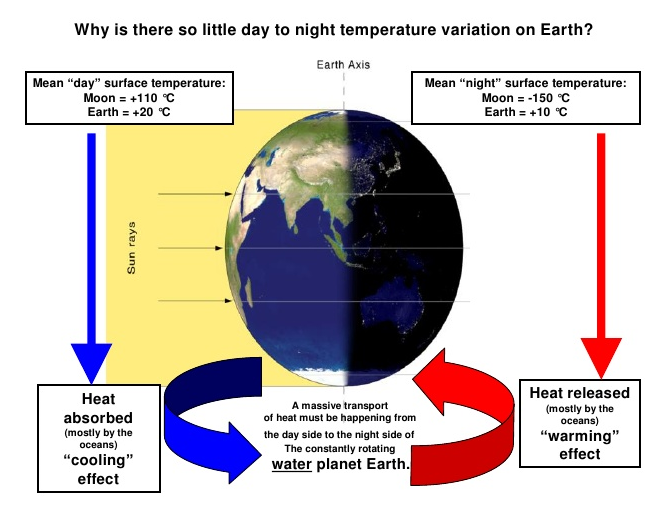
RB: You’re absolutely correct. We run on an energy balance, and that energy balance coming from the sun has part to do with the climate on earth. And as Gregory Wrightstone pointed out in his book, 90% of the global warming effect of CO2 is already behind us. So, the next 10% is going to be minimal. So, the next 10% is not the control knob of temperature on earth. Now, if there was no CO2 on earth, as there is no CO2 on the moon, the first amounts of CO2 added would have a dramatic effect on temperature. But that’s way, way behind us.

AW: Well, in concluding our conversation, I would like to let our viewers and listeners know that they can get your new book, Sunset on Net Zero, A Heretic’s Guide to the Futile CO2 Target at Amazon. Ron, there are many excellent points in your book we didn’t get to. I hope you will join us again soon on Climate Debrief. I’d love to, Angela. Thank you very much.

Infographic explaining the minimal temperature variation between day and night on Earth, illustrating heat absorption and release processes, with comparisons to the Moon's temperatures.

America’s Irreversible Goodbye to Climate Governance

On January 7, President Donald Trump signed an executive order to withdraw the United States from 66 international organizations deemed “redundant, poorly managed, unnecessary, costly, ineffective,” or instruments of America’s adversaries. Among them are various United Nations agencies and, most significantly, the Intergovernmental Panel on Climate Change (IPCC) and the1992 United Nations Framework Convention on Climate Change (UNFCCC), the backbone of global climate governance.

A digital illustration featuring a smiling man signing a document labeled 'America's Irreversible Goodbye to Climate Governance'. He is surrounded by a crowd of shouting individuals, with signs reading 'No More Climate Grifting' and 'Drill Baby Brill'. The background shows a dramatic sunset and icebergs.

Form The CO2- Coalition

By Dr. Samuele Furfari

American flag waving against a blue sky.

On January 7, President Donald Trump signed an executive order to withdraw the United States from 66 international organizations deemed “redundant, poorly managed, unnecessary, costly, ineffective,” or instruments of America’s adversaries. Among them are various United Nations agencies and, most significantly, the Intergovernmental Panel on Climate Change (IPCC) and the1992 United Nations Framework Convention on Climate Change (UNFCCC), the backbone of global climate governance.

During his first term, President Trump removed the U.S. from the Paris Agreement, using its withdrawal clause. But a newly elected President Joe Biden promptly returned the nation to the agreement in 2021, making it a central gesture of his climate diplomacy. The episode exposed the fragility of international climate policy: A simple change in administration could send the U.S. in or out of the agreement, rendering global climate commitments mere extensions of domestic, partisan politics.

This time, however, there is a degree of permanence to the change. By targeting the UNFCCC itself, the Trump Administration has dismantled the legal framework that made possible reversal by a simple executive decree.

Adopted under the 1992 Convention, the Paris Agreement is built on the institutional architecture of the UNFCCC, whose bodies provide necessary support. These include the Conference of the Parties, the secretariat, and a system for financial contributions.

Paragraph 3 of Article 28 of the Paris Agreement reads as follows: “Any Party that withdraws from the Convention shall be considered as also having withdrawn from this Agreement.” By leaving the Framework Convention, Washington severs the link that allowed Biden’s reentry into the Paris Agreement. Trump’s withdrawal is structural, not tactical.

The key precedent insulating Trump from a Supreme Court challenge is Goldwater v. Carter, in which the high court in 1979 declined to review President Carter’s unilateral termination of a mutual defense treaty with Taiwan, effectively strengthening executive authority over withdrawals.

In practice, a president, therefore, can withdraw from a treaty without a clear judicial avenue to stop him. The Trump Administration sits in a legally comfortable position: Opponents have no leverage to undo the move and seeking a new Supreme Court ruling risks establishing further executive power over treaty termination.

Democrats are paying the price for designing Paris to avoid Senate ratification. Knowing they lacked a two-thirds majority, the Obama administration insisted on voluntary, non-binding contributions and targets, which ensured Paris would rest on a reversible presidential signature rather than durable treaty law.

The Trump Administration has fully absorbed these lessons. During his first term, Trump withdrew only from the Paris Agreement, leaving the UNFCCC intact and allowing his successor to rejoin easily. This time, Trump’s action is far more radical: By targeting the Framework Convention itself, Trump deprives future presidents of convenient diplomatic back‑and‑forth. Politically, the message is clear: Washington increasingly views climate diplomacy as an instrument of external constraint, beneficial to America’s strategic competitors, a burden on U.S. industrial competitiveness and costly.

Formally, the U.S. could rejoin the UNFCCC, but politically it would now require a level of consensus that no longer exists. Approved in 1992 with faith in a painless energy transition, the Convention today confronts economic and geopolitical realities that expose prior illusions and make revival unlikely any time soon.

What are climate true believers in the EU supposed to do now?

One question rarely voiced publicly in Brussels, Strasbourg or Berlin:

How long will the European Union persist in a climate strategy that no longer meaningfully binds either the United States or emerging nations beyond benevolent declarations?

The EU continues to lock itself into ever more ambitious targets (90% CO2 reduction by 2040 compared to 1990), while eroding its industrial base, deepening its dependence on China, and widening the gap between rhetoric and the reality of global emissions.

Instead of ritual denunciations of Trump, European leaders should ask this question: If the world’s leading economic and military power no longer wants to be trapped in a U.N.‑ led climate architecture, isn’t it time for the EU to reassess its own commitments with clear eyes?

The wrong answer will leave Europe discovering too late that it has sacrificed its prosperity and strategic autonomy to a climate lunacy abandoned by its closest – and most consequential – allies.

Originally published in National Review on February 7, 2026.

Dr. Samuele Furfari is a professor of energy geopolitics in Brussels and London, a former senior official with the European Commission’s Directorate-General for Energy and a member of the CO2 Coalition. He is author of the paper, “Energy Addition, Not Transition,” and 18 books, including “Energy Insecurity: The organised destruction of the EU’s competitiveness.”

What’s New!

The CO2 Coalition has released its new episode of the Climate Debrief Podcast featuring Wally Manheimer. Watch the full video here!

Trump withdraws from UN Framework Convention; ends illusion we’ll always have Paris

President Trump is withdrawing the United States from 66 intergovernmental organizations he has determined are “contrary to the interests of the United States.” This is a big deal, especially the president’s decision to withdraw from the UN Framework Convention on Climate Change (UNFCCC), the foundational treaty for global climate policy.

A gravestone inscription reads 'PARIS CLIMATE AGREEMENT 2015 - 2025' with two floral arrangements on either side, set in a grassy area.

From Watts Up With That?

Aerial view of the Eiffel Tower in Paris during sunset, with hot air balloons floating in the sky above the cityscape and the Seine River visible below.

From the COMPETITIVE ENTERPRISE INSTITUTE

Marlo Lewis, Jr.

President Trump is withdrawing the United States from 66 intergovernmental organizations he has determined are “contrary to the interests of the United States.” This is a big deal, especially the president’s decision to withdraw from the UN Framework Convention on Climate Change (UNFCCC), the foundational treaty for global climate policy.

This action has been almost a year in the making. Executive Order 14199, issued on February 4, 2025, directed the Secretary of State to “conduct a review of all international intergovernmental organizations of which the United States is a member and provides any type of funding or other support, and all conventions and treaties to which the United States is a party, to determine which organizations, conventions, and treaties are contrary to the interests of the United States and whether such organizations, conventions, or treaties can be reformed.” Upon completion of the review, the Secretary “shall provide recommendations as to whether the United States should withdraw from any such organizations, conventions, or treaties.”

Trump’s January 7, 2026 presidential memorandum directs executive branch agencies, “to the extent permitted by law,” to cease participation in or funding 66 named intergovernmental entities “as soon as possible.”

Although not spelled out in the memorandum, the big picture is clear. Trump aims to free the US from international commitments that hobble or imperil its pursuit of affordable energy, economic growth, and “energy dominance,” a top priority of his National Security Strategy. He has already taken bold steps to free the US energy sector and economy from climate-themed overregulation. Exiting the UN-centric world of climate diplomacy should make those achievements more durable.   

Trump’s decision to withdraw from the UNFCCC is especially gratifying to CEI. In the early 1990s, CEI Founder Fred Smith led a coalition that urged the George H.W. Bush administration not to ratify the purportedly “voluntary” UNFCCC. Ratification, they warned, would legitimize and entangle the US in a global pressure campaign for energy-suppression policies detrimental to American liberty and prosperity. They were right.

The UNFCCC became the parent treaty for the 1997 Kyoto Protocol and then the 2015 Paris Agreement. Paris aims to mitigate climate change by “holding the increase in the global average temperature to well below 2°C above pre-industrial levels and pursuing efforts to limit the temperature increase to 1.5°C.” However, as energy analyst Stephen Eule observes, the Agreement does not specify the quantity of emission reductions needed to meet those targets.

That important detail was still largely unknown in November 2016, when the Paris Agreement entered into force. The UN Intergovernmental Panel on Climate Change (IPCC) first published an official estimate in its October 2018 Special Report on Global Warming of 1.5°C. Global carbon dioxide emissions would have to “decline by about 45 percent from 2010 levels by 2030, reaching net zero by around 2050.”

Thus, the Paris Agreement both concealed and launched the infeasible and unaffordable net-zero agenda that today contributes to rising US electricity prices (especially in blue states) and risks deindustrialization in EU nations as manufacturers consider shifting operations to countries with lower energy costs.

Recognizing the deep incompatibility between Paris and US energy dominance, Trump withdrew from the Agreement in June 2017 and again in January 2025. A question that remained unanswered each time was how Trump could prevent a future president from rejoining the global carbon-haters club.

Trump’s challenge was formidable. The Obama administration denied that Paris was a “treaty” for purposes of Article II, Section 2 of the Constitution. Under that provision, the president “shall have power, by and with the advice and consent of the Senate, to make treaties, provided two thirds of the Senators present concur.” The Obama administration therefore claimed Paris was an “executive agreement” — a pact that the president can “accept” (i.e., ratify) acting on his sole authority as chief diplomat. The Biden administration took the same position when rejoining Paris.

Whether or not that was their sincere belief, the Obama and Biden administrations must have known there was no chance “two thirds of the Senators present” would vote in favor of ratifying a new global climate treaty. Hence, evading the Article II, Section 2 procedure was the only way for a US president to join or rejoin the Agreement.

The Senate’s shared role in treaty making is a well-known example of the Constitution’s checks and balances but its special character is often overlooked. Under Article II, Section 2, the president may appoint ambassadors, other officers of the United States, and even Supreme Court justices with the concurrence of a simple majority in the Senate. Adopting a treaty requires a much higher level of consent, one reflecting a broad national consensus. That is fitting, given the “delicate and momentous” nature of the “interests” at risk.

President Obama called Paris “the most ambitious climate change agreement in history.” In fact, Paris is the most ambitious environmental treaty in history. It aims at nothing less than a global transformation of national energy policies, markets, and infrastructure, ostensibly to save the planet. As noted, Paris midwifed the net-zero agenda, which a recent study estimates could impose costs of up to £7.6 trillion ($10.2 trillion) in Great Britain alone.

The bottom line is that Paris should have been reviewed under the Article II, Section 2 procedure due to its potential costs and risks to the nation, dependence on subsequent legislation by Congress, potential to affect state laws, past US practice regarding similar agreements, duration, and other common-sense criteria.  

Responding to such criticism, Obama climate adviser Brian Deese reportedly told The Washington Times that Presidents Ronald Reagan and George W. Bush “joined important international environmental agreements by using executive agreements.” Deese did not cite any examples. I checked the State Department’s Treaties and Other International Acts Series database. It does not support Deese’s claim.

With the advice and consent of the Senate, President Reagan ratified the Montreal Protocol on Substances that Deplete the Ozone Layer, on April 5, 1988. He did not join any environmental pacts as executive agreements.

The George W. Bush administration negotiated 15 environmental executive agreements, but none entailed commitments or risks to the nation. Unlike Paris, all were clearly authorized either by Congress, other treaties, or the president’s inherent powers as chief executive or Commander in Chief.

CEI has long advocated that President Trump ask the Senate to debate and vote on ratification of the Paris Agreement and then, when the ratification vote fails, declare the US is not now and has never been a party to the Agreement.

However, we also acknowledged that presidential withdrawal from the UNFCCC is a quicker and more comprehensive remedy, as the Paris Agreement itself implicitly confirms. Paris Article 28 states: “Any Party that withdraws from the Convention [UNFCCC] shall be considered as also having withdrawn from this Agreement.”

In short, by withdrawing from the UNFCCC, Trump has blocked future presidents from attempting to rejoin Paris via executive agreement. They could rejoin Paris on their sole authority only if they first obtain the Senate’s consent to re-ratify the UNFCCC. That would be hard.

After all, we are a long way from 1992, when the Senate, having little awareness of the economic, humanitarian, and security risks of regulatory climate policy, voted overwhelmingly in favor of ratifying the UNFCCC. Senators supporting US energy dominance today should have no difficulty understanding they must keep America out of the UNFCCC and the Paris Agreement.

Music man Paul Simon sang of “50 ways to leave your lover.” Trump has not found 50 ways to leave Paris, but he seems to have found three.

As indicated above, on January 20, 2025, President Trump directed the ambassador to the UN to “immediately submit formal written notification of the United States’ withdrawal from the Paris Agreement.” That’s the first way. To recap, Trump’s January 7, 2026 memorandum directed the State Department to withdraw from the UNFCCC, the Paris parent treaty. That’s the second way.

Here’s the third way. The Environmental Protection Agency (EPA) is expected to finalize a decision to repeal the 2009 Greenhouse Gas Endangerment Finding soon. That finding ostensibly required the EPA to establish first-ever greenhouse gas (GHG) emission standards for new motor vehicles. It soon morphed into a generic scientific justification for other GHG regulatory initiatives, including the Obama administration’s 2015 Clean Power Plan, which was a central pillar of President Obama’s emission-reduction pledge under the Paris Agreement.

If courts uphold the EPA’s repeal of the 2009 Endangerment Finding, a future administration could not make credible emission-reduction commitments under the Paris Agreement. More precisely, it could not do so without first adopting and successfully defending a new endangerment finding.

If all goes according to Trump’s plan, America will not just be out of Paris, we will be gone, gone, gone.

No, CBS News, Recent Temperatures Didn’t Surpass a ‘Critical Climate Mark’

CBS News recently published a story “2025 was so hot it pushed Earth past critical climate change mark, scientists say,” from the Associated Press (CBS/AP), claiming that a recent temperature “blip” has pushed the planet past the Paris Agreement’s 1.5°C threshold, implying that catastrophic consequences are now unfolding or inevitable. This is false. Earth has passed that politically chosen temperature hallmark with no disastrous effect and is now cooling. Also, no data support the claims of increased severe weather consequences matching the short-term temperature increase.

A dramatic landscape showcasing a swirling storm cloud, accompanied by lightning and a blue glacier beside a turbulent ocean, with trees silhouetted in the foreground.

From ClimateRealism

By Anthony Watts

Screenshot of a CBS News article discussing climate change, featuring the headline '2025 was so hot it pushed Earth past critical climate change mark, scientists say' with the term 'DOOM-MONGERING' overlayed in bold red letters.

CBS News recently published a story “2025 was so hot it pushed Earth past critical climate change mark, scientists say,” from the Associated Press (CBS/AP), claiming that a recent temperature “blip” has pushed the planet past the Paris Agreement’s 1.5°C threshold, implying that catastrophic consequences are now unfolding or inevitable. This is false. Earth has passed that politically chosen temperature hallmark with no disastrous effect and is now cooling. Also, no data support the claims of increased severe weather consequences matching the short-term temperature increase.

The article states that 2025 was among the hottest years on record and that a three-year average “broke through” the 1.5°C limit, warning that staying below this mark “could save lives and prevent catastrophic environmental destruction.” The story relies a great deal on rapid-attribution outputs  from World Weather Attribution suggesting that specific extreme events in 2025 were far more likely because of climate change. Their implication is clear: crossing 1.5°C is a critical line, and dire outcomes should now be expected.

But a short-term temperature spike, especially one based on a three-year average, is not climate, and it certainly does not validate years of catastrophic predictions tied to the 1.5°C number. What CBS/AP also ignore is the fact that since the peak in early 2024, likely induced by huge amounts of water vapor injected into the atmosphere by the Hunga-Tonga volcanic eruption, global temperature has been trending downward as seen in the graph below.

Graph showing UAH satellite-based temperature departures from the 1991-2020 average in degrees Celsius from 1979 to 2026, with red trend line and blue data points.
Satellite derived global temperature data from January 1979 through December 2025, plotted by Roy Spencer, PhD. The Version 6.1 global area-averaged linear temperature trend remains at a modest +0.16 deg/ C/decade.

Climate is defined and assessed over multi-decade periods, typically 30 years, specifically to smooth out short-term variability from El Niño, La Niña, volcanic aerosols, and other natural influences. A brief overshoot during a warm phase does not establish a new long-term state. As importantly, Climate at a Glance’s “Tipping Point: 1.5 Degrees Celsius Warming” explains the 1.5°C threshold is a policy target, not a scientifically established threshold beyond which climate disaster looms. In short, the 1.5℃ target was chosen by politicians to drive policy action and never represented a physical cliff beyond which the climate system suddenly collapses.

That distinction matters because the public has been told that passing 1.5°C would unleash unmistakable, escalating disasters. Yet when global averages have briefly touched or exceeded that level in recent datasets, the promised cascade of unprecedented impacts did not materialize. Hurricanes have not suddenly multiplied, floods did not surge globally, and agricultural output did not collapse. On the contrary, long-term records summarized at Climate at a Glance: Hurricanes and Climate at a Glance: Floods show no clear global increases that would confirm the article’s apocalyptic framing. This is why critics have long argued that 1.5°C functions as a moving rhetorical goalpost rather than a scientifically demonstrated tipping point.

CBS/AP also amplify claims that extreme weather in 2025 proves the danger of crossing this threshold, but those claims rest on model-based attribution rather than observed long-term trends. Climate Realism has documented the weaknesses of such attribution studies in multiple analyses, including its coverage of World Weather Attribution claims, showing how probabilistic model outputs are routinely presented as settled fact while observational uncertainties are minimized or ignored. The Intergovernmental Panel on Climate Change’s (IPCC) Sixth Assessment Report (ICCC AR6) is far more cautious, assigning low or medium confidence to many asserted global trends in extremes and emphasizing regional variability and uncertainty. Later references to IPCC AR6 in media coverage often omit this caution.

What the CBS/AP piece also leaves out is historical context. The climate system has always exhibited variability, with warm and cool phases layered atop longer-term trends. Selecting a recent warm spike and declaring a “critical mark” crossed tells readers little about where the climate will settle over coming decades. While warming has occurred since the late nineteenth century, the rate and impacts vary substantially over time and region, undermining the idea of a universal danger line.

Finally, the article’s sense of urgency ignores a crucial real-world metric: outcomes. Despite rising global temperatures over the past century, climate-related deaths have declined dramatically due to improved infrastructure, forecasting, and energy access, a point documented at Climate at a Glance: Deaths from Extreme Weather. Deaths related to non-optimum temperatures have also fallen dramatically as the Earth has slightly warmed, in part because cold weather kills more people that hot temperatures. If crossing 1.5°C were truly the existential turning point portrayed, one would expect the opposite trend.

By treating a short-term temperature blip as proof that a “critical climate change mark” has been breached, CBS/AP mislead readers about how climate science actually works. The 1.5°C figure is a political benchmark, not a physical tipping point, and brief excursions above it say little about long-term climate outcomes. The fact that nothing resembling the predicted catastrophes occurred when the threshold was touched suggests that CBS/AP are engaging in doom-mongering rather than journalism.