Major Farside Solar Flare

The biggest flare of Solar Cycle 25 just exploded from the farside of the sun.

From Spaceweather.com

By Dr.Tony Phillips

July 25, 2024: The biggest flare of Solar Cycle 25 just exploded from the farside of the sun. X-ray detectors on Europe’s Solar Orbiter (SolO) spacecraft registered an X14 category blast:

Solar Orbiter was over the farside of the sun when the explosion occured on July 23rd, in perfect position to observe a flare otherwise invisible from Earth.

“From the estimated GOES class, it was the largest flare so far,” says Samuel Krucker of UC Berkeley. Krucker is the principal investigator for STIX, an X-ray telescope on SolO which can detect solar flares and classify them on the same scale as NOAA’s GOES satellites. “Other large flares we’ve detected are from May 20, 2024 (X12) and July 17, 2023 (X10). All of these have come from the back side of the sun.”

Meanwhile on the Earthside of the sun, the largest flare so far registered X8.9 on May 14, 2024. SolO has detected at least three larger farside explosions, which means our planet has been dodging a lot of bullets.

The X14 farside flare was indeed a major event. It hurled a massive CME into space, shown here in a coronagraph movie from the Solar and Heliospheric Observatory (SOHO):

he CME sprayed energetic particles all over the solar system. Earth itself was hit by ‘hard’ protons (E > 100 MeV) despite being on the opposite side of the sun.

“This is a big one–a 360 degree event,” says George Ho of the Southwest Research Institute, principal investigator for one of the energetic particle detectors onboard SolO. “It also caused a high dosage at Mars.”

SolO was squarely in the crosshairs of the CME, and on July 24th it experienced a direct hit. In a matter of minutes, particle counts jumped almost a thousand-fold as the spacecraft was peppered by a hail storm energetic ions and electrons.

“This is something we call an ‘Energetic Storm Particle’ (ESP) event,” explains Ho. “It’s when particles are locally accelerated in the CME’s shock front [to energies higher than a typical solar radiation storm]. An ESP event around Earth in March 1989 caused the Great Quebec Blackout.”

So that’s what might have happened if the CME hit Earth instead of SolO. Maybe next time. The source of this blast will rotate around to face our planet a week to 10 days from now, so stay tuned. Solar flare alerts: SMS Text

Major (and unusual) Solar Flare and CME

March is a peak month for auroras, and this should be a good one in the coming days.

From Watts Up With That?

h/t Roy W. Spencer

March is a peak month for auroras, and this should be a good one in the coming days.

A strong X-class solar flare lasting 5 hours has erupted on the sun, lifting a coronal mass ejection (CME) with an Earth-directed component. Play the right-hand video in the link, 1st comment, to see the CME near the end of the clip.

… the flare was unusual in that it involved two widely-separated sunspots than became magnetically connected during the flare.

https://www.swpc.noaa.gov/products/lasco-coronagraph

NOAA SWPC writes:

R3 (Strong) levels were reached on 22 March, 2024. The flare activity began from Region 3614 (to the north), and was still in progress when another flare erupted from Region 3615 (to the south). It’s tough to say with certainty at this point which flare was the source of R3 level

“Stealthy CME” Sparks Geomagnetic Storm

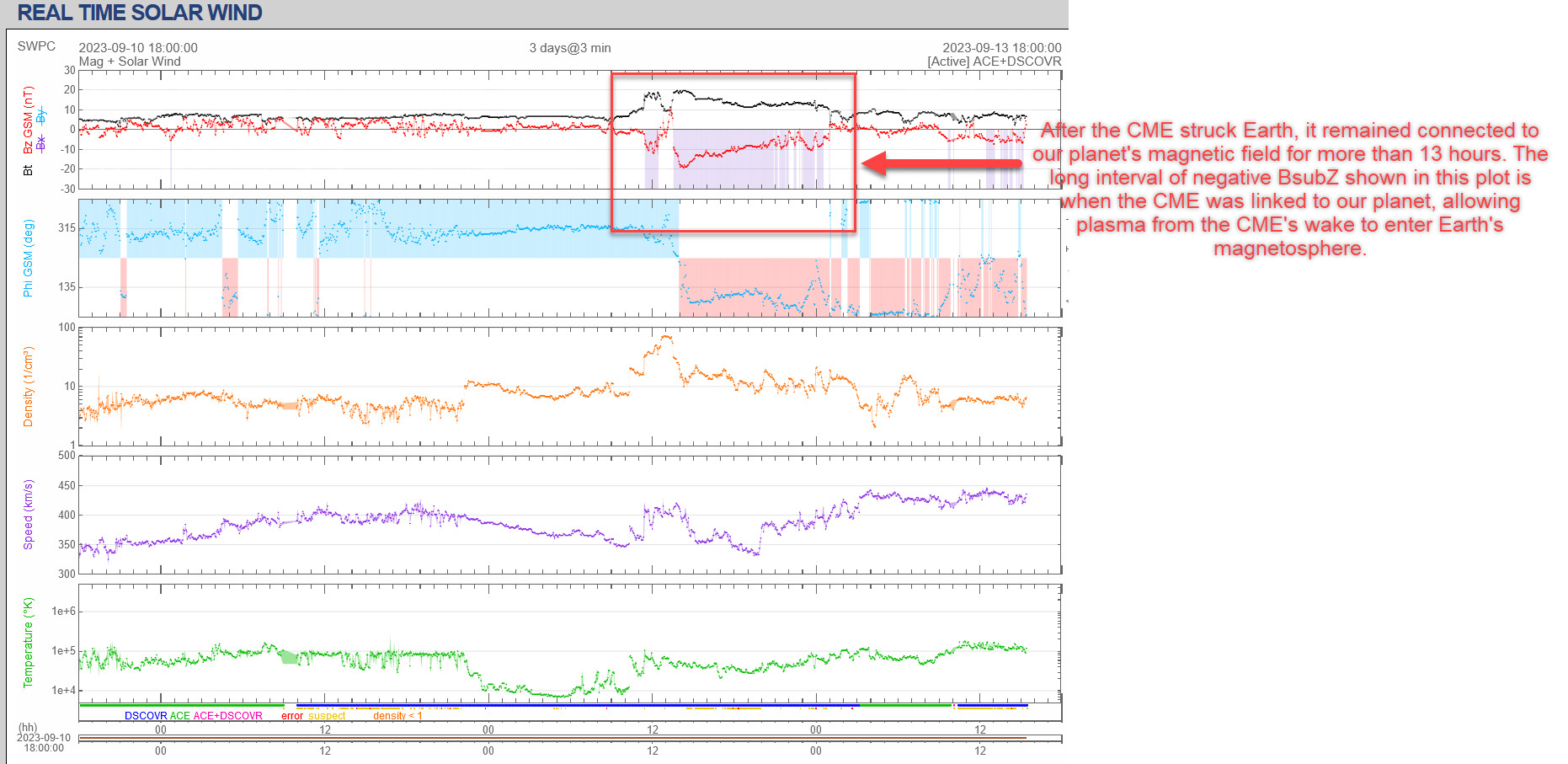
(Spaceweather.com) An unexpected CME hit Earth’s magnetic field on Sept. 12th (1237 UT) and sparked a G2-class geomagnetic storm. Magnetically, the CME remained connected to our planet for more than 13 hours, allowing plasma from the CME’s wake to enter Earth’s magnetosphere. This fueled a display of auroras photographed as far south as Missouri (+40.2N) and Nebraska (+40.9N).

From Spaceweather.com

By DR.TONY PHILLIPS

Sept. 13, 2023: (Spaceweather.com) An unexpected CME hit Earth’s magnetic field on Sept. 12th (1237 UT) and sparked a G2-class geomagnetic storm. Magnetically, the CME remained connected to our planet for more than 13 hours, allowing plasma from the CME’s wake to enter Earth’s magnetosphere. This fueled a display of auroras photographed as far south as Missouri (+40.2N) and Nebraska (+40.9N).

Matthew Merrell knew the storm was underway, and he waited anxiously for the sun to set over his home in central Minnesota. As darkness fell, he saw the auroras:

“It was a great start to the night with pillars visible as soon as the sky was dark enough,” says Merrell. “By 10:00 pm it was just a gentle glow with very little motion.”

Merrell witnessed only the subsiding tail-end of the storm, a G1-class event. At its G2 apex, the storm produced “BRIGHT” and “stunning” activity over Scotland, “massive rays” above Ireland, and an all-sky explosion of color over Iceland. Magnetometer needles in Britain swung wildly with more than 15 hours of dramatic undulations.

Forecasters did not see this coming. One surprised NOAA analyst called it a “stealthy CME.” In retrospect, it was probably one of many relatively bright CMEs that left the sun on Sept. 8th, shown here in a 24 hour time-lapse from the Solar and Heliospheric Observatory (SOHO):

When the sun spits out so many storm clouds in such a short period of time, it can be hard to disentangle them and figure out which one(s) might be heading toward Earth. Notably the movie includes a distinct halo CME. At the time it was thought to be a farside event, but maybe it is the one that hit Earth yesterday.

Did you miss the storm? Subscribers to our Space Weather Alert Service received instant text messages when the CME arrived and, later, when the geomagnetic storm began. Give it a try! Aurora alerts: SMS Text

A Strong Farside CME Just Hit Solar Orbiter

On July 24th, a bright CME rocketed away from the farside of the sun. Its plane-of-sky speed in SOHO coronagraph images exceeded 1,500 km/s (3.4 million mph)

From Spaceweather.com

By DR.TONY PHILLIPS

July 26, 2023: On July 24th, a bright CME rocketed away from the farside of the sun. Its plane-of-sky speed in SOHO coronagraph images exceeded 1,500 km/s (3.4 million mph):

If this CME had hit Earth, a strong (possibly severe) geomagnetic storm would have surely resulted. Instead, it flew in the opposite direction and hit Europe’s Solar Orbiter (SolO) spacecraft.

The CME reached SolO on July 26th (0200 UT), barely 32 hours after it left the sun. Considering that a typical CME would take two or three days to reach the spacecraft at its current location, a transit of only 32 hours confirms this CME was a fast-mover.

“This was definitely a big event,” says George Ho of the Johns Hopkins Applied Physics Lab, co-principal investigator for the Energetic Particle Detector suite onboard Solar Orbiter. Ho checked the data right after the initial explosion on July 24th and saw a 10,000-fold increase of 50 MeV ions reaching the spacecraft. “This indicates a strong incoming interplanetary shock.”

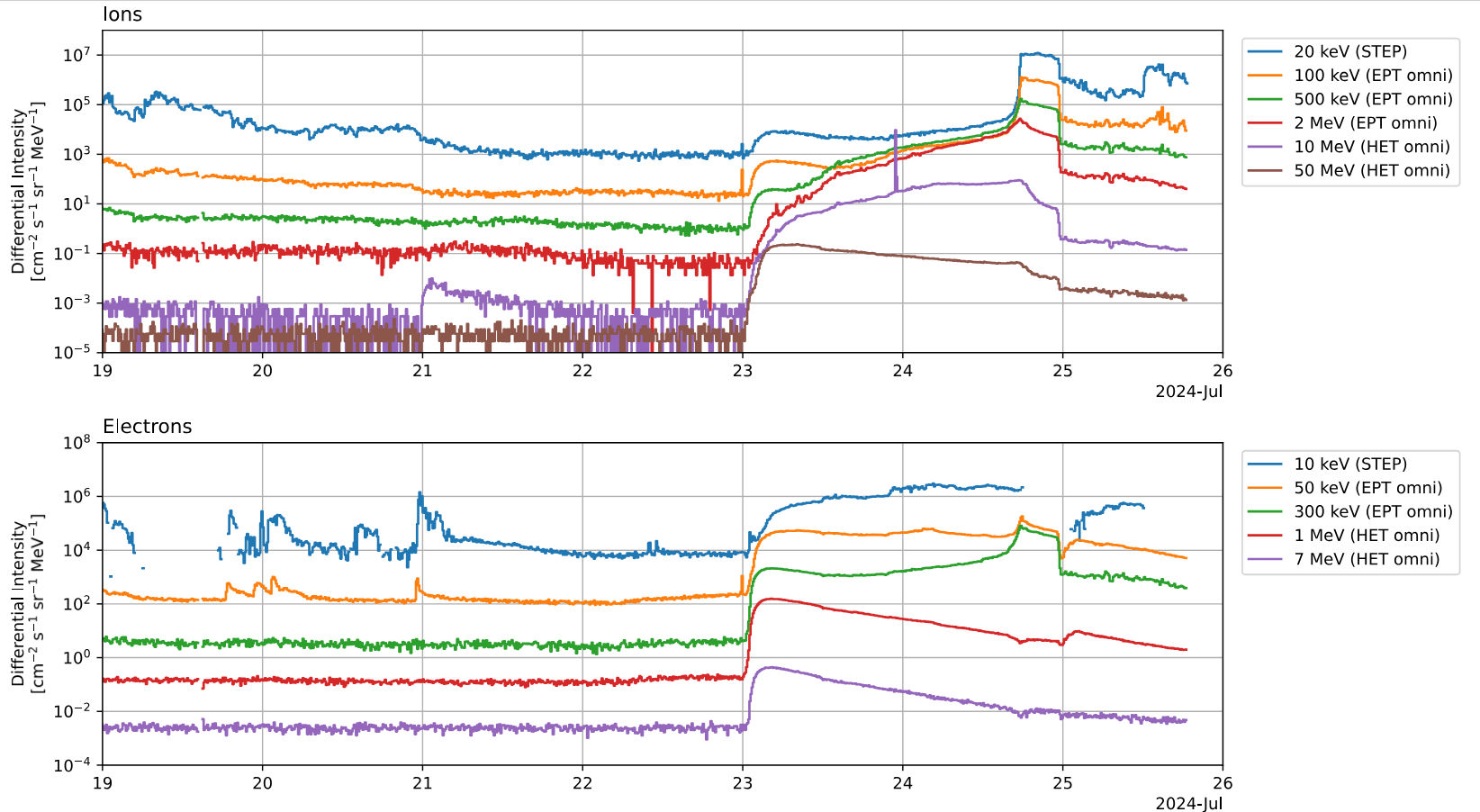
This plot shows two waves of energetic particles washing over Solar Orbiter:

Above: Data from Solar Orbiter’s EPD/Electron-Proton Telescope (Principal Investigator Javier Pacheco from University of Alcala, Spain)

The first wave (yellow) was accelerated by whatever unseen explosion launched the CME. Traveling close to the speed of light, these particles reached the spacecraft soon after the blast. A second wave (blue) traveled with the CME itself and hit the spacecraft 30+ hours later.

“During the 1989 Quebec blackout, it was this type of shock-driven particle increase during the CME arrival that knocked off the power,” notes Ho.

Launched in Feb. 2020, Solar Orbiter is on a mission to study solar storms at point blank range. Mission accomplished. This storm actually swallowed the spacecraft. Mission scientists will analyze the data from this storm and others to improve future forecasts of space weather. Stay tuned.

This story was brought to you by Spaceweather.com

Mysterious “Aurora Blobs” Identified

Europeans are still trying to wrap their minds around what happened on April 23, 2023. Everyone knew that a CME was coming, so its impact was not a surprise. Photographers were already outside at sunset waiting for auroras. And, indeed, auroras appeared, but they were very strange.

From Spaceweather.com

By DR.TONY PHILLIPS

May 15, 2023: Europeans are still trying to wrap their minds around what happened on April 23, 2023. Everyone knew that a CME was coming, so its impact was not a surprise. Photographers were already outside at sunset waiting for auroras. And, indeed, auroras appeared, but they were very strange.

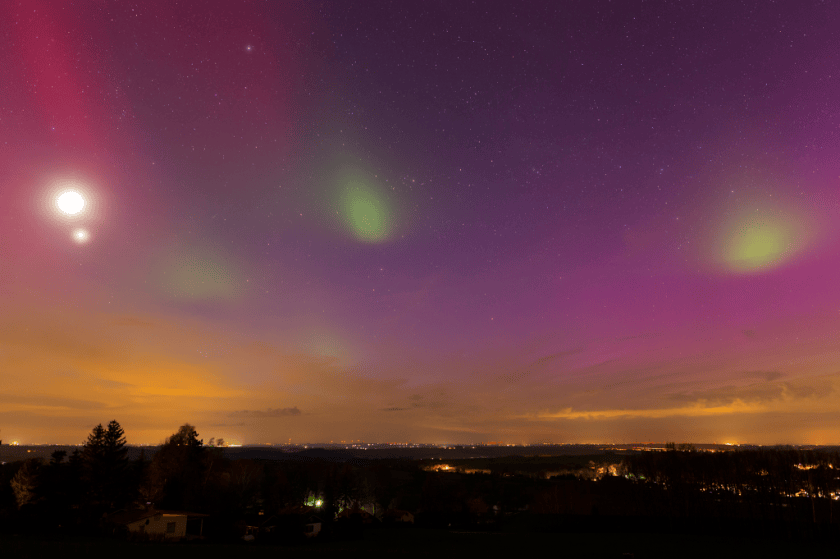
“I had never seen anything quite like it,” says longtime aurora watcher Heiko Ulbricht of Saxony, Germany. “The auroras began to tear themselves apart, forming individual spots and blobs which rose all the way to the zenith.” Here is a sample of what he saw:

“It literally took my breath away,” he says. “My pulse was still racing hours later!” The same blobs were sighted in France and Poland, and in Denmark they were caught flashing like a disco strobe light.

Ordinary auroras don’t act like this.

“These were not ordinary auroras,” confirms space physicist Toshi Nishimura of Boston University. “They are called ‘proton auroras,’ and they come from Earth’s ring current system.”

Most people don’t realize that Earth has rings. Unlike Saturn’s rings, which are vast disks of glittering ice, Earth’s rings are invisible to the naked eye. They are made of electricity–a donut-shaped circuit carrying millions of amps around our planet. The ring current skims the orbits of geosynchronous satellites and plays a huge role in determining the severity of geomagnetic storms. Earth is the only rocky planet in our Solar System that has one.

Sometimes, during strong geomagnetic storms, protons rain down from the ring system, causing a secondary shower of electrons, which strike the atmosphere and make auroras. Earth-orbiting satellites have actually seen these protons on their way down. Ordinary auroras, on the other hand, are caused by particles from more distant parts of Earth’s magnetosphere and have nothing to do with Earth’s ring current.

Mystery solved? Not entirely. “We still don’t know why proton auroras seem to tear themselves apart in such a dramatic way,” says Nishimura. “This is a question for future research.”

“It was very exciting to watch,” recalls Ulbricht. “I would definitely like to see these again.”

Good, because they are likely to return. Solar Cycle 25 ramping up to a potentially-strong Solar Maximum next year. Future storms will surely knock more protons loose from the ring current system.

Here’s what to look for: (1) Proton auroras tend to appear around sunset. Why? Electric fields in Earth’s magnetosphere tend to push the protons toward the dusk side of our planet. (2) Proton auroras love to pulse–a sign of plasma wave activity in Earth’s ring current. (3) Proton auroras are often accompanied by deep red arcs of light (SARs), which are caused by heat leaking from the ring current system. These arcs were also seen on April 23rd.

Let the proton rain begin!

Severe Geomagnetic Storm: April 23-24, 2023

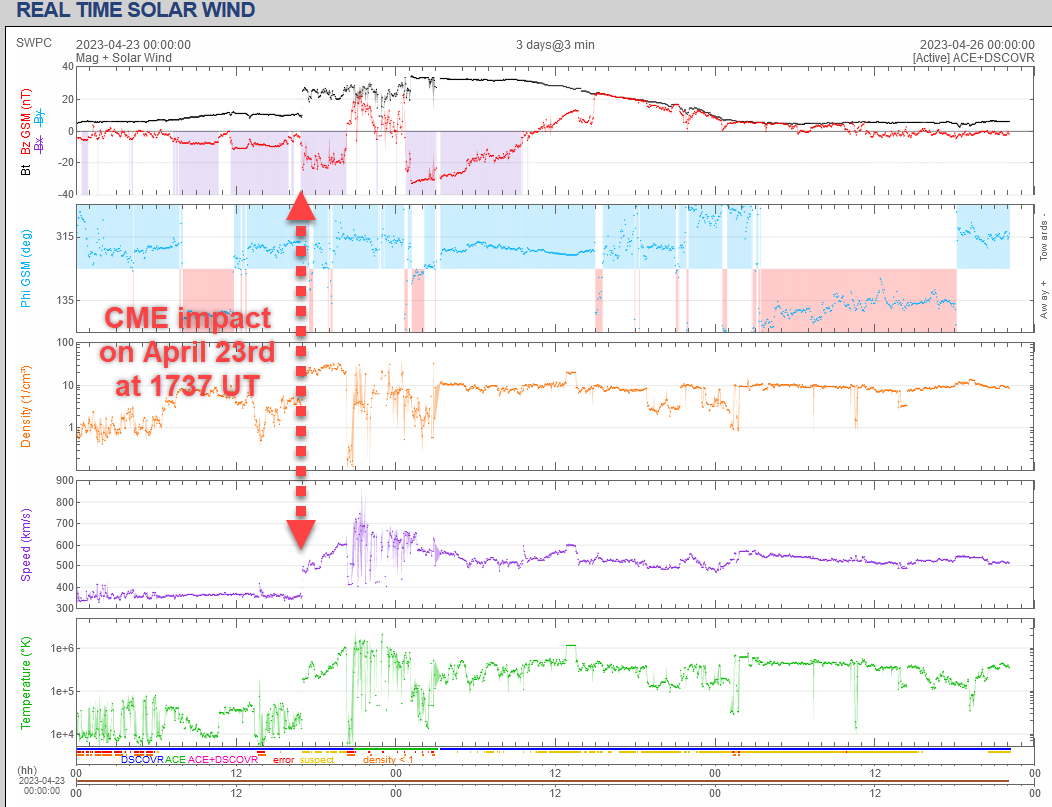
A CME hit Earth’s magnetic field on April 23rd, a direct hit that sparked a severe G4-class geomagnetic storm. Northern lights spilled out of the Arctic Circle all the way down to the US-Mexico border (+29.5N)

From Spaceweather.com

By DR.TONY PHILLIPS

April 23, 2023: A CME hit Earth’s magnetic field on April 23rd, a direct hit that sparked a severe G4-class geomagnetic storm. Northern lights spilled out of the Arctic Circle all the way down to the US-Mexico border (+29.5N):

“I was out shooting the night sky in the Big Bend region of Texas when I saw the alerts of the severe geomagnetic storm,” says photographer Brad Dwight. “I decided to point my camera north just to see if I could see anything. These pillars exploded into view.”

In neighboring Arizona, David Blanchard made a video of the geomagnetic glow:

“It was a spectacular display here in Flagstaff (+35.2N),” says Blanchard. “The video covers the period 0354-0512 UTC on April 24th.”

Other notable low-latitude sightings in the USA include southern California (+32.5N), Arizona (+34.8N), Arkansas (+35.1 N), Colorado (+38N), Utah (+40.8N), Oklahoma (+36.3N), North Carolina (+36.2N), Tennessee (+35.4N), New Mexico (+35.9N) and Nebraska (+40.6N).

There were advantages to being a bit farther north. Consider this photo taken by Katie Korbuszewski of Helena, Montana (+46.5N):

“This was the first time I have seen Northern Lights,” she says. “They became a bright dome right above my head and all around. You could visibly see cars and people in the gravel lot that had previously been obscured by darkness. I used my iPhone 12 mini on the night mode setting with an exposure of 3 seconds.”

“I thank my dad Paul Korbuszewski, an avid astronomer who checks Spaceweather.com like one checks the NASDAQ,” says Katie. “He gave me a call from Western Washington to tell me where to look!”

Auroras over Sturgis, South Dakota (+44.4N), were so big and intense, they surrounded onlookers in all directions. “They were everywhere,” says photographer Chris Yushta, “so I took a 360 degree panorama and turned it into a Panosphere.”

“The auroras were incredible!” says Yushta.

Did you miss the storm? Subscribers to our Space Weather Alert service received instant text messages when the CME arrived and when the subsequent storm erupted. Solar Cycle 25 is just getting started, so this will happen again. Make sure you don’t miss the next storm!

An Earth-Directed Explosion on the Sun

Earth is in the strike zone. On April 21st, a large magnetic filament snaking across the sun’s southern hemisphere exploded, hurling a cloud of debris in our direction.

From Spaceweather.com

By DR.TONY PHILLIPS

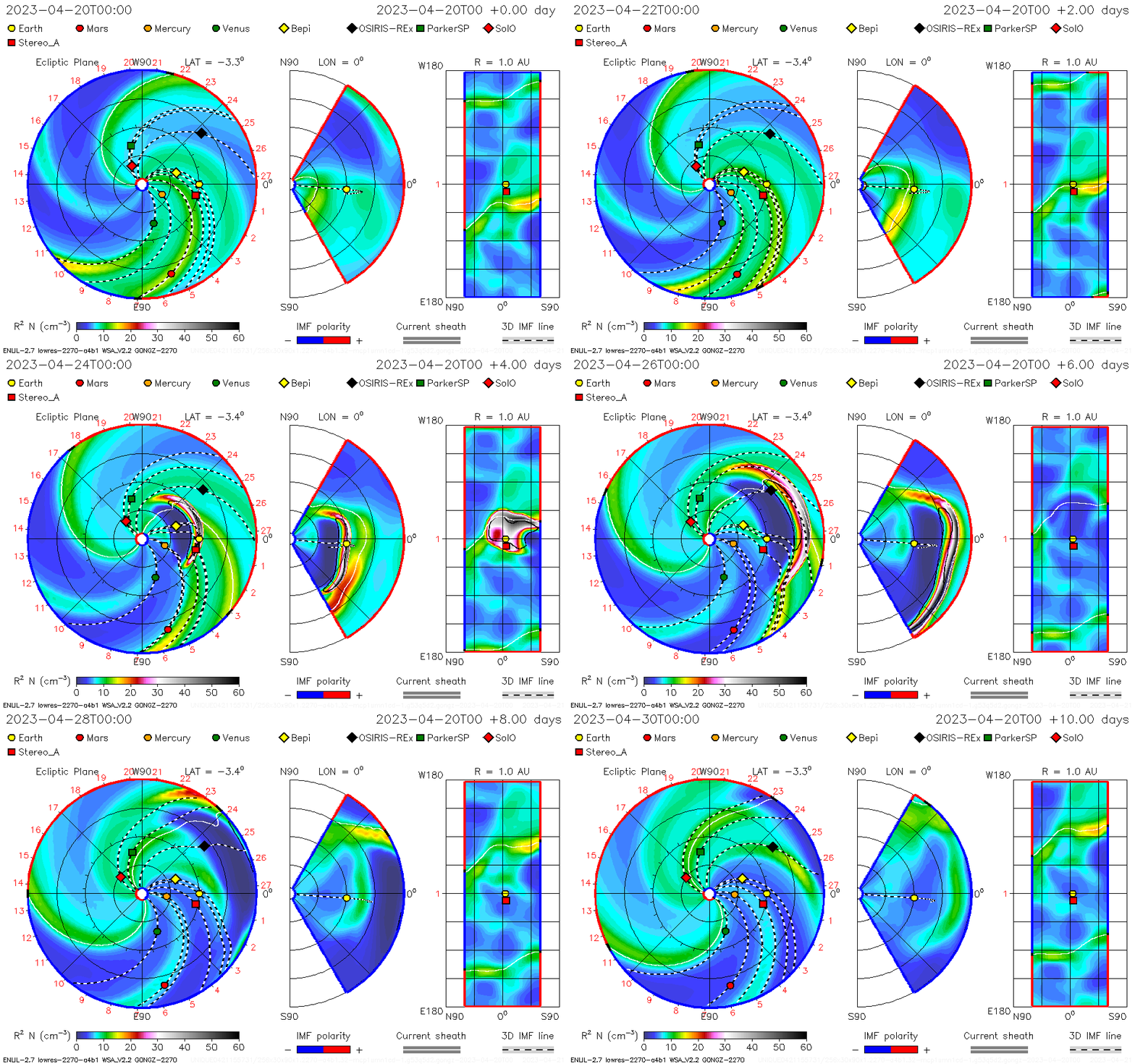
April 21, 2023: Earth is in the strike zone. On April 21st, a large magnetic filament snaking across the sun’s southern hemisphere exploded, hurling a cloud of debris in our direction. This movie from NASA’s Solar Dynamics Observatory shows what happened:

Soon after the eruption, the US Air Force reported strong Type II and Type IV solar radio bursts. These are natural shortwave emissions produced by shock waves preceding the CME as it passes through the sun’s atmosphere. Drift rates in the Type II burst suggested a CME velocity of about 580 km/s (1.3 million mph).

Images from SOHO coronagraphs have since confirmed the CME. It is a “halo CME” heading straight for Earth:

Models from NASA and from NOAA agree: the CME should reach Earth during the early hours of April 24th between the hours of 00:00 and 12:00 UT. The impact could spark G1- (Minor) to G2-class (Moderate) geomagnetic storms, with a slight chance of G3 (Strong). Aurora alerts: SMS Text.

A BURST OF STATIC FROM THE SUN: The explosion that hurled a CME toward Earth on April 21st also illuminated our planet with an intense burst of shortwave radio static. Amateur astronomer Thomas Ashcraft of New Mexico recorded the outburst:

“Few solar radio bursts show as hot purple on my spectrograph, but this one ‘rang the bell’,” he says. “Here is an audio recording in stereo with 22 MHz in one channel and 19 MHz in the other.”

The static in Ashcraft’s recording, which washes over the listener like a slow ocean wave, is naturally produced. Astronomers classify it as a Type V solar radio burst caused by energetic beams of electrons ray-gunning through the sun’s atmosphere. The electrons were accelerated by the same underlying explosion that hurled a CME toward Earth.

Solar radio bursts are an underappreciated form of space weather. We often talk about radio blackouts, which happen when solar flares ionize the top of Earth’s atmosphere. A radio blackout suppresses the normal propagation of terrestrial radio signals. Solar radio bursts, on the other hand, produce a radio drownout. Intense static from the sun overwhelms normal transmissions, drowning out the voices radio operators are trying to hear.

Solar radio bursts will happen more and more often as Solar Cycle 25 intensifies. You can hear them youself using a RadioJOVE radio telescope kit from NASA.