Oil Tanker Fire Sparked by Lithium-ion Battery Explosion -NTSB

โ€‹โ€‹โ€‹NTSB highlights potential fire risks of lithium-ion batteries.

The National Transportation Safety Board (NTSB) on Thursday cited thermal runaway of a cell within a handheld radioโ€™s lithium-ion battery as the cause of a fire on an oil tanker docked in Baton Rouge, La.

The Liberian-registered oil tanker S-Trust was docked at the Genesis Port Allen Terminal on November 13, 2022, when a fire on the bridge was sparked by one of the cells in a lithium-ion battery for an ultra-high-frequency handheld radio exploding, the NTSB’s investigation found. The batteries and chargers for the handheld radios were located on the communications table on the bridge, reportsย  MarineLink

By the time the vesselโ€™s crew extinguished the fire, the S-Trustโ€™s navigation, communication and alarm systems were damaged beyond use.ย In total, the fire caused $3 million in damage to the vessel.ย No injuries were reported.

S-Trust at anchor following the casualty. (Source: U.S. Coast Guard, courtesy NTSB)

Lithium-ion battery cell explosions are typically caused by a thermal runaway, a chemical reaction that can cause the cell to ignite and explode, according to the NTSB. A lithium-ion battery cell can spontaneously experience a thermal runaway if damaged, shorted, overheated, defective or overcharged.

The NTSB said crews can help to prevent thermal runaways and ensuing fires by:

  • Following manufacturersโ€™ instructions for the care and maintenance of lithium-ion batteries;
  • Properly disposing of damaged batteries;
  • Avoiding unsupervised charging; and
  • Keeping batteries and chargers away from heat sources and flammable materials.

โ€œCompanies should ensure that lithium-ion batteries and devices that use lithium-ion battery packs are certified by Underwriters Laboratory or another recognized organization,โ€ the report said.

If a lithium-ion battery fire occurs, crews can attempt to extinguish the fire with water, foam, CO2, or other dry chemical or powdered agents designed for use on Class A (combustible) fires. If the battery fire cannot be extinguished, personnel should attempt to allow the pack to burn in a controlled manner, including by watching for nearby cells that may also experience thermal runaway and extinguishing other combustibles that may catch on fire.

Photos from the bridge closed-circuit camera showing (1) a second explosion occurs, (2) an object is propelled on fire into the air (circled), and (3) the object, still on fire, landing on the floor. (Source: Stalwart Management Ltd, courtesy NTSB)


Luton Car Park Fireย Update

Do you remember such a fire in a multi-storey car park before?

From NOT A LOT OF PEOPLE KNOW THAT

By Paul Homewood

Thereโ€™s some more footage of the Luton fire, which gives a much clearer idea of just how big and explosive it was:

It has been claimed by the Fire Service that the fire started on a Range Rover diesel, but experts are dismissive of this.

For instance, AA technical expert Greg Carter said the most common cause of car fires is an electrical fault with the 12-volt battery system. But he added that diesel is โ€œmuch less flammableโ€ than petrol and in a car it takes โ€œintense pressure or sustained flameโ€ to ignite diesel.

Regardless of the initial cause, it is difficult to see how the fire could have spread so rapidly without EVs being involved. According to Andy Hopkinson of the Bedfordshire Fire Service, within ten minutes, the fire had already spread across a โ€œlarge number of vehicles and a number of floorsโ€.

Can anyone honestly remember such a fire in a multi-storey car park before?

We should not regard it as a coincidence that Sydney Airport had its own electric car fire in its car park just a month ago:

https://www.9news.com.au/national/lithium-battery-fires-cars-destroyed-in-carpark-fire-sydney-airport/1502699d-f2b9-4bd5-aed0-3467d67275d8#:~:text=The%20car%20burst%20into%20flames%20before%20the%20blaze,the%20blaze%2C%20Fire%20and%20Rescue%20NSW%20determined%20today.

Tonga explosionโ€™s weather effects probably small

The weather in many regions of the world has been particularly noteworthy recently. But whatโ€™s behind it?

From Net Zero Watch

The weather in many regions of the world has been particularly noteworthy recently. But whatโ€™s behind it?

Dr David Whitehouse, Science editor

Some have pointed to the violent Hunga Tonga-Hunga Haโ€™apai (HTHH) eruption on 15th January this year which was the largest explosion ever recorded by modern instruments โ€“ far larger than any nuclear test. It was the most powerful explosion since the 1883 Krakatoa event.

Producing the highest known eruption column in history, its effects reached the mesosphere. Because the volcano was 150 metres below sea level the explosion injected water vapour as high as 53 km. Large amounts of water ended up in the stratosphere, surpassing anything we have seen since satellite observation of such events commenced in the 1970s.

Image: NOAA

According toย an assessmentย of the event researchers said it, โ€œranks it among the most remarkable climatic events in the modern observation era, with a range of potential long-lasting repercussions for stratospheric composition and climateโ€.ย 

Observations from NASAโ€™s Aura satellite estimates that the explosion may have added 10% of the typical amount of water vapour into the stratosphere. Water vapour is a powerful greenhouse gas because it traps heat over a wider range of the infra-red spectrum than carbon dioxide. This effect is short-lived though as it soon enters the natural water cycle.

However unlike previous eruptions it may not cool the surface but warm it. This is because it released little in the way of sunlight-reflecting aerosols. The effect could be quite small, or it might not. One estimate suggests 0.035ยฐC over the next 5 years which is within the โ€œnoiseโ€ of variability. So HTHH is likely to have only a small effect โ€” as far as we know at present.ย Jucker at alon the other hand suggest the effect could be long-term winter warming in the northern hemisphere and cooling over Australia in winter.

The recent warmth has also been attributed to El Nino; but it is currently still rather weak, althoughย strengthening.

Thus is seems unlikely that these events have significantly affected recent weather, though we should heed the words of Agatha Christie who once wrote: โ€œAnyย coincidence isย worthย noticing. You can throw it away later if it is only aย coincidence.โ€

Feedback: david.whitehouse@netzerowatch.com

An Earth-Directed Explosion on the Sun

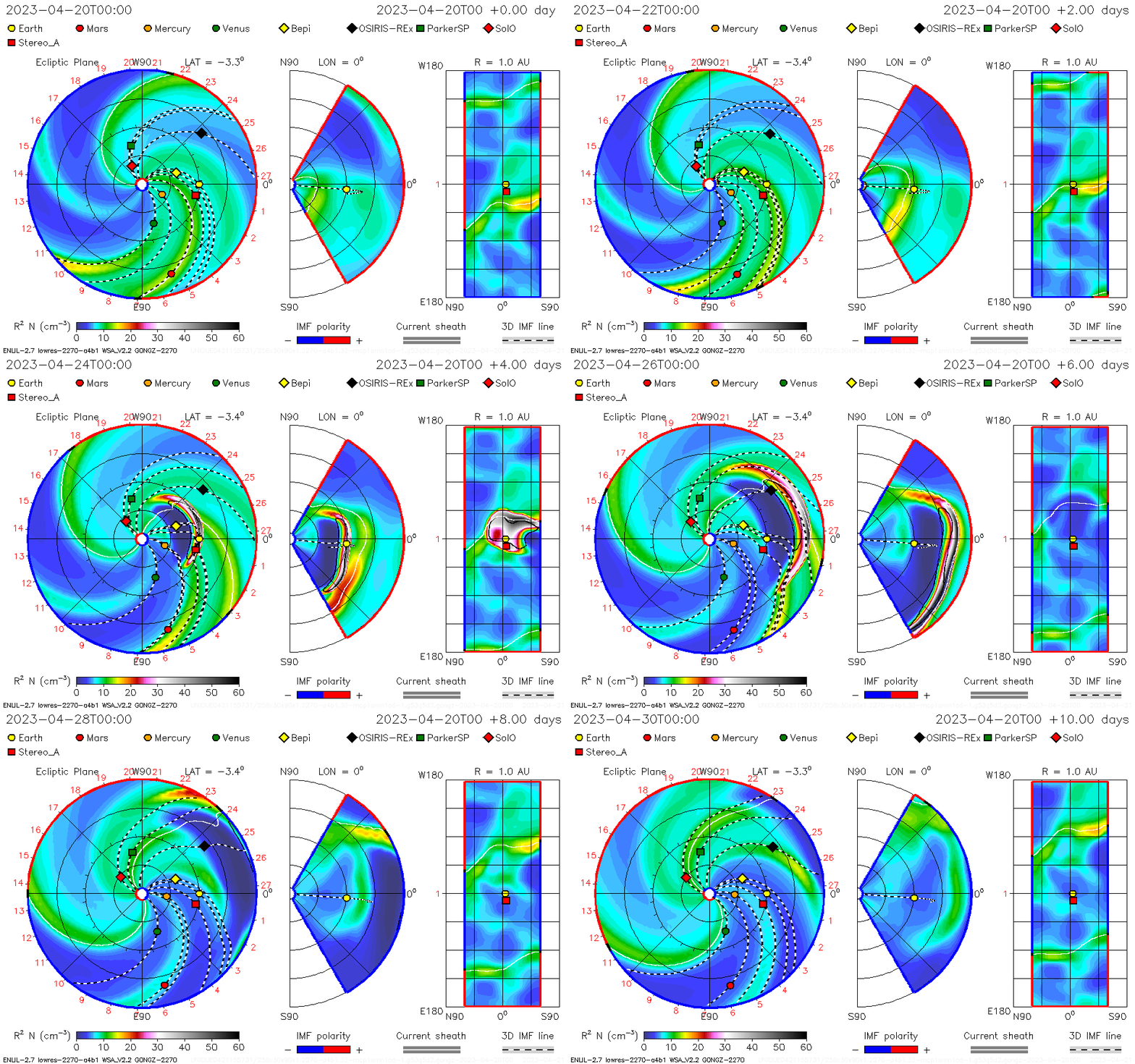
Earth is in the strike zone. On April 21st, a large magnetic filament snaking across the sunโ€™s southern hemisphere exploded, hurling a cloud of debris in our direction.

From Spaceweather.com

By DR.TONY PHILLIPS

April 21, 2023: Earth is in the strike zone. On April 21st, a large magnetic filament snaking across the sunโ€™s southern hemisphere exploded, hurling a cloud of debris in our direction. This movie from NASAโ€™s Solar Dynamics Observatory shows what happened:

Soon after the eruption, the US Air Force reported strong Type II and Type IV solar radio bursts. These are natural shortwave emissions produced by shock waves preceding the CME as it passes through the sunโ€™s atmosphere. Drift rates in the Type II burst suggested a CME velocity of about 580 km/s (1.3 million mph).

Images from SOHO coronagraphs have since confirmed the CME. It is a โ€œhalo CMEโ€ heading straight for Earth:

Models from NASA and from NOAA agree: the CME should reach Earth during the early hours of April 24th between the hours of 00:00 and 12:00 UT. The impact could spark G1- (Minor) to G2-class (Moderate) geomagnetic storms, with a slight chance of G3 (Strong). Aurora alerts: SMS Text.

A BURST OF STATIC FROM THE SUN: The explosion that hurled a CME toward Earth on April 21st also illuminated our planet with an intense burst of shortwave radio static. Amateur astronomer Thomas Ashcraft of New Mexico recorded the outburst:

โ€œFew solar radio bursts show as hot purple on my spectrograph, but this one โ€˜rang the bellโ€™,โ€ he says. โ€œHere is an audio recording in stereo with 22 MHz in one channel and 19 MHz in the other.โ€

The static in Ashcraftโ€™s recording, which washes over the listener like a slow ocean wave, is naturally produced. Astronomers classify it as a Type V solar radio burst caused by energetic beams of electrons ray-gunning through the sunโ€™s atmosphere. The electrons were accelerated by the same underlying explosion that hurled a CME toward Earth.

Solar radio bursts are an underappreciated form of space weather. We often talk about radio blackouts, which happen when solar flares ionize the top of Earthโ€™s atmosphere. A radio blackout suppresses the normal propagation of terrestrial radio signals. Solar radio bursts, on the other hand, produce a radio drownout. Intense static from the sun overwhelms normal transmissions, drowning out the voices radio operators are trying to hear.

Solar radio bursts will happen more and more often as Solar Cycle 25 intensifies. You can hear them youself using a RadioJOVE radio telescope kit from NASA.