Audubon:  Frightful Fundraising

National Audubon has done some terrific work over the last 100+ years but more recently, since the turn of the century (20th to 21st), they have succumbed to the lure of climbing on the Climatism bandwagon – diluting their message and muddying their reputation.   Worse yet, their current messaging and fundraising uses a toxic mix of Climatism and rabid Environmentalism – which I call Enviro-Climatism, a word I use to clarify that this movement includes the worst aspects of the present-day environmental movements and the wild apoplectic versions of the climate scare.

From Watts Up With That?

Opinion by Kip Hansen

The National Audubon Society is a foundational conservation organization in the United States:  “The National Audubon Society launched in 1905, on the heels of American conservationism and a growing movement to protect birds. As with many efforts to conserve nature, women led the way: The first Audubon Society was organized by two Boston environmentalists, Harriet Hemenway and Minna B. Hall, in response to the widespread slaughter of waterbirds, the gorgeous feathers of which were used to make women’s hats.”   [ source ]  Yes, that’s right, birds were being slaughtered all over the world to feed the fad of fancy-feathered women’s hats – some even having whole birds on them!

National Audubon has done some terrific work over the last 100+ years but more recently, since the turn of the century (20th to 21st), they have succumbed to the lure of climbing on the Climatism bandwagon – diluting their message and muddying their reputation.   Worse yet, their current messaging and fundraising uses a toxic mix of Climatism and rabid Environmentalism – which I call Enviro-Climatism, a word I use to clarify that this movement includes the worst aspects of the present-day environmental movements and the wild apoplectic versions of the climate scare.

I have donated money to Audubon in the past and thus am on their fund-raising mailing list.  Every day I get yet another plea for money based on some mostly-false scary claim about the fate of birds like these pulled from the last ten days or so:

“Birds are suffering from the impacts of climate change. Will you help?

It’s nothing short of a crisis, which means we don’t have a moment to waste in protecting them for generations to come. In fact, two-thirds of North American bird species, including familiar songbirds like American Goldfinches, are at increasing risk of extinction because of climate change.”

—

For birds like the Piping Plover, more frequent and intense weather events like storms and hurricanes are existential threats.

Climate change is putting birds at serious risk.

These beloved songbirds could disappear from two-thirds of their present breeding range.

Extreme weather like heat waves and storms endanger young birds.

We’ve already lost 3 billion birds in the span of a human lifetime.

—

“Birds like the Piping Plover are not yet safe from potential extinction and we need ongoing support from generous people like you to protect them.

The Piping Plover is a species at serious risk: Although the breeding population is increasing, the Great Lakes population is still just a fraction of what it once was. Habitat loss and degradation contribute to its decline, as does disturbance from people, pets, and wildlife near their nests. And it’s one of the two-thirds of North American species at increasing risk of extinction from climate change.”

But, we’re not willing to let the birds we love go extinct.

—

With their brilliant colors, bouncy flight, and musical call notes, American Goldfinches are summer favorites in open habitats across much of North America. But if climate change continues unchecked, they could disappear from two-thirds of their present breeding range.

In the midst of this code-red climate emergency—and as their very survival is threatened—birds rely on your support now more than ever. Two-thirds of North American birds are at increasing risk of extinction from climate change including beloved songbirds like American Goldfinches and vulnerable shorebirds like Piping Plovers.

—

Had enough?  I have, and more…. Let me try and set a bit of this straight:

The American Goldfinch  

This lovely little bird is a common sight at backyard birdfeeders across most of North America.  The males are a brilliant yellow when in full-breeding plumage.  I see them every Spring as they arrive in the U.S. Northeast and watch as they take on their breeding fancy dress colors.

The claim that Goldfinches might disappear is simply false.  The latest  IUCN Red List assessment for the American Goldfinch, reads:

“This species has an extremely large range, and hence does not approach the thresholds for Vulnerable under the range size criterion. ….  The population trend appears to be increasing, and hence the species does not approach the thresholds for Vulnerable under the population trend criterion …. The population size is extremely large, and hence does not approach the thresholds for Vulnerable under the population size criterion…. For these reasons the species is evaluated as Least Concern.”

They are not Vulnerable at all for any reason.  

National Audubon uses this non-existent threat as a scare tactic to get donations out of the anxious, the “little old ladies with too much money” (I have a relative I am thinking of, who is a sucker for begging junk mail), and true bird-lovers for whom National Audubon was once a respected source of information.

The Piping Plover  

This little shorebird is so cute that it fascinates beachgoers as it runs this way and that, avoiding the tiniest of waves as it picks and pecks at the sand for bits of food.  I have written about plovers before, when they were benefitted by the aftermath of Hurricane/Superstorm Sandy.

The latest IUCN Red List assessment lists the Piping Plover as ‘Near Threatened” – that is, not actually threatened with possible extinction, but might be so soon – “A near-threatened species is a species which has been categorized as “Near Threatened” (NT) by the International Union for Conservation of Nature (IUCN) as that may be vulnerable to endangerment in the near future, but it does not currently qualify for the threatened status.” [ source ]  “Near Threatened” is one of the three “Lower Risk” categories in the IUCN Red List hierarchy.

The IUCN assessment reads:

“This species has a small population which has declined significantly since the 1950s. However, there have been overall population increases since 1991 and the species’s population is thought to currently be growing at a slow rate. The population increase is however largely the result of intensive conservation management and thus it is likely that positive trends would reverse again if conservation action were to stop. Due to its high conservation dependence and the risk of future declines following any stochastic event, the species warrants listing as Near Threatened.”

The Piping Plover faces a number of threats..  They breed in the dunes along the seashores and lakeshores – and waterfront development and the intrusions caused by humans and their pets (dogs and cats) interfere with nesting and endanger brooding chicks.  This sign has Piping Plovers as the right-hand image. 

Increasing populations of the small falcon, the Merlin, a winning species,  whose primary prey is other birds, are listed as a threat in Virginia. 

Any disturbance of beaches during breeding season can disrupt Pipers, including conservation efforts, like beach replenishment, nest surveillance and beach-grass planting.   

But, the bottom line for Piping Plovers is that while their breeding areas can benefit from some protections,  they are not particularly at risk and certainly not in crisis. 

In fact, two-thirds of North American bird species…are at increasing risk of extinction because of climate change.

All of these types of claims have some basis in fact, but, as you would suspect, are alarmist spins produced by advocacy organizations.  Most of the data comes from a report called “State of the Birds 2022”,  “The 2022 U.S. State of the Birds report was produced by a consortium of government agencies, private organizations, and bird initiatives led by NABCI (North American Bird Conservation Initiative).” 

I have written here at WUWT about earlier versions of this report – “About those claims of declining bird populations due to ‘climate change’” and “Birds in Crisis?”. 

There is no doubt that as land-use changes and local weather conditions change, cities are built, farms and ranches expand and, on the other hand, as much agricultural land is abandoned and reverts to transitional forests or grasslands, the populations of birds that inhabit these ecological niches will change.  There are winners and losers, some individual species and types of birds have expanding populations and some have shrinking populations. 

In the latest State of the Birds , the NABCI offers this overall picture:

In this we see that waterbirds of all kinds are booming.  Western Forest Birds are long-term steady.  Eastern Forest Birds, Shorebirds and Grassland Birds populations have leveled out and stabilized in the last decade.  And, a number of birds types declining, some very steeply.  Note that in keeping with Enviro-Climatism memes, NABCI has labelled some species “Tipping Point species”. 

The sources for the data for this (and previous reports) are explained as: “This report describes population change for 259 species of North American birds summarized from 5 surveys: the North American Breeding Bird Survey (BBS, 176 species, Sauer et al., 2020), the Christmas Bird Count (CBC, 60 species, Meehan et al., 2020), the Waterfowl Breeding Population and Habitat Survey (WBPHS, 14 species, U.S. Fish and Wildlife Service, 2021), the American Woodcock Signing-ground Survey (SGS, 1 species, Seamans and Rau, 2021), and International Shorebird Surveys (ISS, 9 species, Smith and Smith, 2022).”…

The bird counts may all suffer from the same problems recently found in monarch butterfly counts,  which I explain in this essay: “Modern Scientific Controversies 2024: The Monarch Wars — Part 1”, to wit; the counts are performed by volunteers who count at specified locations on pre-determined days, year after year.  Neither the butterflies or the birds are informed of the locations and dates in advance and may miss their appointments or simply pass by at another time or another location.

There are conflicting reports on some of these trends.  For instance, the category “Sea Ducks”:  in the NABCI report, it says:  “Sea ducks face elevated threats from climate change, including effects on food resources, altered predator communities, and rapid changes to breeding habitats.” And show a sharp declining trend of “30%”.

But, the specialized conservation group “Sea Duck Joint Venture” contradicts that statement,  explictly saying “…for most species of sea ducks, we cannot accurately estimate abundance, relative densities, or population trends, nor determine abundance objectives.”

And the oft-repeated claim:

“Three billion birds lost 1 in 4 breeding birds have been lost from the United States and Canada in the past 50 years.”?  [ State of the Birds 2022, page 4 ]

We have this from the Cornell Lab of Ornithology: 

“In the United States alone, there are 60 million to 100 million free-ranging, unowned cats. These are non-native predators that, even using conservative estimates, kill 1.3–4 billion birds and 6.3–22.3 billion mammals each year in the U.S. alone (Loss et al. 2013, Nature Communications).”

This does not include the number of birds killed by 58 million owned pet cats allowed to roam free at least part of the day.   In the 50 years covered by the NABCI claim, cats would account for between 65 and 200 Billion birds killed (by feral cats) and untold billions more by pet cats. 

The reports of  “3 billion birds lost”, repeated in Audubon fund-raising,  pales by comparison.

These are staggering numbers, yet there is very little real pressure from National Audubon or NACBI , nothing in the The State of the Birds report,  calling for laws and regulations to prevent this rampant slaughter.  The topic is somewhat toxic for National Audubon as illustrated by the 2013 kurfluffle over a Ted Williams Op-Ed in a non-Audubon publication, resulting in an official apology from Williams..   A search of the National Audubon’s magazine reveals that Audubon took a strong stand on cats in 2013 thru about 2015:

“So let’s be clear: Audubon’s long-standing view, strongly supported by the best available science and laid out in a resolution by our board of directors, is that cats – particularly feral cats – are a leading cause of bird deaths. Audubon strongly believes that cats belong indoors. That’s safer for them and for birds.”

After 2015, their magazine is silent about the cat issue, until recently, with two articles in the Spring 2024 issue in support of keeping pet cats indoors [ here and here ], but no lobbying campaigns for legislation or regulations.

Bottom Lines:

National Audubon is among the many advocacy organizations that are using exaggerated and, in some cases, outright false claims of crisis and disaster to extract money from the gullible and from the caring.

I find it extremely offensive.   In the case of National Audubon, they could make perfectly reasonable requests for money for the support of their good, helpful, and useful projects and programs.  They do have programs that actually improve the situation for various birds, such as protecting wildlands and breeding sites.

# # # # #

Author’s Comment:

Please take note that this Opinion piece applies to National Audubon, and not to the many affiliated regional and local Audubon clubs and groups, which generally all do great work, educating children and adults about birds and helping to maintain safe places for the birds to live and breed. 

Of course, National Audubon is not the only advocacy groups to use fear as a motivator in fund raising, it is just the one that appears in my email stream regularly with outrageous misleading claims.

If you are a bird lover, support your local Audubon chapter and bring fund-raising the abuses of National Audubon the attention of your local people.

And, keep your cat indoors – or at least prevent it from free-roaming.

Thanks for reading.

# # # # #

And The Green Jobs Go To…

Now, with the general election tomorrow, they have changed course and now say that Labour’s plans will destroy Scottish jobs, and that this is rather important after all. Of course Labour’s plans to throw money at the “green transition” pale almost into insignificance when compared to the huge sums of money spent by President Biden’s administration under the strangely-named Inflation Reduction Act (“IRA”) (strangely-named, since the one thing that is guaranteed when governments borrow money to spend in huge amounts is that it will increase, rather than reduce, inflation).

From Climate Scepticism

BY MARK HODGSON

…China

In Where Did All The Green Jobs Go? I expressed considerable scepticism about the oft-repeated claims of green jobs connected to Net Zero in this country. In comments below that article I have also drawn attention to the sacrifice of manufacturing jobs in the UK on the Net Zero altar and the failure of the promised jobs to replace them. In addition, there is now of course an ongoing discussion of, inter alia, the effect on jobs in the North Sea oil and gas exploration sector of Labour’s proposed ban on new exploration and extraction licences there. The SNP, having originally planned to fund independence by using the taxes generated by North Sea oil and gas, then decided it was evil and that we had to put “saving the planet” before Scottish jobs. Now, with the general election tomorrow, they have changed course and now say that Labour’s plans will destroy Scottish jobs, and that this is rather important after all. Of course Labour’s plans to throw money at the “green transition” pale almost into insignificance when compared to the huge sums of money spent by President Biden’s administration under the strangely-named Inflation Reduction Act (“IRA”) (strangely-named, since the one thing that is guaranteed when governments borrow money to spend in huge amounts is that it will increase, rather than reduce, inflation).

Given all of the above, it strikes me as an appropriate time to see how things are going in the USA. Has the extraordinary expenditure of federal government funds on the “green economy” lived up to the claims made on behalf of the Act? Earlier this week a BBC article asked a similar question, with this heading: “Will Biden’s green jobs policy help him win votes?” Interestingly, when I clicked on it the heading changed to “‘Only latte liberals care about green energy round here’”, which might suggest that the working class at the sharp end of Washington DC politics aren’t much interested or impressed. Let’s see what the BBC makes of it.

The BBC seems perplexed by the lack of interest, given what it clearly sees as a superbly beneficial policy. In fact the thumbs up could hardly have been more enthusiastic if it had been written by Democrat party presidential campaigners. According to the BBC, the Act:

…offered hundreds of billions of dollars in tax incentives, credits and loans to stimulate American manufacturing in clean energy.

The most ambitious climate legislation in US history has generated a tsunami of private sector investments, with big implications for the rest of the world. And Georgia – a state President Biden hopes is in play in this year’s presidential election – has been a big beneficiary.

But with four months before the president goes head-to-head against Donald Trump, the billions of dollars of new investment in this key battleground state doesn’t appear to have lifted the incumbent’s support.

President Biden’s pitch is that solving the climate problem is also good for jobs. Since the law was passed, more than 300,000 clean energy jobs have been created in the US, according to the advocacy group Climate Power.

And there’s no doubt it’s creating opportunities in places like Dalton. Here you see Bidenomics in action – foreign and government money being used to fight climate change and build an economy from the middle out.

And yet something doesn’t add up. Despite the fact that much of this money has quite deliberately been directed to states such as Georgia that the Democrats hope to take from the Republicans in November’s Presidential election, the “message either isn’t getting through or simply isn’t resonating with locals – not even local Democrats”. The problem seems to be that they resent the fact that such jobs as are being created aren’t jobs created by US-owned businesses. On the contrary, locals resent it:

“The business community resents the fact that we have a company from South Korea coming in this area with government subsidies, while they themselves get nothing from the government,” says Mr Pourquoi, who identified as a Republican before switching parties following Trump’s election in 2016.

Perhaps Burns was right when he said the best laid schemes o’ mice an’ men gang aft a-gley. And yet the BBC is very clear in uncritically accepting (no need for a fact-check by BBC Verify here) the figures offered by “advocacy group Climate Power” as referred to above. If, as they claim, “CLEAN ENERGY BOOM SOARS PAST 300,000 JOBS: 312,900 NEW CLEAN ENERGY JOBS NOW AT RISK FROM TRUMP AND BIG OIL’S REPEAL CRUSADE”, how on earth could anyone contemplate voting against Biden and for Trump? (Personally I think it’s more poignant than that – I have no idea how anybody could contemplate voting for either of them, but I digress). It’s worth, I think, taking a look at the report from Climate Power, since the BBC didn’t trouble to interrogate the claims they made.

I think it’s fair to say that even if the report is accurate (on which I express no opinion), it’s rather brief. It runs to 21 pages, of which at best perhaps six pages represent analysis, and the rest comprises appendices presenting the data by state and by Congressional Districts. The first thing that jumps out at me is the breakdown of the claimed jobs: 4% in the wind industry; 18.2% solar; 3.5% hydrogen; 3.8% grids; 14.7% electric vehicles; 14.2% “clean tech”; and a whopping 46.1% batteries. While it’s certainly true that if the US is to become dependent on renewable energy, batteries will be in great demand. However, putting 46.1% of your “green” job creation in a basket where China controls most of the necessary raw materials might not be the wisest strategy.

Then there is the cost of the jobs. I take at face value the claim that the jobs are skilled and well-paid. A deeper analysis might find something to question in that claim, but for present purposes I take it as read. In any event, the jobs had better be well-paid, given the costs associated with them. Space doesn’t permit a line-by-line analysis, but some headlines might be of interest. Let’s concentrate on the ten states which it is claimed benefit from the majority of new jobs:

Georgia – 41 projects, 30,661 new jobs, $23.88Bn investment (remember, it’s always an investment, never a cost). That equates to $778,839 per job.

New York – 23 projects, 28,934 jobs, $115.45Bn. That equates to a staggering $3,990,115 per job.

Texas – 46 projects, 23,146 jobs, $16.45Bn = $710,705 per job.

Michigan – 58 projects, 21,490 jobs, $25.38Bn = $1,181,014 per job.

Kansas – 5 projects, 21,077 jobs, $4.24Bn = $201,167 per job.

Nevada – 16 projects, 20,098 jobs, $14.5Bn = $721,464 per job.

South Carolina – 31 projects, 17,865 jobs, $15.01Bn = $840,190 per job.

New Mexico – 7 projects, 16,625 jobs, $2.99Bn = $179,849 per job.

Arizona – 20 projects, 15,570 jobs, $11.24Bn = $721,901 per job.

Ohio – 27 projects, 13,669 jobs, $10.43Bn = $763,040 per job.

North Carolina – 26 projects, 12,090 jobs, $19.18BN = $1,586,435 per job.

Perhaps the lesson is to invest in Kansas and New Mexico, as they represent better value than investments in New York, Michigan and North Carolina. Taking the total money spent and the total jobs claimed to be created, a spend of over $361Bn to create 312,900 new jobs equates to a cost per job of $1,153,723. In UK terms, at today’s exchange rate, that equates to £905,520 per job.

I have not considered whether any part of the policy underlying the Act has cost jobs. Even if we accept that it’s unalloyed good news, with high-quality well-paid jobs being created and none lost, it’s still an extraordinarily expensive policy.

Returning to the BBC article, however, the most telling statistics relate to China. China dominates world markets in these areas. As we are often told by those who tut when sceptics point to China’s continually rising greenhouse gas emissions, in 2024 it is expected to invest $359Bn in renewable power, while the figures for the EU are $106Bn and for the USA are $85Bn. At least the table in the BBC article says its $359Bn in China, but in the following paragraph it refers to an International Energy Agency Report, which instead claims a figure of $675Bn. Also, China controls 80% of the world’s solar panel supply chain.

The object of the Inflation Reduction Act, the BBC tells us, is to deny China any more of an opening into the US renewables market. And yet if one looks at the “Clean Energy Boom Report” cited by Climate Power in its brief analysis, Chinese and other Asian company names feature regularly when it comes to jobs that it claims are created thanks to the federal government’s largesse. Donghee America is a subsidiary of a South Korean company. Hyundai Mobis is also South Korean, as are Samkee Corp and Seohan Group, Daesol Ausys, Kia, Seoyan E-Hwa, Hanwha, Hwashin, Woory Industrial, Jaewon Industrial, SungEel HiTech and (no surprise here) NVH Korea. JA Solar is Chinese, as are Jinko Solar, Daechang Seat, Fuyao, and Sewong America is a subsidiary of a Chinese company. Bekaert is Belgian, as is Syensqo. Standard Lithium is Canadian. RWE Offshore Wind is German, as is Bosch. Canigou Group is based in Hong Kong. Panacea Global Energy is French-owned. Rayzon Solar is Indian. And so on. You get the picture. Yes, lots of US companies are seeing benefit, but so are companies based in Asian “developing” countries with massive greenhouse gas emissions, even if the companies themselves usually claim to be committed to Net Zero by some date or other. The US taxpayer is digging deep for the benefit of lots of foreign companies. It all begins to make sense. Remember the quote above:

“The business community resents the fact that we have a company from South Korea coming in this area with government subsidies, while they themselves get nothing from the government…”

Sir Keir Starmer and Mr Miliband: you are probably going to achieve a huge majority at this general election, but be careful what you do with it. Use it unwisely and you may well regret it.

Google emissions surge nearly 50% as demand for AI sets fire to their Net Zero plan

Saint Google’s climate piousness vanished the moment they had to give up something they cared about. The unwashed masses need to take cold showers, eat bugs and fly less often, but if those same people want artificial intelligence, who cares about the heat waves or the hurricanes? Do carbon emissions matter, or don’t they?

For three decades Saint Google strove to save the world from CO2 (and from skeptical opinions). Google were the first major company to become carbon neutral in 2007, the first to commit to operating 24/7 on carbon-free energy. They boast they’re helping 550 cities to reduce a gigaton of carbon emissions. Then opportunity knocked and set fire to those plans.

From JoNova

By Jo Nova

The World must act, The Science is clear say Google,  but Armageddon will have to wait while they make money from AI

Saint Google’s climate piousness vanished the moment they had to give up something they cared about. The unwashed masses need to take cold showers, eat bugs and fly less often, but if those same people want artificial intelligence, who cares about the heat waves or the hurricanes? Do carbon emissions matter, or don’t they?

For three decades Saint Google strove to save the world from CO2 (and from skeptical opinions). Google were the first major company to become carbon neutral in 2007, the first to commit to operating 24/7 on carbon-free energy. They boast they’re helping 550 cities to reduce a gigaton of carbon emissions. Then opportunity knocked and set fire to those plans.

In 2020 they boldly set the goal of being 100% carbon-free by 2030, now three years later, their emissions are up 50% on what they were in 2019.

In September 2020, it was Google’s “Most Ambitious Decade” because the fires of climate change were already upon them:

Google announces it will run on carbon-free energy by 2030

“We have until 2030 to chart a sustainable cause for our planet or face the worst consequences of climate change,” Google CEO Sundar Pichai said in a video released today. “We are already feeling those impacts today from historic wildfires in the US to devastating flooding in many parts of the world.”

Once Google’s data centers are powered completely by carbon-free energy, “this will mean every email you send through Gmail, every question you ask Google Search, every YouTube video you watch, and every route you take using Google Maps, is supplied by clean energy every hour of every day,” Pichai wrote in a blog post ….

So much for that — July 2024:

Google’s carbon emissions surge nearly 50% due to AI energy demand

Google’s emissions surged nearly 50% compared to 2019, the company said Tuesday in its 2024 environmental report, marking a notable setback in its goal to achieve net-zero emissions by 2030.  The company attributed the emissions spike to an increase in data center energy consumption and supply chain emissions driven by rapid advancements in and demand for artificial intelligence. The report noted that the company’s total data center electricity consumption grew 17% in 2023.

Way back in prehistoric times of 2020 the only mention of AI in these ambitious plans was “to optimize their electricity demand and forecasting.” which suggests AI was pretty useless, given that it didn’t tell them their 2024 electricity demand would be up 50%.

Most of Googles emissions are “Scope 3” which makes them just like the fossil fuel giants they despise

It’s not the oil and gas extraction that creates most of the emissions, it’s what Exxon’s customers do with the oil and gas that does. So it is with Google — it’s not creating the AI program that burns through the electricity, it’s the customers who keep asking it to make things like deep-fake porn movies.  I mean, “Scope 3” is just plain silly —  that any company should be accountable for what their customers do, but if you are going to apply silly rules, at least do it equally.

Fully 75% of Google’s carbon footprint are scope 3 emissions.

Our total Scope 3 emissions were approximately 10.8 million tCO2e in 2023, representing 75% of our total carbon footprint. Our Scope 3 emissions are indirect emissions from sources in our value chain. The majority of these emissions come from the production of goods and services purchased for our operations, including the upstream manufacturing and assembly of servers and networking equipment used in our technical infrastructure.

So is the world at stake or not? If emissions will wash the coast away and melt the polar ice caps, why is it OK to demand people live in cold homes and give up their family holiday to Bali, but frivolously expand artificial intelligence use?

Do carbon emissions really matter or not?

“The science is clear: The world must act now if we’re going to avert the worst consequences of climate change. 

We are committed to doing our part.”  — Sundar Pichai, CEO of Google, Sept 2020

No, CBS News, New York City Isn’t Going to Be Flooded by Sea Level Rise

An recent CBS News article claims that climate change induced sea level rise could result in large parts of New York City being underwater by the year 2100. This is false. The best and most relevant data measuring sea level rise in the New York Battery Park area shows a slow but steady rate of rise since 1850 that would fall very far short of submerging any locations in New York City by 2100.

From ClimateRealism

By Anthony Watts

An recent CBS News article claims that climate change induced sea level rise could result in large parts of New York City being underwater by the year 2100. This is false. The best and most relevant data measuring sea level rise in the New York Battery Park area shows a slow but steady rate of rise since 1850 that would fall very far short of submerging any locations in New York City by 2100.

In the article, CBS News cites the National Oceanic and Atmospheric Administration (NOAA) saying:

“NOAA predicts sea levels in Battery Park City and on the East Side of Manhattan will rise between 2.5 feet and 6.5 feet by the year 2100.”

CBS interviewed a resident nearby who said:

“That’s crazy to even picture,” said Nef Garcia, who lives in Battery Park City.

He’s right, it is crazy and here is why.

NOAA’s prediction is heavily predicated on computer climate models that assume a huge acceleration in sea level rate of rise over the next 75 years. In particular, NOAA’s Sea Level Rise Viewer, upon which the prediction is based, relies on estimates and models used in 2007. These estimates are woefully outdated, and with the new generation of models now in use, the old estimates used by CBS don’t accurately represent the future the current best projections. The predictions CBS cites are shown in Figure 1.

Figure 1- IPCC estimation for the average surface temperature rise based on the rate of CO 2 emissions. Reproduced from Solomon, S., Qin, D., Manning, M., Marquis, M., Averyt, K., Tignor MMB., et al (2007). Climate Change 2007: The Physical Science Basis. Contribution of Working Group I to the Fourth Assessment Report of the Intergovernmental Panel on Climate Change.

Since 2007, research has shown that computer climate models consistently run too hot. The unfortunate part of these “too hot models” is that they have been in use for years, referenced by other scientific papers, and have been the basis for claiming future doom scenarios in thousands of media stories just like this one.

So, there’s a built-in bias in these models, and if you use their outputs to predict things like sea level rise, you’ll end up with exaggerations rather than reality. This is a dramatic case of Garbage In, Garbage Out.

Speaking of reality, actual data exists on sea level rise from the Battery Park area of New York City, cited in the story. NOAA has plotted the data here, seen in Figure 2 below:

Figure 2 – NOAA plot of sea level rise since 1855 in New York City.

Note the text provided by NOAA at the bottom of the graph:

The relative sea level trend is 2.92 millimeters/year with a 95% confidence interval of +/- 0.09 mm/yr based on monthly mean sea level data from 1856 to 2023 which is equivalent to a change of 0.96 feet in 100 years.

Actual data says 0.96 feet (less than a full foot) in 100 years, and of course, it will be even less that for the 75 years until 2100. Despite the hard data, another division of NOAA, who produced the sea level viewer that CBS News touted, says “between 2.5 feet and 6.5 feet by the year 2100.” Clearly, somebody is wrong, they both can’t be right. Sound science practice dictates that when data and theory conflict, you question the theory, not the data, which in this case would mean trusting actual data, rather than computer model projections.

Also notable are the past failed predictions of NYC being inundated by rising seas by some prominent people, such as James Hansen, Ph.D. of NASA, often referred to as the father of global warming, who had an office just a few blocks away from the Battery Park tide gauge. In a 2001 interview with Salon.com, he said this:

While doing research 12 or 13 years ago, I met Jim Hansen, the scientist who in 1988 predicted the greenhouse effect before Congress. I went over to the window with him and looked out on Broadway in New York City and said, “If what you’re saying about the greenhouse effect is true, is anything going to look different down there in 20 years?” He looked for a while and was quiet and didn’t say anything for a couple seconds. Then he said, “Well, there will be more traffic.” I, of course, didn’t think he heard the question right. Then he explained, “The West Side Highway [which runs along the Hudson River] will be under water. And there will be tape across the windows across the street because of high winds. And the same birds won’t be there. The trees in the median strip will change.” Then he said, “There will be more police cars.” Why? “Well, you know what happens to crime when the heat goes up.” (emphasis, authors)

When WUWT reported the story in 2011, discussing Hansen’s falsified prediction, it made some waves, and lo and behold, the original reporter comes to the Hansen’s rescue, by moving the goalposts out another 20 years saying he had misquoted Hansen, and it was actually 40 years not 20 years.

So, by that Hansen claim, the West Side Highway will be under water in 2028. Here is a 2023 Google Earth Street View of the West Side Highway, about a mile North of Battery Park. It seems the ocean has a huge way to go before the highway is flooded in 5 years, seen in Figure 3 below:

Figure 3 – 2023 Google Earth Street View from the West Side Highway in New York City showing the level of the ocean there is not close to flooding at all

When the topic is climate change, even the “father of global warming” has repeatedly been proven wrong.

The bottom line: hyperbolic predictions on New York City and sea level have been around for decades, and not one of them has come true, nor is there evidence that they will come true within any realistic time frame. If CBS News had bothered to fact check, they would have discovered this. Instead, they chose to write a scare story citing outdated, flawed computer models predictions of future doom, ignoring real world data to the contrary, in the process.

About the only accurate portion of the CBS News story is the quote from Battery Park resident Nef Garcia, who said “That’s crazy to even picture.”

Green Baloney, Hype and Fairy Tales in Australia

How low Australia has fallen… Our once-great BHP now has a ‘Vice President for Sustainability and Climate Change’, the number of Australian students choosing physics at high school is collapsing, and our government opposes nuclear energy while pretending we can build and operate nuclear submarines.

From Science Matters

By Ron Clutz

Viv Forbes writes at Spectator Australia Battery baloney, hydrogen hype, and green fairy tales in Australia.  Excerpts in italics with my bolds and added images.  H/T John Ray at his blog Greenie Watch.

How low Australia has fallen… Our once-great BHP now has a ‘Vice President for Sustainability and Climate Change’, the number of Australian students choosing physics at high school is collapsing, and our government opposes nuclear energy while pretending we can build and operate nuclear submarines.

Our Green politicians want: ‘No Coal, No Gas, No Nuclear!’ while Our ABC, Our CSIRO, and Our Australian Energy Market Operator (AEMO) are telling us that wind and solar energy (plus a bit of standby gas, heaps of batteries, and new power lines) can power our homes, industries and the mass electrification of our vehicle fleet. This sounds like Australia’s very own great leap backwards.

There are two troublesome Green Energy Unions: the Solar Workers down tools every night and cloudy day, and the Turbine Crews stop work if winds are too weak or too strong. And wind droughts can last for days. The reliable Coal and Gas Crews spend sunny days playing cards, but are expected to keep their turbines revving up and down to keep stable power in the lines.

From Duck to Canyon Curve

Magical things are also expected from more rooftop solar. But panel-power has four huge problems:

♦  Zero solar energy is generated to meet peak demand at breakfast and dinner times.

♦  Piddling solar power is produced from many poorly oriented roof panels or from the weak sunshine anywhere south of Sydney.

♦  If too much solar energy pours into the network (say at noon on a quiet sunny Sunday), the grid becomes unstable. Our green engineers have the solution – be ready to charge people for unwanted power they export to the grid, or just use ‘smart meters’ to turn them off.

♦  More rooftop solar means less income and more instability for power utilities so they have to raise electricity charges. This cost falls heaviest on those with no solar panels, or no homes.

Magical things are also expected from batteries.

When I was a kid on a dairy farm in Queensland, I saw our kerosene lamps and beeswax candles replaced by electric lights. We had 16 X 2 volt batteries on the verandah and a big thumping diesel generator in the dairy.

It was a huge relief, years later, when power poles bringing reliable electricity marched up the lane to our house. All those batteries disappeared with the introduction of 24/7 coal power.

Batteries are never a net generator of power – they store energy generated elsewhere, incurring losses on charging and discharging.

There has to be sufficient generating capacity to meet current demand while also recharging those batteries. What provides electricity to power homes, lifts, hospitals, and trains and to recharge all those vehicle batteries after sundown on a still winter night? (Hint: Call the reliable coal/gas/nuclear crews.)

The same remorseless equations apply to all the pumped hydro schemes being dreamed up – everyone is a net consumer of power once losses are covered and the water is pumped back up the hill.

Yet AEMO hopes we will install 16 times our current capacity of batteries and pumped hydro by 2050 – sounds like the backyard steel plans of Chairman Mao or the Soviet Gosplan that constipated initiative in USSR for 70 years. Who needs several Snowy 2 fiascos running simultaneously?

Mother Nature has created the perfect solar battery which holds the energy of sunlight for millions of years. When it releases that energy for enterprising humans, it returns CO2 for plants to the atmosphere from whence it came. It is called ‘Coal’.

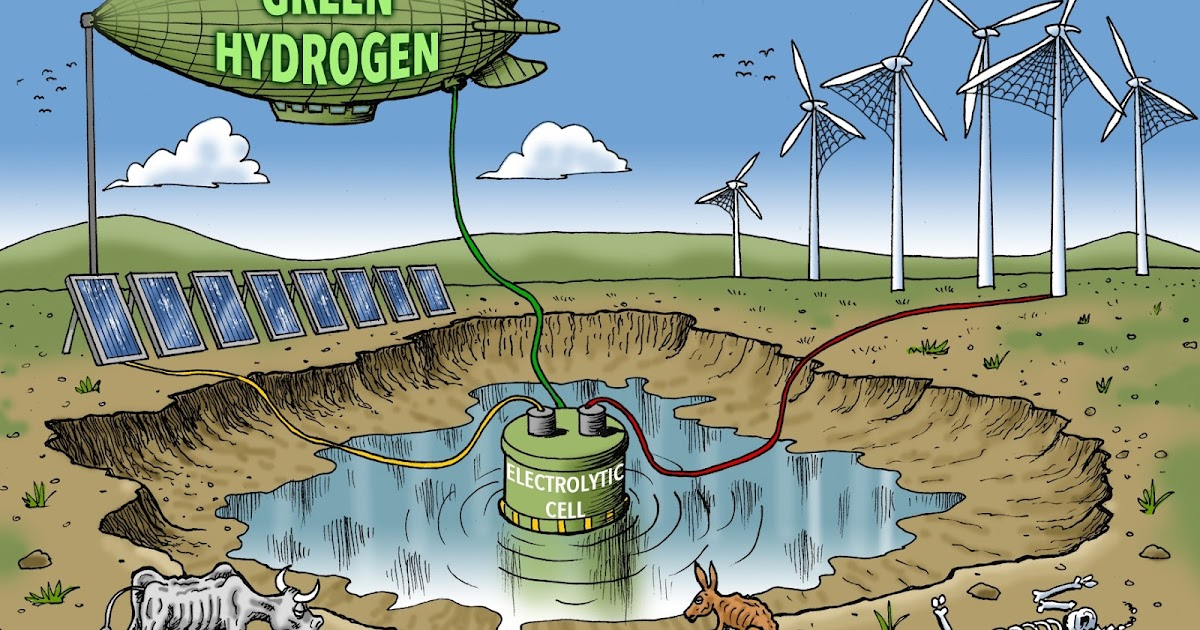
‘Hydrogen’ gets a lot of hype, but it is an elusive and dangerous gas that is rarely found naturally. To use solar energy to generate hydrogen and to then use that hydrogen as a power source is just another silly scheme to waste water and solar energy. It always takes more energy to produce hydrogen than it gives back. Let green billionaires, not taxpayers, spend their money on this merry-go-round.

Who is counting the energy and capital consumed, and the emissions generated, to manufacture, transport, and install a continent being covered by ugly solar panels, bird slicers, high voltage power lines, access roads, and hydro schemes? Now they want to invade our shallow seas. Who is going to clean up this mess in a few years’ time?

As Jo Nova says:

‘No one wants industrial plants in their backyard, but when we have to build 10,000 km of high voltage towers, 40 million solar panels, and 2,500 bird-killing turbines – it’s in everyone’s backyard.’

With all of this planned and managed by the same people who gave us Pink Batts, Snowy 2 hydro, and the NBN/NDIS fiascoes, what could possibly go wrong?

Another big problem is emerging – country people don’t want power lines across their paddocks, whining wind turbines on their hills, and glittering solar panels smothering their flats. And seaside dwellers don’t want to hear or see wind turbines off their beaches. Even whales are confused.

The solution is obvious – build all wind and solar facilities in electorates that vote Green, Teal, and Labor. Those good citizens can then listen to the turbines turning in the night breezes and look out their windows to see shiny solar panels on every roof. This will make them feel good that they are preventing man-made global warming. Those electorates who oppose this silly green agenda should get their electricity from local coal, gas or nuclear plants.

What about the Net Zero targets?

At the same time as Australia struggles to generate enough reliable power for today, governments keep welcoming more migrants, more tourists, more foreign students and planning yet more stadiums, games, and circuses. None of this is compatible with their demand for Net Zero emissions.

Unlike Europe, the Americas, and Asia, Australia has no extension cords to neighbours with reliable power from nuclear, hydro, coal, or gas – we are on our own.

Australia has abundant resources of coal and uranium – we mine and export these energy minerals but Mr Bowen, our Minister for Blackouts, says we may not use our own coal and uranium to generate future electricity here. Someone needs to tell him that no country in the world relies solely on wind, solar, and pumped hydro. Germany tried but soon found they needed French nuclear, Scandinavian hydro, imported gas, and at least 20 coal-fired German power plants are being resurrected or extended past their closing dates to ensure Germans have enough energy to get through the winter.

Australia is the only G20 country in which nuclear power is illegal (maybe no one has told green regulators that we have had a nuclear reactor at Lucas Heights in Sydney since 1958). Australia is prepared to lock navy personnel beside nuclear power plants in our new nuclear-powered submarines but our politicians forbid nuclear power stations in our wide open countryside.

More CO2 in the atmosphere brings great benefits to life on Earth. If man adds to it, the oceans dissolve a swag of it, and what stays in the atmosphere is gratefully welcomed by all plant life.

In 2023, Australia added just 0.025 ppm to the 420 ppm in today’s atmosphere. Most of this probably dissolved in the oceans. If we in Australia turned everything off tomorrow, the climate wouldn’t notice, but our plant life would, especially those growing near power stations burning coal or gas and spreading plant food.

Climate has always changed and a warm climate has never been a problem
on Earth.  It is cold that kills. Especially during blackouts.

Google Damage Control Over AI Driven 48% CO2 Emissions Surge

Are all the Silicon Valley hippies jumping on board the AI greed train, selling out their alleged green principles for big pay checks, trying to avoid each other’s eyes? Are they hiding their MAGA hats at the bottom of their rucksacks? Or are there intense Soviet style denunciations of the management climate wreckers during lunch breaks, before everyone goes back to work on coding the next energy gulping AI upgrade?

From Watts Up With That?

Essay by Eric Worrall

“We know this is not going to be easy and that our approach will need to continue to evolve”.

Google falling short of important climate target, cites electricity needs of AI

Google, which has an ambitious plan to address climate change with cleaner operations, came nowhere close to its goals last year, according to the company’s annual Environmental Report Tuesday

By ALEXA ST. JOHN Associated Press
July 3, 2024, 2:01 AM

Three years ago, Google set an ambitious plan to address climate change by going “net zero,” meaning it would release no more climate-changing gases into the air than it removes, by 2030.

But a report from the company Tuesday shows it is nowhere near meeting that goal. 

Rather than declining, its emissions grew 13% in 2023 over the year before. Compared to its baseline year of 2019, emissions have soared 48%. 

Google cited artificial intelligence and the demand it puts on data centers, which require massive amounts of electricity, for last year’s growth.

…

Google Chief Sustainability Officer Kate Brandt told The Associated Press, “Reaching this net zero goal by 2030, this is an extremely ambitious goal. 

“We know this is not going to be easy and that our approach will need to continue to evolve,” Brandt added, “and it will require us to navigate a lot of uncertainty, including this uncertainty around the future of AI’s environmental impacts.”

…Read more: 

https://abcnews.go.com/Business/wireStory/google-falling-short-important-climate-target-cites-electricity-111614506

What can I say – yet more evidence the AI revolution has broken Silicon Valley’s commitment to Net Zero.

I’d love to know how this AI at any cost push is playing with the Silicon Valley hippies, because it is not just Google – Microsoft and other tech giants are also pedal to the metal when it comes to the AI revolution.

The Connecticut Nuclear Data Center Controversy Exposes Tech Giant Renewable Hypocrisy – Watts Up With That?

Are all the Silicon Valley hippies jumping on board the AI greed train, selling out their alleged green principles for big pay checks, trying to avoid each other’s eyes? Are they hiding their MAGA hats at the bottom of their rucksacks? Or are there intense Soviet style denunciations of the management climate wreckers during lunch breaks, before everyone goes back to work on coding the next energy gulping AI upgrade?

I guess life would be too perfect, if we had answers to all of our questions.

Europe’s Green Energy Plans Stall As Leading Companies Reduce Expansion Plans

Green energies in turmoil…projects being postponed, scaled back…

Europe’s largest green energy producer drastically reduces expansion plans for wind and solar energy

From NoTricksZone

By P Gosselin

Green energies in turmoil…projects being postponed, scaled back…

Europe’s largest green energy producer drastically reduces expansion plans for wind and solar energy

Europe’s green energy projects are in the doldrums. Photo: P. Gosselin

Europe’s leading green energy producer, Statkraft, is drastically scaling back its plans for new wind and solar power plants – due to falling electricity prices and rising costs, so reports Germany’s online Blackout News, a leading site for independent German energy news.

According to company CEO, Birgitte Vartdal, market conditions have become more difficult as the company’s ambitious targets for wind energy and solar power are now being called into question.

The new Statkraft target is two to two and a half GW instead of an originally planned 4 gigawatts annually.

“In the offshore wind energy sector, the Group is now planning a total output of six to eight GW. The original target was ten GW,” Blackout News adds.

The scaleback follows other Europeans countries’ plans to reduce expansion, including Danish energy company Orsted, which “has lowered its targets by more than ten GW” and has also “canceled two offshore wind projects in the USA and reported impairments amounting to 28.4 billion Danish kroner (approx. 3.8 billion euros).”

Portugal’s largest energy supplier, Energias de Portugal (EDP), has also reduced its investment plans – due to the “deterioration in market conditions.” Moreover, French energy supplier Engie earlier had postponed developing hydrogen projects.

Leading officials blame projects having become “much more challenging” and offering “no relative returns.”

As a result, solar and wind equipment manufacturers have seen their values plummeting and ESG equity funds have “recently suffered outflows of 38 billion dollars,” reports Blackout News.

Blackout News is operated by an independent and non-partisan small group of engineers with experience in energy management.

If they cared about humanity, the Left wouldn’t ban fossil fuels

Poorer nations need the same products enjoyed in wealthy countries that are based on fossil fuels to begin flourishing, concurrent with developed nations that only wish to live only on electricity from renewables!

Almost half the world — over three billion people — live on less than $2.50 a day, and billions live with little to no access to electricity, like those living in places like Africa, Brazil, China, India, Indonesia, and Malaysia, is complicated by the hypocritical “green” agendas of leaders in the few wealthier developed economies that have benefited from the more than 6,000 products made from fossil fuels since the beginning of the industrial era.

From CFACT

By Ronald Stein, Vijay Raj Jayaraj

Poorer nations need the same products enjoyed in wealthy countries that are based on fossil fuels to begin flourishing, concurrent with developed nations that only wish to live only on electricity from renewables!

Almost half the world — over three billion people — live on less than $2.50 a day, and billions live with little to no access to electricity, like those living in places like Africa, Brazil, China, India, Indonesia, and Malaysia, is complicated by the hypocritical “green” agendas of leaders in the few wealthier developed economies that have benefited from the more than 6,000 products made from fossil fuels since the beginning of the industrial era.

Wealthy countries desiring to pursue their net-zero emissions goals wish to rid themselves of fossil fuel usage and the products and fuels that made them Developed Nations, while poor countries need those “products” to elevate themselves from their underdeveloped status to become flourishing economies, not just for the growth of national GDP but also for the socio-economic improvement of individual families.

The vast difference in the lifestyle of some of these families will make many of us wonder if we are in a time travel machine. Hospitals without electricity, homes without refrigerators, families without a car or a motorbike, and millions with uncertainty about the next morsel of food on their plates!

The future prosperity for these people, and about 80 percent of humanity, is contingent on their economic advancement through the rightful access to harness the foundational elements of any flourishing economy, i.e., the strategic use of fossil fuels to enjoy the products and fuels that are the basis of all the infrastructures such as:

  • Transportation
  • Water filtration
  • Sanitation
  • Hospitals
  • Medical equipment
  • Appliances
  • Electronics
  • Telecommunications
  • Communications systems
  • Heating and ventilating

Wealthy countries wishing to rid the world of crude oil, coal, and natural gas without replacements in mind would be immoral and evil, as extreme shortages of the petroleum products manufactured from fossil fuels will result in billions of fatalities from diseases, malnutrition, and weather-related deaths in both the developed and the under-developed economies.

Shortages of fossil fuel products would necessitate mandating the lifestyles of those in the wealthier countries, which would bring them back to the horse and buggy days of the pre-fossil fuel 1800s and could be the greatest threat to most of the planet’s eight billion residents.

The few wealthy countries pursuing the generation of electricity from wind turbines and solar panels while simultaneously moving to rid the world of fossil fuels have short memories of petrochemical products and human ingenuity being the reasons for the world populating from 1 to 8 billion in less than two hundred years.

The world’s population explosion was not just based on the discovery of oil alone. We have learned that crude oil is useless unless it can be manufactured into something usable. The 8 billion now on this planet are dependent on the oil derivatives and fuels that are manufactured from crude oil.

Today, through human ingenuity, we have more than 6,000 products currently benefiting society and transportation fuels for the 50,000 jets moving people and products, and transportation fuels for more than 50,000 merchant ships for global trade flows, and the fuels for the militaries and space programs, as well as the fuel for the President’s 400-ton Air Force One airplane.

As the world’s population depletes the earth’s crude oil reserves over the next few centuries or so, the grandchildren in wealthier developed countries will be unable to enjoy the more than 6,000 products of our materialistic society being enjoyed by the current residents of those developed nations on this planet. Those in poorer nations have yet to enjoy the lifestyles of those fortunate to live in the wealthier nations, all made possible with the products made from fossil fuels.

It cannot be overemphasized that implementing Net Zero emission policies would eliminate products derived from petroleum, which are the foundation of today’s lifestyles and economies. Disruption to nitrogen fertilizers and pesticides alone will result in about half the world’s population not having enough food to eat.

Life without oil is NOT AS SIMPLE AS YOU MAY THINK, as renewable energy is only intermittent electricity from breezes and sunshine, and neither wind turbines nor solar panels can manufacture anything for society.

The climate will continue to be a challenge, as it has for billions of years, but now, we have 8 billion on this planet that we didn’t have a few centuries ago, and we need to maintain healthy and productive lives in the decades ahead, currently being enjoyed by the few in the modern world. Depriving developing nations of the products and fuels manufactured from fossil fuels could be a much greater threat to mankind than any climatic challenges facing humanity.

This article originally  appeared at America Out Loud

Independence Day: Driving, Grilling, Fireworks

The July Fourth week will be energetic coming and going. The celebration is another reminder that modern life revolves activities that naturally emit the “gas of life”—carbon dioxide.

Peak demand? No, just the opposite. Record driving, flying, and cruising; Record grilling; Record fireworks.

From Master Resource

By Robert Bradley Jr.

The July Fourth week will be energetic coming and going. The celebration is another reminder that modern life revolves activities that naturally emit the “gas of life”—carbon dioxide.

Peak demand? No, just the opposite. Record driving, flying, and cruising; Record grilling; Record fireworks.

Driving

“Nearly 71 Million People Expected to Travel over July 4th Week,” the American Automobile Association predicts. “This year’s extended Independence Day forecast exceeds pre-pandemic numbers, sets new record.” Here is the full story:

AAA projects a record 60.6 million people will travel by car over Independence Day week – that’s an additional 2.8 million travelers compared to last year. This year’s number also surpasses 2019 when 55.3 million people traveled by car over July 4th week….

Affordability? Still strong despite Biden’s best efforts to reduce oil supplies.

Gas prices are lower than last year when the national average was $3.53. Pump prices will likely continue going down leading up to Independence Day.  At that point, they will likely level off and remain relatively stable until after Labor Day, similar to last year. An important caveat is hurricane season – underway now – which could affect gas prices should a storm negatively impact Gulf Coast oil production and refining centers.

Flying

AAA also commented on other modes of transportation.

The number of air travelers is also expected to set a new record. AAA projects 5.74 million people will fly to their July 4th destinations. That’s an increase of nearly 7% compared to last year and a 12% increase over 2019. AAA booking data shows domestic airfare is 2% cheaper this Independence Day week compared to last year, and the average price for a domestic roundtrip ticket is $800.

Other Transportation

“More than 4.6 million people are expected to travel by other modes of transportation, including buses, cruises, and trains,” AAA notes. “This category is seeing an increase of 9% compared to last year, but this year’s number is shy of 2019’s figure of 4.79 million.”

The newest luxury transportation is by ship. AAA reports:

Cruising continues its remarkable post-pandemic comeback. This time of year, Alaska cruises are in high demand, making Seattle and Anchorage top domestic destinations. Cruise travelers are also finding deals this summer. With new ships coming onto the market – and going for a premium – some cruise lines have been offering targeted discounts to fill older inventory for remaining cabins.

Grilling

Grilling has seen significant growth in the United States in recent years,” AI summarizes, “with the outdoor cooking industry’s revenue growing to $6.1 billion in 2021, a 14% increase from the previous year.”

According to the Hearth, Patio & Barbecue Association (HPBA), 80% of U.S. homeowners owned a grill or smoker in 2023, up from 64% in 2019. NPD reports that U.S. consumers purchased more than 21 million grills and smokers between July 2020 and 2022, with 27% of new grill owners citing cooking more at home during COVID as the reason for their purchase.

The North American barbecue grill market is projected to reach $3.2 billion by 2028, with a compound annual growth rate (CAGR) of 6.7% from 2022 to 2028. Market trends for electric products are expected to grow at a 5.3% annual rate between 2023 and 2032, driven by the growing interest in home cooking as a hobby or leisure activity.

Fireworks

It’s boomtime with fireworks, with July Fourth being the “big day.” The American Pyrotechnics Association reports:

We expect a banner year for fireworks sales. Despite inflationary pressures, ocean shipping rates have declined since the height of the supply chain crisis during COVID-19, making consumer fireworks more affordable this year by 5-10%.

“Our member companies are reporting strong consumer fireworks sales numbers, and we predict revenues could exceed $2.4 billion for the 2024 fireworks season,” said Julie L. Heckman, Executive Director of the APA.

Forth of July fireworks at Long Beach, California.; Shutterstock ID 112578440

Shell to pause Dutch biofuels project as market sags

There is no viable commercial market for biofuels. It only survives because of government subsidies and diktat.

From NOT A LOT OF PEOPLE KNOW THAT

By Paul Homewood

There is no viable commercial market for biofuels. It only survives because of government subsidies and diktat.

LONDON (Reuters) -Shell will pause construction work at one of Europe’s largest biofuel plants due to weak market conditions, the latest low-carbon project to suffer a setback as CEO Wael Sawan is striving to boost returns.

It is rare for companies to suspend development of projects underway. Rival BP last week said it is pausing two biofuel projects in Germany and the United States.

Under Sawan, who took office in January 2023, Shell has scrapped and sold renewable and hydrogen projects, retreated from European and Chinese power markets and sold refineries in order to focus on the most profitable operations, primarily in oil and gas.

Shell shares have gained over 11% so far this year.

Shell gave the greenlight for the development of the 820,000-ton-a-year plant in the Netherlands in September 2021 which was originally planned to start production in 2025. The project is now expected to go online towards the end of the decade.

The facility at its chemicals park in Rotterdam was slated to produce sustainable aviation fuel and renewable diesel made from waste.

Shell said in a statement that following the decision to pause construction, “contractor numbers will reduce on site and activity will slow down, helping to control costs and optimise project sequencing.”

UBS analyst Joshua Stone said that the pause was consistent with Shell’s strategy to focus on returns

“The delays further highlight that the advanced biofuels market is not an easy one. The oil majors have dipped their toes and found it challenging,” Stone said.

Shell will also consider an impairment for the project and will provide further details in its quarterly trading update on Friday, it said.

“Temporarily pausing on-site construction now will allow us to assess the most commercial way forward for the project,” Shell’s downstream head Huibert Vigeveno said in a statement.

https://www.msn.com/en-gb/money/other/shell-to-pause-dutch-biofuels-project-as-market-sags/ar-BB1pg5xh