The Climate Creed: How Fear Replaced Science

For decades, politicians and pundits have told us that โ€œthe science is settled.โ€ Those four words have become a shield for power and a sword against dissent. But real science thrives on inquiry and investigation; not the suppression of it. What has emerged instead is not science at all, but a kind of secular faith โ€” one that demands belief in man-made CO2-induced climate catastrophe and punishes heresy. Yet, many scientists, including scientists that have worked within the climate bureaucracy, know how fragile the claim that โ€œclimate change is caused by CO2โ€ really is.

A cloaked figure holding a staff stands in a dimly lit space, facing a group of hooded individuals who are seated or standing in reverence.

From American Thinker

Byย Mark Keenan

For decades, politicians and pundits have told us that โ€œthe science is settled.โ€ Those four words have become a shield for power and a sword against dissent. But real science thrives on inquiry and investigation; not the suppression of it. What has emerged instead is not science at all, but a kind of secular faith โ€” one that demands belief in man-made CO2-induced climate catastrophe and punishes heresy. Yet, many scientists, including scientists that have worked within the climate bureaucracy, know how fragile the claim that โ€œclimate change is caused by CO2โ€ really is.

As a former scientist with the UK Department of Energy and Climate Change and later a technical expert for United Nations Environment, I saw firsthand how the modern climate narrative was shaped โ€” not by evidence, but by politics. Uncertainty wasnโ€™t treated as a question to investigate; it was treated as a threat to suppress. Entire careers and institutions came to depend on preserving a preordained conclusion: that carbon dioxide, the same gas that feeds plant life, is destroying the planet.

What began as environmental concern has hardened into climate orthodoxy โ€” a moral creed enforced by bureaucrats, bankers, and media alike. It is a belief system that demands faith rather than understanding, obedience rather than inquiry. None of this means the climate isnโ€™t changing. It means that the conversation about why and how has been systematically narrowed โ€” not by discovery, but by decree.

The Rise of Climate Bureaucracy

By the 1990s, climate science had morphed from an academic discipline into a vast global bureaucracy. The Intergovernmental Panel on Climate Change (IPCC), founded in 1988, became the central authority โ€” linking governments, corporations, and NGOs under a single mission: to define and manage โ€œthe problem.โ€

But the IPCCโ€™s reports were never neutral. The โ€œSummary for Policymakersโ€ โ€” the only section most journalists ever read โ€” was often written before the science was finalized. Conclusions drove the evidence, not the other way around. Scientists who emphasized natural climate drivers such as solar cycles or ocean oscillations were quietly pushed aside. The institution that once claimed to study the climate became invested in proving a single narrative.

The Other Consensus

While the UN promotes its โ€œconsensus,โ€ thousands of scientists disagree. In 2019, more than 2,000 experts signed the Climate Intelligence (CLINTEL) Declaration, stating bluntly:

โ€œThere is no [COโ‚‚-induced] climate emergency. The geological record shows Earthโ€™s climate has always varied naturally.โ€

CO2 is not pollution โ€” it is plant food, essential for life and photosynthesis. Yet the UNโ€™s focus on carbon rather than true pollutants such as heavy metals or industrial toxins has diverted environmentalism from its original mission into politics.

I witnessed this distortion firsthand while working within the UN system. My role involved servicing the Pollution Release and Transfer Register Protocol โ€” a multinational agreement that monitors pollutants to air, land, and water. Real pollution exists, and itโ€™s severe. But CO2 is not the problem. Confusing the two has served political and financial ends, not ecological ones.

When Science Becomes Statecraft

The line between scientific advice and political advocacy blurred long ago. Governments needed crisis to justify regulation and taxation. NGOs needed fear to justify funding. And so โ€œconsensus scienceโ€ โ€” a contradiction in terms โ€” entered the lexicon and became the new norm.

Real science advances through dissent and enquiry; consensus is a political construct. But once the term took hold, it became a weapon. Questioning it marked one as a heretic. The language of faith โ€” belief, denial, salvation โ€” replaced the language of analysis. What began as environmental concern hardened into a kind of secular theology: the carbon creed.

Complexity was the enemy. Climate models that showed alarming forecasts were amplified, while those showing uncertainty were ignored. What followed was the moralization of data. The language of faith replaced the language of evidence: belief, denial, salvation, catastrophe. Dissenters werenโ€™t debated โ€” they were denounced. What began as environmental concern hardened into an ideology โ€” one that rewards fear over reason.

Scientists Who Broke Ranks

Many respected scientists have spoken out. Professor John R. Christy, Director of Atmospheric and Earth Sciences, University of Alabama, stated: โ€œThe established global warming theory significantly misrepresents the impact of extra greenhouse gases.โ€ MITโ€™s Richard Lindzen observed, โ€œIn Earthโ€™s long history, thereโ€™s been almost no correlation between climate and COโ‚‚.โ€ Dr. Nils-Axel Mรถrner, once with the IPCC, called the carbon narrative โ€œa wonderful way to control taxation and people.โ€ Greenpeace co-founder Patrick Moore declared the crisis โ€œfake scienceโ€ hijacked by ideology.

Such voices are rarely heard in mainstream media, not because their credentials lack merit, but because they challenge the most politically valuable story of the century.

The Money Behind the Mandate

Follow the money, and the picture becomes clearer. The financialization of carbon โ€” through emissions trading, carbon credits, and โ€œgreen investmentโ€ funds โ€” transformed moral urgency into a trillion-dollar industry.

Governments pour billions into renewable subsidies, enriching banks and corporations far more than benefiting the planet. If the climate crisis were truly existential, would its management really be entrusted to those who profit from it?

In my book Climate COโ‚‚ Hoax โ€“ How Bankers Hijacked the Environmental Movement, I detail how the 1992 UN Earth Summit in Rio marked the turning point โ€” when financial elites effectively captured global environmental policy. Reports and whistleblower accounts later suggested that key policies adopted at the summit were drafted without open debate โ€” policies that subordinated national sovereignty to global โ€˜sustainabilityโ€™ goals.โ€

Net Zero: The Mirage of Green Energy

The worldโ€™s economies are being restructured around โ€œnet zero,โ€ but the irony is glaring. Building the infrastructure for so-called โ€œgreen energyโ€ โ€” from solar panels to EV batteries โ€” requires massive fossil-fuel use and destructive rare-earth mining.

Electric cars rely on lithium and cobalt extracted through environmentally devastating processes. The energy required to mine and refine these materials often exceeds what the vehicles save over their lifetimes.

In Germany, the green energy transition has turned a once-stable, low-cost energy grid into one of the most expensive in the industrial world. In Ireland, plans to close the coal-fired Moneypoint power station were reversed in 2022 as the government quietly converted it to burn oil instead โ€” an unspoken admission that โ€œrenewablesโ€ canโ€™t power modern economies.

Silencing Dissent

In this new orthodoxy, questioning the narrative is treated as blasphemy. Scientists who deviate from the CO2 script face censorship, ostracism, and blacklisting. The term โ€œdenierโ€ โ€” borrowed from the lexicon of moral condemnation โ€” equates disagreement with depravity, and scepticism with sin

Dr. Roger Pielke Jr. of the University of Colorado revealed how the IPCC relies on the RCP 8.5 model โ€” one he described as โ€œfantasy land,โ€ completely detached from real-world data. Yet it remains the foundation of global policy and countless policy papers and media headlines.

When truth becomes heresy, science itself collapses.

The Moralization of Carbon

CO2 has been transformed from a molecule into a moral symbol โ€” the embodiment of human guilt. Citizens are told to measure their โ€œcarbon footprintโ€ as if it were a sin ledger, redeemable only through โ€œgreenโ€ consumption. Yet many of these same products โ€” from electric cars to solar infrastructure โ€” depend on the same industrial extraction that environmentalism once opposed.

This framing serves a purpose. Instead of questioning the powerful institutions that profit from pollution and its supposed cure, individuals are encouraged to internalize blame. The message: You are the problem โ€” not the system. Itโ€™s an old strategy of control โ€” rule through guilt rather than force.

The Politics of Fear

No ideology survives without fear. Apocalyptic imagery โ€” burning forests, flooded cities, โ€œticking clocksโ€ โ€” has replaced empirical evidence as the main instrument of persuasion. Yet forest fires and floods are as old as the Earth itself.

Children now grow up believing the planet will collapse before they reach adulthood. Politicians invoke โ€œexistential threatโ€ rhetoric to justify sweeping economic and social controls. What was once a challenge to power has become a tool of it.

The New Creed

Modern climate orthodoxy is not science but ideology โ€” a sociopolitical construct โ€” a fusion of fear, money, and power that rewards conformity and punishes doubt. Science must never serve politics. When data becomes dogma, truth dies โ€” and with it, freedom. If we truly wish to โ€œsave the planet,โ€ we must first save science itself.

Mark Keenan is a former scientist at the UK Department of Energy and Climate Change and a former Environmental Affairs Officer with United Nations Environment. He is the author of Climate CO2 Hoax: How Bankers Hijacked the Environment Movement

Book cover of 'Climate CO2 Hoax: How Bankers Hijacked the Environment Movement' by Mark-Gerad Keenan, featuring green grass and a misty backdrop.

Devastating Official US Report Lays Bare The Abuses of โ€˜Settledโ€™ Climate Science And Its Role in Net Zero

Net Zero is dead in the United States and the last rites have been administered in the devastating official report from the Department of Energy. Released earlier this week, the report cancels the decades-long censorship imposed by so-called โ€˜settledโ€™ climate science.

A dramatic scene depicting a mythical figure representing climate change, holding a burning globe, while scientists in lab coats kneel in a gesture of reverence or prayer amidst a backdrop of industrial pollution.

From The Daily Sceptic

Byย Chris Morrison

A weathered and cracked road sign depicting the phrase 'NET ZERO' against a dark, cloudy sky, symbolizing the decline of the Net Zero initiative.

Net Zero is dead in the United States and the last rites have been administered in the devastating official report from the Department of Energy. Released earlier this week, the report cancels the decades-long censorship imposed by so-called โ€˜settledโ€™ climate science. It is compiled by five eminent scientists and is a systematic take-down of the claims, methodologies and motivations driving activist scientists, politicians and opinion formers promoting the hard-Left Net Zero fantasy. Despite its ground-breaking importance, to date it has been largely ignored by mainstream media including the BBC and Guardian.

Computer models are said to offer โ€œlittle guidanceโ€ on how much of the climate responds to higher levels of carbon dioxide, most extreme weather events are not increasing, sea levels in North America show no increasing trend while weather attribution claims are challenged by natural climate variation along with an admission that they were originally designed with โ€˜lawfareโ€™ in mind. For Anthony Watts, who has spent decades challenging the โ€˜settledโ€™ politicised science, the most important consideration is that the report, โ€œdirectly confronts the exaggerated and politicised rhetoric that has dominated headlines for decadesโ€.

Watts, who runs the Watts Up With That? (WUWT?) site that was responsible for publicising the infamous Climategate scandal, argues that the new report is unique in that it has both official status and author independence. It is not a think tank paper or an article in a โ€˜dissentingโ€™ journal. โ€œItโ€™s rare to see scientists of this calibre (with backgrounds at NASA, IPCC and major universities) allowed to directly challenge prevailing policy narratives with government resources behind themโ€, he notes. The work is a โ€œcomprehensive critiqueโ€ quoting extensively from peer-reviewed literature with clear explanations of scientific uncertainties and climate model error. 

For regular readers of WUWT? and other inquiring publications such as the Daily Sceptic, many of the issues discussed in the report will be familiar. In the last four years, your correspondent has written nearly 500 articles on climate science and Net Zero in an attempt to fill in the significant reporting gaps left by the narrative-driven mainstream media. Many of the papers quoted are familiar, not least in the section that deals with the sensational โ€˜greeningโ€™ of the planet caused by higher levels of CO2. 

The report quotes from recent work that shows extensive plant and crop growth due to the atmospheric fertilisation that has enhanced photosynthesis and improved water use efficiency. Over the past 60+ years, the authors observe that there have been thousands of studies on the response of plants to rising CO2 levels, and the overwhelming theme is that they benefit from the extra gas. In 2016, Zhu et al detected greening over 25%โ€“50% of the planet. But there is a near official news blackout on the subject. A few mentions can be found in the Intergovernmental Panel on Climate Change (IPCC) reports but overall, observe the authors, โ€œthe Policymakers Summaries, Technical Summaries and [IPCC] Synthesis reports of AR5 and ASR6 do not discuss the topicโ€.

Needless to say there are few kind words for the climate projections based on the notorious IPCC emission scenario known as RCP8.5. Most academic climate impact studies in recent years are based on this extreme scenario, โ€œthat is now considered implausibleโ€. Why is this castigation important โ€“ because RCP8.5 litters the scientific clickbait literature and has a key role in promoting the Net Zero plan. Most stories in mainstream media debunked in recent years by the Daily Sceptic and others โ€“ from the future collapsing Gulf Stream to the disappearing coral โ€“ are based on this trash โ€œbusiness-as-usualโ€ computer model pathway.

Climate models are noted to be the primary tool used to project future climate changes in response to higher levels of anthropogenic greenhouse gases. It might be added that their outputs are the basis of 40 years of fear mongering designed to drive Net Zero and the destruction of the hydrocarbon industrial economy. โ€œOf great concernโ€, continue the authors, โ€œis the fact that after several decades of the climate modelling enterprise involving approximately three dozen models operated by research centres around the world, the range of future warming they produce in response to a hypothetical doubling of CO2 extends over a factor of threeโ€. This range of disagreement among models has not decreased for decades, they add.

Those inclined to use less charitable language might comment that climate models are useless for the purpose of providing genuine science upon which reasonable public policy can be determined โ€“ and always have been.

Much of the recent climate fear mongering surrounds โ€˜extremeโ€™ weather events and the suggestion that something Nature has always thrown at life on Earth can now be directly attributed to the actions of humans. The most prominent in this field is the Green Blob-funded World Weather Attribution (WWA) run out of Imperial College in London and headed byย BBC favourite, Dr Friederike Otto. โ€œWWAโ€™s extensive promotion of non-peer-reviewed findings, its open admission to shaping analyses to serve litigation, and its methodological challenges have sparked controversyโ€, it is noted. The biggest problem (apart from using computer models) is the lack of past data on extreme weather events. A few years of data allied to an unproven conviction that all current warming is caused by humans, cannot provide guidance for events that crop up as outliers. If paleoclimate reconstruction is considered, โ€œit becomes very difficult for an event to pass thresholds of what is expected from natural variabilityโ€, it is concluded.ย 

US Department of Energy: A Critical Review of Impacts of Greenhouse Gas Emissions on the US Climate. Authors โ€“ John Christy Ph.D, Judith Curry Ph.D, Steven Koonin Ph.D, Ross McKitrick Ph.D, Roy Spencer Ph.D.

Chris Morrison is the Daily Sceptic Environment Editor. Follow him on X.

BOMBSHELL: Study Reveals Climate Warming Driven by Receding Cloud Cover

The recent paper by Tselioudis et al., titled โ€œContraction of the Worldโ€™s Storm-Cloud Zones the Primary Contributor to the 21st Century Increase in the Earthโ€™s Sunlight Absorptionโ€, is a fascinatingโ€”and deeply problematicโ€”addition to the climate science canon. It offers yet another reminder that so-called โ€œsettled scienceโ€ in climate modeling is anything but settled. In fact, it inadvertently illustrates how fragile the predictive power of climate models is, especially when fundamental atmospheric processes like cloud coverage are shown to be both more dynamic and less understood than previously claimed.

From Watts Up With That?

From Charles Rotter

The recent paper by Tselioudis et al., titled โ€œContraction of the Worldโ€™s Storm-Cloud Zones the Primary Contributor to the 21st Century Increase in the Earthโ€™s Sunlight Absorptionโ€, is a fascinatingโ€”and deeply problematicโ€”addition to the climate science canon. It offers yet another reminder that so-called โ€œsettled scienceโ€ in climate modeling is anything but settled. In fact, it inadvertently illustrates how fragile the predictive power of climate models is, especially when fundamental atmospheric processes like cloud coverage are shown to be both more dynamic and less understood than previously claimed.

Not that any of this is news to WUWT readers. Dr. Roy Spencer has been noting almost identical observations for over a decade as noted here,

Now letโ€™s look at the broader scientific community catching up to Dr. Spencer.

Abstract

Recent Earth energy budget observations show an increase in the sunlight absorbed by the Earth of 0.45 W/m2 per decade, caused primarily by a decrease in cloud reflection. Here we decompose the solar radiative budget trends into general circulation and cloud controlling process components. Regimes representing the midlatitude and tropical storm zones are defined, and the trends in the areal coverage of those regimes which are potentially induced by circulation changes are separated from trends in the cloud radiative effect within each regime which are potentially induced by changes in local cloud controlling processes. The regime area change component, which manifests itself as a contraction of the midlatitude and tropical storm regimes, constitutes the largest contribution to the solar absorption trend, causing decreased sunlight reflection of 0.37 W/m2 per decade. This result provides a crucial missing piece in the puzzle of the 21st century increase of the Earthโ€™s solar absorption.

Key Points

  • Satellite observations show that in the past 24ย years the worlds storm cloud zones have been contracting at a rate of 1.5%โ€“3% per decade
  • This contraction allows more solar radiation to reach the Earthโ€™s surface and constitutes the largest contribution to the observed 21st century trend of increased solar absorption

Plain Language Summary

Analysis of satellite observations shows that in the past 24 years the Earthโ€™s storm cloud zones in the tropics and the middle latitudes have been contracting at a rate of 1.5%โ€“3% per decade. This cloud contraction, along with cloud cover decreases at low latitudes, allows more solar radiation to reach the Earthโ€™s surface. When the contribution of all cloud changes is calculated, the storm cloud contraction is found to be the main contributor to the observed increase of the Earthโ€™s solar absorption during the 21st century.

To understand the full implications of this study, we need to parse its findings in plain terms. The paper concludes that the Earth has absorbed significantly more solar radiation over the past 24 yearsโ€”0.45 W/mยฒ per decade. The primary culprit? A reduction in cloud cover, specifically a contraction of the midlatitude and tropical storm-cloud zones. This change has resulted in less solar radiation being reflected back into space and more being absorbed by the Earthโ€™s surface. Crucially, 0.37 W/mยฒ of this uptick is attributed solely to this contraction in cloud coverage, a result of large-scale atmospheric circulation changes:

โ€œThis cloud contraction, along with cloud cover decreases at low latitudes, allows more solar radiation to reach the Earthโ€™s surface. When the contribution of all cloud changes is calculated, the storm cloud contraction is found to be the main contributor to the observed increase of the Earthโ€™s solar absorption during the 21st century.โ€

Letโ€™s pause there. Climate science has long emphasized the role of anthropogenic greenhouse gasesโ€”especially CO2โ€”in trapping outgoing longwave radiation, contributing to surface warming. Yet here we have empirical satellite observations showing that changes in shortwave radiation absorption, due to cloud dynamics, dominate recent trends in Earthโ€™s energy imbalance. That revelation alone should be enough to shake the very foundations of climate policy, which has funneled trillions into carbon control with scant attention paid to cloud feedback mechanisms.

More damning still is the admission that these changes are likely tied to โ€œgeneral circulation shifts,โ€ specifically poleward movements of storm tracks and contractions of the Intertropical Convergence Zone (ITCZ). These are phenomena long suspected in model projections but never given such a central, quantifiable role in the planetary energy budget. And hereโ€™s the kicker: these circulation shifts are said to have emerged gradually, to the tune of 1.3% to 3% per decade:

โ€œIn all three zones, the area coverage of the Lโ€TCC regime shows statistically significant decreases with extremes of 1.84 ยฑ 0.38% to 3.20 ยฑ 0.97% per decadeโ€ฆ indicating a contraction of the midlatitude storm regions and a narrowing of the ITCZ region.โ€

These arenโ€™t theoretical projectionsโ€”they are based on hard satellite data from the MODIS and CERES instruments. Models, by contrast, have only roughly hinted at these changes, and often fail to reproduce them with consistency.

The paper outlines that most of the shortwave cloud radiative effect (SWCRE) changeโ€”the key measure of how much solar energy is reflected by cloudsโ€”comes not from changes in cloud properties themselves, but from the shrinking geographic area of major cloud regimes:

โ€œIn all zones, the dominant trend is the SW cloud radiative warming that is coming from the contraction of the Sโ€SWCRE regimes and the corresponding expansion of the Wโ€SWCRE regimes.โ€

Thatโ€™s the kind of subtle, high-leverage feedback mechanism that models tend to get wrong or underrepresent entirely. And thatโ€™s a problem. Because if your model canโ€™t accurately simulate cloud regime shiftsโ€”which appear to contribute more than 80% of the increase in solar absorptionโ€”then your forecasts for future warming are at best incomplete, and at worst, wildly misleading.

Tselioudis et al. even admit this shortcoming, noting:

โ€œIt is imperative to test the skills of climate models in simulating the observed stormโ€cloud area contraction, and to use both modeling and observational analyses to understand the interactions between atmospheric dynamics shifts and storm cloud changes.โ€

Thatโ€™s bureaucratese for โ€œwe didnโ€™t see this coming, and weโ€™re not sure our models can catch up.โ€ Itโ€™s reminiscent of NASAโ€™s Gavin Schmidtโ€™s recent handwringing over 2023โ€™s โ€œunexplainableโ€ heat spike, suggesting that โ€œwe could be in uncharted territory.โ€ Now, we have the chart. And it doesnโ€™t point toward CO2 aloneโ€”it points to dynamic, cloud-driven changes that no carbon tax will stop.

What this paper also inadvertently confirms is the unreliability of using long-term climate models to dictate aggressive, disruptive policies like Net Zero. The models are missing key physical processesโ€”cloud behavior, aerosol effects, and large-scale atmospheric shifts. As the paper notes:

โ€œThe general circulation shift component constitutes the dominant term of the recent increase in absorbed solar radiation and provides a crucial missing piece in the puzzle of the 21st century radiative warming and the large heat anomaly of 2023.โ€

Yet these shifts are only just beginning to be understood, and their driving forcesโ€”whether natural variability, solar activity, ocean cycles, or some interaction thereofโ€”remain far from nailed down.

Worse still, the authors openly speculate that low-latitude cloud reductions could be driven by aerosol changesโ€”particularly the decline in ship emissions:

โ€œThis component shows a significant cloud radiative warming of 0.21 W/mยฒ/decade that can be attributed to aerosol indirect effects on clouds including effects from the reduction of aerosol ship emissions.โ€

Thatโ€™s right: the same well-meaning efforts to reduce pollution from ocean-going vessels may have accelerated warming by allowing more sunlight to hit the surface. Climate mitigation whack-a-mole strikes again.

In sum, Tselioudis et al.โ€™s paper is a quietly revolutionary workโ€”not because it introduces a new alarmist narrative, but because it destabilizes the prevailing one. It shows that:

  • Cloud feedbacks, especially those driven by circulation shifts, have enormous and previously underestimated impacts on Earthโ€™s radiative balance.
  • These changes are driven by complex, poorly understood dynamics that current climate models struggle to replicate.
  • Policy decisions predicated on โ€œsettled scienceโ€ have been made in the absence of understanding a major component of the Earthโ€™s energy system.

If climate science were a functioning scientific discipline rather than a priesthood, this paper would trigger a major course correction. It would cast doubt on the simplistic link between CO2 and warming, redirecting focus toward cloud physics, ocean-atmosphere interactions, and circulation dynamics. It would foster humility in the face of atmospheric complexityโ€”not arrogance born from model outputs.

But donโ€™t expect that anytime soon. Instead, expect the usual suspects to spin this as evidence of โ€œeven worse than we thoughtโ€ warming, conveniently omitting the part where their models didnโ€™t predict it and their policies had nothing to do with it.

In the meantime, this paper should serve as ammunition for any skeptic pointing out the absurdity of building trillion-dollar policies on the backs of incomplete and overconfident simulations. The cloud regimes are shifting. The models arenโ€™t keeping up. And neither is the narrative.

Settled Science Springs a Leak: Rivers Reveal the Carbon Cycleโ€™s Dirty Secret

Let that sink in. Climate models and carbon budgets, paraded as settled science by every bureaucrat, green politician, and eco-apocalyptic influencer on Earth, have been built on the foundational assumption that riverine CO2 is part of a contemporary, short-term biosphere loop. Turns out, theyโ€™ve been routing old ghosts through a new story.

From Watts Up With That?

By Charles Rotter

Abstract

Rivers and streams are an important pathway in the global carbon cycle, releasing carbon dioxide (CO2) and methane (CH4) from their water surfaces to the atmosphere1,2. Until now, CO2 and CH4 emitted from rivers were thought to be predominantly derived from recent (sub-decadal) biomass production and, thus, part of ecosystem respiration3,4,5,6. Here we combine new and published measurements to create a global database of the radiocarbon content of river dissolved inorganic carbon (DIC), CO2 and CH4. Isotopic mass balance of our database suggests that 59โ€‰ยฑโ€‰17% of global river CO2 emissions are derived from old carbon (millennial or older), the release of which is linked to river catchment lithology and biome. This previously unrecognized release of old, pre-industrial-aged carbon to the atmosphere from long-term soil, sediment and geologic carbon stores through lateral hydrological routing equates to 1.2โ€‰ยฑโ€‰0.3โ€‰Pgโ€‰Cโ€‰yearโˆ’1, similar in magnitude to terrestrial net ecosystem exchange. A consequence of this flux is a greater than expected net loss of carbon from aged organic matter stores on land. This requires a reassessment of the fate of anthropogenic carbon in terrestrial systems and in global carbon cycle budgets and models.

The recent Nature study titled โ€œOld carbon routed from land to the atmosphere by global river systemsโ€ is not only a rigorous piece of scientific workโ€”itโ€™s also a spectacular indictment of the so-called โ€œsettled scienceโ€ of climate change. This 2025 paper is a flaming arrow into the heart of carbon cycle certainty, unearthing yet another inconvenient truth: over half of the CO2 emitted from rivers comes from carbon sources that are hundreds to thousands of years oldโ€”not from recent fossil fuel emissions or current biological activity.

Let that sink in. Climate models and carbon budgets, paraded as settled science by every bureaucrat, green politician, and eco-apocalyptic influencer on Earth, have been built on the foundational assumption that riverine CO2 is part of a contemporary, short-term biosphere loop. Turns out, theyโ€™ve been routing old ghosts through a new story.

According to the authors:

โ€œThe largest proportion (52โ€‰ยฑโ€‰16%) of river CO2 emissions is sourced from millennial-aged carbonโ€ฆโ€ and โ€œ7โ€‰ยฑโ€‰1%โ€ฆfrom petrogenic carbonโ€ .

Thatโ€™s right. Over half of these emissions are from old carbon storesโ€”carbon that, until now, was presumed stable, buried, and irrelevant to modern emission tallies. In other words, nature has its own deeply entrenched carbon leaks, and our modern instruments are just now getting around to noticing them.

The implications are vast and devastatingโ€”to the credibility of those who have weaponized science to promote radical climate policy. Here are a few of the most laughable consequences of this study for the โ€œsettled scienceโ€ narrative:

1. The Carbon Budget Is a Fantasy

The entire idea of a โ€œcarbon budgetโ€ depends on the assumption that we can accurately track all natural and anthropogenic carbon sources and sinks. The paperโ€™s authors explicitly state:

โ€œThis previously unrecognized releaseโ€ฆequates to 1.2โ€‰ยฑโ€‰0.3 Pg C yrโปยน, similar in magnitude to terrestrial net ecosystem exchangeโ€.

Translation: We were missing a carbon leak as big as the net carbon uptake of all land-based ecosystems. Thatโ€™s like losing a financial ledger entry equivalent to your annual revenue and still claiming your books balance.

2. Climate Models Canโ€™t Model What They Didnโ€™t Know Existed

This isnโ€™t a rounding error. This is a previously invisible carbon flux at a planetary scaleโ€”entirely omitted from mainstream Earth system models. The authors even note:

โ€œCurrent numerical models of river carbon transport and emission also fail to account for inputs from old carbon sourcesโ€.

For those of us who have long argued that climate models are glorified curve-fitting exercises based on selectively tuned assumptions, this study is pure vindication. Itโ€™s an outright admission that the models are not merely imperfectโ€”theyโ€™re structurally blind to major natural processes.

3. Climate Science Is Still in Diapers

If 59% of riverine CO2 emissions come from millennial or older carbon pools, then just how settled can the science be? The authors describe this as a โ€œplanetary-scale releaseโ€ of old carbon and conclude:

โ€œWe provide evidence for a previously unrecognized, planetary-scale release of old, pre-industrial-aged carbon from land to the atmosphere through riversโ€.

Imagine building a trillion-dollar global policy framework on a dataset that left out half the equation. It would be funny if it werenโ€™t tragic.

4. Anthropogenic Carbon Attribution Is Now a Shell Game

One of the central talking points of climate activists is that CO2 in the atmosphere is traceable and largely caused by human emissions. This study kicks that stool out from under them. After adjusting the models to include this new understanding, the study finds that only:

โ€œ41โ€‰ยฑโ€‰16% of river CO2 emissionsโ€ฆcould contain recent anthropogenic-derived carbonโ€.

That means nearly 60% of river-based CO2 emissions are from carbon predating modern industrial activity. This calls into question the accuracy of anthropogenic attribution modelsโ€”models which governments use to justify taxes, regulations, and top-down restructurings of energy and agriculture.

5. So Much for Predicting the Future

The authors admit they donโ€™t know whether the increase in old carbon emissions is from natural variability or anthropogenic disturbance. In their own words:

โ€œWhether or not anthropogenic perturbation has increased the leak of old carbonโ€ฆremains a notable knowledge gapโ€.

Yet weโ€™re told with absolute certainty that the Earth will warm by 1.5ยฐC unless we ban gas stoves, eat bugs, and shut down reliable energy. This study exposes just how deeply uncertain and unresolved the feedbacks in the carbon cycle remain.

6. Rivers: Natureโ€™s Carbon Cheaters

The new conceptual model developed in this paper (see Fig. 3b on page 13) is a quiet revolution. It admits that the traditional model of river emissionsโ€”where CO2 was thought to be recent and localโ€”is deeply flawed. Instead, rivers act as carbon transport systems, redistributing ancient carbon from soils, rocks, and geologic layers into the atmosphere. Thatโ€™s not just a different magnitudeโ€”itโ€™s an entirely different mechanism.

Existing model in which river CO2 is only derived from young, rapid-cycling carbon (decadal-agedโ€‰=โ€‰green); lateral DIC export to the coast is considered a mixture of decadal and petrogenic inputs (grey). By accounting for these river carbon losses, it is estimated that 1.7โ€‰Pgโ€‰Cโ€‰yearโˆ’1 of anthropogenic carbon emitted to the atmosphere may be accumulating in the rapid-cycling terrestrial carbon pools3; anote that this estimate is based on a lower estimate of vertical river CO2 emissions of 1.51โ€‰Pgโ€‰Cโ€‰yearโˆ’1. b, revised conceptual model based on the assembled F14C values of river DIC, CO2 and CH4 presented here; millennial carbon inputs are needed from organic matter degradation in soils or river sediments (orange) as well as petrogenic carbon from rock weathering to explain the observed F14C values in our database. This revised conceptual model indicates a loss of carbon from an old (millennial) store on land through vertical river CO2 emissions; a first-order estimate of the impact on the partitioning of carbon in the biosphere and soils is provided (b).

7. Policy Has Left Science Behind

The studyโ€™s authors call for a reexamination of the terrestrial carbon sink and the role of rivers, noting:

โ€œThis fundamentally changes our inference of where anthropogenic carbon resides within the main Earth system carbon reservoirsโ€.

But donโ€™t expect the IPCC, Net Zero campaigners, or ESG investors to acknowledge this. Their policy steamrollers are already in motion, powered by inertia and political leverage rather than scientific humility.


This study is a torpedo below the waterline of climate orthodoxy. It makes it painfully clear that we donโ€™t understand the Earthโ€™s carbon system nearly well enough to justify radical economic and societal upheaval. The confidence of climate alarmistsโ€”built on the brittle scaffolding of incomplete data and overconfident modelsโ€”has once again been exposed for what it is: performative certainty.

To call climate science โ€œsettledโ€ in the wake of this paper is not just intellectually lazyโ€”itโ€™s laughable. Itโ€™s the scientific equivalent of declaring victory halfway through a chess match while ignoring that your queen is missing and half your pawns are spies. The river CO2 study is not a minor correction. Itโ€™s a flashing red light that weโ€™re still flying blind.

So, the next time someone tells you the science is settled, ask them if theyโ€™ve heard of FยนโดC. Then sit back and enjoy the silence.

Study: Marine life in oceans has a cooling effect on climate

Putting another nail in the coffin of the mantra that โ€œthe science is settled on climate change,โ€ researchers in Spain have found that global emissions of a sulfur gas produced by marine life have a hitherto unknown cooling effect on temperatures.

From CFACT

By Bonner Cohen, Ph. D

Putting another nail in the coffin of the mantra that โ€œthe science is settled on climate change,โ€ researchers in Spain have found that global emissions of a sulfur gas produced by marine life have a hitherto unknown cooling effect on temperatures.

It has long been known that oceans capture and redistribute the sunโ€™s heat.  But there is more to the story.  A study published Nov. 29 in the journal Science Advances noted that oceans, notably in the Southern Hemisphere, produce gases known as marine sulfur.  And one of these gases, methanethiol, influences the climate in a way that has gone unnoticed.

Microscopic plankton living on the surface of the oceans โ€œproduce sulfur in the form of a gas, dimethyl sulphide, that once in the atmosphere, oxidizes and forms small particles called aerosols,โ€ the University of East Anglia (UEA) said in a news release.

โ€œAerosols reflect part of the solar radiation back into space and therefore reduce the heat retained by the Earth,โ€ UEA explained.  โ€œTheir cooling effect is magnified when they become involved in making clouds, with an effect opposite to, but of the same magnitude as, that of the well-known warming greenhouse gases, such as carbon dioxide or methane.โ€

The study is โ€œMarine Emissions of Methanethiol Increase Aerosol Cooling in the Southern Ocean.โ€  It is, UEA noted, based on measurements of methanethiol the researchers gathered in seawater, added those they had made in the Southern Ocean and the Mediterranean coast, โ€œand statistically related them to seawater temperature, obtained from satellites.โ€

โ€œClimate models have greatly overstated the solar radiation actually reaching the Southern Ocean, largely because they are not capable of correctly simulating clouds,โ€ Charel Wohl, of UEAโ€™s Centre for Ocean and Atmospheric Science and one of the studyโ€™s lead authors, said.  โ€œThe work here largely closes the longstanding knowledge gap between models and observations.โ€  Wohl acknowledged that scientists knew that โ€œmethanethiol was coming out of the ocean, but we had no idea about how much and where.  We also did not know it had such an impact on climate.โ€  That effect is more visible in the Southern Hemisphere, UEA points out, where there is more ocean and less human activity.

โ€œUntil now we thought that the oceans emitted sulfur into the atmosphere only in the form of dimethyl sulphide, a residue of plankton that is largely responsible for the evocative smell of shellfish,โ€ said Dr. Marti Gali, one of the studyโ€™s authors.

UEA is no stranger when it comes to breaking climate news.  In November 2009, the university was embroiled in a scandal known as โ€œClimategate.โ€  UEAโ€™s Climate Research Unit (CRU) was the source of a trove of emails โ€œsuggesting,โ€ in the words of climatologist Patrick Michaels, โ€œsome of the worldโ€™s leading climate scientists engaged in professional misconduct, data manipulation and jiggering of both the scientific literature and climatic data to paint what scientist Keith Briffa called โ€˜a nice, tidy storyโ€™ of climate history.โ€  It was never determined whether the emails were leaked or hacked, but they showed climate scientists colluding to suppress scientific findings questioning the narrative of manmade global warming.  An investigation launched by UEA reached no definitive conclusions.  But, as Michaels noted, the British university received generous climate-research grant money that gave it a disincentive to investigate the matter too closely.

UEA is still in the business of spreading climate alarm.  While its press release on the Spanish study accurately summarizes its findings, it claims the study highlights โ€œthe magnitude of the impact of human activity on the climate and that the planet will continue to warm if no action is taken.โ€  Yet it is the action that UEA insists be taken that that has crippled economies in the United Kingdom, Germany and elsewhere in Europe, and has led to soaring energy costs and undermined the stability of the electric grid in California, New York, Illinois and other states, where climate-centric energy policies have been adopted.

At the same time, the acknowledgement that there still are gaps in our understanding of the myriad variables that lie behind fluctuations in the Earthโ€™s climate should give pause to those intent on imposing life-changing policies on the rest of us.  Policies based on a still-evolving understanding of the climate and adopted with little regard for their consequences for ordinary people are an open invitation to calamity.

This article originally appeared in The Daily Caller

Oops, Science Was โ€œSettledโ€โ€”Until It Wasnโ€™t: Plants Absorb 31% More COโ‚‚ Than We Thought

A new study reveals that plants have been absorbing 31% more COโ‚‚ than previously believed. Yes, 31%โ€”a glaring error that casts serious doubt on climate models, emissions scenarios, and policy prescriptions like Net Zero. For years, we were told that the โ€œscience was settled,โ€ and that urgent action was needed to avoid catastrophic warming. But this discovery suggests that our models have been dramatically underestimating natureโ€™s ability to manage COโ‚‚. This revelation not only upends the rationale behind aggressive policies but also raises broader questions about the supposed certainty of climate science.

Aerial top view forest tree, Rainforest ecosystem and healthy environment concept and background, Texture of green tree forest view from above.

From Watts Up With That?

A new study reveals that plants have been absorbing 31% more COโ‚‚ than previously believed. Yes, 31%โ€”a glaring error that casts serious doubt on climate models, emissions scenarios, and policy prescriptions like Net Zero. For years, we were told that the โ€œscience was settled,โ€ and that urgent action was needed to avoid catastrophic warming. But this discovery suggests that our models have been dramatically underestimating natureโ€™s ability to manage COโ‚‚. This revelation not only upends the rationale behind aggressive policies but also raises broader questions about the supposed certainty of climate science.

The Myth of โ€œSettled Scienceโ€

The phrase โ€œsettled scienceโ€ has been the bedrock of climate advocacy for decades. Weโ€™ve been told that if we donโ€™t make rapid, costly changes, weโ€™d face imminent disaster. Skeptics were treated as heretics, while the so-called consensus was portrayed as unquestionable. Yet, it turns out we were 31% wrong about something as fundamental as plant COโ‚‚ absorption. This isnโ€™t a minor correction; itโ€™s a massive revision that undermines the credibility of models driving policy.

The Unraveling of Climate Models

Climate models are the tools used to predict warming and guide policy. Theyโ€™ve been treated as scientific scripture, driving policies from emissions reductions to renewable energy mandates. But with a key assumption proven wrong, the modelsโ€™ projections are called into question:

  1. Overblown Emissions Impact:ย Climate models predicted rapid COโ‚‚ buildup, assuming limited natural absorption. This inflated the urgency of drastic emissions cuts. Correcting for higher COโ‚‚ absorption rates means that COโ‚‚ accumulates in the atmosphere slower than models predicted, weakening the case for urgent, economy-wrenching measures.
  2. Questionable Feedback Loops:ย Many models rely on dramatic feedback loopsโ€”such as reduced plant COโ‚‚ absorption at higher temperaturesโ€”to justify emergency interventions. But this new data shows plants can handle more COโ‚‚ than anticipated, making these feedback loops look less inevitable and more speculative.
  3. Policy Implications:ย If the models guiding climate policy have been this far off, then the entire framework behind policies like Net Zero becomes shaky. Policies driven by these models wereย never proven to be beneficial, but were only assumed to be so. The discovery that plants are absorbing significantly more COโ‚‚ undermines the supposed need for extreme measures.

Integrated Assessment Models: Revisiting Flawed Assumptions

Integrated Assessment Models (IAMs) blend climate and economic data to suggest policies that balance costs and benefits. They have provided much of the justification for global measures ranging from carbon taxes to renewable subsidies. But with COโ‚‚ absorption rates off by 31%, these models face a major credibility problem.

  1. Cost-Benefit Analysis Loses Its Basis:ย IAMs assume a certain rate of COโ‚‚ absorption to weigh the costs of emissions cuts against the benefits. If the natural absorption is higher, then the benefits of aggressive cuts are lower than the models projected. In short, many of these โ€œbenefitsโ€ wereย assumed rather than demonstrated.
  2. Marginal Abatement Costs Are Likely Wrong:ย If plants are more effective carbon sinks, the cost of reducing each additional ton of COโ‚‚ may be overstated in current models. This means that the high costs of immediate interventions may not be justified by the reduced warming they are supposed to achieve.
  3. Tech-Centric Solutions Become Harder to Justify:ย Expensive technological carbon capture schemes, often seen as a cornerstone of Net Zero strategies, become less urgent in light of natureโ€™s greater COโ‚‚ absorption capacity. Relying on natural processes might be more cost-effective, while prioritizing costly tech solutions could be a waste of resources.

The Net Zero Push: Unproven and Assumed to Be Beneficial

Net Zero policies are often presented as inherently beneficial, with no need to prove their value. The assumption is that reducing emissions rapidly will stabilize the climate and prevent catastrophic warming. But the reality is far less certain:

  1. Urgency Based on Unproven Models:ย The rush to Net Zero has been justified by models that assumed much lower natural COโ‚‚ absorption. With plants taking in more COโ‚‚, the urgency diminishes, raising questions about whether this policy was ever justified, beyond mere assumptions of benefit.
  2. Economic Costs Without Clear Benefits:ย The transition to Net Zero is projected to cost trillions, requiring massive infrastructure changes and energy system overhauls. These changes were sold as necessary to prevent dire outcomes, but with natural systems absorbing more COโ‚‚, the supposed benefits become even murkier.ย The costs are real, while the benefits remain speculative.
  3. A Flawed Logic of Assumed Good:ย Proponents argue that even if Net Zero doesnโ€™t deliver promised benefits, itโ€™s better to โ€œplay it safe.โ€ But this logic ignores the very real economic and social costs of these policiesโ€”costs that can harm the most vulnerable. If models were wrong about something as basic as COโ‚‚ absorption, then continuing these extreme measures without re-evaluation is irresponsible at best.

Climate Sensitivity: Rethinking the Crisis Narrative

Climate sensitivity measures how much the Earthโ€™s temperature will rise with a doubling of COโ‚‚. Itโ€™s a core figure in climate models, typically estimated to be between 1.5ยฐC and 4.5ยฐC, with policy-driving models often assuming a midpoint of 3ยฐC. If plant COโ‚‚ absorption rates were so underestimated, it suggests that the models might also be overestimating climate sensitivity.

  1. Slower COโ‚‚ Accumulation Reduces Sensitivity:ย If natural absorption is higher, the atmospheric COโ‚‚ concentration increases more slowly, which may imply a lower climate sensitivity than currently assumed. In other words, less COโ‚‚ means less immediate warming, contradicting the dire predictions that have justified extreme policies.
  2. Overestimated Warming Scenarios:ย The upper estimates of climate sensitivity have driven much of the urgency around climate action, but this new data suggests that the Earth may not warm as rapidly as claimed. If the worst-case scenarios are less likely, then the aggressive timelines for emissions reductions look increasingly unjustified.
  3. Time to Adapt, Not Panic:ย If climate sensitivity is indeed lower, it means we have more time to adapt to any changes, that may in fact be natural, rather than rush into drastic mitigation measures that havenโ€™t been proven to work. Adaptation becomes a more reasonable and potentially effective strategy, given the new information on natural absorption rates.

The Bigger Picture: Science Isnโ€™t Settled, and Neither Is Policy

The discovery that plants absorb 31% more COโ‚‚ than we thought reveals just how far off the mark climate modelsโ€”and the policies based on themโ€”can be. Itโ€™s not just a matter of revising a few numbers; itโ€™s about rethinking the entire narrative of โ€œsettled science.โ€

  • Assumptions, Not Proof:ย Policies like Net Zero were based on assumptions of benefit, not evidence. They were sold as urgently needed to prevent catastrophe, but those catastrophic outcomes were based on models that got a core assumption wrong by nearly a third.
  • More Surprises Await:ย If this key factor in the carbon cycle was so miscalculated, how many other natural systems might also be misunderstood? The real danger may not be climate change itself, but the overconfidence of those who claim to understand it fully.
  • The Real Risk Is Bad Policy:ย Extreme measures based on flawed models can do more harm than good. If the costs of policies like Net Zero outweigh their uncertain benefits, then pushing ahead with them is reckless and potentially damaging.

Conclusion: Stop Assuming, Start Reassessing

The revelation that plants absorb 31% more COโ‚‚ than previously estimated is a major blow to the models driving global climate policy. It challenges the core assumptions behind policies like Net Zero, which were never proven to be beneficial but only assumed to be so. If climate sensitivity is lower, warming slower, and natural COโ‚‚ absorption higher, then the rush toward extreme measures looks increasingly unjustifiable.

Itโ€™s time for policymakers to recognize that the science is not โ€œsettledโ€ and that uncertainty remains the defining feature of climate science. Instead of doubling down on unproven policies, itโ€™s time to pause, reassess, and adapt to evolving evidence. Continuing the rush to Net Zero without a fundamental re-evaluation isnโ€™t prudent; itโ€™s a gamble with societyโ€™s resources and well-being.

Abstract

Terrestrial photosynthesis, or gross primary production (GPP), is the largest carbon flux in the biosphere, but its global magnitude and spatiotemporal dynamics remain uncertain1. The global annual mean GPP is historically thought to be around 120โ€‰PgCโ€‰yrโˆ’1 (refs.โ€‰2,3,4,5,6), which is about 30โ€“50โ€‰PgCโ€‰yrโˆ’1 lower than GPP inferred from the oxygen-18 (18O) isotope7 and soil respiration8. This disparity is a source of uncertainty in predicting climateโ€“carbon cycle feedbacks9,10. Here we infer GPP from carbonyl sulfide, an innovative tracer for CO2 diffusion from ambient air to leaf chloroplasts through stomata and mesophyll layers. We demonstrate that explicitly representing mesophyll diffusion is important for accurately quantifying the spatiotemporal dynamics of carbonyl sulfide uptake by plants. From the estimate of carbonyl sulfide uptake by plants, we infer a global contemporary GPP of 157โ€‰(ยฑ8.5)โ€‰PgCโ€‰yrโˆ’1, which is consistent with estimates from 18O (150โ€“175โ€‰PgCโ€‰yrโˆ’1) and soil respiration (โ€‰PgCโ€‰yrโˆ’1), but with an improved confidence level. Our global GPP is higher than satellite optical observation-driven estimates (120โ€“140โ€‰PgCโ€‰yrโ€“1) that are used for Earth system model benchmarking. This difference predominantly occurs in the pan-tropical rainforests and is corroborated by ground measurements11, suggesting a more productive tropics than satellite-based GPP products indicated. As GPP is a primary determinant of terrestrial carbon sinks and may shape climate trajectories9,10, our findings lay a physiological foundation on which the understanding and prediction of carbonโ€“climate feedbacks can be advanced.

https://www.nature.com/articles/s41586-024-08050-3

Newsflash: Science Not Settled on How Waterย Freezes

Hereโ€™s a great short video for those who like to think science is settled on global warming/climate change, as only one example of hubris despite our limited understanding of natural phenomena.ย  Further on is a discussion of the climate system we see as chaotic, another way of saying its behavior surpasses our understanding.

From Science Matters

Byย Ron Clutz

Hereโ€™s a great short video for those who like to think science is settled on global warming/climate change, as only one example of hubris despite our limited understanding of natural phenomena.  Further on is a discussion of the climate system we see as chaotic, another way of saying its behavior surpasses our understanding.

Readers here will know that I report frequently on the changes in Arctic ice extents during the year. So I was impressed to learn about fundamental mysteries underlying even this ordinary process. We do know a lot about the phase change of liquid water into ice.  And we have a theoretical law that is predictable, but only when water is absolutely pure, i.e. only H2O with no gases or impurities dissolved in the sample.  As the researcher explains, almost all of the water in nature has impurities and thus parts of the process are still beyond our scientific knowledge.

Our Chaotic Climate System

h/t tom0mason for inspiring this post, including his comment below

Foucaultโ€™s pendulum in the Panthรฉon, Paris

The Pendulum is Settled Science

I attended North Phoenix High School (Go Mustangs!) where students took their required physics class from a wild and crazy guy. Decades later alumni who donโ€™t remember his name still reminisce about โ€œthe crazy science teacher with the bowling ball.โ€

To demonstrate the law of conservation of energy, he required each and every student to stand on a ladder in one corner of the classroom. Attached to a hook in the center of the rather high ceiling was a rope with a bowling ball on the other end. The student held the ball to his/her nose and then released it, being careful to hold still afterwards.

The 16 pound ball traveled majestically diagonally across the room and equally impressively returned along the same path. The proof of concept was established when the ball stopped before hitting your nose (though not by much).  In those days we learned to trust science and didnโ€™t need to go out marching to signal some abstract virtue.

The equations for pendulums are centuries old and can predict the position of the ball at any point in time based on the mass of the object, length of the rope and starting position.

Pictured above is the currently operating Foucault pendulum that exactly follows these equations. While it had long been known that the Earth rotates, the introduction of the Foucault pendulum in 1851 was the first simple proof of planetary rotation in an easy-to-see experiment. Today, Foucault pendulums are popular displays in science museums and universities.

What About the Double Pendulum?

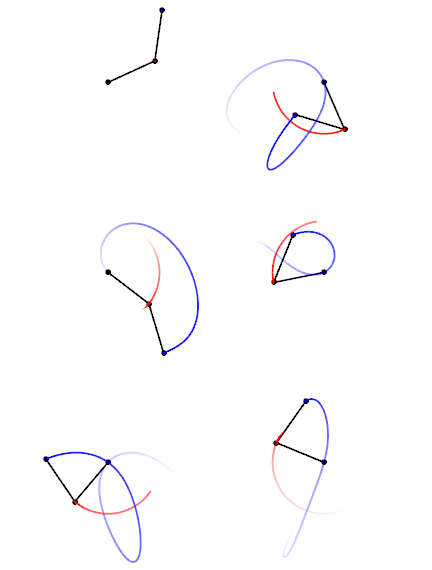
Trajectories of a double pendulum

A comment by tom0mason at alerted me to the science demonstrated by the double compound pendulum, that is, a second pendulum attached to the ball of the first one. It consists entirely of two simple objects functioning as pendulums, only now each is influenced by the behavior of the other.

Lo and behold, you observe that a double pendulum in motion produces chaotic behavior. In a remarkable achievement, complex equations have been developed that can and do predict the positions of the two balls over time, so in fact the movements are not truly chaotic, but with considerable effort can be determined. The equations and descriptions are at Wikipedia Double Pendulum

Long exposure of double pendulum exhibiting chaotic motion (tracked with anย LED)

But here is the kicker, as described in tomomasonโ€™s comment:

If you arrive to observe the double pendulum at an arbitrary time after the motion has started from an unknown condition (unknown height, initial force, etc) you will be very taxed mathematically to predict where in space the pendulum will move to next, on a second to second basis. Indeed it would take considerable time and many iterative calculations (preferably on a super-computer) to be able to perform this feat. And all this on a very basic system of known elementary mechanics.

And What about the Climate?

This is a simple example of chaotic motion and its unpredictability. How predictable is our climate with so many variables and feedbacks, some known some unknown? Consider that this planetโ€™s weather/climate system is chaotic in nature with many thousands (millions?) of loosely coupled variables and dependencies, and many of these variables have very complex feedback features within them.

Hurricane Gladys, photographed from orbit by Apollo 7 in 1968 (Photo: NASA)

Summary

To quote the IPCC:

The climate system is a coupled non-linear chaotic system, and therefore the long-term prediction of future climate states is not possible. Rather the focus must be upon the prediction of the probability distribution of the systemโ€™s future possible states by the generation of ensembles of model solutions.

A recent National Review article draws the implications:
The range of predicted future warming is enormous โ€” apocalyptism is unwarranted.

But as the IPCC emphasizes, the range for future projections remains enormous. The central question is โ€œclimate sensitivityโ€ โ€” the amount of warming that accompanies a doubling of carbon dioxide in the atmosphere. As of its Fifth Assessment Report in 2013, the IPCC could estimate only that this sensitivity is somewhere between 1.5 and 4.5ยฐC. Nor is science narrowing that range. The 2013 assessment actually widened it on the low end, from a 2.0โ€“4.5ยฐC range in the prior assessment. And remember, for any specific level of warming, forecasts vary widely on the subsequent environmental and economic implications.

For now, though, navigating the climate debate will require translating the phrase โ€œclimate denierโ€ to mean โ€œanyone unsympathetic to the most aggressive activistsโ€™ claims.โ€ This apparently includes anyone who acknowledges meaningful uncertainty in climate models, adopts a less-than-catastrophic outlook about the consequences of future warming, or opposes any facet of the activist policy agenda. The activists will be identifiable as the small group continuing to shout โ€œDenier!โ€ The โ€œdeniersโ€ will be identifiable as everyone else.

Climate System Summation

Esteemed climate scientist Richard Lindzen ends a very fine recent presentation (here) with this description of the climate system:

I havenโ€™t spent much time on the details of the science, but there is one thing that should spark skepticism in any intelligent reader. The system we are looking at consists in two turbulent fluids interacting with each other. They are on a rotating planet that is differentially heated by the sun. A vital constituent of the atmospheric component is water in the liquid, solid and vapor phases, and the changes in phase have vast energetic ramifications. The energy budget of this system involves the absorption and reemission of about 200 watts per square meter. Doubling CO2 involves a 2% perturbation to this budget. So do minor changes in clouds and other features, and such changes are common. In this complex multifactor system, what is the likelihood of the climate (which, itself, consists in many variables and not just globally averaged temperature anomaly) is controlled by this 2% perturbation in a single variable? Believing this is pretty close to believing in magic. Instead, you are told that it is believing in โ€˜science.โ€™ Such a claim should be a tip-off that something is amiss. After all, science is a mode of inquiry rather than a belief structure.

Flow Diagram for Climate Modeling, Showing Feedback Loops

The Limitations ofย Limits

Following the spectacle and theatre of COP 28, I thought it might be a good idea to remind ourselves of the rationale behind the targets upon which its deliberations were founded. After all, we all thought we knew that a two degree Celsius increase in temperature would spell disaster.

Why COP 28 is destined to disappoint

From Climate Scepticism

BYย JOHN RIDGWAY

Following the spectacle and theatre of COP 28, I thought it might be a good idea to remind ourselves of the rationale behind the targets upon which its deliberations were founded. After all, we all thought we knew that a two degree Celsius increase in temperature would spell disaster. Now we all presume to know that one and a half degrees will do the trick. But what exactly is the strength of the science behind the determination of such thresholds?

The COP 28 delegates will tell you that they donโ€™t care anymore, because this is a matter of settled science, and that is all you need to know. Short shrift would be given to any suggestion that there is still debate to be had concerning the scientific basis. As for any suggestion that the specification of the targets was actually a political manoeuvre โ€ฆ well, that is to laugh. Except itโ€™s true, and Iโ€™m not even joking.

That values ascribed to safety targets owe more to politics than science should not strike you as controversial, but I am prepared to bet that it will, at least where climate change safety targets are concerned. This is because, whereas safety professionals are quite aware of the arbitrariness that often accompanies the quantification of targets, climate policy-makers wouldnโ€™t dream of conceding an inch on the mantra of โ€˜following the scienceโ€™. For them, two degrees increase doesnโ€™t just provide a simply understood framework within which to work, it represents a consensus arrived at by thousands of scientists objectively beavering away in the way that scientists always do. Itโ€™s as if the 40 mph speed limit that suddenly appeared on your commute to work was the result of endless studies of accident statistics, combined with consideration of the local road conditions as related to accident causation, rather than an arbitrary gesture in response to a general road safety campaign (which is actually the much more likely scenario). Iโ€™m sure a set of consultants would have been employed to validate the choice of speed limit, but rest assured that their recommendations were provided only to help push through the โ€˜correctโ€™ policy. Speaking as a former traffic control systems safety analyst, I have to hope that you can just take my word that this is how these things generally go down.

But climate science is different, I hear you say. Well, let us look at the evidence for that. What exactly is the history behind the setting of the current climate change speed limit?

Itโ€™s politics, stupid

It is generally accepted that the first person to mention a two degree Celsius limit was Nobel economist William Nordhaus, back in the 1970s. As he put it:

โ€œAs a first approximation, it seems reasonable to argue that the climatic effects of carbon dioxide should be kept within the normal range of long-term climatic variation. According to most sources the range of variation between distinct climatic regimes is in the order of ยฑ5ยฐC, and at the present time the global climate is at the high end of this range. If there were global temperatures more than 2ยฐ or 3ยฐ above the current average temperature, this would take the climate outside of the range of observations which have been made over the last several hundred thousand years.โ€

The first thing to note here is the range of uncertainty, i.e. โ€˜2ยฐ or 3ยฐโ€™. The second is how weak the argument is for this โ€˜first approximationโ€™. It doesnโ€™t involve a detailed scientific assessment of the impacts of warming, it merely makes the โ€˜reasonableโ€™ assumption that we might not wish to invite an unfamiliar scenario. As such, it is essentially precautionary in its nature. Furthermore, no data or citations were offered at the time by Nordhaus to back up his claims regarding the Earthโ€™s temperature record.

Be that as it may, there were many who were later willing to back Nordhausโ€™s intuitions. In particular, the WMO/ICSU/UNEP Advisory Group on Greenhouse Gases produced a report in 1990 that re-iterated the significance of a 2ยฐ limit (the lower of the two figures proposed by Nordhaus), this time by arguing for the likelihood of non-linear, catastrophic impacts beyond that threshold. The baton was also picked up by the German Advisory Council for Global Change (WBGU) in the 1990s. It was the WBGU, under chairman Hans Joachim Schellnhuber, that convinced Angela Merkel of the 2ยฐC target, thereby starting a political process that ultimately led to the adoption of the 2ยฐC target by organisations such as the G8, the Major Economies Forum, and the Conference of the Parties held in 2010 in Copenhagen. It was also largely through the exhortations of Schellnhuber (a member of the Club of Rome advocating for a โ€˜move towards more equitable economic, financial, and socio-political modelsโ€™) that the target was later to be reduced to 1.5ยฐC. Again, such arguments were ostensibly motivated by the desire to avoid tipping points that could not be proven but were deemed sufficiently plausible to invoke the precautionary principle.

I would not wish to give the idea that there was no science behind the proposal of the 2ยฐC target, or indeed its subsequent reduction to 1.5ยฐC. However, it would be naรฏve to suggest that the values chosen arose from any detailed calculations corroborated by multiple groups of scientists working independently. The history of the limit owes a lot more to the scientific hand-waving of small but influential bodies who have furnished their political overlords with suitably rounded numbers that can function as a focal point in the climate policy arena. In that respect, the analogy with traffic speed limits is most apt. The science might suggest a speed limit of 37 mph, and even that different limits apply for differently experienced drivers. It is fortunate, however, that speed limits are not set by scientists but set by politicians who understand that focal points are important for success, and simplicity is important for focal points. Richard Betts of the Met Office puts it this way:

โ€œThe level of danger at any particular speed depends on many factorsโ€ฆ It would be too complicated and unworkable to set individual speed limits for individual circumstances taking into account all these factors, so clear and simple general speed limits are set using judgement and experience to try to get an overall balance between advantages and disadvantages of higher speeds for the community of road users as a whole.โ€

So 40 mph it is for everyone. Similarly, 1.5ยฐC is chosen not so much for its scientific accuracy but for its political expediency. After all, it is supposed to equate to an acceptable level of risk, and questions of acceptability are political rather than scientific.

Build it and they will come

And that would be the end of my story were it not for one more important detail. If 1.5ยฐC is just a number plucked out of the air because it sets a good target, then why is it that so many scientific studies have subsequently appeared to verify its critical importance? How come that a figure that arose from years of intuitions, guesses and vaguely applied scientific insights has proven to be bang on the money, according to the current crop of peer-reviewed articles published in prestigious journals.

To understand this apparent coincidence, one has to appreciate just how a politically established focal point serves to guide the direction taken by scientific study. Furthermore, one has to drop the naรฏve view, often expressed, that the scientific method and the competitive nature of the scientific enterprise ensure that any suspect propositions will be challenged and ultimately overturned. The main problem with this naรฏve view is that it ignores the social feedback that occurs once a particular view has gained dominance. In an ideal world, such dominance should not interfere with the objectivity of decisions taken, but in the real world there are positive feedbacks that tend to reinforce popularity at the expense of veracity. Put another way, once an authoritative position has been established, credence can no longer be purely evidence-driven. One example of this phenomenon is the Matthew Effect as it applies to the establishment of a dominance of citations for particular researchers. Unfortunately, however, because science is a social undertaking, such feedbacks are a lot more pervasive than citation bias alone might suggest, since they also bear upon the popularity of research undertaken, methods adopted, the conclusions to be drawn and the chances of gaining publication. None of the above are free decisions to be undertaken, since they will all be marshalled by a guiding social hand that reinforces with agency that has no need of conspiracy.

Occasionally, though rarely, the reality of social feedback within the scientific domain will be highlighted by those who operate within it. The message is rarely welcomed, however, since it undermines the whole idea that scientific authority can always be trusted to inform political decision-making. The suggestion that science has a propensity to provide politically correct answers does not go down well with those who have been brought up to believe in an unchallengeable scientific integrity. And so the social sanctions for those who speak out can be severe, as exemplified by the recent experience of climate scientist Patrick T. Brown when he detailed how these mechanisms operate within climate science. To him there is no surprise that research vindicating the 1.5ยฐC target hugely dominates within the prestigious journals, any more than I wasnโ€™t surprised to see safety analyses that conveniently validated traffic speed limits that had been the result of politically taken decisions.

But does any of it matter?

One of the most interesting features of limits and targets is the alacrity with which they are set and the facility with which they are ignored. There are laws of physics that should be borne in mind when determining whether a proposed action or current situation can be deemed sufficiently safe. But the law that states โ€˜thou shalt not exceed 1.5ยฐC warmingโ€™ is of quite a different stripe. It was readily conceived with the minimum of required science, and has been subsequently โ€˜validatedโ€™ with more science than can be decently applied. Since COP 15, such limits have been treated with a dread reverence that looks increasingly melodramatic when one considers how much reality and rhetoric have diverged. It is no wonder, therefore, that each successive COP declaration has been heralded with unprecedented hope, only to be reviewed with unprecedented despair. I guess there is only so much one can achieve by setting limits when everyone knows that they are just symbolic focal points.

Why Wonโ€™t those Troglodytes Trust Us and How, How, How! Can We Finally Get Through to THEM?!!! Number Eleventy Zillion

From Watts Up With That?

More rending of garments.

Thereโ€™s a lot of bad science papers out there, but this may be a hall of famer.

nature human behavior presents:

Psychological inoculation strategies to fight climate disinformation across 12 countries

It is clearly written by โ€œsocial scienceโ€ โ€œresearchersโ€ whose knowledge of the underlying subject matter is on a level of grade school indoctrination. Wellโ€ฆhigh school these days. Here is the abstract, emphasis mine.

Decades after the scientific debate about the anthropogenic causes of climate change was settled, climate disinformation still challenges the scientific evidence in public discourse. Here we present a comprehensive theoretical framework of (anti)science belief formation and updating to account for the psychological factors that influence the acceptance or rejection of scientific messages. We experimentally investigated, across 12 countries (Nโ€‰=โ€‰6,816), the effectiveness of six inoculation strategies targeting these factorsโ€”scientific consensus, trust in scientists, transparent communication, moralization of climate action, accuracy and positive emotionsโ€”to fight real-world disinformation about climate science and mitigation actions. While exposure to disinformation had strong detrimental effects on participantsโ€™ climate change beliefs (ฮดโ€‰=โ€‰โˆ’0.16), affect towards climate mitigation action (ฮดโ€‰=โ€‰โˆ’0.33), ability to detect disinformation (ฮดโ€‰=โ€‰โˆ’0.14) and pro-environmental behaviour (ฮดโ€‰=โ€‰โˆ’0.24), we found almost no evidence for protective effects of the inoculations (all ฮดโ€‰<โ€‰0.20). We discuss the implications of these findings and propose ways forward to fight climate disinformation.https://www.nature.com/articles/s41562-023-01736-0

That stupid public discourse and all those knuckle-dragging morons who dare, actually dare to doubt our sacred SETTLED SCIENCEยฎ

The paper gives the standard party line, citing the IPPCC, Orekes, and Lewandosky, about sacred truths and evil disinformation.

The sixth report of the Intergovernmental Panel on Climate Change (IPCC) unequivocally declared that climate change is real and that humans are driving it1,2. Whereas 97โ€“99% of climate scientists agree about the human causation of climate change3,4,5, one third of the global population doubts or denies its anthropogenic roots6,7,8. This can be traced back to half a century of disinformation by the climate change countermovement, comprising fossil fuel corporations and their front groups, scientists-for-hire and lobbied politicians, who have contested climate science and are now delaying necessary climate mitigation actions9,10,11,12,13,14,15,16,17. This multi-million-dollar public relations effort18,19,20,21,22 operates mainly via popular communication avenues3,23,24, such as traditional25,26,27 and social media28,29,30, to shape climate discourse and political decision-making17,29. Their claims take up legitimate concerns that people expressโ€”such as high costs or uncertain efficacy of climate actionโ€”but qualify as disinformation because these concerns are intentionally distorted and amplified into misleading claims31,32 such as bad-faith questioning of the scientific consensus33, overemphasizing the socio-financial burden of climate mitigation policies14,34 and scaremongering citizens into inaction through climate doomism14. Unfortunately, climate disinformation can be more persuasive than scientifically accurate information35,36,37,38 (see also ref. 39).https://www.nature.com/articles/s41562-023-01736-0

So, with no understanding of how scientific skepticism actually functions, the authors then launch into their assertions about how and why people think they do.

People process scientific messages not as neutral information processors but rather by weighing the messages against their prior convictions40,41,42,43,44,45, against desired outcomes46,47,48,49, against affective associations50,51 and through the lens of their sociocultural and ideological contexts52,53,54,55 (see reviews in refs. 56,57,58,59,60). When these psychological factors are misaligned with scientific information about climate change, antiscience beliefs fester39,61 and become resistant to correction57. Two recent reviews offer distinct yet complementary perspectives on how (dis)information and (anti)science beliefs hinge on different communicational bases and psychological drivers. Philipp-Muller and colleagues61 identified the different communicational bases on which (anti)science beliefs can build: the sources of scientific messages, the scientific messages themselves, the recipients of the scientific messages and the recipientsโ€™ epistemic style. In parallel, Ecker and colleagues57 grouped the psychological drivers influencing (dis)information belief formation and revision into cognitive and socio-affective drivers, depending on the psychological pathways they act on to facilitate or hinder belief formation and updating. Overall, both analyses affirmed that peopleโ€™s capacity and motivation to process information and disinformationโ€”(dis)information henceforthโ€”is conditional to the (mis)alignment of scientific information about climate change with specific communicational and/or psychological factors57,61.

Here we adapt these factors to construct a comprehensive framework of (anti)science belief formation and updating (Table 1). In this framework, the processing of scientific (dis)information is mapped onto its core communicational bases61: sources, messages and recipients. These communicational bases are the entry points62 where different psychological factors can influence (anti)science belief formation and updating through cognitive or socio-affective pathways57.https://www.nature.com/articles/s41562-023-01736-0

Table 1 Comprehensive framework of (anti)science belief formation and updating

From: Psychological inoculation strategies to fight climate disinformation across 12 countries

 Core communicational bases
Sources of scientific messagesScientific messages themselvesRecipients of scientific messages
Psychological driversCognitive pathwayDriverConsideration of scientific sourcesMatch/mismatch with prior beliefs(Lack of) analytical thinking and/or deliberation
Proposed interventionScientific consensus inoculationTransparent communication inoculationAccuracy inoculation
Socio-affective pathwayDriverTrust in scientific sourcesMatch/mismatch with moral convictionsEmotional state during message processing
Proposed interventionTrust inoculationMoralization inoculationPositive emotions inoculation
  1. The table shows the interplay between the communicational bases and psychological drivers of (anti)science belief formation and updating, and the theory-based psychological inoculations designed to address each entry point. Note that the boundaries between the cognitive and socio-affective pathways are permeable, and the effects of most interventions meant to address one pathway will very probably spill out to the other pathway of scientific (dis)information processing. For example, we consider the transparent communication inoculation to act on the cognitive driver โ€˜match/mismatch with prior beliefsโ€™; however, its effects can spill over towards the socio-affective driver โ€˜trust in scientific sourcesโ€™112,113.

Wandering through the citations scattered throughout this paper will probably spawn a future post or two from me, but thereโ€™s plenty here for multiple PhDโ€™s is someone wants to research the construction of alternate realities based on academic nonsense as well as the crossover subject of institutional capture.

Comedy writers or jargon generators couldnโ€™t do better. Put down your coffee before reading the next quote box.

In summary, here we integrated previous analyses into a comprehensive framework of the communicational and psychological factors influencing (anti)science belief formation and updating. On the basis of this integrated, theory-driven perspective, we introduce a set of broad-spectrum psychological inoculations to protect against climate disinformation that act on each of the identified entry points and pathways:

  • A scientific consensus inoculation explaining that among climate scientists there is virtually no disagreement that humans are causing climate change
  • A trust inoculation making salient the trustworthiness of IPCC scientists in terms of climate change science and mitigation actions
  • A transparent communication inoculation addressing the pros and cons of climate mitigation action
  • A moralization inoculation creating a stronger link between climate mitigation actions and the diversity of moral convictions
  • An accuracy inoculation reorienting participants towards judging incoming information by its factual accuracy
  • A positive emotions inoculation eliciting positive emotions towards climate mitigation actions

https://www.nature.com/articles/s41562-023-01736-0

Table 2 Text of the six inoculations

From: Psychological inoculation strategies to fight climate disinformation across 12 countries

Cognitive inoculationSocio-affective inoculation
Scientific consensus inoculationTrust inoculation
When confronted with such misleading information about the science of climate change and the actions to mitigate it, remember that the IPCC, the most comprehensive review on the scientific agreement behind climate change and climate action, found that among thousands of climate scientists with the highest degrees of expertise โ€˜there is virtually no disagreement that humans are causing climate changeโ€™. Studies have shown that the consensus about anthropogenic climate change among expert scientists ranges from 97% to 99%. IPCC scientists from all cultural backgrounds and nations stated in the report that โ€˜It is unequivocal that human influence has warmed the atmosphere, ocean and landโ€™ and they are in agreement that urgent climate action is needed for a better planet and society.When confronted with such misleading information about the science of climate change and the actions to mitigate it, remember that the IPCC is the most authoritative scientific body in the world assessing the knowledge about climate change and climate action and that the majority of citizens of multiple countries trust scientists. Climate scientists have the highest degrees of expertise and are committed to open and transparent review by other scientists and governments around the world, and value rigorous and balanced scientific information above all else. IPCC scientists come from all cultural backgrounds and nations, to reflect a diverse range of views and expertise in their work and to ensure an objective and complete assessment of the scientific evidence about climate change, to recommend actions and policies for a better planet and society.
Transparent communication inoculationMoralization inoculation
When confronted with such misleading information about the science of climate change and the actions to mitigate it, remember that the IPCC scientists are open about the fact that climate actions will require substantial funding and a significant overhaul of our way of life to keep our planet livable. They also disclosed that there is some uncertainty about if and how these climate actions may reduce our quality of life, but they still concluded with confidence that limiting irreversible climate-induced risks with climate action is less risky than not acting at all. Acting is hard, they admit, but it is through these scientifically supported actions that we can protect our planet, reduce inequality, and generate sustainable growth.When confronted with such misleading information about the science of climate change and the actions to mitigate it, remember that the IPCC scientists provide valuable and authoritative advice about actions that our communities and nations must take to responsibly keep our planet livable for us and for future generations. As citizens of this earth, we have a moral responsibility to protect our homeland and our community from climate-induced risks and harms, and to stop defiling our pristine natural environment. Through these scientifically supported actions, we can protect our planet, create a more just and fair society with decent living conditions for everyone, and generate sustainable growth beneficial for us, our nations, the world, and generations to come.
Accuracy inoculationPositive emotions inoculation
When confronted with such misleading information about the science of climate change and the actions to mitigate it, remember that it is important to be able to accurately recognize these misinformation to avoid being influenced by them. One good strategy to distinguish between good and bad information is to ask yourself: โ€˜do I think this information is accurately describing the state of the science of climate change? Is this information not at all accurate, not very accurate, somewhat accurate, or very accurate?โ€™. When you evaluate the information you see on any media about climate change, think about this accuracy question to get in the right frame of mind.When confronted with such misleading information about the science of climate change and the actions to mitigate it, remember that climate actions are vital actions that will keep our planet livable for the next generation. Actions such as eating delicious and healthy meals with a lower carbon footprint or taking a bike ride instead of getting stuck in traffic are scientifically supported ways to make you happier and more fulfilled in your daily life. When you evaluate the information you see on any media about climate change, imagine the positive changes you can create with climate action, and think about how good you will feel when doing so.

Hereโ€™s the kicker. This is their table of disinformation, most of which is true.

Table 3 The 20 climate disinformation statements and their coding

From: Psychological inoculation strategies to fight climate disinformation across 12 countries

CodingDisinformation tweet
Science_1As more wind and solar are added they raise electricity prices and destabilize electric grids. Because they are part-time unreliable weather dependent sources. We want full-time electricity. Not part-time like third world countries. All for silly expensive net zero. CA pays more.
Science_2The current exceptional warming and cooling your seeing is due to the location of the Jet Stream. Itโ€™s become very wavy due to the lack of Solar Energy going into the Oceans and nothing to do with Man Made CO2
Science_3Todayโ€™s โ€˜global warmingโ€™ is estimated to be an otherwise unmeasurable 0.4ยฐC (0.72ยฐF) over the 1979-2000 averageโ€ฆ despite 50% of all manmade emissions. No 2022 weather event was unprecedented or can be blamed on CO2 emissions.
Science_4This is a portrait of climate fraud, posturing as the saviours of the world. They are a breed of crooks, getting rich by ripping off gullible western nations. The UN led climate hoax has been running since 1988. They want us to believe a pack of lies about earthโ€™s climate.
Science_5Too often, academic reports on climate use highly skewed data that seem to have been carefully selected to support aggressive environmental regulations. One recent and much-cited Lancet report appears deliberately deceptive.
Science_6The climate hoax devised by the UN, supported by rich elitists is endorsed by our treacherous leaders is an attack on freedoms & rights. Climate cultism is a form of global self hatred. It aims to punish western nations by transferring huge reparations to the developing world.
Science_7Top NASA Climate Modeler Admits Predictions Are โ€˜Mathematically Impossibleโ€™
Science_8Lots of links of studies of the Medieval Warm Period that climate science deniers (alarmists) want to pretend did not exist. Because there is no explanation for natural warming during this time. Studies point out temp was warmer back then, than now.
Science_9According to global warming theory the poles should warm significantly if carbon dioxide is driving temperatures Just the opposite is occurring in the southern hemisphere.
Science_10The evidence for manmade climate change is so thin they cannot debate it. They hide behind the lie of consensus. There is no room for consensus in science. The basis is a provable hypothesis. There is not a single peer reviewed study that proves manmade CO2 is causing warming.
Action_1At Climate Summit, Elites Chow Down on Gourmet Meats While Telling Us to Eat Bugs
Action_2FACT CHECK Results of the Biden administrationโ€™s extreme climate agenda cutting emissions by 44% by 2030. Annual Jobs Lost: 1.2 MILLION. Lost Economic Growth: $7.7 TRILLION. Increase in Electric Bills: 23% Increase in Gas Prices: 2$ PER YEAR
Action_3The war on โ€˜fossil fuelsโ€™ is absurd considering the vast fields of coal/oil/gas everywhere on earth. The mantle is brimming over with it. A United Nations bid for control, cash & power has led to an energy crisis that looms as the biggest self-inflicted disaster in human history.
Action_4Death and privation caused by the lack of affordable energy caused by Green Energy policies will not affect the Elites at all. They want us to eat bugs, do a lot less as they carry on with their lives just as they are doing now. Climate scamsters. They should lead by example.
Action_5You are lying. Fossil fuels gave us cheap energy for decades so billions live longer healthier happier lives. Many technologies like carbon capture, filters fuel additives etc reduces emissions. Banning fossil fuels is creating fuel poverty and harming people
Action_6Energy literacy starts with the knowledge that renewable energy is only intermittent electricity generated from unreliable breezes and sunshine, as wind turbines and solar panels cannot manufacture anything for the 8 billion on this planet.
Action_7Imagine sacrificing 500 high-paying coal jobs, ranging up to $60,000/yr, for the climate hoax. Even if you believe in the hoax, global emissions are up 5% from pre-pandemic levels โ€” 90% because of China. Emissions from a single mine are insignificant.
Action_8Europeโ€™s transition to renewable energy and net zero carbon is not working, except to make life hard on average European citizens.
Action_9Willfully-blind ignorance about the consequences of [the rush to green policies] โ€“ deep recessions, broken societies and millions more going hungry โ€“ doesnโ€™t make them any less immoral. The road to hell is paved with good intentions. Bingo.
Action_10Solar and wind are far more expensive than established reliable stable secure electricity from pure hydro coal gas nuclear. Thatโ€™s why your shift to unreliable, unstable, expensive solar and wind; is devastating families; and exporting manufacturing jobs

The rest of the article is, standard sociology focus group discussion masquerading as a useful statistical psychological analysis, some caterwauling about personality traits, especially conservative politics, frustration that their attempt at blatant indoctrination had a negligible effect.

In summation, they hope their fauxearch will lead to actual results if someone does a better job at indoctrinating or manipulating people.

While the psychological inoculations evaluated in this Registered Report were of limited efficacy, the framework proposed here can be helpful to systematize future psychological inoculation research to fight climate disinformation. It may generate new psychological inoculations, which can result in more systematic research192 on psychological inoculations, their moderators and climate-relevant outcomes. For example, one of the reviewers suggested developing a โ€˜pluralistic ignoranceโ€™ inoculation, whereby participants are made aware that most of their peers support climate mitigation action, and that awareness should increase support of climate action193,194. Many-labs and mega-studies approaches, promising recent frameworks for systematically creating and testing multiple interventions195,196,197 with large sample sizes that could help the detection of small intervention effects, can be applied to test sets of theory-guided psychological inoculation strategies against a validated set of climate disinformation statements, measuring climate-relevant outcomes and mapping the heterogeneity generated by model-identified individual differences. Such a combination could produce the next generation of psychological inoculations, which may yield better protection from climate disinformation.https://www.nature.com/articles/s41562-023-01736-0

Read the whole paper yourself and use it as more evidence for cutting off federal funds to universities.

The Myth of โ€œSettledโ€ Climate Science: A Revelatory Study on Cloud Formation

From Watts Up With That?

Trees, Clouds, and the Unsettling Truth about Climate Science

In a recent revelation from the international CLOUD project at the nuclear research center CERN, researchers have identified sesquiterpenesโ€”gaseous hydrocarbons released by plantsโ€”as a pivotal factor in cloud formation. This study, published in the journal Science Advances, might just be the wrench in the works for those who have long touted the notion of โ€œsettledโ€ climate science.

The Intergovernmental Panel on Climate Change (IPCC) has been confidently projecting that the global climate will warm by 1.5 to 4.4 degrees Celsius above pre-industrial levels by 2100. Yet, these projections are riddled with uncertainties. For instance, in a worst-case scenario, the temperature could swing anywhere between 3.3 to 5.7 degrees Celsius. Such a vast range hardly inspires confidence.

The root of these uncertainties? A glaring lack of understanding of the intricate processes occurring in our atmosphere. The CLOUD project, in its quest to demystify these processes, has been delving deep into the enigma of cloud formation.

Clouds, as it turns out, are not just fluffy white entities in the sky. Their formation and behavior have profound implications for the planetโ€™s temperature. While itโ€™s known that clouds reflect solar radiation, cooling the earthโ€™s surface, the exact mechanics of their formation remain elusive.

Aerosols, both natural and man-made, provide the condensation nuclei essential for cloud formation. However, a significant portion of these nuclei form in the air when gaseous molecules combine, turning into solidsโ€”a process known as โ€œnucleationโ€ or โ€œnew particle formationโ€ (NPF).

While the role of anthropogenic gases like sulfur dioxide is somewhat-documented, the study has shed light on the underestimated influence of natural gases like sesquiterpenes. Despite being less prevalent than other substances, sesquiterpenes have a disproportionately large impact on cloud formation. In fact, they form ten times more particles than other organic substances at equivalent concentrations.

This studyโ€™s findings underscore the need to reconsider the role of sesquiterpenes in climate models, potentially rendering many existing models obsolete.


Conclusion:

For those whoโ€™ve been echoing the mantra that climate science is โ€œsettledโ€ and beyond dispute, this study serves as a stark reminder of the complexities and unknowns still at play. Itโ€™s high time to question the wisdom of pouring vast sums of money into policies based on potentially flawed models. The discovery of sesquiterpenesโ€™ role in cloud formation is a testament to the ever-evolving nature of climate scienceโ€”a field that is far from settled.

Source:ย How trees influence cloud formationย (2023, September 8).