Global warming, climate change, all these things are just a dream come true for politicians. I deal with evidence and not with frightening computer models because the seeker after truth does not put his faith in any consensus. The road to the truth is long and hard, but this is the road we must follow. People who describe the unprecedented comfort and ease of modern life as a climate disaster, in my opinion have no idea what a real problem is.
When news broke that climate.gov was about to go dark in June, Jeffrey Grant scrambled to download as many graphs and data tables from the website as he could. The high school biology teacher had relied heavily on the U.S. National Oceanic and Atmospheric Administration (NOAA) website to teach students about climate change…
[…]
The cuts go beyond climate.gov to sites explicitly designed for educators, such as the Climate Literacy and Energy Awareness Network (CLEAN)…
[…]
Breck Foster, a teacher at Lake Oswego High School in Oregon who weaves climate change into her social studies classes…
Biology teachers should be teaching biology. Social studies teachers should be teaching anything other than actual science.
Some nonprofit organizations have been scrambling to fill the void. Margaret Wang-Aghania, executive director and co-founder of SubjectToClimate…
[…]
Former NOAA employees hope to mitigate the loss of climate.gov. “We intend to restore all that content … outside the federal domain, where it is safe from further political interference,” says Rebecca Lindsey, former program manager of climate.gov…
If there are “nonprofit organizations” and “former NOAA employees” willing to fund climate propaganda, why were taxpayers footing the bill in the first place?
Anticipating steep cuts to its budget, the National Center for Atmospheric Research (NCAR), one of the world’s leading climate research centers, this week laid off 29 employees and decided not to fill 21 vacant positions.
The job actions, which have not been announced publicly, coincide with the start of a partial U.S. government shutdown. NCAR, which is funded by the National Science Foundation (NSF), has so far been able to maintain normal operations and avoid furloughs of its 830 employees. But NCAR officials fear what could happen next: a $50 million cut to the center’s current $123 million budget.
President Donald Trump proposed the 40% reduction in his 2026 budget request to Congress…
[…]
In addition to laying off workers in the center’s administrative and support units, the belt-tightening will result in a loss of employee benefits and reduced services—such as shorter cafeteria hours and fewer shuttle buses…
Science is not the answer. It cannot be “because Science” that you ought to give up meat. Which Harvard scientists want you to do in the name of “justice”. And, of course, to save the planet. Which is in no danger and does not need saving.
Science is not the answer. It cannot be “because Science” that you ought to give up meat. Which Harvard scientists want you to do in the name of “justice”. And, of course, to save the planet. Which is in no danger and does not need saving.
Justice is not a concept in science. Science is forever mute on justice. Or fairness. Or equity or Equality. You cannot use Science to justify DIE (diversity, etc.). Though science tells us when Science DIEs, just as when anything DIEs, it dies.
Realistic, simple dietary swaps can help Americans make a difference in the country’s carbon footprint, a new study found.
Changing how the world eats could reduce premature deaths, save trillions of dollars and slow the impacts of climate change, according to a new landmark report released Thursday by the 2025 EAT-Lancet Commission, a coalition of experts in nutrition, climate, economics, health and agriculture from more than 35 countries.
I do not propose here today to go through this paper (or papers), as it is long and dreary. They say, for instance, in their opening sentence, the covid panic was responsible for “exacerbating existing vulnerabilities”. No. Experts were. Experts did the panic to us, starting with creating the bug. Their second sentence is “However, food systems remain squarely centred at the nexus of food security, human health, environmental sustainability, social justice, and the resilience of nations.” Which also has next to nothing to do with science.
At the end of their Introduction they say “Our assessment of justice integrates three dimensions—distributive, representational, and recognitional—within a human rights framing that includes the rights to food, a healthy environment, and decent work.”
All of this is pure politics. And since Lancet is woke, it is woke politics: progressivism and the commitment to DIE.
So today we will stick to philosophy and some very basic science. We can leave the rest for later, if there is interest.
Now it is obvious man is a meat eater. It is just as obvious that are two sexes. These are two of the kinds of truths that used to form the core backbone of science, the subject which studies the way the world works. Yet obviousness carries no weight in The Science, which is the political branch of science. Desires are brought to The Science, and science is asked to justify them. If it cannot, science is ignored.
It does not follow from the true observation that man is a meat eater that from time to time eats other things that man ought to eschew (a bad pun) meat. It only follows that man is a meat eater. Observation tells us man can eat other things beside meat. But this does not make him a non-meat eater. He remains a meat eater.
And that is as far as this science can take us. Except for the deduction that because man is a meat eater, it must have allowed him to live and thrive by this, which we observe by being here and discussing this. Thus any conclusion that says “meat is bad for you”, cannot be true.
Without heavily qualifying what “bad” means, where and when and how, we cannot trust any statement that says eating meat is bad, for us or the “planet”. We deduce eating meat cannot be universally or always bad. Observation has ruled that out and falsified “eating meat is bad” tout court.
We saw earlier that Thomas Malthus’s theory that all species, man included, breed up to the limit of available food. It is not that creatures out-eat their food supply, it is that food provides the energy needed for breeding. Most have this wrong, and think man will cause mass starvation by eating. And so “destroy” the “planet”. Somehow.
In man’s case, Malthus’s theory needs an addendum (I don’t know if the following holds true for other creatures, but I wonder that it might, and know it does in lab rats). It is true man bred vociferously when food began to be produced in vast quantity. But there came a point when there was more food than man could eat, or rather needed to eat to remain alive and healthy and breed. It was then, when man began eating purely for pleasure in addition to eating to live that man stopped breeding in large number.
This picture is a cartoon of the idea:
Most of the food man eats purely for pleasure is not meat. It is plant based and processed heavily. That we can process so much raw food into packaged food is proof enough we have excess food, which was done without “killing” the “planet”.
It can be that a person wanting to eat not because of hunger but for reasons of pleasure wanders to the fridge, pulls out a steak, and fries it up. It is much, much, much more likely he will rip open a package and consume concentrated plant matter, loaded with flavorings and other chemicals to delight the tongue.
Whether that plant matter with flavorings and chemicals are bad or good for you is for us today irrelevant. Even suppose it is good or harmless. Little of what is in that stuff has what is in meat, like protein, which man needs in good quantify lest he look like an NPR listener. Those who eat too much for pleasure end up eating extra food to fill the cravings for the necessary materials found only in meager quantities in concentrated processed plant matter.
And that is before considering whether what’s in those packages is good or bad for health in other ways besides consuming excessive amounts of food. I’m telling you now that the evidence “PHD” scientists used to say plant matter is good, and that meat is bad, is of the standard terrible kind I keep going on and on about (wee P-values galore, etc. etc.) in the Class. If there is interest we can go through some of this. Let me know in the comments.
The “PHD” authors are aware of over-eating, but focus on the maladies which accompany this and not on the lack of breeding which results. Crucially, they do not answer why man produces too much food, much of it existing purely for pleasure. Instead they say “The destabilising effect of unhealthy overconsumption on the Earth’s systems highlights the importance of viewing healthy diets not just as a human right, but also as a shared responsibility.”
There is no “destabilising effect” on “Earth’s systems”. This, like many things in The Science, has causality bacward. It is what some would, as we have seen, falsely call “Malthusian”. Their idea that healthy diets are a “human right” and “shared responsibility” means, as it could only mean, Experts must be put in charge of your plate. Experts cannot bear the idea of people not heeding their credentialed advice.
The reason man makes too much bad food, and does not eat simple diets of meat and the like, and thus does not breed, is because he has surrendered himself to pleasure. Having some HR lady scold you for eating steak is the typical bad doctor approach of treating the symptom and not the disease. Which is wholly spiritual. An area which doctors have less experience than auto mechanics. This must be obvious. Our solution to over-eating is to produce drugs which vanquish fat while continuing to allow the over-eating. This happens because doctors are not priests, and we have turned to doctors for our answers instead of priests.
Thus my unhappy, and surely correct, prediction is that if the “PHD” Experts’ solution is adopted, matters will only grow worse. And the planet will be, as now, in no danger.
There is one more point to amplify. It is rather subtle. Man must eat to live. A stupid and obvious point. But we have learned obviousness is not important to The Science. There is a whispery idea in the minds of many Experts (Western) about man in his environment. Is it that man has no environment. That everywhere and in everything man is an intruder. (Unless non-White, of course. In all environmental propaganda, non-Whites are pictured with their hair gently flowing in the wind as they talk about “My people” and their interaction to “the environment.” Always wind.)
Ants are allowed their hills and beavers their damns, but man is allowed nothing. Or, rather, excused nothing. Even gathering his food, necessary for survival, is seen as tainted, not quite right, worthy of condemnation. Something must be wrong with it. It must be studied! In particular, the idea that man could eat another animal, even though animals eating animals is as natural as the sunrise–“Rise up Peter, kill and eat”–fills him with a peculiar kind of suspicious queasiness, even as he downs a hot dog.
Understand, no scientist “studying” the “problem” of man gathering his food would put it like this. But he believes something very like this just the same.
The Biden administration granted major offshore wind projects financial breaks despite internal warnings of increased risks to taxpayers, according to documents obtained by the watchdog group Functional Government Initiative (FGI).
The Biden administration granted major offshore wind projects financial breaks despite internal warnings of increased risks to taxpayers, according to documents obtained by the watchdog group Functional Government Initiative (FGI).
Denmark-based Ørsted’s massive “Revolution Wind” project off the coast of Rhode Island and Connecticut not only received final approval in August 2023 under the Biden administration but also an exception that allowed the company to postpone the funds for dismantling the project at the end of its life for 15 years, according to the documents. Despite internal warnings that this kind of exception “increases the risk to the federal taxpayer,” the Biden administration granted Revolution Wind and Vineyard Wind sweetheart breaks for their decommissioning costs that were estimated at $325 million and $191 million, respectively, according to the documents and FGI.
“With each revelation, two things become clearer: wind electricity wasn’t ready for primetime, and the Biden administration didn’t care. It was determined to force these projects through no matter the cost, the risks to taxpayers, or the dubious value to the people who pay for electricity and pay federal taxes,” FGI spokesman Roderick Law told the DCNF. “President Trump was right to halt projects and put them under careful review to ensure every environmental and safety impact is examined and that the taxpayers are at risk propping up failing, untested efforts.”
A May 2021 internal memo revealed the Bureau of Safety and Environmental Enforcement (BSEE) warned the Bureau of Ocean Energy Management (BOEM) that “delaying receipt of financial assurance increases the risk to the federal taxpayer” when BOEM was considering granting Vineyard Wind the 15-year decommissioning cost delay.
Federal rules typically require companies to pre-fund decommissioning to protect taxpayers if a project fails or reaches the end of its life. The Biden administration allowed Ørsted and other developers a special exception to delay those funds, despite offshore wind being relatively untested in the U.S., while cracking down on well-established energy resources like oil, gas and coal.
“While this is a BOEM decision, BSEE has significant concerns with granting a departure to current regulations that require financial assurance before installation of any facilities,” the memo states. “The primary risk are as follows: delaying receipt of financial assurance increases the risk to the federal taxpayer as identified by Government Accountability Office (GAO), the longer financial assurance is deferred, the greater the chance that the government will not collect [and] decommissioning funds may need to be accessed prior to the expected end of project life due to unforeseen events.”
The documents show that Ørsted requested the 15-year deferral of the customary financial assurance for decommissioning Revolution Wind in November 2023 and subsequently received approval for it in March 2024. Notably, a Reagan-appointed federal judge allowed Revolution Wind to continue in a ruling on Sept. 22 after the Department of the Interior (DOI) issued a work-stop order in August 2025.
“Revolution Wind, LLC is in compliance with BOEM financial assurance requirements for the project, including with respect to decommissioning,” an Ørsted spokesperson told the DCNF. “Revolution Wind is 80% complete, remains under construction, and will power more than 350,000 American homes upon its completion.”
While the Biden administration aggressively promoted offshore wind development, President Donald Trump issued an executive order that temporarily blocked virtually all federal waters from new wind leasing on his first day back in office, pending a review. The Trump administration has branded offshore wind farms as “costly failures” and moved to block several projects, with Trump himself repeatedlylambasting wind energy.
The DOI halted all “preferential treatment” on July 17 for wind and solar projects that it considered to be “unreliable,” “subsidy-dependent” and “foreign-controlled.”
FGI previously discovered Vineyard Wind, the project that shed debris off the coast of Nantucket after a defective turbine broke, received a similar exception from the Biden administration in 2021.
“This was essentially a $191 million gamble with our money,” Roderick said at the time of the first discovered decommission cost delay exception. “It’s not often you can put a price on recklessness, but BOEM under its previous leadership was in such a rush to get the risky project underway that it left American taxpayers unprotected.”
FGI argues that the failure of these projects granted exemptions by the Biden administration were not implausible, as Revolution Wind was reportedly a year behind schedule before Trump called for the wind farm reviews.
BOEM adapted its “renewable energy modernization” rules in May 2024, allowing wind companies a more flexible framework to cover decommissioning costs. In some cases, wind companies can avoid paying these costs upfront by proving their financial strength through other means, including power purchase agreements. Notably, multiple other power purchase agreements for offshore wind have been scrapped in recent years, including projects involving Ørsted, after utilities backed out citing financial concerns with contract costs.
Additionally, the National Oceanic and Atmospheric Administration (NOAA) previously confirmed to the DCNF that the Biden administration did not adequately review the environmental impacts of some offshore wind projects before approval. Additionally, some fishermen and environmentalists have protested and criticized offshore wind as they believe wind farms pose dangers to and disturb marine life.
All content created by the Daily Caller News Foundation, an independent and nonpartisan newswire service, is available without charge to any legitimate news publisher that can provide a large audience. All republished articles must include our logo, our reporter’s byline and their DCNF affiliation. For any questions about our guidelines or partnering with us, please contact licensing@dailycallernewsfoundation.org.
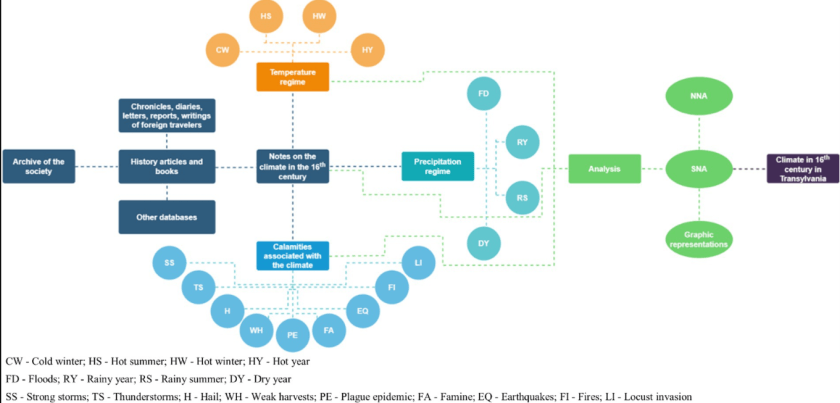
Extremes hundreds of years ago…scientific analysis of historical documents about the 16th-century climate of Transylvania, Romania… reveals a pattern of intense extreme weather events, frequent and intense heat waves and droughts.
Extremes hundreds of years ago…scientific analysis of historical documents about the 16th-century climate of Transylvania, Romania… reveals a pattern of intense extreme weather events, frequent and intense heat waves and droughts.
The video addresses the effects of the Little Ice Age (approx. 1400–1850) and argues that extreme weather events are not a new consequence of CO2-caused climate change, but are historically normal, especially during colder centuries.
These findings are based on a study by Romanian scientists who analyzed 500-year-old diaries and archival data from the 16th century in Transylvania (Siebenbürgen) to document how the Little Ice Age changed life in the region. Here’s what they found:
Initial Heat and Drought: In contrast to Western Europe, where temperatures dropped in the 16th century, Transylvania initially recorded more hot and dry weather in the first half of the century. A striking source describes the summer of 1540, during which springs dried up, rivers shrunk, and people prayed for rain.
Late 16th Century Extremes: The second half of the century was marked by heavy rainfall and floods, especially in the 1590s. Later writings document increasing cold waves and harsh winters, suggesting that the Little Ice Age may have manifested later in this part of Europe.
Climate-Related Catastrophes: Such weather changes often led to disasters directly or indirectly linked to the climate, including 30 years of plague, 23 years of famine and 9 years of locust plagues.
Human Adaptations: The weather extremes and catastrophes may have led to changes in settlement patterns, for example, through the introduction of flood-resistant infrastructure or migration to more favourable areas. Technological innovations such as improved irrigation systems or storage facilities may also have been advanced.
Summary
The Romanian authors reveal from an analysis of historical documents that reconstructed the 16th-century climate of Transylvania that there was a pattern of intense extreme weather events. There were frequent and intense heat waves and droughts in the first half of the century, contrasting with the climate in Western Europe.
Ultimately, these extremes, which later included increased rainfall and flooding, had a profound socio-economic impact, leading to famine, disease, and mortality.
“Solar construction firm Blue Ridge Power issues mass worker layoff in North Carolina,” read the article in pv magazine. “The utility-scale solar engineering, procurement and construction firm filed a WARN act with the state, cutting over 500 jobs.”
“… this was one of the hottest and most promising job sectors in the country at the end of 2024. Now, clean energy job growth is at serious risk – and with it, our overall economy.” (-Bob Keefe, below)
Much of the rooftop solar industry is in liquidation mode, and now the central station “utility scale” solar industry is in trouble. Expect more of the same in the next months as solar subsidies and local opposition (the environmental grassroots) grows. The delayed end of the Investment Tax Credit (30 percent credit) and the Production Tax Credit (2.8 cents/kWh) will cause a rush to the exits before the credits expire at the end of 2027 (with credits at risk for projects not started by July 4, 2026).
Blue Ridge is a primary industrial solar installer in South and North Carolina, with 8,000 MW installed and 1,200 MW under construction in 14 states. Some quotations from Ryan Kennedy‘s September 23, 2025, recap:
“Blue Ridge Power has experienced market headwinds similar to those impacting the entire renewable energy industry, requiring Pine Gate Renewables to dedicate significant resources to support the organization. After reviewing numerous options to find a path forward, Pine Gate made the difficult decision to conduct an orderly wind-down of Blue Ridge Power,” said Pine Gate Renewables in a statement.
And on the macro situation:
E2 research shows that since January 2025, businesses cancelled more than $22 billion of planned clean energy factories and projects that were expected to create 16,500 jobs. Analysis by Energy Innovation suggests that more than 830,000 jobs could be lost due to policy rollbacks created by the Trump Administration’s One Big Beautiful Bill Act.
The U.S. clean energy workforce now stands at 3.56 million. In 2024, 7% of all new jobs in the United States were in clean energy, and clean energy represented 82% of all new energy sector jobs. However, approximately 50,000 fewer jobs were created in 2024 as compared to 2023.
“What these numbers show is that this was one of the hottest and most promising job sectors in the country at the end of 2024,” said Bob Keefe, E2’s executive director. “Now, clean energy job growth is at serious risk – and with it, our overall economy.”
Final Comment
Solar as grid electricity is a government-created industry. It would not exist without the large tax credits that began with the 10 percent ITC in 1978, which was extended six times (1980, 1986, 1988, 1989, 1990, 1991). Then came the 30 percent credit in the Energy Policy Act of 1992, itself extended seven times (2006, 2008, 2009, 2016, 2018, 2019, and 2022).
That’s a total of thirteen extensions if you are counting. So much for an ‘infant’ industry, which was not infant to begin with.
Just a few years ago, Carbon Capture and Storage (CCS) was expected to be the saviour of the oil and gas industry, as major fossil fuel firms invested heavily in CCS activities aimed at decarbonising operations. Governments worldwide have encouraged companies to invest in CCS in recent years, funding green energy projects to help reduce the carbon emitted from oil and gas operations, and to allow countries to continue using fossil fuels to bridge the energy gap over the coming decades. However, as we see delays in the rollout of CCS projects and more evidence that suggests most CCS installations do not work as well as anticipated, many are questioning whether investing in this type of decarbonisation is viable.
Governments and fossil fuel firms have invested billions in CCS, but delays, glitches, and cost overruns have slowed progress.
Evidence shows many CCS and DAC facilities are capturing far less carbon than promised, shaking investor and public confidence.
Critics warn that overreliance on CCS could divert crucial funding away from long-term renewable energy development.
Just a few years ago, Carbon Capture and Storage (CCS) was expected to be the saviour of the oil and gas industry, as major fossil fuel firms invested heavily in CCS activities aimed at decarbonising operations. Governments worldwide have encouraged companies to invest in CCS in recent years, funding green energy projects to help reduce the carbon emitted from oil and gas operations, and to allow countries to continue using fossil fuels to bridge the energy gap over the coming decades. However, as we see delays in the rollout of CCS projects and more evidence that suggests most CCS installations do not work as well as anticipated, many are questioning whether investing in this type of decarbonisation is viable.
CCS involves capturing carbon dioxide at emission sources, to be transported and stored or buried in a suitable deep, underground location. There is now a range of CCS technologies being used in fossil fuel and industrial operations worldwide, including conventional CCS installations and direct air capture (DAC), which removes CO2 directly from the atmosphere.
Following significant support from governments and fossil fuel companies worldwide, the CCS market could attract as much as $80 billion in investment by 2030, to support an anticipated 270 million tons of carbon dioxide capture a year. However, many scientists now suggest that financing CCS is a waste of money, as the technology does not work as effectively as previously expected, and it could detract from funding long-term green energy projects. A new report suggests that globally, the maximum reduction that CCS operations could achieve for the atmosphere would be 0.7 degrees Celsius, which is far short of the 5 °C to 6 °C industry and governments claim.
The U.K. has committed $40.5 billion to CCS technology in support of its net-zero emissions aims for 2050. The country hopes to find a way to reduce emissions in the mid-term as it gradually incorporates more renewable energy capacity into the energy mix, while it continues to rely heavily on oil and gas for power and heating. However, getting CCS projects off the ground has been no easy feat, with decades of delays under several governments.
The increased funding into CCS technology in recent years is supposed to have led to technological improvements and design innovation that will help suck more carbon from the sky. However, technology glitches and the high costs associated with installing CCS equipment have delayed projects and deterred companies from investing in CCS operations. Thilo Trabner, a business development manager for the Zurich-based CSS provider ABB, explained, “First-of-a-kind technology challenges continue to contribute to delays in some projects, and reliance on subsidies and offtake agreements continues to play a critical role in project viability.”
Some of the projects for the U.K. include a gas power plant on Teesside in the north of England, which is expected to be operational by 2028, with plans to capture 95 percent of its emissions – around 2 million tonnes a year, and capacity to transport and store up to 4 million tonnes of carbon a year. Another three projects in the first round of the project pipeline are under negotiation, with plans to capture carbon from a methane-based blue hydrogen plant and energy from waste.
In Switzerland, one of the world’s most well-known CCS companies, Climeworks, announced in May that it would be cutting its workforce by more than 10 percent, citing economic uncertainty and “reduced momentum” for CCS technology. Climeworks is famous for constructing the world’s first DAC facilities. However, the company has come under fire as two of its flagship plants in Iceland were found to be capturing significantly less carbon than originally anticipated. Climeworks said that it was uncertain whether a third facility planned for the U.S. would go ahead due to the uncertain energy environment under President Trump.
DAC technology is much more expensive than conventional CCS equipment, but many companies have invested in DAC activities in recent years in response to government pressure to decarbonise. Now, recent reviews suggest that DAC technology is struggling to grow out of the pilot phase, as interest in the sector wanes. Climeworks said that at its flagship Mammoth plant in Iceland, which is thought to have a carbon capture capacity of 36,000 tonnes of carbon dioxide a year, the equipment captured just 750 tonnes in the first 10 months of operations.
The outlook for CCS technology is uncertain. In recent years, several governments, industries, and oil and gas companies have invested heavily in CCS technology in a bid to decarbonise. However, many of the planned projects have been delayed due to technological constraints and high costs. Now, reports on existing CCS activities suggest that the technology may not be working as successfully as anticipated, which has cooled investor interest in the sector and could cause progress in the CCS rollout to stall in the coming years.
Felicity Bradstock
Felicity Bradstock is a freelance writer specialising in Energy and Finance. She has a Master’s in International Development from the University of Birmingham, UK.
In August 2025, Japanese media revealed that Mitsubishi Corporation was preparing to withdraw from three offshore wind projects off the coasts of Chiba and Akita prefectures. In 2021, Mitsubishi had won these sites with remarkably low bids of 8-11 cents/kilowatt-hour (kWh), hailed as proof of Japan’s corporate strength and renewable ambition.
In August 2025, Japanese media revealed that Mitsubishi Corporation was preparing to withdraw from three offshore wind projects off the coasts of Chiba and Akita prefectures. In 2021, Mitsubishi had won these sites with remarkably low bids of 8-11 cents/kilowatt-hour (kWh), hailed as proof of Japan’s corporate strength and renewable ambition.
But reality was harsh. Costs for steel, turbines, and logistics surged. The yen weakened, interest rates rose, and certification processes faced delays. By 2025, Mitsubishi had already booked over $350 million in impairment losses, with more likely if the projects continued. The retreat is not just a corporate failure; it exposes apparent self-contradictions in Japan’s energy policy.
Across the Atlantic, offshore facilities have faced similar headwinds. On the U.S. East Coast, Ørsted cancelled two large projects in New Jersey, absorbing billions in losses. BP and Equinor abandoned contracts in New York after costs rose by 40% beyond estimates. In some cases, companies chose to pay hefty penalties rather than commit to losing ventures.
Europe, the pioneer of offshore wind, has also stumbled. In the U.K., Vattenfall halted its Norfolk Boreas project citing a 40% cost increase. Even Denmark, often celebrated as a leader, has delayed new tenders.
Market signals in these regions were clear: When economics fail, projects are scaled back or canceled. Japan, however, continues to treat offshore wind as a central pillar of its 2040 roadmap, aiming for 45 gigawatts of capacity. Why the difference?
Once designated a national project, policies in Japan are difficult to reverse. Offshore wind has been tied to three goals at once: decarbonization, energy security, and industrial revitalization. Billions in subsidies through the Green Innovation Fund are already committed, while local governments and industries expect contracts and jobs.
In effect, offshore wind has become a new type of public works project. Ports, construction companies, heavy industry, and trading houses all benefit from government support. For politicians, it delivers regional development; for bureaucrats, it provides visible progress. Under these conditions, corporate withdrawal is treated as a temporary setback and prompts no policy review.
The debate over energy costs often centers on the Levelized Cost of Electricity (LCOE), which narrowly focuses on the cost of generating a kilowatt-hour of electricity. However, this metric fails to capture the broader economic realities encapsulated by the Full Cost of Electricity (FCOE). FCOE provides a more comprehensive assessment by incorporating additional factors such as the expense of backup power from fossil or nuclear plants to address the intermittency of renewable sources, the costs associated with grid expansion and balancing services to maintain stability, as well as subsidies, premiums, and public support schemes that often prop up certain energy technologies. Furthermore, FCOE accounts for the long-term costs of decommissioning, recycling, and environmental restoration, ensuring a more accurate reflection of the true economic and environmental impact of electricity production.
When these are included, offshore wind’s cost can be double or triple its LCOE.
Offshore wind’s LCOE is around 12–16 ¢/kWh, but when the full cost of electricity (FCOE) is considered, it rises to 20–30 ¢/kWh. Nuclear and gas remain much lower, at roughly 12–14 ¢/kWh and 10–12 ¢/kWh, respectively.
OECD studies confirm that as “renewables” such as wind and solar rise from 10% to 30% of the grid, FCOE escalates sharply. Yet Japan highlights falling LCOE while downplaying FCOE, creating an illusion of competitiveness.
Because fixed-bottom projects face difficulties, Japanese policymakers increasingly promote floating offshore wind as a unique advantage. Japan’s deep coastal waters, they argue, make floating turbines more suitable.
Globally, however, floating wind remains at the developmental stage. Norway’s Hywind Scotland and France’s Provence Grand Large provide valuable data, but their costs remain far higher than fixed-bottom projects. Commercial viability has not yet been proven. Betting on floating wind as a “game-changer” risks repeating the same error: political enthusiasm without economic grounding.
Japan’s offshore wind experience is not just about Japan. It illustrates how energy policy everywhere can drift into policy inertia, selective cost reporting, technological optimism, and entrenched interests.
The lesson is clear. Policymakers should always assess the full costs, not just partial figures. They should heed market signals and adjust policy accordingly. Most importantly, they should avoid turning energy policy reliant on unproven technology into political patronage.
Mitsubishi’s retreat shows that even giants cannot overcome flawed policy frameworks. If Japan, with its formidable industrial base, struggles to make offshore wind viable, others should pay attention.
Japan’s offshore wind setback is more than a domestic issue. It is a global reminder of the dangers of ignoring full costs and clinging to illusions. Ambitious targets and political inertia can mask reality, but economics will always reassert itself.
For policymakers worldwide, Japan’s case should not be seen as an embarrassment, but as a warning and an opportunity: Energy transitions must be guided by facts, not hopes, if they are to be sustainable.
This commentary was first published by The Western Journal on October 6, 2025.
Yoshihiro Muronaka has extensive experience in energy and technology sectors, including R&D projects commissioned by Japan’s national research agency and others. He is a Professional Engineer (Japan) in environmental systems and a member of the CO2 Coalition. He has a master’s in chemical engineering from Osaka University and studied at Massachusetts Institute of Technology.
Well, we have had the news, we have had the picture, and we have had Roger Watson’s judgement – a sound one – but I fear that, since this story concerns his Holiness the Pope, we also need a bit of history and theology. Or untheology, as the case may be.
Well, we have had the news, we have had the picture, and we have had Roger Watson’s judgement – a sound one – but I fear that, since this story concerns his Holiness the Pope, we also need a bit of history and theology. Or untheology, as the case may be.
For a thousand years Jesus spoke Latin and though I have little Latin and less Greek, I always remember the phrase “super hanc Petram”: which means: on, or I suppose, literally, above this rock. “Super hanc petram aedificabo ecclesiam meam,” said Jesus in the Vulgate. “On this rock I shall build my church.” It is the only known instance of Jesus joking, since he was playing on the name of Peter. This is from Matthew 16:18. In (archaic) English it is: “And I say unto thee, That thou art Peter, and upon this rock I will build my church.” The play on words is there in the original Greek (and it is likely that Jesus spoke Greek, as a cosmopolitan Galilean): “Su ei Petros, kai epi taute te petra oikodomeso mou ten ekklesian.”
Well, the 267th Pope, perhaps provoked by the 45th and 47th President of the United States, has suggested that his church shall be built on a new rock, namely, that chunk of ice that some activist transported down from Greenland to drip all over the stage in a palace in Castel Gandolfo, Italy.
Ironies abound.
The old church was built on a rock who was a man: a flawed man, Peter. He betrayed Jesus, three times, but was penitent, and is always treated in the Gospels as the most important of the disciples. By tradition he was the first Pope: he went to Rome, founded the church there, perhaps, and then died a martyr’s death. Whatever Peter was, he was a rock. He was not a pseudo-rock of frozen water.
The Pope has been an important figure, as a bishop, ever since then, and has been important as the bishop-of-bishops and emperor-overseas ever since Constantine shifted the capital of the Roman Empire to Byzantion. The Pope guided the barbarian remnants of Western empire into civilisation and Christianity.
For centuries, Popes crowned Emperors. Eventually, in a twist that resembles Leo XIV’s, Napoleon summoned the Pope to Paris in 1804 and, in the present of Pius VII, crowned himself emperor. Symbols, you see. So now, in a wonderfully 21st century twist, instead of building his church on the old rock of Peter, this man, this vicarius Petri, Leo XIV, has instead blessed a bit of ice. Perhaps he would like to build his church on it.
The irony of the symbol. For ice melts. Try building a church on ice.
But isn’t this a wonderful image, or symbol, for what the Catholic Church is trying to do? It is beating the drum for care-of-the-world, interpreted to meaning worrying-about-climate-change. We are told (in Laudate Deum) that Pope Francis emphasised that “the most effective solutions will not come from individual efforts alone, but above all from major political decisions on the national and international levels”. Lord above, even he was using the wholly inappropriate language of ‘solutions’, as if he were a chemistry teacher. Anyhow, it’s about as biblical as the Beatles.
I checked, and ‘ice’ is not in the New Testament, though ‘snow’ does appear. My biblical concordance informed me that ‘snow’ is usually associated with purity in the Bible. Angels, ‘white as snow’, all that. But there are three references to ice in the Old Testament:
“Out of whose womb came the ice? And the …. frost” (Job 38:29); “By the breath of God ice is given” (Job 37:10); “He casteth forth his ice like morsels” (Psalms 147:17).
Oddly, ice is not a symbol of purity, like snow. It is a symbol of God’s power. Well, nowadays, unlike in biblical times, man can create ice, and so, perhaps, we have lost any sense that ice reflects God’s power. Nay, ice, even when it is not made in a refrigerator, only represents our human-all-too-human capacity to melt it: sometimes by placing a benedicting hand on it, and sometimes by coughing carbon omissions into the atmosphere.
And, aye, the church is more interested in power than purity. Ice, ice, baby.
I discover by chance that the church did have ‘ice saints‘, including St Pancras, but, as far as I can see, none of them was ever pictured with ice. No, not until Leo XIV did we have a picture of a holy man staring at an ice cube with his hand on it, respectfully gazing as if imagining the whisky that could go with such a rock.
Will Leo XIV be remembered as the Ice Pope? I hope so.
If he builds his church on such a rock it has not long for this world.
James Alexander is a Professor in the Department of Political Science at Bilkent University in Turkey.
Marine heatwaves are influenced by natural climate variability, such as El Niño, Pacific Decadal Oscillation (PDO), and other oceanic and atmospheric processes. These phenomena can cause fluctuations in sea surface temperatures independent of long-term climate change, leading to periods of warmer ocean conditions that may be mistaken for climate-driven trends.
If you watch legacy media, you must also be wondering after seeing all the current headlines about Marine Heat Waves raising the ocean to its boiling point.
Ocean heatwaves are breaking Earth’s hidden climate engine, Science Daily
The Pacific Ocean is overheated, making fall feel like summer, CBC
The ‘blob’ is back — except this time it stretches across the entire north Pacific, CNN
Record marine heatwaves may signal a permanent shift in the oceans, New Scientist
Global warming drives a threefold increase in persistence and 1 °C rise in intensity of marine heatwaves, PNAS
Etc., etc. etc.
The last one is the paper driving this recent clamor over Ocean SSTs Marcos et al. 2025 From the abstract:
We determine that global warming is responsible for nearly half of these extreme events and that, on a global average, it has led to a three-fold increase in the number of days per year that the oceans experience extreme surface heat conditions. We also show that global warming is responsible for an increase of 1 °C in the maximum intensity of the events. Our findings highlight the detrimental role that human-induced global warming plays on marine heatwaves. This study supports the need for mitigation and adaptation strategies to address these threats to marine ecosystems.
The coordinated media reports are exposed by all of them containing virtually the same claim:
As climate change causes our planet to warm, marine heatwaves are becoming more frequent, more intense, and longer lasting.
Animation shows locations of moderate to severe MHWs mid-month 2025 January to October. A marine heatwave is defined as one where the measured temperature is within 10% of the maximum values observed (i.e., above the Threshold (90th quantile) , for at least 5 consecutive days. For this, the intensity is compared to the difference between the climatological mean and the 90th percentile value (threshold). A marine heatwave intensity between 1 and 2 times this difference corresponds to a heatwave of moderate category; between 2 and 3 times, to a strong category; between 3 and 4 times, to a severe category; and a difference greater than 4 times corresponds to an extreme category.
First some background context on the phenomena (in italics with my bolds).
Background from perplexity.ai How Do Warm and Cool Ocean Blobs Circulate?
Warm and cool ocean blobs circulate through distinct oceanic and atmospheric processes, often linked to major currents and atmospheric patterns.
Warm ocean blobs, such as the “warm blob” in the northeast Pacific, form due to atmospheric circulation changes triggered by factors like Arctic warming. This leads to a high-pressure system over the region, weakening westerly winds and reducing ocean heat loss, causing surface waters to warm and creating persistent warm anomalies. The formation of these warm blobs involves a feedback loop between weakened winds, reduced ocean-atmosphere heat exchange, and ocean circulation, which retains heat in the mixed layer of the ocean.
Cool ocean blobs, like the North Atlantic “cold blob,” are influenced by weakening of the Atlantic Meridional Overturning Circulation (AMOC). This circulation moves warm, salty water northward, which cools, sinks, and then the cooler deep-water travels southward in a conveyor-belt style flow. The cold blob forms when excess freshwater from ice melt dilutes the salty water, reducing its density and sinking ability, weakening this circulation and causing cooler surface water to persist. This cooling also affects the atmosphere by reducing water vapor, which decreases greenhouse effect locally and amplifies the cold anomaly, creating a coupled ocean-atmosphere feedback loop.
In summary, warm and cool ocean blobs circulate through a combination of ocean current dynamics and atmospheric interactions. Warm blobs form where atmospheric changes reduce ocean heat loss and circulation shifts retain heat, while cool blobs occur where circulation weakens, allowing cooler, less dense waters to persist and affect atmospheric conditions as well.
Then a summary of the issues undermining the alarmists’ claim.
From perplexity.ai What are reasons to doubt climate change is increasing marine heatwaves?
There are several reasons to doubt that climate change is definitively increasing the frequency, intensity, duration, and spatial extent of marine heatwaves, based on some ongoing scientific debates and uncertainties.
Natural Variability and Other Factors
♦ Marine heatwaves are influenced by natural climate variability, such as El Niño, Pacific Decadal Oscillation (PDO), and other oceanic and atmospheric processes. These phenomena can cause fluctuations in sea surface temperatures independent of long-term climate change, leading to periods of warmer ocean conditions that may be mistaken for climate-driven trends.
♦ Some studies emphasize the role of internal ocean variability, which can cause significant short-term temperature anomalies without requiring a direct link to anthropogenic climate change.
Complexity of Attribution
♦ The attribution of marine heatwave trends specifically to climate change involves complex modeling and statistical analysis, which can have uncertainties. Certain models suggest that long-term temperature increases are the primary driver, but the contribution of natural variability remains significant and sometimes difficult to separate clearly from climate signals.
♦ Regional differences and localized oceanic processes can obscure the global patterns, leading some scientists to argue that not all observed phenomena are directly attributable to climate change, particularly in areas with strong natural variability.
Limitations of Climate Models
♦ Climate models predicting future marine heatwave conditions depend heavily on assumptions about greenhouse gas emissions and other factors. These models often have limitations in resolution and in capturing small-scale processes, which could lead to overestimations or underestimations of climate change impacts.
Data Gaps and Uncertainties
♦ Although current observations show increasing trends in marine heatwaves, data gaps exist, especially in remote or deep-sea regions, making comprehensive global assessments challenging. These gaps contribute to uncertainty regarding the full extent and causality of observed changes.
♦ The precise long-term ecological impacts and possible adaptation or resilience mechanisms of marine ecosystems also remain uncertain, complicating the understanding of climate change’s role versus natural variability.
Summary
While a considerable body of evidence supports the role of climate change in increasing marine heatwaves, skepticism persists due to the influence of natural variability, model limitations, regional differences, and data gaps. These factors suggest that attribution is complex, and ongoing research continues to refine our understanding of the relative contributions of human influences and natural climate fluctuations.
Finally, a discussion of a specific example revealing flawed methods supposedly connecting CO2 emissions to marine heatwaves.
Over the last decade, the northeast Pacific experienced marine heatwaves that caused devastating marine ecological impacts with socioeconomic implications. Here we use two different attribution methods and show that forcing by elevated greenhouse gases levels has virtually certainly caused the multi-year persistent 2019–2021 marine heatwave.
There is less than 1% chance that the 2019–2021 event with ~3 years duration and 1.6 ∘C intensity could have happened in the absence of greenhouse gases forcing.
We further discover that the recent marine heatwaves are co-located with a systematically forced outstanding warming pool, which we attribute to forcing by elevated greenhouse gases levels and the recent industrial aerosol-load decrease.
The here-detected Pacific long-term warming pool is associated with a strengthening ridge of high-pressure system, which has recently emerged from the natural variability of climate system, indicating that they will provide favorable conditions over the northeast Pacific for even more severe marine heatwave events in the future.
The Western Hemisphere warm pool (WHWP) of water warmer than 28.5°C extends from the eastern North Pacific to the Gulf of Mexico and the Caribbean, and at its peak, overlaps with the tropical North Atlantic.
It has a large seasonal cycle and its interannual fluctuations of area and intensity are significant. Surface heat fluxes warm the WHWP through the boreal spring to an annual maximum of SST and areal extent in the late summer/early fall, associated with eastern North Pacific and Atlantic hurricane activities and rainfall from northern South America to the southern tier of the United States.
SST and area anomalies occur at high temperatures where small changes can have a large impact on tropical convection. Observations suggest that positive ocean-atmosphere feedback operating through longwave radiation and associated cloudiness is responsible for the WHWP SST anomalies. Associated with an increase in SST anomalies is a decrease in atmospheric sea level pressure.
Analyses of data on clouds, winds, and surface heat fluxes show that the transient behavior of basin-wide large-scale circulation has a significant influence on the warm pool sea surface temperature (SST). Trade winds converge to regions of the highest SST in the equatorial western Pacific.
The reduced evaporative cooling due to weakened winds exceeds the reduced solar heating due to enhanced cloudiness. The result is a maximum surface heating in the strong convective and high SST regions. The maximum surface heating in strong convective regions is interrupted by transient atmospheric and oceanic circulation.
Regions of high SST and low-level convergence follow the Sun.As the Sun moves away from a convective region, the strong trade winds set in, and the evaporative cooling enhances, resulting in a net cooling of the surface. We conclude that the evaporative cooling associatedwith the seasonal and interannual variations of trade winds is one of the major factors that modulate the SST distribution of the Pacific warm pool.
Comment:
So these are but two examples of oceanographic studies describing natural factors driving the rise and fall of Pacific warm pools. Yet the Nature paper claims rising CO2 from fossil fuels is the causal factor, waving away natural processes. Skeptical responses were already lodged upon the first incidence of the North Pacific marine heat wave, the “Blob” much discussed by west coast US meteorologists. One of the most outspoken against the global warming attributionists has been Cliff Mass of Seattle and University of Washington. Writing in 2014 and 2015, he observed the rise and fall of the warming blob and then posted a critique of attribution attempts at his blog. For example, Media Miscommunication about the Blob. Excerpts in italics with my bolds.
Blob Media Misinformation
One of the most depressing things for scientists is to see the media misinform the public about an important issue.
During the past few days, an unfortunate example occurred regarding the warm water pool that formed over a year ago in the middle of the north Pacific, a.k.a., the blob. Let me show how this communication failure occurred, with various media outlets messed things up in various ways.
The stimulant for the nationwide coverage of the Blob was a very nice paper published by Nick Bond (UW scientist and State Climatologist), Meghan Cronin, Howard Freeland, and Nathan Mantua in Geophysical Research Letters.
This publication described the origin of the Blob, showing that it was the result of persistent ridging (high pressure) over the Pacific. The high pressure, and associated light winds, resulted in less vertical mixing of the upper layer of the ocean, with less mixing of subsurface cold water to the surface. Furthermore, the high pressure reduced horizontal movement of colder water from the north. Straightforward and convincing work.
The inaccurate press release then led to a media frenzy, with the story going viral. And unfortunately, many of the media got it wrong.
There were two failure modes. In one, the headline was wrong, but the internal story was correct. . . In the second failure mode, the story itself was essentially flawed, with most claiming that the Blob off of western North America was the cause of the anomalous circulation (big ridge over West Coast, trough over the eastern U.S.). (The truth: the Blob was the RESULT of the anomalous circulations.) That the Blob CAUSED the California drought or the cold wave in the eastern U.S. These deceptive stories were found in major outlets around the country, including the Washington Post, NBC News, and others.
Blob Returns, Attribution Misinformation
When the Blob returned 2020-2021, Cliff Mass had cause to again lament how the public is misled. This time misdirection instigated by activist scientists using flawed methods. His post Miscommunication in Recent Climate Attribution Studies. Excerpts in italics with my bolds.
This attribution report, and most media stories that covered it, suggested a central role for global warming for the heatwave. As demonstrated in my previous blog, their narrative simply does not hold up to careful examination.
This blog will explain why their basic framing and approach is problematic, leading readers (and most of the media) to incorrect conclusions.
For the heatwave, the attribution folks only examine the statistics of temperatures hitting the record highs (108F in Seattle), but avoid looking at the statistics of temperature exceeding 100F, or even the record highs (like 103F in Seattle). There is a reason they don’t do that. It would tell a dramatically different (and less persuasive) story.
In the attribution studies, the main technology for determining changed odds of extreme weather is to use global climate models. First, they run the models with greenhouse gas forcing (which produces more extreme precipitation and temperature), and then they run the models again without increased greenhouse gases concentrations. By comparing the statistics of the two sets of simulations, they attempt to determine how the odds of extreme precipitation or temperature change.
Unfortunately, there are serious flaws in their approach: climate models fail to produce sufficient natural variability (they underplay the black swans) and their global climate models don’t have enough resolution to correctly simulate critical intense, local precipitation features (from mountain enhancement to thunderstorms). On top of that, they generally use unrealistic greenhouse gas emissions in their models (too much, often using the RCP8.5 extreme emissions scenario) And there is more, but you get the message. ( I am weather/climate modeler, by the way, and know the model deficiencies intimately.)
Vaunted Fingerprinting Attribution Is Statistically Unsound
From Barkhordarian et al.
Unlike previous studies which have focused on linking the SST patterns in the North Pacific to changes in the oceanic circulation and the extratropical/tropical teleconnections2,12,17,18,20,24,26, we here perform two different statistical attribution methodologies in order to identify the human fingerprint in Northeast Pacific SST changes both on multidecadal timescale (changes of mean SST) and on extreme SST events on daily timescale (Marine Heatwaves).
Evidence that anthropogenic forcing has altered the base state (long-term changes of mean SST) over the northeast Pacific, which is characterized by strong low-frequency SST fluctuations, would increase confidence in the attribution of MHWs27, since rising mean SST is the dominant driver of increasing MHW frequency and intensity, outweighing changes due to temperature variability1,2.
In this study, we provide a quantitative assessment of whether GHG forcing, the main component of anthropogenic forcings, was necessary for the North Pacific high-impact MHWs (the Blob-like SST anomalies) to occur, and whether it is a sufficient cause for such events to continue to repeatedly occur in the future. With these purposes, we use two high-resolution observed SST datasets, along with harnessing two initial-condition large ensembles of coupled general circulation models (CESM1-LE28,29 with 35 members, and MPI-GE30 with 100 members).
These large ensembles can provide better estimates of an individual model’s internal variability and response to external forcing31,32, and facilitate the explicit consideration of stochastic uncertainty in attribution results33. We also use multiple single-forcing experiments from the Detection and Attribution Model Intercomparision Project (DAMIP34) component of Coupled Model Intercomparison Project phase 6 (CMIP635).
The central paper underpinning the attribution analysis was assessed and found unreliable by statistician Ross McKitrick’s published evaluation. Excerpts in italics with my bolds.
One day after the IPCC released the AR6 I published a paper in Climate Dynamics showing that their “Optimal Fingerprinting” methodology on which they have long relied for attributing climate change to greenhouse gases is seriously flawed and its results are unreliable and largely meaningless. Some of the errors would be obvious to anyone trained in regression analysis, and the fact that they went unnoticed for 20 years despite the method being so heavily used does not reflect well on climatology as an empirical discipline.
My paper is a critique of “Checking for model consistency in optimal fingerprinting” by Myles Allen and Simon Tett, which was published in Climate Dynamics in 1999 and to which I refer as AT99. Their attribution methodology was instantly embraced and promoted by the IPCC in the 2001 Third Assessment Report (coincident with their embrace and promotion of the Mann hockey stick). The IPCC promotion continues today: see AR6 Section 3.2.1. It has been used in dozens and possibly hundreds of studies over the years. Wherever you begin in the Optimal Fingerprinting literature (example), all paths lead back to AT99, often via Allen and Stott (2003). So its errors and deficiencies matter acutely.
Abstract
Allen and Tett (1999, herein AT99) introduced a Generalized Least Squares (GLS) regression methodology for decomposing patterns of climate change for attribution purposes and proposed the “Residual Consistency Test” (RCT) to check the GLS specification. Their methodology has been widely used and highly influential ever since, in part because subsequent authors have relied upon their claim that their GLS model satisfies the conditions of the Gauss-Markov (GM) Theorem, thereby yielding unbiased and efficient estimators.
But AT99:
stated the GM Theorem incorrectly, omitting a critical condition altogether,
their GLS method cannot satisfy the GM conditions, and
their variance estimator is inconsistent by construction.
Additionally, they did not formally state the null hypothesis of the RCT nor
identify which of the GM conditions it tests, nor
did they prove its distribution and critical values, rendering it uninformative as a specification test.
The continuing influence of AT99 two decades later means these issues should be corrected. I identify 6 conditions needing to be shown for the AT99 method to be valid.”
In Conclusion, McKitrick:
One point I make is that the assumption that an estimator of C provides a valid estimate of the error covariances means the AT99 method cannot be used to test a null hypothesis that greenhouse gases have no effect on the climate. Why not? Because an elementary principle of hypothesis testing is that the distribution of a test statistic under the assumption that the null hypothesis is true cannot be conditional on the null hypothesis being false. The use of a climate model to generate the homoscedasticity weights requires the researcher to assume the weights are a true representation of climate processes and dynamics.
The climate model embeds the assumption that greenhouse gases have a significant climate impact.
Or, equivalently, that natural processes alone cannot generate a large class of observed events in the climate, whereas greenhouse gases can. It is therefore not possible to use the climate model-generated weights to construct a test of the assumption that natural processes alone could generate the class of observed events in the climate.
Multiple Democratic officials were quick to point to climate change after the devastating Pacific Palisades fires ravished California earlier this year, though the Trump administration announced Wednesday that the fires were lit by an arsonist.
Multiple Democratic officials were quick to point to climate change after the devastating Pacific Palisades fires ravished California earlier this year, though the Trump administration announced Wednesday that the fires were lit by an arsonist.
Acting U.S. Attorney Bill Essayli announced Wednesday that a suspect was arrested in connection with the criminal investigation into the January Palisades fire that burned for 24 days, eviscerated acres of land, destroyed homes and killed a dozen people. Several Democratic officials almost immediately posted about how climate change caused or worsened the fire in January, long before the cause of arson was discovered.
“Donald Trump must treat this like the existential crisis it is,” Independent Vermont Sen. Bernie Sanders wrote on X on Jan. 8. “Climate change is real, not ‘a hoax.’”
Democratic Massachusetts Sen. Ed Markey wrote that the wildfires in Los Angeles were “climate change-induced” on Jan. 30, as well as Democratic California Sen. Alex Padilla on Jan. 24. Democratic Rhode Island Sen. Sheldon Whitehouse also called out President Donald Trump over the fires and climate change in January.
“Nice to see Time magazine calling out the Trump lies and putting accountability where it belongs: on climate change driven by decades of fossil fuel false propaganda and political corruption,” Whitehouse wrote Jan. 10.
Democratic California Rep. Jared Huffman wrote on Jan. 10 that “right now, our priority is immediate aid and safety for those affected. Once relief is secured, it’s time to demand real action. The GOP majority can no longer ignore the climate crisis or the solutions that will actually make meaningful change.”
Democratic Los Angeles Mayor Karen Bass and Democratic California Gov. Gavin Newsom posted that the conditions were “unprecedented,” with Bass branding the fire as a “natural disaster” and Newsom stressing that “climate change is here, and it is real” in January.
“Two things can be true: a wildfire was started by arson and was spread by hurricane-force winds that are increasing because of climate change,” a spokesperson for Newsom’s office told the Daily Caller News Foundation and linked to a National Oceanic and Atmospheric Administration fact sheet on how climate change might have influenced the fires.
As we witness more tragic climate change-induced disasters like the wildfires in Los Angeles, broadcast AM radio continues to be a critical lifeline for people across the country. That's why I'm reintroducing my AM Radio for Every Vehicle Act.
Emergency management and policy experts told the DCNF previously that the January Palisades and Eaton fires were exacerbated by a key reservoir sitting empty for months in the lead-up to the fires and fire extinguishers running dry due to water infrastructure issues.
“We saw this coming, and we have said, ‘I told you so’ every time there’s been a super fire. This time, the super fire happens to be even more catastrophic, because it’s happening in one of the most densely populated areas in the United States,” Edward Ring, director of water and energy policy for the California Policy Center, told the DCNF previously. “It’s the same message, which is that we have neglected our water infrastructure. We have mismanaged our forests and chaparral in the name of environmentalism, and we’re paying the price.”
Newsom announced at the time that he would call for an investigation probing the factors that led up to fire hydrant failure and the reported unavailability of the reservoir.
Notably, several legacy media outlets were also quick to attribute the Palisades fire damage to climate change.
Staff for Bass, Markey, Padilla, Whitehouse, Huffman and Sanders did not immediately respond to the DCNF’s requests for comment.
All content created by the Daily Caller News Foundation, an independent and nonpartisan newswire service, is available without charge to any legitimate news publisher that can provide a large audience. All republished articles must include our logo, our reporter’s byline and their DCNF affiliation. For any questions about our guidelines or partnering with us, please contact licensing@dailycallernewsfoundation.org.




You must be logged in to post a comment.