Global warming, climate change, all these things are just a dream come true for politicians. I deal with evidence and not with frightening computer models because the seeker after truth does not put his faith in any consensus. The road to the truth is long and hard, but this is the road we must follow. People who describe the unprecedented comfort and ease of modern life as a climate disaster, in my opinion have no idea what a real problem is.
Thereafter, Happer was dismissed for his contrarian views and ‘head butting’ with climate change luminary Al Gore, only to be brought back to Washington by former president Donald Trump in 2018. BizNews spoke to Happer about his prodigious career and discovery that the burgeoning climate change hysteria had no scientific basis. Happer meticulously detailed why and how CO2, the “demon gas”, is not a pollutant but is essential to mankind’s prosperity.
Biznews published excerpts from an interview with Dr. William Happer Sign Elimination of CO2 is a suicide pact. Text below in italiics with my bolds and added images.
Overview
It’s safe to assume no one consciously sets out to challenge a narrative as deeply entrenched and emotionally charged as climate change. Dr William Happer, an American physicist and Professor Emeritus in the Department of Physics at Princeton University, certainly didn’t. It was only in 1991, upon Happer’s appointment by President George W Bush as director of Energy Research in the US Department of Energy, that his interaction with climate change authorities – and their refusal to engage in customary scientific debate on climate change – piqued his interest.
Thereafter, Happer was dismissed for his contrarian views and ‘head butting’ with climate change luminary Al Gore, only to be brought back to Washington by former president Donald Trump in 2018. BizNews spoke to Happer about his prodigious career and discovery that the burgeoning climate change hysteria had no scientific basis. Happer meticulously detailed why and how CO2, the “demon gas”, is not a pollutant but is essential to mankind’s prosperity.
Professor William Happer on the effect of carbon dioxide on planet Earth
Carbon dioxide is what drives life on Earth. The growth of plants depends on carbon dioxide. The carbon dioxide in the air diffuses into the leaves of plants through little holes, and the plants combine this with water and it requires energy. This energy comes from sunlight. So, the combination of carbon dioxide, the so-called pollutant, water and sunlight is what makes life. You know, that’s what we live on. And carbon dioxide at the present time is much lower [in] concentration than has prevailed over most of geological history. [During] most of geological history, it’s pretty clear from proxy records, CO2 levels have been two or three times greater than they are now.
We probably don’t have enough fossil fuels around to restore those levels where plants evolve and where they function best.
But even the relatively small increases we’ve had – from maybe 280, 300 parts per million 200 years ago to a little over 400 today – that’s not a big increase. It’s 35%, maybe. But it has caused greening all around the Earth. You can see that from satellites looking down over the last two or three decades. Earth is getting greener. Especially arid regions are getting greener. You know, the edges of the great deserts of the Earth are shrinking. They’re not growing, they are shrinking.
They’re shrinking because of more CO2. And the reason is that there are a number of benefits from more CO2, but one of the most important ones is that if there’s more CO2, plants can live with less water. They don’t waste as much water with more CO2 in the air, because they grow leaves with fewer holes in them so they don’t leak as much water. And the little holes, the stomata – the little mouths, that’s what it means and it’s where the CO2 comes in – don’t open as wide. So, the problem with sucking CO2 out of the air, which is what plants have to do, is for every CO2 molecule that diffuses into your leaf, you lose a hundred water molecules diffusing the other way. This is a real dilemma for the planet.
It’s true. CO2 is a greenhouse gas and it warms the Earth, but the warming isn’t enough to matter.
It’s very small. And so, it’s probably beneficial on balance. If you double CO2, it seems like a lot, that’s a 100% increase of CO2. How much does that affect the cooling radiation that goes off to space? That sounds like a lot, but in effect it only decreases the radiation to space by 1%. So, 100% increase of CO2, 1% decrease in radiation to space. It’s a very small effect, and you don’t have to change the Earth’s temperature very much or cloudiness very much to bring it back into equilibrium with the situation before you increase the CO2.
So, it’s an ineffective climate influencer. Yet you get this demon gas that is going to cause us all to boil to death or something like that. Nothing could be further from the truth. It’s a trivial gas, but it’s very, very good for life on Earth. More CO2 has been wonderful for mankind because it helps provide the abundance of food we have today and it’s caused no harm, whatsoever.
On climate change activism having become like a religious cult
It is a religious cult for many people. Many people have stopped believing in traditional religions, you know? So, they don’t believe in God, but they need something beyond themselves to believe in. What could be more noble than saving the planet? “The planet is threatened by the demon gas CO2, so we’re going to save it.” The fact that it means essentially suicide for the human race doesn’t get into their brains. But that is what it means.
You cannot immediately eliminate CO2 and let the human population survive. It can’t be done. So, it’s a suicide pact, you know, what is being proposed.
The movement is a joke – a little bit – but it’s not so different from a coalition of organised crime and religious fanaticism. And the religious fanatics … You know, you don’t argue with someone about their religion. This is not a joking matter. It brings crusades and religious wars and God knows what. So, that’s a big problem. There is this religious aspect; so many people now have been brainwashed into thinking there really is an emergency. And anyone who stands in the way of saving the planet is Satan incarnate. They are sincere people but they’re just badly misled.
Many of the most vociferous climate emergency folks; if you press them, they say, “Yes, the real problem is not fossil fuels, it’s human beings. You know, there are just too many people. We should not have more than a billion people.” We’re roughly eight billion now, so that means seven out of eight of us should disappear from the planet. This is extremely dangerous. It’s an evil cult.
On what has been lost owing to climate hysteria
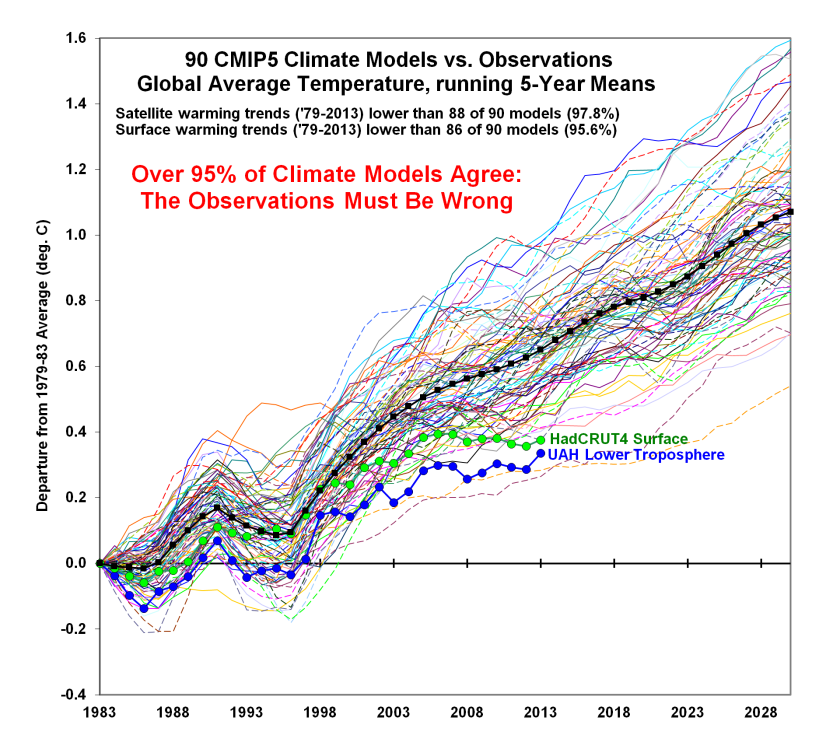
The alarmist community recognised 20 years ago that the warming is a lot less than their models had predicted. “Just you wait,” they’d say, “Sooner or later it will warm. But in the meantime, we need something else to keep the alarm going.” And they seized on extreme weather and rising sea levels and ocean acidification… Things that really were not warming. And they changed the name from global warming to climate change because warming wasn’t going to cut it. There wasn’t enough warming.
Earth has an unstable climate which isn’t very well understood to this day, and it would be wonderful if we understood it better. But I think our ability to understand it has been set back very badly by the climate hysteria. So, what could’ve been 20, 30 years of good, basic research and real understanding of the climate has been wasted with hysteria about this false climate emergency, which does not exist. In the meantime, the real parts of the climate – which would be good to understand – have been ignored.
Andrew Griffiths and Verel Rodrigues, UK climate activists, refuse to question climate alarm and forced energy transformation. They are frustrated despite major (anti-commoner) government intervention for not doing enough. And this in a country that produces about one percent of global GHG emissions.
“Personally , I’ve now reached a point where I believe breaking the law for the climate is the ethically responsible thing to do.” (- Chris Packham, UK Wildlife TV presenter & conservationist)
Andrew Griffiths and Verel Rodrigues, UK climate activists, refuse to question climate alarm and forced energy transformation. They are frustrated despite major (anti-commoner) government intervention for not doing enough. And this in a country that produces about one percent of global GHG emissions.
Instead of checking their premises, Griffiths and Rodrigues (and others) want to double down. So what is the floor on despair–when you “hit bottom” in the vernacular of addiction? Is it open-ended violence?!
Watching this eco documentary just after watching Rishi Sunak’s roll back on climate policies genuinely restored hope that there is a significant shift coming. I am grateful for Chris Packham showing leadership and pledging full support to those who break the law for climate.
Documentary presenters don’t usually make a virtue out of bewilderment, but these are confounding, confusing times. Chris Packham: Is It Time to Break the Law? – an extraordinary, anguished think piece – opens with an audio montage of Packham’s desperate thoughts about the climate crisis, arranged so they chaotically overlap. This chattering inner monologue is accompanied by the unforgettable sight of the presenter’s face slowly being smothered in thick, black crude oil.
OK, the “oil” is probably treacle, but Packham’s film does involve the idea of putting his own safety and future on the line. It is beyond merely thought provoking: it follows him as he deals with a profound dilemma about how to live his life, and what that life is for, and it tells us that this is a decision we at home must also now make. The climate apocalypse is here and, despite fires and floods around the world, there is still – maddeningly – little sign of the change needed to avert the deeper catastrophe that is coming. Voting hasn’t worked. Peaceful protest hasn’t worked. Rational debate hasn’t worked. What now?
Bring on the violence, the article and its subject continues:
Packham, however, is deeply sympathetic towards the ordinary people who have become some of Britain’s most hardline climate activists, via actions organized by the guerrilla pressure group Just Stop Oil. … Packham opines that society ought to feel shame at putting principled people behind high walls and razor wire.
But the risks these pioneers are willing to brave are not confined to retaliation by the state. Viral clips of the actions of Just Stop Oil increasingly feature members of the public taking grim pleasure in reacting with violence, from shoving activists out of the road to driving heavy goods vehicles at them. Packham states that those people have been riled up by “the rightwing media”, referring to a Mail Online article in which Just Stop Oil activists are called “zealots” who have formed a “mob”.
Knowing what is at stake, Packham is still inclined towards extreme measures – not just approving of them, but participating in them himself…. Self-confessedly lost and uncertain, he seeks further counsel. He meets the Swedish ecology professor Andreas Malm, whose book How to Blow Up a Pipeline is worth the publishing deal just for the title. Malm stresses that he doesn’t mean literally blowing things up. Well, not necessarily. But he does advocate sabotaging pipelines or other fossil-fuel infrastructure….
In the end, Packham does not make TV history by publicly announcing his intention to commit an imprisonable offence, though he does reiterate his support for climate activists who cross that line. There is one obvious reason to hope he doesn’t get himself sent to jail: it would stop him making programmes as honest, as challenging and as urgently relevant as this.
Reaction on LinkedIn
Verel’s post seconding Packham got a cool reaction. Stated the self-described “Social Entrepreneur, UN Award Recipient, Inventor, Vegan” Theo Cosmora:
Instead of spending hours sitting in the middle of the road stopping others’ important travel, which may well include someone reaching hospital in time for an urgent operation or giving birth, spend the time and resources raising money for and deploying one of these in permitted river locations around the country to deliver clean very low cost 24/7 energy to local communities nationwide.
It’s important to understand that the solutions to all are problems are already here, but they are being delayed by lack of awareness, lack of funding, and delay tactics by the fossil fuel industry. The most important thing is social change. How do we change ourselves if we are not aware of how pressing the issues we face are? Most of the population is just trying to survive, they don’t have the mental capacity to think about how climate change is going to affect them 10 years down the line.
Assuming that technology is going to fix all of our problems without fixing ourselves, is only going to create more problems. It’s a deadly cycle. Worth reflecting on this for a few days
They don’t have the mental capacity. Well, that pretty much says in all about you, does it not? We know, you are special, you are mentally capable. We bow down to your genius.
Given that you are already committed to that reality, you are not open to reason, logic, or fact based-dialog. In other words, your mind is closed and you have moved on to justifying violence in the name of the “greater good.” That makes you no better to the millions who have come before you. They all thought they were right as well.
Verel: For goodness sakes, check your premises. Don’t assume, study. Human betterment is just the opposite of what you are proposing as the God in the Machine. “The road to hell is paved with good intentions.”
Yes – there are times when governments pass laws that go against basic morality and those with morals should disobey. However regarding the use of energy to live that some say will bring disaster sometime in the future is hardly a moral imperative. Especially in light of the ongoing debate by good and honest skeptics. It is in fact immoral to silence those who may in fact be right.
But Verel might be beyond saving. He has a religion, the Church of Climate. As he commented to one critic:
I don’t see sitting in the road to raise awareness about how climate change is going to kill so many people across the world as violent. Allowing and being complicit with climate change to killing millions of people is not moral, and I support those who are doing their best to raise awareness about this crisis in whatever way they can, as long as they are not violent.
Two cheers for Rishi Sunak for having the courage to push back on some climate deadlines last week. But the dates he juggles are almost irrelevant. A cliff edge is approaching, and beyond it, a chasm that will devour whoever is in power. This is Britain’s Energy Gap, which is already here, and is getting wider every day.
The Gap is easy to understand – it’s the difference between supply and demand. Western societies have committed themselves to the electrification of transport and heating, but without actually providing sufficient electricity to achieve this goal. The size of the gap is contentious. It will be twice as much electricity by 2050 than we make or use today, according to the British Energy Security Strategy.
But nobody believes that number is realistic: in reality, we’ll need much more. Electrifying home heating, transport, and industry and commerce, requires around “four times” more power than we make and use today, a minister acknowledged in January 2022.
The Energy Gap is more than a cost or an inconvenience, but an existential threat to our national security and social stability. The more we depend on unreliable energy, the higher the risk of a catastrophic societal breakdown if the grid fails us.
When demand exceeds supply, the electricity grid collapses, and the consequences of that are very serious indeed. Food can’t reach the supermarkets, because petrol stations can’t pump diesel – let alone charge an EV. People freeze in their homes. Thousands of water pumping stations have no backup power. Without clean water, disease can break out. And don’t expect Britain’s creaking water infrastructure to keep working when it can’t cope with a heavy rain shower today.
This nightmare will most likely happen in deepest midwinter, during those beautiful, clear, calm lulls that the Germans have a word for – a dunkelflaute. That’s when an anticyclone settles upon us, and the wind doesn’t blow.
Last winter, one such a spell lasted over a fortnight, during which time the British mainland saw almost no wattage returned from its costly investments in onshore wind: the wind didn’t move the air fast enough to turn their blades. Not many more of our offshore facilities reached the required speed, either, although a few did.
The Gap is here today, the National Grid confirms. Today, we need over 60GW of electricity at peak demand, with much of our home heating and transportation using dependable hydrocarbons instead. But even so, the Grid acknowledges we can’t meet demand as it is.
The Grid then has to fall back on what it calls “operational tools”, of which “Demand Flexibility Service” is the most ominous. We already rely on other countries to sell us their surplus, at a pretty price, via interconnectors. Now imagine what happens when the anticyclone becalms Europe. Then no country could afford to export energy, and the entire continent grinds to a halt.
Add in around 50GW more to keep HGVs and large vans moving. (I haven’t counted small vans, which make more journeys than ever). On top of that, UCL researchers reckon an additional 70GW will be needed at peak times to get us through a cold winter like 2010 using heat pumps.
Alas, we’re closing nuclear power stations faster than we‘re building them. So the paltry “24 GW [more] by 2050” that the Security Strategy blithely predicts falls short by about 90 per cent. What about batteries, you wonder – surely there must be a Plan B? Alas, our largest battery backup facility can power 300,000 households for just two hours. That’s not much use for Britain’s other 28 million homes.
What’s remarkable about the Energy Gap is how so many people in authority have been able to ignore it for so long – either by fudging reality, or pretending it doesn’t exist at all. In July, the Grid published its latest Future Energy Scenarios (FES), which made an attempt to square the circle.
It does so by predicting we will use much less energy than we do today: up to 52 per cent less. As energy expert and blogger David Turver points out, no Western society has achieved this or would want to. Nor does the Grid doesn’t explain how this will be achieved.
I’m not the first to warn about the looming societal breakdown, or even write about it. Researcher James McSweeney raised it in The Critic, suggesting it will arrive in 2035. It may be even sooner than that.
“No one has the courage to look people in the eye and explain what that involves,” said Rishi Sunak in his speech last week. I fear that as a storyteller, he has barely begun on such a journey.
But he should take heart that both Germany and Sweden have embarked on emergency expansions of hydrocarbons and nuclear – while still swearing loyalty to net zero targets. Those pledges, like those sacred targets, don’t mean anything any more.
Prime Minister Rishi Sunak’s new net zero targets will be irrelevant if there’s not enough energy CREDIT: POOL/via REUTERS
It is worth pointing out that Andrew Orlowski is a technology journalist. So he knows what is talking about, unlike the Emma Gattens of the world who environmental reporters and who usually get to report on energy matters.
Prime MInister Rishi Sunak. One of Rishi’s first acts as Prime Minister was to re-instate the fracking ban. By Chris McAndrew – link, CC BY 3.0, link
If only this was true. The real British conservative energy policy is a lot stranger.
Rishi Sunak has ripped up decades of cross-party consensus on climate change
Published: September 27, 2023 1.13am AEST
Tim Jackson Professor of Sustainable Development and Director of the Centre for the Understanding of Sustainable Prosperity (CUSP), University of Surrey
…
I’d had what you might call a front row seat as a political consensus on climate change emerged in the UK. But during the long and uncomfortable 25 minutes of Sunak’s speech, I felt I was witnessing a homage to catatonia.
There was so much patently wrong in the speech that it’s difficult to know where to start. Most obviously, the prime minister’s insistence that the UK can still meet its climate commitments, despite putting a brake on policy, bucks his own advisors’ assessment of the country’s progress towards net zero emissions. It also reveals a deep misunderstanding of the science.
…
As my own analysis has shown, the UK’s fair share of the global carbon budget, taking into account the development needs of the poorest parts of the world, will be exhausted before 2030. Forget 2050. The science is clear. Delay is tantamount to capitulation.
…
Those costs are already being counted: fires in Europe and Canada, droughts in North America and Africa, floods in Libya. All this will keep getting worse. Homes in some parts of the US are already “essentially uninsurable” because of climate risk.
…
It’s no surprise to find an embattled political party trying to draw clear blue water between itself and the opposition. Buoyed by Labour’s narrow defeat in the Uxbridge and South Ruislip byelection (widely attributed to a backlash against London’s Ulez policy) Tory strategy is now turning net zero into election fodder.
Back in the real world, British Prime Minister Rishi Sunak did not back down from Net Zero, quite the opposite. He just pushed back a few targets, on the reasonable grounds that the current plan was unacceptably expensive for poor people – but sadly left most of the excruciatingly expensive policy package and goals in place.
…
No one can watch the floods in Libya or the extreme heat in Europe this summer, and doubt that it is real and happening.
We must reduce our emissions.
And when I look at our economic future, I see huge opportunities in green industry.
The change in our economy is as profound as the industrial revolution and I’m confident that we can lead the world now as we did then.
So, I’ll have no truck with anyone saying we lack ambition.
But there’s nothing ambitious about simply asserting a goal for a short-term headline without being honest with the public about the tough choices and sacrifices involved and without any meaningful democratic debate about how we get there.
…
Now I believe deeply that when you ask most people about climate change, they want to do the right thing, they’re even prepared to make sacrifices.
But it cannot be right for Westminster to impose such significant costs on working people especially those who are already struggling to make ends meet and to interfere so much in people’s way of life without a properly informed national debate.
Why is Prime Minister Rishi Sunak so confident Britain can hit Net Zero despite backpedaling on policies which likely would already have been inadequate for the task?
This is where it gets a little strange.
Hasty changes to Sunak’s climate strategy reveal a warring Tory party
Fiona Harvey Environment editor Fri 31 Mar 2023 04.05 AEDT
Major omissions and a last-minute refocus on energy security rather than net zero suggest a prime minister buffeted by internal factions
Rishi Sunak, the UK prime minister, headed to Oxfordshire on Thursday to visit a development facility for nuclear fusion, the early-stage concept that promises unlimited clean energy at an unspecified future point, if only some hefty physical constraints can be overcome.
He was accompanied by Grant Shapps, energy and net zero secretary, for the biggest energy and climate change announcement of his premiership, a comprehensive package of measures encompassing everything from onshore wind and solar power to carbon taxes and heat pumps.
“When global energy supplies are disrupted and weaponised by the likes of Putin, we have seen household bills soar and economic growth slow around the world,” said Sunak, of the “powering up Britain” energy package. “We have stepped in to shield people from its worst impacts by helping to pay around half the typical energy bill. But we are also stepping up to power Britain and ensure our energy security in the long term, with more affordable, clean energy from Britain, so we can drive down energy prices and grow our economy.”
British conservative energy policy appears to be a confident assumption that the rollout of commercial nuclear fusion is imminent. They’ve even started picking out generator sites.
Another STEP towards near limitless, low-carbon energy at West Burton
The future of abundant low-carbon energy without the need for fossil fuels could be in sight after Science Minister George Freeman announced the creation of a new delivery body for the UK’s fusion programme, named UK Industrial Fusion Solutions Ltd.
…
On the visit to the future site of the UK’s first prototype fusion energy plant at West Burton, near Retford, the minister urged energy companies and investors to recognise the vast potential fusion energy could have for both the UK and the wider world.
The Spherical Tokamak for Energy Production (STEP) plant will be constructed by 2040 to demonstrate the ability to use fusion energy to generate electricity for the UK grid.
MPs in Nottinghamshire’s former coalfield communities say the construction of the UK’s first nuclear fusion site in the county could replace some of the jobs lost from coal mining. A national inquiry has launched to consider questions such as whether the job losses from the coal industry have been fully replaced and whether these jobs are adequate in terms of pay and opportunities.
A devolution deal to give more power to Nottinghamshire councils has also been highlighted as something which could improve long-term opportunities for people living in former coalfield areas. Nottinghamshire was home to several pits in areas such as Ashfield, Bassetlaw and Mansfield, but most of them closed in the 90s and early 2000s, with the county’s last working colliery at Thoresby closing in 2015.
Since then, studies have shown people in these former mining areas find it harder to get good jobs than in other areas of the country. A 2019 report by Sheffield Hallam University found the former coalfields have only 55 employee jobs per 100 residents of working age, compared to a national average of 73.
The British Conservative suggestion nuclear fusion is imminent is so absurd, betting the entire country on such a gamble is so reckless, there are times I wonder if their minds have snapped.
Britain has made noteworthy contributions to nuclear fusion. The British spherical tokamak is a significant advance on traditional donut shaped nuclear fusion tokamaks, the spherical configuration substantially addresses magnetic containment defects inherent to traditional donut shaped tokamaks. But so do other improvements on the original tokamak such as the Stellarator – and that was developed decades ago.
None of these fusion innovations are ready for prime time. There are still huge problems still to address, like whether they scale, how to move from a few seconds plasma stability to hours or days, research into breakthrough reactor core materials which can withstand the blast of radiation from the fusion plasma without crumbling into dust (a far greater challenge for fusion than with fission reactors), and how to make the reactors affordable if they in fact do turn out to be scalable.
Yet the British Conservative Government is giving every impression that fusion jobs are all the benefits are about to happen. Squeezing votes and continued support out of working class people whose lives were ruined by green energy policy madness, encouraging desperate voters to believe in false hopes of an imminent fusion renaissance, to say I’m disgusted with such vile political messaging would be an understatement.
Throw another one onto the “growing number” (growing number!) of “Exxon Knew”-style lawsuits which insinuate that ‘Big Oil’ knew the burning of fossil fuels harmed the environment but deceived the public by employing ‘shill’ climate scientists in ‘disinformation campaigns’ to say there was no harm.
Throw another one onto the “growing number” (growing number!) of “Exxon Knew”-style lawsuits which insinuate that ‘Big Oil’ knew the burning of fossil fuels harmed the environment but deceived the public by employing ‘shill’ climate scientists in ‘disinformation campaigns’ to say there was no harm. This latest Sept 15, 2023 filing appears to be no different than the 31 other “Exxon Knew” lawsuits I’ve dissected where it fits a pattern of repeating (plagiarizing?) material out of the others, from dubious ‘science certainty’ assertions to corruption accusations worded carelessly enough that they potentially stray into reckless disregard territory. I’ll get into how this latest one fits that pattern, but first, let me illustrate how the ‘news reports’ about it reinforce the problem that we no longer have an objective news reporting media, we have a propaganda media telling the public – working at the most basic of intellectually dishonest levels – about these lawsuits.
Sift though enough of the ‘news reporting’ about this lawsuit and the impression soon forms that, well, finally California has entered the fray of climate litigation to hold the fossil fuel industry accountable for the harm brought on by catastrophic Clima-Change™, inadvertently implying that while it’s late coming to the party, it’s late punch will be devastating. Associated Press: “California’s legal action joins similar lawsuits.” CNBC: “California’s complaint joins a wave of climate litigation.” Reuters: “it’s ominous for oil firms that the state has joined others.” Politico: “California’s legal action joins dozens of similar lawsuits.” E&E News: ‘Watershed moment’: California enters climate litigation fray.”
The 9/16/23 National Public Radio online article continued that basic theme, but went one increment farther by asking “Why Now?” as though California had been waiting for some particularly opportune time.
That was the wrong question.
The correct question is “Why Again??”
Wasn’t the two separate same-day filings back in September 2017 of People of the State of California v. BP PLC, et al. in San Francisco Superior Court and Alameda Superior Court more than adequate enough to get the point across?
Weren’t “The Peoples of CA v Big Oil” lawsuits filed by the San Francisco Sher Edling law firm between Sept 2017 and January 2018 for six California cities more than adequate enough? Aren’t the ten additional lawsuits filed by Sher Edling from Hawaii to Delaware approaching pure California-influence overkill? Isn’t the Sher Edling assistance into three more supposedly “independently-led” lawsuits starting to look like ‘California’ is the ‘man who came to dinner and now won’t leave?’ Does Sher Edling’s self-admitted takeover of those two California Superior Court lawsuits end up indicating that “California” is no late-comer here at all, but instead is the possibly ‘over-70-percentage-gorilla-in-the-room’ of all the current “Exxon Knew” lawsuits? Was the unsuccessful attempt to shoehorn that law firm into Florida lawsuits an indication that the whole U.S. “Exxon Knew” climate litigation is approaching almost an entirely California-influence effort?
News media reporters are being intellectually dishonest with both the public and themselves if they believe this State of California v. Exxon lawsuit is any kind of ‘first’ for California overall. It’s also quite clear from their ‘reporting’ that they have no intellectual curiosity about whether the central accusations in these have any merit — that Exxon knew runaway global warming was caused by the use of their product, and that Exxon colluded with skeptic climate scientists and other skeptic ‘shills’ in disinformation campaigns.
So on that latter note, let’s examine where this lawsuit shares fatal faults – just like the dozen+ similar lawsuits, which have suspect citations for their corrupt activity accusations. As loyal readers at GelbspanFiles know, this can get really repetitive, so I’ll just cover three fatally faulty claims which potentially could prompt any one of these lawsuits to be dismissed for being devoid of evidence to back up the claims.
First, with just a few exceptions among the other 28, nearly all of these lawsuits are enslaved to both ye olde notorious ‘leaked industry memos’ known as the “reposition global warming” set andye olde 1998 American Petroleum Institute “victory will be achieved” set. The former set is absolutely the best the enviro-activists have in their arsenal to accuse fossil fuel execs of running sinister disinformation plans, the latter comes in as a weak second-best. Neither were ever implemented, they are worthless to serve as evidence because of that. In a flippant illustration, I put them together into a single silly indictment phrase to show how the Puerto Rico v Exxon lawsuit fit the pattern of enslavement to them. Massachusetts v. Exxon is enslaved singly to the “reposition global warming” memo set, as I noted in my dissection about the filing referring to it in an oddly cursory manner; nobody uses language like that, so it was unmistakable what the intent was. My dissections of District of Columbia v Exxon and Connecticut v. Exxon describe how each of those only featured the “victory” memo set as its cornerstone evidence about industry disinformation campaigns. The prior 2017twin The People of CA v BP lawsuits did that, too.
Next, this CA v Exxon repeats the narrative about a 1977 presentation made by James Black to Exxon, which supposedly proves Exxon knew with absolute certainty as far back as the 1970s that burning fossil fuels caused global warming. In my web browser, due to a possible glitch, the DocumentCloud link this filing cites for the report displays a blank page. There’s more than one way to skin a cat, as the old saying goes. I can at minimum drop the link into a Google search and see how the result spells out a portion of the page; Google displays the same thing in its text-only Cache result. The link opens on my smartphone. Who uploaded that page?
Roland C. “Kert” Davies. Davies.Davies. Those orangy smudges up at the top right of the document scan? Same seen right at his Climate Files page for the James Black Report (I get the same blank page glitch in my old computer’s browser – here’s the screencapture from my smartphone). Question is, why didn’t CA AG Bonta’s office dispense with the “DocumentCloud” link and just link straight to Davies’ Climate Files page? They already cite his pages eleven times, why not once more for the ‘most damaging industry memo evidence’ AG Bonta has?
There’s a gigantic hole in that claim, big enough to drive a Mack truck factory through. There’s no way possible Exxon could have known their products would cause global warming in the face of rampant reports across the spectrum back then on the potential for runaway global cooling. Over at Tony Heller’s blog (when efforts fail to erase his blog completely off the internet), he can describe for hours on end how the years prior to the late 1980s were awash with reports of global cooling. Even the TV sitcom “Barney Miller” had an episode in 1977 in which the brainy detective character explains the effects of killer cooling.
Third, CA AG Bonta’s office dug a hole for themselves even deeper than all the prior “Exxon Knew” lawsuits with this filing’s new ‘evidence citation’ twist for its accusation that skeptic climate scientist Dr Willie Soon is ‘on the payroll of Big Oil to spread disinformation.’ I didn’t have an opportunity to mention it in my 2018 dissection of Boulder v Suncor or my prior post followup on that lawsuit’s handlers having an apparently troubling association with Sher Edling, but the Boulder filing essentially accused Dr Soon of taking bribes from Exxon … sans any citation sources to support that accusation. The supposedly also ‘independently done’ Vermont v Exxon lawsuit did the same thing, just without mentioning Dr Soon. As I showed in my dissection of the Sher Edling Delaware v BP, all of their boilerplate copy lawsuits had the specific word “bankroll” in their accusation against Dr Soon, relying on a 2015 Smithsonian press release page as their evidence that he didn’t fully disclose his funding, where from Delaware onward to the last in their line, New Jersey AG’s Platkin v Exxon, they switched to citing an Internet Archive version of that press release. Notwithstanding that the Smithsonian press release merely stated that Smithsonian was only beginning its investigation of Dr Soon’s funding, of course. Only. Beginning. Allegations of wrongdoing are not proof of wrongdoing. The Oregon county Multnomah v Exxon filing – a seemingly plagiarized copy of Puerto Rico v Exxon as I detailed in my dissection of Multnomah – featured the same “bankroll” accusation that Puerto Rico had, but the twist there (having the Sher Edling “bankroll” accusation repeated too similarly to be a coincidence) is that both of those lawsuits inexplicably had the “LegiStorm” page’s copy of the 2015 Smithsonian press release. LegiStorm is a database of Capitol Hill staffers, not an archive site for museum press releases.
What’s the egregious twist in the CA v Exxon accusation against Dr Soon? AG Bonta’s office didn’t use an Internet Archive version of the Smithsonian press release. They didn’t use the wacko LegiStorm link. They didn’t point to the Smithsonian press release at all. They cited a SmithsonianMag.com 2015 article about the news of Dr Soon’s ‘undisclosed $1.2 million Exxon bribe.’ The article author only goes so far as to say the New York Times broke the news of this situation, and that the accusation comes from Greenpeace and some outfit called the ‘Climate Investigations Center.’ Readers have to read all the way to the bottom before they get to the bit about the Smithsonian Institute only beginning their inquiry. Who does the NYT hit piece say runs the Climate Investigations Center? Wait for it …… Kert Davies — who mere days before this ‘big news exposé’ was described in an email by the Rockefeller Family Fund Director Lee Wassermann to the New York Attorney General’s office as Roland Davies.
Why did the Smithsonian Institute apparently felt a need to take their press release offline about investigating Dr Soon? As Dr Soon said in this Oct 2022 video clip – the result of the 5 year Smithsonian investigation is that he committed no wrongdoings. If the Smithsonian had found anything that even remotely resembled Dr Soon hiding this ‘Exxon funding’ situation, wouldn’t the revelation had been broadcasted to the entire world by every one of Dr Soon’s detractors from Davies to Desmogblog??
Let me emphasize this again: Allegations of wrongdoing are not proof of wrongdoing.
One more thing here, regarding AG Bonta’s office’s specific wording against Dr Soon: where have we seen that before, in nearly the identical, straying-into-plagiarism-territory? The last in the line of the Sher Edling lawsuits, NJ AG Platkin’s filing. I highlight the wording differences in gray.
In the Sept 20th broadcast of the PBS NewsHour, its host interviewed AG Bonta about his lawsuit, initially handing him a softball question about the complicity of fossil fuel companies in deceiving the public on what they knew, and then later posing a question based on the false premise that the industry was already guilty of causing …… weather events. No joke.
Those were the wrong questions. A proper, objective, hard-nosed investigative team would have carefully read through the filing, done background research on similar filings, spotted items to question, and compiled these kinds of questions for the host to ask:
• Your suit alleges that as far back as the 1960s and ’70s that the industry as a whole knew for certain that usage of their products could lead to catastrophic global warming. How do you justify that in the face of so many news reports and analysis during that time that the Earth might be headed into a period of significant cooling? • In your suit, you allege that a particular set of memos, which at least at first glance, seem to be not much more than a set of truisms about how the public might become better informed after learning about what skeptic climate scientists have to say. How do you prove there was an outright conspiracy to deceive the public based on the wording of those memos? • Regarding industry-paid corruption of skeptic climate scientists, one of your footnote references was to a 2015 article about a scientist working at that time for the Smithsonian Institute where the allegation was that the scientist failed to disclose Exxon-sourced million dollar-plus funding of his work and the end of the article noted that the Smithsonian Institute was undertaking an investigation as to whether he violated funding disclosure requirements there. Do you know what the Smithsonian Institute’s investigation results were?
Truth of the matter is, after objective examination, this latest People of the State of California v. ExxonMobil lawsuit is not a watershed legal action in the least, it is little more than a repackaged repetition of prior lawsuits among a larger lineage of efforts dating back to the late 1990s** to defame the fossil fuel industry and skeptic climate scientists. And the coverage of this latest lawsuit once again illustrates mainstream media journalism malfeasance on the overall climate issue. —————————————————————— **(Don’t get me started on the intellectually dishonest accusation in that screencapture about Dr S Fred Singer’s “Exxon/Shell/ARCO/Unocal/Sun Oil funding,” and how the last objective reporting about such accusations was done in 1994by ABC Nightline’s Ted Koppel)
The illogical conclusion of tail-wagging-dog climate theories fed into models based on them, with a side order of volcanoes. In any case a lot happened to Earth in the last 250 million years, including periods when CO2 was much higher than today – so whatever comes out of a supercomputer, natural evolution will continue.
The illogical conclusion of tail-wagging-dog climate theories fed into models based on them, with a side order of volcanoes. In any case a lot happened to Earth in the last 250 million years, including periods when CO2 was much higher than today – so whatever comes out of a supercomputer, natural evolution will continue. – – – Extreme global warming will likely wipe all mammals – including humans – off the face of the Earth in 250 million years, according to a new scientific study. Sky News reporting.
Temperatures could spiral to 70C (158F) and transform the planet into a “hostile environment devoid of food and water”, the research warns.
The planet would heat up to such an extent that many mammals would be unable to survive – and the Earth’s continents would merge to form one hot, dry, uninhabitable supercontinent.
The apocalyptic projections are from the first-ever supercomputer climate models.
They suggest the sun would become brighter, with tectonic movements unleashing huge amounts of carbon dioxide (CO2) into the air through volcanic eruptions.
The Earth would become so hot that only 8% to 16% of the projected supercontinent would be habitable.
Mammals, including humans, are better adapted to living in the cold, and are less able to deal with extreme heat.
‘Humans would expire’
The study’s lead author, Dr Alexander Farnsworth of the University of Bristol, said: “The newly emerged supercontinent would effectively create a triple whammy, comprising the continentality effect, hotter sun and more CO2 in the atmosphere, of increasing heat for much of the planet.
“The result is a mostly hostile environment devoid of food and water sources for mammals.
“Widespread temperatures of between 40C to 50C, and even greater daily extremes, compounded by high levels of humidity would ultimately seal our fate.
“Humans – along with many other species – would expire due to their inability to shed this heat through sweat, cooling their bodies.”
The authors of the research believe CO2 levels could rise from around 400 parts per million (ppm) today to more than 600 ppm by the time of the formation of the supercontinent – named Pangea Ultima.
This assumes, however, that humans stop burning fossil fuels – “otherwise we will see those numbers much, much sooner”, warned Professor Benjamin Mills, who calculated the future CO2 projections for the study.
“The injunction is a necessary and welcome response from the court to an unnecessary decision by the Biden administration. The removal of millions of highly prospective acres and the imposition of excessive restrictions stemmed from a voluntary agreement with activist groups that circumvented the law, ignored science, and bypassed public input.
For Immediate Release: Friday, September 22, 2023 NOIA Contact: jwilliams@noia.org
U.S. District Court for the Western District of Louisiana Preliminary Injunction Corrects Biden Restrictions on Gulf Energy Development
Washington, D.C. – Erik Milito, President of the National Ocean Industries Association (NOIA), issued the following statement in response to the U.S. District Court for the Western District of Louisiana’s preliminary injunction finding that the implementation of the challenged actions was procedurally invalid and that Interior’s decision was arbitrary and capricious. This injunction blocks the new restrictions related to the Rice’s whale in the Final Notice of Sale for Gulf of Mexico Lease Sale 261 and restores millions of acres to the sale.
“The injunction is a necessary and welcome response from the court to an unnecessary decision by the Biden administration. The removal of millions of highly prospective acres and the imposition of excessive restrictions stemmed from a voluntary agreement with activist groups that circumvented the law, ignored science, and bypassed public input.
“In a period when inflation is increasing expenses for Americans, particularly in terms of gasoline prices, we must fully harness America’s energy production capabilities, particularly those offshore. Our leaders should stop ignoring the vast benefits that U.S. offshore oil and gas production provides to Americans. This includes an abundance of energy resources, high-paying job opportunities, environmentally responsible low carbon output, support for coastal resilience and restoration, and enhanced national security, among numerous other benefits.”
##
About NOIA The National Ocean Industries Association (NOIA) represents and advances a dynamic and growing offshore energy industry, providing solutions that support communities and protect our workers, the public and our environment.NOIA
Just in the nick of time
The Bureau of Ocean Energy Management (BOEM) will conduct Lease Sale 261 tomorrow morning. No doubt there will be a lot of bids on blocks that would have otherwise been excluded from the sale.
Rice’s whales are primarily located in the yellow and back outlined area in the Eastern Gulf of Mexico, an area off-limits to oil & gas exploration. The Biden administration attempted to illegally remove the “Rice’s Whale Exanded Area” (dark blue area on map below) from this, and all future, lease sales.
The Biden administration attempted to exclude one of the most active areas from Sale 261. The Flex Trend was one of the first deepwater plays the location of dozens of production platforms and other infrastructure. Recent advances in seismic imaging have rejuvenated this play.
Reprocessed Flex Trend data reveals near-field GoM potential
May 19, 2021
PGS has released more full integrity products from the Flex Vision data rejuvenation program in the Gulf of Mexico.
Offshore staff
OSLO, Norway – PGS has released more full integrity products from the Flex Vision data rejuvenation program in the Gulf of Mexico.
The application of new imaging technology to the Flex Trend has revealed near-field opportunities that boost potential far beyond original estimates, the company said.
New data unlocks opportunities adjacent to existing discoveries, to enable infrastructure-led exploration in an area of the Gulf of Mexico that has been producing oil and gas for more than two decades. Salt, the biggest challenge for exploration on the Flex Trend, is resolved with high-quality depth imaging and improved velocity control.
Oil production isn’t “under Biden.” Biden has no control over oil production from private and state-owned leases. About 24% of our total domestic crude oil production comes from Federal leases. This production is conducted under Federal laws passed by Congress. It is not “under Biden.” Although Biden has done everything in his power to inhibit oil production. These generally unlawful actions haven’t reduced current production. They will delay and/or reduce future production. This is particularly true for offshore production.
Biden: I Wanted ‘to Stop All Drilling’ on the Coasts and Gulf, Got Blocked by Courts
During an interview with The Weather Channel that is set to air on Wednesday, a portion of which aired on Tuesday, President Joe Biden said that he “wanted to stop all drilling on the East Coast and the West Coast and in the Gulf” but was blocked by the courts from doing so.
From the time a lease is awarded, it can take years to establish production. Biden’s intent is to reduce future production by delaying and slowing down the pace of leasing.
From the time a lease is awarded, it can take years to establish production. Biden’s intent is to reduce future production by delaying and slowing down the pace of leasing.
Biden’s Abysmal Lease Record
When Biden became President, he immediately placed a moratorium on lease sales supposedly for agencies to review their practices due to climate change. During his first 19 months in office, President Biden leased fewer acres for offshore oil and gas production than any other President before him since the inception of offshore drilling rights. Not since Harry Truman have fewer acres of federal land or offshore rights to develop oil and gas resources been leased by a U.S. president. Under President Truman, offshore drilling was just beginning and the federal government did not yet control the deep-water leases that have made up the largest part of the federal oil-and-gas program. It is clear from the graph below that the Biden administration is withholding U.S. energy development at a time when the world is facing an energy crisis and consumers are experiencing very high energy prices. President Biden is withholding resources that Americans own, resulting in gasoline prices reaching an all-time high of $5 a gallon in June 2022 and remaining over a dollar per gallon above the gas price when he took office The following graph from the Wall Street Journal indicates how few acres have been leased during Biden’s first 19 months in office despite the law requiring oil and natural gas lease sales.
Meanwhile, rival litigation filed by Earthjustice and other prominent environmental groups seeks to halt the lease sale. The organizations say the lease sale violates the National Environmental Policy. They say the administration failed to account for health threats to Gulf Coast communities near oil refineries and didn’t adequately the effects of new fossil fuel development on the climate.AP
They filed their lawsuit in the District of Columbia Circuit, where Federal judges routinely put left-wing causes above the law. The Inflation Reduction Act requires that Sale 261 be held before September 30, 2023.
These same environmental activists will likely try to prevent BOEM from issuing a new five-year leasing plan… Something BOEM is legally required to do.
In September, Interior is also expected to release its final proposed Five-Year Program (National OCS Oil and Gas Leasing Program) for offshore oil and gas leasing this September. The final plan, which lasts through 2028, could include as many as 11 new offshore lease sales, according to the proposed program. Holding 11 new fossil fuel auctions would sanction up to 70 years of additional fossil-fuel extraction with the potential to emit up to 3.5 billion tons of carbon pollution.
The Green funds cartel is “in shock” sayth Bloomberg, at the Sunak shift — so it must be pretty serious. Green investors are using the words “dismay” and “bewilderment”, which they almost never use. Green investment relies almost entirely on crowd psychology and government subsidies, so normally bad news is padded and fluffed so it doesn’t look so bad. We wouldn’t want to lose momentum would we? Boy are they losing momentum.
It threatens to ignite a climate election. It matters, because now, suddenly, one party can point out the absurdities and the costs. They can be an Opposition, and mock the sacred cows. That doesn’t mean Sunak will do that, but the fork in the road has opened, the world is watching — and his party is suddenly up four points.
The Green funds cartel is “in shock” sayth Bloomberg, at the Sunak shift — so it must be pretty serious. Green investors are using the words “dismay” and “bewilderment”, which they almost never use. Green investment relies almost entirely on crowd psychology and government subsidies, so normally bad news is padded and fluffed so it doesn’t look so bad. We wouldn’t want to lose momentum would we? Boy are they losing momentum.
Meanwhile Sweden has not only cut climate money a bit, it’s unshackled some taxes off fossil fuels as well, leaving the centre left apoplectic and threatening to move motions of no-confidence. It is unthinkable, apparently, but Sweden might even increase emissions.
What’s more scary than climate change? — The rise of the far-right
The quote of the day is from a German politician who sums up the major driver of these policy shifts.
Earlier this month, German Finance Minister Christian Lindner told Politico that stricter energy efficiency rules for buildings could fuel the rise of the far-right, amid growing apathy across Europe over plans to reach net zero.
So Climate Change might cause the sixth mass extinction of life on Earth, but nothing is more frightening than the possibility of the far-left losing power at elections.*
Polls have leapt for the conservative government in the UK since Rishi Sunak slowed the NetZero train
This is what all the Climate-believer politicians are afraid of. Deep down, they know the NetZero quest is not popular with the masses, even though they say it is all the time. If they thought climate policies were really winners with the workers, they wouldn’t be so afraid of their opponents catching the skeptical train would they? Instead, they are aghast when their opponents dare suggest other priorities might be higher than changing the weather.
Deltapoll polled people from the 22nd to 25th, and saw a four point swing from Labour to the Tories compared to their last poll 10 days ago. Labour are down three points, with Mr Sunak’s party rising five points. While Labour is still ahead of the Tories by 16 points, this is a significant swing in a short amount of time.
The poll was of 1,507 adults from Great Britain…
This is a very good sign. Financial types almost never speak unguarded, out loud, lest they scare the horses. This is panic:
Some of the world’s biggest green investors are voicing dismay and bewilderment as they struggle to digest the UK government’s stated intention to wind back key climate commitments.
“It was a complete shock,” said Ian Simm, founder and chief executive of London-based Impax Asset Management Group Plc, a low-carbon fund investor overseeing close to $50 billion in assets. Britain’s official policy now represents “a risk for anyone considering an investment in the UK that’s dependent on government policy,” he said.
Investments in “government policy” are always riskier compared to investments in essential goods and services. They’re shaking, because the magic spell has broken. The cash cow might evaporate.
The budget, unveiled on Wednesday morning, includes a 259m krona (£19m) reduction in funding for climate and environmental measures next year, and tax cuts on petrol and diesel.
Rickard Nordin, the climate and energy spokesperson for the opposition Centre party, condemned the climate cuts, which he said were unprecedented.
“What has happened is that the Swedish government is consciously increasing emissions,” he said. “No Swedish government in modern times has consciously increased emissions. Few countries in the world have done that and it’s extremely serious.”
Amazing he could say it with a straight face — few countries have consciously increased emissions, he says, as if China and India don’t exist.
Macron is changing his tune too:
“We will not prohibit” the installation of new gas boilers, he said, “because we cannot leave our compatriots, particularly in the most rural areas, without a solution,” said Mr Macron.
The French “love their car, and I do too” said Mr Macron on Sunday in a prime-time TV interview, acknowledging public reluctance to switch to electric vehicles with higher purchase prices than combustion-engine cars.
So many key words repeated in so many countries at the same time.
*We breathe a sigh of relief that some elections still matter. This is good news.
Above all it is not conservative to bypass the public and effectively hand control of public policy to a tiny, unelected clique of extreme climate activists and the renewable lobby.
Conservatism is about being pragmatic, fiscally competent and defending personal freedoms from the abuses of state power.
It is not conservative to force the public to spend tens of thousands on products they don’t want.
It is not conservative to ban things.
It is not conservative to wreck the car industry.
It is not conservative to endanger our electricity grid.
It is not conservative to damage the economy in pursuit of a target that is meaningless, given the continued growth in global emissions.
It is not conservative to blindly carry on with policies which are not working.
Above all it is not conservative to bypass the public and effectively hand control of public policy to a tiny, unelected clique of extreme climate activists and the renewable lobby.
When all else fails on the climate fearmongering front, try warning that beer shortages are likely in the near future. The Financial Times reports that the Chief Executive of the Japanese brewer Asahi, Atsushi Katsuki, says climate change could lead to beer shortages as warmer temperatures hit barley and hop supplies around the world. Fortune goes into full climate tragedy mode, noting: “Beer could face an existential crisis.”
When all else fails on the climate fearmongering front, try warning that beer shortages are likely in the near future. The Financial Times reports that the Chief Executive of the Japanese brewer Asahi, Atsushi Katsuki, says climate change could lead to beer shortages as warmer temperatures hit barley and hop supplies around the world. Fortune goes into full climate tragedy mode, noting: “Beer could face an existential crisis.” Needless to say, missing from all this doomsday drivel is a note that barley is the most adaptable cereal and can grow in many areas from the sub-tropics to the Arctic. Meanwhile, world hop production has never been in better health with global acreage rising in 2021 for the eighth year in succession.
This is not the first time the booze gets it in the climate crisis, with the need to constantly supply political messaging to promote Net Zero. Earlier this year, America celebrated National Margarita Day with CNN warning that climate change could be coming for the seemingly luckless libation. Behind the scare was some made-up nonsense about the weather affecting the ingredients going into tequila, despite the fact that since 1995 tequila production has increased six-fold, and from 2018 it has doubled.
Pushing the beer scare, the Asahi boss spoke of significant falls in the barley harvest and the quality of hops under the “UN’s four degrees scenario”. This assumption from the Intergovernmental Panel on Climate Change is used to posit a rise of nearly 3°C in less than 30 years, a ‘pathway’ that is an insult to scientific realism given that global temperatures have barely risen by 0.2°C over the last 25 years. Perhaps Mr. Katsuki was imbibing a little too freely of his excellent product when he told the FT that volatile weather has already interfered with barley yields in recent years. Curiously he added that climate change “had a bigger impact on the price of barley than even Russia’s invasion of Ukraine”.
A great deal of barley ends up with brewers, and with important sectors like beer considered a mature business, with steady rather than spectacular growth, the demand for the grain is fairly constant. Like all harvests it can be affected by local weather conditions but the Statistica graph above shows a steady trend with 2020-21 posting a record total of 160.91 million metric tons. If there are to be dramatic shortages in barley going forward due to climate change, they have yet to show up in the production record. Meanwhile, the situation in Ukraine is of particular concern since it is one of the world’s top producers of the crop.
Barley is a versatile global grain and ranks fourth in both quantity produced and area of cultivation. It is much prized because it is so versatile and can thrive in regions where cereals such as maize and rice do not grow well. According to the agricultural scientist Meixue Zhou, it grows in areas up to the Arctic, along with near desert areas such as North Africa. Other areas where it can thrive include those with a Mediterranean climate, as well as those with oceanic and continental features. In the United States, barley can be grown from the northern tip of Maine down to southern Florida, Texas and much of California. Throughout human history it has played an important part in both food production – humans and animal – and brewing, due to its tolerance of aridity and salinity along with adaptability to weather.
Over on the hop front, two countries – Germany and the United States – account for 77% of world hop acreage, according to Craft Brewing Business, quoting from the BarthHass Report 2021-2022. Alpha acid content is an important factor in beer flavouring, and volumes of this prized ingredient in recent years are said to be at their “highest levels yet”. In the FT, Mr. Katasuki, noted the role hops played in flavouring beer, but claimed that analysis conducted by his company found global warming meant the quality of hops would reduce “significantly” over the next three decades.
In the meantime, the recent problems for the hop growing business are somewhat different to those forecast by Katasuki. “Production cost increases and over-production are a dangerous combination presenting the hop industry with huge challenges. The global hop industry can only counter excess production by adjusting acreage,” observes Peter Hintermeier, of BarthHaas.
Perhaps the Asahi boss gets extra ESG points for pumping out climate fear stories. Back in the real world, with shareholders to keep sweet, he seems to be somewhat more bullish about the future, telling the FT that he hopes to have the brands Asahi Super Dry and Peroni Nastro Azzurro established in the global top 10 by 2030. The company intends to reduce debt by not making further acquisitions until next year, but from 2025, “we’ll be able to become more aggressive in investment again”. Big plans are being made in the U.S., although he suggests that acquiring smaller craft brewers will not achieve the goal of having “wide reach throughout the region”.
While we can, we must all raise a glass to such positive plans for future global expansion.
Chris Morrison isthe Daily Sceptic’sEnvironment Editor.




You must be logged in to post a comment.