Climate Doomsters in Driverโ€™sย Seat

Climate alarmists have a fundamental problem,ย however, which may help explain their stridency. The complexity ofย climate science is not settled,ย as Steve E. Koonin, a physicist and former undersecretary for science in Barack Obamaโ€™s Department of Energy, explained in his 2021 book, Unsettled. Other prominent scientists agree, although they are a distinct minority.

From Science Matters

Byย Ron Clutz

Joe Oliver wrote at Financial Post We are in the grip of climate-change catastrophism.  Excerpts in italics with my bolds.

The climate-change movement is a powerful cultural entity.ย It does not affirm or negate the reality ofย its core narrative, whichย is for science to decide.ย Culture does, however, explain the power and prevalence of the narrative,ย the political and societal responses to it and the apparentย willingness of many people to incur immense cost to avert a supposed existential threat, without proof of either its existence or our ability to alter its impact. In a new book available from the Global Warming Policy Foundation, The Grip of Culture: the Social Psychology of Climate Change Catastrophism,ย Andy A. West,ย who works for the Philosophy Foundation in London,ย provides an academic analysis of the phenomenon. Its lessons have particular relevance to Canadaโ€™s climate obsession.

As we know,ย the overarching climate narrativeย is that human GHG emissions have created a climate emergency that calls for urgent and extraordinary action, without which the consequences for humanity will be catastrophic. In many ways, itsย cultural characteristics parallel religions and ideological movements,ย starting withย an unshakable foundational belief impervious to contradictory evidence, and extending toย incessant incantations from politicians, mainstream media, thought leaders and environmentalists.

The faithful are reassured by groupthink, while apostates or sinful skeptics,
i.e. โ€œdeniers,โ€ are vilified, penalized and ostracized.

Environment and Climate Change Minister Steven Guilbeaultโ€™s veiled threat to charge Premier Scott Moe of Saskatchewan criminally if he violates federal coal regulations evokes Thomas of Torquemada, Grand Inquisitor of the Spanish Inquisition โ€” though so far absent the burnings at the stake. The movement has its high priests and priestesses โ€” Al Gore, Justin Trudeau, Greta Thunberg, King Charles and Mark Carney, none a scientist โ€” who convey certainty to the multitudes.

Core principles and a multitude of subsidiaryย tenets are validated by exaggerated interpretationsย of scientific studies, as well asย anecdotal evidence and conveniently chosen statisticsย that reinforce the sacred text.ย For example, the end of the Little Ice Ageย is invariably theย starting point for calculating a global temperature increaseย โ€” which is like a government calculating its effects on economic growth by starting at the trough of the last recession.ย Confirmation bias is provided by influencers, includingย uniquely unqualified Hollywood stars,ย who propagate the doctrine of the faith. Fear is employed as a powerful motivator and is inculcated from childhood.ย Apocalyptic doom is preordainedย for collective disobedience andย salvation promised for devoteesย and repentants who comply with onerous strictures, many of which have no practical utility.

The instinctiveย responseย from climate alarmistsย to public hesitancy is that โ€œthe science is settled,โ€ย the facts are overwhelming and the need so urgent theyย canโ€™t waste time quibblingย with ignorant or malevolent naysayers who in any case are probably racist, misogynist, far-right conspiracists.

Climate alarmists have a fundamental problem,ย however, which may help explain their stridency. The complexity ofย climate science is not settled,ย as Steve E. Koonin, a physicist and former undersecretary for science in Barack Obamaโ€™s Department of Energy, explained in his 2021 book, Unsettled. Other prominent scientists agree, although they are a distinct minority.

Nor is climate apocalypse supported byย the UNโ€™s Intergovernmental Panel on Climate Changeย (IPCC),ย even though its conclusions go farther than the scientific studies on which it allegedly relies. Proffered evidence is based on models that have consistently run hot. Yet the conventional consensus is to accept at face value theย predictions of people who have been consistently and spectacularly wrongย and who, if they were around in the 1970โ€™s, were more than likely to have issued dire warnings about an impending ice age, like Paul Ehrlich and Kenneth Watt, as well as newspapers and journals like Time, Science Digest, The New York Times and Newsweek.

Barring a miraculous technological innovation, there is
virtually no chance of reaching global net zero by 2050.

Two-thirds of GHG emissions come from poorer countries that are deliberately increasing their use of fossil fuels, while the developed economies, including Canada, have consistently failed to reach the targets they have set themselves. And it takes centuries for excess carbon dioxide to disappear from the atmosphere, so any partial reduction in anthropogenic emissions would only slow their increase, not prevent it or eliminate them. Nevertheless, McKinsey says $275 trillion may be spent on the doomed gesture, disproportionately hurting the least advantaged and weakening the West in what may actually be an existential struggle with an expansionist communist China.

Andy West writes thatย culture can be a great unifierย of societies and even civilizations. But because it isย not based on reason, it can also be extraordinarily destructive:ย witness the calamities perpetrated by communism and fascism. So it isย uncertain where climate catastrophism may lead or whatย negative feedback could potentially provoke aย counter-reaction.ย Last yearโ€™s European energy crisis did undermine support for it, even if green activists claimed it proved we need more of the renewable energy that had in fact made the continent more vulnerable to higher prices and inadequate supply.

Zeitgeists do change. When people have to choose between food and heat and when the poorest countries are deprived of the affordable energy they desperately need to raise themselves up, thenย practicality and guilt may eventually change peopleโ€™s beliefs.ย That they havenโ€™t yet done so demonstrates theย power of culture in the face of logic, morality, self-interest and the facts.

Addendum:  

Retraction of Paper Saying There is No Climate Emergency Illustrates How Dependent Climate Activists Are on Scaremongering by Chris Morris at Daily Sceptic.

The recent cancellation of Alimonti et al shows clearly that catastrophising bad weather events and attributing them to a collapse of the climate is now the main weapon deployed to scare populations into embracing the Net Zero agenda. Of course, reference is still made to global warming, but most recent rises seem to owe more to frequent upward retrospective adjustments of temperature, rather than any significant natural boost. Perhaps we should not be surprised by this turn of events. In a short essay titled โ€˜The New Apocalypticismโ€™, the science writer Roger Pielke Jr. noted: โ€œFor the secular millenarian, extreme events โ€“ floods, hurricanes, fires โ€“ are more than mere portents, they are evidence of our sins of the past and provide opportunities for redemption in the future, if only we listen, accept and change.โ€

The climate is collapsing all around us, shout the headlines โ€“ they require we ignore the data, the historical record, even common sense. When all is said and done, the Earth is not actually boiling! Well Professor Gianluca Alimonti and three other Italian scientists didnโ€™t ignore the past data, much of it in fact from the UN Intergovernmental Panel on Climate Change, and they found little change in extreme weather events. They published a paper concluding that there was certainly not enough to justify the declaration of a โ€˜climate emergencyโ€™.

A year later, the publisher Springer Nature bowed to the demands of a group of activist scientists and journalists led by the Guardian and Agence France-Presse and retracted the non-conforming paper. An addendum was proposed and sent to four reviewers for comment. Three reviewers argued for publication. The fourth stated that typical readers were not climate experts and โ€œeditors should seriously consider the implications of the possible publication of this addendumโ€.

We own climate science, boasted UN communications flak Melissa Fleming at a recent World Economic Forum disinformation seminar, and we partner with Google to keep our version at the top of the search list. What a great service these climate experts provide in telling us what to think and see as we unsophisticated rubes struggle towards the path of true enlightenment!

For the distinguished climatologist Dr. Judith Curry, the Alimonti affair is โ€œwhy I no longer publish in peer-reviewed papersโ€. She described the behaviour of the journal editors as โ€œreprehensibleโ€ in retracting a widely read climate paper just because it contained โ€œpolitically inconvenient conclusionsโ€. She is right of course โ€“ the Alimonti affair is another shocking scientific scandal that casts further doubt on the climate science peer-review process.

But then, Dr. Curry is merely a scientist in all this
โ€“she doesnโ€™t own the science.

Hero to Zero: The Descent of Climate Heretic Russell Brand

No one is better at attackingย Russell Brandย than Russell Brand. He takes the lavish criticisms aimed at him and, like Cyrano de Bergerac, shows his opponents how to do it properly.ย 

Russell Brand. By Raph_PH – RussBrandRegPark140920EARLY-10, CC BY 2.0,ย link

From Watts Up With That?

Essay by Eric Worrall

h/t Dr. Willie Soon; From a left wing hero of 2014, to a green energy heretic who hangs out with Bjรธrn Lomborg, to accusations of sex offences. But weโ€™ve seen all this before.

In 2014, the George Monbiot lauded Brandโ€™s flawed left wing activism.

Heroes of 2014: Russell Brand

George Monbiot

The volatile comedian-turned-activistโ€™s ability to be openly and honestly flawed sets him apart from the grand old men of the left

Mon 29 Dec 2014 22.29 AEDT

No one is better at attacking Russell Brand than Russell Brand. He takes the lavish criticisms aimed at him and, like Cyrano de Bergerac, shows his opponents how to do it properly. 

He is volatile, vulnerable, troubled, mercurial, but unlike most people in public life, he makes no attempt to hide it. His emotional honesty helps to explain his appeal, and his ability to inspire people who had switched off from politics.

Yes, his politics are rough and inchoate, but he doesnโ€™t claim to have all the answers. Sometimes he can be incoherent. But even that is a refreshing change from the stifling coherence of some of the grand old men of the left, for whom everything must conform to a rigid scheme of loyalties and enmities, and who appear unable to admit mistakes. This obnoxious and dishonest rigidity, often enforced by a cult-like following, is, I believe, one of the reasons why the left often struggles to build support. 

โ€ฆRead more: https://www.theguardian.com/commentisfree/2014/dec/29/russell-brand-comedian-turned-activist

How quickly things change. The Guardian reclassified Brand as a hate figure when Brand strayed off the establishment narrative thought plantation once too often.

Russell Brand is the latest to platform climate conservative Bjรธrn Lomborgโ€™s โ€˜recklessโ€™ net-zero cost claims

Graham Readfearn
Thu 16 Mar 2023 10.00 AEDT

The Danish commentator has been accused of continuing tomisrepresent findings about the costs of cutting emissions, despite pleas from scientists

โ€ฆ

Brand has more than 6 million subscribers on YouTube and this week his channel turned to the Danish political scientist, Bjรธrn Lomborg, for a โ€œdebateโ€ (not really a debate) on climate change.

โ€œI know that polluting the planet cannot be good on a spiritual level and there seems to be significant evidence to suggest that man-made climate change is real,โ€ Brand said.

During the segment on Brandโ€™s โ€œStay Freeโ€ show, viewed 315,000 times in the four days after it was published, Lomborg argued that renewable energy was too expensive and appeared to try to undermine the role that batteries play in storing renewable energy.

The Guardian commentator and environmentalist George Monbiot wrote last week that Brand had seemingly shifted from โ€œchallenging injustice to conjuring phantomsโ€.

โ€ฆRead more: https://www.theguardian.com/environment/2023/mar/16/russell-brand-is-the-latest-to-platform-climate-conservative-bjrn-lomborgs-reckless-net-zero-cost-claims

Monbiot was even more scathing.

I once admired Russell Brand. But his grim trajectory shows us where politics is heading

George Monbiot
Fri 10 Mar 2023 18.00 AEDT

In an age of distortion, public figures have powerful tools and a responsibility. This is an object lesson in how that can go wrong

In 2014, the Guardian asked me to nominate my hero of the year. To some peopleโ€™s surprise, I chose Russell Brand. I loved the way he energised young people who had been alienated from politics. I claimed, perhaps hyperbolically, he was โ€œthe best thing that has happened to the left in yearsโ€ (in my defence, there wasnโ€™t, at the time, much competition).

โ€ฆ

In 2014, he was bursting with new ideas and creative ways of presenting them. Today, he wastes his talent on tired and discredited tales: endless iterations of the alleged evils of the World Economic Forum founder, Klaus Schwab, the Great Reset, Bill Gates, Nancy Pelosi, the former US chief medical adviser, Anthony Fauci, Covid vaccines, medical data, the World Health Organization, Pfizer, smart cities and โ€œthe globalist masterplanโ€.

His videos appear to promote โ€œnatural immunityโ€ ahead of vaccines, and for a while pushed ivermectin and hydroxychloroquine as treatments for Covid(they arenโ€™t).

He championed the โ€œFreedom Convoyโ€ that occupied Ottawa, which apparently stood proudly against the โ€œtyrannyโ€ of Justin Trudeauโ€™s policies. He hawks Graham Hancockโ€™s widely debunked claims about ancient monuments.

โ€ฆRead more: https://www.theguardian.com/commentisfree/2023/mar/10/russell-brand-politics-public-figures-responsibility

Now, surprise, Brand has been accused of sexual assault.

Russell Brand allegations come as no surprise to anyone who listened to his jokes

Katy Hall
Age deputy opinion editor
September 21, 2023 โ€” 7.40pmSave

Though the recent accusations made against Russell Brand of rape and sexual assaults are shocking for their alleged levels of violence, that these claims are being levelled against Brand himself is not shocking at all.

Until his recent pivot into the wellness and conspiracy theorist space, a central aspect of Brandโ€™s persona that made him a globally loved comedian and actor was his sexual proclivities. He identified as a sex addict and spoke freely and often about the number of women he had slept with. He regularly used his bedroom antics as material in his comedy routines, while marketing himself as a kind of new-age ethical shagger. Where some go to great lengths to hide their sexual habits, Brand positioned the spotlight on his.

โ€ฆRead more: https://www.smh.com.au/culture/celebrity/russell-brand-allegations-come-as-no-surprise-to-anyone-who-listened-to-his-jokes-20230921-p5e6i7.html

Isnโ€™t it strange that high profile personalities get cancelled and in some cases are accused of sexual assault, after they offend the establishment or tangle with the green movement?

Andrew Tate, another high profile figure, was arrested for sexual assault shortly after tangling with Greta Thunberg. Russell Brand was accused of sexual assault months after he introduced his followers to climate lukewarmer Bjรธrn Lomborg.

President Trump, probably one of the greatest threats to the green movement today, has repeatedly been accused of sexual misconduct.

Andrew Tate and Russell Brand have certainly done things I consider unsavoury, like Tateโ€™s trademark online misogyny, and Jonathan Ross and Brandโ€™s nasty public humiliation of Faulty Towers actor Andrew Sachs grand daughter, a cruel prank which defined my opinion of Brand for years afterwards.

If any of these people are guilty of the crimes of which they have been accused, they deserve whatever is coming.

But being rude to an ex girlfriend also does automatically make Russell Brand guilty of a sex crime. Andrew Sachs grandaughter Georgina Baillie, the target of Jonathan Ross and Russell Brandโ€™s cruel prank, actually spoke up in Brandโ€™s defence a few days ago:

โ€ฆ

โ€œFrom my own personal experience I do not see Russell as a rapist however a lot of the evidence is very compelling so one has to keep an open mind,โ€ she said. โ€œI want him to continue on his path of recovery and when we make mistakes we make amends thatโ€™s what we do.โ€

โ€œHe was always very nice to me,โ€ she continued. โ€œIt was always clear what the parameters were and that was mutually agreed upon and never did anything untoward happen โ€“ apart from that [the Sachsgate tapes].

โ€œI was struggling with addiction for about 10- 15 years and I was finding it very hard to get clean and sober. So one of my mutual friends between me and Russell called him up and said, โ€˜Georgie needs some helpโ€™, and so he sent me to rehab.

โ€ฆRead more: https://www.independent.co.uk/news/uk/crime/russell-brand-andrew-sachs-piers-morgan-b2414109.html

There is another factor which makes me wonder what is really happening. A few days ago Rumble accused a senior member of the British Conservative Government of sending a โ€œdeeply inappropriate and dangerousโ€ letter to Rumble, demanding they cancel Brandโ€™s ability to profit from his online content โ€“ including Brandโ€™s Rumble interview with climate lukewarmer Bjรธrn Lomborg.

โ€ฆ On Thursday, Rumble accused a parliamentary committee of โ€œdeeply inappropriateโ€ behaviour after Caroline Dinenage, the Conservative chair of the culture, media and sport committee, wrote a letter to the companyโ€™s chief executive, Chris Pavlovski, to express concern that Brand โ€œmay be able to profit from his content on the platformโ€.

In a public statement posted on X, Rumble called the letter โ€œdisturbingโ€ and said parliamentโ€™s demands were โ€œdeeply inappropriate and dangerousโ€. The platform added that it was devoted to an internet โ€œwhere no one arbitrarily dictates which ideas can or cannot be heard, or which citizens may or may not be entitled to a platformโ€.

Rumble added: โ€œSingling out an individual and demanding his ban is even more disturbing given the absence of any connection between the allegations and his content on Rumble.โ€ โ€ฆRead more: https://www.theguardian.com/culture/2023/sep/23/firms-pull-ads-from-rumble-platform-over-russell-brand-videos

Meanwhile leftist climate heroes who infamously hung out with Jeffrey Epstein, in some cases people whose own ex wives have criticised their association with Epstein, nobody in mainstream media or government is demanding they be demonetised, or dragging their reputations through the mud.

Iโ€™m not passing judgement on which if any accusations are true, and what people did or didnโ€™t do. I donโ€™t have the evidence in front of me to make such judgements.

Likewise the failure of media or governments to pursue leftist figures doesnโ€™t automatically make them guilty. Climate hero Bill Gates maintains his relationship with Jeffrey Epstein was entirely innocent. Bill Gateโ€™s claim in my opinion is plausible, however suspicious his association with Epstein seems. Scum like Epstein would surely have made it a priority to cultivate innocent friendships with powerful people, as a smoke screen to conceal his own crimes, to help shield his less innocent friends, and to create a potential opportunity to dupe innocent people into being sincere character witnesses.

Maybe itโ€™s all a big coincidence that high profile people with the capacity and willingness to damage the climate movement seem to be unusually susceptible to public accusations of sexual assault.

But the question in my mind, if the allegations against โ€œRussell Brandโ€ are โ€œno surpriseโ€, as Sydney Morning Herald reporter Katy Hall claims, why wasnโ€™t more done to address these concerns back when Brand was a hero of the left?

I think it is reasonable to suspect there may be some serious journalistic and possibly even legal double standards at play.

Wildly inappropriate pressure from the British Conservative Government to choke off Russell Brandโ€™s income does nothing to dispel my concerns about this situation. Brand is still innocent in the eyes of the law, at least that is how British justice used to work โ€“ yet a senior government committee chairperson is pressuring media organisations to treat Russell like he had already been found guilty.

How can Brand be confident he will be treated fairly by the British justice system, if formal charges are laid in response to the accusations which have been levelled, when the British government is already openly exercising their influence to attack his reputation, deplatform and silence him?

Iโ€™d be a lot happier if I could be certain that the intense pressure to shut down Russell Brand, in his moment of vulnerability, was not simply opportunistic political payback for Brand rousing millions of followers to start asking who is cashing in on their green cost of living pain, and all the other ways he has challenged government narratives in recent years. And Iโ€™d be happier still, if I knew for sure the British governmentโ€™s actions were not something worse than opportunism.


Russell Brandโ€™s interview with Bjรธrn Lomborg โ€“ part of Brandโ€™s Rumble stream the British Conservative Government tried to cancel.

Is Climate Change A Real Threat? With Bjรธrn Lomborg – #063 – Stay Free With Russell Brand

Poland at war with the European Union over the banning of internal combustion engines

According to Ursula von der Leyen in her State of the Union address to the European Parliament on 13 September, the EU is doing well thanks to the Green Deal.ย But millions of people can no longer afford to pay for their energy.ย But before we get back to energy, a few words about Europeโ€™s migration crisis.ย 

Fromย Friends of Science Calgary

by Samuel Furfari โ€“ originally published inย Factuel in French. Republished here in English translation with permission of the author.

According to Ursula von der Leyen in her State of the Union address to the European Parliament on 13 September, the EU is doing well thanks to the Green Deal. But millions of people can no longer afford to pay for their energy. But before we get back to energy, a few words about Europeโ€™s migration crisis. While the small Italian island of Lampedusa had to take in 7,000 migrants in 48 hours โ€“ and not climate refugees, as a colleague pointed out to me โ€“ Poland complained that the Commission President did not want to see the reality of the problem. Responding to the speech, Polish European Affairs Minister Szymon Szynkowski vel Sฤ™k said: โ€œI am convinced that there is a certain reluctance on the part of European leaders and European institutions to notice the problems that plague the EU today.โ€

We know that relations between the Polish government and the European Commission are not harmonious, as ideological differences clash. In the area of โ€‹โ€‹migration, it is clear that Poland does not intend to follow Brusselsโ€™s instructions to take on migrants. But tensions have also been evident for some time in the field of energy.

The Polish workshop destroyed by alchemy

Poland can be considered the EUโ€™s main workshop for the production of automotive components, which are then assembled by the major manufacturers in their assembly plants. A large number of SMEs in the mechanical sector have specialized in the production of components for our cars. The electric car poses a serious threat to Polandโ€™s manufacturing industry. An electric motor is infinitely simpler than a combustion engine and requires less labor to produce; in addition, electric vehicles do not need a gearbox or clutch, and even braking is simpler because the engine brake is powerful. It is understandable that Poles are strongly opposed to the obligation to stop selling combustion engine vehicles by 2035, as this will throw thousands of workers who had secure and well-paid jobs in the automotive sector out on the street.

For a while, Germany joined Italy and Poland in opposing this strange decision.ย Then the first vice-president of the European Commission, the Dutchman Frans Timmermans, pulled out his green environmental magicianโ€™s hat and came up with a solution to convince Germany: donโ€™t worry, we will allow internal combustion vehicles to run on electric fuels.ย E-fuels that do not exist and will never be economical because they have to be made from hydrogen produced from wind and solar photovoltaic energy and COโ‚‚.ย At the moment, wind energy produces only 2.2% of the primary energy consumed in the EU, but it is promised that there will be so much that it will be enough to produce 100% green electricity and, in addition, synthetic fuels โ€ฆ by 2035 Chemistry forbids such utopias, but we in Brussels-Strasbourg donโ€™t care.ย Neither does Berlin,ย and itโ€™s even stranger in the country where the chemical industry was born.ย In short, the green alchemist who wants to turn lifeโ€™s escape into energy โ€“ COโ‚‚ โ€“ has managed to convince Berlin.ย Left to their own devices, Italy and Poland have therefore been unable to resist the mistake that will destroy the automotive sector, the sector that the United States and China envy us.

Poland rebels

After the failure of Soviet socialism, an ideology imposed by force on the countries of Central and Eastern Europe, they embraced the market economy without reservation. Poland is a good example. Since joining the EU, Eurostat data show that Polandโ€™s growth rate has hovered around 5%, almost double that of the EU-27.

In the car industry, of course, there was no hope of selling the Polski, the Fiat-licensed car produced in Poland. Poland has therefore wisely chosen to become a subcontractor for large companies in the west of the EU. It has managed to organize itself so that its specialized workers produce the parts that German, Italian and French companies assemble in their own country or elsewhere. According to PZPM(the Polish Association of the Automotive Industry), 153,900 people worked in the sector in 2019. However, EU pressure on the automotive sector has reduced this number to 141,400 workers. Similarly, in 2019, Poland produced 434,700 engines, but by 2022 it will only produce 255,100. These cuts of 41% in engine production and 8% in employment are worrying, and it is understandable that the Polish government is very wary and is trying to reverse this trend.

However, Poland has not given up and we have just learned that on 17 July it lodged an appeal with the Court of Justice of the EU (Case C-444/23). The Republic of Poland seeks the full annulment of Regulation (EU) No 2023/851 of the European Parliament and of the Council of 19 April 1985 as regards the strengthening of the COโ‚‚ emission performance standards for new passenger cars and light commercial vehicles, in line with the Unionโ€™s climate change objectives. In the alternative, it seeks the partial annulment of that regulation in so far as it relates to the provisions of emission targets for new passenger cars and light commercial vehicles applicable from 1 January 2035, in the event that the Court considers that the pleas put forward do not justify the annulment of the regulation in its entirety.

According to Poland, the EU legislator โ€“ the European Parliament and the Council of the EU โ€“ infringed Article 192 (2c) of the Lisbon Treaty, which requires unanimity in the Council, because the contested decision โ€˜ significantly affects a Member Stateโ€™s choice between different energies sources and the general structure of its energy supply โ€˜.

Poland intends to defend the well-being of its people

Poland believes that this regulation will have a significant impact on the automotive industry as well as on companies in related sectors, and that the European legislator has therefore failed to fulfill its obligation to promote the well-being of the people of the Union, its obligation to promote social justice, to work for sustainable economic development and to promote economic cohesion, social and territorial solidarity and solidarity between Member States. Warsaw also believes that the legislator has failed to take into account the requirements of promoting a high level of employment and combating social exclusion (Article 9 of the Treaty) and the prohibition of discrimination on the grounds of wealth. The argument makes sense, because sustainable development is not just about promoting ecology, but also about ensuring the well-being of society and economic growth. In fact, โ€˜sustainableโ€™ is the qualifier for โ€˜developmentโ€™, although environmentalists have managed to erase the word โ€˜developmentโ€™ by replacing the term โ€˜sustainable developmentโ€™ with the noun โ€˜sustainabilityโ€™. The Polish government disagrees.

Green policy is disproportionate

It considers that the principle of proportionality has not been taken into account because the resulting disadvantages, in particular the costs, are manifestly disproportionate to the objectives pursued. According to Poland, the costs of adapting the EU economy and society to the stricter standards for the reduction of COโ‚‚ emissions laid down in the contested regulation are significantly higher than the resulting benefits. For Poland, the contested regulation imposes a disproportionate burden on European citizens, in particular the most disadvantaged, and on the European car industry, due to the transition to zero-emission mobility. The contested regulation is likely to have serious negative effects on the European car industry, social exclusion, exclusion of the poorest from means of transport,

Carbon market manipulation

Poland also accuses the Council and the European Parliament for failing to provide a sufficient impact assessment of this Regulation (an obligation for all legislative texts presented by the European Commission). It considers that the assessment of the impact of the obligations and objectives set out in the Regulation of individual Member States is fundamentally flawed. Furthermore, Warsaw believes that insufficient account has been taken of the available scientific and technical data, the potential benefits and costs of an activity or its cessation, as well as the economic and social development of the Union as a whole and the balanced development of its regions. In short, this regulation was adopted on an ideological basis which Poland rejects.

At the same time, the Polish government is challenging the number of COโ‚‚ allowances to be placed in the carbon market stability reserve until 2030 in order to artificially increase the price per ton of COโ‚‚. Again, according to the Polish government, the case is based on a violation of Article 192.2c. It argues that this carbon market-manipulating reserve could eliminate jobs in the mining sector, leading to โ€˜greater social inequality between Member States and increased social exclusionโ€™. Polandโ€™s car sector is crucial, but its coal and therefore mining sector is even more, as the country generates around 70% of its electricity from coal, which is mainly mined in Silesia.

It is unlikely that such an institutional imbroglio over non-compliance with the legal basis of this regulation will be resolved before the European elections on 9 June 2024. But whether Poland loses the case or not, there is no doubt that the Poles will take it into account when they vote.

The Brussels-Strasbourg specialized press deciphered the speech of the President of the European Commission before the European Parliament as her candidacy for re-election. However, the appointment of the President of the European Commission is decided by the Member States. The Italian government, abandoned in the face of migrants, and the Polish government, which will not accept the destruction of its car industry, will know who not to vote for.

~~~~

Prof. Samuel Furfariโ€™s books available on Amazon.

Recent work:

https://a.co/49KlX3g

https://a.co/49KlX3g

โ€œClimate Dataโ€ Meant to Mislead

ClimateData.caย is a climate data portal supported financially by Environment and Climate Change Canada (ECCC) and allegedly produced by Canadaโ€™s โ€œleading climate organizationsโ€. The stated goal of the portal is to โ€œsupport decision makers across a broad spectrum of sectors and locations by providing the most up-to-date climate data in easy to use formats and visualizations.โ€

From ย Friends of Science Calgary

Contributed by Robert Lyman ยฉ 2023. Robert Lymanโ€™s bio can be read here.

ClimateData.ca is a climate data portal supported financially by Environment and Climate Change Canada (ECCC) and allegedly produced by Canadaโ€™s โ€œleading climate organizationsโ€. The stated goal of the portal is to โ€œsupport decision makers across a broad spectrum of sectors and locations by providing the most up-to-date climate data in easy to use formats and visualizations.โ€

The unsuspecting reader might think that the portal focuses its reporting on the past and current changes in Canadaโ€™s temperatures, weather and climate. That would be factual reporting. Instead, if you open the portal for the city in which you live, as I did for Ottawa, you mostly find a set of alarming projections about what the areaโ€™s temperatures and precipitation will be for the 2021-2050, 2051-2080 and 2070-2100 time periods. In other words, it is a set of forecasts based upon computer modelling and using scenarios developed for the Intergovernmental Panel on Climate Change (IPCC).

The purpose of this note is to explain why those projections may seriously mislead any person really interested in understanding what the future may hold. No one, of course, knows that. To project it first requires a fair-minded and accurate establishment of the โ€œbase caseโ€ โ€“ in other words, an understanding of what has happened to climate in the past and what the continuation of past trends would indicate. Then, one has to imagine and quantify what will happen in future.

All attempts to predict the future are laden with uncertainties and often tainted by the political agendas of the forecasters. The best that anyone can do is to assemble what the best current studies show are the relationships between natural and human influences on the climate; the comparative influences of different economic, scientific and population trends; and the range of possibilities about how these things may change in future. Part of this guessing process is to experiment with different possibilities, packaged together as โ€œscenariosโ€.

Understanding the Past

Estimates of historical temperatures up until a century ago are based on โ€œproxyโ€ estimates, as there were no direct measurements. The only direct and reliable measures of global average temperatures are those provided since satellites began providing data in 1979, so any claims to precision before that time are false. There, however, is a general consensus that, to the extent it is possible to measure โ€œaverage global temperatureโ€, it has risen about 1.1 degree Celsius over the period 1870 to 2020. Temperatures were as warm or warmer in the Minoan Period 3,000 years ago, the Roman Period 2000 years ago and the Medieval Warm Period 1,000 years ago as they are today.

It is especially difficult to determine what has changed temperatures in the past, and especially in the period since the mid-nineteenth century. Climate and temperatures are affected by many influences, including notably solar activity, the oceans and other natural cycles plus the effects of human activities. The earth is still warming as a result of the transition since the Little Ice Age in the seventeenth century. The measurement of changes in temperatures is greatly complicated by the urban heat island effect, which contaminates the instrument temperature records, and the decline in operating stations (the number of stations dropped from 6000 globally in the 1970s to 2600 by 1997). A study by McKitrick and Michaels in 2007 showed that over half of the warming over land since 1980 in instrument data sets is due to the urban heat island effect.

Modelling

An understanding of the past is important to assess the relationship between increases in the concentration of greenhouse gases (measured in terms of carbon dioxide equivalent)  in the atmosphere and changes in global temperatures, if any. These are inputs into economic computer programs called integrated assessment models (IAM), of which the most commonly used are called PAGE, DICE and FUND. The IAM links projections (i.e. educated guesses) of future population, technology, economics with emissions scenarios. Most of the public reporting that people see is based on the DICE and PAGE models. The FUND model, however, is arguably superior because the other two do not take into account the significant benefits to the world of carbon dioxide fertilization of crops and forests.   

The IAM attempts to estimate the Equilibrium Climate Sensitivity (ECS), which is the global average surface temperature change due to a doubling of carbon dioxide concentrations. This will occur after the oceans reach a temperature equilibrium, which takes about 1500 years.

The IPCC, in its AR5 report, estimated that the ECS is 3.0, meaning that the effect of doubling CO2 concentrations by about the year 2100 would be an increase average global temperatures of 3.0 degrees C. , with an uncertainty range of 1.5 degrees C to 4.5 degrees C. Actual temperature changes could be higher or lower than that due to the effects of natural cycles.

Climatologists Nicholas Lewis and Dr. Judith Curry published a paper in 2018 that used an observationally-based energy balance method to estimate the ECS. They estimated that the ECS was 1.50. More recent analyses, taking into account natural warming and the effects of urban heat islands, have lowered the estimated ECS to 1.04. How to determine the most likely ECS remains one of the central controversies in the climate change debate.

Scenarios

During the preparation of its Fifth Assessment Report in 2014, the Intergovernmental Panel on Climate Change (IPCC) decided to use four โ€œRepresentative Concentration Pathwaysโ€ (RCPs), meaning scenarios developed by modelers regarding carbon dioxide-equivalent concentrations in the earthโ€™s atmosphere. The pathways were labelled RCP2.6, RCP 4.5. RCP6 and RCP8.5. They correspond to estimates of the ECS of 2.6, 4.5, 6.0 and 8.5, generally far above the climate sensitivity estimates  from recent academic research. They were initially developed with the understanding that the scenarios, and the models that used them, were simply scientific tools aimed at exploring a variety of conditions as a way to test hypotheses and researchersโ€™ understanding of the climate system.

The IPCC, however, associated the RCP scenarios with likelihoods of happening when it labeled the scenario leading to the largest amount of climate change, RCP8.5, as the single โ€œbusiness-as-usualโ€ scenario of the set. As Roger Pielke has observed, โ€œIn so doing, the IPCC identified RCP8.5 as the most likely future in the absence of further policy intervention, which gave it special status among not only the RCPs but among the hundreds of baseline scenarios of the broader IPCC scenario database.โ€

The RCP 8.5 scenario was very different from the others. It was perceived as depicting the  situation that might prevail โ€œwithout climate policyโ€; in other words, if the countries of the world took no measures to reduce GHG emissions beyond those in place in 2014.  RCP8.5 has annual carbon dioxide emissions more than tripling by centuryโ€™s end, the concentration of carbon dioxide in the atmosphere soaring to more than 900 parts per million, and the radiative forcing (i.e. a scientific concept used to quantify and compare the external drivers of change to Earthโ€™s energy balance) more than triple what it is today.

Some of the most prestigious experts, such as Dr. Judith Curry, have characterized RCP8.5 as clearly โ€œimplausibleโ€ implying that it has less than a 2% chance of occurring. It was undoubtedly intended by the modelers to be a โ€œworst caseโ€.

Without the attention and credibility given to RCP8.5, it is doubtful that a persuasive case could be made for high carbon dioxide taxes or โ€œnet-zero by 2050โ€ policies.

RCP8.5 is a perverse corruption of climate science and an extraordinarily damaging propaganda tool used by climate campaigners. It does not even remotely provide a credible basis for projecting the future; its probability ranges between the implausible and the impossible. However, by the magic of misrepresentation and skillful public relations, the worst case became in the publicโ€™s mind the โ€œmost likelyโ€ case.

IPCC Modelling Performance

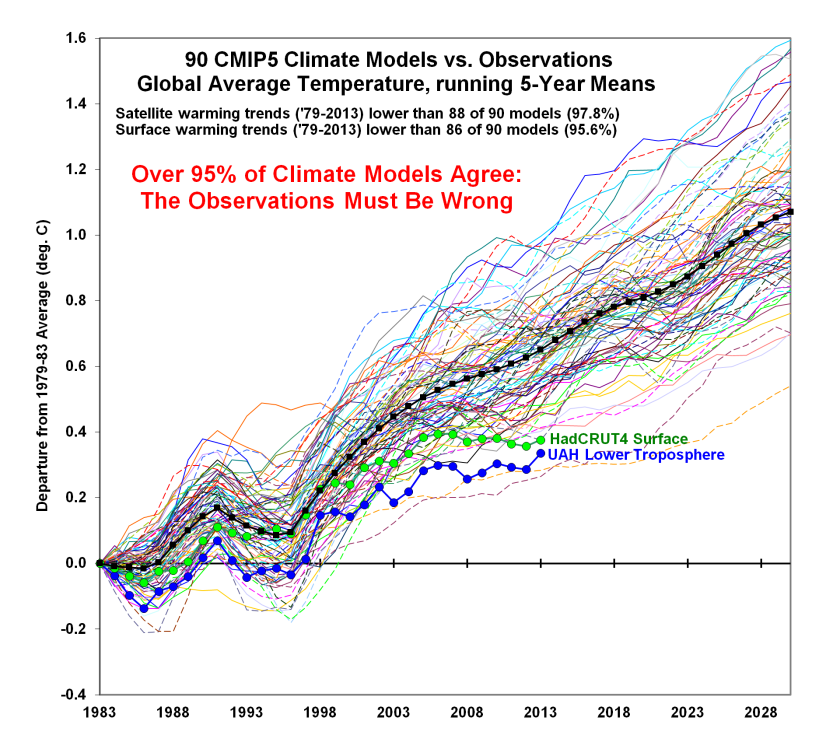
The climate models used by the IPCC have failed even to model accurately the temperature changes that have occurred since 1990. The IPCC models are โ€œrunning too hotโ€. The average modelled global lower troposphere temperature trend from 1979 is 200% of the measured trends. The troposphere is the lowest part of the atmosphere where we live.

Nowhere in any of the IPCC science reports will you find a claim that the world is facing a climate catastrophe or that humanityโ€™s future is in peril.

What ClimateData.ca Does

ClimateData.ca explicitly relies upon the IPCCโ€™s modelling and scenarios. Indeed, it specifically quotes RCP8.5 as the basis for its projections. In other words, it perpetuates the myth that the worst case is the most likely case.

In the case of Ottawa, it notes that for the 1971-2000 period, the annual average temperature was 6.0 degrees C. and the average annual precipitation was 933 mm.

It then warns that under a high emissions scenario (i.e. RCP 8.5):

  • Annual average temperatures will be 8.7 degrees C in the 2021-2050 period (i.e. 42% higher)
  • Annual average temperatures will be 10.8 degrees C. in the 2051-2080 period (i.e. 60% higher)
  • Annual average temperatures will be 12.6 degrees C. for the last 30 years of the century (i.e. 110% higher)
  • Average annual precipitation will be 13% higher for the 2051-2080 period
  • Average annual precipitation will ne 17% higher for the last 30 years of the century.

This is not data reporting. It is propaganda intended to serve a political purpose.

Related:

In The Future, You’ll Own Nothing – Housing

This episode dives into a concept popularized by the World Economic Forum – In the future, you’ll own nothing.

The Heartland Institute

This episode dives into a concept popularized by the World Economic Forum – In the future, you’ll own nothing.

Heartland’s Donald Kendal talks about a new article published by Axios titled “The problem with America’s high home ownership rate,” and then talks about how America may be well on the path to this terrifying future.

About This Video

Welcome to episode #3 of Davos Watch.

This episode dives into a concept popularized by the World Economic Forum – In the future, you’ll own nothing.

Host Donald Kendal talks about a new article published by Axios titled “The problem with America’s high home ownership rate,” and then talks about how America may be well on the path to this terrifying future.

Topics Covered

Introduction to Davos Watch

Axios – “The problem with America’s high homeownership rate”

WEF – In The Future You’ll Own Nothing

Rentership Society report by Morgan Stanley

The implications of this system

Davos Watch takes place live during our weekly In The Tank podcast, broadcast every Thursday at 12pm CT on our sister channel, Stopping Socialism TV.

Orchestrating a Fake Climate Crisis by Cherrypicking Tragic Photos

16-year-old actress Greta Thunberg was elevated to fame by people such as the World Economic Forum who wanted to pull on heart strings to manipulate votes, funding and government policy. Despite her total lack of scientific understanding Greta ranted, โ€œEntire ecosystems are collapsing. We are in the beginning of a mass extinctionโ€.

From Jim Steele

16-year-old actress Greta Thunberg was elevated to fame by people such as the World Economic Forum who wanted to pull on heart strings to manipulate votes, funding and government policy. Despite her total lack of scientific understanding Greta ranted, โ€œEntire ecosystems are collapsing. We are in the beginning of a mass extinctionโ€. Click-bait medial like the New York Times and National Geographic eagerly added their support to the climate crisis myth by attaching false narratives to cherrypicked tragic photos.

Indeed, humans have reduced biodiversity via overhunting, lost habitat and introduced species.

But humans are now actively increasing biodiversity by preventing overhunting, removing invasive species and restoring habitat.

Increasing CO2 to 400+ ppm is greening the earth because the worldโ€™s vegetation thrives when CO2 concentrations approach their optimal 1000 ppm. Pictures of thriving ecosystems debunk the climate crisis as a few degrees of warmer minimum temperatures benefit wildlife. Flowers bloom and wild babies are born during the warm seasons.

Net Zero and the Politics of Narcissism

In anย excellent interview withย UnHerdโ€™sย Freddie Sayers, political philosopher John Gray questions the effectiveness of current climate policies, suggesting they were implemented prematurely and lacked the necessary technology and materials.

From The Daily Sceptic

BYย RICHARD ELDRED

In anย excellent interview withย UnHerdโ€™sย Freddie Sayers, political philosopher John Gray questions the effectiveness of current climate policies, suggesting they were implemented prematurely and lacked the necessary technology and materials. Hereโ€™s an excerpt:

Iโ€™m not a climate sceptic. Iโ€™m a disciple in that regard of a great friend who died recently, James Lovelock. He used to say that climate science is inexact, but if it has a bias, itโ€™s probably towards underestimating the speed of climate change. He thought that climate change would consist of sudden jumps and it could transform things quite quickly, in a couple of decades. We might be in the middle of it. Thatโ€™s my view โ€“ Iโ€™m not a climate sceptic.

What I am very sceptical about is Net Zero, and the kind of conventional green policies that are being launched. Firstly, they were launched before the infrastructure was there โ€“ before the technology was developed that could make them work. No consideration was given to the fact that many of the raw materials that were needed for the inputs, the batteries and so on, were now substantially or even largely controlled by China in Africa and elsewhere. Itโ€™s in Africa that the Great Game of the 19th century is being refought.

Now, they might be found in other countries; in Sweden and America, various deposits have been found. But they are not easily developed. And in the meantime, these programmes canโ€™t go ahead. Nor were the economic costs of these green programmes properly assessed. There was a constant insistence that they would be job-creative. Even in America, they havenโ€™t been that job-creative. And remember, America is very big, and can throw very large amounts of money at these things โ€“ the Green New Deal is largely a protectionist scheme. We canโ€™t do that because weโ€™re too small; weโ€™re too exposed to flows of international capital. The idea that in Britain or in Europe these programmes could ever possibly work โ€“ itโ€™s a bit like suffering from cancer and using candle therapy.

Some people might say: โ€œBut weโ€™ve got to, weโ€™ve got to show that weโ€™re on the right side, weโ€™ve got to accomplish it, even if other people donโ€™t do it.โ€ I think thatโ€™s the politics of narcissism: โ€œI want to feel good.โ€ But in the meantime, youโ€™re wasting resources and youโ€™re wasting time. There is a serious possibility that weโ€™re now in the early stages of runaway climate change. We should be focusing everything weโ€™ve got โ€“ not on having an infinitesimal impact on global carbon levels, which would be the case even if the whole Net Zero programme was implemented, but on policies of adaptation. And adaptation is not going to be easy. Remember, most climate scientists agree that once human-induced climate change is in the works, it goes on for decades or even centuries. You canโ€™t just stop it. Thereโ€™s a general idea among environmentalists that we started this so we can stop it. They are wrong. We started it, probably, but we canโ€™t stop it.

Iโ€™ve said previously weโ€™re living in an age of tragedy. Iโ€™m not too sure about that anymore. I think weโ€™ve advanced further than tragedy. Weโ€™re entering an age of absurdity. Consider German climate policy. Germany, as we keep hearing, is incomparably more adult, more advanced, more modern and in every way superior to bungling Britain. But in Germany, the result of their closing down of nuclear and going for renewables has been an increased reliance on the dirtiest kind of coal. Well, this is tragic, but itโ€™s even more than tragic. It is completely absurd.

And itโ€™s difficult to put these arguments forward because people start shouting at you or they start crying or they say they canโ€™t get up in the morning. I rather brutally suggest: โ€œWell donโ€™t. Stay in bed until you get a better reason for getting up. And if you donโ€™t, well, there we are. Progress always has casualties.โ€

Worth reading in full.

Stop Press: According to Polar Bear Science, Arctic sea ice has once more defied expectations by not experiencing a significant decline this year, disappointing those who had long anticipated a โ€˜death-spiral decrease.

Desperate governors beg for offshore wind cost relief

Six Atlantic shore Governors are begging the Feds to bail them out of a huge looming offshore wind cost overrun. They sent Biden a joint letter asking for a list of relief measures ranging from tax breaks to revenue sharing.

From ย CFACT

Byย David Wojickย 

Six Atlantic shore Governors are begging the Feds to bail them out of a huge looming offshore wind cost overrun. They sent Biden a joint letter asking for a list of relief measures ranging from tax breaks to revenue sharing.

The outcome is far from clear but my guess is the largess is unlikely to appear, especially given the ongoing federal budget battles. Maybe later. However most of the requests also likely require major regulatory changes which could take years. They might even take legislation which could be never.

But the need is urgent as the offshore developers are demanding immediate power price increases around 50% lest they leave for better opportunities elsewhere. They can do this because offshore wind is a global boom. Even mid-income developing countries like Indonesia are talking big offshore numbers.

Ironically it is this boom that is driving some of the sticker shocking price increases. There is even a shortage of the highly specialized crane ships to erect these huge towers. The supply chain is a sellerโ€™s market, at least on paper. Rising interest rates are another big driver.

The letter is pretty vague but there are basically three kinds of federal relief requested. These are tax credits, revenue sharing and streamlined permitting. I am sure there is lots of lobbying going on, by the developers as well as the Governors. Unfortunately it is all secret so the specific issues are well hidden, making the following brief analysis somewhat speculative.

The letter is here:ย 

There look to be two tax credit issues. The first, which the IRS might actually be able to do something about, involves the definition of the renewables energy project that gets the investment tax credits. At present probably only the generating assembly counts. This likely includes the tower and monopile foundation as well as the turbine generator and enormous blades.

But it may not include the extensive undersea connector cabling, the massive offshore substations, the huge export cabling and the costly onshore transmission upgrades. These system components make up a sizable fraction of the project cost.

The second issue here is the bonus tax credits awarded under the so-called Inflation Reduction Act. This is a 10% credit bump that developers get if they meet certain domestic content specs. Offshore wind already gets a big break under IRA because their content requirement is just half that of all other renewable projects.

As near as I can tell they want the presently measly requirement to be even less. This is likely because most of the components come from overseas. America has very little specialized offshore component production capability since we have never built any here. Building this kind of industrial capacity will take a long time.

However since the specific domestic component requirements are in the law the IRS may have very little leeway and what they have should require rulemaking. How this works out will be very interesting to watch. It might take legislation which is uncertain to say the least.

On revenue sharing the States want a piece of the billions of dollars developers are paying the Feds in offshore site lease payments. Single sites have paid over a billion. Some sites are at least partially within State waters but most are not.

Here the question is why taxpayers in, say, Wyoming should in effect pay to lower electricity bills in New Jersey? The agency in charge of offshore leasing is the Bureau of Ocean Energy Management (BOEM) in the Interior Dept. They are gung ho for offshore wind so might not mind sharing revenue if it keeps the project coming.

I have no idea what the legalities are here except they are likely to be complex. BOEM has been doing offshore oil and gas leasing in the Gulf for a long time so there should be a big body of law to deal with.

Who gets how much is an interesting question, especially for projects set to sell juice to several States. Plus the States expect to sell some to other States. Given that many of the power purchase contracts at issue are with utilities, not States, maybe they should get the money.

For that matter if this revenue sharing happened the Gulf states might want a piece of the oil and gas action. None of this is simple, for sure. (Aside: maybe the Feds should collect royalties on the harvested wind power, like the 18.75% they get on offshore oil production.)

As for speeding up permitting, that is already a hot topic in Congress but there is no consensus on what it even means, much less how to do it. I think BOEM is already going as fast as it can, ignoring a lot of issues in the process, such as whale deaths. And of course the Biden Executive Branch cannot speed up the Judiciary, where a lot of the project delay lies in litigation.

In short this seemingly simple letter is pointed at some really hairy issues. The talks are going on in secret and I have yet to see any detailed analysis of the potential policies and ramifications thereof. If the fate of Atlantic offshore wind really depends on taking these hairy steps then we are in โ€œNobody knows landโ€ for sure. This cannot be good from the investment point of view, so more stocks may drop.

Stay tuned to CFACT to see how this wacky offshore drama plays out. It might be awhile.

Author

David Wojick

David Wojick, Ph.D. is an independent analyst working at the intersection of science, technology and policy.

For origins see http://www.stemed.info/engineer_tackles_confusion.html

For over 100 prior articles for CFACT see http://www.cfact.org/author/david-wojick-ph-d/ Available for confidential research and consulting.

View all posts  

Net Zero Experiment Built on Intermittent Wind & Solar โ€“ Doomed toย Failure

A decade from now weโ€™ll be talking about the transition to wind and solar that never happened. Right now, though, rent seekers and their enabling politicos are making claims, fast and furious about reaching net-zero carbon dioxide gas emissions targets using nothing but sunshine and breezes.

From STOP THESE THINGS

A decade from now weโ€™ll be talking about the transition to wind and solar that never happened. Right now, though, rent seekers and their enabling politicos are making claims, fast and furious about reaching net-zero carbon dioxide gas emissions targets using nothing but sunshine and breezes.

No country has ever run itself entirely on wind and solar; no country ever will. But that doesnโ€™t stop the myth makers from pretending that the grand transition is just a giant battery or two away.

With all the substance of a Soviet 5-year plan, Australiaโ€™s Green/Labor Alliance has laid out a path that, as John Cameron explains below, looks more like a Highway to Hell.

The Incoherent Roadmap to Net Zero
Quadrant
John Cameron
3 September 2023

In 2021 we were confidently told that it would cost $78 billion to rewire the grid for renewables and that the average annual household electricity bill would fall by $275 under Labor because, as Anthony Albanese explained, โ€˜we have done the modellingโ€™ [2].

Despite the Prime Ministerโ€™s assurances, the cost of transforming the grid by 2030 is estimated to be $1,500 billion (not $78 billion) and the full cost to 2060 is up to $9,000 billion[1]. Also, retail prices in Victoria are to increase by 25 per cent from July 2023, and more pain is in store for households and business when the hedging and contracts roll over and the doubling of wholesale electricity prices fully impact retail prices. As Nick Cater wrote โ€œrenewables vision is blind to the cost of calamityโ€[2].

It is time the Victorian public are made fully aware of the enormous cost of a reckless transition to renewables and the huge amount of land (up to 12 million ha) to become renewable infrastructure.

The Victorian default offer (DFO) price is set by an independent regulator to provide a simple, trusted and reasonably priced electricity option, for consumers who donโ€™t engage in the market to find a competitive retail market offer. All electricity retailers in Victoria must offer residential or small business customers the option to take up the current Victorian Default Offer.

The DFO is expected to deliver households a $354 per year increase on 2022-23, or a 25% year on year increase, assuming there are no further increases in 2023-24. Further increases cannot be discounted, as while retail prices are up 25 per cent, wholesale prices are up 100%. Average households now face an annual electricity bill of $1,756 per year (Table 1).[3]

Note that the generation of electricity (wholesale component) only accounts for about a third of the cost and that network costs account for about another third of the total. Reaching Net Zero requires considerable investment in the two largest components of the cost of getting electricity to your home โ€“ wholesale costs and network costs. Unlike solar panels on the roof, which are โ€˜behind the meterโ€™, utility scale solar and wind power in particular require a huge investment in new transmission networks.

Comparisons of renewables against existing coal- and gas-fired power typically ignore the new transmission costs for the renewables while also simplistically assuming costs for completely new coal- or gas-fired power stations, rather than the lower cost of continuing to operate the existing power stations.

Victorian wholesale electricity prices have more than doubled, from an average of $40/MWh (1999-2015) to $88/MWh (2016-23) under the Andrews Government, even after some impact from COVID lockdowns in 2020-21 (Figure 1). South Australia, the most advanced in the transition to renewables, is the canary in the coal mine as its wholesale electricity prices have consistently been Australiaโ€™s highest.

Victorian wholesale spot electricity prices by financial year

The latest Net Zero Mobilisation Report[4] modelled linear reductions to net zero by 2050 for domestic emissions and 2060 for fossil fuel energy export emissions. Six scenarios were modelled โ€“ Reference, Rapid Electrification, Slower Electrification, Full Renewables Rollout, Constrained Renewables Rollout and On-shoring (domestic iron and aluminium).

The Reference scenario [4] has no emissions objective. All other scenarios track in a straight line to net zero emissions by 2050 (domestic) and 2060 (export). None of the scenarios are forecasts, suggesting considerable uncertainty of outcomes. As Emeritus Professor Robin Batterham, Chair of the Net Zero Australia Steering Committee, has said โ€œThere are too many uncertainties to map a single path to net zeroโ€.

The Net Zero Mobilisation Report [4] highlights what actions Australia must complete by 2030 to reach net zero by 2050. The Mobilisation Report does not consider whether we should reach net zero, nor critique past or proposed actions by governments or companies, nor express preferences. However, the Net Zero Mobilisation Report does express one preference by explicitly excluding nuclear power.

The final Net Zero Modelling Report released in April 2023 illustrates the immense scale, extreme complexity, and breakneck speed required to transition to net zero by 2050. Net Zeros predict capital investment of up to $9 trillion ($9,000 billion) on the transition in the next 37 years to 2060[4].

Funding that transition cost of $9,000 billion over 37 years requires spending $243 billion per year. To put this in perspective, it represents 36 per cent of the entire federal government budgeted expenditure for 2023-24 of $684 billion and roughly equates to the annual federal government spend on social security and welfare of $250 billion per year and more than twice the federal government expenditure of $107 billion pa on health. Have those waiting months and years for critical surgery been told this.

Spending $243 billion per year on energy transition is equivalent to spending 17 per cent of Australiaโ€™s GDP, and so far without a business case nor final investment decision report.

According to Net Zero, the transition will be among the largest and fastest economic transformations in history, with major new infrastructure required, however, progress is slower than modelled and Net Zero call for accelerated action [4]. We also have a call for accelerated action for those awaiting critical surgery!

Nick Cater[5] described the enormity of the challenge as โ€œthe irrational pursuit of renewable energy as the antidote to planetary pain must eventually confront the immutable laws of physics and the scarcity of landโ€.

The report by Net Zero calls for a huge list of expensive strategic actions as follows (with my comments in italic):

โ™ฆ Accelerate all options that could make a material contribution to decarbonisation.
There is no rigorous cost benefit analysis, nor analysis of the opportunity costs, nor the risks of a reckless rapid transition.

โ™ฆ Clean energy and clean processed minerals should be pursued as export opportunities.
Australiaโ€™s electricity costs are now well above world parity such that Australia is unlikely to be internationally competitive processing of iron ore into steel and bauxite into aluminium.

โ™ฆ Considerable land use change will be essential and requires proactive management, particularly for indigenous communities and farming communities.
Up to 12 million ha of land may be required, equivalent to half of Victoria or 77 per cent of private land in Victoria. Many rural communities face acquisitions and easements, loss of scale economies in food and fibre production, and a plethora of ugly new transmission lines, wind turbines and utility solar panels.

โ™ฆ Benefit sharing must be prioritised based on principles of partnership, inclusion, and net gain.
Most households are more concerned about how the costs are to be shared.

โ™ฆ Net gain for environments and biodiversity should be pursued in parallel with net zero.
This suggests degrading the environment is OK provided it is in pursuit of the ideal of net zero.

โ™ฆ Minimising public impacts requires orderly asset closures, supported by multiple policy mechanisms.
Government has already locked in the exit of fossil fuel generated power, prior to development of a plan for orderly asset closures and the so-called policy mechanisms are not yet supported by rigorous strategies, feasibility studies, business cases and investment decisions.

โ™ฆ Low-income households and fossil fuel regions will need support to mitigate impacts.
The government will need to throw billions of everyoneโ€™s hard-earned taxes at income support and worker transition. This approach has so far failed in the Latrobe Valley where despite the Andrews Government spending hundreds of millions of your taxes, the number of jobs in the Latrobe local government area are down 8 per cent over the last decade.

โ™ฆ Private sector investment risk will be too high in many cases, unless mitigated by government.
This means that net zero can only be achieved by 2050 with huge government subsidies accompanied by huge opportunity costs โ€“ we will have to forego opportunities to fix our failing health, social housing, emergency services, triple 0 and education systems.

โ™ฆ Net zero supply chains require certain, large, and a long investment pipeline.
Unfortunately the current supply chain mostly traces to overseas, particularly to China where things like solar panels are made, using power derived from fossil fuels including huge imports of coal, gas and oil from Russia. Chinese imports of fossil fuels from Russia tripled immediately after the invasion of Ukraine. The reckless haste with the transition is just exporting or offshoring jobs and emissions. We need time to gear up for greater Australian domestic content of renewable components.

Options to achieve net zero
The Net Zero Mobilisation Report essentially calls for the development of wide ranging options including a couple of sensible options (that may not garner support from idealistic and powerful activists), such as gas-fired peaking generation and carbon capture, utilisation and storage4:

  • Strengthen deployment drivers of renewables, transmission, and electricity storage.
  • Build a large fleet of gas-fired peaking generation to help accelerate renewable growth.
  • Plan and develop clean hydrogen infrastructure, including hydrogen storage.
  • Determine whether bioenergy has a serious role to play through research.
  • Ambitious energy productivity standards for new buildings, and incentives for retrofits.
  • Decide the future of gas distribution to household and commercial customers.
  • Develop plans and mechanisms for industrial decarbonisation.
  • Implement mandatory emissions standards for all road vehicles, and support EV charging.
  • Prepare carbon capture, utilisation and storage (CCUS) networks and basins for large-scale use. Private investment in a CCUS industry will require targeted government support.
  • Research, develop, and scale up land sector abatement pathways, policies and technologies.
  • Do not factor nuclear power into renewable, storage, and firming targets.

Recent analysis shows that investment in utility solar and onshore wind has slowed, and the current pipeline of projects risks falling short of the Net Zero required build rate. Offshore wind has the most uncertain pipeline and faces the highest barriers, due to the need for large subsidies and long lead times to develop initial projects, establish supply chains and provide grid access [4].

The Net Zero Mobilisation Report does not present a pre-feasibility analysis, nor feasibility reports, nor business cases nor final investment decision (FID) reports. Governments have locked in the transition timeline without completing all of these critical aspects that are vital in ensuring that your hard earned tax dollars are invested optimally, and without huge โ€˜opportunity costsโ€™ โ€“ such as underspending on health, social housing, education, emergency services etc.

Australia is undertaking a gigantic socioeconomic and environmental experiment on a scale that is unprecedented, and cannot be justified given the many unknowns, the uncertainty, and considerable risk associated with the total costs and benefits. Australiaโ€™s reckless transition is unwarranted given our miniscule impact on global climate. This is particularly the case while large consumers of fossil fuels such as China, India and Russia pursue only token transitions.

As Mark Lawson puts it in his book, Dark Ages, โ€œIn order to avoid a climate crisis that never seems to arrive, activists and governments are about to plunge us all into a very real power crisisโ€[6].
Quadrant

[1] Net Zero Australia (2023). Mobilisation Report, July 2023.

[2] Nick Cater 2023. Renewables Vision blind to the cost of calamity, Australian, 17 July 2023.

[3] Source: AER; AEMO 2023. Annual flat tariff bill for domestic customers assuming an annual usage of 4,000 kWh.

[4] Net Zero Australia (2023), How to make net zero happen โ€“ Mobilisation Report July 2023. The Mobilisation Report has been prepared by academics at the University of Melbourne, The University of Queensland, Princeton University, and management consultancy Nous Group. Net Zero Australia is funded by gifts and grants from its sponsors: Worley, Dow, Future Fuels Cooperative Research Centre, Future Energy Exports (FEnEx) Cooperative Research Centre, APA Group and Minderoo Foundation).

[5] Nick Cater (2023). Victoriaโ€™s energy policy is all at sea. Menzies Research Centre Report, 29 March 2023

[6] Mark Lawson (2023). Dark ages, the looming destruction of the Australian power grid. Connor Court Publishing.
Quadrant

Subsea cable failures could derail offshore wind ambitions โ€“ insurance costs โ€˜becoming prohibitiveโ€™

Another blow for net-zero dogmatists. More evidence that cheap offshore wind power doesnโ€™t exist and nobody can control its costs, or be sure of a good level of reliability.

From Tallbloke’s Talkshop

September 25, 2023 byย oldbrew

Another blow for net-zero dogmatists. More evidence that cheap offshore wind power doesnโ€™t exist and nobody can control its costs, or be sure of a good level of reliability.
โ€“ โ€“ โ€“
Global Underwater Hub (GUH) is leading the charge to tackle failures in underwater cables which could derail global offshore wind ambitions, says AGCC.

The trade body, which champions the UKโ€™s ยฃ8billion underwater industry, says that reliability of subsea cables is โ€œparamountโ€ to the success of offshore wind and the energy transition.

But failure of these cables is all too common, to the point that the cost of insuring them is becoming prohibitive.

GUH chief executive, Neil Gordon, said: โ€œItโ€™s estimated that around 85% of the total value of offshore wind insurance claims relate to subsea cables. Insurers are losing money underwriting cables with the average settlement claim in the region of ยฃ9million. Brokers have warned that the high number of cable claims is affecting capacity and coverage and the cost of repairs typically runs into millions, with warranties rarely covering the high cost of business interruption.

โ€œIf these critical components become uninsurable, offshore wind projects around the world will be derailed, making global 2050 net zero targets completely unachievable.โ€

Globally, over ยฃ620billion of investment in offshore windfarms is anticipated by 2030 and, for the world to hit net-zero emissions by 2050, the generating capacity from offshore wind must increase by a staggering 1,120 GW. The subsea cable sector for offshore wind has been estimated at ยฃ100billion over the next ten years.

Mr Gordon added: โ€œThis scale of expansion and opportunity can only be achieved by installing and maintaining thousands of miles of reliable cables under the seabed.

โ€œThere is an urgent need for a holistic approach to finding solutions which can be implemented as offshore wind increases in scale and technical capability with higher voltages and dynamic elements.โ€
. . .
Mr Gordon explained: โ€œWith the shift from fixed to floating offshore wind, where the dynamic nature of floating cables is even more challenging, the critical issue of their reliability must be addressed as a matter of urgency.

โ€œItโ€™s clear there are inherent issues affecting the performance and reliability of subsea cables that are within the industryโ€™s control. Failures can stem from any stage in the cable lifecycle โ€“ from design to manufacture, handling and installation, through to operation and maintenance.โ€

Full articleย here.