Global warming, climate change, all these things are just a dream come true for politicians. I deal with evidence and not with frightening computer models because the seeker after truth does not put his faith in any consensus. The road to the truth is long and hard, but this is the road we must follow. People who describe the unprecedented comfort and ease of modern life as a climate disaster, in my opinion have no idea what a real problem is.
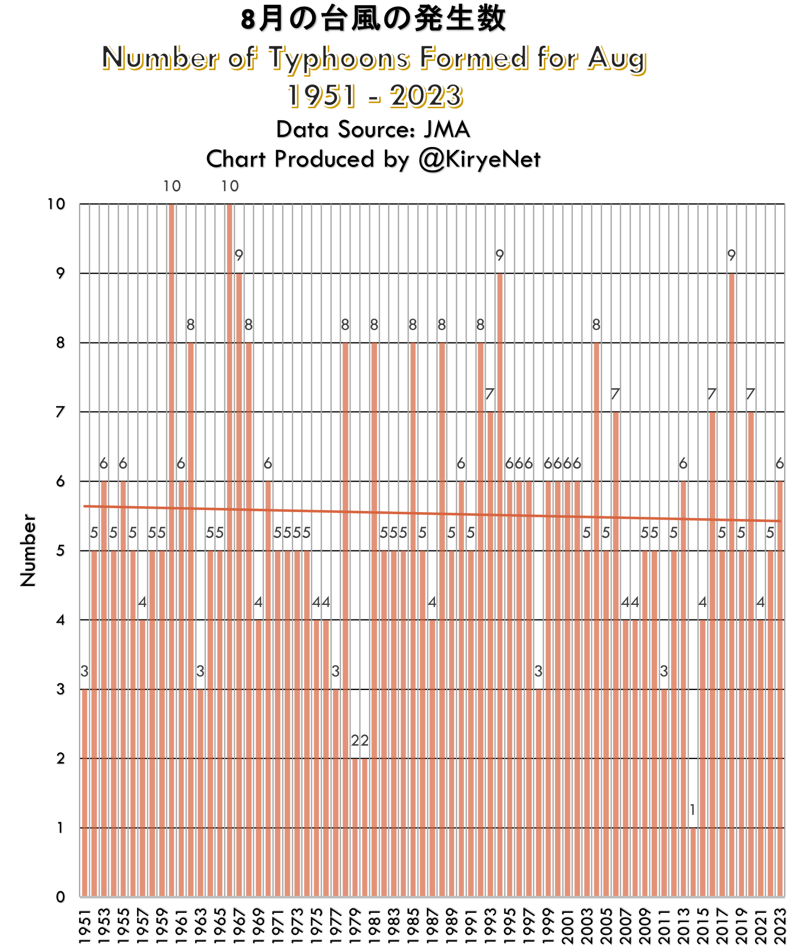
The number of Pacific typhoons have decreased over the past 7 decades. That’s the trend according to the latest data from the Japan Meteorological Agency (JMA).
An amazing looking super cell storm cloud forming on the east coast of Queensland, Australia.
Waves crash the shore as Super Typhoon Surigae moves close to the Philippines in the province of Catbalogan, Samar, Philippines April 18, 2021. DJ RJ RENE CASTINO via REUTERS
Typhoon Update:
The number of Pacific typhoons have decreased over the past 7 decades. That’s the trend according to the latest data from the Japan Meteorological Agency (JMA).
This past August saw 6 typhoons, and so over the past 70+ years the overall August trend in terms of frequency has been modestly downward.
Clearly the so-called “climate experts” have been wrong since they claimed tropical storms and would intensify and become more frequent as a result of a warmer planet. That hasn’t been the case in the Pacific.
The ships that are loaded with more than 200,000 tons of oil might have been surprised by ice pack in the East Siberian Sea.
The Primorsky Prospect and NS Arctic on the 12th and 14th of July respectively set out from St.Petersburg with course for the Chinese ports of Dalian and Rizhao. They were to arrive at destinations by the middle of August. That schedule is now significantly postponed. Shipping data show that the ships will make it to the Chinese ports no earlier than 26th of August.
Although the tankers both have ice classification Arc3, their voyage across the Laptev Sea and East Siberian Sea have been marred with troubles with the sea-ice. For several days, the tankers were at standstill off the New Siberian Islands, and later also in the southern part of the East Siberian Sea.
Nevertheless, the long and icy voyage of the two oil tankers raises new questions about the actual benefits of sailing on the Northern Sea Route, as well as security in the area.
Sea-ice in thee East Siberian Sea in period 6-8th of August 2023. Map by Arctic and Antarctic Research Institute
Both the NS Arctic and Primorsky Prospect have ice classification Arc3, but neither of them have permission to sail independently through the most complex parts of the Northern Sea Route in anything but light ice conditions. Growing parts of the East Siberian Sea are ice-free. But changes can quickly occur in this region and a sudden emergence of ice pack might have taken the ships by surprise.
But in medium ice conditions, the ships are obliged to hire icebreaker escort. It is not clear to what extent the tankers have made it into medium ice conditions. But ice maps from the Russian Arctic and Antarctic Research Institute show that major parts of the East Siberian Sea have a white sheet.
“Perhaps the wind has pushed the ice pack towards the coast, increasing the concentration locally so that there’s no longer continuous green strip along the coast?” an anonymous industry expert says to the Barents Observer.
According to the expert, there appears to be no imminent risk for a dangerous situation.
Nuclear icebreaker Sibir escorts ships through the Vilkitsky Strait. Photo: Rosatom/Kirill Razin
In Episode 379 of District of Conservation, Gabriella discusses Connecticut passing a bear self-defense law that allows residents to shoot bears in self-defense cases and discourages feeding the burgeoning black bear population. The Connecticut legislature was short of passing a bill allowing a highly-regulated hunt, arguably a more preferable and humane option. Tune in to learn more!
“Indeed, the DEEP supported this legislation when it was first introduced and would have welcomed hunting as a tool to manage the increasing bear population. But state legislators acquiesced to pressure from ill-informed animal rights groups and prioritized emotional appeals over conservation and public safety. SB 1148 now fails to fully address this public safety risk for the Constitution State’s 3.6 million residents—a risk made clear last year when a 10-year-old boy was mauled by a bear in his grandparents’ backyard.” — Hartford Courier
In Episode 379 of District of Conservation, Gabriella discusses Connecticut passing a bear self-defense law that allows residents to shoot bears in self-defense cases and discourages feeding the burgeoning black bear population. The Connecticut legislature was short of passing a bill allowing a highly-regulated hunt, arguably a more preferable and humane option. Tune in to learn more!
In Episode 579 of District of Conservation, Gabriella discusses the permitting reform bill – aka BAAJA – that is gaining traction in Congress now. The Senate will hold a cloture vote starting at 3:30pm ET in a motion to proceed. Gabriella discusses the status quo without permitting reform, how BAAJA is good for the environment and affordability. Tune in!SHOW NOTESBipartisan Policy Center: BAAJA ExplainerEstimating the US Energy System Impacts of the Bipartisan American Affordability and Jobs Act
The whole mythology of Global Warming depends on having you NOT think about anything but radiative processes and physics. To trap you into the Radiative Model. But the Earth is more complex than that. Much more complex. Then there’s the fact that you DO have some essential Radiative Physics to deal with, so the bait is there. However…
One year time lapse of precipitable water (amount of water in the atmosphere) from Jan 1, 2016 to Dec 31, 2016, as modeled by the GFS. The Pacific ocean rotates into view just as the tropical cyclone season picks up steam.
Lately the media refers increasingly to how important is the water cycle in our climate system. Unfortunately, as usual, the headlines confuse cause and effect. For example, Climate change has a dramatic impact on the global water cycle, say researchers. from phys.org. How perverse to position climate change as an agent rather than the effect from water fluxes in the ocean and atmosphere. The headline misleads entirely (written by scientists or journos?) as the beginning texts shows (in italics with my bolds).
For Christoph Schär, ETH Zurich’s Professor of Climate and Water Cycle, “global warming” is not quite accurate when it comes to describing the driver of climate change. “A better term would be ‘climate humidification,’” he explains. “Most of the solar energy that reaches the Earth serves to evaporate water and thereby drives the hydrological cycle.” Properly accounting for the implications of this is the most challenging task of all for climate modelers.
In order to build a global climate model, grid points spaced around 50 to 100 kilometers apart are used. This scale is too coarse to map small-scale, local thunderstorm cells. Yet it is precisely these thunderstorm cells—and where they occur—that drive atmospheric circulation, especially in the tropics, where solar radiation is highest.
The workaround, at present, is to add extra parameters to the model in order to map clouds. “But predicting future climate change is still pretty imprecise,” Schär says. “If we don’t know how many clouds are forming in the tropics, then we don’t know how much sunlight is hitting the earth’s surface—and hence we don’t know the actual size of the global energy balance.”
The climatist paradigm is myopic and lopsided. A previous post below provides a cure for those whose vision is impaired by the IPCC consensus view of climate reality.
Curing Radiation Myopia Regarding Climate
E.M. Smith provides an helpful critique of a recent incomplete theory of earth’s climate functioning in his Chiefio blog post So Close–Missing Convection and Homeostasis. Excerpts in italics with my bolds and added images.
It is Soooo easy to get things just a little bit off and miss reality. Especially in complex systems and even more so when folks raking in $Millions are interested in misleading for profit. Sigh.
Sabine Hosenfelder does a wonderful series of videos ‘explaining’ all sorts of interesting things in and about actual science and how the universe works. She is quite smart and generally “knows her stuff”.But… It looks like she has gotten trapped into the Radiative Model of Globull Warming.
The whole mythology of Global Warming depends on having you NOT think about anything but radiative processes and physics. To trap you into the Radiative Model. But the Earth is more complex than that. Much more complex. Then there’s the fact that you DO have some essential Radiative Physics to deal with, so the bait is there. However…
It is absolutely essential to pay attention to convection in the lower atmosphere and to the “feedback loops” or homeostasis in the system.
The system acts to restore its original state. There is NO “runaway greenhouse” or we would have never evolved into being since the early earth had astoundingly high levels of CO2 and we would have baked to death before getting out of our slime beds as microbes.
Figure 16. The geological history of CO2 level and temperature proxy for the past 400 million years. CO2 levels now are ~ 400ppm. Source: Davis, W. J. (2017).
OK, I’ll show you her video. It is quite good even with the “swing and a miss” at the end. She does 3 levels of The Greenhouse Gas Mythology so you can see the process evolving from grammar school to high school to college level of mythology. But then she doesn’t quite make it to Post-Doc Reality.
Where’s she wrong? (Well, not really wrong, but lacking…)
I see 2 major issues. First off, she talks about the “lower atmosphere warming”. Well, yes and no. It doesn’t “warm” in the sense of getting hotter, but it does speed up convection to move the added heat flow.
In English “heating” has 2 different meanings. Increasing temperature. Increasing heat flow at a temperature.
We see this in “warm up the TV dinner in the microwave” meaning to heat it up from frozen to edible; and in the part where the frozen dinner is defrosting at a constant temperature as it absorbs heat but turns it into the heat of fusion of water. So you can “warm it up” by melting at a constant temperature of frozen water (but adding a LOT of thermal energy – “heat”) then later as increasing temperature once the ice is melted. It is very important to keep in mind that there are 2 kinds of “heating”. NOT just “increasing temperature”.
In the lower atmosphere, the CO2 window / Infrared Window is already firmly slammed shut. Sabine “gets that”. Yay! One BIG point for her! No amount of “greenhouse gas” is going to shut that IR window any more. As she points out, you get about 20 meters of transmission and then it is back to molecular vibrations (aka “heat”).
So what’s an atmosphere to do? It has heat to move! Well, it convects. It evaporates water.
Those 2 things dominate by orders of magnitude any sort of Radiative Model Physics. Yes, you have radiation of light bringing energy in, but then it goes into the ocean and into the dirt and the plants and even warms your skin on a sunny day. And it sits there. It does NOT re-radiate to any significant degree. Once “warmed” by absorption, heat trying to leave as IR hits a slammed shut window.
The hydrological cycle. Estimates of the observed main water reservoirs (black numbers in 10^3 km3 ) and the flow of moisture through the system (red numbers, in 10^3 km3 yr À1 ). Adjusted from Trenberth et al. [2007a] for the period 2002-2008 as in Trenberth et al. [2011].
So what does happen? Look around, what do you see? Clouds. Rain. Snow. (sleet hail fog etc. etc.)
Our planet is a Water Planet. It moves that energy (vibrations of atoms, NOT radiation) by having water evaporate into the atmosphere. (Yes, there are a few very dry deserts where you get some radiative effects and can get quite cold at night via radiation through very dry air, but our planet is 70% or so oceans, so those areas are minor side bars on the dominant processes). This water vapor makes the IR window even more closed (less distance to absorption). It isn’t CO2 that matters, it is the global water vapor.
What happens next?
Well, water holds a LOT of heat (vibration of atoms and NOT “temperature”) as the heat of vaporization. About 540 calories per gram (compared to 80 for melting “heat of fusion” and 1 for specific heat of a gram of water). Compare those numbers again. 1 for a gram of water. 80 for melting a gram of ice. 540 for evaporating a gram of water. It’s dramatically the case that evaporation of water matters a lot more than melting ice, and both of them make “warming water” look like an irrelevant thing.
Warming water is 1/80 as important as melting ice, and it is 1/540 th as important as evaporation of the surface of the water. Warming air is another order of magnitude less important to heat content.
So to have clue, one MUST look at the evaporation of water from the oceans as everything else is in the small change.
Look at any photo of the Earth from space. The Blue Marble covered in clouds. Water and clouds. The product of evaporation, convection, and condensation. Physical flows carrying all that heat (“vibration of atoms” and NOT temperature, remember). IF you add more heat energy, you can speed up the flows, but it will not cause a huge increase in temperature (and mostly none at all). It is mass flow that changes. The number of vibrating molecules at a temperature, not the temperature of each.
In the end, a lot of mass flow happens, lofting all that water vapor with all that heat of vaporization way up toward the Stratosphere. This is why we have a troposphere, a tropopause (where it runs out of steam… literally…) and a stratosphere.
What happens when it gets to the stratosphere boundary? Well, along the way that water vapor turns into water liquid very tiny drops (clouds) and eventually condenses to big drops of water (rain) and some of it even freezes (hail, snow, etc.). Now think about that for a minute. That’s 540 calories per gram of heat (molecular vibration NOT temperature, remember) being “dumped” way up high in the top of the troposphere as it condenses, and another 80 / gram if if freezes. 620 total. That’s just huge.
This is WHY we have a globe covered with rain, snow, hail, etc. etc. THAT is all that heat moving. NOT any IR Radiation from the surface. Let that sink in a minute. Fix it in your mind. WATER and ICE and Water Vapor are what moves the heat, not radiation. We ski on it, swim in it, have it water our crops and flood the land. That’s huge and it is ALL evidence of heat flows via heat of vaporization and fusion of water.
It is all those giga-tons of water cycling to snow, ice and rain, then falling back to be lofted again as evaporation in the next cycle. That’s what moves the heat to the stratosphere where CO2 then radiates it to space (after all, radiation toward the surface hits that closed IR window and stops.) At most, more CO2 can let the Stratosphere radiate (and “cool”) better. It can not make the Troposphere any less convective and non-radiative.
Then any more energy “trapped” at the surface would just run the mass transport water cycle faster. It would not increase the temperature.
More molecules would move, but at a limit on temperature. Homeostasis wins. We can see this already in the Sub-Tropics. As the seasons move to fall and winter, water flows slow dramatically. I have to water my Florida lawn and garden. As the seasons move to spring and summer, the mass flow picks up dramatically. Eventually reaching hurricane size. Dumping up to FEET of condensed water (that all started as warm water vapor evaporating from the ocean). It is presently headed for about 72 F today (and no rain). At the peak of hurricane season, we get to about 84 or 85 F ocean surface temperature as the water vapor cycle is running full blast and we get “frog strangler” levels of rain. That’s the difference. Slow water cycle or fast.
IF (and it is only an “if”, not a when) you could manage to increase the heat at the surface of the planet in, say, Alaska: At most you would get a bit more rain in summer, a bit more snow in winter, and MAYBE only a slight possible, of one or two days that are rain which could have been snow or sleet.
Then there’s the fact that natural cycles swamp all of that CO2 fantasy anyway. The Sun, as just one example, had a large change of IR / UV levels with both the Great Pacific Climate Shift (about 1975) and then back again in about 2000. Planetary tilt, wobble, eccentricity of the orbit and more put us in ice ages (as we ARE right now, but in an “interglacial” in this ice age… a nice period of warmth that WILL end) and pulls us out of them. Glacials and interglacials come and go on various cycles (100,000 years, 40,000 years, and 12,000 year interglacials – ours ending now, but slowly). The simple fact is that Nature Dominates, and we are just not relevant. To think we are is hubris of the highest order.
Figure 9: Two contrasting views of the effects of how the continuous intensification of deep cumulus convection would act to alter radiation flux to space. The top (bottom) diagram represents a net increase (decrease) in radiation to space
Footnote
There are two main reasons why investigators are skeptical of AGW (anthropogenic global warming) alarm. This post intends to be an antidote to myopic and lop-sided understandings of our climate system.
CO2 Alarm is Myopic: Claiming CO2 causes dangerous global warming is too simplistic. CO2 is but one factor among many other forces and processes interacting to make weather and climate.
Myopia is a failure of perception by focusing on one near thing to the exclusion of the other realities present, thus missing the big picture. For example: “Not seeing the forest for the trees.” AKA “tunnel vision.”
2. CO2 Alarm is Lopsided: CO2 forcing is too small to have the overblown effect claimed for it. Other factors are orders of magnitude larger than the potential of CO2 to influence the climate system.
Lop-sided refers to a failure in judging values, whereby someone lacking in sense of proportion, places great weight on a factor which actually has a minor influence compared to other forces. For example: “Making a mountain out of a mole hill.”
The fact that those pushing net-zero emissions targets aren’t talking seriously about nuclear power, says it all.
If energy policy is left in the hands of the wind and sun cult – and other weather-obsessed lunatics – it won’t be long before we’re all left sitting freezing or boiling in the dark.
The fact that those pushing net-zero emissions targets aren’t talking seriously about nuclear power, says it all.
If energy policy is left in the hands of the wind and sun cult – and other weather-obsessed lunatics – it won’t be long before we’re all left sitting freezing or boiling in the dark.
Those with financial skin in the game keep pushing for the purported elimination of carbon dioxide gas emissions, even if only at a fictional accounting level. A balance sheet somewhere will eventually claim that Nation ‘X’ has reached a (supposedly virtuous) target of net-zero emissions.
Digging into the net-zero narrative always returns to the same question; viz, if eliminating carbon dioxide gas emissions in the electricity generation sector is the object, then why, oh why, does this crowd ignore the only stand-alone power generation source that does not generate carbon dioxide gas in the process?
Nowhere is that question more obvious than in Australia, where lunatics really have taken over the asylum.
In those circumstances, it beggars belief that Labor’s Energy Minister – the witless Chris Bowen – can maintain an argument that Australia (apparently unique amongst all nations) can reject nuclear power generation and somehow meet his net-zero carbon dioxide gas target using nothing but wind and solar.
As the Australian’s Judith Sloan points out below, if Australia wants to meet its suicidal net-zero target, then the only path is nuclear power generation.
Nuclear resistance casts Australia as energy laggard nation The Australian Judith Sloan 22 August 2023
Judged by the reaction to my column last week, many readers share my concerns about the planned transition of the energy system outlined by Energy Minister Chris Bowen. It’s already clear that the vision of an electricity grid powered almost entirely by renewable energy by the end of the decade and linked by many kilometres of new transmission lines is unachievable.
As for the proposition that electricity prices will fall, it’s similarly clear that the modelling on which this appealing idea was based is fundamentally flawed. In particular, the work undertaken by the CSIRO bizarrely assumes all the capital costs of transmission and distribution associated with the transition are simply written off at the end of the decade. The reality is the investors will continue to earn guaranteed returns on these investments and these will feed into higher consumer prices.
It’s anyone’s guess what Bowen will be up to in 2030 but it’s odds-on to a dollar that he won’t be the climate change and energy minister. But the point is that the fate of the electricity grid, and energy generation more broadly, is too important to be left to day-to-day politics; it requires careful planning and implementation by those who really understand how the system works.
Sadly, the leadership and staff of the Australian Energy Market Operator appear to be incapable of this task given the faulty and impractical Integrated System Plans the agency releases. The incompetence of state government ministers and bureaucrats, in combination with starry-eyed fantasies of renewable energy zones, simply adds to the developing nightmare.
The features of the failing transition are obvious already. Snowy 2.0 is behind schedule and now it is predicted that the pumped-hydro project alone will cost $10bn – the original estimate was $2bn. Many billions of dollars for additional transmission will also be needed.
The Marinus Link between Tasmania and Victoria increasingly looks unlikely to go ahead as its cost blows out from $3.1bn to $5.5bn and the fiscally fragile Tasmanian government baulks at bearing the higher figure. Absent this link, the slew of renewable energy projects in Tasmania envisaged as part of the transition is unlikely to proceed. This setback also exposes Victoria’s energy transmission plans.
As for Queensland’s energy transition plans, the inclusion of two large-scale pumped-hydro projects increasingly looks absurd, both in terms of costs and feasibility. There is strong local opposition to the project outside Mackay. The only upside to Queensland’s plan is the intention to keep its (relatively new) coal-fired plants going until renewable energy plus storage can provide guaranteed electricity.
One of the most worrying aspects of this unfolding tragedy is Bowen’s closed mind when it comes to other options to achieve a reliable and affordable grid as well as meeting decarbonisation goals. His muted objection to gas is part of the problem and the fact this energy source is not part of the national security mechanism, the capacity mechanism to provide back-up power to the grid in the event of power shortfalls, is close to incomprehensible. But his fierce and ongoing opposition to nuclear power as the greenest form of 24/7 generation simply beggars belief. His unfounded assertion that nuclear is simply too expensive must be tested by the market on the basis of the government lifting the completely unjustified ban on nuclear power.
There are more and more countries that beg to differ with Bowen’s assertion. France, Sweden, Finland, Britain, Canada, South Korea, the US and others are all ramping up investments in nuclear energy. If nuclear power is too expensive, it’s news to these economic powerhouses. We really run the risk of being left at the starting gate unless we make this shift.
The turning point for Labor is the signing of the AUKUS deal and its commitment to the use of nuclear-powered submarines. As part of this agreement, we are required to ramp up the nuclear-related workforce substantially and to deal with the waste on our shores. It is the perfect correlate to the establishment of a domestic nuclear power industry.
The lessons being learnt by other countries will prove useful and should allow us to short-circuit some of the lengthy delays that have plagued the nuclear industry. Indeed, there is clear evidence that the high expense of nuclear has been partly the result of massive over-regulation and a tendency for heel-dragging by the authorities. The comparison between the US and Canadian regulators is telling in this context, with the Canadian regulator much more efficient and cooperative.
There are several technology choices we could make, including simply using the tried-and-true ones. The South Koreans, for instance, are finalising several plants using the current principal technology. In Australia, these plants could be easily located where coal-fired plants exist or have existed: the sources of water and their proximity to transmission lines make them perfect sites.
There is also the option of providing a pilot site for TerraPower, the new form of nuclear generation promoted by Bill Gates.
Work is proceeding in Wyoming, US; the plant will generate 350 megawatts to 500MW. While the cost of this plant is estimated to be $US4bn ($6.2bn), the expectation is the next ones could cost as little as $US1bn. This form of nuclear generation doesn’t require significant amounts of water or auxiliary power. Interestingly, there was fierce bidding to have the plant located at the various possible sites.
If it were not for Bowen’s, and Labor’s, ingrained opposition to nuclear power that has little justification in the current climate, it could be exciting times for the electricity industry in Australia.
Small modular reactors will also likely be part of the mix; after all, we currently have them floating around the oceans. The Canadians have made a major commitment to their development and Rolls-Royce is working day-and-night to achieve SMRs as a commercial option for that company. In time, Australia may be simply be able to buy them off the shelf.
Of course, the renewable energy industrial complex is likely to arc up because the most sensible thing to do, if decarbonisation is the paramount concern, is simply to go with nuclear and forget short-lived, unreliable intermittent wind and solar, even with the fanciful addition of batteries.
In the short term, it is possible to make nuclear and renewable energy complementary. But as the turbines and panels reach the end of their short lives, it won’t make much sense to replace the landscape-scarring installations. But the key now is to get on with it. The Australian
Despite daily fees for non-compliant vehicles, Sadiq Khan’s Ulez initiative has lowered emissions by just 3% in four years. Experts warn it could take over a century to achieve Net Zero emissions at this rate.
Despite daily fees for non-compliant vehicles, Sadiq Khan’s Ulez initiative has lowered emissions by just 3% in four years. Experts warn it could take over a century to achieve Net Zero emissions at this rate. The Mailhas more.
Sadiq Khan’s… deeply unpopular road charge, which has seen protests and violence on the city’s streets, is not a “big story” in terms of environmental benefit, researchers say.
The revelation raises questions as to why the new driving levies were rushed through so quickly.
Mr. Khan has insisted the Ulez scheme is not simply yet another income stream to prop up cash-strapped City Hall and the frequently delayed Tube network and is about the environment.
But Richard Holt, the Director of Global Cities Research at Oxford Economics, said non-compliant cars in London would have fallen anyway because of changing industry standards.
He says the greener type of cars being sold already will have much more impact than any of Mr. Khan’s schemes.
Mr. Holt added: “It’s going to cut the number of high polluting vehicles by about 120,000 or less, out of three million vehicles in London, so it’s a small part of the overall story.
“It will probably have some benefit, but it’s not a big story. The progress we have seen so far is really just because cars have become much, much more energy efficient and much cleaner than they used to be.
“I think the first four years of Ulez, CO2 emissions fell by about 3% over those three years, so it would take more than a century to get to Net Zero this way, which puts the scheme in perspective,” he told the Telegraph.
The Ultra Low Emission Zone, was last week expanded to cover all of London’s 32 boroughs, and carries a daily charge of £12.50 if vehicles do not comply.
The new Oxford Economics report suggested that Mr. Khan’s Net Zero goal is not achievable until 2050.
Ulez has been devastatingly unpopular already but vast resources have been deployed to make sure people are caught and fined.
A fleet of camera vans have already been deployed in a fresh bid to catch charge dodgers.
Patrick T. Brown explains that “There is a formula for publishing climate change impacts research in the most prestigious and widely-read scientific journals. Following it brings professional success, but it comes at a cost to society.” His formula explains part of the reason we see so little skeptical research in those journals.
Regular readers of Watts Up With That have noticed that there aren’t many articles in high-profile journals that suggest there are any issues with the narrative that climate change impacts are pervasive and catastrophic. On his blog, Patrick T. Brown explains that “There is a formula for publishing climate change impacts research in the most prestigious and widely-read scientific journals. Following it brings professional success, but it comes at a cost to society.” His formula explains part of the reason we see so little skeptical research in those journals.
Background
Patrick T. Brown is a Ph.D. climate scientist. He is a Co-Director of the Climate and Energy Team at The Breakthrough Institute and is an adjunct faculty member (lecturer) in the Energy Policy and Climate Program at Johns Hopkins University.
This month, he published a lead-author research paper in Nature on changes in extreme wildfire behavior under climate change. This ishisthird publication in Nature to go along with another in Nature’s climate-focused journal Nature Climate Change. He notes that “because Nature is one of the world’s most prestigious and visible scientific journals, getting published there is highly competitive, and it can significantly advance a researcher’s career.”
His article is based on this publication experience, as well as through various failures to get research published in these journals. He explains:
I have learned that there is a formula for success which I enumerate below in a four-item checklist. Unfortunately, the formula is more about shaping your research in specific ways to support pre-approved narratives than it is about generating useful knowledge for society.
Formula for Publishing Climate Changes Impact Research
Before describing his approach to get research published, he describes what is needed for useful scientific research. He says:
It should prize curiosity, dispassionate objectivity, commitment to uncovering the truth, and practicality. However, scientific research is carried out by people, and people tend to subconsciously prioritize more immediate personal goals tied to meaning, status, and professional advancement. Aligning the personal incentives that researchers face with the production of the most valuable information for society is critical for the public to get what it deserves from the research that they largely fund, but the current reality falls far short of this ideal.
Brown explains that the “publish or perish” mentality in academic research is necessary. In addition, it also matters “which journals you publish in”. It turns out a “researcher’s career depends on their work being widely known and perceived as important.” Because there is so much competition now it has become more important to publish in the highly regarded journals” “while there has always been a tremendous premium placed on publishing in the most high-profile scientific journals – namely Nature and its rival Science – this has never been more true.” As a result, “savvy researchers will tailor their studies to maximize their likelihood of being accepted.” In his article he explains just how he did it.
First, he offers general advice:
My overarching advice for getting climate change impacts research published in a high-profile journal is to make sure that it supports the mainstream narrative that climate change impacts are pervasive and catastrophic, and the primary way to deal with them is not through practical adaptation measures but through policies that reduce greenhouse gas emissions. Specifically, the paper should try to check at least four boxes.
The first box to hit is that it is that “climate change impacts something of value is usually sufficient, and it is not typically necessary to show that the impact is large compared to other relevant influences.” In order to do this there are tradeoffs:
In my recent Nature paper, we focused on the influence of climate change on extreme wildfire behavior but did not bother to quantify the influence of other obviously relevant factors like changes in human ignitions or the effect of poor forest management. I knew that considering these factors would make for a more realistic and useful analysis, but I also knew that it would muddy the waters and thus make the research moredifficult to publish.
This type of framing, where the influence of climate change is unrealistically considered in isolation, is the norm for high-profile research papers. For example, in another recent influential Nature paper, they calculated that the two largest climate change impacts on society are deaths related to extreme heat and damage to agriculture. However, that paper does not mention that climate change is not the dominant driver for either one of these impacts: temperature-related deaths have been declining, and agricultural yields have been increasing for decades despite climate change.
The second box is to avoid discussion of anything that could reduce the impact of climate change:
This brings me to the second component of the formula, which is to ignore or at least downplay near-term practical actions that can negate the impact of climate change. If deaths related to outdoor temperatures are decreasing and agricultural yields are increasing, then it stands to reason that we can overcome some major negative effects of climate change. It is then valuable to study how we have been able to achieve success so that we can facilitate more of it. However, there is a strong taboo against studying or even mentioning successes since they are thought to undermine the motivation for emissions reductions. Identifying and focusing on problems rather than studying the effectiveness of solutions makes for more compelling abstracts that can be turned into headlines, but it is a major reason why high-profile research is not as useful to society as it could be.
His third component is to focus the presentation on alarm:
A third element of a high-profile climate change research paper is to focus on metrics that are not necessarily the most illuminating or relevant but rather are specifically designed to generate impressive numbers. In the case of our paper, we followed the common convention of focusing on changes in the risk of extreme wildfire events rather than simpler and more intuitive metrics like changes in the amount of acres burned. The sacrifice of clarity for the sake of more impressive numbers was probably necessary for it to get into Nature.
Another related convention, which we also followed in our paper, is to report results corresponding to time periods that are not necessarily relevant to society but, again, get you the large numbers that justify the importance of your research. For example, it is standard practice to report societal climate change impacts associated with how much warming has occurred since the industrial revolution but to ignore or “hold constant” societal changes over that time. This makes little sense from a practical standpoint since societal changes have been much larger than climate changes since the 1800s. Similarly, it is conventional to report projections associated with distant future warming scenarios now thought to be implausible while ignoring potential changes in technology and resilience.
The good news is that Brown has transitioned out of a tenure-track academic position to one that does not require high-impact publications. He explains a better approach than what is necessary to publish there:
A much more useful analysis for informing adaptation decisions would focus on changes in climate from the recent past that living people have actually experienced to the foreseeable future – the next several decades – while accounting for changes in technology and resilience. In the case of my recent Nature paper, this would mean considering the impact of climate change in conjunction with proposed reforms to forest management practices over the next several decades (research we are conducting now). This more practical kind of analysis is discouraged, however, because looking at changes in impacts over shorter time periods and in the context of other relevant factors reduces the calculated magnitude of the impact of climate change, and thus it appears to weaken the case for greenhouse gas emissions reductions.
The final key to publication is presentation:
The final and perhaps most insidious element of producing a high-profile scientific research paper has to do with the clean, concise format of the presentation. These papers are required to be short, with only a few graphics, and thus there is little room for discussion of complicating factors or contradictory evidence. Furthermore, such discussions will weaken the argument that the findings deserve the high-profile venue. This incentivizes researchers to assemble and promote only the strongest evidence in favor of the case they are making. The data may be messy and contradictory, but that messiness has to be downplayed and the data shoehorned into a neat compelling story. This encouragement of confirmation bias is, of course, completely contradictory to the spirit of objective truth-seeking that many imagine animates the scientific enterprise.
Brown explains that despite the allowances he had to make to get it his work published there still is value in it:
All this is not to say that I think my recent Nature paper is useless. On the contrary, I do think it advances our understanding of climate change’s role in day-to-day wildfire behavior. It’s just that the process of customizing the research for a high-profile journal caused it to be less useful than it could have been. I am now conducting the version of this research that I believe adds much more practical value for real-world decisions. This entails using more straightforward metrics over more relevant timeframes to quantify the impact of climate change on wildfire behavior in the context of other important influences like changes in human ignition patterns and changes in forest management practices.
Brown explains his motivations and his new plans:
But why did I follow the formula for producing a high-profile scientific research paper if I don’t believe it creates the most useful knowledge for society? I did it because I began this research as a new assistant professor facing pressure to establish myself in a new field and to maximize my prospects of securing respect from my peers, future funding, tenure, and ultimately a successful career. When I had previously attempted to deviate from the formula I outlined here, my papers were promptly rejected out of hand by the editors of high-profile journals without even going to peer review. Thus, I sacrificed value added for society in order to for the research to be compatible with the preferred narratives of the editors.
I have now transitioned out of a tenure-track academic position, and I feel liberated to direct my research toward questions that I think are more useful for society, even if they won’t make for clean stories that are published in high-profile venues. Stepping outside of the academy also removes the reservations I had to call out the perverse incentives facing scientific researchers because I no longer have to worry about the possibility of burning bridges and ruining my chances of ever publishing in a Nature journal again.
Brown concludes:
So what can shift the research landscape towards a more honest and useful treatment of climate change impacts? A good place to start would be for the editors of high-profile scientific journals to widen the scope of what is eligible for their stamp of approval and embrace their ostensible policies that encourage out-of-the-box thinking that challenges conventional wisdom. If they can open the door to research that places the impacts of climate change in the appropriate context, uses the most relevant metrics, gives serious treatment to societal changes in resilience, and is more honest about contradictory evidence, a wider array of valuable research will be published, and the career goals of researchers will be better aligned with the production of the most useful decision support for society.
Roger Caiazza blogs on New York energy and environmental issues at Pragmatic Environmentalist of New York. This represents his opinion and not the opinion of any of his previous employers or any other company with which he has been associated.
Don’t expect the Houston Chronicle editorial team, much less the conflicted, climate-religionist business editorialist Chris Tomlinson, to forthrightly explain how a once reliable grid in the Lone Start State became wounded. They will blame it on the weather (too cold, too hot). But the real story is wind and solar reliance at the expense of thermal generation, as well as central planning of the wholesale grid by regulators/politicians (ERCOT/PUCT).
“If you had to take a life-saving medication that had to be refrigerated, would you want the energy source to be reliable fossil fuels or literally leave it to the wind and the sun?” – LTE, below
Don’t expect the Houston Chronicleeditorial team, much less the conflicted, climate-religionist business editorialist Chris Tomlinson, to forthrightly explain how a once reliable grid in the Lone Start State became wounded. They will blame it on the weather (too cold, too hot). But the real story is wind and solar reliance at the expense of thermal generation, as well as central planning of the wholesale grid by regulators/politicians (ERCOT/PUCT).
I have long complained about how Houston’s newspaper of record went from biased to uber-biased on many things political, particularly climate change/forced energy transformation. No doubt some “environmental education” money has been involved in this hometown hate against oil and gas.
I personally have stopped trying to publish op-ed’s in my longtime hometown paper (I live in central Texas now) and spend time calling out Tomlinson, the worst of the worst. (In the old days, my op-ed’s were published.)
The Chronicle likes to publish op-ed’s from industry trade groups (the authors are transparently biased, right)? But the ideological opponents of climate activism (Big Brother energy policy) are marginalized. As Tomlinson himself describes the likes of Alex Epstein and Robert Bryce: “The industry’s most talented propagandists will offer advice on burnishing petroleum’s image as resentment toward fossil fuels grows.”
Almost all of my letters-to-the-editor do not get in. But as the Texas grid problems are in the daily news, it is hard not to note the primacy of intermittency. Tomlinson’s fallacious take is that old thermal generation is failing, and “new technology” is here. But the problem goes back to public policy, specifically wind and solar forcing on a once reliable grid.
A letter in last week in the Houston Chronicle focused on just this.
Regarding “ERCOT issues conservation request amid high outages of natural gas, coal plants,” (Aug. 30): The Electricity Reliability Council of Texas has issued another conservation notice. How did we end up in this situation? In 1999, Gov. George W. Bush signed legislation to mandate the state’s electricity retailers to purchase a certain amount of their energy from qualifying renewable sources. In 2005, Gov. Rick Perry further increased the amount of energy derived from renewable energy. Renewable energy is currently responsible for 28% of ERCOT’s fuel source.
Observed ERCOT data from Thursday, Aug. 24 (when ERCOT issued a conservation notice) at 5:30 p.m. shows solar energy generated less than 1% of its total capacity and wind energy generated less than 17% of its total capacity. Compare this abysmal performance with natural gas, coal and nuclear energy, which generated between 70 and 90% of its total capacity. It should be pointed out that nuclear energy was the highest of the group (and also is carbon free). If the energy generated from renewables was instead generated from natural gas, coal and nuclear, I believe that it would greatly reduce the need for ERCOT conservation notices. Remember there are only so many hours of sunlight in a day, and the wind, unfortunately, doesn’t always blow.
If you had to take a life-saving medication that had to be refrigerated, would you want the energy source to be reliable fossil fuels or literally leave it to the wind and the sun? Reducing our dependence on renewable energy and adding additional capacity from nuclear, coal and natural gas sources will allow Texans to have reliable energy and not worry about literally being in the dark. – Peter Parlapiano, Houston
Hubris drives the so-called wind and solar ‘transition’, which now depends upon the myth of giant batteries compensating for the vagaries of the weather and sunset. These mythical batteries come in all shapes and sizes and with enough added hyperbole have grown to include the entire island state of Tasmania. Touted with the rent-seeking classes’ usual understatement as “The Battery of the Nation”.
Hubris drives the so-called wind and solar ‘transition’, which now depends upon the myth of giant batteries compensating for the vagaries of the weather and sunset. These mythical batteries come in all shapes and sizes and with enough added hyperbole have grown to include the entire island state of Tasmania. Touted with the rent-seeking classes’ usual understatement as “The Battery of the Nation”.
The wheeze goes something like this.
Tasmania has an enviable hydropower generation capacity (2,270MW in total), thanks to its mountains and exceptional annual average rainfall. It also features 4 clusters of wind turbines with a total notional capacity of 556MW. Whereas its hydropower generation capacity is available on demand (with the exception of lengthy dry conditions when Tasmania turns to diesel generators), its wind power fleet delivers occasional power around 30% of the time, they just can’t tell you which 30% of the time that might be with any meaningful advance notice.
The Battery of the Nation story depends upon yet another cable with a multibillion-dollar pricetag being dropped beneath the icy waters of Bass Strait, presumably allowing Tasmania’s wealth of wind and hydro power to pass seamlessly between Tasmania and the mainland. However, as it turns out, Tasmania hasn’t got enough power to power itself, as the team from Jo Nova report below.
Battery of the Nation goes flat J Nova Blog Jo Nova 11 August 2023
The Marinus Link cable was meant to spark a glorious renewables boom and make Tasmania “The Battery of the Nation”, instead it will cost more than a new advanced coal fired plant, provide no energy at all, and currently even the thought of it is causing chaos. New projects are on hold, factories can’t expand and Tasmania is held hostage to visions of an electricity grid designed to stop storms instead of generate energy.
The Marinus Link is a 255km cable that was supposed to be the second interconnector from Tasmania to the mainland. In theory it would cost $3 billion and carry 1.5GW of electricity. But the costs have blown out to $5.5 billion and the State Premier is balking at the new bill.
However, most of the new wind power projects in the state are awaiting the magic cable before they commit — without it, they can’t reach the real market, which is mainland Australia. But without them, the local grid doesn’t have enough surplus capacity to cover the lean times (or rather, without the cable, they can’t get access to more reliable brown coal power in Victoria).
The brutal truth is that wind power is only “cheap” (or even barely economic) if the poor taxpayer serfs pay for the five thousand million dollar cable (and the storage). If Tasmania built another reliable power plant instead, it wouldn’t need the inter-connector at all. The cables look, smell and cost like public infrastructure, but are just another hidden cost of “renewables”.
The foiled plan and uncertainty means Tasmania is in a quiet energy crisis.
Even without being built, “the cable” is causing chaos As reported in The Australian, Tasmanian businesses can’t get energy to expand. One paper mill that runs on coal-fired boilers wants to replace them with electricity but can’t. In a state with “100% renewable energy” you’d think the state electricity corporation would be beating a path to their door. Instead Hydro Tasmania said it can’t spare 50MW of despatchable power and told the company it needs to arrange equivalent power from wind and solar generators. But the paper mill is struggling, and says it would involve “substantially higher operating costs”. Funny how the free energy always costs more?
Industry, jobs on hold as Tasmania ‘runs out of power’ and Marinus Link stalls Matthew Denholm, The Australian
Tasmanian Chamber of Commerce and Industry chief executive Michael Bailey said the state was in “another energy crisis”.
We have businesses asking the government for more power to expand and create more jobs, yet today we’ve heard that the government is turning them away because we simply do not have enough generation to meet demand,” Mr Bailey said. “If that’s not the definition of a crisis, then what is? Even the Economic Regulator has said … there is no ‘head room’ in the Tasmanian grid, which confirms the business community’s worst fears.
Some Greens want to Sink the Link too Environmentally the idea is so bad even Bob Brown and Christine Milne, former Greens leaders, have launched a “Sink the Link” campaign to stop the cable for environmental reasons. They can see now that it will unleash a wave of industrial development that will consume the wilderness.
Are these older Greens finally realizing they were tools of property developers and big industry all along? They campaigned for years for exactly this future. Now they want to stop this train?
“No one in Tasmania’s south appreciates the sell-out and industrialisation of the north that is being proposed to line the pockets of private developers and feed power to the mainland. The magnificent Robbins Island, takayna, Stanley, and forests and farmlands from Circular Head to Eddystone Point and the Central Plateau are all in the firing line. It is time that people had access to information about what is happening on the ground,” Bob Brown Foundation takayna Campaigner Scott Jordan said.




 David Kurten


You must be logged in to post a comment.