Global warming, climate change, all these things are just a dream come true for politicians. I deal with evidence and not with frightening computer models because the seeker after truth does not put his faith in any consensus. The road to the truth is long and hard, but this is the road we must follow. People who describe the unprecedented comfort and ease of modern life as a climate disaster, in my opinion have no idea what a real problem is.
Prime MInister Rishi Sunak. By Chris McAndrew – link, CC BY 3.0, link. King Charles at COP21. Public Domain, Link
Essay by Eric Worrall
Did Prime Minister Rishi Sunak wait until King Charles was safely on his way to France, before announcing a Net Zero retreat?
Rishi Sunak delays petrol car ban in major shift on green policies
By Sam Francis Political reporter, BBC News
…
In a speech from Downing Street on Wednesday, Mr Sunak said moving too fast on green policies “risks losing the consent of the British people”.
Among the key changes announced were:
A five-year delay in the ban on the sale of new petrol and diesel cars, meaning a requirement for all new cars to be “zero emission” will not come into force until 2035
A nine-year delay in the ban on new fossil fuel heating for off-gas-grid homes to 2035
Raising the Boiler Upgrade Grant by 50% to £7,500 to help households who want to replace their gas boilers
The ban on the sale of new gas boilers in 2035 remains, but the government will introduce new exemption for poorer households
Scrapping the requirement on landlords to ensure all rental properties had a Energy Performance Certificate (EPC) of grade C or higher, from 2025.
Meanwhile, King Charles addressed the French Parliament on the need for greater climate ambition;
King Charles uses historic address to French parliament to label global warming an ‘existential challenge’ and call for a ‘sustainability agreement’ with France – hours after Rishi U-turned on green targets
PUBLISHED: 16:41 AEST, 21 September 2023 | UPDATED: 03:20 AEST, 22 September 2023
King Charles made history today by becoming the first British monarch to address the French Senate – and used his speech to declare global warming as ‘our most existential challenge’ – just hours after Rishi Sunak put the brakes on Net Zero.
The monarch spoke of the close friendship between the UK and France but focused on tackling climate change, calling for a new ‘entente cordiale’ specifically to ‘tackle the global climate and biodiversity emergency’.
Speaking in perfect French, Charles suggested France and Britain needed the same unity shown in the World Wars and now Ukraine to ‘stand together’ on the environment, shortly after the PM warned that imposing ‘unacceptable costs’ and ‘heavy-handed’ proposals on families risked wrecking support for saving the planet.
Waiting until the king is out of the country, before staging a revolution – there is plenty of precedent for that.
Not that Prime Minister Rishi Sunak’s timid retreat could really be described as a revolution – more likely a desperate attempt to bring false hope to furious voters, many of whom are counting the minutes until they can throw his incompetent administration out of office.
Britain’s prime minister Rishi Sunak was denounced before he’d uttered a word on net zero ahead of his short remarks on Wednesday. Lord Deben, the recently departed chair of the statutory Climate Change Committee, took to the airwaves to accuse the government of stupidity. Lord Zac Goldsmith, son of the billionaire Sir James Goldsmith who resigned from the government earlier this summer, said the prime minister had no mandate to change any net zero commitments and should call an immediate election.
As it turned out, Sunak’s remarks did not substantively change very much. “I’m absolutely committed to reaching Net Zero by 2050,” the prime minister insisted. True, the prime minister pledged that the government wouldn’t force families to rip out their gas-fired boilers and replace them with expensive heat pumps. And he announced that the ban on sales of petrol and diesel cars would be pushed back to 2035, which former prime minister Boris Johnson had brought forward to 2030 in one of his periodic fits of climate jingoism. What Sunak didn’t say was whether the rising quota of electric vehicle (EV) mandates squeezing out sales of conventional vehicles would remain in place.
This, though, would be to miss what the prime minister had done: politically, everything has changed.
“No one in politics has had the courage to look people in the eye and explain what that involves,” Sunak said of net zero. “That’s wrong – and it changes now.” He promised that his approach to net zero would be pragmatic, proportionate, and realistic.
Of course, net zero by 2050 is none of those things. It is ideological, disproportionate, and unachievable.
So why the vehemence of the climate lobby’s attacks on Sunak? In their eyes, Sunak has committed the worst crime of all: he has broken the net zero omertà, which enforces a pact of silence on discussing the policy’s true costs. In public, net zero should only be spoken of as the growth opportunity of the century, something that’s good for the economy as well as the planet. That it might inflict cost and hardship must never be said.
Sunak has destroyed this silent agreement. He has made it possible for mainstream political discourse to mention possible downsides to net zero. In this respect, he’s been assisted by his opponent’s reaction. Labor could have closed the issue down by saying it would be counter-productive to bring forward the ban. Instead, Labor leader Sir Keir Starmer immediately pledged to reverse Sunak’s reversal of the 2030 ban on the sale of new petrol and diesel cars. With EV sale mandates still in place, there is very little before and after difference – except Sir Keir now owns the downsides of the net zero anti-car policy.
Commentary on EVs focuses on the user experience – the vehicles’ cost premium, for example, or problems such as range anxiety and the inconvenience of re-charging them compared to filling up with a tank of fuel. These issues make EVs either a luxury purchase for individuals or a tax-efficient purchase made by businesses on behalf of their employees. There’s been much less focus on the implications for the electrical grid of mass EV adoption. As Manhattan Institute senior fellow Mark Mills discusses in a recent paper, “Electric Vehicles for Everyone? The Impossible Dream,” transitioning automotive energy derived from molecules to electrons has enormous implications for the grid and local distribution networks.
It’s not solely about the relative costs of electricity versus liquid hydrocarbons. (Electricity is much more expensive before taxes, a net zero fiscal hole Labor also needs to address.) According to Mills, transporting a unit of electrical energy using wires and transformers is about 20-fold more expensive than transporting the same quantity of energy as oil in pipelines and tankers. When you fill up your tank with gasoline, the same amount of energy per second is going into your car as being generated by four 5-megawatt wind turbines. The electrical grid and local distribution networks are simply not designed to accommodate the enormous increase in electrical power required for mass EV adoption – and the faster the EV charger, the more power it needs.
Upgrading Britain’s electrical network for EVs will cost many tens of billions of pounds. Who pays?
That’s now a question for Sir Keir and Labor to answer. Will electrical utilities discriminate between electricity used to charge an EV and boil a kettle? Some 55% of British households don’t own a car. Does Labor expect the 55% of non-car owners to subsidize the cost of grid and local network upgrades for the benefit of the small proportion of the 45% of car owners who have EVs? Labor’s green socialism inverts traditional socialism. It envisions less well-off members of the community subsidizing better-off EV owners through their electricity bills.
The prime minister can have had few illusions about the consequences of breaking with the climate consensus to speak of costs and downsides. The climate lobby is well-funded and deeply networked throughout politics and the media. It required courage and conviction for Sunak to have taken this step.
Thanks to him, Britain’s climate policy debate will never be the same.
Did the students who stormed the schools and universities, dragging teachers into the street and beating them to death, genuinely believe they were delivering righteous justice to traitors? “Traitors” being defined as anyone who gave the slightest hint of less than absolute devotion to the Maoist ideals embraced by the students?
“… when I discuss climate change with people who are older than me, the general response is to … feel angry and betrayed by their lack of involvement, considering that they contributed to the world we now live in.’ …”
‘Listen to me!’: Young people’s experiences of talking about emotional impacts of climate change
Charlotte A. Jones
Chloe Lucas University of Tasmania School of Geography, Planning, and Spatial Sciences, Australia
Received 23 December 2022, Revised 21 July 2023, Accepted 30 August 2023, Available online 16 September 2023, Version of Record 16 September 2023.
Highlights
•Results of a large national Australian survey of young people (15–19 years)
•High concern, worry, powerlessness, and frustration about climate change.
•Respondents most commonly talked to friends about climate change feelings.
•Feeling listened to predicted talking about climate change feelings.
•Differences in emotions when talking to different generations were evident.
•Young people need respect, opportunities to act, and shared understanding.
Abstract
The emotional significance of climate change for young people is becoming recognised. However, their experiences of talking about these feelings are not well understood, despite being acknowledged as an important avenue for support and social change. This article reports on a survey of 1,943 young people aged 15–19 years living in Australia. The survey examined their level of concern about climate change, the feelings they associate with climate change, whom they talk to about these feelings, under what conditions, and with what effects. Respondents reported a high level of concern about climate change, most associated with feelings of worry, powerlessness, and frustration. Friends were most trusted to share these feelings with, followed by parents/guardians and then teachers. The most important predictor of young people talking about their climate feelings was whether they felt listened to. Respondents were more likely to feel comfortable having climate conversations with younger or same-aged people and associated these conversations with hope. In contrast, climate conversations with older people were most often associated with betrayal, uncertainty, and worry. Through open-ended responses, the young people surveyed called for further respect and consideration of their views, opportunities to drive action and lead climate conversations, and a need for shared understanding of the issues at stake. Our findings highlight opportunities for those who care about and interact with young people to help them come to terms with the challenges of living in a changing climate through listening and creating safe spaces for what can be difficult discussions.
…
When talking with older people about climate change, nearly half of respondents expressed they felt betrayed (49.4%). This was supported in respondents’ open-ended reflections with one stating ‘when I discuss climate change with people who are older than me, the general response is to nod and smile and then change the subject which makes me feel angry and betrayed by their lack of involvement, considering that they contributed to the world we now live in.’ 38.5% of respondents said that when they talked to people older than them they felt uncertain, and 32.4% said they felt worried. This uncertainty and worry could be directed towards climate change, or about the direction and form of the conversation. As one participant described, ‘talking with people older than myself can be a mixed bag, it’s unsettling.’ Only a small percentage of respondents felt encouraged (15.3%), comfortable (13.5%), hopeful (11.9%) and safe (6.1%) when talking with older people. For those who did experience these feelings, open-ended responses indicated this was related to being supported and learning from older people: ‘I feel when talking about climate change to older people, I become more informed of the situation.’.
…
One key avenue through which the findings of this study could be enacted is within education structures, offering opportunities for changing intergenerational relationships through student–teacher interactions. While less than half of the respondents of this study shared their feelings about climate change with their teachers, it was clear from our findings that participants who felt regularly listened to by their teachers were more likely to talk to them about their emotions. Further, high perceived teacher concern about climate change was also a significant factor in increasing the likelihood of these conversations. …
…
Studies have demonstrated how cultures of silence and silencing work to produce and cultivate maladaptive behaviours and denial (Verlie, 2022, Norgaard, 2011). Conversely, to offer young people the opportunity to talk about climate change in open, non-judgemental conversation, and most importantly to listen, rather than seek to reframe their perspective, is to offer them power to adapt and respond to the crisis they face. …
To her credit, the author admitted that the sample in her study was possibly biased, because “… the survey was based on a non-representative and convenience sample which may have led to a higher proportion of respondents who are concerned about climate change and engaged in climate action.”.
What does the study tell us?
I get a strong impression that young people who participated in the study think talking to older people about climate change is intolerable, if the older people do anything which remotely challenges their climate beliefs. Even nodding, smiling and trying to change the subject is enough to arouse feelings of betrayal. Young climate fanatics demand complete attention, submission and enthusiastic affirmation, otherwise they “feel betrayed”.
Nobody, including the author, asked why older people are frequently so dismissive of climate concerns, why they don’t express concern at the same intensity as young people, and the most absurd precept, the implicit believe that the climate education process is only supposed to go one way, from the younger people to the older.
The author and the participants appear to have completely ignored or discounted the possibility they might learn something new, if they do some listening, instead of insisting on doing all the talking.
One thing is very clear, this intense anger and sense of betrayal seems about as far as you can get from mutual tolerance and respect for others, which underpins Western democracy and civil society.
We all have fun laughing at the climate snowflakes getting offended at their own shadows, but then I had a disturbing thought.
Was the Chinese Communist Revolution an explosion of mob violence perpetrated by a group of left wing Maoist snowflakes?
Did the students who stormed the schools and universities, dragging teachers into the street and beating them to death, genuinely believe they were delivering righteous justice to traitors? “Traitors” being defined as anyone who gave the slightest hint of less than absolute devotion to the Maoist ideals embraced by the students?
How do we convince today’s young fanatics that they don’t have all the answers, that sometimes they need to listen to the experience and opinions of others? How do we convince them to not blind themselves with irrational feelings of hurt and betrayal, when in the presence of someone who doesn’t completely share all of their beliefs?
How do we shore up the foundations of our freedoms, by ensuring our young people learn tolerance and respect for others? Values which were so universal in our youth, it never occurred to us such values might be lost to future generations?
I think we need answers to these questions, and fast, before something terrible happens.
The world of carbon credits has long been presented as a major tool for supposed climate woes. Advocates of this system have been quick to sing its praises, positioning it as the ultimate solution for mitigating greenhouse gas emissions. But skeptics, like yours truly, have long pointed out the inherent flaws in such a system.
Whaddya mean the Indulgences don’t live up to their hype?
The world of carbon credits has long been presented as a major tool for supposed climate woes. Advocates of this system have been quick to sing its praises, positioning it as the ultimate solution for mitigating greenhouse gas emissions. But skeptics, like yours truly, have long pointed out the inherent flaws in such a system. Now, even The Guardian, a publication that has been a staunch advocate of climate alarmism, seems to be having second thoughts. It’s almost as if they’re saying, “Oops, maybe the skeptics had a point.”
The Guardian’s Late Awakening
The article from The Guardian delves deep into the world of carbon credits, questioning their actual impact on reducing emissions. It’s almost amusing to see them now asking:
“Carbon credits are supposed to offset the emissions caused by companies and individuals. But do they really reduce greenhouse gases?”
A question that should have been asked and critically examined long before jumping on the carbon credit bandwagon.
The Mirage of Offsetting
The Guardian highlights a significant concern: the illusion of offsetting. Purchasing carbon credits doesn’t necessarily equate to genuine offsetting of emissions. Many of these credits are tied to projects that would have been executed regardless, meaning no real reduction in emissions.
“Many of the projects supported by carbon credits, such as the construction of windfarms and solar parks, would have been built anyway.”
In essence, it’s a system that allows companies to parade their “green” credentials without making any tangible changes to their carbon footprint.
The Inconsistencies of Carbon Credit Accounting
The article also sheds light on the convoluted and inconsistent world of carbon credit accounting. With no unified standard and a lack of rigorous oversight, it’s a system rife with potential for manipulation.
“There is no single standard for carbon credits, and critics argue that this has allowed projects that do not deliver real-world emissions reductions to flourish.”
It’s a system that skeptics have long warned about, and it seems these concerns were not unfounded.
A Misguided Approach
The Guardian’s article suggests that carbon credits, while potentially playing a role in the transition to a low-carbon economy, cannot replace genuine efforts to reduce emissions.
“While carbon credits can play a role in the transition to a low-carbon economy, they cannot replace genuine efforts to reduce emissions.”
But let’s be clear: the very premise of transitioning to a “low-carbon economy” based on the current climate narrative is questionable. The entire carbon credit system is built on a foundation of misguided intentions and collective alarmist groupthink.
Conclusion
The Guardian’s newfound skepticism towards carbon credits is a telling sign of the system’s inherent flaws. While it’s somewhat satisfying to see them finally question a system that skeptics have long criticized, one can’t help but wonder about the time, resources, and efforts wasted on such a flawed approach.
Genuine progress doesn’t come from blindly following trends or from virtue signaling. It requires a grounded, pragmatic approach. The carbon credit saga serves as a reminder that it’s high time we move beyond the current climate narrative’s fads.
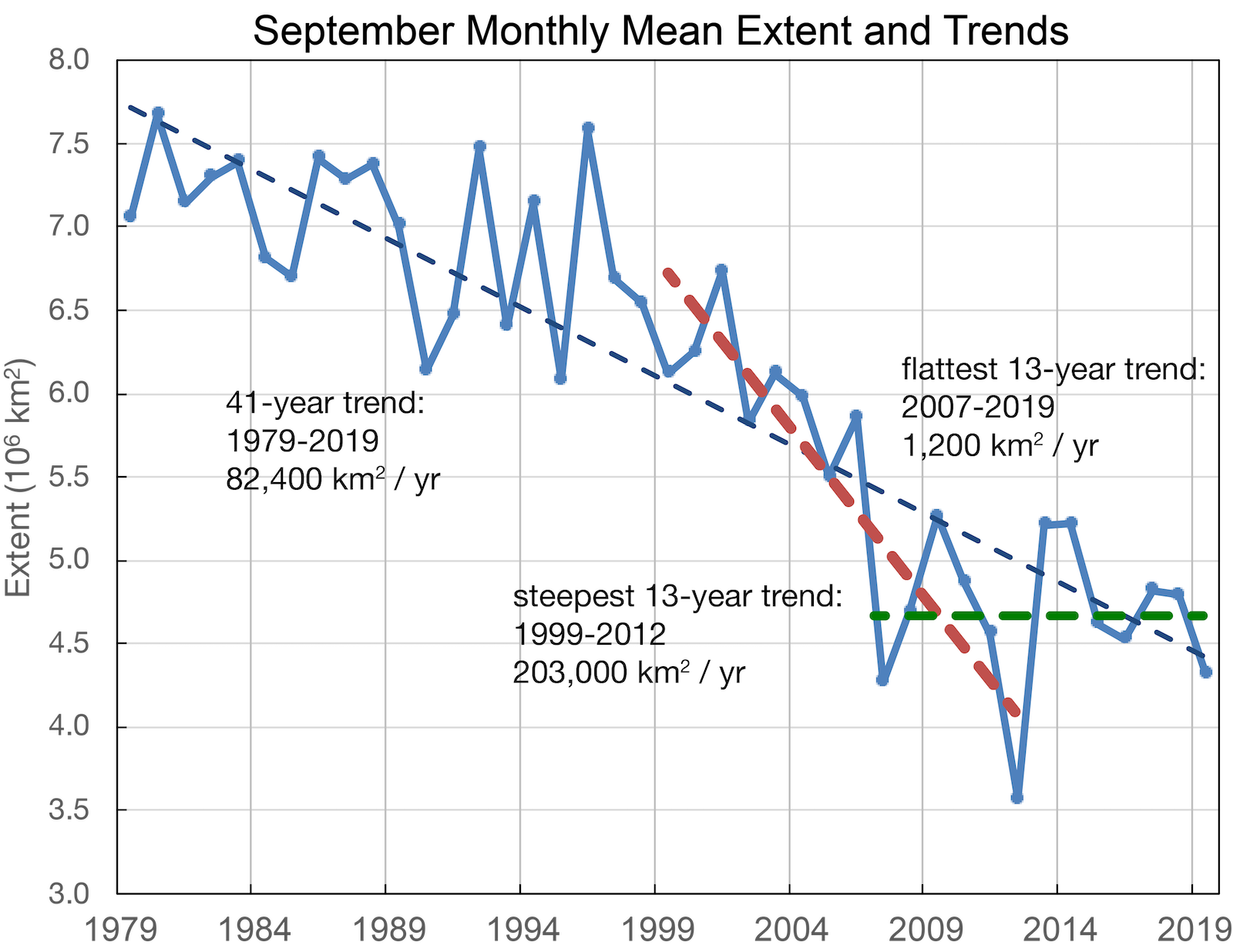
If the hottest year ever can’t precipitate ‘ice-free’ conditions in September, what’s it going to take? Arctic sea ice failed to nose-dive again this year, undoubtedly disappointing expects who have been anticipating a ‘death-spiral’ decline for ages. Arctic sea ice hit its seasonal low sometime around mid-September this year and although the precise value hasn’t been published, the average September ice coverage will likely be about 4.2 mkm2 once it gets announced in early October.
If the hottest year ever can’t precipitate ‘ice-free’ conditions in September, what’s it going to take? Arctic sea ice failed to nose-dive again this year, undoubtedly disappointing expects who have been anticipating a ‘death-spiral’ decline for ages. Arctic sea ice hit its seasonal low sometime around mid-September this year and although the precise value hasn’t been published, the average September ice coverage will likely be about 4.2 mkm2 once it gets announced in early October.
This means we have now had 17 years of a near-zero trend for September sea ice, extending the nearly-flat trend NSIDC sea ice experts acknowledged four years ago. This surely busts a huge hole in the prevailing concept that more atmospheric CO2 causes less summer sea ice. Note that CO2 levels measured in August 2023 were 419.7 parts per million (ppm), compared to 382.2 in August 2007, a rise of 37.5ppm with no corresponding decline in summer sea ice (and vs. 314.2 ppm in 1960). Measured in metric tons, CO2 emissions due to fossil fuels rose from 31.1 billion in 2007 to 37.1 billion in 2021 (last year of data), again with no corresponding decline in summer sea ice.
Background
In 2015, Neil Swart and colleagues argued that statistically speaking, the 7-year near-zero trend that was documented from 2007-2013 was caused by natural variability and was eminently compatible with models predicting “ice-free” conditions within decades due to increased CO2 levels. Their models led them to conclude that the possibility of a 14-year near-zero trend (e.g. 2007-2020) was possible but far less likely and that even longer near-zero trends are much more likely to occur when the Arctic is nearly ice-free (i.e. about 1 mkm2).
Surely a near-zero trend lasting 17 years (2007-2023), particularly before extent has reached the scary-sounding “ice-free” level, virtually destroys the assumption that sea ice extent is being controlled by atmospheric CO2 or even global temperatures, especially given the claim that 2023 may be the “hottest year on record”!
You don’t have to be a math wiz to see that there has been a nearly-flat trend in September sea ice extent since 2007 (pink dot marks approximate level for 2023 on this 2022 graph) but Walt Meier at the NSIDC actually did the math back in 2019 (insert), which is now extended another four years.
This absurd idea that atmospheric CO2 controls Arctic sea ice in summer–but causes only a slight decline in winter and no decline in Antarctic sea ice (Blanchard-Wrigglesworth et al. 2022; Crockford 2023)–has been embraced by biologists who want to see polar bears listed as ‘threatened with extinction’ by every government and conservation organization in the world, whatever the cost to their scientific integrity.
Prior to 2015, polar bear specialists needed to inject the IUCN Red List assessment with a semblance of scientific merit, so they programmed their predictive models to assume a linear relationship between CO2 and Arctic sea ice in summer (Notz and Stroeve 2016; Stern and Laidre 2016; Regehr et al. 2016: Wiig et al. 2015). And in 2023, the same assumption was made by Steven Amstrup and his sea ice expert sidekick when they made the ridiculous claim that CO2 emissions can be directly linked to reduced polar bear cub survival across the Arctic (Amstrup and Bitz 2023; Molnar et al. 2020). But while polar bear researchers generally apply this linear CO2-sea ice concept at a regional (subpopulation) scale (and use a slightly different metric of “summer” ice extent), the effect is the same: they assume more global CO2 means that summer sea ice at any Arctic location will continue to decline in a linear fashion decades into the future.
Which brings us back to the pause and my big question: Are polar bear specialists ever going to acknowledge the 17-year near-zero trend in summer sea ice or will they forever just draw a straight line from 1979 and insist summer sea ice is still declining?
Amstrup, S.C. and Bitz, C.M. 2023. Unlock the Endangered Species Act to address GHG emissions. Science 381(6661):949-951. pdf here.
Blanchard-Wrigglesworth, E., I. Eisenman, S. Zhang, et al. 2022. New perspectives on the enigma of expanding Antarctic sea ice, Eos 103. https://doi.org/10.1029/2022EO220076.
Crockford, S.J. 2023. The Polar Wildlife Report. Global Warming Policy Foundation Briefing 63, London. pdf here.
Molnár, P.K., Bitz, C.M., Holland, M.M., Kay, J.E., Penk, S.R. and Amstrup, S.C. 2020. Fasting season length sets temporal limits for global polar bear persistence. Nature Climate Change. https://doi.org/10.1038/s41558-020-0818-9 pdf here.
Notz, D. and Stroeve, J. 2016. Observed Arctic sea-ice loss follows anthropogenic CO2 emission. Science 354(6313):747-750. pdf here.
Stern, H.L. and Laidre, K.L. 2016. Sea-ice indicators of polar bear habitat. Cryosphere 10: 2027-2041.
Swart, N.C., Fyfe, J.C., Hawkins, E., Kay, J.E. and Jahn, A. 2015. Influence of internal variability on Arctic sea-ice trends. Nature Climate Change 5(2): 86–89.
Wiig, Ø., Amstrup, S., Atwood, T., Laidre, K., Lunn, N., Obbard, M., et al. 2015.Ursus maritimus. The IUCN Red List of Threatened Species 2015: e.T22823A14871490. Available from http://www.iucnredlist.org/details/22823/0 [accessed Nov. 28, 2015]. See the supplement for population figures.
The Weather Channel is absolutely ridiculous. The channel’s “Weather Across the Country” map on their homepage for September 19 had red colors EVERYWHERE! Because it’s HOT HOT HOT! No area of the country is experiencing normal weather for mid September, apparently. Chicago, for instance, was displayed as red to deep orange. Warm, right?
The Weather Channel is absolutely ridiculous. The channel’s “Weather Across the Country” map on their homepage for September 19 had red colors EVERYWHERE! Because it’s HOT HOT HOT! No area of the country is experiencing normal weather for mid September, apparently. Chicago, for instance, was displayed as red to deep orange. Warm, right?
I can tell you from personal experience: It was “freezing” on Tuesday, September 19 in Northern Illinois for a day that is still technically summer. It rained all day and barely got over 60 all afternoon. I regretted not wearing a jacket to the office.
On this map, Seattle is in “yellow/green” denoting cooler weather, but I can assure you that today in Chicago felt like Seattle … and it probably felt a lot warmer in Seattle where The Weather Channel said, and showed with color, that it was significantly “cooler.”
Kansas City is 82 degrees and is in orange, approaching light orange to “cooler” yellow. Oklahoma City is also 82 degrees, but is DEEP RED HOT and close to the now new “hot” color of whitish pink. (When I was a kid, they saved the “white” color for cold. Now it’s “white hot”!)
Minot, North Dakota was allegedly 86 degrees today and is in “cool” yellow. Jacksonville, Florida is one degree higher at 87 and is in “deep red hot.” Missed opportunity there for The Weather Channel to move even more reds deeper into North Dakota, since it’s their goal to make it seem like going to towards the Canadian border is like visiting Florida. It’s like Florida everywhere!
More BS: International Falls, Minnesota is 70 degrees and portrayed as “red hot.” St. Louis, Missouri is 86 degrees and has the same color scheme, but even closer to a cooler orange and yellow. How can that be for a forecast of the high temperatures for the day?
HOT DAMN! I just noticed that Oklahoma City is 82 degrees and in deep red color and close to “hot pink” while St. Louis — 4 degrees hotter — is in orange to yellow.
The Weather Channel is propagandizing America. It is part of the “climate change causes everything, all the time, everywhere” effort to brainwash people to believe the myth that the summer of 2023 was the hottest year ever on record. EVER!!!!! They do that with visual propaganda, displayed above. But the facts and data show, that is just not true.
The Weather Channel has a mandate to continually reinforce climate alarmist propaganda by making you think, at a glance, that most of the middle of this country in September is just as warm as Florida. The historic heat wave we talked about all summer (but wasn’t actually historic) continues!
THIS IS THE TRUTH: Tuesday, September 19, 2023 was a cool, rainy, and dreary day in Chicagoland — yet the map by The Weather Channel would make you think otherwise. And, by the way, the weathermen on TV said it would rain a bit in the late morning, but clear up and warm up later in the afternoon. WRONG, AGAIN. These are the same people who assure us that most of Florida will be underwater by the time children now in Kindergarten are in their mid-50s, like me.
It’s all BS all the way down, and they know it. But they just need to keep enough people believing it long enough so the people will stop thinking for themselves and remember how the weather used to be delivered to us compared to now.
It’s all about advancing a larger agenda of panic about the climate and government “solutions” that take away your liberty. Green on the outside, deep red on the inside.
Weather forecasting is an inexact science. We all know that. But these same people assure us that unless we give up our way of life — a life of going where we want, growing enough food for everyone, driving for family vacations — these maps will get even more red! It’s a lie, but it’s insidious and unceasing.
Heartland friend John Coleman, who passed away a few years ago, founded The Weather Channel. He was aghast at what had become of his dream: a channel dedicated 24/7 to telling all of America what was happening with the weather across the country and in their backyard. It was a revolutionary idea, and The Weather Channel he founded became the go-to and trusted source for truthful weather information.
John was horrified that his idea had been infiltrated by climate alarmists and turned into a propaganda outfit.
Below is one of the best presentations John ever gave at one of Heartland’s climate conferences.
Here is John Coleman embarrassing CNN’s Brian Stelter when he made the mistake of booking him on his show — a media appearance I was honored to arrange for him.
Little Tin Gods by Don Henley from his album End of the Innocence.
“A new age is dawning On fewer than expected Business is usual” That’s how the headline read Some shaky modern saviors Have now been resurrected In all this excitement You may have been misled
People want a miracle They say “Oh Lord, can’t you see us? We’re tryin’ to make a livin’ down here And keep the children fed” But, from little dark motel rooms to “Six Flags Over Jesus” “How are the mighty fallen” So the Bible said
You don’t have to pray to a little tin god Step out of the way for a little tin god You might fear the reaper, you might fear the rod But you never have to get down on your knees You don’t have to holler, “please, please” No, you never have to get down on your knees For a little tin god
The cowboy’s name was “Jingo” And he knew that there was trouble So in a blaze of glory He rode out of the west No one was ever certain What it was that he was sayin’ But they loved it when he told them They were better than the rest
But you don’t have to pray for a little tin god Step out of the way for a little tin god You might hate the system, hate the job But you never have to get down on your knees You don’t have to holler, “please, please” No, you never have to get down on your knees For a little tin god
Throw down a rope from heaven And lead the flock to water The man in the middle would have you think That you have no other choice But to wander in the wilderness Of all the upturned faces If you stop and listen long enough You will hear your own small voice
But you don’t have to pray to a little tin god Step out of the way for a little tin god You might fear the reaper, fear the rod But you never have to get down on your knees You don’t have to holler, “please, please” No, you never have to get down on your knees You don’t have to holler, “please, please” You never have to get down on your knees For a little tin god
The Australian Youth Climate Coalition (AYCC) is asking supporters to send deceptive links out to friends and family that look like a cookie recipe but embed software cookies instead on the victim’s computer. The digital cookie then pushes green climate videos into their feeds, (as if the ABC news wasn’t loaded enough).
The Australian Youth Climate Coalition (AYCC) is asking supporters to send deceptive links out to friends and family that look like a cookie recipe but embed software cookies instead on the victim’s computer. The digital cookie then pushes green climate videos into their feeds, (as if the ABC news wasn’t loaded enough).
Look out for any links to oneminutecookie.com.
The AYCC gets about $3m in donations, and even visits schools, teaching children how to cheat and lie to save the planet, or something like that. What are good family relationships built on after all, if not deception? What is science if it is not propaganda?
These are all good questions to raise with the children in your life and the schools in your area. Don’t wait for an email to arrive, thank the AYCC for providing the opportunity to start the conversation now.
If the believers are so caring, ethical and moral why are they teaching children it’s OK to deceive family members? Is this the kind of “fair and just” world we want to live in?
Call up schools and the local P&C and ask if they are aware the AYCC — which runs programs in schools — teaches children to fool parents and grandparents and use malware. Are these the kind of family values that belong in our schools? Will the local school guarantee that they will not allow this group to manipulate children?
Reporter Joseph Lam spoke to cyber security experts at Check Point Research:
The company’s tech evangelist Ashwin Ram, one of Australia’s top 100 Innovators, said the technique was not common but was something he imagined cyber criminals would use as part of phishing campaigns.
Mr Ram said cookies were used to “enhance the user experience”, but in the case of AYCC campaign, “it looks like the goal here was to lure sceptics of climate change to oneminutecookie.com”. He adds: “While the site looks innocent, a victim’s browser will store cookies that will affect their browsing experience by displaying content to support a particular narrative.”
If the evidence for climate change is so overwhelming, why don’t they use that to win friends and influence people instead of phishing tricks that criminals might use?
Last week, Climate Change Roundtable discussed, “The failure of peer review: Climate is Beholden to Bullying and Bad Decisions.” That episode dealt with the bullying of a journal to remove a paper. This week we look at another incident: The use of FOI requests by NASA’s Dr. Gavin Schmidt to look into correspondence between authors, editors, and collaborators for for another paper they don’t like, of which Dr. Willie Soon was the lead author.
Last week, Climate Change Roundtable discussed, “The failure of peer review: Climate is Beholden to Bullying and Bad Decisions.” That episode dealt with the bullying of a journal to remove a paper. This week we look at another incident: The use of FOI requests by NASA’s Dr. Gavin Schmidt to look into correspondence between authors, editors, and collaborators for for another paper they don’t like, of which Dr. Willie Soon was the lead author.
Join our host, Anthony Watts, and weekly panelists, Dr. Sterling Burnett and Linnea Lueken, and Dr. Willie Soon as will delve into the fight between the dark Climate Empire and the Climate Rebellion over the right to publish, or perish at the hands of the Climate Empire.
Tune in LIVE for Climate Change Roundtable at Noon CT/1PM ET this Friday to engage in this enlightening discussion. Don’t forget to leave your questions to have them answered live during the show! Tune in to share your thoughts and be a part of this pivotal conversation.
The report states”But punishing weather conditions linked to climate change have eroded so much of the village’s soft sandy rock “ In fact coastal erosion has been taking place in Happisburgh for thousands of years. There are well established historical links for this fact, for instance: http://happisburgh.org.uk/ccag/history/ The British Geological Study in their 2006 study on Happisburgh erosion states: “It is likely that the Norfolk cliffs have been eroding at the present rate for about the last 5000 years” https://www.bgs.ac.uk/case-studies/coastal-erosion-at-happisburgh-norfolk-landslide-case-study/ The recent increase in erosion is due to fact that sea defences built in the 1950s, which worked well, have lately fallen into disrepair. Your claim of “punishing weather conditions” also does not stand up to scrutiny. The Met Office have recently said that “There’s no evidence of a trend in storminess because of climate change [in the UK]”: https://www.metoffice.gov.uk/about-us/press-office/news/weather-and-climate/2022/2022-provisionally-warmest-year-on-record-for-uk And the Met Office’s own charts clearly show that the frequency and intensity of storms in the UK has actually declined since the 1990S: https://notalotofpeopleknowthat.files.wordpress.com/2023/01/image-1.png Sea levels on the East Coast have been rising at a steady rate since the mid 19thC. There is no evidence of recent acceleration. https://www.tidesandcurrents.noaa.gov/sltrends/sltrends_station.shtml?id=170-053 About half of the sea level rise along the Norfolk coast, about 1mm a year, is caused by the land sinking, something which has been occurring since the Ice Age: https://notalotofpeopleknowthat.files.wordpress.com/2022/01/image-61.png Nowhere in the article is there any mention of the above facts. Consequently readers will have been badly misinformed, and led into thinking that coastal erosion is all due to modern, man-made global warming.
The first response was obviously written by the office junior, which I refused to accept. I have just received the second formal response:
I appreciate you may not believe there is a link between coastal erosion and climate change however many scientists and experts would disagree. Within the article, we quoted a spokesperson for the Department for Environment, Food and Rural Affairs as saying: “We recognise the threat from climate change and sea level rise, which is why we are investing a record £5.2bn over six years in around 2,000 flood and coastal erosion schemes to better protect communities across England,” The LSE’s Grantham Research Institute released a paper on this in 2021 which says: “Climate change is causing sea level rise, which is increasing the risk of flooding around the UK’s coastline. It is also increasing coastal erosion. Both of these hazards pose a risk to people and the environment. …The major impacts of sea level rise occur during high tides and storms, causing flooding along coastlines and estuaries.” The LSE paper further says: “Sea level rise can also increase coastal erosion because waves can extend further up and along beaches and cliffs. Erosion is happening faster along coastlines made from softer sediments, notably on the East coast of England”– which is where Happisburgh is sited. You have cited a BGS survey from 2006. As you suggested, it does indeed say “It is likely that the Norfolk cliffs have been eroding at the present rate for about the last 5000 years…” However it goes on to say: “…future predictions of sea-level rise and storm frequency due to climate change are likely to have a profound impact on coastal erosion and serious consequences for the effectiveness of coastal protection and sea defence schemes in East Anglia in the near future.” It also states: “Sea-level rise and climate change, including increased storminess, may also increase the rate of erosion.” The BGS survey was conducted 17 years ago in 2006, since when knowledge about climate change has moved on. What it predicted then does indeed seem to be happening. We reported in our article that During the last 20 years, 34 homes have crumbled into the water in Happisburgh because of coastal erosion. I am sorry if you were disappointed by our coverage however I do not believe there has been any breach of our Guidelines relating to editorial values and standards. I would however like to thank you for taking the time to write in and share your views with us.
So I have now sent my complaint up to the Executive Complaints Unit, with this reply:
Your response implies that the rate of sea level rise and storminess have increased since 2006, when the BGS stated that “It is likely that the Norfolk cliffs have been eroding at the present rate for about the last 5000 years”
There is no evidence for this. In terms of sea levels, the rate of rise has actually slowed in the period:
You quote DEFRA on the future threat of sea level rise, but the data shows that has not happened yet.
And as my original complaint noted, the Met Office have recently confirmed that storminess has not increased either. Their charts actually show a decline since the 1990s.
Your comment that “During the last 20 years, 34 homes have crumbled into the water in Happisburgh because of coastal erosion” is utterly irrelevant, as homes have been lost to the sea for centuries.
Above all you offer no evidence that the rate of erosion has increased since 2006. This is obviously crucial to your claim that climate change is having an increased effect on erosion.
Unless you can prove that the rate of erosion has increased since 2006, the BGS statement remains true, that “the Norfolk cliffs have been eroding at the present rate for about the last 5000 years”. This in turn therefore invalidates your report’s claim that “punishing weather conditions linked to climate change have eroded so much of the village’s soft sandy rock that her house is now the last one before the cliff edge”.
Whatever role modern climate change may have played, it is a fact that most of the erosion is due to geological forces which have been taking place for thousands of years.
It is grossly misleading not to mention this fact. It is also inaccurate to claim that climate change is having an increasing effect, as your reponses state.


 The Heartland Institute




You must be logged in to post a comment.