Koonin’s Climate Honesty

But scientists must tell the truth, absolutely completely lay it all out,
and we’re not getting that out of the scientific establishment.

From Science Matters

by Ron Clutz

Hot or Not: Steven Koonin Questions Conventional Climate Science and Methodology| Uncommon Knowledge

Steven Koonin shared his honest and wise perspective on global warming/climate change in the interview above.  For those who prefer reading, an excerpted transcript from the closed captions provides the highlights in italics with my bolds and added images.

PR: Welcome to uncommon knowledge; I’m Peter Robinson. Now a professor at New York University and a fellow at the Hoover Institution, Steven Koonin received a Bachelor of Science degree at Caltech and a doctorate in physics at MIT during a career in which he published more than 200 peer-reviewed scientific papers and a textbook on computational physics. Dr Koonin rose to become Provost of Caltech. In 2009 President Obama appointed him under Secretary of science at the Department of Energy a position Dr Koonin held for some two and a half years. During that time he found himself shocked by the misuse of climate science in politics and the press. In 2021 Dr Koonin published Unsettled. What climate science tells us, what it doesn’t and why it matters.

In Unsettled you write of a 2014 workshop for the American physical society, which means it’s you and a bunch of other people who I cannot even begin to follow. Serious professional scientists such as you and several colleagues were asked to subject current climate science to a stress test: to push it, to prod, to test it to see how good it was. From Unsettled I’m quoting you now Steve:

“ I’m a scientist; I work to understand the world through measurements and observations. I came away from the workshop not only not only surprised but shaken by the realization that climate science was far less mature than I had supposed.”

Let’s start with the end of that. What had you supposed?

SK: Well I had supposed that humans were warming the globe; carbon dioxide was accumulating in the atmosphere causing all kinds of trouble, melting ice caps, warming oceans and so on. And the data didn’t support a lot of that. And the projections of what would happen in the future relied on models that were, let’s say, shaky at best.

PR: All right. Former Senator John Kerry is now President Biden’s special Envoy for climate. Let me quote from John Kerry in a 2021 address to the UN Security Council:

“Net zero emissions by 2050 or earlier is the only way that science tells us we can limit this planet’s warming to 1.5 degrees Celsius. Why is that so crucial? Because overwhelming evidence tells us that anything more will have catastrophic implications. We are Marching forward in what is tantamount to a mutual suicide pact.”

Overwhelming evidence science tells us. What’s wrong with that?

SK: Well you should look at the actual science which I suspect that Ambassador Kerry has not done. The U.N puts out assessment reports every five or six years. Those are by the IPCC the Intergovernmental Panel for Climate Change and are meant to survey, assess and summarize the state of our knowledge about the climate. The most recent one came out about a year ago in 2022, the previous one in 2014 or so.

Those reports are massive to read; the latest one is three thousand pages and it took 300 scientists a couple years to write. And you really need to be a scientist to understand them. I have a background in theoretical physics, I can understand this stuff. But still it took me a couple years to really understand what goes on. Now Ambassador Kerry and other politicians certainly have not done that.

Likely he’s getting his information from the summary for policy makers, or more likely for an even further boiled down version. And as you boil down the good assessment into the summary, into more condensed versions, there’s plenty of room for mischief. That Mischief is evident when you compare what comes out the end of that game of telephone with what the actual science really is.

PR: All right: what we know and what we don’t. Let’s start with what we know. I’m quoting you again Steve from Unsettled  “Not everything you’ve heard about climate science is wrong.” In particular you grant in this book two of the central premises or conclusions of climate science that the Press is always telling us about. here’s one and again I’m going to quote you:

“Surely we can all agree that the globe has gotten warmer
over the last several decades.”

SK: No debunking. In fact it’s gotten warmer over the last four centuries Now that’s a different assertion, but it’s equally supported by the assessment reports.  We’ll have to come back to that because the time scale is important. It’s one thing to say this about in my own lifetime the the the climate of the the surface of this planet, and it’s an entirely different thing to say beginning 150 years before this nation was founded temperatures began to rise.

PR: Yes, it’s a different statement but it’s equally true and has some bearing on the warming that we’ve seen over the last century. Here’s the premise that you do grant again I’m going to quote Unsettled

“There is no question that our emission of greenhouse gases in particular CO2 is exerting a warming influence on the planet.” We’re pumping CO2 into the atmosphere, CO2 is a greenhouse gas it must be having some effect of course.”

Absolutely that’s as far as you’re willing to go.   But then you say so actually those are pretty two benign premises that you grant: the Earth has been warming and it’s been warming for a long time. CO2 is a greenhouse gas and it must be having some effect it’s coming from human activities and it’scoming from Humanity, mostly fossil fuels. Now now on to what we don’t know okay again from Unsettled

“Even though human influences could have serious consequences for the climate, they are small in relation to the climate system as a whole. That sets a very high bar for projecting the consequences of human influences.”

That is so counter to the general understanding that informs the headlines, particularly this hot summer we’ve had . So explain that.

SK: Human influences as described in the IPCC are a one percent effect on the radiation flow–the flow of heat radiation and sunlight in the atmosphere. That means your understanding had better be at the one percent level or better if you’re going to predict how the climate system is going to respond. And the one percent makes sense because the changes in temperature we’re talking about are three degrees Kelvin right whereas the average temperature of the earth is about 300 degrees Kelvin.

PR: So human influences are a one percent effect on a complicated chaotic multi-scale system for which we have poor observations  You seem to you seem to quite relaxed about the original science

SK: The underlying science is expressed in the data and expressed in the research literature the journals the research papers that people produce the conference proceedings and so on. The IPCC takes those and assesses and summarizes them and in general it does a pretty good job at that level. And there’s not going to be much politics in that although they might quibble among themselves about adjectives and adverbs; this is extremely certain or this is unlikely or highly unlikely and so on. But by and large it’s pretty good, this is done by fellow Professionals in a professional manner

Now things begin to go wrong. The next step is because nobody who isn’t deeply in the field is going to read all that stuff, so there is a formal process to create a summary for policy makers which is initially drafted by the governments not by the scientists. Well it’s not of course all of them, there’s some subcommittee to do the summary for policy makers and that gets drafted and passed by the scientists for comment. In the end it’s the governments who have approved the summary for policy makers line by line and that’s where the disconnect happens.

For the disconnect I’ll give you an example. Look at the most recent report and the summary for policy makers is talking about deaths from extreme heat incremental deaths and it says that you know extreme heat or heat waves have contributed to uh mortality okay and that’s a true statement But they forgot to tell you that the warming of the planet decreases the incidence of extreme cold events. And since nine times as many people around the globe die from extreme cold than from extreme heat, the warming from the planet has actually cut the number of deaths from extreme temperatures by a lot. That’s not in there at all.

So the statement was completely factual, but factually incomplete
in a way meant to alarm, not to inform. 

And then John Kerry stands up and gives a speech. Maybe he read the SPM I don’t know or his staff read it and probably some of their talking points. And so you get Kerry saying that, you get the Secretary General of the U.N Gutierrez saying, we’re on a highway to climate hell with our foot on the accelerator. But they’re Preposterous of course, even by the IPCC reports they’re Preposterous.  The climate scientists are negligent for not speaking up and saying that’s not okay.

PR: Another one of the things going wrong you write about in a way that I have never seen anyone write about computer models. I have never seen anybody make computer models interesting. So congratulations Steve you did something special as far as I know in the entire Corpus of English language.

Here I’m going to quote from a piece you published in the Wall Street Journal not long ago:

“Projections of future climate and weather events rely on models
demonstrably unfit for the purpose.”

SK: Well, to make a projection of future climate you need to build this big complicated computer model which is really one of the grand computational challenges of all time.

This is not something I wrote a textbook in 1980s when the first PCS came out about how to do modeling on computers with physics. I do know what I’m talking about okay. And then you have to feed into the model what you think future emissions are going to be and the IPCC has five or six different scenarios, High emissions ,low emissions. If you take a particular scenario and feed it into the roughly 50 different models that exist that are developed by groups around the world

So Caltech has a model, Harvard has a model, yeah Oxford. But the Chinese have several models, the Russians and so on. When you feed the same scenario into those different models you get a range of answers. The range is as big as the change you’re trying to describe itself okay, And we can go into the reasons why there is that uncertainty, and in the latest generation of models about 40 percent of them were deemed to be too sensitive to be of much use.

Too sensitive meaning that when you add the carbon dioxide in and the temperature goes up too fast compared to what we’ve seen already. So that’s really disheartening the world’s best models are trying as hard as they can, and they get it very wrong at least 40 percent of the time.

This is not only my assessment you can look at papers published by Tim Palmer and Bjorn Stevens who are serious modelers in the consensus. And their own phrases are that these models are not fit for purpose. at least at the regional or more detailed Global level .

PR: Quoting Unsettled again, and this is one of the most astonishing passages in the book.  Writing about the effects of the increases in computing power over the years:

“Having better tools and information to work with should make the models more accurate
and  
more in line with each other.  This has not happened.
The spread in results among different computer models is increasing.”

This one you’re going to have to explain to me.  As our modeling power, as our processing power increases, we should be closing in on reliable conclusions and yet they seem to be receding faster than we can approach them. if I got that correct that’s right how can that be

SK: Because  as the models become more sophisticated  that means either you made the boxes a little bit smaller in the model the grid boxes so there are more of them or you made more sophisticated your description.

The whole globe is sort of divided into 10 million slabs really.  The average size of a grid box in the current generation is 100 kilometers 60 miles okay and within that 60 miles there’s a lot that goes on that we can’t describe explicitly in the computer because clouds are maybe five kilometers big and Rain happens here and not there within the grid box we can’t describe all that.

One day we’ll be able to , but not really very soon and let me explain why. The current grid boxes are 100 kilometers so you might say well why not make them 10. well suddenly the number of boxes has gone up by a hundred okay so you need a hundred times more powerful computer but it’s worse than that because the time steps have to be smaller also because things shouldn’t move more than a grid box in one time step and so the processing power actually goes up as the cube of the grid size and so if you want to go from 100 kilometers to 10 kilometers that’s a factor of 10. the processing power required goes up by a factor of a thousand and it’s going to be a long time before we got a computer that’s a thousand times more powerful than what we have.

PR: You and I are speaking in the middle of August I just started collecting headlines thinking I’ll just read this to Steve and see what he says about it.

CBS News this past May “Scientists say climate change is making hurricanes worse.”

Koonin in Unsettled:  “Hurricanes and tornadoes show no changes attributable to human influences.” 

[The graph above shows exhibit 2a from Truchelut and Staehling overlaid with the record of atmospheric CO2 concentrations.  From NOAA combining Mauna Loa with earlier datasets.]
To determine Integrated Storm Activity Annually over the Continental U.S. (ISAAC) from 1900 through 2017, we summed this landfall ACE spatially over the entire continental U.S. and temporally over each hour of each hurricane season. We used the same methodology to calculate integrated annual landfall ACE for five additional geographic subsets of the continental U.S.

Well what do you think you’re doing taking on CBS?

SK: Well you know what science does CBS know?  The media gets their information from reporters who have no or very little scientific training. (PR: you mean you didn’t graduate people from Caltech who went to work there?)  Probably one or so and they do a good job. But they have reporters on a climate beat who have to produce stories the more dramatic the better:  If it bleeds It leads. and so you get that kind of stuff I quote

When I say something about hurricanes, I quote right from the IPCC reports and it doesn’t say that at all. Actually the most recent report said it based on a paper which was subsequently corrected

PR: Floods here’s a 2020 headline this is from an article or press release published by the UN environment program quote climate change this is the U.N now not the IPCC but it is a U.N agency:

UNEP: “Climate change is making record-breaking floods.”

Steve Koonin in Unsettled:  “We don’t know whether floods globally are increasing, decreasing or doing nothing at all.”

SK: I would say the U.N needs to be consistent and and they should check their press release against the IPCC reports before they say anything. 

When I wrote unsettled I tried very hard to stick with the gold standard which was the IPCC report at the time or the subsequent research literature I had available to me when I wrote the book only the fifth assessment report which came out in 2014 as we’ve discussed.

The sixth assessment report came out about a year ago and I’m proud to say there’s essentially nothing in there now that needs to be changed in the paperback edition. I will do an update of course but the paperback edition is not going to be totally rewritten.

PR:  All right agriculture. Here’s a 2019 headline

New York Times: “Climate change threatens world’s food supply United Nations warns.”

Steve Koonin in Unsettled:  “Agricultural yields have surged during the past Century even as the globe has warmed.  And projected price impacts from future human induced climate changes through 2050 should hardly be noticeable among ordinary market dynamics.”

SK: It’s not what I said but what the IPCC said. Take current media and almost any climate story, I can write a very effective counter-– it’s like shooting fish in a barrel. I’ve got I’ve actually gotten to the point where I say oh no not another one do I have to do that too. So this is endemic to a media that is ill-informed and has an agenda to set.

The agenda is to promote alarm and induce governments to decarbonize.

I think that probably the primary agenda is to get clicks and eyeballs but and you know there are organizations it’s wonderful there’s an organization called Covering Climate Now which is a non-profit membership organization it’s got the guardian it’s got various other media NPR I believe and their mission is to promote the narrative. They will not allow anything to be broadcast or written that is counter to the narrative The Narrative is: We’ve already broken the climate.

PR: These are headlines in July of 2023. This is last month here as you and I tape this.

New York Times on July 6th: ” Heat records are broken around the globe as Earth warms fast from north to south. Temperatures are surging as greenhouse gases combined with the effects of El Nino.“

New York Times on July 18: “Heat waves grip three continents as climate change warms Earth.  Across North America, Europe and Asia hundreds of millions endured blistering conditions.  A U.S official called it a threat to all humankind.”

Wall Street Journal on July 25th:  “July heat waves nearly impossible without climate change study says.  Record temperatures have been fueled by decades of fossil fuel emissions.” 

New York Times on July 27th; “This looks like Earth’s warmest month, hotter ones appear to be in store. July is on track to break all records for any month scientists say,  as the planet enters an extended period of exceptional warmth.”

Unsettled came out in April 2021 so we will forgive you not knowing in April 2021 what would happen last month July of 2023.  But now July 2023 is in the record books,  and doesn’t it prove that climate science is settled?

SK: That statement together with all those headlines confuse weather and climate. So weather is what happens every day or maybe even every season; climate the official definition is a multi-decade average of weather properties. That’s what the IPCC and another U.N agency, the World Meteorological organization (WMO) says.

We have satellites that are continually monitoring the temperature of the atmosphere and they report out every month what the monthly temperature is or more precisely what the monthly temperature anomaly is namely how much warmer or colder is it than the average what would have been expected for that month.  We have data that go back to about 1979. so we have good monthly measures of the global temperature on the lower atmosphere for 40 something years.

You see month-to-month variations of course but a long-term Trend that’s going up no question about it. I I won’t get the number exactly right, but it’s going up at about 0.13 degrees per decade all right. That’s some combination of natural variability and greenhouse gases. Human influences are more general and then every couple years you see a sharp Spike going up, and that’s El Nino.   It’s weather, and so it goes up and then goes back down.

So there’s a long-term Trend which is greenhouse gases and natural variability and then there’s this natural Spike every once in a while, but an eruption goes off you see something, El Ninos happen you see something.  And so on the last month in July there was another Spike in the anomaly the anomalies about as large as we’ve ever seen but not unprecedented okay

The real question is why did it Spike so much right?
Nothing to do with CO2

CO2 is kind of the well human influences a kind of the base on which this uh phenomenon occurs so because the the CO2 even if you stipulate that CO2 is causing some large proportion of this warming,  it’s a slow steady process you would not expect to see spikes you wouldn’t expect to see sudden step functions absolutely not all right and there are various reasons people hypothesize we don’t know yet why we’ve seen the spike in the last month

PR: You better take just a moment to explain what is El Nino

SK: El Nino is a phenomenon in the climate system that happens once every four or five years heat builds up in the equatorial Pacific to the west of Indonesia and so on and then when enough of it builds up it kind of surges across the Pacific and changes the currents and the winds uh as it surges toward South America all right it was discovered in the 19th century and it kind of well understood at this point 19th century means that phenomenon has nothing to do with CO2.

Now people talk about changes in that phenomena as a result of CO2 but it’s there in the climate system already and when it happens it influences weather all over the world we feel it we feel it it gets Rainier in Southern California for example and so on so we had it we we have been in the opposite of an El Nino, a La Nina for the last 3 years, part of the reason people think the West Coast has been in drought and it is Shifting.

It has now shifted in the last months to an El Nino condition that warms the globe and is thought to contribute to this Spike we have seen. But there are other contributions as well one of the most surprising ones is that back in January of 22 an enormous underwater volcano went off in Tonga and it put up a lot of water vapor into the upper atmosphere. It increased the upper atmosphere of water vapor by about 10 percent, and that’s a warming effect and it may be that that is contributing to why the spike is so high. so you’re let me go

PR: Back to New York since you spent you spent July there. I happened to visit in July and we have Canadian wildfires and the Press telling us that the wildfires are because of climate change. And for the first time anybody I know could remember smoke is so heavy and it gets blown into New York And this sky feels as though there’s a solar eclipse taking place for three days it’s so dark in New York

Meanwhile New York is hot it’s really hot and we’re reading reports that Europe is hot and there’s sweltering even in Madrid, a culture built around heat in the midday where they take siestas. Even in Madrid they don’t quite know how to handle this heat and it’s perfectly normal for people to say wait a minute this is getting scary. It feels for the first time as though the Earth is threatening, it’s unsafe in New York of all places where you didn’t have to worry about earthquakes. But the other thing you didn’t have to worry about was breathing the air, but suddenly you can’t breathe the air it feels uncomfortable it’s scary. And you’re saying and your response to that is what?

SK: So we have two responses. First we have a very short memory for weather. Go back in the archives or the newspapers and you can read from even the 19th century on the East Coast descriptions of so-called yellow days when the atmosphere was clouded by smoke from Canadian fires. So look at the historical record first and if it happened before human influences were significant you got a much higher bar to clear to say that’s CO2.

Secondly, there’s a lot of variability. Here in California we had two decades of drought and the governor was screaming New Normal. New Normal. And then what happened last year: historical record torrential rains because people forgot about the 1860 some odd event where the Central Valley was under many feet of water.

PR: So climate is not weather and the weather can really fool you. all right Steve some last questions.  From Unsettled:

“Humans have been successfully adapting to changes in climate for millennia.
Today’s society can adapt to climate changes whether they are
natural phenomena or the result of human influences.”

So you draw the distinction between adapting to climate change on the one hand and the John Kerry approach on the other which is trying to stop climate change. Explain that distinction and why you favor one over the other

SK: Okay. I would take issue though with your description of Kerry’s approach. It’s not trying to stop climate change, it’s to reduce human influences on the climate. Because the climate will keep changing even if we reduce emissions carry the night okay then I would even dream all right go ahead.

Let me talk about adaptation a little bit and give you some examples that are probably not well known, at least it wasn’t really known to me until I looked into it. If you go back to 1900 and you look from 1900 till today the globe warmed by about 1.3 degrees Celsius. That’s This Global temperature record that everybody more or less agrees upon . And before we get to the consequences, the other statement is that the IPCC projects about the same amount of warming over the next hundred years. You might ask what’s going to happen over the next hundred years as that warming happens.

We can look at the past to get some sense of how we might fare,
okay not perfect, but a good indication.

Since 1900 until now:

♦  The global population has gone up by a factor of five, we’re now 8 billion people.
♦  The average lifespan or life expectancy went from 32 years to 73 years
♦  The GDP per capita in constant dollars went up by a factor of seven
♦  The literacy rate went up by a factor of four
♦   The nutrition etc etc

The greatest flourishing of human well-being ever as the globe warmed by 1.3 degrees. And the kicker of course is that the death rate from extreme weather events fell by a factor of 50, due to better prediction, better resilience of infrastructure, and so on. So to think that another 1.3 or 1.4 whatever degrees over the next century is going to significantly derail that beggars belief.

Okay so not an existential threat perhaps some drag on the economy a little bit; the IPCC says not very much at all. So the notion that the world is going to end unless we stop Greenhouse Gas Energy is just nonsense. This is not a mutual suicide pact, not at all.

PR: On August 16th of last year a year ago President Biden signed legislation that included some 360 billion of climate spending, at least the Biden Administration claimed it was climate spending over the next decade. President Biden:

“The American people won and the climate deniers lost and the inflation reduction act takes the most aggressive action to combat climate change ever.”

Curiously enough, they called it the inflation reduction act while it seems to have prompted inflation rather than reduced it. Good legislation or not?

SK: It would be if it focused on useful adaptation, but it’s aimed at mitigation by and large, namely reducing emissions. I think there are parts of it that are good in particular the spur to innovate. New technologies are the only way we’re going to reduce emissions if that is the goal. We need to develop Energy Technologies that are no more expensive than fossil fuels technologies

PR: But our low emission or zero emission goals? Let’s take that one. Because here I have the Provost of Caltech, let’s ask  what tech what we can reasonably hope and what we cannot reasonably hope. Can we reasonably hope you and I are talking after 10 days after the internet went crazy with some claim of cold fusion, no it was room temperature superconductivity. Is this a problem we can crack?

SK:  So  I think it’s going to be really difficult there is one existing solution and that’s nuclear power fission right we know about Fusion separately Fission exists yes uh it can be done right; it’s more expensive than other methods,  because of the regulatory order and it’s got a large lead time, but also because at least in the U.S we build every plant to a custom design.  So one of the things I helped catalyze when I was in the department of energy was small modular reactors.  These are about a tenth the size of the big ones, you can build them in a factory put them on a flatbed truck and this is not a crazy dream. Venture money is going on and there are companies that are on the verge of putting out a test deployment of of commercially constructed power plants.

So why isn’t John Kerry going to one of these hot new startups and doing a photo shoot? I don’t follow Ambassador okay, but you know the nuclear word that is a political hot potato in some quarters. Not to get too much into politics, but I think there is a faction of the left wing that just sees that as anathema and not a solution at all. Meanwhile the Chinese are doing it.

So I like the technology parts of the IRA I do not like the subsidies for wind and solar. One of the things you didn’t mention was I was Chief scientist for BP the oil company for five years. So I learned the energy industry. I never had to make any money in it, but I helped to strategize and kind of systematize thinking for them. So I know from the inside about subsidies to solar and wind. Everybody thinks that’s a solution, but of course wind and solar are intermittent sources of electricity: solar obviously doesn’t produce at night or when it’s cloudy, wind does not produce when the wind doesn’t blow. If you’re going to build a grid that’s entirely wind and solar you better have some way of filling in the times when they’re not producing.

Now if it’s only eight hours or 12 hours you’re trying to fill in, not so hard you can build batteries and so on. But if you need to fill in a couple weeks such as times in Europe, Texas and California when the wind has become still and the solar is clouded out. So you need something else right and that might be batteries although I think that’s unlikely. Gas with carbon capture or nuclear is going to be at least as capable as the wind and solar and since the wind and solar feeds are the cheapest the backup system is going to be more expensive, so you wind up running two parallel systems making electricity at least twice as expensive.

So I say that wind and solar can be an ornament on the real electrical system
but they can never be the backbone of the system.

Let me explain the biggest problem in trying to reduce emissions is not the one and a half billion people in the developed world; it’s the six and a half billion people who don’t have enough energy. And you’re telling them that because of some vague distant threat that we in the developed world are worried about, that they’re going to have to pay more for energy or get more less reliable sources. They should be able to make their own choices about whether they’re willing to tolerate whatever threat there might be from the climate versus having round-the-clock lighting, having adequate Refrigeration, having transportation and so on. Millions of people in India,  six and a half billion people worldwide right absolutely they’re energy starved.

Three billion people on the planet of the 8 billion use less electricity every year than the average U.S refrigerator. So first fix that problem, which is existential and immediate and solvable, and then we can talk about some vague climate thing that might happen 50 years from now.

But scientists must tell the truth, absolutely completely lay it all out,
and we’re not getting that out of the scientific establishment.

PR: Unsettled has been out for more than two years now how have your colleagues responded?

SK: Many colleagues who are not climate scientists say thanks for writing the book it gives me a framework to think about these things and points me to some of the problems that we’re seeing in the popular discussion. I got some rather awful reviews from mainstream climate scientists which disappointed me. Not because they found anything wrong in the book, they didn’t. But the quality of the discussion, the ad hominem attacks, the putting words in my mouth and so on, that wasn’t so good.  Their argument was, Steve Koonin you’re one of us ; you shouldn’t be saying this. It may be true but you shouldn’t be saying it. Steve how could you?

First of all I’ve been involved in science advice in other aspects of public policy particularly National Defense together with some Stanford former colleagues now passed on. And I was taught that you tell the whole truth and you let the politicians make the value judgments and the cost Effectiveness trade-offs. My sense of that balance is no better than anybody else’s, but I can bring to the table the scientific facts. If you trust democracy, you trust people to elect politicians who can over time make a mistake here, they’ll make a mistake there.

But over time you trust them. Now there are colleagues who say: No don’t tell them the truth we can’t trust them to make the right decision. That’s fundamentally what’s going on. I know scientists who know better than everybody else, and you know it’s even worse because these are scientists in the developed world. And if you ask the scientists in Nigeria or India and so on, you get a very different values calculus, that the primary concern is getting enough energy for folks.

PR: According to a Harris poll in January 2022 a little over a year year and a half ago now 84% of teenagers in the United States agree with both of the two following statements. they agree with:

♦  Climate change will impact everyone in my generation through Global political instability.
♦  If we don’t address climate change today it will be too late for future Generations making some parts of the planet unlivable.

John Kerry, Al Gore, Greta Thunberg and on and on, and countless voices warning that climate change represents a genuine danger to life on the planet. And now millions of Young Americans are really scared. Surely this has some role to play in what we see the the suicidal ideation and the increasing unhappiness.

SK: I’m sure there are all kinds of social factors but surely this is part of what’s going on. There are two immoralities here. One is the immoral treatment of the developing World which we talked about. The other immorality is scaring the bejesus out of the younger generation. And it’s doubly dangerous because it’s mostly in the west and not in China or India. I’ve tried. I go out and talk in universities and of course the audiences I talk to tend to be quantitative and factually driven. So the minds get opened up if the eyes get opened up.

I think in the U.S the problem will eventually solve itself because the route we are headed down is starting to impact people’s daily lives. Electricity is getting more expensive, you won’t be able to buy an internal combustion car in 10 or 15 years. If you’re here in California, people are going to say wait a second, as they already are in Europe, in UK , Germany, France. And I think there will be a falling down to Earth of all of this at some point and we will get more sensible.

PR: Let’s say your audience now is not a colleague of yours but is an 18 to 24 year old American pretty bright, maybe in college maybe not, but bright. Reads newspapers or at least reads them online. Speaking to that person speaking to an American kid or young adult: Do you need, do they need to be scared?

SK: No absolutely not. I would quote the 1900 to now flourishing as an example. And I would say, you probably believe that hurricanes are getting worse, and then point them to the IPCC line. And say you know you were misinformed about that by the media, don’t you think that there are other things about which you’ve been misinformed. You can read the book and find out many of them, and then go ask your climate friends how come it says one thing in the IPCC report but you’re telling me something else.

The Scandalous EU Contract with Pfizer-BioNTech Has Been Online For Two Years. Why Has Nobody Seen It?

A recent court order requiring disclosure of the South African COVID-19 vaccine procurement contracts has caused a stir in social media and raised hopes that some of the secret clauses offering special protection to manufacturers might finally be revealed.

From The Daily Sceptic

BY ROBERT KOGON

A recent court order requiring disclosure of the South African COVID-19 vaccine procurement contracts has caused a stir in social media and raised hopes that some of the secret clauses offering special protection to manufacturers might finally be revealed. The Romanian Member of the European Parliament Cristian Terhes, who has long criticised Ursula von der Leyen and the EU Commission for publishing heavily redacted versions of the EU’s own procurement contracts, hailed the ruling in a tweet as a “huge win for transparency and accountability”, pointing, in particular, to the inclusion of the all-important ‘Pfizer’ contract among the documents to be released.

But why the excitement? The EU’s own procurement contract or Advanced Purchase Agreement (APA) with the consortium of Pfizer and the German company BioNTech has been available online in unredacted form for well over two years now: since, more precisely, April 2021, just shortly after vaccine rollout. It does indeed contain hair-raising clauses, which would undoubtedly have provoked massive opposition and ‘vaccine hesitancy’ had they been more widely known.

Consider, for instance, the following clause from Article 1, paragraph 4, of the Vaccine Order Form which is appended to the APA: “The Participating Member State further acknowledges that the long-term effects and efficacy of the Vaccine are not currently known and that there may be adverse effects of the Vaccine that are not currently known.” (See full paragraph below.) How many Europeans would have rushed to take the vaccine or even consented to take it if they had known that?

But they did not know it. For here is what the same paragraph looks like in the redacted version of the APA posted by the European Commission.

This ‘acknowledgement’ clause in the order form – acknowledgement, in effect, that the manufacturers knew neither if the vaccine was safe nor if it was effective, at any rate in the long-term – is in addition to the clauses which already provide the manufacturers extremely wide-reaching indemnification in the section on indemnification of the contract proper. See, for instance, the excerpt from Article I.12.1 below.

The ‘contractor’, as specified on the first page of the APA, refers to Pfizer and BioNTech collectively.

This is how the same passage looks in the redacted version of the contract posted by the European Commission.

Here is what the full page looks like.

And the following page.

In fact, apart from the first sentence, the entire section on indemnification, covering nearly three full pages of text has been redacted in the version of the APA posted by the Commission (see pages 24-26).

It is these extensive redactions which have been the focus of Cristian Terhes and other vaccine-critical members of the European Parliament. Taking Ursula von der Leyen and the Commission to task for their lack of transparency, Terhes has made a regular practice of theatrically holding up blacked-out pages of the contract in plenary sessions. (See here, for instance, from October 2022.)

But if the unredacted version was available anyway, why did Terhes and his colleagues not also refer to that, i.e., to the actual content of the passages which were being hidden? And how did the unredacted APA and the obviously explosive provisions it contains fail to become better known?

Well, Cristian Terhes and the other MEPs will have to answer the first question themselves. If they were unaware of the availability of the unredacted document, they were made aware of it in September 2022, namely, by the present author in a tweet-reply to Cristian Terhes to which Terhes replied in turn.

But the answer to the latter question – why the existence of the unredacted APA has not become better known – is perhaps more intriguing and would appear to have something to do with the form of stealth censorship or ‘visibility filtering’ which has since become the norm precisely on Twitter.

Thus, in July 2022, after stumbling upon the unredacted contract, I posted a thread on it on Twitter, which quickly went somewhat viral by the standards of a small account, garnering hundreds of retweets and likes and eventually, according to Twitter’s own metrics, just over 100,000 impressions. I began the thread with the same acknowledgement of the unknown efficacy and safety of the vaccine highlighted above.

On September 11th 2022, I quoted this thread in the above-mentioned tweet-reply to Cristian Terhes and asked him why he was showing redacted copies of the EU contracts when the unredacted documents were available. Terhes’s response was to call into question the authenticity of the unredacted document. “Nobody can confirm that those unredacted versions are the real one,” he wrote.

But the Pfizer-BioNTech contract was not just mysteriously floating around the web and it was not published by any obscure conspiracy website. It was published rather by the Italian public broadcaster RAI. The RAI is the Italian equivalent of the BBC.

The original April 17th 2021 RAI article, titled ‘Here Are the “Secret” Pfizer and Moderna Contracts for the Anti-Covid Vaccines’, is still available online. The article contains links to both the Pfizer-BioNTech and Moderna contracts.

The Pfizer-BioNTech contract has been available ever since on the RAI server. (Beware that when I first tweeted the contract in July 2022, it temporarily became unavailable, perhaps because the resulting traffic was greater than the server could handle.)

Furthermore, four days after publication of the RAI article, on April 21st, the Spanish daily La Vanguardia, Spain’s third largest newspaper in terms of readership, also announced that it had come into possession of the unredacted Pfizer-BioNTech contract – presumably simply by downloading it from the RAI website! – and published an article titled ‘The Contract With the European Commission Absolves Pfizer of Liability’.

Although, unlike the RAI, La Vanguardia did not post the contract as such, it did publish photos of selected pages, including a photo of the first page of the indemnification section I highlighted above, which it likewise contrasted to the redacted version published by the Commission.

On that same day, none other than Reuters also published an article on the leaked contract, citing La Vanguardia’s scoop (even though the scoop was in fact the RAI’s). Reuters, however, discreetly avoided mentioning the issue of indemnification, merely focusing on the price of the vaccine. (See ‘Leaked EU-Pfizer contract shows price for COVID vaccines set at 15.5 euros per dose’.)

So for three major European media, the RAI, La Vanguardia and Reuters, there was no question about the authenticity of the document when it first emerged in April 2021 – and before it again fell into oblivion. In the meanwhile, incidentally, Norman Fenton has also come upon the above-cited order form from the APA via a Slovenian FOI request, thus providing further confirmation of the document’s authenticity, supposing it were really needed.

But what was especially curious about my Twitter interaction with Cristian Terhes is what happened after it. Almost immediately after flagging the unredacted APA in reply to Cristian Terhes’s tweet, my Twitter account was hit with a shadow ban. This was what the results of my shadowban test looked like on the next day.

At the time, under the old Twitter regime, being shadow-banned was still a kind of status, which could be easily and accurately verified by online shadow-ban tests (or even by users themselves by searching for their own tweets when logged out of their accounts).

Furthermore, some other Twitter users let me know that they were unable to like or retweet my reply. See below, for instance. Similar feedback in the same vein is no longer available since Twitter has permanently suspended the author’s account.

This was not all that unusual per se. It will be recalled that tweets labelled ‘misleading’ under the old regime could not be liked or retweeted. But what was ‘misleading’ about my tweet? And, more to the point, it was precisely not labelled as such. Nonetheless, it appeared – surreptitiously – to be subject to similar sorts of restrictions.

Thereafter, engagement with my reply-tweets quoting the thread plummeted in general, occasionally popping up again, but still to less than half the previous level, before trending down to essentially, and apparently permanently, non-existent under the new Twitter regime. The below graph of relevant engagement (likes plus retweets) before and after the date of the interaction with Terhes illustrates this. It only includes tweets in which I used the word ‘unredacted’.

Restricting engagement remains very much a thing on the new Twitter/X, as X CEO Linda Yaccarino readily admits and as can be seen in the below extract on ‘tweet-level enforcement’ from the X ‘Help Centre’. Indeed, the actions taken to suppress tweet visibility appear to be more extensive now than under the old regime. (‘misleading’ tweets could be quoted, for instance.)

But unlike the old Twitter, which as a rule let users know when action was being taken against a given tweet, ‘X’ no longer publicises the fact.

Interestingly, the ‘Help Centre’ also acknowledges that such action may be taken in response to a “valid legal request from an authorised entity in a given country”. Who knows what a “valid legal request” is. But presumably the European Commission would count as such an “authorised entity” – especially since the Commission is designated as the ultimate regulator of online speech under the EU’s Digital Services Act. (See, for instance, here, here and here.)

In any case, the party with the most obvious interest in suppressing the unredacted APA is, of course, the party that redacted the document in the first place: the European Commission. It is not hard to imagine why the Commission would want, so to say, to ‘re-hide’ it.

Did old Twitter restrict the visibility of the unredacted APA in response to a request from EU authorities? Is new Twitter/X continuing to do so today?

Robert Kogon is the pen name of a widely-published journalist covering European affairs. Subscribe to his Substack and follow him on Twitter.

Greenland’s 2022-’23 Ice Coverage Well Above 1981-2010 Average Despite ‘Global Boiling’ Rhetoric

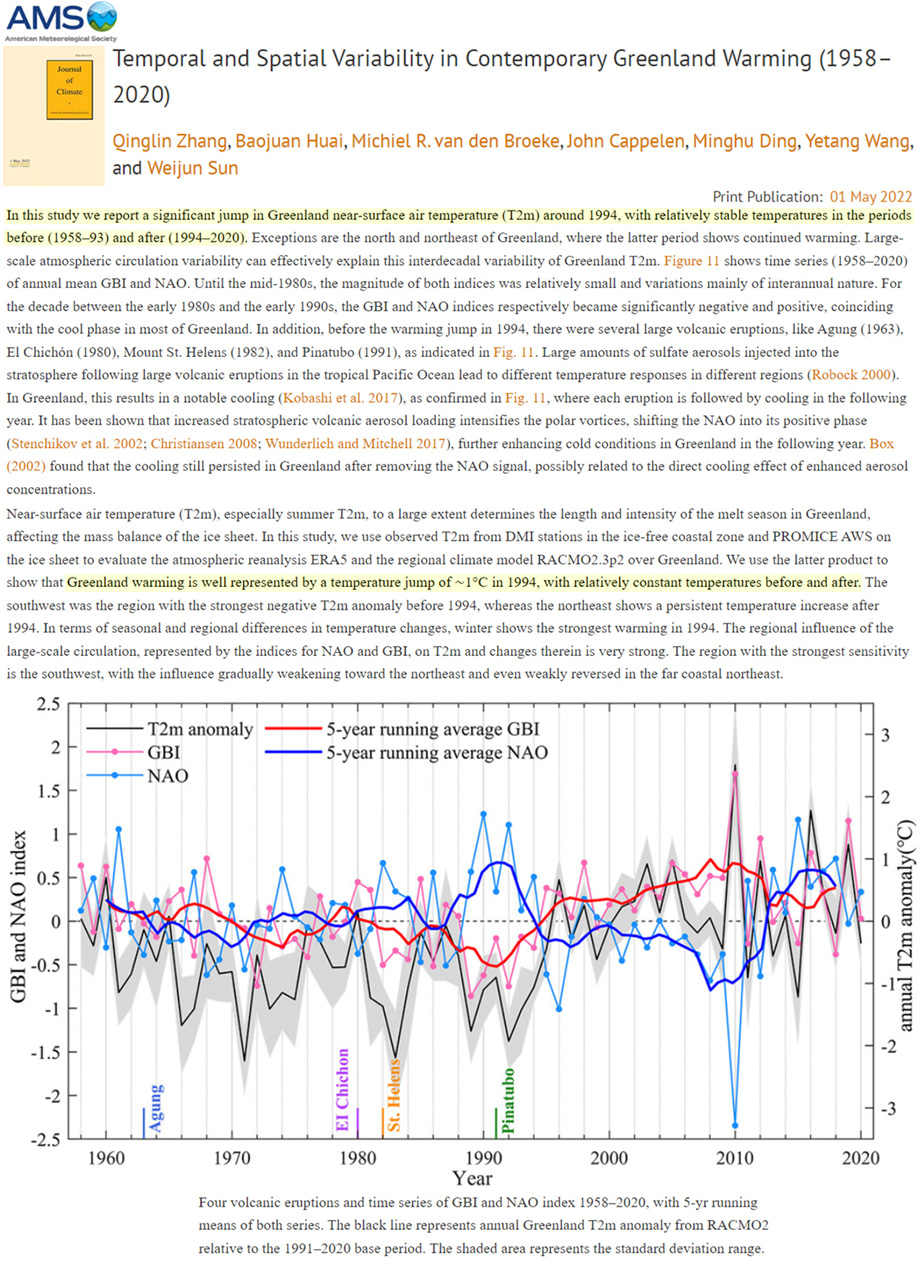
Since the early 2000s there has been no net change in the Greenland ice sheet mean annual surface temperature, as well as no net change in melt extent percentage.

From NoTricksZone

By Kenneth Richard on 31. August 2023

Since the early 2000s there has been no net change in the Greenland ice sheet mean annual surface temperature, as well as no net change in melt extent percentage.

Greenland’s ice coverage was, for most of this year (September 1, 2022 to August 31, 2023), observed to be significantly above the long-term (1981-2010) climate average. The Greenland ice sheet didn’t even cooperate with the narrative during the “global boiling” melt months of July and August.

Image Source: PolarPortal

Greenland has been defying the narrative for decades now. After a brief, sharp warming from 1994 to the early 2000s, the mean annual land surface temperatures (LST) have been trendless since about 2003. Since 2012, Greenland has been cooling (Fang et al., 2023). Compare the colorized Greenland temperature trends lineup for 2007-2012 to the 2013-2020 period (bottom).

Image Source: Fang et al., 2023

A trendless temperature record also manifests as non-significant change in melt extent as a percentage of surface area as well as the the mass balance for the whole ice sheet, especially from about 2005 onwards.

Image Source: Fang et al., 2023

Other scientists have also reported Greenland warming “is not evident” (Matsumura et al., 2022) in recent decades. Instead, temperature stations document net cooling trends from 2001-2019 (Hanna et al., 2021).

Image Source: Matsumura et al., 2022

Image Source: Hanna et al., 2021

Idalia Update

There have been suggestions that the rapid intensification of Idalia was somehow unprecedented.
This is nonsense.

From NOT A LOT OF PEOPLE KNOW THAT

By Paul Homewood

There have been suggestions that the rapid intensification of Idalia was somehow unprecedented.

This is nonsense.

Idalia went from a tropical storm, with winds of 60 kts (69 mph), to a Cat 3 hurricane at landfall, with winds of 125 mph, in the space of about 32 hours.

http://rammb-data.cira.colostate.edu/tc_realtime/storm.asp?storm_identifier=al102023

But that was nothing compared to the 1935 Labor Day Hurricane, by far the strongest to hit the US. This went from a tropical storm to a Cat 5 , with winds of 185 mph, all in the space of less than two days.

We must also remember, of course, that we now have satellite updates every six hours, plus frequent hurricane hunter flights, to give us almost hourly data for these bigger storms.

In 1935, they had little idea what was happening out at sea, and so often had no idea how quickly storms intensified.

http://www.hurricanescience.org/history/storms/1930s/LaborDay/

Trail of Destruction

Even the weakest hurricanes can be devastating to anybody in their path. But as the impacts from Idalia become clear, it seems that it was much less catastrophic than forecast, and certainly not in the same league as Ian last year.

Storm surge, according to Fox, never seems to have got much above 6 ft, much less than the 15 ft forecast before landfall. That however is still enough to inundate places like Cedar Key, a group of low lying islands which took the brunt of Idalia, and which are now more than a few feet above sea level for the most part.

Rainfall was not excessive either by hurricane standards. And as the storm tracked across Georgia, the expected catastrophic rainfall did not materialise – totals of up to in Georgia for example.

Fortunately it also appears that there have been no deaths identified so far, as a direct result of the storm.

Global Greening – The Good Kind of Green

Join us for a special episode of Climate Change Roundtable titled, “Global Greening – the Good Kind of Green.” Dive deep into the benefits of global greening and discover how increasing atmospheric CO2 is leading to enhanced plant growth globally. This week features special guests Patrick Moore and William Happer, two of the most distinguished scientists in their fields.

The Heartland Institute

Join us for a special episode of Climate Change Roundtable titled, “Global Greening – the Good Kind of Green.” Dive deep into the benefits of global greening and discover how increasing atmospheric CO2 is leading to enhanced plant growth globally. This week features special guests Patrick Moore and William Happer, two of the most distinguished scientists in their fields.

Patrick Moore, not just a co-founder of Greenpeace but also an environmentalist with over 40 years of dedication, has been a vocal advocate for sound environmental practices his entire career. His key achievements include leading campaigns against whaling and exposing the anti-human agenda of the organization he co-founded, Greenpeace. Moore left the organization due to differences in beliefs, feeling that Greenpeace had shifted from a science-based approach to one driven by sensationalism and politics.

William Happer, a distinguished physicist from Princeton, has been recognized for his groundbreaking research in atomic physics, optics, and atmospheric science. He served as the Cyrus Fogg Brackett Professor of Physics at Princeton University and has been a prominent figure in the U.S. Department of Energy. Happer’s extensive research on the interactions between light and matter has paved the way for numerous technological advancements, and his insights into atmospheric phenomena have been pivotal in shaping our understanding of the environment.

In this episode, our host, Anthony Watts, and weekly panelist, Linnea Lueken, will delve into the science behind global greening. Special guests Patrick Moore and William Happer will reveal details and insights you haven’t heard before, shedding light on the lesser-known aspects of this phenomenon.

Tune in LIVE for Climate Change Roundtable at noon CT on Friday to engage in this enlightening discussion. Don’t forget to leave your questions to have them answered live during the show! Tune in to share your thoughts, and be a part of this pivotal conversation on the positive side of global greening.

Bloomberg Falsely Says Climate Change is Harming Crop Production, Reality Says Otherwise

A recent post at Bloomberg, titled “Climate Change Is Helping Pests and Diseases Destroy Our Food,” claims that recent crop shortages are due to increases in pest infestations and disease because of climate change. This is false for multiple reasons. First, the crops listed are not seeing substantial declines outside of particular production regions, which is to be expected from agriculture some years.

From ClimateRealism

ByLinnea Lueken

A recent post at Bloomberg, titled “Climate Change Is Helping Pests and Diseases Destroy Our Food,” claims that recent crop shortages are due to increases in pest infestations and disease because of climate change. This is false for multiple reasons. First, the crops listed are not seeing substantial declines outside of particular production regions, which is to be expected from agriculture some years.

Bloomberg contributor Mumbi Gitau writes that pests and disease “are exacerbating crop shortages that have sent prices for goods like cocoa, olive oil, and orange juice soaring.” Gitau also asserts that these shortages will “become even more prevalent as extreme weather events multiply.”

To be clear data show that extreme weather events are not getting more frequent or extreme, even amid the last hundred-plus years of warming. Climate Realism has covered this fact many times, here, here, and here, for just a few examples.

While the article covers several foods allegedly threatened by climate change which have mostly been covered by Climate Realism before, including cocoa, olives, orange juice, grains, and tomatoes, the article places a bit more emphasis the first three, and so we will do likewise.

Beginning with cocoa, Gitau says “West Africa, home to two-thirds of global cocoa supply, has seen serious difficulties with its crop in recent seasons, causing wholesale prices to soar near historic highs this year.”

There are two main diseases attacking cocoa in West Africa, according to Gitau. The first is “black pod disease” – a fungal disease that is spread most easily in the wet conditions that parts of West Africa have seen. The other is swollen shoot virus, which is spread by pests that already live in warmer parts of the world, so there is no evidence modest warming is spread those pests to regions where they hadn’t previously existed.

Cocoa is typically grown in rainforests and warmer equatorial parts of the world, regions that are naturally susceptible to those diseases in the first place. Additionally, as explained in “Correct, CNN, Cocoa Prices Are Due to Natural Weather Conditions and Disease,” climate change is not necessary for these kinds of illnesses to break out in cocoa plantations. The International Cocoa Organization (ICCO) says on their website that “[a]verage yields for cocoa production are low due to extensive systems of cultivation, ageing tree populations, high incidence and poor control systems of pests and diseases, ageing farmer populations, shortage of affordable labour, lack of easily available inputs, poor extension services and above all, the use of poor/average quality planting material.”

Because so much of the world’s cocoa is produced in a limited geographical area, any disease or poor conditions that strike the region will have a disproportionate impact on the total supply. Despite this, the same Climate Realism shows that world production of cocoa has steadily increased over time, despite fluctuations in yield. In fact, both yield and production of cocoa beans in West Africa have shown an increasing trend over period of modest warming, according to data from the United Nations Food and Agriculture Organization (FAO).

(See Figure below)

  • Cocoa bean production in West Africa alone has increased by 371 percent since 1961.
  • Yield has increased 87 percent since 1961, though it has flattened off since the 1990s.
  • Production records have been broken as recently as 2020, and have occurred 7 times from 2010 to 2021.

The article then says that olives, and olive oil, is threatened in Spain, “as drought has caused output to dwindle, more than doubling wholesale costs in the past year,” and by a plant-targeting bacterium that lives year around if winters aren’t cold enough to kill it off. Some famous, ancient trees in Italy are likewise threatened, but the report that Bloomberg links to as evidence blames “widespread agriculture abandonment” which allowed the insect that carries the disease to flourish and spread, whereas agricultural practices like tilling and cutting excess grass prevents the spread of the insect.

Although, according to U.N. FAO data, Italy’s production of olives has fallen off since it’s 2005 peak, Spain has meanwhile picked up the slack in a big way and is now the larger producer. (See figure below)

In Spain:

  • Olive production has increased 343 percent since 1961;
  • Yield has increased 61 percent;
  • All-time production records have been set as recently as 2018, and records have been set four times since 2010 alone.

Finally, regarding orange juice, Bloomberg says “hurricanes, frost, and diseases have decimated orange groves in Florida, pushing US orange juice futures to record highs this month.” They also say citrus greening disease, spread by an insect, is likewise causing shortages. However, again, these problems are already endemic to warm weather zones where oranges are produced. Also, although bad weather like hurricanes can destroy fruit orchards and cause problems for years afterwards, data shows that the modest recent rise in global average over more than a hundred years has not caused an increase in the number or severity of hurricanes, as demonstrated in numerous Climate Realism posts. In addition, there is no evidence rising temperatures have negatively impacted orange production.

While this article points to the United States for proof of production woes, the United States has been growing fewer oranges for decades as the country is outcompeted by Brazil, China, and Mexico.

Looking again at available production data from the U.N. FAO, worldwide the production and yield of oranges has been rising for decades, with an amazing production increase of 372 percent since 1961. (See figure below)

Orange juice prices can be better explained by looking at historic price data. (See figure below)

Prices have been going up along with energy costs and supply chain issues, with a historic upwards trend starting around the time of the COVID pandemic lockdowns, certainly made worse by weather like hurricane Ian, but not exclusively driven by it. And one must consider the fact that energy prices have risen, in large part due to climate policies imposed by the Biden administration, in Europe, and in other industrialized nations, which have increased the price the pesticides and fertilizers made using oil and gas. Oil and gas restrictions have increased the price of producing, transporting, storing, and selling cocoa, olive oil, and oranges at retail outlets.

It may be tempting to believe that crop failures in different parts of the world are indicative of some major global climate change impact, however, long-term data in weather trends, pest and crop disease patterns, and production show no such trends. A more likely factor for the “appearance” of a crop apocalypse is the advent of the internet and instantaneous worldwide news, allowing us for the first time ever to now can see much more of what afflicts different crops around the world, coinciding with the media’s adoption of a climate crisis narrative in which every bad thing that happens can trace its cause to climate change. Regional crop failures have always occurred, causing difficulties for producers and consumers, but there is no evidence recent isolated crop declines are more than temporary or due to long-term climate change. Bloomberg, ostensibly a business and economics focused publication, should be aware of this, and be able to explain the intricacies without resorting to climate alarm.

Linnea Lueken

Linnea Lueken is a Research Fellow with the Arthur B. Robinson Center on Climate and Environmental Policy.

While she was an intern with The Heartland Institute in 2018, she co-authored a Heartland Institute Policy Brief “Debunking Four Persistent Myths About Hydraulic Fracturing.”

Happy Labor Not Day!

Energy is the resource of resources, the master resource. This Labor Day weekend, give thanks to the dense, plentiful, affordable, reliable energies that have done much to improve living standards worldwide and master the vagaries of extreme weather and climate.

From Master Resource

By Robert Bradley Jr.

Energy is the resource of resources, the master resource. This Labor Day weekend, give thanks to the dense, plentiful, affordable, reliable energies that have done much to improve living standards worldwide and master the vagaries of extreme weather and climate.

Man-Made Disaster’: Byron Donalds Blames ‘Green New Deal Stuff’ For Maui Wildfire

Republican Rep. Byron Donalds blamed “green new deal stuff” for the devastating wildfire in Maui, saying an electric company ignored “the basic things.”

HAROLD HUTCHISON
REPORTER

Republican Rep. Byron Donalds blamed “green new deal stuff” for the devastating wildfire in Maui, saying an electric company ignored “the basic things.”

Maui County filed a lawsuit against Maui Electric Company, Limited, Hawaiian Electric Company, Inc., Hawaiʻi Electric Light Company, Inc., and Hawaiian Electric Industries, Inc. for allegedly failing to shut down equipment on Aug. 7, when the National Weather Service issued a “red flag” warning, ABC News reported. The deadly wildfire that destroyed many buildings in the town of Lahaina on Aug. 8, killed at least 114 people and left hundreds missing. (RELATED: ‘Are You Freaking Kidding Me?’: Former FEMA Head Blasts Hawaii Officials’ Focus On ‘Equity’ Prior To Fire)

“I don’t believe in man-made climate change, that is number one. Number two, even if you believe in climate change, quote, unquote what are the actual solutions? What the Democrats want us to do is to send money and treasure over to the Chinese so they can strip mine the planet, basically dump a lot of emissions into the atmosphere and give us solar panels and windmills,” Donalds told “Kudlow” guest host David Asman. “Even with the solar panels and windmills it will not help the American people be able to survive if there are higher temperatures because you need massive amounts of electricity to run air-conditioning, to run refrigerators, so on, so forth.”

“What people on the left who really dig into this climate change stuff really want for us to do is to unwind some of the very fabric of our economy. That doesn’t make any sense,” Donalds continued. “You need fossil fuels. You need energy production and that primarily comes from natural gas, fossil fuels and what we should be doing is embracing nuclear power, not going down this green new deal stuff because frankly that is what happened in Hawaii. There was so much pressure on the electric company from officials both locally in Hawaii, but also the federal government, to chase down renewable energy. They weren’t paying attention to the basic things like making sure that you don’t have limbs touching power lines and that you actually clear out the underbrush so that the fuel for a fire which is fresh wood and other things like that, is not laying around to catch fire and nearly burn down an area.”

The West Maui Land Company accused M. Kaleo Manuel, an official with the Hawaii Department of Land and Natural Resources (DLNR), of delaying a response to a request to use water to refill reservoirs used by the Maui Fire Department to fight the wildfire, Hawaii News Now reported.

“I’ll tell you this: This is much more after man-made disaster, what happened in Maui, than being caused by the planet,” Donalds concluded.

Thanks, Washington Post, for Demonstrating There is No Climate Change/Wine Apocalypse

The Washington Post (WaPo) ran a story bemoaning the fact that France has produced more wine than wine drinkers are demanding, resulting in French wine producers destroying large volumes of wine. This is a dramatic reversal from just two years ago when the mainstream media and French vintners were claiming climate change had made large regions of France inhospitable to wine production.

From ClimateRealism

By H. Sterling Burnett

The Washington Post (WaPo) ran a story bemoaning the fact that France has produced more wine than wine drinkers are demanding, resulting in French wine producers destroying large volumes of wine. This is a dramatic reversal from just two years ago when the mainstream media and French vintners were claiming climate change had made large regions of France inhospitable to wine production. This reversal shows, as Climate Realism pointed out at the time, that France’s low wine production in 2021 was a result of temporary weather events, events similar to ones’ wine producers in France and elsewhere had experienced many times previously, and were not indicative long-term trend resulting from climate change.

In the WaPo story, titled “France has too much wine. It’s paying millions to destroy the leftovers,” Caroline Anders, a researcher for The Daily 202, writes:

France is about to destroy enough wine to fill more than 100 Olympic-size swimming pools. And it’s going to cost the nation about $216 million.

Ruining so much wine may sound ludicrous, but there’s a straightforward economic reason this is happening: Making wine is getting more expensive due in part to recent world events, and people are drinking less of it. That has left some producers with a surplus that they cannot price high enough to make a profit. Now, some of France’s most famous wine-producing regions, like Bordeaux, are struggling.

Continuing, Anders notes that previously, the European Union (EU) had already provided France, the second most prosperous country in the EU as measured by GDP, with $172 million to destroy nearly 80 million gallons of wine. France garnered even more EU funding to destroy yet more wine just last week.

As discussed in Climate Realism, here and here, for example, just two years ago, French grape and wine producers were decrying lost production, blaming climate change for weather events from which many expressed concerns that they would never recover since a continued worsening was locked in. At the time, Climate Realism wrote:

2021 was a particularly bad year for wine production in France. But, long-term data show 2021 was an anomaly, not indicative of a long-term trend which might implicate a changing climate.

Although weather conditions in Europe were unfavorable to wine production in 2021, other countries were producing more wine than in the previous year. A Forbes magazine article on France’s wine woes in 2021 stated:

The almost catastrophic figures from France were caused by very unfavorable climatic [sic] conditions during most of the growing season: frost, hail, storms, and humidity in the summer (causing diseases).

Grape and wine production has grown spectacularly during the recent decades, as modest warming has expanded the number and location of areas favorable for grape and wine production. The most recent record for both grape and wine production was set as recently as 2018, according to the U.N. Food and Agriculture Organization, well into the period of modest warming. It is this global increase in production and declining consumption that has resulted in the present wine glut that French growers are facing. Increased competition from foreign producers and declining sales, not climate change, is responsible for French wine producers’ woes.

Wine can be stored for years, even decades, with the best wines improving with age. Despite this, French producers, with subsidies from the EU, are destroying millions of gallons of wine that could be sold at a later date if demand for wine rebounds. The decision to destroy their wine is driven by concerns about cost and profits, not climate change. Sadly, the WaPo and Anders ignore the elephant in the room. Although Anders’ notes, “wine is getting more expensive due in part to recent world events,” she fails to acknowledge the fact that prominent among the factors contributing to wine becoming more expensive, are the Western world’s climate policies that have increased energy costs and the cost of fertilizers and pesticides. Nor does WaPo or Anders mention that climate change has improved grape and wine production globally, benefiting average wine imbibers, if not dedicated oenophiles.

H. Sterling Burnett

H. Sterling Burnett, Ph.D., is the Director of the Arthur B. Robinson Center on Climate and Environmental Policy and the managing editor of Environment & Climate News.

In addition to directing The Heartland Institute’s Arthur B. Robinson Center on Climate and Environmental Policy, Burett puts Environment & Climate News together, is the editor of Heartland’s Climate Change Weekly email, and the host of the Environment & Climate News Podcast.

Germany begins dismantling wind farm for coal

German energy giant RWE has begun dismantling a wind farm to make way for a further expansion of an open-pit lignite coal mine in the western region of North Rhine Westphalia.

German energy giant RWE has begun dismantling a wind farm — to make way the expansion of its Garzweiler open-pit mine (Photo: Alle Dörfer bleiben)

NOT A LOT OF PEOPLE KNOW THAT

By Paul Homewood

h/t Dave Ward

German energy giant RWE has begun dismantling a wind farm to make way for a further expansion of an open-pit lignite coal mine in the western region of North Rhine Westphalia.

One wind turbine has already been dismantled, with a further seven scheduled for removal to excavate an additional 15m to 20m tonnes of so-called ‘brown’ coal, the most polluting energy source.

The demolitions are part of a deal brokered last year between Robert Habeck, the Green party’s minister for economy and climate action and Mona Neubaur, who is the economy minister for North Rhine Westphalia, to allow the expansion of the mine.

In return, RWE had to agree to phase out coal in 2030, eight years before the previous deadline. “It’s a good day for climate protection,” Habeck said at the time.

But this week’s move has sparked sharp criticism from activists.

“The current climate emergency requires urgent and concerted efforts to accelerate the deployment of every single wind turbine, solar panel and heat pump that we can muster,” said Fabian Hübner, a senior campaigner at Beyond Fossil Fuels, a German-based coalition of climate activists.

“Anything that diverts from this critical endeavour, especially the dismantling of renewable energy sources to extract more fossil fuels, must be unequivocally prohibited,” he added.

But RWE and Germany’s government have persistently justified the expansion of the so-called Garzweiler coal fields by pointing to the Russian invasion of Ukraine and the ensuing energy crisis.

According to RWE, the expansion is necessary “due to the energy crisis.” The government in Berlin follows this logic. Indeed, some of the leading advocates of RWE’s coal expansion plans come from the Green Party, one of three ruling parties in Germany’s current ‘traffic light’ coalition with centre-left SPD and business-friendly FPD-party.

Habeck has defended the expansion as the “right decision.” Green party politician Oliver Krischer has described the expansion and earlier phase-out as “one of the greatest advances we’ve made in recent years,”

But energy consultation firm Aurora has found that expanding the Garzweiler open-pit mine would cause the country to overshoot its climate pledges. Researchers also said lignite coal is likely to end in 2030 anyway because it is rapidly becoming uneconomical compared to other cheaper energy sources such as solar and wind.

https://euobserver.com/green-economy/157364