Global warming, climate change, all these things are just a dream come true for politicians. I deal with evidence and not with frightening computer models because the seeker after truth does not put his faith in any consensus. The road to the truth is long and hard, but this is the road we must follow. People who describe the unprecedented comfort and ease of modern life as a climate disaster, in my opinion have no idea what a real problem is.
A stable current global sea level record has apparently been “corrected” to show accelerated rise since the 1990s.
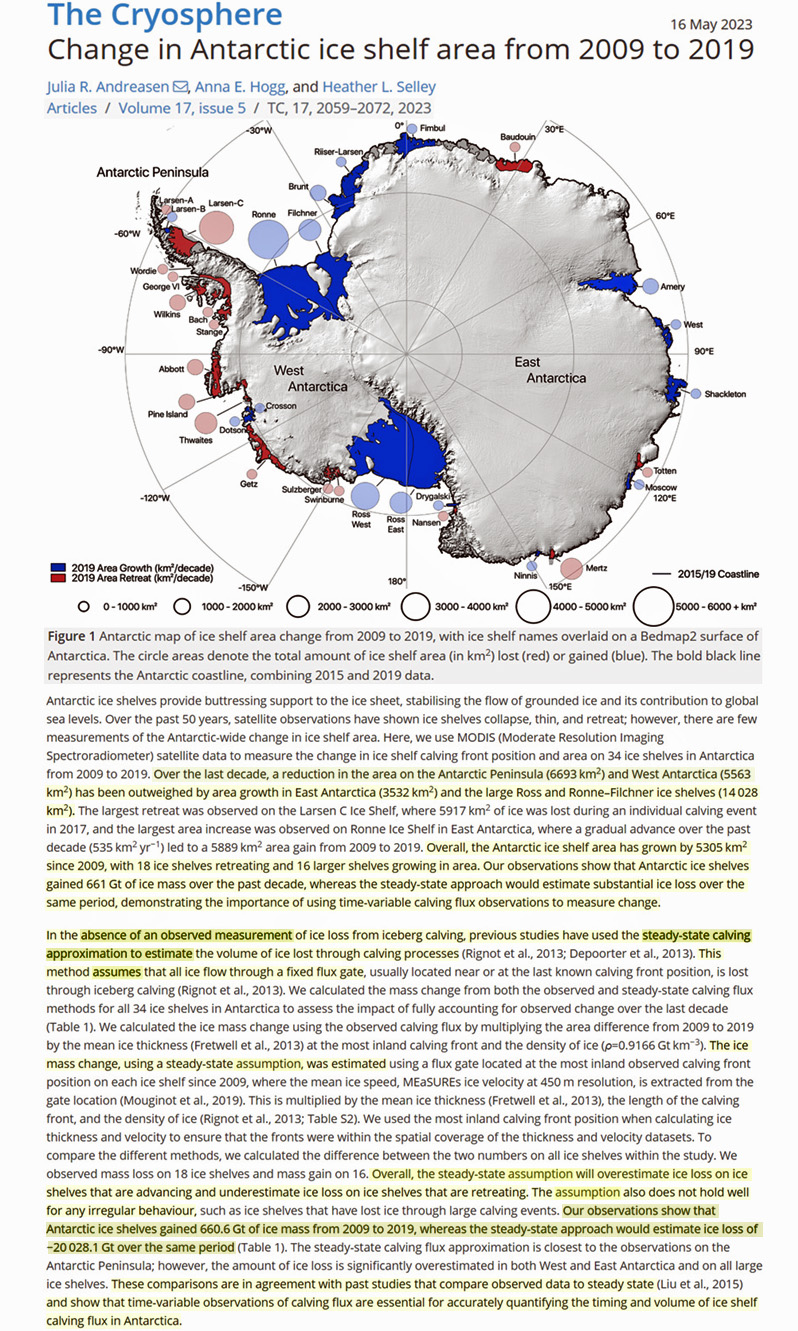
A few months ago we highlighted a new study indicating satellite observations reveal Antarctic-wide ice shelves gained +661 Gt of mass from 2009 to 2019.
Instead of reporting on these actual observations, agenda-driven scientists have long been using an approach relying on assumptions of an unrealistic “steady state” or fixed calving flux (instead of real-world time-variable observations). An assumption-based assessment approach allows estimates a net Antarctic ice shelf change to go from a +661 Gt mass gain to a -20,028 Gt mass loss over this 11-year period (Andreasen et al., 2023).
This is a more than 30-fold distortion of what actual observations indicate.
“Correcting” stable sea levels to show accelerated rise
According to long-term global tide gauge data (from the 100 tide gauges with more than 80 years of continuous data), sea levels have been gradually rising at rates of about +0.25 mm/year with no perceptible acceleration since the early 20th century.
Likewise, when satellite altimeters were originally deployed in the 1990s to early 2000s they consistently did “not show any sea level rise.”
A lack of sea level rise didn’t advance the narrative, of course.
So instead of reporting on what the actual satellite observations showed, arbitrary, subjective assumptions were employed to “correct” the data to show sea levels have been rising at rates of 3.2 mm/year instead.
The GMSL satellite altimeter data showed no rising trend for the first 5 years of the record. The first 5 years were then “corrected” to show +2.3 mm/year of sea level rise.
The GRACE satellite data showed the was a -0.12 mm/yr sea level fall trend from 2003 to 2008. After “correction,” this was changed to a +1.9 mm/year sea level rising trend.
“…the untampered results, not showing the desired sea level rise, were replaced by ‘corrected’ results. [U]ntil August 4, 2011 the European Space Agency’s Envisat satellite was showing less than +0.976 mm/year sea level rise since 2004. A few months later, thanks entirely to further corrections, the same data set showed +2.97 mm/year of sea level rise.”
Satellite data reveal coastal land area has been expanding seaward since 1984
A 2021 study (Mao et al., 2021) lends support to what the untampered satellite altimetry data indicated − prior to the assumption-based corrections.
Today there are high resolution satellite images available from Google Earth clearly demarcating global-scale decadal shoreline change since the 1980s. And, despite the “accelerating sea level rise” claims, the 1984-2019 satellite data show coastlines have been expanding by a net +0.26 m/year.
According to Mao and colleagues, Australia’s coasts have been growing at a rate of +0.10 m/year since 1984. Asia’s coasts have been expanding +0.64 m/year. Europe’s coasts are accreting +0.45 m/year. And the African continent has been observed expanding at a +0.31 m/year clip.
The only two continents where coasts have not been observed expanding in recent decades are South America, 0.00 m/year, and North America, -0.29 m/year.
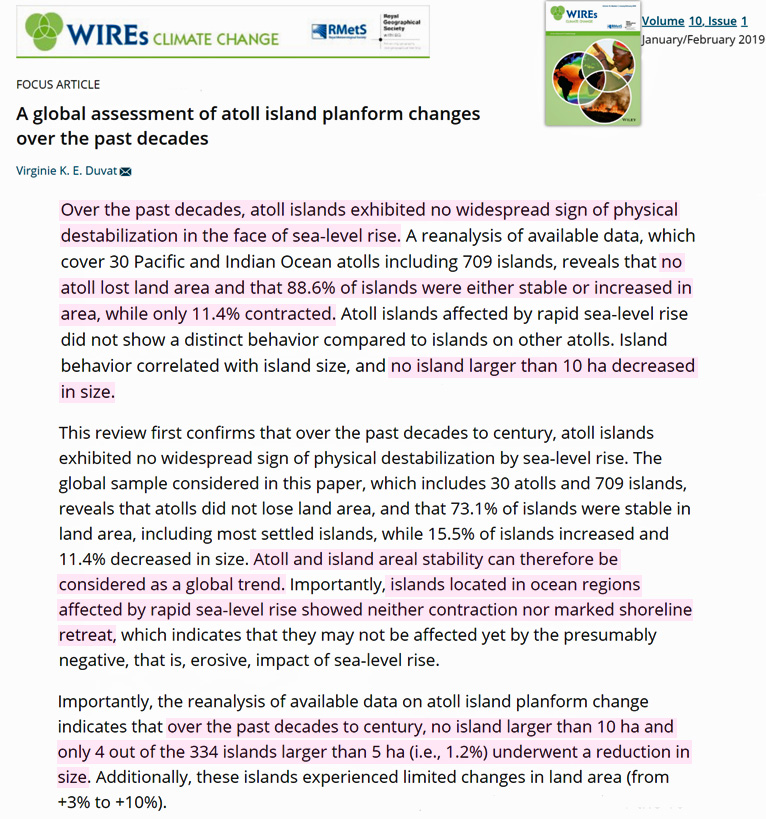
A 2019 global-scale analysis of 709 islands in the Pacific and Indian Oceans revealed 89% were either stable or growing in size, and that no island larger than 10 ha (and only 1.2% of islands larger than 5 ha) had decreased in size since the 1980s (Duvat, 2019).
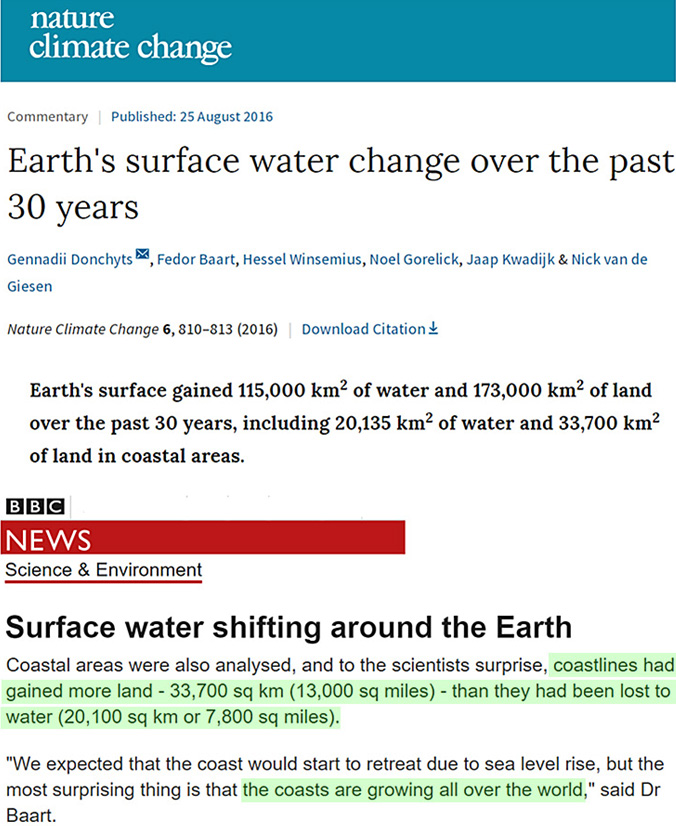
In apress release for 2016 paper on coastal land area changes from 1985 to 2015, scientists acknowledged this:
“We expected that the coast would start to retreat due to sea level rise, but the most surprising thing is that the coasts are growing all over the world“ – BBC
Claims of dangerously accelerating sea level rise posing an imminent global threat to coasts in the satellite altimetry era may not just be inaccurate. They may be fake.
In this episode, our host, Anthony Watts, and weekly panelists, Dr. Sterling Burnett and Linnea Lueken, will delve into the not-so-scientific ways that science gets published (or retracted) that have come to light in the past two weeks.
This episode of Climate Change Roundtable titled, “The failure of peer review: Climate is Beholden to Bullying and Bad Decisions” delves into the shadowy and competitive world of climate journal publications.
In this episode, our host, Anthony Watts, and weekly panelists, Dr. Sterling Burnett and Linnea Lueken, will delve into the not-so-scientific ways that science gets published (or retracted) that have come to light in the past two weeks.
We’ll discuss Dr. Robert T. Brown’s stunning admission that he held back certain data and analysis in order to ensure his climate paper got published by Nature. We’ll also look at the “climategate gang” and how they have bullied another journal to retract a paper they don’t like, which had already passed peer review. Now, new evidence has emerged of even more bullying.
Tune in LIVE for Climate Change Roundtable at Noon CT/1PM ET this Friday to engage in this enlightening discussion. Don’t forget to leave your questions to have them answered live during the show! Tune in to share your thoughts and be a part of this pivotal conversation.
Climate change is melting the ice on Mount Rainier. The environmental effects will be widespread, a Park Service study warned.
…
The changes reflect a stark global reality: Mountain glaciers are vanishing as the burning of fossil fuels heats up Earth’s atmosphere. According to the World Glacier Monitoring Service, total glacier area has shrunk steadily in the last half-century; some of the steepest declines have been in the Western United States and Canada.
Meteorologist Cliff Mass, Ph.D. of the University of Washington published a solid rebuttal to this claim back in June 2023, which is reproduced here from his website.
The Real Story About a “Melting” Mount Rainier
As many readers of the blog know, I often provide a reality check for over-the-top and often inaccurate Seattle Times articles dealing with climate change.
It is unfortunate that the Seattle Times has moved to an advocacy role on the issue of climate change, often exaggerating the effects of global warming. They often fail to provide reliable information to their readers on this important topic.
In yesterday’s online paper, they had a front-page story written by their columnist, Danny Westneat: Mount Rainier is melting. Can anything be done to stop it?
As you can imagine, they are talking about the glaciers on Mt. Rainier. The story references a new “piercing” National Park Service report and talks about the substantial reduction in glacier ice volume.
The message in the article is clear: Rainier’s glaciers are now rapidly retreating and that human CO2 emissions are the cause. We need to act now.
“It’s climate change before your eyes.”
“We’ve really got to focus on how we emit carbon into the air.”
This is a very deceptive article designed to convince us that a signature aspect of our region is being lost due to human carbon emissions.
The truth is that Rainier’s glacial melt has been predominantly natural, with human carbon emissions a small part of the story.
Although the story was supposedly motivated by a new report by Scott Beason and associates of the National Park Service (a very nice piece of work, I might add), this article NEVER mentions that most of the glacial loss on Rainier has little to do with human-caused climate change produced by increasing CO2, and the proof of this statement is found in the report itself.
Consider Figure 6 of the report, which shows the change in glacial ice area on Mount Rainier since 1895 (below). The glacial area has been reduced from around 130 km2 to around 75. Note that most of the loss was between 1895 and 1970, a period when there was very little human-caused global warming.
Viewing the ice volume of Rainier’s largest glacier (Emmons) shows that nearly ALL of the loss occurred during the 1895-1915 period.
There is, a large literature demonstrating the impacts of human greenhouse gas emissions is only significant after approximately 1980. Thus, the majority of the loss of Rainier’s glacial ice had to be natural.
In fact, we have a good idea of what happened. From roughly 1350 to 1850 AD, a large portion of the Northern Hemisphere was in the Little Ice Age, a period of cold temperatures and enhanced snowfall. There are a variety of proposed mechanisms, including changes in solar radiation and shifts in ocean circulation, all caused by natural processes. Starting during the late 1800s, the world and our region started to warm, and glaciers began to melt and retreat…as shown in the figure above.
Don’t get me wrong: global warming due to our emissions of greenhouse gases is slowly warming the planet and such warming would contribute to glacial melt during the past few decades. But that contribution has been quite modest compared to natural variability, something that is not mentioned in the article.
But there is more.
The amount of warming that has occurred over Rainier (and our region in general) has been relatively small due to the presence of the Pacific Ocean, which has slowed regional warming considerably. And this is particularly true of the windward (western) side of the Cascades, of which Rainier is a part.
We can show this explicitly using observations at Paradise on Mt. Rainier, located at roughly 5000 ft ASL. Below is a plot of annual temperatures at Paradise from 1917 to 2022, covering the period following the end of the Little Ice Age.
There is NO WARMING. In fact, the trend line shows slight cooling. This hardly suggests a major warming that would cause massive glacial melt. There are periods of slightly warmer and cooler temperatures, but no overall trend.
I should note that there was little change in precipitation over the entire period at this location.
But let’s take this one step further. Glaciers are controlled by additions during the winter and melting during the summer, so let’s look at the trend of summer (June, July, August) temperatures at the Paradise Ranger Station (below). There is a small upward trend of roughly 1°F. Less ocean influence during the summer.
The long-term perspective is critical for looking at such climatological data. Imagine I plotted only the last 30 years of Rainier summer temperatures (see below).
The Bottom Line
A detailed look at the excellent National Park Service report and long-term glacial and meteorological data suggests the following story.
There has been a substantial loss of glacial area and mass on Mount Rainier during the past 130 years.
Most of the loss has been natural and occurred before human-forced global warming could have been significant.
Mount Rainier, downstream of the slow-to-warm Pacific Ocean, has experienced very little warming over the entire year since the early part of the 20th century. Summer warming has been weak over the past century, but there has been some short-term warming during the past decades.
I believe a reasonable conclusion of all this is that most of the glacial loss on Rainier during the past century has been natural, but that human-caused warming could be making a modest contribution to glacial loss during the past few decades.
I wish Seattle Times reporters such as Danny Westneat would take the time to provide their readers a scientifically accurate, nuanced understanding of what is occurring. And no, I don’t think his idea of putting tarps or glass beads on the glacier is a good idea.
In New York, politicians are selling the public a narrative that electricity is going to be the solution to climate change. We will eliminate all CO2 emissions by banning gasoline-powered cars, banning natural gas infrastructure, banning gas heat in buildings, and banning gas for cooking. All of these are to be replaced with supposedly “green,” emissions-free, alternatives – which in practice consist of only one thing, electricity. We’ve been told that this is how we are going to protect the planet for future generations.
The following post was written jointly by Jane Menton and Francis Menton:
In New York, politicians are selling the public a narrative that electricity is going to be the solution to climate change. We will eliminate all CO2 emissions by banning gasoline-powered cars, banning natural gas infrastructure, banning gas heat in buildings, and banning gas for cooking. All of these are to be replaced with supposedly “green,” emissions-free, alternatives – which in practice consist of only one thing, electricity. We’ve been told that this is how we are going to protect the planet for future generations.
But there is nothing emissions-free about the way electricity is currently generated in New York. About half of our electricity comes now, as it traditionally has, from burning fossil fuels. New York has announced plans to eliminate those from electricity generation by 2030, but as of now has no realistic plan to replace them. Meanwhile, it is forcing its citizens to convert essential systems like heating to electricity, with no basis to believe that the electricity will be available to prevent people from freezing in the winter only a few years from now. This is a glaring contradiction, that needs urgently to be addressed before we suffer a self-inflicted catastrophe.
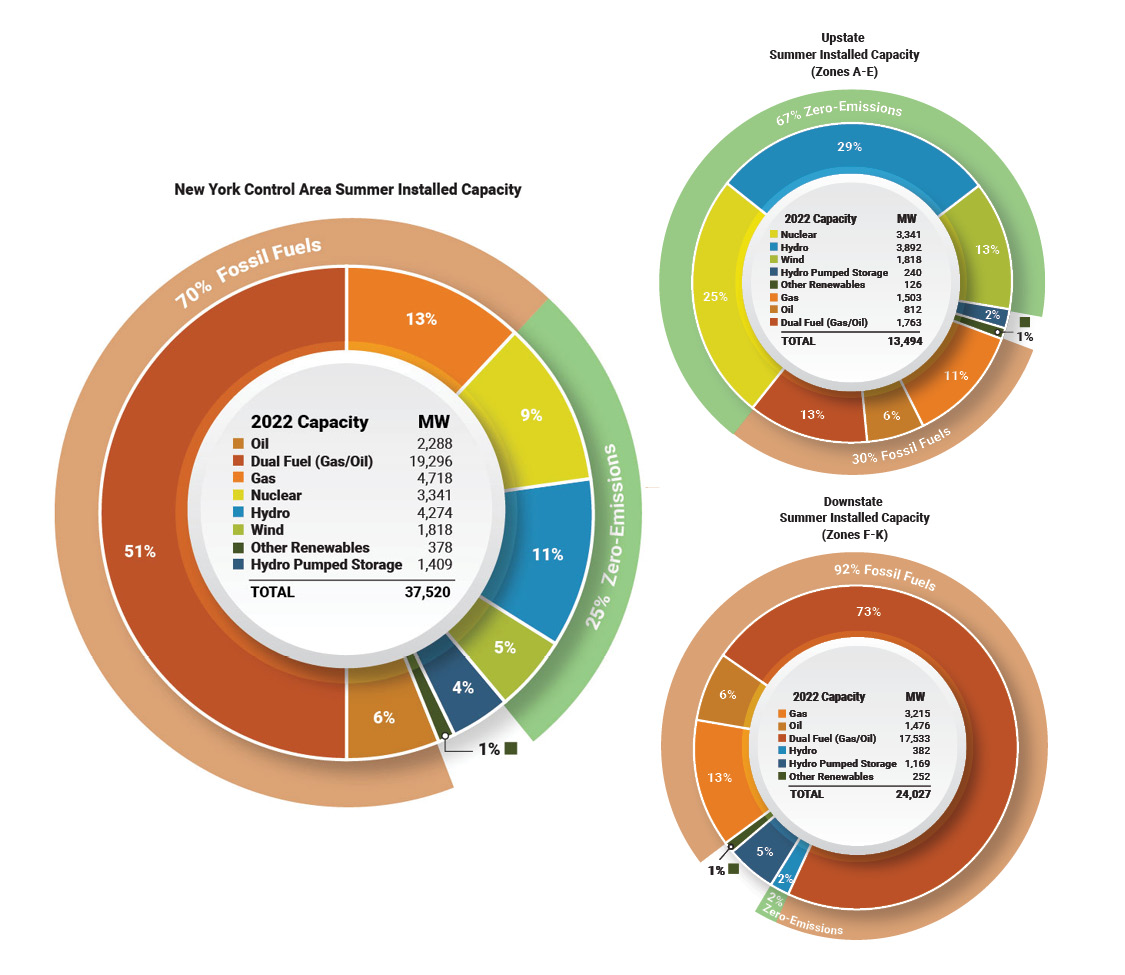
At present, fossil fuels are critical to our generation of electricity. According to the most recent data from the federal government’s Energy Information Administration, in 2021 New York got some 46% of its electricity from burning natural gas and another 1% from fuel oil, and almost all of the rest from either nuclear (25%) or hydropower (23%, most of which comes from Niagara Falls). Non-hydro “renewables” (wood, wind and solar) provided only about 6% in total, and about 2% of that was from wood. After decades of hype about their wondrous future, wind and solar provided only about 4%. And in 2021, the state closed the Indian Point nuclear plant, replacing its output almost entirely with natural gas generation, meaning that the percent of our electricity supply coming from fossil fuels is now up near 50% today.
If more electricity is needed, the options are few. New nuclear plants face vociferous opposition from environmentalists, with almost no prospect that that can be overcome. A completely finished nuclear plant called Shoreham sits idle on Long Island, having never been approved for commercial operation in the face of vigorous environmental opposition. As to hydropower, we do not have another Niagara Falls. Wind and solar produce remarkably small amounts after decades of hype and massive subsidies; and what they do produce is intermittent and often unavailable when most needed on the hottest and coldest days. The last option, natural gas – the one that is available, scalable, and actually works – is the one our politicians are pledging to eliminate without anything to replace it.
In the face of this generation picture, the State and New York City are proceeding with proposed electricity mandates that will have the effect of greatly increasing demand for the power. This will either require scaling up our electric grid to match that need or else leaving people without functioning infrastructure. Policies already in place in New York City require electrification of cars, heat, and cooking, aiming for widespread conversion by 2035, and continuing thereafter. A piece in the Daily News on June 3 includes a projection from National Grid (one of our utilities) that the State will need to increase the capacity of the grid by 57% by 2035, and 100% by 2050.
In scenarios where people’s cars, heat, cooking and more are all entirely dependent on reliable electricity, ensuring that our electricity sources are adequate and reliable is critical to the functioning of everyday life. Yet, even as our government is rapidly rolling out electrification mandates, it is simultaneously closing the biggest piece of our reliable generation.
New York is Exhibit A of a current crisis-in-waiting. At the State level, Governor Hochul has committed to closing all of the State’s fossil fuel electricity plants by 2030. Current New York State summer installed capacity is 37,520 MW, or 37.5 GW. Of that, about 60%, or more than 22 GW, consists of natural gas facilities, which are capable of running nearly all the time and ramping up to maximum output when most needed. Based on National Grid’s projection of 57% increased demand by 2035, New York should be planning to have 37.5 GW x 1.57, or almost 59 GW of always-available capacity on hand by that year. Yet the only significant plans for additional capacity by 2035 consist of about 9 GW of offshore wind, and another 1.25 GW to come from a transmission line to bring hydropower from Quebec. (In recent weeks, all of the offshore wind developers have demanded major contract price increases of 50% and up, failing which they threaten to walk off the job.)
Something here does not remotely add up. If New York state succeeds by 2030 in closing its natural gas plants — the plants that account for 60% of the State’s generation capacity — that would bring our total installed capacity down from 37.5 GW to as little as 15 GW. But we need almost 60 GW to meet projected demand. And that’s 60 GW that can be called on any time as needed to meet peak usage. The 9 GW of projected offshore wind turbines wouldn’t make much of a dent even if they operated all the time and could be dispatched to meet peak demand, which they can’t. Instead, they will operate only about a third of the time, and at their own whim. At best they will provide about 3 GW on average, when what we need for this full electrification project is more like 45 GW of dispatchable power to add to our existing hydro and nuclear.
The New York Independent System Operator, which is well aware of this gigantic contradiction, talks vaguely of something they call a “dispatchable emissions-free resource” to fill the enormous gap. Other than nuclear, which is blocked, that is something that is a pure fantasy and does not exist.
Our State’s and City’s proposed plans are putting New Yorkers on a path to catastrophe, with greatly increased dependence on electricity, but without nearly enough of the stuff to function at even the current usage level. New York City got a huge lesson on dependence on electricity from Hurricane Sandy a decade ago, when a week-long blackout left people in high-rises without elevator service and without water. Now they plan to add all heat, cooking, and transportation to the things that absolutely require electricity. In that world, insufficient electricity becomes a humanitarian crisis.
It is high time for the politicians writing electricity mandates to demonstrate that it is even possible to build and scale an emission-free grid, one that is dispatchable (meaning it will work when we need it), reliable, and resilient. In today’s world, no demonstration of such a grid exists anywhere in the world.
If these mandates are allowed to go forward unabated, the real cost of will be the impoverishment of communities and destruction of quality of life. It’s up to us to realize we’re being sold a false narrative and to stop playing along.
1953 was one of the deadliest tornado years on record in the US, with 519 dead. There were five F5/EF5 tornadoes, the third most on record. In stark contrast, there have been no EF5s at all since the Moore Tornado in 2013.
Hurricane Carol was the strongest Atlantic hurricane of 1953 in what was a quiet season. Its 160 mph winds fortunately stayed well away from any land, before making landfall in New Brunswick as a Cat 1 storm.
But it was out in the western Pacific where the year’s biggest storms played havoc, including three Cat 4 and four Cat 5 Super Typhoons:
Typhoon Judy – Cat 4 – hit the Japanese island of Kyushu, leaving 37 dead and 15 missing
Typhoon Kit – Cat 5 – although it had winds of 175 mph, it stayed away from land until it had considerably weakened.
Typhoon Nina – Cat 5 – the strongest typhoon in 1953, made landfall in China as Cat 4. Nina is believed to have had the 2nd lowest central pressure of any Western Pacific typhoon. Only Typhoon Tip in 1979 had lower.
Typhoon Rita – Cat 4 – again did not make landfall until it had weaken to a tropical storm
Typhoon Tess – Cat 5 – struck the Central Honshū Island in Japan. 393 people were killed and 85 were missing.
Typhoon Betty – Cat 4 – hit Hong Kong
Typhoon Doris – Cat 5 – A rare late-season Super Typhoon. Did not affect land.
A tropical cyclone also hit Madagascar in January 1953, killing twelve.
Tornadoes
1953 was one of the deadliest tornado years on record in the US, with 519 dead. There were five F5/EF5 tornadoes, the third most on record. In stark contrast, there have been no EF5s at all since the Moore Tornado in 2013.
Feb 6th – an F3 killed two people in Centerville, La
Feb 19th/20th – an outbreak of 15 tornadoes struck Texas, Oklahoma, Arkansas, Mississippi and Alabama leaving one dead.
March 12th to 15th – a major outbreak of 23 tornadoes, including an F4, hit areas from the Great Plains to the Ohio Valley, killing 21
March 21st/22nd – another outbreak killed three
April 18th – three strong and destructive tornadoes struck Alabama and Georgia, killing eight people
April 23rd/24th – another deadly outbreak killed two in Oklahoma
April 28th to May 2nd – a major tornado outbreak sequence struck areas from the Great Plains to the Southeast, producing 24 tornadoes, including five F4 tornadoes. Overall the death toll was 36
May 9th to 11th – Well known as the Waco Tornado Outbreak, at least 33 tornadoes hit the Great Plains and Upper Mississippi Valley killing 144. Of these, 114 died when Waco, Texas was obliterated by an F5, the deadliest tornado in Texas history
May 20th/21st – three intense tornadoes hit Iowa, Michigan and Ontario killing eight.
May 29th – an F5 hit Fort Rice, ND, killing two people.
June 7th to 9th – another notorious outbreak, known as Flint-Worcester, which hit the Great Plains, Great Lakes and even New England, and included five F4s and another F5. This outbreak was even deadlier than the Waco one. Overall, at least 50 tornadoes touched down, killing 247.
June 27th – yet another F5 destroyed four farms in Iowa, but luckily only one person died.
Dec 1st to 6th – five violent tornadoes, including an F5, something unheard of in December, hit the South. The F5 hit Vicksburg, MS, killing 38.
‘DISASTROUS’: Expert warns of Biden ‘demolition’ of auto industry – Fox Business – Climatedepot.com publisher Marc Morano discusses the impact of Biden’s electric vehicle push on the auto industry and the pending UAW strikes. #foxbusiness
Stuart Varney: Marc Morano is the publisher of ClimateDepot.com and he joins me now. A big part of this strike is about the switch to electric vehicles and how to compensate the people building them. In your opinion, how is the switch, the forced switch to electric going?
Marc Morano: It’s going disastrously, first of all on this UAW pending strike. You have a million workers making non-electric cars with these electric car mandates. You’re talking about 40% or 400,000 workers being displaced. There are also about seven and a half million jobs related to the auto industry that are going to be impacted.
Joe Biden’s EV mandates are a controlled demolition of the US auto industry. There’s no other way to put it. Because China is the main beneficiary, and we’re seeing a potential Chinese invasion of electric cars. The transition is going horribly, but I think that’s not the actual purpose of this Biden plan. The plan is to create vehicle rationing to force less people to drive and force us into mass transit, and restrict our freedom of movement. That’s that’s coming out of these EV climate plans.
Stuart Varney: But Marc, that is politically out of the question. Any administration which imposes rationing on cars are limiting your ability to drive in these United States? That’s political suicide.
Marc Morano: It is but that’s why it’s in 2035. That’s why it’s several years away. But here’s the key: Has Congress voted on a car ban? No. Has even the California legislature voted? No. This is all being done bypassing democracy — in many ways the same way that COVID restrictions, we didn’t vote for church closures, or school closures. Well, we didn’t vote now for food restrictions. We didn’t vote for the gas-powered car ban.
This is a corporate government collusion, mostly coming from ideology coming from the United Nations, World Economic Forum. And they are forcing this upon us now. It’s not affecting us immediately. But it’s down the road, and the question is, are we going to allow it?
It looks like this whole EV mandate thing is going to collapse when people realize that it is going to create car rationing. I mean, this is similar to East Germany they had one government-authorized car: the crappy East German Trabant. Fast forward here in the United States. The government is saying you can only buy one car in the future, an EV — likely manufactured solely from China. This is our future if we allow it, Stuart, and it’s going terrible.
Stuart Varney: All right, Marc, I think we know where you’re coming from, Marc Morano. Thank you very much for being here, Marc. Good stuff. Thank you.
Radio Free Asia: The number of Chinese automakers at the International Automobile Association Mobility Conference in Munich this week has spooked some European auto sector bosses. “It’s a Chinese takeover,” came the text from an alarmed senior executive, standing amid a vast array of gleaming Chinese vehicles at the show, reported sector analyst Michael Dunne on social media. “China invades Germany,” said another auto watcher. “China could be exporting 9 million cars a year by 2030,” Dunne, who heads an EV market consultancy, added.
If banning gas cars is such a good idea, then why the end run around Congress or the California legislature? Let’s vote! – Washington Examiner (9/12/23) By Chet Thompson: Three years ago, California announced it would ban the sale of new vehicles that run on gasoline, diesel, and biofuels by 2035, effectively mandating a 100% transition to electric vehicles. The plan is extreme, particularly given the glaring absence of sufficient EV charging infrastructure, EV supply chain uncertainties, and the […]
Bloomberg News: Western automakers are set to lose a fifth of their global market share due to the unstoppable rise of more-affordable, cheaper-to-produce Chinese electric vehicles, according to UBS analysts.
BYD, China’s biggest-selling auto brand, has a 25% cost advantage over North American and European brands, giving the Shenzhen-based company ample firepower to undercut rivals on their home turf as it expands globally.
The U.K.’s Members of Parliament returned from their summer holidays last week to give the final nod to the Energy Bill 2023. It is a leviathan piece of legislation in every sense of the word. It is 427 pages long. It has 15 parts and 330 separate provisions (many of which have lots of sub-provisions), not to mention another supplementary 22 schedules.
The U.K.’s Members of Parliament returned from their summer holidays last week to give the final nod to the Energy Bill 2023. It is a leviathan piece of legislation in every sense of the word. It is 427 pages long. It has 15 parts and 330 separate provisions (many of which have lots of sub-provisions), not to mention another supplementary 22 schedules. Its full title alone consists of 130 words. It covers everything from the licensing of carbon dioxide storage to hydrogen grid trials to offshore energy production. And in every aspect it aggrandises the power of the State and gives sweeping executive authority to Government ministers. As law-making, it is a travesty. As policy, it is inexcusable. As an illustration of the indefensible way in which Western societies are coming to be governed, however, it is exemplary.
Explaining the substantive content of the Bill in full would take a long time, and it is not my intention to do that here. (There is absolutely no doubt in my mind that the complexity of the Act and its consequent opacity to the lay reader and sheer unwieldiness for the commentator is deliberate. But that’s a subject for another post.)
Instead I wish to highlight some key features, and explicate what the Bill tells us about how we are currently governed and are likely to be governed in the future. I will also elucidate the negative consequences of this governing style. To achieve this, I’m afraid that I will have to touch upon a subject which even most legal philosophers think of as arid and sterile, namely the morality of law. But before doing this, let’s back up and sketch out the changing nature of law in modernity.
From Rules to Regulation
Once upon a time, law could be thought of as primarily consisting of rules that are applied to facts. Bob intends to kill, and kills, Graham; he has committed murder. Sarah’s contract with Chris was entered into on the basis of a misrepresentation, and therefore the contract can be rescinded. Etcetera. This is how laypeople still tend to think of law, and it is how law students are still generally taught: ‘thinking like a lawyer’ means being able to approach a set of facts concerning a dispute, and apply legal rules to determine the likely legal outcome.
Rules, of course, still exist, are still created, and are still applied. But the fashion, really ever since the birth of the administrative state in the late 19th and early 20th centuries, has been to deploy law in a more regulatory way. Legislatures legislate, not primarily to make rules for ordinary people to follow, but to delegate power to administrative agencies or technical experts (or politicians advised by such agencies and experts) to make ad hoc, flexible rulings; to issue guidance and recommendations; to publish codes of conduct; to give and revoke licences; and so on as and when they see fit – often with a very wide discretion.
Roger Brownsword, an eminent legal scholar, gives us a useful shorthand for understanding this change, describing it as the transition from “Law 1.0” to “Law 2.0”. It represents, in essence, a move away from law understood chiefly as comprising rules per se, to law understood as policy. Legislation is not created simply to order the conduct of otherwise free citizens. It is created in order to give effect to governmental purposes. It is used not to make clear rules, but to delegate the authority necessary to effect desired changes of some kind within the economy or society, usually to the state’s ever-growing administrative bureaucracy (but also to private companies).
This is a plausible way of describing the history of legal developments over the past century and a half or so. And it has been frequently observed by people concerned with such matters that modern governance is a matter of – as Foucault put it – “tactics rather than laws”:
[Modern governance] is not a matter of imposing law on men, but of the disposition of things, that is to say, employing tactics rather than laws… I think this marks an important break… the end of government [is] to be sought in the perfection, maximisation or intensification of the processes it directs, and the instruments of government will become diverse tactics rather than laws.
The medieval concept of the sovereign as the upholder of the law (and, indeed, of good governance itself as being a matter simply of upholding the law), has thus gradually eroded over the course of modernity such that we are in the position in which we now find ourselves, with law simply being a tool to help the state manage society. It is not that laws are no longer made – legislation is still enacted and enforced – it is just that the point of legislation is no longer merely to make rules but to achieve purposes. And this very frequently means that legislation essentially delegates executive power to technicians, managers and what are inevitably referred to as ‘stakeholders’.
The Energy Bill 2023 is in many respects an example par excellence of the ‘Law 2.0’ mode of governance. To take one example, Part 5 of the Bill will when enacted create something called the Independent System Operator and Planner, a legal person (“likely a company“), which will do all sorts of vaguely-defined but important things, like “co-ordinating and directing the flow of electricity onto and over transmission systems”, “carrying out strategic planning and forecasting in connection with… the conveyance or supply of electricity [and] the conveyance and supply of gas”, “providing advice or information” to Government ministers, and so on. And the Bill also mandates that it shall do these things in view of three requirements: to achieve Net Zero, to secure energy supply, and to promote economy and efficiency. In other words, the Bill creates an independent entity (“likely a company”, remember, meaning it will have limited liability) with sweeping powers and wide discretion to regulate electricity and gas supplies as it sees fit in line with certain objectives.
The Emergence of Law 3.0
You will be with me so far. And if this kind of thing was all that the Energy Bill 2023 did, it would not be particularly noteworthy. It would simply be another depressing example of the way in which decisions of the most profound political importance are nowadays determined not by our elected legislatures, but by a penumbra of technical ‘experts’ and managers, acting either directly (through agencies and regulatory bodies) or through ‘advising’ Government ministers who then issue rules accordingly.
But this is not all that the Energy Bill 2023 does, and here we come to a fresher development in the relationship between law and the state. Importantly, Brownsword has recently been suggesting that we are rapidly advancing into the next iteration of law – Law 3.0 – in which law becomes essentially self-executing through technology and, indeed, the very exercise of subjecting human conduct to rules becomes subsumed by technological management. Here, the creation of rules itself will become seen as archaic, with technology providing us with better – more efficient, more rational, more effective – forms of justice than those available to the flawed system of law which we currently respect. The end result (the apotheosis of Law 3.0, as it were), will be the merging of technology with law, such that the requirement for rules to exist will disappear and human conduct will be more or less entirely managed by technology.
The example Brownsword uses – and it is an example used almost everywhere in the literature on this topic – is that of golf carts. We are invited to imagine the following scenario: a golf club buys in a new fleet of golf carts for members to use. But members keep driving them on the greens. The golf club could make it a rule for members not to drive on the greens, but, of course, there is no guarantee that such a rule would be complied with. Would it not be better, those referring to this scenario typically suggest, if there could be a technological solution instead? Would it not be better if the golf club just bought golf carts which, through the awesome power of digital tech, automatically stop working if they are about to go on the greens? Would that not be more efficient, and would it not achieve a more perfect result than simply making a rule?
The golf cart example is often invoked, one suspects, because it seems so benign. Who could object, the implication seems to be, to such a neat solution? Nobody would be harmed by golf carts which simply can’t be driven onto the greens. And everybody would benefit because there would be 100% achievement of the desired end. What would be the problem with this?
As is so often the case when blithe, abstract reasoning of this kind meets the real world, however, and we start to think about the implications in detail, the idea of law’s final union with technological management is revealed to be a genuinely terrifying prospect. This is because it will have two inevitable sets of consequences.
From Golf Carts to Energy Smart Appliances
The first set of consequences is bad enough, and will be obvious to anybody who has been paying attention. We already inhabit a scenario in which legislatures chiefly govern by authorising administrative agencies, regulative bodies, quangos, licensing authorities and so on to issue decrees and edicts as they see fit or to advise Government ministers to do likewise. Now imagine that said administrative agencies, etc., can make such decrees and edicts self-executing through technology, thus rendering non-compliance not simply illegal but impossible.
The tyrannical implications of such a mode of governance are so obvious that it really ought to go without saying. Golf carts are one thing, but given that our future seems to be populated almost exclusively by ‘internet of things’-connected ‘smart’ artefacts (fridges, cars, mobile phones, TVs, watches, even doors), and given the apparent lack of any principled limit on the purview of government in modernity, things begin to look increasingly dystopian when the implications of Law 3.0 are properly thought through.
And sure enough, sections of the Energy Bill 2023 give one pause when considered in the light of all this discussion about the union of technological management and law. Consider, for example, Part 9 of the Bill, which allows the Secretary of State to make regulations about something called “energy smart appliances and load control” (with this type of regulation being referred to as an “energy smart regulation”).
What is an “energy smart appliance”? Well, it’s “an appliance which is capable of adjusting the immediate or future flow of electricity into or out of itself or another appliance in response to a load control signal” (clause 234 (2)). What’s a “load control signal”? It means “a digital communication sent via a relevant electronic communications network to an energy smart appliance for the purpose of causing or otherwise facilitating such an adjustment [i.e. to the immediate or future flow of electricity]” (clause 234 (4)).
What does this Part of the Act therefore seem to entail? Well, without going into vast detail, it seems to empower the Secretary of State to make regulations concerning the sending of load control signals to energy smart appliances (which do things like “refrigeration”, “cleaning tableware”, “washing or drying textiles”, and “heating”) in order to adjust the flow of electricity to them, and to control who has a licence to send such signals. Yes, if you’re keeping up: this appears to create the legal infrastructure to permit the Secretary of State (advised, of course, by the ‘experts’) to issue regulations concerning the flow of electricity into fridges, dishwashers, washing machines, and so on, and to delegate the issuing of load control signals themselves to approved licensees – presumably utility companies.
The explanatory notes to the Bill suggest this will be done to “help consumers save money on their energy bills” by “shift[ing] electricity usage to times when it is beneficial for the energy system” and thus “smart[ly] and flexib[ly]… control consumption”. Sceptics may wonder if this is the only reason why it will be done – and will also have their eyes unavoidably drawn to clause 237 (5) of the Bill, which will “allow enforcement authorities to impose requirements by written notice on persons to… make appliances compliant with energy smart regulations” (i.e., to ensure that their dishwashers, washing machines, etc. can receive load control signals). These sceptics may, if they are capable of parsing modern Parliamentary drafting, also have their eyes drawn to to clause 235 (4) (c) and clause 236 (3) of the Bill, which seem to give the Secretary of State the power to ban the sale of non-smart appliances.
Why would the Secretary of State need to ban the sale of non-smart appliances if their only purpose was to “help consumers save money on their energy bills”? Why would he or she need to require people to make sure their appliances are “energy smart”? I won’t insult your intelligence by spelling it out, but I don’t think “helping consumers save money on their energy bills” is the end of the story.
Setting aside the substance of the Bill itself, what I wish to emphasise here is its character. If Parliament wished to legislate in order to control energy consumption through clear rules (“each household may only use X number of kWH of electricity per day”) that might be authoritarian, but at least it would be clear – and at least it would then be subject to open debate. But that would be to govern through the creation of quaint old Law 1.0. We’re now in the era of Law 3.0, and we don’t even see rules of general application appearing at all. Instead we see legislation delegating authority to a Government minister to appoint licensees to issue “load control signals” to “smart appliances” on a “smart and flexible” basis in order to control energy consumption. The law, in other words, will self-execute through the technology itself, and non-compliance will become impossible – because our machines themselves will simply respond to the load control signals which they are sent. (And because we will have to use such machines, because the sale of others will be banned; ironically, we see here a vestigial role for Law 1.0 after all.)
The substantive purpose of the legislation is not really the issue here. You may agree entirely with the goal of reducing carbon emissions and you may agree with the goal of achieving ‘Net Zero’ by 2050. I reiterate: the problem is the indefensible way in which all of this is being realised – surreptitiously, and through what is effectively executive power wielded by unaccountable managers deploying technological methods which cannot be gainsaid and which are designed to achieve 100% compliance through making non-compliance physically impossible.
Law’s Inner Morality
This is just the first negative consequence of the deployment of ‘Law 3.0’, though. The second is, to my eye, worse, and it concerns the effects of all of this on human subjectivity and indeed on our capacity to act ethically in the first place. To explicate this, we need to turn briefly to the subject of what the legal philosopher Lon Fuller, writing in the 1960s, called ‘the “inner morality” of law.
Fuller, like many postwar legal theorists, was interested in the phenomenon of law exercised within the context of totalitarian regimes. The curious thing about Nazi Germany and the Soviet Union was that, for all that they were brutal dictatorships, they still had the trappings of functioning legal systems: constitutions, courts, judges, advocates and all the rest. This raised a vexed question. We normally think of ‘the rule of law’ as a good thing. But Nazi Germany and the Soviet Union, while appearing to have legal systems, hardly resembled the kinds of states that we think of when ‘the rule of law’ is mentioned. How, then, does one distinguish between societies which are governed by the rule of law from societies which are governed by purported legal systems but which are in fact oppressive and authoritarian?
Fuller’s answer was that law had an “inner morality” – which was distinct from matters of “external morality” (such as whether a given law had a morally right or wrong outcome). He asked us first to consider eight ways in which a lawmaker could “fail to make law”. These were:
Producing no rules at all or making only ad hoc decisions
Failing to make rules public
Using retroactive rules
Producing unclear rules
Producing contradictory rules
Producing rules with which it is impossible to comply
Changing rules too often
Deciding cases in such a way that outcomes bear no relation to the rules
Failing to make law, in these terms, was a violation of law’s inner morality, and a legal system which regularly and consistently failed to make law in any or all of these ways was therefore not to be thought of as comprising laws at all, but something else. And since legal systems in autocratic and totalitarian regimes very often violate law’s inner morality in these ways, this is why we are qualified to distinguish their purported laws from those which prevail in states where law’s inner morality is generally upheld.
Why did this matter so much, though? What’s so good about being governed by legal systems which have rules, where the rules are public, where they do not apply retrospectively, where they are clear, where they are not contradictory, etc.?
Here is one of those occasions in which it is beneficial simply to quote the man himself, in a passage of prose which ought to be reproduced as the compulsory PC desktop background of every legislator in every democracy in the world:
[Legal morality] cannot be neutral in its view of man himself. To embark on the enterprise of subjecting human conduct to the governance of rules involves of necessity a commitment to the view that man is, or can become, a responsible agent, capable of understanding and following rules, and answerable for his defaults.
Every departure from the principles of law’s inner morality is an affront to man’s dignity as a responsible agent. To judge his actions by unpublished or retrospective laws, or to order him to do an act that is impossible, is to convey to him your indifference to his powers of self-determination.
Governing human conduct by rules, in other words, is to treat the people who are subject to the rules as conscious, free-willed, sensible agents who are capable of understanding the world around them and accepting responsibility for their decisions. We are capable of knowing, for instance, the speed limit on a given stretch of road, and we are also capable of making the decision to go faster in full awareness that there may be negative consequences of doing so – which we accept. The speed limit does not compel us: we can choose to abide by it, or not. And this, most crucially of all, means that we have moral agency. We can choose to do right or wrong.
Fuller would not have put it in these terms, but he would therefore have agreed with Foucault’s observation that “freedom is the ontological condition of ethics”. Acting ethically requires the freedom to choose. If one does not have the freedom to choose, because one is compelled to act morally, then one’s moral conduct is not really moral at all. One is simply robotically doing what one is told, and one is in moral terms therefore indistinguishable from a robot. It seems tautologous to point out that this denudes us of one of the central characteristics – perhaps the central characteristic – of humanity: the capacity to choose to act morally, or not.
Law 3.0 was a development which Fuller could not really have foreseen. And it therefore introduces a ninth way of failing to make law to his list: one can fail to make law by making it impossible not to comply, through the deployment of technology. And in its way, this is the worst affront to the dignity of man out of them all, because it destroys the very conditions of moral agency. I reiterate: if one does not have the freedom to choose, because one is compelled to act morally, then one’s moral conduct is not really moral at all. The Energy Bill 2023 is therefore not only bad law because it is unclear, because it mostly delegates authority to make ad hoc decisions rather than rules, and so on. It is bad law because it seeks to automate compliance.
I would say that this has the effect of putting the subjects of the law into the position of children, but this would be to underplay the affront considerably. Children’s conduct (provided they have good parents) is subject to rules which are clear and understandable and with which they have the choice to comply, and children – as any parent knows – are masterful negotiators, adept at carving out exceptions to rules as required. Really, it puts the subjects of the law more into the position of rats in a Skinner Box, and here Fuller was prescient in warning us that once the inner morality of law is routinely violated, social order would have to be enforced through other, behavioural means: “Instead of telling men to be good, we [will] condition them to be good”, and instead of “judg[ing] a man, we [will] act upon him”. The mode of lawmaking which the Energy Bill 2023 exemplifies is one in which our legislators create the conditions for us to be simply acted upon.
We are not going to like where that leads. Having our energy consumption governed through ad hoc micromanagement of the electricity flow to our compulsorily purchased energy smart appliances on a moment to moment basis is dystopian enough. I invite you, though, to consider the other areas of life – both public and private – which are currently likely being eyed up by our legislators for the Law 3.0 treatment. It’s not about, and never has been about, mere golf carts on greens. It is about the fusion of law and technology in every sphere of our lives, and everything that will entail.
Dr. David McGrogan is an Associate Professor of Law at Northumbria Law School. This article first appeared on his Substack. You can subscribe here.
“What a revoltin’ development this is!” – Chester A. Riley
An August article in the Arizona Republic asserted that, “As a new COVID variant emerges, America lifts its middle finger to the same old mandates.”
Author Phil Boas noted that, as federal officials began plans to reimpose vaccine and mask mandates, even mainstream Republican Meghan McCain responded, “Uh no, we ain’t starting this s— again.”
Oddly enough, New York Times columnist Bret Stephens provided the best explanation. Way back in his July 2021 post, “COVID misinformation comes from the top, too,” Stephens calmly explained, “The CDC vastly overstated the risks of outdoor spread of the virus.”
Despite growing public opposition, the Biden Administration has once again “urged” all Americans to get new COVID-19 boosters even as reports circulate that those who have gotten the COVID booster shots are at risk of infection from new variants. One thing is for sure – there is a great divide among Americans on trust of federal health officials.
The Biden Administration’s love of mandates – forcing people to comply whether they want to or not – extends to automobiles and fuels. In his first year of office, President Biden issued an executive order that included a goal of “50 percent of all new passenger cars and light trucks sold in 2030 be zero-emission vehicles.”
But a June 2023 poll conducted by Harvard CAPS-Harris found that 59 percent of Americans opposed the Biden mandate – 75 percent of Republicans, 60 percent of independents, and even 41 percent of Democrats. The poll also found Americans evenly split on the $7,500 EV tax credit and on whether EVs actually reduce carbon dioxide emissions.
Perhaps the key finding in the poll was that 67 percent of Democrats and 88 percent of Republicans believe that gasoline-powered vehicles are more affordable than electric vehicles. In an earlier poll from the Energy Policy Institute at the University of Chicago (EPIC) and AP-NORC Center for Public Affairs Research, only 19 percent of U.S. adults said it was “extremely likely” or even “very likely” that their next automobile would be electric.
The disconnect between Biden’s EV policy and the American public is playing havoc with U.S. automakers, who just two years ago “seemed to be in raptures” with Biden’s EV policy. As Biden announced his mandate, he warbled, “We’ve just got to step up – government, industry, labor working together. We have a playbook, and it’s going to work.”
One problem is the proposed new EPA tailpipe emissions limits that the agency admits will force automakers to sell two EVs for every gasoline vehicle by 2032 – an effective mandate that flies in the face of public opinion.
Only in California does this mix even seem possible. Golden Staters, just 12 percent of Americans, bought 40 percent of U.S. zero-emission vehicles in 2022, with 19 percent of purchases being EVs. And California has banned the sale of non-EVs as of 2035.
Outside California, only in heavily Democratic Washington, Oregon, Massachusetts, New Jersey, and Maryland are EV sales topping the 10 percent level. And some 17 states that have followed California’s emission standards are unlikely to endorse the new California standard.
Despite “generous” rebates and industry price cuts, a solid mass of Americans are flatly opposed to ever buying an electric vehicle – for a growing number of reasons. Many others say they might buy one once those issues are resolved – charging station shortages, sufficient battery storage, lower real prices, quicker turnarounds on repairs, or even an end to hated mandates.
Resistance to EV mandates is growing in the United Kingdom and elsewhere, as well. UK lawmakers have mandated that 22 percent of new car sales be EVs by 2024 and 52 percent by 2028, with a total ban on gasoline-powered vehicles by 2030. Just one problem. Nobody wants one.
The British government has offered subsidies for EVs and home charging ports, provided tax breaks for company vehicles, and exemptions from residential parking permits. Yet over half of British drivers absolutely do not want an electric vehicle, at least without major price drops. Meanwhile, the average price of a new car in the UK has risen by 39 percent since 2011, as wages have risen just 22 percent.
As a result, major dealerships in the UK report most buyers want internal combustion engines, and EVs are sitting unwanted in new car lots. Automakers are complying with production mandates, but consumers are not complying with purchasing mandates even as dealers, faced with growing inventories of unsold EVs, are cutting prices for the government-favored vehicles.
Things may be even worse for new car dealers in the U.S. Kelley reports that America’s car dealers ended June 2023 with more than 92,000 unsold electric vehicles on their lots, up from 21,000 a year earlier. That’s 92 days’ worth of unsold EVs compared with 51 days’ worth of all new cars. This is despite a $10,000 price drop for the average EV.
The greater problem for dealers is that their automakers have required them to invest in infrastructure to sell and service EVs. This considerable added expense is not yet justified by EV sales, which are hindered by a number of factors (price, long service waits, fear of blackouts, charging times) – and some new wrinkles not previously anticipated.
Hurricane Idalia revealed that EV batteries and salt water are not good companions, as several battery-powered vehicles caught fire. Only now are we learning that residual saltwater particles left behind on flooded batteries and battery components can conduct electricity, resulting in short circuits and eventual fires. It’s funny no one ever mentioned this before. No wonder those fires broke out on ocean-going ships hauling EVs to faraway markets.
But perhaps the most “revoltin’ development” giving EVs a black eye came just last week, thanks to Energy Secretary Jennifer Granholm. To promote “how well” the nation’s EV charging infrastructure is set up, Granholm led a four-day EV caravan from Charlotte (NC) to Memphis (TN) – a luxury Cadillac Lyriq, a Ford F-150 truck, and a Chevy Bolt utility vehicle, but none of those right-wing (not union-built) Teslas shunned by the Biden Administration.
At the first charging station along their route, just outside Augusta (GA), one of the four chargers was broken, and the others were occupied. An Energy Department staffer driving an internal combustion engine vehicle parked in front of one of the working chargers to reserve a spot for Granholm’s vehicle, preventing a family with a baby on board from charging their vehicle.
The family, visibly upset, called the police to report that some nutcase was blocking their access to the charging station. However, they learned that blocking a charging station is not illegal. Even NPR reporter Camila Domonoske, who was along for the ride, admitted, “Electric cars have a road trip problem, even for the Secretary of Energy.”
As Chester A. Riley (and later both Daffy Duck and The Thing) would say, “What a revoltin’ development this is!”
Today, it is clear the old catchphrase is quite appropriate for both vaccine and EV mandates.
Duggan Flanakin is a Senior Policy Analyst with the Committee For A Constructive Tomorrow.
A former Senior Fellow with the Texas Public Policy Foundation, Mr. Flanakin authored definitive works on the creation of the Texas Commission on Environmental Quality and on environmental education in Texas.
A brief history of his multifaceted career appears in his book, “Infinite Galaxies: Poems from the Dugout.”
The BBC have been hyperventilating about US heatwaves seemingly all summer.
Now we have the data from NOAA for the last three months, we can see that it has not been remarkable at all, even using the heavily adjusted data
The practical case against a governmental transportation remake is strong. EVs are very heavy, battery-laden transportation that are susceptible to fires, excessive tire and road wear, range anxiety, and carry high insurance rates. They duplicate the transportation network to inconvenience all.
By Robert Bradley Jr.
A new grassroots coalition has formed to push back against the Biden Administration war against consumer-chosen, taxpayer-neutral motor vehicle choices in the United States. As such, it is a new battleground against the industrial climate complex (including major car companies) that is at odds with consumers, taxpayers, and freedom.
Here is the pitch:
Tell Biden To Back Off America’s Cars
The Biden administration is moving swiftly to get rid of gas-fueled cars–essentially through abolition.
A new proposed rule from Biden’s EPA would allow American automakers to have only ONE THIRDof their total yearly production be traditional gas and diesel powered vehilces, while forcing the remaining TWO THIRDSof all automobiles produced in America to be electric powered.
This proposed regulation, among others, are depriving the American public of vehicle choice that most fits their lifestyle and could easily affect economic growth in this country by stifling transportation. This is especially true when only one-third of Americans would consider purchasing an electric vehicle.
Take action today and send a message directly to the White House using this form to tell Biden and his cabinet what you think of their plans to all but outlaw private car ownership in America.
Ensure American families have accesss to vehicles they can afford and suit their needs.
The press release follows:
WASHINGTON DC (09/12/2023) – Today, the Institute for Energy Research and 31 other national and state-based organizations launched the Save Our Cars Coalition. The coalition will fight to preserve and expand consumer choice in the selection of cars and trucks and ensure that all Americans will continue to benefit from them, as they have for more than a hundred years.
The Biden administration and California Governor Gavin Newsom have launched two different regulatory programs directed at gradually eliminating the sales of gasoline-powered cars and mandating the sale of electric vehicles.
The Save Our Cars Coalition will alert and educate the public to the threats posed by these and other harmful regulatory programs adding more to the price tag of vehicles – which are already at record highs – and eventually eliminating gas-powered cars and trucks altogether.
Thomas Pyle, president of the Institute for Energy Research, issued the following statement:
“I am proud to join the Save Our Cars Coalition, which will fight to preserve the ability for all Americans to choose the cars and trucks that best suit their needs.
The Biden administration and the State of California want to ban cars and trucks powered by gasoline and diesel and replace them with electric vehicles. Past regulatory efforts have already had an impact on the price of new cars and trucks – which are at record highs. These regulations will make it even harder for people to buy and enjoy a car or truck by making them even more expensive and by reducing the number and types of automobiles available in the market. This is a feature, not a bug, of these rules.
In a nation as expansive as the United States, cars are not merely vehicles, they are integral to the American way of life. They play a pivotal role in our daily lives, especially in suburban and rural settings. This modern-day Prohibition would outlaw a product and a value – in this case, gasoline-powered cars and trucks that have created personal mobility on an unprecedented scale – that it cannot persuade people to forego themselves.
The simple reality is that this aggressive government assault is intended specifically to make cars and trucks much, much more expensive and therefore available only in much smaller numbers to much wealthier consumers. This is not about the environment; it is about personal freedom and mobility.”
A timeline of the whole-of-government approach to increase the cost of gas-powered vehicles relative to their EV counterparts is as follows:
November 2021: President Biden signed the Infrastructure Investment and Jobs Act (IIJA), which included $7.5 billion for EV charging stations and more than $7 billion for battery manufacturers.
April 2022: The Department of Transportation’s National Highway Traffic Safety Administration finalized Corporate Average Fuel Economy (CAFE) standards for 2024-2026 models which are a 43% increase on standards set by the Trump administration.
August 2022: President Biden signed the Inflation Reduction Act (IRA), which eliminated the cap for the EV tax credit and included subsidies for the manufacture of EV battery components.
August 2022: California board moves to ban gas-powered cars by 2035.
April 2023: The Environmental Protection Agency (EPA) proposed tailpipe emissions standards for cars and trucks that amount to a massive overreach intended to force a transition to EVs.
August 2023: The Department of Energy announced $15.5 billion in funding and loans to support conversion projects and domestic battery manufacturing.
Additional Resources:
The practical case against a governmental transportation remake is strong. EVs are very heavy, battery-laden transportation that are susceptible to fires, excessive tire and road wear, range anxiety, and carry high insurance rates. They duplicate the transportation network to inconvenience all. The taxpayer and conventional drivers subsidize the richer Americans who chose EVs. And, finally, EVs have their own eco-sins from battery inputs to ’emissions elsewhere’.


 The Heartland Institute



You must be logged in to post a comment.