Global warming, climate change, all these things are just a dream come true for politicians. I deal with evidence and not with frightening computer models because the seeker after truth does not put his faith in any consensus. The road to the truth is long and hard, but this is the road we must follow. People who describe the unprecedented comfort and ease of modern life as a climate disaster, in my opinion have no idea what a real problem is.
The average cost of second hand electric cars is plummeting by a “phenomenal amount” as they sit for “months on end” without any buyers.
Research by online motor marketplace, AutoTrader, revealed the average price for a used EV has dropped by 21.4 per cent this month, compared to a year ago. Marc Palmer, the head of strategy and insights at AutoTrader, told MailOnline: “The used market will now be slower to mature. There will be fewer new EVs registered and fewer used cars coming to market. “There will be sections of the public, especially those who are sceptical, who will want to wait.” The expert explained that used cars are the “biggest” section of the industry, however motorists are likely to “take longer” in the switch to electric.
Prices of second hand electric cars are plummeting as motorists lose confidence Credit: Getty
According to the Mail:
Mid-month figures for September released by AutoTrader – the largest online marketplace for cars – reveal that the average price of a used EV has fallen by 21.4 per cent to £32,463.
Premium sector EVs, including Tesla, BMW, Mini and Mercedes-Benz, were hit hardest – with values falling by up to 24.1 per cent year-on-year.
The data, reported by The Times, showed that prices of second-hand premium sector EVs peaked at £51,704 last August and have since plummeted by more than £10,000 to £39,268.
Dealers have warned that Electric Vehicles (EVs) are sitting on forecourts for ‘months on end while they haemorrhage value’ (file image)
The second hand EV is between a rock and a hard place!
Increasing numbers are now coming onto the market, corresponding to the increasing number of new sales in recent years.
Yet at the same time, there seems to be little appetite from buyers. Most new EVs go either to Business/Fleet purchasers, or rich, virtue signallers. Neither sector is interested in buying second hand EVs.
Private buyers of second hand cars cannot afford the inflated price of EVs – if they could, they would buy a new petrol car anyway. And they are less likely to have off street parking, therefore making charging more expensive and problematic. Hence the low turnover of second hand EVs.
EV manufacturers have taken a huge risk in offering cheap PCPs, in the hope attracting buyers. These deals are ultimately based on EVs holding their value well.
With plummeting second hand values, they and the lease companies could be facing massive losses.
What is remarkable about these reports is that the so-called experts seem genuinely surprised about all of this. It was utterly predictable all along.
One “expert”, Marc Palmer, the head of strategy and insights at AutoTrader, told the Mail that the used market will now be slower to mature, and that motorists are likely to “take longer” in the switch to electric.
And the SMMT said “A faster and fairer mass transition [to zero-emission vehicles] is threatened by the absence of support for private buyers, many of whom plan to go electric but are delaying due to concerns over affordability and uncertainty regarding the availability of a charging network.”
They have obviously been believing their own propaganda about EVs for too long.
They still do not seem to have worked out that EVs are utterly useless for most private drivers, who will refuse to make the switch until forced to.
Is anyone awake in shareholder land? Who put the fools who bet the futures of their businesses on the trustworthiness of politicians in charge of major automobile companies?
I doubt British Prime Minister Rishi Sunak’shesitant retreat will save his Conservative administration. British people are so upset at the green cost of living hikes they’ve endured in recent years, they appear to be preparing to vote out the Conservatives just to express their anger, even though the main opposition party promises even more green commitment.
I suspect British Prime Minister Rishi Sunak knows what must be done to turn the ship, and win the next election – embrace the policy positions of his short lived predecessor Prime Minister Liz Truss, to try to convince voters a real conservative is back in charge.
How will all this play out at the next British election?
I don’t think Prime Minister Rishi’s timid move to ease Net Zero pressure is convincing – it does nothing to address the day to day pain of excruciating energy and food bills, and soaring house rental and mortgage costs. Large numbers of desperate former conservative voters are completely focussed on short term issues, like how to pay their next heating bill, and how to survive the coming winter with their personal finances intact. Liberating the energy market as Prime Minister Liz Truss tried to do, permitting companies like Caudrilla to flood the domestic gas market and drive down prices, undoing green mandates which drive up the cost of electricity, could together provide massive and almost immediate relief to voters struggling with the cost of living. But no mainstream British party leader is offering such relief.
Whatever the reason for this rejection of common sense, my crystal ball tells me that in the face of bipartisan support for increasingly unpopular high cost green policies, the British people will express their frustration by flip-flopping at every election, driving a wrecking ball through the careers of less established politicians, blowing up administration after administration, until someone in power gets it right.
Meanwhile, shareholders should consider housecleaning the senior management of major auto companies. It is a commercial disgrace that Ferrari are the only major auto company which made the right call. Betting billions of dollars of shareholder capital on a political promise to coerce voters was never a sensible strategy, it was always a wild gamble – as Rishi Sunak’s hesitant retreat on EV coercion has now demonstrated. In my opinion, so long as the executives who made these questionable decisions remain in charge of their companies, shareholder capital may be at risk.
British Foreign Secretary James Cleverly announced this week that the UK will push to unlock global finance and help developing countries invest to achieve the Sustainable Development Goals (SDGs).
British Foreign Secretary James Cleverly announced this week that the UK will push to unlock global finance and help developing countries invest to achieve the Sustainable Development Goals (SDGs).
According to Cleverly, the spotlight will be on improving the global financial system, including making it easier for developing countries to access funds and invest in their own sustainable development. Cleverly also insisted on the UK’s support for climate preparedness and improved access to education worldwide.
Climate change, the threat of pandemics, and stagnant economic growth are some of the biggest challenges facing the world’s most vulnerable and require a united global effort to tackle.
Unlocking more finance from international financial institutions and the private sector will be critical if we are to achieve those goals and the UK is already playing a key role by mobilizing private investment, improving global tax systems, and future-proofing for climate change – including through the UK’s recent US$ 2 billion commitment to the Green Climate Fund.
The UK is announcing pledges and reforms that will unlock billions of pounds in global finance and support developing countries investing in their future to boost sustainable development goals.
As representatives of global governments gather for the Sustainable Development Goals Summit, the Foreign Secretary further underlined new financial guarantees for Multilateral Development Banks to help the UK’s overseas aid go further and multiply its impact by unlocking more affordable loans.
Through one of these guarantees, the UK will help unlock up to US$ 1.8 billion of climate finance to support at-risk populations across Asia and the Pacific in adapting to the impacts of climate change and increase their resilience to natural disasters. It will help accelerate their transition from fossil fuels to low-carbon energy sources, demonstrating how sustainable economic growth and development can go hand-in-hand.
“The extra finance needed to achieve the Sustainable Development Goals is estimated to be around US$ 4 trillion annually. We urgently need bold global action to build a bigger, better, and fairer international financial system that helps close this gap,” Cleverly said.
The UK is providing a guarantee of up to $300 million to the Innovative Finance Facility for Climate in Asia and the Pacific (IFCAP). We estimate this will unlock $1.2 to $1.8 billion in additional climate financing over the next 5 years, meaning around a 4 to 6-time return of increased climate finance compared to our guarantee commitment. The Innovative Finance Facility for Climate in Asia and the Pacific (IFCAP) is a multi-donor financing partnership facility set up by the Asian Development Bank (ADB) with the goal of scaling-up finance for accelerated action against climate change in Asia and the Pacific.
James Cleverly seems to have forgotten that money does not grow on trees!
Any money spent on Sustainability Development Goals, whether public or private, is money that cannot be invested in other, probably more worthwhile projects.
And heaven knows how many of these billions will be wasted or misappropriated.
Outcome of an exchange of Comments at Geophysical Research Letters (GRL) on my paper regarding ECS of CMIP6 climate models
Back in March 2022 Gavin Schmidt on RealClimate.org critiqued one of my papers:
Scafetta, N., Advanced testing of low, medium, and high ECS CMIP6 GCM simulations versus ERA5-T2m, Geophysical Research Letters, 49, e2022GL097716, 2022, https://doi.org/10.1029/2022GL097716.
My GRL paper compared the warming of the global surface temperature data from 1980–1990 to 2011–2021 against the CMIP6 GCM hindcasts and found that only the GCM macro-ensemble made with the models with an Equilibrium Climate Sensitivity (ECS) ≤ 3 °C well agrees with the global surface temperature observations. The result is rather important because the GCMs with a low ECS are also those that project a moderate and nonalarming warming for the 21st century, in particular when the SSP2-4.5 scenario, which is the only SSP that seems to be realistic, is used for the climate projections.
Schmidt disliked my paper and claimed that it contains “numerous conceptual and statistical errors that undermine all of the conclusions”. Together with Gareth Jones and John Kennedy, he wrote a letter to the Editorial Board of GRL asking them to retract my paper. They claimed that (1) my GRL 2022 paper overlooked the error of the mean of the temperature data from 2011 to 2021, which they claimed to be 0.10 °C, and (2) they insisted that “the full ensemble for each model must be used” to test the models.
Their retraction request was rejected. GRL decided that a Comment-Reply exchange was more appropriate to clarify the subtle statistical issues that were being raised by their critiques and my rebuttals. Thus, Schmidt, Jones and Kennedy submitted their formal Comment, which essentially repeated the claims previously published on Real Climate. After their Comment was accepted on the 28th of January 2023, GRL asked me to write a formal Reply, which I submitted on the 21st of February 2023. My Reply was accepted on the 22nd of July 2023 and, finally, on the 21st of September both papers were published by GRL:
Schmidt, G.A., Jones, G.S., & Kennedy, J.J. (2023). Comment on “Advanced testing of low, medium, and high ECS CMIP6 GCM simulations versus ERA5-T2m” by N. Scafetta (2022). Geophysical Research Letters, 50, e2022GL102530. https://doi.org/10.1029/2022GL102530
Scafetta, N. (2023). Reply to “Comment on ‘Advanced testing of low, medium, and high ECS CMIP6 GCM simulations versus ERA5-T2m’ by N. Scafetta (2022)” by Schmidt et al. (2023). Geophysical Research Letters, 50, e2023GL104960. https://doi.org/10.1029/2023GL104960
My Reply demonstrates that Schmidt et al. made gross statistical and physical errors and that, in any case, their critiques do not change the conclusions of my 2022 GRL paper.
The Plain Language Summary of my Reply reads:
Schmidt, Jones, and Kennedy’s (SJK) (2023, GRL, link) assessment of the error of the ERA-T2m 2011–2021 mean (σμ,95% = 0.10 °C) incorrectly assumes that, during such a period, the global surface temperature was constant (T(t) = M) and that its interannual variability (ΔT i = T i – T (ti) = T i – M) was random noise. This is a nonphysical interpretation of the climate system that inflates the real error of the temperature mean by 5–10 times. In fact, the analysis of the ensemble of the global surface temperature members yields a decadal-scale error of about 0.01–0.02 °C, as reported in published records and deduced from the Gaussian error propagation formula (GEPF) of a function of several variables (such as the mean of a temperature sequence of 11 different years). Instead, SJK assessed such error using the standard deviation of the mean (SDOM), which is an equation that can only be used when there exists a distribution of repeated measurements of the same variable, which is not the present case. Furthermore, SJK misinterpreted Scafetta (2022, GRL, link) and ignored published literature such as Scafetta (2023, Climate Dynamics, link) that already contradicted their main claim about the role of the internal variability of the models and confirmed the results of Scafetta (2022, GRL,[link].
Both publications are open access, so interested readers can judge the scientific merits of both points of view for themselves. See also Schmidt’s latest post at RealClimate [link].
I found the Comment by Schmidt, Jones and Kennedy to be outdated and paradoxical because their main arguments had already been fully rebutted in another and much more extended paper of mine (Scafetta, N., CMIP6 GCM ensemble members versus global surface temperatures, Climate Dynamics 60, 3091–3120, 2023, [link], which they did not even cite. They also ignored other works (e.g. Lewis, N., Objectively combining climate sensitivity evidence, Climate Dynamics 60, 3139–3165, 2023 [link], first published on 18 September 2022) which essentially confirmed my main result that the actual ECS had to be ≤ 3 °C. The same result is now also confirmed by a third work (Spencer, R.W., Christy, J.R., Effective climate sensitivity distributions from a 1D model of global ocean and land temperature trends, 1970–2021, Theoretical and Applied Climatology, 2023 [link]. My GRL Reply performs the calculations using the same data as in my GRL 2022 study, also considering Schmidt et al.’s main critiques outlined above, and once again validates the original finding in my 2022 GRL paper.
Herein, I would like to address only a major statistical and simple topic discussed in my Reply that might be of general interest: how to calculate the error of the mean of a temperature record.
The issue was to determine the error of the mean of the global surface temperature record from 2011 to 2021, that is an 11-year period. Schmidt, Jones, and Kennedy claimed that such an error must be calculated with an equation known as the Standard Deviation of the Mean (SDOM) and adopted the following equation:
where T i are the N = 11 annual temperature values from 2011 to 2021 and
is the mean over the 11-year period. As a result, they stated that the global surface temperature records from 2011 to 2021 are affected by a mean error of 0.10 °C.
However, such a result is clearly incorrect because the decadal uncertainty associated with the global surface temperature record from 2011 to 2021 (or even since 1980) has never been calculated to be 0.10 °C in scientific literature. Even on an annual scale, the global surface temperature data error has been reported to be much smaller than 0.10 °C, as also GISTEM (authored by Schmidt) and HadCRUT (authored by Kennedy) clearly show. For example, the Berkeley Earth’s global surface temperature record [link] reports a decadal scale error of about 0.02 °C (I reported the data version published in April 2023). Moreover, the claimed 0.10°C error is arbitrary calculated because Eq. 1 with the monthly temperature record (which has N = 132) yields an error of about 0.03 °C. As a result, utilizing the SDOM makes no sense because by simply interpolating the data and raising N, one may obtain an error as small as desired.
In fact, Schmidt, Jones, and Kennedy did not realize that, in our specific case, Eq. 2 is not the mean of a distribution of N repeated random measurements of one quantity, but a function of N different quantities. The 11 annual mean temperature data used for evaluating the mean from 2011 to 2021 are not 11 stochastic estimates of their 11-year mean and, therefore, they do not form a distribution of stochastic measurements of one quantity. When one just has a function of N different quantities, its error cannot be computed with the SDOM but only with a different equation known as the Gaussian Error Propagation Formula (GEPF) of a function of several quantities. In the case of the function called “mean”, the GEPF establishes that its error is given by the equation
where σzi2 is the variance of the single measurements zi, that is the reported experimental error of zi, and σzi,zj is the covariance of the individual measurement errors. When Eq. 3 is applied to the global surface temperature data from 2011 to 2021, it yields an error that varies between 0.01 and 0.02 °C according to whether the covariance of the errors is used or not.
The difference between the SDOM and the GEPF is covered in any 101 course of Statistics and Error Analysis in Physics and are detailed in popular textbooks (e.g. see Chapter 3 and Chapter 4 in Taylor, J.R., An Introduction to Error Analysis: The Study of Uncertainties in Physical Measurements (second edition), University Science Books, 1997; see also Chapter 4 and 5 in Evaluation of measurement data — Guide to the expression of uncertainty in measurement, JCGM 100:2008. [link]
In a nutshell, the GEPF must be used to assess the error of the mean weight between Mary and John (two different quantities) when using the same scale; the SDOM must be used to estimate the error of the weight of John (one quantity) when using two measurements from two separate scales. For example, every child knows that the mean between 10 and 20 (two different quantities) is 15. However, the SDOM adopted by Schmidt, Jones and Kennedy (Eq. 1) calculates 15±5 even when 10 and 20 indicate two different quantities and are error-free, which is clearly wrong because, for example, 11 or 17 are not be the mean of 10 and 20. The SDOM can be used only if 10 and 20 are two stochastic measures of the same thing of which one would like to estimate the best estimate.
Even more paradoxically, the erroneous adoption of the SDOM physically implies that Schmidt, Jones, and Kennedy assumed that the climate temperature of the Earth from 2011 to 2021 was constant, and that natural fluctuations such as ENSO and (natural and anthropogenic) trends are just errors of measure. To justify such a claim, Schmidt, Jones, and Kennedy even invented a new concept in climatology, the concept of “random nature” (perhaps derived from a parallel universe theory?). However, their interpretation of the temperature data is clearly nonphysical. Natural variability does not contribute to the error of measure of the data, but at most only to the error of a model regression coefficient of the data. However, here the issue was not to test an isothermal climate model of the type T (t) = M.
Then, Schmidt, Jones and Kennedy used their erroneous and inflated 0.10 °C error of the mean of the global surface temperature record from 2011 to 2021 to qualitatively claim that the conclusion of my GRL 2022 paper was wrong just because a very few GCM member simulations obtained with a very few GCM models with an ECS > 3 °C agree with the data within such erroneous interval, as Figure 1a shows. However, their own figure clearly shows that all the GCMs with ECS > 3 °C produce hindcasts that are statistically skewed toward temperature values larger than the warming reported by the data: see the green dots indicating the GCM average simulations. Thus, statistically speaking, such models run too hot. In fact, as my Figure 2 shows, when the right error of the mean is considered and the climate models are ensembled into three macro-GCM indicating the three ECS ranges (1.5–3.0 °C; 3.0–4.5 °C; and 4.5–6.0 °C) as did in my 2022 GRL paper and the proper statistics is evaluated also assuming some statistical dispersion due to their internal variability, the warm bias of the GCM groups with an ECS > 3.0 becomes evident. My figures are reported below.
In conclusion, the Comment by Schmidt, Jones, and Kennedy is flawed, both statistically and physically. Its publication, together with my Reply, is important only because pointing out such errors is also useful for educational purposes.
I need to add that this is not the first time that Schmidt has critiqued one of my works using severely flawed mathematics and logic. Some readers may remember that in 2009 Benestad and Schmidt published a paper in JGR (Benestad, R.E., and G.A. Schmidt, Solar trends and global warming, J. Geophys. Res. 114, D14101, 2009, [link], which was actually a kind of comment on some of my works. Here Schmidt made severe and naïve errors in the wavelet analysis and multilinear regression model, as I first demonstrated here [link]. Such errors obscured the empirically evident and significant solar contribution to climate change and might have misled the scientific community on this topic. For the interested readers, the detailed rebuttal of Benestad and Schmidt’s paper was later published here: Scafetta, N., Discussion on common errors in analyzing sea level accelerations, solar trends and global warming, Pattern Recognition in Physics 1, 37–57 [link]. Schmidt recently wrote other Real Climate flawed articles that critique papers that I have coauthored with Dr. Connolly, Dr. Soon, and many other colleagues which show the possibility that the sun can significantly contribute to climate change of the last century. The rebuttals of his critiques are found on [link].
In conclusion, these are cases that clearly demonstrate the necessity of having formal Comments and Replies published together to let the readers to properly evaluate both viewpoints. Thus, I am surprised that on RealClimate, Schmidt appears to complain that his Comment was not published by alone, before or even without my Reply. However, it is critical that professionally written Comments and Replies are published concurrently. Furthermore, for the sake of science, any form of political manipulation of journals behind the scenes (as the ClimateGate emails revealed link) must be abhorred. This must be done mostly for ethical reasons, notably to avoid potentially occurring instances of scientific disinformation campaigns promoted by the authors of the Comments and by various activist scientists.
As shown here, any critical thinking person knows the alarmist polar bear narratives are just totally false, ignorant and manipulative fear mongering.
It is not ice that bears depend on, but ringed seals. An understanding of seal biology reveals that less ice is good and more ice is bad for polar bears.
Fact 1: Most ringed seals remain in the Arctic Ocean all winter and give birth to their pups on the ice. Bear cubs and adults gain most of their weight feeding on ringed seal pups from March through May, before any significant sea ice melt.
Fact 2: To survive the winter freeze ringed seals must make breathing holes in the sea ice. They can only make breathing holes in thin new ice. New ice mostly forms where ice melts each summer. Old ice that never melted in previous years is too thick to make breathing holes.
Thus, places like Hudson Bay where the sea ice melts completely each year provides ideal habitat for ringed seals and thus polar bears. In contrast due to dominance of thick multi-year ice, in the central Arctic Ocean very few seals and thus very few polar bears are observed!
Fact 3: Seals depend on fish and the fish food web depends on the primary production of photosynthesizing plankton.
Thick ice prevents photosynthesis. Ice free water allows photosynthesis. Research by Lewis (2020) Changes in Phytoplankton Concentration now drive Increased Arctic Ocean Primary Production reported, “primary production increased by 57% between 1998 and 2018” and “increases were due to widespread sea ice loss”.
Thus the truth is, less ice enables a bountiful food web that sustains the bears.
But observe here how the alarmist Polar Bear International totally misrepresented the arctic food web to push a global warming threat by suggesting the foodweb dependends on ice.
The graphic on the left by the Arctic Monitoring and Assessment Programme correctly illustrates how phytoplankton are mostly abundant where the ice has melted and is in agreement with scientific research that less ice increased primary production by 57%. Their graphic also shows a minor contribution from ice algae.
Then compare the propaganda graphic by Polar Bear International. Their illustration only show ice algae on and under ice, but deceptively omits the far greater importance of phytoplankton to the food web where there is no ice.
Beware people of these dishonest so-called Arctic scientists.
Each summer wherever ice melts, abundant photosynthesizing plankton generate a bountiful food web that maintains an abundance of ringed seals. Ringed seals are so abundant the IUCN designates them as species of Least Concern.
Due to the lack of solar heating during long Arctic nights, new sea ice will always form each year. Each year ringed seals will make their breathing holes and birthing lairs. And female polar bears and their cubs will emerge from winter hibernations to fatten on baby seals. Global warming has benefitted polar bears!
Britain’s prime minister Rishi Sunak was denounced before he’d uttered a word on net zero ahead of his short remarks on Wednesday. Lord Deben, the recently departed chair of the statutory Climate Change Committee, took to the airwaves to accuse the government of stupidity. Lord Zac Goldsmith, son of the billionaire Sir James Goldsmith who resigned from the government earlier this summer, said the prime minister had no mandate to change any net zero commitments and should call an immediate election.
Britain’s prime minister Rishi Sunak was denounced before he’d uttered a word on net zero ahead of his short remarks on Wednesday. Lord Deben, the recently departed chair of the statutory Climate Change Committee, took to the airwaves to accuse the government of stupidity. Lord Zac Goldsmith, son of the billionaire Sir James Goldsmith who resigned from the government earlier this summer, said the prime minister had no mandate to change any net zero commitments and should call an immediate election.
As it turned out, Sunak’s remarks did not substantively change very much. “I’m absolutely committed to reaching Net Zero by 2050,” the prime minister insisted. True, the prime minister pledged that the government wouldn’t force families to rip out their gas-fired boilers and replace them with expensive heat pumps. And he announced that the ban on sales of petrol and diesel cars would be pushed back to 2035, which former prime minister Boris Johnson had brought forward to 2030 in one of his periodic fits of climate jingoism. What Sunak didn’t say was whether the rising quota of electric vehicle (EV) mandates squeezing out sales of conventional vehicles would remain in place.
This, though, would be to miss what the prime minister had done: politically, everything has changed. “No one in politics has had the courage to look people in the eye and explain what that involves,” Sunak said of net zero. “That’s wrong – and it changes now.” He promised that his approach to net zero would be pragmatic, proportionate, and realistic.
Of course, net zero by 2050 is none of those things. It is ideological, disproportionate, and unachievable. So why the vehemence of the climate lobby’s attacks on Sunak? In their eyes, Sunak has committed the worst crime of all: he has broken the net zero omertà, which enforces a pact of silence on discussing the policy’s true costs. In public, net zero should only be spoken of as the growth opportunity of the century, something that’s good for the economy as well as the planet. That it might inflict cost and hardship must never be said.
Sunak has destroyed this silent agreement. He has made it possible for mainstream political discourse to mention possible downsides to net zero. In this respect, he’s been assisted by his opponent’s reaction. Labor could have closed the issue down by saying it would be counter-productive to bring forward the ban. Instead, Labor leader Sir Keir Starmer immediately pledged to reverse Sunak’s reversal of the 2030 ban on the sale of new petrol and diesel cars. With EV sale mandates still in place, there is very little before and after difference – except Sir Keir now owns the downsides of the net zero anti-car policy.
Commentary on EVs focuses on the user experience – the vehicles’ cost premium, for example, or problems such as range anxiety and the inconvenience of re-charging them compared to filling up with a tank of fuel. These issues make EVs either a luxury purchase for individuals or a tax-efficient purchase made by businesses on behalf of their employees. There’s been much less focus on the implications for the electrical grid of mass EV adoption. As Manhattan Institute senior fellow Mark Mills discusses in a recent paper, “Electric Vehicles for Everyone? The Impossible Dream,” transitioning automotive energy derived from molecules to electrons has enormous implications for the grid and local distribution networks.
It’s not solely about the relative costs of electricity versus liquid hydrocarbons. (Electricity is much more expensive before taxes, a net zero fiscal hole Labor also needs to address.) According to Mills, transporting a unit of electrical energy using wires and transformers is about 20-fold more expensive than transporting the same quantity of energy as oil in pipelines and tankers. When you fill up your tank with gasoline, the same amount of energy per second is going into your car as being generated by four 5-megawatt wind turbines. The electrical grid and local distribution networks are simply not designed to accommodate the enormous increase in electrical power required for mass EV adoption – and the faster the EV charger, the more power it needs.
Upgrading Britain’s electrical network for EVs will cost many tens of billions of pounds. Who pays? That’s now a question for Sir Keir and Labor to answer. Will electrical utilities discriminate between electricity used to charge an EV and boil a kettle? Some 55% of British households don’t own a car. Does Labor expect the 55% of non-car owners to subsidize the cost of grid and local network upgrades for the benefit of the small proportion of the 45% of car owners who have EVs? Labor’s green socialism inverts traditional socialism. It envisions less well-off members of the community subsidizing better-off EV owners through their electricity bills.
The prime minister can have had few illusions about the consequences of breaking with the climate consensus to speak of costs and downsides. The climate lobby is well-funded and deeply networked throughout politics and the media. It required courage and conviction for Sunak to have taken this step. Thanks to him, Britain’s climate policy debate will never be the same.
Whatever ‘social licence’ the wind industry had evaporated years ago; wrecked communities, wrecked environments and wrecked economies will do it every time.
Whatever ‘social licence’ the wind industry had evaporated years ago; wrecked communities, wrecked environments and wrecked economies will do it every time.
Sure enough, the usual ‘not in my back yard’ protester often takes the lead in opposition to another aggregation of these monstrosities. However, the arguments these days are broader and more to the point; viz, because wind power is always and everywhere chaotically intermittent, and depends entirely on subsidies, it makes absolutely no sense, at all – not in my backyard and not in yours.
Which is the problem faced by Australia’s Federal Green-Labor Alliance desperately trying to ram home an 82% wind and solar target, riding roughshod over communities far and wide, in the bargain.
The spin masters reckon that it’s all about the ‘pitch’. That is, if only they had engaged in smoother ‘consultation’ the locals wouldn’t be revolting. Gaslighting and soft soaping, however, no longer works the way it did.
Instead, the curious and the wise have identified the flaw in the entire grand wind and solar transition proposition. If the aim is to reduce carbon dioxide emission gas in the electricity generation sector, the answer is obvious: reliable, safe and affordable nuclear power. No need for batteries, no need for back up.
Moreover, placing nuclear power plants (including small modular reactors) on the sites occupied by coal-fired power plants means there is no need to shroud an entire continent in tens of thousands of kilometres of new and additional transmission lines to bring occasional power generated by wind and solar from the back blocks, to the burbs.
In short, facing a group of hostile natives, armed with the facts, the Federal Energy Minister, Chris Bowen is in more trouble the Ned Kelly at Glenrowan. As this piece from The Australian attests.
Wind turbines’ blowback in Labor heartland seats The Australian Geoff Chambers and Greg Brown 19 September 2023
Chris Bowen is attempting to head off a voter revolt in Labor heartland seats over plans to rollout offshore wind turbines and massive transmission lines, holding a closed-door meeting with leaders in the NSW Hunter region to keep his ambitious renewables target on track.
As Mr Bowen launched a fear campaign over the Coalition’s nuclear ambitions, senior ALP figures are concerned a widespread community backlash against wind farm zones could negatively impact key Labor seats, including Paterson, Shortland and Gilmore.
Mr Bowen on Tuesday will meet with handpicked Port Stephens community leaders amid rising local anger over the government’s decision to ram through its 5GW Hunter offshore wind zone.
The government’s approach to consultation in the Hunter region has sparked a fierce backlash from an alliance of fishermen, tourism and whale-watching operators, environmentalists and residents who oppose offshore turbines.
Labor sources said there was concern within the party about losing support in the region, with “working-class people united against” the proposal for offshore wind turbines stretching over 1800sq/km between Swansea and Port Stephens.
The opposition is based on the impact of giant, floating wind turbines on the scenery, marine life and birdlife, water currents, its flow-on impact on tourism, and concerns it would curtail shipping trade into the Port of Newcastle.
“There is this constant perception you are going to be able to see them and it will ruin the pristine coastline,” the Labor source said.
The NSW Labor figure told The Australian the same arguments the party used against developing offshore gas in the region through the PEP-11 project was being used against the government over the wind farms.
“They are using our own stuff against us because we sowed this idea that you have to protect what you can see,” the source said. Newcastle and Port Stephens Game Fish Club president Troy Radford – who is leading the community pushback against the wind zone – said Mr Bowen had told them he wanted the wind turbines in the water by 2028-30 and that up to three licences would be granted. Applications are due to close in November.
Mr Radford, who has heavily criticised the consultation process and is hosting a public rally on October 7, said he was concerned about the project’s impact on tourism, fishing, whale-watching and birdlife.
Rhys Westbury, who runs the Stop Wind Farm off Port Stephens Facebook Page, said impacted communities were seeking to broaden the offshore wind turbine protest movement under a “No Coastal Wind Farms Collective” banner.
The government, which last year announced the nation’s first offshore wind zone off Gippsland in Victoria, in August launched public consultation over plans to create another offshore wind zone on the NSW south coast.
The South Australian Labor government last month joined concerned rock lobster fishers in formally opposing a proposed Southern Ocean offshore wind zone stretching from Warrnambool in Victoria to Port MacDonnell on the state’s southeast Limestone Coast region.
Ahead of his closed-door meeting in the NSW Hunter on Tuesday, a spokeswoman for Mr Bowen said: “The Albanese government is committed to genuine consultation with all communities and local groups regarding the Hunter offshore wind zone.
“Having reviewed the 1916 submissions, the minister declared a final area which was around a third smaller than the original zone. Before a project can commence, proponents must seek and receive approval for feasibility licences and comply with strict environmental regulations. The government will only be licensing projects that work well with existing industry and the environment, and deliver meaningful, long-lasting community benefits.”
Mr Bowen in July reduced the size of the Hunter-Central Coast wind zone from its initial 8GW proposal after community anger, with Labor sources saying the decision was designed to prevent blowback in the electorates of Dobell and Robertson.
In an attempt to shift the conversation away from contentious renewables projects, Mr Bowen on Sunday released costings from his department claiming a shift to nuclear energy would cost $387bn. Opposition Leader Peter Dutton on Monday rejected the costing and declared there was no “credible path to get to net zero by 2050 without the use of latest technology nuclear”.
“It’s zero emissions, it firms up renewables,” Mr Dutton said.
“Chris Bowen did numbers before the election that he promised Australians on 97 occasions that he would bring power prices down by $275. Has anyone’s power bill gone down by $275 under Chris Bowen? No.
“Chris Bowen has got his head in the sand when it comes to nuclear power, and what he’s worried about is the internal dynamic within the Labor Party, he’s not worried about the national interest.”
A senior Labor source said Mr Bowen’s modelling was a “shocking misrepresentation” of the Coalition’s policy idea.
“They are clearly not suggesting that taxpayers will fund and build 71 SMRs. They will target those existing coal sites like Liddell, Bayswater and Eraring and use the existing infrastructure and connections to lock in the baseload power that’s going to be needed,” the source said.
The Labor insider also said it was likely “no coincidence” that Mr Bowen had reduced the capacity of the original Hunter-Central Coast offshore wind zone from 8GW to 5GW.
“He pushed it away from the Central Coast, where there are two marginal seats.”
Labor electorates in NSW coalmining, steelmaking and tourism regions are crucial for Anthony Albanese to hold at the 2025 election, with the Coalition making a big push in the Hunter and Central Coast regions.
The fate of the seats could depend on whether voters decide they are more opposed to large-scale renewable projects or the development of nuclear.
Polling obtained by The Australian reveals that 56 per cent of Australians agree that the federal government should seriously consider the use of SMRs to generate energy. Of the Labor voters polled, 51 per cent agreed, 34 per cent were neutral and 15 per cent disagreed. The Insightfully polling of 2400 voters, commissioned by the Minerals Council of Australia in May found that only 24 per cent of Australians knew about SMRs, which have a footprint roughly the same as a cricket oval and can power a million homes. However, the polling shows that 40 per cent of Australians would support the development of an SMR near their town or city, with only 25 per cent opposed.
The top reasons for supporting SMRs were that nuclear is emissions free, nuclear is safely used in other Western nations and that all low-emissions technologies should be accessed to help the nation decarbonise.
Mr Bowen on Monday denied that his attack on nuclear was linked to the Coalition gaining traction on nuclear and a shift in public sentiment. But he conceded there needed to be better consultation with regional comminutes on the rollout of large-scale renewable projects.
“Communities deserve proper engagement. It hasn’t been done well enough in the past,” Mr Bowen told the ABC.
Opposition climate change and energy spokesman Ted O’Brien – who will hold a public forum with Port Stephens residents on Tuesday – said “local residents are in disbelief that the government has ignored their concerns”. “Labor announced a review of its community engagement process in July in an admission that public consultations were flawed, but steamrolled ahead anyhow,” he said. The Australian
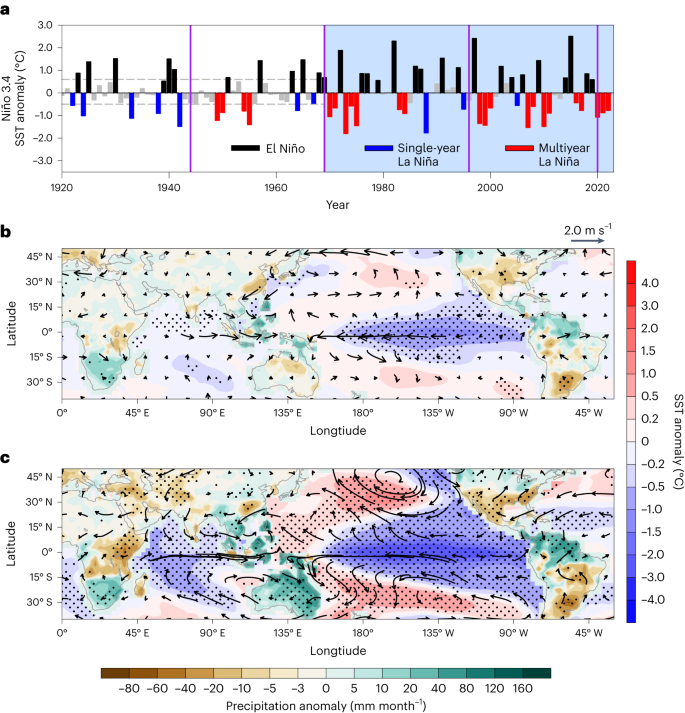
Global temperatures typically increase during an El Niño episode, and fall during La Niña’ – says BBC Science. This article also refers to ‘El Niño and La Niña, the warm and cool phases of a recurring climate pattern’. The featured research concludes that recent La Niñas are different, being more to do with warming, supported by ‘complex computer simulations’. The question is: does ‘the recent increase in multiyear La Niñas’ (per the study title) since 1998 suggest more cooling, or not? In the climate science world we read that ‘answers remain elusive’.
‘Global temperatures typically increase during an El Niño episode, and fall during La Niña’ – says BBC Science. This article also refers to ‘El Niño and La Niña, the warm and cool phases of a recurring climate pattern’. The featured research concludes that recent La Niñas are different, being more to do with warming, supported by ‘complex computer simulations’. The question is: does ‘the recent increase in multiyear La Niñas’ (per the study title) since 1998 suggest more cooling, or not? In the climate science world we read that ‘answers remain elusive’. – – – Multiyear La Niña events have become more common over the last 100 years, according to a new study led by University of Hawai’i (UH) at Mānoa atmospheric scientist Bin Wang.
Five out of six La Niña events since 1998 have lasted more than one year, including an unprecedented triple-year event [Talkshop comment – no, occurred three times since 1950]. The study was published in Nature Climate Change.
“The clustering of multiyear La Niña events is phenomenal given that only ten such events have occurred since 1920,” said Wang, emeritus professor of atmospheric sciences in the UH Mānoa School of Ocean and Earth Science and Technology.
El Niño and La Niña, the warm and cool phases of a recurring climate pattern across the tropical Pacific, affect weather and ocean conditions, which can, in turn, influence the marine environment and fishing industry in Hawai’i and throughout the Pacific Ocean.
Long-lasting La Niñas could cause persistent climate extremes and devastating weather events, affecting community resilience, tourist industry and agriculture.
Determining why so many multiyear La Niña events have emerged recently and whether they will become more common has sparked worldwide discussion among climate scientists, yet answers remain elusive.
Wang and co-authors examined 20 La Niña events from 1920-2022 to investigate the fundamental reasons behind the historic change of the multiyear La Niña. Some long-lasting La Niñas occurred after a super El Niño, which the researchers expected due to the massive discharge of heat from the upper-ocean following an El Niño.
However, three recent multiyear La Niña episodes (2007–08, 2010–11, and 2020–22) did not follow this pattern.
They discovered these events are fueled by warming in the western Pacific Ocean and steep gradients in sea surface temperature from the western to central Pacific.
“Warming in the western Pacific triggers the rapid onset and persistence of these events,” said Wang. “Additionally, our study revealed that multiyear La Niña are distinguished from single-year La Niña by a conspicuous onset rate, which foretells its accumulative intensity and climate impacts.”
Results from complex computer simulations of climate support the observed link between multiyear La Niña events and western Pacific warming.
UK Telegraph: The French plan to save the planet? Stop poorer people flying – Minimum prices for air tickets, proposed by France, will hurt the less well off without doing anything to reduce the number of flights
UK Telegraph: The French plan to save the planet? Stop poorer people flying – Minimum prices for air tickets, proposed by France, will hurt the less well off without doing anything to reduce the number of flights Cheap deals might be a thing of the past. France is seeking support from other European Union countries for a minimum price for airfares within the EU in a bid to reduce the number of flights in Europe and reduce the aviation sector’s CO2 emissions. Transport Minister Clement Beaune wants to “open the debate on the fair social and environmental price of a flight ticket”. The Netherlands and Belgium support the idea in principle. … France has already banned domestic flights for journeys that are possible in less than two-and-a-half hours by train. The Dutch government is going ahead with plans to cap the number of flights at Amsterdam’s Schiphol Airport next year, pending EU approval, in a bid to reduce noise pollution and greenhouse gas emissions. Watch: Morano on Fox News on climate flight bans: ‘You will go nowhere & be happy’ – ‘Flying is going to be a venue only for the rich’ & they are ‘intentionally creating car shortages’ – ’15-minute cities’ like E. Germany – June 2, 2023
Excerpts: By John Arlidge: I was living in Edinburgh when I first saw an advertisement that would transform air travel. “Making flying as affordable as a pair of jeans – £29 one-way.” The fare for EasyJet’s first flights from Luton to Edinburgh and Glasgow in 1995, celebrated in its inaugural advertisement campaign, seems rather pricey by modern standards. You can get a ticket on that route on EasyJet for less than £29 today and fares on some other low-cost carriers can be under a tenner.
But cheap deals might be a thing of the past. France is seeking support from other European Union countries for a minimum price for airfares within the EU in a bid to reduce the number of flights in Europe and reduce the aviation sector’s CO2 emissions. Transport Minister Clement Beaune wants to “open the debate on the fair social and environmental price of a flight ticket”. The Netherlands and Belgium support the idea in principle. Although Brexit means flights from Britain to EU countries might not be covered by any new EU price policies, flights from the bloc to the UK would be.
France has already banned domestic flights for journeys that are possible in less than two-and-a-half hours by train. The Dutch government is going ahead with plans to cap the number of flights at Amsterdam’s Schiphol Airport next year, pending EU approval, in a bid to reduce noise pollution and greenhouse gas emissions.
…
The good news for consumers is that EU complexities mean the French minimum pricing proposal is unlikely to become law. Two years ago Austria proposed a similar measure, but legal issues around the rights of companies freely to set their own prices across the EU meant the government abandoned it. EU leaders often find it hard to reach agreement on aviation matters. Talks on aviation fuel taxes have run into the sand, with some governments opposed to passing measures that could raise prices for voters ahead of EU elections next year. With a bit of luck, Paris’s half-cooked idea will also fail and EU governments will, instead, begin to put new technology, not higher fares, at the top of their environmental to-do list.
Cheap deals might be a thing of the past. France is seeking support from other European Union countries for a minimum price for airfares within the EU in a bid to reduce the number of flights in Europe and reduce the aviation sector’s CO2 emissions. Transport Minister Clement Beaune wants to “open the debate on the fair social and environmental price of a flight ticket”. The Netherlands and Belgium support the idea in principle. …
France has already banned domestic flights for journeys that are possible in less than two-and-a-half hours by train. The Dutch government is going ahead with plans to cap the number of flights at Amsterdam’s Schiphol Airport next year, pending EU approval, in a bid to reduce noise pollution and greenhouse gas emissions.
Fossil fuels offer developing nations a “bridge to the future”
that empowers economic development and, ultimately,
diversification of energy resources.
Note: “faux” means “artificial” or “contrived”–IOW “fake” without any Trumpian overtones. I referred to Sunak in the title because he is now the man in the barrel for raising energy issues. But those elected officials who climb down even a little from ruinous Zero Carbon promises will find themselves in the same predicament. So this messaging would serve many in these dire straits. Excerpts in italics with my bolds and added images.
There is a growing realisation that emissions and temperature targets are now detached from the issues of human well-being and the development of our 21st century world.
For the past two centuries, fossil fuels have fueled humanity’s progress, improving standards of living and increasing the life span for billions of people. In the 21st century, a rapid transition away from fossil fuels has become an international imperative for climate change mitigation, under the auspices of the UN Paris Agreement. As a result, the 21st century energy transition is dominated by stringent targets to rapidly eliminate carbon dioxide emissions. However, the recent COP27 meeting in Egypt highlighted that very few of the world’s countries are on track to meet their emissions reductions commitment.
The desire for cleaner, more abundant, more reliable and less expensive sources of energy is universal.
However, the goal of rapidly eliminating fossil fuels is at odds with the urgency of providing grid electricity to developing countries. Rapid deployment of wind and solar power has invariably increased electricity costs and reduced reliability, particularly with increasing penetration into the grid. Allegations of human rights abuses in China’s Xinjiang region, where global solar voltaic supplies are concentrated, are generating political conflicts that threaten the solar power industry. Global supply chains of materials needed to produce solar and wind energy plus battery storage are spawning new regional conflicts, logistical problems, supply shortages and rising costs. The large amount of land use required for wind and solar farms plus transmission lines is causing local land use conflicts in many regions.
Given the apocalyptic rhetoric surrounding climate change, does the alleged urgency of reducing carbon dioxide emissions somehow trump these other considerations? Well, the climate ‘crisis’ isn’t what it used to be. The COP27 has dropped the most extreme emissions scenario from consideration, which was the source of the most alarming predictions. Only a few years ago, an emissions trajectory that produced 2 to 3 oC warming was regarded as climate policy success. As limiting warming to 2 oC seems to be in reach, the goal posts were moved to limit the warming target to 1.5 oC. These warming targets are referenced to a baseline at the end of the 19th century; the Earth’s climate has already warmed by 1.1 oC. In context of this relatively modest warming, climate ‘crisis’ rhetoric is now linked to extreme weather events.
Attributing extreme weather and climate events to global warming can motivate a country to attempt to rapidly transition away from fossil fuels. However, we should not delude ourselves into thinking that eliminating emissions would have a noticeable impact on weather and climate extremes in the 21st century. It is very difficult to untangle the roles of natural weather and climate variability and land use from the slow creep of global warming. Looking back into the past, including paleoclimatic data, there has been more extreme weather everywhere on the planet. Thinking that we can minimize severe weather through using atmospheric carbon dioxide as a control knob is a fairy tale. In particular, Australia is responsible for slightly more than 1% of global carbon emissions. Hence, Australia’s emissions have a minimal impact on global warming as well as on Australia’s own climate.
There is growing realization that these emissions and temperature targets have become detached from the issues of human well-being and development. Yes, we need to reduce CO2 emissions over the course of the 21st century. However once we relax the faux urgency for eliminating CO2 emissions and the stringent time tables, we have time and space to envision new energy systems that can meet the diverse, growing needs of the 21st century. This includes sufficient energy to help reduce our vulnerability to surprises from extreme weather and climate events.
Framework for a robust transition of our energy systems.
In transitioning to cleaner sources of power, we need to acknowledge that the world will need much more energy than it is currently consuming – not just in developing countries, but also in countries with advanced economies. Constructing, operating, and maintaining low-carbon energy systems will itself require substantial amounts of energy, with much of it currently derived from fossil fuels. Increasing adoption of electric vehicles and electric heat pumps will increase electricity demand. More electricity can help reduce our vulnerability to the weather and climate: air conditioners, water desalination plants, irrigation, vertical farming operations, water pumps, coastal defenses, and environmental monitoring systems. Further, abundant electricity is key to innovations in advanced materials, advanced manufacturing, artificial intelligence, robotics, photonics, quantum computing and others that are currently unforeseen or unimagined.
In the near term, laying the foundation for new energy systems is substantially more important than trying to stamp out fossil fuel use.
This should focus on developing and testing new energy technologies. There will continue to be demand for fossil fuels over the coming decades. Countries that restrict fossil fuel production will not only hurt themselves economically. Paradoxically, restricting fossil fuel production in the near term will actually slow down the energy transition, which itself requires substantial amounts of energy to implement.
The best use of the next three decades is to continue to develop and test a range of options for energy production, storage, transmission and other technologies that support goals of reliable, low-cost energy while lessening environmental impacts and carbon emissions. A more prudent strategy is to use the next two to three decades as a learning period with new technologies, experimentation and intelligent trial and error.
Near-term targets for CO2 emissions, such as 75% renewable energy by 2035, drives the energy transition towards using existing technologies in ways that are counterproductive in the longer term. The perceived urgency of making such a colossal transformation can lead to poor decisions that not only harms the economy and overall human wellbeing, but also slows down progress on reducing carbon emissions.
Rapid technological innovation across all domains of the global energy sector continues to accelerate: long-distance transmission and smart microgrids, energy storage, residential heating, electric vehicles and remarkable progress in advanced nuclear designs. Different countries and locales will use different combinations of these innovations based upon their location, local resources, power needs, and sociopolitical preferences.
In Addition: Energy Balance Includes Every Energy Source
If we are going to discuss the climate change movement’s agenda, let’s admit that the underlying problem they seek to resolve is an energy imbalance—one which they attribute to humanity’s excessive reliance on fossil fuels that contribute to global warming. To many members of the movement, the imbalance can only be corrected by reducing our dependence on sources such as coal and oil, and replacing them with others (ie. natural gas, ethanol, solar, wind).
Although this sounds tempting to some, the proportion of each source’s contribution to the new “balance” is elusive—both scientifically and politically. Indeed, many environmentalists largely neglect other important energy sources—such as nuclear energy—even though nuclear power plants produce negligible greenhouse gases. In its haste to “save the Earth,” the climate change movement has failed to appreciate that, for the foreseeable future, every source of energy is essential. We cannot afford to demonize and exclude any resources. Instead, each competing source must be sustained by a balanced energy policy that fosters economic growth, environmental protection and human health.
Moreover, if we are seriously concerned about global environmental issues, this new balance cannot be struck without considering its impact on economic, environmental and health concerns in each nation. This requires open minds regarding how certain resources, such as fossil fuels, can be used in developing nations which cannot reasonably be expected to shift immediately to alternative sources.
The use of coal, for example, as an imported product in such countries should not be disfavored while society diversifies to accommodate cleaner-burning technologies and affordable alternative sources. Encouraging such exports creates markets in developed nations that offset pressures to reduce usage domestically. Without relatively inexpensive imported resources, developing nations cannot develop their economies—and insisting on unaffordable alternatives denies them the opportunities that developed nations have exploited for centuries. The inevitable result will be continued poverty, depressed nutrition, increased disease and premature deaths in developing nations—a scenario that any reasonable climate advocate should find unacceptable.
Nevertheless, many climate activists doggedly argue for policies that will suppress the availability and use of fossil fuels in developing nations—as though renewable and other cleaner-burning sources were already available to meet the needs of their disadvantaged citizens. The insensitivity of such policies is alarming—especially since renewable and alternative fuel sources are not yet widely available and effectively deployed even in wealthier nations, such as the United States. It is irrational and, indeed, cruel to insist that fossil fuel use should be minimized globally when such an approach deprives the world’s most impoverished nations of relatively inexpensive and widely available energy sources.
Fossil fuels offer developing nations a “bridge to the future” that empowers economic development and, ultimately, diversification of energy resources.
A “balanced” energy policy therefore must consider much more than the appropriate global blend of energy sources. It must also consider the types of energy that can best be utilized in particular nations according to their financial abilities, technical skills and particular needs. It is naive to insist that renewable or alternative sources replace fossil fuels if those advanced sources are unaffordable, unavailable or otherwise impractical in the locations where energy is needed. Such idealism does nothing to feed the hungry, heat and light their homes, workplaces and schools, or encourage economic and technical development.





You must be logged in to post a comment.