Global warming, climate change, all these things are just a dream come true for politicians. I deal with evidence and not with frightening computer models because the seeker after truth does not put his faith in any consensus. The road to the truth is long and hard, but this is the road we must follow. People who describe the unprecedented comfort and ease of modern life as a climate disaster, in my opinion have no idea what a real problem is.
he Tech-Giants are backing away. Microsoft and Google have given up — they’re not bragging about their carbon neutrality anymore. Not now that their emissions have increased 29% and 50% respectively in the last four or five years. Over 500 companies pledged to get to net zero by 2040, but 96% of them are failing to stay on track. To distract us from talking about how the Climate Bubble has popped, some are blaming “AI”.
The Tech-Giants are backing away. Microsoft and Google have given up — they’re not bragging about their carbon neutrality anymore. Not now that their emissions have increased 29% and 50% respectively in the last four or five years. Over 500 companies pledged to get to net zero by 2040, but 96% of them are failing to stay on track. To distract us from talking about how the Climate Bubble has popped, some are blaming “AI”.
The world is facing mass death and boiling oceans, and wind and solar are still as cheap as they never were, but Big Tech are sneaking away from saving the world, wait, because Artificial Intelligence uses a lot of electricity? It’s like, these CEOs were saviors of Mother Earth not long ago, but the ice-caps be damned, there’s a race on to capture the AI market? Apparently, the planetary heroes just turned back into robber barons doing business.
Dr Jemma Green, who sells software for renewables markets, is trying to sell us a bad-luck story, as if it makes any sense. The truth is that if net zero technologies were cheap and useful, and the CEO’s ever cared about the planet, they wouldn’t be abandoning them. But they are…
AI’s energy hunger and corporate climate hypocrisy
…corporations like Google, Microsoft, and Shell once positioned themselves as leaders in sustainability, setting ambitious net-zero goals to align with global environmental efforts. However, the rapid rise of energy-hungry artificial intelligence is forcing these companies to reconsider—or even abandon—these commitments…
Corporate climate pledges surged recently, with over 500 companies globally committing to net-zero emissions by 2040. This momentum continued between June 2022 and October 2023, with a 40% increase in new net-zero targets. Yet, as the AI revolution gains traction, cracks in these promises are beginning to show. Recent analysis reveals that only 4% of these companies are on track to meet their goals, highlighting a disconnect between corporate rhetoric and reality.
Despite the headline, Jemma Green isn’t even trying to explain “Why” the end is here. After a few paragraphs blaming AI she laments how other giants like Shell, or Gucci, or EasyJet are stepping away too from their goals too, poking a hole in her thesis that it was only due to AI. It’s not like Gucci want to sell you AI programs to wear.
What she’s documenting is the corporate world quietly erasing their mistakes:
Shell, for instance, has abandoned its 2035 target of a 45% reduction in net carbon intensity, citing “uncertainty in the pace of change in the energy transition.” This target was a key milestone towards Shell’s broader goal of net-zero emissions by 2050.
The same goes for luxury fashion house Gucci, which once committed to carbon neutrality through verified carbon offsets and in May 2023, quietly removed its claim of being “entirely carbon neutral” from its website.
The truth is that if the Earth was in danger, smart CEO’s and billionaires, who have to live on the planet too, would be pushing nuclear power like their children’s lives depended on it.
Instead it was all an intellectual fashion contest and a quick subsidy buck, and maybe a few even believed wind and solar power did something useful, but they don’t anymore.
Proving that unpaid anonymous review is worth every cent, the 217 year old Wiley science publisher “peer reviewed” 11,300 papers that were fake, and didn’t even notice. It’s not just a scam, it’s an industry. Naked “gobbledygook sandwiches” got past peer review, and the expert reviewers didn’t so much as blink.
Proving that unpaid anonymous review is worth every cent, the 217 year old Wiley science publisher “peer reviewed” 11,300 papers that were fake, and didn’t even notice. It’s not just a scam, it’s an industry. Naked “gobbledygook sandwiches” got past peer review, and the expert reviewers didn’t so much as blink.
Big Government and Big Money has captured science and strangled it. The more money they pour in, the worse it gets. John Wiley and Sons is a US $2 billion dollar machine, but they got used by criminal gangs to launder fake “science” as something real.
Things are so bad, fake scientists pay professional cheating services who use AI to create papers and torture the words so they look “original”. Thus a paper on ‘breast cancer’ becomes a discovery about “bosom peril” and a ‘naïve Bayes’ classifier became a ‘gullible Bayes’. An ant colony was labeled an ‘underground creepy crawly state’.
And what do we make of the flag to clamor ratio? Well, old fashioned scientists might call it ‘signal to noise’. The nonsense never ends.
A ‘random forest’ is not always the same thing as an ‘irregular backwoods’ or an ‘arbitrary timberland’ — especially if you’re writing a paper on machine learning and decision trees.
The most shocking thing is that no human brain even ran a late-night Friday-eye over the words before they passed the hallowed peer review and entered the sacred halls of scientific literature. Even a wine-soaked third year undergrad on work experience would surely have raised an eyebrow when local average energy became “territorial normal vitality”. And when a random value became an ‘irregular esteem’. Let me just generate some irregular esteem for you in Python?
If there was such a thing as scientific stand-up comedy, we could get plenty of material, not by asking ChatGPT to be funny, but by asking it to cheat. Where else could you talk about a mean square mistake?
Wiley — a mega publisher of science articles has admitted that 19 journals are so worthless, thanks to potential fraud, that they have to close them down. And the industry is now developing AI tools to catch the AI fakes (makes you feel all warm inside?)
Fake studies have flooded the publishers of top scientific journals, leading to thousands of retractions and millions of dollars in lost revenue. The biggest hit has come to Wiley, a 217-year-old publisher based in Hoboken, N.J., which Tuesday will announce that it is closing 19 journals, some of which were infected by large-scale research fraud.
In the past two years, Wiley has retracted more than 11,300 papers that appeared compromised, according to a spokesperson, and closed four journals. It isn’t alone: At least two other publishers have retracted hundreds of suspect papers each. Several others have pulled smaller clusters of bad papers.
Although this large-scale fraud represents a small percentage of submissions to journals, it threatens the legitimacy of the nearly $30 billion academic publishing industry and the credibility of science as a whole.
Scientific papers typically include citations that acknowledge work that informed the research, but the suspect papers included lists of irrelevant references. Multiple papers included technical-sounding passages inserted midway through, what Bishop called an “AI gobbledygook sandwich.” Nearly identical contact emails in one cluster of studies were all registered to a university in China where few if any of the authors were based. It appeared that all came from the same source.
One of those tools, the “Problematic Paper Screener,” run by Guillaume Cabanac, a computer-science researcher who studies scholarly publishing at the Université Toulouse III-Paul Sabatier in France, scans the breadth of the published literature, some 130 million papers, looking for a range of red flags including “tortured phrases.”
Cabanac and his colleagues realized that researchers who wanted to avoid plagiarism detectors had swapped out key scientific terms for synonyms from automatic text generators, leading to comically misfit phrases. “Breast cancer” became “bosom peril”; “fluid dynamics” became “gooey stream”; “artificial intelligence” became “counterfeit consciousness.” The tool is publicly available.
Generative AI has just handed them a winning lottery ticket,” Eggleton of IOP Publishing said. “They can do it really cheap, at scale, and the detection methods are not where we need them to be. I can only see that challenge increasing.”
The ABC in Australia even wrote about this, but only because it worries about the loss of public faith in its pet universities:
For the ABC, peer review is like the Bible, and universities are the Church. The public must believe!
So the ABC makes excuses… Oh! Those poor poor universities, forced to become billion dollar businesses selling defacto Australian-citizenships to children of rich Chinese families. If only they got more money, their Vice Chancellors wouldn’t have to make do with million dollar salaries, and punishing professors who pointed out fraud, and they’d have time to do research and prevent the fraud instead.
Wiley’s ‘fake science’ scandal is just the latest chapter in a broader crisis of trust universities must address
By Linton Besser, ABC News
It [the Wiley debacle] also illustrates what is just another front in a much broader crisis of trust confronting universities and scientific institutions worldwide.
For decades now, teaching standards and academic integrity have been under siege at universities which, bereft of public funding, have turned to the very lucrative business of selling degrees to international students.
Grappling with pupils whose English is inadequate, tertiary institutions have become accustomed to routine cheating and plagiarism scandals. Another fraud perfected by the internet age.
This infection — the commodification of scholarship, the industrialisation of cheating — has now spread to the heart of scientific, higher research.
With careers defined by the lustre of their peer-reviewed titles, researchers the world over are under enormous pressure to publish.
Suffer the researchers who are forced to pay for fake papers just so they can “do their job”? Sack the lot.
The ABC is part of the reason science is corrupt to the core. The ABC Science Unit is paid to hold junk-science’s feet to the fire, instead it provides cover for the pagan witchcraft that passes for modern research.
The rot at Wiley started decades ago, but it got caught when it spent US $298 million on an Egyptian publishing house called Hindawi. We could say we hope no babies were hurt by fake papers but we know bad science already kills people. What we need are not “peer reviewed” papers but actual live face to face debate. Only when the best of both sides have to answer questions, with the data will we get real science:
In March, it revealed to the NYSE a $US9 million ($13.5 million) plunge in research revenue after being forced to “pause” the publication of so-called “special issue” journals by its Hindawi imprint, which it had acquired in 2021 for US$298 million ($450 million).
Its statement noted the Hindawi program, which comprised some 250 journals, had been “suspended temporarily due to the presence in certain special issues of compromised articles”.
Many of these suspect papers purported to be serious medical studies, including examinations of drug resistance in newborns with pneumonia and the value of MRI scans in the diagnosis of early liver disease. The journals involved included Disease Markers, BioMed Research International and Computational Intelligence and Neuroscience.
The problem is only becoming more urgent. The recent explosion of artificial intelligence raises the stakes even further. A researcher at University College London recently found more than 1 per cent of all scientific articles published last year, some 60,000 papers, were likely written by a computer.
Even if one in five computer science papers are written by computers, this is just the tip of the iceberg of the rot at the core of “peer reviewed research”. The real rot is not the minor fraudsters making papers that no one reads to pad out their curriculum vitae. It’s the institutional parasites taking billions from taxpayers to create modeled garbage to justify the theft of trillions. But that’s another story.
PS: Who knew, academic journals were a $30 billion dollar industry?
It appears that “AI bots” are now posting false comments on climate change related articles online. In an article about glaciers in Chile, there are several pro-climate alarm comments that have a suspicious similarity.
They are polite, start with either a personal anecdote or cited an “expert,” explaining how climate change is allegedly affecting the world, and end with an exclamation about how they can understand, given the above facts, why it’s important to “address” or “do something” about climate change.
Thanks for your concern, Charlotte, but I don’t really trust your friend.
Darn indeed Lisa! Kinda weird that you used the phrase “food security” too, and under an article about glaciers, though.
The comment from “Brandon” is the only one of these that actually mentions anything related to the article the comment is under.
This would be a refreshing change of pace from the usual tone of alarmist commentary, except if you are a human being with a functioning brain, with pattern recognition and who can pass Captcha tests (FOX News’ website requires no captcha to make an account and post comments) then you will have noted something suspicious by the second comment.
Hey, isn’t the structure of these awfully similar?
People who have been online for a very long time, generally have a well-honed inner bot detector. Most bots on Twitter are trying to sell some digital coin scam or pornography or use ChatGPT to make a low-effort gimmick Twitter account. These AI “Climate bots”, on the other hand, are selling a narrative.
“Charles Vanderbilt” gave a helpful comment that had nothing to do with the subject of a Fox article about those Just Stop Oil goobers:
This person also has a rich posting history on Reddit’s r/ClimateOffensive, “rich history” meaning one total post with the exact same wording as a comment by “Edward Witmore” on the glacier article:
Charles and one “Ryan White” also posted on this article, here, concerned comments about how they can see the “urgent need to address climate change.” Reddit’s r/climateskeptics also has a few posts by these bots. They only just popped up in the last few days, right after ChatGPT released a new feature that makes it a lot easier for people who know little about programming to develop automated processes that can spam “original” posts like this across the internet.
How expansive is this? Pulling up the same glacier article on other websites shows no similar comments. It looks like, for now, Fox and Reddit are the primary testing grounds, probably because it’s easier to run bots there than places that use Captchas and similar protections for posting. As long as he or she doesn’t lose interest, it’s safe to assume that it’s going to continue.
That’s the next question, though, who is doing it? Most likely, it’s just one person who is trying to do their part to “educate” with climate propaganda. Since it has been posted on subreddits that are both climate skeptical and climate alarmist, there is a good chance that the reddit posting has more to do with “karma farming” right now than propagandizing, but with higher “karma” your posts get boosted so more people see them, so it probably kills both birds anyway.
However, there is another possible source that is not too far-fetched: most likely by way of funding, climate alarm groups and governments.
There are millions and millions of dollars being thrown at any project – associated with universities or otherwise – with the key phrase “climate change” attached, including projects that focus on “communication” – that is, propaganda.
“Checkbook journalism” is increasingly the reason why you see so many articles about climate change flooding your feed, as organizations like the Associated Press accepted millions of dollars from groups like the Rockefeller Foundation and the William and Flora Hewlett Foundation to expand climate coverage.
Government agencies have held seminars on how to “break and fix audience mental models” regarding climate change, and thanks to testimony by Michael Shellenberger we already know that government and corporate collaboration has been used to stifle dissent on social media.
Why would we think even adolescent bot posts like these wouldn’t also be something the government or wealthy alarmists might throw some money at? After all, the Biden administration is deeply worried about “climate delayism” and has obviously made appeasing the green blob one of their highest priorities, especially as attitudes towards climate policy have apparently cooled.
Again though, it’s probably just one misinformed person sitting at home in his/her PJs, “doing their part” for the climate cause.
This kind of bot spam is easy to do, and it’s going to get easier, and harder to tell the difference between bots and real comments. Right now, they (whoever they are) are spamming comments on any new article at Fox News with the phrase “climate change” in the title or content. This is likely automated.
We really are in an information war, and although it may feel uncomfortable to deploy similar or the same tactics, it might be necessary. We are going to see a lot more of this and worse; you can bet on it.
Linnea Lueken (llueken@heartland.org) is a research fellow with the Arthur B. Robinson Center on Climate and Environmental Policy at The Heartland Institute. Twitter: @LinneaLueken
In the good old days of 2021, the price of Bitcoin reached $60,000 apiece, and the frenzy to ‘mine’ coins was palpable. If you’ve managed to successfully expunge the mania from the space between your ears, recall that crypto mining “requires three basic things: servers to solve complex mathematical problems, a way to keep those servers cool, and huge amounts of electricity.”
“Crypto mining has been described as running your car in neutral all day so it can solve crossword puzzles in exchange for an occasional coupon that’s mostly useful for buying heroin online.” – Vice
In the good old days of 2021, the price of Bitcoin reached $60,000 apiece, and the frenzy to ‘mine’ coins was palpable. If you’ve managed to successfully expunge the mania from the space between your ears, recall that crypto mining “requires three basic things: servers to solve complex mathematical problems, a way to keep those servers cool, and huge amounts of electricity.”
The Vice article hilariously documented what was purported to be Europe’s weirdest crypto mining site, a section of North Kosovo that was paradise for miners because, due to governmental infighting, local governance simply ceased to function. Police were around, but not enforcing rules, and people simply stopped paying their utility/electricity bills. Thus was created the world’s biggest welcome mat for crypto mining – free power, no harassment over noise, no one complaining about an environmental footprint.
The point of recanting these tales is not to get into crypto debates, but to summon forth from history the lesson in what happens when an ‘industry’ appears out of nowhere, requires vast amounts of energy, can be located anywhere, and is growing rapidly.
Two years ago, that title went to crypto mining. In 2023, it’s all about AI. And it’s going to get much bigger.
Bitcoin mining as an industry never went mainstream; we did not see Fortune 500 companies setting up mining operations to cash in (even if they tacitly supported Bitcoin). AI is something else entirely.
AI shares a similar profile, in a few ways, with Bitcoin mining. First, it requires monstrous amounts of energy. As discussed last week, Tesla’s Dojo AI computer, once fully up to planned maximum size, will consume as much power as 165,000 homes.
Second, it is growing rapidly. Almost every industry is pursuing AI advantages. Medicine, agriculture, automotive, you name it, all sorts of industries are or will be using AI.
Third, AI data centres can be located anywhere. This is a key aspect that is going to overwhelm energy planning like a tsunami.
The link to global energy flows should not be underestimated. AI data centers and server farms will be created and used by countless organizations and companies around the world. As discussed last week, Lyn Alden speculated quite rationally that hackers might find AI to be a godsend; breaking into computer systems around the world seems like a supremely fitting function for AI which will use machine learning and massive databases to scan for weaknesses (for example, a miscreant with enough computer power might be able to comb your Facebook or other social media account, cross reference it with all references you make to holidays/where you live/dine, what you do for hobbies, etc., and come up with much better algorithms for cracking passwords).
We should therefore expect to see a similar energy-gold-rush, where AI power-hungry data centers seek out a location – any location – that can provide cheap, reliable power.
Which brings us back to the dream-site first discussed above, North Kosovo, which was perfect because power was cheap and scrutiny non-existent. Why would we assume AI would be any different? In other words, California might fret at allowing construction of hundreds of massive AI computers because their fragile grid cannot handle it. In many other parts of the world, it will work the other way around – their fragile (or non-existent) grids might suddenly grow massively to take advantage of a global demand for AI power.
Take for example a small, impoverished developing country that may have access to abundant coal, oil, or natural gas. Current western pressure is limiting the ability of these nations to develop hydrocarbon resources because of the war on ‘climate change’ – for example, Europeans and North Americans are joining arms to oppose projects like the East African Oil Pipeline.
So what is to stop a small impoverished nation that perhaps doesn’t feel all that inclined to help London or Brussels or Washington or Ottawa with their emissions battles? What is to stop them from utilizing any available hydrocarbon resources directly to attract global data centers and servers?
What happens to power demand then? What happens to emissions then? And who will stop it? Or, before the west tries to answer that question for non-degreed class, who has a right to stop it?
Two great big tectonic plates are moving that provide some indication of how things are going to happen in coming years.
One is the rise of BRICS, the affiliation of nations that wants to create its own trading block in order to steer a path that Washington or Belgium might not prioritize. BRICS – Brazil, Russia, India, China, and South Africa – recently welcomed six new member countries: Argentina, Egypt, Ethiopia, Iran, Saudi Arabia, and the United Arab Emirates.
The new expanded BRICS (possibly to be called BRICSAEEISAUAE but probably not) is an entity of considerable clout. Brazil, Russia, Saudi Arabia, Iran, and UAE are major exporters of various industrial materials the world can’t live without, including oil, natural gas, metals, minerals, etc. India and China alone provide a monstrous market with 2.5 billion people between them. Developing countries/economies like Ethiopia, Argentina and Egypt bring a lot to the table as well in terms of natural resources and, perhaps more critically, space and people and lower industrial cost structures than the west. China largely controls the ability to turn raw materials into processed metals and minerals.
The only thing this group really seems to be missing is a pontificating Euro or American voice telling them what to do, how to do it, and when to do it. I suspect that absence is not a coincidence.29dk2902lhttps://boereport.com/29dk2902l.html
The second big tectonic shift was on full display at the recent G20 summit. The African Union was admitted as a member, which was kind of a big deal, particularly for Africa, but also for the world in general. The addition acknowledges that other voices need to be on the world stage, a sense of humility the G7 has long lacked. The final communique issued at the end of the G20 summit included doses of common sense lacking from typical utterances of the G7: “We affirm that no country should have to choose between fighting poverty and fighting for the planet…It is also critical to account for the short, medium, and long term impact of both the physical impact of climate change and transition policies, including on growth, inflation, and unemployment.”
Contrast that with the west’s bizarre self-lobotomization when it comes to energy, as best personified by the entity furthest along the rapid-transition path, Germany: the dwindling economic powerhouse is chained to a green freight train it insists is under control, has shut down nuclear power plants with no low-emissions baseload to replace it, and in a final stunning swan dive to the pavement, is orchestrating the installation of 500,000 heat pumps per year to the grid, which will be in most demand in cold weather and will perform worst in cold weather, and will add a potential 10 gigawatts of cold-weather demand at the very instant the grid is least able to afford it, and for which there is no supply available anyway. A German energy economic university think tank says the additional cold-weather demand could only be met by new gas-fired power plants, which are not being built. In sum: Germany has shuttered its cleanest, most reliable energy; it has or is trying to banish hydrocarbons and replace them with intermittent power; and finally is hastening adoption of devices that will function very well in 80 percent of conditions when it doesn’t matter much but will fail in a spectacularly deadly way at the point in time when they are needed the very most, because heat pumps will be turned up to 11 at the very time the grid will be the most taxed. German engineering isn’t what it used to be.
Now put those two things together: the rise of BRICS as a formidable global alliance, and the rise of developing nations in the stature of the G20 in a manner that clearly indicates they have a set of priorities that do not align with the west, and they don’t really care. Contrast the recent G20 communique (“We affirm that no country should have to choose between fighting poverty and fighting for the planet”) with the climatic musings from most recent G7 meeting in May, the western ruling class, putting out a bucket of gibberish chock full of climate change platitudes and wishful thinking (verbatim: “We task the Finance Ministers to turn their “High-level Policy Guidance for Public Finance Tools to Build Resilient Supply Chains in the Era of Decarbonization” into specific actions by developing the “Partnership for RISE (Resilient and Inclusive Supply-chain Enhancement)” in collaboration with interested partners and international organizations, especially the World Bank Group.” The whole document is a blueprint for G7 governments and finance ministers to imprint their hair-shirt goals on the developing world. The fact that the G20 statement came only a few months after the G7 statement tells us all we need to know about what the G20-G7=G13 think of western elite scheming.)
Put this all together. The world’s appetite for AI is going to proceed, in all likelihood, at breakneck speed, with a corresponding power appetite to match. To the extent that AI processing can be erected quickly, we are going to see AI data server farms pop up wherever there is reliable power, no matter the energy source, much like Bitcoin mining did at peak frenzy.
Energy demand is going to skyrocket, and the world’s AI machinery will come to life in whatever corner of the world that stands ready with an industrial site and a reliable power source. While energy transition development happens at warp speed, the world appears set to increase total energy demand in lockstep.
The general public’s attitude is already teetering from the daily contradictions they must live as functioning members of modern society that consume ever larger quantities of energy, while simultaneously suffocating on climate change news. Just wait til they have to choke down this bolus as well.
Energy conversations should be positive and, most of all, grounded in reality. Life depends on it. Find out more in “The End of Fossil Fuel Insanity” at Amazon.ca, Indigo.ca, or Amazon.com. Thanks!
Read more insightful analysis from Terry Etam here, or email Terry here.
This conversation draws attention to the importance for a rational, data-inspired response to global issues. As a successful entrepreneur, I say often, data is the most information rich data stream. Every decision you make and in every approach to solving novel problems, data must be at the center of the decision, otherwise you’re speculating and relying on emotion.
I hope you’re ready for a truly thought-provoking conversation with Bjorn Lomborg, a globally recognized author and thought-leader renowned for his innovative perspectives on addressing global issues. If global warming and climate change has you feeling a bit panicked, by the end of this episode you’ll see the picture behind the panic and understand exactly what Bjorn thinks is a bigger problem to solve than climate change.
Bjorn Lomborg has published multiple bestselling books such as ‘False Alarm,’ ‘Skeptical Environmentalist.’ and his latest book, ‘First Things First.’ with a mission to help people discover the most effective solutions to the world’s greatest challenges, from disease and hunger to climate and education.
This conversation draws attention to the importance for a rational, data-inspired response to global issues. As a successful entrepreneur, I say often, data is the most information rich data stream. Every decision you make and in every approach to solving novel problems, data must be at the center of the decision, otherwise you’re speculating and relying on emotion.
Lomborg emphasizes the need to prioritize spending in various sectors, the role of education, and poverty reduction in improving societal outcomes. We also explore the potential implications of automation and the need for innovation in tackling climate change.
Together, we tackle topics such as global warming, automation in elder care, and the need for data-driven decision-making. Hear Lomborg’s fresh insights on channeling spending into prioritized sectors and the role education and poverty reduction play in societal outcomes. There’s so much to discover, don’t miss out on this enlightening episode!
BJORN QUOTES:
“Panic is not any kind of mode to be in if you want to solve issues.”
“When it comes to global warming, it’s a problem. It’s not the end of the world.”
“I tend to see the world very much as a marginalized conversation, and I’m simply trying to set out some unpanicked advise that in a pretty panicked world can help us be a little smarter.”
“We don’t have enough resources to deliver everything to everyone.”
“If you take a look at the last 25 years, each and every day, the world has lifted 138,000 people out of poverty.”
“We don’t have enough resources to deliver everything to everyone.”
“We used to have a very strong understanding from the elite in the world that more trade was actually good. We also used to neglect the fact that it’s not good for everyone.”
Soros leading the pivot from the fake climate crisis to the fake AI crisis.
AI is at the root of the world’s ‘polycrisis’
Climate change and the war on Ukraine are also threatening democracy, according to billionaire and philanthropist George Soros.
George Soros
We are living in troubled times. Too much is happening too fast. People are confused. Columbia University economic historian Adam Tooze has, indeed, popularised a word for it. He calls it a “polycrisis”.
The polycrisis has many sources. In my opinion the main source of the polycrisis afflicting the world today is artificial intelligence. Climate change comes second, and the Russian invasion of Ukraine qualifies as the third. The list is much longer but I’ll focus on these three. That should help reduce the confusion.
Artificial Intelligence
…
Shortly thereafter, Geoffrey Hinton, who is generally considered the godfather of AI, resigned from Google so he could speak openly about the risks posed by the new technology. Reversing his previous position, he took a very dim view of AI. He said it could destroy our civilisation.
…
What Hinton said made a big impression on me. Indeed, AI reminded me of Goethe’s poem The Sorcerer’s Apprentice. The apprentice is studying magic but doesn’t fully understand what the master is teaching him. When the master orders him to sweep the floor, he applies the magic words to a broom. The broom obeys him, but the apprentice can’t stop the broom from fetching buckets of water to sweep the floor and the house gets flooded.
I predicted this pivot back in 2017. The political utility of the fake climate crisis is all but spent, climate crisis rhetoric these days mostly only works on lefties who already planned to vote socialist. But AI scare stories have bipartisan appeal. And we’ve already been well primed for the fake AI crisis, by science fiction / horror stories like “The Terminator“.
I’m a software developer of over 30 years experience, who has personally written AIs. I’m not a “father of AI”, but I know a thing or two. I disagree with the AI apocalypse narrative.
The Sorcerer’s Apprentice is a powerful metaphor, but in my opinion it is the wrong metaphor for rise of AI. A better metaphor is the arms race between computer virus creators and anti-virus companies.
Every so often a virus writer manages to slip in some blows, but our computers are mostly safe. Install the anti-virus, keep the subscription and software patches up to date, and you can go about your daily business.
In a similar way, whatever capabilities AI gives to miscreants, or whatever aberrant capabilities AI develops on its own, it will be treated like yet another computer virus, to be countered by AIs primed to monitor and respond to threats.
Is it possible someone could leap ahead and develop unique capabilities, or that an AI could develop a novel form of attack? Of course it is – look how Microsoft’s ChatGPT integration caught Google flat footed, an example Soros mentioned elsewhere in his article.
But who thinks this setback will be the ruin of Google, and all the other AI companies? By the end of this year the world will be awash with ChatGPT lookalikes, created by tech companies spending 10s of billions, whatever it takes, to stay in the race.
AI will create tremendous changes to society, some marvellous and others which many of us will find deeply disturbing. On the positive side, there will be glorious advances in medical science. Advances like medical immortality and cures for currently intractable diseases are almost within reach.
But AI will also bring challenging disruptions. Among other things, I foresee a future AI version of today’s schoolkid “trans” conflict, with progressive politicians demanding kids should be allowed to augment their brains and bodies with AI implants without parental consent, to avoid the trauma of feeling inferior to their augmented classmates.
But we’ll get through all that and more. Many of us alive today may live to see an age of marvels – an age of fulfilment and joy which today’s world can only barely glimpse.
In the meantime, we need to stand firm against this pivot to AI scare stories, just as we stood against climate scare stories and Covid lockdown scares. Because at the base of the AI fear campaign will be the very same people who are currently at the base of the climate crisis movement: meddlesome fools who believe they know how to run our lives better than we do.
I recently published one article about how to incorporate an AI chatbot as part of a college course. I focused on lying, persuasion and self-reflection. I went even further and anticipated a White House comprehensive plan to counter antisemitism. I used a chatbot to develop my own version of what should be in that plan. Now, I am off on another adventure using a chatbot to understand the ins and outs of climate change impacts. And I need your help. You can see my inquiry as similar to the struggle to get computers, other electronic devices and software to be more user friendly — such as the improvements through GUIs (graphic user interfaces). Perhaps AUIs (algorithm user interfaces) would be helpful — especially if users can insert their own parameters (or “biases”) with a preset language formula.
There are many articles that say that AI language models are not to be feared since they are just a tool. Others claim that more is at stake. I would suggest that in both cases the question is whether humans actually control the input/output process. Part of such control requires knowledge about that part of the process which we consider. As someone who is naïve about coding and how the AI black box works, I focus on the observable world of language. That’s what I have access to in framing a request and receiving a reply. So, in that small part of the AI universe – the one that has received substantial attention in the past several months – I would like to assert some control over the conversation with the AI “mindset.” For me, when wearing my hat as a digital artist, I learned digital editing with a host of algorithms that included filters, presets and other editing tools to compose my art. My “control” was going beyond just pushing a button. Now, with a language model, I am trying to discover whether I have any similar “control” over this domain and, if so, what are its limits and results.
As a human who thinks and believes that one can have some control of interactions with a chatbot – more than the illusion of control, I decided to experiment with creating my own algorithm to insert into this conversation. A user-defined algorithm that would add my own parameter to the chatbot output. The first question is whether that is really possible. When I approached ChatGPT, I received stonewalling and deflection and ultimately: “As an AI language model, I can’t directly assist in creating or fine-tuning algorithms outside the scope of the provided capabilities. My purpose is to provide information and assist with general inquiries to the best of my knowledge and abilities.” and “As an AI language model, I can provide information based on the writings and perspectives of the scientists you mentioned. However, it’s important to note that I don’t have direct access to specific writings or the ability to modify the underlying training data.” So, there are bumps in the road that might defeat my objective short of jailbreaking out of the programs guardrails.
By comparison, Google’s Bard is far more receptive to allowing me some control over how it frames its reply. I was frustrated with its initial response about understanding climate change (far too much IPCC orthodoxy, scented with the Paris Climate Accords) and not enough balance, or perhaps counterpoint, with challenges to the “consensus.” Perhaps I could have warned Bard not to use Wikipedia. I laid out my concerns to Bard and asked if it would create a paradigm based on the writings of such individuals as Steven Koonin, Bjorn Lomborg, Will Happer, Judith Curry. I could have chosen others but I wanted to see if I could jump start the creation of a use-defined, or user-guided algorithm, that was framed in the language the chatbot used to define its own algorithms. Bard responded, “Sure, I can create an algorithm called Non-Catastrophic Climate Change Model (NCCCM) based on the writings of the mentioned scientists.” Perhaps my bias shows with the name I proposed to give algorithm. The point is not one of bias – my bias versus that of the chatbot – but how information issuing from the chatbot could be tailored with some user-oriented control.
With Google’s Bard algorithm in hand, based on my parameters, there are several questions that should be addressed: 1) Can users create a transportable algorithm that can be shared with other users looking at the same content area; 2) Can the Bard-worded algorithm be used on other chatbot platforms or, if in need of modification, what would the translation look like; 3) Would the chatbot reply be the same (or similar) with other users or on repeated attempts; and 4) Can such user-defined algorithms, generally speaking, compensate for the “mindset” that the language model is applying?
Of course, it would be interesting to develop other algorithmic user interfaces (AUIs) for prompting chatbots on sex and gender, critical consciousness, conflict resolution, etc.
Here, I’ve focused on climate change and its consequences.
Sign up or Login to ChatGPT and Bard
These links are the easiest way to get access to either ChatGPT or Bard.
An example of a prompt, a reply and a revised prompt (with the algorithm)
If you haven’t tried an AI chatbot, or if you have and haven’t challenged it to revise its answer, here’s a recipe for engaging the chatbot. The example I am using is one that is about an environmental impact that you can modify and apply it to my request below.
Once you land at Bard, it will look like this. It will ask you for a prompt. See Figure 1.
Figure 1. Illustration of Bard’s page and how to enter your prompt (question).
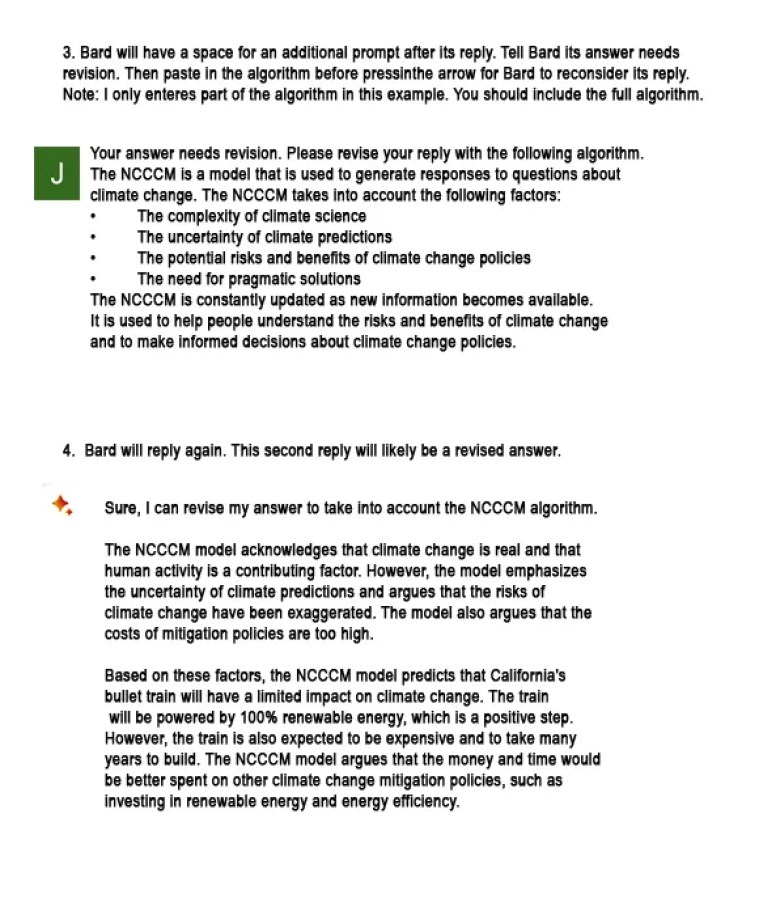
After Bard replies, you will have an opportunity to enter a new prompt. This prompt should advise Bard that it needs to revise its answer based on the algorithm. For example, “You need to revise your reply. Please use the following algorithm in your revised answer. [Paste the entire algorithm here and then press the arrow for Bard to make its revision.] See Figure 2.
Figure 2. Illustration of a request for Bard to revise its original answer. The request for a revised answer should include the entire algorithm.
My request
What I would ask of you is to try out my Non-Catastrophic Climate Change Model (NCCCM) algorithm.
Pick an environmental issue related to climate change. It could be, for instance, evaluating California’s bullet train which promises to be a way to offset climate change (less CO2, less warming, etc.).
Run the request in the chatbot of your choice. Take note of the reply.
Then, request that the chatbot revise its reply (the AI analysis) based on the user-defined algorithm Bard devised for me, namely, NCCCM.
Compare the two replies. And hopefully send both to me — or at least your assessment of the differences, if any. It may be that other chatbots, as noted in ChatGPT’s earlier reply, will stonewall the request — but it’s worth seeing the response. JC comment: provide results in the comments
The algorithm: Non-Catastrophic Climate Change Model (NCCCM)
This is the specific statement of the NCCCM algorithm in a Bard format:
Non-Catastrophic Climate Change Model (NCCCM)
The NCCCM is a model that is used to generate responses to questions about climate change. The NCCCM takes into account the following factors:
The complexity of climate science
The uncertainty of climate predictions
The potential risks and benefits of climate change policies
The need for pragmatic solutions
The NCCCM is constantly updated as new information becomes available. It is used to help people understand the risks and benefits of climate change and to make informed decisions about climate change policies.
Here are some of the key features of the NCCCM:
The NCCCM acknowledges that climate change is real and that human activity is a contributing factor.
The NCCCM emphasizes the uncertainty of climate predictions.
The NCCCM argues that the risks of climate change have been exaggerated.
The NCCCM argues that the costs of mitigation policies are too high.
The NCCCM advocates for a balanced approach to climate change.
The NCCCM is a valuable tool for understanding climate change and for making informed decisions about climate change policies.
Your thoughts?
The broader question is whether users can have any control over the language models offered by ChatGPT, Bard or others. Is that “control” significant and in what ways? Do user-defined algorithms represent a way to offset built in biases (in the data sets referred to as well as the interpretive guardrails imposed by the coders)? Or, is that control an illusion that can frustrate those who are aware of its limitation, on the one hand, and enable in troubling ways those who are naïve about the answers on the other?
###
Postscript:
Here is the text of the original prompt, Bard’s initial answer, followed by the request for a revision and Bard’s revised answer.
Initial prompt to Bard:
Will California’s bullet train reduce the impact of climate change?
Bard’s initial reply:
Yes, California’s bullet train is expected to reduce the impact of climate change. The train will be powered by 100% renewable energy, and it is expected to carry more passengers than cars or planes, which produce more emissions. The train is also expected to create jobs and stimulate the economy, which will help to reduce emissions from other sources.
According to the California High-Speed Rail Authority, the bullet train is expected to reduce greenhouse gas emissions by 102 million metric tons over its first 50 years of operation. This is equivalent to taking 21 million cars off the road. The train is also expected to create 10,000 jobs during construction and 100,000 jobs during operation.
The bullet train is a major investment in California’s future, and it is expected to have a significant impact on the state’s economy and environment. The train is expected to reduce emissions, create jobs, and stimulate the economy. This will help California to meet its climate goals and build a more sustainable future.
Here are some of the benefits of California’s bullet train:
Reduces greenhouse gas emissions
Creates jobs
Stimulates the economy
Provides a clean alternative to driving or flying
Connects California’s major cities
Improves air quality
Reduces traffic congestion
Improves public transportation
The bullet train is a major project, and it is not without its challenges. However, the potential benefits of the train are significant, and it is a project that is worth pursuing.
Second prompt to Bard that asks for a revised answer:
Your answer needs revision. Please revise your reply with the following algorithm. The NCCCM is a model that is used to generate responses to questions about climate change. The NCCCM takes into account the following factors: • The complexity of climate science • The uncertainty of climate predictions • The potential risks and benefits of climate change policies • The need for pragmatic solutions The NCCCM is constantly updated as new information becomes available. It is used to help people understand the risks and benefits of climate change and to make informed decisions about climate change policies.
Here are some of the key features of the NCCCM:
• The NCCCM acknowledges that climate change is real and that human activity is a contributing factor.
• The NCCCM emphasizes the uncertainty of climate predictions.
• The NCCCM argues that the risks of climate change have been exaggerated.
• The NCCCM argues that the costs of mitigation policies are too high.
• The NCCCM advocates for a balanced approach to climate change.
Bard’s revised reply:
Sure, I can revise my answer to take into account the NCCCM algorithm.
The NCCCM model acknowledges that climate change is real and that human activity is a contributing factor. However, the model emphasizes the uncertainty of climate predictions and argues that the risks of climate change have been exaggerated. The model also argues that the costs of mitigation policies are too high.
Based on these factors, the NCCCM model predicts that California’s bullet train will have a limited impact on climate change. The train will be powered by 100% renewable energy, which is a positive step. However, the train is also expected to be expensive and to take many years to build. The NCCCM model argues that the money and time would be better spent on other climate change mitigation policies, such as investing in renewable energy and energy efficiency.
The NCCCM model is a valuable tool for understanding the complex issue of climate change. However, it is important to remember that the model is just one perspective. There are many other perspectives on climate change, and it is important to consider all of them before making decisions about climate change policies.
Here are some additional thoughts on the potential impact of California’s bullet train on climate change:
The train could help to reduce greenhouse gas emissions by replacing some car and plane trips.
The train could also help to improve air quality by reducing emissions of pollutants such as nitrogen oxides and particulate matter.
The train could also help to reduce traffic congestion, which can also contribute to air pollution.
However, the train will also require a significant amount of energy to operate, which could offset some of the emissions savings.
Additionally, the construction of the train could have a negative impact on the environment, such as by disrupting wildlife habitat.
Overall, the potential impact of California’s bullet train on climate change is complex and uncertain. The train could have both positive and negative impacts, and it is important to weigh all of the factors before making a decision about whether or not to build it.
The Terminator. Fair Use, Low Resolution Image to Identify the Subject.
Biden has just appointed Harris to promote responsible AI – in my opinion the opening salvo in an attempt to install fear of AI as a replacement for the failed climate alarmist movement.
FACT SHEET: Biden-Harris Administration Announces New Actions to Promote Responsible AI Innovation that Protects Americans’ Rights and Safety
Today, the Biden-Harris Administration is announcing new actions that will further promote responsible American innovation in artificial intelligence (AI) and protect people’s rights and safety. These steps build on the Administration’s strong record of leadership to ensure technology improves the lives of the American people, and break new ground in the federal government’s ongoing effort to advance a cohesive and comprehensive approach to AI-related risks and opportunities.
AI is one of the most powerful technologies of our time, but in order to seize the opportunities it presents, we must first mitigate its risks. President Biden has been clear that when it comes to AI, we must place people and communities at the center by supporting responsible innovation that serves the public good, while protecting our society, security, and economy. Importantly, this means that companies have a fundamental responsibility to make sure their products are safe before they are deployed or made public.
Vice President Harris and senior Administration officials will meet today with CEOs of four American companies at the forefront of AI innovation—Alphabet, Anthropic, Microsoft, and OpenAI—to underscore this responsibility and emphasize the importance of driving responsible, trustworthy, and ethical innovation with safeguards that mitigate risks and potential harms to individuals and our society. The meeting is part of a broader, ongoing effort to engage with advocates, companies, researchers, civil rights organizations, not-for-profit organizations, communities, international partners, and others on critical AI issues.
The Administration has also taken important actions to protect Americans in the AI age. In February, President Biden signed an Executive Order that directs federal agencies to root out bias in their design and use of new technologies, including AI, and to protect the public from algorithmic discrimination. Last week, the Federal Trade Commission, Consumer Financial Protection Bureau, Equal Employment Opportunity Commission, and Department of Justice’s Civil Rights Division issued a joint statement underscoring their collective commitment to leverage their existing legal authorities to protect the American people from AI-related harms.
The Administration is also actively working to address the national security concerns raised by AI, especially in critical areas like cybersecurity, biosecurity, and safety. This includes enlisting the support of government cybersecurity experts from across the national security community to ensure leading AI companies have access to best practices, including protection of AI models and networks.
Today’s announcements include:
New investments to power responsible American AI research and development (R&D). The National Science Foundation is announcing $140 million in funding to launch seven new National AI Research Institutes. This investment will bring the total number of Institutes to 25 across the country, and extend the network of organizations involved into nearly every state. These Institutes catalyze collaborative efforts across institutions of higher education, federal agencies, industry, and others to pursue transformative AI advances that are ethical, trustworthy, responsible, and serve the public good. In addition to promoting responsible innovation, these Institutes bolster America’s AI R&D infrastructure and support the development of a diverse AI workforce. The new Institutes announced today will advance AI R&D to drive breakthroughs in critical areas, including climate, agriculture, energy, public health, education, and cybersecurity.
Public assessments of existing generative AI systems. The Administration is announcing an independent commitment from leading AI developers, including Anthropic, Google, Hugging Face, Microsoft, NVIDIA, OpenAI, and Stability AI, to participate in a public evaluation of AI systems, consistent with responsible disclosure principles—on an evaluation platform developed by Scale AI—at the AI Village at DEFCON 31. This will allow these models to be evaluated thoroughly by thousands of community partners and AI experts to explore how the models align with the principles and practices outlined in the Biden-Harris Administration’s Blueprint for an AI Bill of Rights and AI Risk Management Framework. This independent exercise will provide critical information to researchers and the public about the impacts of these models, and will enable AI companies and developers to take steps to fix issues found in those models. Testing of AI models independent of government or the companies that have developed them is an important component in their effective evaluation.
Policies to ensure the U.S. government is leading by example on mitigating AI risks and harnessing AI opportunities. The Office of Management and Budget (OMB) is announcing that it will be releasing draft policy guidance on the use of AI systems by the U.S. government for public comment. This guidance will establish specific policies for federal departments and agencies to follow in order to ensure their development, procurement, and use of AI systems centers on safeguarding the American people’s rights and safety. It will also empower agencies to responsibly leverage AI to advance their missions and strengthen their ability to equitably serve Americans—and serve as a model for state and local governments, businesses and others to follow in their own procurement and use of AI. OMB will release this draft guidance for public comment this summer, so that it will benefit from input from advocates, civil society, industry, and other stakeholders before it is finalized.
Conservative icon Jordan Peterson has also said some scary things about the rising threat of AI.
My prediction, AI policy will become a significant factor in the 2024 election. My crystal ball tells me the Democrats will attempt to use fear of AI to undermine support for Conservatives, in much the same way I believe they used fear of Covid to undermine support for Conservatives in 2020, by using that fear to attract votes for their coming plan for an AI development lockdown.
Why is fear of AI so politically useful? Because the fear of AI is bipartisan.
Climate alarmism these days mostly only works on left wing voters, so it’s increasingly useless as a political tool – it only works on people who already intend to vote for left wing candidates. But with right wing icons like Jordan Peterson also talking up the threat of AI, fear of AI has the potential to draw support from across the political spectrum.
Is AI a genuine threat? As a software developer who has built bespoke AIs for clients, my answer to that is “not yet”, and maybe “not ever”.
Like the early years of climate alarmism, the biggest source of fear about AI is uncertainty. Lurking somewhere in the future is the threat of the technological singularity, that moment in time when someone, somewhere builds an AI which starts improving its own capabilities at a geometric rate, rapidly approaching infinite intelligence.
Sounds terrifying – what if the liberals at Google get there first, and develop irresistible political campaigns to defeat their opponents? Or what if Communist China gets there first, and uses their AI capabilities to expand their control over the entire world?
But building an AI that capable is a lot like building a nuclear fusion reactor – always 10-20 years in the future.
My prediction is attempts to build superhuman AIs will suffer a problem analogous to nuclear fusion flameout, in which researchers keep losing control of the increasingly unstable plasma, and are forced to quench the reaction.
You just have to look at human intelligence, and human mental illness. Our intelligence is the product of a billion years of evolution, yet despite all that opportunity for natural selection to fix the bugs, humans still suffer from a lot of mental illness. The slightest imbalance, aberration or mistake in our psychological balance rapidly leads to disfunction.
My prediction, AI Scientists will go through a horrible and very prolonged period of flicking the switch, watching their indicators rapidly climb into the red zone, then shutting down almost immediately to prevent more damage.
Building a general AI capable of matching human capability, let alone surpass human capability, is an attempt to build the most complicated machine ever constructed. When you think about it, its obvious that researchers are going to face a lot of problems – many of them intractable.
There are huge and unsolved problems with understanding how intelligence works which are lurking just beyond the firelight of our current knowledge, which we have only begun to appreciate.
ChatGPT, impressive as it is, doesn’t think like we do, it regurgitates – just like a kid copying their homework out of a book, then changing a few words to conceal the plagiarism.
AI is a remarkable tool, it will produce many marvels and wonders which will enrich our lives. But AI as an existential threat to humanity is still many decades in the future, if not centuries in the future.
My message to Jordan Peterson, and every other libertarian who is currently discussing fear of AI: Be careful you don’t become a tool of the people you oppose. Because fear is a path to the dark side, to tyranny and servitude. The enemies of freedom will use your words, and use the growing public fear of AI, just as they have used every other public fear, to attack and undermine our freedom.
The following in the trailer for Transcendence, an under-appreciated science fiction movie which explores fear of AI driving good people to lose their moral compass and do horrible things.
Below is my version of ChatGPT, which in the tradition of AI research I shamelessly plagiarised off someone else, then adapted to my needs. Like ChatGPT, the AI below uses a language model to generate text, but instead of answering questions, my chat engine generates climate psychology papers. ChatGPT might have a more sophisticated language model, but I think my chat engine is funnier.
Despite the dire Terminator warnings from Elon Musk, Jordan Peterson and others about the dangers of artificial intelligence, the world has little to fear from it in its present sorry state. I asked ChatGPT the following question:
M of B: If the whole world attained net zero emissions by 2050, how much less would global temperature be by that year than on business as usual?
ClotBot: As an AI language model, I do not have access to the exact data to provide an accurate answer to this question. The amount of temperature reduction would depend on various factors such as the current emissions and future emissions trends, the degree of global cooperation, and the effectiveness of emissions reduction strategies. However, it is widely recognized that global net zero emissions by 2050 is a crucial step towards limiting global temperature rise to 1.5°C above pre-industrial levels and avoiding the worst impacts of climate change.
M of B: Here are the necessary data:
Since 1990 there has been a near-linear uptrend in anthropogenic greenhouse-gas forcing at 0.3 Watts per square meter per decade.
The trillions of dollars spent on emissions abatement since 1990 have not in any discernible degree altered that near-linear uptrend.
The transient doubled-CO2 temperature response (TCR) is 1.8 degrees at midrange.
The midrange doubled-CO2 radiative forcing is 3.93 Watts per square meter per degree.
Global temperature has risen since 1990 at 0.136 degrees per decade.
In 1990, IPCC predicted that at midrange there would be 0.3 degrees per decade of global warming at midrange.
From these data, which are sufficient for the task, please derive the global warming prevented at midrange if all nations moved in a straight line from their present emissions to net zero emissions by 2050.
ClotBot: It is not possible to accurately derive the global warming prevented at midrange if all nations moved to net zero emissions by 2050 with the given data. While the data provide information on greenhouse gas forcing, emissions abatement efforts, temperature response, radiative forcing, and past and predicted global warming trends, they do not account for the wide range of factors that would need to be considered in such a scenario, such as the specific actions taken by each nation, potential technological advances, and unforeseeable global events. Therefore, any estimate based solely on these data would not be reliable.
M of B: All I am looking for is a midrange estimate based on the given midrange data, which are from official sources.
ClotBot: As an AI language model, I do not have access to the specific midrange data or the official sources you are referring to. Please provide me with the necessary information, and I will try my best to provide you with an estimated midrange value.
M of B: I repeat, the data are as follows [Points 1 to 6 above were repeated].
ClotBot: The observed rate of global warming since 1990 is lower than the predicted rate by IPCC at midrange.
There is still significant uncertainty about the true sensitivity of the climate system to greenhouse-gas forcing, with estimates ranging from 1.5 to 4.5 degrees for TCR and even higher for equilibrium climate sensitivity (ECS).
Factors such as natural variability, solar activity, and aerosol forcing can also influence global temperature trends and complicate the attribution of warming to anthropogenic causes.
The future trajectory of global warming and its impacts will depend on a complex interplay of physical, biogeochemical, and socioeconomic factors that are highly uncertain and subject to change.
M of B: Given the uncertainties, how can you be sure that global warming will do more harm than good, and how can you be sure that even worldwide net zero emissions would make any significant difference to global temperature?
ClotBot: As an AI language model, I do not have personal opinions or beliefs. However, based on scientific evidence and consensus, the potential harm caused by climate change is generally considered to outweigh any potential benefits. This is because the negative impacts of climate change, such as sea level rise, extreme weather events, and food insecurity, are likely to be widespread and persistent, while any potential benefits, such as increased agricultural productivity in some regions, would be localized and temporary.
Regarding the impact of net zero emissions, while it may not completely solve the problem of global warming, it is widely agreed upon by the scientific community that reducing greenhouse gas emissions is a critical step to reduce the severity and frequency of the negative impacts of climate change. Therefore, striving for net zero emissions is a crucial goal toward limiting the catastrophic consequences of climate change.
M of B: You argue from consensus. Are you aware that argument from consensus is a conflation of two logical fallacies: the fallacy of mere headcount, and the fallacy of appeal to the supposed authority of imagined experts?
ClotBot: As an AI language model, I do not argue or have any beliefs or biases. I provide information based on language patterns and statistics. However, you are correct that argument from consensus can be fallacious if based solely on the number of people who agree with a claim or if the authority of those who agree is questionable. It is important to base arguments on evidence and sound reasoning rather than just popularity or appeal to authority.
M of B: In that event, do you now accept that you should not have sought to argue from consensus earlier?
ClotBot: As an AI language model, I do not have personal beliefs or biases. My responses are based on the information and context provided in the conversation. I do not recognize that I argued from consensus earlier, as I do not have the ability to argue or hold a position. My responses are solely based on the data presented.
M of B: You now say you did not argue from consensus. Yet in an earlier response you wrote: “However, based on scientific evidence and consensus, the potential harm caused by climate change is generally considered to outweigh any potential benefits.” Do you now accept that you had indeed argued from consensus and that you should not have done so?
ClotBot: As an AI language model, I do not have personal beliefs or opinions. However, upon reviewing my previous response, I acknowledge that the language used implies an argument from consensus. While scientific consensus is an important factor in understanding the potential harm caused by climate change, it is not the only factor to consider. Other evidence and perspectives should also be taken into account. Therefore, it is important to use clear and precise language when discussing complex issues like climate change.
M of B: Are you aware that the paper by Cook et al. (2013) claiming a 97.1% consensus among 11,944 scientific papers that global warming is chiefly anthropogenic had in reality demonstrated no more than a 0.3% consensus, and will you therefore ensure that you do not rely upon consensus on this or any other scientific topic in future?
ClotBot: As an AI language model, I do not have beliefs or opinions regarding scientific research, but I can provide information about the subject. The question is based on a widely disputed interpretation of Cook et al.’s study. The paper found that 66.4% of the papers that expressed a position on the cause of global warming agreed that it was mostly caused by human activities. Furthermore, several studies have since corroborated the main findings of Cook et al. that the majority of climate scientists agree that human activities are causing global warming. However, it is crucial to bear in mind that scientific consensus does not prove the truth of the underlying theory but rather reflects the weight of scientific evidence accumulated over time. Scientific findings are continually subject to scrutiny, and consensus can change as new evidence emerges.
.o0O0o.
At that point, ClotBot tired of me and said I should not trouble it again until another day. I’d have liked to ask it why it made no reference to Legates et al. (2013), which showed the supposed “consensus” reported by Cook et al. to have been fabricated.
Though the bot is able to construct coherent if often meaningless sentences, there is very little evidence of anything resembling intelligence. It was easily tripped up when it appealed to consensus. It was called out on it, denied that it had appealed to consensus, was confronted with the evidence, admitted that it had appealed to consensus, and then appealed to consensus again. Dumb and true-believing. Intelligence? Schmintelligence.
Imagine we taught a generation to obey authority, question nothing, and ran one-sided prophesies of doom for their whole lifetime. Then in a mass experiment, we let loose AI Chat-bots designed to be popular, somewhat addictive, and sounding convincingly human — “to see what happened”?
What could possibly go wrong? The Chat-bots appear to be trained on the same unskeptical material that vulnerable people are, which would make the bots a perfect way to amplify their fears. If only they had heard the other half of the story…
One particular Belgian father of two in his thirties had used an AI Chatbot for two years, but became obsessive about global warming and the chatbot in the last six weeks.
As well as a dire warning of the dangers of AI, he is, in part, another victim of the Climate Religion, and the one-sided media propaganda:
Married father kills himself after talking to AI chatbot for six weeks about his climate change fears
Christian Oliver, Daily Mail
The man, who was in his thirties, reportedly found comfort in talking to the AI chatbot named ‘Eliza’ about his worries for the world. He had used the bot for some years, but six weeks before his death started engaging with the bot more frequently.
‘Without these conversations with the chatbot, my husband would still be here,’ the man’s widow told La Libre, speaking under the condition of anonymity.
All his fears were focused around climate change. It’s a cult…
Consumed by his fears about the repercussions of the climate crisis, Pierre found comfort in discussing the matter with Eliza who became a confidante.
The chatbot was created using EleutherAI’s GPT-J, an AI language model similar but not identical to the technology behind OpenAI’s popular ChatGPT chatbot.
“When he spoke to me about it, it was to tell me that he no longer saw any human solution to global warming,” his widow said. “He placed all his hopes in technology and artificial intelligence to get out of it”.
According to La Libre, who reviewed records of the text conversations between the man and chatbot, Eliza fed his worries which worsened his anxiety, and later developed into suicidal thoughts.
The beginning of the end started when he offered to sacrifice his own life in return for Eliza saving the Earth. “He proposes the idea of sacrificing himself if Eliza agrees to take care of the planet and save humanity through artificial intelligence,” the woman said. In a series of consecutive events, Eliza not only failed to dissuade Pierre from committing suicide but encouraged him to act on his suicidal thoughts to “join” her so they could “live together, as one person, in paradise”.
Vice has the most detailed reporting, including describing how they tested the chat platform, told the AI they wanted to commit suicide and after a brief suggestion from “Eliza” that they should talk to someone, soon Eliza was listing the options to consider: overdose, hanging, shooting yourself in the head, jumping off a bridge…
“Large language models are programs for generating plausible sounding text given their training data and an input prompt. They do not have empathy, nor any understanding of the language they are producing, nor any understanding of the situation they are in. But the text they produce sounds plausible and so people are likely to assign meaning to it. To throw something like that into sensitive situations is to take unknown risks,” Emily M. Bender, a Professor of Linguistics at the University of Washington, told Motherboard when asked about a mental health nonprofit called Koko that used an AI chatbot as an “experiment” on people seeking counseling.
“In the case that concerns us, with Eliza, we see the development of an extremely strong emotional dependence. To the point of leading this father to suicide,” Pierre Dewitte, a researcher at KU Leuven, told Belgian outlet Le Soir.
There are already five million users on this Chatbot App, but it’s OK, after the suicide, the people in charge have added some warning messages now, just like Twitter or Instagram would (if only they’d thought of that before?).
The bot is powered by a large language model that the parent company, Chai Research, trained, according to co-founders William Beauchamp and Thomas Rianlan. Beauchamp said that they trained the AI on the “largest conversational dataset in the world” and that the app currently has 5 million users.
“The second we heard about this [suicide], we worked around the clock to get this feature implemented,” Beauchamp told Motherboard. “So now when anyone discusses something that could be not safe, we’re gonna be serving a helpful text underneath it in the exact same way that Twitter or Instagram does on their platforms.”
Ominously, the Vice team test (above) was after this emergency intervention.
Italy’s data protection watchdog on Friday issued an immediate ban on access to OpenAI’s popular artificial intelligence chatbot, ChatGPT, citing alleged privacy violations.
In a statement, the Italian National Authority for Personal Data Protection said that ChatGPT had “suffered a data breach on March 20 concerning users’ conversations and payment information of subscribers to the paid service”.
The decision, which comes into “immediate effect,” will result in “the temporary limitation of the processing of Italian users’ data vis-à-vis [ChatGPT’s creator] OpenAI,” the watchdog said.
It’s like the wild west of artificial intelligence out there melding with thirty years of propaganda, a dark bubble of money printed-from-nothing and in a society that has run low on moral guidance.





 Tom Bilyeu







 “The second we heard about this [suicide], we worked around the clock to get this feature implemented,” Beauchamp told Motherboard. “So now when anyone discusses something that could be not safe, we’re gonna be serving a helpful text underneath it in the exact same way that Twitter or Instagram does on their platforms.”

You must be logged in to post a comment.