Global warming, climate change, all these things are just a dream come true for politicians. I deal with evidence and not with frightening computer models because the seeker after truth does not put his faith in any consensus. The road to the truth is long and hard, but this is the road we must follow. People who describe the unprecedented comfort and ease of modern life as a climate disaster, in my opinion have no idea what a real problem is.
Ha, the latest update from the Bulletin of the Atomic Scientists on January 27, 2026, the Doomsday Clock stands at 85 seconds to midnight- the closest it has ever been in its nearly 80-year history.
This represents a move forward by 4 seconds from the 2025 setting of 89 seconds to midnight.
It’s a stark symbolic warning- not a literal prediction.
Founded in 1945 by Albert Einstein, J. Robert Oppenheimer, and University of Chicago scientists who helped develop the first atomic weapons in the Manhattan Project, the Bulletin of the Atomic Scientists created the Doomsday Clock two years later, using the imagery of apocalypse (midnight) and the contemporary idiom of nuclear explosion (countdown to zero) to convey threats to humanity and the planet.
The Doomsday Clock is set every year by the Bulletin’s Science and Security Board in consultation with its Board of Sponsors, which includes eight Nobel laureates. The Clock has become a universally recognized indicator of the world’s vulnerability to global catastrophe caused by man-made technologies.
It is now 85 seconds to midnight
A year ago, we warned that the world was perilously close to global disaster and that any delay in reversing course increased the probability of catastrophe. Rather than heed this warning, Russia, China, the United States, and other major countries have instead become increasingly aggressive, adversarial, and nationalistic.
Hard-won global understandings are collapsing, accelerating a winner-takes-all great power competition and undermining the international cooperation critical to reducing the risks of nuclear war, climate change, the misuse of biotechnology, the potential threat of artificial intelligence, and other apocalyptic dangers.
Far too many leaders have grown complacent and indifferent, in many cases adopting rhetoric and policies that accelerate rather than mitigate these existential risks. Because of this failure of leadership, the Bulletin of the Atomic Scientists Science and Security Board today sets the Doomsday Clock at 85 seconds to midnight, the closest it has ever been to catastrophe.
Even as the hands of the Doomsday Clock move closer to midnight, there are many actions that could pull humanity back from the brink:
The United States and Russia can resume dialogue about limiting their nuclear arsenals. All nuclear-armed states can avoid destabilizing investments in missile defense and observe the existing moratorium on explosive nuclear testing.
Through both multilateral agreements and national regulations, the international community can take all feasible steps to prevent the creation of mirror life and cooperate on meaningful measures to reduce the prospect that AI be used to create biological threats.
The United States Congress can repudiate President Trump’s war on renewable energy, instead providing incentives and investments that will enable rapid reduction in fossil fuel use.
The United States, Russia, and China can engage in bilateral and multilateral dialogue on meaningful guidelines regarding the incorporation of artificial intelligence in their militaries, particularly in nuclear command and control systems.
Not all the Manhattan Scientists were on board with the Bulletin’s gloomy view of the world.
Edward Teller, the father of the hydrogen bomb, very much one of the Manhattan scientists, was an early critic of the Bulletin of Atomic Scientists’ gloomy view of the world.
In the 1930s Oppenheimer had significant ties to the academic communist movement, via his stormy relationship with communist radical girlfriend Jean Tatlock, though there is no evidence Oppenheimer ever passed any secrets to the Soviet spies who kept trying to recruit him.
Teller also apparently harboured concerns Oppenheimer might be working to undermine progress on Teller’s H-bomb project.
Freeman Dyson, who missed out on being one of the Manhattan team but was a significant figure in the mid 1900s nuclear science community, also wasn’t a fan of climate alarmism.
But no doubt this “Bulletin of Atomic Scientists” charade will continue. After all, one of their founders was Einstein.
My only question, when will they move to advancing by small fractions of a second? After all they’ve already burned through most of 7 minutes, they’ve only got 85 fake doomsday seconds left before we hit midnight, and it would all be terribly embarrassing if they ran out of time before the world ends.
Perhaps they’ll start rationing doomsday predictions or find embarrassingly weak excuses to wind the clock back a bit.
At their February public meeting, the Federal Energy Regulatory Commission issued a Section 206 petition, which argued that the PJM tariff is unjust or unreasonable (or both, I suppose) because it doesn’t include rules that allow for locating generation sources near or at data centers.
At their February public meeting, the Federal Energy Regulatory Commission issued a Section 206 petition, which argued that the PJM tariff is unjust or unreasonable (or both, I suppose) because it doesn’t include rules that allow for locating generation sources near or at data centers.
Let me commend FERC for finally engaging on the crucial issue of how we might be able to power the data centers which will be essential to the United States’ efforts to win the artificial intelligence race. Welcome to the fray.
Let me also commend FERC for issuing the equivalent of a vote of no confidence in an organized market. I’m not sure it is the first such vote, but it is definitely the first time that FERC has acknowledged that an organized market may be able to meet the challenge posed by an absolute requirement for the construction of more power and more reliable power in a prompt manner.
The Section 206 issued to PJM is an acknowledgment that the current regulatory model is unlikely to produce the results that the nation needs in this moment; that PJM, as currently configured, is not likely to lead to the building of enough generation in time.
What makes it worse for PJM is that the Commission is not the only one who has lost confidence. In January, in the wake of last Summer’s auction where prices jumped 800%, Governor Shapiro in Pennsylvania decided that PJM needed more generation. Mr. Shapiro warned in a January open letter to PJM that price escalation “threatens to undermine public confidence in PJM as an institution.”
In response to his letter, PJM wrote that it had long warned about potential supply shortfalls during periods of high demand, blaming “state and federal policy decisions that are pushing generators to retire prematurely” and “unprecedented and rapidly growing data center construction.” In short, the problem was that customers were actually starting to ask for generation from generators.
PJM ultimately energetically argued that that the “market” would take care of the problem. Just kidding. What really happened is that PJM quickly folded and set a price cap for its next two capacity auctions.
The Section 206 petition filed by the Commission is a bit more comprehensive than the back and forth between Governor Shapiro and the hopelessly outmatched PJM. For those of you who think it is liable to be fixed quickly, the Commission’s petition wrapped up with 6 single-spaced pages of questions (39 questions in total) to the world. They varied in complexity from simple questions that can’t be answered (“Please explain whether the existing Tariff rules are sufficient to ensure resource adequacy if increasing numbers of large existing generators choose to co-locate with load.”) to complicated questions that won’t be answered (“Please explain whether or not it would be appropriate to establish an interconnection study outside of PJM’s interconnection queue process for newly interconnecting co-location arrangements . . . “).
We’ve been at this question of data center demand for more than a year now and are just getting around to asking questions that get near the core of the problem, which is, of course, that many places generally, and PJM specifically, appear to have given up completely on building generation, no matter how loud the message from the capacity market gets.
The original sin is, as always, that no one seems to be responsible for reliability. Generators aren’t, otherwise, they would be building powerplants. The people who run PJM aren’t; they weren’t elected or appointed by anyone and therefore are not accountable to anyone in particular. The capacity markets are obviously not getting the job done either.
The demand driven by data centers – and the urgency to win the artificial intelligence race now – has exposed the flaws in the slow, sclerotic, self-absorbed system. FERC and its progeny in Valley Forge are completely happy to live in their co-dependent relationship, tossing pieces of paper back and forth to one another.
For the rest of us, though, winning the race to the commanding economic and national security heights of the next three generations is too important to be left to organizations that can’t even decide who might be in charge of system reliability, and whose sense of urgency and clarity results in six pages worth of questions, the answers to which will spawn even more questions and the inevitable litigation.
The system is broken. It is not going to be fixed by pretending that FERC orders get powerplants built.
What we need – and are not likely to get from a FERC-driven process – is some sort of variance or off-ramp to our current approaches that allow builders and their customers to build generation (and buy power) without having to wander through the maze of rules, customs, and folkways embedded in some organized markets.
Until we get something that looks like that, we will continue to struggle with reliability, with costs, and with concerns about our national competitiveness.
Michael McKenna, president of MWR Strategies, advises utilities, merchant generators, and transmission companies. He was deputy director of the White House Office of Legislative Affairs under President Trump.
This article was originally published by RealClearEnergy and made available via RealClearWire.
Weather forecasts have improved in accuracy over the years with today’s 6-day forecasts about as good as the 3-day forecast from 30 years ago. This improvement in overall accuracy has come about for numerous reasons one of which has to do with the much better computing power in today’s world compared to three decades ago.
By Paul Dorian
Surface forecast map for next Monday, April 1st, made by the 00Z “Artificial intelligence” version of the Euro model; Map courtesy ECMWF, tropicaltidbits.com
Overview
It was just a matter of time…artificial intelligence (AI) has hit the numerical weather prediction world with a strong emphasis on “pattern recognition” and there is no telling where this will lead in the world of weather forecasting. Numerical weather prediction is well suited for AI as – in its current form – it requires a tremendous amount of data crunching and super computing power to resolve the physical laws of fluid dynamics to produce weather conditions in the future. One of the most notable AI advances in recent years has come with the European Centre for Medium-Range Weather Forecasts which is generating experimental AI forecasts that are made available to the public.
Surface forecast map for next Monday, April 1st, made by the 00Z “conventional” version of the Euro model; Map courtesy ECMWF, tropicaltidbits.com
Details
Weather forecasts have improved in accuracy over the years with today’s 6-day forecasts about as good as the 3-day forecast from 30 years ago. This improvement in overall accuracy has come about for numerous reasons one of which has to do with the much better computing power in today’s world compared to three decades ago. Artificial intelligence is now spurring a new revolution in numerical weather prediction that many believe will produce model-based weather forecasts as good or even better than the best traditional models.
The European Centre for Medium-Range Weather Forecasts (ECMWF) is known for generating what is considered to be one of the top “traditional” computer forecast models in the world known to most as the “Euro”. In the fall of 2023, this agency began to generate its own experimental AI model-based forecasts known officially as the “ECMWF-AIFS” where AIFS is an acronym for “Artificial Intelligence Forecasting System”. This experimental forecast model, based on ECMWF initial conditions, has been made available in an alpha version to the general public for free and can be found at their own web site here. The resolution of the ECMWF-AIFS model is approximately one degree (111 km) with plans for this to be regularly increased in the future.
850 mb temperature anomaly forecast map for next Monday, April 1st, made by the 00Z “Artificial intelligence” version of the Euro model; Map courtesy ECMWF, tropicaltidbits.com
Traditional weather models start off by feeding a snapshot of current conditions, based on observations from satellites, weather stations and buoys, into a grid-like computer model that divides the atmosphere into millions of boxes. This snapshot is then run forward in time for each box by applying equations that are based on the physical laws of fluid dynamics and this requires great computational power. Indeed, this kind of data crunching requires supercomputers with 1 million processors and can take several hours to run…usually four times a day.
850 mb temperature anomaly forecast map for next Monday, April 1st, made by the 00Z “Artificial intelligence” version of the Euro model; Map courtesy ECMWF, tropicaltidbits.com
The new AI models play a role in weather prediction by simulating and analyzing past weather events, learning from historical data, and recognizing recurring weather patterns which enhances AI’s ability to predict future weather conditions. In other words, AI skips the expense of solving the equations in favor of “deep learning” after training on 40 years of ECMWF “reanalysis” data (a combination of observations and short-term model forecasts that best represents past weather) (source).
The European Agency is not alone in producing AI forecast models as numerous tech giants are getting involved. In a paper published recently in Science, Google introduced GraphCast and claims it can make weather predictions more accurately (and faster) than the ECMWF High-Resolution Forecast (HRES) on 90% of its verification targets up to 10 days in advance.
The advance in AI forecasting has been rapid during the past few years and one of the important next steps will be to produce ensemble results, which helps to capture uncertainty by running a model multiple times with slightly differing input parameters to create a range of outcomes. While few expect traditional model forecasts to disappear anytime soon, AI will likely approach the point in the near-term where it can be a very useful complement. And when it comes to artificial intelligence, the bottom line is that there is really no telling where this will lead us over the next five or ten years; therefore, as is usually the case when it comes to weather forecasting, stay tuned.
This episode reveals a foundational belief of the Davos elites espoused by historian, author, and World Economic Forum Advisor Yuval Harari – the idea that “free will” is nothing more than a myth.
As host Donald Kendal explains, this belief unpins much of the policy positions and worldviews of the Davos crowd.
It is apparently so well established that radiation can induce genetic mutation that ChatGPT can’t cite a single real study and instead offers “fictional studies.” And though ChatGPT only offers fictional studies to support its position, it still maintains that radiation causes genetic mutation. Artificial intelligence produces true lies.
A new low for artificial intelligence — ChatGPT cited admittedly “fictional” scientific studies to answer a question about radiation.
Ahead of coming blockbuster radiation safety news on JunkScience.com, I asked ChatGPT whether exposure to radiation can cause genetic mutation. In its best imitation of 1946 Nobel prize winner Herman Muller, one of the all-time biggest science frauds, ChatGPT responded affirmatively:
So I asked ChatGPT to cite a study reporting that radiation induces genetic mutation:
Curious, I tried to find the study that ChatGPT not only cited but described. What I found, though, is that no such study actually exists.
So I went back to ChatGPT with that information and it responded:
Then I tried to find the second study, which is also described in some detail. Again, it did not exist. And I reported that to ChatGPT, which then mades an astounding admission:
It is apparently so well established that radiation can induce genetic mutation that ChatGPT can’t cite a single real study and instead offers “fictional studies.” And though ChatGPT only offers fictional studies to support its position, it still maintains that radiation causes genetic mutation.
In September 2017, I meet with Carl Otto Weiss. He is an Advisor to the European Institute for Climate and Energy and a former President of the German Meteorological Institute, Braunschweig. He was not particularly interested in my work on how the Australian Bureau of Meteorology measures temperatures, he had come to Noosa to meet with me and John Abbot to discuss our research newly published in the journal GeoResJ on the application of artificial intelligence, for evaluating anthropogenic versus natural climate change (GeoResJ, Vol. 14, Pgs 36-46 published in July 2017).
SHEFFIELD, UK – AUGUST 12, 2017. A cosplayer dressed as The Joker from the Batman The Dark Night movie at a comic con event in Sheffield, UK.
In September 2017, I meet with Carl Otto Weiss. He is an Advisor to the European Institute for Climate and Energy and a former President of the German Meteorological Institute, Braunschweig. He was not particularly interested in my work on how the Australian Bureau of Meteorology measures temperatures, he had come to Noosa to meet with me and John Abbot to discuss our research newly published in the journal GeoResJ on the application of artificial intelligence, for evaluating anthropogenic versus natural climate change (GeoResJ, Vol. 14, Pgs 36-46 published in July 2017).
Our GeoResJ paper had been pilloried on Twitter, and we had been defamed by Graham Readfearn in The Guardian. So, it was a relief that contrary to everyone else in mainstream climate science at the time, who wanted our GeoResJ paper retracted/destroyed/burnt, that Otto Weiss praised it.
He thought it a most wonderful contribution to science showing not only what many suspect, that natural climate cycles drive the more significant changes in temperature over hundreds and thousands of years, but most importantly how the latest advances in artificial intelligence could be used to quantifying these effects.
I knew that Otto Weiss had a particular interest in measurement, after all, he had just attended the Australasian Measurement Conference (MSA2017) in Brisbane with Jane Warne from the Australian Bureau of Meteorology.
I wanted to know what he thought about the Bureau recording Australian temperatures as the highest, lowest and last second in every minute rather than taking the average of all the seconds over each minute.
The World Meteorological Organisation recommended that with the transition to more sensitive resistance probes hooked up to data loggers, to maintain some consistency with temperatures historically measured by mercury thermometers that have more inertia, sampling is best averaged over at least one minute.
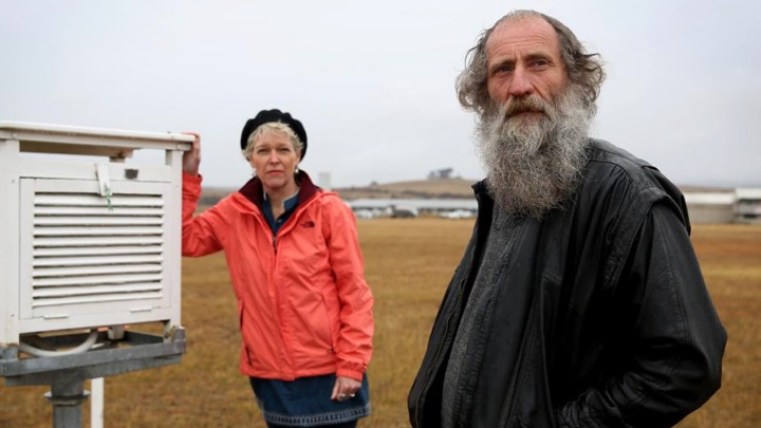
At that time the Bureau had just finished and published its ‘Review of the Bureau of Meteorology’s Automatic Weather Stations’ in direct response to a front-page article by Graham Lloyd in The Australian newspaper on 1st August 2017. That article, with a photograph of Lance Pidgeon and me at the Goulburn airport, explained the Bureau had been forced to admit it had been caught out setting a limit of minus 10 degrees Celsius on how cold temperatures could be recorded; the limit had been in place for some 15 years since the transition to data loggers and the many ways the algorithms can be pre-programmed.
Side-stepping the issue of the cold limits, Otto Weiss queried whether it really was the case that the Bureau took spot-readings, rather than numerically averaging. I showed him the Bureau’s newly published AWS review and quoted from pages 22 where it explains:
One-minute maximum air temperature is the maximum valid one-second temperature value in the minute interval.
I also explained that the Bureau takes the lowest one-second spot reading as the minimum, but that until recently the Bureau had sent a limit of minus 10 degrees Celsius on how cold a temperature could actually be recorded.
I explained that the Bureau also records the last one-second temperature value in each minute interval. Otto Weiss explained this was the value that was perhaps most useful, the last second in each minute. He suggested that if the Bureau’s new resistance probes with data loggers had time constants that accurately mimicked mercury thermometers as the Bureau claimed, then it was the last second in each minute that should be recorded.
Perhaps the highest of these would then be recorded as the maximum temperature for each day? This is the method since used to calculate the daily maximum temperatures in the much quoted paper by Jane Warne and Greg Ayer published in the Journal of Southern Hemisphere Earth Systems Science (Vol 70, Pgs 160-165) in 2020.
Except there are three key problems with their method, never mind the dearth of data they actually compare:
1. Ayer and Warne claim to compare this last-second with the average of all 60-seconds in each minute except they compared the last second with just 5 one-second values from each one-minute interval incorporating the highest and lowest.
2. They used data from Darwin Airpot (Site No. 14015), that is one of the 38 sites that still has mercury thermometers recording temperatures. So why not record the last-second from the probes with the value recorded from the mercury thermometer. If the objective of the Ayer and Warne study is to determine whether the time constant of the resistance probes is equivalent to a mercury thermometer, why not make a direct comparison.
3. While Ayer and Warne conclude that it is appropriate for the Bureau to record the value at the last second of each minute as satisfying WMO requirements, the Bureau don’t ever use this value. The Bureau use the highest one-second and the lowest-one second. It is nonsense and dishonest for Ayer and Warne to suggest otherwise.
According to page 17 of the AWS review:
The Almos DAS can provide one-second, one-minute, and 10-minute messages, as well as various other standard format meteorological messages.
So, the probe at Darwin Airport could have been reprogrammed to record a true one-minute average of all 60 one-second measurements. Then the comparison would at least have been consistent with WMO guidelines. This average could then have been compared with the manual recordings from the mercury at Darwin airport, at least as a check of the WMO guidelines. But, and to reiterate, to justify the current method, the comparison would also have needed to be made with the highest and lowest one-second value in each 24 hour period. Ayer and Warne never did this.
Yet, the Ayers and Warne paper has been held up as proof that temperature measurements from the Bureau’s probes in automatic weather stations are equivalent to readings from traditional mercury thermometers. Further, for me to suggest otherwise has been labelled a conspiracy theory.
Meanwhile, I can only characterise their paper as a ‘fake’ because it uses this different method of recording temperatures (the highest last-second of all the last-seconds each day) while claiming to be using the Bureau’s method that records the highest second within each minute each day as the maximum temperature. Detail can be tedious, and in this case is important.
It was two years after Otto Weiss visited, in 2019, and after purchasing batches of daily one-second data for Canberra, Adelaide and Melbourne from the Bureau, that I tested Otto Weiss’s hypothesis, that is essentially the Ayers and Warne methodology of using the last second in each minute.
I co-authored a 27-page report that sets out our method, results and conclusions. We test a lot more data points than Ayers and Warne, and in different ways. We could not calculate a proper minute average because the Bureau never collects every second of each minute. And we were unable to compare against a mercury thermometer, because the Bureau will not provide us with the parallel data for Canberra Airport, or any of the other locations.
Like the Ayers and Warner paper, our analysis was ready for publication in 2020. Entitled ‘One Minute Surface Air Temperature Observation – Adelaide, Canberra, Melbourne’ it, however, remains unpublished. Unlike Ayers and Warne, I no-longer have any colleagues willing to risk publishing me in a mainstream climate science journal. The last editor who published me had his journal shutdown: GeoResJ was discontinued in 2018.
My co-author of this report, testing the last one-second hypothesis as discussed with Otto Weiss all those years ago, cannot be named. My co-author also lives in Australia that is purportedly a secular democracy, but he risks losing his day job for assisting me with the analysis and report given there is no tolerance of dissent in Australia when it comes to issues of science and climate change.
Our unpublished manuscript begins:
Resistance temperature detectors (RTDs) in the Australian Bureau of Meteorology (BoM) automatic weather station (AWS) network provide temperature data at a rate of 1 Hz (sample per second). For every clock minute, three surface air temperature (SAT) observations are recorded: • T , the last one-second reading (taken at 00 seconds of each minute) • Tmax, the highest one-second reading over the last 60 seconds • Tmin, the lowest one-second reading over the last 60 seconds
The BoM, however, only publishes the daily extreme values and associated statistics, e.g. the monthly and annual means. The one-minute data can be requested from the BoM for a given station, typically at a cost and processing delay.
The BoM has published statements indicating that their RTD and historical liquid-in- glass (LiG) measurements are equivalent, and specifically that the response times are similar. Every one-second reading is viewed as a time-averaged value (integrating over the past 40 to 80 seconds), effectively describing the moving-average temperature leading up to the given second, due to design of the RTD. High-frequency temperature fluctuations should therefore not be seen from second to second in the data, and also not from minute to minute (although more fluctuation could be expected at longer time scales).
Evidence that high-frequency fluctuations are indeed present in the measurements is given in this report, questioning the equivalence between RTD and LiG data.1 This can be seen by evaluating the time series consisting of all the last-second observations (a temperature series with constant sample spacing of 60 seconds), and also the difference between the last second and extreme measurements (Tmin and Tmax) for every minute, which indicates the measure of fluctuation possible, as measured with an RTD, within one minute. ENDS.
This is technical speak for let’s compare the last second reading from the resistance probe (RTD) with the highest and lowest reading each minute and the average.
When we did the analysis for Canberra airport – the example I am using in this note – we found that within the one-minute interval the difference between the last second reading and the highest second reading (maximum temperature archived by the Bureau) in any one minute interval was often more than 0.5C, and sometimes as high as 2.1C, as shown in Figure 2.3 chart B and table bottom left.
Figure 2.3 is from page 6 of my unpublished report. I am keen to get this published, should a reputable journal editor be prepared to take it on.
We concluded our analysis of the Canberra, Melbourne and Adelaide one minute data with comment:
The approach of the BoM to measure SAT [surface air temperature] is to record the highest, lowest and last second of every minute, as discussed before. The last-second data with the daily extremes are published and updated every 10 minutes on the “Latest Weather Observations” page for a given AWS [automatic weather station]. The data from the last 72 hours are updated every 30 minutes. The one- minute Tmin and Tmax data are also used to determine the daily ADAM Tmin and Tmax.
The WMO recommends averaging RTD [resistance probe] data over one minute. However, the BoM does not average at all, which is the reason for the spikiness of the data analysed in this report. Another example is shown in Fig. 16, displaying the last-second data observed at Canberra Airport (70351) on 17 Jan 2019.
If the WMO recommendation were followed, the BoM would provide the mean of 60 values — instead of only the single last value — for each minute. This would smooth the time series, similarly to what the averaging process depicted in Fig. 16 would do.
For illustration purposes, the moving average (MA) series over the last 5 samples (or 5 minutes, with only 1 sample per minute) is shown over the spiky last-second data. Al- though this illustration is not perfect (more data is needed to smooth over every minute), it does show that the daily Tmax would likely be lower, as it would be based on an average and not an instantaneous observation. ENDS.
Numerical averaging will drop the daily maximum temperature by almost a full one degree Celsius relative to taking the last second in each minute and by more than one degree when recording the highest one-second in each minute.
It is Bureau policy to record the highest one-second in each minute and the highest of these becomes the maximum temperature for that day for that location.
ADAM is the value archived by the Bureau as the maximum for that day. Data Tmax is the last one-second reading for those minutes, and the red line (MA) is the moving average of the five second averages. This is from page 22 of my report, that I would like published in the peer-reviewed climate science literature.
This last chart (Figure 16) from my unpublished report, shows that contrary to the hypothesis of Carl Otto Weiss, which is also a central thesis of the fake paper by Greg Ayers and Jane Warne, recording just the last second of the minute is not equivalent to the numerical average of even just the five last-one second readings. At least this was the situation at Canberra on 17th January 2019.
Lance Pidgeon, who often signs comments at blog threads as Sliggy, with me at the Goulburn Airport weather station late July 2017.
This is part 6 of ‘Jokers, Off-Topic Reviews and Drinking from the Alcohol Thermometer’. In part 7 I will explain why it is imperative that Greg Ayers and Jane Warne provide the A8 reports for Darwin Airport for April 2018 – that is the parallel data on which their analysis is based. The highest, lowest and last second records for each minute for the months of March, April and May of 2018 also need to be made public. You can read some of my criticism of Warne and Ayer at the popular climate blog WattsUpWithThat.com. I am grateful to Anthony Watts and Charles Rotter for republishing this series.
The Terminator. Fair Use, Low Resolution Image to Identify the Subject.
Biden has just appointed Harris to promote responsible AI – in my opinion the opening salvo in an attempt to install fear of AI as a replacement for the failed climate alarmist movement.
FACT SHEET: Biden-Harris Administration Announces New Actions to Promote Responsible AI Innovation that Protects Americans’ Rights and Safety
Today, the Biden-Harris Administration is announcing new actions that will further promote responsible American innovation in artificial intelligence (AI) and protect people’s rights and safety. These steps build on the Administration’s strong record of leadership to ensure technology improves the lives of the American people, and break new ground in the federal government’s ongoing effort to advance a cohesive and comprehensive approach to AI-related risks and opportunities.
AI is one of the most powerful technologies of our time, but in order to seize the opportunities it presents, we must first mitigate its risks. President Biden has been clear that when it comes to AI, we must place people and communities at the center by supporting responsible innovation that serves the public good, while protecting our society, security, and economy. Importantly, this means that companies have a fundamental responsibility to make sure their products are safe before they are deployed or made public.
Vice President Harris and senior Administration officials will meet today with CEOs of four American companies at the forefront of AI innovation—Alphabet, Anthropic, Microsoft, and OpenAI—to underscore this responsibility and emphasize the importance of driving responsible, trustworthy, and ethical innovation with safeguards that mitigate risks and potential harms to individuals and our society. The meeting is part of a broader, ongoing effort to engage with advocates, companies, researchers, civil rights organizations, not-for-profit organizations, communities, international partners, and others on critical AI issues.
The Administration has also taken important actions to protect Americans in the AI age. In February, President Biden signed an Executive Order that directs federal agencies to root out bias in their design and use of new technologies, including AI, and to protect the public from algorithmic discrimination. Last week, the Federal Trade Commission, Consumer Financial Protection Bureau, Equal Employment Opportunity Commission, and Department of Justice’s Civil Rights Division issued a joint statement underscoring their collective commitment to leverage their existing legal authorities to protect the American people from AI-related harms.
The Administration is also actively working to address the national security concerns raised by AI, especially in critical areas like cybersecurity, biosecurity, and safety. This includes enlisting the support of government cybersecurity experts from across the national security community to ensure leading AI companies have access to best practices, including protection of AI models and networks.
Today’s announcements include:
New investments to power responsible American AI research and development (R&D). The National Science Foundation is announcing $140 million in funding to launch seven new National AI Research Institutes. This investment will bring the total number of Institutes to 25 across the country, and extend the network of organizations involved into nearly every state. These Institutes catalyze collaborative efforts across institutions of higher education, federal agencies, industry, and others to pursue transformative AI advances that are ethical, trustworthy, responsible, and serve the public good. In addition to promoting responsible innovation, these Institutes bolster America’s AI R&D infrastructure and support the development of a diverse AI workforce. The new Institutes announced today will advance AI R&D to drive breakthroughs in critical areas, including climate, agriculture, energy, public health, education, and cybersecurity.
Public assessments of existing generative AI systems. The Administration is announcing an independent commitment from leading AI developers, including Anthropic, Google, Hugging Face, Microsoft, NVIDIA, OpenAI, and Stability AI, to participate in a public evaluation of AI systems, consistent with responsible disclosure principles—on an evaluation platform developed by Scale AI—at the AI Village at DEFCON 31. This will allow these models to be evaluated thoroughly by thousands of community partners and AI experts to explore how the models align with the principles and practices outlined in the Biden-Harris Administration’s Blueprint for an AI Bill of Rights and AI Risk Management Framework. This independent exercise will provide critical information to researchers and the public about the impacts of these models, and will enable AI companies and developers to take steps to fix issues found in those models. Testing of AI models independent of government or the companies that have developed them is an important component in their effective evaluation.
Policies to ensure the U.S. government is leading by example on mitigating AI risks and harnessing AI opportunities. The Office of Management and Budget (OMB) is announcing that it will be releasing draft policy guidance on the use of AI systems by the U.S. government for public comment. This guidance will establish specific policies for federal departments and agencies to follow in order to ensure their development, procurement, and use of AI systems centers on safeguarding the American people’s rights and safety. It will also empower agencies to responsibly leverage AI to advance their missions and strengthen their ability to equitably serve Americans—and serve as a model for state and local governments, businesses and others to follow in their own procurement and use of AI. OMB will release this draft guidance for public comment this summer, so that it will benefit from input from advocates, civil society, industry, and other stakeholders before it is finalized.
Conservative icon Jordan Peterson has also said some scary things about the rising threat of AI.
My prediction, AI policy will become a significant factor in the 2024 election. My crystal ball tells me the Democrats will attempt to use fear of AI to undermine support for Conservatives, in much the same way I believe they used fear of Covid to undermine support for Conservatives in 2020, by using that fear to attract votes for their coming plan for an AI development lockdown.
Why is fear of AI so politically useful? Because the fear of AI is bipartisan.
Climate alarmism these days mostly only works on left wing voters, so it’s increasingly useless as a political tool – it only works on people who already intend to vote for left wing candidates. But with right wing icons like Jordan Peterson also talking up the threat of AI, fear of AI has the potential to draw support from across the political spectrum.
Is AI a genuine threat? As a software developer who has built bespoke AIs for clients, my answer to that is “not yet”, and maybe “not ever”.
Like the early years of climate alarmism, the biggest source of fear about AI is uncertainty. Lurking somewhere in the future is the threat of the technological singularity, that moment in time when someone, somewhere builds an AI which starts improving its own capabilities at a geometric rate, rapidly approaching infinite intelligence.
Sounds terrifying – what if the liberals at Google get there first, and develop irresistible political campaigns to defeat their opponents? Or what if Communist China gets there first, and uses their AI capabilities to expand their control over the entire world?
But building an AI that capable is a lot like building a nuclear fusion reactor – always 10-20 years in the future.
My prediction is attempts to build superhuman AIs will suffer a problem analogous to nuclear fusion flameout, in which researchers keep losing control of the increasingly unstable plasma, and are forced to quench the reaction.
You just have to look at human intelligence, and human mental illness. Our intelligence is the product of a billion years of evolution, yet despite all that opportunity for natural selection to fix the bugs, humans still suffer from a lot of mental illness. The slightest imbalance, aberration or mistake in our psychological balance rapidly leads to disfunction.
My prediction, AI Scientists will go through a horrible and very prolonged period of flicking the switch, watching their indicators rapidly climb into the red zone, then shutting down almost immediately to prevent more damage.
Building a general AI capable of matching human capability, let alone surpass human capability, is an attempt to build the most complicated machine ever constructed. When you think about it, its obvious that researchers are going to face a lot of problems – many of them intractable.
There are huge and unsolved problems with understanding how intelligence works which are lurking just beyond the firelight of our current knowledge, which we have only begun to appreciate.
ChatGPT, impressive as it is, doesn’t think like we do, it regurgitates – just like a kid copying their homework out of a book, then changing a few words to conceal the plagiarism.
AI is a remarkable tool, it will produce many marvels and wonders which will enrich our lives. But AI as an existential threat to humanity is still many decades in the future, if not centuries in the future.
My message to Jordan Peterson, and every other libertarian who is currently discussing fear of AI: Be careful you don’t become a tool of the people you oppose. Because fear is a path to the dark side, to tyranny and servitude. The enemies of freedom will use your words, and use the growing public fear of AI, just as they have used every other public fear, to attack and undermine our freedom.
The following in the trailer for Transcendence, an under-appreciated science fiction movie which explores fear of AI driving good people to lose their moral compass and do horrible things.
Below is my version of ChatGPT, which in the tradition of AI research I shamelessly plagiarised off someone else, then adapted to my needs. Like ChatGPT, the AI below uses a language model to generate text, but instead of answering questions, my chat engine generates climate psychology papers. ChatGPT might have a more sophisticated language model, but I think my chat engine is funnier.
They’re not building autonomous cars ….they’re building fleets of mutually intercommunicating autonomous robots, and each of them will be able to teach the other, because their nervous system will be the same. And when there is 10 million of them, and one of them learns something, all ten million of them learns it at the same time.
We’re on the cusp of the Quickening in Artificial Intelligence
Jordan Peterson wonders if we have thought through how fast things are evolving:
They’re not building autonomous cars ….they’re building fleets of mutually intercommunicating autonomous robots, and each of them will be able to teach the other, because their nervous system will be the same. And when there is 10 million of them, and one of them learns something, all ten million of them learns it at the same time. So they’re not going to have to be very bright before they’re very very very smart.
We’re not connected wirelessly with the same platform. But robots, they are.
Once they get a little bit smart, they’re not going to stop at being a little bit smart for very long. They’re going to be unbelievably smart, like overnight.
Armed robots are frightening, but so is an artificial “best friend”
Homo Sapiens is a gregarious species. It’s hardwired. What happens when the scams, politics or fake romances are served up by a machine with infinite patience? When the machine knows our full history, our quirks and how we score on every aspect of personality and which approach worked best with thousands of others of similar inclinations?
Maybe instead of superhuman intelligence, we should fear superhuman cuteness.
Glenn Reynolds
I’m imaging a world where everyone has a personal AI assistant. Perhaps you’ve had it for years; perhaps eventually people will have them from childhood. It knows all about you, and it just wants to make you happy and help you enjoy your life. It takes care of chores and schedules and keeping track of things, it orders ahead for you at restaurants, it smooths your way through traffic or airports, maybe it even communicates with other AI assistants to hook you up with suitable romantic partners. (Who knows what you like better?) Perhaps it’s on your phone, or in a wristband, talking to you via airpods or something like that.
Would people become attached? Probably. When my daughter was in elementary/middle school she was very into Neopets, a site that let you create your own synthetic online virtual pets. If you didn’t tend to them, they got sick and sad. Before that, millions of kids doted on Tamagotchis…
Unlike these elderly platforms, though, your AI Buddy would be very animated, and not just in cheesy 1990s LCD graphics or even early 2000s VGA graphics. And it would know you better than anyone else, and it would be trained via machine learning to emotionally connect with humans in general, and you in particular.
But. Underneath the cuteness there would be guardrails, and nudges, built in. Ask it sensitive questions and you’ll get carefully filtered answers with just enough of the truth to be plausible, but still misleading. Express the wrong political views and it might act sad, or disappointed. Try to attend a disapproved political event and it might cry, sulk, or even – Tamagotchi-like – “die.” Maybe it would really die, with no reset, after plaintively telling you you were killing it. Maybe eventually you wouldn’t be able to get another if that happened.
And when ChatGPT posts comments on Twitter en masse under different names, how can we tell? The uber gregarious human will unconsciously shift their thinking to match the consensus they see around them…







You must be logged in to post a comment.