An Enhanced Hippocratic Oath for a Free Society

A noble profession should require its students and graduates
to swear an oath revering patients’ rights and autonomy.

From Science Matters

By Ron Clutz

Jeffrey A. Singer advocates for a new version of the oath to which medical doctors swear in his Newsweek article We Need a New Hippocratic Oath That Puts Patient Autonomy First.  Excerpts in italics with my bolds a added images.

A noble profession should require its students and graduates
to swear an oath revering patients’ rights and autonomy.

In the mid‐​20th century, medical schools began administering modernized versions of the oath, more applicable to modern times and sensibilities. In the last 20 or so years, many medical schools have created unique versions of the oath, often allowing students to compose them. These newer versions stray far from the oaths that older‐​generation doctors like me recited. Some have shifted the emphasis from patient care to social justice, generating a firestorm of controversy.

Yet all these oaths—traditional or modern—are self‐​indulgent.

They focus primarily on how physicians should comport themselves, relate to professional colleagues, and view the medical profession’s role. But they also regard patients similarly to how parents regard children.

The original oath states, “I will prescribe for the good of my patients… and never do harm to anyone… nor give advice which may cause his death.” But it also pledges to impart to “the sons of the master who taught me and to the disciples who have enrolled themselves and agreed to the rules of the profession, but to these alone, the precepts and the instruction” (emphasis added) anticipating the protectionism of cartelized modern medicine.

The Declaration of Geneva, composed by the World Medical Association, states “the health of my patient will be my first consideration,” while “maintaining the honor and noble traditions of the medical profession,” but makes no mention of informed consent or respecting patients’ choices.

Many medical school graduates of my generation recited the oath that Dr. Louis Lasagna, Dean of Tufts University Medical School, composed in 1964. The oath pays proper fealty to patients’ privacy and to treat the whole patient—not just a set of lab tests or x‑rays. And it pledges to “not play at God.” But the oath makes no references to patients’ freedom and autonomy.

Since the 1990s, many medical schools have added “white coat ceremonies” to the list of medical school rituals. These are ceremonies for incoming classes of medical students, where they also recite a version of the Hippocratic oath.  The 2019 white coat ceremony oath for Harvard Medical School and Harvard School of Dental Medicine vowed to “place ethics and equity at the core of each patient interaction,” “combat structural oppression,” “promote social justice,” and “leverage our position of privilege to confront health inequities.” No mention of patients as autonomous individuals.

Among the most controversial oaths was the white coat ceremony oath taken last September by incoming medical students at the University of Minnesota Twin Cities Medical School. After noting that the Medical School “is located on Dakota land” and committing to “uprooting the legacy and perpetuation of structural violence within the healthcare system,” the students pledged to “honor all indigenous ways of healing that have been historically marginalized by Western medicine” and did not only commit to healing the sick but to “healing our planet and communities.”

None of the oaths, dating back to the original, make more than a passing mention of respect for patients as autonomous, sovereign adults. All of them smack of paternalism. None of these oaths prioritize or consistently apply a commitment to individual patient autonomy, including respect for patients’ rights to self‐​medicate and to seek treatment from any health care provider they choose—an oath that states, for example,

“Even if they act against my advice and I disapprove of their choices, I will respect the right of my patients as autonomous adults to self‐​medicate and oppose any laws and regulations that force them to seek my permission—or permission from any other health professional, through a prescription or otherwise—to consume medications or treatments according to their independent judgment.”

Today’s medical students should reject being forced to take oaths that have nothing to do with patient care. Instead, a noble profession should require its students and graduates to swear an oath revering patients’ rights and autonomy.

Footnote:  Overheard on a golf course: 

Q:  What’s the difference between God and a Doctor?
A:  God knows He’s not a Doctor.

Q:  What’s the difference between a general practitioner and a specialist?
A:  One treats what you have, the other thinks you have what they treat.

Q:  What is a double-blind study?
A:  Two orthopaedists reading an electrocardiogram.

Q: Did you hear she married her radiologist?
A:  I wonder what he saw in her.

Q:  Why have I had to wait two hours to see the Doctor?
A:  That why we call you “patient.”

California’s Mean Annual Temps Were Up To 3.8°C Warmer Than Today During The Last Glacial

From 14,000 to 45,000 years ago, when the atmospheric CO2 values were said to be under 200 ppm, California lakes record millennial-scale mean annual air temperature (MAAT) variations of over 12°C and intervals when it was nearly 4°C warmer than modern.

From NoTricksZone

By Kenneth Richard on 15. May 2023

From 14,000 to 45,000 years ago, when the atmospheric CO2 values were said to be under 200 ppm, California lakes record millennial-scale mean annual air temperature (MAAT) variations of over 12°C and intervals when it was nearly 4°C warmer than modern.

Per a new paleotemperature reconstruction (Olson et al., 2023) from a California lake, there were periods during the last glacial when MAATs were both significantly colder (11.8°C) and warmer (23.9°C) than today (20.1°C).

The Holocene, ~250-275 ppm CO2, has also had periods when paleotemperatures were multiple degrees warmer than modern.

Image Source: Olson et al., 2023

Another California paleotemperature reconstruction (Feakins et al., 2019) also indicates the last glacial had abrupt warm-up periods reaching 10-15°C and MAATs ranging up to 4 to 5°C warmer than today (18°C vs. 22-23°C) between 31,000 and 24,000 years ago.

Image Source: Feakins et al., 2019

These temperature reconstructions do not support the contention that atmospheric CO2 concentrations are a driver of climate variations.

Note to Yale Climate Connections – There Is no Link Between Droughts and Climate Change

A May 11, 2023 opinion piece in Yale Climate Connections (YCC) titled, “Climate change and droughts: What’s the connection?” link climate change and droughts in the United States. The opinion is provably false. There is no evidence climate change is making droughts in the United States worse.

From ClimateRealism

ByAnthony Watts

A May 11, 2023 opinion piece in Yale Climate Connections (YCC) titled, “Climate change and droughts: What’s the connection?” link climate change and droughts in the United States. The opinion is provably false. There is no evidence climate change is making droughts in the United States worse.

The YCC article opens saying, “For tens of millions of Americans, drought has become an ever-present natural disaster.”

Figure 1: August 10, 2021, U.S. Drought map. Source: U.S. Drought Monitor

To bolster this claim, the article cites this August 10, 2021 graphic from the U.S. Drought Monitor:

The YCC goes off the rails by citing a U.S. drought map from nearly two years ago, while making arguments about drought in the present. When you access the map that they should have referenced for their May 11th, article, dated May 9, 2023, an entirely different picture emerges, as seen in figure 2 below:

Figure 2: May 9, 2023, U.S. Drought map. Source: U.S. Drought Monitor

Unsurprisingly, YCC seems to have chosen the August 10, 2021, map for their article because the plethora of deep reds fits the narrative that climate change is causing drought, whereas the most recent map shown in figure 2, undermines this claim since virtually all the drought in the Western United States has dissipated. This is a very inconvenient truth for the story the YCC opinion piece is trying to tell.

Later in the article, the author asks and answers this question:

Is global warming causing more droughts?

Scientists see a clear correlation between droughts and global warming. But a correlation between two events does not always mean one caused the other.

…

It can be tricky to attribute an increase in droughts to global warming because droughts are variable. In other words, they can occur every year or every few years, last for years or decades, and cause varying levels of dryness. That makes it difficult to distinguish random events from those possibly shaped by human-caused warming.

So, which is it YCC? Is there a clear correlation, or is it tricky to make a correlation? The answer lies in real-world data, not in the opinions of pundits and doomsayers.

In this graph of data, seen in Figure 3, provided by the National Centers for Environmental Information, (NCEI) it shows the contiguous United States percentage area product of very wet and very dry data, derived from standardized precipitation values, which are based on the U.S. Climate Divisional Dataset.

Figure 3: data showing percentage of U.S that is either very wet (green) or very dry (orange) since 1895. Source, NCEI: https://www.ncei.noaa.gov/access/monitoring/uspa/wet-dry/0

There is no upward or downward trend in this data. However, examining the data carefully shows that some of the biggest dry spikes are far in the past, such as in October 1952, when 78.42% of the contiguous United States was listed as very dry. This happened well before “human caused climate change” was ever even a subject, during a period when the Earth was in a cooling trend. No drought since has matched the one experienced in 1952, or multiple dry periods that occurred even earlier in the 1930s and early 1900s.

Despite the historical record, YCC makes this claim:

In a 2020 study in the journal Science, for example, researchers observed how human-caused climate change is contributing to the 21st-century megadrought in the Western U.S. and northern Mexico by evaluating trends in modeled temperature, relative humidity, and precipitation data between 1901 and 2018. According to the study’s findings, human-caused warming accounts for 46% of this drought’s severity.

The key difference is this: “…modeled temperature, relative humidity, and precipitation.” Model outputs are not the same as and do not match real-world data. Modeled data should never be used as a substitute for actual data when examining the past where actual data is available.

From Climate at a Glance: Drought, here are a few facts that YCC should have considered before falsely implying that climate change is increasing drought.

At the same time Yale was claiming the second hottest year on record, the U.S. had record low area of drought on May 23, 2017, when only 4.52% of the contiguous U.S. was in drought. On April 9, 2019, that record was beaten when only 4.36% of the contiguous U.S. was classified in drought by the U.S. drought monitor.

The U.N. IPCC reports with “high confidence” that precipitation has increased over mid-latitude land areas of the Northern Hemisphere (including the United States) during the past 70 years, while the IPCC reports having “low confidence” about any negative trends globally.

Droughts have always occurred, and they always will. The available evidence shows that recent years display no trend of increasing drought. If droughts aren’t worsening then climate change can’t be causing worse droughts. Instead, global and U.S. drought data show recent droughts have been less frequent and severe than the droughts of the early and mid-twentieth century. The recent drought history of the United States reflects natural variability, not a long-term trend upwards amid modest warming. Indeed, he United States recently underwent its longest period in recorded history with fewer than 40 percent of the country experiencing “very dry” conditions.

The author of the YCC editorial ignored these easily discoverable facts, perhaps out of ignorance—which is doubtful since she is trained as a meteorologist—, perhaps out of laziness, or most likely, because it undermined her predisposition to promote an alarmist climate change narrative, in this case by connecting recent droughts to climate change. In any case, it was shoddy journalism. Instead of “seeking truth and reporting it” she, and YCC which published her story, promoted unwarranted fears over demonstrable facts about climate change and drought.

Anthony Watts

Anthony Watts is a senior fellow for environment and climate at The Heartland Institute.

Watts has been in the weather business both in front of, and behind the camera as an on-air television meteorologist since 1978, and currently does daily radio forecasts.

He has created weather graphics presentation systems for television, specialized weather instrumentation, as well as co-authored peer-reviewed papers on climate issues.

He operates the most viewed website in the world on climate, the award-winning website wattsupwiththat.com.

Extinction Rebellion Radicals Claim Responsibility for a Stage Invasion

A green radical seizing a microphone podium from a speaker by force, shoving the speaker bodily out of the way, then denouncing the speaker as a fascist, has a certain irony. Reminds me of descriptions of other speakers in another time, who got manhandled by fanatics who invaded their meetings. But self awareness has never been an Extinction Rebellion strength.

From Watts Up With That?

Essay by Eric Worrall

06/09/2022. London, United Kingdom. Official Cabinet Portrait; Secretary of State for Business, Energy and Industrial Strategy – Rt Hon Jacob Rees-Mogg MP poses for a photograph in 10 Downing Street. Picture by Simon Dawson / No 10 Downing Street

Jacob Rees Mogg – free to hold “his national loonies convention next week and see how many people show up”.

Watch: Extinction Rebellion Activist Storms Stage at National Conservatism Conference

KURT ZINDULKA15 May 2023

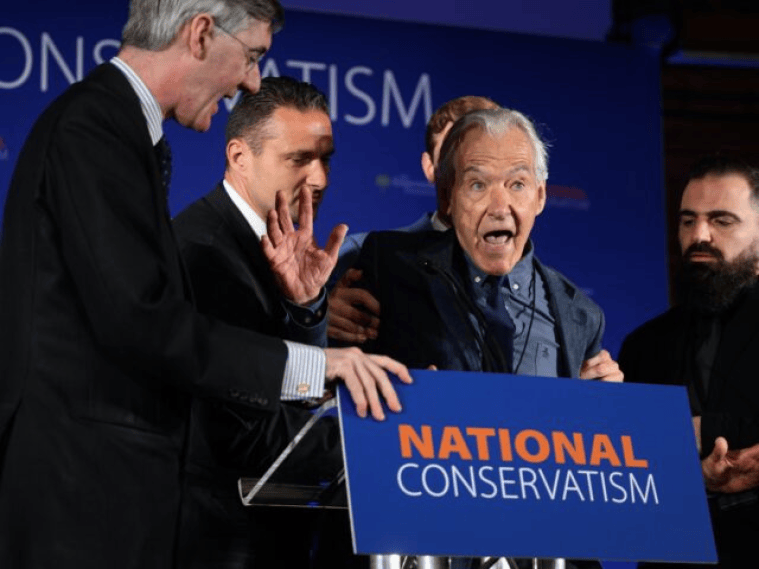
A leftist agitator allegedly acting on behalf of the climate alarmist Extinction Rebellion activist group stormed the stage of the National Conservatism Conference in London on Monday during the keynote speech from former cabinet minister Jacob Rees-Mogg.

During an address from former Business Secretary Jacob Rees-Mogg at the Emmanuel Centre in Westminster, a man climbed up on the stage in order to disrupt the NatCon Conference on Monday.

Grabbing the microphone from Rees-Mogg, the leftist told the crowd: “Ladies and gentlemen, you’re very nice people and I’m sure you are fantastic. I’d like to draw your attention to a few characteristics of fascism.”

…Read more: https://www.breitbart.com/europe/2023/05/15/watch-extinction-rebellion-activist-storms-stage-at-national-conservatism-conference/

A green radical seizing a microphone podium from a speaker by force, shoving the speaker bodily out of the way, then denouncing the speaker as a fascist, has a certain irony. Reminds me of descriptions of other speakers in another time, who got manhandled by fanatics who invaded their meetings. But self awareness has never been an Extinction Rebellion strength.

Entertaining as he is, Rees Mogg is a long way from being my favourite conservative. In 2022 Rees Mogg wrote a piece for The Guardian, urging people to get on board Net Zero. At the time Rees Mogg’s mum was reportedly trying to get approval for a large wind farm, though I don’t recall Rees Mogg publicly stating his views on his mum’s wind project.

The silliest part of this protest is, Rees Mogg probably would have been happy to accommodate the Extinction Rebellion gentleman in a staged debate if he had asked nicely, and might have even agreed with some of his points, given Rees Mogg’s support for green energy.

But Extinction Rebellion have had a few bad experiences with Rees Mogg. Back in March this year, Rees Mogg reduced Extinction Rebellion’s Phoebe Plummer to incoherent spluttering in a televised debate. Phoebe is one of those Extinction Rebellion radicals who goes around trying to deface priceless artworks, to force people to listen to her point of view.

Whatever my reservations about Rees Mogg’s claim to be a small government conservative who supports big green, I can’t fault Rees Mogg’s handling of this latest Extinction Rebellion outburst.

h/t Mr. David Guy-Jason – Jacob Rees-Mogg also said Britain “must get every cubic inch of gas out of the North Sea”

On Legal and General

Legal and General Investment Management (LGIM) recently published a paper that sets out the company’s position on decarbonisation. Written by Nick Stansbury and Justine Schafer of their “Climate Solutions” department, makes the remarkable claim that ‘the cost of transitioning [to Net Zero] is no longer an especially relevant factor’.

From Net Zero Watch

From Andrew Montford, Net Zero Watch

You would think a large financial house would be able to employ someone willing and able to understand a set of accounts. Unfortunately, it seems not.

Legal and General Investment Management (LGIM) recently published a paper that sets out the company’s position on decarbonisation. Written by Nick Stansbury and Justine Schafer of their “Climate Solutions” department, makes the remarkable claim that ‘the cost of transitioning [to Net Zero] is no longer an especially relevant factor’.

Is the magic money tree going to provide, you might wonder? But it’s not that. In fact, according to the authors, we have solved most of the technological problems already:

A low carbon energy system is now so cheap, that further improvements in costs and efficiencies are no longer likely to have as large an impact on the pace of change as they have had historically…Science and engineering have already delivered much of the cost reduction that we need.

I think I may have a bridge to sell Mr Stansbury.

In support of this extraordinary claim, the authors cite figures from the International Renewable Energy Agency (IRENA), showing long-term reductions in the cost of wind and solar. The naïvety is breathtaking. The energy sector is notorious for being full of wild claims about cost revolutions. Those working in the field usually learn to check and double check what they are told, and to view every claim with a critical eye. LGIM rather give the impression of having stepped into this den of thieves in good faith but without thinking too hard.

If they had decided to dig a little bit deeper, they might have noticed the interesting detail that IRENA translates all its cost figures into US dollars. With most renewables deployed outside America, performing that currency conversion introduces a spurious downwards trend into the cost figures, simply because there has been a long-term appreciation of the dollar against other countries.

They might also have attempted to verify IRENA’s numbers in some way. After all, a tiny think tank like the GWPF can manage to do it; why not a huge financial house? Their army of analysts, lawyers and accountants could surely have found their way to Companies House, where financial accounts of windfarms are readily available, and to Ofgem’s data portal, where generation data can be downloaded. I know this is a bit radical, but they could actually have recalculated the cost numbers themselves! Had they done so, they would have found little or no sign of reducing costs for offshore wind, and indeed of increasing costs onshore. And don’t get me started on the eye-watering system costs associated with renewables.

Instead we get what is essentially a public relations document, regurgitating renewables marketing fluff.

Morano on Newsmax: “Say hell no to NetZero!”

Marc Morano of ClimateDepot.com and author of The Great Reset: Global Elites and the Permanent Lockdown. Also with us as Steve Milloy, Senior Legal Fellow at the Energy and Environmental Legal Institute is also a former Trump advisor.

From CFACT

By CFACT Ed

WATCH NOW

RUSH TRANSCRIPT:

Host: Lidia Curanaj: Marc Morano of ClimateDepot.com and author of The Great Reset: Global Elites and the Permanent Lockdown. Also with us as Steve Milloy, Senior Legal Fellow at the Energy and Environmental Legal Institute is also a former Trump advisor.

Marc Morano, I’ll start off with you. What do you think of President Trump’s solutions that.

Trump: “Drill baby drill.”

Marc Morano: Trump’s solution is the number one solution that we have to do to get out of our current mess, which is energy shortages, energy, skyrocketing prices, inflation, debt. The backbone of any healthy economy- is to have cheap, reliable energy. Don’t forget when Donald Trump was president pre-COIVD. The United States had more energy exports than imports, and that was for the first time since Harry Truman was president in 1952. Donald Trump has laid out exactly what he wants to do, which is exactly what he did. Biden literally started shutting down American energy creating this collapse, and this is what they intended — collapse. Because the more energy fails and the more shortages we face, the more they call for nationalization of the energy industry because the market forces have ‘failed.’ It’s all the government interference that is creating this mess.

Steve Milloy: The administration also just announced a new climate rule that would require most fossil fuel power plants, a status to slash their greenhouse gas pollution. Ninety percent, between 20 30 five and 20 forty or shut down, I mean that this is just so out of control biting he shut down the Keystone pipeline day. One right: they want everybody to get the electric cars, but they don’t have the grades in place. Yet we don’t have the infrastructure in place to simply go all green. What did they want us to do like have windmills all over the place and people on bicycles? I mean what did they think actually? Is you know in order to make the electric car batteries they they need? They need fuel.

…

Lidia Curanaj: Marc, they’re, coming after their, they have come after our gas stoves. They want to come after our dishwashers. They want to come after our washing machines, they want us to be cold, have dirty dishes and smell, really bad, because we can’t Wash our clothes efficiently. I mean just. Why are we allowing? Why would anybody allow the federal government into our homes, because that’s essentially what we’re doing and is this kind of just all a scam to line the pockets of the special interest groups.

Morano: This is well beyond lining the pockets of special interest groups. This goes back thousands of years — all civilizations have had a ruling class that has literally tried to come up with reasons why the rest of the population can’t be free — us — the masses have to be enslaved, have to be living under their domain. Energy Sec. Jennifer Granholm, when she announced new dishwasher rules, which is going to be about 30% less power, 30%, less water, roughly for all the dishwashers, which means up to seven or eight hours cycles to wash dishes. Jennifer Granholm actually said, we need this to do this to ‘combat the climate crisis.’ They’re actually thinking like you’re, going to sit there with the dishes that aren’t clean now, but have a smile on your face because you’re saving the planet. This is a movement to literally crush human freedom. And they’re collapsing energy, agriculture, and transportation and they’re doing at all rapidly at once, all by bypassing democracy. None of this is being voted on in Congress. There are no town halls, there are no switchboards lighting up on Capitol Hill, there are no committee hearings. This is all being done by the Executive Branch and in many cases, corporate government collusion outside of democracy. We need to stand up. We need Republican leadership to say, ‘Hell, no’ to end this whole Net Zero climate, scam, one and for all.

> It’s such a joke as the steed malloy, 30, second seal, your reaction.

Milloy: Yeah, absolutely. This is all about controlling us about telling us what to do. You know the environmentalists goal is to reduce global population from eight billion down to two billion. Seventy five percent less that they want to get rid of and their do with it by attacking our energy supplies and food supplies.

Lidia Curanaj: Marc Morano and Steve Milloy. Thank you so much for coming on tonight and keep telling the truth out there. Thank you so so much.

Author

  • CFACT EdCFACT Ed
  • CFACT — We’re freedom people.

Ferrari Rejects Green Pressure to Phase Out Internal Combustion Engines

Ferrari resists pressure to phase out combustion engine

From Watts Up With That?

Essay by Eric Worrall

Ferrari 125 S replica. By Herranderssvensson – Own work, CC BY-SA 4.0, link

h/t Breitbart; “… I don’t want to be arrogant and impose a choice on our client …”

Ferrari resists pressure to phase out combustion engine

By Theo Leggett

Business correspondent, BBC News

Ferrari will continue to build cars with internal combustion engines into the late 2030s, despite efforts by governments around the world to phase out the technology. 

The boss of the Italian manufacturer said it would be “arrogant” to dictate to customers what they can buy.

For Ferrari, as for many other premium brands, the move towards electric cars presents a steep marketing challenge. 

But the company is due to introduce its first electric supercar in 2025.

…

In a BBC interview, Ferarri boss Benedetto Vigna pointed to this decision as a sign that technology was evolving, and denied doing so would undermine the company’s environmental credentials.

“I don’t want to be arrogant and impose a choice on our client,” he said.

“It is the client who must choose if they want an ICE (internal combustion engine), a hybrid or an electric car.”

…Read more: https://www.bbc.com/news/65539880

What can I say – Ferrari we love you. I’d buy one of your cars if I could afford it.

Imagine if other car makers focussed on what customers want, instead of focussing on being woke.

The government 2030s 100% EV target is nonsense, unless there are radical improvements in EV technology, and a complete overhaul of our roads.

For example, my second hand 4WD diesel can easily get 600 miles per tank, “recharges” in minutes, is light enough to climb and descend difficult slopes, and is mechanically good for at least another 100,000 miles. I bought it because I was fed up with my road vehicle being shaken to pieces on our failing roads.

The thought of current generation EVs being driven regularly on such roads is absurd.

Correction (EW): Corrected the quote from Ferrari boss Benedetto Vigna

Can Anyone Now Stop the Greens From Destroying Germany?

The fault lies with the self-defeating and unworkable energy policies that have a death grip not merely on the Scholz Government, but on the entire administrative state.

From The Daily Sceptic

BY EUGYPPIUS

The international press has maintained near-total silence on the escalating insanity of what is happening in Germany. Media outlets that routinely celebrate German progress towards energy transition don’t want you to know that Europe’s dominant industrial power has entered a deeply destructive political and administrative spiral from which it may never recover. The fault lies with the self-defeating and unworkable energy policies that have a death grip not merely on the Scholz Government, but on the entire administrative state. Since completing the nuclear phase-out in the midst of an ongoing energy crisis and avoiding winter catastrophe thanks only to the accident of mild weather, our rulers are now forcing devastating changes to the so-called Gebäudeenergiegesetz, or the Building Energy Act, which regulates energy consumption in residential and commercial structures.

That sounds bland and boring, but it’s not. This latest turning of the screws aims to phase out traditional gas and oil heating by mandating that all new heating systems installed after 2024 use no less than 65% renewable energy. In most cases, this can only be achieved by installing electric-powered heat pumps. Particularly in the case of many older buildings, the associated renovation costs will prove catastrophic, and unless they’re drastically revised, the rules will simply upset the housing market and destroy a great deal of personal wealth. Nor does the grid have any hope of powering these new heat sources, now or in the future.

In the midst of growing alarm and the seeming futility of all opposition, even some German establishment media have begun to voice unease. On Friday, Der Spiegel (of all magazines) published a lengthy piece on the origins, funding and rise to power of the ‘Eco Network’ currently controlling German energy policy, and I want to discuss it in detail, because it is so revealing about so many things. It pulls together many separate threads, to show how policy behemoths originate and are set in motion in modern managerial states, and how they can remain impervious and even contrary to popular opinion even in allegedly democratic systems.

The Spiegel reporting takes a close look at the careers of several key characters behind the energy transition, among them the Green politician Rainer Baake, and Robert Habeck’s scandal-riddled right-hand man Patrick Graichen, who is the policy brains driving most of the current insanity.

The rise of the environmentalists in the Ministry of Economics began a full decade ago. For a long time, the view was that the state should impose as few rules as possible on the corporate sector. … According to this logic, environmentalism and economic policy were seen as nearly mutually exclusive. It was not until 2013 that the dominance of free-market civil servants began to crumble.

At this time, Sigmar Gabriel of the SPD became Minister of Economics and appointed an unusual State-Secretary for Energy: Rainer Baake. … The move was a surprise, because Baake is not a Social Democrat, but a Green. … As State Secretary in the Ministry of the Environment … Baake helped orchestrate the first legislation on Germany’s nuclear phase-out. …

In 2012, Baake founded Agora Energiewende, probably the most influential think-tank advocating a carbon-neutral society in German politics. Patrick Graichen was at that time already Baake’s protegé. …

As the old-guard industry-friendly civil servants in the German bureaucracy began to retire, Baake filled their posts with Green technocrats wherever possible, such that when control of the Ministry passed to the centre-Right CDU in 2018, the damage was done. The institutional momentum had already shifted towards climate change and begun to gather strength under its own power. The catchword for Baake’s political vision was the so-called ‘All Electric World’, one in which a grid powered entirely by renewables drives cars (electrical vehicles), heats buildings (heat pumps) and even powers industry (though here the solutions are much vaguer).

During his five-year tenure as State Secretary, Baake appointed Graichen to head the Agora think-tank, which began churning out policy papers, sponsoring Green scientific research and gathering an ever-growing crowd of loyal advocates and technocrats. This paid off:

Whenever energy and climate were discussed in Berlin [in the years after Baake’s resignation from the Ministry of Economics in 2018], Graichen’s name came up, often peddling unwieldy terms that only experts understand. The “merit order principle”, for example, or the “locked-in effect”. The red-haired man with the sonorous voice knew his way around this specialist world like no other. …

The ability appears to have come naturally to him. His mother worked in the Ministry of Development, his father for a while in the Ministry of Transport. He himself became involved in environmental issues as a schoolboy, initially in the youth organisation of BUND. In 1993, he began studying at the University of Heidelberg. In 1996, he joined the Green Party. In 2001, he became a consultant for international climate protection… and helped draft the Kyoto Protocol.

Graichen is straight from the German political establishment, and his was the first generation that saw significant Green penetration in the years around the turn of the millennium. We are witnessing the fruition of long-term environmentalist activism, stretching back to the 1970s.

In 2020, Baake… founded the Climate Neutrality Foundation (Stiftung Klimaneutralität) and began producing studies on the energy transition. In their papers, Baake and Graichen touch on almost every climate issue. They talk about the restructuring of industry, the expansion of wind power, and the heating transition.

Their work was financed in the background by two men: Bernhard Lorentz, who as head of the Mercator Foundation helped to bring the Agora think-tank to life. And Hal Harvey, an American lobbyist who has funded environmentalist and climate organisations around the world for almost three decades, helped among other things by the philanthropic billions of families like the Hewletts.

This is not the first time we’ve found unlikely American activists and philanthropists behind European – and specifically German – climate activism. Spiegel explains, ominously, that “Harvey sees Europe as the key to preparing a climate-neutral future” and that for this reason “he directs millions… to support the likes of Baake and Graichen”. This man, who hardly appears in Anglophone media and doesn’t even have an English-language Wikipedia page, has been christened by Die Zeit as “the most powerful Green politician in the world“.

Harvey relies particularly upon think tanks to develop policy and warehouse political candidates when they’re out of power, and his immensely well-funded lobbying efforts can easily overwhelm the political discourse in smaller countries, which is probably one reason he’s so interested in Europe.

German think tanks such as Agora… or the Climate Neutrality Foundation… recruit researchers with the millions donated by their sponsors and steadily build expert influence. They shape the way politics and society think about environmental and climate protection – and fill their studies with legal proposals which include their favoured solutions. …

The influence of the Green support organisations is undisputed. They have given the party a great knowledge advantage in matters of climate protection. And with this knowledge, the party’s attractiveness as a problem-solver for one of the greatest crises of our time grew. … Other parties have neglected this area for a long time.

‘Knowledge’ is of course the wrong term to use here. ‘Policy prescriptions’ is much better, and if Der Spiegel weren’t so addled by its own ideological preconceptions, it could write about this more clearly. It’s a three-step process. 1) Activists and regime-approved scientists identify and make noise about looming problems, and then 2) think tanks write pages and pages of legislative and regulatory solutions for them. All of this happens largely out of sight, until 3) politicians respond to the demand stirred up by the activist arm, and having no real expertise or understanding of anything themselves, they have no choice but to enact the proposals that people like Graichen feed them.

Here, then, is the explanation for Robert Habeck’s stubborn idiocy since last Fall. As soon as the Greens entered Government, he made Graichen his State Secretary for Energy, and it is Graichen and the army of technocrats he commands who have been behind every political disaster since. The farcical response to the energy crisis, where these people were actually forced to work contrary to their principles and buy enormous quantities of coal (from Russia no less); the botched but nevertheless completed nuclear phase-out; and, finally, the catastrophic changes to the Building Energy Act, which will immiserate millions of Germans and do absolutely nothing to change the temperature of Earth.

Graichen’s failures have made him many enemies, which is one reason he’s currently mired in a nepotism scandal. Yet all the negative headlines are powerless to change any of the insanity that is coming for us, for the simple reason that there are no other policies to implement and no other scientific or technocratic solution to turn to. Graichen and his wealthy backers have spent 10 years filling all the political and intellectual pipelines with their preferred problems and their preferred solutions.

This is how you implement an agenda from the top down, and it is a key point on which Corona can be differentiated from the climate change farce. Over many years, the climate brigade have worked to fill academia and the bureaucracy with their ideas and their supporters. They took advantage of generational change and retirements to position their people, and they waited for an election to bring the right politicians to power and complete the circuit. The pandemicists of course followed the same path, but their mild mostly self-serving solutions were abandoned at the last moment in favour of much harsher, vastly more dangerous mass containment measures. The zeal for the novel response originated not with philanthropic lunatics and think-tanks over decades, but from within the bureaucracy itself. This lent the Corona coup much more power in the moment, but without any broader institutional or ideological support the worst aspects of the virus suppression regime crumbled just as quickly and are now quietly repudiated everywhere.

The Green fanatics never had that level of insane messianic enthusiasm, but for the same reason, they’re going to prove much, much harder to drive out.

This article originally appeared on Eugyppius’s Substack newsletter. You can subscribe here.

War on Motorists: Birmingham Council to Turn Ring Road Into Park to Mimic Copenhagen

Birmingham’s Labour-run council plans to turn part of the city’s famous ring road into a “park that circles the city” in an effort to put “pedestrians and cyclists first”.

From The Daily Sceptic

By IAN MACLEOD

Birmingham’s Labour-run council plans to turn part of the city’s famous ring road into a “park that circles the city” in an effort to put “pedestrians and cyclists first”.

Labour’s City Council Leader Ian Ward explained on Radio 4’s Today programme that the goal is to double the amount of green space and become “carbon zero”.

MailOnline has the story.

According to the plans for how Birmingham might look in 2040, it will double its green spaces and build around 124 miles of walking and cycling routes, placing it on a level with Denmark’s cycling haven capital city Copenhagen.  

‘”The plan we are going to be launching tomorrow is a route map to a greener Birmingham, creating more jobs, better transport options and having higher quality, more energy efficient new homes,” Mr Ward, told Radio 4 Today.

“We are already a city on the up and we’re looking to use the investments coming in to double the amount of green space in the city, making us as green as Vienna, and to double active travel routes to some 200km which will put us at the same level for cycle friendliness as Copenhagen.

“This is probably the most ambitious plan in a century for the city and it’s going to map out how we’ll become carbon zero and how we will green our city in the future.”

Mr Ward claimed the council is attracting record levels of investment into the city.

He said they are working with developers and investors “to ensure that as the city expands out into the deprived communities beyond the ring road that the wealth that this creates as a result is shared with those communities. We’re also working to create a new park in Birmingham, right in the heart of the city centre, creating a green space – in order to ensure the city is more liveable.”

Mr. Ward said the “plan has been very well received”. No comment was provided from motorists who will have to find new ways to get to work.

Worth reading in full.

Pictured: Plans for how the city might look following the implementation of the green scheme

Guardian: Climate Change is Linked to More Pirate Attacks

Given fish thrived in seas of coastal East Coast of Africa, during a period when global temperatures were at least 5C warmer than today, I think we can safely conclude that the claim global warming harms fish stocks or is likely to harm fish stocks in the foreseeable future is bogus.

From Watts Up With That?

090211-N-1082Z-111 GULF OF ADEN (Feb. 11, 2009) Suspected pirates keep their hands in the air as directed by the guided-missile cruiser USS Vella Gulf (CG 72) as the visit, board, search and seizure (VBSS) team prepares to apprehend them. Vella Gulf is the flagship for Combined Task Force 151, a multi-national task force conducting counterpiracy operations to detect and deter piracy in and around the Gulf of Aden, Arabian Gulf, Indian Ocean and Red Sea. It was established to create a maritime lawful order and develop security in the maritime environment. (U.S. Navy photo by Mass Communications Specialist 2nd Class Jason R. Zalasky/Released)

Essay by Eric Worrall

The authors appear to ignore some other more obvious explanations.

Impact of warmer seas on fish stocks leads to rise in pirate attacks

Study of piracy hotspots in east Africa and South China Sea found that piracy increases when fish populations decline and vice versa

Karen McVeigh @karenmcveigh1 Thu 11 May 2023 17.00 AEST

Dwindling fish stocks caused by the climate crisis are leading to an increase in pirate attacks, according to a new study looking at two piracy hotspots over the past two decades.

Warmer seas have negatively affected fisheries in east Africa, one of the world’s worst areas for piracy; while in the South China Sea, another hotspot for attacks, it has had the opposite effect: fish populations have risen.

This phenomenon created a “rare natural experiment” in which to test the links between climate breakdown and piracy risk, according to Gary LaFree, a professor of criminology and criminal justice at the University of Maryland, and one of the co-authors of the paper, published in the American Meteorological Society journal, Weather, Climate, and Society (WCAS).

…Read more: https://www.theguardian.com/environment/2023/may/11/impact-of-warmer-seas-on-fish-stocks-leads-to-rise-in-pirate-attacks

The abstract of the paper;

Climate Change, Fish Production, and Maritime Piracy

Bo Jiang and Gary LaFree

 Online Publication: 25 Apr 2023 Print Publication: 01 Apr 2023DOI: https://doi.org/10.1175/WCAS-D-21-0147.1 Page(s): 289–306

Contemporary social science has produced little research on connections between climate change and crime. Nonetheless, much prior research suggests that economic insecurity may affect individual calculations of the cost and benefit of engaging in criminal behavior, and climate change is likely to have important economic consequences for professions like fishing that depend directly on the environment. In this paper, we test the possibility that climate change affects participation in maritime piracy, depending on the specific ways that it impacts regional fish production. Our analysis is based on piracy in East Africa and the South China Sea. These two regions are strategic in that both areas have experienced a large amount of piracy; however, rising sea temperatures have been associated with declines in fish production in East Africa but increases in the South China Sea. We treat sea surface temperature as an instrument for fish output and find that in East Africa higher sea surface temperature is associated with declining fish production, which in turn increases the risk of piracy, whereas in the South China Sea higher sea surface temperature is associated with increasing fish production, which in turn decreases the risk of piracy. Our results also show that decreases in fish production bring about a larger number of successful piracy attacks in East Africa and that increases in fish production are associated with fewer successful attacks in the South China Sea. We discuss the theoretical and policy implications of the findings and point out that as climate change continues, its impact on specific crimes will likely be complex, with increases and decreases depending on context.Read more: https://journals.ametsoc.org/view/journals/wcas/15/2/WCAS-D-21-0147.1.xml

Unfortunately the full study is paywalled. But there are other factors which might be contributing to food shortages in East Africa;

Challenges from Chinese distant water fishing fleets in Africa

By Dipanjan Roy Chaudhury, ET BureauLast Updated: Jan 24, 2023, 10:10 AM IST

China is consistently ranked at number one in the global list of 152 countries practicing illegal, unreported and unregulated (IUU) fishing. Being an industrialized nation, China has been forcing its way into other poorer countries’ Exclusive Economic Zones (EEZ), forcing the local fishermen out of jobs and disrupting the local marine ecosystem. The worst hit is taken by countries in Africa, Latin America and the Indian Ocean Region (IOR), according to IJ-Reportika, a leading investigative journ .. 

According to a comprehensive report published by IJ-Reportika, about 20% of the global IUU catch comes from just six western African countries – Mauritania, Senegal, the Gambia, GuineaBissau, Guinea and Sierra Leone. There have been multiple incidents of Chinese incursions and conflicts with the local African fishermen. Mauritania is suffering from Chinese incursions and aggressive fishing vessels since 2018. In 2020, three Mauritanian artisanal fishermen died when their boat was struck by a large Chinese Trawler. Despite being a smaller EEZ, it has been reported that the Chinese have spent over 2 million hours fishing. 

…Read more: https://economictimes.indiatimes.com/news/international/world-news/challenges-from-chinese-distant-water-fishing-fleets-in-africa/articleshow/97268569.cms

The green war on agriculture and Ukraine war is also contributing to food shortages in poor countries.

Another issue undermining global food security is biofuel subsidies.

In 2008 the United Nations admitted biofuel subsidies were causing widespread hunger, and urged nations to review their policies.

U.N. Says Biofuel Subsidies Raise Food Bill and Hunger

By Elisabeth Rosenthal

ROME United Nations food agency called on Tuesday for a review of biofuel subsidies and policies, noting that they had contributed significantly to rising food prices and the hunger in poor countries. 

With policies and subsidies to encourage biofuel production in place in much of the developed world, farmers often find it more profitable to plants crops for fuel than for food, a shift that has helped lead to global food shortages. 

Current policies should be “urgently reviewed in order to preserve the goal of world food security, protect poor farmers, promote broad-based rural development and ensure environmental sustainability,” said a report released here on Tuesday by Jacques Diouf, the executive director of the United Nations Food and Agriculture Organization. 

In releasing the report, the United Nations joined a number of environmental groups and prominent international specialists who have called for an end to at least an overhaul of subsidies for biofuels, which are cleaner, plant-based fuels that can sometimes be substituted for oil and gas.

…Read more: https://www.nytimes.com/2008/10/08/world/europe/08italy.html

While there was some pullback, biofuel subsidies never really went away – they likely continue to exert upward pressure on food prices.

What if I’m wrong? What if global warming is having a direct impact on warm ocean fish stocks, which is possibly partially masked by other issues?

We can’t heat up the ocean to see what happens, but we can look at distant past periods in the same part of the world, when the world was much warmer than today.

RESEARCH ARTICLE| APRIL 17, 2021

Diverse marine fish assemblages inhabited the paleotropics during the Paleocene-Eocene thermal maximum 

Sanaa El-Sayed; Matt Friedman; Tarek Anan; Mahmoud A. Faris; Hesham Sallam

The Paleocene-Eocene thermal maximum (PETM) was a short interval (120–220 k.y.) of elevated global temperatures, but it is important for understanding biotic responses to climatic warming. Consequences of the PETM for marine fishes remain unclear, despite evidence that they might have been particularly vulnerable to increasing temperatures. Part of this uncertainty reflects a lack of data on marine fishes across a range of latitudes at the time. We report a new paleotropical (~12°N paleolatitude) fish fauna from the Dababiya Quarry Member of Egypt dating to the PETM. This assemblage—Ras Gharib A—is a snapshot of a time when tropical sea-surface temperatures approached limits lethal for many modern fishes. Despite extreme conditions, the Ras Gharib A fauna is compositionally similar to well-known, midlatitude Lagerstätten from the PETM or later in the Eocene. The Ras Gharib A fauna shows that diverse fish communities thrived in the paleotropics during the PETM, that these assemblages shared elements with coeval assemblages at higher latitudes, and that some taxa had broad latitudinal ranges substantially exceeding those found during cooler intervals.

…Read more: https://pubs.geoscienceworld.org/gsa/geology/article-abstract/49/8/993/598743/Diverse-marine-fish-assemblages-inhabited-the?redirectedFrom=fulltext

Given fish thrived in seas of coastal East Coast of Africa, during a period when global temperatures were at least 5C warmer than today, I think we can safely conclude that the claim global warming harms fish stocks or is likely to harm fish stocks in the foreseeable future is bogus.

I suspect there likely has been an increase in food distress in the last few decades in some parts of Africa, but the problems are more likely being caused by climate policy rather than climate change.