1875 was coldest in 10,000 years, Warming A Goodย Thing

And then around 1875 we have right here the lowest point in the last 10,000 years.
And that matches exactly the time when meteorological observations started.

From Science Matters

Byย Ron Clutz

Jรธrgen Peder Steffensen, of Denmarkโ€™s Niels Bohr Institute, is one of the most experienced experts in ice core analysis, in both Greenland and Antarctica. In this video he explains a coincidence that has misled those alarmed about the warming recovery since the Little Ice Age.  And if you skip to 2:25, you will see the huge error we have made and the assumptions and extrapolations based on that error.  Transcript below is from closed captions with my bolds and added images. H/T Raymond

What do ice cores tell us about the history of climate change and the present trend?ย 

This ice is from the Viking age around the year one thousand, also called the medieval warm period. We believe that in Greenland the Medieval Warm Period was about one and a half degrees warmer on average than today

NorthGRIP the Greenland ice core project is being reopened to drill the last few meters through the ice sheet to the rock beneath the research station. The ice core over three kilometers in length has been hauled up to the surface piece by piece, and contains important data on the history of the climate of the earth. It bears the fingerprints of climatic conditions over more than 120 thousand years.

When we remove a drilled ice core we leave a hole, and we insert a thermometer in the hole. We are able to map out the temperature through the three kilometer ice sheet. Now that temperature, if we do it precisely enough with a thousandth of a degree accuracy, then the ice has not forgotten how cold or warm it was on the surface at the time the snow fell.

So using those temperatures we have beenย able to reconstruct the temperatures of the last ten thousand years. Here we have our picture of the temperature reconstructions that we have from Greenland in the graphical form. And if we go back along this axis itโ€™s going back in time. This is the last 8 000 years we have plotted here. On this axis we have the temperatures at the site in Greenland, and we can see that if we go back from now about 4000 years ago, we would have temperatures up here for about 4 000 years in the past that on average were two and a half degrees warmer than today.

Reconstructed temperatures for Greenland ice cores Dye3 and GRIP. (A) The temperature from 8000 BP to present; (B) the temperature from AD 0-2000 (after Dahl-Jensen et al., 1998). The observed difference in amplitude between the two cores is a result of their different geographic location in relation to the variability in atmospheric circulation. Source: Reconstructed-temperatures-for-Greenland-ice-cores-Dye3-and-GRIP-A

Now as we go forward to approach our time, we can see that in the period after four thousand years ago and up to the two thousand years ago (which is actually the Roman Age) the temperatures have been decreasing in Greenland by two and a half degrees. Then temperatures increased gradually up to a maximum point around a thousand years ago, we call it the Medieval Warm Period. And then temperatures declined and go down to minimum around 1650 a.d., before coming back up a little in the 18th century.

And then around 1875 we have right here the lowest point in the last 10,000 years.
And that matches exactly the time when meteorological observations started.

Other core samples from elsewhere in Greenland confirmed that the little ice age ended about 140 years ago at the coldest point in the last 10,000 years. The natural pronounced alteration of warm and cold periods back in time has also been confirmed elsewhere in the northern hemisphere. Carbon 14 dating of organic matter from peat bogs and tree rings confirms the pattern. Also the data from stalactite caves in China and measurements from North Africa.

The problem is that we can allย agree completelyย that we have hadย a global temperature increase in the 20th century. Yes, but an increase from what?ย It was probably an increaseย from the lowest point weโ€™ve had for the last 10,000 years. And this means it will beย very hard indeed to proveย whether the increase of temperature in the 20th century wasย man-made or itโ€™s a natural variation.ย That would be very hard because we made ourselves an extremely poor experiment whenย we started to observe meteorology at the coldest time in the last ten thousand years.

NASA Data: Southern Hemisphere Cooled Over Past Decadeโ€ฆNorthern Hemisphere No Rise!

What a surprise! Global warming isnโ€™t global any more. As the chart shows, the southern hemisphere has in fact cooled over the recent years.

From NoTricksZone

Byย P Gosselinย onย 10. May 2023

wallup.net

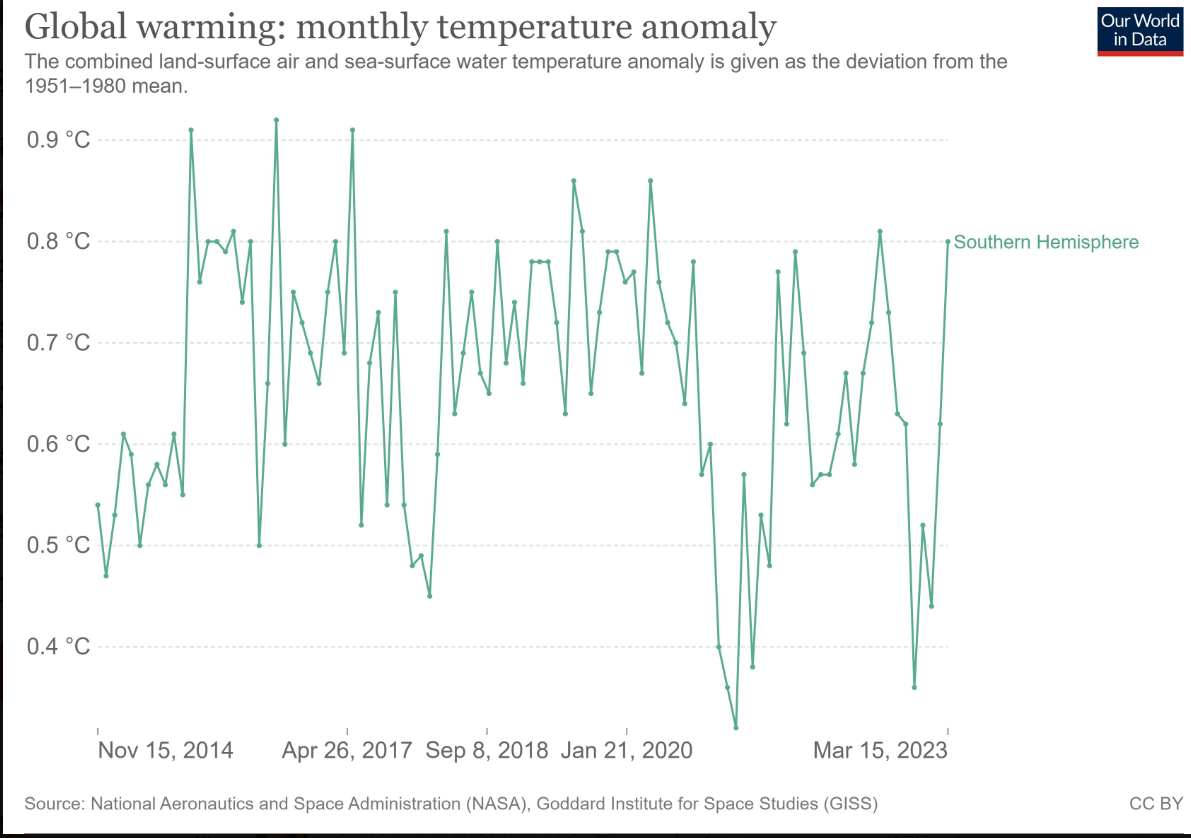
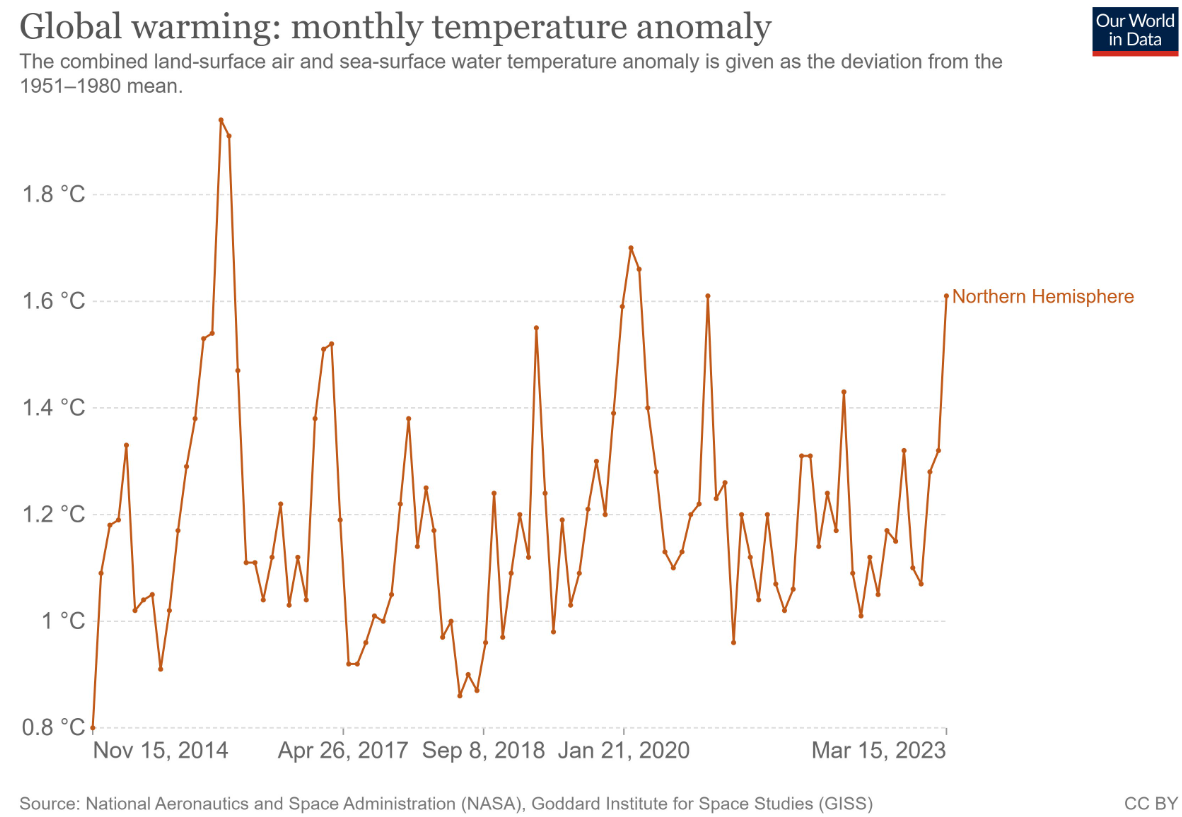
NASA data show no planetary warming over the past decade. Are we heading for cooling?ย 

Twitter account Zacki here tweeted on the northern and southern hemisphere sea land land surface temperature trend over the past decade, using NASA GISS data.

First lets begin with the northern hemisphere for the past 9 years:

Thereโ€™s been no general rise in temperature, despite all the claims of a planet that is allegedly rapidly heating.

Next we look at the southern hemisphere:

What a surprise! Global warming isnโ€™t global any more. As the chart shows, the southern hemisphere has in fact cooled over the recent years.

NASA may have to change the chart heading to: โ€œGlobal cooling: monthly temperature anomalyโ€

NASA data show no planetary warming over the past decade. Are we heading for cooling?  Twitter account Zacki here tweeted on the northern and southern hemisphere sea land land surface temperature trend over the past decade, using NASA GISS data. 81 weitere Wรถrter

From NoTricksZone

ESG Battle Over Italian Energyย Giant

Once again we have climatist financiers using ESG to push zero carbon against the mission of providing secure and affordable energy that citizens need.

FILE PHOTO: A logo of Italian multinational energy company Enel is seen at the Milan headquarters, Italy, February 5, 2020. REUTERS/Flavio Lo Scalzo/File Photo

From Science Matters

Byย Ron Clutz

Enel, Italyโ€™s largest energy utility is in the news with conflict over appointing a new CEO because  aspirations differ between ESG investors and the Italian government.   There are headlines like these:

Norwayโ€™s oil fund rejects Romeโ€™s candidate for Enel chair, Financial Times

Wanted! Investors demand Italy hire renewable expert, global networker to run Enel, Zawya

Government board nominations for Enel run into opposition, msn

Enel confirms 2023 guidance, enters press blackout on nominations, Reuters

MILAN (Reuters) โ€“ Italyโ€™s biggest utility, Enel, confirmed its full-year guidance and entered a press blackout period ahead of a May 10 shareholder vote on a challenged board shake-up.

The group, whose main shareholder is Italyโ€™s Treasury with nearly a 24%-stake, is at the centre of a governance row that will be decided at the AGM scheduled for next Wednesday.

The Treasury has proposed a new management, putting forward a slate of six new candidates and ousting current Enel CEO Francesco Starace, who has been at the helm since 2014.

Hedge fund Covalis, which holds around 1% in Enel, presented an alternative list of nominees, criticising the process under which the government picked its candidates.  Covalis said the system that led to the governmentโ€™s nominations โ€œundermines investor confidence, erodes value and is out of line with international standards of best practice in shareholder democracyโ€.[Would those best practices be ESG?]

Proxy adviser Frontis Governance has urged shareholders to back the candidates promoted by Covalis and reject names put forward by the Treasury, in a report tailored for Switzerlandโ€™s Ethos, a group of pension funds and other investors.

On the financial side, Enelโ€™s ordinary earnings before interest, taxes, depreciation and amortization (EBITDA) in the first quarter rose 22% to 5.5 billion euros above an analyst consensus of 5.4 billion euros.  Net debt at the end of March was 58.9 billion euros, down from 60.1 billion euros at the end of last year.

Starace described the results in the first three months of 2023 as outstanding and said the group had already exceeded half of its 21 billion euro ($23 billion) asset sale target unveiled last November.

The state-controlled group intends to focus its business on the core markets of Italy, Spain, the United States, Brazil, Chile and Colombia.

Wanted! Investors demand Italy hire renewable expert, global networker to run Enel,  Zawya

Expertise in renewables and an international focus are what investors want to see from a new head of state-controlled Enel, as Italyโ€™s government screens candidates to replace the energy groupโ€™s long-serving chief executive.

Prime Minister Giorgia Meloniโ€™s administration is determined to oust current CEO Francesco Starace, several sources told Reuters. In charge since 2014, Starace is in the crosshairs of Meloniโ€™s inner circle as he is deemed too independent.

Meloniโ€™s office is also concerned about the groupโ€™s debt pile. But sources familiar with the matter said that head hunters hired by the Treasury are finding it tricky to put forward potential successors with the broad range of skills required to run one of Europeโ€™s largest utilities.

With almost 60 Gigawatt of installed capacity, Enel is one
of the worldโ€™s biggest players in renewable energy

Starace won plaudits for his commitment to green energy. However, investors and the government grew restless over a debt pile that had grown to around 60 billion euros ($65.40 billion) in 2022 from 45.5 billion in 2020, when Starace was reappointed for a third term.

The company, which has been hit by soaring gas prices and government measures capping bills to shield consumers, saw net profit slip to 5.4 billion euros last year, from 5.6 billion euros in 2021.

The new CEO should not sacrifice the groupโ€™s exposure to North America and confirm its dividend policy, a number of investors said.

โ€œPeople in Italy may prefer that Enel focuses on making things as much as possible in its home country and not investing so much abroad, but the company has no choiceโ€ฆ if it wants to attract foreign investors,โ€ said Vincent McEntegart, multi-asset investment manager at Aegon Asset Management, an Enel shareholder with assets under management worth $311 billion.

For Enel, U.S. President Joe Bidenโ€™s green energy subsidy package could mean double digit returns in North America compared with single digit in Europe, McEntegart said, adding such returns would underpin the groupโ€™s attractive dividend policy.

Since Starace was appointed CEO in May 2014, Enel has increased its
installed renewable energy capacity to 59 GW from 36 GW at the end of 2013.

Staraceโ€™s mantra has been electrification of consumption and digitalisation of grids and he said last year he wanted to leverage a renewed focus on energy security around the world to accelerate the groupโ€™s exit from natural gas. The group currently plans to become carbon free in 2040.

โ€œMy priorities for the new CEO would be to continue to roll out renewables and accelerate the exit from gas,โ€ Simone Siliani, the director for Italyโ€™s Fondazione Finanza Etica, told Reuters.  Finanza Etica, which is an active investor on ESG issues, has been holding a tiny stake in Enel since 2008.

โ€œEnel can make the difference if Italy wants to meet its decarbonisation goals,โ€ added Siliani.

Summary: 

Once again we have climatist financiers using ESG to push zero carbon against the mission of providing secure and affordable energy that citizens need.

Wrong, NYT, Rising Insurance Costs Do NOT Prove Thereโ€™s a Climate Catastrophe

Writing on the increasing costs of insurance and attributing potential home value loss to climate change, Benjamin Keys writes, โ€œ[a]fter recent years of paying out claims forย about 20 disasters a year with damagesย of over $1 billion, a sixfold increase from the 1980s, insurers are getting serious about new pricing models that incorporate the costs of a warming climate.โ€

From ClimateRealism

By Linnea Lueken

The New York Times (NYT) posted an op-ed titled โ€œYour Homeownersโ€™ Insurance Bill Is the Canary in the Climate Coal Mine,โ€ claiming that rising insurance costs are proof that climate change is a growing danger, and that all insured should not have to pay for those who choose to live in riskier areas like the Florida coast or southwestern deserts. Although it would be sound policy to not have all insured persons, or as is more often the case, taxpayers, cover the cost of premiums and losses for homeowners and businesses who choose to live in areas prone to natural disasters, there is no evidence climate change is making extreme weather events worse.

Writing on the increasing costs of insurance and attributing potential home value loss to climate change, Benjamin Keys writes, โ€œ[a]fter recent years of paying out claims for about 20 disasters a year with damages of over $1 billion, a sixfold increase from the 1980s, insurers are getting serious about new pricing models that incorporate the costs of a warming climate.โ€

Keys uses Phoenix, Arizona as an example, citing the idea that climate scientists claim it is forecasted โ€œto endure 132 days each year with temperatures of over 100 degrees.โ€ Keys describes the low water levels in Lake Mead, and goes on to point out the obvious, that โ€œliving in Phoenix requires energy-intensive amenities like air conditioning,โ€ then suggests that air conditioning use itself contributes to the problem of global warming. Finally, he mentions that despite all these threats, home prices in Phoenix have risen 53 percent.

It is true that water use is a difficult issue in the Southwest, but it is a natural problem that one faces trying to build communities, including golf courses and other water-intensive features, in the middle of a desert region that is naturally arid with consistently low water levels, historically. Climate Realism covered the issue with Lake Mead, here, and its low levels are only partially due to low rainfall. The bulk of the blame can be placed on increasing water demand that cannot be met by the region amid natural periods of drought.

More to the point, what does that have to do with insurance? Insurers donโ€™t offer โ€œurban drought insurance,โ€ โ€œwater shortage insuranceโ€ or โ€œhigh air conditioning cost insurance,โ€ for homeowners, so why figure the โ€œcost of a warming climate,โ€ into home insurance rates in Phoenix? Sounds like a made-up reason to increase regional insurance rates.

Forecasts based on faulty computer models that run too hot, as explained by Climate Realism many times, do not provide compelling reasons for raising insurance rates in the Phoenix area. There are mitigation strategies for handling a growing population in the desert, trying to limit air conditioner use is not one of them.

Florida, where home costs are also rising, is also discussed in the article. Keys claims that the primary threats there are sea level rise and associated flooding. It is true that sea levels are rising, albeit more slowly than commonly asserted. Rising seas, erosion and water incursion, in part from coastal wetlands destruction, land compaction and subsidence, have created a situation putting some beachfront homes, in Florida and along the coast, at risk of being flooded with some regularity or even swept away.

This is not a new phenomenon. Sea level rise has always been a concern for coastal communities, and as more buildings are built right up on the beaches, like in Miami, the more risk there is for them to be damaged by hurricanes or king tides.

Nor, as explored in Climate Realism, here, and here, for example, have hurricanes become more numerous or more powerful.

As such, speculative climate change impacts should not be factored into pricing hurricane insurance.

One critical issue ignored in Keysโ€™ NYT article is that, although itโ€™s true that the costs of natural disasters are rising, itโ€™s largely due to population and development growth itself in the geographic areas discussed. This also accounts for the rising home prices. As pointed out by H. Sterling Burnett in a Climate Realism post, โ€œSorry, Big Insurance Corporations, Climate Change Is Not Causing Record Disasters,โ€ real property values are also increasing. Demand is rising faster than housing stock is being built or becoming available. This means any threat from climate change is being discounted by the growing number of home buyers.

Burnett wrote that โ€œinflation, as well as the annually rising quality and value of technology and property amenities will make a disaster in 2020 much costlier in reported dollar losses than in 2010, 2000, 1990, or other prior years.โ€

Keys complains that those who choose to live in โ€œriskierโ€ areas are being subsidized by everyone else, and heโ€™s not totally wrong on this point. The government creates a moral hazard by subsidizing flood and hurricane insurance, making it easier for people to afford to live in places that they otherwise might have second-guessed. Its easier for people to build homes and businesses in locations naturally prone to hurricanes and floods when taxpayers are covering much of the insurance premium costs and the coasts related to disaster recovery.

The truth is every part of the United States, and the world, face weather threats of one type of another, with some locations being more prone to some types of natural disasters than others. There is a cost-benefit analysis that everyone needs to make when deciding where to live and how much insurance coverage to purchase, including the author of the NYT piece, who writes from snowstorm-prone Pennsylvania. Blaming climate change may be a convenient excuse for insurers to justify higher insurance premiums, but there is little evidence, in factโ€”and none at all provided in the NYT storyโ€”that climate change is making weather worse or instances of extreme weather more frequent, in Arizona, Florida, or anywhere else.

Linnea Lueken

Linnea Lueken is a Research Fellow with the Arthur B. Robinson Center on Climate and Environmental Policy.

While she was an intern with The Heartland Institute in 2018, she co-authored a Heartland Institute Policy Brief “Debunking Four Persistent Myths About Hydraulic Fracturing.”

Renewable energy projects worth billions stuck onย hold

Billions of poundsโ€™ worth of green energy projects are on hold because they cannot plug into the UKโ€™s electricity system, BBC research shows.

From NOT A LOT OF PEOPLE KNOW THAT

By Paul Homewood

h/t Robin Guenier

Billions of poundsโ€™ worth of green energy projects are on hold because they cannot plug into the UKโ€™s electricity system, BBC research shows.

Some new solar and wind sites are waiting up to 10 to 15 years to be connected because of a lack of capacity in the system โ€“ known as the “grid”.

Renewable energy companies worry it could threaten UK climate targets.

National Grid, which manages the system, acknowledges the problem but says fundamental reform is needed.

The UK currently has a 2035 target for 100% of its electricity to be produced without carbon emissions.

But meeting the target will require a big increase in the number of renewable projects across the country. It is estimated as much as five times more solar and four times as much wind is needed.

The government and private investors have spent ยฃ198bn on renewable power infrastructure since 2010. But now energy companies are warning that significant delays to connect their green energy projects to the system will threaten their ability to bring more green power online.

A new wind farm or solar site can only start supplying energy to peopleโ€™s homes once it has been plugged into the grid.

Energy companies like Octopus Energy, one of Europeโ€™s largest investors in renewable energy, say they have been told by National Grid that they need to wait up to 15 years for some connections โ€“ far beyond the governmentโ€™s 2035 target.

https://www.bbc.co.uk/news/science-environment-65500339

Somebody, of course, has to pay for all of this nonsense, something Justin Rowlatt forgets to mention.

Maybe if all of these renewable schemes had to pay the cost themselves, they might get the work done quicker.

Saudis Demand Hydrogen Enthusiasts Back their Hype with Money

Saudi Aramcoย is weighing exports of liquefied natural gas instead of blue hydrogen, as talks with potential buyers of the latter fuel prove tough.

From Watts Up With That?

Essay by Eric Worrall

โ€œโ€ฆ we will not sanction a project without securing an off-take agreement.โ€.

Aramco Weighs LNG Exports as Hydrogen Talks Prove Tough

May 11, 2023

Aramco weighs LNG exports as hydrogen talks prove tough. 

Saudi Aramco is weighing exports of liquefied natural gas instead of blue hydrogen, as talks with potential buyers of the latter fuel prove tough.

โ€ฆ

Yet existing technology means blue hydrogen could cost the equivalent of around $250 a barrel of oil, Aramcoโ€™s chief executive officer said.

Amin Nasser, for blue hydrogen said on a call with analysts:

It is very difficult to identify any off-take agreement in Europe.

โ€œEven the customers in Japan and Korea are waiting for government incentives. Until they get these incentives, itโ€™ll be costly for them to pursue that blue hydrogen.โ€

โ€ฆ

โ€œThis is a very expensive program,โ€ Nasser said. โ€œItโ€™s a lot of capital and you need customers. So we will not sanction a project without securing an off-take agreement.โ€

โ€ฆRead more: https://hydrogen-central.com/aramco-weighs-lng-exports-hydrogen-talks-prove-tough/

Blue hydrogen is produced from fossil fuel, but the CO2 is supposed to be buried via carbon sequestration.

I wish our politicians were smart enough to wait until there is an actual demand for product, before blowing billions of taxpayer dollars on building infrastructure to produce hydrogen which nobody genuinely wants.

As for the Saudis, I suspect they will eventually embrace the low risk option of exporting low cost natural gas to countries with hydrogen programmes, so those who claim to support the hydrogen economy can also carry the financial risk of building the infrastructure.

The Saudi position seems crystal clear and rational. Itโ€™s tough to justify building expensive climate friendly hydrogen facilities, when despite all the noisy hype, nobody genuinely wants the product.

How Much Warming Reduction by Spending $50,000,000,000,000?

โ€œIf you could answerย my question: if we spend $50 trillion to become carbon neutral in the United States of America by 2050,ย youโ€™re the deputy secretary of energy, give me your estimate ofย how much that is going to reduce world temperature.โ€

From Science Matters

Byย Ron Clutz

From Daily Caller:  Biden Official Speechless After John Kennedy Grills Him On Simple Question

Department of Energy Deputy Secretary David Turk testified Wednesday before the Senate committee on appropriations to discuss the 2024 budget request for the Department of Energy.

Kennedy noted the budget requests a 38% increase in green energy funding while cutting nuclear energy funding with barely an increase fossil fuel energy. Kennedy then asked Turk for an estimate of how much it would cost to be carbon neutral by 2050, with Turk refusing to provide a number. Kennedy first said Turkโ€™s colleagues have presented a figure in the range of $50 trillion before asking how much would temperatures be affected by that massive spending.

โ€œIf you could answer my question: if we spend $50 trillion to become carbon neutral in the United States of America by 2050, youโ€™re the deputy secretary of energy, give me your estimate of how much that is going to reduce world temperature.โ€

โ€œSo first of all itโ€™s a net cost, itโ€™s what benefits weโ€™re having by getting our act together and reducing all of those climate benefits, weโ€™re seeing โ€“โ€ Turk said before Kennedy interjected.

โ€œIโ€™m gonna ask again, maybe Iโ€™m not being clear: if we spent $50 trillion to become carbon neutral by 2050 in the United States of America, how much is that going to reduce world temperatures?โ€

โ€œThis is a global problem so we need to reduce our emissions and we need to do everything we can โ€“โ€

โ€œHow much if we do our part is it going to reduce world temperatures?โ€

โ€œWeโ€™re 13% of global emissionsโ€“โ€

โ€œYou donโ€™t know do you?โ€ Kennedy asked, stunning Turk who had his mouth agape. โ€œYou donโ€™t know, do ya?โ€

โ€œYou can do the mathโ€“โ€

โ€œYou donโ€™t know do ya Mr. Secretary?โ€ Kennedy again asked.

โ€œSo weโ€™re 13% of global emissionsโ€“โ€ Turk said.

โ€œIf you know why wonโ€™t you tell me?โ€

โ€œIf we went to 0 that would be a 13% less pollution,โ€ Turk said.

โ€œYou donโ€™t know do ya? You just want us to spend $50 trillion and you donโ€™t have the slightest idea whether itโ€™s going to reduce world temperatures,โ€ Kennedy said. โ€œNow Iโ€™m all for carbon neutrality, but youโ€™re the Deputy Secretary of the Department of Energy and youโ€™re advocating we spend trillions of dollars to seek carbon neutrality โ€“ and this isnโ€™t your money or my money, itโ€™s taxpayer money โ€“ and you canโ€™t tell me how much itโ€™s going to lower world temperatures? Or you wonโ€™t tell me, you know but you wonโ€™t?โ€

โ€œIn my heart of hearts there is no way the world gets its act together on climate change unless the U.S. leads,โ€ Turk responded, before Kennedy once again asked him for a number.

The Department of Energy is requesting $51,99 billion to, among other things, advance โ€œcritical climate goals,โ€ according to Turk.

Bjorn Lomborg Answers the Question

From WUWT: WSJ and Lomborg show just how useless is the โ€œInflation Reduction Actโ€ at tackling climate

As seen in the figure above provided by Lomborg, we get somewhere between 0.028 and 0.0009ยฐF reduction in temperature by 2100 for about 400 billion dollars in climate spending contained in the bill.

At that rate, simple math suggests the amount of money required to achieve the much desired 1.5ยฐC (2.7ยฐF) reduction in temperature using the best case reduction of 0.028ยฐF would be $38,571,428,571,428 or approximately 39 Trillion dollars. The worst-case temperature reduction of 0.0009ยฐF would cost a staggering 1,200,000,000,000,000 dollars or ONE QUADRILLION TWO HUNDRED TRILLION DOLLARS.

To put that number in perspective, according to the World Bank, the 2020 world economy in U.S. dollars was approximately $84.7 trillion. Assuming it would actually work, to have a meaningful effect on climate, the world would have to spend about half the global annual economy for the best-case scenario. If you think inflation is bad now, just wait for those sorts of numbers.

Summary:

Even if you buy UN IPCC assumptions about reducing carbon emissions reducing global warming, the cost is outrageous for neglible benefit.ย  What a rip-off.

Community Choice Aggregation

In this area, perfectly good farm land is being turned into solar farms taking advantage of Federal subsidies and State incentives.ย 

From Watts Up With That?

Opinion by Kip Hansen โ€” 11 May 2023

My local town has just chosen, for us, the residents of the town, to pay more for โ€œrenewableโ€ energy. 

โ€œThe Town of ##### is pleased to announce our participation in the program relaunch of  ##### #### Community Power, a Community Choice Aggregation (CCA) program administered by Joule Community Power, a division of Joule Assests, Inc. that puts control of energy supply choices into local hands.โ€

[Note:  In this part of the USA a town is: โ€œan urban area that has a name, defined boundaries, and local government, and that is generally larger than a village and smaller than a city.โ€]

The U.S. Environmental Protection Agency (EPA)  explains it this way:

โ€œCCA [Community Choice Aggregation] โ€”also known as municipal aggregationโ€”programs allow local governments to procure power on behalf of their residents, businesses, and municipal accounts from an alternative supplier while still receiving transmission and distribution service from their existing utility provider. CCAs are an attractive option for communities that want more local control over their electricity sources, more green power than is offered by the default utility, and/or lower electricity prices. By aggregating demand, communities gain leverage to negotiate better rates with competitive suppliers and choose greener power sources.โ€

That sounds nice, and in part, it can offer lower electricity prices โ€“ through the aggregation step:

โ€œPrices for electricity under CCAs may be lower than the residential retail price for electricityโ€”sometimes by 15 to 20 percentโ€”because of the collective buying power of entire communities and current market trends. CCA customers continue to receive the same delivery and maintenance services from their local utility, with a single utility bill that reflects the change in supplier. The only changes for customers are the sources and prices of electricity generation.โ€ 
And in the case of my community, this turns out to be the case. Customers of the CCA will receive electricity at a rate ($/kWh) that is 6% less than last yearโ€™s average price charged by our local utility company.

But there is a hook โ€“ a trick โ€“ an unexpected โ€˜gotchaโ€™ in the program. In the quote from the EPA above, it is in the โ€œand/orโ€โ€ฆ.

โ€œAll eligible residential and small-commercial electricity customers will be automatically enrolled in the 50% renewable supply productโ€ฆ.โ€

Our Town fathers, encouraged no doubt by the representatives of Joule Community Power,  has have decided for us that the electricity we use should be 50% from โ€renewable sourcesโ€.  That โ€œ50% renewable supplyโ€ electricity will be sold to us at a rate 14% higher than โ€œstandard supplyโ€ electricity.   Still, all-in-all, because of the advantages of the buying power of aggregated supply agreements, that higher cost for โ€œ50% renewableโ€ is, bless their souls, 6% cheaper than what we paid to our local utility last year (on average).

The New York State law that authorized CCAs to operate in the state requires the Town to inform us of the decision they have made on our behalf, and give us citizens the chance to โ€œopt-outโ€ of the program.

If one is very clever, and has access to the internet, and an understanding of the program (gained through an extra half hour of research), then as a residential customer it is possible to โ€œopt-outโ€ into the โ€œCCA Standard Supplyโ€ option โ€“ which is , as you have guessed, 14% cheaper than the โ€œ50% Renewable Supplyโ€ which is the default into which we are โ€œautomatically enrolledโ€ by our caring Town officials. 

But overall, with the total of an hour of effort, this electricity customer (your ever-striving author) has opted-out by opting-in to the โ€œStandard Supplyโ€  option, thus achieving an overall rate reduction of 21%.

The numbers:

My utilities average rate for 2022: $ 0.1195/kWh

My rate with CCA Standard Supply:  $0.0987/kWh

My local CCAโ€™s 50% Renewable rate:  $0.1124/kWh

My local CCAโ€™s 100% Renewable rate:  $0.1240/kWh

Thus, my local rate will be less than 10 cents per kilowatt/hour โ€“ more precisely $0.09870/kWh.

And that, my friends, is a good thing.ย  Compare to this chart of average rates in the U.S.:

Here we see the โ€œnational averageโ€ is running above $ 0.16/kWh. 

My new rate, with the power aggregation scheme, will be reduced to the 2001 national average rates.  [A savings of 22 years โ€“ sort of.]

Note that the reduction is gained through aggregate purchasing power, not through renewable energy.  The 100% renewable rate is higher than the utilities original rates.  Customers taking no action โ€“which are automatically opted-in to the 50% renewable scheme โ€”  will have a new rate very slightly below their old rate, lower by  $0.0071/kWh, getting the advantage of the lower aggregated rate for standard supply electricity for the other 50%.

How does this work?  Can we follow the money?  Joule Community Power is a division of Joule Assets, Inc..  Joule Assets uses its link to Joule Community Power to provide instant customers for federal-government subsidized Solar Farm Developers.  In addition, the price breaks, for them, come from โ€œsavings in the form of solar bill credits derived from NY State incentives for renewable generation.โ€

BOTTOM LINE:

Your money (tax dollars โ€“ both State and Federal) is being spent to provide you, as an electricity customer in NY State, with conveniently more-expensive renewable-supplied electricity. Without this opportunity to pay twice (first in your tax dollars and secondly in  increased electricity rates) you could be paying over 20% less.

Aggregated energy buying is a good thing โ€“ it saves customers money.  Mixing that good idea with the โ€œgo greenโ€ mania is a silly thing, and increases electricity costs to the customer.  

# # # # #

Authorโ€™s Comment:

And thatโ€™s the latest energy news from Upstate New York, USA.

In this area, perfectly good farm land is being turned into solar farms taking advantage of Federal subsidies and State incentives. 

As you can see, it is driving our electricity prices UP โ€“ not down as usually claimed by advocates and the main stream media.

Aggregated energy buying though presents the possibility of lowering electricity rates if it can be de-coupled from government mandated renewables policy.

Thanks for reading.

Love America or Loveย Woke

This phobia towards the National Anthem or the American flag
is not a new phenomenon.

From Science Matters

Byย Ron Clutz

Update on the cultural war for Americaโ€™s soul comes from the heart of California reported by Breitbart Bar Patrons Standing for National Anthem Sparks Outrage: โ€˜The Most Dangerous Situationโ€™.  Excerpts in italics with my bolds and added images.

At Rainbow Oaks Restaurant โ€” just an hour outside of San Diego โ€” a TikTok user shared that she had faced the most โ€œdangerousโ€ situation she had ever been in. At noon, while she was eating her stack of pancakes, about a dozen people stood up for the Star-Spangled Banner being played on the barโ€™s TVs.

As first reported by Fox News, the TikTok user who goes by the screen name @Paulinaappa_0ย recorded the patriotic display and included the caption: โ€œBy far the most dangerous situation Iโ€™ve ever been in #godblessamerica #getout #illegal #whitepeoplethings.โ€

The Tik Tok video racked up 3.1 million views and over 19,000 comments with the vast majority affirming Paulinaโ€™s feelings of fear and disgust.

For the past six years, theย restaurant has played the National Anthem every day at noon,ย according to the restaurantโ€™s Facebook page.

Patriotism has suffered a steep decline in the last couple of decades. A March 2023 survey conducted by the Wall Street Journal found that 38 percent of respondents said patriotism was โ€œvery importantโ€ to them. When this same question was asked in 1998, 70 percent of people said it was โ€œvery important,โ€ the newspaper reported.

This phobia towards the National Anthem or the American flag
is not a new phenomenon.

Two years ago, the New York Post reported that a California school teacher, Kristin Pitzen, removed the American flag from her classroom and put the LGBTQ pride flag in its place. Echoing the same cry of Paulina and her thousands of commenters, Pitzen said the American flag made her feel โ€œuncomfortable.โ€

As for Hollywood actor and evangelist Kirk Cameron, neither the American flag nor the National Anthem strike fear into his eyes but rather hope in his heart. A viral video from February, shows Cameron leading a room full of children and parents in the National Anthem at a public library in Savannah, Georgia, in February. Cameron is on a 14-city book tour to combat the โ€œwokenessโ€ being pushed on children.

โ€œWe donโ€™t want this woke garbage,โ€ Cameron said in an interview with the Daily Signal. โ€œIt leads to brokenness and bondage and leads to misery.ย What we want is what our country was built on, which was the Bible and faith and family and love for country.โ€

New Analysis Highlights Serious Errors And Bias In Latest IPCCย Report

Clintel published the World Climate Declaration, which has now been signed by more than 1500 scientists and experts. Its central message is โ€œthere is no climate emergencyโ€.

From NOT A LOT OF PEOPLE KNOW THAT

By Paul Homewood

Amsterdam, 9 May 2023

* IPCC hides good news about disaster losses and climate-related deaths
* IPCC wrongly claimed the estimate of climate sensitivity is above 2.5
ยฐC; it is more likely below 2ยฐC

* IPCC misleads policy makers by focusing on an implausible worst-case emissions scenario
* Errors in the AR6 report are worse than those that led to the IAC Review in 2010

The IPCC ignored crucial peer-reviewed literature showing that normalised disaster losses have decreased since 1990 and that human mortality due to extreme weather has decreased by more than 95% since 1920. The IPCC, by cherry picking from the literature, drew the opposite conclusions, claiming increases in damage and mortality due to anthropogenic climate change. These are two important conclusions of the report The Frozen Climate Views of the IPCC, published by the Clintel Foundation.
The 180-page report is โ€“ as far as we know โ€“ the first serious international โ€˜assessmentโ€™ of the IPCCโ€™s Sixth Assessment Report. In 13 chapters the Clintel report shows the IPCC rewrote climate history, emphasizes an implausible worst-case scenario, has a huge bias in favour of โ€˜bad newsโ€™ and against โ€˜good newsโ€™, and keeps the good news out of the Summary for Policy Makers.
The errors and biases that Clintel documents in the report are far worse than those that led to the investigation of the IPCC by the Interacademy Council (IAC Review) in 2010. Clintel believes that the IPCC should reform or be dismantled.

With the recently published Synthesis Report, the IPCC finished its sixth assessment cycle, consisting of seven reports in total. An international team of scientists from the Clintel network has analysed several claims from the Working Group 1 (The Physical Science Basis) and Working Group 2 (Impacts, Adaptation and Vulnerability) reports. This has now led to the report The Frozen Climate Views of the IPCC.

In every chapter the Clintel report documents biases and errors in the IPCC assessment. The errors are worse in the WG2 report than in the WG1 report. Given the political relevance of what is known as โ€œLoss and Damageโ€ (at the yearly COP meetings, countries currently negotiate donations to a Loss and Damage fund) one would expect a thorough review of the relevant literature. However, Clintel shows that the IPCC has totally failed in this respect. For example, a review article on the subject, published in 2020, showed that 52 out of 53 peer reviewed papers dealing with โ€œnormalised disaster lossesโ€ saw no increase in harms that could be attributed to climate change. The IPCC highlighted the single paper that claimed an increase in losses. That paper is โ€“ unsurprisingly โ€“ flawed, but its cherry picking by the IPCC suggests they found its conclusions irresistible.

Climate-related deaths
โ€œWe are on a highway to climate hellโ€, said UN-boss Guterres recently. But an in-depth look at the mortality data shows that climate-related deaths are at an all-time low. Well-known economist Bjorn Lomborg published that important information in a 2020 peer-reviewed paper, but the IPCC, again, chose to ignore it.
The strategy of the IPCC seems to be to hide any good news about climate change and hype anything bad.

Erasing climate history
The Working Group 1 report is not free from bias and misleading conclusions either. The report documents problems in every chapter the Clintel team reviewed. The IPCC has tried to rewrite climate history by erasing the existence of the so-called Holocene Thermal Maximum (or Holocene Climate Optimum), a warm period between 10,000 and 6000 years ago. It has introduced a new hockey stick graph, which is the result of combining cherry-picked proxies. And it has ignored temperature reconstructions that show more variability in the past, such as the well-documented Little Ice Age.

The IPCC claims there is an acceleration in the rate of sea-level rise in recent decades. Clintel has shown this claim is flawed, because the IPCC ignores decadal variability in sea level. We also show that its sea-level tool โ€“ made available for the first time โ€“ shows a mysterious and improbable jump upward in 2020.

Climate sensitivity
Canadian economist Ross McKitrick has pointed out that all global climate models used by the IPCC show too much warming in the troposphere, both globally and in the tropics (where models predict a โ€˜hotspotโ€™). This probably indicates some fundamental problems in the way that these models simulate the climate system.

A โ€™spectacularโ€™ result of the IPCC AR6 report was the rise of the lower bound for the climate sensitivity likely range from 1.5ยฐC to 2.5ยฐC, therefore claiming that low values for climate sensitivity are now unlikely. The Clintel report shows this rise is not justified. The Clintel report suggests that observed warming and other evidence indicates that the true figure is more likely to be below 2ยฐC than above 2.5ยฐC. This also means that the best estimate for climate sensitivity, which the IPCC says is 3ยฐC, is not justified.

On top of that, the IPCC is โ€˜addictedโ€™ to its highest emissions scenario, so-called RCP8.5 (or now SSP5-8.5). In recent years, several papers have demonstrated that this scenario is implausible and should not be used for policy purposes. Deep inside the WG1 report, the IPCC acknowledges that this scenario has a โ€˜low likelihoodโ€™ but this very important remark was not highlighted in the Summary for Policymakers, so these important audiences are unaware of the issue. RCP8.5 is the scenario most often referred to in the IPCC report.

IAC Review
Back in 2010, errors in the WG2 report of the Fourth Assessment led to the investigation of the IPCC by the U.N. Interacademy Council (IAC). This review recommended, amongst other things, that โ€œ[h]aving author teams with diverse viewpoints is the first step toward ensuring that a full range of thoughtful views are considered.โ€ This important recommendation is still being ignored by the IPCC. Worse, we document that Roger Pielke Jr, a scientist with considerable expertise in these areas, is regarded as a kind of โ€˜Voldemortโ€™ by the IPCC, and they deliberately avoid mentioning his work or even his name. This leads to biased conclusions.

Reform
We are sorry to conclude that the IPCC has done a poor job of assessing the scientific literature. All countries rely on the IPCC reports to support their climate policies and most of the media blindly trust its claims. The Clintel report The Frozen Climate Views of the IPCC shows that this trust is not justified.
In our view the IPCC should be reformed, and should include a broader range of views. Inviting scientists with different views, such as Roger Pielke Jr and Ross McKitrick, to participate more actively in the process is a necessary first step. If, for some reason, such inclusion of different views is unacceptable, the IPCC should be dismantled.

Our own conclusions about climate โ€“ based on the same underlying literature โ€“ are far less bleak. Due to increasing wealth and advancing technology, humanity is largely immune to climate change and can easily cope with it. Global warming is far less dangerous to humanity than the IPCC tells us.

The report can be downloaded here.

The press release (in English) can be downloaded here in pdf.
Dutch press release 
here.
Hungarian press release 
here.


ABOUT CLINTEL
The Climate Intelligence foundation (Clintel) was founded in 2019 by emeritus professor of geophysics Guus Berkhout and science journalist Marcel Crok. Clintelโ€™s main objective is to generate knowledge and understanding of the causes and effects of climate change, as well as the effects of climate policy. Clintel published the World Climate Declaration, which has now been signed by more than 1500 scientists and experts. Its central message is โ€œthere is no climate emergencyโ€.