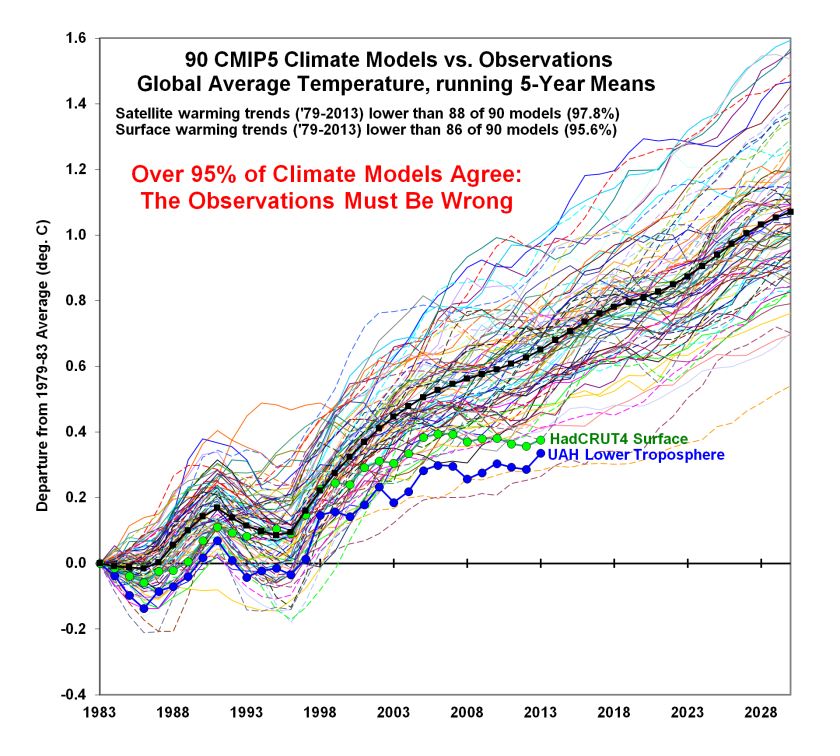
Global warming, climate change, all these things are just a dream come true for politicians. I deal with evidence and not with frightening computer models because the seeker after truth does not put his faith in any consensus. The road to the truth is long and hard, but this is the road we must follow. People who describe the unprecedented comfort and ease of modern life as a climate disaster, in my opinion have no idea what a real problem is.
The 1.5C relates back to sometime in the 19th century, when global temperature data was minimal compared to today, one exception being the Central England data which shows nothing dramatic. After three years of La Niña, climate alarmists are relishing the prospect of an El Niño to revive their sagging crisis narrative a bit.
The 1.5C relates back to sometime in the 19th century, when global temperature data was minimal compared to today, one exception being the Central England data which shows nothing dramatic. After three years of La Niña, climate alarmists are relishing the prospect of an El Niño to revive their sagging crisis narrative a bit. – – – Our overheating world [Talkshop comment – BBC climate hype] is likely to break a key temperature limit for the first time over the next few years, scientists predict.
Researchers say there’s now a 66% chance we will pass the 1.5C global warming threshold between now and 2027.
The chances are rising due to emissions from human activities and a change in weather patterns expected this summer, says BBC News.
If the world passes the limit, scientists stress the breach, while worrying, will likely be temporary.
Hitting the threshold would mean the world is 1.5C warmer than it was during the second half of the 19th Century, before fossil fuel emissions from industrialisation really began to ramp up. [Talkshop comment – the old correlation/causation confusion again].
And breaking the limit even for just one year is a worrying sign that warming is accelerating and not slowing down.
The 1.5C figure has become a symbol of global climate change negotiations. Countries agreed to „pursue efforts“ to limit global temperature rises to 1.5C under the 2015 Paris agreement.
Going over 1.5C every year for a decade or two would see far greater impacts of warming, such as longer heatwaves, more intense storms and wildfires.
But passing the level in one of the next few years would not mean that the Paris limit had been broken. Scientists say there is still time to restrict global warming by cutting emissions sharply.
Credit: nationalreview.com The 1.5C relates back to sometime in the 19th century, when global temperature data was minimal compared to today, one exception being the Central England data which shows nothing dramatic. After three years of La Niña, climate alarmists are relishing the prospect of an El Niño to revive their sagging crisis narrative a […]
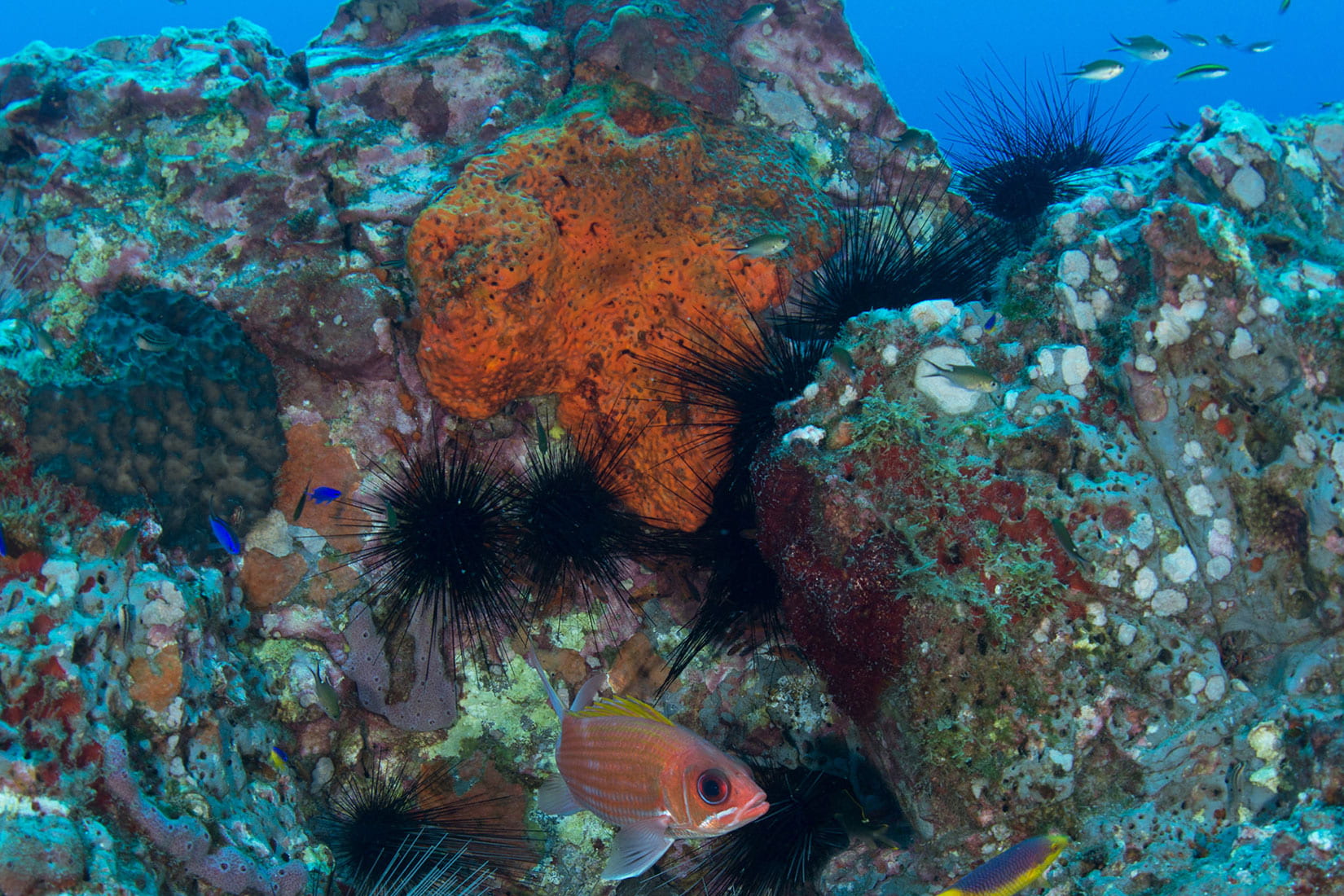
IMAGE: THE FLOWER GARDEN BANKS NATIONAL MARINE SANCTUARY ABOUT 100 MILES OFFSHORE FROM TEXAS AND LOUISIANA IS HOME TO SOME OF THE HEALTHIEST CORAL REEFS IN THE UNITED STATES.view more CREDIT: PHOTO BY G.P. SCHMAHL/NOAA
HOUSTON – (Oct. 5, 2022) – Ocean temperatures in the Gulf of Mexico and the Caribbean Sea are on pace to surpass critical thresholds for coral health by mid-century, but rapid action to significantly reduce emissions could slow warming, giving corals and coral conservation programs as much as 20 more years to adapt, according to new research.
Climate scientists and marine biologists from Rice University, the University of Colorado Boulder and Louisiana State University used computer models to simulate climate warming from 2015-2100 under both a “business as usual” scenario with very high emissions and a scenario in which emissions were reduced to high levels. Their study and analysis of ocean warming and ocean acidification levels for specific regions in the Gulf of Mexico and Caribbean under each scenario is published in the Journal of Geophysical Research: Biogeosciences. The researchers found reducing emissions could delay the onset of critically warm ocean temperatures in some areas where reefs are still healthy.
“There are reefs in the Gulf that are really worth saving,” said Rice University marine biologist Adrienne Correa, a co-author of the study. “Some of the healthiest reefs that we still have in the United States are in the areas covered by these projections.”
Live coral cover on reefs has declined worldwide by about 50% since 1950, and few reefs in the Caribbean and Gulf have more than 10% live coral cover. Reefs in Dry Tortugas National Park in western Florida and in the Flower Garden Banks National Marine Sanctuary off the coasts of Texas and Louisiana are notable exceptions with more than 50% live coral cover.
The study found ocean temperatures in the Caribbean and parts of Florida could reach critically warm temperatures as early as 2050, posing a serious risk for coral survival.
“The fact that we’re going to see these changes by 2050 is a strong wake-up call,” said Correa, an assistant professor of biosciences whose lab specializes in studying corals and reef ecosystems. “We get a lot of bad news about reefs, but we can still draw hope and motivation from this. Some of the reefs that are included in this analysis are really special, like the Flower Garden Banks, and reefs off of Cuba and in some other parts of the Caribbean where there’s still really high coral cover. We can help protect and keep the high-coral-cover reefs we have if we take immediate action to shift how much energy we use and where we get our energy.”
“In one case, we have more time to mitigate, and in the other we don’t,” said Dee, a climate modeling expert and assistant professor of Earth, environmental and planetary science. “People need to be aware this is coming up fast, and the time to explore mitigation techniques is now.”
Corals are symbiotic organisms that live in partnership with photosynthetic algae that help feed their coral hosts. Corals are also builders that draw upon carbonate minerals in seawater to construct their own rocky outer frameworks. Climate warming threatens both coral symbiosis and coral reef-building. For example, heat stress can cause corals to expel their symbiotic algae en masse, a sometimes deadly phenomenon known as bleaching. And oceans become more acidic as they warm, reducing the efficiency of the chemical reactions corals use to build reefs.
Previous studies have shown that heat-related coral bleaching is often triggered by prolonged, abnormally warm ocean temperatures. The critical threshold temperature for bleaching varies between ocean regions and reefs. For example, the threshold temperature for reefs in the Flower Garden Banks is 29.5 degrees Celsius (85.1 degrees Fahrenheit). The researchers analyzed regional warming patterns in each scenario to project when specific regions with coral reefs were likely to reach threshold temperatures under each emissions scenario. A similar regional analysis was performed to project the timing of critical thresholds for ocean acidification.
Lawman, the corresponding author of the study and a former postdoctoral scholar in Dee’s lab, said the study showed heat-related stress was the biggest and most immediate climate-related threat to corals under each emissions scenario.
“The difference was whether you crossed the critical thresholds around 2050 versus 20 years later,” said Lawman, a postdoctoral associate at the Cooperative Institute for Research in Environmental Sciences at CU Boulder.
The researchers found the key determinant of coral mortality in each scenario was the number of months that corals in the future will be exposed to prolonged temperatures hotter than the hottest average months projected for 2015-2034. The researchers dubbed these “degree heating months.”
“There’s always one month that is the hottest of the year,” Lawman said. “Let’s say it’s August and the average baseline temperature for that month is 29 degrees Celsius in the region we’re studying. A ‘degree heating month’ in that region is any month in the future that has a higher average temperature than 29 degrees Celsius.”
The research showed that under the “business as usual” emissions scenario, “degree heating months” become the norm in the late 2100s, occurring as much as 10 months out of the year in some parts of the Caribbean.
“That’s a huge number of months in which corals could experience thermal stress beyond the usual levels to which they are adapted,” Lawman said.
“These projections are very concerning,” she said. “I think the takeaway message is that the time to act is now.”
DeLong is an associate professor of geography and anthropology at LSU.
The research was funded by the Gulf Research Program of the National Academies of Sciences, Engineering and Medicine, Rice University, the Department of the Interior (G19AC00086) and the National Science Foundation (2102931, 2109622).
-30-
Peer-reviewed paper:
“Rates of future climate change in the Gulf of Mexico and the Caribbean Sea: Implications for coral reef ecosystems ” | Journal of Geophysical Research – Biogeosciences | DOI: 10.1029/2022JG006999
A. E. Lawman, S. G. Dee, K. L. DeLong and A. M. S. Correa
Follow Rice News and Media Relations via Twitter @RiceUNews.
Located on a 300-acre forested campus in Houston, Rice University is consistently ranked among the nation’s top 20 universities by U.S. News & World Report. Rice has highly respected schools of Architecture, Business, Continuing Studies, Engineering, Humanities, Music, Natural Sciences and Social Sciences and is home to the Baker Institute for Public Policy. With 4,240 undergraduates and 3,972 graduate students, Rice’s undergraduate student-to-faculty ratio is just under 6-to-1. Its residential college system builds close-knit communities and lifelong friendships, just one reason why Rice is ranked No. 1 for lots of race/class interaction and No. 1 for quality of life by the Princeton Review. Rice is also rated as a best value among private universities by Kiplinger’s Personal Finance.
An article posted to the World Economic Forum (WEF) blog on climate claims that climate change is having “unusual effects around the world.” In a short post, not all of the claimed effects can be checked, but the ones for which data is readily available suggest any climate impact is overblown if not entirely non-existent.
An article posted to the World Economic Forum (WEF) blog on climate claims that climate change is having “unusual effects around the world.” In a short post, not all of the claimed effects can be checked, but the ones for which data is readily available suggest any climate impact is overblown if not entirely non-existent.
The article, “8 unexpected side effects of climate change,” lists several claimed deleterious effects of climate change, but upon further examination, available data easily refutes the claims.
Interestingly, there is a discrepancy between claims made in the article’s summary and the actual claims made in the paper itself.
The summary’s bullet points definitively state that climate change IS “impacting everything from the sex and size of animals to the state of wine and coffee crops,” and “it’s also making flights a lot bumpier and lightning strikes more frequent.” By contrast, the sections of the article related to these claims give no evidence that any of this actually happening. Instead, the WEF hedges its claims, by stating, the effects “could” or “may” be happening or might in the future. In addition, the WEF fails to examine other factors, besides climate change, possibly contributing to the changes it says are occurring, and unscientifically represents a single year’s weather anomaly as if it were representative of a long-term trend.
The WEF says that bearded dragons, native to Australia, are threatened by global warming because of a genetic trait where male embryos can “end up developing as female if incubated in a nest at a temperature of 32°C or higher[.]” This is a concern because “males could become increasingly rare as temperatures keep rising, leaving the entire species at risk of extinction.”
Among the problems with the WEF’s assertion about bearded dragons is that the environment is not a temperature-controlled incubator, and bearded dragons are able to choose where to lay their eggs. Field studies of this exact situation have been done, and while the researchers involved in one particular study, “Evolving thermal thresholds explain the distribution of temperature sex reversal in an Australian dragon lizard,” assert in the abstract that the dragons were particularly susceptible to climate change, their findings failed to actually show this. Instead, their research found that sex reversal is predominantly observed in a certain part of the species’ eastern range, and neither “climatic variables during the inferred incubation period nor geographic population genetic structure explain this disjunct distribution of sex reversal.” The researchers concluded that genetic adaptation can “counteract” the effect of high temperatures on sex reversal.
The science is hardly straightforward on this topic, because life and evolution are complex. Considering the fact that crocodilians and other reptiles that also display temperature induced sex-reversal have survived through long periods of much warmer and much colder average temperatures, it is unlikely that bearded dragons are at existential risk from modern climate change. Indeed, research indicates that ancestors of the bearded dragons themselves originated more than 250 million years ago, and that bearded dragons themselves originated more than 40 million years ago — eras when the planet was warmer than at present
Next, the WEF article claims that the quality and taste of wine is being impacted by climate change, or, at least, could be in the future. This claim is as misguided as it is unverifiable. As Climate Realism has pointed out, here, here, and here, for example, grape production has been rising over the past few decades of modest warming. That localized weather conditions like drought and temperature impact the flavor of wines is well known to wine producers. Vineyards are found in a variety of different climate regions around the globe, and there is no data showing that weather is becoming more unpredictable than in the past. Modest warming over the past hundred-plus years has not destroyed winemaking, but there is evidence that the range of winemaking regions has expanded with warming. This is a benefit.
WEF also claims coffee production is threatened by climate change, citing as proof, the case of Brazilian coffee producers, writing they “have faced substantially lower yields of Arabica beans this year because of frosts and droughts.” The WEF’s worldwide predictions of coffee losses are based on computer modelled growing projects for the next 30 years.Climate Realismhas posted dozens of articles demonstrating computer models are seriously flawed and that, as a result, their projections can’t be trusted. Lest one be concerned about Arabica bean production, data from Statista, shows Arabica bean production has increased by approximately 25 percent since 2005.
Crop production varies from year to year due to localized weather conditions. Farmer have recognized this fact since the agricultural revolution first occurred more than 10,000 years ago. Nothing has changed since then. Brazil’s single year arabica coffee bean decline does not reflect a long-term trend indicative of climate change. In fact, Brazil’s coffee production has been trending upwards during the recent period of modest warming, according to data from the United Nations Food and Agricultural Organization. (See Figure below)
Another assertion that the WEF makes is that air turbulence is getting worse because of climate change. However, as previously explained in Climate Realismhere, here, and here, available data refutes this claim. According to a report from the International Civil Aviation Organization, there has been no increase in the accidents or injuries due to turbulence that one would expect if air conditions were worsening. (See figure below)
What the data shows, in fact, is that although air traffic and the number of passengers has increased dramatically, there has been no upward trend in increasing turbulence related accidents over the past 30 years.
While the WEF claim’s “clear air turbulence” is already increasing, the link provided by the WEF to support this claim provides no evidence to support it. Rather than providing real world data as proof for the claim, the study relies on projections from computer model simulations. Whereas the WEF claims that wind shear is stronger in the jet stream due to climate change, other climate research indicates the exact opposite has occurred. In either case, turbulence data shows no growing threat.
The claims made by the WEF, such Alpine mountain goats body size declining, an asserted increase in lightning strike frequency, a possible increase in volcano activity in the future, and “louder frogs,” are either pure speculation, sometimes based on flawed computer model scenarios, or fail to account for possible confounding or contributing factors aside from long-term climate change. WEF using words like “might” “could” and “may,” doesn’t inspire the same level of confidence as saying “data shows,” or “X has been measured.” The evidence suggests that the WEF is ignoring facts in pursuit of an agenda, because hard data fails to confirm any of the WEF’s “unexpected side-effects of climate change.”
Linnea Lueken is a Research Fellow with the Arthur B. Robinson Center on Climate and Environmental Policy.
While she was an intern with The Heartland Institute in 2018, she co-authored a Heartland Institute Policy Brief “Debunking Four Persistent Myths About Hydraulic Fracturing.”
Researchers at the U.S. Department of Defence wrote a devastating takedown of the Proximal Origin study, which was used by Dr. Anthony Fauci as proof that the COVID-19 virus had come from nature. The Epoch Times has the story.
Researchers at the U.S. Department of Defence wrote a devastating takedown of the Proximal Origin study, which was used by Dr. Anthony Fauci as proof that the COVID-19 virus had come from nature. The Epoch Timeshas the story.
The takedown, dated May 26th 2020, was written in the form of a working paper called ‘Critical analysis of Andersen et al. The proximal origin of SARS-CoV-2‘. It was authored by Commander Jean-Paul Chretien, a Navy doctor working at the Defence Advanced Research Projects Agency, and Dr. Robert Cutlip, a research scientist at the Defence Intelligence Agency. The paper came to light on May 15th 2023, when it was leaked to the public via virus origins search group DRASTIC (Decentralised Radical Autonomous Search Team Investigating COVID-19).
The working paper forensically dismantles the natural origin case made in Proximal Origin and concludes, “The arguments that Andersen et al. use to support a natural-origin scenario for SARS-CoV-2 are based not on scientific analysis, but on unwarranted assumptions.”
The existence of this internal Pentagon paper is crucial, as it proves that Government officials were well aware in the early months of the pandemic that there was no evidence in support of a natural origin of the COVID-19 virus. Additionally, given the crushing discrediting of Proximal Origin, Pentagon officials would also have been aware of Fauci’s efforts to seed a false narrative about the origin of COVID-19.
Proximal Origin was initially conceived by Fauci during a secret teleconference held on February 1st 2020. The ostensible purpose of the teleconference was to deflect attention from a possible lab origin of COVID-19 and to shift the focus to a natural origin theory. Fauci directed a number of scientists, led by Kristian Andersen of Scripps Research and Robert Garry of Tulane Medical School, to pen a study that could be used to discredit the lab leak theory. Despite being directly involved in the inception of the paper, as well as in shaping its arguments, Fauci’s role was concealed from the public. Fauci later bestowed Andersen and Garry with lavish taxpayer-funded grants.
The defects in Proximal Origin were immediately noticed by reviewers at science journal Nature. This fact only became known late last year from emails obtained via the Freedom of Information Act by independent journalist Jimmy Tobias. However, with the help of Jeremy Farrar, who now is the Chief Scientist of the World Health Organisation and who had helped Fauci shape the natural origin narrative, Proximal Origin was accepted for publication in Nature Medicine on March 17th 2020. It boldly concluded that no “laboratory-based scenario is plausible”.
On April 17th 2020, President Donald Trump confirmed that the COVID-19 pandemic likely started in a Wuhan laboratory in China. On the same day, while attending a White House press conference, Fauci categorically dismissed the possibility of a lab origin of COVID-19, citing Proximal Origin as corroboration. Fauci feigned independence, telling reporters that he could not recall the names of the authors. What was not known at the time was that Fauci not only knew the authors well, but had personally led the effort to have Proximal Origin written.
Proximal Origin became the media’s go-to natural origin authority, repeating Fauci’s claim that the paper provided dispositive proof that COVID-19 had come out of nature. It also became the most-read article on COVID-19 and one of the most cited academic papers of all time.
Yet, while the public was being told by Fauci and the media that Proximal Origin had settled the origin debate, Pentagon researchers came to a very different conclusion.
How do you get people to take pharmacological action against something that hits them on average once a year and lasts a few days, like acute respiratory infections? They have been around since creation and are extremely familiar to everyone around the globe, including animals.
How do you get people to take pharmacological action against something that hits them on average once a year and lasts a few days, like acute respiratory infections? They have been around since creation and are extremely familiar to everyone around the globe, including animals.
Acute respiratory infections manifest themselves with a range of symptoms – from none all the way to pneumonia and death from respiratory failure. Thankfully this happens only in a small minority of cases.
To sell, you have to have a market, but familiarity breeds contempt. So you have to create a market for your products, be they medicines, opinions, careers, research funds or whatever.
One approach is to confuse a syndrome with a disease. This means using the F-Word ‘flu’, a terrible Anglo-Saxon colloquialism which is used all over the world, even by WHO and the U.S. CDC. Using the F-word, you are bundling up familiar signs and symptoms, fever, ache and pains, tiredness, cough and runny nose due to numerous but uncountable microorganisms (a syndrome) and implying that it is due to a single agent (influenza).
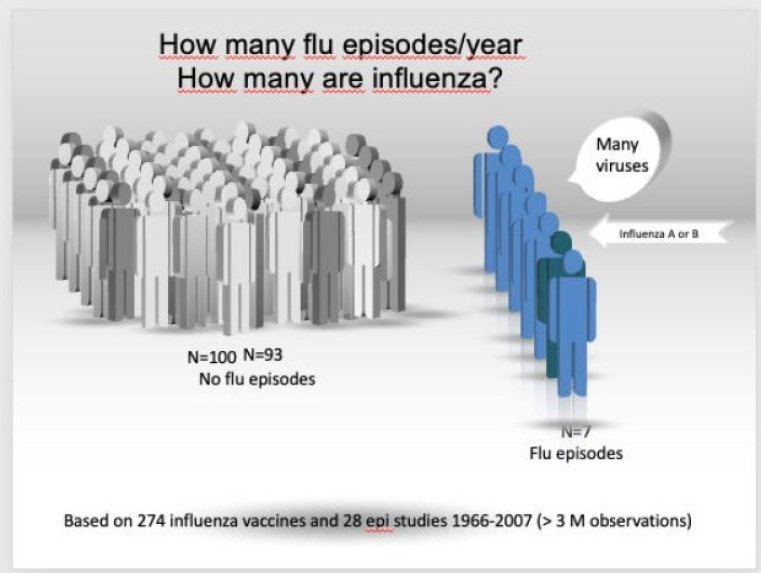
In a pie study, we did nearly 20 years ago, we showed that based on three million observations in an average year, only one out of nine F-word episodes are due to influenza.
When ministers blame winter crises on ‘flu’, we do not really know what they are talking about (neither do they), but they do have a solution: vaccines and antivirals. That is because, up until very recently, influenza was the only seasonal respiratory agent for which licensed pharmaceuticals (antivirals) or biologics (vaccines) were available. Now the tune has changed, they blame it on ‘Flu and Covid‘ (F- and C- words), but it’s just an update of the same manipulation.
Politically this is a helpful strategy. Because instead of admitting there is little that can be done to minimise the impact of the seasonal F-word and the ‘new’ C-word, you can be seen to be doing something like railing about low vaccine uptakes or putting pressure on pharma to produce more antivirals.
A second approach is to frighten everyone into thinking that the yearly death tally for the F-word (influenza) is a lot higher than what is verifiable and that the next pandemic is around the corner.
You do need the media’s help to frighten everyone, but you can always find editors to oblige.
Some media may be owned at least in part by pharma, which makes life a lot easier to get your message across.
We have seen this approach in detail with Covid and the yearly F-word ‘flu’ for at least fifty years. How do you inflate deaths? That’s easy! You start with taking the bundle ‘influenza and pneumonia’ on a death certificate as a true, verified fact. We have explained just how imprecise this method is. For example, in the U.K., in 2015, there were three verifiable influenza deaths per million inhabitants, rising to roughly 24 per million in 2018. Is this a health crisis? Hardly enough to justify doing much. This is why incidentally, influenza vaccines and antiviral trials show an absence of evidence on death prevention: the outcome is too rare even for a large trial.
The next step is to ask modellers to forecast deaths either in what you will call interpandemic or in intrapandemic years.
In going back to models, note the use of the two terms (interpandemic and intrapandemic), which subtly introduced the concept of the inevitability of a pandemic. “It’s just a question of time.”
A third approach is to appoint those who most benefit from creating fear to run or inform your Government of ‘protection measures’, as pointed out by Philip Alcabes at the dawn of the 2009 influenza pandemic:
We are supposed to be prepared for a pandemic of some kind of influenza because the flu watchers, the people who make a living out of studying the virus and who need to attract continued grant funding to keep studying it, must persuade the funding agencies of the urgency of fighting a coming plague.
This is why the worst-case scenario is always presented.
A further approach is to create a cartel of key opinion leaders apparently hugely knowledgeable and capable of giving advice even on newly identified agents. This is the case for the European Working Group on Influenza (or ESWI), which is funded by pharma companies and has been hugely successful in influencing opinion and even policymaking. Many of the ESWI member names recur in our series on antivirals.
Keith Duddlestone pointed us to a further refinement: adding ‘community groups’ to the chorus of voices building pressure. Patient involvement is an old marketing technique, but continuous funding by the industry points to their importance in creating demand.
Then you should present your product as the pharmacological equivalent to a Gucci bag or Rolex watch, a designer drug tailored and produced to keep the monster at bay. Yes, such articles exist, written by people who should have known better because they have a long history of doing good work in this area.
Linked to this is the other approach to turn funders and industrialists into saviours. This happens time and time again when politicians are running out of fig leaves – we will publish three of the contracts that states stipulated with vaccine manufacturers in the run-up to the 2009 influenza pandemic.
We would be very surprised if the model had changed during the last pandemic.
Last but not least, you can change definitions such as ‘pandemic’ to fit what is going on rather than the other way around. This way, the facts always fit the definition, and you can keep everyone on their toes and provide the magic button to be pressed to activate sleeping contracts and emergency laws: it’s a pandemic! Panic stations.
Here is a rather blatant example: the 2009 influenza pandemic was nowhere as severe as the marketeers forecast, so they needed to change a few things, better if done without creating too much fuss.
Manipulation apart, the WHO ‘pandemic preparedness’ page shows a further and now discredited equation: that ‘pandemic’ means influenza. In the end, the most perceptive observer of the many transformations, Peter Doshi, concluded that there is no universal definition of an (influenza) pandemic.
So are we sleepwalking into something much worse than the last three years if the WHO is true to form?
But make no mistake: the creation of the market for antivirals has been hugely successful, as a reply to a Parliamentary question shows:
Pandemics are good for the business model of antivirals: £840 million spent so far. Not a bad return for ‘modestly’ performing drugs!
Dr. Carl Heneghan is the Oxford Professor of Evidence Based Medicine and Dr. Tom Jefferson is an epidemiologist based in Rome who works with Professor Heneghan on the Cochrane Collaboration. This article was first published on their Substack blog, Trust The Evidence, which you can subscribe to here.
No country ever got rich relying on wind and solar power, but plenty of rich countries are driving themselves into penury by doing so.
At the heart of every prosperous nation is the ability to tap reliable and affordable energy sources.
While the richest billion are intent on squandering their energy legacy on weather -dependent so-called ‘renewables’, countries like India and China are building nuclear and coal-fired power plants at a staggering rate. Almost as if their march out of poverty depends upon it.
Zubrin is clearly a pragmatist who understands the critical role that reliable energy plays in civilised society and the part it must play in bringing peace and prosperity to all comers.
Chelsea Follett provides a helpful review of Zubrin’s timely work.
Energy Abundance Is Liberating Humanity From Grueling Labor Reason Chelsea Follett 14 April 2023
Refreshingly pragmatic and nonpartisan, The Case for Nukes: How We Can Beat Global Warming and Create a Free, Open, and Magnificent Future (Polaris Books, 2023) by Robert Zubrin offers a sweeping history of energy technology advances. It also provides a taxonomy of the enemies of nuclear power, including Malthusians and “degrowth” advocates who would, ironically, limit the world’s only scalable clean energy technology in the name of protecting the environment. The book launches a compelling and detailed defense of one of humanity’s most promising yet misunderstood sources of energy. Policy makers across the political spectrum would be wise to heed Zubrin’s call to reform and liberalize what he calls the “regulatory whipsawing and strangulation of the nuclear industry.”
Zubrin pulls no punches, refusing to play games of political tribalism (i.e., opining that climate change “has become politicized to the point where opposing parties have chosen to either deny it or grossly exaggerate it”). While he presents nuclear energy’s potential to lower emissions as a huge positive, he also notes, “The existential threat facing humanity is not climate change. It is the ideologies of despair.”
Specifically, when people see the world as a zero-sum battle over scarce energy and limited resources, such desperation can curtail freedoms and even produce unthinkable atrocities. As Zubrin writes, “If the belief persists that there is only so much to go around, then the haves and the want-to-haves are going to have to duke it out, the only question being when.” He frames producing ample energy as not only an economic but also a moral imperative.
Although the book’s main point may be to promote nuclear power as a solution to some of society’s problems, Zubrin’s most gripping insight lies not in the specifics of its case for nuclear energy but in its broader dual thesis about the relationship between energy abundance (regardless of the energy’s source) and freedom. He writes that energy technology “is the foundation for freedom.” He posits both that free societies are better able to produce energy and that access to more energy liberates mankind.
Zubrin tells of how, as civilization has become increasingly energy-intensive, our employment of energy has liberated humanity—particularly women—from grinding labor. “Powered mills had the same significance for women of the Twelfth Century as washing machines did for those of the Twentieth,” Zubrin claims. He quotes the ancient Greek poet Antipater of Thessalonica, who praised the water wheel’s reduction of women’s work hours with these words:
Hold back your hand from the mills, you grinding girls. Even if the cockcrow heralds the dawn, sleep on. For Demeter [the goddess of harvest and agriculture] has imposed the labors of your hands on the [water] nymphs, who leaping down upon the topmost part of the wheel, rotate its axle; with encircling cogs, it turns the hollow weight of the Nisyrian millstones. If we learn to feast toil-free on the fruits of the earth, we taste again the golden age.
The water wheel saving women from waking at sunrise for the mind-numbing task of grinding grain to make bread is just one more example of how technological advances throughout history have arguably benefited women even more than men.
Harnessing energy and mechanizing labor has unshackled countless individuals from exhausting toil—a liberating process that is ongoing in many countries as more households gain access to electricity and labor-saving devices such as laundry machines. Given how many tasks now delegated to electric machines traditionally fell to women, perhaps it is unsurprising that many prominent advocates of an energy-abundant future fueled by nuclear power are women, or as Zubrin alliteratively puts it, a “fine friendly force of fierce feminine fission freedom fighters.”
Of course, as Zubrin would likely agree, energy access alone does not create freedom, even if it may help to counter the scarcity mindset that is so often freedom’s enemy. One need only look to the Gulf petrostates featuring both massive oil fields and authoritarian political systems to find proof that energy abundance is insufficient to spread liberalism or gender equality.
Oil-rich Saudi Arabia did not even issue driver’s licenses to its female citizens until five years ago. It is clear that freedom leads to energy abundance. It is more doubtful that energy abundance necessarily leads to freedom broadly understood—although it at least defuses scarcity-based rationales for limiting human liberty. (Sadly, authoritarians have invented many other justifications for restricting freedom.)
While energy abundance and freedom may be somewhat mutually reinforcing, if humanity were to pick only one, the choice seems clear: institutions and policies of freedom. History shows that free people in lands devoid of natural resources can innovate their way to high living standards. (As Zubrin points out, “It is human ingenuity that turns natural raw materials into resources.”)
Consider Hong Kong’s whirlwind free market transformation from a barren island into a gleaming metropolis in the 1950s and the 1960s. Freedom is the wellspring of prosperity and innovation, and the energy needed to power modernity. As Zubrin notes, when it comes to environmental challenges, once again, “Freedom is not the problem. Freedom is the solution. Prosperity is not the problem. Prosperity is the solution.”
Zubrin also writes that “human progress must and will inevitably entail continued exponential growth of human power generation.” Whether humanity generates that power with nuclear reactors or finds an even better solution, the relationship between many aspects of freedom and energy is worth pondering.
Zubrin’s book shows the urgency of unleashing energy abundance. He argues convincingly that a future of bountiful energy could help preserve the liberty that scarcity often imperils. Embracing freedom is the surest way to power the future. Reason
‘NOBODY voted for this!’ The cry echoes up and down the land. And yet (albeit in decreasing numbers) people still vote for a political party they would like to believe is telling them the truth and has their interests at heart, because ‘we live in a democratic society’.
‘NOBODY voted for this!’ The cry echoes up and down the land. And yet (albeit in decreasing numbers) people still vote for a political party they would like to believe is telling them the truth and has their interests at heart, because ‘we live in a democratic society’.
Yeah, right! What’s ‘democracy?’, I ask. To which it is hard to get a comprehensible answer. Most often the reply is something like, the right to vote. Vote for whom and for what? The choice is increasingly like having the right to vote for your death either by hanging, shooting or poisoning, when you really wanted to vote for living. And even if you vote for being shot, there’s no guarantee they’ll keep their promise. It’s more likely they will starve you to death – a proper sacrifice, because you’ll be doing it for the planet.
So it’s hardly surprising that Newcastle City Council, a cabal of over-mighty, third-rate windbags and busybodies, have blocked dozens of streets with bollards in a number of suburbs. Why? To save the planet, of course. If you don’t know there’s a ‘climate emergency’, you can’t have been listening, because the sage councillors and their handlers, the officials who know better than the people they purport to represent, have declared one.
And on that pretext the way is open for them to impose almost anything: in this case ‘low traffic neighbourhoods’. The three-quarters of a million people of Tyneside and the wider rural areas are to be forced, by those who know best, to suffer for the planet. Nothing is more important than ‘combating climate change’ and, oblivious to the irony, the bollards are, says the council, necessary ‘milestones on the journey to Net Zero’. See here. Although Newcastle isn’t unique in suffering this oppression, it is no less irksome to know others are being treated similarly.
The council openly admit they are involved in social engineering, trying to curb private car use and forcing people to walk, cycle or take public transport to ‘reduce carbon emissions’, whatever that means. But if ‘carbon emissions’ and clean air were really the purpose they would not be funnelling vehicles on to a few bigger roads to crawl along in jams, getting nowhere. Are the councillors and officials so blind that they can’t see these road closures are killing Newcastle? Or at least destroying independent businesses. One long-standing independent grocer and off-licence in Jesmond has lost so much trade in the last month that it will either have to close or move out.
If their latest scheme for the centre of the city is any guide, in a perfect example of the marriage between global business and government, the councillors show how little they regard independent business or the welfare of the people. They recently approved the building of a new HMRC headquarters on a prime site to accommodate 9,000 ‘civil servants’. HMRC has signed a 25-year lease (I couldn’t find out at what rent, but it will almost certainly be at a level that pays back the cost of building) with a company owned by the billionaire Reuben Brothers. We are not told how these 9,000 staff are going to get to work or if they will be able to park their cars.
The right to use the highway belongs to each of us as subjects of the Crown, guaranteed for centuries under English law. It is not in the gift of a few councillors and unelected officials. Talking to people, it soon becomes clear that many are outraged by the council’s high-handed actions, imposed after coming out with the usual platitudes about ‘listening to a wide range of views’ and holding ‘public consultations’ – in some cases after they had started to install the bollards. They even expect us to believe that these ‘low traffic’ measures are being ‘trialled’ for 18 months, without telling us how they will judge whether the trial has succeeded or failed. Notwithstanding the gross inconvenience and curtailment of what, until the month before last, was the liberty to pass along the King’s highway, it is dispiriting that apart from moaning, there seems little inclination to make a real fuss about it. Orwell observed, at a dance in Wigan, ‘the same sheeplike crowd . . . there is no turbulence left in England’. How much more accurate is that a century later.
The truth behind these road closures and other impositions is that the council is implementing global policies it has agreed with its international collaborators to inflict on the populace. Is it a coincidence that the Reuben Brothers’ development has all the hallmarks of such collaboration? The councillors like to give the impression they came up with these policies themselves. They dare not admit that they are acting in accordance with supra-national global interests that are sucking power from the local (and the national) and ceding it to a globalist network that intends to act as a world government. On the route to achieving it, an international association of cities has got together as the Urban 7 (U7) to put into effect, at a local level, what the G7 does at a supra-national level, to ‘localise globalism’ in the jargon, and to expand global government control from the bottom up.
To ensure participation of the local governments of the G7 countries, national associations of cities have also been created. In Britain it is Core Cities UK, an alliance of 11 city councils: Belfast, Birmingham, Bristol, Cardiff, Glasgow, Leeds, Liverpool, Manchester, Newcastle, Nottingham and Sheffield. These cities collaborate with the common goal of effecting the 17 Sustainable Development Goals of the United Nations. These vague aspirations stem from the Earth Summit in 1992 in Rio and are a call for one world government and abolition of national sovereignty in the name of ‘combating climate change’, ‘creating sustainable development’, ‘equality’ – both gender and social – and all the usual utopian slogans that feed and cloak a determined attempt at power.
Understanding this makes sense of the council’s actions and exposes the councillors’ failure to honour the function for which they were elected – to represent the people of the city and provide the services they need. They were not elected to involve themselves in partnership with the globalists and to implement their policies. Their authority derives from the people who elect them, not from those supra-national forces to whom they now do obeisance. But they can’t admit what interests they truly serve or where the real power lies. If they did, their irrelevance would become clear for all to see. And, although I wouldn’t bet on it, even the sheeple might clamour for a cull of councillors as the pointless waste of money they have allowed themselves to become.
Only a handful of individuals have ever seen or touched crude oil, but every one of the 8 billion on this planet is enjoying the products made from the oil derivatives manufactured from that black gold.
Only a handful of individuals have ever seen or touched crude oil, but every one of the 8 billion on this planet is enjoying the products made from the oil derivatives manufactured from that black gold.
Chemical products, such as plastics, solvents, medical supplies, and fertilizers, are essential for supporting modern lifestyles.
The world is trying to transition away from fossil fuels, but the ruling class are not yet cognizant of the limitations of solar and wind. The elephant in the room that no one wants to talk about is that wind and solar only generate electricity but manufacture absolutely nothing for society. This 1-minute video is short, educational, and entertaining and has already been viewed by more than 800,000 on social media https://www.youtube.com/shorts/stf2YrznkZU.
Over the last 200 years when the world populated from 1 to 8 billion, we learned that crude oil is virtually useless, unless it’s manufactured (refineries) into oil derivatives that are the basis of more than 6,000 products in our daily lives that did not exist before the 1900’s, and the fuels to move the heavy-weight and long-range needs of more than 50,000 jets moving people and products, and more than 50,000 merchant ships for global trade flows, and the military and space programs.
Ridding the world of fossil fuels to help achieve net zero emissions without a replacement supply chain for the products and fuels now derived from crude oil will impact the 8 billion on this planet in negative ways:
A massive reduction in reliable source of products and fuels now manufactured from crude oil, leading to a society in which we are regularly left freezing in the dark, resulting in at least millions of dead in cold countries that impose net-zero.
A dangerous reduction in the availability (and so a huge increase in the cost) of all the products we use in the modern world that derive from petroleum such as plastics, paints, pharmaceuticals, etc.
A huge reduction in the food supply, leading to mass starvation in countries that impose net-zero if all nitrogen fertilizers are banned.
For those who survive the above outcomes, a financial collapse including a deep depression and a consequent collapse in our standard of living and, with that, a huge reduction in environmental protection because we no longer have the wherewithal of the products and fuels needed to engage in environmental protection and are forced to rely on dirty energy sources such as wood (goodbye forests), garbage, dung, etc.
For those who survive the above, significant social unrest, skyrocketing crime, and the likely consequent imposition of martial law with a removal of our basic freedoms, in those countries that impose net-zero.
With the collapse in the economy, there would be a serious weakening of our military deterrence and consequent emboldening of our adversaries who do not go net zero (China, etc.) to engage in invasions at will, possibly culminating in the direct invasion and collapse of western democracies.
Leaders from wealthy countries omit from conversation the extraordinary social benefits of CO2 and fossil fuels. Carbon dioxide, including that from the burning of fossil fuels, serves as plant food that increases crop production and enables the feeding of more people. CO2, as well as the greenhouse gases of methane and nitrous oxide, help to keep Earth at temperatures conducive to life; without them, people would suffer. Fossil fuels are economical and abundant sources of energy necessary for modern societies and are critical feedstocks for everyday products and transportation fuels, and fertilizers and pesticides that support the lives of billions of people.
The ruling class omits from conversations the disastrous consequences of reducing fossil fuels and CO2 emissions to Net Zero. It cannot be overemphasized that eliminating fossil fuels and implementing Net Zero policies and actions mean the elimination of the fossil fuel-derived 6,000 products that are the foundation of today’s lifestyles and economies, and the nitrogen fertilizers and pesticides that will result in about half the world’s population not having enough food to eat.
For the sake of the 8 billion now living on this planet, before we jump out of an airplane without a tested parachute, the world needs to have a plan to be able to support the demands of the population on this globe for all the products and infrastructures that exist today that did not exist a few hundred years ago.
Where is our elite leaders’ plan to keep the planet’s eight billion alive and well with the products now being manufactured from crude oil?
In summary, Life without oil is NOT AS SIMPLE AS YOU MAY THINK as renewable energy is only intermittent electricity from breezes and sunshine and NEITHER wind turbines, nor solar panels, can manufacture anything for society.
Ronald Stein is an engineer, senior policy advisor on energy literacy for CFACT, and co-author of the Pulitzer Prize nominated book “Clean Energy Exploitations.”
Placing industrial wind turbines in schoolyards is hardly the brightest move, given their habit of throwing blades in all directions and collapsing without warning. They’ve also been known to throw massive chunks of ice through roofs and windows – which is what happened at a Massachusetts Community College back in 2018 – luckily no one was killed.
Placing industrial wind turbines in schoolyards is hardly the brightest move, given their habit of throwing blades in all directions and collapsing without warning. They’ve also been known to throw massive chunks of ice through roofs and windows – which is what happened at a Massachusetts Community College back in 2018 – luckily no one was killed.
Back in 2013, turbines in schoolyards across the Scottish Highlands were shut down (with many quietly removed) after one of the same kind of turbine unshackled its blades and threw one of them 60m. Parents were justifiably horrified at the thought of having one of their precious darlings impaled in the name of ‘green’ energy.
Following that trend, a few weeks back, a turbine in a schoolyard near Petersburg, Illinois decided to go rogue and do much the same.
The turbine, situated next to the school’s baseball field, started losing its blades after its braking system failed.
Softballers were alerted to the danger and ordered off the field, mid-game. A short while later, gravity did what it does best, and the turbine hit the deck – bringing the turbine’s reign of terror to a spectacular end.
Fortunately, no school kids were harmed in the making of this ‘green’ energy drama. No doubt parents (and the school’s insurer) will be very interested to hear about the principal’s updated Occupational Health & Safety plans – presumably involving the removal of machines that self-destruct without warning.
Welcome to your wind-powered future kids!
PORTA High School Runaway Wind Turbine Collapses WLDS Jeremy Coumbes 22 April 2023
A runaway wind turbine at an area high school is on the ground after spinning freely for nearly 24 hours.
Menard County Sheriff’s Deputies, Emergency Response personnel, and school administration officials responded to PORTA High School in Petersburg after the school’s multi-story wind turbine began spinning freely around 4:30 Friday afternoon.
PORTA Superintendent Matt Brue says the large wind turbine that sits at the edge of the school grounds near the baseball field was installed approximately 15 years ago and for many years provided as much as 70% of the school’s electricity [on days when the wind was blowing at the right speed and when the turbine wasn’t broken down].
Brue says the turbine has been shut down for the last two years however as parts were becoming more difficult to obtain for the older turbine. He says the system that kept the blades from spinning in the wind failed Friday afternoon.
“When it’s shut down, there’s a braking system that would let it rotate real slowly on occasion but not very much, and this was full-on spinning. So the braking system wasn’t working and there was no way to get it to stop. So we cleared the area yesterday afternoon and police and school staff were on site all day and night watching it.
It made it through the night but then this morning we started losing some of the blades on it. They started breaking and coming apart and it didn’t fly far or anything, it was all contained right there locally so that was a great thing as well. Once that happened it slowed down quite a bit and then the tower itself failed at about four o’clock this afternoon.”
The PORTA girls’ softball game that was taking place near the turbine was postponed in the 3rd inning Friday as school and county officials cleared the area out of an abundance of caution.
A wind turbine technician was called in and Brue says the tech team had a plan for how to lock out the turbine but it could not be done while the blades were spinning. He said they had hoped the winds would have calmed long enough to allow the team to ascend the tower but the wind never slowed down enough.
Menard County Chief Deputy Sheriff Ben Hollis said he received the call that the turbine tower had failed near the bottom causing the tower to bend and the turbine to fall to the ground at 3:40 Saturday afternoon.
Brue says the school district already had a plan in place to do away with the old turbine after recent inquiries into having it repaired were unsuccessful.
“A couple years now it’s been down and we’ve been trying to get companies to come in and work on it but it’s an older turbine and it’s kind of obsolete. We were actually going to decommission it this summer and have it taken down and hauled away. It was at the end of its useful life for us and so that process was already in motion.”
Luckily, no one was injured when the tower fell. Brue praised the first responders that were on scene throughout the course of the event saying they did a great job.
He says both school and emergency officials are keeping the area around the tower clear of the public as the tower is still connected at the point it fractured. He says they are working on a plan to get it the rest of the way down so it is safe, and the demo process can be undertaken. WLDS
Clean, green and safe, is that what you said, Miss?
Being the media darlings has not prevented the German Greens from collapsing in the public opinion polls. 40% of green voters have taken their approval away since it peaked in popularity at 23%.
Being the media darlings has not prevented the German Greens from collapsing in the public opinion polls. 40% of green voters have taken their approval away since it peaked in popularity at 23%.
A series of unpopular, draconian policy proposals along with cronyism scandals have resulted in a body blow for Green Party popularity in Germany.
Accusations of cronyism have surfaced after a top advisor of Green Economics Minister Robert Habeck awarded state contracts to family members and other close associates.
Secretary for Climate Affairs Dr. Patrick Graichen is accused of having awarded government contracts to a research institute run by multiple members of his family. He also appointed his best man to head the German Energy Agency.
The woes for Graichen may also be compounding as “a suspicion of violations of citation rules” regarding his doctoral thesis has surfaced.
“Thanks to the Graichen scandal and the dispute between the Socialist-Green government over the heat pump law, the party has recently plummeted in the polls to 14 percent, well behind the hard right AfD (17 percent) – ten months ago the Greens were still at 23 percent,” reports Pleiteticker. That means the party has lost 40% of its voter base.
This is the result of the most recent INSA survey by “BILD am Sonntag”.
“More than half of Germans (56 per cent) say Habeck is doing a bad job, only 25 per cent attest him good work – in June, 2022, 43 per cent of people still thought Habeck was a good minister. Forty-two per cent even think Habeck is damaging the reputation of the Greens, only 9 per cent think he is helping the party’s reputation,” comments Pleiteticker.
The future for the Greens will remain bleak, with no signs of a turnaround in sight. In fact chances are better than even that things are going to get a lot worse as the bills for energy and drastic green policies start coming due.






You must be logged in to post a comment.