The Case of the Missing Climate Crisis:  Greek Edition

You can guess by the title of the paper that, in regards to drought, the “Climate Crisis” was not found in Greece – your computer would have reported “Error 404:  Climate Crisis Not Found”.

From Watts Up With That?

News Brief by Kip Hansen  — 4 May 2023

A sharp-eyed reader suggested covering this new paper with the clever title:  “In Search of Climate Crisis in Greece Using Hydrological Data: 404 Not Found”, published 27 April 2023 in the hydrology journal Water.  [ .pdf copy available at that link ].

The paper, by Demetris Koutsoyiannis and seven others, all associated with the Department of Water Resources and Environmental Engineering, School of Civil Engineering, National Technical University of Athens and/or the Department of Agriculture, University of Patras, is in response to the EU’s declaration of a Climate Emergency:  “Given the European declaration of climate emergency, along with the establishment of a ministry of climate crisis in Greece, this dataset was also investigated from a climatic perspective using the longest of the data records to assess whether or not they support the climate crisis doctrine.”

You can guess by the title of the paper that, in regards to drought, the “Climate Crisis” was not found in Greece – your computer would have reported “Error 404:  Climate Crisis Not Found”.

Using the longest hydrology records available, the authors found:

“The two over-century-long rainfall time series of Greece (Athens and Thessaloniki) show that the record average and maximum rainfall depths occurred in the 19th or early 20th century. Compared to other locations on the globe with long time series, these two time series of Greece show much smaller to negligible climate variability, both in mean and maximum rainfall heights.”

“In terms of the annual average rainfall, the two most important climatic events that have occurred in Greece from the middle of the 20th century to the present day are (a) the grouping of the high records of the annual average rainfall depth, namely 1/3 of all stations, in one year, the hydrological year 1962–63, and (b) the intense and persistent drought before and after 1990, where the five-year period from 1988–89 to 1992–93 saw more than 50% of all record lows.”

Greece has seen this alternation of dry periods and wetter periods over the entire historical period, yet civilization flourished there over the same period:

“The alternation of dry and wet periods is also a notable characteristic revealed by the study of hydrological data. This behaviour has been known to Greek philosophers since the 6th century BC (cf. Xenophanes;). Besides, the dry conditions in Greece have not been an obstacle to the development of Greek civilization but rather a trigger for the development of science, technology, and management. The ancient aqueducts of Athens that are still operational to date are a living testimony of this fact.“

“A modern repetition of the latter achievement is that, as a result of the successful management of the big drought 30 years ago, Athens now has a perfect water supply system. The successful handling of this crisis is arguably one of the greatest achievements of modern Greek public policy. It would have been impossible without competent and pragmatic leadership and public participation.”
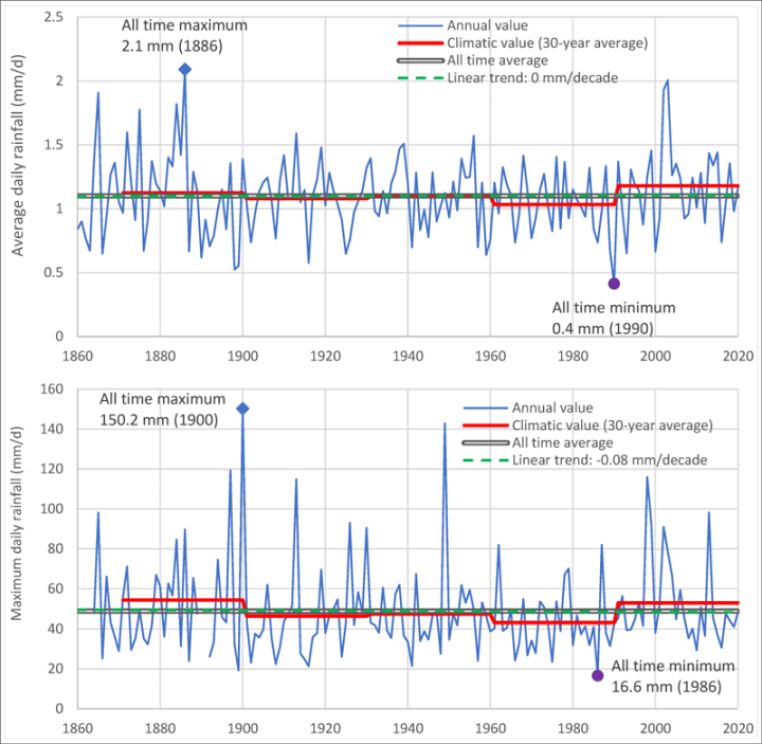
The realities of climate, the shifting from dry to wet and back to dry periods, was the impetus for advancements in science and engineering and social policy, successfully overcoming the challenges presented by the real world.

There have been dry periods, some deep and spanning years and there have been wet periods.  This describes the Mediterranean climate type – the same climate classification as found in California and much of the Pacific Coast of the United States.   But Greece’s 2,000+ years of experience, wisely acted upon, have saved Greece from the downsides of the dry periods and allowed them to take advantage of the wetter times, establishing the infrastructure and policies that truly benefit the people and ensure a constant and adequate water source for the cities of Greece.   

Bottom Line:  Error 404: Not Found

Sorry European Union,  a thorough search of long-term hydrological data found no Climate Crisis-caused drought in Greece.

Kudos are due the authors of this study – fighting back against the tide of climate nonsense. 

# # # # #

Author’s Comment:

[Try as I might, I could not recover the name of the helpful reader that suggested this paper as the subject of a post here. If it was you — please let me know in comments. ]

One of the many curses of modern society, found very often in the Sciences, is Presentism – the partiality to the present (conditions, attitudes, values) as opposed to taking a longer-term viewpoint.  Thus often in Climate Studies, we find the present (or very near past —  ‘when I was a kid’ ) being held up as the ideal. 

We find this in California’s battle with its own historical climate – dry periods followed by deluges of rain.  (See the Great Flood of 1862). 

But the prophets of doom, the prophets of crisis, must fail as they spread falsehoods based on perverse ideologies. 

Thanks for reading.

CfD Indexation Is A Rip Off

We have been looking at indexation of CfD strike prices. So let’s look at an example of how it works in practice.

FromNOT A LOT OF PEOPLE KNOW THAT

By Paul Homewood

We have been looking at indexation of CfD strike prices. So let’s look at an example of how it works in practice.

Beatrice is an offshore wind farm off the Scottish coast. It has been operational since 2019.

Their first three years of full accounts show:

https://find-and-update.company-information.service.gov.uk/company/SC350248/filing-history

Profits increased by £53 million between 2021 and 2022, despite lower output, on the back of higher revenue, mainly due to indexation of 8.1% on strike prices.Finance costs fell as debt began to be repaid. Most of the debt is spread over 15 years, on floating interest rates. As with most businesses with large capital expenditures, Beatrice has covered all of its long term debt with interest rate swaps, meaning the interest rate it pays is fixed for the full maturity of the loans.

The only real risk to the business profitability therefore is the actual output of the wind farm.

In the y/e March 2023, Beatrice received another uplift in strike prices of 8.1%, and a further 6.1% was added last month. Together these will increase revenue by another £55 million, assuming output remains the same.

It was grossly negligent and a misuse of public money for Ed Davey to have drawn up contracts guaranteeing full indexation of strike prices. I know of no private business which would have offered such generous terms.

It is plainly evident that his only concern was to get as many wind farms built as he could, regardless of the cost to the public.

It has been suggested that offshore wind farms simply would not have been viable without such generous terms. If so, it gives the lie to the claim that wind power is as cheap as advertised.

New Study: Climate Models Have Uncertainties, Errors Over 100x Larger Than Claimed Drivers Of Warming

Per a new study on the hydrological cycle’s role in climate change, today’s state-of-the-art climate models “assume the mean relative humidity at the ocean surface is constant.” They are also known to “assume unchanged wind conditions.” Even with this imaginary constancy, “uncertainties in modeling the hydrological cycle significantly [orders of magnitude, or more than 100-fold] exceed the observed effects of global warming.”

From NoTricksZone

By Kenneth Richard on 4. May 2023

Per a new study on the hydrological cycle’s role in climate change, today’s state-of-the-art climate models “assume the mean relative humidity at the ocean surface is constant.” They are also known to “assume unchanged wind conditions.” Even with this imaginary constancy, “uncertainties in modeling the hydrological cycle significantly [orders of magnitude, or more than 100-fold] exceed the observed effects of global warming.”

In a summarizing analysis of the thermodynamics associated with Earth’s hydrological processes (Koutsoyiannis, 2021), we learn that the impact of the natural heat exchange by evaporation, or the latent heat transfer from the ocean to the atmosphere, is approximately 80 W/m²/year, or 1,290 ZJ/year.

Total climate impacts from human greenhouse gas emissions amount to only  0.038 W/m²/year (0.612 ZJ/year in 2014).

Thus, Earth’s “natural locomotive” is about 2,100 times larger than claimed for anthropogenic forcing.

It is therefore clearly evident that “water is the main element that drives climate, rather than just being affected by climate as commonly thought.”

Image Source: Koutsoyiannis, 2021

The below quote selections from a new review paper (Feistel and Hellmuth, 2023) on the thermodynamics of air-sea processes (i.e., evaporation) expand on the extreme nature of this magnitude differential in even more detail.

The ocean’s heat capacity is 1,000 times larger than the atmosphere’s. An ocean heat flux of 0.005 W/m²/year can thus warm air temperatures 2°C/century.

Uncertainty in estimating latent heat flux and relative humidity is 5-6 W/m². This means uncertainty and error are about 1,100 times larger than the identified global warming terms.

The dominance of water in driving climatic processes is so massive that claims we can detect a 0.038 W/m²/year anthropogenic forcing signal amid the orders of magnitude larger background of internal or natural variability, uncertainty, and calculative error is, in a word, absurd.

“[T]he climate of the Earth is ultimately determined by the temperatures of the oceans,” as “the oceans have a heat capacity about 1000 times greater than the atmosphere and land surface.” Because this orders-of-magnitude oceanic dominance, even “a minor heating flux of just 0.005 W/m² is sufficient to raise the atmospheric temperature at an observed rate of 2 °C per century.”

“[A]n error of 1% in RH [relative humidity] … would cause an error of 5 W/m² in the computed ocean atmosphere latent heat fluxes. For comparison, the observed global warming of the atmosphere is driven by a minor climatic forcing of only 0.005 W/m², the total anthropogenic power consumption amounts to 0.02 W/m², and the ocean is warming up by 0.5 W/m².”

“[N]umerical climate models possess uncertainties that exceed certain relevant, either observed or predicted, effects of global warming by orders of magnitude.”

“[T]he global mean of LHF [latent heat flux] was found to be overestimated in the MME [multi-model ensemble] by 5.9 W/m²…”

“Observations and models of oceanic evaporation typically deviate from one another by 6 W/m², or 6%.”

“If also expressed per global surface unit area, even an increase in the large oceanic heat content by as much as 0.5 W/m² would remain well below the model uncertainty range.”

Image Source: Feistel and Hellmuth, 2023

Watch: Morano on Newsmax: Biden ‘bypassing democracy to impose Net Zero vision’

Biden ‘bypassing democracy to impose Net Zero vision’

From CFACT

By Marc Morano 

Newsmax TV – John Bachman Now – Broadcast May 3, 2023

By: Marc Morano – Climate DepotMay 5, 2023 8:42 AM

https://www.newsmaxtv.com/Shows/John-Bachman-Now/vid/1_qaelv95w

Segment begins at 22:00 min into video.

https://iframely.net/vsGvhGz?media=1

Author

  • Marc MoranoMarc Morano
  • Marc Morano manages CFACT’s award-winning ClimateDepot.com news and information service.
  • He is the award-winning producer, writer and host of CFACT’s Climate Hustle feature films.
  • Marc served as a reporter for “Rush Limbaugh the Television Show” and as a senior advisor to Senator James Inhofe.
  • He is author of “The Politically Incorrect Guide to Climate Change,” “Green Fraud: Why the Green New Deal Is Even Worse than You Think,” and “The Great Reset: Global Elites and the Permanent Lockdown.”

Climate Change Roundtable: Embracing Petro-Masculinity

Join us for episode 62 of Climate Change Roundtable, titled Embracing Petro-Masculinity”

The Heartland Institute

Join us for episode 62 of Climate Change Roundtable, titled Embracing Petro-Masculinity”

Yes, you read that right.

The left has come with yet another ridiculous label to slur climate realists, or for that matter, normal people just driving their car. For example from a tweet this past week we learn this:

“Scholars like Cara Daggett have long pointed out the intersection between climate denial and misogyny through the concept of petro–masculinity, which describes the way that fossil fuel systems uphold patriarchy, white supremacy, and authoritarianism.”

Host Anthony Watts and expert weekly panelists H. Sterling Burnett and Linnea Lueken will embrace “petro-masculinity” 100% and point out that without it, the world would soon collapse.

We’ll answer your questions too! Set a reminder and tune in to join the conversation as we point out absurdity of this label and poke fun at the claims.

Reversed-Polarity Sunspot

New sunspot AR3296 is breaking the law: Hale’s Law. The sunspot’s magnetic field is reversed compared to other nearby sunspots in the sun’s northern hemisphere.

From Spaceweather.com

By DR.TONY PHILLIPS

May 4, 2023: New sunspot AR3296 is breaking the law: Hale’s Law. The sunspot’s magnetic field is reversed compared to other nearby sunspots in the sun’s northern hemisphere. This magnetogram from NASA’s Solar Dynamics Observatory (SDO) shows the situation:

According to Hale’s Law, Solar Cycle 25 sunspots in the sun’s northern hemisphere should have a -/+ polarity (negative on the left, positive on the right). AR3296 is reversed; its polarity is +/-.

Studies show that about 3% of all sunspots violate Hale’s Law. In most ways, reversed polarity sunspots are totally normal. They have about the same lifespan and size as ordinary sunspots. In one important way, however, they are different. According to a 1982 survey by Frances Tang of the Big Bear Solar Observatory, reversed polarity sunspots are more than twice as likely to develop complex magnetic fields, in which + and – are mixed together. Reversed polarity sunspots are therefore more likely to explode. 

Solar flare alerts: SMS Text.

This story is brought to you by Spaceweather.com

Right, CBS, Wind and Solar Facilities Do Produce a Lot of Hard to Manage Waste

As these problems have become more evident, as CBS discussed, companies are seeking different ways to dispose of turbine blades. With proper environmental protocols in place, used blades can be shredded and burned in kilns or power plants. This, however, releases air toxins and carbon dioxide.

From ClimateRealism

By H. Sterling Burnett

CBS News published a story, titled “A black eye for green energy? Renewable energy growth brings mounting waste challenge,” detailing the fact that it is difficult, if not impossible, to recycle many of the components of wind and solar projects. This is true. Those who designed wind turbines and solar panels, the developers erecting them, and the federal and state governments pushing their use, largely failed to consider how to manage the large amounts of waste produced when turbines and panels fail prematurely or are decommissioned and replaced at the end of their useful lives. This already amounts to millions of pounds of waste annually.

CBS News described the present management of solar panel and wind turbine disposal thusly:

[A]s the [wind and solar] industry expands, a new problem emerges: what to do with the mounting waste generated by worn-out solar panels and wind turbine blades.

More than 90 percent of discarded solar panels end up in landfills. By 2030, the retired panels are estimated to cover an area equivalent to about 3,000 football fields.

The wind industry is also producing waste — creating an estimated 47 million tons of blade waste annually by 2050.

Although CBS suggests the waste problem is one for the future, problems with disposing of the hundreds of turbines and thousands of panels that need replacing annually, are already evident.

Wind turbine blades are difficult if not impossible to recycle. They are composites, consisting of what one publication referred to as “a toxic amalgam of unique composites, fiberglass, epoxy, polyvinyl chloride foam, polyethylene terephthalate foam, balsa wood, and polyurethane coatings.”

As such, as of 2020, decommissioned or broken wind turbine blades were already amounting to 50,000 tons of waste annually, an amount expected to grow drastically in the near future. Almost all of this waste is either being left standing to rot, being taken down and temporarily stored on site until sufficient landfill space is found, or being shipped to landfills. Yet landfill space is becoming scarce, and for economic and liability reasons, becoming scarcer all the time.

As reported on at Heartland Daily News, a separate tractor-trailer is needed to haul each blade to a landfill, and cutting them up requires powerful specialized equipment. With as many as 8,000 blades a year already being removed from service just in the United States, this amounts to 32,000 truckloads over the next four years—a number that will five times higher in just a few years. That’s a lot of carbon dioxide emitted in the turbine disposal process, emissions unaccounted for when the emissions profile of industrial wind facilities are compared to traditional power plants.

Some wind energy companies have taken to cutting the blades into shorter sections before sending them to landfills, because most landfills lack cutting tools. Today’s turbine blades are 20 percent longer and their towers up to 200 feet taller than most of those currently being landfilled.

Turbine disposal costs are upwards of $400,000 apiece, amounting to $24 billion to dispose of the 60,000 turbines currently in use in the U.S. The cost and the toll on existing landfills will rise as more, longer, heavier blades reach their end of life.

That’s if landfills will take them. Because of the potentially toxic elements in them and the huge amount of space they take up, only certified landfills accept decommissioned wind turbine parts. Yet, municipalities running certified landfills are increasingly rejecting wind turbine blades, even when they can charge double the amount per ton for accepting turbines, because they take up tremendous amounts of space, must be crushed at considerable expense, and take hundreds of years to break down.

As these problems have become more evident, as CBS discussed, companies are seeking different ways to dispose of turbine blades. With proper environmental protocols in place, used blades can be shredded and burned in kilns or power plants. This, however, releases air toxins and carbon dioxide. Currently the emissions from burning decommissioned wind turbine blades is small, but if the practice becomes more widespread, such emissions could become considerable.

It is also difficult to dispose of or recycle decommissioned solar panels. Currently, most used solar panels are either shipped to landfills or shipped for use overseas.

Solar panels are typically removed when the energy they produce declines significantly, usually between 20 and 30 years, if they have not been damaged or become non-functional previously. Such panels still produce energy, just significantly less than required for homeowners, businesses, and utilities to benefit from them. Some companies have found a growing market for used, substandard solar panels over seas in developing countries. However, because the panels’ useful lives do come to an end eventually, over the long term, this just shifts the waste disposal problem from the United States, to poorer nations.

Solar panels contain a mixture of components, some of which can be recycled, some of which can’t. Although many of the material in solar panels are valuable and recyclable, like glass, copper, silver, and various critical materials, because of the way the panels are composed, it is expensive to do so. In addition, solar panels contain toxic metals like lead, cadmium, and selenium. The blending of these recyclable and toxic elements makes teasing the small amount of the valuable materials out from the toxic ones prohibitively expensive.

“The reason you do not see more companies doing solar panel recycling is because the economics don’t make sense,” AJ Orben, vice president at We Recycle Solar, told GreenBiz. “It costs more to break a panel down and recover the raw materials than what the raw materials themselves are worth.”

As CBS News notes, government incentives and subsidies are being used to encourage solar panel recycling but at the present they haven’t closed the gap between what it cost to capture the recyclable material from the panels and their value. As such, less than one in 10 solar panels are recycled, with thousands of panels each year piling up in landfills, potentially leaching toxic heavy metals into the soil and groundwater.

The waste disposal problem for green energy technology is big and growing bigger. CBS News did the public a service by bringing this problem to light. As CBS wrote, the waste “challenge” is, “black eye,” for the green energy industry. Maybe next CBS will take on the challenge of recycling or disposal of electric vehicle battery packs.

H. Sterling Burnett

H. Sterling Burnett, Ph.D., is the Director of the Arthur B. Robinson Center on Climate and Environmental Policy and the managing editor of Environment & Climate News.

In addition to directing The Heartland Institute’s Arthur B. Robinson Center on Climate and Environmental Policy, Burett puts Environment & Climate News together, is the editor of Heartland’s Climate Change Weekly email, and the host of the Environment & Climate News Podcast.

China, Russia, Oil, Gas, Coal, Climate …

The China-Russia axis is dangerous for fossil-fuel-disarming America and the West

新华社照片,北京,2021年5月19日 习近平同俄罗斯总统普京共同见证中俄核能合作项目开工仪式 5月19日下午,国家主席习近平在北京通过视频连线,同俄罗斯总统普京共同见证两国核能合作项目——田湾核电站和徐大堡核电站开工仪式。 新华社记者 岳月伟 摄

From Watts Up With That?

The China-Russia axis is dangerous for fossil-fuel-disarming America and the West

Don Ritter

The relationship between China and Russia poses the greatest danger faced by America and the West since the Hitler-Stalin Pact in 1939 initiated WWII. If alarm bells are not ringing all across Washington, DC, they should be. China was already a global power based on its expanding economy, modernizing military and diplomatic reach, but the burgeoning relations with Moscow provide Beijing with renewed energy, literally and figuratively.

What does that mean for the rest of the world?

The China-Russia symbiosis is easy to understand. Russia provides the oil, gas and raw materials at discount prices, while China trades its high technology and endless amounts of manufactured products. It’s a win-win.

Russia is fueling China’s technology-based economy and its military. Not to mention Russian agricultural production, which helps feed China’s 1.5 billion people. The relationship fulfills the long-term basic needs of the respective partners. It’s no wonder China’s President Xi Jinping gloats that “this hasn’t happened in 100 years.”

For the foreseeable future, China’s vast purchases of Russian natural resources perpetuates the war in Ukraine, making China wholly complicit in the ongoing death and destruction. Because of the China lifeline, Russian President Vladimir Putin can conceivably keep fighting until Western electorates lose patience and quit.

Since the Russians went on the warpath, the resulting global sanctions have so far not seriously wounded its economy, while fossil fuel sales at high prices have buoyed it. That’s thanks mostly to China – but also India, and to Europe itself!  Russia’s GDP fell by only 2% in 2022, well below predictions, thanks to fossil fuel sales keeping it afloat.

Conversely, America’s economy is struggling with high inflation and bank failures, and experiencing a pressing need to mobilize its defense industries to keep up with its critical role in the war in Ukraine – producing ammunition, in particular. Perhaps worse, Biden administration climate change policies and priorities mean there’s been no mobilization of America’s vast fossil fuels capacity to push back on the current Russian and Saudi energy dominance.

Outside of America (add Canada, Western Europe and Australia), the rest of the world, including Eastern Europe, see Western democracies denuding themselves of the very fossil fuels that still-developing countries need to grow their economies and feed their people. These nations are committed to using fossil fuels and may only be giving lip service to climate change because they want friendly and financial relations with the West.

At the same time, the West will not help developing nations harness their own fossil fuel capacities. This is true for institutions like the USAID, World Bank and Asian Development Bank, among others.

Developing nations like India and Brazil are on the sidelines over the war in Ukraine largely because they see the West fossil fuel-energy disarming in the presentwhile over-focusing on the risks of climate change forthe future. These countries need oil, gas, coal and fossil fuel-derived fertilizers and petrochemicals to survive and prosper. Unfortunately for the West but fortunately for developing nations, these resources are readily available from Russia and the Middle East, along with manufactured products from China. This further marginalizes the U.S. and Europe.

America’s leadership is no longer the guiding North Star in the Global South, as the investments, products and markets of China and the fossil fuels and related products of Russia and the Middle East begin to supersede the advantages of tying their futures to Europe and the United States.

Adding to the West’s self-induced dilemma, most of these countries have traditional populations and governance that are not ready for the revolutionary social policies sweeping over the West – while Putin lays claim to “protecting traditional values” and such social policies have no traction in China.

The West faces a serious predicament: How to weigh the value of guarding against what many view as the potentially seriouslong-term effects of climate change versus the current phasing out of fossil fuels despite the risk of geopolitical failure. Unfortunately, the West is not even actually considering its options; it is denouncing and repressing fossil fuel production, thus inadvertently strengthening the China-Russia axis. Iran is already in the China-Russia bag and Turkey is more and more leaning that way.

Recently, oil and gas giant Saudi Arabia has made stunning moves in the China-Russia direction, in some large part because fossil fuels are their lifeblood, now and into the future – and the Saudis see America downgrading that life blood while at the same time seeking to cut back its presence in the Middle East.

Adding to the dilemma, China totally dominates the world in green energy raw materials, technologies and production. In that regard, “going green” means greater U.S. energy dependence on China for the foreseeable future – gravely affecting its ability to control its own foreign, domestic and defense policies.

The fact is, fossil fuels are by far the most indispensable component of all the world’s economies and the dominant weapon of war as militaries are built and run on fossil fuels. In fact, 85% of the world’s energy consumption comes from fossil fuels and we see China, ostensibly our main adversary, going full steam ahead on an “all-of-the-above” approach – which focuses on oil, gas and coal, plus some renewable wind, solar and hydropower. They are also actively engaged in nuclear power: 43 plants have been built, 13 are under construction and 45 are planned, while the West’s nuclear power atrophies.

The U.S. Energy Information Administration recently reported that, while the Biden administration is pushing for net-zero “carbon” emissions by 2050, a policy with potentially enormous negative impacts on the economy and military preparedness, the U.S. will still derive some 65% of its energy from fossil fuels as compared with some 79% today. But what will the geopolitical cost be for even a 14% reduction?

A long-term China-Russia axis is dangerous for a fossil-fuel-disarming America and West. France and the European Union recently urged Xi to hold back on supporting Russia, but begging or delaying is not enough to make us safer. Add a still developing, natural-resources-dependent Global South going along (by energy necessity) with this fossil-fuel-strong new world power structure, and the situation becomes even more precarious. It may soon give rise to a civilizational shift or true existential threat.

The “alarm bells” only ring for those willing to listen. It’s high time the West re-evaluates its energy and climate change approach – before it is too late.

Former Rep. Don Ritter (R-Pa.), Ph.D., served 14 years on the House of Representatives Energy and Commerce and Science and Technology Committees. After leaving Congress he created and led the National Environmental Policy Institute. He was a National Academy of Sciences fellow in the USSR, speaks fluent Russian and was ranking member on the Congressional Helsinki Commission and founding co-chair of the Baltic States-Ukraine Caucus. He is a trustee of the Victims of Communism Memorial Foundation and Museum and co-chairs its Capital Campaign.

(This article was originally published by The Hill as “China-Russia axis is dangerous for fossil fuel disarming America and the West.”)

Climate hysteria: Will Germany’s economy soon go out of lights?

In the “Situation Meeting AUF1”, Dietmar Heuritsch discusses the energy transition in Germany and its consequences with the AfD member of the Bundestag Karsten Hilse and the microbiologist and biochemist Dipl.-Ing. After the shutdown of the last three nuclear power plants, there is a threat of an energy shortage and a migration of many companies abroad.

From auf1.info

By AUF1 editorial team

In the “Situation Meeting AUF1”, Dietmar Heuritsch discusses the energy transition in Germany and its consequences with the AfD member of the Bundestag Karsten Hilse and the microbiologist and biochemist Dipl.-Ing. After the shutdown of the last three nuclear power plants, there is a threat of an energy shortage and a migration of many companies abroad.

Especially if coal-fired power plants are to be taken off the grid in the 2030s and electricity will become even rarer and more expensive. However, it is not technically feasible to replace the energy of coal-fired power plants by 2030, warns Hilse. Both interlocutors see purely ideological reasons for this step on the part of the political leaders. They also explain why climate change cannot be influenced by humans.

Green madness: CO2 savings through shutdowns

The so-called energy transition will have serious consequences for Germany and its economy. Karsten Hilse explains that Germany already has the highest electricity prices in the world. The Greens are to blame for this. “I call them green communists,” he said. With regard to security of supply, he explained that in 2005 the number of grid interventions was 4 to 6 per year. “Last year, we had 12,000 grid interventions, 12,000,” says Hilse, explaining the dramatic situation. There will be electricity rationing or shutdowns, so-called load shedding, in “primarily energy-intensive industries”. Hilse believes that the shutdown of entire areas, so-called “brownouts”, is possible.

“Mr. Habeck and the Greens will then stand up. Yes, we have saved CO2, we have saved energy. But why did we save energy? Because production is simply being shut down because it is being stopped. Big players like BASF or others are going abroad,” the AfD politician paints a gloomy picture for the future of Germany as a business location. This will further advance the deindustrialization that is already underway.

Humans cannot “overturn” the climate

For Dipl.-Ing. Rudolf Hammer it is clear that “German industry is a sacrifice that is being offered to the climate god”. “The story of evil CO2 goes back historically to the 1990s and originated in the USA. And in the mid-1980s, starting in the USA, propaganda about man-made CO2 emissions, which leads to global warming, was spread, especially via the Western industrialized countries, and the Intergovernmental Panel on Climate Change was founded, i.e. the IPCC,” Hammer explains. The Intergovernmental Panel on Climate Change is a purely political organization and has the task of proving man-made climate change. In reality, it is the sun and “cosmic influences” “that are decisive for the climate.”

In addition, there would be a heat storage effect through the oceans. “The function of the oceans is to absorb sunlight, convert it into heat and store that heat. The oceans are therefore a huge reservoir and ensure that, for example, a moderate temperature can still exist on Earth in one night,” explains Hammer. Man-made CO2 cannot “overturn” the climate.

CO2 is one of two key molecules in the development of life and also in the history of the earth. Man-made CO2 emissions, i.e. the use of resources, are already part of this system. “And that’s why CO2, the man-made CO2, cannot have any influence on the fact that the Earth’s climate is overturned,” Hammer makes clear.

The Elephants in The Room

The “climate hell” mentioned in the run-up to the latest COPout conference by the excitable Mr Guterres, Sekjen of the United Nations, is not a happening thing. As the New Pause in global warming lengthens inexorably, month by month, real-world global warming departs more and more visibly from what was and is predicted.

From Watts Up With That?

By Christopher Monckton of Brenchley

The “climate hell” mentioned in the run-up to the latest COPout conference by the excitable Mr Guterres, Sekjen of the United Nations, is not a happening thing. As the New Pause in global warming lengthens inexorably, month by month, real-world global warming departs more and more visibly from what was and is predicted.

Yet the Thermageddonites, flogging the dead horse like a bull in a china shop even though the emperor has no clothes, are ignoring the elephants in the room.

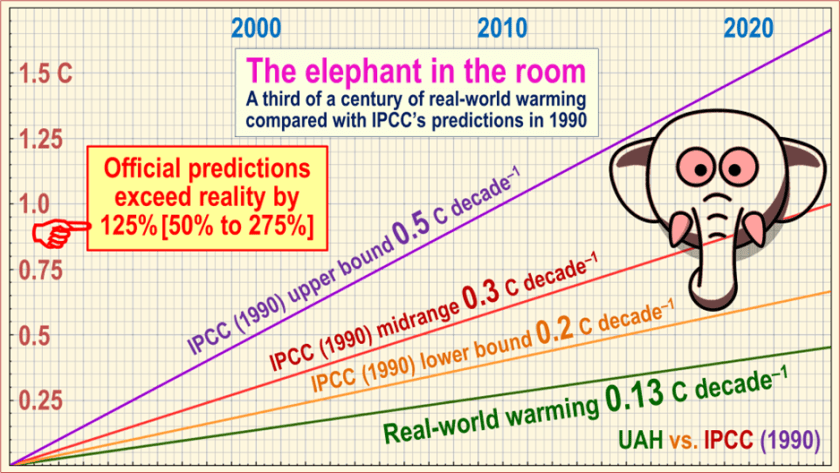
Their latest wheeze is to point out that the real-world global-warming trend in the third of a century since IPCC’s First Assessment Report in 1990is greater than the trend from that year to June 2014, the month when the New Pause began. From 1990 to June 2014 the trend was 0.09 C/decade. However, despite the New Pause, the trend from 1990 to April 2023 was 50% greater, at 0.136 C/decade.

If the New Pause continues, of course, eventually the overall trend will match the trend to the beginning of the New Pause. If it continues long enough, it will fall below that prior trend, just as with the previous Long Pause.

Either way, these long Pauses are visible indicators of the elephant in the room: namely, the fact that the entire interval of predictions of global warming made by IPCC (1990), and still adhered to by IPCC (2021), has proven to be flagrantly in excess of observed reality:

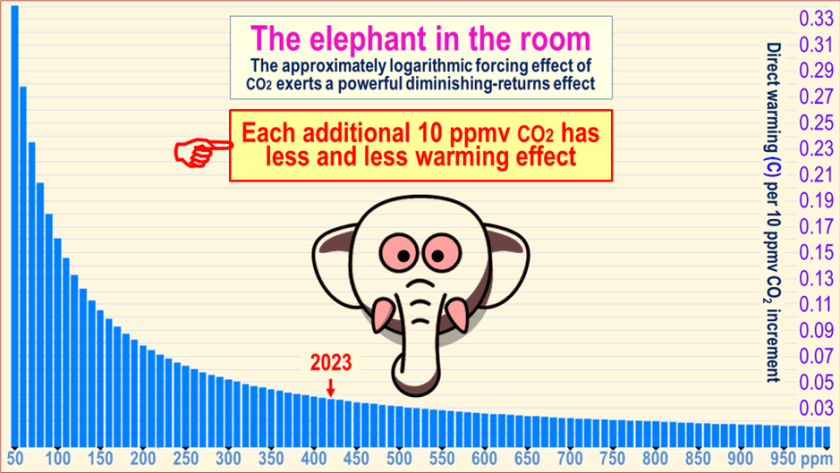
Nor is gross over-prediction the only elephant in the room. Let us quickly summarize some other members of the growing herd. For instance, the approximately logarithmic forcing response to increased CO2 concentration means that each additional molecule of CO2 we add to the atmosphere causes less forcing, and hence less warming, than any of its predecessors:

Most official methods of predicting global warming rely on feedback analysis. Feedback strength implicit in the 3 [2, 5] C ECS predicted by IPCC (2021) is 0.24 [0.23, 0.26] Watts per square meter per degree of the reference temperature. The breadth of the interval is just 0.03 W m–2 K–1. Thus, adding only 0.01 W m–2 K–1 to feedback strength would increase ECS by 1 K. But feedback strength is not knowable to so tiny a precision as a hundredth of a Watt per square meter. Thus, all IPCC’s predictions are no better than mere guesswork, and provide no basis for the costly policies being pursued by imprudent Western governments.

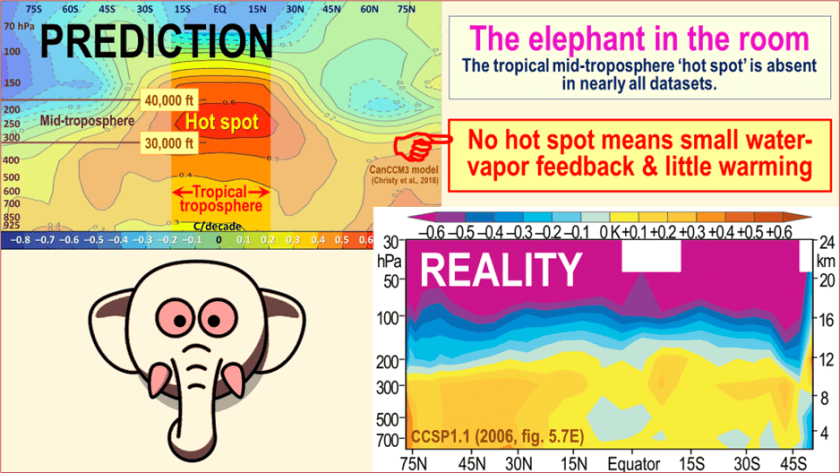
The absence of the predicted tropical mid-troposphere “hot spot” confirms that the water-vapor feedback (the only one potentially big enough to matter: the rest self-cancel) is small:

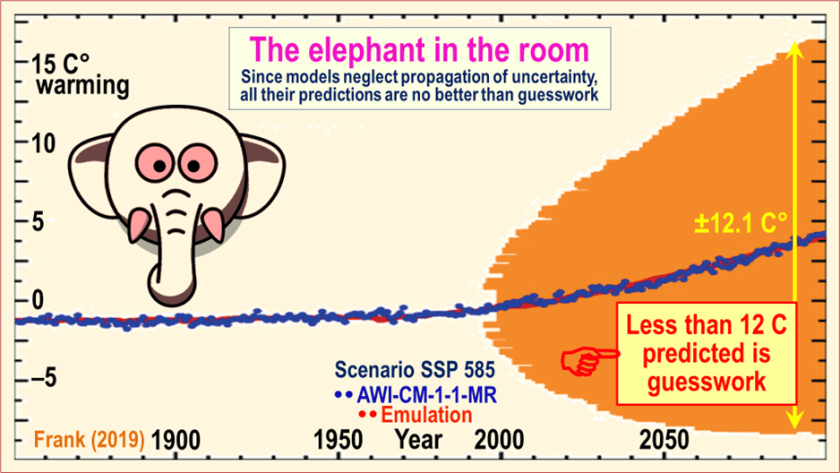
Nor is misrepresentation of feedback the models’ only error. When Dr Pat Frank of the Stanford Linear Accelerator Laboratory first presented his finding that the general-circulation models had not accounted for propagation of error across the time-steps from here to 2100 and beyond, his audience – the World Federation of Scientists – were flabbergasted. His result, published in 2019, stands unrefuted in the learned journals to this day. His result renders all of the models’ predictions valueless. They are no better than mere guesswork:

Fortunately, there are observationally-based methods of temperature prediction that do not depend on diagnosing feedback strength from the outputs of general-circulation models, or on any other form of feedback analysis, and do not depend on the models’ failure to account for propagation of uncertainty. The energy-budget method, for instance, does not depend on knowing feedback strength. Monte Carlo distribution based on the mainstream, published uncertainties in the five listed initial conditions gives ECS as a harmless 0.13 [0.09, 0.20] K:

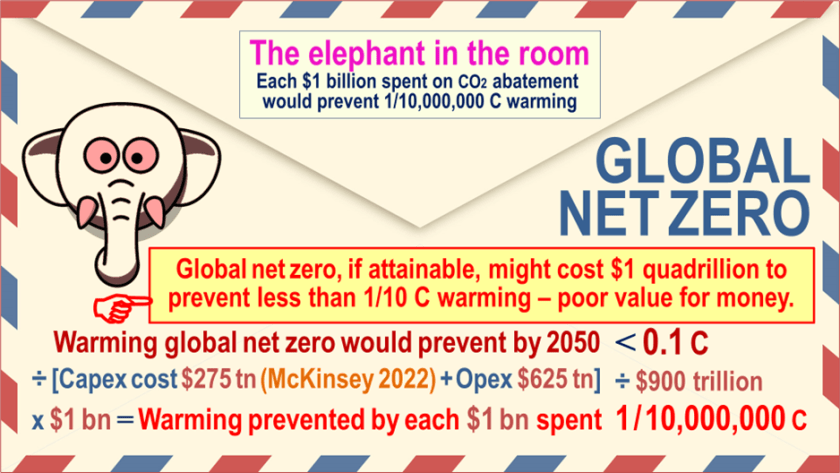
One may also use Monte Carlo distribution to derive the 0.1 C global warming that might be prevented in the unlikely event that the whole world attained net zero emissions by 2050:

The above graph generously assumes that global net zero emissions are possible. In reality, China, Russia, India and Pakistan are greatly increasing their coal-fired capacity so as to keep their electricity prices an order of magnitude below those of Western nations. On that assumption, each $1 billion spent on abatement would prevent less than 1/10,000,000 C:

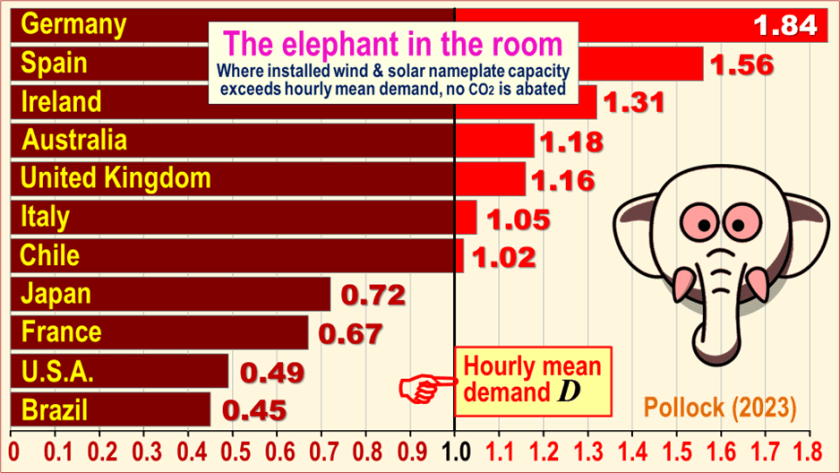
The favored method of reaching net zero – installing wind and solar power – cannot further reduce CO2 emissions without costly static-battery or hydrogen-production backup once hourly mean demand on a national grid exceeds the installed nameplate capacity of wind and solar power – their output in ideal weather. Many Western countries are now above that limit. So the above estimates of warming prevented, of cost and of value for money are optimistic:

Finally, the lurid predictions of death by famine made by the profiteers of doom were false. Indeed, in the global warming era from the 1970s onward, deaths by famine have fallen to record lows:

Experience has shown that simple and irrefutable points such as those which are summarized in this set of diagrams exert a powerful influence on those whose minds are still open to the objective truth.

One of my projects for this summer will be to make the elephants in the room visible to all by drawing them together in a book of images such as these, with a necessary minimum of text. The graphs can then be updated for each annual edition. Not everyone will understand every point, but most people of goodwill can understand most of them. On any view, the organized hysteria reflected in Mr Guterres’ utterances is wholly misplaced.