Why We See So Many Horrid Little Activists

Further fact-checking Cool material that teachers stuff down the throats of kids from age of five is just too depressing. In a democracy those with power are supposed to be accountable. But to whom are these leftist institutions intruding into our classrooms accountable?

From Climate Scepticism

By TONY THOMAS

Who’s the most important educator of Australian schoolkids? The learned amongst us might nominate my fellow-(ex)journo Derek Scott, CEO of Melbourne’s Haileybury College and current chair of ACARA (Australian Curriculum Assessment and Reporting Authority). Nah, not him.

My nomination is Jason Kimberley, whose dad, Craig Kimberley, sold the Just Jeans empire for $64 million in 2001. Jason’s 2008 brainchild, Cool Australia, is all about teaching kids to love the environment [1] and get with the anti-emissions program. But Jason’s own entertainments seem to have a giant carbon footprint – his Cool biography skites about travelling “throughout the globe”, climbing Mt Aconcagua (23,000ft), man-hauling sledges in Antarctica, walking Denali and kayaking Prince William Sound in Alaska for a month, trekking up Mt Everest and dogsledding in the Yukon.

Whatever, here’s Cool Australia’s impact on your kids and grandkids.

♦ Cool’s free on-line lessons for schoolteachers to download are used by 9000 schools, or  92 per cent of all schools.

♦ 3.3 million kids last year engaged with the materials. Cool claims that since it started in 2008, it’s helped educate 16 million kids (2022 annual report, p2)

♦ Cool claims 205,000 “members” – i.e. teachers, but with a sprinkling of 20,000 parents/home-schoolers.

♦ The teachers downloaded and taught Cool’s lessons 340,000 times last year. Two million lessons have been downloaded since inception.

♦ Cool claims that each lesson teachers download is shared with two other teachers and used in more than two classes.

♦ Cool gets all this done on an annual budget of a mere $2 million and 13 full-time-equivalent staff – including education contractors. For Cool, the cost per student is a mere half of one cent.

♦ Teachers love Cool’s pre-fabricated lessons because nearly half the teachers are teaching outside their expertise and three-quarters complain of unmanageable workloads.

♦ Cool’s ambition is for 1 million members (teachers, basically) enrolled by 2025, and 100 million kids educated by 2030. No, I haven’t added too many zeros. (Annual Report, p12)

So it’s clear that state education departments and private-sector schools have farmed out a good deal of education to Jason’s little team. Cool’s lessons cover the whole spectrum of school topics, and Cool’s design team ensure that every lesson they create is mapped to the official curricula. In other words, teachers can download the written and video material, set up the lesson and tick the box for teaching-job-accomplished.

Tony Thomas will co-launch Peter O’Brien’s THE INDIGENOUS VOICE TO PARLIAMENT? THE NO CASE (Connor Court), at Il Gambero restaurant, 166 Lygon Street, Carlton, Thursday May 11, 6pm-8.30pm. To accept ($6), click here.

Cool’s reason for existence is green-left-wokism. All the non-environmental lessons are a useful “extra”. For example, I’ve written about one of Cool’s lessons inciting kids to remain seated during the national anthem because of its colonialist-oppression aspects. Kids do a ‘swot’ analysis to justify staying seated. Cool offers no contrary argument.

Cool has partnered with green-left film-maker Damon Gameau to promote his films 2040 (92mins) and Regenerating Australia (17mins) with their absurd plot-lines based in the year 2040 and 2030 respectively. In those years all green policies are implemented and all are an unalloyed success in saving the planet from CO2 hell. The movie closes with rapturous music and vision of youngsters of all colors and creeds dancing through a forest to celebrate low CO2 levels. One 20-something gal in a white frock grows from her shoulder-blades giant butterfly wings that actually flap. This might well be the cheesiest movie clip ever made or even imaginable.

Cool offers no fewer than 31 lessons on 2040 plus 12 for at-home use, and for Regenerating, about 10 lessons. Teachers and fans have force-fed 2040 to 1.5 million students and downloaded 2 million copies of Cool’s notes on 2040. So far Regenerating has been fed to 37,000 students and schools have created 2500 “action plans” based on it.

A teacher who screens or takes kids to see a screening of 2040 loses at least half a day’s serious teaching. Far from the leftist education authorities being concerned about indoctrination, we can safely assume they would see that as a bonus. After all, “Sustainability” is one of those three cross-curricula priorities, thanks to Labor’s then-education minister Julia Gillard and the “Melbourne Declaration” of December 2008. The “progressive” politicians and teachers’ unions, of course, endorse and promote Cool. Conservative politicians have never – to my knowledge – pushed back against it. They become their own pall-bearers as new cohorts of kids are brainwashed through the 13-year school system to voting age.

The half of all parents who lean conservative don’t enter the equation. Their kids come home spouting mantras about human-caused catastrophic global warming and how society can be transformed to net-zero emissions. Parents probably retain a vague idea that teachers are looking after their darlings’ best interest. They have no idea how the teachers have stepped back from the coalface (sorry, front-line) to let Cool’s zealots take over with their prefabricated lessons.

I’ve tracked Cool over the years, for example see here and here and here. I took a further look last week when preparing a short speech for the Carlton launch of Dr Mark Lopez’s new book, School Sucks(Connor Court). The talk gathers material on half a dozen leftist third-party institutions enjoying unfettered on-line rights to kids in the classrooms – access a transcript of the talk here. The fresh material from Cool rather threw me, with its naked green slant and palpable errors. Moreover Cool seems never to prune its old, stale material. Masses of it date from more than a decade ago – tired stuff then and trebly so when accessed by teachers today.

To take a random example, there’s a lesson for eight-year-olds about the Arctic and Antarctic. Apart from the supplied text, there’s a video of know-nothing teachers coaching the kids to regurgitate Cool’s messages. The cited data stops at 2008. The text says an increase of 0.5degC at the equator “would mean an increase of as much as 4-6 degrees at the poles [plural]”. Whatever might be happening in the Arctic, the Antarctic is making monkeys out of the global warming brigade’s theorising – it hasn’t warmed in 70 years despite a steady rise in atmospheric CO2, and that’s not even a controversial statement. Kids aren’t told about that, of course. Instead, Cool implies that “changing these patterns will affect our economy, people, crops, water supplies and pretty much everything we do.” Jason Kimberley himself stars in the video, claiming that “our continued burning of coil oil and gas is now having a direct effect on these frozen worlds.”

The film cuts to a teacher showing loss of Arctic sea ice for the decade to 2008 – which happened to be a low point followed by stability for the past decade. Eight-year-olds absorb the message, with a boy repeating back to the teacher that fossil fuel emissions and belching cows are hurting the poles, and a girl grieving that “if we lose the sea ice the animals will lose their homes and what they live on.”

Cool’s aim is not just to indoctrinate but to turn kids into horrid little activists. The video shows these eight-year-olds writing complaints to state and federal energy and resources ministers about emissions, and preparing two-minute-hates against fossil fuels for student radio. The kids say they want adults to cut down of fuels and driving cars around — an idea not entirely without merit, as  last week I was cursing the parental traffic jams at the local school gates.

To complete the Soviet-style brainwashing, girls clap along to a song they created for the class:

[inaudible] melting ice, I wonder how they sleep at night.
Global warming is so sad,
Ice is melting really bad.
People want to mine the ice:
Oil and gas has a price. 

To the strains of triumphant music, Jason Kimberley re-appears to harangue kids,

“We are mucking around with our planet’s thermostat by changing the balance of nature [cut to picture of  power station belching steam]…Will we continue to destroy or can we learn to change? The choice is ours!”

Cool, of course, gives kids an adoring treatment of would-be Aborigine Bruce Pascoe and his dodgy histories.[2]

Cool’s “Fact Sheets” present loaded and dubious material. One example is,

Fact Sheet: Angry Summer: Extreme Rainfall. All-time daily rainfall records for January. This presents the information that, in 2013 (note the staleness), a dozen east-coast hamlets such as Mundubbera (pop 1200), Monto (1100), Moogerah (250), and Old Koreelah (pop 800) had experienced record rain (weather “records” always pop up somewhere about something.) Cool’s intent is to demonstrate global warming’s ill effects. But the BoM report from which Cool takes the records, merely says the record rains stemmed from “the former tropical cyclone Oswald tracking southwards along a track just inland from the Queensland coast.” In a map in the same May 2013 document, the BoM clearly shows equivalent areas further inland at the same time suffering record or near-record low rainfall. (p7). This one-way “Fact Sheet” is an amateurish attempt by Cool to give schoolkids climate evidence based on one tropical cyclone’s unusual path.

Another stale “Fact Sheet” boosts China for its renewable energy expansion. It lauds China’s 7GW of installed solar and 63GW of installed windpower capacity as at 2012, without mentioning renewables (including hydro) represented only 8.5 per cent of China’s primary energy sources that year. A decade later (2021) fossil fuels were still providing 85 per cent of China’s energy. Cool is certainly not going to tell our schoolkids that the coal power capacity China began building in 2022 was six times as much as the rest of the world combined. 

What really dropped my jaw, though, was Cool’s “Fact Sheet” on renewables. Its claims include

♦ Coal power plants are not very energy efficient and on average only 30-40% of the chemical energy in coal is converted to useful energy. The rest is lost as heat in the conversion process.

This is bizarre. Engineering has taken the thermal efficiency of modern coal plants close to the theoretical maximum. It’s an argument for coal power, not against it.

♦The alternative is renewable energy sources. These produce energy using natural resources that are constantly replaced and never run out.

Victoria’s brown coal reserves are sufficient for another 1000 years power generation.  Who cares if they run out in year 3123?[3]

♦ The amount of energy received from the sun in one hour could power the entire world for a year.

So what? That doesn’t make solar-panel energy cheap, clean or reliable 24/7.

♦ The best part about solar energy is that it creates almost no pollution — some pollution may be generated in building and transporting the solar panels.

Note that Cool makes no mention of horrific and polluting third-world mineral extraction for panels, the Chinese manufacturing near-monopoly, or future problems disposing of millions of toxic panels.

♦Every 24 hours, wind generates enough energy to produce roughly 35x more electricity than humanity uses each day. However, only 8 per cent of Australia’s electricity generation in 2019-20 came from wind power. 

For the good reasons that wind power is intermittent, requires vast tracts of land for its low-density energy, and is only viable after massive taxpayer and consumer subsidies. Further, the material pretends that wind’s intermittency is no problem

♦ Wind is not constant and doesn’t blow in the same place all the time (although there will always be wind somewhere and it will never run out, making it a truly renewable source of energy). If the wind turbines are spread far enough they can be always capturing the wind energy and putting it into the grid. 

Real fact: wind droughts are normal across the Eastern States grid and can last several days – way beyond any offset from any conceivable battery storage. It is hard to know if the Cool writers are knowingly misleading kids or merely believe their own nonsense.[4]

♦The trouble with wind energy has nothing to do with energy creation itself, but everything to do with the look of wind turbines.

What childish nonsense!

♦ Some people have a problem with them, and this has prevented a number of wind farms being constructed in Australia and other parts of the world. 

But thousands of subsidised wind farms have been built regardless of objectors.

♦ There is a very low chance that wind turbines can harm birds or bats flying through them.

Go ask Greens’ icon Bob Brown in Tasmania about bird-mincing turbine plans for Robbins Island.

Weirdly, Cool disparages emission-free hydro power because the power availability varies with rain levels. But Cool has no problem with solar power varying to zero at night, or wind power varying every ten minutes.

♦ Also, constructing the dams and diverting the rivers … can lead to environmental damage, both through the construction of the dam and also through reduced water flows to the natural environment.

So let’s litter the environment with wind turbines instead!

Nuclear: Cool tells kids to rule it out, despite zero-emissions, because it’s costly to build [so what, that’s for the market to decide], creates a nuclear waste problem [which the French and Western world have dealt with for more than half a century], and is a nuclear weapon risk [ditto]. It also lamely cites accidents at Three Mile Island in 1979, (with no fatalities and only ambiguous evidence of any radioactivity harms) and the outdated, Soviet-era, graphite moderated Chernobyl (1986).

Further fact-checking Cool material that teachers stuff down the throats of kids from age of five is just too depressing. In a democracy those with power are supposed to be accountable. But to whom are these leftist institutions intruding into our classrooms accountable?

_________________________

[1] “Jason identified the need to provide our current and future generations with relevant and engaging information about the three pillars of sustainability: social, economic and environmental. Our education system was identified as the most important and effective medium for connecting real-world education with kids.”

[2] “Step 2. Now explain to students that they will be watching a clip featuring Bruce Pascoe. Bruce Pascoe is a Yuin, Bunurong and Tasmanian man … In 2014 he published a book called Dark Emu which documents and argues “for a reconsideration of the hunter-gatherer label for pre-colonial Aboriginal Australians. The evidence insists that Aboriginal people right across the continent were using domesticated plants, sowing, harvesting, irrigating and storing – behaviours inconsistent with the hunter-gatherer tag” (source: Dark Emu, 2018).

Bruce Pascoe – keynote clip (https://youtu.be/UEMeruNEtWY)

Consider inviting students to share their reflections on this clip…

Step 3. Once complete, display the following quotes from Bruce from this clip on the board (also available on the Student Worksheet)…”

For students: “You could create one of the following to communicate your ideas [about Pascoe]:

  • Written persuasive piece
  • Oral persuasive piece
  • Mind-map (with annotations in full sentences)”

[3] Australia’s total coal is sufficient for 1200 years.

[4] Rafe Champion, Spectator, Nov 9, 2022: “The [AEMO] records can be interrogated to the depth and duration of all the wind droughts from 2010 to the latest serious episode which lasted over 40 hours through the 7th, 8th, and 9th of August.”

RELEASE: Save the whales coalition warns NOAA — Don’t allow more harassment from wind power

Dominion Energy recently submitted a “Request for Rulemaking and Letter of Authorization for Taking of Marine Mammals” as dead whales have been increasingly washing ashore along the Atlantic Coast. The Save the Whale Coalition says that NOAA granting Dominion’s request would prompt litigation to stop it.

From CFACT

By Craig Rucker

ARLINGTON HEIGHTS, IL (May 2, 2023) – The Save the Whale Coalition – consisting of The Heartland Institute, the Committee for a Constructive Tomorrow (CFACT), and the American Committee for Ocean Protection (ACOP) sent a letter today to the National Marine Fisheries Service, a division of the National Oceanic and Atmospheric Administration (NOAA), warning them not to authorize the harassment of whales requested by Dominion Energy of Virginia.

Dominion Energy recently submitted a “Request for Rulemaking and Letter of Authorization for Taking of Marine Mammals” as dead whales have been increasingly washing ashore along the Atlantic Coast. The Save the Whale Coalition says that NOAA granting Dominion’s request would prompt litigation to stop it.

Dominion’s request, issued in August, asks NOAA for permission to begin construction of “all offshore project components,” including turbines, monopiles, substations, and underwater cables “no later than March 4, 2024 and to extend for five years.” The company also requests the “unintentional (but not unexpected) taking of protected species,” including the critically endangered North Atlantic right whale, of which only around 300 remain.

The Coalition notes in its letter that the project will be subject to judicial review for a period of time substantially beyond the March 4, 2024 time frame, and that until that judicial review us finalized, there should be no offshore construction authorized to proceed.

The letter is signed by David Hubbard, partner in the firm of Gatzke, Dillon, and Ballance (GDB), which has been retained by the Coalition to provide advice and counsel with respect to Dominion’s offshore wind project and its compliance with federal statutes and regulations. GDB is also counsel for plaintiffs who have brought suit against the Bureau of Ocean Energy Management (BOEM), the Department of Interior, the National Marine Fisheries Service, and other federal agencies with respect to offshore wind development in Massachusetts, New York, and New Jersey.

The following statements from members of the Coalition may be used for attribution. For more comment or to schedule an interview, please contact Jim Lakely, vice president and director of communications at The Heartland Institute at jlakely@heartland.org or call/text his cell: 312-731-9364.

“The Draft Environmental Impact Statement issued by BOEM for the Virginia Wind project contains numerous procedural and substantive violations of the Marine Mammal Protection Act and other federal statutes and regulations. The Coalition is warning BOEM, NOAA, and other federal agencies not to approve Dominion Energy’s recent request – which would allow the harassment and injuring of whales and other marine mammals – until all of the federal statutory requirements and regulations have been complied with and approved by appropriate federal agencies, and that permission has been obtained from all courts that have been requested to review and approve the federal permits.

“With dozens of dead whales and dolphins washing up on the shores of New York, New Jersey, Maryland, and Virginia, now is a particularly unsuitable time for NOAA to authorize the harassment or injury of right whales and other endangered species. It is equally problematic for Dominion Energy to be seeking whale harassment permission at this time. Dominion Energy is attempting to put the cart before the horse. There should be no issuance of incidental harassment authority by federal agencies until the offshore construction activities to which it is ‘incidental’ have been finally approved by appropriate federal agencies and the courts.”

Craig Rucker

President, CFACT

crucker@cfact.org

“We have conferred with dozens of environmental and conservation groups from NY, MD, and NJ who are furious that all of these dead whales and dolphins should appear on their beaches immediately following the sonar blasting survey work undertaken by wind developers adjacent to these beaches. The excuse by the federal authorities that there is ‘no evidence’ connecting this sonar blasting with mammal deaths rings hollow as any federally approved harassment could send whales into major shipping channels that surround the lease areas.

“Possible death by vessel strikes of harassed whales supports our request, along with the congressional resolution sponsored by U.S. Reps. Jeff Van Drew (R-NJ), Chris Smith (R- NJ), Andy Harris (R-MD) and Scott Perry (R-PA), for an immediate moratorium on offshore wind development and a complete, independent investigation into the cause of all this marine mammal destruction.”

David Stevenson

President, ACOP

davidstevenson@caesarrodney.com

302-236-2050

“BOEM has already admitted that it is a ‘partner’ with offshore wind developers in implementing the Biden administration’s goal of industrializing the East Coast with thousands of wind turbines. It is not acting, as it should by law, like an independent body equally as concerned with environmental protection as with the construction of expensive, unreliable, industrial wind factories.

“This request by Dominion Energy for permission to harm, injure, and kill whales and other marine mammals even before the environmental impacts, construction and operations plan, and potential biological removal for Virginia Wind have been finally issued and approved raises suspicions that the Biden administration is prepared to green light offshore wind development regardless of clear legal requirements and the obvious danger it poses to the survival of the Right Whale and other endangered species.”

H. Sterling Burnett, Ph.D.
Director, Arthur B. Robinson Center on Climate & Environmental Policy
The Heartland Institute
Managing Editor, Environment & Climate News
hsburnett@heartland.org
214/909-2368

Author

  • Craig RuckerCraig Rucker
  • Craig Rucker is a co-founder of CFACT and currently serves as its president.

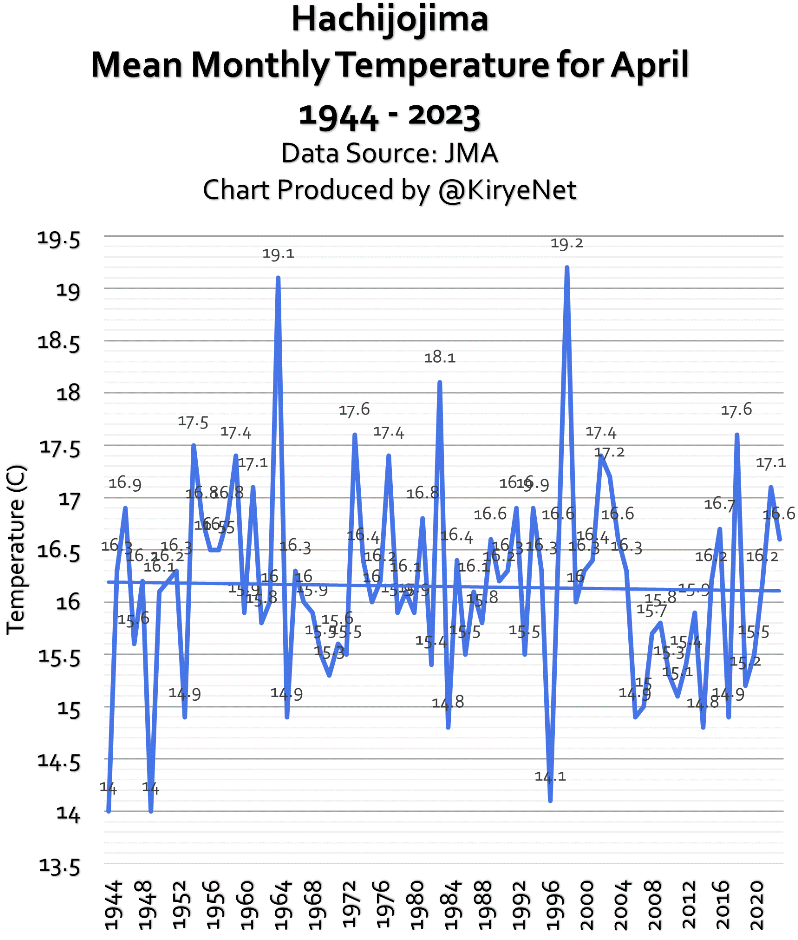
Where’s The Warming? April In Tokyo Hasn’t Warmed In 35 Years…Hachijo-jima Island In 80 Years!

April is the big month of spring, and warming would tell us that this month ought to be getting colder due to more CO2 in the atmosphere. But the data doesn’t show that.

From NoTricksZone

By P Gosselin on 2. May 2023

Charts by Tony Heller’s wife, Kirye

The Japan Meteorological Agency (JMA) has released the mean temperature data for April, 2023, for Tokyo and its island in the Pacific: Hachijō-jima.

April is the big month of spring, and warming would tell us that this month ought to be getting colder due to more CO2 in the atmosphere. But the data doesn’t show that.

Here’s the April mean temperature data for the city of Tokyo since 1988:

The April, 2023, mean temperature for Tokyo was a warm 16.3°C, but the trend for the least 35 years still shows no warming.  Data source: JMA.

 Indeed April mean temperatures for the city of Tokyo hasn’t warmed since James Hansen warned of catastrophic global warming before Congress.

Hachijō-jima

April mean temperatures of Tokyo’s island of Hachijō-jima  (located in the Pacific Ocean 287 kilometers south of Tokyo) going back to 1944. The island is rural and free of the urban heat island (UHI) effects.

Data source: JMA.

Here we see that Hachijo-jima’s April mean temperature hasn’t risen in some 80 years! We’ve provided the links so readers can check the data themselves.

Warming little to do with CO2

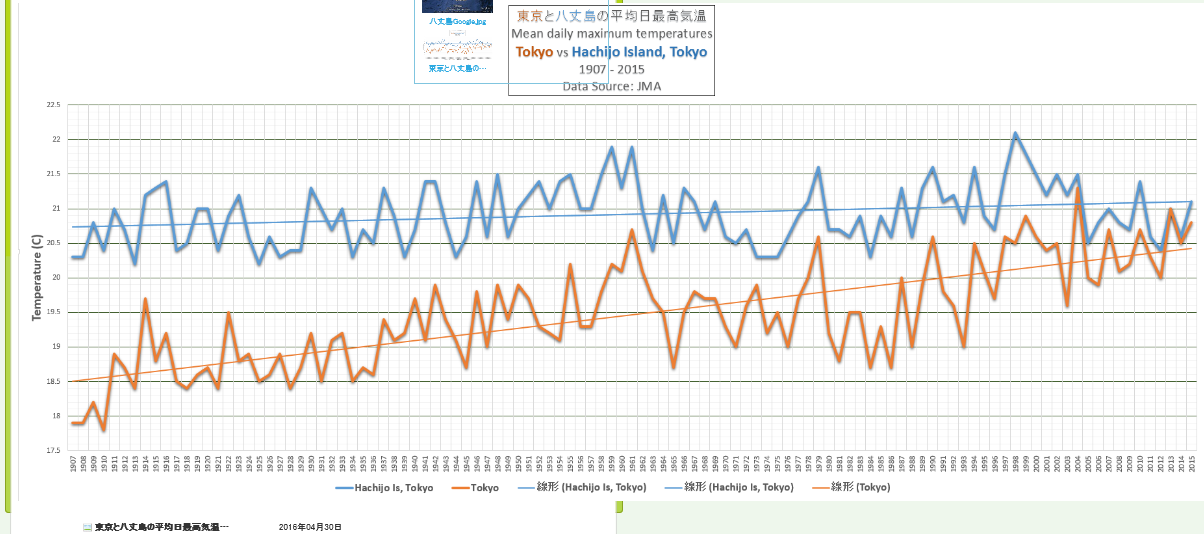
If we go back to the time since temperature recording began, it’s true that both locations have warmed. Yet if we compare mean daily of  maximum temperature of (urban) Tokyo’s rate to rural Hachijō-jima, we see a glaring urban heat island (UHI) difference:

Data source: JMA

While mean daily maximum temperature in rural Hachijo-jima has risen only very modestly, the rise has been much greater in urban Tokyo, especially over the most recent decades.

Thanks, Guardian, For Reporting that Europeans Are Also Unwilling to Make Huge Lifestyle Changes to Stop Climate Change

A recent poll, reported on by The Guardian, found that, although Europeans were concerned about climate change and thought governments should work together to fight it, the majority of those polled were unenthusiastic about any proposal that called on them to personally change their present lifestyles.

From ClimateRealism

By Linnea Lueken

A recent poll, reported on by The Guardian, found that, although Europeans were concerned about climate change and thought governments should work together to fight it, the majority of those polled were unenthusiastic about any proposal that called on them to personally change their present lifestyles. The impression the poll leaves seems to be that respondents wanted to fight climate change if it doesn’t call for too much personal sacrifice. This is consistent with similar polling done in the United States, which shows Americans are concerned about climate change, but not enough to make big changes or pay much more in direct taxes or energy costs.

The Guardian piece, “Many Europeans want climate action – but less so if it changes their lifestyle, shows poll,” describes the results of a YouGov poll which surveyed between 1,000 and 2,000 people in Denmark, France, Germany, Italy, Spain, Sweden, and the U.K. A majority of Europeans surveyed in each country were either “very” or “fairly” worried about climate change, and believed that it is caused by human activities. Most Europeans were willing to support non-lifestyle threatening activities like tree planting, or small sacrifices like avoiding single-use plastics, but enthusiasm waned when YouGov asked respondents about changes they would be willing to make to their own lives to fight climate change.

“The more a measure would change their lifestyle, the less they support it,” reported The Guardian.

Strangely, The Guardian said “there was fairly solid support” among countries for limiting meat or dairy intake to two or three meals per week, but, in truth a majority of those surveyed in each country rejected even that change, with the highest support for that life choice coming from Italy at only 43 percent. That may represent a little wishful thinking on the alarmist end, but the poll results get worse for climate alarmists from there.

The poll found that government subsidies for energy efficiency were popular, but when individuals had to cover the costs themselves, support plummeted to 19 percent in Germany to 40 percent in Spain.

Very few people supported eliminating meat, or limiting the number of children they had, with The Guardian writing “10 percent (Germany) and 19 percent (Italy), and 9 percent (Germany) and 17 percent (Italy) respectively.”

These kinds of results were shown across the board on various climate policies; the more distant the proposal, like offering government subsidies, the more support there was for it. On the other hand, the more immediate an impact, like extra fuel taxes or banning combustion engine cars altogether, the less support it had among Europeans.

These results are very similar to recent polls conducted in the United States. For example, a poll conducted by the Energy Policy Institute at the University of Chicago and the Associated Press-NORC Center for Public Affairs Research (UC/AP) found that fewer than half of Americans (far fewer it turns out, would be willing to pay a monthly “carbon fee,” to fight climate change. Indeed, only 38 percent surveyed said that they would be willing to pay $1 per month carbon fee to fight climate change. As the amount of monthly fee increased, support fell off from there.

That poll also found that despite the widespread availability of electric and hybrid vehicles, solar panels, and utilities with renewable energy supplies, only 12 percent of respondents drive an electric or hybrid vehicle, 11 percent have solar panels, and just a quarter get their power from utilities relying on renewable energy.

Even more telling, the poll shows that despite the constant barrage of media attention and coverage that attributes every weather event or natural disaster to climate change, the percentage of Americans who believe climate change is mainly caused by human activities has dropped across all political affiliations in the last few years. Overall, fewer than half of Americans now believe that climate change is mostly caused by human activities.

Again, as Climate Realism has covered on many occasions, here, here, and here, for example, people do tend to express concern over climate change when asked about it alone. But, when climate change is ranked in comparison to other pressing issues, like crime, the economy, general pollution, and healthcare, among others, climate change consistently ranks among the least important issues to voters, usually but not always ranking dead last.

The YouGov poll, reported on by The Guardian, basically confirmed what polls taken in the United States have, that people support fighting climate change as long as it doesn’t involve much personal or economic sacrifice. As proposals to fight climate change become more invasive, requiring significant behavioral or lifestyle changes, they quickly plummet in popularity. This highlights the widening gap between what climate alarmists prioritize and what the general public is concerned about. In general, most people are alright with supporting efforts like planting trees or subsidizing electric vehicle purchases, but when the government wants to reach into their wallets, or control what they can drive and eat, support for climate policies rapidly wanes.

Linnea Lueken

Linnea Lueken is a Research Fellow with the Arthur B. Robinson Center on Climate and Environmental Policy.

While she was an intern with The Heartland Institute in 2018, she co-authored a Heartland Institute Policy Brief “Debunking Four Persistent Myths About Hydraulic Fracturing.”

“The thinking error that makes people susceptible to climate change denial”

My personal theory is most greens don’t possess a sense of humour, so they have difficulty recognising humour when they see it.

From Watts Up With That?

Essay by Eric Worrall

Jeremy P Shapiro. Source The Conversation, Fair Use, Low Resolution Image to Identify the Subject.

“… Climate change deniers simplify the spectrum of possible scientific consensus into two categories: 100% agreement or no consensus at all. If it’s not one, it’s the other. …”

The thinking error that makes people susceptible to climate change denial

Published: May 2, 2023 10.13pm AEST
Jeremy P. Shapiro
Adjunct Assistant Professor of Psychological Sciences, Case Western Reserve University

Cold spells often bring climate change deniers out in force on social media, with hashtags like #ClimateHoax and #ClimateScam. Former President Donald Trump often chimes in, repeatedly claiming that each cold snap disproves the existence of global warming.

From a scientific standpoint, these claims of disproof are absurd. Fluctuations in the weather don’t refute clear long-term trends in the climate. 

Yet many people believe these claims, and the political result has been reduced willingness to take action to mitigate climate change.

Why are so many people susceptible to this type of disinformation? My field, psychology, can help explain – and help people avoid being misled.

The allure of black-and-white thinking

Close examination of the arguments made by climate change deniers reveals the same mistake made over and over again. That mistake is the cognitive error known as black-and-white thinking, also called dichotomous and all-or-none thinking. As I explain in my book “Finding Goldilocks,” black-and-white thinking is a source of dysfunction in mental health, relationships – and politics.

…

Climate change deniers simplify the spectrum of possible scientific consensus into two categories: 100% agreement or no consensus at all. If it’s not one, it’s the other.

…Read more: https://theconversation.com/the-thinking-error-that-makes-people-susceptible-to-climate-change-denial-204607

Do any of you seriously believe a single cold snap disproves global warming?

I personally support the premise that the world has warmed since the mid 1800s, and anthropogenic CO2 likely contributed. A single cold snap is not proof that global warming has stopped, that would be an absurd proposition.

But climate alarmists seem all too ready to promote the black and white thinking fallacy Professor Shapiro accuses deniers of embracing, they seem very ready to spin every heatwave as proof of the global warming end times.

For example;

3Q: Why Europe is so vulnerable to heat waves

Climate modeling shows that this summer’s devastating European heat wave may indeed be a harbinger of the future for that region.

David L. Chandler | MIT News Office
Publication Date: October 11, 2022

This year saw high-temperature records shattered across much of Europe, as crops withered in the fields due to widespread drought. Is this a harbinger of things to come as the Earth’s climate steadily warms up? 

Elfatih Eltahir, MIT professor of civil and environmental engineering and H. M. King Bhumibol Professor of Hydrology and Climate, and former doctoral student Alexandre Tuel PhD ’20 recently published a piece in the Bulletin of the Atomic Scientists describing how their research helps explain this anomalous European weather. The findings are based in part on analyses described in their book “Future Climate of the Mediterranean and Europe,” published earlier this year. MIT News asked the two authors to describe the dynamics behind these extreme weather events.

Q: Was the European heat wave this summer anticipated based on existing climate models?

Eltahir: Climate models project increasingly dry summers over Europe. This is especially true for the second half of the 21st century, and for southern Europe. Extreme dryness is often associated with hot conditions and heat waves, since any reduction in evaporation heats the soil and the air above it. In general, models agree in making such projections about European summers. However, understanding the physical mechanisms responsible for these projections is an active area of research.

…Read more: https://news.mit.edu/2022/europe-heat-waves-climate-change-1011

What about Professor Shapiro’s claim that President Trump thinks cold snaps disprove global warming?

Do any of you seriously believe President Trump thinks cold snaps disprove global warming? Or is it more likely he is poking fun at alarmists?

Did this humorous tweet get included in Professor Shapiro’s analysis? Was it part of his proof that climate deniers, and he specifically cited President Trump, are black and white thinkers?

If so, how could Professor Shapiro make such an obvious mistake?

My personal theory is most greens don’t possess a sense of humour, so they have difficulty recognising humour when they see it. I accept that Professor Shapiro genuinely believes Trump is being serious when he pokes fun at climate alarmist tropes.

Of course, I’m not an adjunct assistant professor of psychological sciences, whatever that is. Feel free to share your own theory, about what might have gone wrong with Professor Shapiro’s analysis.

No, AP, Climate Change Is Not Increasing Wildfires in Anchorage

In fact, the increase in human population alone explains the increase in wildfires far better than climate change.

From ClimateRealism

ByAnthony Watts

An article by The Associated Press (AP) titled Wildfires in Anchorage? Climate change sparks disaster fears suggests disaster due to climate change induced drought is just ahead this coming summer. The article is badly misleading because it ignores several other contributing factors and historical data.

The article says:

Research on a flat spot for air evacuations. Talk of old-style civil defense sirens to warn of fast-moving wildfires. Hundreds of urban firefighters training in wildland firefighting techniques while snow still blankets the ground.

This is the new reality in Alaska’s largest city, where a recent series of wildfires near Anchorage and the hottest day on record have sparked fears that a warming climate could soon mean serious, untenable blazes in urban areas — just like in the rest of the drought-plagued American West.

Wildfire training early in the year is prudent but certainly no indicator of climate change. The citation made in the article to reference a warming climate from another AP story also does nothing to illustrate climate change in Alaska.

To be clear, large wildfires have been common throughout Alaska’s history. The third largest wildfire since consistent data has been recorded occurred in the late 1950s and the fifth largest in the late 1960s, during decades when the Earth was cooling.

Among the factors contributing to present wildfire trends that the AP article misses are the makeup of the data on wildfires, as well as the cause for the perceived climate change. When these factors are carefully examined it becomes clear that the present wildfire trends have more to do with landscape change than climate change.

First, as the wildfire data seen in Figure 1 below from the International Arctic Research Center (IARC) clearly shows, the majority of Alaskan fires is caused by humans and lightning – neither of which are climate driven metrics.

In fact, the increase in human population alone explains the increase in wildfires far better than climate change. According to U.S Census Bureau data, Alaska’s population increased  from 135,000 in 1950 to more than 733,000 in 2022. Anchorage has experienced an even steeper population increase than the state as a whole, going from 11,254 in 1950 to 289,810 in 2022 – a 25 fold increase since 1950.

The IARC reports:

Human-caused wildfires tend to occur closer to communities, are suppressed quickly, and occur earlier in the year than fires ignited by lightning. In many years, the total number of fires caused by humans is greater, and require more resources to fight than the number of fires started by lightning.

Also, as Anchorage has grown, its subdivisions and associated urban development has spread into previously forested areas surrounding the city. As such, it stands to reason that with a 25 times greater population in Anchorage, and humans starting more wildfires, more wildfires in need of quick suppression would be the result. Climate change has nothing to do with it.

The other major cause of Alaskan wildfire, lightning, also shows a sharp increase according to data, seen in Figure 2 below:

“In most years, and all years with a substantial fire season, the majority of acres burned are caused by lightning ignitions,” the IARC notes. “These fires are often in remote locations where managers often allow fires to burn, in order to serve their ecological role without directly impacting human life or property.”

The increase in lightning can also be explained by increased human presence, from the paper, “Lightning hazards to human societies in a changing climate” we learn that human populations produce more cloud condensation nuclei, and therefore increase the number of lightning-creating thunderstorms, especially in urban environments like Anchorage:

Westcott (1995) reported an increase of 40%–85% in downwind lightning flash densities during summer around 16 central US cities for the period 1989–1992. She attributed the result to several factors, such as increased urban cloud condensation nuclei (CCN) concentrations and also urban population and size, which interact in complex ways. The increase was most notable during afternoon hours, when convective thunderstorms are most likely to develop in the unstable atmosphere. The results indicate that larger cities had higher annual values of PM10 concentrations and exhibited larger lightning increases (with some exceptions).

The AP asserts increased drought in Alaska is contributing to wildfires, but the data on precipitation presented in Figure 3 below, refutes this claim. Interior Alaska has experienced 40 percent more precipitation during the period over which the AP reports wildfires have the increased. This increase in precipitation has also contributed to a greening in Alaska, which means more fuel for wildfires when they start.

Each of these factors have contributed to the recent increased in wildfires, none of which are due to climate change. the AP simply ignored such easily verified facts, in order to promote the narrative that climate change is responsible for yet another type of bad outcome.

It is sad commentary on the state of journalism at the world’s most widespread news outlet when its reporters, editors, and fact checkers, can’t take a few minutes to do basic research and seek out the real reasons behind Alaska’s wildfire increase. As it is, the AP’s story is a disservice to its readers.

Anthony Watts

Anthony Watts is a senior fellow for environment and climate at The Heartland Institute. Watts has been in the weather business both in front of, and behind the camera as an on-air television meteorologist since 1978, and currently does daily radio forecasts.

He has created weather graphics presentation systems for television, specialized weather instrumentation, as well as co-authored peer-reviewed papers on climate issues.

He operates the most viewed website in the world on climate, the award-winning website wattsupwiththat.com.

Aussie Green Energy Shock: Snowy Hydro Cost and Completion Time Blowout

As coal power operators respond to the new carbon tax by accelerating plant closures, Australia’s big battery, the Snowy 2 pumped hydro project, has just announced more cost and delivery time blowouts.

From Watts Up With That?

Essay by Eric Worrall

Snowy River from McKillops Road. By The original uploader was Tirin at English Wikipedia. – Transferred from en.wikipedia to Commons by Berichard using CommonsHelper., CC BY-SA 3.0, link

As coal power operators respond to the new carbon tax by accelerating plant closures, Australia’s big battery, the Snowy 2 pumped hydro project, has just announced more cost and delivery time blowouts.

Power grid at risk as Snowy 2.0 finish date blows out

Angela Macdonald-Smith Senior resources writer
Updated May 3, 2023 – 10.27am

Snowy Hydro has advised that its troubled Snowy 2.0 pumped hydro storage project in NSW will overrun its already-revised $5.9 billion budget and may not be fully online until the end of the decade.

The latest delay, of as much as two years, looks set to intensify worries about the reliability of the east coast electricity grid as owners of coal power stations accelerate closure plans.

The federal government-owned company said it is working to “reset” the timetable and budget for the project with key contractor Future Generation Joint Venture, controlled by Italy’s Webuild.

…

One of the huge tunnel boring machines used at the project, a 2000-tonne machine named Florence, has been essentially stuck for months in soft ground, while a “depression” has appeared on the surface, 30 metres above where it is located. Work is under way to stabilise the ground to allow the machine to resume tunnelling.

…Read more (paywalled): https://www.afr.com/companies/energy/snowy-2-0-faces-further-cost-increases-delays-20230503-p5d54v

Even when the Snowy 2 pumped hydro storage is complete, if it ever completes, serious doubts have been expressed about its viability as a giant renewable backup battery.

The following was published last year in the Sydney Morning Herald – Australia’s answer to the New York Times.

Five years on, Snowy 2.0 emerges as a $10 billion white elephant

By Ted Woodley
March 15, 2022 — 5.00am

Five years ago on Tuesday, then prime minister Malcolm Turnbull announced, with great fanfare, the Snowy 2.0 pumped hydro project: “The Turnbull Government will start work on an electricity game-changer … This plan will increase the generation of the Snowy Hydro scheme by 50 per cent, adding 2000 megawatts of renewable energy to the National Electricity Market (NEM).”

Senate Estimates papers confirm the announcement was cobbled together in less than two weeks after the concept was floated by Snowy Hydro.

The nation-building vision was for a big battery to be added to the Snowy Mountains Hydro-Electric Scheme. It was to be completed in four years (that is, by last year) at a cost of $2 billion without any taxpayer subsidy, bring down electricity prices, generate renewable energy and incur minimal environmental impact on Kosciuszko National Park.

Inspiring stuff. But not one of these grand claims has turned out to be true. Worse, Australian taxpayers and NSW electricity consumers will be up for billions of dollars in subsidies and increased electricity costs, all while Kosciuszko is trashed. Let’s have a quick recap.

…

… Transmission tariffs in NSW will increase by more than 50 per cent if the NSW government allows Snowy Hydro to get its way, based on analysis in a Victoria Energy Policy Centre report.

…

Far from bringing electricity prices down, Snowy Hydro’s own modelling predicts that prices will rise because of Snowy 2.0.

As far as the claim that Snowy 2.0 will add 2000 megawatts of renewable energy to the National Electricity Market, Snowy 2.0 is not a conventional hydro station generating renewable energy. It is no different to any other battery, and as such it will be a net load on the NEM. For every 100 units of electricity purchased from the NEM to pump water uphill, only 75 units are returned when the water flows back down through the turbine generators. Not only is the electricity generated not renewable, Snowy 2.0 will be the most inefficient battery on the NEM, losing 25 per cent of energy cycled.

…

There are many cheaper, more efficient and far less environmentally destructive energy storage alternatives.

…Read more: https://www.smh.com.au/national/five-years-on-snowy-2-0-emerges-as-a-10-billion-white-elephant-20220310-p5a3ge.html

Australia has just advanced another step towards that green energy wall WUWT described. I think we can safely conclude Australia is aiming for a head first collision, at running speed.

Even if you believe the renewable energy fairy can deliver, Australia’s coal plant closure timetable was already looking terrifyingly tight. Australia’s newly introduced carbon tax just adds to the pressure to close coal plants, regardless of whether the green energy infrastructure meant to replace coal is ready.

Coal plant owners don’t have an obligation to keep the grid viable, their duty is to shareholders. Keeping the grid stable is the government’s responsibility.

5

Net Zero Watch calls for emergency restart of fracking

Campaigning group Net Zero Watch has warned the Government that its ban on fracking is now a direct threat to national security and has called for Prime Minister Rishi Sunak to change course as a matter of urgency. 

From Net Zero Watch

As Russia threatens UK energy supplies, Britain needs to restart fracking now

London, 4 May – Campaigning group Net Zero Watch has warned the Government that its ban on fracking is now a direct threat to national security and has called for Prime Minister Rishi Sunak to change course as a matter of urgency. 

It has been reported this week that NATO officials are extremely concerned that Russia may have mined gas pipelines and windfarm cables in the North Sea. 

According to Net Zero Watch analysis, offshore wind generates 10% of the UK’s electricity supply, a figure that is rising rapidly.

According to Net Zero Watch director, Andrew Montford:

Offshore wind generation is increasingly concentrated in a small number of huge windfarms. If someone takes out the undersea grid connections of just the ten largest, 6% of our electricity supply could be eliminated at a stroke, and nobody would know who had done it.”

In addition, 77% of the UK’s gas imports come by undersea pipeline from Norway, and are thus also at risk. With geopolitical tensions on the rise, it is clear that pipelines, undersea wires and interconnectors have become a critical vulnerability, and experts are calling for an urgent rethink.

Security expert Professor Gwythian Prins said:

In time of ‘grey war’ the only secure energy sources are ‘firm’ power sovereign assets. That means onshore gas – and coal – starting with fracked gas. National security requires fully exploiting those resources, while giving the Royal Navy and the RAF the wherewithal fully to defend firm energy assets – first and foremost oil and gas rigs and pipelines and the Norwegian gas pipeline in the North Sea.”

Further information

Government’s years of irresponsible neglect has left Britain “at mercy of Putin”

Revitalise North Sea exploration and start fracking — or lose Putin’s energy war for good

How UK shale gas was killed by Green lies and Russian propaganda

Some Elementary Facts about UK Energy Use in 2022

This little piece is addressed to people who won’t see it. I speak of those who are paid to write about energy, but don’t know what it is. It was prompted by a couple of pieces in Norfolk’s local newspaper, the Eastern Daily Press, or rather its web presence.

From Climate Scepticism

By JIT

This little piece is addressed to people who won’t see it. I speak of those who are paid to write about energy, but don’t know what it is. It was prompted by a couple of pieces in Norfolk’s local newspaper, the Eastern Daily Press, or rather its web presence. The first was this from December last year, in which the following is said:

More than 10pc of the UK’s domestic energy will be supplied from a wind farm set to be built off the north Norfolk coast. Vattenfall, the firm behind the Norfolk Offshore Wind Zone, has increased its capacity to 4.2GW and will now power 700,000 more homes compared to its original design. This will see the turbines supply electricity to 4.6m houses across the country.

Wrongness abounds here. This can all be ascribed to being imprecise with language; there is no intent to deceive. Nevertheless it may give rise to a false understanding of the facts by the audience. The second was more recent. It cuts and pastes (and links back to) the first, and says:

Once completed, the 4.2GW wind zone will supply more than 10pc of the UK’s domestic energy.

As an aside, the article is actually about the cabling. No it is not manufactured in the UK. In fact:

Vattenfall, the company behind the Norfolk Offshore Wind Zone, has signed an agreement with Greek firm Hellenic Cables to provide the inter array cables for the project. Hellenic Cables will supply around 528 miles (850km) of aluminium cables – as far as from Great Yarmouth to Aberdeen – to connect the wind turbines with the offshore substation, helping to power the wind zone.

Let us begin with the obvious point. The UK’s energy consumption does not solely consist of electricity. If it did, then the EDP would not be so obviously wrong – it would be on the right planet at least. Last year, according to the March 2023 update of Energy Trends, the (provisional) energy consumption of the UK was:

170.9 million tonnes of oil equivalent (mtoe).

I prefer to use joules. Naturally this is “wrong” in the sense that not all the oil and gas will be used for its energy content. However, it has that potential at least. According to the internet, 1 toe = 41,868,000,000 J, so the number is:

7.16×10¹⁸ J

Or if you prefer, 7.16 EJ. It does not include energy sent to “marine bunkers,” which is fuel for ships. It does include a small amount of electricity exports.

The pie chart shows what that energy consists of. Here the electricity exports are missing, so the total is slightly higher than 7.16 EJ. The lion’s share is fossil fuel; note the small share of primary electricity from our “zero carbon” friends. Data from Energy Trends Table 1.3, except there they give the numbers in mtoe, as mentioned.

Of course, the end user does not obtain all that energy goodness. Some of it is thrown away by converting the energy from one form to another (e.g. by generating electricity). The final energy delivered was 127.364 mtoe, or in joules…

5.33 EJ

This does not include non-energy uses of energy. (Huh? Well, it means things like turning fossil fuel into plastic.) Of this, 0.98 EJ was the final energy consumed as electricity. This is smaller than the quantity of electricity generated. It does not include electricity used by power generators or losses. It means that electricity is 18.5% of final energy consumed. [It’s 273 TWh, if you prefer it that way. Energy Trends does.]

How much of this is domestic electricity? The next pie shows the breakdown of the UK’s final electricity consumption, provisional, for 2022. Data this time from Energy Trends Table 5.2; I have not bothered to convert into joules. The pie shows that domestic electricity is about 37% of all electricity. That means it’s roughly 7% of all energy (0.37 * 0.185 as a proportion).

So, making the assumption that our correspondent meant domestic electricity when he spoke of domestic energy, to reach “more than 10pc” of that number, the Norfolk Offshore Wind Zone (NOWZ) needs to generate roughly 100 TWh * 0.1 ~ 10 TWh. Once all 4.2 GW is operational, NOWZ will cover an average of 10% of domestic electricity if its capacity factor exceeds about 27%. [4.2 GW * 8766 hours in a year * 0.27 = 9.94 TWh.] This is obviously achievable for an offshore wind “zone”, or maybe a more appropriate term would be an offshore wind “defeatherisation.” Of course, we know that the actual delivered power is likely to swing from 0.42 GW to 3.8 GW, but that’s another story.

If we wanted to build a wind farm to actually produce 10% of UK domestic energy, not just electricity, how big would it have to be? Well, about 4 times larger than if you wanted to just cover 10% of domestic leccy. [The proportion of domestic energy that is electricity is usually given as 0.2, e.g. by Ofgem, but it has been creeping up over the past 25 years on my look at the numbers and is now closer to 0.25. Of course, it is eventually intended to reach 1. Given that increase in leccy – from 20% of all domestic energy to 25% – in 25 years, it might take a while for that to happen.] You would therefore need a wind farm of about 16.8 GW.

Incidentally, the first part of NOWZ, Boreas, has been awarded a CfD at a ludicrous price:

Government has awarded Vattenfall a CfD at £37.35/MWh (2012 prices) for the 1.4GW Norfolk Boreas Offshore Wind Farm

According to power-technology.com, it will cover 1,300 km2 when completed:

The Norfolk offshore wind zone will cover an area of 1,307km² in the southern North Sea.

An elementary sum would show that if NOWZ produces <1% of the UK’s energy, then to produce 100% from this source, we will need 130,000 km2 of offshore wind farms.

The NOWZ belongs to Vattenfall (Swedish). As noted, the cabling is Greek. The turbines are Spanish-German. A Dutch company did the surveys. The HVDC converter stations are from a Norwegian-German consortium. Some British companies helpfully arranged pieces of paper. (I don’t know where the turbines will be made.)

There is much more to be said on this topic, but this post is already long enough.

Please alert me if I have missed a decimal point somewhere…

Data tables and the Energy Trends report available via this link.

Featured image: „A power engineer juggling pie charts in front of an offshore wind farm“ – Dall.E.

Right to hunt and fish amendment clears Florida legislature, now onto 2024 ballot

In Episode 359 of District of Conservation, Gabriella hosts a roundtable with Florida conservationists on how the Sunshine State passed a right to hunt and fish amendment. Featured guests include Rep. Lauren Melo, the House sponsor, and activists Travis Thompson and Mike Elfenbein. Tune in to learn more!

From CFACT

By Gabriella Hoffman

“I think we are seeing this movement of canceled culture that is taking over our nation. It’s in our schools. It’s on social media. It’s everywhere. The movement you know, is in Oregon, New Mexico. I think there’s seven to nine states who already are looking at language to ban hunting and fishing and actually actually criminalized hunting and fishing. We’re seeing sitting US Congressmen that have been banned on Twitter for a harvest picture with their spouse and honestly, it’s terrifying.” — Florida State Representative Lauren Melo, sponsor of House Joint Resolution 1157

In Episode 359 of District of Conservation, Gabriella hosts a roundtable with Florida conservationists on how the Sunshine State passed a right to hunt and fish amendment. Featured guests include Rep. Lauren Melo, the House sponsor, and activists Travis Thompson and Mike Elfenbein. Tune in to learn more!

Listen on Apple Podcasts

EP 579: BAAJA Blast: Permitting Reform or Bust – District of Conservation

In Episode 579 of District of Conservation, Gabriella discusses the permitting reform bill – aka BAAJA – that is gaining traction in Congress now. The Senate will hold a cloture vote starting at 3:30pm ET in a motion to proceed. Gabriella discusses the status quo without permitting reform, how BAAJA is good for the environment and affordability. Tune in!SHOW NOTESBipartisan Policy Center: BAAJA ExplainerEstimating the US Energy System Impacts of the Bipartisan American Affordability and Jobs Act
  1. EP 579: BAAJA Blast: Permitting Reform or Bust
  2. EP 578: Midterms, CO Amendment 83, Disneyland Goes Electric
  3. EP 577: Kaylyn Glenn – Florida Gladeswoman & Conservationist
  4. EP 576: Chiricahua National Park & Energy Security Index
  5. EP 575: Menhaden Madness (ft. Whit Fosburgh, Forage Fish Campaign)

SHOW NOTES

Townhall: More States Should Adopt Right to Hunt and Fish Amendments

CS/HJR 1157: Fishing and Hunting

Florida: Right to Hunt & Fish Amendment Placed on 2024 Ballot
RIGHT TO HUNT AND FISH CONSTITUTIONAL AMENDMENT HEADED TO THE BALLOT IN FL IN 2024

Photo Credit: Gabriella Hoffman / Florida Peacock Bass – June 2021[/fusion_builder_column][/fusion_builder_row][/fusion_builder_container]

Author

  • Gabriella HoffmanGabriella Hoffman
  • Gabriella Hoffman is a Media Strategist and Award-Winning Outdoor Writer. She hosts the “District of Conservation” podcast and CFACT’s original YouTube series “Conservation Nation.” Learn more about her work at http://www.gabriellahoffman.com