Water, Water Everywhere: Maximizing Oil Field Produced Water Use in West Texas

Texas has an opportunity to continue as the leader in oil and gas production for decades to come. To do so, industry and the state must manage and productively use the significant volume of water that gets produced along with the oil and gas.

From Watts Up With That?

By Scott W. Tinker

Texas has an opportunity to continue as the leader in oil and gas production for decades to come. To do so, industry and the state must manage and productively use the significant volume of water that gets produced along with the oil and gas.

Permian oil and gas production is vital to U. S. transportation and power generation. Each day the Permian Basin produces about 6 million barrels of oil (~ 45% of U.S. supply) daily, which industry refines to produce gasoline, diesel, jet fuel and myriad other products.

The basin also produces about 26 billion cubic feet of natural gas (~ 22% of U.S. supply), which industry processes for industrial, residential, commercial and transportation use. In addition, natural gas has become the backbone of Texas power generation and is increasingly being called on for “behind the meter” electricity generation for data centers.

Associated with oil and gas, each day the Permian basin produces over 20 million barrels of salty water! North Dakota, Oklahoma, Appalachia and other regions also produce significant water along with oil or natural gas. In Texas, industry reuses what it can, then transports and disposes the remainder into deep or shallow rock formations, which changes subsurface pressure conditions and can induce earthquakes.    

A decade ago, as the State Geologist of Texas, I worked with the Texas Legislature, industry, and academics to create TexNet at the Bureau of Economic Geology (BEG). BEG maintains over 200 seismometers tracking earthquakes across Texas and makes the data publicly available.

The Railroad Commission of Texas, which regulates oil and gas activity, uses TexNet to help mitigate earthquakes, while still allowing for production of oil and gas.

A similar program should be created for produced water. Rather than continue to reinject the water, industry would use water desalination (desal) technologies to clean up about half of the volume, creating hundreds of millions of gallons of fresh water daily. The remaining volume of salt water would help reduce earthquakes.

Rather than dumping the cleaned-up water in the Pecos River, why not put it to beneficial use? What could benefit from that much fresh water in Texas? Data centers. But their demand would be easily satisfied.

Nonfood crops. Farmers grow hundreds of thousands of acres of cotton in nine counties less than 50 miles north of Permian oil and gas production. Cotton farmers currently use about 50% rainwater and 50% irrigation from the Ogallala, the largest U.S. aquifer. In Texas, Ogallala recharge rates—the natural process where surface water percolates down to replenish aquifers—are much lower than rates of withdrawal. Thus, the Ogallala in Texas is in decline and nearing depletion, which would mean the end of cotton in the Panhandle. Nothing would make China and Brazil, who are competing with the U.S. in cotton, happier.

Does the water math work? Daily cotton irrigation volumes during the growing season are      greater than daily produced oilfield water in West Texas. In the off season, desalinated produced water could be stored in lined surface reservoirs. A second cotton growing season could even be possible. Produced water reuse would significantly reduce pressure on the Ogallala Aquifer and extend its productive life.       

Does the dollar math work? Today, desal costs two to three times that of water disposal, owing to the energy and infrastructure required. But, as earthquakes continue to grow in frequency and magnitude—risking industry license to operate—produced water is being moved farther for disposal, resulting in increased costs.

By contrast, with economies of scale and technology improvements, the cost of desal will come down. Factoring in avoided seismic risk, regulatory certainty, long-term water supply stability, and public license for industry to operate, the economics make sense.

What is needed from each sector? Leadership.

State government could support farmers by helping with the cost of water. State regulators, like the Texas Commission on Environmental Quality (TCEQ), must accelerate water desal permitting approvals.

The Federal government could support testing of various desal technologies to accelerate water cleanup at scale; loans to build water pipelines from oil wells to cotton fields; and an independent testing lab to ensure water quality.

Industry, including oil and gas and tech, must desal produced water at scale, build water pipelines, and support water tracking to verify systemwide water volumes. This will gain public trust and provide regulatory integrity.

Texas can lead the way with a practical energy-environment-economy win-win-win.

Dr. Scott W. Tinker was State Geologist of Texas for 24 years and is Professor Emeritus and Director Emeritus at UT Austin.

This article was originally published by RealClearEnergy and made available via RealClearWire.

Yorkshire Gas Field to Launch Bitcoin Mining Pilot Using Early Flows to Fund Development

Reabold Resources (a UK-listed oil & gas investment company) has just received an Environment Agency licence to carry out limited (“gentle”) fracking and well workover at the West Newton A site near Hull. The field is one of the largest onshore gas discoveries in Britain in recent decades, with estimated resources of up to 8 billion cubic metres of gas — theoretically enough to meet roughly a tenth of the UK’s annual gas demand if extracted all at once (though real-world recovery rates and production profiles mean the actual contribution would be spread over years and smaller).

Reabold Resources (a UK-listed oil & gas investment company) has just received an Environment Agency licence to carry out limited (“gentle”) fracking and well workover at the West Newton A site near Hull.

The field is one of the largest onshore gas discoveries in Britain in recent decadesReabold Resources (a UK-listed oil & gas investment company) has just received an Environment Agency licence to carry out limited (“gentle”) fracking and well workover at the West Newton A site near Hull.

The field is one of the largest onshore gas discoveries in Britain in recent decades, with estimated resources of up to 8 billion cubic metres of gas — theoretically enough to meet roughly a tenth of the UK’s annual gas demand if extracted all at once (though real-world recovery rates and production profiles mean the actual contribution would be spread over years and smaller).

Instead of immediately piping the gas into the national grid, Reabold is exploring a pilot project: build a small on-site gas-fired power station using the initial flows of gas after the upcoming workover. That electricity would power a Bitcoin mining data centre.

Bitcoin mining is being positioned as a quick-revenue, flexible first step — not the permanent, exclusive fate of the entire field.

_____________________________________________________________________________________

Giant Yorkshire Gas Field ‘To Mine Bitcoin Instead of Boosting British Energy’

Reabold Resources plans to build data centre powered by West Newton field near Hull

A giant new natural gas field in Yorkshire is to be exploited for mining Bitcoin rather than boosting Britain’s energy supplies. The Telegraph has the story.

Reabold Resources has been awarded a licence to carry out “gentle” fracking in the West Newton field near Hull, which is estimated to contain up to eight billion cubic metres of gas.

That would be enough to meet more than a tenth of the UK’s annual needs and makes it one of the largest onshore fields discovered in Britain, with the potential to bolster energy security for years to come.

However, Reabold instead plans to construct a small gas-fired power station on the site and use the energy produced to “mine” Bitcoin.

“A private gas supply means we can run a data centre to mine Bitcoin relatively cheaply,” said Sachin Oza, the co-chief executive of Reabold Resources, which has just been given a drilling licence by the Environment Agency.

“Initially, this would help fund the further development of the gas field and prove the concept – meaning it could become the precursor to a far larger data centre.”

The scheme has angered environmental groups opposed to new gas fields and fracking in particular.

It is also likely to raise questions in the Government after the war in Iran prompted fears of fuel shortages in the UK.

Bitcoin mining is one of the most energy-intensive of all digital activities. A power station would need to burn around 150,000 cubic metres of gas – the volume of 50 Olympic swimming pools – to generate the electricity needed to create one Bitcoin.

Reabold’s West Newton gas field is so large that it could theoretically power the creation of 50,000 Bitcoins.

Alternatively, it could help provide gas for the whole of the UK. The drilling site lies within a couple of miles of National Gas’s transmission pipeline and so could easily be connected.

Lorraine Inglis, a leader of an anti-fracking campaign group in southern England, said: “The West Newton permit exposes everything that is wrong with the UK’s current approach to energy and climate. A new onshore gas field in 2026 is fundamentally at odds with our climate commitments.

“Using that gas to power Bitcoin mining is not energy security or any genuine public benefit but the deliberate burning of fossil fuels for one of the most energy-intensive and socially questionable activities at a time of high bills and missed climate targets.”

Ed Miliband, the Energy Secretary, imposed a ban on full-scale fracking last year. The process involves injecting high-pressure water laden with chemicals into rock to create cracks through which gas can flow.

The ban emerged after a fracking operation near Blackpool generated a series of minor earthquakes.

Read the full story here.

The Fracking Truth

I’m talking about fracking: the process of extracting oil and natural gas from fine cracks in shale rock.

Gas tanks and workers at a fracking site during sunset.

From Science Matters

By Ron Clutz

Linnea Lueken sers the record straight on fracking in the above video from Prager U.  Transcript in italics below with my added images.

Graph showing oil production in thousands of barrels per day compared to oil prices per barrel from 2010 to 2018. Conventional oil production is represented in orange, shale oil production in blue, and the spot price in red.

It is one of the greatest innovations of the last fifty years.

It has saved consumers billions of dollars…

Prevented untold tons of carbon emissions from entering the atmosphere…

Graph depicting U.S. natural gas plant liquids production by region and type, showing historical data and projections from 2000 to 2050.

And almost single-handedly rescued an economy that was in the middle of a severe downturn.

You’ve probably heard of this innovation — not as a source of pride, but as an object of scorn.

I’m talking about fracking: the process of extracting oil and natural gas from fine cracks in shale rock.

So, what gives?

A close-up image of a hand holding a lighter near a flame, with a faucet in the background, illustrating the controversial effects of fracking.
Originated from treehugger.com

Why has something that has done so much good been so unappreciated — even vilified?

The answer, of course, is that the opponents of fracking — environmentalists and their political and media allies — say that the negatives of fracking outweigh its positives.

What are those negatives?

Detractors have a long list: contributing to global warming, putting local drinking water at risk, and even causing earthquakes are high among their complaints.

Those are pretty serious charges. But are they valid?

Before I answer that question, let’s cover a little history.

Fracking — whatever your current impression of it — is a great American success story.

A diagram illustrating the differences between conventional and unconventional oil and gas wells, showing drilling methods, water aquifers, and the process of hydraulic fracturing.

Before the twenty-first century, fracking as we know it now barely existed. The concept — reaching pockets of oil and gas trapped in shale — had been around for decades, but wasn’t practically or financially feasible.

Technological breakthroughs and a few eureka moments — like horizontal drilling and using improved ground-penetrating radar — in the early 2000s changed everything.

In traditional oil production, a company drills a well with the goal of finding a reservoir of oil. In fracking, the goal is to liberate a vast number of small pockets of oil and gas that have been trapped in the shale rock.

A narrow shaft is drilled — first vertically, and then horizontally. Water, mixed with sand and other additives, is pumped down the shaft at extremely high pressure to create tiny fissures in the surrounding rock. The sand holds the tiny cracks open, allowing the oil and gas to escape and flow back up the well to the surface.

What makes the innovation of fracking even more remarkable is that it emerged at a time when the theory of “Peak Oil” was widely accepted. Advocates of this theory—including many prominent scientists—warned that humans would soon run out of fossil fuels.

Fracking turned the theory upside down. In a matter of a few years, the world had more oil and gas than it knew what to do with — most of it coming from the United States.

The benefits from the fracking revolution were almost immediate.

The price of natural gas fell from $9 per cubic foot to $3. Consumers saved big on their gas and electric bills.

As gas replaced coal as a cheap, reliable energy source, greenhouse gas emissions fell more than 20%.

The US economy, reeling from the 2008 financial crisis, reversed course. The fracking boom was the number one reason.

Ironically, the politician who benefited the most from this boom was a fierce foe of fossil fuels, President Barack Obama. And, while he continued to push his green agenda, he did almost nothing to stop the fracking phenomenon.

Perhaps he read the science. It emphatically endorses natural gas as a clean energy source. Even Carl Pope, then the executive director of the Sierra Club, one of the world’s largest environmental groups, came out for fracking. As Pope saw it, natural gas was the perfect transition between fossil fuels and alternative energy.

With that history in mind, let’s return to the charges made by opponents of fracking.

The EPA — hardly a friend of the oil and gas industry — has looked closely into the question of whether fracking puts aquifers, the source of much of our drinking water, at risk. One EPA study examined 110,000 fracking sites. It concluded that fracking does not pose a threat. One obvious reason is that fracking is done at depths of six to ten thousand feet. Water tables tend to be at 500 feet or higher.

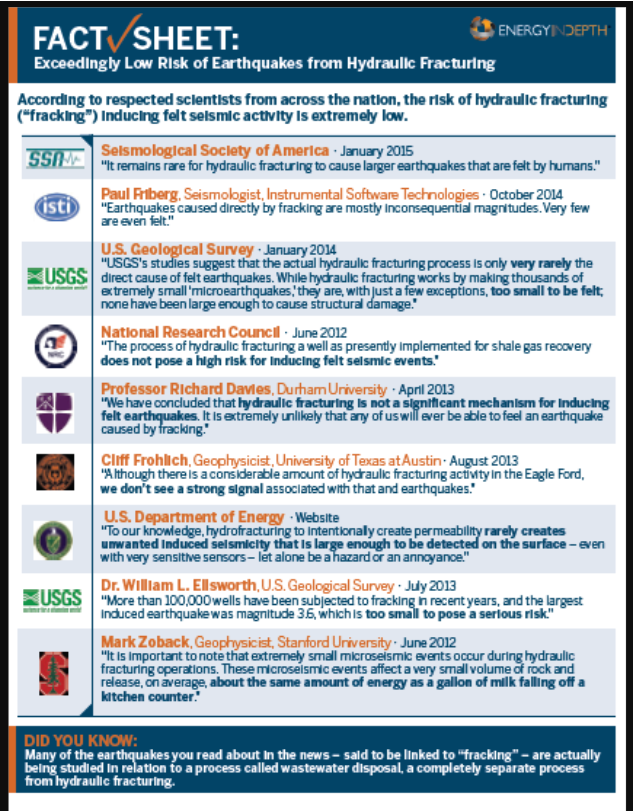
What about the concern that fracking causes earthquakes? Numerous studies have concluded that related tremors are so minor they’re barely detectable and cause no damage. At its worst, it produces vibrations comparable to a passing truck.

Vibrat

Fact sheet detailing the low risk of earthquakes from hydraulic fracturing, featuring quotes from various scientific organizations.

Air pollution?

According to the EPA emissions of sulfur, nitrogen, mercury, particulates, and carbon dioxide have all declined since large-scale fracking began and natural gas replaced coal for much of the nation’s electricity production.

Infographic displaying emission reductions from 2005 to 2016, highlighting percentages for sulfur dioxide, nitrogen oxide, fine particulate matter, and carbon dioxide alongside a symbol representing natural gas consumption.

Something else that natural gas has going for it which isn’t talked about much is land use. Per megawatt, natural gas uses about 12.4 total acres – including mining and transmission lines. By comparison, solar uses about 43.5 acres per megawatt, and wind uses more than 70.

More energy, less pollution, lower prices for consumers, small footprint.

Instead of vilifying fracking, maybe we should throw it a parade.

I’m Linnea Lueken, research fellow at the Heartland Institute, for Prager University.

A cartoon depicting two characters in a truck watching fireworks resembling stars explode above an oil rig, celebrating Independence Day.

Giant Gas Field Discovery Could Power Britain for a Decade

A giant gas field has been discovered under Lincolnshire that could fuel the UK’s entire needs for a decade, reducing dependence on imports and generating tens of thousands of jobs, an energy company has said.

From The Daily Sceptic

By Will Jones

A giant gas field has been discovered under Lincolnshire that could fuel the UK’s entire needs for a decade, reducing dependence on imports and generating tens of thousands of jobs, an energy company has said. The Telegraph has the story.

Egdon Resources, the business behind the discovery, is to formally announce its findings at an energy industry conference later this month.

Its preliminary work suggests that the field, centred on the market town of Gainsborough, is so large that it could benefit the whole UK economy, boosting growth through more jobs, increased tax revenue and cheaper energy.

If subsequent drilling confirms the scale of the find, it is likely to reignite the debate about fracking – and create a potential clash between Rachel Reeves, the Chancellor, and Ed Miliband, the Energy Secretary, as the Government attempts to chart a course between Net Zero and economic growth.

Fracking, the process of extracting gas by pumping ultra-high pressure liquid underground to crack the bedrock, is currently banned in Britain after previous work triggered small earthquakes.

Exploiting the field would mean ending this moratorium as well as lifting a ban on new oil and gas licensing introduced by Mr Miliband, whose own constituency of Doncaster North is close to part of the discovery.

It comes after Ms Reeves announced Labour’s support for a third runway at Heathrow Airport, despite longstanding opposition to the scheme from Mr Miliband. Earlier this year the Chancellor emphasised that growth, not Net Zero, was the Government’s “No 1 mission”.

Worth reading in full.

Stop Press: Ed Miliband is the only Cabinet Minister to say that he has a heat pump at his home.

Stop Press 2: Miliband has responded by pledging a permanent ban on fracking. Because of course he has.

Fracking and Pennsylvania: Why it Matters

To frack or not to frack has been a hot topic in the United States for several years. That discussion has been most intense in the state of Pennsylvania.

From The CO2 Coalition

To frack or not to frack has been a hot topic in the United States for several years. That discussion has been most intense in the state of Pennsylvania.

That is because the Keystone State is home to the Marcellus Shale, the largest natural gas accumulation in the world. According to Bill Zagorski, who was given the honorary moniker of “Father of the Marcellus,” the Marcellus contains 3,698 trillion cubic feet of gas (TCF). That size qualifies it as a mega-giant field.

To put that in perspective, the bubble map included here shows the top fifteen conventional natural gas fields in the world. The combined Gas-in-Place for all 15 is only slightly more than that for the Marcellus by itself.

In addition to this incredibly huge reservoir, two more reservoirs are being exploited in Pennsylvania. The Burket Shale is above the Marcellus and is a super-giant field, while the deeper Utica Shale may have reserves approaching that of the Marcellus.

Only by using horizontal drilling and hydraulic fracturing are these reserves made viable.

Pennsylvania and America can fuel the world’s needs for clean-burning natural gas for many generations and have plenty left over for our own domestic requirements. That is, if politicians and government would just get out of the way.

Learn more about America’s Natural Gas Juggernaut

Team Harris Swears Kamala Won’t Kill Fracking, But Will Anyone Believe Them?

Vice President Kamala Harris’ campaign has said she no longer endorses a ban on fracking, but political strategists and energy experts say the sudden policy shift will do little to move the needle with key voters in November.

From Watts Up With That?

The DAILY CALLER

Nick Pope
Contributor

Vice President Kamala Harris’ campaign has said she no longer endorses a ban on fracking, but political strategists and energy experts say the sudden policy shift will do little to move the needle with key voters in November.

Harris said in 2020 there is “no question” she would end fracking if elected president, but her campaign recently told The Hill she no longer wants to outlaw the practice after videos of her endorsing a ban resurfaced following President Joe Biden’s withdrawal from the 2024 race. The campaign can walk back Harris’ old fracking position as it pleases, but it likely won’t be enough to allay the concerns of crucial voting blocs — particularly more rural, blue-collar voters in Pennsylvania — that Harris may wage war on the industry or otherwise escalate Biden’s climate agenda to their detriment if elected, political strategists and energy experts told the Daily Caller News Foundation.

“She is going to find herself between a rock and a hard place on the issue of fracking, and also other issues like Gaza, too. She has all of her past statements, and the Biden-Harris administration record, which is against fracking and exports of liquefied natural gas,” Jon McHenry, a GOP polling analyst and vice president at North Star Opinion Research, told the DCNF. “And that’s great for her base supporters, the people who were upset about Joe Biden representing Democrats a couple weeks ago and are excited about Kamala Harris, who want her to ban fracking, and they’re excited to have a younger, more liberal candidate running for president.” (RELATED: Trump Campaign’s Simple Plan To Destroy Kamala Harris: Get Her Off-Script)

“The problem is she’s got to win independents in states like Pennsylvania and Wisconsin and Michigan and Georgia, North Carolina and Arizona, who want to see more energy developed in this country and for us to be more energy independent,” McHenry continued. “She wants to have her energy and ban it too.”

However, Harris could find a politically viable solution to her public perception problem on fracking if she were to disavow her old position and explain to voters that experiences in the White House — such as seeing how global energy markets were impacted by the Ukraine war — led her to change her mind, McHenry explained to the DCNF.

Fracking is a technique for extracting oil and gas from certain underground rock formations, and it enabled a natural gas boom in the U.S., with American natural gas consumption increasing by approximately 40% between 2000 and 2023 as the U.S. became the global leader in liquefied natural gas (LNG) exports, according to the U.S. Energy Information Administration.

The Biden administration decided in January to freeze approvals for new LNG export terminals, a move that critics say was meant to appease climate-focused voters and deep-pocketed environmental interests ahead of an election.

“Climate change and banning fracking were CENTRAL to her 2020 campaign! I mean, she went on the Tonight Show and performed a song about it! Nobody is going to believe anything other than she’s a climate cultist,” Scott Jennings, a political strategist and an on-air pundit for CNN, told the DCNF. “She’s the Greta of the U.S. government, and that ought to scare the bejeezus out of every energy worker in Pennsylvania and any American who would suffer under her obviously radical views.”

Harris has already racked up endorsements from major, deep-pocketed environmental organizations that oppose fracking just weeks after announcing her candidacy. Meanwhile, two of the more radical groups in the environmentalist movement — the Sunrise Movement and Climate Defiance — have so far withheld official endorsements.

“If I’m looking at the options around the election this November, there’s a lot of ways in which Kamala Harris will be immensely easier to pressure and change on that than a Donald Trump presidency would,” Aru Shiney-Ajay, the Sunrise Movement’s executive director, told reporters Monday, according to Politico.

Climate Defiance, which has protested against Harris with one of its disruptive demonstrations, has made demands for Harris to meet to demonstrate that she is a candidate who can “usher in an era of equity and sustainability.” The demands include ensuring that there is no more oil and gas infrastructure development and ending oil and gas leasing on federally-controlled lands and waters.

The political and electoral ramifications of Harris’ fracking flip-flop could be most visible in Pennsylvania, a huge natural gas producer and a crucial swing state in the 2024 cycle. Former President Donald Trump carried Pennsylvania in 2016 by a tight margin before losing it to Biden in 2020 in another close race; the state figures to be hotly-contested again in 2024, according to McHenry, with a new poll from Susquehanna Polling showing Harris up on Trump by four percentage points with 7% of respondents unsure who they will back in November.

Pennsylvania produced more natural gas than any state other than Texas in 2022, according to the U.S. Energy Information Administration, and the natural gas industry directly or indirectly supported about 123,000 jobs in the state as of 2022, according to an August 2023 report prepared by FTI Consulting for the Marcellus Shale Coalition. (RELATED: Could Joe Biden’s Natural Gas Pause Cost Dems The Senate In November?)

‘Abhorrent To Business’: Billionaire Warns Kamala Harris ‘Further Left Than Biden’ pic.twitter.com/WPMznW9N4u— Daily Caller (@DailyCaller) July 30, 2024

“Going back on her 2019 comments about banning fracking or abolishing the filibuster to pass the Green New Deal doesn’t change the facts that the Biden-Harris administration paused the expansion of LNG exports, exacerbated our looming reliability crisis with subsidized unreliable weather-dependent energy sources with the Inflation Reduction Act, and allowed federal agencies to over-regulate every coal and natural gas power plant in the nation providing reliable and affordable energy,” André Béliveau, senior manager of energy policy for the Commonwealth Foundation, told the DCNF. “Harris can backpedal on her 2019 comments all she wants, but her record from the last four years is clear.”

Dave McCormick, the GOP candidate for U.S. Senate in Pennsylvania, is already running an advertisement attacking Harris’ energy positions and tying together the vice president and his opponent, incumbent Democratic Pennsylvania Sen. Bob Casey.

Some pundits have suggested that Harris could mitigate risks she may face in Pennsylvania by picking Democratic Pennsylvania Gov. Josh Shapiro as her running mate. However, selecting Shapiro could cause problems for Harris in other states and isolate voting blocs she needs to win due to his support of Israel and criticisms of pro-Palestinian activists, McHenry told the DCNF.

“Bob Casey and Kamala Harris have opposed Pennsylvania energy every step of the way, and their anti-fossil fuel agenda would be disastrous for our commonwealth and the 600,000 workers who rely on the energy sector for a paycheck,” McCormick said in a statement shared with the DCNF. “Banning fracking and abolishing the filibuster to pass a Green New Deal may be popular among the far-left, but here in Pennsylvania these radical proposals are radically out of step with the needs of working families.”

The Harris and Casey campaigns did not respond immediately to a request for comment.

All content created by the Daily Caller News Foundation, an independent and nonpartisan newswire service, is available without charge to any legitimate news publisher that can provide a large audience. All republished articles must include our logo, our reporter’s byline and their DCNF affiliation. For any questions about our guidelines or partnering with us, please contact licensing@dailycallernewsfoundation.org.

UK Government is playing into Putin’s hands

Net Zero Watch has warned that the Government’s ban on fracking and its strangling of North Sea oil and gas investment is playing into Russian hands.

From Net Zero Watch

London, 9 May – Net Zero Watch has warned that the Government’s ban on fracking and its strangling of North Sea oil and gas investment is playing into Russian hands.

The merchant bank Goldman Sachs has today warned that European gas prices could triple this winter, triggering a new energy cost crisis, even before the possibility of Russia sabotaging undersea cables and pipelines, a real threat raised by security experts last week.

Net Zero Watch has been warning for years that Britain’s energy security can only be safeguarded by developing domestic energy resources. Its director Andrew Montford said:

Putin barely needs to attack oil and gas infrastructure in the UK, because the Government is doing such a good job of restricting domestic supply without him. Net Zero policy plays straight into his hands.”

Net Zero Watch has been highlighting the fact that prioritising renewable energy over reliable energy sources represents a major threat to national security for several years.

Andrew Montford said:

The government are sacrificing everything on the altar of their Net Zero dogma: economic security and national security just don’t seem to matter to them any longer.”

Further information

* Net Zero Watch calls for emergency restart of fracking

* Government’s years of irresponsible neglect has left Britain “at mercy of Putin”

* Revitalise North Sea exploration and start fracking — or lose Putin’s energy war for good

* How UK shale gas was killed by Green lies and Russian propaganda

Net Zero Watch calls for emergency restart of fracking

Campaigning group Net Zero Watch has warned the Government that its ban on fracking is now a direct threat to national security and has called for Prime Minister Rishi Sunak to change course as a matter of urgency. 

From Net Zero Watch

As Russia threatens UK energy supplies, Britain needs to restart fracking now

London, 4 May – Campaigning group Net Zero Watch has warned the Government that its ban on fracking is now a direct threat to national security and has called for Prime Minister Rishi Sunak to change course as a matter of urgency. 

It has been reported this week that NATO officials are extremely concerned that Russia may have mined gas pipelines and windfarm cables in the North Sea. 

According to Net Zero Watch analysis, offshore wind generates 10% of the UK’s electricity supply, a figure that is rising rapidly.

According to Net Zero Watch director, Andrew Montford:

Offshore wind generation is increasingly concentrated in a small number of huge windfarms. If someone takes out the undersea grid connections of just the ten largest, 6% of our electricity supply could be eliminated at a stroke, and nobody would know who had done it.”

In addition, 77% of the UK’s gas imports come by undersea pipeline from Norway, and are thus also at risk. With geopolitical tensions on the rise, it is clear that pipelines, undersea wires and interconnectors have become a critical vulnerability, and experts are calling for an urgent rethink.

Security expert Professor Gwythian Prins said:

In time of ‘grey war’ the only secure energy sources are ‘firm’ power sovereign assets. That means onshore gas – and coal – starting with fracked gas. National security requires fully exploiting those resources, while giving the Royal Navy and the RAF the wherewithal fully to defend firm energy assets – first and foremost oil and gas rigs and pipelines and the Norwegian gas pipeline in the North Sea.”

Further information

Government’s years of irresponsible neglect has left Britain “at mercy of Putin”

Revitalise North Sea exploration and start fracking — or lose Putin’s energy war for good

How UK shale gas was killed by Green lies and Russian propaganda