Ending America’s critical minerals self-sabotage

The war with Iran – with its disruptions to the flow of oil, gas, fertilizer, jet fuel, and other petroleum-based products to global markets – is a timely reminder that not even the relatively self-sufficient United States can escape the effects of geopolitical disharmony.

From CFACT

By Bonner Cohen, Ph. D.

The war with Iran – with its disruptions to the flow of oil, gas, fertilizer, jet fuel, and other petroleum-based products to global markets – is a timely reminder that not even the relatively self-sufficient United States can escape the effects of geopolitical disharmony.

However much Americans may gripe about prices at the pump and the supermarket, the current discomfort is nothing compared with the pain the nation endured in the 1970s in the wake of the Arab oil embargo. Even though the closure of the Strait of Hormuz resulted in greater disruptions to global energy supplies, the effect on American consumers was far less than in the earlier episode. A half-century ago, the U.S. was the world’s largest importer of crude oil, and American households and businesses paid dearly for our energy dependence on the chronically unstable Middle East.

Now, as the world’s largest producer of oil and natural gas, and the global leader in the export of liquified natural gas (LNG), America is reaping the benefits of global energy dominance. This will become even more apparent as energy prices begin to fall now that an, albeit fragile, peace agreement has been reached.

While being prepared for a global energy shock paid off in 2026, we can’t afford to rest on our laurels, thanks to self-inflicted wounds in another vital sector of the economy that go back decades. Though the country is blessed with abundant resources of critical minerals, as the expression goes, “you can’t get there from here.”

According to a recent analysis by the Pacific Legal Foundation (PLF), “It takes an average of 29 years [for a mining project] to make it through the permitting process in the United States – the second-longest of any country in the world, followed only by Zambia.” Facing the gauntlet of endless litigation and paperwork, many developers wind up walking away from promising mining projects.

“As a result, America relies primarily on imports for critical minerals, minerals crucial to national security, energy infrastructure, and technological development – that are vulnerable to supply-chain disruptions,” PLF points out. “In 2025, China supplied more than 50 percent of U.S. demand for 21 mineral commodities.”

Dependence on our greatest geopolitical rival for critical minerals is asking for trouble. China’s control of the global supply chain for critical minerals is one of the stepping stones Beijing uses in its quest to displace the U.S. as the world’s premier power. “These materials make up the electrical wires that power our homes and businesses and the chips inside smartphones and laptops, and they form the backbones of the entire energy infrastructure of the United States,” the PLF analysis notes. According to S&P Global, the U.S. is home to some 275 million metric tons of copper, along with generous deposits of lithium, nickel, cobalt, and rare earths. Yet these riches are largely off-limits to domestic development.

Any serious talk about reshoring manufacturing to the U.S. must include dismantling the barriers that stand in the way of getting domestic raw materials to our factories. Among other things, this means revisiting four decades-old statutes – the National Environmental Policy Act, the Endangered Species Act, the Clean Water Act, and the National Historic Preservation Act. Taken together, these laws, which serve different purposes, entail overlapping permitting requirements that can take decades to navigate. They also are an open invitation for environmental groups who use endless litigation to “keep it in the ground.”

Efforts to pass sweeping bipartisan permitting reform in Congress have stalled, notably in the Senate, with Democrats hoping to use the issue to boost the fortunes of wind and solar power. Specifically, Democrats want permitting reform to cover high-voltage, long-distance powerlines connecting remote wind and solar facilities to population centers, something opposed by the Trump administration and most Republicans. Critical minerals, along with the build-out of oil and gas pipelines, are now captives to green energy.

Iran’s closure of the Strait of Hormuz will be a one-off. In what is the energy equivalent of a coronary bypass, Gulf oil and gas producers are already planning the rapid expansion of pipeline networks in the region so they can escape the strait’s bottleneck once and for all. The permitting nightmare blocking America’s access to priceless critical minerals is not a one-off. It must be dismantled, the sooner, the better.

A version of this article originally appeared at The Washington Times

British Climate Crusade Creates Economic Disaster

Across the Atlantic, a self-inflicted disaster is steadily unfolding. One of the United States’ closest allies, the United Kingdom, has surrendered energy riches and industrial prowess.

A desolate street featuring the iconic Big Ben and crumbled buildings, with two figures walking among debris and a torn Union Jack flag on the ground.

From The CO2 Coalition

By Vijay Jayaraj

A dramatic scene depicting a distressed man shouting in front of a backdrop of industrial ruins and smoke, with the text 'British Net Zero Industrial Collapse' overlaying the image.

Across the Atlantic, a self-inflicted disaster is steadily unfolding. One of the United States’ closest allies, the United Kingdom, has surrendered energy riches and industrial prowess.

This decline is not the result of any shortage of capital, technological capacity or natural resources. Instead, it is the consequence of an ideologically driven climate agenda that has elevated “green” symbolism over engineering reality.

For years, politicians have beaten their chests about the U.K.’s “world-leading” renewable capacity. They paraded statistics showing wind and solar generating most of the electricity, conveniently ignoring that this only happens when the wind blows and the sun shines.

When “green” generation doesn’t perform, British taxpayers pay for natural gas-fired power plants to back up idle facilities and stabilize the grid. They also pay “constraint payments” to switch off wind turbines when it is too windy to operate them.

This is the great deception of the Levelized Cost of Energy (LCOE) metric the green lobby loves to cite. LCOE excludes the enormous price of grid balancing, backup generation, curtailment payments, transmission expansion and subsidies – all required to prop up the green sham.

In the real world – where bills must be paid – the U.K. has created for itself some of the highest electricity rates on the planet, up to four times more than in the United States. One-third of Scots live in energy poverty. But the real cost never shows up in glossy charts that promote manipulated data representing wind and solar as cheap.

The price caps of Great Britain’s Office of Gas and Electricity Markets now dominate household conversations, which are amplified by each winter’s anxiety over lifestyle choices. Heat or eat has shifted from a slogan to a lived reality. Once a power behind the Industrial Revolution, Britain has shamefully imposed on its citizens energy poverty. Families ration warmth while politicians celebrate decarbonization targets.

One reader told U.K.’s Independent of heating only a single room with a wood-burning stove, mimicking a 19th century living standard 200 years later. Such is the “Green Industrial Revolution” promised by know-nothing managers of energy policy.

And for what? So that the U.K. can reduce its negligible contribution to global emissions of harmless carbon dioxide. Meanwhile, China and India build coal plants to power the manufacturing exported to them by those who have frittered away British industrial might.

Manufacturers have little choice but to leave when a “carbon tax” and heavy-handed regulation on carbon dioxide emissions artificially inflate the cost of energy. Steelmakers are on their knees, facing energy bills that have surged by billions, rendering British steel uncompetitive against foreign rivals free of net-zero dogma.

Nowhere is the insanity more visible than in the North Sea. For decades, offshore oil and natural gas were the crown jewels of the British economy, providing cheap, reliable energy and revenue to fund public services.

Today, this resource is being sacrificed at the altar of climate theology. The Prime Minister’s punitive windfall taxes and refusal to issue new licenses have effectively killed North Sea energy development. Investors have fled. Rigs are decommissioning. Thousands of skilled jobs are evaporating.

Compare this to U.K. neighbor Norway, which continues to extract oil and natural gas from the sea and sell to global customers, including the U.K. While Britain dismantles its energy sovereignty to appease the likes of Extinction Rebellion, Norway enriches its citizens and funds its sovereign wealth fund.

The contrast is humiliating. The U.K. imported over 50% of its natural gas supply in 2024 from Norway.

Apologists for this British collapse point to anything but the truth. They blame Brexit and the Russia-Ukraine war. They blame a “global recession,” pretending that the U.K.’s de-industrialization isn’t an outlier. But the fundamental reason for the collapse is the “green” agenda espoused by the political establishment for 20 years.

It has been a bipartisan failure. Tories chased the “green vote” by banning fracking and demonizing diesel. The Labour party doubled down with net-zero mandates that defy the laws of physics and economics. They built a grid fragile to the weather and expensive to the user.

A crusade to avoid an imaginary climate catastrophe of the future has created a very real economic disaster in the present.

Originally published in Real Clear Markets on January 21, 2026.

Vijay Jayaraj is a Science and Research Associate at the CO2 Coalition, Fairfax, Virginia. He holds an M.S. in environmental sciences from the University of East Anglia and a postgraduate degree in energy management from Robert Gordon University, both in the U.K., and a bachelor’s in engineering from Anna University, India. He served as a research associate with the Changing Oceans Research Unit at University of British Columbia, Canada.

Climate Cult’s Inevitable Dissolution

The collapse of the Paris Agreement and the unmasking of the net zero illusion were never hard to predict for anyone with a shred of intellectual honesty. It didn’t take a fancy research title or an advanced degree. The writing was carved deep into the stone of energy reality, which no press release, no activist lobby and no billionaire-backed foundation could erase.

A dramatic illustration featuring a towering figure in tribal attire with a skull ornament, holding a flaming Earth, while four scientists in lab coats kneel in reverence or fear, surrounded by smokestacks in the background.

From The CO2 Coalition

By Vijay Jayaraj

A gravestone commemorating the Paris Climate Agreement, with the years 2015 - 2025 inscribed, surrounded by flowers on a grassy field.

The collapse of the Paris Agreement and the unmasking of the net zero illusion were never hard to predict for anyone with a shred of intellectual honesty. It didn’t take a fancy research title or an advanced degree. The writing was carved deep into the stone of energy reality, which no press release, no activist lobby and no billionaire-backed foundation could erase.

Most nations – particularly those early in building their futures – offered only empty nods to climate targets. Their participation was a transparent quest for political leverage. The climate crusade survived by hijacking the political class, manipulating data through compliant scientists, and converting media empires into megaphones of fear.

Bill Gates stepped away from the frontlines of climate alarmism in a recent essay timed for the United Nations’ COP30, an annual gathering of jet-setting moralists. Gates admits – as supported by the recent U.S. Department of Energy report on carbon dioxide – that the world will not collapse because of climate change.

He has called for a shift in focus to more immediate needs. Gates says that “we will still rely on fossil fuels for decades,” that “no single technology can decarbonize the global economy,” and that “the pace of change will be slow.” He’s reacting to the wreckage of ideology from its collision with the laws of physics.

In recent New York election campaigns, some of the Green New Deal’s most famous apostles, Alexandria Ocasio-Cortez and Bernie Sanders, saw their climate gospel sidelined, no longer commanding the stage. Voters heard more about housing, jobs, and public safety than decarbonization, offshore wind or carbon credits.

These are signposts of a larger movement underway, both in the United States and abroad.

In the U.K.’s North Sea and off the U.S. East Coast, massive wind projects are being canceled. Green steel is struggling to compete with fossil fuel-based conventional steel. Oil companies, after spending years and billions of dollars on “green” branding and virtue signaling, are quietly backtracking on ambitious climate goals.

In 2025, Argentina shocked global institutions by withdrawing from the Paris Agreement. President Javier Milei declared that his nation would no longer “kneel before climate bureaucrats.” China continues its rapid construction of coal-fired power plants, adding more coal capacity than the rest of the world combined. India’s coal consumption is at an all-time high, and the government is aggressively auctioning new blocks of coal.

Developing economies in Asia and South America know survival requires coal, oil and natural gas. African leaders seek to tap their continent’s reserves of hydrocarbons to power economic development.

The fragile structure of global decarbonization depended on financing from its chief patron, the United States. When that flow of dollars ceased with the incoming Trump administration, the fading of an already decrepit climate narrative accelerated. What remains now is to utterly unmask the 21st century’s most malignant fraud and to educate a generation propagandized in public schools and woke universities.

The truth has emerged bit by bit. We were told that wildfires were unprecedented, yet historical data show fire frequency has declined globally. We were told the Arctic would be ice-free, yet it remains frozen. We were told of a “climate-driven” food crisis, while the mild warming and increased CO2 – a vital plant food – have contributed to global greening and record crop harvests. The food supply is more secure, not less.

The gap between alarmist predictions and observed reality is no longer possible to hide. Scientists deliberately misled the public with cherry-picked data, tortured computer models until they produced the “correct” scary result and labeled any natural weather event as “proof” of climate change. What masqueraded as “consensus” was nothing more than a cartel of profiteers feeding on public guilt and taxpayer money.

This was not good-faith scientific inquiry but rather a narrative designed to frighten, to control consumer choices and to justify a massive political and economic reorganization. Much of the public, sensing this dishonesty, no longer listens. The authority of the climate “experts” has been damaged, perhaps irrevocably. Their incessant cries of “wolf” failed to produce the climate beast.

The climate cult declared war on the very engines that lifted humanity from hunger and hardship. Its legacy is economic vandalism and moral decay. The spell is breaking, and what’s emerging from the rubble is not despair, but liberation — a long-awaited return of reason to a world held hostage by fear.

This commentary was first published by The Hill on December 9, 2025.

Vijay Jayaraj is a Science and Research Associate at the CO2 Coalition, Fairfax, Virginia. He holds an M.S. in environmental sciences from the University of East Anglia and a postgraduate degree in energy management from Robert Gordon University, both in the U.K., and a bachelor’s in engineering from Anna University, India.

A digitally created scene featuring a prominent figure standing confidently with a backdrop of the U.S. Capitol building, oil refineries, and the Statue of Liberty, under a large sun with birds flying in the sky.

Norway Avoids ‘Green’ Energy Quicksand

While the rest of Europe shivers under the self-imposed austerity of net zero mandates, Norway in the frozen north is keeping the lights on and the bank vaults full as it avoids the “green” ideological quicksand that has defined the continent’s energy policy.

An offshore oil rig illuminated under the Northern Lights, with colorful auroras lighting up the night sky above snow-covered mountains.

From Watts Up With That?

By Vijay Jayaraj

While the rest of Europe shivers under the self-imposed austerity of net zero mandates, Norway in the frozen north is keeping the lights on and the bank vaults full as it avoids the “green” ideological quicksand that has defined the continent’s energy policy.

Despite pressures to decarbonize, Norway has increased efforts to exploit oil and natural gas reserves. The crown jewel of this fossil fuel renaissance is the Johan Castberg field. Located in the Barents Sea, 100 kilometers north of the 20-year-old Snøhvit natural gas field, Johan Castberg is expected to be a beast of a producer – 450 million–650 million barrels over 30 years, with a peak daily capacity of 220,000 barrels.

And the investments don’t stop there. The Norwegian government – ignoring wailing of the United Nations – has initiated plans for its 26th round of oil and gas licensing. Targeted will be “frontier areas” – little-explored regions that can reward high risk with massive returns. While the U.K. suffocates its North Sea industry with windfall taxes and regulatory hostility, Norway is effectively saying, “If you won’t drill, we will.”

Companies operating on the Norwegian continental shelf plan to pour about $25 billion into oil and natural gas projects in 2026. Almost $2 billion higher than a previous estimate because of rising development costs, the commitment signals determination to keep production climbing.

Since autumn 2024, the price of ongoing development has swelled by 17%, which is consistent with a rising trajectory that had Norway overtake Russia in 2022 as Europe’s principal supplier of natural gas.

Despite the country’s embrace of fossil fuels, “greens” enthusiasts often point to Norwegians’ widespread adoption of electric vehicles as a model for other countries. However, as is often the case, the pretense of a “green” utopia is promoted through a deception.

The gleaming EVs filling the streets of Oslo are subsidized by the government’s oil revenue.

The Norwegian sovereign wealth fund – known as the Government Pension Fund Global – is the largest of its kind in the world. As of November, its assets were valued at over $2 trillion. On paper, that is $340,000 for every Norwegian.

It is a delicious irony that the climate activists’ favorite “model” nation is funded by the very substance they despise. Every time Norwegians plug in an EV, they are effectively accepting a handout from drillers at Johan Castberg. The “green” lifestyle is a luxury purchased with petrodollars.

Norway is not without its problems. The country’s substantial electricity exports to the EU become toxic, as the continent uses Norway as a crutch to compensate for the failure of its own wind and solar investments.

Norwegian households, accustomed to decades of low energy prices from abundant hydropower, have been adversely affected by flexible pricing contracts that link their electricity costs to the high prices of European markets. Oslo – along with Stockholm and Helsinki – is tiring of mainland Europe treating the Nordic grid as a dumping ground for the costs of EU’s star-crossed love affair with so-called renewable energy.

Nonetheless, Norway is better off than European Union countries. Not being a member of the EU, Norway has been able to maintain energy sovereignty and out of the net zero suicide pact gripping EU capitals.

Free of the European Union’s authoritarian energy directives has turned into the greatest blessing Norway never asked for. While the EU suffers through “managed decline” in the name of climate salvation, Norway stands apart – enjoying relative wealth and secure energy supplies while watching the spectacle of a continent that chose ideology over arithmetic.

Among the foreign countries in which Gregory Wrightstone’s “Inconvenient Facts: The science that Al Gore doesn’t want you to know” received wide distribution was Norway. (A Norwegian language version is available.)

Europe built its “green” cathedral on the shifting sands of a cult. Norway built its future on rocks that happen to float in black gold.

This commentary was first published by American Greatness on December 14, 2025.

Vijay Jayaraj is a Science and Research Associate at the CO2 Coalition, Fairfax, Virginia. He holds an M.S. in environmental sciences from the University of East Anglia and a postgraduate degree in energy management from Robert Gordon University, both in the U.K., and a bachelor’s in engineering from Anna University, India.

IEA Publishes Climate Era’s Obituary

The end is nigh – not for the world, but for the climate industrial complex. It has been a decline brought about mainly by the sheer reality of energy economics in the developing world.

A dystopian landscape depicting a desolate city with crumbling buildings and abandoned cars, overlaid with the text 'NET ZERO 2093.'

From Watts Up With That?

By Vijay Jayaraj

The end is nigh – not for the world, but for the climate industrial complex. It has been a decline brought about mainly by the sheer reality of energy economics in the developing world.

Published by the International Energy Agency (IEA), the “World Energy Outlook 2025” reads like an obituary for the fantasy of global decarbonization, acknowledging the undeniable truth that nations prioritizing prosperity must unapologetically embrace coal, oil and natural gas.

For years, the IEA and Western think tanks insisted that hydrocarbons were in structural decline, predicting a fatal drop in demand after 2030. Yet in the very document meant to track progress toward realizing an absurd net-zero objective, the IEA concedes that demand for oil and natural gas will continue to grow well beyond 2035 and may not peak until 2050.

The key insight of the IEA report is that emerging markets, excluding China, are becoming the primary drivers of growth in global energy consumption. This is a massive, structural shift. No longer will the trajectory of energy markets be dictated by the policies of Paris, Berlin or Washington but rather by the sovereign choices of nations whose citizens are desperate for better lives.

India is projected to see the fastest average increase in energy consumption among all emerging markets, rising by a robust 3% each year on average through the middle of the century. Oil and natural gas will meet a large percentage of this. India’s oil use is projected to jump from 5.5 million barrels per day in 2024 to 8 million by 2035 to match growth in aviation, vehicle ownership and the manufacture of plastics and chemicals.​

But the real deal is India’s and Indonesia’s adoption of coal – until recently treated as a relic of the past. For the next 40 years, the dynamics of this fossil fuel will be shaped in the boardrooms of New Delhi and Jakarta.

The demand for coal by India’s industrial sector is projected to skyrocket by an astounding 60% by 2035. Nearly a quarter of new steel manufacturing globally is planned for India and Southeast Asia, with production in these regions to almost double by 2035.

Indonesia’s need for industrial coal is expected to increase by more than 45% over the same period. Factories, nickel smelters and chemical plants – the backbone of its manufacturing boom – are consuming more energy every quarter.

Perhaps the IEA’s most revealing figures are for growth in per capita electricity demand. India’s and Indonesia’s are to grow by 80% and 70%, respectively, by 2035.

These surges are driven by air conditioning, appliances, urbanization and relentless population growth. Power-grid extensions in Indonesia have almost doubled, adding nearly 1 million kilometers of new lines within a decade.

The IEA notes that India hit its 2030 target for non-fossil power capacity five years ahead of schedule, yet fossil fuels continue to provide the lion’s share of flexible and dispatchable generation. Why? Because so-called renewables remain intermittent, and only fossil fuels, along with nuclear power, can hope to guarantee the kind of reliability that industry requires and modern society expects.

For India and Indonesia – and many others – coal is a guarantor of industrial ascendancy; and it very well may prove to be a key ingredient in the development of data centers in the already tech-dominated cities of India.

For developing nations, the primary threats come from energy deprivation and economic stagnation, not ideological driven forecasts of a climate apocalypse. Serious leaders will not place their bets on unreliable technologies like wind and solar in pursuit of Western elites’ fanciful “carbon-free” utopia. Way too much is at stake.

This commentary was first published by American Thinker on November 17, 2025.

Vijay Jayaraj is a Science and Research Associate at the CO2 Coalition, Fairfax, Virginia. He holds an M.S. in environmental sciences from the University of East Anglia and a postgraduate degree in energy management from Robert Gordon University, both in the U.K., and a bachelor’s in engineering from Anna University, India.

Transportation Dept. takes more wind out of offshore wind

The Department of Transportation recently scuttled $679 million in federal funding for coastal port projects intended to support the heavily subsidized offshore wind industry. The money will instead be used for much-needed traditional infrastructure and shipbuilding.

A view of offshore wind turbines standing tall in the ocean under a cloudy sky, with birds flying above and a city skyline visible in the background.

From CFACT

By Craig Rucker

Offshore wind turbines silhouetted against a vibrant sunset over calm waters.

The Department of Transportation recently scuttled $679 million in federal funding for coastal port projects intended to support the heavily subsidized offshore wind industry. The money will instead be used for much-needed traditional infrastructure and shipbuilding. 

It’s a tiny fraction of the tens of billions spent or committed to wind and solar energy projects. But the cuts reinforce President Trump’s determination to end federal funding for this expensive form of electricity from offshore turbines that generate power only 35 to 40 percent of the time. 

Where will people get their electricity during the other 100 hours each week? If oil and natural gas are locked in the ground, where will they get their paints, plastics, pharmaceuticals, synthetic fibers, and cosmetics — the 6,000-plus products that come from petrochemicals—including wind turbine blades? 

An infographic displaying various everyday products made from oil, arranged around a central image of an oil barrel. Categories include automotive, beauty, kitchen, medical, and more, showcasing items like car seats, toys, hair dryers, and plastic bags.

Twelve projects were affected, including California’s Humboldt Bay Offshore Wind Project. At $427 million, this was the most significant federal grant rescinded by the Transportation Department. 

Along with the $8 million Redwood Marine Terminal, Humboldt was the most indefensible of any offshore wind power proposal yet conceived. There is no continental shelf off the once-Golden State, so wind advocates were planning to install Washington Monument-size turbines on enormous semi-submersible platforms anchored by cables to the seafloor, 1,000 feet or more below the ocean surface. 

The concept has never been tested in the real world, and the unfathomable risks include the danger that cables could snap, causing entire rigs to capsize in storms, creating debris fields along the Pacific Coast. 

Funding was also withdrawn from “wind port projects” at the Bridgeport Port Authority (Connecticut), Port of Davisville (Rhode Island), Paulsboro (New Jersey), Norfolk (Virginia), Sparrows Point (Maryland), and Arthur Kill Terminal (New York). 

Funding was terminated for  Radio Island (North Carolina), Lake Erie (Michigan), Portsmouth Marine Terminal (Virginia), and Salem Wind Port (Massachusetts) projects. 

These subsidies were cunning, part of a decades-long effort to keep alive the myths that offshore wind energy is nearly self-sufficient and generates increasingly inexpensive electricity. Who’d have thought funding for Atlantic, Pacific, and Great Lakes ports was actually another wind energy subsidy? 

The same applies to some of the terminology, such as the Lake Erie Renewable Energy Resilience Project. Its on-and-off electricity will certainly force customers to be resilient—if they want to cool their homes 24/7 in summer, heat them in winter, or watch the Super Bowl. 

Reactions to the cutbacks were swift and predictable. 

Five East Coast governors jointly criticized the Transportation Department’s actions. Walking back these government commitments jeopardizes families and wastes years of progress, they said. Terminating this funding could “cost tens of thousands of American jobs” in energy industries and cause investors to avoid financing future projects. 

Environmentalists and wind industry representatives said the decision undermines the “clean” energy industry, kills high-paying jobs and could lead to higher energy prices. 

They’re all mistaken. This energy is not “clean.” Offshore wind installations require 14 times more raw materials than combined-cycle gas-generating plants to produce the same amount of electricity, without including materials for backup power and transmission lines. 

That requires mining all over the planet, much of it involving widespread destruction of croplands and wildlife habitats, extensive child and slave labor, and enormous amounts of toxic air and water pollution. 

Any high-paying jobs that might be lost in installing and maintaining offshore turbines would be replaced by jobs building and operating coal, gas, and nuclear power plants that generate reliable, affordable electricity in quantities that the power-hungry nation needs — for AI, data centers, hospitals, factories, and modern living standards. 

Higher energy prices are primarily a result of policies favoring wind and solar energy. Many costs are hidden in subsidies and electricity rate add-ons. Rates are much higher in states and countries that have the most wind and solar generation, primarily because they must duplicate every megawatt of “renewable” power with generators that ensure electricity when there is no wind or sunshine. 

A heavy reliance on wind and solar power leads to repeated, often widespread blackouts. Sky-high electricity prices kill jobs. Replacing wind and solar with gas, coal, and nuclear power means reliable, affordable electricity that supports and sustains industries and employment.   

States can still finance these port upgrades themselves and pursue their offshore wind turbine dreams. However, they must also safeguard endangered whales and other marine species, Navy submarines, and other military operations, fishing vessels, and vital air and surface transportation activities that offshore wind installations may jeopardize. 

American budgets, jobs, health, welfare, and environmental treasures cannot afford more energy fantasies, especially offshore wind. 

The DOT made the right call in ending these wind turbine subsidies and redirecting the money to where it’s really needed.

This article originally appeared at DC Journal

The Fracking Truth

I’m talking about fracking: the process of extracting oil and natural gas from fine cracks in shale rock.

Gas tanks and workers at a fracking site during sunset.

From Science Matters

By Ron Clutz

Linnea Lueken sers the record straight on fracking in the above video from Prager U.  Transcript in italics below with my added images.

Graph showing oil production in thousands of barrels per day compared to oil prices per barrel from 2010 to 2018. Conventional oil production is represented in orange, shale oil production in blue, and the spot price in red.

It is one of the greatest innovations of the last fifty years.

It has saved consumers billions of dollars…

Prevented untold tons of carbon emissions from entering the atmosphere…

Graph depicting U.S. natural gas plant liquids production by region and type, showing historical data and projections from 2000 to 2050.

And almost single-handedly rescued an economy that was in the middle of a severe downturn.

You’ve probably heard of this innovation — not as a source of pride, but as an object of scorn.

I’m talking about fracking: the process of extracting oil and natural gas from fine cracks in shale rock.

So, what gives?

A close-up image of a hand holding a lighter near a flame, with a faucet in the background, illustrating the controversial effects of fracking.
Originated from treehugger.com

Why has something that has done so much good been so unappreciated — even vilified?

The answer, of course, is that the opponents of fracking — environmentalists and their political and media allies — say that the negatives of fracking outweigh its positives.

What are those negatives?

Detractors have a long list: contributing to global warming, putting local drinking water at risk, and even causing earthquakes are high among their complaints.

Those are pretty serious charges. But are they valid?

Before I answer that question, let’s cover a little history.

Fracking — whatever your current impression of it — is a great American success story.

A diagram illustrating the differences between conventional and unconventional oil and gas wells, showing drilling methods, water aquifers, and the process of hydraulic fracturing.

Before the twenty-first century, fracking as we know it now barely existed. The concept — reaching pockets of oil and gas trapped in shale — had been around for decades, but wasn’t practically or financially feasible.

Technological breakthroughs and a few eureka moments — like horizontal drilling and using improved ground-penetrating radar — in the early 2000s changed everything.

In traditional oil production, a company drills a well with the goal of finding a reservoir of oil. In fracking, the goal is to liberate a vast number of small pockets of oil and gas that have been trapped in the shale rock.

A narrow shaft is drilled — first vertically, and then horizontally. Water, mixed with sand and other additives, is pumped down the shaft at extremely high pressure to create tiny fissures in the surrounding rock. The sand holds the tiny cracks open, allowing the oil and gas to escape and flow back up the well to the surface.

What makes the innovation of fracking even more remarkable is that it emerged at a time when the theory of “Peak Oil” was widely accepted. Advocates of this theory—including many prominent scientists—warned that humans would soon run out of fossil fuels.

Fracking turned the theory upside down. In a matter of a few years, the world had more oil and gas than it knew what to do with — most of it coming from the United States.

The benefits from the fracking revolution were almost immediate.

The price of natural gas fell from $9 per cubic foot to $3. Consumers saved big on their gas and electric bills.

As gas replaced coal as a cheap, reliable energy source, greenhouse gas emissions fell more than 20%.

The US economy, reeling from the 2008 financial crisis, reversed course. The fracking boom was the number one reason.

Ironically, the politician who benefited the most from this boom was a fierce foe of fossil fuels, President Barack Obama. And, while he continued to push his green agenda, he did almost nothing to stop the fracking phenomenon.

Perhaps he read the science. It emphatically endorses natural gas as a clean energy source. Even Carl Pope, then the executive director of the Sierra Club, one of the world’s largest environmental groups, came out for fracking. As Pope saw it, natural gas was the perfect transition between fossil fuels and alternative energy.

With that history in mind, let’s return to the charges made by opponents of fracking.

The EPA — hardly a friend of the oil and gas industry — has looked closely into the question of whether fracking puts aquifers, the source of much of our drinking water, at risk. One EPA study examined 110,000 fracking sites. It concluded that fracking does not pose a threat. One obvious reason is that fracking is done at depths of six to ten thousand feet. Water tables tend to be at 500 feet or higher.

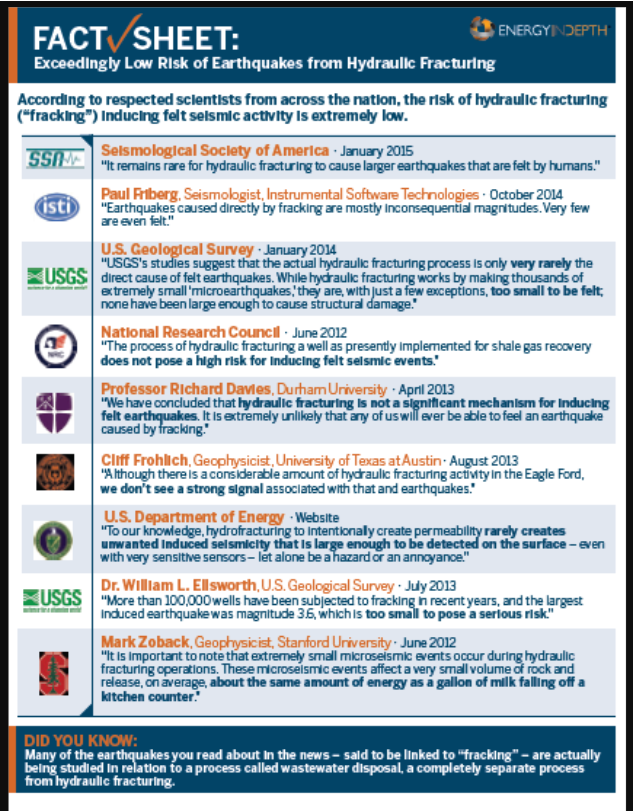
What about the concern that fracking causes earthquakes? Numerous studies have concluded that related tremors are so minor they’re barely detectable and cause no damage. At its worst, it produces vibrations comparable to a passing truck.

Vibrat

Fact sheet detailing the low risk of earthquakes from hydraulic fracturing, featuring quotes from various scientific organizations.

Air pollution?

According to the EPA emissions of sulfur, nitrogen, mercury, particulates, and carbon dioxide have all declined since large-scale fracking began and natural gas replaced coal for much of the nation’s electricity production.

Infographic displaying emission reductions from 2005 to 2016, highlighting percentages for sulfur dioxide, nitrogen oxide, fine particulate matter, and carbon dioxide alongside a symbol representing natural gas consumption.

Something else that natural gas has going for it which isn’t talked about much is land use. Per megawatt, natural gas uses about 12.4 total acres – including mining and transmission lines. By comparison, solar uses about 43.5 acres per megawatt, and wind uses more than 70.

More energy, less pollution, lower prices for consumers, small footprint.

Instead of vilifying fracking, maybe we should throw it a parade.

I’m Linnea Lueken, research fellow at the Heartland Institute, for Prager University.

A cartoon depicting two characters in a truck watching fireworks resembling stars explode above an oil rig, celebrating Independence Day.

Leveraging Michigan’s Assets as an Economic Growth Catalyst

The One Big Beautiful Bill (OBBB) cuts red tape and trims taxes on new resource projects. It simplifies rules, clarifies costs, and enforces swift penalties. These reforms reduce investor risk and shorten the timeline from testing to production. As a result, the legislation will be able to reshape many state’s natural resource landscape. Michigan can be an ideal example of federal, state and local government partnering to develop a modern strategy that both safeguards the environment, especially the Great Lakes while responsibly develops oil, natural gas, and rare earth elements as well. With this new legal framework in place, Michigan is well-positioned to strategically leverage three of its most valuable natural assets.

A city street view featuring the Empire State Building in the background with green trees lining both sides and various vehicles parked along the road.

From Watts Up With That?

By Timothy G. NashAnthony StorerBob ThomasParker Fairbairn

A scenic view of a sunset over a calm body of water, with a shoreline featuring trees and a small sailboat in the distance.

The One Big Beautiful Bill (OBBB) cuts red tape and trims taxes on new resource projects. It simplifies rules, clarifies costs, and enforces swift penalties. These reforms reduce investor risk and shorten the timeline from testing to production. As a result, the legislation will be able to reshape many state’s natural resource landscape. Michigan can be an ideal example of federal, state and local government partnering to develop a modern strategy that both safeguards the environment, especially the Great Lakes while responsibly develops oil, natural gas, and rare earth elements as well. With this new legal framework in place, Michigan is well-positioned to strategically leverage three of its most valuable natural assets.

1. Water as a Key Resource

Michigan’s freshwater, including the five Great Lakes and deep underground aquifers, is a long-term strategic asset. In addition to abundant surface water, groundwater beneath the Lower Peninsula alone is estimated to equal the volume of Lake Huron. Michiganders withdraw around 700 million gallons of groundwater daily for drinking, agriculture, and industry, reinforcing its central role in the state’s economy. Nearly 45% of Michigan residents rely on groundwater from wells or community systems, making aquifer protection a vital public health priority.

State environmental agencies have dubbed groundwater Michigan’s “Sixth Great Lake,” recognizing its significance for both economic resilience and environmental health. With OBBB enhancing state authority, states like Michigan can now promote industrial and municipal use of this resource while preserving environmental longevity.

2. History and Potential of Michigan’s Oil and Natural Gas Reserves

In the 1920s and 1930s, Michigan led oil and gas production in the Northeast, with prolific fields in Saginaw, Muskegon, and Mount Pleasant. The 1928 Mount Pleasant discovery earned the town the title “Oil Capital of Michigan.” By 1934, annual production exceeded 10 million barrels and peaked at over 23 million barrels by 1939. With decades of technological advancement since then, modest and environmentally responsible extraction is again feasible.

New formations and enhanced recovery techniques in the Dundee, Traverse, and Detroit River zones offer renewed potential across previously tapped areas. Under OBBB, Michigan can test cleaner extraction technologies in carefully selected zones, guided by scientific research and environmental oversight.

3. Rare Earth Element Prospects

Rare earth elements (REEs) are vital for clean energy, electronics, and defense. Although Michigan does not yet produce REEs commercially, geological surveys—especially in the western Upper Peninsula—indicate promising deposits in phosphate minerals and uranium-monazite complexes. The Michigan Geological Survey at Western Michigan University, alongside U.S. Geological Survey collaborators, is actively mapping critical minerals including REEs, copper, nickel, manganese, cobalt, and platinum group metals.

Past academic findings identified strong REE, thorium, and uranium signals in the Goodrich quartzite of Marquette County, indicating detrital monazite deposits. Because REEs are typically dispersed at low concentrations, their extraction demands precise scientific approaches and environmental safeguards. Yet, with demand rising, Michigan has the opportunity to emerge as a secure domestic supplier of these strategic materials.

Supportive Research and Pilot Programs

Since 2019, researchers at the University of Michigan and Western Michigan University have secured U.S. Geological Survey funding to map and assess Michigan’s mineral resources. Their work aims to quantify reserves and evaluate the feasibility of extracting rare earths and other strategic materials.

More recently, Wayne State University received a $3.1 million grant from the U.S. Army Corps of Engineers’ Engineer Research and Development Center (ERDC) for its REUSE project. This initiative is developing scalable methods to extract REEs from mine waste and industrial byproducts, aiming to minimize environmental impact and reduce dependency on foreign sources.

The Lower Peninsula’s Strengths

While the Upper Peninsula holds more metallic and REE-bearing rocks, the Lower Peninsula contains vast sedimentary formations with potash and saline brine minerals. A recent geological survey suggests a potash deposit spanning up to 22 counties, characterized by high salinity and potassium content. Additional elements, including magnesium, lithium, manganese, strontium, cesium, and helium, have also been identified in these brine systems, though not yet in commercial quantities.

Research into these resources is still early-stage, but their industrial applications in batteries, fertilizers, and specialty chemicals hold long-term promise. With OBBB in place, Michigan could initiate pilot projects for environmentally sound brine extraction that respects landowner rights and community standards.

Aligning Resource Development with Stewardship

Effective resource development must balance economic opportunity with environmental responsibility. That means rigorous, science-based assessments, continuous groundwater monitoring, and strict remediation protocols. Under OBBB, Michigan can require water reuse systems, restoration bonds, and closed-loop operations to minimize ecological impact.

Financial reforms allow agencies greater flexibility to invest in testing capacity and partner with universities and national labs. The shared objectives are clear: protect drinking water, limit land disruption, ensure air quality, and maintain wildlife habitats. Robust state data systems now enable real-time tracking of drilling permits, groundwater quality, and historical mineral activity.

Public oversight mechanisms ensure that any oil, natural gas, or REE development occurs with transparency.

Conclusion

Michigan’s natural assets include unparalleled freshwater reserves, a historic oil and natural gas sector, and emerging potential in rare earth and strategic minerals. Deep aquifers, once overlooked, now represent both a public health safeguard and an economic advantage. Oil and gas fields, long dormant, are candidates for clean reinvestment. And while REEs are not yet mined here, promising deposits and brine-based opportunities suggest Michigan could play a national role in critical mineral supply chains. Just recently, Nebraska announced the discovery of rare earth elements and a mine near Elk Creek, Nebraska. The sooner more states like Nebraska and potentially Michigan can join California, Georgia, Missouri, Montana, Texas, Wyoming and Alaska to ensure America’s independence from unfriendly rare earth element suppliers, the better.

Thanks to OBBB, Michigan now has a modern regulatory structure that pairs environmental stewardship with economic development. By empowering science-led policy and embracing public-private collaboration, Michigan can ensure resource development supports long-term prosperity and ecological integrity.

This is not a return to extraction for its own sake; it is a chance to pursue strategic, sustainable development with accountability and vision. The OBBB reforms lay the groundwork for pilot projects, research expansion, and community dialogue that can position Michigan as a leader in the next era of resource innovation.

Michigan’s economic future is not just in factories or finance, it is also in its fields, its rocks, and its water. With the right balance of protection and progress, these assets can be responsibly leveraged to secure jobs, strengthen communities, and build a more resilient state economy.

Dr. Timothy G. Nash is director of The Northwood University Center for the Advancement of Free Enterprise and Entrepreneurship (NUCAFEE). 

Mr. Anthony Storer is an honors economics and finance major and NUCAFEE student scholar at Northwood University. 

Mr. Bob Thomas is COO of the Michigan Chamber of Commerce. 

Mr. Parker Fairbairn serves in the Michigan House of Representatives from the 107th District.

This article was originally published by RealClearEnergy and made available via RealClearWire.

Project 2025 on Energy (just a start, remember)

The Heritage Foundation’s Project 2025 covers federal energy policy in some detail. The agenda is largely free market, and the subtle politicization of means and ends under the Biden/Harris Administration is identified for reform.

From Master Resource

By Robert Bradley Jr.

The Heritage Foundation’s Project 2025 covers federal energy policy in some detail. The agenda is largely free market, and the subtle politicization of means and ends under the Biden/Harris Administration is identified for reform.

This document is congruent with the very brief Republican Party energy platform, “Make America the Dominant Energy Producer in the World, by Far”. But it falls short of true classical liberalism, as exemplified by my general approach to free market energy; the call by the Cato Institute to “zero out” the U.S. Department of Energy (2011); and end all preferential energy taxation (in 2013); and IER’s American Energy Act (2011).

The energy sections of Project 2025 follow verbatim. I offer a final comment on some of the missing initiatives.

A conservative President must be committed to unleashing all of America’s energy resources and making the energy economy serve the American people, not special interests. This means that the next conservative Administration should:

  • Promote American energy security by ensuring access to abundant, reliable, and affordable energy.
  • Affirm an “all of the above” energy policy through which the best attributes of every resource can be harnessed for the benefit of the American people.
  • Support repeal of massive spending bills like the Infrastructure Investment and Jobs Act (IIJA) and Inflation Reduction Act (IRA), which established new programs and are providing hundreds of billions of dollars in subsidies to renewable energy developers, their investors, and special interests, and support the rescinding of all funds not already spent by these programs.
  • Unleash private-sector energy innovation by ending government interference in energy decisions.
  • Stop the war on oil and natural gas.
  • Allow individuals, families, and business to use the energy resources they want to use and that will best serve their needs.
  • Secure and protect energy infrastructure from cyber and physical attacks.
  • Refocus the Department of Energy on energy security, accelerated remediation, and advanced science.
  • Promote U.S. energy resources as a means to assist our allies and diminish our strategic adversaries
  • Refocus FERC on ensuring that customers have affordable and reliable electricity, natural gas, and oil and no longer allow it to favor special interests and progressive causes.
  • Ensure that the Nuclear Regulatory Commission facilitates rather than hampers private-sector nuclear energy innovation and deployment.

Mission Statement for a Reformed Department of Energy

  • The Department of Energy should be renamed and refocused as the Department of Energy Security and Advanced Science (DESAS). DESAS would refocus on DOE’s five existing core missions: Providing leadership and coordination on energy security and related national security issues,
  • Promoting U.S. energy economic interests abroad,
  • Leading the nation and the world in cutting-edge fundamental advanced science,
  • Remediating former Manhattan Project and Cold War nuclear material sites, and
  • Developing new nuclear weapons and naval nuclear reactors

Eliminate special-interest funding programs. Many DOE energy funding programs are not targeted on fundamental science and technology; instead, they focus more on commercialization and act as subsidies to the Department of Energy and Related Commissions private sector for government-favored resources. The DOE Office of Clean Energy Demonstrations (OCED); Office of State and Community Energy
Programs; ARPA-E; Office of Grid Deployment (OGD); and DOE Loan Program should be eliminated or reformed. If they continue to exist, FECM, NE, OE, and EERE should focus on fundamental science and technology issues, particularly in relation to cyber and physical threats to energy security, rather than subsidizing and commercializing energy resources.

Eliminate political and climate-change interference in DOE approvals of liquefied natural gas (LNG) exports. In addition, Congress should reform the Natural Gas Act to expand required approvals from
merely nations with free trade agreements to all of our allies, such as NATO countries.

Focus the Federal Energy Management Program (FEMP) on ensuring that government buildings and operations have reliable and cost-effective energy. FEMP should stop using taxpayer dollars to force the
purchase of more expensive and less reliable energy resources in the name of combating climate change.

Ensure that information provided by the U.S. Energy Information Agency (EIA), a data and statistical organization, is data-neutral.

Focus FERC on its statutory obligation to ensure access to reliable energy at just, reasonable, and nondiscriminatory rates. FERC is a five-member commission created under the DOE Organization Act that
regulates the wholesale sales and transmission of electricity, promotes electric reliability through standards, permits natural gas pipelines and LNG export facilities, sets natural gas pipeline shipping rates, and sets oil pipeline shipping rates. It is an economic regulator and should not make itself a climate regulator.

Streamline the nuclear regulatory requirements and licensing process. Such changes would help to lower costs and accelerate the development and deployment of civilian nuclear, such as advanced nuclear reactors (including small modular nuclear reactors). The Nuclear Regulatory Commission (NRC) is commission tasked with the licensing of civilian nuclear reactors and power plants and regulating other uses of nuclear materials, such as nuclear medicine. Although it is not a DOE agency, its jurisdiction over nuclear reactor, fuel, safety, and trade issues often relates to or impinges on DOE’s jurisdiction.

Focus on energy and science issues, not politicized social programs.

The next Administration should stop using energy policy to advance politicized social agendas. Programs that sound innocuous, such as “energy justice,” Justice40, and DEI, can be transformed to promote politicized agendas. DOE should focus on providing all Americans with access to abundant, affordable, reliable, and secure energy, and DOE should manage its employees so that everyone is treated fairly based on his or her talent, skills, and hard work.

Analysis

A better, more thorough-going free market energy agenda would correct or add the following:

  • Replace “‘all of the above’ energy policy” with consumer-driven, taxpayer-neutral “energy policy, through which the best attributes of every resource can be harnessed for the benefit of the American people.”
  • Eliminate the civilian programs of the U.S. Department of Energy rather than “Refocus [DOE] … on energy security, accelerated remediation, and advanced science.”
  • End all government subsidies to nuclear power.
  • Abolish the Federal Energy Regulatory Commission (FERC) rather than reform it, which would require repealing enabling legislation such as the Federal Power Act of 1935 and Natural Gas Act of 1938.
  • Privatize the energy assets of the Department of Energy, the Department of Interior, and other energy agencies,

Numerous other federal laws should be repealed, including the Public Utility Holding Company Act of 1935, Public Utility Regulatory Practices Act of 1978, and the Energy Policy Act (various years).

———–

[1] The Cato Institute’s Handbook for Policymakers does not include a chapter on energy, and it ducks the whole issue of climate change in the environmental chapter. Peter van Doren is the culprit here.