
From CFACT
The war with Iran – with its disruptions to the flow of oil, gas, fertilizer, jet fuel, and other petroleum-based products to global markets – is a timely reminder that not even the relatively self-sufficient United States can escape the effects of geopolitical disharmony.
However much Americans may gripe about prices at the pump and the supermarket, the current discomfort is nothing compared with the pain the nation endured in the 1970s in the wake of the Arab oil embargo. Even though the closure of the Strait of Hormuz resulted in greater disruptions to global energy supplies, the effect on American consumers was far less than in the earlier episode. A half-century ago, the U.S. was the world’s largest importer of crude oil, and American households and businesses paid dearly for our energy dependence on the chronically unstable Middle East.
Now, as the world’s largest producer of oil and natural gas, and the global leader in the export of liquified natural gas (LNG), America is reaping the benefits of global energy dominance. This will become even more apparent as energy prices begin to fall now that an, albeit fragile, peace agreement has been reached.
While being prepared for a global energy shock paid off in 2026, we can’t afford to rest on our laurels, thanks to self-inflicted wounds in another vital sector of the economy that go back decades. Though the country is blessed with abundant resources of critical minerals, as the expression goes, “you can’t get there from here.”
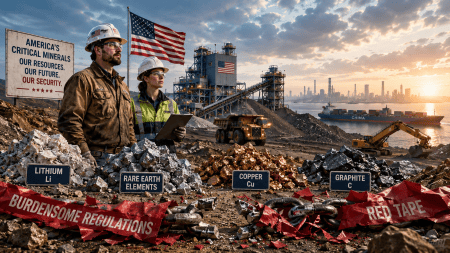
According to a recent analysis by the Pacific Legal Foundation (PLF), “It takes an average of 29 years [for a mining project] to make it through the permitting process in the United States – the second-longest of any country in the world, followed only by Zambia.” Facing the gauntlet of endless litigation and paperwork, many developers wind up walking away from promising mining projects.
“As a result, America relies primarily on imports for critical minerals, minerals crucial to national security, energy infrastructure, and technological development – that are vulnerable to supply-chain disruptions,” PLF points out. “In 2025, China supplied more than 50 percent of U.S. demand for 21 mineral commodities.”
Dependence on our greatest geopolitical rival for critical minerals is asking for trouble. China’s control of the global supply chain for critical minerals is one of the stepping stones Beijing uses in its quest to displace the U.S. as the world’s premier power. “These materials make up the electrical wires that power our homes and businesses and the chips inside smartphones and laptops, and they form the backbones of the entire energy infrastructure of the United States,” the PLF analysis notes. According to S&P Global, the U.S. is home to some 275 million metric tons of copper, along with generous deposits of lithium, nickel, cobalt, and rare earths. Yet these riches are largely off-limits to domestic development.
Any serious talk about reshoring manufacturing to the U.S. must include dismantling the barriers that stand in the way of getting domestic raw materials to our factories. Among other things, this means revisiting four decades-old statutes – the National Environmental Policy Act, the Endangered Species Act, the Clean Water Act, and the National Historic Preservation Act. Taken together, these laws, which serve different purposes, entail overlapping permitting requirements that can take decades to navigate. They also are an open invitation for environmental groups who use endless litigation to “keep it in the ground.”
Efforts to pass sweeping bipartisan permitting reform in Congress have stalled, notably in the Senate, with Democrats hoping to use the issue to boost the fortunes of wind and solar power. Specifically, Democrats want permitting reform to cover high-voltage, long-distance powerlines connecting remote wind and solar facilities to population centers, something opposed by the Trump administration and most Republicans. Critical minerals, along with the build-out of oil and gas pipelines, are now captives to green energy.
Iran’s closure of the Strait of Hormuz will be a one-off. In what is the energy equivalent of a coronary bypass, Gulf oil and gas producers are already planning the rapid expansion of pipeline networks in the region so they can escape the strait’s bottleneck once and for all. The permitting nightmare blocking America’s access to priceless critical minerals is not a one-off. It must be dismantled, the sooner, the better.
A version of this article originally appeared at The Washington Times




You must be logged in to post a comment.