Global warming, climate change, all these things are just a dream come true for politicians. I deal with evidence and not with frightening computer models because the seeker after truth does not put his faith in any consensus. The road to the truth is long and hard, but this is the road we must follow. People who describe the unprecedented comfort and ease of modern life as a climate disaster, in my opinion have no idea what a real problem is.
The Italian parliament, demonstrating confidence in Prime Minister Giorgia Meloni, this week formally backed her plan to reintroduce nuclear power plants into Italy’s energy mix, reversing the nation’s 1987 moratorium on nuclear power. Meanwhile, energy-starved Germany is feeling the pinch from shuttering all of its 17 nuclear power plants.
The Italian parliament, demonstrating confidence in Prime Minister Giorgia Meloni, this week formally backed her plan to reintroduce nuclear power plants into Italy’s energy mix, reversing the nation’s 1987 moratorium on nuclear power. Meanwhile, energy-starved Germany is feeling the pinch from shuttering all of its 17 nuclear power plants.
The U.S. has closed 11 nuclear reactors since 2013, with another eight of the 94 remaining reactors scheduled for decommissioning by 2025. Although Presidents Trump and Biden have favored bolstering the U.S. nuclear energy portfolio, America’s bureaucrat-heavy regulatory jungle remains designed to drag out facility permitting and construction for decades.
The sad truth is that the energy crisis is imminent – we don’t have decades to play gotcha political games. Another truth – wind and solar cannot fully power the U.S. grid.
Meloni’s plan would enable Italy to generate up to 35 MW of power from nuclear energy by 2050 (likely from small modular reactors). The plan adds nuclear to the list of low-carbon technologies with guaranteed sales of the energy they produce. The move towards nuclear also bolsters Meloni’s negotiations over Italy’s participation in China’s Belt and Road Initiative.
Germany’s removing nuclear power from its energy mix makes little sense, given the cutoff of Russian natural gas. Higher energy prices and shortfalls have led many German manufacturers to shut down or relocate to other, more energy friendly, nations. Germany has had negative economic growth since last October.
The German delusion is perhaps best exemplified by Steffi Lemke, minister for the environment and nuclear safety, who glowingly praised the shuttering of the last German nuclear power plants as an “excellent – indeed, visionary – move.” By contrast, fellow Green Party minister for the economy Robert Habeck recently bemoaned that German industries face an existential threat due to high electricity prices.
Habeck’s proposed solution is a massive (Bidenesque) subsidies program that would guarantee a fixed consumer price per megawatt-hour until 2030 – at a back-end cost to the public of 25 to 30 billion euros (not included in the “fixed” price).
As nuclear energy advocate Todd Royal points out, Congress in 2018 passed the Nuclear Energy Innovation Capabilities Act that requires the Department of Energy to “develop a versatile fast neutron test reactor that could help develop fuels and materials for advanced reactors.” It also authorized DOE national laboratories to host reactor testing and demonstration projects.”
Congress in 2018 also passed the Nuclear Energy Innovation and Modernization Act, which requires the Nuclear Regulatory Commission to “develop an optional regulatory framework suitable for advanced nuclear technologies.” This February, the Nuclear Innovation Alliance released draft recommendations for addressing barriers to NRC licensing of advanced reactors.
The draft recommended bolstering staff capacity and capability for licensing advanced reactors; upgrading unaccountable regulatory processes and procedures for scheduling, breadth of scope, and depth of review; developing regulatory processes that streamline rather than inhibit the commercialization of advanced reactors; and establishing practices that increase stakeholder understanding and public trust in the regulatory process.
As a follow-up, in April five Republican and five Democrat Senators introduced the bipartisan ADVANCE ( (Accelerating Deployment of Versatile, Advanced Nuclear for Clean Energy) Act, which addresses licensing fees, insurance, and a host of other barriers to moving proposed nuclear reactors from drawing board to full operation.
Today, companies that develop and sell new reactors pay up front the government’s $290 per hour cost for analyzing license applications. The 18,000-plus hours for reviewing even small test reactors presents a massive financial hurdle, especially for startups with innovative designs.
The bill recommends deferring these fees until the applicant has a license and can generate revenue from sales. The NRC would be compensated from a small rolling fund seeded by the government. A second proposal adds a time cap for the review of an accepted application, with additional billable hours paid by Congress.
The bill also grants a 20-year extension to the Price-Anderson Act, which pertains to civilian power plants, that would otherwise expire in 2025. The extension gives policy makers sufficient time to tweak the law while reassuring potential investors and developers that its reauthorization will not be a barrier to startups.
Regulatory reform appears to be a hot issue, as President Biden just this week endorsed a reform bill proposed last fall by Sen. Joe Manchin (D, WV) that would streamline permitting for mining of critical minerals and remove barriers for renewable energy.
White House energy spokesman John Podesta said delays caused by the current permitting process “are pervasive at every level of government,” with the result that “we got so good at stopping projects we forgot how to build things in America.”
Manchin last fall stated, “No matter what you want to build, whether it’s transmission pipelines or hydropower dams, more often than not, it takes too long and drives up costs. You can double your cost within a five to six, seven-year period from what the original cost may have been.”
If the regulatory reform momentum that covers transmission lines and mining extends to nuclear, that bodes well for widespread efforts to revitalize the long-bearded U.S. nuclear energy industry. Michigan Governor Gretchen Whitmer is spearheading an effort to restart a decommissioned reactor in her state, with help from Holtec Decommissioning International, whose primary focus is, as its name implies, decommissioning old plants.
Whitmer now says that keeping the Palisades Nuclear Generating Station open “is critical for Michigan’s competitiveness and future economic development opportunities.” But the 800-MW reactor that had provided 5 percent of Michigan’s electricity was plagued with complaints about poor maintenance, including instances of nuclear fuel container weakening – serious issues that forced its shutdown weeks earlier than originally anticipated.
On the other end of the spectrum, Westinghouse just announced the launch of its AP300 reactor, which it calls “the only small modular reactor offering available that is based on deployed, operating, and advanced reactor technology.” CEO and President Patrick Fragman is confident that the $1 billion per unit, 300-MW reactor design can win NRC approval by 2027.
From these developments, it appears the U.S. is aligning itself more with the so-called “right-wing” Italian government than with the Green Party-infused German leadership – at least on nuclear energy. Nuclear energy has powered U.S. submarines since the U.S.S. Nautilus was commissioned in 1954. And nuclear has supplied up to a fifth of U.S. electricity despite heavy propaganda and lack of government support.
Maybe, just maybe, after seventy years of nuclear submarines, America will finally believe – as Todd Royal believes – that carbon-free nuclear power is the nation’s best hope for meeting growing U.S. demand for electricity and global needs for basic economic growth. With worldwide energy consumption expected to grow by 50 percent by 2050, reliance on wind and solar (and, yes, geothermal) alone to meet that demand is a pipe dream.
Duggan Flanakin is a Senior Policy Analyst with the Committee For A Constructive Tomorrow.
A former Senior Fellow with the Texas Public Policy Foundation, Mr. Flanakin authored definitive works on the creation of the Texas Commission on Environmental Quality and on environmental education in Texas.
A brief history of his multifaceted career appears in his book, “Infinite Galaxies: Poems from the Dugout.”
America’s energy policy has been captured by the same class of ideologues and rent seekers, that have destroyed reliable and affordable power supplies in Europe, Australia and elsewhere.
America’s energy policy has been captured by the same class of ideologues and rent seekers, that have destroyed reliable and affordable power supplies in Europe, Australia and elsewhere.
So, it’s probably not entirely fair to attribute the blame to the bumbling Joe Biden. Struggling with signs of senile dementia, on occasions, Biden gives the appearance of not knowing what day it is. Which suggests that what comes out of his mouth has been put there by those keen to exploit his senility.
America’s energy policy seems to be a case in point.
Steve Hilton picks up the thread below.
The left’s energy policy is incoherent and destructive Fox News Steve Hilton 23 April 2023
Transcript
Steve Hilton: Welcome back. So, guess which states are doing best at delivering on environmental goals and reducing emissions? Is it the blue states who never stop lecturing everyone about climate and seem to keep outdoing each other in climate extremism? Well, our friend, Benji Backer, from the American Conservation Coalition laid out the facts on Twitter the other day. It’s actually red states that lead the nation in wind production, for example. All of the top six wind producing states are actually Republican, but the real point isn’t even about wind. It turns out that wind power and solar for that matter, they don’t do all that much in terms of clean energy production.
According to this chart in The Washington Post that Benji shared, the top six states producing the cleanest energy actually use nuclear and hydropower over any other energy source. As a result, their carbon emissions dropped significantly. But even though the facts suggest that nuclear and hydro are the best solution for producing clean energy in America, the extremist climate zealots on the left oppose these proven clean energy options. They are totally obsessed with wind and solar. Anyone would think they’re funded by big wind and solar corporations. Oh, wait. It looks like they are. It’s gotten so extreme and crazy that in California, the official state categories for energy sources list hydropower as a non-renewable alongside coal. At the federal level, Biden these days is programmed by the far left activists who control his party to spew out climate extremism in every speech.
Joe Biden: Nothing gives me more hope for the future than seeing my five grandchildren challenge expectations. They see breakthroughs in technology we can’t even yet imagine, but the only way they’re going to get a chance to fulfil all that potential is if we take drastic action right now to address the climate disaster facing the nation and our world. Science tells us that how we act or fail to act in the next 12 years will determine the very livability of our planet. So, today, I’m announcing my plan for clean energy revolution. It outlines what we have to do to meet this challenge head-on and how we’re going to get there.
Steve Hilton: What a load of old tut. Clean Energy Revolution. Biden has just announced that he’s cutting spending on zero emission nuclear energy. What utter charlatans they are. The solar panels they go on and on about, are made with coal from China. Meanwhile, the actual emissions reductions we achieved here in America over the last two years or better performance than any other major economy, it was mainly thanks to increased use of natural gas, not wind and solar. Yeah, natural gas, which they’re trying to get rid of, but actually, it’s even worse than that. They’re not, in fact, against fossil fuels. They’re just against American fossil fuels, and as usual, the absolute worst, most stupid, and self-defeating extremism, well, of course, it came from California.
In the years the Democrats have been in charge, imports of foreign oil have gone up from 12% to nearly 60% while oil from California has been cut from 50% to 25%. They’re destroying energy jobs here, so they can bring it across the ocean in giant tankers, the most polluting form of transportation on the planet. As Arnold Schwarzenegger has pointed out, the biggest 15 tankers produce more emissions than all the cars in the world put together. These clueless climate extremists want to ban gas stoves, ban gas-powered cars, ban gas for heating and hot water, electrify everything, and make us completely reliant on electricity while making electricity completely unreliable by attacking base load power generation like natural gas and nuclear.
Then, when they finally realise the lights will go out, panic and tell the gas plants to stand by to fill the gap, only to realise that the years of attacking natural gas means those plants are ageing, haven’t had any investment, and in any case, are way more expensive to use for filling the gap left by wind and solar than they would be for base load power. So their next genius idea is to pass a blank bill in the state legislature to avoid public scrutiny. Then, later on, fill it with a demented scheme to charge utility customers by income to cover the cost of energy infrastructure so they can reduce the price for electricity usage, which will incentivize people to use more electricity even as they’re also telling people to use less electricity because the grid can’t cope now that they’ve undermined gas and nuclear. But actually, they do want you to use more after all because everything has to be electrified because climate. Out of all the appalling ideology-driven departures from common sense and practicality that these extreme Democrats have pushed these last few years, there is nothing, nothing as totally clueless, contradictory, incoherent, and destructive as their energy policy. Fox News
Would you leave your energy policy in Biden’s hands?
Accusatory polemics disguised as climate science news is a commonplace these days. Perhaps you, dear reader, have written an email to some science reporter expressing dismay at their unthinking IPCC bias, or offered some correction to purported science. I have done, too, and many times. Typically, there is no reply.
In which “Exxon Knew” is found to be not about knowledge
Accusatory polemics disguised as climate science news is a commonplace these days. Perhaps you, dear reader, have written an email to some science reporter expressing dismay at their unthinking IPCC bias, or offered some correction to purported science. I have done, too, and many times. Typically, there is no reply.
Recently, and above general character, a science reporter constructively replied when I emailed about an article on “climate denial” and “the coal-funded attack on clean energy.” Named climate deniers included John Droz, Steve Milloy — royalty among climate deniers, apparently — and Donald Trump.
Long story short, the reporter sent my comments to Emeritus Prof. Martin Hoffert (New York University), a long-time climate modeler with some impressive early theoretical work. He replied.
This essay is the nuclear fallout emergent from that small spark.
Prof. Hoffert had worked under contract with Exxon climate scientists in the 1980s. In his House Subcommittee testimony, Prof. Hoffert expressed considerable respect for their professionalism and talent. However, his testimony (pdf) included, “… Exxon’s outward facing disinformation and funding of climate change deniers even as our in-house research was predicting just the opposite. They are, as Naomi Oreskes calls them, “Merchants of Doubt” who capitalize on the fact that more people watch TV ads than read scientific literature.“
Along with his critical reply to my reporter interlocutor, Prof. Hoffert sent his Congressional testimony and a copy of (2023) Supran, Rahmstorf, and Oreskes (S-R-O), which declaims proof-positive that, “Exxon Knew.”
The S-R-O (2023) story is that by 1980 Exxon scientists knew as an absolute surety that fossil fuel CO2 emissions would warm the climate, also that by then the scientists had so-informed Exxon management, and also that Exxon management had gone on cynically and with all malign deliberation to lie to the public for the next 40+ years. All for the sake of profits, and the future their own children be damned.
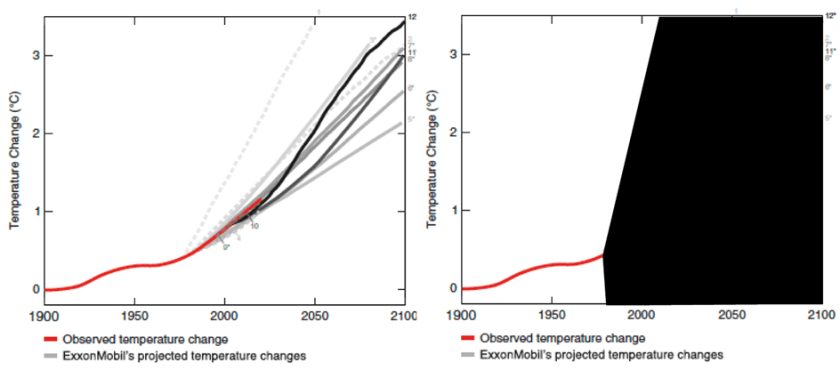
The accusatory center of S-R-O (2023) is their Figure 2; here Figure 1 below, left.
Figure 1, left, compiles the Exxon in-house and published air temperature projections produced by sundry 1970s-2000s-vintage climate models, working on speculative scenarios of future CO2 emissions. The red line is the observed air temperature record, for comparison.
The combination of the entirety of projections with the entirety of their uncertainty bars will ring midnight down on the entirety of the graphic.
Clouds govern the thermal energy flux in the atmosphere. Thermal energy flux governs air temperature. Get the clouds wrong, get the air temperature wrong.
Figure 1: Left, Figure 2 from (2023) Supran-Rahmstorf-Oreskes. The original legend is: “Summary of all global warming projections (nominal scenarios) reported by ExxonMobil scientists in internal documents and peer-reviewed publications (gray lines), superimposed on historically observed temperature change (red).” The projections date from 1977 to 2003. Right: S-R-O (2023) Figure 2 with all the projection uncertainty bars expressing model cloud calibration error added in and plotted together.
Over the entire 1977-2003 time-frame, the lower limit of detection for climate models was >100× larger than the annual perturbation of greenhouse gas emissions. S-R-O (2023) claims that climate models can reveal something that is totally invisible to climate models. This is equivalent to declaiming, ‘Bacterium!‘ on turning a 4× Jeweler’s loupe onto a water droplet.
S-R-O (2023) claim they know now, and in 1977 Exxon scientists and Exxon management knew then, the climate impact of a perturbation that is more than 100-times smaller than the smallest perturbation the climate model can possibly resolve.
A complete inventory of climate model simulation error is very much larger. Also here and here. The climate information transmitted by those Exxon air temperature projections is zero.
Exxon could not have known then and neither could anyone else. Exxon doesn’t know now, either, and neither does anyone else because the total ignorance of 1977 still reigns today.
The S-R-O (2023) graphic in Figure 1, left, also lacks the uncertainty bars of known systematic field measurement error which would stretch the projection black-out curtain back over the observed temperatures. S-R-O (2023) Figure 2 would then correctly display the climate information actually available.
II. In which Exxon reveals what it knew.
The Exxon documents on which S-R-O (2023) rely are conveniently collected at the Climate Files site created and maintained by the Climate Investigations Center. Reading them, one is struck by the professional caution of the Exxon scientists. They wrote plainly about the contemporaneous lack of knowledge. About the ignorance (in 1977) of whether increasing atmospheric CO2 is due to fossil fuel emissions or to forest clearing. About climate models that needed lots of work and were unable to predict the effect of our CO2 emissions on the climate.
A 29 January 1980 internal letter from Walter Eckelmann, Exxon’s Deputy Manager of the Exxon Science and Engineering Department, to Morey O’Loughlin on the Exxon board, noted that, “Science & Technology feels that the build-up of carbon dioxide in the atmosphere is a potentially serious problem requiring the results of a huge world-wide research effort before quantitative predictions can be reached on the probabilities and timing of world climate changes.“
“Potentially” and “huge worldwide research effort,” capture the significance. They didn’t know and much needed doing to find out.
Despite banal partisan avowals to the contrary, no one precociously knows future knowledge.
Mr. Eckelmann went on to say that the effort is beyond the resources of any one company (i.e., Exxon]. He further stated that Exxon had an on-going annual $600k research program dedicated to the CO2-climate problem, and was also funding CO2-climate work at the Marine Biological Lab at Woods Hole and the Scientific Committee on Problems of the Environment (SCOPE), at $20k each per year.
M.B. Glaser was the manager of Exxon’s Environmental Affairs Program. His 1982, “The CO2 “Greenhouse” Effect” (pdf) summarized the situation in an eminently sensible way: “Making significant changes in energy consumption patterns now to deal with this potential problem and all the scientific uncertainties would be premature in view of the severe impact such moves could have on the world’s economies and societies.”
And this: The participants of a AAAS-DOE workshop on the societal and institutional responses to an increase in CO2, “felt that society canadapt to a CO2 increase within economic constraints that will be existing atthe time. Some adaptive measures that were tested would not consume more thana few percent of the gross national Product estimated in the middle of thenext century.“
In his 1984 report about the Exxon corporate research program on climate and CO2, A. J. Callegeri wrote that,
“· Models are being used to explore physical effects (scenarios) and as a predictive tool.
-Carbon cycle modeling to determine fate of fossil-fuel CO2 emissions.
· Validity of models not established.
-Complexity of carbon cycle and climate system require many approximations and parameterizations.
-Geological and historical data are inadequate for validation of models.”
Sound familiar? Callegeri’s points are still completely true today, nearly 40 years later.
In December 2000 Exxon climate scientist Brian Flannery wrote to Lloyd Keigwin (pdf), of 1996 Sargasso Sea fame, in dismay at the misrepresentation of both his position and of Exxon’s support of climate science. The letter is well worth reading. The negation of Naomi Oreske’s Exxon Knew accusations could not be more explicit.
In short, the plain evidence is that Exxon did not know and was making a good-faith effort to find out.
The entire claim that ‘Exxon Knew’ is completely reliant upon the unspoken, wrong, and utterly fatuous embrace of climate models — even their 1977 incarnations — as truth-machines. God’s lips to their terminals-become-flat-screens.
Exxon knew that they didn’t know and that nobody else knew, either (and still don’t).
III. In which Supran, Rahmstorf, and Oreskes reveal what they did not know in 2023.
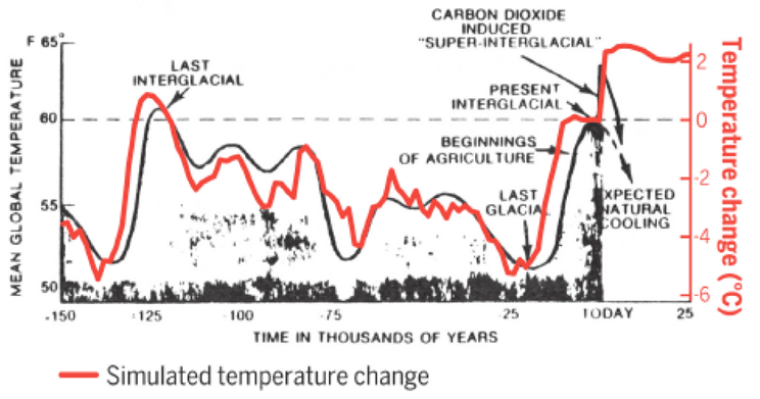
Reading S-R-O (2023), I became curious about their Figure 1b (below). The black part of Figure 1b dates back to 1977. In July that year it was vugraph #11 in a presentation made by J. F. Black to the Exxon Corporation Management committee. J. F. Black was a science advisor to Exxon.
J. F. Black gave his presentation 5 years before Neftel, et al., published the first ice-core CO2/δ18O record. So I was curious about the origin of the Figure 1b 150,000-year temperature record. And how were deep-time air temperatures assigned in 1977?
Figure 2: S-R-O (2023) Figure 1b. The black line and axes, complete with smudging, are J. F. Black’s 1977 vugraph #11. The red line is a smoothed, “Earth system model simulation (Ganopolski and Brovkin (2017)) of the last 150,000 years driven by orbital forcing only, with an appended moderate anthropogenic emissions scenario.” S-R-O (2023) Supporting Information (pdf).
So, how were the Figure 1b Fahrenheit temperatures (left ordinate) assigned in 1977? S-R-O cites Figure 1b to J. J. M. Mitchell, Carbon dioxide and future climate. Environmental Data Service (March): 3–9 (1977), but the S-R-O link is to a Department of Energy abstract, not to the paper.
After some effort I found the EDS journal archive (42 MB pdf). Mitchell’s article appears in the March 1977 issue, pp. 3-9. S-R-O (2023) Figure 1b started life as Figure 5 in Mitchell (1977).
But Mitchell did not provide a citation for his Figure 5, either. Nor did he say how the temperature scale was assigned. Where did all that come from?
Long story short, I searched the literature for a proxy that might have provided data for Mitchell in 1977. That quest led to J. D. Hays, et al., (1976) “Variations in the Earth’s Orbit: Pacemaker of the Ice Ages.”
Hays (1976) reported foraminiferal δ18O from two deep sea sediment cores obtained from the southern Indian Ocean, (near 45° S latitude; 85° E longitude). Hays (1976) also used radiolarian assemblages to estimate summer subantarctic sea surface temperatures (SST ±3 C; 95% CI) at the core sites.
Hays (1976) would have been the best knowledge available in 1977 when Mitchell wrote his paper and when Black made his 1977 presentation to Exxon.
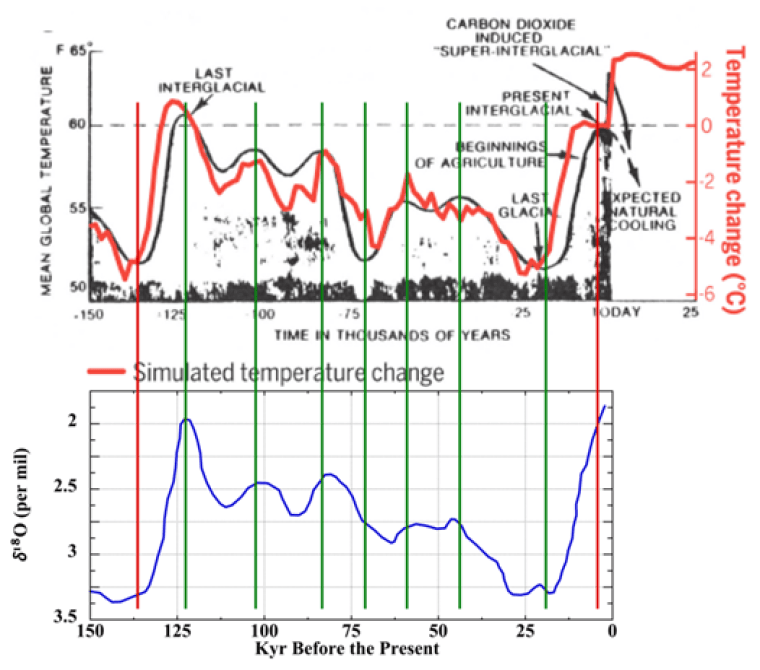
But it gets complicated. Figure 3 shows that the Mitchell (1977) temperature graphic looks very much like stage 1-6 of the Hays (1976) Figure 9A foraminiferal δ18O series.
Figure 3: Extract of the first 150 kYr Before the Present of the d18O series from Figure 9A of Hays, et al., (1976). The abscissa is reversed relative to S-R-O (2023) Figure 1b.
In fact, Mitchell Figure 5 appears to be a hand-drawn reproduction of Hays (1976) Figure 9A..
Figure 4 below is S-R-O (2023) Figure 1b and the Hays (1976) foraminiferal δ18O over the same time range and with scaled abscissas. The vertical red lines position the two graphics. The year ticks all line up nicely. The vertical green lines centered on the Hays (1976) δ18O features line up well with Mitchell (1977).
Figure 4: S-R-O (2023) Figure 1b lined up with my digitized version of Hays (1976) foraminiferal δ18O. The vertical green lines traverse the centers of the Mitchell (1977) features in black and line up well with Hays δ18O. The features of the simulation used by S-R-O (2023) (red) do not align with Mitchell, 1977 or Hays (1976) at -130 kyr and “Today”.
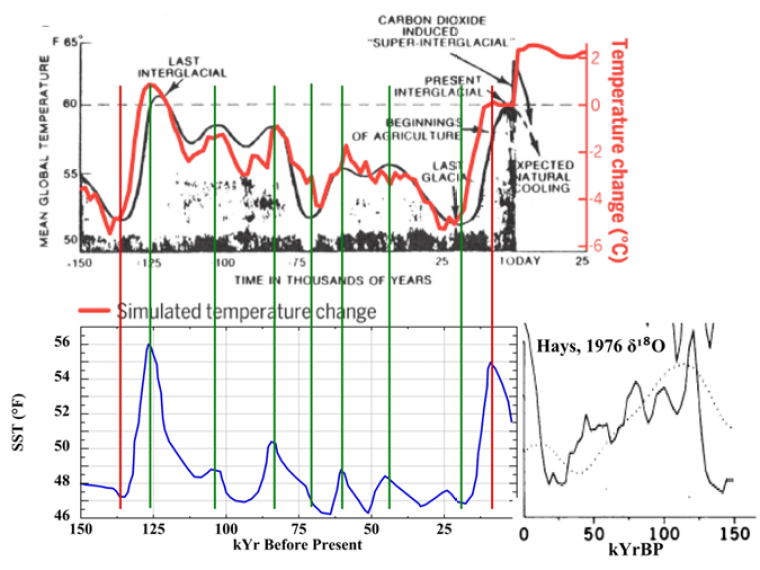
Hays (1976) also included an equally extensive SST series, but Mitchell (1977) Figure 5 does not match it. Figure 5 below is S-R-O (2023) Figure 1b and the Hays (1976) radiolarian SST series, over the same annual range and with the abscissas in registry. The vertical green lines indicate good time-registry between the radiolarian SSTs and the simulation used in S-R-O (2023) (red).
However, the shapes and intensities of the Hays (1976) SSTs do not match the Mitchell (1977) features. The S-R-O (2023) simulation matches the timing of the Hays (1976) SST series, but between 25-105 kYr bp the shapes and intensities are a mismatch.
Figure 5: The S-R-O (2023) Figure 1b aligns well with the time sequence of the Hays (1976) radiolarian SST series. The vertical green lines traverse the centers of the SST features. Mitchell (1977) aligns positionally with Hays (1976) between -105 kYBP and -20kYB, but the intensities and structures are disparate. S-R-O (2023) (red) aligns with the Hays (1976) SST time series, but not with the shapes or intensities. Far right, bottom is the first 150 kYr of the published Hays (1976) foraminiferal δ18O series. The similarity of both S-R-O (2023) and Mitchell (1977) with Hays (1976) δ18O, but not with Hays (1976) SST is obvious by inspection.
Both Mitchell (1977) and S-R-O (2023) obviously correspond much more closely with the shape of the Hays (1976) δ18O series, than with the Hays SST series.
It seems neither Supran, Rahmstorf, nor Oreskes did any careful source-check of Mitchell (1977). S-R-O evidently didn’t realize in 2023 that Mitchell (1977) had re-purposed Hays (1976) 150 kYr Indian Ocean δ18O series to use as a global air temperature series.
It also seems likely that S-R-O did not know that Mitchell (1977) Figure 5 is, by every indication, a hand-drawn cartoon of the Hays (1976) δ18O curve.
Oops.
IV. In which the temperature bug bites.
So, how did Mitchell assign temperatures to his Figure 5? Mitchell had clearly read Hays (1976). Hays (1976) in turn estimated the glacial temperature to be about 6±1.5 C colder than now, which equates to -10.8±2.7 °F.
Very likely Mitchell (1977) got the temperature scale on his re-purposed δ18O Figure 5 series from the glacial estimate in Hays (1976).
In this light, Mitchell converted the Hays (1976) Celsius into Fahrenheit, estimated the present global mean temperature to be 60 F (15.6 C), and used the Hays (1976) estimate to get the glacial minimum. Mitchell’s 60 °F modern period is the dashed line, and the last glacial minimum at -25k years is about 9 °F colder. The Mitchell Fahrenheit range is about 49-65 °F. The Fahrenheit scale is just the linear interpolation.
The Hays (1976) radiolarian proxy temperature has a very wide statistical uncertainty (95% CI = ±3 C). Hays (1976) estimated the SST of the southern Indian Ocean where the sedimentary cores were drilled. It was not a global average of SST.
Mitchell apparently assigned the re-purposed the Hays (1976) δ18O series to indicate global average air temperature. We don’t know why. Perhaps he thought it reasonable. Regardless, his assignment was uncritically accepted by S-R-O (2023) when they did the work for Figure 1b.
The emergent mystery is how Stefan Rahmstorf and his applied Earth System Model air temperature simulation exactly reproduced a hand-drawn cartoon of 150,000 years of Indian Ocean δ18O re-branded as a speculative global air temperature.
Repeat: Stefan Rahmstorf applied the Earth System Model simulation to hand-drawn cartoon wiggles of an Indian Ocean δ18O doppelganger as though they were physically real global air temperatures.
V. In which the benthic despond is revealed.
It gets worse. S-R-O (2023) represented that their Figure 1b (red) Earth System Model simulation was published in(Ganopolski and Brovkin (2017))(see the legend to Figure 2 above). But that paper includes no air temperature simulations. The S-R-O (2023) simulation is actually found in Figure 1 of Ganopolski and Calov, 2011, who used the same CLIMBER 2 Earth System model.
Ganopolski and Calov (G-C) (2011) simulated 800,000 years of Antarctic and Greenland air temperature anomalies. S-R-O (2023) used the Antarctic simulation in their Figure 1b overlay of Mitchell (1977) Figure 5.
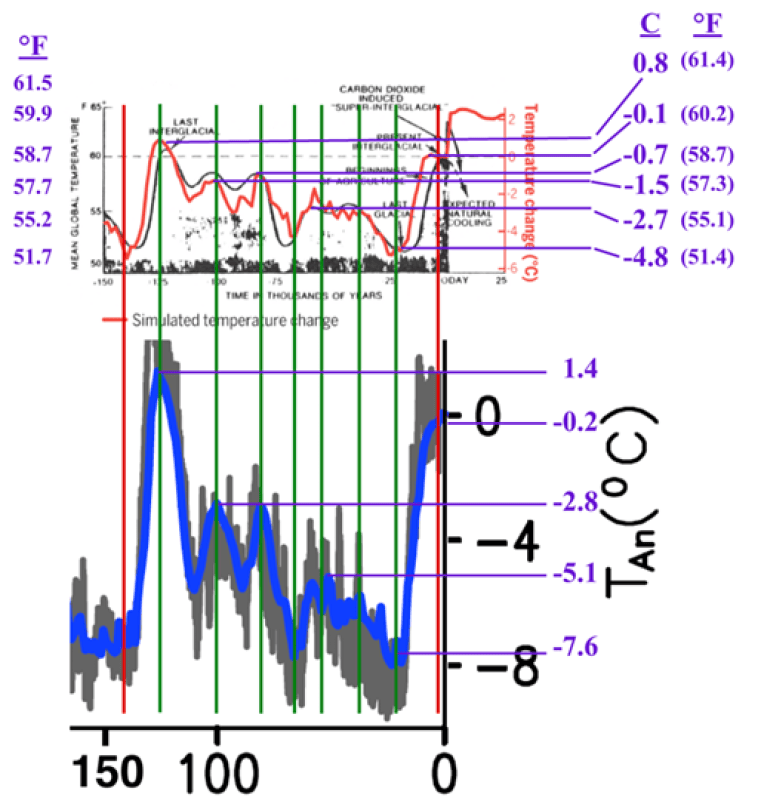
Figure 6 below compares the Antarctic simulation of G-C (2011) with Figure 1b of S-R-O (2023). The comparison is a bit cluttered, but reveals a depth of unscientific benthos that either escaped the notice of, or perhaps was sailed over by, Profs. Supran, Rahmstorf, and Oreskes.
Figure 6: Top, Figure 1b of Supran, Rahmstorf and Oreskes (2023), with selected features annotated. Bottom, Figure 1e Ganopolski and Calov, 2011, first 150kYr of the “Antarctic temperature anomaly,” simulation selectively annotated and with an added 150 kYr bp tick. The top and bottom abscissas are in registry. The red vertical lines fix the comparison at the paleo-minimum and the modern maximum. The vertical green lines traverse the centers of major G-C (2011) features. The horizontal purple lines mark out features that have been temperature-annotated.
The selected temperatures were extracted from using mm ruler measurements. Their precision is not better than ±0.2 C. Figure 6 shows good correspondence between the G-O (2011) Antarctic simulation and the S-R-O (2023) Figure 1b overlay. The G-O (2011) Greenland temperature anomaly series is structurally similar but much colder (Table 1).
S-R-O (2023) Supporting Informationdescribed the simulation in Figure 1b, absent the technicalese, as: “The observations in panel 1b of Fig. 1 reflect a smoothed (LOWESS) Earth system model simulation of the last 150,000 years driven by orbital forcing only, with an appended moderate anthropogenic emissions scenario.“
S-R-O (2023) itself described Figure 1b as, “a smoothed Earth system model simulation of the last 150,000 years.” and, “a smoothed Earth system model simulation of the last 150,000 years driven by orbital forcing only, with an appended moderate anthropogenic emissions scenario.“
And the S-R-O (2023) extended description: “Panel 1b of Fig. 1 is a graph of the global warming “effect of CO2 on an interglacial scale” originally published by climate scientist J. Murray Mitchell Jr. in March 1977 and reproduced by Exxon scientist James Black in a private briefing to the Exxon Corporation Management Committee 4 months later. … [O]verlaying the original graph with the temperatures simulated by a modern Earth system model (in red) shows that Exxon scientists were accurate in warning their superiors of the prospect of a “carbon dioxide induced ‘super-interglacial,’” as Mitchell Jr. termed it, that would render Earth hotter than at any time in at least 150,000 years.”
The language of S-R-O (2023) directly implies that the Mitchell (1977) Figure 5 graphic represented a global air temperature record.
However, Hays (1976) described the re-purposed δ18O series (p. 1122) as, “Down-core variations in δ18O reflect changes in oceanic isotopic composition, caused primarily by the waxing and waning of Northern Hemisphere ice sheets. Thus, the δ18O in our subantarctic cores is a Northern Hemisphere climatic record.“
In other words, the δ18O series reflects large-scale swings in the climate over geological time. Not global air temperature.
Foraminiferal δ18O remains problematic today for use as an SST proxy. Waelbroeck, et al., (2005) state, “The large discrepancy between δ18O values of living and recent fossil foraminifera highlights the difficulty in reconstructing past surface conditions based on fossil planktonic foraminifera δ18O.
VI. In which the Mariana Trench of Despond is plumbed.
Given that the S-R-O (2023) and G-C (2011) Antarctic anomaly simulations are reported to be identical, one should expect identical anomaly temperatures. But Figure 6 and Table 1 show that the anomaly temperatures that should be identical are in fact very different. The S-R-O (2023) temperatures are all smaller than the G-C (2011) homologues, except at 0 kYr bp. How did that happen?
Stefan Rahmstorf is the climate modeler of the group. He has likely walked into quicksand. But I want to be very careful with my language here.
The only reasonable explanation for the smaller temperature differences within the S-R-O (2023) Figure 1b overlay relative to the G-C (2011) simulation, is that the G-C simulation was compressed into artificial correspondence with the Mitchell (1977) hand-drawn, low-precision, thermally speculative, physically ambiguated, version of the Hays (1976) southern Indian Ocean foraminiferal δ18O series.
The Figure 1b red overlay is not an accurate reproduction of the G-O (2017)(sic) simulation as it was represented to be. From G-C (2011} (the evident source), the red overlay has been compressed into correspondence, rendering false physical meaning to a speculative cartoon and lending an entirely spurious analytical credit to Mitchell (1977). It is very hard to imagine how this misconstruction was inadvertent.
Figure 1b does not show that Exxon knew (which we already know to a certainty that it did not and indeed could not). Exxon has been indicted on spurious evidence.
The Figure 1b overlay instead shows that S-R-O did not know the speculative standing of Mitchell (1977) Figure 5. They were careless. They did not track Mitchell (1977) Figure 5 back to its origin. They were evidently uncurious about its provenance. And they employed it to their purpose despite all.
Perhaps Profs. Supran, Rahmstorf, and Oreskes should be asked how that happened.
“You really not have addressed my criticisms about your accepting, at face value, climate alarmism, forced energy transformation, and a technocratic solution to the current grid problems brought on by the wind/solar takeover.” (Bradley to Kiesling, below)
“You clearly disagree with my synthetic theory of regulation and technological change. I synthesize institutional and transaction cost economics, Schumpeterian innovation economics, economic history, public choice, and yes, Austrian economics….. I think this theory … does a better job of helping us understand the institutional and organizational, and technological, reality of what’s feasible in liberalizing the electricity industry and its regulation.” (Kiesling to Bradley, below)
More than a century of increasing government intervention has created today’s crisis in electricity. It is not only a crisis of performance (affordability, reliability). It is a crisis where the cumulative interventionist process is now coming to your home or business. The shared narrative (of which Lynne Kiesling is a part) is that supply-side problems (created by a witches brew of intervention at all levels of government, btw) now require a demand-side solution of demand modeling and smart-meter control of your usage, part of the virtual power plant.
I argue as an industry historian and political economist why this is wrong–and why a thoroughgoing move toward real free markets will best coordinate electricity going forward. I also as a historian of energy thought interpret why a ‘classical liberal’ is anything but in the area of electricity, ignoring what is professed to believe elsewhere (the free market as a discovery process; the knowledge problem of central planning; the process of regulation; the ‘romantic’ view of government….).
Kiesling brings in a variety of academic traditions and technical concepts (economic and engineering) to state her case. But with the exchange below, it is time for her to show her hole cards. Ducking the hard questions will be much harder now with our public exchanges. May a one-sided debate be joined.
This is anything but an idle tiff. The Texas electricity debacle just over two years ago (which free market types predicted, and Kiesling, et al. did not) was carnage on a scale not previously experienced or even imagined in the industry. It has many governmental mothers and fathers–even grandmothers and grandfathers. In an industry premised on reliability, the whole system exploded! And all the studies (including that of Michael Giberson for Reason) stopped at the physical why, with just hints of the why-behind-the-why, the unseen.
If $65 billion in wind and solar (mal)investment in Texas did not have anything to do with the performance issues with thermal generation … if disappearing wind/solar when most needed is okay because ‘we expected that’ … if central planner ERCOT did not fall prey to the ‘knowledge problem’ …. if market learning/improvement could not be expected after the 2011 Texas freeze … and if climate models and NOAA predicting warmth going into the winter of 2020/2021 did not affect any of the decisions on the margin …. then I guess (per Kiesling) I am badly misinformed since I know much too little about economics, technology, and electricity.
Kiesling: (Part 1 of 3) I have tried not to respond to you since [Texas Storm] Uri [in February 2021] because I find your approach to both substance and rhetoric fundamentally flawed. [emotionalism, deleted here–see below]
First, on the substance. Your understanding of the relevant economics is incomplete, and what economics you do bring to your analysis is filtered through an ideological lens that leads you to engage in such highly motivated reasoning that it damages your economic logic beyond repair. You either choose not to learn or choose to ignore the relevance of institutional, organizational, and transaction cost economics to industrial organization questions in electricity (Coase, Williamson, Ostrom, etc.).
You have similar blind spots with the economics of innovation and technological change, such as Christensen’s work and Henderson’s work on S curves and technology maturity models. Putting those two fields together would enable you to engage with how digitization reduces transaction costs and how new, more energy efficient generation technologies like the combined cycle gas turbine changed the industry cost structure and made competitive wholesale markets feasible. But they still needed a transportation network, and there were still substantial economies of scale in the wires, so to this day the wires are ROR regulated.
Part of that ongoing regulation includes participation in the transportation network, implemented through the open access tariff that you decry so vehemently. That institutional choice reflects the physical reality that AC power networks are common pool resources with ill defined property rights, another piece of economics that you refuse to acknowledge.
Where the RTOs should have done better IMO is in governance, which is quite flawed but flawed differently in each RTO, and here Ostrom’s work on common pool governance institutions is a valuable analytical lens (and Mike Giberson and I have done some preliminary work on this).
The second way your economics is wanting is in your cartoonish caricature of Austrian economics and Hayek in particular. You use only a small portion of his Road to Serfdom argument against central planning, and never engage with his deeper treatment of market epistemology in his (1937) and (1945) seminal works on knowledge. You also project your didactic binary perspective onto his ideas, ignoring all of the nuance of his articulation of emergent order but within an institutional framework that admits roles for the welfare state and other non-market institutions (some voluntary, some coercive), as he does in the Constitution of Liberty (1960) and Law, Legislation and Liberty Vol. 1.
Hayek died before electric system liberalization in the UK and US started, so we can’t know, but I think you’re wrong to say that he would have rejected the move to liberalize wholesale markets. In our Hayek and the Texas Blackout article, Stephen Littlechild and I make some pretty deep critiques of RTO practices and market designs, all grounded in our reading of Hayek’s larger body of work, a reading that I think is more thoughtful and informed than yours.
Bradley: I am aware of your economic writings in Austrian economics. I don’t disagree with their substance. This is what is so disconcerting. Your fatal flaw is forgetting these writings (and classical liberalism in general) when it comes to electricity analysis and policy. The economists and concepts you mention–a lot of different literatures–can be used against the notion of central planning of electricity.
You somehow think that these literatures and disciplines can be used in a government context. One question you have refused to answer: apply the knowledge problem to ISOs/RTOs. Can you do that for us all at substack? And not only Hayek–bring in Don Lavoie’s analysis on noncomprehensive planning, and the Austrian view of competition.
Lots of mumbo-jumbo above–but can you apply it to a free market where entrepreneurs take advantage of new situations in electricity? And please do not say this is all in the service of government-subsidized/enabled wind/solar, dilute/intermittent technologies that have nothing to do with the economic traditions above. Check your premises–don’t make flawed premises and try to intellectualize your way out of it.
Kiesling: (Part 2 of 3) Another substantive area where your lack of knowledge diminishes your analyses is in power systems engineering. Successful markets must be embedded in the physical reality of AC power systems, which require substantial coordination among participants through voltage support, reactive power, frequency support, and other grid services. Market products and market designs have to reflect this physical reality. Again, the grid is a common pool resource in which it is literally—literally—impossible to define and enforce property rights.
Nothing that you critique or suggest as an alternative reflects any understanding of the implications the physics of the system for how to operate liberalized markets. Open access membership in a larger network exploits the economies of scale in operating such a complex system, and in the abstract that’s the impetus behind the operations side of the RTO.
I’m also mystified by your fanciful counterfactual of an industry with multiple competing vertically integrated electric and gas companies, each owning their own pipes and wires networks and enabling interconnection through contract. As a good Coasean I’m open to contracting, but in order for your proposal to make any sense there has to be pretty serious economies of scope across both sets of production assets and both sets of transportation networks.
I find that idea analytically dubious, and you have never offered any data to suggest how and why it might be the logical, organic organizational structure to emerge out of a liberalized but not open access framework. It’s much more likely to devolve into monopolies again, and if I am anti anything I’m anti-monopoly.
[emotionalism, deleted here–see below]
While you call yourself a classical liberal, your rhetorical approach and your intellectual framework are so rigid and you are so convinced that your way is the One True Way that you are more of a Rothbardian. That is not a compliment. Given that, why would you expect me to choose to join in discussion with you? I have no expectation that you would enter into that discussion in good faith, so better not to even provoke it.
Bradley: We had this argument after the February 2021 debacle where I again and again said control areas and the unique properties of electricity do not require a centrally planned wholesale market. You first said that ERCOT was not a governmental organization in our exchange–and you backed off from that. ERCOT is a central planner that does not know how to price reliability, for starters. And they totally messed up with their analysis of supply and demand going into the Texas debacle. (The Knowledge Problem, right?)
Why central planning? You assume what must be debated. You say: “Again, the grid is a common pool resource in which it is literally—literally—impossible to define and enforce property rights.” What???
Explain why the market cannot handle electricity please. You might have to share (I have asked you to many times) your theory of market failure and natural monopoly. “Liberalized markets”? What is that–‘planning for freedom’?
Power systems engineering–that is a question for markets, free market entrepreneurs, not central planners. If this is not true, then what is classical liberalism applied to electricity? Your criticism of me here is a non sequitur.
Bradley Regarding integration, we have oil majors, and the power industry pre-regulation (and post-regulation where Insull was ahead of cost-based rates) was vertically and horizontally integrated. This was a market development that was violated by New Deal legislation that had a false diagnosis–and bad cure. (Should have eliminated existing regulation, not added it.)
Transaction costs is an economic force that must be dealt with in a market. Coordination between the different parts of electric provision and of natural gas provision suggests having it under one roof. Not always, but as the market decides. Do you know what that is?
Could have gas/electric companies where everything is integrated in-house on each side. THAT would have prevented the mal-coordination that occurred when upstream gas was not weatherized–or gas compressors were cut off from electricity at the height of the Texas crisis.
Speaking of Coase and transaction costs, do you recognize that consumers having to deal and choose with different providers (and switch for this-or-that reason) under mandatory open access is a transaction cost? On Facebook once, you excitedly reported about racing around your house because of a price change to do something with your electricity usage. I asked you how much money your saved. No response–again a ducked hard question. Coase might have wondered if you were engaged in peculiar action.
Most of us just want our electricity on and from a free market (no wind or solar or central planning) and be done with it. Don’t want a ‘smart meter’ that is a cost (subsidized by intervention, another story) and an invasion since it can be controlled from the outside.
Lynne, my evidence is based on the history of the industry and noting the huge mal-coordination problems coming out of Texas. And I simply submit to you the question: why not let the market decide the form of industrial organization between nonintegrated independents and integrated majors? A true market discovery process that has been hijacked by a witches brew of government intervention (including antitrust law).
That’s economy of scope. On scale, central station electricity has high scale economies. Not only in generation but also in consumption (the load factor). Wind and solar and other on-grid distributed generation lack scale economies.
Lynne Kiesling (Part 3 of 3) [emotionalism, deleted here–see below] I have no intention to enter into a hip-thrusting machismo contest with you on which one of us is the “better Austrian”, because such purity tests are pernicious and anti-intellectual (again your desire for such a purity test shows you to be more Rothbardian).
But setting the record straight about my scholarship, you and your readers may benefit from reading my chapter, Knowledge Problem, in the Oxford Handbook of Austrian Economics (2014), the Littlechild and Kiesling article I mentioned above, or any of my other works published in Austrian journals. Can you say the same for your scholarly record?
I’ve also taught History of Economic Thought for 20 years, at College of William and Mary, Northwestern University, and Purdue University. My class always included coverage of Menger and Hayek. Your characterization of me as being unfamiliar with Austrian economics is deeply false and deeply petty. What do you expect to achieve with a characterization that is so different from all of my publicly available information?
You clearly disagree with my synthetic theory of regulation and technological change. I synthesize institutional and transaction cost economics, Schumpeterian innovation economics, economic history, public choice, and yes, Austrian economics. If you want me to point big neon arrows and scream AUSTRIAN ECONOMICS, you’ll be disappointed. But I think this theory of regulation and technological change does a better job of helping us understand the institutional and organizational, and technological, reality of what’s feasible in liberalizing the electricity industry and its regulation.
You also object to my Substack. It obviously has not occurred to you that, as a professor, I am using educational pedagogy and building a coherent narrative. That narrative does not start with Austrian economics but it’s going to incorporate it soon. I also did not go back and edit a post that you referred to; I mentioned negative pricing because it’s a core issue, so you probably did not read it carefully the first time.
And speaking of opportunity costs, the time I’ve spent writing this involved my giving up time reading Matt Zwolinski’s and John Tomasi’s new book The Individualists, an intellectual history of libertarianism that you would do well to read so you can develop a deeper understanding of the ideas you purport to advocate. We’re done here. Congratulations on burning this bridge.
Bradley: Thank you for engaging further. Good to get this out there. In my decades in classical liberal thought, I have seen a lot of strange things (like Jerry Taylor’s ‘conversion’ to energy statism). But I have never seen a divergence like yours between talking market-process economics and ‘walking’ market process economics in the real world. And all because of a skill set aligned with technocratic planning.
You really not have addressed my criticisms about your accepting, at face value, climate alarmism, forced energy transformation, and a technocratic solution to the current grid problems brought on by the wind/solar takeover.
Yes, you can disengage–and once again, dodge the hard questions. But getting my criticisms out there will let others see what is going on and ask you all the basic, ducked questions–starting with ‘what is classic liberalism applied to electricity’ and ending with ‘are your smart meters coming to the home to ration users, the next step down the electricity road to serfdom?’
Bradley: Lynne: You state: ”It’s much more likely to devolve into monopolies again, and if I am anti anything I’m anti-monopoly.” Now that is interesting. First, ERCOT and ISOs/RTOs are government monopolies that are hard to equate to a free market monopoly. Would a free power market in Texas result in a 90 percent market share for a company, for starters?
I have long argued (as you know) for removing franchise protection/public-utility regulation for natural gas and electricity–and have written primer articles on the origins and history of the regulatory covenant. And outlined a classical liberal approach to electricity (at EconLib). In your substack primer articles (and in our entire discussions), you have failed to bring in the arguments against ‘natural monopoly’.
Harold Demsetz? Walter Primeaux? And can you apply Public Choice arguments to electricity politicization going in–not only in retrospect or as an appendage? I expect you will now do so. Market-process economics, Public Choice … this fronts the debate, not tails the debate.
Emotionalism
Now you have impugned both my intellectual integrity and my character, and have done so in a petty way that has lurched from your more typical passive aggressiveness to outright aggressiveness, so I feel compelled to respond.
Finally, the way you have chosen to impugn my intellectual character is shameful, and the way you have chosen to lash out at me in this post is grotesque.
Comment: Lynne’s continuing silence on U.S. electricity’s road to serfdom–and her role in advancing it–should have been called out a long time ago. I have recognized it for many years and hoped for some midcourse correction. She doubles down on Statism and Big Brother with her skill set in tow, advocating more government involvement instead of less. It is time for open debate in the classical liberal community–and far beyond.
In terms of your rhetoric, the way you choose to engage online is distasteful. Your tone is snide and passive aggressive, your various comments that you sprinkle like breadcrumbs on LinkedIn are often incoherent because you are so deeply embedded in your own ideological lens that you cannot (or will not) manage to figure out how to communicate your ideas effectively to people who don’t already agree with you.
Comment: When Lynne has engaged with my critical comments, I have reproduced the exchanges at MasterResource (here and here, not only last week’s post). You be the judge. My questions were probing and firm–and reflected the fact that she disappears just when things are getting very interesting, so I press.
Something else that is disconcerting. I have been surprised, if not shocked, at the lack of understanding and imagination of a free-market alternative to electricity statism from electricity experts on social media. Lynne (above) blames my bad rhetoric and deficient knowledge for this. Another interpretation is that she has misrepresented classical liberalism so badly to wider audiences that they do not even recognize the intellectual and practical case for the separation of government and electricity.
There has been another sighting of the regular complaint that climate scientists are being subject to hurty comments on Twitter. The Guardian reports a “huge” rise in abuse since Elon Musk took over the platform last year.
There has been another sighting of the regular complaint that climate scientists are being subject to hurty comments on Twitter. The Guardianreports a “huge” rise in abuse since Elon Musk took over the platform last year. “It’s mostly just people saying you are talking rubbish,” admits Professor Richard Betts from the Met Office, although the Guardian headlines its story with a “vicious abuse” charge. This would appear to be the same Guardian that apologised in 2019 for saying David Cameron felt only “privileged pain” upon the death of his handicapped young son. The same newspaper that recently published George Monbiot’s belief that “taking out” pipelines, refineries, abattoirs, coal plants and SUVs is “morally justified“, and the same publication that has taken to printing racist cartoons aimed at its political opponents that would not have looked out of place in a Third Reich newspaper.
The Guardian reports that some of the U.K.’s top scientists are struggling to deal with this rise in abuse from “climate deniers”. They are fighting to make themselves heard over what is described as a “barrage of hostile comments”. Twitter employees who ensured ‘trusted’ content was prioritised have been sacked, while Right-wing culture warriors such as Jordan Peterson have been reinstated. The newspaper cites a recent survey from Global Witness which suggested prominent scientists were the most likely to face abuse.
One of those prominent scientists is UCL Geography Professor Mark Maslin, who received an ‘abusive’ tweet that referred to “a fairy tale about the big bad weather”. Another correspondent replied: “Great stories about BS science Mark. But I am tired of sci-fi.” Dr. Helen Muri, a Norwegian researcher, was sent a graph of Greenland ice core temperatures over the last 10,000 years suggesting current temperatures were at an all-time low. The writer asked in polite terms, “Any luck finding the climate crisis yet?”
Of course there is abuse across social media, some of it not very pleasant. Nobody condones threats of violence, or indeed support for violent acts, and it should be removed from public discourse. But anyone who takes an inquiring view on the current mainstream narrative on issues such as climate change and Covid gets enormous amounts of abuse on a daily basis. Slightly less concern seems to be in evidence for all the hurty feelings this may be causing us (not that it is something that really fusses us).
What is happening of course is that the horrors of the collectivist Net Zero project are becoming increasingly apparent, as a widespread attack on almost all human activity is launched under the suggestion that the climate is breaking down. Until recently the ‘settled’ science promoting this view had a safe, largely uncontested space to prosper. But scepticism about the unproven hypothesis that humans operate the climate thermostat by burning fossil fuels is growing, with two recent polls showing that over 40% of people surveyed worldwide believe climate change is mainly due to natural causes. Far from coughing up the huge sums required to hit Net Zero, 4 in 10 Americans are not even prepared to pay more than two dimes a week to combat climate change.
Professor Maslin has noted an “uptick in stupid comments” when he says something “very logical” such as “if we all eat a lot less meat, we’ll live a lot longer and be healthier”. As regular readers will recall, Maslin believes that climate change politics helps build “a new political (and socio economic) system”. It is hardly surprising that the banning of meat eating, along with all the other notable Net Zero suggestions such as no flying, shipping, barely enough energy to heat homes and cook food and restrictions on all common building materials, is starting to foster wide debate – even sometimes robust debate. Maslin, along with many of his fellow climate extremists, seem oblivious to this gathering trend. This is perhaps not surprising. In 2018, he was one of a number of eco-activists who signed a letter to the Guardian saying they would no longer “lend their credibility” by debating climate change scepticism.
The loss of Twitter as a ‘safe’ space for climate alarmists has been a bitter blow. It is not seemingly enough to exert considerable control over most other public platforms including social and mainstream media. Global Witness is of the view that if climate scientists are unable to do their work because of “stress and fear caused by harassment”, the critical evidence that undergirds climate action and solutions is put at risk. For his part, Maslin seems particularly disappointed, since he discloses that he held regular meetings with the platform’s Head of Sustainability to ensure ‘trusted’ information was pushed to the top. But the sustainability chief was sacked and Twitter “became the Wild West”, he laments.
It is reasonable for social media users to tell delicate activists like Maslin that there is really nothing to worry about from our climate. It’s just free speech, and it applies – in fact it is vital – in science and geography, as elsewhere. But it’s not just about science anymore. It is becoming apparent that Net Zero is being used as an attack on almost all human activity. Everything humans do to survive, from keeping warm to growing food, is being cast as an attack on Mother Earth.
In his Guardian article backing eco-saboteurs “who have acted with courage”, George Monbiot argues that if we take out the obvious targets, “we are still committed to extinction”. He finds that the case for a campaign of violent attacks on the industrial economy is “compelling”. In his view, the struggle is not just with fossil capital and the governments that support it. “We are fighting against all capital and, perhaps, most of the people it employs”, he explains.
Chris Morrison isthe Daily Sceptic’sEnvironment Editor.
President Macron has chosen to dump climate activists in his desperate struggle to save his political skin from the rise of French Conservative Marine Le Pen.
President Macron has chosen to dump climate activists in his desperate struggle to save his political skin from the rise of French Conservative Marine Le Pen.
Is Macron finally taking on the cult of net zero?
15 May 2023, 8:13am
…
Calling for a ‘pause’ of more EU environmental red tape, Macron said member states required stability if they were to attract future investment.
A day later, the president doubled down on his remarks while on a visit to Europe’s leading steel producer in Dunkirk. ‘I prefer factories that respect our European standards, which are the best, rather than those who want to add more and more standards, but without having any more factories,’ declared Macron.
There was a reason Macron chose Dunkirk. It is Marine Le Pen territory, a region where unemployment is at 9 per cent, 2 per cent more than the national average. ‘The Dunkirk basin has lost 6,000 industrial jobs in 20 years,’ acknowledged the president. ‘We will recreate 16,000 by 2030.’
…
But from the left there has been only rage. ‘Absolutely irresponsible’ cried the Green MP Sandrine Rousseau, who said it wasn’t fewer environmental regulations that were needed: ‘On the contrary, we have to increase them.’
Macron is now desperate to distance himself from climate issues a little, to prevent more of his working class industrial belt supporters defecting to his rival Marine Le-Pen. France has been rent by widespread protests against pension reforms and cost of living rises. The situation in France is now so unstable, France has cancelled hosting the World Cup Soccer tournament in 2025, claiming they don’t have enough money to support the event – but more likely, Macron is worried football violence could escalate into a popular uprising against his heavy handed incompetence.
Politicians selling out climate activists will become more common, as the political value of climate activism as a campaign lever plummets. Support for climate policies mostly only works on left wing activists these days, so it is politically useless as a means to broaden your support base.
By contrast, other crisis like the fake AI crisis have stronger bipartisan appeal, which makes alternatives like the AI scare increasingly useful virtue signalling props.
The big question, what will President Macron do next? Will President Macron crawl to President Trump, and beg for an endorsement, to raise his credibility with right wing voters? Will he support more fossil fuel? Will he try an entirely new strategy, to deflect attention from his failures? Whatever happens, this is quite a fall, for a French President who promised to rule like a Roman God.




 Duggan Flanakin





 Institute of Public Affairs


You must be logged in to post a comment.