Stop Promoting Attribution Studies, Associated Press, Europeโ€™s Wildfires Arenโ€™t Worsening

The Associated Press (AP), via ABC News, claims that climate change is responsible for the intensity of European wildfires in a story titled โ€œClimate change made deadly wildfires in Turkey, Greece and Cyprus more fierce, study finds.โ€ This is false. Data show no long-term trend of increasing wildfires in any of the countries listed, and overall global wildfire data shows declining fire extent.

A view of a hillside engulfed in flames, with smoke billowing into the air, and a nearby town visible in the background.

From ClimateRealism

By Linnea Lueken

News article on ABC discussing the impact of climate change on wildfires in Turkey, Greece, and Cyprus, with a prominent 'WRONG' stamp overlay.

The Associated Press (AP), via ABC News, claims that climate change is responsible for the intensity of European wildfires in a story titled โ€œClimate change made deadly wildfires in Turkey, Greece and Cyprus more fierce, study finds.โ€ This is false. Data show no long-term trend of increasing wildfires in any of the countries listed, and overall global wildfire data shows declining fire extent.

The AP cites a non-peer reviewed report by World Weather Attribution (WWA) to claim that climate change was responsible for necessary conditions, specifically, hot and dry weather, which drove the widespread wildfire outbreaks in Turkey, Greece, and Cyprus, and made them โ€œburn much more fiercely.โ€

The story and the report it relies upon are suspect from the start. First, as discussed by Climate Realism previously, as a matter of geography the climate of the Mediterranean region is naturally arid, prone to drought, extreme heat, and associated wildfires. Fire helped shape the ecology of the entire region. Some past fires have been huge. For instance, more than 112 years of global warming ago, when global average temperatures were cooler and humans werenโ€™t contributing significantly to atmospheric carbon dioxide levels, the great Thessaloniki fire burned for 13 days. It left more than 70,000 people homeless, and destroyed two-thirds of Greeceโ€™s second largest city. So hot and dry weather is the norm for the Turkey, Greece, and Cyprus, especially during the summer, rather than being unusual weather conditions.

The AP ignores this fact about the regionโ€™s climate. It also did not critically assess WWA. The AP portrays WWA an unbiased โ€œgroup of researchers that examines whether and to what extent extreme weather events are linked to climate change.โ€ But this is false. The entire reason for WWAโ€™s existence is specifically to โ€œattributeโ€ extreme weather events to human-caused climate change, in part to provide material that can be used in lawsuits filed against governments and the fossil fuel industry. The WWA believes the U.N. Intergovernmental Panel on Climate Changeโ€™s data driven approach to understating the causes of extreme weather is far too cautious when it comes to attribution. WWA produces studies on the assumption that climate change caused or contributed to an extreme event, the only real question being how much more likely was the event to occur, or how much more severe was the event, than it would have been absent human fossil fuel use. That is the fallacy of affirming the consequent or assuming what you are attempting to prove.

In this case, WWA claimed the fires were โ€œ22% more intense in 2025, Europeโ€™s worst recorded year of wildfires.โ€ This claim is unverified and misleading, at best. The Mediterranean region the AP discusses is not all of Europe, and it was not that regions worst year of wildfires.

It is worth noting that WWA seems to only attribute extreme weather to climate change, never mild or good weather. WWA specifically identifies its goal as increasing the โ€œimmediacy of climate change, thereby increasing support for mitigation.โ€ Climate Realism has explained at length why single event attribution is scientifically misleading and unreliable at best in past articles, and weโ€™ve specifically refuted flawed WWA reports previously dozens of times, here, here, and here, for example.

This year may well be a record fire year for parts of Europe and Asia, but only a sustained trend of worsening fires would prove that they were driven by climate change. No such trend exists, globally or in the individual countries mentioned.

Looking at the most recent available data from the joint collaborative project between NASA and the European Space Agency, Copernicus, for each country we can see the wildfire trends are far from consistent.

First, we haveย Turkey:

A graph showing yearly burned area and number of wildfires in Turkey from 2002 to 2023, with a red bar representing burned area and a blue line indicating the number of fires.

If anything, this trend shows that wildfires have been trending down since 2009โ€™s peak over Copernicusโ€™ period of record.

Next,ย Greece:

A graph displaying the yearly burned area and number of wildfires in Greece from 2002 to 2023, with a sharp spike in burned area in 2008, and a downward trend in burned area in recent years.

Again, no real long term consistent trend.

Finally,ย Cyprus:

Graph showing yearly burned area and number of wildfires in Turkey from 2002 to 2023, with a red bar chart for burned area and a blue line graph for the number of fires.

Again, particularly in the case of yearly burned area, there is no consistent trend in wildfire data for Cypress, and a possible overall decline in the yearly number of fires.

Downward or flat trends canโ€™t honestly be portrayed as increasing trends.

Although global wildfire data also is spotty for long-term trends, what data exists consistently suggest a declining global trend. NASA data shows a global decline in acreage lost to wildfire since 2003.

Extreme weather event attribution studies, produced rapidly in hours after a natural disaster strikes, arenโ€™t vetted science. Still, they are eagerly accepted as evidence of climate impacts by the alarmist media. This is absurd when any credible fact checker, editor, or investigative journalist could easily access publicly available data that devastates the climate change linkage at the core of the story. One would hope that the Associated Pressโ€™ writers are gullible or naรฏve, but even taking that charitable view, the lack of basic research is inexcusable for any journalistic outlet. One reason to doubt the charitable belief in how so many false climate tales are spun out of the AP is that the stories are all biased in the same direction of climate alarm โ€“ climate change is never not to blame โ€“ and that the APโ€™s climate coverage is specifically funded by foundations and non-profit organizations who have long pushed climate alarm.

A wildfire burning vigorously in a Mediterranean landscape, with bright flames and thick smoke billowing into the sky.

Wrong, The Hill, Climate Change Is Not Causing Emigration

An Associated Press (AP) article picked up by the political website, The Hill, claims that Greece is unwillingly becoming the recipient of refugees from the Middle East and Africa that are migrating due to climate change, among other things. This is false. There is no evidence that long-term climate change is forcing anyone to migrate internally within borders or emigrate to foreign nations. This climate change โ€œrefugeeโ€ story is an ongoing narrative that has been going on in the media for more than 30 years, despite the fact there is no data to support it.

From ClimateRealism

By Anthony Watts

An Associated Press (AP) article picked up by the political website, The Hill, claims that Greece is unwillingly becoming the recipient of refugees from the Middle East and Africa that are migrating due to climate change, among other things. This is false. There is no evidence that long-term climate change is forcing anyone to migrate internally within borders or emigrate to foreign nations. This climate change โ€œrefugeeโ€ story is an ongoing narrative that has been going on in the media for more than 30 years, despite the fact there is no data to support it.

The article, โ€œGreek official accuses EU of policy failure on migration as war and climate change fuel displacement,โ€ says this:

Voultepsi expressed alarm at the growing number of refugees in Lebanon because of ongoing Israeli airstrikes targeting the militant group Hezbollah, and added: โ€œCountries like Somalia, Ethiopia, and South Sudan โ€ฆ are affected by both war and climate change, creating an ever-growing flow of migrants towards Europe.โ€

Greece is a major entry point for migrants into the European Union, with most crossing from Turkey and Libya in unsafe boats.

First, letโ€™s tackle the obvious. In the article while climate change is mentioned as a driver of refugees from Africa, there is not one mention of how this comes to be. AP simply mentions it as if it were fact without any reference to support it.

As Climate Realism has repeatedly discussed, no evidence shows climate refugees exist. For example, this article from November 2022, โ€œNo, CBS News, Drought in Somalia is Not Being Driven by Climate Change,โ€ clearly demonstrated that Somalia, due to its location, is normally mostly arid, as monsoon winds lose most of their moisture by the time they reach the country. This makes it more sensitive to changes in ocean currents than other countries. Plus, history demonstrates that droughts in Somalia have been common all the way back to the 1700โ€™s. Data from the last 120 years in Figure 1 shows rainfall in the Sahel part of Africa, including Somalia, to be highly variable.

The Sahel is a transitional zone between the Sahara Desert to the north and the savannas of North-Central Africa to the south. It includes Burkina Faso, Chad, Mali, Mauritania, and Niger, plus Cameroon, Gambia, Guinea, Nigeria, Senegal, Sudan, and South Sudan.

Figure 1. More than a century of rainfall data in the Sahel show an unusually wet period from 1950 until 1970 (positive index values), followed by extremely dry years from 1970 to 1991. (negative index values). From 1990 until present rainfall returned to levels slightly below the 1898โ€“1993 average, but year-to-year variability was high. Source: Benedikt Seidl โ€“ based on JISAO data

In short, drought in the Sahel band in North Africa is a normal and regular occurrence that happened long before man-made climate change was ever an issue. The conclusion then is that other factors, such as war, poverty, political strife, and lack of a stable food supply are the drivers of African refugees rather than the imagined impact of climate change.

In fact, one report says that climate change hasnโ€™t even entered into the migration equation yet, saying that it isnโ€™t expected to be of any significance until mid-century, and then if it happens, is projected to be just 10 percent compared to other factors.

Population growth also figures into emigration, Africaโ€™s population has been steadily increasing and is expected to double from 1.2 billion to 2.5 billion by 2050. This puts extreme pressure on the food and water supplies, resulting in more visible impacts on those countries when normal periods of drought occur.

The AP article also says the Middle East is a source of migrants for Greece, while lumping it in with โ€œclimate changeโ€ as the cause. This too is unsupported by the data.

The biggest reason for migration from the Middle East is armed conflict and political instability in the region, which often leads to people fleeing war, civil conflict, persecution, political corruption, and human rights violations, resulting in large numbers of refugees and displaced persons. A report by the Pew Research Center Middle Eastโ€™s Migrant Population More Than Doubles Since 2005, says,

Some of this growth was due to individuals and families seeking economic opportunities. But the majority of the migration surge, especially after 2011, was a consequence of armed conflict and the forced displacement of millions of people from their homes, many of whom have left their countries of birth.

All told, the Middle Eastโ€™s migrant population increased by about 120% between 2005 and 2015. This far exceeds increases in the combined international migrant and forcibly displaced populations over the same period in continental Africa (91% growth), Latin America and the Caribbean (77%) and the Asia-Pacific region (26%).

The word โ€œclimateโ€ isnโ€™t mentioned even once in the report.

Clearly, climate isnโ€™t a driver of refugees into Greece or other countries. People are fleeing the conditions that affect their everyday lives, not some imagined and non-existent threat from climate change. The AP and The Hill could take a lesson from the embarrassing and telling episode from the United Nations where they fabricated a climate migration crisis that never happened. In 2005, the United Nations Environmental Programme (UNEP) issued a warning that a whopping 50 million people could already become environmental refugees by 2010, fleeing the effects of climate change.

But, that never happened, and the UNEP quietly disappeared the claim from their website, but botched the disappearing attempt, adding even more embarrassment.

Now doubling down on failure, the UNEP and other organizations estimate the number of climate refugees by 2050 from 50 million to 1.2 billion people, but these claims have been widely debunked.

It is sad that The Hill chose to republish this false article without doing any due diligence to check the claims. It is doubly sad that the AP, with resources worldwide, didnโ€™t even do a modicum of research before making the false unsourced connection between Greeceโ€™s migrant crisis, and climate change. A modicum of research easily proves such a connection false. Such is the pathetic state of our journalism today.

Greece tops โ€˜heat death listโ€™ as temperatures soar acrossย Europe

In other words they are not talking about actual excess deaths, or even modelled ones.

From NOT A LOT OF PEOPLE KNOW THAT

By Paul Homewood

Rightly the Telegraph gets slammed again by the Comments section:

Searing temperatures have put Greece on top of the list of the deadliest places in Europe for heat deaths, according to new research.

Other popular Mediterranean holiday destinations, such as Italy and Spain, are also among the leading continental nations for fatalities linked to extreme heat.

Scientists from the IS Global Institute in Barcelona analysed the impact of heatwaves in 800 regions in 35 European countries in 2023, finding a total of 47,690 deaths attributable to high temperatures.

Greece came out worst for deaths caused by heat as a proportion of the population with 393 per one million inhabitants, followed by Bulgaria (229), Italy (209) and Spain (175).

Cyprus, Portugal, Malta and Croatia were next on the so-called โ€œheat-death listโ€, highlighting the extent to which southern European summers are being marked by searing heatwaves.

While the list refers to last year, the outlook for Greece in 2024 does not appear to improve, with its hottest summer on record being predicted by forecasters.

Firefighters are already battling wildfires caused by high temperatures in a country that is on the front line of climate change.

https://www.telegraph.co.uk/world-news/2024/08/13/greece-heat-death-list-temperatures-is-global-institute

As many point out, it is always hot in Greece during summer โ€“ that is why we go on holiday then.

Nowhere is there any mention in this silly article of the fact that cold kills many times more people, even in Greece, as confirmed in a recent Lancet study:

https://notalotofpeopleknowthat.wordpress.com/2023/08/06/lancets-misleading-excess-mortality-chart/

As Bjorn Lomborg pointed out, The Lancet had been caught posting misleading images. Their graph, on the left, suggests that death rates in Greece are similar for heat and cold. The right hand graph shows the actual data:

image

But most ludicrous of all is this paragraph near the end of the Telegraph story:

In other words they are not talking about actual excess deaths, or even modelled ones. Instead they accept that heat-related mortality has progessively decreased in recent decades, thanks to fossil fuels. Without those fossil fuels, they say, deaths would have been higher!

Post-1980s Increases In Shortwave Radiation Explains Europeโ€™s Warming Trends Far Better Than CO2

Across Europe there has been a downward trend in cloud and aerosol albedo over the last 40 years, allowing more solar radiation to reach the surface. This โ€œbrighteningโ€ effect thus explains recent warming.

From NoTricksZone

Byย Kenneth Richard

Across Europe there has been a downward trend in cloud and aerosol albedo over the last 40 years, allowing more solar radiation to reach the surface. This โ€œbrighteningโ€ effect thus explains recent warming.

A new study (Wacker et al., 2024) from a โ€œtestbed siteโ€ in Germany reports total and direct shortwave (SW) radiation forcing rose by 3.5 and 9.3 W/mยฒ per decade, respectively, from 1996-2021 over Germany.

Compare these much larger per-decade forcing trends to the much tinier (0.2 W/mยฒ per decade) climate impact that CO2 allegedly has in clear-sky.

Image Source:ย Wacker et al., 2024

Another new study, Natsis et al., 2024, finds Greece has also sustained a significant increasing trend in โ€œdownward shortwave solar irradianceโ€ since 1993.

โ€œMonitoring the trends of the downward shortwave solar irradiance or Global Horizontal Irradiance (GHI), is an important tool, for evaluating long term changes of the local climate and in revealing some local atmospheric characteristics. Here, we analyse data from a pyranometer installed at the Laboratory of Atmospheric Physics in Thessaloniki. The location of the monitoring site is within the urban area and near the commercial centre of the city, thus we expect that the atmospheric attenuation of radiation is strongly affected by the human activities in the area. Observed GHI trends in different locations worldwide revealed either negative or positive tendencies if GHI, mainly due to combined effects of local factors. On global scale, studies have reported a decrease in GHI for the period 1960โ€“1980, known as โ€˜global dimmingโ€™, followed by a decrease since the late 1980s, known as โ€˜global brighteningโ€™ (Wild, 2009, 2012).โ€
โ€œIn this study, we are reporting increasing trends in downward shortwave solar irradiance from measurements at Thessaloniki, Greece for the period 1993-2021. The main drive of this study was to investigate whether the longterm increases in GHI that have been reported in an earlier study (Bais et al., 2013) continue also in the 10-year longer dataset. We confirmed the continuation and a slight enhancement of the linear trend (0.43% per year for allskies and 0.24% per year for clear skies). The two main factors that may have caused the observed solar radiation brightening over Thessaloniki are the reduction of the aerosol optical depth, and changes in cloud cover and optical depth. Another factor, could be a possible increase in the enhancement cases of the GHI by the clouds (Vamvakas et al., 2020), which will be investigated in a subsequent study together with the role of clouds. Our findings are in accordance with other studies (Wild 2012, 2009; Philipona et al., 2009; Kazadzis et al. 2007), that have also reported increases in GHI in other locations.โ€

Europe as a whole has โ€œexperienced an increase in surface solar radiation, termed โ€˜brighteningโ€™, since the 1980sโ€ (Schilliger et al., 2024) due to trends in cloud and aerosol shortwave forcing.

โ€œSurface solar radiation is fundamental for terrestrial life. It provides warmth to make our planet habitable, drives atmospheric circulation, the hydrological cycle and photosynthesis.ย Europe has experienced an increase in surface solar radiation, termed โ€˜brighteningโ€™, since the 1980s. This study investigates the causative factors behind this brightening. A novel algorithm from the EUMETSAT satellite application facility on climate monitoring (CM SAF) provides the unique opportunity to simulate surface solar radiation under various atmospheric conditions for clouds (clear-sky or all-sky), aerosol optical depth (time-varying or climatological averages) and water vapor content (with or without its direct influence on surface solar radiation). Through a multiple linear regression approach, the study attributes brightening trends to changes in these atmospheric parameters.ย Analyzing 61 locations distributed across Europe from 1983 to 2020, aerosols emerge as key driver during 1983-2002, with Southern Europe and high elevations showing subdued effects (0-1%/decade) versus more pronounced impacts in Northern and Eastern Europe (2-6%/decade). Cloud effects exhibit spatial variability, inducing a negative effect on surface solar radiation (-3 to -2%/decade) at most investigated locations in the same period. In the subsequent period 2001-2020, aerosol effects are negligible, while cloud effects dominate the observed brightening (2-5%/decade). This study therefore finds a substantial decrease in the cloud radiative forcing over Europe in the first two decades of the 21st century. Water vapor exerts negligible influence in both sub-periods.โ€

A year agoย Marsz et al. (2023) presented compelling evidence that decadal-scale sunshine duration variations across Europe and the North Atlantic are driven by the internal (non-anthropogenic) processes affecting cloud cover, namely the natural thermohaline circulation in the North Atlantic (THC NA). This relationship spans the entire period from 1900 to 2018.

โ€œThe mechanisms of the THC NA functioning are known and indicate that they are the result of the internal variability in the ocean-atmosphere system.โ€
โ€œSST changes occur not only because of changes in the amount of radiation reaching the oceanโ€™s surface but also due to the meridonal oceanic heat transport.โ€
โ€œ[I]t is the long-term changes in the thermal condition of the North Atlantic, and not changes in the concentration of aerosols, that would be the primary cause of the long-term change in the SD over Europe.โ€
โ€œ[T]he occurrence of long-term variability in the SD over Europe, manifested in the occurrence of successive phases of dimming and brightening, can be explained without resorting to changes in the concentration of volcanic and anthropogenic aerosols in the atmosphere.โ€
Image Source:ย Marsz et al., 2023

Greece arrests 79 people on arson charges as fire death toll reaches 21

Authorities in Greece have arrested 79 people on charges related to arson as the death toll rises to 21.

Sky News Australia

Authorities in Greece have arrested 79 people on charges related to arson as the death toll rises to 21.

The ongoing fires are officially the largest recorded in the European Union – more than 73,000 hectares have been burned.

A further 61 people have been arrested on other wildfire-related charges, as authorities warn several areas remain at “very high risk” for fires.

Most fires in Greece were started โ€˜by human handโ€™, governmentย says

Most of the 667 fires that have erupted across Greece in recent weeks were started โ€œby human handโ€, the countryโ€™s senior climate crisis official has said.

From NOT A LOT OF PEOPLE KNOW THAT

By Paul Homewood

From the Guardian:

Most of the 667 fires that have erupted across Greece in recent weeks were started โ€œby human handโ€, the countryโ€™s senior climate crisis official has said.

โ€ฆ most of the fires could have been prevented, the government claimed on Friday.
Vassilis Kikilias, the Greek minister of climate crisis and civil protection, told reporters: โ€œDuring this time 667 fires erupted, that is more than 60 fires a day, almost all over the country. Unfortunately, the majority were ignited by human hand, either by criminal negligence or intent.

Kikilias said that, in certain places, blazes had broken out at numerous points in close proximity at the same time, suggesting the involvement of arsonists intent on spreading fires further.

https://www.theguardian.com/world/2023/jul/28/greece-fires-arsonists-extreme-weather?mc_cid=6fa8a08ead&mc_eid=4961da7cb1

WATCH: Morano on Watters โ€” arsonists responsible for โ€˜climateโ€™ wildfires

This is a global problem of people starting fires. Now is it climate change? Well, this would be the equivalent of blowing up a dam or sabotaging a dam and allowing a valley to flood and then saying โ€˜Oh look, climate change is causing more floods

From CFACT

Fox News Channel โ€“ Jesse Watters Primetime โ€“ Broadcastย ย โ€“ย Are arsonists responsible for global wildfires? โ€˜The Green Fraudโ€™ author Marc Morano says there are โ€˜other forces at workโ€™ as wildfires rage across the planet on โ€˜Jesse Watters Primetime.โ€™

Morano: โ€œArson, of course, happened in the United States. Jesse, you mentioned the Yosemite fires. What that wasย a Democratic donor who had actually given to Democratic candidates started the fire.ย So we have Democratic politicians blaming wildfires on climate change when in reality it was one of their donors who actually started the wildfire.ย  And this goes on in Australia 42 percent of the Australian firesย were said to be caused by mankind. Theyโ€™ve had 700 unnatural fires started and over 250 arrests a few years ago in Australia.ย 

This is a global problem of people starting fires. Now is it climate change? Well, this would be the equivalent of blowing up a dam or sabotaging a dam and allowing a valley to flood and then saying โ€˜Oh look, climate change is causing more floods.โ€™ย  There are other forces at work here, Jesse.โ€Jesse Watters: โ€œAll right Marc. Thank you so much. Youโ€™re always on top of this. We appreciate it.โ€

https://www.foxnews.com/video/6332050523112

https://iframely.net/KFjH6HBFox News Channel โ€“ Jesse Watters Primetime โ€“ Broadcastย 04:26

Are arsonists responsible for global wildfires? โ€˜The Green Fraudโ€™ author Marc Morano says there are โ€˜other forces at workโ€™ as wildfires rage across the planet on โ€˜Jesse Watters Primetime.โ€™

Rough Transcript:

Jesse Watters:ย Author of Theย Green Fraudย Marc Morano joins me now. So Marc, can you distinguish between an arsonist fire or winds blowing and an already hot forest?

Marc Morano: No, not really. It looks like they started these fires, the arsonists at the worst possible times, with high winds, with dry conditions, with heat. So it sounds like they may even know what theyโ€™re doing. And there are two different islands in Greece, thereโ€™s Rhodes island and Corfu island, and in both of them now, the officials are saying these are intentionally started and they actually said theyโ€™re basically sick individuals who get pleasure out of causing other people pain.

Arson of course, happened in the United States. Jesse, you mentioned the Yosemite fires. What that wasย a Democratic donor who had actually given to Democratic candidates started the fire.ย So we have Democratic politicians blaming wildfires on climate change when in reality it was one of their donors who actually started the wildfire.

And this goes on in Australia 42 percent of the Australian firesย were said to be caused by mankind. Theyโ€™ve had 700 unnatural fires started and over 250 arrests a few years ago in Australia.

This is a global problem of people starting fires. Now is it climate change? Well, this would be the equivalent of blowing up a dam or sabotaging a dam and allowing a valley to flood and then saying โ€˜Oh look, climate change is causing more floods.โ€™ย  There are other forces at work here, Jesse.

Jesse Watters:ย All right Marc. Thank you so much. Youโ€™re always on top of this. We appreciate it. Have a great weekend.

Marc Morano: Thank you, Jesse.

Background Info:ย 

Most fires in Greece were started โ€˜by human handโ€™, government says
The Guardian, 28 July 2023ย 

Most of the 667 fires that have erupted across Greece in recent weeks were started โ€œby human handโ€, the countryโ€™s senior climate crisis official has said.

As the Mediterranean country emerges from an unprecedented, 15-day period of heatwave-induced infernos, the scale of the destruction is finally being laid bare.
While weather conditions have been different from any other year โ€“ with experts calling the first three weeks of July the hottest on record โ€“ most of the fires could have been prevented, the government claimed on Friday.ย  Vassilis Kikilias, the Greek minister of climate crisis and civil protection, told reporters: โ€œDuring this time 667 fires erupted, that is more than 60 fires a day, almost all over the country. Unfortunately, the majority were ignited by human hand, either by criminal negligence or intent.ย  Kikilias said that, in certain places, blazes had broken out at numerous points in close proximity at the same time, suggesting the involvement of arsonists intent on spreading fires further. ย  He added: โ€œThe difference with other years were the weather conditions. Climate change, which yielded a historic and unprecedented heatwave, is here. There were very few days where the extreme weather was not combined with strong winds.โ€

The Fires in Greece Are More Likely to Have Been Caused by Arsonists Than Global Warming

The more likely cause of the fires in Greece is arson. Firefighters in Rhodesย have indicatedย arson may be to blame, whileย local officialsย in Corfu say the fires in Corfu were started by arsonists.

From The Daily Sceptic

Byย TOBY YOUNG

Ross Clark has written aย good pieceย for theย Spectatorโ€™s Coffee House blog pointing out that 2023 has not been an unusually bad year for forest fires in Europe and, according to Nasa satellite date, the number of forest fires globally actually fell by about 25% between 2001 and 2015. Hereโ€™s how it begins:

Summer wouldnโ€™t be complete without hordes of disgruntled British tourists being evacuated from their hotels, flown home early or spending their holidays sprawled on the floor of an international airport. But are the scenes of Rhodes really a symptom of a the world โ€˜being on fireโ€™, as Greta Thunberg would put it?

Actually, in spite of scenes of burning forests on Rhodes and elsewhere being presented daily on our television screens, 2023 has not been a devastating year for forest fires in Europe. Data from the European Forest Fire Information System (EFFIS), which covers the EU, shows that it has been an average year to date โ€“ with an early burst of fires in the spring followed by less activity since then.

It is a similar story with wildfires globally. A 2016 study published in a Royal Society journal using Nasa satellite data surprised many people by revealing that the amount of land burned annually in wildfires globally had decreased by about a quarter between 2001 and 2015. The authors have since updated their study and confirmed that in spite of increasing agonising over fires in the US, Europe and Australia, the amount of land being burned is still falling. This data includes all wildfires, not just forests โ€“ and globally 70% of fires are on grassland rather than forests.

None of this is to say that climate change is not increasing the risk of fires in certain locations at certain times of year, but it does rather undermine lazy claims about the world being on fire. If anything, the world is being damped down.

We have been conditioned to think that climate change is the overwhelming problem facing human civilisation and all other life on Earth. But why is the extent of fires not actually increasing in the way that climate campaigners frequently claim? Partly because in some places shifting patterns of rainfall have reduced the risk of fire. But also because rising global temperatures are not the only influence on fires.

The incidence of wildfires also has a lot to do with land use. Where wildfires have increased in recent years, such as in some parts of Eastern Europe, it is down to farmland being abandoned and allowed to return to scrubland, which contains far more flammable material. Urban development close to forested areas also plays a big role, increasing the sources of ignition through barbecues, overhead electricity wires and so on.

Worthย reading in full.

Stop Press:ย The more likely cause of the fires in Greece is arson. Firefighters in Rhodesย have indicatedย arson may be to blame, whileย local officialsย in Corfu say the fires in Corfu were started by arsonists. Not surprisingly, the BBC isย still trying to argueย that global warming is to blame: โ€œThere are reports that some fires may have been started by arsonists, but southern Europeโ€™s extended heatwave has helped create the dry conditions that make it easier for flames to take hold and spread,โ€ writes Justin Rowlatt, the Beebโ€™s Climate Editor. Careful with that straw youโ€™re clutching, Justin. It might catch fire.

The Case of the Missing Climate Crisis:ย  Greek Edition

You can guess by the title of the paper that, in regards to drought, the โ€œClimate Crisisโ€ was not found in Greece โ€“ your computer would have reported โ€œError 404:ย  Climate Crisis Not Foundโ€.

From Watts Up With That?

News Brief by Kip Hansenย  โ€” 4 May 2023

A sharp-eyed reader suggested covering this new paper with the clever title:  โ€œIn Search of Climate Crisis in Greece Using Hydrological Data: 404 Not Foundโ€, published 27 April 2023 in the hydrology journal Water.  [ .pdf copy available at that link ].

The paper, by Demetris Koutsoyiannis and seven others, all associated with the Department of Water Resources and Environmental Engineering, School of Civil Engineering, National Technical University of Athens and/or the Department of Agriculture, University of Patras, is in response to the EUโ€™s declaration of a Climate Emergency:  โ€œGiven the European declaration of climate emergency, along with the establishment of a ministry of climate crisis in Greece, this dataset was also investigated from a climatic perspective using the longest of the data records to assess whether or not they support the climate crisis doctrine.โ€

You can guess by the title of the paper that, in regards to drought, the โ€œClimate Crisisโ€ was not found in Greece โ€“ your computer would have reported โ€œError 404:  Climate Crisis Not Foundโ€.

Using the longest hydrology records available, the authors found:

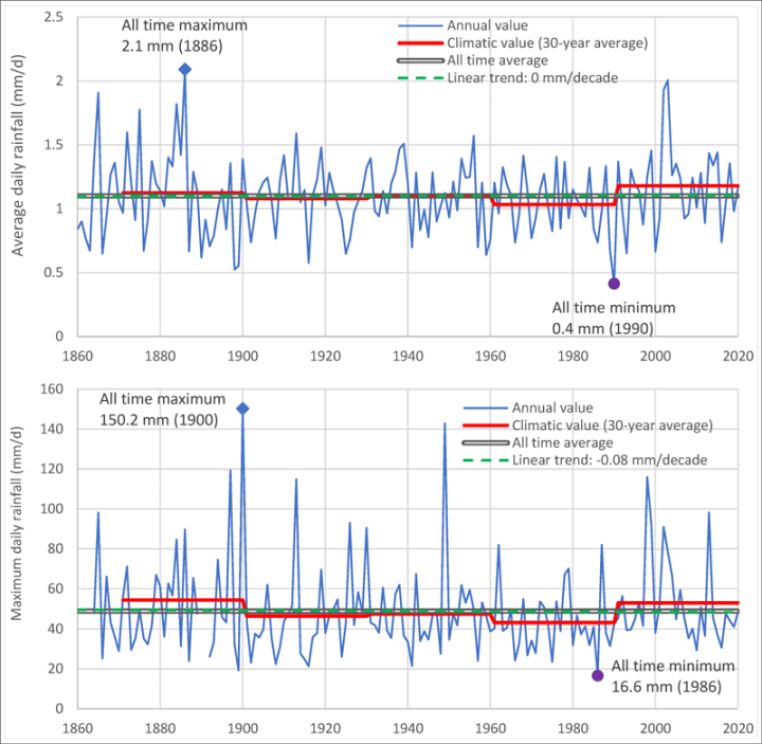
โ€œThe two over-century-long rainfall time series of Greece (Athens and Thessaloniki) show that the record average and maximum rainfall depths occurred in the 19th or early 20th century. Compared to other locations on the globe with long time series, these two time series of Greece show much smaller to negligible climate variability, both in mean and maximum rainfall heights.โ€

โ€œIn terms of the annual average rainfall, the two most important climatic events that have occurred in Greece from the middle of the 20th century to the present day are (a) the grouping of the high records of the annual average rainfall depth, namely 1/3 of all stations, in one year, the hydrological year 1962โ€“63, and (b) the intense and persistent drought before and after 1990, where the five-year period from 1988โ€“89 to 1992โ€“93 saw more than 50% of all record lows.โ€

Greece has seen this alternation of dry periods and wetter periods over the entire historical period, yet civilization flourished there over the same period:

โ€œThe alternation of dry and wet periods is also a notable characteristic revealed by the study of hydrological data. This behaviour has been known to Greek philosophers since the 6th century BC (cf. Xenophanes;). Besides, the dry conditions in Greece have not been an obstacle to the development of Greek civilization but rather a trigger for the development of science, technology, and management. The ancient aqueducts of Athens that are still operational to date are a living testimony of this fact.โ€œ

โ€œA modern repetition of the latter achievement is that, as a result of the successful management of the big drought 30 years ago, Athens now has a perfect water supply system. The successful handling of this crisis is arguably one of the greatest achievements of modern Greek public policy. It would have been impossible without competent and pragmatic leadership and public participation.โ€

The realities of climate, the shifting from dry to wet and back to dry periods, was the impetus for advancements in science and engineering and social policy, successfully overcoming the challenges presented by the real world.

There have been dry periods, some deep and spanning years and there have been wet periods.  This describes the Mediterranean climate type โ€“ the same climate classification as found in California and much of the Pacific Coast of the United States.   But Greeceโ€™s 2,000+ years of experience, wisely acted upon, have saved Greece from the downsides of the dry periods and allowed them to take advantage of the wetter times, establishing the infrastructure and policies that truly benefit the people and ensure a constant and adequate water source for the cities of Greece.   

Bottom Line:  Error 404: Not Found

Sorry European Union,  a thorough search of long-term hydrological data found no Climate Crisis-caused drought in Greece.

Kudos are due the authors of this study โ€“ fighting back against the tide of climate nonsense. 

# # # # #

Authorโ€™s Comment:

[Try as I might, I could not recover the name of the helpful reader that suggested this paper as the subject of a post here. If it was you โ€” please let me know in comments. ]

One of the many curses of modern society, found very often in the Sciences, is Presentism โ€“ the partiality to the present (conditions, attitudes, values) as opposed to taking a longer-term viewpoint.  Thus often in Climate Studies, we find the present (or very near past โ€”  โ€˜when I was a kidโ€™ ) being held up as the ideal. 

We find this in Californiaโ€™s battle with its own historical climate โ€“ dry periods followed by deluges of rain.  (See the Great Flood of 1862). 

But the prophets of doom, the prophets of crisis, must fail as they spread falsehoods based on perverse ideologies. 

Thanks for reading.

Scientists Employ Wit To Highlight The Lack of Climate Trends Across Greece Since The 1800s

The accumulation of over two centuries of precipitation records across Greece indicates there have been overall slightly declining trends in precipitation extremes across the region and โ€œnegligible climate variability.โ€ This supports a new studyโ€™s tongue-in-cheek title referencing a โ€œ404 Not Foundโ€ climate crisis.

From NoTricksZone

Byย Kenneth Richardย onย 1. May 2023

The accumulation of over two centuries of precipitation records across Greece indicates there have been overall slightly declining trends in precipitation extremes across the region and โ€œnegligible climate variability.โ€ This supports a new studyโ€™s tongue-in-cheek title referencing a โ€œ404 Not Foundโ€ climate crisis.

Eight scientists have published a new study  examining the popularized conceptualization of an anthropogenically-induced climate change that has increasingly become โ€œthe post-modern scapegoat for which every disaster is blamed.โ€ The authors point out, for example, that even the 2020-2021 COVID-19 pandemic has been blamed on a human-caused warming climate.

The study utilizes detailed precipitation data available for Greece, as these climate records often extend to the early 1800s.

The scientists tendentiously searched for climate-related (i.e., 30+ years) trends that might confirm there is a โ€œclimate emergency, climate crisis, etc.โ€ in the works linked to an anthropogenic influence.

However, no trend consistent with any anthropogenic climate influence could be found in the records. Hence, the wit-intended โ€œ404 Not Foundโ€ study title (which one of the 3 peer-reviewers recommended be kept in the final publication rather than discarded).

โ€œThe current period can be characterized as normal without notable climatic events.โ€

โ€œThe overall period does not show a linear trend or appreciable difference in the two 30-year climate periods.โ€

โ€œโ€ฆprecipitation did not linearly change during the past 7 decades.โ€

Analyses of precipitation extremes may even support a โ€œdecreasing, albeit slightlyโ€ trend over the two centuries, as the record average and maximum rainfall depths occurred in the 1800s or early 1900s.

Image Source:ย Koutsoyiannis et al., 2023

In anticipation of the timeworn, โ€œBut Greece is not the globe!โ€ criticism, it should be noted that comprehensive analysis of global-scale precipitation data in the satellite era also do not support detection of intensifying trends associated with the timing of the sharp rise in anthropogenic CO2 emissions or a warming climate.

Image Source:ย Nguyen et al., 2018