Why is the WHO Asking Doctors to Lie to Promote Climate Alarm?

Last month, everybodyโ€™s favourite intergovernmental agency, the World Health Organisation (WHO),ย publishedย a โ€œnew toolkit empowering health professionals to tackle climate changeโ€. The toolkit is the latest attempt to enlist one of the most trusted professions into the climate war.

From The Daily Sceptic

BYย BEN PILE

Last month, everybodyโ€™s favourite intergovernmental agency, the World Health Organisation (WHO), published a โ€œnew toolkit empowering health professionals to tackle climate changeโ€. The toolkit is the latest attempt to enlist one of the most trusted professions into the climate war. But not only is this transparently ideological and condescending โ€˜toolkitโ€™ lacking in fact, it requires โ€˜healthcare professionalsโ€™ to use their authority to eschew science and lie to their patients and politicians. The climate war is, after all, political.

The problem for climate warriors of all kinds since the climate scare story emerged in the 1980s and became orthodoxy in the 1990s and 2000s has been the rapid improvement of all human welfare metrics the world over. On the one hand, all life on Earth and the collapse of civilisation hangs in the balance โ€“ that is supposedly the implication of data that shows the atmosphere has got warmer. But on the other hand, people living in economies at all levels of development are today living longer, healthier, wealthier and safer lives than any preceding generation. The era of โ€˜global boilingโ€™, as UN Secretary General Antรณnio Guterres put it, also happens to be the era in which unprecedented social development has occurred.

That is a paradox if you accept the green premise that economic development comes at the expense of the climate. The UN, which has staked its authority on being able to address โ€˜globalโ€™ issues such as environmental degradation, is committed to defending the โ€˜global boilingโ€™ narrative. But, at the same time, actively trying to retard the development of low-income countries risks undermining its authority in the developing world.

The statement made by the WHOโ€™s introduction to its new toolkit epitomises the feeble efforts to square this circle, which try to spin interference in the development of low-income countries as being for their benefit:

Our world is witnessing a concerning trend of warming temperatures, extreme weather events, water and food security challenges and deteriorating air quality. The frequency and intensity of these events are surpassing the capacity of both natural and human systems to respond effectively, resulting in far-reaching consequences for health.

Surprisingly, for a โ€˜toolkitโ€™ aimed at people such as doctors, who have a proven capacity to understand scientific literature, the toolkit offers little evidence in support of these claims. It says that โ€œchanging weather patterns and extreme weather events can reduce crop yields, potentially leading to food insecurity and malnutritionโ€ and that the โ€œbreeding window for mosquito-borne disease is broadening due to changing weather patternsโ€. The reference for both of these claims is given in a footnote, which provides a link to the 2023 IPCC AR6 Synthesis Report, which says in relation to the first claim:

The occurrence of climate-related food-borne and water-borne diseases has increased (very high confidence). The incidence of vector-borne diseases has increased from range expansion and/or increased reproduction of disease vectors (high confidence).

But dig a little deeper into theย IPCCโ€™s discussion on vector-borne diseasesย and you find the following figure depicting mortality risk of various climate-related factors for six regions of the world.

As the data clearly show, since 1990 there have been radical reductions in mortality caused by malaria, malnutrition, diarrhoeal disease, natural disasters and exposure to temperature extremes. The only departure from those trends is dengue, which in any case is of far less significance than the other factors, claiming approximately just 1.75 lives per 100,000 per year, compared with malaria, which claims more than 50.

How do these data compare with the WHOโ€™s claim that โ€œthe frequency and intensity of these events are surpassing the capacity of both natural and human systems to respond effectively, resulting in far-reaching consequences for healthโ€, and the โ€œoccurrence of climate-related food-borne and water-borne diseasesโ€ and the โ€œincidence of vector-borne diseasesโ€ have increased? They do not compare. In Africa, deaths from malnutrition have fallen by three quarters between 1990 and 2017. Diarrhoeal disease mortality has fallen by two thirds in the same period. Malaria deaths have halved. Consequently, more than 10,000 fewer infants die in the world each day than died each day in 1990.

This is, or ought to be, all the more remarkable to anyone who tracks developmental data, because of the WHOโ€™s longstanding attempt to link these diseases of poverty to climate change. In the 2002 World Health Report, the WHO claimed that 154,000 deaths were attributable to climate change, almost exclusively in High Mortality Developing Countries (HMDCs) โ€“ a figure obtained by estimating climate changeโ€™s impact on each of these diseases of poverty. Yet despite the radical progress that has been shown since 2000, the WHO has shown no interest either in revising its understanding of climate change or in developing an understanding of what has driven these improvements in global health, in spite of its name. Instead, it has doubled down on the climate-health narrative.

A similar โ€˜paradoxโ€™ can be shown by comparing the WHOโ€™s statements on food security with other UN agenciesโ€™ data. There is no evidence of climate change adversely affecting agricultural production in vulnerable economies.

Yet the WHOโ€™s toolkit urges โ€œhealth professionalsโ€ to โ€œcommunicateโ€ the urgent climate crisis to ordinary people and to use their authority to influence politics:

Things you could say to a policymaker: Climate change is here now, and I am already seeing the impacts on my patientsโ€™ health. The health of some people is affected more severely, including children and elderly people, disadvantaged communities, remote communities, and people with disabilities or chronic illness.

People are living longer and healthier lives. Infant mortality is way down. Far fewer people are living in poverty. But the WHO wants doctors and nurses to claim that the opposite is true. And worse than that, the toolkit advises those doctors and nurses not to debate:

Donโ€™t debate the science Donโ€™t get caught up in conversations that question climate science. Itโ€™s not up for debate. If conversation veers into this territory, redirect it back to your professional expertise and the links between climate change and health.

But there are no โ€œlinks between climate change and healthโ€. And if there appear to be, these local or regional health trends run counter to the global trends. Therefore, there must be a better explanation than โ€˜climate changeโ€™. It may well be that extreme weather afflicts a place, or even that unusual weather causes the population of that place a number of problems, as it always has. But โ€˜extreme weatherโ€™ is both rare and as yet not attributable to climate change, on the IPCCโ€™s own analysis. And so, if small changes in weather are coincident with negative economic change or health metrics, the cause is less likely to be meteorological than political in nature. For example, incompetence, especially that of undemocratic regimesโ€™ bureaucracies, is very often the cause of hunger, thirst and the lack of basic services. And in their haste to find politically expedient correlations between weather and welfare metrics, researchers fail to consider alternative causes, despite the knowledge that humans are far more sensitive to economic forces than to natureโ€™s whims.

Donโ€™t believe me? Well,ย the evidenceย is extremely stark. Whereas the WHO wants to persuade doctors to ignore science to claim there are โ€œlinks between climate change and healthโ€, by far the strongest predictor of health is in fact wealth. Accordingly, the WHO 2002 report found practically no climate-related deaths in โ€˜Low Mortality Developing Countriesโ€™ and โ€˜Developing Countriesโ€™. There are no deaths โ€œfrom climate changeโ€ where malaria, malnutrition and diarrhoea are eliminated by rising income levels.

Seen from this perspective, the WHOโ€™s mobilisation of health professionals looks very much like a political campaign against wealth. Only such an ideological โ€“ and anti-science โ€“ aversion to wealth could put such emphasis on the link between health and weather, because whereas doctors can and should say that income and health are linked, the WHO presses them not to: the best thing that can be given to poorer people is โ€˜stable weatherโ€™, apparently, not higher incomes. The toolkit even anticipates this criticism, advising people how to answer the argument that โ€œclimate action is perceived as detrimental to the economyโ€. According to the WHO, this is โ€œan untrue and unhelpful perception held by some peopleโ€ฆ which was repeated by some businesses and governments to delay the implementation of climate solutionsโ€. A conspiracy theory, no less, which is supported only by the highly dubious claim that โ€œfor every dollar spent on reducing greenhouse gas emissions, approximately $2 are saved in health costsโ€.

Any doctor who took such an extraordinary and unevidenced claim about a new drug at face value and promptly started prescribing it to their patients would have his or her licence taken away. Britain, for instance, spends around ยฃ10 billion per year on subsidising its green electricity transition alone, yet there is no evidence of the NHS budget benefiting by ยฃ20bn. An analysis of Germanyโ€™s Energiewende estimates the annual cost at โ‚ฌ45 billion, yet per capita expenditure on healthcare rose from โ‚ฌ3,500 in 2009 to โ‚ฌ5,700 in 2021 โ€“ an increase of 62%. Moreover, Germanyโ€™s green deindustrialisation has come at a heavy price, signalling to the world that not even a first-tier industrialised and wealthy nation can survive such environmentalism, with far reaching consequences looming for similar policies in the rest of Europe. The countryโ€™s status as Europeโ€™s deep-green policy champion has passed and now half of Germans believe that lower prices should be put before emissions-reduction policies. German tractors, and for that matter French and Dutch ones as well, arenโ€™t heading to the capitalโ€™s streets to protest against green economic and health miracles. The WHOโ€™s claim is simply mad.

The reason the WHOโ€™s toolkit is so bereft of evidence and logic is because itโ€™s just political propaganda. The document credits authors who are not medical doctors and climate scientists, but psychologists at the Centre for Climate Change Communication located at George Mason University, led by Dr. Ed Maibach. As I have pointed out previously in the Daily Sceptic, climate shrinksโ€™ unwelcome intrusion into climate politics does nothing to improve debate and only serves to antagonise increasingly intense conflicts. And their involvement in producing the WHOโ€™s toolkit is no exception. This remote, conflicted intergovernmental agency claims the authority of โ€˜expertsโ€™, but its guidance instructs doctors to eschew science, evidence and debate โ€“ it literally advises them not to engage in debate โ€“ and instead to promulgate green ideology: the mythical claim that there are โ€˜linksโ€™ between climate and health, that the green โ€˜transitionโ€™ will improve health and that complying with emissions targets is cheap as chips.

The toolkit may give โ€˜healthcare professionalsโ€™ the justification to lie to the public and politicians, but thatโ€™s not โ€˜empowermentโ€™, itโ€™s just fibs. And its recruitment of psychologists to mobilise doctors and nurses as the instruments of a political agenda is yet more evidence of the urgent need to dismantle the WHO, for the sake of billions of peopleโ€™s health and wealth.

Subscribe to Ben Pileโ€™s The Net Zero Scandal Substack here.

Health & Democracy: Expert Hearing in the EU Parliament – Part 1/3

The WHO – with its worldwide striving for more and more power and higher financial resources – has become a central danger for our democratic basic order.

In the worst case the now threatening โ€œWHO-pandemic-treatyโ€ means nothing else than the de facto self-deprivation of power of national parliaments and the transfer of political decision-making authority to an unelected supranational organization. This “world health government,” which could be activated at any time by means of an emergency clause, would not be democratically legitimized and would no longer be accessible to us – the citizens – not even through elections.

Christine Anderson, MdEP

Therefore, together with my colleagues from “Team Freedom”, I recently invited renowned international experts to a hearing in the EU Parliament to discuss this totally underestimated danger from a

โš–๏ธ legal,
๐Ÿ’Š medical,
๐Ÿ’ก psychological,
๐Ÿ“œ historical &
๐Ÿ’ฐ financial perspective to shed light on and to understand.

EXPERTS: Prof. Mattias Desmet (Belgium) Prof. Michael Geistlinger (Austria) Prof. Andreas Sรถnnichsen (Austria) Dr. Peter McCollough (USA) Dr. Beate Pfeil (Germany) Dr. David E. Martin (USA) Dr. Maria Hubmer-Mogg (Austria) Dr. Renate Holzeisen (Italy) Philipp Kruse, Attorney at law (Switzerland)

Hosting MEPs: MEP Christine ANDERSON (Germany) MEP Mislav KOLAKUล Iฤ† (Croatia) MEP Ivan SINฤŒIฤ† (Croatia) MEP Cristian TERHES (Romania) MEP Virginie JORON (France) MEP Rob Roos (Netherlands)

Watch now part 1 of my new and exciting three-hour series on this important as well as disturbing issue.

In this episode, the following speakers take the floor:

MEP Christine Anderson (Germany)
Philipp Kruse, Attorney at law (Switzerland)
Dr. Renate Holzeisen (Italy)
Prof. Michael Geistlinger (Austria)
Dr. Beate Pfeil (Germany

This expert hearing in 3 episodes is the perfect opportunity to get an in-depth look at the โ€œWHO-pandemic-treatyโ€ and to understand the WHO’s hidden background and its entanglements with the global fake elites.

Part 2 and 3 will follow soon here on my channel. Therefore, itโ€™s best to subscribe now, so you don’t miss the sequels!

Sincerely
Yours Christine Anderson, MEP

Over 200 health journals call on the UN & WHO to recognize โ€˜climate changeโ€™ as โ€˜a global health emergencyโ€™

British Medical Journal: Published 25 October 2023: Over 200 health journals call on the United Nations, political leaders, and health professionals to recognize that climate change and biodiversity loss are one indivisible crisis and must be tackled together to preserve health and avoid catastrophe. This overall environmental crisis is now so severe as to be a global health emergency…
Human health is damaged directly by both the climate crisis, as the journals have described in previous editorials, and the nature crisis. โ€ฆ
The World Health Organization should declare the indivisible climate and nature crisis as a global health emergency. The three preconditions for WHO to declare a situation to be a public health emergency of international concern are that it is serious, sudden, unusual, or unexpected; carries implications for public health beyond the affected stateโ€™s national border; and may require immediate international action. Climate change seems to fulfil all those conditions. … 
We must recognise this crisis for what it is: a global health emergency.”
#

The Weather Channel: Worldโ€™s Biggest Journals Join Forces, Demand Climate Crisis be Declared a Global Public Health Emergency

From ClimateDepot.com

Byย Marc Morano

https://www.bmj.com/content/383/bmj.p2355

Published 25 October 2023

BMJ 2023; 383 doi: https://doi.org/10.1136/bmj.p2355 (Published 25 October 2023)Cite this as: BMJ 2023;383:p2355

Editorials

Time to treat the climate and nature crisis as one indivisible global health emergency

BMJ 2023; 383 doi: https://doi.org/10.1136/bmj.p2355 (Published 25 October 2023)Cite this as: BMJ 2023;383:p2355

  1. Kamran Abbasi, editor in chief1,
  2. Parveen Ali, editor in chief2,
  3. Virginia Barbour, editor in chief3,
  4. Thomas Benfield, editor in chief4,
  5. Kirsten Bibbins-Domingo, editor in chief5,
  6. Stephen Hancocks, editor in chief6,
  7. Richard Horton, editor in chief7,
  8. Laurie Laybourn-Langton8,
  9. Robert Mash, editor in chief9,
  10. Peush Sahni, editor in chief10,
  11. Wadeia Mohammad Sharief, editor in chief11,
  12. Paul Yonga, editor in chief12,
  13. Chris Zielinski13

Author affiliations

  1. Correspondence to: C Zielinski chris.zielinski@ukhealthalliance.org

Joint action is essential for planetary and human health

Over 200 health journals call on the United Nations, political leaders, and health professionals to recognise that climate change and biodiversity loss are one indivisible crisis and must be tackled together to preserve health and avoid catastrophe. This overall environmental crisis is now so severe as to be a global health emergency.

The world is currently responding to the climate crisis and the nature crisis as if they were separate challenges. This is a dangerous mistake. The 28th UN Conference of the Parties (COP) on climate change is about to be held in Dubai while the 16th COP on biodiversity is due to be held in Turkey in 2024. The research communities that provide the evidence for the two COPs are unfortunately largely separate, but they were brought together for a workshop in 2020 when they concluded: โ€œOnly by considering climate and biodiversity as parts of the same complex problem โ€ฆ can solutions be developed that avoid maladaptation and maximize the beneficial outcomes.โ€1

As the health world has recognised with the development of the concept of planetary health, the natural world is made up of one overall interdependent system. Damage to one subsystem can create feedback that damages anotherโ€”for example, drought, wildfires, floods, and the other effects of rising global temperatures destroy plant life and lead to soil erosion and so inhibit carbon storage, which means more global warming.2 Climate change is set to overtake deforestation and other land use change as the primary driver of nature loss.3

Nature has a remarkable power to restore. For example, deforested land can revert to forest through natural regeneration, and marine phytoplankton, which act as natural carbon stores, turn over one billion tonnes of photosynthesising biomass every eight days.4 Indigenous peoplesโ€™ approaches to land and sea management have a particularly important role in regeneration and continuing care.5

Restoring one subsystem can help anotherโ€”for example, replenishing soil could help remove greenhouse gases from the atmosphere on a vast scale.6 But actions that may benefit one subsystem can harm anotherโ€”for example, planting forests with one type of tree can remove carbon dioxide from the air but can damage the biodiversity that is fundamental to healthy ecosystems.7

โ€ฆ

Human health is damaged directly by both the climate crisis, as the journals have described in previous editorials,89 and the nature crisis. โ€ฆ

Global health emergency

In December 2022 the biodiversity COP agreed on the effective conservation and management of at least 30% of the worldโ€™s land, coastal areas, and oceans by 2030.23 Industrialised countries agreed to mobilise $30bn a year to support developing nations to do so.23 These agreements echo promises made at climate COPs.

Yet many commitments made at COPs have not been met. โ€ฆ

The World Health Organization should declare the indivisible climate and nature crisis as a global health emergency. The three preconditions for WHO to declare a situation to be a public health emergency of international concern are that it is serious, sudden, unusual, or unexpected; carries implications for public health beyond the affected stateโ€™s national border; and may require immediate international action. Climate change seems to fulfil all those conditions.25 โ€ฆ

Political leaders must recognise both the severe threats to health from the planetary crisis and the benefits that can flow to health from tackling the crisis.26 But, first, we must recognise this crisis for what it is: a global health emergency.

#

https://weather.com/en-IN/india/climate-change/news/2023-10-27-biggest-journal-climate-crisis-global-public-health-emergency

Worldโ€™s Biggest Journals Join Forces, Demand Climate Crisis be Declared a Global Public Health Emergency

By Ankush Banerjee

These health journals are urging world leaders and health professionals to recognise that the climate crisis and biodiversity loss are interconnected crises, both of which pose a severe threat to human health, even insisting that the World Health Organisation (WHO) officially declare a global health emergency.

As climate change exacerbates extreme weather, pollution and disease, humans โ€” particularly those from marginalised communities โ€” continue to face its weighty interlinked consequences. In addition to harming ocean life, deteriorating water quality continues to worsen water-borne disease spread and the seafood crisis. Further, rapid changes in land use and climbing temperatures are breeding the perfect conditions for more pathogens to make the deadly jump to humans, leading to worrisome new diseases and pandemics.

Many studies have shown that access to green spaces is crucial for healthier communities as they help filter air pollution, reduce temperatures, and provide opportunities for physical activity. Nature has a positive impact on mental health, while also reducing stress, loneliness and depression, but these benefits are under threat due to increasing urbanisation.

Despite official goals to conserve 30% of the worldโ€™s land, coastal areas and oceans by 2030, many ecosystems are at the brink of their breaking points. Tipping over could lead to catastrophic harm to health, even if global warming is kept below a 1.5ยฐC increase over pre-industrial levels.

Therefore, it is imperative that national climate plans be integrated with biodiversity goals. Health professionals, who command a ton of influence and trust in the public domain, have been urged to advocate for both restoring biodiversity and addressing climate change. Political leaders have also been called upon to recognisze the severe threats to health from this planetary crisis and the health benefits that can arise from taking action.

The editors of these prestigious journals have also backed a petition calling for WHO to declare a global public health emergency in May 2024. This united effort underscores the urgency of recognising and addressing the intertwined climate and nature crisis as a global health emergency.

The editorial can be accessed here.

#

British Medical Journal: Published 25 October 2023: Over 200 health journals call on the United Nations, political leaders, and health professionals to recognize that climate change and biodiversity loss are one indivisible crisis and must be tackled together to preserve health and avoid catastrophe. This overall environmental crisis is now so severe as to be a global health emergencyโ€ฆ

Human health is damaged directly by both the climate crisis, as the journals have described in previous editorials, and the nature crisis. โ€ฆ

The World Health Organization should declare the indivisible climate and nature crisis as a global health emergency. The three preconditions for WHO to declare a situation to be a public health emergency of international concern are that it is serious, sudden, unusual, or unexpected; carries implications for public health beyond the affected stateโ€™s national border; and may require immediate international action. Climate change seems to fulfil all those conditions. โ€ฆ 

We must recognise this crisis for what it is: a global health emergency.โ€

#

The Weather Channel: Worldโ€™s Biggest Journals Join Forces, Demand Climate Crisis be Declared a Global Public Health Emergency

Big Pharma all in on merging climate into health scare! CEO of AstraZeneca: โ€˜Climate emergency is the biggest health crisis of our time โ€“ bigger than Covidโ€™ โ€“ โ€˜Radical action is needed on greenhouse gas emissionsโ€™

THE WHOLE TRUTH LAID BARE – Tell the WHO TO GO TO HELL!

On September 13 in the EU Parliament, another set of presentations were made at the invitation of MEP Christine Anderson of Germany and some of her colleagues, listed below, who have been doing a sterling job of alerting the EU public to the tyranny that has been going on.

On September 13 in the EU Parliament, another set of presentations were made at the invitation of MEP Christine Anderson of Germany and some of her colleagues, listed below, who have been doing a sterling job of alerting the EU public to the tyranny that has been going on. The video of the presentations is found above.

————

Dr. Peter McCullough (2:36 minutes to 18:45)
There have been 2 waves of injury to the world (SARS-CoV 2 & the vaccine) โ€“ the role of the WHO appears to be adverse in both of these cases;

WHO is part of a globalist NGO-govt. syndicate (actors are all named); many of these conspired in 2020 to cover up what they knew;

WHO has deceived the world and impeded doctorsโ€™ ability to treat patients effectively;

weโ€™re going on 3 years now and there is nothing to relieve human suffering on this; most deaths were preventable;

the vaccines have โ€˜ravaged the population in the worldโ€™ (2/3 of the world took them);

the genetic design of the vaccine has been a disaster; everyone agrees about the heart damage done by them โ€“ many young people are having cardiac arrests โ€˜due to the vaccine until proven otherwiseโ€™;

neurological damage is the 2nd domain;

3rd, blood clots โ€˜like weโ€™ve never seen beforeโ€™ which wonโ€™t dissolve up to 2 year with conventional blood thinners;

4th, immunological disorders; cardiac arrests have happened up to TWO YEARS after the shots; 74% of deaths after vaccination are due to the vaccine;

in myocarditis cases, 100% of deaths are due to the vaccine; there have been 3 false narratives,

the latest being that it is Covid, not the vaccine, that is killing people; vaccines are โ€˜causing this enormous wave of illnessโ€™;

one study says that 30% of vaccinated people have experienced NO side effects; less than 70% are getting some symptoms, with a small percentage getting dramatic illnesses โ€“ some batches are โ€˜high riskโ€™ (small % estimates range thus,

4.2% โ€“ 7.7% โ€“ 15%); no-one should take another shot โ€“ they should be removed for โ€˜excess risk of deathโ€™ โ€“ many groups are coming out, based on the evidence, saying this; they are not safe for human use;

yet WHO is still standing behind these vaccines; all major stakeholders should pull out of the WHO.

Dr. David Martin (30:24 minutes to 54:56)

๐Ÿ‘‰๐Ÿผ๐Ÿ‘‰๐Ÿผ โ€˜For 110 years, we the people of the world have been lied to โ€ฆโ€™
๐Ÿ‘‰๐Ÿผ๐Ÿ‘‰๐Ÿผ โ€˜Iโ€™m done being politeโ€™
๐Ÿ‘‰๐Ÿผ๐Ÿ‘‰๐Ÿผ โ€˜This (WHO) is a criminal cartelโ€™
๐Ÿ‘‰๐Ÿผ๐Ÿ‘‰๐Ÿผ โ€˜We did not have a pandemic, we had genocideโ€™

MEP Christine Anderson concluding remarks (1:12:28 to 1:18:25)

UN Set to Agree New Political Declaration on Pandemics Next Week โ€“ and itโ€™s a Horror Show

In four daysโ€™ time, on Wednesday September 20th, our representatives meeting at the United Nations will sign off on a โ€˜Declarationโ€™ titled: โ€˜Political Declaration of the United Nations General Assembly High-level Meeting on Pandemic Prevention, Preparedness and Response.โ€™

From The Daily Sceptic

BYย DR DAVID BELL

In four daysโ€™ time, on Wednesday September 20th, our representatives meeting at the United Nations will sign off on a โ€˜Declarationโ€™ titled: โ€˜Political Declaration of the United Nations General Assembly High-level Meeting on Pandemic Prevention, Preparedness and Response.โ€™

This was announced as a โ€œsilent procedureโ€, meaning that States not responding will be deemed supporters of the text. The document expresses a new policy pathway for managing populations when the World Health Organisation (WHO), the health arm of the UN, declares a future viral variant to be a โ€œpublic health emergency of international concernโ€. The WHO noted in 2019 that pandemics are rare and insignificant in terms of overall mortality over the last century. Since then, it decided that the 2019 old-normal population was simply oblivious to impending annihilation. The WHO and the entire UN system now consider pandemics an existential and imminent threat. This matters, because:

  1. They are asking for far more money than is spent on any other international health program (your money);
  2. This will deliver great wealth to some people who now work closely with WHO and the UN;
  3. The powers being sought from your Government will reimpose the very responses that have just caused the largest growth in poverty and disease in our lifetimes; and
  4. Logically, pandemics will only become more frequent if someone intends to make them so (so we should wonder what is going on).

Staff who drafted this Declaration did so because it is their job. They were paid to write a text that is clearly contradictory, sometimes fallacious, and often quite meaningless. They are part of a rapidly growing industry, and the Declaration is intended to justify this growth and the centralisation of power that goes with it. The document will almost certainly be agreed by our Governments because, frankly, this is where the momentum and money are.

Whilst the Declarationโ€™s 13 pages are all over the place in terms of reality and farce, they are not atypical of recent UN output. People are trained to use trigger words, slogans and propaganda themes (e.g., โ€œequityโ€, โ€œempowerment of all women and girlsโ€, โ€œaccess to educationโ€, โ€œtechnology transfer hubsโ€) that no one could oppose without risking being labelled a denier, far-Right or colonialist.

The Declaration should be read in the context of what these institutions and their staff have just done. It is difficult to summarise such a compendium of right-speak intended to veil reality, but it is hoped this short summary will prompt some thought. Wickedness is not a mistake but an intended deception, so we need to distinguish these clearly.  

Fomenting darkness behind a veil of light

Put together, the following two extracts summarise the internal contradiction of the Declarationโ€™s agenda and its staggering shamelessness and lack of empathy:

In this regard, we:

PP3: Recognise also the need to tackle health inequities and inequalities, within and among countriesโ€ฆ

PP5: Recognise that the illness, death, socio-economic disruption and devastation caused by the COVID-19 pandemicโ€ฆ

โ€˜Recognitionโ€™ of devastation is important. SARS-CoV-2 was associated with mortality predominantly within wealthy countries, where median age of Covid-associated death was between 75 and 85 years. Nearly all of these people had significant co-morbidities such as obesity and diabetes, meaning their life-expectancy was already restricted. Most people contributing significantly to economic activity were at very low risk, a profile know in early 2020. 

These three years of socio-economic devastation must, therefore, be overwhelmingly due to the response. The virus did not starve people, as the Declarationโ€™s writers would like us to believe. Deteriorating disease control was predicted by WHO and others in early 2020, increasing malaria, tuberculosis, HIV/AIDS and malnutrition. Economic disruption in low-income countries specifically results in more infant and child deaths.

In Western countries, adult mortality has risen as expected when screening for cancer and heart disease are reduced and poverty and stress increase. Knowing this, WHO advised in late 2019 to โ€not under any circumstancesโ€ impose lockdown-like measures for pandemic influenza. In early 2020, under the influence of its sponsors, it advocated them for COVID-19. The Declaration, however, carries no note of contrition or repentance.

Undeterred by incongruity, the Declaration goes on to describe COVID-19 as โ€œone of the greatest challengesโ€ in UN history (PP6), noting that somehow this outbreak resulted in โ€œexacerbation of poverty in all its forms and dimensions, including extreme povertyโ€. In fact, it acknowledges that this caused:

(a) negative impact on equity, human and economic development across all spheres of society, as well as on global humanitarian needs, gender equality and the empowerment of all women and girls, the enjoyment of human rights, livelihoods, food security and nutrition, education, its disruption to economies, supply chains, trade, societies and the environment, within and among countries, which is reversing hard-won development gains and hampering progress (PP6)

To restate the obvious, this does not happen due to a virus targeting sick elderly people. It occurs when children and productive adults are barred from school, work, healthcare and participation in markets for goods and services. Economic, social and health catastrophe inevitably results, disproportionately harming poorer people and low-income countries, conveniently far indeed from the halls of Geneva and New York.

No, we were not all in this together.

Not all were negatively impacted by this catastrophe. People and corporations who sponsor much of the WHOโ€™s health emergency work, and that of its sister organisations such as CEPI, Gavi and Unitaid, did very well from the policies they advocated so strongly. Software and Pharma companies made unprecedently high profits while this mass impoverishment played out. The international agencies have also gained; construction and recruitment are strong in Geneva. Philanthro-capitalism is good for some.

The main aim of the Declaration is to back the proposed WHO International Health Regulation (IHR) amendments and treaty (PP26), key to ensuring that viral outbreaks that have such small impact can remain highly profitable. An additional $10 billion dollars per year in new financing is requested to support this (PP29). There is a reason why most countries have laws against scams. The UN and its agencies, fortunately for its staff, are outside of any national jurisdiction.

Based on their sponsorsโ€™ assessments, the staff of these agencies are doing their job well. For the rest of humanity, their work is an unmitigated disaster. In 2019 they said never lock down, then spent 2020 defending top-down lockdowns and mandates. For three years, they theatrically pretended that decades of knowledge on immunity, disease burden and the association of poverty with mortality did not exist. Now they write this UN Declaration to fund their industry further through taxpayers they so recently impoverished. Once tasked to serve the worldโ€™s vast populations, particularly the poor and vulnerable, the UN vision has been consumed by public private partnerships, the allure of Davos and a fascination with high-net-worth individuals.

When words are used to obscure actions

While the Declaration underlines the importance of educating children during pandemics (PP23), these same organisations backed school closures for hundreds of millions of children at minimal risk from COVID-19. Among them, several million more girls are now being farmed off to nightly rape as child brides, others in child labour. Women and girls were disproportionately removed from education and from employment. They werenโ€™t asked if they supported these policies!

The girls are being raped because the people paid to implement these policies did so. They know the contradiction, and the harm. But this is a job like many others. The only unusual aspects, from a business standpoint, are the sheer amorality and lack of empathy that must be engaged to excel in it.

To justify wrecking African childrenโ€™s lives, the UN claims out that the continent has โ€œover 100 major public health emergencies annuallyโ€ (OP4). Africa has a rising burden of endemic diseases that dwarf mortality from such outbreaks โ€“ over half a million children die every year from malaria (increased through the COVID-19 lockdowns) and similar burdens from tuberculosis and HIV. By contrast, total COVID-19 deaths recorded in Africa over the past three years are just 256,000. The 2015 West African Ebola outbreak, the largest such recent emergency pre-Covid, killed 11,300 people. MERS and SARS1 killed less than 1,000 each globally. However, induced poverty does cause famine, raises child mortality and wrecks health systems โ€“ is this the health emergency that the UN is referring to? Or is it simply making things up?

Through the IHR amendments, these agencies will coordinate the locking down, border closures, mandated medical examinations and vaccination of you and your family. Their Pharma sponsors reasonably expect to make several hundred billion more dollars from these actions, so we can be confident that emergencies will be declared. By claiming 100 such events annually in Africa alone, they are signalling how these new powers will be used. We are to believe the world is such that only the abandonment of our rights and sovereignty, for the enrichment of others, can save us.

The UN and WHO do recognise that some will question this illogic. In PP35, they characterise such scepticism as โ€œhealth-related misinformation, disinformation, hate speech and stigmatisationโ€.

The WHO recentlyย publicly characterisedย people who discuss adverse effects of Covid vaccines and question WHO policies as โ€œfar-Rightโ€, โ€œanti-science aggressorsโ€ and โ€œa killing forceโ€.

https://x.com/WHO/status/1602991915808456705?s=20

This is unhinged. It is the denigration and hate speech that fascist regimes use. The reader must decide whether such an organisation should control his or her freedom of expression and decide what constitutes truth.

It is not helpful here to give details of all 13 pages of right-speak, contradiction and fallacy. You will find similar rhetoric in other UN and WHO documents, particularly on pandemic preparedness. Straight-talk is contrary to business requirements. However, the first paragraph in the Declarationโ€™s โ€˜Call to Actionโ€™ sets the tone:

We therefore commit to scale up our efforts to strengthen pandemic prevention, preparedness and response and further implement the following actions and express our strong resolve to:  

OP1. Strengthen regional and international cooperation, multilateralism, global solidarity, coordination and governance at the highest political levels and across all relevant sectors, with the determination to overcome inequities and ensure the sustainable, affordable, fair, equitable, effective, efficient and timely access to medical countermeasures including vaccines, diagnostics, therapeutics and other health products to ensure high-level attention through a multisectoral approach to prevent, prepare for and respond to pandemics and other health emergencies, particularly in developing countries;

There are 48 more. You paid taxes so that someone could write that!

Those millions of girls suffering at night, the hundreds of millions of children who had their futures stolen, the mothers of those malaria-killed children, and all suffering under the increasing burden of poverty and inequality unleashed by this farce are watching. The Declaration, like the IHR amendments and pandemic treaty it supports, await the signatures of the Governments that purport to represent us.

Dr. David Bell is a clinical and public health physician with a PhD in population health and background in internal medicine, modelling and epidemiology of infectious disease. Previously, he was Programme Head for Malaria and Acute Febrile Disease at FIND in Geneva, and coordinating malaria diagnostics strategy with the World Health Organisation. He is a member of the Executive Committee of PANDA.

Eris vaccine marketing hits Germany, complete with panic about a nonexistent August “Covid wave” ripped from British and American headlines

The leftist taz newspaper on 17 August:ย New German Wave: The new Covid variant Eris has arrived in Germany. Concerns about a new wave are growing โ€“ but the country is not well prepared.

By EUGYPPIUS

We will not be free of the virus until we are free of the vaccinators.

The leftist taz newspaper on 17 August: New German Wave: The new Covid variant Eris has arrived in Germany. Concerns about a new wave are growing โ€“ but the country is not well prepared.

The pandemic is over, but the virus is still dangerous: Reports of the new variant EG.5.1. seem to confirm this analysis. EG.5.1. (Eris) has been considered a โ€œvariant of interestโ€ since 9 August. According to the WHO, the phenotype does not differ fundamentally from other Omicron lineages and does not require special public health measures …

With the announced end of the pandemic, virtually all mandated protective measures have been lifted in Germany.ย The most important instrument in the fight against Covid-19 is thus the immunisation of the population through infection or vaccination.

Das Erste, state media, on 19 August: Covid Variant โ€œErisโ€: How Dangerous is the New Mutation EG.5?

The World Health Organisation WHO has upgraded the new Covid mutationEG.5. This variant, called โ€œEris,โ€ now belongs to the โ€œvariants of interest.โ€ โ€ฆ

As WHO Covid expert Maria Van Kerkhove explained in Geneva on Wednesday, more severe outcomes have not been observed with Eris, but vaccination confers less protection than with other virus variants. …

Even though the new variant is unlikely to cause severe disease,ย the [German vaccine regulatory authority] STIKO still recommends getting vaccinatedย โ€“ above all to avoid possible long-term consequences of SARS-CoV-2 infection and to protect employees in medical and nursing care.

n-tv, a subsidiary broadcaster of RTL, on 18 August: The Number of Coivd-19-Cases Continues to Rise.

The pharmaceutical company Moderna has announced thatย its updated Covid vaccine according to an initial study is effective against the Eris sub-variant.ย The company now expects to launch the new vaccine in time for the autumn vaccination season.ย Approval from vaccine regulators however is still pending.

Moderna, like vaccine manufacturers Novavax and Pfizer, has developed versions of its vaccines with Biontech SE that target Eris subvariants.ย Shortly before, the pharmaceutical company Pfizer had reported that its revised vaccine had been effective against Eris in a study with mice. โ€ฆ

Most recently, it was suspected that the cinema hype surrounding the feel-good film โ€œBarbieโ€ and the gloomy biopic โ€œOppenheimerโ€ may have caused many infections. At the same time, the Robert Koch Institute (RKI) recorded an increase in the number of reported Covid infections. Experts, however, see no reason for concern so far.

Frankfurter Rundschau, a regional Frankfurt paper, on 17 August: Covid comeback with โ€œErisโ€: First experts demand return to masking.

Is Covid on the attack again? There are indications that the virus is once on the rise once more. โ€ฆ

British doctors are already calling for a return to masking. [Relentless virus charlatan and deranged hypermasker] Trisha Greenhalgh suggests that, โ€œin view of the spread of new variants,โ€ masking in high-risk situations should be considered.

The [virus surveillance] of the Federal Ministry of Health shows that the numbers are also on the rise in Germany. โ€ฆ โ€œErisโ€ is already responsible for every fourth corona infection, according to new figures from the RKI. โ€œThe number of Covid-19 cases reported to the RKI .. seems to be related to the increasing circulation of this โ€˜variant of interestโ€™,โ€ the Robert Koch Institute says.

The increase in the case numbers โ€“ at least in Great Britain โ€“ coincides with the opening of the blockbusters โ€œBarbieโ€ and โ€œOppenheimerโ€ in British cinemas, which has given rise to talk of the โ€œBarbenheimerโ€ phenomenon. It is well known that larger crowds in enclosed indoor spaces are associated with an increased risk of corona infection. So is it time for a mask renaissance?

In the USA, more and more voices calling for one. [Relentless virus pest] Eric Feigl-Ding โ€ฆ used the hashtag #MaskUp on Twitter to call once again for protecting oneself from Covid infections with masks. Health Minister Karl Lauterbach shared the post, warning that the latest Covid data from New York is โ€œworrying.โ€ โ€ฆ

โ€œThere is still a risk that a more dangerous variant will emerge, which could lead to a sudden increase in cases and deaths,โ€ emphasises WHO Director-General Tedros Adhanom Ghebreyesus.ย Not only adapted vaccines that take the new variants into account,ย but also wearing a mask would then help to protect oneself and others, Frankfurt virologist Martin Stรผrmer toldย Spiegel.

tagesschau, state media, on 17 August: Covid Case Numbers are Rising Again.

The number of laboratory-confirmed Corona cases in Germany is rising again – but at a relatively low level. This development has been ongoing for around a month, reports the Influenza Working Group at the Robert Koch Institute (RKI) โ€ฆ According to the report, about 2,400 confirmed cases of Covid-19 were reported nationwide last week. This is more than double the number reported in the week ending 9 July, when there were about 1,000. โ€ฆ

According to the RKI report, the activity of acute respiratory diseases in general in the population was โ€œat a low summer level.โ€ โ€ฆ โ€œAnyone with symptoms of an acute respiratory infection should stay at home for three to five days and until the symptoms have clearly improved,โ€ advises the RKI. โ€ฆ


Despite all of this obnoxious verbiage, absolutely nothing of virological note is happening in Germany. Official Covid testing has been all but abolished here, forcing our journaloids to unearth statistics from RKI influenza surveillance โ€“ something they refused to do during the pandemic itself, because the flu people routinely posted data that undermined their panic narrative. Here, Iโ€™ve circled in red the scary RiSE iN InFEctiOnS from the latest RKI report that weโ€™re meant to be worried about:

This microscopic uptick is dwarfed by the February/March wave that peaked between weeks 8 and 13. Our media luminaries took next to no notice of this frightening late-winter surge, and as I type this, Covid diagnoses have not even re-achieved their June levels. The difference between the state of things now and the state of things in February is not the unremarkable Eris variant. XBB was also debuting across Europe early this year, driving the post-February case peak, and nobody cared. The only thing that is different now, is the proximity of the autumnal vaccination liturgy and the prospect of new, updated vaccines from Pfizer/BioNTech, Moderna and Novavax. That is why we are hearing about variants and masks and Long Covid all over again. It is also why many of these articles contain buried within them somewhere the advice to line up for the shiny new anti-Covid juice this Fall. This whole thing is, very plainly, a psy-op, if a very low-effort one.

There are several patterns in the German reporting that are worth noting. First of all, the latest hysteria was unleashed on 17 August, prompted by a report on Eris from the German news agency Deutsche Presse-Agentur. Particularly in the realm of routine reporting, the news agencies are a powerful coordinating force, and their influence here means that the full media panic machine is not engaged. Weโ€™re looking instead at pieces thrown together by low-level staff desperate to fill column inches. Second, all the German stories are firmly downstream from Anglophone sources, going so far as to recycle from British tabloids the improbable theory of a โ€œBarbenheimerโ€ wave (it is painful even to type this stupid word). Third, at least German health authorities โ€“ Karl Lauterbach excepted โ€“ resolutely refuse to provide virus doom quotes. Thus the Frankfurter Rundschau had to appropriate the tweets of Anglosphere mask hysterics like Greenhalgh and Feigl-Ding to make Eris sound scary.

I know there areย rumours that American authorities are planning to bring back mask mandates and other restrictions in the coming months, and Iโ€™ll be honest: We should be so lucky. If the pandemicists try to kick up another round of non-pharmaceutical interventions this fall, theyโ€™ll be flirting with self destruction. There are important prerequisites for virus panic: You need a plausibly novel pathogen, the risk of which can be exaggerated. You need a prevailing sense of stability, with nothing else much going on, because the public health interventions themselves have to seem new. Risk, excitement and the prospect of a break from routine are important enticements. Thatโ€™s all gone now. Covid is not a new scary virus anymore; nearly everyone has had personal experience with it. Solid majorities everywhere have learned to hate lockdowns, despise masking and avoid the mRNA vaccines. The pandemicists need a plausibly new virus to reopen the circus, and they need a lot of people to forget about what a misery the last pandemic response was. Theyโ€™ll have another chance in ten or fifteen years, Iโ€™d guess. Then, itโ€™ll be time to worry.

Originally appearedย onย Eugyppiusโ€™s Substack newsletter.

The German Origins of the Pandemic Treaty

With the WHO hurtling towards adoption of the โ€˜Pandemic Treatyโ€™, as well as revisions of its International Health Regulations (IHR) which some knowledgeable observers regard as even more consequential, a leading theory among opponents appears to be that the changes will consolidate the power of the WHO bureaucracy and hence of private interests which allegedly control the latter.

From The Daily Sceptic

Byย ROBERT KOGON

With the WHO hurtling towards adoption of the โ€˜Pandemic Treatyโ€™, as well as revisions of its International Health Regulations (IHR) which some knowledgeable observers regard as even more consequential, a leading theory among opponents appears to be that the changes will consolidate the power of the WHO bureaucracy and hence of private interests which allegedly control the latter.

But,ย prima facie, the theory makes little sense. The WHO is, after all โ€“ย like, say, the UN or the World Trade Organisation โ€“ an international organisation, in which negotiations take place among memberย statesย and decisions are made by them. Private sources can contribute as much funding as they like, and this may well give them influence, but it will not give them a seat at the negotiating table or a vote. Without precisely state sponsorship, a project like the Pandemic Treaty and the related revisions of the IHR could not even get off the ground.

And, lo and behold, if we go back far enough โ€“ before hardly anyone will have ever even heard the expression โ€˜pandemic treatyโ€™ โ€“ we discover that the treaty did indeed have a state sponsor and that, unsurprisingly, the state in question is the very same state which, if albeit unbeknownst to the broader public, was the driving force behind the WHOโ€™s COVID-19 โ€˜pandemic responseโ€™: namely, Germany.

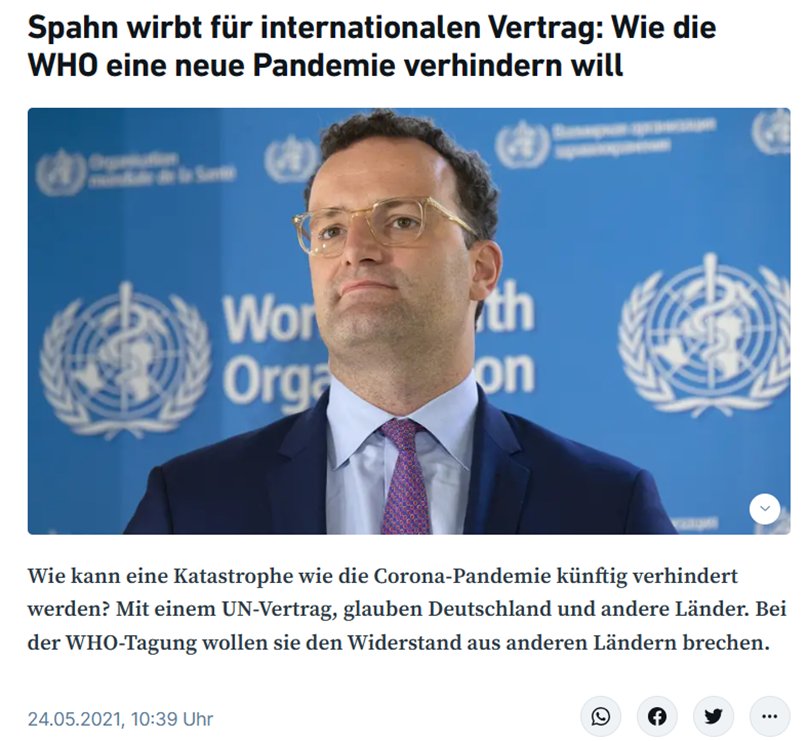
Thus, referring to then German Minister of Health Jens Spahn, the headline of a May 24th 2021 report from Germanyโ€™sย dpaย wire service reads: โ€˜Spahn Pushes for International Treaty: How the WHO Wants to Prevent a New Pandemicโ€˜.

But the article is not in fact about howย the WHOย wants to prevent a future pandemic, but rather about howย Germany wants the WHOย to prevent a future pandemic. Thus, the accompanying blurb reads: โ€œHow can a catastrophe like the Corona pandemic be prevented in the future? With a UN treaty, Germany and other countries believe. At the WHO meeting, they want to break the resistance of other countries.โ€

The article goes on to narrate how Germany and its allies wanted to use the WHOโ€™s annual assembly, which was being held remotely that year and which began on that very day, in order to โ€œfire off the starting pistol for an international pandemic treatyโ€.

And so it would come to pass. By the end of the yearly event, a few days later, then German Chancellor Angela Merkel and a somewhat rag-tag band of two dozen other world leaders would publish aย joint statementย calling for the conclusion of a pandemic treaty. The signatories included many frankly minor figures like the Prime Ministers of Fiji and of Trinidad and Tobago, as well as heads of international organisations โ€“ like none other than WHO Director-General Tedros โ€“ but also somewhat weightier figures like then British Prime Minister Boris Johnson and French President Emmanuel Macron.

โ€œStates have to commit to cooperating and to the implementation of jointly established rules,โ€ Spahn told theย dpa. โ€œSo as not to remain at the level of pious wishes,โ€ the article continues.

A legally binding treaty is planned: whoever takes part has to abide by it. A form of compulsion is supposed to come into being: practically only rogue states could then afford not to cooperate and they would have to count on international condemnation.

Speaking of private versus state interests, by this time, in mid-2021, Germany had shot past the Bill and Melinda Gates Foundation to become the WHOโ€™s largest funder, nearly quadrupling its contribution overnight in a funding effort which theย dpaย report explicitly links to its desire to lead the world in pandemic prevention and response. Germanyโ€™s contribution thus reached nearly $1.15 billion for the 2020-21 funding period (as can be seenย here).

All of the additional funding was, of course, voluntary (Germanyโ€™s assessed contribution as member state represented a mere 5% of the total), and nearly all of it was earmarked precisely for the WHOโ€™s COVID-19 response budget. As in previous years, the bulk of Gates Foundation funding, by contrast, continued to be devoted to polio eradication. (See flowchartย here.)

Thus, more to the point, if Germanyโ€™s total contribution to the WHO budget easily surpassed that of the Gates Foundation, its specific contribution to the COVID-19 response budget dwarfed that of the Gates Foundation. The below graphs generated from the WHO database clearly illustrate this fact for 2020, with Germanyโ€™s $425 million contribution leading the pack by a wide margin and the Gates Foundationโ€™s mere $15 million trailing even the likes of Yemen!

In 2021, Germany would continue to lead the pack, with the European Commission, under former German Minister of Defence Ursula von der Leyen, now upping its game and finishing (a distant) second. The combined pledges of Germany ($406 million) and the Commission ($160 million) would represent around half of the WHOโ€™s total COVID-19 response budget. The Gates Foundation contribution would fall to just $10 million. (See the WHO databaseย here, selecting โ€˜SPRP 2021โ€™, and for further discussion, my earlier articleย here.)

Moreover, Germany was not only massively funding the WHOโ€™s COVID-19 response. It was also uniquely well-positioned within the organisation to influence the development of the Pandemic Treaty and the revisions of the International Health Regulations.

Thus, theย dpaย report notes that โ€œa WHO expert commission led by Lothar Wieler, the Head of the Robert Koch Institute,โ€ had recommended the quick dispatch of โ€œcrisis teamsโ€ to the area of a โ€œpandemic outbreakโ€. This procedure is supposed to be โ€œanchored in the treatyโ€, i.e., to be mandatory whether a country wants to receive such โ€˜crisis teamsโ€™ or not.

A commission led by Lothar Wieler, the Head of the Robert Koch Institute? The Robert Koch Institute (RKI) is none other than the German public heath authority. Wielerโ€™s leading such a commission is as if Rochelle Walensky would lead a WHO expert commissionย while still heading the CDCย or, say, Anthony Fauci would lead a WHO expert commission while still heading NIAID.

Wieler, who has since stepped down from his position as head of the RKI, chaired the WHOโ€™s โ€˜Review Committee on the Functioning of the International Health Regulations during the COVID-19 Responseโ€™, which undoubtedly played a key role in developing the proposed revisions of the IHR. This is perhaps the commission to which theย dpaย report is referring.

Wieler is also a long-time champion of the so-called โ€˜One Healthโ€™ approach, focusing on โ€˜zoonoticโ€™ or animal origins of human diseases, which is at the very heart of the proposed Pandemic Treaty. (See the โ€˜zero draftโ€™ย hereย and the Wieler-edited volumeย here.) Wieler is a veterinarian, incidentally.

As further evidence of Germanyโ€™s commitment to โ€˜pandemic preventionโ€™, theย dpaย report also points to a German Government grant of โ‚ฌ30 million ($33m, ยฃ26m) to the WHO to create a โ€œpandemic early warning centreโ€ in Berlin. The โ‚ฌ30 million would soon become $100 million (โ‚ฌ90m, ยฃ77m) and the โ€˜early warning systemโ€™ would become the Hub for Pandemic and Epidemic Intelligence, which wasย inaugurated in Berlinย โ€“ just three months later! โ€“ on September 1st 2021, by Chancellor Merkel and WHO Director-General Tedros.

Although the hub is commonly described as a WHO centre, it is in fact run as a full-fledged partnership between the WHO and none other than the German public health authority, the RKI. On that same September 1st 2021, Wieler and Tedros marked the creation of the partnership with a celebratory elbow-bump, as can be seen in the above picture taken from the RKI tweetย here.

Robert Kogon is the pen name of a widely-published journalist covering European affairs. Subscribe to hisย Substackย and follow him onย Twitter.

Australia Advances Draft โ€œDisinformationโ€ Free Speech Lockdown Laws

The new powers will enable the ACMA to monitor efforts and require digital platforms to do more, placing Australia at the forefront in tackling harmful online misinformation and disinformation, while balancing freedom of speech.

From Watts Up With That?

Essay by Eric Worrall

No constitutional guarantee = free speech at the pleasure of politicians. But even the USA is at risk from attempts to shut down free speech.

The Issue

Misinformation and disinformation pose a threat to the safety and wellbeing of Australians, as well as to our democracy, society and economy.

In January 2023, the Minister for Communications announced that the Australian Government would introduce new laws to provide the independent regulator, the Australian Communications and Media Authority (ACMA), with new powers to combat online misinformation and disinformation.

The new powers will enable the ACMA to monitor efforts and require digital platforms to do more, placing Australia at the forefront in tackling harmful online misinformation and disinformation, while balancing freedom of speech.

The proposed powers would:

  • enable the ACMA to gather information from digital platform providers, or require them to keep certain records about matters regarding misinformation and disinformation
  • enable the ACMA to request industry develop a code of practice covering measures to combat misinformation and disinformation on digital platforms, which the ACMA could register and enforce
  • allow the ACMA to create and enforce an industry standard (a stronger form of regulation), should a code of practice be deemed ineffective in combatting misinformation and disinformation on digital platforms.

The ACMA will not have the power to request specific content or posts be removed from digital platform services.

The ACMA powers will strengthen and support the existing voluntary framework established by the Australian Code of Practice on Disinformation and Misinformation (the voluntary code), and will extend to non-signatories of the voluntary code.

These powers are consistent with the key recommendations in the ACMAโ€™s June 2021 Report to government on the adequacy of digital platformsโ€™ disinformation and news quality measures.

We want to hear your feedback on the proposed legislation. Itโ€™s easy to have your sayโ€”simply read the exposure draft Bill and the supporting documents and:

Relevant documentation

The Guidance Note for the exposure draft Bill provides an explanation of the key parts of the Bill. For a short explanation of some of the Billโ€™s key elements, please see the fact sheet.

Source: https://www.infrastructure.gov.au/have-your-say/new-acma-powers-combat-misinformation-and-disinformation

More information;

New disinformation laws

21 March 2022

The Australian Government will introduce legislation this year to combat harmful disinformation and misinformation online.

The legislation will provide the Australian Communications and Media Authority (ACMA) with new regulatory powers to hold big tech companies to account for harmful content on their platforms.

The new powers follow the release of a report by ACMA on the adequacy of digital platformsโ€™ disinformation and news quality measures, including the effectiveness of the Australian Code of Practice on Disinformation and Misinformation which was launched by industry in February 2021. The report highlights that disinformation and misinformation are significant and ongoing issues.

The growth of disinformation and misinformation erodes trust in democratic institutions and causes harm to individuals and businesses. Digital platforms must take responsibility for what is on their sites and take action when harmful or misleading content appears.

During the COVID-19 pandemic, rampant disinformation and misinformation on social media undermined public health efforts to contain and treat the virus. More than 4 in 5 Australians reported having experienced COVID-19 misinformation in the 18 months to June 2021.

The new powers include:

  • Information gathering powers which will incentivise greater platform transparency and improve access to Australia-specific data on the effectiveness of measures to address disinformation and misinformation
  • Additional powers to register and enforce industry codes or make industry standards to encourage platforms to be ambitious in addressing the harms of disinformation and misinformation. These will provide ACMA with the ability to hold platforms to account should their voluntary efforts prove inadequate or untimely.

A Misinformation and Disinformation Action Group will be established, bringing together key stakeholders across government and the private sector to collaborate and share information on emerging issues and best practice responses.

The Government will consult on the scope of the new powers ahead of introducing legislation into the Parliament in the second half of 2022.

For more information on the report, visit www.acma.gov.au/report-government-adequacy-digital-platforms-disinformation-and-news-quality-measures  Source: https://www.infrastructure.gov.au/department/media/news/new-disinformation-laws

Although the draft laws seem a little vague about what the government believes constitutes disinformation, there seems little doubt climate skepticism will be included in the scope of these new laws. Federal Climate Minister Chris Bowen has indicated he thinks climate skeptic narratives are โ€œfundamentally dishonestโ€.

Climate Change and Energy Minister Chris Bowen criticises โ€˜right-wing commentatorsโ€™

Energy and Climate Change Minister Chris Bowen has taken aim at โ€œright-wing commentatorsโ€ in Australia.

Catie McLeod@catiemcleod
October 10, 2022 โ€“ 2:27PM

Australian โ€œright-wing commentatorsโ€ are pedalling a โ€œfundamentally dishonest narrativeโ€ about the energy crisis in Europe, a Labor cabinet minister has said.

Climate Change and Energy Minister Chris Bowen said heโ€™d โ€œseen plentyโ€ of these people attempting to blame energy shocks in the wake of the Ukraine war on a too-rapid transition to renewables.

โ€œThe price of gas in Europe is around nine times that of renewables, and yet some geniuses argue the problem is too much reliance on renewables,โ€ Mr Bowen said on Monday.

โ€œThis is the latest catchcry of those who seek to deny and delay action in Australia, like we havenโ€™t had enough denial and delay in Australia over the last ten years.โ€

โ€ฆRead more: https://www.news.com.au/national/politics/climate-change-and-energy-minister-chris-bowen-criticises-rightwing-commentators/news-story/07ab5a2d06c3edd56de74975aac8392b

The obvious premise behind these laws, that the government or government appointed experts have the wisdom to decide what constitutes disinformation, is absurd.

Look at the embarrassment Facebook faced when they had to backflip on censoring Covid lab leak theories, after Fauci hinted that a lab leak was a possibility.

Update on May 26, 2021 at 3:30PM PT:

In light of ongoing investigations into the origin of COVID-19 and in consultation with public health experts, we will no longer remove the claim that COVID-19 is man-made or manufactured from our apps. Weโ€™re continuing to work with health experts to keep pace with the evolving nature of the pandemic and regularly update our policies as new facts and trends emerge.

โ€ฆRead more: https://about.fb.com/news/2020/04/covid-19-misinfo-update/


Were people wrong to suggest Covid might have leaked from a lab, until Fauci gave permission to discuss this possibility?

Imagine a future where people like Fauci or Bowen decide what constitutes a legitimate public conversation, in all aspects of public life. Because that is where Australia, Canada, New Zealand, Europe, and perhaps even the USA are headed, if we donโ€™t start pushing back against these ill considered attempts to constrain our freedom.

Companies like Facebook are dancing a fine line between legitimate content moderation and editorialising. Nobody wants social media sites full of obscene and criminal sexualised underage material, with anti-censorship laws so strict that social media companies are powerless to remove such filth. Yet at the same time there are legitimate arguments that heavy handed social media censorship is already impeding the right of US citizens to enjoy their constitutional guarantee of free speech.

Social media companies are very much the town square of todayโ€™s world. This especially applied during the recent Covid lockdown, when people were prohibited from socialising in person โ€“ an issue which I believe has not received sufficient recognition.

Of course, US citizens enjoy protections which Australians do not. Australians, unlike Americans, have no constitutional free speech guarantee, so we are a lot more vulnerable to these kinds of encroachments on our freedom.

Australians have been invited to comment on these proposed laws. I urge all Australians to respond, and to contact your federal MP and Senators, to tell them exactly what we think of politicians trying to constrain our freedom to share our opinions with our fellows.

WHO Pandemic Treaty Will Give it Power to Declare Pandemics, Lockdowns and Vaccine Mandates With Force of Law, Leading Experts Tell MPs

The World Health Organisationโ€™s (WHO) proposed Pandemic Treaty and amendments to the International Health Regulations (IHR) will hand the international health body unprecedented powers to declare pandemics, lockdowns and vaccination mandates, with the force of international law, leading experts have told MPs.

From The Daily Sceptic

Byย WILL JONES

The World Health Organisationโ€™s (WHO) proposed Pandemic Treaty and amendments to the International Health Regulations (IHR) will hand the international health body unprecedented powers to declare pandemics, lockdowns and vaccination mandates, with the force of international law, leading experts have told MPs.

Speaking to U.K. lawmakers at a meeting of the Pandemic Response and Recovery All-Party Parliamentary Group (APPG), Dr. David Bell, a former WHO scientific and medical officer, and Professor Garrett Wallace Brown, Chair in Global Health Policy at the University of Leeds and Director of the World Health Organisation Collaborative Centre on Health Systems and Health Security, said that the changes would fundamentally alter the relationship between WHO and member states and put vital health programmes at risk.

Dr. Bell explained that the two agreements, as currently drafted, will hand the WHO the authority to order measures including significant financial contributions by individual states, censorship of scientific debate, lockdowns, travel restrictions, forced medical examinations and mandatory vaccinations during a public health emergency of its own declaring.

He said:

The WHO was established in 1946 with the best of intentions, to help coordinate responses to major health issues and advise governments accordingly. Over the decades we have seen a significant change in direction as funding streams have shifted to private โ€˜specified fundingโ€™, particularly from private donors. This has led to the WHO becoming a far more centralised and externally-directed body in which private and corporate funders shape and direct programmes. What we have also seen shifting is the definition of a health emergency, making it extremely broad. It is a worrying background against which the IHR amendments and the Treaty are being negotiated.

These pandemic instruments are founded on a fallacy regarding the frequency and impact of pandemics and would, if ratified, fundamentally change the relationship between the WHO and national governments and their citizens. Of particular concern are the amendments to the IHR which constitute a dangerous increase in power and authority bestowed on just one person. The Director-General would be able to proclaim health emergencies, whether real or potential, on any health-related matter that they, influenced by their private and corporate funders, say is a threat. The WHO would be able to issue legally-binding directions to member states and their citizens. In light of the catastrophic harms the WHOโ€™s policies have caused during this pandemic, probably greater than the virus itself, the potential economic and health-related harms of such power cannot be overstated. There is a vast pandemic industry waiting for these buttons to be pushed and I am in no doubt that policymakers should reject WHOโ€™s pandemic proposals.

Professor Brown and his research team has been advising the WHO and others on the $31.1 billion a year plan for pandemic preparedness and whether it is defensible or even feasible. Vital public health programmes are suffering globally as a result of the misguided shift to focus on post-Covid pandemic preparedness, he warned.

The post-Covid policy environment has triggered a remarkable grab by various institutions to capture the pandemic preparedness and response agenda and its corresponding financial capacities. This raises concerns about the legitimacy of the policy processes in terms of the representativeness of the emerging pandemic preparedness agenda. One particular concern involves the $31.1bn per year price tag, particularly the more than $24bn a year required from low-and middle income countries. The concern is whether this number is appropriate or even feasible. Nations need to be able to address their individual public health needs, to encourage better population health and resilience and the sort of sums they will be required to contribute to pandemic preparedness could threaten to divert resources from where they are most needed. We already saw this happen during the pandemic and there is evidence to suggest this has continued.

For example, tracking Overseas Development Aid for health from 2019 to the present shows that vital and established preventive public health programmes have suffered globally as a result of policy shifts to Covid and post-Covid pandemic preparedness and response. Evidence shows that malaria, tuberculosis, HIV, AIDS, reproductive health and non-communicable diseases have been impacted by resource shifting. Overseas Development Aid saw a 34% decrease in funding for basic health and a 10% decrease for basic nutrition in developing countries. The fear is that emerging pandemic preparedness instruments will be a continuation of this trend, which will have significant population health effects.

Listening to the speakers, APPG Co-Chair, Conservative MP and former Government minister Esther McVey said:

In April, I spoke at the Westminster Hall debate on this topic [and] much more parliamentary scrutiny and debate is needed. As the COVID-19 Inquiry begins to hear evidence, how we prepare for future pandemics must be carefully considered. We have heard concerns about the expansion of the WHOโ€™s powers, the encroachment on national sovereignty and the rights of the individual and the sheer cost of the plans. These are vast amounts of public money to prepare for pandemics when we have a proportional, evidence-based pandemic plan, formulated to prevent the avoidable suffering and loss we have now experienced. The Government abandoned those plans in early 2020, despite knowing the likely outcomes.

The Treaty and IHR amendments could cement a disastrous approach to future pandemics. It seems unwise to give an unelected and largely privately-funded supranational body power over sovereignty and individual rights with seemingly no oversight. My constituents are concerned, not least because the WHO has a poor track record when it comes to pandemics. I question whether we want to hand such authority to the WHO, whose focus in recent decades has moved away from its laudable founding principles, to blunt instruments such as lockdowns and a one-size fits all approach to public health with the terrible consequences we are now seeing.

APPG Co-Chair, Labour MP Graham Stringer MP, added:

I am opposed to these plans as they could represent a huge expansion of the WHOโ€™s powers, to the detriment of public health. The authority it could gain would surely pressure countries into complying with diktats of its choosing. We saw the unaccountable and extreme influence of China on the WHO when it refused to investigate the Wuhan laboratory and the origin of SARS-CoV-2. Itโ€™s also worrying to see the increase in commercial interests within the WHO.

We experienced the WHOโ€™s unscientific volte face on mask wearing, despite there being no strong evidence that they had suddenly become effective. It was an entirely political decision, much like many of the decisions taken by the U.K. Government, often in the absence of any real parliamentary scrutiny. We appear to have learnt nothing from that experience, in terms of both the eye-watering cost and the vast collateral damage, which the Treaty and amendments seem set to enshrine in the WHOโ€™s principles. If these plans come to be, we would be handing over powers to an organisation with less clinical and scientific expertise than our own.

It may not be clear how the WHO will enforce these powers but we know the potential is there as we lived through it, and not just with Covid but also swine flu previously. The ease with which unelected bureaucrats can dictate damaging public health policy and erode democracy, civil liberties and individual rights is something we never want to happen again. This is why these plans demand robust debate, and an open review in Parliament and in public. As Sweden did during the pandemic, and is an example to us all, we must make our own decisions about how we manage public health threats in this country.

A Note to Legislators About What Ceding Power to the World Health Organisation Really Means

We are told that, in a world of multiplying health emergencies, it has become necessary to give up some independence in return for safety. It is a tribute to those backing this agenda through the World Health Organisation (WHO) that this message continues to gain traction. If humans are important, then we should also understand its flaws, and decide whether they matter.

From The Daily Sceptic

Byย DR DAVID BELL

We are told that, in a world of multiplying health emergencies, it has become necessary to give up some independence in return for safety. It is a tribute to those backing this agenda through the World Health Organisation (WHO) that this message continues to gain traction. If humans are important, then we should also understand its flaws, and decide whether they matter.

1. The World Health Organisation is not independent, and is significantly privately directed.

Early WHO funding was dominated by โ€˜assessedโ€™ contributions from countries, based on their national income, and the WHO decided how to use this core funding to achieve greatest impact. Now, WHO funding is mainly โ€˜specifiedโ€™, meaning that the funder may decide how and where the work will be done. The WHO has become a conduit through which a funder can implement programmes from which they stand to benefit. These funders are increasingly private entities; the second largest funder of the WHO is the foundation of a software entrepreneur and Pharma investor.

In ceding power to the WHO, a state will be ceding power to the funders of the WHO. They can then profit by imposing the increasingly centralised and commodity-based approach that the WHO is taking.

2. People in democracies cannot be subject to dictatorships.

The WHO rightly represents all countries. This means that member states run by military dictatorships or other non-democratic regimes have an equal say at the World Health Assembly (WHA), the WHOโ€™s governing body.

In ceding power to the WHO, democratic States are therefore sharing decision-making power over the health of their own citizens with these non-democratic states, some of which will have geopolitical reasons to restrict the movement of a democratic stateโ€™s people and harm its economy. While equal say in policy may be appropriate for a purely advisory organisation, ceding actual power over citizens to such an organisation is obviously incompatible with democracy.

3. The WHO is not accountable to those it seeks to control.

Democratic states have systems through which those allowed to wield power over citizens wield it only at the citizensโ€™ will, and are subject to independent courts for malfeasance or gross and harmful incompetence. This is necessary to address the corruption that always arises, as institutions are run by humans. Like other branches of the United Nations, the WHO is answerable to itself and the geo-politics of the WHA. Even the UN secretariat has limited influence as the WHO operates under its own constitution.

No one will be held accountable for the nearly quarter million children that UNICEF estimates were killed by policies that the WHO promoted in South Asia. None of the up to 10 million girls forced into child marriage by the WHOโ€™s Covid policies will have any path for redress. Such lack of accountability may be acceptable if an institution is simply giving advice, but it is completely unacceptable for any institution that has powers to restrict, mandate or even censor a countryโ€™s citizens.

4. Centralisation through the WHO is poor policy by incompetent people.

Before the influx of private money, the WHOโ€™s focus was high burden endemic infectious disease, such as malaria, tuberculosis, and HIV/AIDS. These are strongly associated with poverty, as are those arising from malnutrition and poor sanitation. Public health experience tells us that addressing such preventable or treatable diseases is the best way to lengthen lives and promote sustainable good health. They are most effectively addressed by people on the ground, with local knowledge of behaviour, culture and disease epidemiology. This involves empowering communities to manage their own health. The WHO once emphasised such decentralisation, advocating for the strengthening of primary care. It was consistent with the fight against fascism and colonialism within which the WHO arose.

Centralised approaches to health, in contrast, require communities and individuals to comply with dictats that ignore local heterogeneity and community priorities. Malaria is not an issue to Icelandic people, but it absolutely dwarfs Covid in Uganda. Both human rights and effective interventions require local knowledge and direction. The WHO pushed mass Covid vaccination onto sub-Saharan Africa for nearly two years through its most expensive program to date, while knowing a large majority of the population were already immune, half were under 20, and deaths from each of malaria, tuberculosis and HIV/AIDs absolutely dwarfed COVID-19 mortality.

The WHOโ€™s staff are rarely experts. Experience in the 2009 Swine flu and West African Ebola outbreaks demonstrated that. Many have spent decades sitting in an office with minimal experience in programme implementation or practical disease management. Country quotas and the nepotism associated with large international organisations mean that most countries will have far greater expertise within their borders than exists in a closeted bureaucracy in Geneva.

5. Real pandemics are not common, and are not becoming more common.

Pandemics due to respiratory viruses, as the WHO pointed out in 2019, are rare events. They have occurred about once per generation over the past 120 years. Since the advent of antibiotics (for primary or secondary infections), mortality has dropped dramatically. An increase in mortality recorded during COVID-19 was complicated by definitions (โ€˜withโ€™ versus โ€˜ofโ€™), the average age of death was over 75 and death was unusual in healthy people. The global infection mortality rate was not greatly different to influenza. Tuberculosis, malaria, HIV/AIDS and most other common infections kill at a much younger age, imparting a greater burden in life years lost.

In summary

It makes no sense to grant a foreign-based, unaccountable institution powers that contradict democratic norms and good public health policy. More so when this institution has limited expertise and a poor track record, is directed by private interests and influenced by authoritarian governments. This is obviously counter to what a government in a democracy is supposed to do.

This is not a matter of domestic political rivalries. However, the public relations departments of the prospective beneficiaries of this perpetual health emergency project would like us to believe it is. We are currently funding the dismantling of our own independence and ceding our human rights to a small group that stands to benefit from our impoverishment, financed from a war chest accrued through the pandemic just ended. We donโ€™t have to. It is as straightforward to see through this as it should be to stop it. All that is needed is clarity, honesty and a little courage.

Dr. David Bell is a clinical and public health physician with a PhD in population health and background in internal medicine, modelling and epidemiology of infectious disease. Previously, he was Programme Head for Malaria and Acute Febrile Disease at FIND in Geneva, and coordinating malaria diagnostics strategy with the World Health Organisation. He is a member of the Executive Committee of PANDA.