Global warming, climate change, all these things are just a dream come true for politicians. I deal with evidence and not with frightening computer models because the seeker after truth does not put his faith in any consensus. The road to the truth is long and hard, but this is the road we must follow. People who describe the unprecedented comfort and ease of modern life as a climate disaster, in my opinion have no idea what a real problem is.
It’s not even mid-February, and Germany’s gas storage buffer is already down to 25.5% full and faces rationing.
LNG Supply Blocked By Sea Ice
German authorities hope to avert a supply shortage by importing gas from the Netherlands and Norway, and shipments of LNG. However, according to Blackout News, the LNG terminal on the island of Rügen is currently out of operation due to a thick layer of ice in the Prorer Wiek and the port of Mukran. Because the shipping channel is no longer safe to navigate, LNG tankers are unable to enter or leave the terminal.
The Federal Maritime and Hydrographic Agency (BSH) reports that wind is pushing the ice together, narrowing the channels. Additionally, navigation buoys have been displaced or pushed under the ice, making safe passage nearly impossible for large tankers.
Spiegelsberger points out that gas storage levels are already very low (approx. 25.5% as of February 10) and, with a daily withdrawal rate of about 0.7% per day, they are rapidly approaching the critical limit of 20%. Below this mark, the pressure in the storage facilities drops so significantly that sufficient withdrawal becomes technically difficult, which can lead to a gas shortage, especially during cold snaps.
Consequence Of Coal, Nuclear Phaseout
Another central problem is that since the shutdown of nuclear power plants, Germany has had to use significantly more gas for electricity generation, thus diverting large amounts of gas away from the heating and industrial markets, emptying storage facilities faster than in previous years.
Germany’s energy woes were compounded by the country’s move away from coal and nuclear power as part as its transition to green energies. According to Spiegelsperger, “We have switched from nuclear and coal now mainly to gas; every day we produce an average of between 15 and 20 GW with gas-fired power plants, which naturally causes the problem that we are now in this—perhaps soon to be—gas shortage situation…”
Merz Bans Gas Debate!
According to the YouTube channel by Alexander Raue, the situation in Germany is so dismal that Chancellor Friedrich Merz has reportedly issued an official ban on debating the current gas crisis until the end of March in order to avoid negatively affecting the ongoing election campaigns.
The U.S. Department of Energy is urging the heads of State in the European Union (EU) to repeal or significantly change climate regulations adopted in July 2024 that require companies to conduct due diligence to prevent adverse human rights and environmental impacts across the supply chain, DOE said Wednesday.
The U.S. Department of Energy is urging the heads of State in the European Union (EU) to repeal or significantly change climate regulations adopted in July 2024 that require companies to conduct due diligence to prevent adverse human rights and environmental impacts across the supply chain, DOE said Wednesday.
DOE joined Qatar in sending a letter to the European leaders.
“As two of its most trusted partners and the world’s leading LNG producers, we reaffirm our deep commitment to supporting the EU’s prosperity and stability,” the two governments began the letter.
“We write in this spirit, united in our views, to express our deep concern over the continued lack of action to address the universally acknowledged, serious, and legitimate concerns raised by the global business community regarding the Corporate Sustainability Due Diligence Directive (CSDDD). Particularly its unintended consequences for LNG export competitiveness and the availability of reliable, affordable energy for EU consumers,” DOE Secretary Chris Wright and Qatari Minister of State for Energy Affairs Saad Sherida Al-Kaabi wrote in the letter.
In 2024, U.S. LNG exporters supplied approximately 45% of Europe’s LNG needs while Qatar supplied about 12%, according to the European Commission.
The two governments urged reconsideration of Articles 2 and 22, which mandate that companies registered outside the EU generating net turnover of more than €450 million must submit detailed plans showing how they will meet climate goals compatible with limiting global warming to 1.5°C, as required by the Paris Agreement signed in 2016.
The U.S. and Qatar governments have objected to Articles 27 and 29, which include provisions related to the financial penalties and civil liabilities of companies deemed non-compliant. As the regulations are currently written, financial penalties could potentially reach 5% of a company’s global turnover.
“We have consistently and transparently communicated how the CSDDD, as it is worded today, poses a significant risk to the affordability and reliability of critical energy supplies for households and businesses across Europe and an existential threat to the future growth, competitiveness, and resilience of the EU’s industrial economy,” wrote U.S. Energy Secretary and Qatari Energy Minister.
U.S. business groups opposing the directive include the Chamber of Commerce, the American Petroleum Institute, the Business Roundtable, and the National Association of Manufacturers.
In December 2024, the business groups collectively sent a letter expressing their concerns to South Carolina U.S. Sens. Tim Scott and Linsdey Graham and to U.S. Rep. Jim Jordan, R-OH, and Patrick McHenry, R-NC, now retired. Near the same time, Qatar’s Kaabi vowed to stop selling gas to the EU if fined under due diligence regulations, MSNBC reported.
In August, the EU committed to undertake efforts to ensure that the sustainability directive includes provisions reducing administrative burdens on businesses, including small- and medium-sized enterprises, and to propose changes to the requirement for coordinated civil liability rules. To date, the EU Parliament has not reported further actions related to the directive.
The U.S. and Qataris said in the letter that a continuation of the climate regulations could disrupt trade and investments across nearly all EU economies. “Its implementation could jeopardize existing and future investments, employment, and compliance with recent trade agreements,” the letter said.
The European Parliament reportedWednesdaythat its members are considering changes to the climate directive and related regulations that would reduce administrative burdens on companies, with a vote on simplified sustainability and due diligence rules scheduled ahead of a plenary session in Brussels on Nov. 13, although no specifics were provided.
Over the past four years, Alaska’s economic potential has been stifled by the Biden Administration’s full-scale assault on the state’s vast resources. With President Trump back in office, there is a tangible shift in direction. In just his first few weeks, the administration acted decisively— signing an executive order designed to unlock Alaska’s “extraordinary resource potential” and appointing an Alaskan environmental commissioner to a pivotal EPA role. Notably, Japan is already considering backing the $44 billion LNG pipeline from the North Slope to Nikiski, according to industry reports.
Over the past four years, Alaska’s economic potential has been stifled by the Biden Administration’s full-scale assault on the state’s vast resources. With President Trump back in office, there is a tangible shift in direction. In just his first few weeks, the administration acted decisively— signing an executive order designed to unlock Alaska’s “extraordinary resource potential” and appointing an Alaskan environmental commissioner to a pivotal EPA role. Notably, Japan is already considering backing the $44 billion LNG pipeline from the North Slope to Nikiski, according to industry reports.
During my tenure as U.S. Secretary of Energy in President Trump’s first term, I witnessed firsthand an unwavering commitment to advancing Alaska’s prosperity. Alaska’s success is a linchpin for national energy independence, and if decisive action is taken now, the impact could be transformative.
A top priority must be addressing Alaska’s domestic natural gas shortage. The reality is stark: without prompt intervention, there is a near-certain risk of higher energy prices and perhaps even rolling blackouts. The Dunleavy administration is working on long-term strategies to harness Alaska’s natural gas resources, while recognizing the urgent need for immediate measures. In the near term, importing LNG to cover production shortfalls—particularly from Cook Inlet—is not merely a stopgap; it is a critical, strategic move that fortifies Alaska’s energy future. Data from the Energy Information Administration (EIA) supports the view that timely LNG imports can stabilize market fluctuations and ensure reliability.
Beyond these immediate supply concerns lies a broader market challenge. In Southcentral Alaska, Enstar Alaska—a Canadian-owned utility—is leveraging its market power to pursue legal actions that could lock consumers into inflated energy rates while hoarding scarce gas supplies. This is particularly concerning given that, two years ago, Enstar’s gas storage failed during one of the coldest winters on record, as documented by state energy reports.
It is essential to confront these challenges head-on, prioritizing robust, collaborative solutions over parochial self-interests. Supporting projects that provide immediate relief while laying the groundwork for long-term energy security is imperative. Investments in domestic production, strategic LNG imports, and ongoing innovation are not mutually exclusive; together, they form the backbone of a resilient energy strategy.
Additionally, the influence of extreme environmental groups in Alaska poses a tangible threat to progress. Although their clout in Washington, DC is diminishing, these groups are expected to intensify their efforts at the state level. Recent proposals for higher taxes on oil and gas producers serve as a warning—while the legislature wisely rejected those tax hikes, similar future attempts could derail key projects through litigation and lobbying.
President Trump’s second term represents a historic turning point—not just for Alaska, but for the U.S. as a whole. Alaska’s role in reshaping U.S. energy policy is undeniable. Unlocking the state’s full potential will ignite unprecedented innovation and pave the way for a more secure national energy future. The time to act is now.
The Honorable Dan R. Brouillette is a distinguished leader in energy, finance, and government policy, having served as 15th U.S. Secretary of Energy, 19th Deputy Secretary of Energy, President of Sempra Infrastructure, and CEO of Edison Electric Institute. With a career spanning public service and corporate leadership, he has played a pivotal role in shaping global energy strategy, advancing technological innovation, and managing large-scale infrastructure investments.
This article was originally published by RealClearEnergy and made available via RealClearWire.
Not only did we come perilously close to blackouts this week, but our reserves of gas are also dangerously low:
Plunging temperatures and high demand for gas fired power stations have reduced UK winter gas storage to concerningly low levels.
The UK’s gas storage is under pressure this winter as the UK battles both extreme cold and high gas prices. The ongoing colder-than-usual conditions in the UK combined with the end of Russian gas pipeline supplies through Ukraine on 31 December 2024 has meant that gas inventory levels across the UK are down. As of the 9th of January 2025, UK storage sites are 26% lower than last year’s inventory at the same time, leaving them around half full. This means the UK has less than a week of gas demand in store. Gas storage was already lower than usual heading into December as a result of the early onset of winter. Combined with stubbornly high gas prices, this has meant that it has been more difficult to top up storage over Christmas. The situation is echoed across Europe. By 7 January 2025, despite many countries mandating minimum storage levels ahead of winter, European storage was at 69% capacity, down from 84% at the same time the previous year. The UK’s total gas storage capacity is around 10 per cent or less than in France, Germany, or the Netherlands. As energy demand spikes due to the freezing weather, the UK has seen a particular strain on its gas storage. Despite being full ahead of winter, current gas inventory at Rough, the country’s largest gas storage site, which is operated by Centrica, is 20% lower than at the same time last year. Rough has played a crucial role so far this winter by supplying almost 420 million cubic meters (mcm) of gas since early November, enough to heat three million homes every day.
Little wonder then that gas stocks get depleted. As of yesterday, we had 18752 of natural gas and 10365 GWh of liquified gas in store, enough for seven day’s consumption. This however is misleading, as it implies there will be no gas supplied.
What is perhaps a more meaningful indicator is that we get about 200 mcm/day from the North Sea, both own production and import from Norway. This can reasonably be regarded as a secure supply.
With demand running at 363 mcm/day, that means we need to import 163 mcm/day of LNG, a big increase on the annual average of 50 mcm/day. Our gas storage of about 2600 mcm therefore represents sixteen days of LNG imports.
If we have not got enough gas in storage, we have to pay through the nose for imports in winter, when prices peak.
But of much greater concern is what will happen when North Sea gas production drops away. Demand for natural gas will still remain high in winter for many years to come – we still need it to heat our homes and generate electricity in weeks like this one. Banning further North Sea development, as Miliband wants, will simply make us ever more reliant on imported LNG, something that will not only cost money but also endanger our energy security.
The carbon footprint of a long-delayed new “green” ferry will be far larger than the 31-year-old diesel ship that usually serves the route between the Scottish mainland and the island of Arran.
The carbon footprint of a long-delayed new “green” ferry will be far larger than the 31-year-old diesel ship that usually serves the route between the Scottish mainland and the island of Arran.
An emissions analysis by CalMac has calculated MV Glen Sannox will emit 10,391 equivalent tonnes of CO2 a year compared with 7,732 for MV Caledonian Isles.
The dual-fuel ferry has more car capacity but requires larger engines which also emit methane, a greenhouse gas with a far greater global warming effect than CO2.
It has not occurred to the BBC to ask what carbon footprint was involved in the building of the new ferry, when there was already a perfectly good one.
Nor has it occurred to them to question why this “green” ferry needs to use LNG at all!
Surely it could not be because the batteries could not power the ferry for the whole trip across to Arran and back again?
Where would the world be today or tomorrow without gas or coal? Short answer: nowhere!
Coal and Gas make up 60% of global electricity and 50% of global primary energy. In China and India alone electricity from coal and gas account for about 65% and 75% respectively of the overall mix.
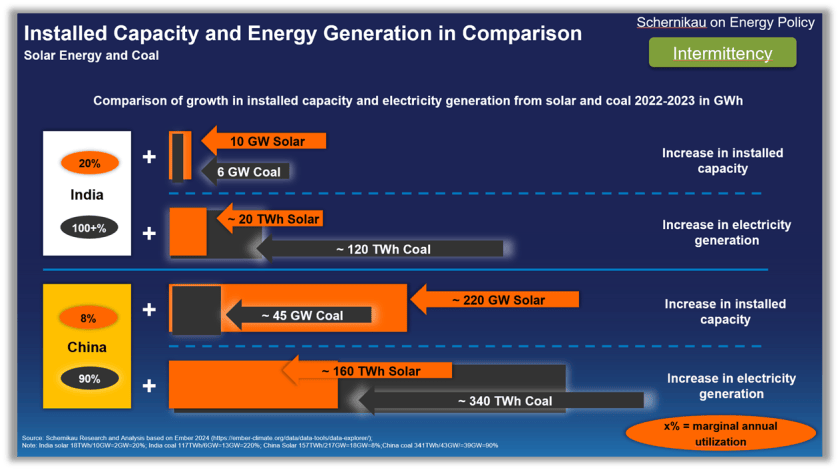
In 2023 alone, China added over 40 GW of coal capacity and generated 340 TWh of additional electricity from coal (more than half of entire Germany)
India added 6 GW of coal capacity and generated 120 TWh of additional electricity from coal
China: 220 GW added solar capacity and 160 TWh added power from Solar (India: 10 GW added solar capa, and 20 TWh power, see Figure 1)
Most banks and government institutions support gas, but not coal as many scientific papers and most reports. They are modeling an economic pathway with “fewer emissions”, assuming that gas emits about half the “greenhouse gases” that coal does. Therefore, gas has been considered the “bridge towards the transition”.
Case in point of course, Germany. Germany’s energy policy towards so called “net-zero” relied on Russian gas to provide the “bridge” towards the desired “zero-emission future”. The Russian attack on the Ukraine put a forceful stop to that policy.
Liquified natural gas, LNG, reduces the dependence on pipelines and allows new suppliers and consumers to enter the market, making it seaborne. Southeast Asia and Europe, and so many more regions, started to take advantage of this new influx of “cleaner” fuel to power their thermal power plants
Then the year 2022 marked the big turning point. LNG prices skyrocketed, as Europe literally swept up the entire market and left close to “nothing” for developing nations. Heightened risks of grid failures in Bangladesh [1,2] and Pakistan [3] where just one of the many consequences.
Let’s have a look at Gas vs Coal. Is there a favorite? Can someone like me even answer such a question? Probably not completely unbiased, but let me try to give you a rundown anyway… to allow you to form an informed opinion about coal and gas.
Figure 1: 2023 wind and solar additions in India and China
Coal and gas use an established, relatively simple technology for power generation consisting of boilers, turbines, and generators. Looking at combustion for power generation only, the key advantages of gas include:
Gas burns cleaner than coal, leaving less residue and causing less particle emissions. Since gas is invisible, it also appears cleaner to transport
Gas has a higher thermal efficiency than coal during combustion
Gas power plants can be used as “peaker plants” as they ramp up and down in minutes, faster than coal, which may ramp up and down slightly slower.
There are four key advantages of coal.
Usually, not always, lower cost than gas (especially upfront investment and transportation/processing costs)
Insignificant geopolitical concerns with reserves more evenly spread around the globe with difficult to control production and transportation (because of simplicity)
Simple transportation (no pipelines, LNG terminals, regasification equipment, etc)
High energy security, coal can be stored easily with less risk (no dependency on pipelines, no tanks required, no risk of explosion)
A CEO of a medium sized US utility that switched from coal to gas for economic reasons and under “ESG pressure”, recently summarized it as follows:
“Gas is great, but still… I used to have 4 months of energy supply in my backyard, today I wake up every morning praying that there is no problem with the gas pipeline, because I have millions of customers to serve every day. My energy security is far reduced”.
Let me reiterate that we need both gas and coal for our modern existence today and we will need it tomorrow. Personally, I am convinced that we need much more of both. The choice of coal or gas or both depends on each country’s specific geographical and geological situations, which makes it obvious why Saudi Arabia uses gas, India uses coal, and why the US uses both.
However, I sense that the biggest misunderstanding about both coal and gas is their importance as a raw material input (nothing to do with energy). There is hardly any product that we use that does not require either both or at least gas or coal as a chemical “raw material” input (your phone, clothes, your car, food, your house, computers, solar panels, on and on it goes).
For example, the importance of coal for solar panels is summarized in my recent article “Coal’s importance for solar panel manufacturing”.
What is gas, what is coal, and what do we use it for?
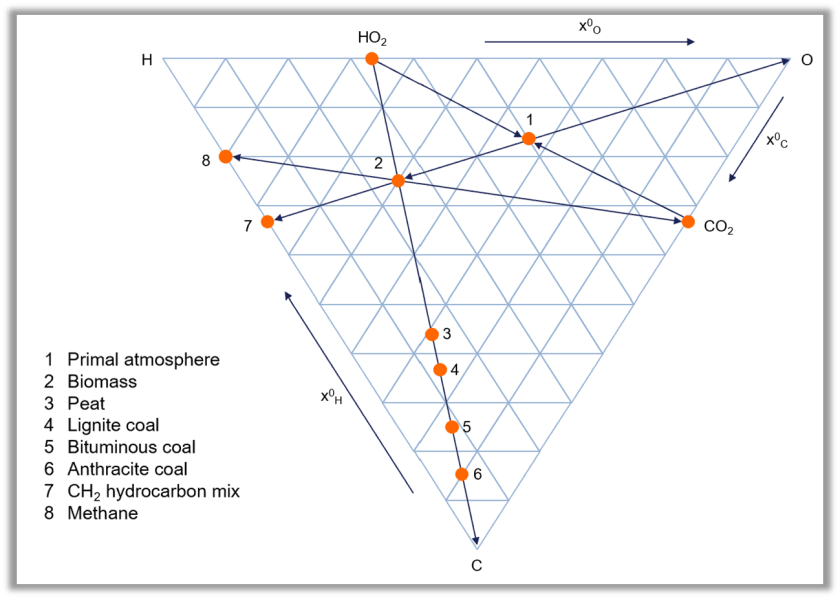
Natural gas or methane – simplified – is a hydrocarbon (CH4), consisting of one atom of carbon and four atoms of hydrogen. It is an energy dense gas, denser than hydrogen alone, and that is because of carbon. Carbon literally is a chemical miracle worker when it comes to hydrogen. Combined with hydrogen, carbon forms highly versatile and energetic “hydrocarbon” gaseous, liquid, and solid fuels (Figure 2). Higher carbon ratios yield solids and lower ratios yield gases, all possible at typical ambient temperatures and pressures. There is no need for complex equipment or pressure chambers.
Natural gas is considered a “fossil fuel” that developed from ancient plants and animals, tens to hundreds of millions of years ago. It is believed that both oil and natural gas originated from the remains of ancient marine organisms. Natural gas is extracted from underground reserves, often in combination with oil before it is “conditioned” for transport to the final consumer. Such conditioning may be as simple as preparing and sending it through a pipeline or as difficult as “making” liquified natural gas or LNG, a very cold and pressurized liquid form of gas. A fun fact, at −160°C the liquid gas volume reduces by a factor of about 600.
As per latest available resource information the from German BGR 2024 [18] we have over 200 years of known gas remaining potential available at current production rates. Remaining potential is the sum of known reserves and resources. Of course, new resources are being discovered continuously and technological advances continue to increase “the remaining life of fossil fuels”.
What is gas used for? Here are 5 main applications:
Power generation (about 25% of global power comes from gas)
Household heating and cooking
Industrial heat (glass, cement, other product manufacturing)
Feedstock for fertilizers (production of ammonia)
Other raw material input (plastics, paint, pharmaceuticals, other products)
Coal on the other hand is a solid, largely consisting of the element carbon, mined from either underground or surface mines around the world, resulting in almost 9 Bln tons p.a., making up almost 10% of all “raw materials” we mine or grow annually for human existence. Coal is also considered a “fossil fuel” that basically comes from very old trees and plants, pressurized under airtight conditions for tens to hundreds of millions of years.
Coal is one of the few raw materials that we mine that can be used as is, without further processing or cleaning. Regardless, a significant portion of coal is processed in so called “washeries” to reduce the ash (silica or sand) content to upgrade the coal and increase the carbon content.
The German BGR 2024 [19] global analysis states that we have over 2,000 years of known hard coal remaining potential available, and over 3,000 years of lignite coal, at current production rates. Remaining potential is the sum of known reserves and resources.
There are many types of coals, depending on how old the coal is and what the geological conditions of coalification were. On average, older coal is more valuable than younger coal, but it is not always true. Two main types of coal exist: (1) metallurgical coal including coking coal and anthracites, but there is more; and (2) coal that is used primarily for thermal applications, often referred to as thermal coal.
As such, the main uses for coal include the following:
Power generation (about 35% of global power comes from coal)
Industrial heat (glass, cement, other product manufacturing)
Steel making (2/3rd of global 2 Bln tons p.a. of steel are only possible because of coal)
Other raw material input through chemical reduction and other processes (silicon for computers or solar panels, chrome, nickel, aluminum, + much more such as fly ash for cement products)
Household heating (being phased out, rightly so)
Source for critical minerals and fertilizer using humates
All chemical and physical details on coal can be accessed via Kindle or in print at “Schernikau’s Coal Handbook”
Figure 2: Fuels in a Thermodynamic System C-H2-O2; Conversion of Carbohydrate to Coal, Methane and Liquid Hydrocarbons Source: Wolf 2021, from our book www.unpopular-truth.com (downloadable image available there)
The current “switching” sentiment: coal, gas, and hydrogen
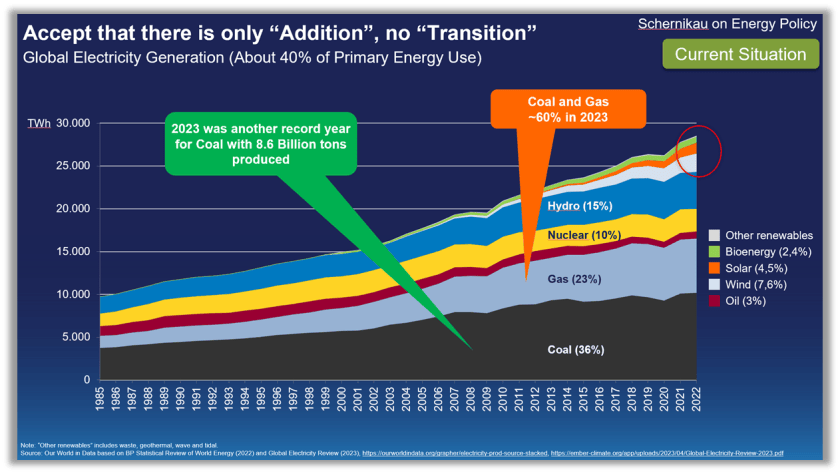
The percentage of gas in the global electricity mix has been increasing over the past two decades from about 20% in 2004 to 25% in 2023. During the same time, coal’s share of electricity reduced from 40% to just over 35%. While both coal and gas continued growing in absolute terms (Figure 3) and retained their combined share essentially unchanged, this “switch” from coal to gas was driven by two reasons:
Economic: low-cost fracking made additional abundant gas resources available especially in the US
Political: the believe that gas has less “climate impact” than coal
Global Energy Monitor’s “Global Coal Plant Tracker” [17] – an anti-coal organization – noted that the number of countries with coal power under development (pre-construction and construction) has nearly halved from 75 in 2014 to 40 in 2024. China and India combined account for 86% of current development.
They also note that new coal-fired power station proposals continue to outpace cancellations. In the first half of 2024, over 60GW of coal capacity was newly proposed or revived, compared to the 34GW that was shelved or cancelled over the same period. China plans for 1.3 Bln annual tons of new coal mine capacity. So, coal is expanding! Despite this many governments and organizations predict peak coal by end of this decade… we shall see.
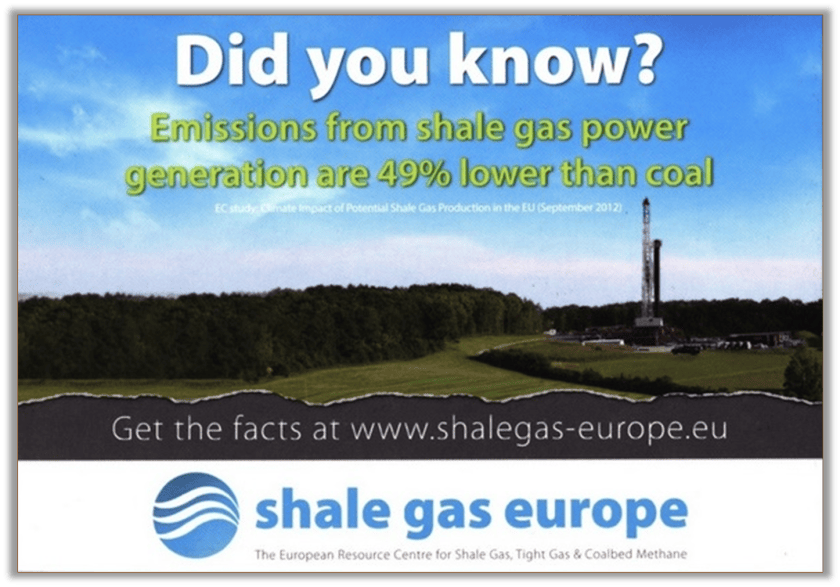
Gas is expanding even faster. Coal and gas have been “competing” for decades and gas is still favored by many governments. The gas industry, closely linked to the oil industry, is generally better funded for industrial policy and lobbying than coal. The gas industry has also specifically targeted coal in some of its advertising (Figure 4).
In the pre-Russia energy communication in October 2021, the EU President van der Leyen said “Wind energy is very volatile… Alongside this, we need a stable source, nuclear, and during the transition, of course, natural gas”.
As recent as September 2024, the European Commission [17, p26] writes that “Develop a comprehensive strategy at the EU level, coordinate with Member States on how to manage natural gas during the transition and on how to secure natural gas (from where, volumes and conditions) for the next 20 years.”
There appears to be two fundamental misunderstandings in the general media, among the population, and many political and industrial leaders, about coal and gas, namely:
Misunderstanding 1: Coal and gas are interchangeable when it comes to energy and raw material resources, they clearly are not always.
Misunderstanding 2: Gas is “better for the climate” than coal making it better suited as a “transition fuel”, see next section.
The interesting point is that sometimes gas is favored because there is a belief that Hydrogen will be the sustainable solution to long-duration energy storage, and gas power plants and transmission infrastructure may be more easily converted to hydrogen power plants than what coal power plant would. “The Hydrogen future” and gas’ role is a 3rd significant misunderstanding well summarized in the book “The Hydrogen Illusion” by Prof Furfari [4]. The fundamental misunderstanding is around the belief that hydrogen is sustainable, safe, and cost effective.
Figure 3: Coal and gas growth as% of global electricity production
Source: Schernikau based on BP, Our World in Data, Global Electricity Review
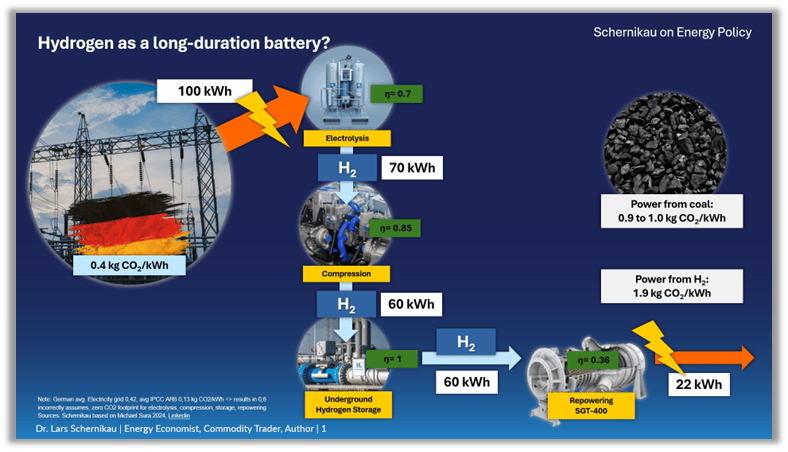
One simple point I would like to make here is that since solar and wind cannot be zero CO2, neither can hydrogen derived from excess or unutilized wind and solar. The value chain of hydrogen for storage includes “making” H2, storing H2, transporting H2 and then repowering H2. In all these steps about 65-80% of the input energy gets lost and dissipates in the form of low value, high entropy heat into the atmosphere (Figure 5). Thus, the CO2 footprint of wind and solar, when using H2 for storage, would multiply by a factor of 3 or 4! In addition, hydrogen is highly explosive, permeates practically everything including steel, and is thus a dangerous product to handle.
for example, our yet unpublished research shows that the CO2 footprint is likely at the higher end or above of the IPCC AR6 range of 9-250 gCO2/kWh for solar power
assuming 250 gCO2/kWh was correct, then a 4x increase due to hydrogen storage value chain’s energy “losses” would make solar power + H2 with 750 to 1.000 gCO2/kWh on par with “unabated” coal power plants
Even if H2 was a viable solution, which it is not, the development of a so called “hydrogen economy” does not initially require H2-ready gas power plants. Because (1) such H2-ready gas plants cannot yet be connected to the non-existing hydrogen grid, and (2) hydrogen sprinter and hybrid power plants would be well suited as well, not requiring gas [7].
Interestingly, the cost of producing hydrogen from coal with CCUS (Carbon Capture Utilization and Storage) would be about three times less expensive than producing low-carbon hydrogen through water electrolysis [17]
In addition, to safeguard the fluctuating feed-in of renewable energy sources, consideration must also be given to the continuation of alternative technological developments such as large-scale storage systems. Until these are available, coal-fired power plants can easily take, and sometimes already do take the place of H2-ready gas turbines in securing the fluctuating feed-in of renewable energy sources [8]. Also, ammonia could be co-fired in coal-fired power plants as an H2 carrier [based on IEA].
Fyi, China or India are not building gas-fired power stations but continue to build coal instead, I wonder why. It appears coal can very well be used as backup for solar?
Figure 3: Coal and gas growth as% of global electricity production Source: Schernikau based on BP, Our World in Data, Global Electricity ReviewFigure 4: Hydrogen’s “energy” inefficiency, Michael SuraFigure 5: misguided advertising for gas, dismissing methane and natural CO2 uptake
Lifecycle GHG emissions
Many discussions in the media and press have been about the lifecycle greenhouse gas emissions of gas, especially LNG. Not too long ago, The New Yorker [5] summarized it to the point “A new analysis suggests that LNG exports may well be worse for the environment than burning coal.” The peer-reviewed research referenced is from Howarth 2023 [6].
The well-established fact is that, assuming the IPCC is correct about methane’s global warming potential GWP, the relatively higher methane emissions throughout the life cycle of natural gas and LNG – from production and transportation to usage (including leaks), often offset, and in many cases exceed, the CO2 emissions advantage that gas has over coal. If one is worried about imminent human greenhouse gas induced catastrophic warming then CO2 doesn’t matter but CO2-equivalent (CO2eq) matters… over the next 20 years. This metric the IPCC measures with its 20-year Global Warming Potential GWP20.
For the record, I do not doubt that CO2 or CH4 (methane) are greenhouse gases. However, there remains scientific uncertainty and debate about the global warming potential and climate sensitivity of greenhouse gases. My detailed objection to IPCC’s GWP as well as the scientific debate and uncertainty on GWP cannot be detailed on this platform (see also [14]). For instance, Wijngaarden/Happer 2020 have analyzed GHG forcing in detail and conclude significantly lower climate sensitivities than those used by the IPCC.
In our own peer-reviewed research Schernikau/Smith 2022 “Climate Impacts’ of Fossil Fuels in Today’s Energy Systems” [7] we come to the same conclusion of gas not being “better for the climate” than coal, using data solely from the International Energy Agency (IEA in Paris) and the Intergovernmental Panel on Climate Change (IPCC in Geneva).
The main “novelty” is that we included the fact that only half the CO2 emissions from any source can contribute to warming of the planet. This is a fact that is confirmed by the IPCC, but forgotten by most, because more than half of CO2 is taken up by nature such as plant life and oceans, contributing to greening of the Earth. The global warming potential of CO2 is for molecules remaining in the atmosphere acting as “greenhouse gases”, not for those taken up by nature.
Another noteworthy study confirming that LNG is “not better for the climate” than coal was published by Prof Wodopia of Germany in 2023 [8]. He concluded “the net lifecycle greenhouse gas emissions of liquefied natural gas (LNG) from the USA or Qatar are compared with those of coal, taking sulphur dioxide emissions into account. When used in a simple-cycle gas turbine, they are higher than those of coal. In part-load operation, the results shift further in favor of coal.
Countless additional studies make similar points, here some more examples:
[9] Rosselot et al 2021: Comparing Greenhouse Gas Impacts from Domestic Coal and Imported Natural Gas Electricity Generation in China,
[10] Mar et al 2022: Beyond CO2 Equivalence: The Impacts of Methane on Climate, Ecosystems, and Health,
[11] Kemfert et al 2022: The Expansion of Natural Gas Infrastructure Puts Energy Transitions at Risk,
[12] Nature 2022: Scientists Raise Alarm over ‘Dangerously Fast’ Growth in Atmospheric Methane,
[13] IEEFA 2020, The Australian LNG Industry’s Growth – and the Decline in Greenhouse Gas Emissions Standards,”
[14] Alvarez et al 2018, Assessment of Methane Emissions from the U.S. Oil and Gas Supply Chain.
[15] Howarth, Robert W. “Howarth 2024: The Greenhouse Gas Footprint of Liquefied Natural Gas (LNG) Exported from the United States.” Energy Science & Engineering n/a, no. n/a (October 2024)
When “the science” is clear on this fact, then why does the EU support gas, but not coal? What am I missing? Why is the public being misled? Why do we continue to spend billions on replacing coal with imported LNG? Why are banks reluctant to fund coal, but not gas?
I repeat, we need more of both coal and gas, but isn’t it time to be honest with ourselves about its impact and consequences for economies and the environment?
Economic future for coal and gas
Understanding more about gas and coal, their importance for our energy needs and daily products used, but also their environmental impact, helps us make smarter energy policy decisions. I see that it is undisputed that coal and gas are on par when it comes to “the climate”. My opinion on the fallacy of measuring everything with CO2 is published here “The Dilemma of pricing CO2“.
The future of coal and gas appears to look bright, because (1) the demand for carbon and hydrogen sourced from coal and gas cannot be easily replaced when it comes to the production of our day-to-day products, and (2) because alternative ways of producing grid-ready power are either significantly more expensive and/or have a much worse impact on the environment.
For more details on energy costs please refer to my article “The Energy Trilemma” from earlier this year.
The fact that we need to continue investing in our coal and gas supply chains, power plants, and material use infrastructure, appears to be obvious.
Consider this – assuming coal and gas have a 40% power plant efficiency on average, then a global 1% efficiency improvement results in 2.5% (1/40%) less raw material used and less environmental impact. Isn’t this worth the investment? Remember that coal and gas make up almost two thirds of the world’s power generation!
Investments especially for coal but also for gas are not keeping up with demand and this will logically lead to power shortages and inflated prices. That in turn will lead to energy poverty and less GDP growth. Has anyone counted the cost to humanity from such personal and economic losses? I fear not.
[6] Howarth 2023: The Greenhouse Gas Footprint of Liquefied Natural Gas (LNG) Exported from the United States,” October 2023,
[7] Schernikau and Smith 2022 ‘Climate Impacts’ of Fossil Fuels in Today’s Energy Systems’, SSRN Electronic Journal, March 2022. https://doi.org/10.2139/ssrn.3968359
[8] Wodopia 2024: Lifecycle Emissions From Gas and Coal Do Not Support a Coal-to-Gas Shift.” SSRN Scholarly Paper. Rochester, NY, January 2024. https://doi.org/10.2139/ssrn.4674204
[9] Rosselot et al 2021: Comparing Greenhouse Gas Impacts from Domestic Coal and Imported Natural Gas Electricity Generation in China.” ACS Sustainable Chemistry & Engineering 9, no. 26 (July 2021): 8759–69. https://doi.org/10.1021/acssuschemeng.1c01517
[10] Mar et al 2022: Beyond CO2 Equivalence: The Impacts of Methane on Climate, Ecosystems, and Health, Environmental Science & Policy 134 (April 2022): 127–36. https://doi.org/10.1016/j.envsci.2022.03.027.
[11] Kemfert et al 2022: The Expansion of Natural Gas Infrastructure Puts Energy Transitions at Risk, Nature Energy, July 2022, 1–6. https://doi.org/10.1038/s41560-022-01060-3
[14] Alvarez et al 2018, Assessment of Methane Emissions from the U.S. Oil and Gas Supply Chain.” Science 361, no. 6398 (July 2018): 186–88. https://doi.org/10.1126/science.aar7204.
[15] Howarth, Robert W. “Howarth 2024: The Greenhouse Gas Footprint of Liquefied Natural Gas (LNG) Exported from the United States.” Energy Science & Engineering n/a, no. n/a (October 2024)
[16] Wijngaarden/Happer 2020: Dependence of Earth’s Thermal Radiation on Five Most Abundant Greenhouse Gases.” arXiv:2006.03098 [Physics], June 2020. http://arxiv.org/abs/2006.03098.
LNG Canada to boost and stabilize Canadian natural gas prices? Not so fast…
There was a worthwhile read here last week in the BOE Report entitled “Canadian natural gas firms eager for LNG boom swamp market with excess supply”, which sums up the current situation quite well. It is astonishing that over the summer, the lowest-priced thing I can think of – candy, a stamp, anything – was a gigajoule of natural gas, and ten of those can look after a modest home for a month. What a world.
There was one potential caveat in the article, however – speculation that LNG Canada’s activity is expected to “reduce volatility in the AECO market.” Hmm…not so sure about that.
The premise is that new LNG exports will provide added demand via a brand new outlet for natural gas. LNG Canada will certainly do that, but it will also introduce a wildcard into the equation.
Presently, the existing system is remarkably stable on a day to day basis, with any significant outages generally planned and announced well in advance. But LNG terminals are not like that.29dk2902lhttps://boereport.com/29dk2902l.html
There are many events that can occur in very short order that can shut down an LNG terminal, because these terminals do not have significant (or any) gas storage accompanying them (or LNG Canada doesn’t anyway) that can act as a buffer in the even of a power outage, bad weather, an equipment failure, an accident…the list is lengthy, and each can bring the LNG off take to a standstill, quickly, with significant impacts.
Such speculation is not without precedent. Two years ago, a single US LNG export facility went out of service after a relatively minor explosion, and it had a negative impact on US natural gas prices for 8 months.
Consider also that the US natural gas market is what Nassim Taleb would call “robust” in one sense; the country is laced with major NG pipeline systems, and gas can often flow bidirectionally. Thus, the US market – which is also huge – was able to absorb the 2 bcf/d that was pushed back into the market, with a discernible but not devastating price impact.
The US natural gas system in another sense would earn Taleb’s classification of “antifragile” – that which grows stronger through stresses – because it is continuously strengthened by such stressors, new pipe is built as required to enable new production and connect to new markets – to the extent that regulations and enemies will allow (which, for now, pretty much means “only build in Texas” but that could change depending on which butt lands in the White House).
Canada’s natural gas market, on the other hand, is considerably more fragile in the sense of becoming dysfunctional at even a relatively minor whim or nature or incident. Recall a few years ago when an Enbridge gas line blew up outside of Prince George in northern BC – one of two that brings gas to the lower mainland. The other line was shut down for two days for inspections, and as a result of the reduced flow some schools in Vancouver turned off heat in buildings and reduced temperatures in classrooms.
If a natural gas system is extensive and web-like, it can maintain resilience, stability, and function well even if one part of it suffers a failure of some kind. If a system is constrained and highly dependent on a limited number of access points, both for supply and offtake, the risk of volatility increases significantly, and the risk to consumers grows to unhealthy levels. Everyone should be thankful those chilly gas-deprived Vancouver students in a coastal October were not Winnipeg students in ears-fall-off January.
On the other hand, LNG usage is soaring and Canada might catch the wave yet despite our habits
Dan Yergin, the senior oil patch observer and author of the legendary book The Prize, recently wrote an article for S&P Global called “The return of energy security”. It’s chock full of good information about how the world is recognizing that an energy transition may be an admirable goal but that there is no doubt it is going to take a back seat to energy security. Much of the world is not as cavalier as we are, but then much of the world does not have the, ahem, phenomenally skilled oil and gas workforce that we do here in North America.
Yergin notes, “The biggest emphasis on the need for reliable and affordable energy is in the developing world, where 80% of the world’s population lives… Attaining energy security is basic to making progress out of poverty in general and remedying the lack of access to commercial energy and electricity… Natural gas is a particular focus for promoting economic development — and for reducing emissions.”
He’s not whistling Dixie. Much of the world is stampeding to secure LNG supplies. Per the above article, India earlier this year announced a $67 billion investment plan to expand India’s natural gas infrastructure. Colombia, which has vast natural gas reserves of its own, is looking to increase its LNG import capacity. Malaysia, one of the world’s top exporters of LNG, is looking to increase imports of LNG to meet soaring consumption.
Other countries are racing to meet the new demand. The US has, in one measly decade, become the world’s largest LNG exporter, including by using some basic infrastructure developments started 25 years ago when the US was planning to import LNG to meet its needs (the US shale boom was something else, adding about 20 percent to world supplies in 15 years). Even Saudi Arabia announced plans to become a major LNG player, signing a 20 year offtake agreement from a new US LNG terminal.
Overall, the Gas Exporting Countries Forum, a group of guess-what’s comprised of 12 member countries and 7 observer countries (observing gas? The ultimate government job), expects global natural gas demand to increase from 4,015 billion cubic meters in 2022 to 5,360 bcm by 2050, a 34 percent increase, and with no peak in site. Because the LNG trade is anchored by multi-billion dollar terminals, which often require multi-decade contracts in order to obtain financing, much of this demand/trade is being baked into the system for decades to come, so even if the GECF is talking it’s book, they have very good reason to be believed.
In front of this global steamroller of natural gas development, Canada stands alone, with our leadership turning away an LNG-begging Germany with admonishments to get serious about climate change and just sit back and wait for Canada’s green hydrogen economy to develop (haha) and you’ll get the first boatload (or whatever it arrives in once we determine how in the heck to build such a castle in the sky) (German leaders then flew to Senegal, looking to trump Canada’s leadership’s peculiar stance, encouraging the Senegalese to develop their reserves and ship to Europe; ultimately the Germans simply signed a long term LNG deal with the US, who by some unbelievable skillset found the ‘business case’ that Canada found lacking).
And don’t even get me started on data center demand, which is getting more crazy by the hour it seems. The biggest AI players have now all raced to lock up existing or nearly-existing nuclear power (Amazon, Google, Microsoft) because it is the only emissions-free 24/7 baseload power available. Everyone else will be scrambling for whatever 24/7 baseload they can get, and, as with the newly rediscovered importance of energy security, these firms will place AI development over any qualms about what sort of energy they are sourcing. Natural gas is the best choice because of its availability, speed of development, and relatively clean burning. So look to AI data centers to pop up wherever there are natural gas supplies – it will shave years off the process if the data center developers can build a power source independent of the electrical grid (which is to development plans what quicksand is to humans).
Five years old, and the future painted within is turning out pretty much exactly as expected (ok, I missed the nuclear renaissance, sue me). Pick up The End of Fossil Fuel Insanity, where energy is actually entertaining. Available at Amazon.ca, Indigo.ca, or Amazon.com.
Read more insightful analysis from Terry Etam here, or email Terry here.
In the US resides a guy who’s academic and professional credentials are as impressive and impeccable as one can assemble in a career. His Wikipedia professional/academic bio shows top-level roles at a who’s who of globally significant institutions.
In the US resides a guy who’s academic and professional credentials are as impressive and impeccable as one can assemble in a career. His Wikipedia professional/academic bio shows top-level roles at a who’s who of globally significant institutions.
Larry Summers has been: student at MIT, PhD from Harvard, US Secretary of the Treasury, director of the National Economic Council, president of Harvard University, Chief Economist of the World Bank, US federal Under Secretary for International Affairs in the Department of Treasury, a managing partner at a hedge fund, and is now on the board of OpenAI.
And yet…just a few weeks ago, Larry Summers made a comment about a bedrock of the economy seems so fundamentally bad that it is enough to shake one’s faith in every one of those institutions. He was talking about whether the US should create a Sovereign Wealth Fund, which is kind of like a national savings account that governments squirrel money into in order to fund future projects or spending requirements. They are very great things indeed, reflecting the wisdom of having savings for a rainy day, but given how politicians love to spend not just the money that they have but everything they can borrow, the idea seems kind of quaintly hopeless in the first place, even though some countries have accomplished it.
But the shocking part of this story is why Summers was against the idea; here’s his quote: “It’s one thing if you’re Norway or the Emirates — that has this huge natural resource that’s going to run out that you’re exporting— to accumulate a big wealth fund. But we’ve got a big trade deficit. We’ve got a big, budget deficit…”
He’s absolutely right about the US’ financial woes; our dear southern neighbour is currently the equivalent of a 28-year-old guy twice divorced with 8 kids between 4 women who is working at the lumber yard and juggles 14 credit cards simultaneously (definitely not implying Canada is much better…).
No, he’s right that those are the biggest fiscal issues to deal with, but what’s crazy is the other part of his statement. He says that Norway and the Emirates should create sovereign wealth funds because they ‘have this huge resource that’s going to run out that you’re exporting’ and thus can/should accumulate a big wealth fund.
Mr. Summers apparently does not understand either depleting natural resources, or the US’ economic powerhouse status due to these resources, or both. Either fact is shocking, given his stature; but his analysis of the situation gives a clue about why major western powers are in such shambles with respect to energy policy.
What Mr. Summers presumably meant is that the US does not have an economy that is dominated by export of a natural resource, such as how oil or natural gas exports are not a fundamental pillar of the economy as with Norway or the Emirates. And yes, the US does have other desperately needed uses for the money derived from exports.
But he seems to think the US is immune from its resources ‘running out’. He doesn’t seem to understand that while the US economy may not be dominated by oil/gas exports, the problem of resource depletion will not matter to the US because it does not dominate the economy. That is the charitable interpretation; the less kind one is that he may well believe that the US will never run out of affordable hydrocarbons.
It’s easy to see where he and other policy makers get the idea. If they think about petroleum reserves at all, they would find coverage in the general mainstream financial press, in publications such as Forbes, a standard of US economic communications that claims over 5 million readers through 43 global editions. The publication is aimed at the who’s who of the financial world: “Forbes is #1 within the business & finance competitive set for reaching influential decision-makers.” It is exactly what a guy like Summers would turn to to understand the US’ resource capability (I doubt he spends much time understanding rock quality).
Here is what Forbes had to say about the US’ hydrocarbon reserves. In an article entitled U.S. Shale Oil and Natural Gas, Underestimated Its Whole Life, the author chronicles how forecasts of US shale potential have been continually underestimating productive capability. Fair enough, that is definitely true. But the extrapolations/conclusions are pretty wild, and, dangerous: “…the reality is that shale production [for both oil and natural gas] has surpassed all expectations namely through the constant advance of technologies and improvement of operations…In fact, the Shale Revolution has shown us that the amount of oil and gas we can produce is essentially unlimited.”
It’s not a bad article on the whole, when it describes how we’ve underestimated shale growth, but these silly concluding assumptions are not good at all. They’re soundbites that reach far more ears because of the source than true expertise from industry journals (including, ahem, this excellent one). Those soundbites are what lodge in the minds of people like Larry Summers when he huddles with his global cohort to discuss energy policy.
Consider as an alternative analysis something far more thoughtful and thus less dead-certain, such as the work of Novi Labs, who put out incredibly detailed reports that analyze production trends, with a key difference from Forbes: Novi bases their projections on actual well data, well spacing, well productivity, well length, gas/oil ratios, rock quality, and many other parameters. For example, Novi recently published a paper entitled “Analyzing Midland Basin Well Performance and Future Outlook with Machine Learning” in which they conclude that, based on the above parameters and more, that the Midland Basin has about 25,000 future locations remaining, and breaks them out into prices required to develop them, and has the wisdom to conclude: “Due to the Permian Basin’s role as the marginal growth barrel, overestimating the remaining resources will have consequences spanning from price spikes to energy security and geopolitics.”
Based on such incredibly detailed analyses, Novi is comfortable making, for example, Permian oil/gas production out to the year 2030.
Forbes is comfortable making oil/gas production forecasts to infinity, based on nothing more than a string of failed projections.
And people head off into the highest levels of government having read Forbes but not Novi. And we get Germany. And Canada. And etc.
This isn’t a question about whether we will “run out of oil”. The surest way to rile an audience it seems – just behind challenging EV superiority – is to question the ultimate productive capability of hydrocarbon resources. “Peak oil” is now a term of derision, in some ways rightly so because many smart people have, over time, warned that resources are about to run out.
It does seem erroneous to think that way, because as prices for something rise, more exploration will occur, and by definition we don’t know what those discoveries will encounter. Could be a little, could be a lot.
The point here is best explained by way of a real life example. A long time ago, late last century, natural gas was dirt cheap across western Canada. (Bizarrely, it’s even cheaper now, but not consistently so.) In Saskatchewan where (and when) I grew up, an alfalfa processing industry had developed that was a godsend to many small communities. Farmers would grow alfalfa and dedicate the output to a local (often community owned) alfalfa-processing facility that would convert green alfalfa into nutrient-rich pellets for which Japan (primarily) had a seemingly insatiable appetite.
The whole business existed because of the availability of cheap natural gas, which allowed for the rapid and economical dehydration of the green alfalfa; huge drying drums ran around the clock, all summer long, turning huge piles of fresh chopped-alfalfa salad into dried out pellets within 12 hours.
But then natural gas prices soared to unprecedented levels, over $10/GJ, and found a new average that was probably about twice the average in the 1980s and 1990s. This spike in natural gas prices wiped out the entire industry. Every little town lost a pillar of the community, investors lost investments, municipalities lost tax revenue, and hundreds or maybe even thousands of punks like me lost summer job opportunities.
THAT is what people like Larry Summers should be thinking about when they talk of, or heaven forbid ask questions about, the longevity of our hydrocarbon resources. Yes, there will be oil and natural gas reserves forever – but at what price? And what will the consequences of higher prices be?
In the spring of 2022, some large US trade associations issued warnings about the consequences of higher natural gas prices. “Last winter’s heating bills were unsustainable,” said the CEO of the Western Equipment Dealers Association. The winter to which he was referring, 2021-22, had average Henry Hub prices of $4.56/mmbtu – far higher than today, but a number that will probably be required over the long term to enable continued US reservoir development and feed LNG export demand. 29dk2902lhttps://boereport.com/29dk2902l.html
That price level of which the CEO was frightened of, it is well worth noting, is a fraction of the global price of LNG. In other words, US industry will freak out if it has to pay even half of what the rest of the world does.
At a time when the US is desperate to ‘onshore’ a lot of manufacturing capacity, policy makers should be very careful about ‘what they know for sure’ about the future of US and Canadian energy productive capability.
Energy ignorance, at these levels of government, are getting deadly. I mean, we can all see Germany, right? It’s turning slapstick, what they’re doing to energy policy, and so many western leaders seem intent on following them. Force the closure of baseload power, force the adoption of intermittent power, watch AI buy up all the power from nuclear sources, claim to support new nuclear power which everyone knows won’t get here for a few decades, then trot off to an annual fall climate conference to tell the world what to do next.
As Mark Twain said, “It ain’t what you don’t know that gets you in trouble. It’s what you know for sure that just ain’t so.”
What the world desperately needs – energy clarity. And a few laughs. Pick up The End of Fossil Fuel Insanity, available at Amazon.ca, Indigo.ca, or Amazon.com.
Read more insightful analysis from Terry Etam here, or email Terry here.
In a recent court filing, after months of stalling and flouting numerous legal obligations and deadlines the Biden-Harris Department of Energy, through its lawyers at the U.S. Attorney’s Office for the District of Columbia, let slip something it had spent a year, including three months in litigation, trying to avoid becoming known.
DoE court filing supports claims of buried 2023 study, LNG “pause” based on a lie
In a recent court filing, after months of stalling and flouting numerous legal obligations and deadlines the Biden-Harris Department of Energy, through its lawyers at the U.S. Attorney’s Office for the District of Columbia, let slip something it had spent a year, including three months in litigation, trying to avoid becoming known.
Specifically, DoE has “identified 97 potentially responsive documents totaling 4,354 pages” of records meeting the following description:
1) any LNG export study transmitted by the National Energy Technology Lab to the Office of Fossil Energy between January 1, 2023 and October 31, 2023, and 2) the email(s) transmitting the document(s) from the National Energy Technology Labs (NETL) to, inter alia, DoE’s Office of Fossil Energy.
This is the scope of a Freedom of Information Act request by GAO, whose parameters were very deliberately chosen, for reasons GAO laid out here. DoE’s admission that records exist came not only after months of stall tactics (below), but also repeatedly vague wordplay in its first offerings for this report to the court, avoiding disclosure of the fact until pressed by GAO lawyers to admit this most basic of answers—what have you got?
Further, DoE had known this particular something for six weeks and refused to let on, again despite statutory and judicially imposed deadlines to do so:
Screenshot
These delays were not mere bureaucratic sloth. In FOIA litigation brought by GAO, to avoid admitting these records exist DoE employed motions seeking extensions of time, motions to stay proceedings, motions to tie unrelated cases together causing further delays, and outright refusal to provide even court-ordered answers.
This confession that DoE indeed has copies of such a study on liquified natural gas exports strongly indicates that the administration has been telling a spectacular non-truth to the public about the basis for “this crazy LNG permitting pause [t]he consequences [of which] will be dire for the industry in four to five years, but they also carry national security implications now.”
Recall, the stated reason for this “pause” was that DoE needed to conduct a macroeconomic study of the costs and benefits of LNG exports.
But we see it had already done so meaning, in very short, the supposed basis for “pausing” LNG exports appears to be untrue, the falsehood serving as pretext for this latest gambit to impose “President Joe Biden and Vice President Kamala Harris’s climate agenda, which has focused on limiting natural gas exports. Environmentalists argue that increased gas exports could result in far more domestic drilling and, as a result, more emissions.”
The decision to impose this “pause” caused shock throughout the energy industry, among U.S. allies… and among some others in the know. One of those people let the word go forth that in fact DoE had already conducted such an analysis, in 2023, but buried it because the conclusions would not support the preferred policy of strangling options for abundant, often “fracked” U.S. natural gas. With fewer things to do with the gas (hello, gas stoves they definitely don’t want to ban that’s a conspiracy theory akshully it’s a good thing that heck yeah they sure do want to do that), the opposition to fracking could be worn down.
DoE conducts these studies with some regularity, The most recent (acknowledged) version, the 2018 DoE report, ran 144 pages. The 2014 report was much shorter, at 42 pages.
DoE now admits through counsel that its search produced 97 documents/4,354 pages. This averages 45 pages a document (email threads will be shorter, of course). The most reasonable conclusion from this is that NETL sent several versions of the rumored report over these ten months. Or, put more simply: yes, it appears that the report which DoE claims to need to conduct before continuing LNG exports to non-FTA countries had already been prepared, and buried.
DoE is plainly in no hurry to let the public in on any further details, having taken three months too long to state the basic answer: yes, the study exists.
Post Script: To date, DoE has only responded to one of the four requests made in early June, producing records in response to the request for “chat” logs for certain senior officials over the three days surrounding and including the January “pause”.
Screenshot
It appears that DoE and the White House were “on the same page” in announcing the “pause” and the pretext. But the truth will out, and this recent confession is damning.
Some things you know best by experiencing them; hearing about them, being warned about them, is a start, but sometimes you don’t really know something until you ‘feel it in your bones’. The old adage about not touching a hot stove is one. Children hear that and obey it to the extent they ever obey their parents, but the real education comes at the moment they do indeed touch the stove. Things become quite clear then.
There are a few ways to “know things”. You know how to read, you know how to add, probably, and you know many things.
Some things you can “know” without having to formally learn or experience them. You probably know it would hurt to get shot, though unless the demographic around here has changed significantly you’re not likely to experience that.
Some things you know best by experiencing them; hearing about them, being warned about them, is a start, but sometimes you don’t really know something until you ‘feel it in your bones’. The old adage about not touching a hot stove is one. Children hear that and obey it to the extent they ever obey their parents, but the real education comes at the moment they do indeed touch the stove. Things become quite clear then.
So it goes on the energy front. So much has gone on in the past decade that is enthusiastic speculation about what people think they know, particularly about energy transitions, and not only that but energy itself – where it comes from, how it gets there, who is responsible, how tough it really is to provide.
New Zealand recently gave us a wicked lesson in the process of understanding the gap between being told not to touch the stove and touching the stove.
A few years back, their youthful, idealistic, and globally exuberant leader, Jacinda Ardern, enacted a ban on petroleum exploration in New Zealand. The legislation was cutting-edge energy policy thinking, in alignment with many global leaders whose ears had been stuffed with talk about how oil and gas properties were quickly going to become stranded assets. These policy advocates “knew” this, and passed their knowledge on to leaders who would be visionaries. Want to be in effect a department store manager, running a country like one, or…do you want to go down in history as one of the brave that saved the world from rising temperatures? Appealing to political egos is shooting fish in a barrel, and so off they went, legislating anti-hydrocarbon agendas hither and yon with joyous abandon.
Fast forward a few years, and New Zealand has touched the stove. You can see the minute that it happened. In a June 9 article entitled “Government to reverse oil and gas exploration ban” (thanks to Dan Tsobouchi for flagging; his research and output is invaluable), the NZ government spoke of a startling discovery: that oil and gas fields deplete over time. As they put it: “When the exploration ban was introduced by the previous government in 2018, it not only halted the exploration needed to identify new sources, but it also shrank investment in further development of our known gas fields which sustain our current levels of use…Without this investment, we are now in a situation where our annual natural gas production is expected to peak this year and undergo a sustained decline, meaning we have a security of supply issue barrelling towards us.” In another document, the government put it this way: “The latest petroleum reserves data show gas reserves are declining. There is less natural gas available to produce than previously thought. This drop in natural gas reserves (called Proven plus Probable reserves) is the result of producers lacking certainty that they can economically extract the natural gas in their fields…”
Better late than never, I guess. But this newly-lit lightbulb is only a part of the equation. NZ’s path illustrates just how wrong many energy assumptions are.
The west has been somewhat successful in reducing emissions, which is taken by some as evidence that the ‘energy transition’ is working. It is true that there is a significant amount of renewable energy produced, which is helpful in reducing consumption of other fuels.
But it is more complex than that. The US reduced emissions significantly by replacing coal-fired power with natural gas-fired. That’s not part of the energy transition. Well, it is part of a logical energy transition, but that is not what the Ardern’s of the world intended.
Another confounding factor is that while the west’s emissions may have been reduced, and energy usage has not increased materially (more on that in a minute), the fact is that our consumption patterns remain as formidable as ever; that Walmart remains chock full of everything, that Amazon can get a mind-boggling array of pretty much anything to your doorstep in 24 hours…all this points to the not-much-discussed fact that we simply farmed everything out to developing countries to produce, and then we get annoyed when they construct the power supplies to do so in a way that works for them. A lot of globalists don’t seem all that good at global thinking.
Then, as we saw with NZ, the west’s leaders simply don’t understand energy production at all, at least not hydrocarbon production. There is an assumption that oil companies can be hounded/sued/regulated/protested and that they will continue to invest enough to maintain production (even as the IEA states that no new investments can be permitted to meet climate goals). Wrong. Hydrocarbon companies will not invest in jurisdictions that make their life too miserable. Hence NZ’s about face.
More significantly than depletion though is blind eye given to the trajectory of global energy consumption. Not just oil and gas consumption, but energy consumption, from all sources. It is important to keep these trajectories in mind when considering energy policy.
Here are some fascinating statistics from Our World in Data. From 1965 to 2023, some random reference points for annual energy consumption change over the period:
Vietnam from 786 kWh -> 13,744 kWh or +1,648%
India from 1,239 kWh –> 7,586 kWh +512%
China from 2,122 kWh –> 33,267 kWh +1468%
Consider that Africa and Asia together represent about 6 billion people, and they are not just mining/manufacturing everything for the west, but growing their own consumption as well. Look at Africa’s still-meagre total; one gets the feeling that that situation is not a welcome one, and that the economically-rising continent would love to post numbers like everywhere else.
We can see the impact of the west’s energy/emissions farmout, for the same time period:
Our World in Data breaks it out into digestible and pertinent bigger categories to make the point even more clear:
High income countries: 38,446 kWh –> 52,831 kWh +37%
Lower-middle income countries 926 kWh –> 6,067 kWh +555%
Upper-middle-income countries 8,373 kWh –> 29,987 kWh +258%
While the west seems to have taken a breather compared to the rest of the world, that may be about to change again, and the west might start another growth spurt. We do love our data/videos/Instagram/you name it. Take Texas, for example. As Kinder Morgan pointed out in their Q2 conference call transcript, Texas’ grid operator (the US’ largest power market) predicts that it will need 152 GW of power generation by 2030, a 78 percent increase from 2023’s peak of 85 GW. What’s startling about this increase is that just last year, ERCOT, the Texas grid operator, predicted that 2030 demand would ‘only’ be 111 GW. That’s some adjustment, in just one year.
Over the past 20 years, US electrical demand has grown at about half a percent per year. Recent estimates have US power demand growing by anywhere from 2.6 to 4.7 percent per year through the decade. As a result, according to a Gas Daily report that KIM quoted, US utilities plan to add 133 new gas plants over the next several years. On top of that, gas exports to Mexico are expected to increase by 50 percent in coming years, and US LNG export to grow by some 15 bcf/d in addition to AI forecast gas demand of somewhere between 5 and 15 bcf/d.
The developing world will meet their growing energy requirements any way they can, and not apologize for it. India recently (and proudly) announced record coal production, because they need it, and in addition the us EIA is forecasting that India’s natural gas consumption will triple by 2050, going from about 7 bcf/d in 204 to almost 24 bcf/d.
Here in the west, not only are we getting AI to do everything, but we also see random weirdness that no one saw coming, for example: Chick-fil-A, the huge and delicious fast food purveyor, is launching a streaming service with ‘family-friendly and mostly unscripted programming.’ Just what you’ve all been waiting for: ChickenTV! Because we can!
That’s what us humans do when we have ample affordable energy – we do it all. And when we think we’ve done it all, someone goes and invents ChickenTV. And so will almost every human being that gets the chance. Wealth brings optionality, in many things…even the drive for simplicity. A wealthy enlightened westerner that decides to live ‘off the grid’ will expend hundreds of thousands to build/equip their modern lair with every comfort as well as solar and battery pack arrays. It need not be pointed out that these lifestyle choicers bear little in common with say an African villager who also lives ‘off the grid’ for the reason that there is no grid. Not picking on anyone here; the point is that no one that can afford it will go back to a life of true scarcity that actually reflects a lack of energy as opposed to lower energy consumption in daily life.29dk2902lhttps://boereport.com/29dk2902l.html
Well-meaning people often jump into the fray here, and point out that such consumption patterns are unsustainable. I have no idea whether that is true or not; it seems most likely that we will exhaust some critical materials, and that we need to be very careful with water and habitat management. But simply screaming into the social media void that we need to stop it all is not going to achieve anything at all except cause more nervous breakdowns. Some aspects of humanity are just what they are, and we need to run in the same direction to change the direction of the herd. Go ahead and stand in front of it if you want, best of luck.
What the world desperately needs – energy clarity. And a few laughs. Pick up The End of Fossil Fuel Insanity, available at Amazon.ca, Indigo.ca, or Amazon.com.
Read more insightful analysis from Terry Etam here, or email Terry here.






You must be logged in to post a comment.