Global warming, climate change, all these things are just a dream come true for politicians. I deal with evidence and not with frightening computer models because the seeker after truth does not put his faith in any consensus. The road to the truth is long and hard, but this is the road we must follow. People who describe the unprecedented comfort and ease of modern life as a climate disaster, in my opinion have no idea what a real problem is.
A melting patch of ice in the Rockies is uncovering trees that were growing 7000 years ago:
Significance
Recent warming has decreased snow and ice cover and increased the elevation of most subalpine treelines around the world. A mid-Holocene (c. 5,950 to 5,440 cal y BP) whitebark pine forest preserved within a perennial ice patch in the Greater Yellowstone Ecosystem provides insights into the consequences of past climate change and ecosystem dynamics. Mid-Holocene treeline expanded ~180 m above its modern elevation when warm-season temperatures were similar to mid-to-late-20th-century conditions. Treeline elevation was subsequently lowered due to periods of cooling related to increased volcanism, but primarily from declining summer insolation during the late Holocene. As current ice-patch temperatures exceed the warmest mid-Holocene conditions, we expect regional loss of ice patches and possibly renewed upslope treeline expansion.
Abstract
Climate-driven changes in high-elevation forest distribution and reductions in snow and ice cover have major implications for ecosystems and global water security. In the Greater Yellowstone Ecosystem of the Rocky Mountains (United States), recent melting of a high-elevation (3,091 m asl) ice patch exposed a mature stand of whitebark pine (Pinus albicaulis) trees, located ~180 m in elevation above modern treeline, that date to the mid-Holocene (c. 5,950 to 5,440 cal y BP). Here, we used this subfossil wood record to develop tree-ring-based temperature estimates for the upper-elevation climate conditions that resulted in ancient forest establishment and growth and the subsequent regional ice-patch growth and downslope shift of treeline. Results suggest that mid-Holocene forest establishment and growth occurred under warm-season (May-Oct) mean temperatures of 6.2 °C (±0.2 °C), until a multicentury cooling anomaly suppressed temperatures below 5.8 °C, resulting in stand mortality by c. 5,440 y BP. Transient climate model simulations indicate that regional cooling was driven by changes in summer insolation and Northern Hemisphere volcanism. The initial cooling event was followed centuries later (c. 5,100 y BP) by sustained Icelandic volcanic eruptions that forced a centennial-scale 1.0 °C summer cooling anomaly and led to rapid ice-patch growth and preservation of the trees. With recent warming (c. 2000–2020 CE), warm-season temperatures now equal and will soon exceed those of the mid-Holocene period of high treeline. It is likely that perennial ice cover will again disappear from the region, and treeline may expand upslope so long as plant-available moisture and disturbance are not limiting.
The most recent case of climatists’ bad behavior is the retraction of a peer-reviewed paper analyzing the properties of CO2 as an IR active gas, concluding that additional levels of atmospheric CO2 will have negligible effect on temperatures.
The most recent case of climatists’ bad behavior is the retraction of a peer-reviewed paper analyzing the properties of CO2 as an IR active gas, concluding that additional levels of atmospheric CO2 will have negligible effect on temperatures. From the Daily Sceptic:
Another important paper taking issue with the ‘settled’ climate narrative has been cancelled following a report in the Daily Sceptic and subsequent reposts that went viral across social media. The paper discussed the atmospheric ‘saturation’ of greenhouse gases such as carbon dioxide and argued that higher levels will not cause temperatures to rise. The work was led by the widely-published Polish scientist Dr. Jan Kubicki and appeared on Elsevier’s ScienceDirect website in December 2023. The paper has been widely discussed on social media since April 2024 when the Daily Sceptic reported on the findings. Interest is growing in the saturation hypothesis not least because it provides a coherent explanation for why life and the biosphere grew and often thrived for 600 millionyears despite much higher atmospheric levels of greenhouse gases. Alas for control freaks, it also destroys the science backing for the Net Zero fantasy.
Below are some comments responding to a Quora question, text in italics with my bolds and added images:
What are some reasons why some people do not believe in climate change or global warming despite scientific evidence? Is there any additional information that could help us understand their perspective?
Answer from Mike Jonas, M.A. in Mathematics, Oxford University, UK,
Good scientists do not lie and cheat to protect their science, they are happy to discuss their evidence and their findings, and they always understand that everything needs to be replicable and verifiable.
When Climategate erupted on the scene, and the climate scientists behind the man-made global warming narrative were found to have lied and cheated, all honest scientists thought that would be the end of it. Instead, what happened was that those climate scientists closed ranks and carried on, supported by a massive amount of government (ie, the public’s) money. One of the first things they did was to deflect Climategate by saying the emails involved had been hacked so should be ignored, but some of the people involved confirmed that all of the emails really were genuine.
It has been about 15 years since Climategate, and study after study has shown virtually all of the components of the man-made global warming narrative to be incorrect, even that none of the computer models used by the IPCC are fit for purpose,
And yet they maintained their closed ranks, and the government money kept pouring in.
Did you know that the IPCC does not do any research (please do check that, on their web page About – IPCC they state “The IPCC does not conduct its own research”). It is, as its name says, an inter-governmental organisation, and it is run by and for governments. They say lots of persuasive sciency things, but the simple fact is that they cherry-pick and corrupt the science to achieve their ends. Regrettably, almost all the scientific societies are on the gravy train too. This is part of what the highly respected physicist Professor Hal Lewis said in his resignation letter to the American Physical Society (APS):
It is of course, the global warming scam, with the (literally) trillions of dollars driving it, that has corrupted so many scientists and has carried APS before it like a rogue wave. It is the greatest and most successful pseudoscientific fraud I have seen in my long life as a physicist. Anyone who has the faintest doubt that this is so should force himself to read the ClimateGate documents, which lay it bare.
I don’t believe that any real physicist, nay scientist, can read that stuff without revulsion. I would almost make that revulsion a definition of the word scientist.
So what has the APS, as an organization, done in the face of this challenge? It has accepted the corruption as the norm, and gone along with it.
If you want to find out more about this “greatest and most successful pseudoscientific fraud”, the website Watts Up With That? is a good place to start (the fraudsters absolutely hate it), and it links to many other good websites. It has the full text of Hal Lewis’ resignation letter at:
It’s curious that climate science is the rare scientific field where dissenting scientists, those with contrarian views, are unwelcome and even ostracized.
There are some well known climate scientists that have doubts about the role of CO2 and man made global warming as it pertains to global temperature. They have raised the issue that computer generated prediction models have been inaccurate in predicting temperature patterns because the modeling requires assumptions that have not been shown to be accurate.
Here is a contrarian view from climate scientists who have published climate research results in Nature, which is no small feat:
McNider and Christy are professors of atmospheric science at the University of Alabama in Huntsville and fellows of the American Meteorological Society. Mr. Christy was a member of the Intergovernmental Panel on Climate Change that shared the 2007 Nobel Peace Prize with former Vice President Al Gore.
It is not a known fact by how much the Earth’s atmosphere will warm in response to this added carbon dioxide. The warming numbers most commonly advanced are created by climate computer models built almost entirely by scientists who believe in catastrophic global warming. The rate of warming forecast by these models depends on many assumptions and engineering to replicate a complex world in tractable terms, such as how water vapor and clouds will react to the direct heat added by carbon dioxide or the rate of heat uptake, or absorption, by the oceans.
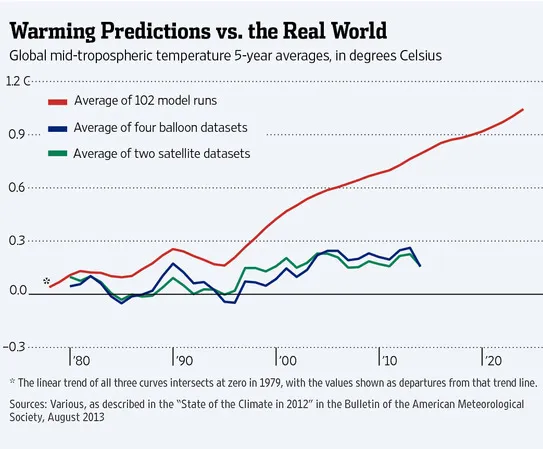
We might forgive these modelers if their forecasts had not been so consistently and spectacularly wrong. From the beginning of climate modeling in the 1980s, these forecasts have, on average, always overstated the degree to which the Earth is warming compared with what we see in the real climate.
For instance, in 1994 we published an article in the journal Nature showing that the actual global temperature trend was “one-quarter of the magnitude of climate model results.” As the nearby graph shows, the disparity between the predicted temperature increases and real-world evidence has only grown in the past 20 years.
“Consensus” science that ignores reality can have tragic consequences if cures are ignored or promising research is abandoned. The climate-change consensus is not endangering lives, but the way it imperils economic growth and warps government policy making has made the future considerably bleaker. The recent Obama administration announcement that it would not provide aid for fossil-fuel energy in developing countries, thereby consigning millions of people to energy poverty, is all too reminiscent of the Sick and Health Board denying fresh fruit to dying British sailors.
Another questioner, Dr. Koonin was undersecretary for science in the Energy Department during President Barack Obama’s first term and is currently director of the Center for Urban Science and Progress at New York University. His previous positions include professor of theoretical physics and provost at Caltech, as well as chief scientist of BP, where his work focused on renewable and low-carbon energy technologies.
But—here’s the catch—those questions are the hardest ones to answer. They challenge, in a fundamental way, what science can tell us about future climates.
Firstly, even though human influences could have serious consequences for the climate, they are physically small in relation to the climate system as a whole. For example, human additions to carbon dioxide in the atmosphere by the middle of the 21st century are expected to directly shift the atmosphere’s natural greenhouse effect by only 1% to 2%. Since the climate system is highly variable on its own, that smallness sets a very high bar for confidently projecting the consequences of human influences.
A second challenge to “knowing” future climate is today’s poor understanding of the oceans. The oceans, which change over decades and centuries, hold most of the climate’s heat and strongly influence the atmosphere. Unfortunately, precise, comprehensive observations of the oceans are available only for the past few decades; the reliable record is still far too short to adequately understand how the oceans will change and how that will affect climate.
A third fundamental challenge arises from feedbacks that can dramatically amplify or mute the climate’s response to human and natural influences. One important feedback, which is thought to approximately double the direct heating effect of carbon dioxide, involves water vapor, clouds and temperature.
Climate Science Is Not Settled
Another group questioning what some consider “settled science”:
Claude Allegre, former director of the Institute for the Study of the Earth, University of Paris;
J. Scott Armstrong, cofounder of the Journal of Forecasting and the International Journal of Forecasting;
Jan Breslow, head of the Laboratory of Biochemical Genetics and Metabolism, Rockefeller University;
Roger Cohen, fellow, American Physical Society;
Edward David, member, National Academy of Engineering and National Academy of Sciences;
William Happer, professor of physics, Princeton;
Michael Kelly, professor of technology, University of Cambridge, U.K.;
William Kininmonth, former head of climate research at the Australian Bureau of Meteorology;
Richard Lindzen, professor of atmospheric sciences, MIT;
James McGrath, professor of chemistry, Virginia Technical University;
Rodney Nichols, former president and CEO of the New York Academy of Sciences;
Burt Rutan, aerospace engineer, designer of Voyager and SpaceShipOne;
Harrison H. Schmitt, Apollo 17 astronaut and former U.S. senator;
Nir Shaviv, professor of astrophysics, Hebrew University, Jerusalem;
Henk Tennekes, former director, Royal Dutch Meteorological Service;
Antonio Zichichi, president of the World Federation of Scientists, Geneva.
Although the number of publicly dissenting scientists is growing, many young scientists furtively say that while they also have serious doubts about the global-warming message, they are afraid to speak up for fear of not being promoted—or worse. They have good reason to worry. In 2003, Dr. Chris de Freitas, the editor of the journal Climate Research, dared to publish a peer-reviewed article with the politically incorrect (but factually correct) conclusion that the recent warming is not unusual in the context of climate changes over the past thousand years. The international warming establishment quickly mounted a determined campaignto haveDr. de Freitas removed from his editorial job and fired from his university position. Fortunately, Dr. de Freitas was able to keep his university job.
This is not the way science is supposed to work, but we have seen it before—for example, in the frightening period when Trofim Lysenko hijacked biology in the Soviet Union. Soviet biologists who revealed that they believed in genes, which Lysenko maintained were a bourgeois fiction, were fired from their jobs. Many were sent to the gulag and some were condemned to death.
Why is there so much passion about global warming, and why has the issue become so vexing that the American Physical Society (APS), from which Dr. Giaever resigned a few months ago, refused the seemingly reasonable request by many of its members to remove the word “incontrovertible” from its description of a scientific issue?
There are several reasons, but a good place to start is the old question “cui bono?” Or the modern update, “Follow the money.”
As the title suggests, it is an anti-fossil fuel rant, full of misinformation worthy of Extinction Rebellion.
He begins by attacking those opposed to woke ESG nonsense, which attempts to block investment in fossil fuels. In Smith’s topsy-turvy world, those opposed to ESG are assaulting “investors’ rights”. In reality the opposite is true.
The Church of England is welcome to invest in whatever it wants. But when I put my savings into a pension fund, I want it to be invested with a view to maximising returns, not forced by ESG regulations and dogma to put it into green energy.
But the main thrust of the article is an attack on fossil fuels themselves. According to him, climate change will bring “catastrophic costs”, and we will leave our children with “a world beset by famine, natural disasters and social upheaval”
I’ll ignore the fact that he is talking through his hat.
What really concerns me is his apparent and total ignorance of the immeasurable benefits brought to humanity by fossil fuels in the last couple of hundred years. Or the fact that the poorer countries of the world need greater access to cheap fossil fuel energy, if they are to improve the lives of their people. Does he really want to put all of this at risk?
Worse than that, he shows no appreciation that hundreds of millions will inevitably die if chemical fertilisers are banned and mechanisation phased out, both of which will be inevitable when fossil fuels are taken away.
Putting political ideology above the interest of people is utterly inexcusable for a Churchman.
If the COE wants to divest in fossil fuels, that’s up to them. But calling for them to be phased out without a practical alternative is not only wrong, it is wicked.
Savor the moment. Donald Trump says he wants no wind farms built during his Presidency, and before we can even crack the champagne, the AfD in Germany say if they are elected, they don’t just want to stop people building new wind plants, they want to tear some of the old ones down.
Savor the moment. Donald Trump says he wants no wind farms built during his Presidency, and before we can even crack the champagne, the AfD in Germany say if they are elected, they don’t just want to stop people building new wind plants, they want to tear some of the old ones down.
That’s what we like to see, some competition… Who can get to Not Zero the fastest?
Bloomberg) — President-elect Donald Trump said Tuesday he would seek to have a policy of having no wind farms constructed during his second term, threatening billions of dollars in planned wind projects.
“We are going to have a policy where no windmills are being built,” Trump said during a lengthy tirade against wind power during a press conference at his Mar-a-Lago resort in Florida.
Trump, who has vowed a first day executive order targeting wind farms, has long made no secret his disdain for the energy source. But his remarks Tuesday represented the sharpest threat yet from the incoming president.
Far-right German poltical party Alternative für Deutschland (AfD) wants to tear down all wind turbines, according to the party’s candidate for chancellor, Alice Weidel. “Down with all these windmills of shame,” she said at a party congress on Saturday in the eastern German town of Riesa, according to Bloomberg News.
Germany will hold Bundestag elections on Feb. 23, and AfD is in second place in the latest polls with 20-22% of eligible voters.
The main question every Western nation needs to get a grip on — is it cheaper to wait for wind turbines to reach the end of life while paying for batteries, flywheels, hydropower, gas storage, interconnectors, plus pandemonium, extra maintenance on your essential infrastructure, and possible blackouts, or to pay out the current wind contracts, and throw a farewell party?
Consumers could get greater control over their energy usage and save money on their bills under plans for an energy smart data scheme.
Smart data is the process of securely sharing customers’ data, such as information on their energy consumption, with businesses known as authorised third parties (ATPs). These third-party providers then use the data, which is only shared at the customer’s request, to provide customers with bespoke products and services which can be tailored to consumers’ needs.
Smart data has the potential to give customers more control over their own data which will help them better understand their energy usage as well as access more personalised services that help them save money. For example, new services could help customers compare prices, change suppliers and switch to low-carbon tariffs.
It all sounds very innocent, but as the Telegraph warns:
A privacy row has broken out over government proposals to allow energy companies to harvest household smart meter data as part of a net zero push.
Ministers are consulting on plans to allow household energy usage to be shared with third parties who could steer them to cheaper deals, as well as lower carbon tariffs from rival suppliers.
But campaigners warned the proposal amounted to “intrusion”, and that bill payers should be “very wary” about agreeing to have their data shared.
Neil Record, a former Bank of England economist who is now chairman of Net Zero Watch, told The Telegraph: “Energy companies get a tremendous amount of data from you, and the public should be very wary of increasingly having their household information provided to external agents.”
He added the proposals “represent an intrusion which once authorised, will provide information about your household, and the public do not realise how extensive that will be”.
Although it will be voluntary at first, how long will it be before it is compulsory?
First understand Southern California is naturally dry. Its Mediterranean climate means it rarely rains in the summer and has a limited winter rainy season. Three deserts in the region attest to its dry climate.
First understand Southern California is naturally dry. Its Mediterranean climate means it rarely rains in the summer and has a limited winter rainy season. Three deserts in the region attest to its dry climate.
As a result, the vegetation around Los Angeles primarily consists of one-hour fuels that can dry in as little as 60 minutes, including dead grasses, leaves and pine needles, and 10-hour fuels that include dead small branches, 1/4 inch to 1 inch in diameter. Able to retain moisture but briefly, this material is essentially kindling.
While a rainstorm can make the vegetation temporarily fire resistant, as soon as the rains stop, the drying process begins. Dead grasses and twigs can become highly flammable within 12 to 24 hours. Due to natural climate oscillations like El Nino, in contrast to this dry year, the previous year’s above-average rains increased the amounts of combustible 1-hour and 10-hour fuels
Los Angeles’s rainy season runs December through February, but the monthly average is only 6 days with rain. Thus, there are usually about 24 dry days during each winter month when vegetation quickly becomes flammable. The length of the natural summer drought or the timing of the winter’s first rain are immaterial to the fundamental aridity of Southern California.
While climate alarmists like Michael Mann blame the fires on global warming, December dryness is not unusual. In fact, the January 9th fires were preceded by a 30-day trend of increasing rainfall, but that obviously was not a factor.
Furthermore, the winter rainy season coincides with the time of the Santa Ana winds. The winds originate in the cold high deserts and blow down the mountainside to the warmer ocean. As they descend, the winds warm and dry further, typically with a relative humidity below 10% that rapidly dries out the vegetation.
When determining the safety of a prescribed burn, the U.S. Department of Agriculture considers there to be a 100% chance of fires spreading when relative humidity is 25% or less. Little wonder that the National Weather Service warned of dangerous conditions when weather systems lined up to amplify the dry winds. The strongest Santa Anas in a decade were predicted.
The region’s last big fire – the December 2017 Thomas Fire – was ignited when Santa Ana winds caused electrical wires to spark.
Knowing that natural, lethal fire dangers are always looming for the growing population, the question is whether city and state governments could have been better prepared to minimize ignitions and more efficiently contain a fire’s spread through southern California. When fires reach neighborhoods with densely packed houses, one burning structure can radiate enough heat to ignite adjacent buildings causing entire neighborhoods to burn to the ground.
Accordingly, ordinances to create a defensible space around homes were enacted in recent decades to keep the height of grass and native brush less than 3 inches within 200 feet of a building. Roofs on new buildings and replacements must be fireproof. But how well such ordinances have been followed is not clear. Nor is it clear if adequate brush management was maintained in adjacent public lands to slow the spread of fire into populated areas. In any case, the flames reached enough homes to cause entire neighborhoods to be destroyed.
The cause of the wildfire ignitions has yet to be determined, but it is absolutely certain it wasn’t due to lightning strikes. During high winds, downed electrical wires are frequent sources of ignitions and likely suspects. However, somewhat unique to large cities like Los Angeles, fires related to homelessness have increased, rising to 13,909 fires in 2023 and doubling since 2020. Those fires sometimes originated with fires that were set to keep warm. But arsonists caused others, such as one of LA’s conflagrations, the Kenneth Fire.
In addition to ineffective policies to address homlessness, many believe government spending priorities have exacerbated the fire threat. For example, LA has increased expenditures on services for the homeless to $1.3 billion. In contrast, budgets for fire prevention were reduced by LA mayor Karen Bass and Governor Newsome by $18 million and $100 million, respectively.
Finally, water-management policies may have also hurt the ability to contain fires, as several hydrants ran out of water. The Santa Ynez Reservoir in Pacific Palisades was dry and off-line. Could money cut from fire-prevention budgets have been used to install more water storage tanks to offset reduced reservoir supplies? Should governments have increased budgets to build more reservoirs. Could systems using ocean water to stop such devasting fires be investigated?
Climate alarmists like Michael Mann claim it is the increase of CO2 causing drier conditions that correlates with bigger fires. But the data do not support his fearmongering.
An increase in the destruction of property by wildfires better correlates with population growth and the expansion of an electrical grid that is vulnerable to high winds. Increased 1-hour fuels and 10-hour fuels due to land disturbances and poor land management correlate with bigger fires. Increased homeless populations correlates with more ignitions.
Blaming climate change for these disasters only deflects attention away from actual causes. Fabrications linking rising CO2 to wildfires should be ignored. Governments must employ solutions that will truly protect people and their property from the unstoppable, natural conditions enabling devastating fires.
James Steele is a biologist, author and former director of San Francisco State University’s Sierra Nevada
This are leftist New England senators who demonstrate their ignorance by supporting wind turbines in an area that had 1 hurricane every 7 years from 1938 to 1991, tells us it is getting worse, when that area has been in a hurricane drought, and then turn around and advocate for the very thing that if we return to normal would lead to major hardship for coastal communities when turbine parts are washing up on shore.
ANYONE PUSHING THIS IS PUSHING JIBBERISH. BE IT WILDFIRES, HURRICANES, OR WHATEVER SHOWS UP NATURALLY
Their comments are symptomatic of a bigger problem which I will discuss at the end of this, and how to stop it.
But back to the wildfires
Here is a list of some notable ones in Southern California, courtesy of Wikipedia
In December 2024, the Franklin Fire in Malibu was significantly exacerbated by strong Santa Ana winds, leading to rapid spread and extensive damage over 3,900 acres (1,600 ha).[26]
Below are the upper air 500 MB anomalies for each of the situations. See if you can pick out a pattern here
1961 event
1982 event
1993 event
2007 event
2008
2014
2017
most recent
What can you easily see in common with all these? The strong ridge along the west coast centered north of southern California. So which one of these events was because of man-made change? How can you tell? YOU CAN’T. BECAUSE IT IS SOMETHING THAT HAPPENS NATURALLY. That strong ridge creates the kind of pattern that causes the strong winds that can spread these fires. SO, IF YOU SEE IT COMING A FEW WEEKS AWAY AND YOU HAVE A KNOWN SETUP, WHY DON’T THE OFFICIALS PRE-PLAN FOR THE EVENT? HOW IS IT THEY DON’T KNOW ITS NOT IF, BUT WHEN, THESE PATTERNS WILL SET UP? Because this whole thing is to push their control missive by trying to get the less knowledgeable public to buy into it. It’s how Markey and his ilk can make a statement that is the height of ignorance because he has never looked at the weather and get away with it. Fox has weather people; they should have been all over that with the kind of sampling I am showing above.
How stupid (sorry that is the word) can the California government be? They have more 3x more people than in the 1950s, and they allow water to simply escape into the oceans? Even the Romans knew to build aqueducts to get water to Rome. And by the way, ever wonder why California and Italy are great wine areas? Similar climates. But the Romans were smart enough to know how to use the water that they had. The absurdity of NOT developing a system of water storage and distribution statewide from the wet northern areas, because of such things as the infamous protection of some 2-inch minnow is like watching a Saturday Night Live Skit of the Californians
Sanders also made his normal looney bin comments about the California drought. California has a feast-or-famine climate that is overall dry and unless you develop the aforementioned system, is going to be strained almost all the time due to demand. The year was above normal because there was so much rain earlier. This means more vegetation that will dry out for fuel with the inevitable swing back, which it has done over the past several months. So, if you do not have government agencies aggressively countering this, what do you think is going to happen? But here are the facts. California rainfall is not dwindling there is just much more demand.
acreage burned even in the worst years is 1/5th what it used to be
I was on Donald Trump Jr.’s Triggered podcast if you want to get a listen it’s about 50 minutes in.
and of course, you see my blogs here, my posts on weatherbell.com premium, tweets and of late our show, the Wise guys of weather with all the shows for you to listen to. (We are on Sunday on am 970 the Answer in NYC, but it streams and is recorded)
For years I have lamented we are nothing but punching bags in this nonsensical climate debate. There is a way to stop it, and it is not to try to censor them. In fact, I want them to continue to speak up. BUT WHAT WE HAVE TO DO, AND I HAVE TRIED TO DO THIS ON TWITTER, IS SET TRAPS 2-3 WEEKS OUT SHOWING THE PATTERN, HOW IT HAPPENED BEFORE, SO WHEN THEY DO TALK AFTER THE FACT, YOU HAVE THEM DEAD TO RIGHTS. It is something I am hoping I can do with the incoming administration. If you get out in front like we did on Sept 8 with the Helene/Miltion tandem pattern set up,
You show people past similar setups, but you have the bullhorn to counter the bull that will show up if and when it does happen, that’s how you do it. You set the trap, and they will gladly walk in every time because they don’t look at the weather except to use it for their agenda, where actual events and how to deal with them are simply examples of their depraved indifference
But no matter what the event, they follow what the title of my book (The Weaponization of Weather in the Phony Climate War) implies. Their agenda is responsible, directly or indirectly for much of the misery that the anchors of their agenda have imposed on our country. And it’s time to get aggressive and in front of these events and then trap them with their own words when they walk into the trap. Not let them and their media minions allow the horse out of the barn where we simply have to try to counter. There is a way to win this.
The report then went on to list a series of bad weather events but failed to provide any evidence that these were anything other than natural events which happen all the time. Nor any evidence that such events have been getting more frequent or extreme over time.
You will recall this BBC article last month, which claimed in the opening paragraph:
Climate change has brought record-breaking heat this year, and with it extreme weather, from hurricanes to month-long droughts.
The report then went on to list a series of bad weather events but failed to provide any evidence that these were anything other than natural events which happen all the time. Nor any evidence that such events have been getting more frequent or extreme over time.
I submitted a complaint, and have just received this response:
In the body of the article, Esme Stallard, BBC’s climate and science reporter, cites the findings of the World Weather Attribution (WWA) group who’s new research shows that people around the world experienced an additional 41 days of dangerous heat due to climate change. Overall, as highlighted in the headline, the article reviews a year of extreme weather that impacted billions, contextualizing the listed events where climate change is not specifically mentioned.
In short, they have tried to wriggle out by claiming that they never said the events were linked to climate change!
This is of course contradicted by that opening paragraph, which said climate change had brought extreme weather, including hurricanes and droughts!
I have now resubmitted my complaint to Stage 2.
But it is obviously significant that they are struggling to find any evidence to back up their claim.
It is painfully obvious what has happened in the Green Energy State (and DEI State). The Wall Street Journal editorial, California’s Climate Time for Choosing (January 10, 2025), subtitled “Sacramento tilts at reducing temperatures while its cities burn from failure to adapt to a variable climate,” fairly described the quandary of the (now) Smoke State.
It is painfully obvious what has happened in the Green Energy State (and DEI State). The Wall Street Journal editorial, California’s Climate Time for Choosing (January 10, 2025), subtitled “Sacramento tilts at reducing temperatures while its cities burn from failure to adapt to a variable climate,” fairly described the quandary of the (now) Smoke State.
“Democrats blame the L.A. blazes on the changing climate, which is a convenient excuse as citizens rage against the failures of state and local government.” Continuing:
The evidence doesn’t support the climate explanation since (among other reasons) California has had a dry climate and Santa Ana winds, even with hurricane-force gusts on occasion, for centuries. If the Democrats who run the state believe their own advertising, why not spend money in useful ways rather than on a green-energy transition to nowhere?
The editorial closed: “It’s time for Democrats to choose which is more important: Their climate obsessions or citizens.”
Counter-narrative …
Against the sober evaluation of California priorities and actions, the climate alarmists have desperately tried to flip the narrative. As discussed yesterday, Joe Romm argued:
In a rational and moral world, the catastrophe of the Los Angeles fires, fueled in part by climate change, would be one of many climate ‘Pearl Harbors’ that might help wake up the public to the urgent need for climate action.
I rejoined:
Is it just a coincidence that the worst of the worst happened in California, the Climate State? The Green State? The DEI State? Joe, the mainstream is not buying your ‘Climate Ate My Homework’ reasoning.
… toVile Counter-narrative
One Tzeporah Berman, International Program Director Stand.earth & Chair at Fossil Fuel Non-Proliferation Treaty, has a take on the southern California wildfires. Her vitriol (below) is worth memorializing, and not in a good way. “Los Angeles has burned in the most destructive fires in US history and fossil fuel profiteers are the arsonists holding the gas can,” she begins.” Our cities are at the mercy of the climate oil, gas and coal has built.” She continues:
In the last week 170,000 people have been evacuated, 10 have died, 35,000 acres have burned taking thousands of homes and businesses with them. Fire is a normal part of the California landscape but this is a catastrophe beyond any bounds of normalcy. It was primed to occur because of the unseasonably dry landscape, the lack of rainfall, and the unnaturally high Santa Ana winds. Vegetation became tinder as it dried out. Thanks to the climate crisis….
This is unambiguously a result of our obsession with burning oil, gas, and coal. While our species’ mastery of fire has seemed like a superpower, fossil fuels are bringing about our downfall…. The climate crisis isn’t just a crisis of warming, it’s also a crisis of outlook: suicidal status quo vs. fragile future….
The greed that has driven us to this moment at the brink of survivability is pure evil and has not been reined in by our political leaders….
Turning to public policy, more government please!
Governments have a responsibility to represent people, not fossil fuel corporations. While Trump wants to expand fossil fuels and dismantle legislation that encourages the adoption of renewables, Canada is gearing up for a federal election that’s billed as a referendum on the carbon tax. We cannot accept these agendas of distraction and destruction.
Moving forward we must treat this moment with the urgency of a tipping point for decisive collective action. While the fires raged, it was confirmed that globally we surpassed 1.5 degrees of warming in 2024.
As temperatures continue to rise and tragedy strikes, we need a concrete, binding plan to stop new fossil fuel projects, and to phase out oil, gas and coal for good. 16 countries and 120 subnational governments have committed to developing a Fossil Fuel Non-Proliferation Treaty. Now is the time to continue building this coalition. [1]
Major scientific organizations’ statements on “climate change” and the conclusions therein form the basis of much of the scientific foundation for governmental, scientific, media, and public concerns on the use of fossil fuels. Trillions of public and private dollars are currently being spent on alternative fuels to “save the planet” from the alleged harm of increasing CO2, a gas which is vital for life on earth. If the evaluations of these societies are erroneous, these measures could impoverish much of the world, to say nothing of wasting trillions.
Major scientific organizations’ statements on “climate change” and the conclusions therein form the basis of much of the scientific foundation for governmental, scientific, media, and public concerns on the use of fossil fuels. Trillions of public and private dollars are currently being spent on alternative fuels to “save the planet” from the alleged harm of increasing CO2, a gas which is vital for life on earth. If the evaluations of these societies are erroneous, these measures could impoverish much of the world, to say nothing of wasting trillions. Economic damage and social unrest are already evident in some countries, including the United States. It is therefore imperative for all that their views be based on sound science, and if not, these societies should change their statements.
A recent publication and podcast have examined the scientific organizations’ climate statements, and have found numerous errors, errors which are easy to find by simply comparing the societies’ statements with data from such reliable sources as NOAA, NASA, and others. These societies are the American Physical Society (APS), American Meteorological Society (AMS), National Academy of Science (NAS), American Chemical Society (ACS), and American Geophysical Union (AGU).
Here is one example. The AGU states “Greater CO2 concentrations in the atmosphere are also affecting the growth and nutritional value of land plants…” Numerous studies, including measurements of terrestrial plant life from space, and measurements of crop production, have shown that if anything, increasing CO2 has increased both plant life and crop production. After all, CO2is a vital nutrient for plants, and the slight warming we have experienced, possibly in part due to the increased CO2, has increased the growing seasons in the temperate latitudes.
As another example, the ACS statement asserts: “Extreme weather and related events, such as floods, droughts… are increasing in frequency and intensity, threatening Americans’ physical, social, and economic well-being.”. The frequency and intensity of floods and droughts is measured by what is called NOAA’s Palmer drought index and this index is displayed as a graph of index versus year. It shows clearly, that in the United States the worst sustained droughts in the U.S. were in the 1930s and 1950s, and the worst sustained floods were in the 1970s through the 1990s.
Tens of thousands of scientists, including over 10,000 with Ph.Ds., have critically examined the evidence, and have concluded that a CO2-induced climate crisis is extremely unlikely. They have willingly and publicly asserted this, by adding their names to documents such as, the Oregon petition, Clintel Climate Petition, and the CO2 Coalition. Among other things, the societies should not ignore these, professional conclusions of many of their members.
Accordingly, and with humility, I suggest that these societies do the following:
Replace their climate statements with ones that say there is most likely an effect humans have on the changing climate, but its importance for humanity is uncertain and it is still being debated.
Eliminate statements that are demonstrably incorrect, as shown by comparison with easily available and reliable data.
Acknowledge in their statements that fossil fuels cannot be replaced in the next several decades without greatly endangering our civilization.
Acknowledge in their statements that CO2 has obvious benefit for human existence, as well as potential risks.
By changing their statements to ones that are more moderate and scientifically correct, these societies will not only be helping the professions they serve, but more important, will ultimately be aiding humanity. On the other hand, if they keep their statements as they are, they will remain on the wrong side of history, and posterity will not look kindly on them. And posterity may be arriving sooner than they think. With a Republican Congress and President Trump referring to the “green new scam,” these society presidents may find themselves hauled before Congress to receive the university president treatment.
After all, the APS statement says, “Multiple lines of evidence strongly support the finding that anthropogenic greenhouse gases have become the dominant driver of global climate warming observed since the mid-twentieth century.” What will its president say when the congressman puts up a graph showing that for 30 years in the early decades of the 20th century, the warming rate was the same or greater? Or when he puts up a map proving that the northern forests, 4000 years ago extended about 200 miles further north worldwide than they do today. Or shows that 2000 years ago, the Romans had vineyards in England extending all the way to Hadrian’s wall, millennia before cold weather grapes had been developed. Or when he shows evidence that 1000 years ago the Vikings grew barley in Greenland, something not possible today. Surely this proves that the world had many warmer periods without the help of extra CO2 in the atmosphere.
There are many such statements that Congress can quote, to very publicly humiliate these society presidents. As a committed life fellow of the APS, I hope these societies will change their statements now, before the roof collapses on them.
This commentary was first published at American Thinker on January 10, 2025.
Dr. Wallace Manheimer is a life fellow of the American Physical Society, the Institute of Electrical and Electronic Engineers and is a member of the CO2 Coalition. He is the author of more than 150 refereed papers.




You must be logged in to post a comment.