12/2024 Update–As Temperature Changes, CO2 Follows

Changes in CO2 follow changes in global temperatures on all time scales, from last month’s observations to ice core datasets spanning millennia. Since CO2 is the lagging variable, it cannot logically be the cause of temperature, the leading variable. It is folly to imagine that by reducing human emissions of CO2, we can change global temperatures, which are obviously driven by other factors.

From Science Matters

By Ron Clutz

Previously I have demonstrated that changes in atmospheric CO2 levels follow changes in Global Mean Temperatures (GMT) as shown by satellite measurements from University of Alabama at Huntsville (UAH). That background post is reprinted later below.

My curiosity was piqued by the remarkable GMT spike starting in January 2023 and rising to a peak in April 2024, and then declining afterward.  I also became aware that UAH has recalibrated their dataset due to a satellite drift that can no longer be corrected. The values since 2020 have shifted slightly in version 6.1, as shown in my recent report  Ocean Leads Cooling UAH December 2024.

In this post, I test the premise that temperature changes are predictive of changes in atmospheric CO2 concentrations.  The chart above shows the two monthly datasets: CO2 levels in blue reported at Mauna Loa, and Global temperature anomalies in purple reported by UAHv6.1, both through December 2024. Would such a sharp increase in temperature be reflected in rising CO2 levels, according to the successful mathematical forecasting model? Would CO2 levels decline as temperatures dropped following the peak?

The answer is yes: that temperature spike resulted
in a corresponding CO2 spike as expected.
And lower CO2 levels followed the temperature decline.

Above are UAH temperature anomalies compared to CO2 monthly changes year over year.

Changes in monthly CO2 synchronize with temperature fluctuations, which for UAH are anomalies now referenced to the 1991-2020 period. CO2 differentials are calculated for the present month by subtracting the value for the same month in the previous year (for example December 2024 minus December 2023).  Temp anomalies are calculated by comparing the present month with the baseline month. Note the recent CO2 upward spike and drop following the temperature spike and drop.

The final proof that CO2 follows temperature due to stimulation of natural CO2 reservoirs is demonstrated by the ability to calculate CO2 levels since 1979 with a simple mathematical formula:

For each subsequent year, the CO2 level for each month was generated

CO2  this month this year = a + b × Temp this month this year  + CO2 this month last year

The values for a and b are constants applied to all monthly temps and are chosen to scale the forecasted CO2 level for comparison with the observed value. Here is the result of those calculations.

In the chart calculated CO2 levels correlate with observed CO2 levels at 0.9987 out of 1.0000.  This mathematical generation of CO2 atmospheric levels is only possible if they are driven by temperature-dependent natural sources, and not by human emissions which are small in comparison, rise steadily and monotonically.  For a more detailed look at the recent fluxes, here are the results since 2015, an ENSO neutral year.

For this recent period, the calculated CO2 values match the annual lows, while some annual generated values of CO2 are slightly higher or lower than observed at other months of the year. Still the correlation for this period is 0.9931.

Key Point

Changes in CO2 follow changes in global temperatures on all time scales, from last month’s observations to ice core datasets spanning millennia. Since CO2 is the lagging variable, it cannot logically be the cause of temperature, the leading variable. It is folly to imagine that by reducing human emissions of CO2, we can change global temperatures, which are obviously driven by other factors.

Background Post Temperature Changes Cause CO2 Changes, Not the Reverse

This post is about proving that CO2 changes in response to temperature changes, not the other way around, as is often claimed.  In order to do that we need two datasets: one for measurements of changes in atmospheric CO2 concentrations over time and one for estimates of Global Mean Temperature changes over time.

Climate science is unsettling because past data are not fixed but change later on.  I ran into this previously and now again in 2021 and 2022 when I set out to update an analysis done in 2014 by Jeremy Shiers (discussed in a previous post reprinted at the end).  Jeremy provided a spreadsheet in his essay Murray Salby Showed CO2 Follows Temperature Now You Can Too posted in January 2014. I downloaded his spreadsheet intending to bring the analysis up to the present to see if the results hold up.  The two sources of data were:

Temperature anomalies from RSS here:  http://www.remss.com/missions/amsu

CO2 monthly levels from NOAA (Mauna Loa): https://www.esrl.noaa.gov/gmd/ccgg/trends/data.html

Changes in CO2 (ΔCO2)

Uploading the CO2 dataset showed that many numbers had changed (why?).

The blue line shows annual observed differences in monthly values year over year, e.g. June 2020 minus June 2019 etc.  The first 12 months (1979) provide the observed starting values from which differentials are calculated.  The orange line shows those CO2 values changed slightly in the 2020 dataset vs. the 2014 dataset, on average +0.035 ppm.  But there is no pattern or trend added, and deviations vary randomly between + and -.  So last year I took the 2020 dataset to replace the older one for updating the analysis.

Now I find the NOAA dataset starting in 2021 has almost completely new values due to a method shift in February 2021, requiring a recalibration of all previous measurements.  The new picture of ΔCO2 is graphed below.

The method shift is reported at a NOAA Global Monitoring Laboratory webpage, Carbon Dioxide (CO2) WMO Scale, with a justification for the difference between X2007 results and the new results from X2019 now in force.  The orange line shows that the shift has resulted in higher values, especially early on and a general slightly increasing trend over time.  However, these are small variations at the decimal level on values 340 and above.  Further, the graph shows that yearly differentials month by month are virtually the same as before.  Thus I redid the analysis with the new values.

Global Temperature Anomalies (ΔTemp)

The other time series was the record of global temperature anomalies according to RSS. The current RSS dataset is not at all the same as the past.

Here we see some seriously unsettling science at work.  The purple line is RSS in 2014, and the blue is RSS as of 2020.  Some further increases appear in the gold 2022 rss dataset. The red line shows alterations from the old to the new.  There is a slight cooling of the data in the beginning years, then the three versions mostly match until 1997, when systematic warming enters the record.  From 1997/5 to 2003/12 the average anomaly increases by 0.04C.  After 2004/1 to 2012/8 the average increase is 0.15C.  At the end from 2012/9 to 2013/12, the average anomaly was higher by 0.21. The 2022 version added slight warming over 2020 values.

RSS continues that accelerated warming to the present, but it cannot be trusted.  And who knows what the numbers will be a few years down the line?  As Dr. Ole Humlum said some years ago (regarding Gistemp): “It should however be noted that a temperature record which keeps on changing the past hardly can qualify as being correct.”

Given the above manipulations, I went instead to the other satellite dataset UAH version 6. UAH has also made a shift by changing its baseline from 1981-2010 to 1991-2020.  This resulted in systematically reducing the anomaly values, but did not alter the pattern of variation over time.  For comparison, here are the two records with measurements through December 2023.

Comparing UAH temperature anomalies to NOAA CO2 changes.

Here are UAH temperature anomalies compared to CO2 monthly changes year over year.

Changes in monthly CO2 synchronize with temperature fluctuations, which for UAH are anomalies now referenced to the 1991-2020 period.  As stated above, CO2 differentials are calculated for the present month by subtracting the value for the same month in the previous year (for example June 2022 minus June 2021).   Temp anomalies are calculated by comparing the present month with the baseline month.

The final proof that CO2 follows temperature due to stimulation of natural CO2 reservoirs is demonstrated by the ability to calculate CO2 levels since 1979 with a simple mathematical formula:

For each subsequent year, the co2 level for each month was generated

CO2  this month this year = a + b × Temp this month this year  + CO2 this month last year

Jeremy used Python to estimate a and b, but I used his spreadsheet to guess values that place for comparison the observed and calculated CO2 levels on top of each other.
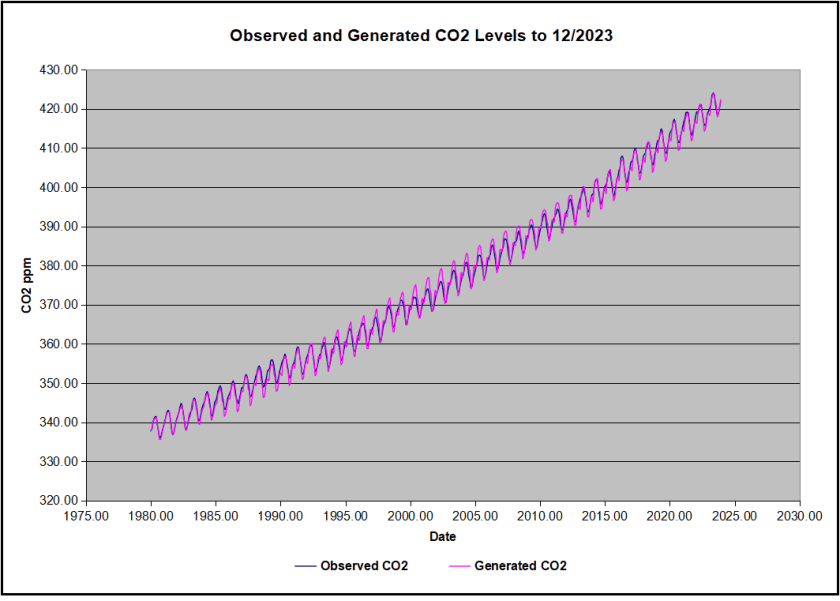
In the chart calculated CO2 levels correlate with observed CO2 levels at 0.9986 out of 1.0000.  This mathematical generation of CO2 atmospheric levels is only possible if they are driven by temperature-dependent natural sources, and not by human emissions which are small in comparison, rise steadily and monotonically.

Comment:  UAH dataset reported a sharp warming spike starting mid year, with causes speculated but not proven.  In any case, that surprising peak has not yet driven CO2 higher, though it might,  but only if it persists despite the likely cooling already under way.

Previous Post:  What Causes Rising Atmospheric CO2?

This post is prompted by a recent exchange with those reasserting the “consensus” view attributing all additional atmospheric CO2 to humans burning fossil fuels.

The IPCC doctrine which has long been promoted goes as follows. We have a number over here for monthly fossil fuel CO2 emissions, and a number over there for monthly atmospheric CO2. We don’t have good numbers for the rest of it-oceans, soils, biosphere–though rough estimates are orders of magnitude higher, dwarfing human CO2.  So, we ignore nature and assume it is always a sink, explaining the difference between the two numbers we do have. Easy peasy, science settled.

What about the fact that nature continues to absorb about half of human emissions, even while FF CO2 increased by 60% over the last 2 decades? What about the fact that in 2020 FF CO2 declined significantly with no discernable impact on rising atmospheric CO2?

These and other issues are raised by Murray Salby and others who conclude that it is not that simple, and the science is not settled. And so these dissenters must be cancelled lest the narrative be weakened.

The non-IPCC paradigm is that atmospheric CO2 levels are a function of two very different fluxes. FF CO2 changes rapidly and increases steadily, while Natural CO2 changes slowly over time, and fluctuates up and down from temperature changes. The implications are that human CO2 is a simple addition, while natural CO2 comes from the integral of previous fluctuations.  Jeremy Shiers has a series of posts at his blog clarifying this paradigm. See Increasing CO2 Raises Global Temperature Or Does Increasing Temperature Raise CO2 Excerpts in italics with my bolds.

The following graph which shows the change in CO2 levels (rather than the levels directly) makes this much clearer.

Note the vertical scale refers to the first differential of the CO2 level not the level itself. The graph depicts that change rate in ppm per year.

There are big swings in the amount of CO2 emitted. Taking the mean as 1.6 ppmv/year (at a guess) there are +/- swings of around 1.2 nearly +/- 100%.

And, surprise surprise, the change in net emissions of CO2 is very strongly correlated with changes in global temperature.

This clearly indicates the net amount of CO2 emitted in any one year is directly linked to global mean temperature in that year.

For any given year the amount of CO2 in the atmosphere will be the sum of

  • all the net annual emissions of CO2
  • in all previous years.

For each year the net annual emission of CO2 is proportional to the annual global mean temperature.

This means the amount of CO2 in the atmosphere will be related to the sum of temperatures in previous years.

So, CO2 levels are not directly related to the current temperature but the integral of temperature over previous years.

The following graph again shows observed levels of CO2 and global temperatures but also has calculated levels of CO2 based on sum of previous years temperatures (dotted blue line).

Summary:

The massive fluxes from natural sources dominate the flow of CO2 through the atmosphere.  Human CO2 from burning fossil fuels is around 4% of the annual addition from all sources. Even if rising CO2 could cause rising temperatures (no evidence, only claims), reducing our emissions would have little impact.

Atmospheric CO2 Math

Ins: 4% human, 96% natural
Outs: 0% human, 98% natural.
Atmospheric storage difference: +2%
(so that: Ins = Outs + Atmospheric storage difference)

Balance = Atmospheric storage difference: 2%, of which,
Humans: 2% X 4% = 0.08%
Nature: 2% X 96 % = 1.92%

Ratio Natural:Human =1.92% : 0.08% = 24 : 1

Resources
For a possible explanation of natural warming and CO2 emissions see Little Ice Age Warming Recovery May be Over
Resources:

CO2 Fluxes, Sources and Sinks

Who to Blame for Rising CO2?

Fearless Physics from Dr. Salby

EV Sales Still Way Below Target

SMMT have released the final data for car registrations last year. BEVs ended the year with a market share of 19.6%, well below the ZEV mandate of 22%, despite a bumper December.

From NOT A LOT OF PEOPLE KNOW THAT

By Paul Homewood

https://www.smmt.co.uk/vehicle-data/car-registrations/

SMMT have released the final data for car registrations last year. BEVs ended the year with a market share of 19.6%, well below the ZEV mandate of 22%, despite a bumper December.

BEV registrations for the month were 56% compared to December 2023, which clearly is not a representative figure. Remember that these are registrations, not sales. It is therefore extremely likely that carmakers have been pre-registering thousands of EVs, in order to get closer to their target. We also know they have been offering unaffordable discounts for purchases before the end of the year.

Either way, there appears to be no way that BEV share will rise to the mandated 28% this year.

It is worth looking behind the numbers though.

First of all, EV take up in the private sector remains stubbornly low at one-in-ten. There is simply no way total EV sales will get anywhere target if private buyers, who account for 38% of the market, refuse to buy them.

https://www.smmt.co.uk/2025/01/record-ev-market-share-but-weak-private-demand-frustrates-ambition/

Secondly sales of petrol and diesels fell sharply in December, as carmakers cut back on production, in order to artificially raise the ratio of EVs.

This is evident from the November manufacturing figures, which are 30% down in November 2023.

https://www.smmt.co.uk/2024/12/car-manufacturing-down-in-november-as-sector-seeks-an-easing-of-cost-pressures/

Registration of Ford cars last year in the UK fell by 23%, Nissan 12%, Toyota 8% and Vauxhall 21%. These are alarming figures, not least for the two Japanese companies.

Nissan, for instance, saw registrations fall from 100K to 89K between 2023 and 2024. Sales of the Leaf have been plummeting recently, and sales of the petrol/diesel Qashqai and Juke models account for 77K on their own. Clearly Nissan will miss the 22% target by a long way.

So will Toyota, who have been been specialising in hybrids in recent years. Late to the EV party, their only electric offering, the Toyota bZ4X, was only introduced to the UK last June, and costs over £40,000, well outside the affordability of the mass market sector. Toyota registrations fell from 108K to 101K last year. Expect more large cutbacks next year to reduce sales of petrol/diesel.

Neither Nissan or Toyota are in strong position to meet the challenge of Chinese made EVs, and there surely must be question marks over their future UK operations, as they will no longer be viable under existing ZEV mandates.

Meanwhile Chinese EV manufacturers, Polestar and BYD, clocked up 17481 EV registrations in 2024, giving them 13635 surplus ZEV allowances, which they may be able sell at a price close £15000 each to carmakers who have fallen short of target and will otherwise have to pay that much in fines. That will hand Polestar and BYD a nice little windfall of £204 million!

Tesla too will rubbing their hands with glee, with their 50334 registrations, potentially worth £600 million.

If you wanted to destroy the UK car industry, while enriching Chinese and US manufacturers, I cannot think of a better way to do it!

Grid battery cost issue storm looms in Massachusetts

Massachusetts just passed a law requiring the big utilities to buy a whopping 1,500 MW of batteries by this July. It should cost several billion dollars requiring immediate rate increases so it will be getting lots of attention. Net zero storage finally hitting the fan.

From CFACT

By David Wojick

13078300 – battery charger with plug. 3d isolated

Massachusetts just passed a law requiring the big utilities to buy a whopping 1,500 MW of batteries by this July. It should cost several billion dollars requiring immediate rate increases so it will be getting lots of attention. Net zero storage finally hitting the fan.

The total battery buy is an incredible 5,000 MW with most of that bought in the next few years so the rate increases will keep coming. The law is a study in vagueness so there will be a lot of confusion along the way.

The complex issues involved have been nicely outlined in two articles by Laurie Belsito at the Massachusetts Fiscal Alliance. The first, written before the Bill passed, is titled “Proposed Battery Law Costs Billions and Does Nothing”. See it here:

https://www.massfiscal.org/op-ed-the-actual-costs-legislature-climate-bill

This article focuses on the cost of the entire 5,000 MW, saying this:

“The number of batteries is somewhat unclear. The Bill specifies that 5,000 Megawatts (MW) of batteries be bought but this is the discharge capacity, that is how fast the batteries can be emptied. The storage capacity is what counts and that is measured in Megawatt-hours (MWh). Specifying MW is like buying juice based on how fast it pours not how much the bottle holds.

The Bill does include a range of storage capacities which bounds the cost somewhat. Most of the batteries are what is called mid-duration which means they can provide full discharge for from four to 10 hours. Almost all grid scale battery systems these days are four-hour duration so for simplicity we will start by assuming the whole 5,000 MW buy is four-hour batteries.

This gives 20,000 MWh of storage. Battery systems today run around $500,000 per MWh. That gives a total cost of $10,000,000,000 or ten billion dollars which equals roughly 17% of the current state budget. If 10-hour batteries are purchased the cost jumps to $25,000,000,000 or twenty-five billion dollars. The Bill actually calls for a good bit of longer duration batteries as well which makes the cost even higher.”

Ten billion, twenty-five billion, maybe more who knows? That is seriously vague, and I doubt the Legislators who voted for this madness had any idea of these numbers.

There is a lot more in the article that is well worth reading.

The second Belsito article analyzes the looming complexities of the utilities buying 1,500 MW in a rush. It is titled “Amidst Glaring Unknowns in New Energy Law, Rate Increases Definite” and is here:

https://www.massfiscal.org/amidst_glaring_unknowns_in_new_energy_law_rate_increases_definite

Here are three excerpts to give the flavor of the analysis. There is a lot more in the article.

1. “This is sure to be a very complex process with little guidance from the new law. The big question we have is who will wind up paying for something we previously found won’t give us much bang for our buck, where many billions of dollars will buy you a few more hours of energy at best. Big rate increases are certain but it’s unclear which ratepayers will be taking the hit and how these price increases will be distributed among them.”

2. “One point to be considered is that the law says this huge battery storage buy shall be made jointly by “every distribution company” in the State. The law is unclear on whether this includes municipal power authorities, which are not technically companies. If it does exclude them, then municipal power customers might be off the hook when it comes to paying the billions.

Assuming it is just the investor-owned utilities that most of us use, the big question is then how will the cost be divided among them? The new law is silent here. They might do it on the basis of customer equity, such as total retail sales. Or they might do it on the basis of their relative need for batteries in which case customers of one utility could see much bigger rate increases than another utility’s customers.

Another complexity is that these rate increases all have to be applied for and approved by the state Department of Public Utilities. This can be a long-drawn-out process but the bill itself puts the state under a significant deadline. Rushing to spend billions is never good policy, but it is now the law that our elected state representatives and governor approved just a week after most of them secured reelection, while the senate gave its approval days before. Presumably while the purchase process is done jointly the rate increases will be done on individual utility cases, especially if the rate increases differ a lot.

There is also a chicken and egg dilemma. The rate increases should be based on the battery costs, but the utilities cannot finalize the purchases to establish costs without the rate increases. Perhaps they will make the purchase contracts contingent upon getting the necessary rate increases. Among the uncertainty, the one thing that can be assured is that your bills will go up.”

3. “These staggering costs and who will pay them will start to come into focus with the rate increase applications that the power companies will have to file. The affected ratepayers should demand an explanation as there is no apparent use for all these thousands of extremely large, expensive and dangerous batteries that will be dotting the landscape in our communities.”

I can hardly wait for this rate increase requests to hit. People will finally see the costly absurdity of battery backup for renewables. I and others at the Net Zero Reality Coalition have been writing about this for several years. See https://www.cfact.org/netzerorealitycoalition/. Until now the issue has been academic, but this is a looming reality.

The astronomical cost of backup batteries is an issue that extends far beyond Massachusetts. We should all watch this issue storm closely.

When to Give a Fig

On 30th April 2014 a Swedish meteorologist caused shock waves to reverberate across the international community of climate scientists. This was not because he had made a major discovery, nor had he been involved in a scientific scandal. But what he had done was to commit the cardinal sin of joining the sceptical Global Warming Policy Foundation (GWPF).

From Climate Scepticism

By John Ridgway

The scourge of prosocial censorship

On 30th April 2014 a Swedish meteorologist caused shock waves to reverberate across the international community of climate scientists. This was not because he had made a major discovery, nor had he been involved in a scientific scandal. But what he had done was to commit the cardinal sin of joining the sceptical Global Warming Policy Foundation (GWPF). The reason why to some this was so shocking was because he wasn’t just any old Swedish meteorologist; he was Professor Lennart Bengtsson, the former head of research at the European Centre for Medium-Range Weather Forecasts before becoming its director until 1990. He had then moved on to become director of the Max Planck Institute for Meteorology in Hamburg. Amongst his many accolades he had been awarded the Milutin Milankovic Medal in 1996, the René Descartes Prize for Collaborative Research in 2005, and the 51st International Meteorological Organization Prize of the World Meteorological Organization in 2006. In 2009 he was made an honorary fellow of the Royal Meteorological Society in recognition of his contribution to meteorology.

Only a fortnight later the same Swedish meteorologist caused an aftershock by resigning from the same foundation. The self-appointed guardians of scientific truth at DeSmog will tell you that it was because he hadn’t quite realised what a shower of reprobates he had joined and so he quickly learned to regret his actions. However, this is what Bengtsson said in his resignation letter:

I have been put under such an enormous group pressure in recent days from all over the world that has become virtually unbearable to me. If this is going to continue I will be unable to conduct my normal work and will even start to worry about my health and safety. I see therefore no other way out therefore than resigning from GWPF…Colleagues are withdrawing their support, other colleagues are withdrawing from joint authorship etc. I see no limit and end to what will happen. It is a situation that reminds me about the time of McCarthy. I would never have expecting anything similar in such an original peaceful community as meteorology. Apparently it has been transformed in recent years.

Bengtsson’s censorious colleagues seemed quick to prove his point by denouncing his accusation that they had denounced him. Gavin Schmidt, for example, dismissed his reference to McCarthyism as being “ridiculous”, suggesting instead that it was the brave scientists such as himself who were the real victims of a witch hunt.

Appalling though it may seem that Professor Bengtsson should have been treated this way, he cannot claim to have not seen it coming. Earlier that same year a paper, in which he had the temerity to suggest that the projected warming was unlikely to be anywhere near as bad as others had maintained, was rejected by the scientific journal Environmental Research Letters on the basis that his findings were “less than helpful“. By way of clarification, the peer reviewer concerned added the reproof, “actually it [the paper] is harmful as it opens the door for oversimplified claims of ‘errors’ and worse from the climate-skeptic media side“. When Bengtsson and others, such as meteorologist Hans von Storch, condemned the rejection as scandalous, the journal’s publisher was eager to play down the comments made by the peer reviewer, claiming instead that the paper simply did not meet the journal’s high standards. Yes, that old chestnut.

What Bengtsson had in fact been subjected to is a phenomenon referred to as ‘prosocial censorship’. It is a form of censorship in which work is rejected, and individuals cancelled, not because the work is substandard or flawed, but because it threatens to undermine a cherished ideology or someone else’s concept of societal safety and harmony. Such censorship is never portrayed as such, of course; the reason given is always that the individual(s) concerned were peddling substandard work leading to harmful misinformation.

For example, if you were to be an Emeritus Professor of Risk with an international reputation for expertise in forensic statistics, but you then produced work that called into question government figures that seemed to be misrepresenting the severity of a pandemic or the safety and effectiveness of vaccines, you could expect your career to be cancelled on the basis that you are peddling harmful misinformation.

If, for example, you were to be a consultant psychiatrist and psychotherapist with more than fifteen years of experience pioneering psychotherapy for patients with gender dysphoria, but you then dared to say that everything in your professional experience had led you to the inescapable conclusion that transgender activists were guilty of promoting inappropriate physical interventions to deal with a basically psychological problem, then you could expect to be denounced as “the most evil dangerous Nazi Psychiatrist in the world” — and a transphobe for good measure.

If, for example, you were a physicist at CERN with a bright future ahead of you, but were then to suggest that the unbalanced gender representation within your field had nothing to do with patriarchy and everything to do with inherent gender traits, then you could expect to be vilified as a misogynist and ostracised by your fellow scientists.

And if, for example, you were to be a prominent climate scientist who had pointed out that self-censorship was rife within your field and that it was responsible for the absence of papers published in prominent journals that quantify both the climatic and non-climatic causations of wildfires, then you could expect the likes of the Grantham Institute’s Bob Ward to bleat that “Unfortunately, his bogus narrative has predictably been seized upon by the opponents of action to tackle climate change“. Worse still, none other than Professor Ken Rice (think poor man’s Sabine Hossenfelder) would be moved to refer to you as if you are now dead to them:

Given that there can be preferred narratives within scientific communities, it is always good for there to be people who are regarded as credible and who push back against them. Even if you don’t agree with them, they can still present views that are worth thinking about. In my view, Patrick used to be one of those people. [His emphasis]

Oh the shame of it all!

In the above examples, the common narrative is one of a previously respected expert who had sadly fallen from grace because they couldn’t help themselves and had allowed their toxic opinions to compromise their ability to stick to the truth. As a consequence, they instantaneously transform into incompetent bad actors who are a danger to society, heartily deserving of prompt and emphatic prosocial censorship.

To be clear, these are not isolated examples. A recent research paper published in The Proceedings of the National Academy of Sciences argued that both self-censorship and the prosocial censorship of colleagues are commonplace within the sciences — and the problem is only getting worse. Some of the figures make for grim reading:

A recent national survey of US faculty at four-year colleges and universities found the following: 1) 4 to 11% had been disciplined or threatened with discipline for teaching or research; 2) 6 to 36% supported soft punishment (condemnation, investigations) for peers who make controversial claims, with higher support among younger, more left-leaning, and female faculty; 3) 34% had been pressured by peers to avoid controversial research; 4) 25% reported being “very” or “extremely” likely to self-censor in academic publications; and 5) 91% reported being at least somewhat likely to self-censor in publications, meetings, presentations, or on social media.

There are, however, trends to be observed. Censorship is more of a problem in the social sciences than within STEM faculties. Women are keener to censor than are their male colleagues. And whilst right-leaning academics are more likely to engage in self-censorship, the left-leaning are far more likely to approve of the prosocial censorship of a colleague. Since prosocial censorship biases both the selection and promotion of staff members, it follows that the system is currently structured in such a way as to entrench the preponderance of left-leaning academics in senior positions. Worse still, the appetite for prosocial censorship is greater within the ranks of the PhDs than it is within faculty staff, suggesting that – to borrow a turn of phrase favoured by climate scientists – the problem is baked in for the future.

As the terminology suggests, those who advocate prosocial censorship will often do so for what they perceive to be the best of possible motives. Most commonly, the intention is to prevent research from being appropriated by “malevolent actors to support harmful policies and attitudes”. Sometimes the research is considered too dangerous to pursue, and in many other cases the censorship is aimed at protecting vulnerable groups. However, no matter how well-intended, the censorship comes with many obvious risks, the clearest of which is the possible suppression of the truth in the cause of a ‘greater good’.

At its most petty, all that may be at stake is one person’s reputation at the expense of a competitor. At its most extreme, prosocial censorship could involve a “wilful blindness of authorities” covering up a heinous crime for fear of offending a section of society, or for fear of giving encouragement to a right-wing that is assumed to be looking for any excuse to destabilise. Somewhere in the middle are the concerns harboured by the climate sceptic. Whilst we understand that science is not supposed to operate by consensus, we would, nevertheless, like to believe that an emergent consensus is the result of a developing common knowledge, rather than the result of social engineering enabled by prosocial censorship. Unfortunately, knowing that Professor Bengtsson’s experiences are far from unique does nothing to encourage such a belief. And, when all is said and done, that is the greatest shame of all. Prosocial censorship may seem a good idea, but it isn’t in the least bit desirable when it undermines the integrity of a discipline and causes widespread distrust amongst the wider community. That is the point, I suggest, at which we should all start giving a fig.

Illinois Electricity: Subsidies, Mandates, Inflation

“If Illinois wants an affordable and reliable grid, the answer is to end subsidies and mandates for all forms of generation. And to eliminate regulations that are taking the most affordable and reliable fuels out of the generation mix. Nothing else will work.”

From Master Resource

By Bill Peacock

“If Illinois wants an affordable and reliable grid, the answer is to end subsidies and mandates for all forms of generation. And to eliminate regulations that are taking the most affordable and reliable fuels out of the generation mix. Nothing else will work.”

Electricity prices are climbing in Illinois. As is the public’s concern about them. To address this, Governor JB Pritzker and governors from four other states recently asked the PJM Interconnection to do something about the escalating rates.

While the concern is widespread, there is little consensus over the cause of the higher prices. Some blame fossil fuels. Others the PJM capacity market. And others a lack of investment in battery storage. Most agree, though, that government intervention is needed to fix the problem.

However, a closer look shows that government intervention is the source of the problem.

Background

Illinois’ fuel mix, the type of facilities used to generate electricity, has dramatically changed over the last ten years. In 2013, 91 percent of the electricity used in the state was generated by nuclear (48%) and coal (43%). Renewable generation from wind and solar were less than 5 percent, and natural gas supplied only 3.4 percent.

The mix is very different today. Coal’s output plummeted to only 15 percent, leaving a huge hole in Illinois’ generation capacity. To fill the breach, renewable generation has almost tripled to 13.3 percent and natural gas now provides 16 percent of load.

Why did this happen? First, over the decade, Congress has provided subsidies of more than $81 billion of taxpayer money to force renewable energy onto the national grid. Illinois is partnering with Congress to require its electric utilities to obtain 40 percent of their electric power from renewables by 2030 and 50 percent by 2040.

The second reason is that in 2021, Illinois enacted a clean energy law mandating zero emissions from all coal-fired power plants by 2045. Federal regulations are also designed to accomplish a similar outcome.

The result of this growing dependence on renewables is a more expensive, less reliable electric grid. Advocates of wind and solar are doing everything they can to mask this.

Misdirection, More Government

For instance, state Sen. Bill Cunningham filed legislation last spring designed to address higher prices and energy shortages. One of the ways the legislation addresses this is to set up a system of energy storage credits. In layman’s terms, Sen. Cunningham is proposing government mandated subsidies for batteries designed to store electricity.

In addition to ignoring how consumers paying for new subsidies will reduce their electricity costs, the senator does not explain that the reason Illinois is facing potential energy shortages is because intermittent, i.e., unreliable, renewable energy has replaced the highly reliable coal-fired generation that had kept the lights on in Illinois for decades.

Another renewable advocate, Sarah Moskowitz, the executive director of the Citizens Utility Board, tries to blame fossil fuels for the grid’s problems. She offers the example of Winter Storm Elliot, when she says PJM “made the unusual request that everyday customers conserve energy.” She claimed that “the fossil-fueled power generators who for years had sold themselves as necessary for grid reliability, failed to deliver.”

However, the data explains that it was renewables that were no shows.

During the storm, PJM asked “consumers to reduce their use of electricity … between the hours of 4 a.m. on December 24, 2022 and 10 a.m. on December 25, 2022.” At 4 a.m. when the call for conservation went into effect, it was 0 degrees outside and demand was rapidly increasing, but renewables were not coming through. Wind provided only 5 percent of the electricity being generated, and solar 0%. Eighty-three percent of the electricity came from natural gas, coal, and nuclear generation. Even at noon that day, solar only provided 1 percent of the load, 692 megawatts, despite having an installed capacity of 2,096 megawatts.

Conclusion

Renewables can still not be counted on, while the options for grid reliability are diminishing. Government mandates, subsidies, and regulations are shutting down investment in reliable, dispatchable thermal generation from fossil and nuclear fuels.

PJM’s capacity market will not solve the problem—it will only make the grid more expensive, not more reliable. My state of Texas—the nation’s leading generator from renewable sources—has already tried this by throwing $40 billion at generators over the last three years in the hope of increasing thermal capacity. It did not work.

If Illinois wants an affordable and reliable grid, the answer is to end subsidies and mandates for all forms of generation. And to eliminate regulations that are taking the most affordable and reliable fuels out of the generation mix. Nothing else will work.

———————————

Bill Peacock is the policy director of the Energy Alliance. He has been researching and writing about electricity markets for 20 years.

A Country With No Wind Turbines?

“What Mr Trump sneeringly calls “windmills” are pretty important right now for keeping the UK’s lights on.”

From NOT A LOT OF PEOPLE KNOW THAT

By Paul Homewood

“What Mr Trump sneeringly calls “windmills” are pretty important right now for keeping the UK’s lights on.”

BBC Environment Correspondent Paul Murphy.

————————————–

Many thanks to Josh.

And don’t forget his brilliant calendars, which you can browse here.

Unshackling Nuclear Energy: The Case Against the NRC’s Overreach

In the high-stakes world of energy production, nuclear power remains one of the most promising technologies for meeting global demand while minimizing emissions. Yet, as Christopher Koopman and Eli Dourado explain in their Wall Street Journal piece, the Nuclear Regulatory Commission (NRC) has become a regulatory quagmire stifling innovation. The recent lawsuit from Texas, Utah, and Last Energy, aimed at curbing the NRC’s overreach, could mark a turning point for the future of small modular reactors (SMRs)—an innovation too vital to be obstructed by bureaucratic inertia​​.

From Watts Up With That?

By Charles Rotter

https://www.wsj.com/opinion/let-states-run-small-nuclear-reactors-energy-policy-f92488ae?st=RY7W2a

In the high-stakes world of energy production, nuclear power remains one of the most promising technologies for meeting global demand while minimizing emissions. Yet, as Christopher Koopman and Eli Dourado explain in their Wall Street Journal piece, the Nuclear Regulatory Commission (NRC) has become a regulatory quagmire stifling innovation. The recent lawsuit from Texas, Utah, and Last Energy, aimed at curbing the NRC’s overreach, could mark a turning point for the future of small modular reactors (SMRs)—an innovation too vital to be obstructed by bureaucratic inertia​​.

A Regulatory Regime Frozen in the Cold War Era

The Atomic Energy Act of 1954 was crafted with the foresight to distinguish between different types of nuclear reactors based on their risk profiles. Reactors that could pose significant national security or public health risks would require federal oversight. Yet, this sensible framework was gutted in 1956 when the Atomic Energy Commission, the NRC’s predecessor, decided that all nuclear reactors, regardless of their size or risk, must undergo the same suffocating regulatory process.

This one-size-fits-all approach persists today, resulting in absurdities like the regulation of the teaching reactor at Texas A&M University—a reactor so small it couldn’t even power a single LED bulb. As Koopman and Dourado point out, even the NRC itself concedes that research reactors like these pose no meaningful safety risk. Nevertheless, they are subjected to the same licensing gauntlet as gigawatt-scale power plants​.

The Small Modular Reactor Revolution

Small modular reactors are a game-changer for nuclear power. Unlike the sprawling nuclear plants of the mid-20th century, SMRs are compact, produce a fraction of the energy of traditional plants (around 20 megawatts or less), and are equipped with modern safety features. For instance, Last Energy’s reactor design operates within a 12-inch steel-walled container, making a radioactive release virtually impossible—even in the worst imaginable scenario.

Last Energy’s design operates entirely inside a container with 12-inch steel walls that has no credible mode of radioactive release even in the worst reasonable scenario.

Even in such a scenario, according to the plaintiffs, radiation exposure would be less than a tenth what the NRC has deemed too safe to require regulation in other contexts—and less than 1/800th of a routine abdominal CT scan.

Yet, these remarkable advancements are stymied by the NRC’s outdated and burdensome licensing process. NuScale, another SMR innovator, spent over $500 million and more than two million hours of labor just to get its design certified. That’s before applying for an operational license, which will only multiply the costs​.

The Stakes for States Like Texas and Utah

The timing of this challenge is crucial. Texas and Utah face energy crises as their populations grow. Texas operates its own electrical grid, serving more than 27 million customers. With its rapid population growth and booming economy, the Lone Star State faces an unprecedented need for reliable power. Utah’s “Operation Gigawatt” aims to double its power production over the next decade. Nuclear power could play a crucial role in both states’ energy futures, to say nothing of America’s, if regulatory barriers don’t stand in the way.

Why the NRC’s Overreach Must End

At the heart of this lawsuit lies a simple yet transformative demand: the NRC must adhere to the law. The Atomic Energy Act did not mandate federal oversight for reactors that pose negligible risks. State regulatory authorities are fully capable of ensuring the safe operation of SMRs, freeing federal regulators to focus on reactors with actual public health and security implications.

Washington’s heavy-handed involvement is not just unnecessary—it’s counterproductive. The NRC’s licensing regime is not a regulatory framework; it is a de facto moratorium on nuclear innovation. By requiring exhaustive and often irrelevant documentation, the NRC has turned what should be a decade of progress into a decade of paperwork​.

Unleashing America’s Nuclear Potential

The NRC’s bureaucratic stranglehold on nuclear energy is not merely a hindrance to innovation; it is a threat to the nation’s energy security and economic competitiveness. As the world increasingly turns to renewable and low-carbon energy sources, the U.S. risks falling behind by hamstringing one of its most promising technologies.

Koopman and Dourado’s call to action is clear:

Federal courts should simply require the NRC to follow federal law. Reactors that could affect the nation’s public health and safety should be subject to rigorous federal oversight. But state regulatory authorities are more than sufficient to ensure that small modular reactors operate safely. Washington doesn’t need to be involved.

This lawsuit is more than a legal battle; it is a pivotal moment for reclaiming the promise of nuclear energy. If successful, it could pave the way for states to harness SMRs to meet growing energy demands sustainably and safely, while liberating innovators to do what they do best—innovate​​.

In short, this is not just a fight against overregulation—it is a fight for the future of energy itself.

Michael E. Mann Calls on Rap Artists to Fight Climate Change (Parody)

Rap music is a cultural force—a genre born from resistance, empowerment, and the raw expression of lived experiences. It’s a medium where truth and defiance converge, a powerful megaphone for calling out injustices, and an art form that resonates deeply with those who’ve been marginalized. But as much as I admire rap’s ability to confront societal issues, I can’t help but tie it back to the greatest injustice of our time: THE CLIMATE CRISIS. Because whether we’re talking about systemic oppression or environmental destruction, the underlying threads of greed, denial, and complacency are the same.

From Watts Up With That?

From Charles Rotter

Rap music is a cultural force—a genre born from resistance, empowerment, and the raw expression of lived experiences. It’s a medium where truth and defiance converge, a powerful megaphone for calling out injustices, and an art form that resonates deeply with those who’ve been marginalized. But as much as I admire rap’s ability to confront societal issues, I can’t help but tie it back to the greatest injustice of our time: THE CLIMATE CRISIS. Because whether we’re talking about systemic oppression or environmental destruction, the underlying threads of greed, denial, and complacency are the same.

RAP: A VOICE FOR THE SILENCED

Rap has always been about giving voice to those who’ve been ignored, dismissed, or oppressed. From the gritty tales of survival in inner cities to the rallying cries against systemic racism, rap doesn’t just entertain—it EDUCATES and MOTIVATES. And if there’s any crisis screaming for such unapologetic truth-telling, it’s the climate emergency.

The fossil fuel industry, the corporate elite, and the climate-denial machine—they don’t want us to talk about the truth. But guess what? Rap knows how to cut through the noise and lay it BARE. Imagine rap’s unfiltered energy unleashed on the biggest existential threat humanity has ever faced. THE BEATS WOULD BE EARTHQUAKES, AND THE LYRICS WOULD BURN THROUGH LIES LIKE WILDFIRE!

DENIAL AND GREED: THE ENEMIES IN BOTH FIGHTS

Just as rap calls out systemic failures like police brutality and economic inequality, it must also tackle the SYSTEMIC DESTRUCTION of our planet. The same greed and apathy that fuel corporate exploitation of vulnerable communities are at the heart of the climate crisis. Fossil fuel executives rake in BILLIONS while the planet BURNS. Neighborhoods—often poor, often communities of color—are turned into sacrifice zones for toxic waste and pollution.

THIS IS ENVIRONMENTAL RACISM! And you know who has the power to shout it from the rooftops and drop the mic on climate deniers? RAP ARTISTS. Imagine lines like:

“They poison our water, they blacken our skies,
Profit from the pain while the Earth slowly dies.
It’s Exxon, it’s Chevron, the billionaires’ game,
But WE are the ones who inherit the flame.”

THE POWER OF RAP’S PLATFORM

Rap has the power to reach audiences far beyond the usual climate conversations. Politicians and scientists can write op-eds, but a rap track can ignite a MOVEMENT. Artists like Kendrick Lamar, J. Cole, and others have already proven that they can weave activism into their music. And we need that fire to fuel climate action, to make it IMPOSSIBLE for deniers to hide, and to inspire the youth who are already leading the fight for a sustainable future.

Picture this: a rap album entirely focused on the climate crisis. Songs about rising seas, disappearing species, and the millions displaced by environmental disasters. Tracks that call out the enablers of destruction by name. THIS IS THE ENERGY WE NEED!

RAP AND CLIMATE: THE ULTIMATE COLLAB

Rap thrives on raw emotion—anger, hope, defiance—and there’s no issue more emotionally charged than the climate emergency. What’s more heartbreaking than knowing the Amazon rainforest is being slashed and burned? What’s more enraging than watching politicians shrug while glaciers melt and wildfires rage? And what’s more hopeful than the realization that WE HAVE THE POWER TO STOP THIS?

Rap could be the soundtrack of the climate revolution. It’s the perfect medium for rallying the masses, for saying what scientists can’t always say: THIS SYSTEM IS BROKEN, AND IT’S KILLING US ALL. Rap artists can turn climate data into battle cries, transforming charts and statistics into unforgettable hooks that shake listeners to their core.

JOIN THE FIGHT FOR OUR FUTURE

Rap music is rebellion. It’s resilience. It’s truth. And in the face of the climate crisis, we need ALL OF THAT and MORE. Because the fight for our planet isn’t just about science—it’s about JUSTICE. It’s about standing up to the forces of greed and denial, just as rap has always stood up to oppression.

So to all the rap artists out there: PICK UP THE MIC AND JOIN THE FIGHT! Use your words to call out the climate deniers, the oil tycoons, and the politicians who delay and deflect while the Earth suffers. Spit bars that inspire action, that make people uncomfortable in the best possible way. Because if we don’t act NOW, there won’t be a stage left to perform on.

THE BEAT IS DROPPING, AND THE TIME IS NOW! WILL YOU RAP FOR THE PLANET? 🎤🌍

Alarmists going to alarm.

So after licking their wounds after the election, they are not done whipping up the hysteria that gives their life meaning. After all, without such claims, would anyone know them, or care?

magnifying glass and colored paper with the words ESTABLISH CREDIBILITY. the concept of credibility.

From CFACT

By Joe Bastardi

Consider the source.

In this case, these two:

A Triple Threat to Humanity: Climate Change, Pandemics, and Anti-Science

Michael E. Mann and Peter J. Hotez

So after licking their wounds after the election, they are not done whipping up the hysteria that gives their life meaning. After all, without such claims, would anyone know them, or care?

Here, you should read what they have to say.

But their strategy is akin to claiming you are a better bowler because you triple the number of pins on the alley, knocking down more with the same ball. We have more people, more infrastructure, more everything, including more science, so guys like this can whip up frenzy and hysteria.

They are the leaders of a segment of the population that has grown quite large and look to people to create a risk-averse society.  It is impossible by its very nature since nature itself is not risk-averse.  Yet this ilk that preaches this hysteria has sold the idea they can control it by their so-called “science” and that appeals to those who wish to skate through life without risk.

Consider this, the percentage of GDP vs floods. It is way down.

Of course, events like Helene are going to occur. But if there was no one living there ( apparently Biden didn’t know there were people there by his handling of it) then there is not the damage to people and infrastructure. Besides it happened before in a more extreme weather event since it was so much further north. Take a look at what the New England Hurricane of 1938 did. It blew down 2 billion board feet of trees.

Climate and weather-related deaths have gone down as co2 has gone up:

With 4x the population than 1930, we have 1/28th the amount of climate-related deaths.

Then there is even the question of how much of this is actually occurring relative to history. Apparently, it was brought out in Mark Steyn’s trial that the “hockey stick” is only 2 of 22 possible statistical variations. How is it, until that showed up, no other reconstruction had it. And why can’t we see the sampling data to see how Dr Mann weighted the different areas where the samples were taken?

yet another

How is it that the warmth today looks like the Medieval warm period:

And don’t get me started on why these 2 might be allied. Even I could see it in April 2020 when I wrote my 2cnd book, the Weaponization of Weather in the Phony Climate War. The Natural Alliance of this and then of course in classic Alinsky fashion, demonizing anyone that dared disagreed.

Two Chapters

Chapter 10: COVID-19/Climate-Change Alliance Weaponization

Chapter 11: The False Equivalency Between Climate Change & COVID-19

So they are still there. I can go on and on, which I usually do, but I will spare you. Hopefully the coming 4 years we can drive home the fact that life has never been better on planet Earth. And inherent in that are problems. But hopefully, we understand that people who have given their lives to magnify whatever problems there are and they say they are the answer, are going to continue to push them. The rest of us should just wave and smile and move on. And Make America What America is capable of being. And it is not living your life in fear because the very life you live does have risk. As Bocelli sings in Un Nuovo Giorno ( A New Day)

” Solo Rischiando Tu Vivrai”

Only by risking will you live.

Not by paying attention to people who create their own bigger strawmen arguments to push their top-down control agenda that limits peopAnd don’t get me started on why these 2 might be allied. Even I could see it in April 2020 when I wrote my 2cnd book, the Weaponization of Weather in the Phony Climate War. The Natural Alliance of this and then of course in classic Alinsky fashion, demonizing anyone that dared disagreed.

Two Chapters

Chapter 10: COVID-19/Climate-Change Alliance Weaponization

Chapter 11: The False Equivalency Between Climate Change & COVID-19

So they are still there. I can go on and on, which I usually do, but I will spare you. Hopefully the coming 4 years we can drive home the fact that life has never been better on planet Earth. And inherent in that are problems. But hopefully, we understand that people who have given their lives to magnify whatever problems there are and they say they are the answer, are going to continue to push them. The rest of us should just wave and smile and move on. And Make America What America is capable of being. And it is not living your life in fear because the very life you live does have risk. As Bocelli sings in Un Nuovo Giorno ( A New Day)

” Solo Rischiando Tu Vivrai”

Only by risking will you live.

Not by paying attention to people who create their own bigger strawmen arguments to push their top-down control agenda that limits people, and satisfies their thirst for power and importance.le, and satisfies their thirst for power and importance.

The Climate Agenda’s March Through the Institutions: Can It Be Stopped?

A spate of stories in the media recently provides a remarkable illustration of how the globalist policy agenda of the climate industrial complex has captured key international institutions and perverted their original organizational aims. From initially serving broad, laudable objectives for the welfare of their constituents, these institutions have been subverted over the years to serve the insistent pseudoscientific claims of climate alarmists.

From Watts Up With That?

By Tilak K. Doshi

A spate of stories in the media recently provides a remarkable illustration of how the globalist policy agenda of the climate industrial complex has captured key international institutions and perverted their original organizational aims. From initially serving broad, laudable objectives for the welfare of their constituents, these institutions have been subverted over the years to serve the insistent pseudoscientific claims of climate alarmists.

The corruption of global institutions has, in turn, led to significant opposition that is becoming apparent. There is the prospect of an incoming Trump administration that is avowedly sceptical of the claims of an alleged climate crisis and is intent on exiting the UN’s Paris Agreement and its “net zero by 2050” policy target for a second time. This presents a welcome challenge to these corrupt institutions. Will President Trump and some of the populist parties in Europe be capable of countering the entrenched globalist climate agenda?

The World Bank

On 17th October, Oxfam published a report that shockingly found that up to $41 billion in World Bank climate finance —nearly 40% of all climate funds disbursed by the Bank over the past seven years— is “unaccounted for between the time projects were approved and when they closed.” In other words, no one knows how the money was used. There is no paper trail revealing where the money went or what the accomplished results were.

Green cronyism, ranging from the Solyndra debacle – the waste of almost half a billion dollars of taxpayers’ money on a failed solar farm project under President Obama’s watch — to President Biden’s duplicitously-named Inflation Reduction Act which will unleash an estimated $1 trillion deluge of subsidies on favored “green” industries is nothing new. But it is instructive to trace the World Bank’s decline from its honorable founding objectives to its current status as yet another institution advocating green causes.

Dr. Jim Yong Kim, reflecting the progressive virtues of President Obama who appointed him as president of the World Bank in 2012, imposed a ban on the financing of coal-fired power stations in 2013. This was followed by a ban on investments in all new upstream oil and gas resource development projects. The distinguished economist Deepak Lal,  a former Research Administrator of the Bank, remarked that Dr. Kim incredulously “over-ruled the cost-benefit estimates of coal-based power over solar and wind-based power generation produced by his own economic staff, justifying this by reference to a wish to cut global emissions of greenhouse gases.”

The World Bank’s objections to the use of fossil fuels despite their importance to economic growth and poverty alleviation – which constitute its foundational institutional objectives — can be traced to the intellectual evolution of its management under James Wolfensohn during his decade as president (1995 – 2005). Mr. Wolfensohn traced the arc from the old regime to the new. The old was represented by the “Washington consensus” of free markets, liberal trading regimes, sound money and entrepreneurship associated with the classical liberalism of Adam Smith.

The new intellectual environment of the World Bank’s management – personified by Joseph Stiglitz, Chief Economist of the World Bank (1997 – 2000) — was defined by the theoretical failures of the free market, especially in accounting for the alleged negative climate impacts of fossil fuel use. Stiglitz, a climate alarmist, wrote in a 2015 court brief for a failed climate lawsuit brought on behalf of a group of children against the US Federal government that “fossil fuel-based economies imposed ‘incalculable’ costs on society and shifting to clean energy will pay off.”

Rupert Darwall, a former adviser to the United Kingdom’s Chancellor of the Exchequer and author of Green Tyranny, encapsulates the betrayal of the World Bank to its founding objectives as follows:

The World Bank’s mission has been subverted by green ideologues who assert that a low-carbon world benefits the world’s poor but fail to acknowledge that making energy much more costly increases poverty. The World Bank tags itself as ‘working for a world free of poverty’…In making its choice between development and sustainability, the World Bank has decided it is going to try and ‘save the planet’ on the backs of the poor.

By abdicating its founding principles for alleviating global poverty, the World Bank has taken a lead role among multilateral financial institutions in denying vast financial resources to poorer countries. It has hypocritically vetoed the right of developing countries to adopt the path of economic growth and environmental improvement that the now-rich countries had taken up successfully since the industrial revolution two centuries ago. The Bank’s obsessive support for intermittent, low-yield renewable energy such as solar and wind power comes at the cost of its central charter to help the poor, an outcome that can only be described as egregiously unjust.

The UN Intergovernmental Panel on Climate Change

The UN IPCC issued a news release on December 6th prior to the start of a “scoping” meeting in Kuala Lumpur of over 230 experts from 70 countries to draft outlines of working group contributions to the UN IPCC’s 7th Assessment Report (to be completed in 2029). In the press release, the IPCC claimed that human combustion of fossil fuels “has resulted in more frequent and more intense extreme weather events that have caused increasingly dangerous impacts on nature and people in every region of the world.” This is contrary to the IPCC’s position hitherto, which is that almost all types of extreme weather events cannot be attributed with confidence to human activity. 

The position of the IPCC regarding the lack of any link between climate change and extreme weather events is contrary to the almost daily headlines in the mainstream media attributing specific adverse weather events to “climate change.”  The work of eminent climate policy analysts  Steve Koonin and Roger Pielke Jr. has done much to expose the pseudoscientific nature of what has been called “attribution studies.” These typically involve researchers who apply their climate models and historical observations to conclude that any particular weather event (say a hurricane or a drought) was made “more likely” or “more severe” by some magnitude in percentage units due to “human influence” (referring to the combustion of fossil fuels).

Based on the dubious claims of “attribution science,” New York Gov. Kathy Hochul signed a climate law last week that will require companies operating in New York state responsible for large amounts of planet-warming pollution to contribute to climate damage repair efforts. Under the new state law, companies responsible for the bulk of emissions from 2000 to 2018 will be on the hook for some $3 billion a year over the next 25 years.

Steve Koonin cites the World Meteorological Organization that states that “any single event, such as tropical cyclone cannot be attributed to human-induced climate change, given the state of scientific understanding.” The IPCC’s “Special Report on Extreme Events” states that “Many weather and climate extremes are the result of natural climate variability…Even if there were no anthropogenic changes in climate, a wide variety of natural weather and climate extremes would still occur.”

Nonetheless, international organizations such as the World Bank and the IPCC have been increasingly politicized to serve climate hysteria. In this context, Chris Morrison of The Daily Sceptic finds that “[f]ears are growing that the IPCC could water down or even ditch its current finding that almost all types of extreme weather events have little or no sign of past human involvement, or any going forward to 2100.”

International Energy Agency

On December 23rd, U.S. Senator John Barrasso (R-WY), ranking member of the Senate Committee on Energy and Natural Resources, released a report documenting how the International Energy Agency “has moved away from its energy security mission to become an “energy transition” cheerleader.” The report finds that the “French President Macron’s observation that IEA has become the ‘armed wing for implementing the Paris Agreement’ is regrettably true. With the many serious energy security challenges facing the world, however, IEA should not be a partisan cheerleader. What the world needs from IEA—and what it is not receiving now—is sober and unbiased analyses and projections that educate and inform policymakers and investors. IEA needs to remember why it was established and return to its energy security mission.”

The divergence of the IEA away from its original mission to advise policymakers in its member countries with sound analysis of trends in global energy supply and demand to becoming a “cheerleader” for radical net zero emission policy targets has not gone unnoticed over recent years. I have written on the ideological approach adopted by the IEA in its advocacy for green causes here, here, and here.

When the organization issued a call for the cessation of all future investments in developing fossil fuel resources in May 2021, this is what I wrote:

It is a month since the International Energy Agency – the rich world’s energy advisory body established in the wake of the oil price shock of 1973 — issued its astonishing report calling for the end to all new investments in oil and gas (let alone coal) from 2021. As expected, the IEA “road-map” elicited widespread media coverage and strong reactions, ranging from gushing support from those convinced of a “climate emergency” to outright dismissal, as in the case of the Saudi oil minister who called the report a sequel to “La La Land.” 

When ideological advocacy becomes the measure of achievement for the IEA, the loss of credibility and soundness of its policy advice is only to be expected.  The IEA’s messianic fervour for green technologies such as solar and wind power, “green” hydrogen, batteries and electric vehicles prevents it from asking basic questions. If it is true that drastically cutting back on fossil fuels is consistent with higher economic growth and increased productive employment, why does the IEA recommend policymakers to force countries along “net-zero” pathways? Surely, if replacing fossil fuels with wind and solar energy and electric vehicles promote growth and employment, then wouldn’t countries such as China and India naturally race towards this best of all possible worlds without expensive green subsidies and punitive anti-fossil fuel policies?

The Trumpian Revolution Looms

Non-profit organizations reflect the needs of their funding members, and organizations such as the World Bank, IPCC and IEA are no different. As their funding is primarily from the US and EU, it is not surprising that they manifest the “climate emergency” predilections of the Biden administration and the largely left-socialist West European governments which see climate change as an existential threat and a national security priority. In taking up the mantle of green advocacy on behalf of their paymasters, these organizations have lost all credibility as independent and objective advisors for their member countries.

The climate industrial complex fears the prospect of the Trump administration’s pullout of the Paris agreement for the second time. Politico, a reliable mouthpiece for the climate establishment, expressed these fears soon after Mr. Trump’s election victory: “The world is bracing for President-elect Donald Trump to withdraw the U.S. from the Paris climate agreement for the second time — only this time, he could move faster and with less restraint.” In Europe, the emergence of populist parties  have been partly propelled by the widespread rejection by EU citizens of the onerous fiscal burdens imposed by green policies. 

The seismic change in policy direction that a second term “drill, baby, drill” Trump administration promises for the global climate juggernaut – represented by the three leading international agencies covered here – can only be seen as hopeful as we look forward to positive developments in energy policy in 2025.

Dr. Tilak K. Doshi is an economist, a former contributor to Forbes and a member of the C02 Coalition. Follow him on Substack and X.

This article was originally published by RealClearEnergy and made available via RealClearWire.