The Los Angeles fire debacle is the peak of the virtue signaling era

The Los Angeles Fires seem to symbolize the great achievements of collectivist governance. It took decades to reach these Black Belt levels of incompetence: to  weaponize the committees, neutralize the media, and to teach the people that fires are caused by hamburgers and stopped by solar panels.

Arson or nature disaster – burning fire flame on wooden house roof

From JoNova

By Jo Nova

The Los Angeles Fires seem to symbolize the great achievements of collectivist governance. It took decades to reach these Black Belt levels of incompetence: to  weaponize the committees, neutralize the media, and to teach the people that fires are caused by hamburgers and stopped by solar panels.

Currently 150,000 people are still under evacuation orders in Los Angeles and some 10,000 buildings are estimated to have been destroyed. To twist the knife on the pain, some insurance companies have recently abandoned Californian clients due to a 1988 law called Proposition 103.  The State government regulates price rises in insurance. It’s a form of price fixing. It means insurance companies can’t adjust their premiums to take the higher risks into account, so they do they only thing they can — stop offering insurance.

Then there is the irony that green activists have worked to stop fuel reduction burns.  @MarioNawfal names the Sierra Club.

The Californian situation by Dennis Presiloski

In a form of Democrat maths — the LA mayor Karen Bass saved $18m from the fire department budget but the state lost $150 billion in damage (so far).

“The bluest people on the planet are going to flip vote red”

Adam Carolla points out that the areas that burnt were some of the wealthiest, most democrat-voting precincts in the country. “It’s about 80% Democrat” — who he predicts will flip red when they drown in regulations trying to rebuild.

What he doesn’t say is that these are often the most important donors who may abandon the party. It’s not the size of the votes that matter but the financial clout and cachet of the famous and wealthy that the Democrats will lose. (Though there will be 10 million people in LA watching this debacle and they might not actually need to have their own house burn down to get the point.) *

The people in the $20 million dollar mansions on the beach are going to be “knee deep” in regulations. The deep blue democrat fire victims are going to spend years trying to permit to rebuild their own homes and that will turn them into red voters. He names one couple that tried to get a permit to rebuild their home of 40 years on PCH (Pacific Coast Highway). In the end they gave up and moved. He says the point that got to Bill Mahar (the comedian who seems so much more conservative lately) was the three-year epic he went through to set up his solar panels on his house in Beverley Hills. “He was strangled by the regulations, the overreach.” “That’s when he turned against the government”.

These are wealthy people who love their homes, he says. They love Malibu, they love the Palisades… there is going to be a whole bunch of rich people, and they want to build as fast as they can. From the time they go in and fill in the first form, til the time they get delivery of the first load of wood on their property will be three years. [These Australian wonders if they will rebuild with wood. How does anyone defend a wooden house against embers during the Santa Ana winds? — Jo] *

Then there are the extras:

You want a swimming pool… it has to double hulled in case it leaks into the water table. Carson Daily had to build a swimming pool like a modern day oil tanker. It’ll just cost $500,000 for a swimming pool.

He’s in a hotel room, evacuated from his home at the time he did this, and “language warning”, he doesn’t hold back:

“You guys all voted for Karen Bass, the mayor of Los Angeles. You all voted for Gavin Newsom, and now you f**ing get what you get. Now that your house is on fire. “

He doesn’t think the coastal commission of California will even let people rebuild on the beach. “They are in the business of getting you to leave …”

Warning: his language is strong.

Accurate https://t.co/aS7f9mw5o6

— Elon Musk (@elonmusk) January 9, 2025

His prediction sounds outlandishly pessimistic, but Elon says “Accurate” and  @StewMama71 agrees, saying: Only 25% of the houses burned in Malibu in 2018 Woolsey fire have been rebuilt. UPDATE: The Democrats could change this in five minutes, by dropping most of the regulations. But will they?*

Then there is the Oscar level Virtue Signalling:

Bureaucrats in California were so concerned about breaking glass ceilings they seemingly forgot their first priority.

Nothing quite sums up how far gone everything is, better than this — listen to the assistant fire chief who blames the man caught in a fire (that she can’t carry) for being in the wrong place:

LAFD Assistant Chief Kristine Larson:

“Am I able to carry your husband out of a fire? He got himself in the wrong place.” pic.twitter.com/BofTVr6dWP

— End Wokeness (@EndWokeness) January 9, 2025

Not only did the Assistant Chief of the LAFD say it — apparently other people edited that into a professional little promo clip. What were they all thinking?

Apparently of rainbows and not fire hydrants and fuel loads.

Exploiting California’s tragic fires for climate propaganda is just wrong

Thousands of Californians have been burned out of their homes.  The danger is not yet over.   It’s hard to breathe.  People lie dead in the ashes of their American dream.

From CFACT

By Craig Rucker

Shameless!

Thousands of Californians have been burned out of their homes.  The danger is not yet over.   It’s hard to breathe.  People lie dead in the ashes of their American dream.

For people of good conscience, this is a time for empathy, prayer, and whatever aid is needed to keep survivors safe, help them rebuild, and improve government’s ability to prevent and respond in the future.

For climate kleptocrats and ideologues, every crisis is an opportunity to increase their wealth and power.

Climate campaigners are “weaponizing every weather event,” is how CFACT’s Marc Morano put it on the radio.

Bogus “attribution” has become the woke-climate campaigner’s favorite weapon.  Whenever tragic weather strikes, the media parrots campaigners’ claims that climate change makes extreme weather “more likely.”

How much more likely?

If the media was doing its job, reporters would vet these claims by following up with, “how meaningful was the climate change impact on this event?”  This would force campaigners to concede that the impact was minimal, or not present.  Particularly, if opposing analysis was fairly included.

We posted an explanation by data prodigy Chris Martz at CFACT.org.

“To a hammer,” the saying goes, “everything looks like a nail.”  To Socialist Senator Bernie Sanders, everything looks like a pretext to expand the power of government.

Sanders, predictably, jumped on X, attributed the fires to climate and demanded that “Donald Trump must treat this like the existential crisis it is,” i.e, submit to the UN climate regime.

Chris Martz was having none of it.

“Hi there Colonel Sanders.” Chris tweeted. “Do you like facts? I hope you do, because you’re about to be sacked with some.”

Take a look at the epic sacking that ensued.  Chris laid out the hard, historical weather data with detailed support from the high holy peer-reviewed scientific literature on California, fire and climate.

To sum up, the Santa Ana Winds blow hard every year.  Past fires have been almost universally attributed to human causes, not how you use energy. Fallen power lines are frequently to blame, along with other accidents, and arson — which is no accident at all.

This current round of fires became a blast furnace when the Santa Ana winds reached hurricane force at the same time the fires burned.  No amount of wind turbines, solar panels or electric vehicles could have saved the day.

Better forest, water and emergency management might have minimized them, and certainly would have mitigated their impact.

The Pacific Palisades have burned before.  That is historically normal.  What is new is the billions of dollars of development that has occurred since the last time they did.

How meaningful would the impact of better, smarter government have been?  Very meaningful.

Pray for those whose lives and homes have been lost.

Lend them your helping hand.

Take action to ensure California is better prepared next time.

Did the LA Fire Disaster Have to Happen?

The weather forecasts for the Los Angeles area were nearly perfect for Tuesday and Wednesday.  
Very strong winds and low relative humidity were predicted by the high-resolution models (such as the NWS HRRR model), with forecast winds greater than 60 mph.    The region was bone-dry with little rain during the past months.

From The Cliff Mass Weather Blog

By Cliff Mass

The weather forecasts for the Los Angeles area were nearly perfect for Tuesday and Wednesday.  

Very strong winds and low relative humidity were predicted by the high-resolution models (such as the NWS HRRR model), with forecast winds greater than 60 mph.    The region was bone-dry with little rain during the past months.

The NOAA’s HRRR model prediction of wildfire potential on Monday indicated very high values in the Pacific Palisades region (see below).  It is hard to imagine doing better.

The National Weather Service put out an ominous forecast for the danger of wildfire. I blogged about it on Monday because I was quite concerned.

Yet with all this warning, a huge fire (actually three major fires) occurred with at least 5 deaths.  Over a thousand homes were destroyed.   The damage will easily be in the billions of dollars.  And the story is not over yet.

Did local governments take sufficient steps to stop this well-predicted disaster? Should Southern California Edison have been more aggressive in turning off power?

Update

The area of the Palisade fire this afternoon is shown below, with a current size of about 16,000 acres.

There are two other large fires, the Easton and Hurst fires.

The strong winds predicted on Monday were verified.. 

Below are the maximum wind gusts yesterday and today.  Up to 98 mph in the hills northeast of  Malibu yesterday and 89 mph today.

Also, very low relative humidity.

Tuesday Max Winds
Wednesday Max Wind Through Noon

We know the fire started around 10:30 AM yesterday (Tuesday) not far from the Summit community (see map)

The big question is ignition.   What started the fire?

Considering the history of such fires,  the most probable origin is a sparking electrical line and the second is arson.  Eventually, we will know.

If a sparking electrical line was the cause, then Southern California Edison needs to explain why the power was not shut down to the entire threatened area.      As shown below, pictures from aircraft landing last night revealed that neighborhoods near the fires were still energized.  

Even Edison’s own maps this AM showed that large areas near the fires (and strong winds) were still energized.

Just frustrating….. such good weather predictions and still such unfortunate outcomes.  We need to do better.

How the Indigenous practice of ‘good fire’ can help our forests thrive

Although the University of California feels obliged to partly blame climate change for wildfires, they then devote the rest of the article to the real reasons

From NOT A LOT OF PEOPLE KNOW THAT

By Paul Homewood

Although the University of California feels obliged to partly blame climate change for wildfires, they then devote the rest of the article to the real reasons:

Two hundred years ago, someone walking through Yosemite would not have seen the densely packed forests we now associate with the Sierra Nevada.

They would have passed through broad meadows and perhaps have even been drawn to comment, as the Spanish did, on how the land appeared like a “well-tended garden.”

In fact, that is exactly what Spaniards were seeing: Indigenous people native to Yosemite and other parts of the world for millennia have used fire to promote healthy forests. Today, the wisdom of that approach is seen as one of the keys to unraveling the deadly cycle of California wildfires.

It’s easy to assume that the impenetrable forests we associate with the mountains of California have always been there. Many of the popular images of Yosemite, for example, were taken decades after federal agencies moved to suppress fires in the region and removed native tribes.

But ecological records and oral Indigenous history alike describe how fire, sparked by lightning or planned by tribes, played a vital role in shaping California’s landscape for thousands of years. A recent UC Berkeley study found that forest biomass in the Klamath Mountains region used to be approximately half of what it is now, and that burns carried out by the Karuk and Yurok tribes played a significant role in maintaining forest structure and biodiversity.

Ask the Honorable Ron W. Goode, Tribal Chairman of the North Fork Mono Tribe, what’s missing from the land, and he will tell you it’s fire.

It may be a contentious subject, especially given California’s recent traumatic wildfires. “But I need to talk to you about fire,” Goode says.

A side-by-side comparison of Yosemite in 1872 versus 2020. Tree cover in the area has greatly expanded. Credit: University of California

Read the full article here.

Regardless of the climatic impact, and we know from tree-line studies that California was much warmer than now in the Middle Ages, there is nothing we can do about that.

But there is plenty we can about forestry management.

Modern Scientific Controversies The War on Food: Part 2, What are UPFs?

What are Ultraprocessed Foods?  The UPF literature gives long and confused definitions, but in almost every case, falls back on the definition provided by Carlos A. Monteiro (and his colleagues Inês Castro, Renata Bertazzi-Levy, Rafael Claro and Geoffrey Cannon) in his original work in 2009 on the subject titled: “Nutrition and health. The issue is not food, nor nutrients, so muchas processing”.

From Watts Up With That?

Guest Essay by Kip Hansen

What are Ultraprocessed Foods?  The UPF literature gives long and confused definitions, but in almost every case, falls back on the definition provided by Carlos A. Monteiro (and his colleagues Inês Castro, Renata Bertazzi-Levy, Rafael Claro and Geoffrey Cannon) in his original work in 2009 on the subject titled: “Nutrition and health. The issue is not food, nor nutrients, so muchas processing”.

[Note:  The use of the word “muchas” is in the original, Monteiro is Brazilian.]

I give it here in a graphic, exactly as used in Monteiro 2019, a restatement of the original work (link as a .docx file, much easier to read):

[ larger image in new tab ]

That definition has not changed in all these years since, but the actual lists used by researchers in all of studies ‘measuring exposure to UPFs’ in Food Frequency Questionnaires (FFQs) and 24-hour dietary recalls (24HR) has changed over time – adding another layer of uncertainty to the results of the studies when pooled.   Not all studies used the same FFQ and not all decisions as to which items in FFQs/24hr Recalls were to be considered UPFs for each study.  Lane et al. 2023 [ .pdf ] includes this:

“SACN [UK’s Scientific Advisory Committee on Nutrition] expressed concerns about various key points. For example, it highlighted that the available studies applying the Nova system are primarily epidemiological in nature and may lack adequate consideration of confounding factors or covariates. Criticisms of Nova as a classification system also exist, with concerns raised about its possible imprecision and inconsistency among evaluators. In contrast, more recent assessments show acceptable construct validity and strong agreement among coders, with the definitions and examples provided by the Nova system deemed adequate in classifying more than 70% of the food items reported in food frequency questionnaires from various cohorts from the US, as well as more than 90% of the food items reported in 24-hour dietary recalls from participants in a national Brazilian dietary survey.”

Elizabeth et al. 2020 Supplementary Information gives a chart of changes to UPF items since 2009:

Then there is one of the more popular  short-form definitions, offered by Dr Chris Van Tulleken, an infectious diseases doctor at University College London, a BBC science presenter and a New York Times bestselling author who, gave this simple one-sentence: “If it’s wrapped in plastic and it contains at least one ingredient that you don’t typically find in a domestic kitchen, then it’s ultra-processed food.””

The Supplemental information of  Monteiro et al. 2019 labels its chart of  NOVA food groups:

“NOVA food groups: definition according to the extent and purpose of food processing”

Ralph Nader refers to UPFs as “Ultraprocessed Deadly Corporate Food”.

We see the anti-corporate mantra appearing in the definitions of UPFs, even in the original from Monteiro et al. (2019):

“Their convenience (imperishable, ready-to-consume), hyper-palatability, branding and ownership by transnational corporations, and aggressive marketing give ultra-processed foods enormous market advantages over all other NOVA food groups. Marketing strategies used worldwide include vivid packaging, health claims, special deals with retailers to secure prime shelf space, establishment of franchised catering outlets, and campaigns using social, electronic, broadcast and print media, including to children and in schools, often with vast budgets.”

You may rightly ask yourself, how does the ownership of the manufacturer of a food cause heart disease? or diabetes? or all-cause-mortality?   How does the “extent and purposes” of the processes used to manufacture the food cause those things?  Neither food company ownership or processing purposes are physical components of the food consumed.

You would not be the only one asking.   Opinion in the nutrition field is growing in both directions:  support for anti-UPFs ideas has grown to include all the liberal journals and organizations, including the UN World Health Organization and various national health organization, as they flock to the band-wagon for research funds and publication credits.   At the same time, individual nutrition experts are beginning to speak out against the anti-UPF movement particularly its use all-inclusive definitions and the potential to nutritionally worsen, instead of improve, human diets.

Levine and Ubbink (2023) , from the Department of Food Science and Nutrition, University of Minnesota, says this:

“The world’s daily food supply is and will remain critically and increasingly dependent on the processing of foods and ingredients. With future population growth, climate change and the need for agricultural practices to become more sustainable, continued innovation in food processing is essential to guarantee a sustainable, healthy, and abundant food supply.”

“While many types of processing can have negative effects, food processing does not need to result in only unhealthy foods, but rather constitutes a critical and essential component of our food system. Ensuring public trust in food processing technology is undermined by the categorization of ultra‐processed foods without more nuanced understanding of the factors that determine the nutritional value (positive or negative) of these foods.”

FoodDrinkEurope, an food industry advocacy group in Europe, offers a review of the science on UPFs (link is a .pdf ) which includes these critical points (out of very many):

“Classifications are ideologically biased

Classifying foods according to their assumed ‘purpose’, including their design to be, for example, ‘highly profitable’, ‘intensely appealing’ or ‘convenient’ is subjective and has been suggested to reflect an ideological bias against modern food production systems (Forde, 2023b [.pdf];  Visioli et al., 2022 [.pdf]). There is no evidence that foods which are unprofitable, unpalatable, expensive or inconvenient are linked to better health outcomes (Forde, 2023b [.pdf])

Classifications are too broad and inclusive and not based on scientific evidence

The classifications are diverse, based on the extent and nature of change in a food from its original form, including changing inherent properties of foods, the addition of ingredients, as well as considering the place of processing, and the purpose of processing. There is no agreement as to what constitutes a processed food or different degrees of processing, including to what extent they should only reflect technical processes and/or include formulation/ingredients. From a food science and technology perspective, without evidence for a correlation between the extent of processing and a products nutritional value, these aspects should remain distinct. Furthermore, the classifications seem to assume that most food processing is deleterious for health, and are hypothesis driven rather than derived from strong scientific evidence i.e. studies using NOVA to support claims made by the NOVA classification itself may represent a circular argument (Sadler et al., 2021).

Without scientific evidence for adverse effects of specific ingredients or processing methods, the ultra-processed category may be too broad and inclusive – covering a high proportion of energy sources (up to 60% in some developed countries) and approximately ten to twelve different food groups with a wide and diverse nutrient composition (Forde, 2023a [.pdf], 2023b [.pdf]).”

The FoodDrinkEurope review [remember, it was produced by a food industry advocacy group] may be biased against the anti-UPF movement, but it does include a extensive list of the literature on the subject through early 2024, and its summaries of the papers listed seem to be straightforward.  In any case, it represents a good summary of the criticisms of the NOVA system of classification of foods from the professional nutrition field.

The best actual answer to the question: 

“What are Ultraprocessed Foods, exactly?”

seems to be:

“Almost everything on the shelves, in the aisles, of your grocery store and in the cupboards and refrigerators of your home.”

Such an answer leaves us to ask  “If not UPFs, what are people to eat?”

# # # # #

Author’s Comment:

This is yet another ongoing Modern Scientific Controversy (MSC).  That means that scientists and experts are taking sides, for and against, and battling it out in the media and in the journals.  In these controversies, these “Wars”, the usual niceties are often forgotten, and papers are written to bash the “other side”, editorials are written in which insinuations of scientific impropriety are allowed to be spoken.  And, as we have seen in other MSCs, views are hardened and papers become more and more biased towards whatever view attracts more research funds and buys more publication credits.  Currently, journals favor “UPFs are bad”, which has become a Popular Health Fad, but, at the same time, nutrition experts willing to take a contrary view are making some headway in the journals and are being given some preferential space in the mass media as the contrarian view. 

The next part of this series will cover a more in-depth view of what is up with the science, as opposed to food-world politics, of the UPF issue.

Thanks for reading.

# # # # #

Net zero is driving up energy prices, admits Bank of England

 Carbon pricing is pushing up energy prices, admits the Bank of England.

From NOT A LOT OF PEOPLE KNOW THAT

By Paul Homewood

 Carbon pricing is pushing up energy prices, admits the Bank of England.

The Telegraph report:

Net zero policies are sharply driving up energy costs, the Bank of England has admitted, as officials battle to bring living costs back under control.

Sarah Breeden, the Bank’s deputy governor, said households and businesses were paying more for energy because of so-called carbon permits, which require power plants to pay for each tonne of carbon dioxide they emit.

These permits accounted for nearly half the cost of fuel bought by gas-fired power plants last year, Ms Breeden said, which was passed on to consumers.

https://www.telegraph.co.uk/business/2025/01/09/net-zero-driving-up-energy-prices-admits-bank-of-england

Breeden’s full speech is here. In it, she says:

My final example relates to the role of climate mitigation policy in energy prices where there is now evidence that policies aimed at the climate transition were probably more important contributors to the recent rise and fall in inflation than we previously thought.

As Chart 3 shows, carbon prices rose materially in 2021 and 2022, peaking at around £100 per tonne of carbon dioxide (CO2) equivalent in the summer of 2022, a roughly 100% increase in price on the previous year.From 2021 onwards, the UK’s emissions trading scheme saw a reduction in the supply of carbon permits, a decreasing share of permits being given out for free, and an expansion of sectoral coverage (over the 2021 to 2030 period). This was around the same time as the increase in wholesale gas prices, which could also have contributed to this rise in carbon prices.

These carbon costs are non-trivial in the sectors most exposed to the scheme, like the power sector. In 2022, during the peak of energy price shock, the wholesale price of gas was the dominant driver of high electricity prices. In 2024, however, carbon costs which amounted to roughly 50% of the fuel costs for gas-fired electricity producers in the UK were a major driver of prices. Overall, we might expect close to 100% of carbon costs naturally to be passed on in wholesale market prices.

Even in 2024, carbon costs amounted for half the fuel cost of a CCGT, in other words about £20/MWh.

As gas-fired power tends to set the wholesale price for electricity, the impact on consumer bills is magnified, with renewable generators making windfall profits on top of their subsidies.

Although carbon prices have fallen from their peak, it is understood that this is just a temporary adjustment.

The ESO, for instance, in their Clean Power 2030 report, states that the officially projected carbon prices in 2030 will be triple today’s.

Mann FINALLY has to pay…

In a recent development reported at SteynOnline.com, Michael E. Mann, known for his controversial “hockey stick” graph and his demeanor of lawfare, has been ordered to personally contribute to the legal expenses of his lengthy lawsuit against Mark Steyn, National Review, and the Competitive Enterprise Institute (CEI). This case, initiated over a decade ago, gained significant attention due to its implications for free speech and scientific debate.

From Watts Up With That?

By Anthony Watts

In a recent development reported at SteynOnline.com, Michael E. Mann, known for his controversial “hockey stick” graph and his demeanor of lawfare, has been ordered to personally contribute to the legal expenses of his lengthy lawsuit against Mark Steyn, National Review, and the Competitive Enterprise Institute (CEI). This case, initiated over a decade ago, gained significant attention due to its implications for free speech and scientific debate.

Initially, Mann testified that he had not personally funded his legal actions, leaving the sources of his financial support unclear. Early in the case, an Anti-SLAPP motion—designed to prevent lawsuits aimed at silencing public discourse—was denied by Judge Natalia Combs-Greene, whose primary expertise lay in landlord-tenant disputes. This decision was upheld by a subsequent judge, complicating the defense’s efforts.

Seeking resolution, Steyn advocated for an immediate trial to clear his name, filing counterclaims and requesting separation from his co-defendants. However, Mann opposed this move, leading to a stay as the appeals process advanced all the way to the U.S. Supreme Court. During this time, Steyn published a compilation of critiques from over 100 scientists who questioned Mann’s work, particularly the methodology behind the “hockey stick” graph.

Over time, National Review successfully had certain charges dismissed at the appellate level, with remaining charges dropped after discovery. Despite raising significant funds from supporters to defend Steyn, National Review eventually distanced itself, suggesting that Steyn was acting independently. Similarly, CEI employed similar arguments to exit the case, leaving Steyn and CEI writer Rand Simberg to proceed alone.

In the end, National Review filed a motion seeking partial reimbursement of legal fees from Mann under the Anti-SLAPP statute. The recent ruling, requiring Mann to personally bear some of the financial burden, represents a small but significant shift in the prolonged legal battle. I applaud the ruling.

But, based on past history, he will probably try to weasel out of it like he did after losing the lawsuit with Dr. Tim Ball. Mann has lost three times in the past, this makes four.

Massive Recovery in Antarctica Sea Ice Unreported by Net Zero-Obsessed Mainstream Media

Remember all that alarmist guff about Antarctica sea ice recording lower levels in winter a couple of years ago? Georgina Rannard of the BBC wrote a story headed ‘Antarctic sea ice at “mind-blowing” low alarms experts‘, while Clive Cookson at the Financial Times gave us his suggestion that the area “faces a catastrophic cascade of extreme environmental events… that will affect the climate around the world”. The scare story caravan has moved on to pastures new these days, not unrelated to the fact that at the end of 2024 the extent of sea ice in Antarctica was roughly the same as the 1981 to 2010 average.

From The Daily Sceptic

Remember all that alarmist guff about Antarctica sea ice recording lower levels in winter a couple of years ago? Georgina Rannard of the BBC wrote a story headed ‘Antarctic sea ice at “mind-blowing” low alarms experts‘, while Clive Cookson at the Financial Times gave us his suggestion that the area “faces a catastrophic cascade of extreme environmental events… that will affect the climate around the world”. The scare story caravan has moved on to pastures new these days, not unrelated to the fact that at the end of 2024 the extent of sea ice in Antarctica was roughly the same as the 1981 to 2010 average. According to the U.S.-based National Snow and Ice Data Centre (NSIDC), “this provides a sharp illustration of the high variability of Antarctica sea ice extent”. It does indeed, and it also provides us with a classic case study of how a short-term natural variation, well understood by many scientists, is weaponised by activists in science, politics and journalism to induce mass climate psychosis with the aim of promoting the political Net Zero lunacy.

The less hysterical NSIDC would appear to be the same NSIDC that published a paper updated as recently as last July asking, “has Antarctic sea ice hit a breaking point?”. As the Daily Sceptic has reported in the past, Antarctica has been a bit of a disappointment to the climate cry-baby crowd since it has shown little warming for at least 70 years. “Now scientists are eager to know if climate change has finally caught up with Antarctica sea ice,” notes the NSIDC paper. Helpful as ever in the mission of preaching climate Armageddon, Rannard of the BBC provides us with an “experts say” quote: “Without its ice cooling the planet, Antarctica could transform from Earth’s refrigerator to a radiator.”

Interestingly, the second author on the Rannard story was ‘data’ specialist Becky Dale who subsequently enrolled for the six-month sabbatical run by the Green Blob-funded Oxford Climate Journalism Network. This is a crash course in climate catastrophisation reporting. Previous participants have been asked to write about how fruits such as mangos are less tasty than in the past due to climate change. A recent speaker has called for “fines and imprisonment” for those expressing scepticism about “well supported” science.

The ’mind-blowing’ quote that made headlines around the world has been attributed to Dr. Walter Meier of the NSIDC. Dr Meier, reported Rannard and Dale, “is not optimistic that the sea ice will recover to a significant degree”. At the height of the scare, Meier claimed the 2023 winter dip was far outside anything we’ve seen. Again as we have reported in the Daily Sceptic, Dr. Meier seems a tad forgetful of the past work he has done on the obvious cyclical nature of Antarctica sea ice. Ten years earlier, Meier was part of a science team that unlocked the secrets of early Nimbus satellite photographs. These revealed significant Antarctica sea ice variability in the 1960s including a high in 1964, not seen again until 2014, and a low in 1966, similar to the recent dip. At the time, Meier commented that extreme ice highs and lows “are not that unusual”.

During November and December 2024, mid to late spring in the Southern Hemisphere, the daily Antarctica sea ice loss was 140,000 square kilometres compared to 165,000 sq kms for the 1981-2010 average. By the end of December the sea ice extent was roughly around the average recorded in the 30 years to 2010. Now it seems the NSIDC is a re-convert to stressing long-term trends, noting that the 2016-2024 timeline “is too short to definitely determine that a regime shift has occurred”.

Perhaps the NSIDC ought to mark the card of the British Antarctica Survey (BAS) team, who as late as May last year issued a press release claiming that the 2023 lows would be a one in 2,000 year event without climate change. Needless to say, this scaremongering twaddle was the product of a computer model. The model told the BAS that such “evidence” adds to existing observational evidence “that the last few years’ low sea ice could signal a lasting regime shift in the Southern Ocean”. More BS than BAS, the uncharitable might conclude.

Needless to say, the recent cyclical recovery in Antarctica sea ice has been ignored by mainstream media. It’s been a bad period for alarmists, coming so soon after years of record growth of coral on the Great Barrier Reef put an end to yet another profitable supply of constant alarums. Thankfully the BBC finds ever more obscure ways to keep the fast-fading Net Zero fantasy alive. Perhaps not as headline-grabbing as ice and coral, but it appears that a bumble bee has been sighted recently in Scotland. It was claimed that critters were “nest building” and this was due to climate change. Britannica does not find such a sighting very surprising, noting that in winter when the temperature outside rises above 10°C, bees will leave the hive momentarily to relieve themselves of waste. Possibly with a cheery wave and a “back in three, going for a wee”.

All of the confusion – designed to constantly promote Net Zero – arises because narrative-driven commentators assign most weather and climate changes to humans adding trace amounts of a trace gas into the atmosphere. It leaves little room for explaining the role of natural variation in the changing climate. Antarctica has not warmed for at least 70 years and a recent paper found that the summer temperature had shown a dramatic 1°C fall from 1977-1999, followed by a pause since the turn of the century.  Another paper found that Antarctica sea ice extent had slowly increased since the start of continuous satellite recordings in 1979.

This case study of the recent hyped sea ice alarm in Antarctica shows how the scientific process is torn up and ridiculous claims, often produced by computer models, are made on the flimsiest of short-term evidence and observation. Lectures on disregarding short-term variations only resume when normal, and often cyclical, trends reappear and follow inconvenient directions.

Chris Morrison is the Daily Sceptic’s Environment Editor.

Patrick T. Brown on the LA Fires and Climate Change

Patrick Brown has crafted an insightful and balanced analysis of the Los Angeles wildfires, breaking down the interplay of factors like meteorology, fuel conditions, and human activity. His post challenges the dominant narratives that overemphasize climate change as the sole culprit, offering a nuanced and data-driven perspective. With clear-eyed attention to practical solutions—like home hardening, fuel management, and ignition prevention—Brown provides a roadmap for mitigating fire risks without resorting to alarmist or impractical global policies. It’s a refreshing, must-read take on an issue too often clouded by ideology.

From Watts Up With That?

By Charles Rotter

Patrick Brown has crafted an insightful and balanced analysis of the Los Angeles wildfires, breaking down the interplay of factors like meteorology, fuel conditions, and human activity. His post challenges the dominant narratives that overemphasize climate change as the sole culprit, offering a nuanced and data-driven perspective. With clear-eyed attention to practical solutions—like home hardening, fuel management, and ignition prevention—Brown provides a roadmap for mitigating fire risks without resorting to alarmist or impractical global policies. It’s a refreshing, must-read take on an issue too often clouded by ideology. The following is a section by section commentary on his post.

Introduction: Setting the Scene

The article begins by situating the reader in the context of ongoing wildfires in Los Angeles, marked by “tragic loss of life and property.” This straightforward acknowledgment underscores the gravity of the situation, setting up the key questions: What drives these events, and how can we mitigate their impact? The framing of this inquiry is critical—it moves beyond simplistic explanations, paving the way for a nuanced exploration.

The article wastes no time highlighting the triad of wildfire factors: meteorology, fuel conditions, and ignition sources. By doing so, it establishes a holistic foundation. This is a welcome break from the overemphasis on climate change often seen in mainstream discussions.

Meteorological Factors: The Role of Santa Ana Winds

One of the strongest sections is the discussion of the Santa Ana winds, described as a “particularly intense” phenomenon with gusts exceeding 80 mph. The article stresses that these winds are a natural part of the Los Angeles climate, with “little evidence that climate change will make them worse.” In fact, it cites research predicting that climate change could reduce their intensity and frequency​.

This point is critical because it disrupts the often-repeated narrative that climate change amplifies every aspect of wildfire behavior. The inclusion of data from a Geophysical Research Letters study supports this assertion, which projects a decrease in Santa Ana wind activity as climate patterns shift. This adds credibility and moves the discussion from speculation to evidence-based conclusions​.

https://agupubs.onlinelibrary.wiley.com/doi/full/10.1029/2018GL080261

Fuel Conditions: A Critical Variable

The article then addresses fuel conditions, noting that vegetation in the region is “very dry” due to a lack of rainfall. However, it challenges the assumption that climate change is the primary driver of this dryness, citing long-term precipitation data showing no clear trend attributable to climate change (page 3). Instead, it emphasizes that Southern California’s rainfall variability is a long-standing feature of the region​.

The article also references the Local Climate Change Snapshot tool, which predicts longer dry spells in some scenarios but acknowledges the region’s inherent variability. The balance here is notable—it doesn’t deny potential climate impacts but carefully refrains from overstating them​.

Fire Intensity and Warming: A Complex Relationship

The discussion of warming’s impact on fire intensity is both cautious and data-driven. While the article concedes that the LA area is “about 3°C warmer” than pre-industrial levels and that this warming can “dry fuels,” it tempers this with modeling results. Specifically, it shows that the predicted increase in wildfire intensity due to warming (7.2% by mid-century) is modest and would still be outweighed by effective fuel treatments (page 5)​​.

This section also critiques the prevailing focus on emissions reductions as a panacea, noting that even aggressive mitigation scenarios only reduce the intensity increase slightly—from 7.2% to 5.5%. This challenges the cost-benefit logic of current climate policies while emphasizing the importance of localized interventions​.

Human Ignitions: The Often-Ignored Catalyst

A standout aspect of the article is its focus on human ignitions, which it rightly identifies as a major driver of fire outbreaks. From sparks caused by equipment to utility-caused fires, the article provides a thorough catalog of ignition sources. Importantly, it discusses practical measures such as public awareness campaigns, vegetation management near power lines, and utility upgrades like burying power lines or de-energizing systems during high-risk periods​​.

This section is refreshing for its pragmatism. While global-scale climate policies dominate headlines, simple steps to reduce human ignitions could have an immediate, measurable impact.

Mitigation Strategies: A Balanced Perspective

The article’s mitigation proposals are among its strongest elements. It champions “home hardening”—using fire-resistant materials and creating defensible space around properties—as a proven method for reducing structural losses during wildfires. It also highlights the synergistic benefits of widespread adoption within communities, showing how individual actions can amplify collective resilience​.

In addressing firefighting resources, the article emphasizes the need for well-funded, well-equipped personnel and infrastructure. This practical focus contrasts sharply with the abstract, long-term goals of many climate policies, demonstrating a clear preference for actionable solutions over ideological posturing.

Fuel Treatment: A Realistic Solution

Returning to fuel conditions, the article makes a compelling case for mechanical brush removal and prescribed burns. It cites specific examples, such as the protective effect of the Franklin Fire footprint on Malibu, to illustrate the effectiveness of such treatments. Moreover, it quantifies their potential benefits, showing that fuel reduction could offset warming-driven increases in wildfire danger by as much as 15%​.

The acknowledgment of trade-offs—such as ecosystem impacts—is equally commendable. This balanced approach lends credibility and avoids the one-sidedness that often plagues environmental debates.

Climate Change: An Overstated Influence?

The article closes by synthesizing its findings, arguing that while climate change may “contribute” to fire danger, it is far from the dominant factor. By framing climate change as one variable among many, it avoids the hyperbolic claims that undermine public trust in environmental science.

The conclusion also critiques the media’s tendency to give “primary billing” to climate change, citing the relatively modest impact of emissions reductions on wildfire intensity. This final point underscores the need for a more nuanced discourse—one that prioritizes evidence over ideology​.

Overall, climate change may be contributing to the fire danger of this event, but only if the warming/drying influence outweighs the potential reduction in Santa Ana winds. To me, that means climate change does not deserve primary billing (e.g., https://x.com/dwallacewells/status/1877030739344081343) Fire suppression and the long-term build-up of fuels are not as much of an issue in the Southern California brush environment as they are in the Northern CA Forests, but our machine-learning wildfire intensity model indicates that fuel treatment would still reduce danger substantially. Other than that, the main way these types of events can be mitigated in the future is via reduced human ignitions, potentially increased firefighting resources, and enhanced “home hardening” measures within fire-prone communities.
https://x.com/PatrickTBrown31/status/1877134442839310573

Conclusion: A Pragmatic Path Forward

This article exemplifies the kind of balanced, evidence-based analysis that is sorely needed in discussions about wildfires and climate policy. By addressing meteorology, fuel conditions, human activity, and mitigation strategies in equal measure, it avoids the reductive narratives that dominate much of the debate.

Its practical recommendations—home hardening, fuel treatments, ignition prevention—offer a clear roadmap for reducing wildfire risks without resorting to costly and ineffectual global policies. In doing so, it shifts the focus from abstract climate goals to tangible local solutions, where progress can actually be measured.

For policymakers, the message is clear: stop chasing global unicorns and start addressing the specific, solvable problems in your own backyard.

I solidly recommend going to X and reading the original.

Carbon Brief and The Guardian Falsely Claim Climate Change is Making Cyclones Worse

Media outlets such as Carbon Brief and The Guardian recently ran articles claiming that climate change is making tropical cyclones worse shortly after cyclone Chido caused destruction and tragic loss of life in Mayotte and Mozambique this past December. This is false. Tropical cyclones are not worsening. Data show no increase in the severity or number of hurricanes and typhoons. In fact, recent research suggests that there has actually been a modest decrease in cyclone frequency and power over the past 30 years.

NASA Earth Observatory, Public domain, via Wikimedia Commons

From ClimateRealism

By Linnea Lueken

Media outlets such as Carbon Brief and The Guardian recently ran articles claiming that climate change is making tropical cyclones worse shortly after cyclone Chido caused destruction and tragic loss of life in Mayotte and Mozambique this past December. This is false. Tropical cyclones are not worsening. Data show no increase in the severity or number of hurricanes and typhoons. In fact, recent research suggests that there has actually been a modest decrease in cyclone frequency and power over the past 30 years.

The Carbon Brief post, “Chido hits; Coal’s new peak; Africa’s energy transition,” citing the Associated Press, claimed that Chido was the “most intense storm to hit Mayotte in 90 years,” and that “[s]cientists have long suggested that climate change is making cyclones worse in the region, but a lack of weather data has hindered more conclusive claims.”

The Guardian’s coverage in the article “Hundreds feared dead as Cyclone Chido devastates French island of Mayotte,” rightly focused examined tragedy of the disaster that occurred there, but the paper could not help itself, claiming in the very last paragraph that tropical cyclones are “getting worse because of the climate emergency,” and “cause large humanitarian crises in poor countries in southern Africa, which contribute a tiny amount to global heating, underlining their call for more help from rich nations to deal with the impacts of climate change.”

The Guardian’s point that African nations need more help because of wealthier nations’ alleged larger contributions to “global heating” is silly, because one imagines that aid would be needed and requested by poor countries when natural disasters occur regardless of climate change. They require help because they are underdeveloped, and they are underdeveloped for a variety of reasons, among them poor institutions, limited property rights, and political corruption, none having to do with climate change.

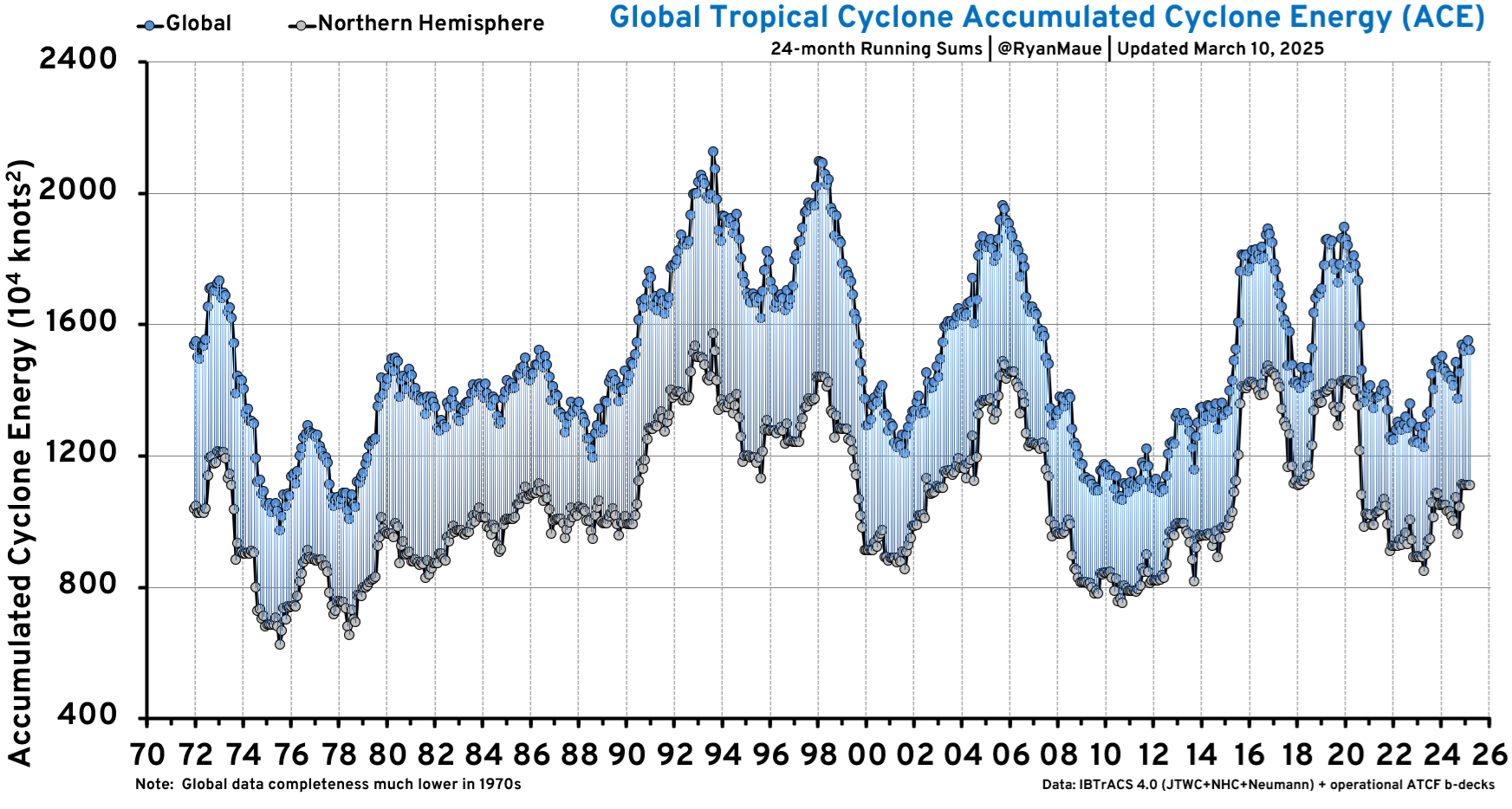
Figure 1: Last 50-years+ of Global and Northern Hemisphere Accumulated Cyclone Energy: 24 month running sums. Note that the year indicated represents the value of ACE through the previous 24-months for the Northern Hemisphere (bottom line/gray boxes) and the entire global (top line/blue boxes). The area in between represents the Southern Hemisphere total ACE. Source: Ryan N. Maue, “Global Tropical Cyclone Activity,” Climate Atlas, accessed October 10, 2024, https://climatlas.com/tropical/global_running_ace.png

Beyond that logical error, publicly available data show that tropical storms are not getting more frequent or extreme. Climate Realism has covered that fact many times looking at the historical tropical cyclone storm data compiled and provided by meteorologist Dr. Ryan Maue. The lack of trend is particularly evident when looking at global Accumulated Cyclone Energy (ACE) – a measure of storm windspeeds over time that gives a value for storm energy. (See graph above) Climate at a Glance: Hurricanes and Climate at a Glance: Global Tropical Cyclones also present real-world data showing no increase in the frequency and severity of such storms.

Emerging research discussed by Chris Morrison in a Daily Sceptic article also shows, contrary to the claims made by Carbon Brief and The Guardian, that cyclones have not been intensifying. Research recently published in the journal Nature that shows there has been “no increase in the destructive power of cyclones – the generic term for typhoons and hurricanes – in any ocean basin over the last 30 years.”

Morrison explains the researchers developed a “Power Dissipation Index,” (PDI) which is similar to ACE except that it includes the intensity of the storm as well as duration and frequency. That metric showed the South Indian basin, where Chido formed, has seen a decline in PDI over the past 30 years. This suggests that the modest warming of the past hundred-plus years has had limited if any impact on cyclone formation and severity. (See graphic below)

Figure 2: Graphic from Tu, S., Hu, Z., Liang, M. et al. Decreasing trend in destructive potential of tropical cyclones in the South Indian Ocean since the mid-1990s. Commun Earth Environ 5, 543 (2024). https://doi.org/10.1038/s43247-024-01683-2

A number of factors besides water temperatures factor into whether cyclones form, how powerful they are, and their duration. This is part of the explanation for why there were more typhoons (hurricanes in the Asian Pacific region and Indian Ocean) in 2024 than there were in 2023, despite 2023 ocean temperatures having been much higher, as Climate Realism discussed in the post “Global Warming is Not Making Record Typhoons, South China Morning Post.”

Multiple lines of evidence indicate that tropical cyclones are not getting worse due to the modest warming of the past hundred plus years, regardless of the reason for the warming. Carbon Brief and The Guardian misinform and do their readers a disservice when they leap to attribute individual storms to climate change, especially when evidence to the contrary is so readily available to the public and journalists.