Global warming, climate change, all these things are just a dream come true for politicians. I deal with evidence and not with frightening computer models because the seeker after truth does not put his faith in any consensus. The road to the truth is long and hard, but this is the road we must follow. People who describe the unprecedented comfort and ease of modern life as a climate disaster, in my opinion have no idea what a real problem is.
Surprisingly former New Zealand PM Jacinda Ardern wasn’t on the list.
UN CLIMATE TALKS 2 July 2026 13:01 Q&A: Where do the UN secretary general candidates stand on climate change?
Candidates are being nominated to take over as the UN secretary general, when António Guterres steps down after nearly a decade in the role at the end of 2026.
Since becoming the ninth secretary general on 1 January 2017, Guterres has been a strong advocate for climate action, saying in January 2026:
“We have been outspoken on the urgent need for climate action, demanding ambition and working to rally governments, businesses and civil society.”
…
Thus far, five of the six candidates are from South or Central America: Michelle Bachelet Jeria; Rebeca Grynspan Mayufis; Rafael Mariano Grossi; María Fernanda Espinosa Garcés; and Carolyn Rodrigues Birkett.
The outlier is Macky Sall, a former Senegalese president nominated by the east African nation of Burundi.
…
Michelle Bachelet Jeria
Dr Michelle Bachelet Jeria is a Chilean diplomat, politician and doctor, nominated to be the next UN secretary general by Brazil and Mexico.
…
As president [of Chile] and in public office, she consistently framed action on climate change as a human-rights obligation and a preventive tool to mitigate the worst impacts, arguing that “there is no space for [climate] denial”.
As part of this role, in February 2022, she outlined the UN’s vision for a sustainable recovery from the Covid-19 pandemic that “avoid[s] another lost decade of development for developing countries”.
…
Rafael Mariano Grossi
Rafael Mariano Grossi is an Argentine diplomat and has served as the director-general of the UN’s nuclear watchdog – the International Atomic Energy Agency (IAEA) – since 2019.
…
Grossi takes credit for helping to achieve “global consensus around the need for nuclear power in the energy transition”.
…
Macky Sall
Macky Sall is a Senegalese politician who served as prime minister from 2004 to 2007 and then president from 2012 to 2024. He has been nominated by Burundi, which is currently the chair of the African Union (AU).
However, Sall’s candidacy has been rejected by other AU states, with Rwanda calling the use of a “silent procedure” to push through consensus on the African candidate for the position “a gross breach of AU rules and regulations”.
…
During the early part of Sall’s presidency, Senegal discovered oil and gas reserves – and the country’s oil exports have since surged from $0.4bn in 2015 to $2.4bn in 2024.
He was supportive of the African oil-and-gas sector, with much of the development of Senegal’s first oil production site undertaken during his term in office.
…
María Fernanda Espinosa Garcés
…
Before her political career, Espinosa was known for her work with Indigenous communities in the Ecuadorian Amazon and biodiversity conservation.
…
Carolyn Rodrigues Birkett
…
In her vision statement for the role, Birkett places a strong emphasis on climate finance and unmet sustainable development goals.
What a lineup. The only candidate who has shown any support for oil and gas, African candidate Macky Sall, has been accused of Crimes Against Humanity for his allegedly harsh suppression of demonstrations against his Presidency in 2021.
Senegal opposition leader launches French legal action against incumbent President Sall
President Sall and accomplices are alleged to have ‘ordered and supervised the commission’ of crimes ‘against unarmed demonstrators since March 2021’ in the suit, which was filed in Paris by Ousmane Sonko.
Le Monde with AFPPublished on June 22, 2023, at 12:58 pm (Paris), updated on July 4, 2023, at 9:52 am
Senegalese opposition leader Ousmane Sonko has filed a criminal complaint in France for “crimes against humanity” against President Macky Sall, his lawyer said, as well as requesting a probe by the International Criminal Court (ICC). Sall is in Paris on Thursday, June 22, and Friday, June 23, for a global climate finance summit called by President Emmanuel Macron.
Sonko alleges that deadly clashes following his sentencing to jail time this month are the latest step in “a generalized and systematic attack on the civilian population” of Senegal since March 2021, lawyer Juan Branco told AFP late on Wednesday, June 21.
Personally I think Macky Sall should get the job. Not because I think he would do a good job, but because it would be hilarious to have a UN Secretary General who might end up with an international arrest warrant. And the rest of the candidates just look like boring apparatchiks.
An article in the Carbon Brief (CB), “UK newspaper editorial opposition to climate action overtakes support for first time,” documents a clear shift towards climate realism in the United Kingdom: for the first time since CB began tracking editorials, more UK newspaper editorials are expressing skepticism towards the climate alarmist narrative and questioning the wisdom of various policies imposed to fight climate change, than are endorsing climate disaster claims and restrictions on energy use. Whatever one thinks of CB’s framing, the underlying trend it reports is real—and it aligns with a broader, global rise in climate realism.
An article in the Carbon Brief (CB), “UK newspaper editorial opposition to climate action overtakes support for first time,” documents a clear shift towards climate realism in the United Kingdom: for the first time since CB began tracking editorials, more UK newspaper editorials are expressing skepticism towards the climate alarmist narrative and questioning the wisdom of various policies imposed to fight climate change, than are endorsing climate disaster claims and restrictions on energy use. Whatever one thinks of CB’s framing, the underlying trend it reports is real—and it aligns with a broader, global rise in climate realism.
The figure below from CB clearly shows the shift.
Note that shift began in 2022, with the steepest drop in alarmist articles and the biggest increase in articles endorsing a more realistic assessment of climate change and climate policies beginning in 2024 with the crossover complete in 2025.
Internationally, The Heartland Institute’s expanding global footprint has played a visible role in that change. The formal launch of Heartland UK/Europe, described in “The Heartland Institute Solidifies Its Global Impact by Founding Heartland UK & Europe,” reflects growing demand across the United Kingdom and Europe for fact-based critiques of climate alarmism and policy overreach. Heartland UK/Europe’s leadership under Lois Perry has emphasized transparency, cost-benefit analysis, and the difference between measured climate trends and speculative worst-case modeling—messages that resonate with editors and commentators increasingly wary of net-zero orthodoxy.
That shift did not appear out of nowhere, it a clear result of the strategies that have been introduced by Heartland UK/Europe coupled with growing international skepticism over the need for costly and disruptive “climate action” policies.
The Heartland Institute hosts the World Prosperity Forum January 19–23 in Zurich, Switzerland, bringing together international leaders and policymakers to challenge the globalist, leftist agenda advanced each year at the World Economic Forum.
While the World Economic Forum promotes a centralized, top-down vision for the global economy, the World Prosperity Forum advances a prosperity-focused, freedom-focused vision rooted in free markets, individual liberty, and rising living standards.
In the United States, climate realism has gained ground as voters and policymakers have grown more skeptical of costly “net-zero” mandates that promised but failed to produce sweeping benefits, instead delivering higher energy prices and grid fragility. The rollback or weakening of major federal climate initiatives during the Trump years—combined with U.S. withdrawal from several symbolic international commitments—punctured the aura of inevitability that once surrounded global climate governance. Since then, debate has widened, and the assumption that “there is no alternative” to sweeping climate action has eroded.
It is notable that CB itself acknowledges in the article that most critical editorials are not disputing the existence of climate change, but rather questioning policy responses—what it labels “response scepticism.”
That distinction is central to the rise of climate realism. Factual websites such as Climate at a Glance and Climate Realism are filled with data-driven examples showing that many headline claims about worsening extremes, accelerating sea-level threats, or imminent tipping points are not supported by long-term observations. The result has been a growing willingness among editors to challenge whether expensive climate policies are justified by the evidence.
Carbon Brief frames this trend as a “backlash,” but another interpretation is that it reflects either or both the triumph of truth over falsehoods over time or a normal democratic correction. As claims of impending catastrophe collide with real-world outcomes—stable or improving human well-being, declining climate-related deaths, and resilient economies—media institutions are reassessing whether fear-based messaging still holds credibility. That reassessment is visible not only in the UK, but across Europe, North America, and beyond.
In that sense, the Carbon Brief article unintentionally underscores a positive development: facts are beginning to compete with fear. Climate realism—grounded in observed data, historical context, and economic reality—is no longer confined to a handful of dissenting voices. It is increasingly part of mainstream debate, amplified by organizations like The Heartland Institute and Heartland UK/Europe and reinforced by the growing body of evidence compiled at Climate at a Glance and Climate Realism. The world is noticing, and the media conversation is finally starting to catch up.
An analysis of Carbon Brief’s exhaustive post-mortem on the Belém climate summit
This piece examines Carbon Brief’s sprawling report on COP30—an 89-page chronicle of diplomatic contortions, procedural chaos, and policy minimalism presented to the world as climate “progress.” Their article attempts to catalogue what negotiators supposedly achieved at the UN climate summit in Belém, Brazil, yet the very details they provide reveal an event that stumbled from crisis to pretense with all the elegance of a wind turbine losing its blades. What follows is not a critique of Carbon Brief’s reporting—which is thorough—but a critique of the hollow spectacle their reporting documents.
If COP30 was the “COP of truth,” as its hosts claimed, then truth has developed a sense of humor.
Because what Carbon Brief describes is a summit whistling past the graveyard—smiling bravely while its own assumptions collapse around it, insisting loudly that it is “keeping 1.5°C alive” even as its negotiators refuse to name the fossil fuels they claim to be phasing out, cannot agree on whether to reference the scientific body that underpins the entire enterprise, and spend days trapped in huddles over whether “efforts” should be “encouraged” or merely “called for.”
With that preface, let us walk through the graveyard together.
The Mutirão: Sweeping Up the Debris of Disagreement
COP30’s headline deliverable—the “global mutirão”—was billed as a unifying text, a collective sweeping-up of the summit’s major issues. In practice, it became a dustpan for everything negotiators didn’t want to deal with.
Carbon Brief notes that the mutirão was an attempt “to draw together controversial issues…including finance, trade policies and meeting the Paris Agreement’s 1.5°C goal”. That phrasing captures it neatly: this was an attempt, not an outcome.
The presidency pushed hard to present this bundle as a breakthrough, but the content speaks otherwise. The fossil-fuel “roadmap” everyone expected? Absent. The deforestation roadmap? Missing. A strengthened 1.5°C pathway? Downgraded to good intentions delivered through two voluntary initiatives no one can define.
The mutirão is a triumph of diplomatic phrasing over substance—a demonstration of how climate diplomacy manufactures momentum where none exists.
When a COP Can’t Even Control Its Own Climate
It’s difficult to take a summit seriously when it cannot keep its own venue from overheating, flooding, or catching fire.
Carbon Brief reports that “faulty air conditioning units” caused “dangerously high temperatures,” while water leaked into rooms and “a major fire broke out in the Africa pavilion” that left “a hole through the roof” and forced thousands to evacuate. The UN climate chief even wrote to the Brazilian government expressing concern.
One could almost call it poetic: delegates demanding planetary climate stabilization found themselves unable to locate functional HVAC.
Perhaps instead of betting $1.3 trillion on transforming the global financial system, the COP could start with a working thermostat.
Adaptation Finance: The Mathematics of Make-Believe
The adaptation section of Carbon Brief’s report is the clearest window into how climate policy has become an accounting fantasy. The mutirão “calls for efforts to triple adaptation finance,” but does not define a baseline year, pushing the target out to 2035 instead of 2030. Carbon Brief characterizes the language as “weakened” and “ambiguous.” Even negotiators admitted the outcome was “not how we reach a global goal on adaptation”.
The numbers alone border on satire:
Developed nations delivered only $26 billion in adaptation finance in 2023—down from the year before.
The UN estimates developing countries need $310 billion per year until 2035.
Yet COP30 declares that tripling the current paltry sum—somewhere between vague and undefined—counts as progress.
Tripling from nowhere in particular to nowhere measurable is not policy. It is numerology.
The report quotes a negotiator stating:
“We cannot keep returning to debate figures; the figures will only grow if action does not follow.”
In any other field, this would be interpreted as a warning that resource allocation must be grounded in real budgets. At COP30, it was interpreted as a mandate to inflate the figures further.
The 1.5°C Target: A Sacred Number No One Can Say Out Loud
COP30 continued the tradition of insisting the 1.5°C limit remains “within reach,” even while acknowledging the “carbon budget…is now small and being rapidly depleted” and that overshoot is now functionally inevitable.
But rather than confront the implications honestly, the summit birthed two new voluntary initiatives: the “global implementation accelerator” and the “Belém mission to 1.5°C.” Both are so ill-defined that even seasoned observers struggled to explain them.
Carbon Brief calls them “ill-defined voluntary initiatives” with “few accountability anchors” and notes the decision “fell well short” of what many countries had demanded.
In other words: placebo policies to soothe those who still pretend the target is scientifically plausible.
The fundamental problem is this: the 1.5°C target is treated less as a scientific benchmark and more as sacred scripture. COP30 could not bring itself to admit that the target is incompatible with the continued growth in global emissions—something even the summit’s own synthesis reports concede.
But once a number becomes moralized, it must be defended at all costs, even if doing so requires performing optimism on the diplomatic stage.
Fossil Fuels: The Roadmap That Never Was
Perhaps the most glaring omission in the final text is the absence of the fossil-fuel roadmap Lula and others spent months promoting. Carbon Brief recounts how countless nations backing a “transition away” from fossil fuels had to accept that COP30 would produce no such roadmap—only a promise to discuss one at the next COP.
The report quotes that the final mutirão text:
“contained no fossil-fuel roadmap.”
Saudi Arabia declared that “the energy sector was off the table.” China, India, and the LMDC group opposed references tying climate ambition to fossil-fuel transition. The presidency eventually conceded the issue was a “red line” for a “great majority” of countries—though it never released the list.
Thus, the COP designed to deliver the “COP of implementation” instead delivered the COP of non-implementation, kicking the can one more year down a road already paved with missed commitments.
Trade Measures: The Green War by Other Means
Climate policy has morphed into a trade war, and COP30 made that impossible to hide. The final decision included, for the first time, references to “unilateral trade measures” such as carbon border tariffs, establishing three years of dialogues on their geopolitical impacts.
The text states that such measures “should not constitute arbitrary or unjustifiable discrimination”—which is the diplomatic equivalent of warning the EU that the rest of the world is not amused by its green tariffs.
China called UTMs “the new injustice.” Saudi Arabia said they would “exacerbate poverty.” The African Group warned these measures would be destabilizing.
This is the part of the climate story many in the West prefer to ignore: climate policy increasingly functions as a competitive tool for industrial advantage. The rhetoric of cooperation masks a mounting global backlash.
The graveyard is getting crowded.
Gender, Science, and the Irony of Consensus-Based Systems
Some of the most absurd episodes of COP30 involved issues not even related to emissions. Negotiators spent days arguing over the definition of gender. The Holy See insisted gender should refer “to the female and male sexes” and demanded this be recorded in the COP’s report, earning boos from the plenary hall.
Meanwhile, the COP could not bring itself to affirm the IPCC as the “best available science.” As Carbon Brief reports, the final text “failed to endorse the IPCC,” and important scientific findings—including that 2025 was likely among the hottest years in history—were removed.
Bangladesh described itself as “deeply concerned” that references to the IPCC were being weakened. Saudi Arabia successfully demanded removal of language about “countering misinformation”.
When a climate summit cannot agree that climate science should inform climate policy, the performance nature of the event becomes difficult to deny.
Loss and Damage: The Fund That Exists Mainly as a Press Release
The much-celebrated Loss and Damage Fund remains an empty shell. Of the $790 million pledged, only $397 million has actually been paid in—small change compared to the “hundreds of billions” annually that developing nations supposedly require. The fund’s first disbursement will amount to just $250 million spread over six months.
The report notes negotiators spent “more than 80 hours” discussing bureaucratic reviews while vulnerable nations pleaded that “no more of these negotiations…It is enough”.
COP30 called this success.
The graveyard chuckles.
Just Transition: When a Mechanism Is Mistaken for a Mission
Activists declared a victory when COP30 agreed to create a “just transition mechanism.” But the final text quietly deleted references to:
Critical minerals
A transition away from fossil fuels
Trade barriers
Stocktake integration
One expert quoted by Carbon Brief noted the mechanism’s vagueness:
“If you don’t have a coordinating entity…it’s just a dialogue. It’s a series of events.”
There’s the essence of COP30: a series of events masquerading as a mechanism.
When Even the Plenary Falls Apart
Carbon Brief recounts how Panama tried to intervene during the adoption of the Global Goal on Adaptation (GGA) text but the presidency ignored its flag—twice. Colombia said the same happened to their delegation. Ministers stormed the microphones, demanding transparency.
One negotiator shouted:
“I raise my flag and you ignore it. I raise a point of order, and you ignore it.”
The presidency then suspended the plenary for an hour because the diplomatic process had melted down.
This is climate governance in its 30th year. Imagine the outrage if a corporate board meeting operated like this.
The Whistling Gets Louder
Carbon Brief’s article is not intended as a critique of the climate-policy machine—yet it inadvertently documents its slow-motion collapse. Read between the lines and you see a system struggling to maintain the illusion that its foundational assumptions still hold.
Consider what the report reveals:
The summit couldn’t deliver the fossil-fuel roadmap that was its central ambition.
Adaptation finance commitments remain vague, delayed, and mathematically implausible.
Climate science references were contested or removed.
The gender action plan nearly derailed over definitions centuries old.
Trade measures ignited geopolitical tensions COP can no longer disguise.
Loss and damage finance is symbolic at best.
And procedural dysfunction overshadowed substantive negotiation.
Yet despite all this, press statements proclaimed COP30 a success.
Thus the graveyard grows, and the whistling turns into a chorus.
As a skeptic committed to disciplined neutrality—not the reflexive dismissal caricatured by activists, but the genuine skepticism that asks for proof, consistency, and measurable outcomes—it has been clear for awhile that climate diplomacy has become untethered from empirical rigor. It rests instead on narrative: crises must be declared, success must be announced, and doubt must be discouraged.
But doubt is precisely what a functioning system requires.
COP30, as documented meticulously by Carbon Brief, demonstrates what happens when doubt is banished: institutions become theatrical, numbers become symbolic, and policy becomes aspirational fiction.
The world deserves better than ritual declarations and shifting deadlines. It deserves honesty about uncertainty, transparency about costs, and recognition that centralized plans cannot remake complex systems on demand.
Until then, global climate summits will continue whistling past the graveyard—hoping the ghosts of their own broken promises don’t answer back.
In which universe is this something to brag about?
Electricity demand on the island of Great Britain has been fully covered by the output of clean-energy sources for a record 87 hours in 2025 to date, new Carbon Brief analysis shows.
This is up from just 2.5 hours in 2021 and 64.5 hours in all of 2024, ahead of the government’s clean-power target for 2030.
The target aims for 95% of the electricity generated in the country in 2030 to come from low-carbon sources, as well as for 100% of national demand to be met without fossil fuels.
I would be more concerned by the other 6417 hours when we did need gas power!
And even then, their “clean power” included nuclear and burning trees, neither of which anybody would regard as “clean”.
But as Carbon Brief admit, we still had plenty of gas power running for the whole of that time, most likely to provide inertia. Although non-fossil fuel power just about covered demand, the surplus power was exported.
Carbon Brief are not a reliable source of information, they are simply a climate change lobby group, funded by the far-left European Climate Foundation.
A month has passed since the DOE climate assessment report was published. It’s time to reflect on what we might learn from the responses to this Report. Of particular relevance is the report that was issued earlier today, led by Andrew Dessler.
A month has passed since the DOE climate assessment report was published. It’s time to reflect on what we might learn from the responses to this Report. Of particular relevance is the report that was issued earlier today, led by Andrew Dessler.
Public comments
The public comment portal for the DOE Report was open for 30 days, and closes on Sept 2 (today). So far there are >2300 comments submitted, with several hundred currently visible on the Federal Register site. The comments are being scrubbed for obscenities, etc. I tried reading through the comments, the portal is awkward (each comment has to be clicked on separately, unlike this blog post). Most of the comments that I’ve looked at are non-substantive cheerleading, attacks or general posturing. It will take time to go through all of these to separate an expected small amount of wheat from the large amount of chaff.
Carbon Brief
One of the early criticisms was that the DOE Report “mis-cited” a paper by Zeke Hausfather by reproducing a diagram from one of his papers, while failing to mention some of the broader points made in his paper (sorry Zeke, that’s not how it works).
This led to Carbon Brief emailing all of the authors cited in the report (plus ~100 other scientists) asking whether the Report uses their work to make misleading or false statements. They received 100 comments from 56 scientists (one scientist contributed about 1/3 of the comments on less than 2 pages of text). The published comments [link] were formatted in a useful way, sorted by chapter/page number and in a single file that is searchable. Several of the comments were useful (including references we hadn’t considered), and worth considering in a revised report. There were many comments on global greening and solar variations. Nearly all the comments were labeled as “misleading”; the factual errors mostly related to misspelling of an author’s name or other mis-citation of a reference.
While I am not in favor of having the media mediate this, and Carbon Brief is arguably far from objective, I appreciate the effort that CB made on compiling this and the effort that individual scientists made to respond.
AMS statement
The American Meteorological Society (AMS) has issued a statement Five foundational flaws in the Department of Energy’s 2025 climate report. This statement has been adopted by the Executive Committee of the AMS Council, I assume this was also written by this Committee. Here is the membership of the Executive Committee [link]. If you cannot recognize any of these names as climate scientists, you would be correct. The statement starts with:
“Here we identify five foundational flaws in the Department of Energy’s (DoE’s) 2025 Climate Synthesis reports. Each of these flaws, alone, places the report at odds with scientific principles and practices. “
Here are the five “flaws”:
Lack of breadth across scientific fields
Lack of depth within scientific fields and specific topics
The DoE Report is based on an unrepresentative group of subject matter experts
TheDoE Report selectively emphasizes a small set of unrepresentative findings, particularly those that might appear beneficial on superficial examination.
The DoE Report extrapolates from a limited subset of findings to reach conclusions that do not follow from comprehensive consideration of the scientific evidence.
These “flaws” and allegations of lack of representativeness are political considerations, not scientific principles or practices. Ironically, the following statements are made in alleged support of their points, when in fact these statements emphasize the need for something like the DOE Report:
“To be credible, scientific assessments must include authors who reflect the full range of defensible views among the subject matter experts within every specific area of science that is included in the assessment.”
“Unusual perspectives and disagreement are important within the scientific process because they can generate alternative plausible explanations; identify needs for additional inquiry; or challenge the thinking of the larger community of subject matter experts.”
The Statement concludes with the following:
“Five conclusions are robust when accounting comprehensively for the scientific evidence. They have been consistently reaffirmed by independent subject matter experts and independent scientific institutions worldwide. Decades of intensive research on climate change demonstrate that:
Climate is changing, and the rate and magnitude of change are unusual in human experience.
People are the primary cause of modern climate change, mostly through burning fossil fuels.
Climate change is harmful to humanity, and the threats to people and all life are increasing.
A wide range of response options is available that can reduce the dangers of climate change.
Those who study the scientific evidence overwhelmingly agree.”
Oops, they better go back and read the DOE Report.
Besides being a pathetic statement and inappropriate for a professional society, the AMS Executive Committee has done a huge disservice to its membership with this Statement, apart from lack of representativeness of the membership. Back when I first joined the AMS circa 1990, ‘atmospheric science policy’ was about working to preserve NOAA’s budget and the larger research funding for atmospheric sciences – an issue of concern for AMS members as well as the broader public. These days, ‘atmospheric science policy’ is about climate activism and consensus enforcement. The AMS seems to be declaring war on the Trump administration – does the AMS really want to see NOAA’s budget and the atmospheric research budget get cut (more than is already on the table)? Maybe the AMS should try working with the Trump administration, not against it. And this is not to mention the fact that the AMS publishes some of the premier journals in atmospheric and climate science; hard not to expect editorial bias when the Society leadership is making such statements.
Dessler and Kopp et al. .
While we’ve seen a lot of whining and posturing from climate scientists and professional societies, there has been very little in the way of actual serious and constructive criticism of the DOE Report from the scientific community (with the exception of Carbon Brief; maybe there is something useful buried in the public comments).
Enter the Dessler and Kopp et al. report, with the et al. including contributions from 85 scientists
This is a comprehensive 439 page report that is directly targeted at rebutting the DOE Report, that was prepared in 30 days (sort of weakens the argument that the DOE report was written too quickly, ha ha). The Dessler et al. report also suffers from the same “flaws” identified by the AMS Statement (ha ha).
Before getting into specifics of the Dessler Report, a big bravo and kudos to Dessler et al., who are actually behaving like scientists with their rebuttal to the DOE report. This is exactly the kind of response and dialogue that we hoped the DOE Report would stimulate. (update: in his media interviews, Dessler is sounding pretty unhinged, at this point he risks undoing the “good” from this report).
I have skimmed the entire report (I’m a very fast reader), and paid closer attention to some of the sections related to text that I wrote. The report is organized in terms of the chapters and sections of the DOE Report, essentially providing a review of the DOE Report and suggested changes. The report is lightly edited and loosely coordinated, this is mainly a compilation (with some organization) of contributions from individual scientists. The quality of the report is very heterogeneous across the different sections. Some contributions are quite good. Others are oblique and don’t directly address what was written in the DOE Report. Other comments merely reiterate the “party line,” ignoring our criticisms of the same “party line.”
Bottom line: interesting report, laudable effort. We will be going through this report in much more detail. But in my initial assessment, the Dessler et al. report didn’t land any strong punches on the DOE Report, and I wouldn’t change any of the conclusions in the DOE Report in response. The combination of the DOE and Dessler report highlight areas of disagreement among climate scientists, and illustrates how weighting of different classes of evidence, addressing different topics, and different logical frameworks for linking evidence can lead to different conclusions. The existence of this kind of disagreement is essential information for policy makers, which hitherto has been hidden under the banner of “consensus” enforcement.
Status of the CWG
Owing to a lawsuit that has been filed against the DOE by the Environmental Defense and Union of Concerned Scientists, activities of the Climate Working Group are currently on hold, apart from individual evaluations of the comments. Personally, I’m collecting the substantive comments for future use.
JC note to lawyers: I made draft edits to the report in response to comments prior to the lawsuit.
Once we get the go ahead from the lawyers, the CWG will respond in detail the Dessler, Kopp et al. report
JC reflections
In the climate science debate, there are two different mindsets:
Insisting that you are right (consensus enforcement, and all that)
Trying to get it right (the scientific process, and all that)
The Climate Working Group as a whole, and the individual scientists (if I can speak for them here), are staunchly in the ‘trying to get it right’ mindset, which is unfortunately the minority mindset.
By bringing forth a less alarming minority perspective that is trying to get it right in a politically favorable environment, the combined efforts of the CWG and the Dessler et al. response present the promise of a genuinely open debate on climate change issue, with more honest and useful assessments that can better guide both climate science and policy.
——-
Specific comments on the Dessler, Kopp et al. report
This section will continue to be expanded upon and edited over the next few days
Global greening (section 2.1). This section elicited a large number of comments from the DOE internal review and Carbon Brief as well as the Dessler et al. report. This is EXCELLENT, since the important topic of global greening has received very little attention in climate assessment reports. The Dessler Report text on section 2.1 is 27 pages long. It claims that some of the DOE statements are misleading or that they imply something that they don’t. While there is much interesting text in this section of the Dessler report and maybe the DOE Report should add some more references, it is clear that none of the statements made in the DOE Report are incorrect, and that the main conclusion “Elevated concentrations of CO2 directly enhance plant growth, globally contributing to “greening” the planet and increasing agricultural productivity” is supported.
Sea level rise (chapter 7). The Dessler, Kopp et al. report objects to the statement “U.S. tide gauge measurements in aggregate show no obvious acceleration in sea level rise beyond the historical average rate.” The Dessler report spends 20 pages trying to convince that sea level rise is accelerating, and that this is evident in the tide gauge measurements. Fortuitously, there is a new paper hot off the press: Global Perspective on Local Sea Level Changes. Key conclusion: “Statistical tests were run on all selected datasets, taking acceleration of sea level rise as a hypothesis. In both datasets, approximately 95% of the suitable locations show no statistically significant acceleration of the rate of sea level rise.” So yes, some additions to DOE chapter 7 on sea level rise acceleration are warranted, but not in the direction of the Dessler et al. report. The claim the data on VLM in Table 7.1 is unsupported; they neglected to read the metadata.
Model predictions of corn belt temperatures (section 5.8) A defense of climate models is presented by claiming that they do a good job of simulating global average temperatures. They explain why climate models have difficulty simulating regional temperatures, and point out the need for a large ensemble. They imply we “cherry picked” a region where the models do worst. Well yes, this is an economically important region where the models perform poorly.
Solar variability (section 8.3.1). There were substantial comments on solar variability submitted to the Carbon Brief, and essentially the same comments were submitted to Dessler et al. (20 pages of text). I carefully went through the Carbon Brief comments, and drafted an edited version of the solar section that deletes several sentences and adds some additional references. I also checked in with members of the ACRIM science team, they continue to support high solar variability. Hence, the high-level conclusion in the DOE Report “Moreover, solar activity’s contribution to the late 20th century warming might be underestimated” is justified.
Hurricanes (section 6.2). Dessler et al. devote 12 pages to the issue of hurricanes. Shortly after the DOE Report was published, I engaged with tropical meteorology experts on the Tropical ListServ to discuss section 6.2 (some of these authored the response here). Some were concerned that theory and models were ignored, and possible future risks weren’t mentioned. In response, I drafted a new subsection entitled “Factors contributing to US economic losses”, which addresses the following issues: rates of intensification, track speed, horizontal size, storm surge, rainfall and tornadoes. The combination of high amplitude natural variability plus short and inhomogeneous data sets imply low confidence in the detection and attribution of any trends. Models and theory are interesting for speculating about future possibilities (something that is not addressed in the DOE Report), but as for interpreting the past, show me the data.
Tornadoes (section 6.5). This section is an example of a useful contribution. These same points, related to more tornadoes earlier in the season and moving further east, were made on the Tropical ListServ, and I had already drafted a new paragraph to account for this.
Urbanization (section 3.3). This section claims to refute our concerns about inadequate treatment of the urban heat island effect by using the Berkeley Earth data set to compare land/ocean temperatures and the ERA5 level 500 m above the surface, and population density map. Very weak tea.
Declining planetary albedo (section 8.4). This is an example where they completely miss the point, focusing on the record temperatures of 2023, 2024 and then arguing that equilibrium climate sensitivity should be 4.5C.
Climate sensitivity (chapter 4). 24 pages of stuff that isn’t useful. This was not written by the climate sensitivity A-team. They claim we have a misleading focus on ECS; we should have focused on TCRE and ZEC. They manage to misrepresent the AR6 and Sherwood et al.
Surface temperature extremes (section 6.3) There is an astonishing result presented by Dessler et al: the Berkeley Earth dataset finds twice as many heat wave days in the Eastern US in the last 20 years as in the 1930s. I’m not sure that I have seen anything published on Berkeley Earth daily temperatures, this should be investigated, something looks very off.
Emissions scenarios (section 2.1) Much word salad, but they seem to be defending the implausible extreme 8.5 emissions scenarios.
Billion dollar weather disasters (section 10.2) Much word salad, but they seem to be defending the now discredited NOAA Billion Dollar Disasters dataset
Pielke Jr’s analysis
Good substack article from Roger Pielke Jr. Excerpts:
To be clear, the DOE report raises no “interesting questions” overlooked by the scientific community, highlights no ignored research gaps, and brings no fresh perspective. Instead, it’s a rats’ nest of bad arguments.
To the extent that there are legitimate scientific arguments in there, those have already been rejected by the scientific community. But scientific arguments are rare in the DOE report; rather, it’s mainly selective misquoting of the scientific literature (cherry picking), omission of contrary results from the scientific literature, and simple errors due to a lack of understanding of the science.
This framing has been adopted by the media, as you can see in the headlines below characterizing the critique upon its release this morning.
I took a look at the DK25 report in my areas of expertise, as I did with the DOE CWG, and I found numerous statements that were simply false — among them that World Weather Attribution was not created with litigation in mind, that NOAA”s “billion dollar disasters” (RIP) tabulation was scientifically valid, that SRES had 6 not 40 scenarios, and that RCP8.5 has not been the most commonly used scenario in research and assessment. DK25 ignored all of our research that was accurately cited by DOE CWG.
DK25 also includes a bizarre claim regarding the detection of changes in extreme weather events:²
“the absence of statistically significant trends in the historical records does not mean that changes are not occurring”³
Actually, that is exactly what the absence of detection means — don’t take it from me, take it from the IPCC, which defines a change in climate as follows:
A change in the state of the climate that can be identified (e.g., by using statistical tests) by changes in the mean and/or the variability of its properties and that persists for an extended period, typically decades or longer.
This line of argument seems not to be against the DOE CWG report — which relies heavily on the IPCC — but against the IPCC’s framework for detection and attribution, which is already under siege for not producing strong indications of change in most measures of weather extremes.
Extreme event attribution, RCP8.5, and “billion dollar disasters” are not the hills I’d choose to die on, but apparently the authors of DK25 were so intent in asserting that every claim of DOE CWG is false, that they could not admit the many places where DOE CWG got things right.
My view is that there are stronger and weaker claims in both DOE CWG and DK25. In my areas of expertise — notably scenarios and extreme weather — the DOE CWG is pretty strong (but could be better) and DK25 is pretty weak. In other areas, the balance will surely be different. But the Manichean nature of climate debates is that no territory can be given to the enemy.
Dessler makes very clear that he believes that this exercise is all about politics:
If you don’t follow climate policy closely, you may not know that the Trump administration is launching an effort to overturn one of the most fundamental pillars of American climate policy: the scientific finding that carbon dioxide endangers human health and welfare (the so-called “Endangerment Finding”). If successful, this move could unravel virtually every U.S. climate regulation on the books, from car emissions standards to power plant rules.
To support this effort, the Department of Energy hand-selected five climate contrarians who dispute mainstream science to write a report, which ended up saying exactly what you would expect it to say: climate science is too uncertain to justify policies to limit warming. . .
The history of cigarettes shows that such tactics can delay policy action for decades, but they cannot indefinitely postpone scientific reality from emerging. The only real question is how much damage the delay causes.
The assumption here is that if you find some degree of merit in the DOE CWG then climate policy is doomed and if you instead side with DK25, then carbon dioxide regulation is on its way. Viewed from this perspective, scientific assessments are ”tactics” to be mobilized to support political action or delay.
Such a perspective turns scientific assessment into partisan politics. Scientific integrity inevitably suffers.
China burned more coal at power plants between January and July of 2025 than at any time since 2016, despite massive renewable capacity, according to new environmental research report.
China continues to burn more and more coal, according to dw.com:
China burned more coal at power plants between January and July of 2025 than at any time since 2016, despite massive renewable capacity, according to new environmental research report.
The report, published by the Center for Research on Energy and Clean Air (CREA), a Finland-based independent air-quality research organization; and Global Energy Monitor (GEM), a US-based energy analytics company, says China put 21 gigawatts (GW) of coal power online in the first six months of 2025.
That is the highest six-month level in nine years. The CREA/GEM report also cites new construction and re-firing of existing coal plants totaling 46 GW and proposed projects with the capacity to produce a further 75 GW.
Total projected coal plant output is forecast to hit between 80-100 GW in 2025.
According to CREA, new coal plants are still being constructed, with expectations of 80 GW of new capacity commissioned this year. This follows an explosion of new permits a few years ago.
The report does highlight the surge in solar power capacity, but it still fails to make a dent in the overall mix, as total demand continues to rise:
The Energy Institute Review
Carbon Brief explain this surge in solar power:
Some 93GW of new solar capacity was added to China’s grid in May alone, as the rush to install before a change in pricing policy culminated. This rate of installations translates to approximately 100 solar panels installed every second of the month.
The acceleration was due to a change in the policy on tariffs paid to new wind and solar generators, which started in June. Previously, new plants were guaranteed to receive the benchmark price for coal-fired power output in each province, for each unit of electricity they generate. Under the new policy, new generators have to secure contracts directly with electricity buyers, causing uncertainty and likely putting downward pressure on revenue.
The consensus among forecasters has been one of a sharp slowdown in installations.
Electricity buyers will of course opt for reliable, dispatchable power any day of the week if it is at the same price. For solar farms to compete, they will have to offer much lower prices to compensate for their intermittency.
Nothing in this report offers any evidence that China can run its grid with high amounts of wind and solar power. Regardless of what edicts might come down from Xi, it is the local and regional bureaucrats who will call the shots. After all, it is their heads that will be on the chopping block if there are blackouts or power shortages.
This is one of the incongruities of modern China. Although the Central Government wields considerable power, China is so big and so bureaucratic that there is considerable autonomy not only within regional government, but also different Departments of State.
Weather and climate extremes—such as high temperatures, floods, droughts, tropical cyclones, extratropical cyclones, and severe thunderstorms—have always threatened both human and natural systems. Given their significant impacts, there is considerable interest in how human-caused climate change influences these extremes. This is the focus of the relatively new discipline of Extreme Event Attribution (EEA).
How a cascade of selection effects bias the collective output of extreme event attribution studies.
Weather and climate extremes—such as high temperatures, floods, droughts, tropical cyclones, extratropical cyclones, and severe thunderstorms—have always threatened both human and natural systems. Given their significant impacts, there is considerable interest in how human-caused climate change influences these extremes. This is the focus of the relatively new discipline of Extreme Event Attribution (EEA).
The collective output of these kinds of studies certainly gives the impression that human-caused climate change is drastically changing the frequency and intensity of all kinds of weather extremes. Indeed, Carbon Brief recently published an extensive summary of the science of EEA studies, which begins with the proclamation, “As global temperatures rise, extreme weather events are becoming more intense and more frequent all around the world.”
However, these numbers cannot be taken as an accurate quantification of the influence of climate change on extreme weather because they are heavily influenced by a cascade of selection biases originating from the physical climate system, as well as researcher and media incentives. Identifying and understanding these biases is a prerequisite for properly interpreting the collective output of EEA studies and, thus, what implications they hold for general scientific understanding, as well as political and legal questions.
The large apparent discrepancy between the size of the influence of human-caused climate change on extreme weather reported in EEA studies (like those compiled by Carbon Brief) compared to more comprehensive systematic analyses (like those compiled by the IPCC) can, in large part, be attributed to the many layers of Selection Biasesthat influence the EEA literature’s collective output.
Selection Bias is a broad term that refers to any bias that arises from a process that selects data for analysis in a way that fails to ensure that data is representative of the broader population that the study wishes to describe.
Selection biases in the context of EEA studies include those associated with the physical climate system itself, those concerning proclivities and incentives facing researchers/journals, and those concerning the proclivities and incentives facing the media. They include
Occurrence Bias is a bias introduced by the physical climate system. Since EEA studies tend to be triggered by extreme events that have actually occurred, there is reason to believe that these studies will disproportionately sample events that are more likely than average to be exacerbated by climate change because the events occurred in the first place. Essentially, extreme events that are more likely to occur under climate change—and thus more likely to be observed—are going to be overrepresented in EEA studies, and extreme events that are less likely to occur under climate change—and thus less likely to be observed—are going to be underrepresented in EEA studies.
The map below illustrates this phenomenon. It shows changes in the magnitude of extreme drought under climate change. Specifically, it shows the fractional change in the intensity of once-per-50-year droughts (as quantified by monthly soil moisture) between a preindustrial and 21st-century run (SSP2-4.5 emissions) of the highly-regarded NCAR CESM2 Climate Model.Blue areas represent locations where the model simulates that extreme droughts become less frequent and intense with enhanced greenhouse gas concentrations, and red areas represent locations where the model simulates that extreme droughts become more frequent and intense with enhanced greenhouse gas concentrations. It is notable that overall, this model simulates that warmingdecreases the frequency and intensity of extreme drought in more locations than it increases it (consistent with soil moistening under warming simulated by other models).
Now, here’s the kicker: The black dots show locations where once-per-50-year droughts actually occurred in the 21st-century simulation and thus represent events that would plausibly trigger EEA studies.
What do you notice about where the dots are compared to where the red is? That’s right; the simulated EEA studies overwhelmingly sample areas where droughts are getting more intense and more frequent by the very nature that those are the types of droughts that are more likely to occur in the warming climate. The result is that the EEA sample is majorly biased: warming decreased the intensity of once-per-50-year droughts by about 1% overall, but it increased their intensity within the EEA sample by 18%!
Thus, if you just relied on the EEA sample, you would come away with an incorrect impression not only on the magnitude of change in extreme droughts but also on the sign of the direction of change!
Choice Bias arises when researchers use prior knowledge to choose events for EEA studies that are more likely to have been made more severe by climate change. A clear example of Choice Bias pervading the Carbon Brief database is there have been 3.6 times more studies on extreme heat than there have been on extreme winter weather (205 vs. 57). Another example would be the dearth of EEA studies on extratropical cyclones (the kinds of low-pressure systems with cold and warm fronts that are responsible for most of the dramatic weather outside of the tropics). The IPCC states that the number of extratropical cyclones associated with intense surface wind speeds is expected to decrease strongly in the Northern Hemisphere with warming. Yet, it is relatively rare for EEA attribution studies to be done on these types of systems, which results in an exclusion of this good news from the EEA literature.
Finally, the climate reporting media ecosystem is characterized by actors whose explicit mission is to raise awareness of the negative impacts of climate change, and thus, there will be a natural Media Coverage Bias with a tendency to selectively highlight EEA studies where climate change is found to be a larger driver than EEA studies that do not reach such a conclusion. These selection biases are apparent at the aggregate level, but there is also strong evidence of their presence in individual studies.
A more recent specific example suggestive of many of these dynamics is a study, Gilford et al. (2024), titled “Human-caused Ocean warming has intensified recent hurricanes”. This study was conducted by three researchers at Climate Central, which summarizes the study’s findings with the following infographic:
From Climate Central press release on Gilford et al. (2024).
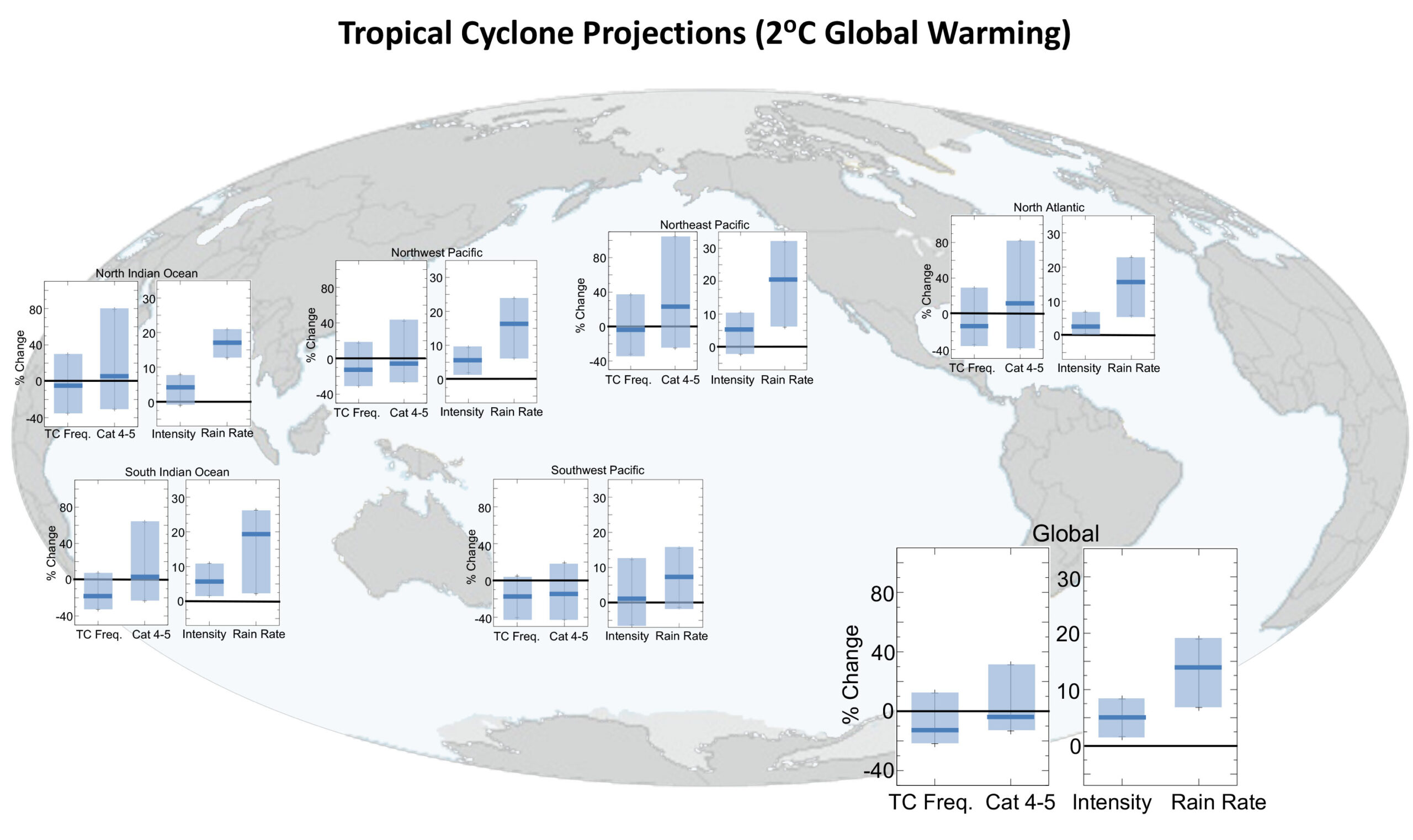
Essentially, they claim that climate change is enhancing the intensity of all hurricanes and that the enhancement is quite large: Storms today are calculated to be an entire Category stronger than they would have been in a preindustrial climate.
This is a huge effect, and thus, if it were real, it is reasonable to expect to see clear long-term trends in metrics of tropical cyclone (hurricane) intensity like the accumulated number of major (Category 3+) hurricane days or the accumulated cyclone energy from all tropical cyclones (which is proportional to the square of hurricane windspeed accumulated over their lifetimes). However, any long-term trends in such metrics are subtle at best, both globally and over the North Atlantic.
From Colorado State University Department of Atmospheric Science Tropical Meteorology Project.
So, this is a microcosm of the aforementioned apparent discrepancy between more broad quantifications of changes in extremes and their associated EEA counterparts, and again, I’d argue there are several selection biases at play affecting the production and dissemination of the EEA study.
Let’s start with Choice Bias on methodology. Human-caused warming changes the environment in some ways that work to enhance hurricanes and in other ways that diminish them. The main way that hurricanes are enhanced is via the increase in sea surface temperatures (which provides the fundamental fuel for hurricanes), and the main way that hurricanes are diminished isvia changes in atmospheric wind shear and humidity.
However, the Climate Central researchers made the methodological choice to largely exclude the influence of factors that diminish hurricane development from the study.
Are these Choice Biases in event type and methodology an accident? There are many reasons to believe they are not.
The research paper itself spells out that the motivation of the study is to “connect the dots” between climate change and hurricanes because “landfalling hurricanes with high intensities—can act as ‘focusing events’ that draw public attention” and that “Increased attention during and in wake of storms creates opportunities for public and private discourse around climate and disaster preparedness.”
Then, there is the extensive media coverage of this study. It was picked up by 134 news outlets and ranked in the 99.95th percentile of research articles (across all journals) of similar age in terms of online attention. Further, it was immediately incorporated into seven Wikipedia articles (likely having high leverage on AI queries, which would make its findings indistinguishable from scientific “fact”). This is affected by the aforementioned Media Coverage Bias, but it is also undoubtedly directly influenced by the efforts of Climate Central, which is explicitly an advocacy organization whose self-described specialty is media placement and dissemination.
“Attributing extreme weather events to climate change, as I do through my work as a climatologist, means we can hold countries and companies to account for their inaction.”
Given the explicitly stated motivation of those in the EEA field, it is quite reasonable to suppose that there are major selection biases at play, and thus, it is not at all surprising that the collective output of the EEA field would look so different from more broad comprehensive assessments.
Media outlets such as Carbon Brief and The Guardian recently ran articles claiming that climate change is making tropical cyclones worse shortly after cyclone Chido caused destruction and tragic loss of life in Mayotte and Mozambique this past December. This is false. Tropical cyclones are not worsening. Data show no increase in the severity or number of hurricanes and typhoons. In fact, recent research suggests that there has actually been a modest decrease in cyclone frequency and power over the past 30 years.
NASA Earth Observatory, Public domain, via Wikimedia Commons
Media outlets such as Carbon Brief and The Guardian recently ran articles claiming that climate change is making tropical cyclones worse shortly after cyclone Chido caused destruction and tragic loss of life in Mayotte and Mozambique this past December. This is false. Tropical cyclones are not worsening. Data show no increase in the severity or number of hurricanes and typhoons. In fact, recent research suggests that there has actually been a modest decrease in cyclone frequency and power over the past 30 years.
The Carbon Brief post, “Chido hits; Coal’s new peak; Africa’s energy transition,” citing the Associated Press, claimed that Chido was the “most intense storm to hit Mayotte in 90 years,” and that “[s]cientists have long suggested that climate change is making cyclones worse in the region, but a lack of weather data has hindered more conclusive claims.”
The Guardian’s coverage in the article “Hundreds feared dead as Cyclone Chido devastates French island of Mayotte,” rightly focused examined tragedy of the disaster that occurred there, but the paper could not help itself, claiming in the very last paragraph that tropical cyclones are “getting worse because of the climate emergency,” and “cause large humanitarian crises in poor countries in southern Africa, which contribute a tiny amount to global heating, underlining their call for more help from rich nations to deal with the impacts of climate change.”
The Guardian’s point that African nations need more help because of wealthier nations’ alleged larger contributions to “global heating” is silly, because one imagines that aid would be needed and requested by poor countries when natural disasters occur regardless of climate change. They require help because they are underdeveloped, and they are underdeveloped for a variety of reasons, among them poor institutions, limited property rights, and political corruption, none having to do with climate change.
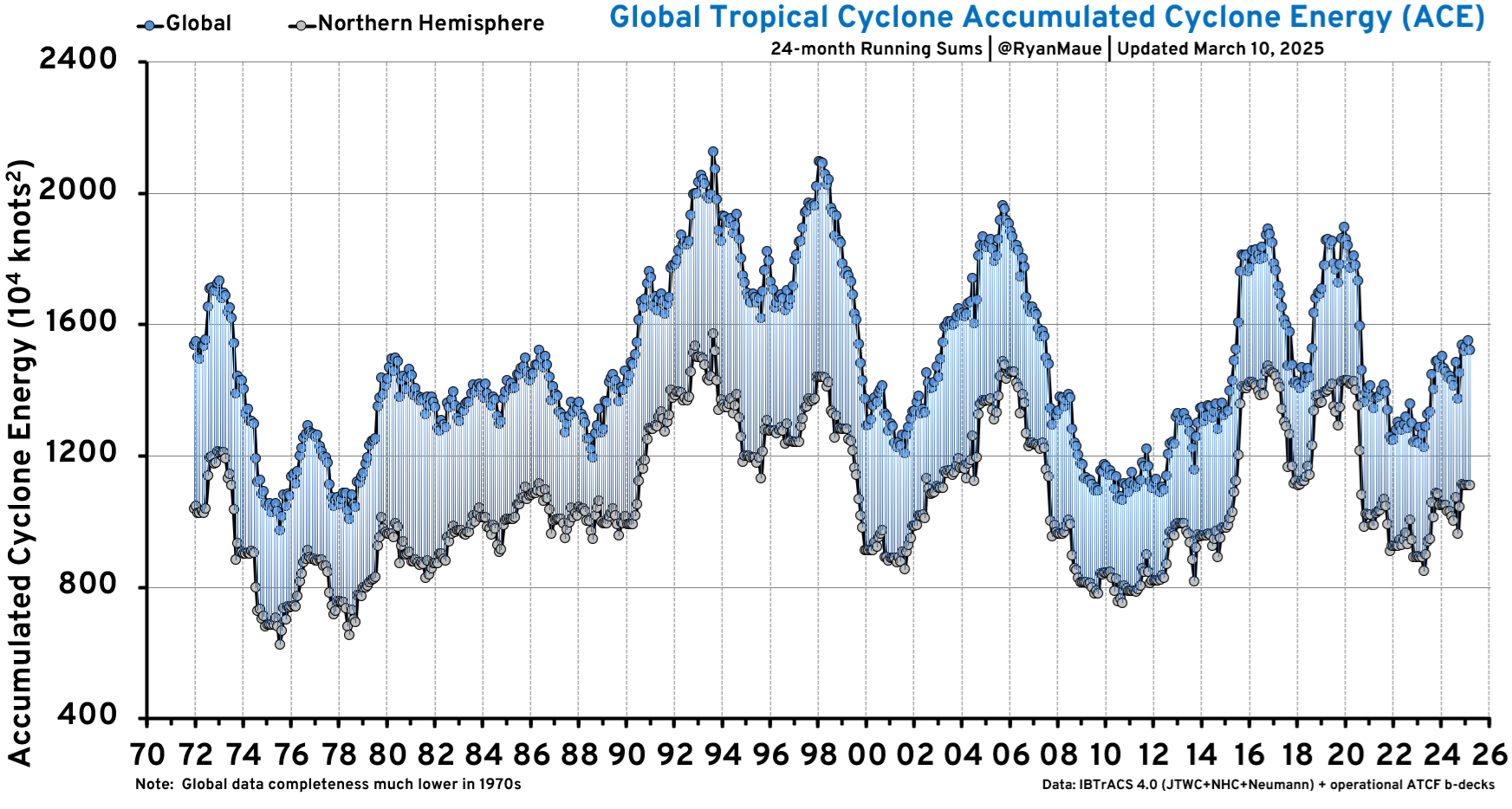
Figure 1: Last 50-years+ of Global and Northern Hemisphere Accumulated Cyclone Energy: 24 month running sums. Note that the year indicated represents the value of ACE through the previous 24-months for the Northern Hemisphere (bottom line/gray boxes) and the entire global (top line/blue boxes). The area in between represents the Southern Hemisphere total ACE. Source: Ryan N. Maue, “Global Tropical Cyclone Activity,” Climate Atlas, accessed October 10, 2024, https://climatlas.com/tropical/global_running_ace.png
Beyond that logical error, publicly available data show that tropical storms are not getting more frequent or extreme. Climate Realism has covered that fact many times looking at the historical tropical cyclone storm data compiled and provided by meteorologist Dr. Ryan Maue. The lack of trend is particularly evident when looking at global Accumulated Cyclone Energy (ACE) – a measure of storm windspeeds over time that gives a value for storm energy. (See graph above) Climate at a Glance: Hurricanes and Climate at a Glance: Global Tropical Cyclones also present real-world data showing no increase in the frequency and severity of such storms.
Emerging research discussed by Chris Morrison in a Daily Sceptic article also shows, contrary to the claims made by Carbon Brief and The Guardian, that cyclones have not been intensifying. Research recently published in the journal Nature that shows there has been “no increase in the destructive power of cyclones – the generic term for typhoons and hurricanes – in any ocean basin over the last 30 years.”
Morrison explains the researchers developed a “Power Dissipation Index,” (PDI) which is similar to ACE except that it includes the intensity of the storm as well as duration and frequency. That metric showed the South Indian basin, where Chido formed, has seen a decline in PDI over the past 30 years. This suggests that the modest warming of the past hundred-plus years has had limited if any impact on cyclone formation and severity. (See graphic below)
Figure 2: Graphic from Tu, S., Hu, Z., Liang, M. et al. Decreasing trend in destructive potential of tropical cyclones in the South Indian Ocean since the mid-1990s. Commun Earth Environ 5, 543 (2024). https://doi.org/10.1038/s43247-024-01683-2
A number of factors besides water temperatures factor into whether cyclones form, how powerful they are, and their duration. This is part of the explanation for why there were more typhoons (hurricanes in the Asian Pacific region and Indian Ocean) in 2024 than there were in 2023, despite 2023 ocean temperatures having been much higher, as Climate Realism discussed in the post “Global Warming is Not Making Record Typhoons, South China Morning Post.”
Multiple lines of evidence indicate that tropical cyclones are not getting worse due to the modest warming of the past hundred plus years, regardless of the reason for the warming. Carbon Brief and The Guardian misinform and do their readers a disservice when they leap to attribute individual storms to climate change, especially when evidence to the contrary is so readily available to the public and journalists.
You may recall that last month climate scientist Professor Patrick T. Brown of the Breakthrough Institute caused a bit of a furore by pointing out how extreme weather event attribution studies invariably restrict their quantification to climatic causation only, thereby excluding quantification of the non-climatic. It was suggested that this may serve those involved in such studies, since they are much more likely to get their papers accepted in prestigious journals that are attracted towards the resulting simplified narrative. Professor Brown admitted that he was one of that self-serving community and questioned whether a change of attitude might better serve the science.
The response from those who adhere to the simplified narrative was predictable, and I reported on their howls of outrage here and here. I have to say, however, it all seems to have gone quiet now. Presumably the likes of Carbon Brief and Ken Rice of ATTP fame feel there is nothing more to be said following their debunking efforts. It’s a job well done, as far as they are concerned. I too should know better and let sleeping dogs lie, but that’s not my style. So I will endeavour here to keep the issue alive by looking at another supposed debunking of Professor Brown, mainly because I want to show just how atrociously inept that effort was, but also because of the relevance of the organisation attempting the rebuttal.
A group on a mission
The supposed debunking I wish to focus upon today comes from the Grantham Institute for Climate Change and the Environment (yes, the institute that employs Professor Friederike Otto, extreme event attributor extraordinaire). To be precise, the individual responsible is none other than the institute’s Policy and Communications Director, Bob Ward, who’s hit piece is titled ‘Newspapers are using climate researcher’s false claims about journal bias to mislead readers’.
Ward comes with a suitably impressive curriculum vitae that includes membership of the board of the Association of British Science Writers; a membership that makes the nature of his error-strewn, hopelessly confused and egregiously misleading attack on Patrick Brown all the more unforgivable. The bad faith starts early on when Ward first refers to Professor Brown’s article written for The Free Press:
“However, the lead author on the paper, Dr Patrick Brown, caused controversy by writing another article in which he appeared to admit that he had been forced to alter his research to publish it in the top scientific journal”.
Well Brown either did or did not admit. To say he ‘appeared to admit’ already smacks of spin. As for being ‘forced’, these are Ward’s words, not Brown’s. In fact, at no stage did Brown talk of being forced to do anything. Nor did he use any synonym of that word. Nor did he ever admit to altering his work to get it published. Once again, this is pure spin from Ward. The real issue was the desire to restrict scope so as not to overcomplicate and dilute the narrative, thereby increasing the likelihood of being accepted for publication.
This is not a good start by Ward. But it gets much worse. Ward goes on to quote Brown as saying:
I knew not to try to quantify key aspects other than climate change in my research because it would dilute the story that prestigious journals like Nature and its rival, Science, want to tell.
To which Ward responds:
This is an incendiary claim. It is also untrue.
To back up his own incendiary claim that Brown is not speaking the truth, Ward refers to comments made by the Nature referees who had peer-reviewed Brown’s paper. Unfortunately, and quite surprisingly in view of Ward’s membership of the board of the Association of British Science Writers, he blatantly misrepresents the review dialogue. According to Ward:
These comments showed that one of the referees recommended that the paper needed significant revision, and challenged Dr Brown and his co-authors about the focus on temperature as a driver of wildfires, while excluding other factors such as humidity.
Here Ward is alluding to the comments of referee number three. This is what that referee actually wrote:
The climate change scenario only includes temperature as input for the modified climate. However, changes in atmospheric humidity would also be highly relevant for predicting changes in VPD or fuel moisture.
So whilst Ward wrote ‘factors such as humidity’, the referee actually wrote ‘humidity’.
This matters because atmospheric humidity is just another climatic factor, and yet the issue is supposed to be about the quantification of the non-climatic. Ward implies that Brown was asked to extend the scope of his quantified attribution to include the non-climatic and yet clearly referee three never made such a request. Ward’s innocent-looking ‘factors such as’ was a gross error at best, and a lie at worst.
In a generous mood, I could argue that Ward was not being deliberately misleading here but had simply conflated the comments of referee three with referee one, who had indeed mentioned non-climatic factors. Nevertheless, in the case of referee one, the concern had been that Brown’s chosen metric (wildfire growth) could be potentially misleading due to confounding, non-climatic factors. Referee one was merely suggesting that these factors should be controlled for. So even this could not be used as evidence that Brown had been asked to extend the scope of his study in order to quantify non-climatic causations. Besides which, Ward specifically refers to ‘one of the referees’ and so conflation of referee one and referee three’s comments would be a significant obfuscation on his part.
Another possible excuse for Ward’s ‘confusion’ is that Brown himself brings up non-climatic factors in one of his replies. But Brown was just pointing out what everyone, including the referees, knew to be the case – that quantification of non-climatic factors is very difficult and complicates the narrative. These difficulties could not be taken as his reason for declining a request to quantify the non-climatic, simply because it is obvious from the review dialogue that the referees had not at any stage made such a request. Instead, they seemed perfectly happy with an attribution that controlled for the non-climatic in order to keep things simple. That said, it is true that Brown himself argues that a simplified narrative has certain merits and he volunteers that he was aiming for simplicity. It also has to be said that it wasn’t until after the paper was published that he disclosed his full reasons for adhering to the simple narrative.
Whichever way you look at it, Ward’s emphatic rebuttal of Brown’s allegations is emphatically unsupported by the referee comments, and he could only find support in them through misrepresentation or obfuscation; hardly the performance you would want to see from the Policy and Communications Director of the Grantham Institute for Climate Change and the Environment. Worst still, Ward would surely have been aware that Professor Brown, by excluding non-climatic factors in his quantification, wasn’t doing anything that the institute’s very own Friederike Otto also does on a routine basis. Everyone, including those within the Grantham Institute, is focusing upon quantifying climatic causation of events, and no one is comparing the impacts of the climatic against the non-climatic. That is Brown’s point.
As a further irony, the Grantham Institute’s Professor Otto actually agrees with Patrick Brown that much more needs to be done to focus upon the non-climatic factors in natural disasters. In this paper she argues:
These hazards are, in many cases, not purely natural anymore, as a result of anthropogenic climate change. Nevertheless, also unnatural hazards only become disasters when they interact with exposure and vulnerability….A fact that is often missing from the public discussions and even the summary for policy makers of the synthesis report of the IPCC 6th assessment report mention vulnerability only once (paragraph A2.2) in the context of current impacts but not at all with respect to adaptation…A focus solely on climate and hazard in the context of disasters creates a discourse that deflects responsibility from the human actions that produce vulnerability and often also exposure.
But the ultimate irony is that, because this paper got published, it was cited by climate scientist Richard Black as proof that Brown is wrong about the bias! In fact, one idiot who reported upon this had this to say about Professor Otto:
“[Her] work has practically won her household-name status as a climate Cassandra, a high-profile career she apparently doesn’t mind risking by countering Brown’s alleged narrative.
Surely he meant ‘risking by agreeing’.
Finally, Ward further demonstrates his parlous disregard for important detail when he says:
Dr Brown’s allegations are further undermined by the fact that Nature has published articles that consider other factors that drive wildfires.
For his counter-example he then cites a published paper that does indeed ‘consider’ other factors. But this was never about mere consideration; this is a matter of the quantification of causality, which Ward’s chosen example singularly fails to do with regard to non-climatic causes. Once again, I am left puzzled as to how someone in Ward’s position could be so careless with the issues. He talks of Brown’s allegations being ‘demonstrably false’, but the only thing I think is demonstrated by Ward’s article is his own incompetence.
Mission unaccomplished
It is not surprising that the folk at the Grantham Institute for Climate Change and the Environment should be in the forefront of those seeking to discredit Professor Brown, since it is they, more than any other group, who have helped to promote the simplified narrative that Brown now challenges. What is surprising, however, is the shoddy and inept effort they have made of it. A good debunking would have to start with a careful reading of the referees’ comments and a clear and unambiguous account of them. It also requires a proper grasp of the issues and an understanding that ‘consider’ and ‘quantify’ are quite different verbs. Regrettably, none of these imperatives seemed to have been within Ward’s capacity to uphold, leading him to falsify and mislead. So it is somewhat ironic that he should then refer to Brown’s ‘false claims’ and bemoan that newspapers are misleading readers. Obviously, that is the message he would like everyone to take away from the saga, since the alternative would be to start questioning the credibility of the Grantham Institute for Climate Change and the Environment. If Ward thinks that his article has put the record straight, then I would have to say that he has grossly underestimated the scale of the task and the standard of critical thinking required.



You must be logged in to post a comment.