Global warming, climate change, all these things are just a dream come true for politicians. I deal with evidence and not with frightening computer models because the seeker after truth does not put his faith in any consensus. The road to the truth is long and hard, but this is the road we must follow. People who describe the unprecedented comfort and ease of modern life as a climate disaster, in my opinion have no idea what a real problem is.
The Climate Change Committee have now gone well beyond any objective assessment of climate change. Instead, their latest report belongs in the world of fantasy and disaster movies:
The Climate Change Committee have now gone well beyond any objective assessment of climate change. Instead, their latest report belongs in the world of fantasy and disaster movies:
From Sky News:
A blistering new report has slated government efforts to protect Britons from climate change that is already flooding homes, farmland and railways, overheating hospitals and schools and fuelling wildfires.
They warned progress in adapting to a hotter world has either been glacial, or moved in the wrong direction – amid fears of budget cuts in the upcoming spending review and spiralling problems in the water industry.
Of the 46 measures of government delivery – from protecting railways from collapsing to ensuring water and food security – not one was rated “good”.
The “Progress in adapting to climate change” report warns that by 2050:
Over half of England’s top farmland, one in four homes and half of roads and rail lines will be at risk of flooding
Heat-related deaths could pass 10,000 in an average year
Unchecked climate change could cost 7% of GDP.
It said climate change is already hitting hard:
Extreme heat buckles rail lines, fuels wildfires and drives up food bills
Heatwaves wiped out a hospital data centre, cancelling appointments when the health service is “already on its knees”
Children are toiling through exams in boiling school halls.
Whatever effect a few days of heat in summer may have, it is certainly dwarfed by the impacts of cold in winter – disruption to transport, hospital overloads, schools shut because of snow. The list goes on and on.
But it is the forecast for 2050 which really shows up this report to be a fraudulent attempt to scare the public into accepting Net Zero.
The idea that our climate would be any noticeably different in 25 years time is ridiculous. It certainly has not changed a jot in the last 25 years.
And anybody who claims that half of farmland and 7 million homes will be at risk of flooding should not be allowed near any position of authority. The actual number of properties flooded last year was 5000.
Never mind a cost of 7% of GDP, which equates to about £140 billion a year.
Meanwhile summer death rates remain the lowest of the year, in contrast to the report’s claims of people dying because of heat, which have already been thoroughly debunked by the ONS.
It is interesting that the report is equally critical of the Labour government for failing to take action. That might be because they are not going to waste billions on adapting to a non-existent problem!
Clearly the CCC are throwing their toys out of the pram, annoyed that nobody is taking their increasingly absurd warnings and threats.
FOOTNOTE
Baroness Brown, who presented the report as Chair of the Adaptation Committee, is still unaccountably a non-executive director of Ceres Power (developers of green hydrogen) and Orsted (Danish wind power company).
Weather and climate extremes—such as high temperatures, floods, droughts, tropical cyclones, extratropical cyclones, and severe thunderstorms—have always threatened both human and natural systems. Given their significant impacts, there is considerable interest in how human-caused climate change influences these extremes. This is the focus of the relatively new discipline of Extreme Event Attribution (EEA).
How a cascade of selection effects bias the collective output of extreme event attribution studies.
Weather and climate extremes—such as high temperatures, floods, droughts, tropical cyclones, extratropical cyclones, and severe thunderstorms—have always threatened both human and natural systems. Given their significant impacts, there is considerable interest in how human-caused climate change influences these extremes. This is the focus of the relatively new discipline of Extreme Event Attribution (EEA).
The collective output of these kinds of studies certainly gives the impression that human-caused climate change is drastically changing the frequency and intensity of all kinds of weather extremes. Indeed, Carbon Brief recently published an extensive summary of the science of EEA studies, which begins with the proclamation, “As global temperatures rise, extreme weather events are becoming more intense and more frequent all around the world.”
However, these numbers cannot be taken as an accurate quantification of the influence of climate change on extreme weather because they are heavily influenced by a cascade of selection biases originating from the physical climate system, as well as researcher and media incentives. Identifying and understanding these biases is a prerequisite for properly interpreting the collective output of EEA studies and, thus, what implications they hold for general scientific understanding, as well as political and legal questions.
The large apparent discrepancy between the size of the influence of human-caused climate change on extreme weather reported in EEA studies (like those compiled by Carbon Brief) compared to more comprehensive systematic analyses (like those compiled by the IPCC) can, in large part, be attributed to the many layers of Selection Biasesthat influence the EEA literature’s collective output.
Selection Bias is a broad term that refers to any bias that arises from a process that selects data for analysis in a way that fails to ensure that data is representative of the broader population that the study wishes to describe.
Selection biases in the context of EEA studies include those associated with the physical climate system itself, those concerning proclivities and incentives facing researchers/journals, and those concerning the proclivities and incentives facing the media. They include
Occurrence Bias is a bias introduced by the physical climate system. Since EEA studies tend to be triggered by extreme events that have actually occurred, there is reason to believe that these studies will disproportionately sample events that are more likely than average to be exacerbated by climate change because the events occurred in the first place. Essentially, extreme events that are more likely to occur under climate change—and thus more likely to be observed—are going to be overrepresented in EEA studies, and extreme events that are less likely to occur under climate change—and thus less likely to be observed—are going to be underrepresented in EEA studies.
The map below illustrates this phenomenon. It shows changes in the magnitude of extreme drought under climate change. Specifically, it shows the fractional change in the intensity of once-per-50-year droughts (as quantified by monthly soil moisture) between a preindustrial and 21st-century run (SSP2-4.5 emissions) of the highly-regarded NCAR CESM2 Climate Model.Blue areas represent locations where the model simulates that extreme droughts become less frequent and intense with enhanced greenhouse gas concentrations, and red areas represent locations where the model simulates that extreme droughts become more frequent and intense with enhanced greenhouse gas concentrations. It is notable that overall, this model simulates that warmingdecreases the frequency and intensity of extreme drought in more locations than it increases it (consistent with soil moistening under warming simulated by other models).
Now, here’s the kicker: The black dots show locations where once-per-50-year droughts actually occurred in the 21st-century simulation and thus represent events that would plausibly trigger EEA studies.
What do you notice about where the dots are compared to where the red is? That’s right; the simulated EEA studies overwhelmingly sample areas where droughts are getting more intense and more frequent by the very nature that those are the types of droughts that are more likely to occur in the warming climate. The result is that the EEA sample is majorly biased: warming decreased the intensity of once-per-50-year droughts by about 1% overall, but it increased their intensity within the EEA sample by 18%!
Thus, if you just relied on the EEA sample, you would come away with an incorrect impression not only on the magnitude of change in extreme droughts but also on the sign of the direction of change!
Choice Bias arises when researchers use prior knowledge to choose events for EEA studies that are more likely to have been made more severe by climate change. A clear example of Choice Bias pervading the Carbon Brief database is there have been 3.6 times more studies on extreme heat than there have been on extreme winter weather (205 vs. 57). Another example would be the dearth of EEA studies on extratropical cyclones (the kinds of low-pressure systems with cold and warm fronts that are responsible for most of the dramatic weather outside of the tropics). The IPCC states that the number of extratropical cyclones associated with intense surface wind speeds is expected to decrease strongly in the Northern Hemisphere with warming. Yet, it is relatively rare for EEA attribution studies to be done on these types of systems, which results in an exclusion of this good news from the EEA literature.
Finally, the climate reporting media ecosystem is characterized by actors whose explicit mission is to raise awareness of the negative impacts of climate change, and thus, there will be a natural Media Coverage Bias with a tendency to selectively highlight EEA studies where climate change is found to be a larger driver than EEA studies that do not reach such a conclusion. These selection biases are apparent at the aggregate level, but there is also strong evidence of their presence in individual studies.
A more recent specific example suggestive of many of these dynamics is a study, Gilford et al. (2024), titled “Human-caused Ocean warming has intensified recent hurricanes”. This study was conducted by three researchers at Climate Central, which summarizes the study’s findings with the following infographic:
From Climate Central press release on Gilford et al. (2024).
Essentially, they claim that climate change is enhancing the intensity of all hurricanes and that the enhancement is quite large: Storms today are calculated to be an entire Category stronger than they would have been in a preindustrial climate.
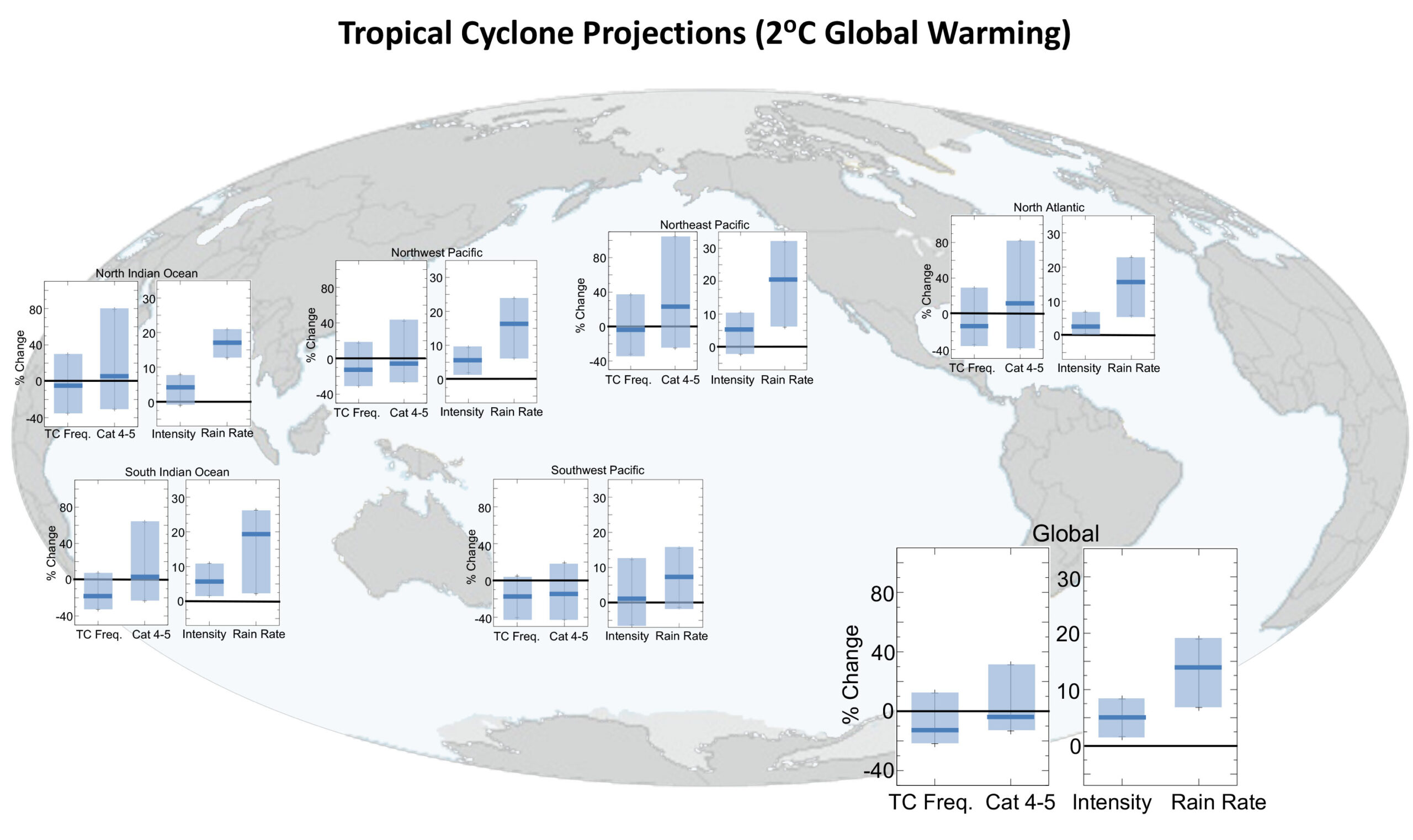
This is a huge effect, and thus, if it were real, it is reasonable to expect to see clear long-term trends in metrics of tropical cyclone (hurricane) intensity like the accumulated number of major (Category 3+) hurricane days or the accumulated cyclone energy from all tropical cyclones (which is proportional to the square of hurricane windspeed accumulated over their lifetimes). However, any long-term trends in such metrics are subtle at best, both globally and over the North Atlantic.
From Colorado State University Department of Atmospheric Science Tropical Meteorology Project.
So, this is a microcosm of the aforementioned apparent discrepancy between more broad quantifications of changes in extremes and their associated EEA counterparts, and again, I’d argue there are several selection biases at play affecting the production and dissemination of the EEA study.
Let’s start with Choice Bias on methodology. Human-caused warming changes the environment in some ways that work to enhance hurricanes and in other ways that diminish them. The main way that hurricanes are enhanced is via the increase in sea surface temperatures (which provides the fundamental fuel for hurricanes), and the main way that hurricanes are diminished isvia changes in atmospheric wind shear and humidity.
However, the Climate Central researchers made the methodological choice to largely exclude the influence of factors that diminish hurricane development from the study.
Are these Choice Biases in event type and methodology an accident? There are many reasons to believe they are not.
The research paper itself spells out that the motivation of the study is to “connect the dots” between climate change and hurricanes because “landfalling hurricanes with high intensities—can act as ‘focusing events’ that draw public attention” and that “Increased attention during and in wake of storms creates opportunities for public and private discourse around climate and disaster preparedness.”
Then, there is the extensive media coverage of this study. It was picked up by 134 news outlets and ranked in the 99.95th percentile of research articles (across all journals) of similar age in terms of online attention. Further, it was immediately incorporated into seven Wikipedia articles (likely having high leverage on AI queries, which would make its findings indistinguishable from scientific “fact”). This is affected by the aforementioned Media Coverage Bias, but it is also undoubtedly directly influenced by the efforts of Climate Central, which is explicitly an advocacy organization whose self-described specialty is media placement and dissemination.
“Attributing extreme weather events to climate change, as I do through my work as a climatologist, means we can hold countries and companies to account for their inaction.”
Given the explicitly stated motivation of those in the EEA field, it is quite reasonable to suppose that there are major selection biases at play, and thus, it is not at all surprising that the collective output of the EEA field would look so different from more broad comprehensive assessments.
The rain in Spain falls mainly on the plain, but only in My Fair Lady. On October 29 and 30, 2024, however, it fell elsewhere with tragic consequences: the loss of over two hundred lives and widespread damage in the Valencia region.
Almost as surprising as the downpour’s intensity was the rush by agencies in this space to conclude it was caused by the bogeyman apparently driving all natural disasters today: “climate change”.
An alternative explanation is that the weather gods were up to their old tricks. After all, a so-called extreme weather event (EWE) happens somewhere in the world every day. So the probability was high they might conjure up one just a week before COP29, as indeed they did last year. Storm Bettina made landfall in Eastern Europe on November 28, 2023, just days before COP28, the annual UN climate conference. It too was attributed rather promptly to nasty anthropogenic greenhouse gas emissions.
The COP29 Conference of the Parties is being held in Baku, Azerbaijan, from 11 to 22 November, 2024. After twenty eight years of talks, the event is being promoted, optimistically, as a Climate Action Summit. How many people does it take to change the climate of a whole planet to suit everybody everywhere and forever? At least 40,000, judging by the number of delegates this year. Good luck with that exercise of breathtaking hubris, the bureaucratic equivalent of collective hara kiri, at least for the developed world.
The UN Secretary-General, António Guterres, had a familiar message for them: immediate steps must be taken to cut [carbon dioxide] emissions, “safeguard people from climate chaos”, and “tear down the walls to climate finance”, especially given what he described as this year’s “masterclass in climate destruction”. It was déjà vu all over again.
COP29 is yet another attempt by the developing world to monetize the climate and raise “trillions of dollars to protect lives and livelihoods from the worsening impacts of climate change.” Yet most countries were silent on the irony of China’s chutzpah: the world’s largest coal consumer, biggest solar panel manufacturer and now space explorer, still claiming developing country status and putting its hand out for billions of dollars of free money.
There is, of course, no suggestion here that the agency rush to judgment mentioned above might have been due to activist researchers so dazzled by confirmation bias – and now underwritten by fabulous funding from both governments and private entities – they could not resist making confident claims about climate causation, such as detecting the “fingerprint of climate change in complex weather events”; or that the MSM has become rather keen to provide them with a media megaphone without further scrutiny, or express any doubt about the veracity of their claims.
Nevertheless, dear reader, here’s an intriguing case for your consideration. On 31 October, 2024, just a few hours after the Spanish deluge, BBC’s climate editor, Justin Rowlatt, posted this article: Deadliest weather made worse by climate change – scientists.
Human-caused climate change made the ten deadliest extreme weather events of the last 20 years more intense and more likely, according to new analysis.
The killer storms, heatwaves and floods affected Europe, Africa and Asia killing more than 570,000 people.
The new analysis highlights how scientists can now discern the fingerprint of climate change in complex weather events.
The study involved reanalysing data for some of the extreme weather events and was carried out by scientists from the World Weather Attribution (WWA) group at Imperial College London.
“This study should be an eye-opener for political leaders hanging on to fossil fuels that heat the planet and destroy lives”, said Dr Friederike Otto, co-founder and lead of WWA.
“If we keep burning oil, gas and coal, the suffering will continue,” she said.
To investigate if climate change influenced the heavy rainfall, we determine if there is a trend in the historic rainfall observations in the region. The three analysed datasets indicate that heavy 1-day rainfall events, as intense as the one observed, are about 12% more intense and about twice as likely in today’s climate, that is 1.3°C warmer than it would have been in the cooler preindustrial climate without human-caused warming.
These results are based on observational data and do not include climate models that are used in full attribution studies. However, the results are in line with existing evidence of climate change signals in similar past extreme daily-rainfall events that have been studied across Europe. They are also aligned with basic physics and the so-called Clausius-Clapeyron relationship, which outlines that a warmer atmosphere can hold more moisture, resulting in a 7% increase in heavy rainfall with 1°C of warming. We are therefore confident the changes in heavy rainfall are driven by human-caused climate change.
Only a seven percent increase in heavy rainfall with an increase of one degree Centigrade of warming hardly seems alarming. In any case, with what alchemy does WWA, or indeed any agency, distinguish the weather’s natural variability from “human-caused climate change”?
WWA’s analysis also “built on a relatively sparse literature on rainfall extremes in the region”. In other words, poor data. Why it included the following paragraph, which appears to contradict its conclusion, is unclear, at least to me.
Working group 1 of the sixth assessment report of the IPCC found evidence of an increasing trend in rainfall extremes in western and central Europe, but with low confidence of the human contribution to this due to limited agreement (IPCC, 2021). Furthermore, projected changes in such extremes vary strongly by location and season, especially in the study region in this analysis, which suggest a wetting trend in winter and drying in summer (Wood & Ludwig, 2020).
How did WWA decipher this EWE and reach such an emphatic conclusion in less than a week? Was its “super rapid analysis” driven more by a desire to turn the Spanish downpour into another scary storyline for the Imperial College climate research team to promote in Baku, when it presented there on November 11, the first day of COP29? The so-called facts in this case surely were not massaged to achieve other objectives.
Whatever the case, if the fate of humankind depends on the insights – and prejudices – of professional readers of the Earth’s atmospheric entrails, perhaps it would be prudent not to ignore their warnings. Yet, on the balance of probabilities, it’s hard to deny that the sequence of events outlined above has a fishy smell about it. A sceptic might conclude that a random EWE – in this case the rain in Spain – may have been weaponised to support the alarmist mood at COP29.
Such a view arguably becomes more credible on discovering that WWA’s main benefactor is The Grantham Institute. It sits “at the heart of Imperial College London’s work on climate change and the environment, with the mission: “to lead on world-class research, policy, training and innovation that supports effective action on climate change.”
The Grantham Institute – Climate Change and the Environment entity was created in February 2007 with a multi-million-pound donation from the Grantham Foundation for the Protection of the Environment. It was the largest sum of private funding given to UK climate change research at the time. The aim: to create a global centre of excellence for research and education on climate change at Imperial College London.
The Granthams hope that their donation will motivate other individuals to support research into the causes, consequences and mitigation of climate change with a view to informing policy on an international scale.
The Grantham Family established the Grantham Foundation for the Protection of the Environment in 1997. The Foundation supports natural resource conservation projects both in the US and internationally. Jeremy Grantham is a well-known investment manager and chairman of Boston-based investment firm, GMO. Hannelore Grantham is Director of the Grantham Foundation.
Jeremy Grantham remains the long-term investment strategist at the firm he cofounded in 1977, Grantham, Mayo, Van Otterloo & Co. (GMO). He still serves on its asset allocation committee and board of directors.
In an interview with Morningstar on October 9 this year, Grantham said he was as concerned as “every scientist in the climate business”.
Morningstar:You spend a lot of time thinking about climate and environmental issues more broadly. Renewables have clearly made a lot of strides, electric vehicles, and yet carbon emissions remain stubbornly high. As a climate solutions investor, what you’re excited about these days?
Grantham:Well, what I consider important is the ability of senior people to miss the point. Climate change is like some giant python. It’s got us gripped and it isn’t squeezing that tight yet. But each year it’s getting a little tighter and it shows no inclination to go away and we’re ignoring it. If we continue to take climate change this lightly, if we continue to protect our short-term profits and ignore longer-term consequences to the general world, we will have a very hard time maintaining a stable world, stable social, stable corporate, stable anything. And I would say, to me, on a global basis, it looks like we’re quite a handful of years into a destabilizing mode and the climate change has a lot to do with it.
The Grantham Foundation has 90% of all the money I’ve ever made: 50% is in venture capital, maybe closer to 60% today, and half of that is green. So, we get a ringside seat at what is going on.
As for the World Weather Attribution group, it was formed by Imperial and The Grantham Institute in 2014 with the explicit aim of “changing the global conversation around climate change, influencing adaptation strategies and paving the way for new sustainability litigation.” In other words, funding a smorgasbord of controversial extreme event attribution computer games, green ideology and climate politics. If the ultimate objective is litigation, perhaps “conversation” is the wrong word.
The group says it has “performed more than 80 attribution studies on heatwaves, extreme rainfall, drought, floods, wildfires and cold spells around the world.”
Having an agreement about the amount of money and where that money’s coming from […] will be one of the most significant outcomes of COP29. Mike Wilkins, Executive Director, Centre of Climate Finance & Investment, Imperial Business School.
The shrinking carbon budget shows the importance and urgency of near-term emissions reductions. Professor Joeri Rogelj, Director of Research, Grantham Institute – Climate change and the Environment.
Grantham is right. Climate change has become a global “business”, presumably very profitable for “carbon” cowboys or green investors like GMO, at least unless the RE music stops for some reason, such as a decline in public gullibility about the “climate crisis”. There’s another python on the planet too: the sperm count.
Grantham:In terms of pessimism, in a sense, you ain’t heard nothing yet. Because in my opinion, there’s not just one python squeezing us, there’s two—the other is toxicity. If we do not move against toxicity, we are going out of business. And to give you the most shocking single number, our sperm count, which is the best indicator of general health, is down to a third of what it was in 1950—and 1950 was not a healthy place to be. Hunter/gatherers a few thousand years earlier would have been much healthier. And it’s falling at an accelerating rate. One of great epidemiologists who study this said, “It’s as if we mean to go out of business.” The drop since 2000 is over 2.5% a year from where we were. And the drop in the 20th century was closer to 1.5%. But no one gives it rat’s tail.
Amen.
Michael Kile
A version of this article was posted at the Australian site, Quadrant Online, on November 19, 2024, with the title: We’re all Doomed. Yawn


You must be logged in to post a comment.