Global warming, climate change, all these things are just a dream come true for politicians. I deal with evidence and not with frightening computer models because the seeker after truth does not put his faith in any consensus. The road to the truth is long and hard, but this is the road we must follow. People who describe the unprecedented comfort and ease of modern life as a climate disaster, in my opinion have no idea what a real problem is.
JD VANCE: “If American democracy can survive ten years of Greta Thunberg scolding, you guys can survive a few months of Elon Musk.” pic.twitter.com/c2KHYkH4IL
Vice President J.D. Vance delivered his first major speech in Europe on Friday speaking at the Munich Security Conference in Germany.
During his speech VP Vance did not hold back – just like his boss!
J.D. Vance, the former attorney, US Senator, and Marine Corps veteran from Ohio, blasted the EU elites who threaten Elon Musk and insist on ridding the continent of free speech.
J.D. Vance did not hold back reminding the Europeans about their nauseating record of lecturing Americans with bratty children like anti-Semite Greta Thunberg.
Vice President J.D. Vance: More and more all over Europe, they’re voting for political leaders who promise to put an end to out-of-control migration. Now, I happen to agree with a lot of these concerns, but you don’t have to agree with me. I just think that people care about their homes, they care about their dreams, they care about their safety and their capacity to provide for themselves and their children, and they’re smart.
I think this is one of the most important things I’ve learned in my brief time in politics, contrary to what you You might hear a couple of mountains over in Davos, the citizens of all of our nations don’t generally think of themselves as educated animals or as interchangeable cogs of a global economy. It’s hardly surprising that they don’t want to be shuffled about or relentlessly ignored by their leaders. It is the business of democracy to adjudicate these big questions at the ballot box.
I believe that dismissing people, dismissing their concerns, or worse yet, shutting down media, shutting down elections, or shutting people out of the political process protects nothing. In fact, it is the most surefire way to destroy democracy. Speaking up and expressing opinions isn’t election interference.
Even when people express views outside your own country, and even when those people are very influential.
Trust me, I say this with all humor, if American democracy can survive 10 years of Greta Thunberg’s scolding, you guys can survive a few months of Elon Musk. But what no democracy, American, German, or European, will survive is telling millions of voters that their thoughts and concerns, their aspirations, their please for relief, are invalid or unworthy of even being considered. Democracy rests on the sacred principle that the voice of the people matters. There’s no room for firewalls. You either uphold the principle or you don’t.
Vice President J.D. Vance is going to steal our hearts if he doesn’t watch it! Bravo!
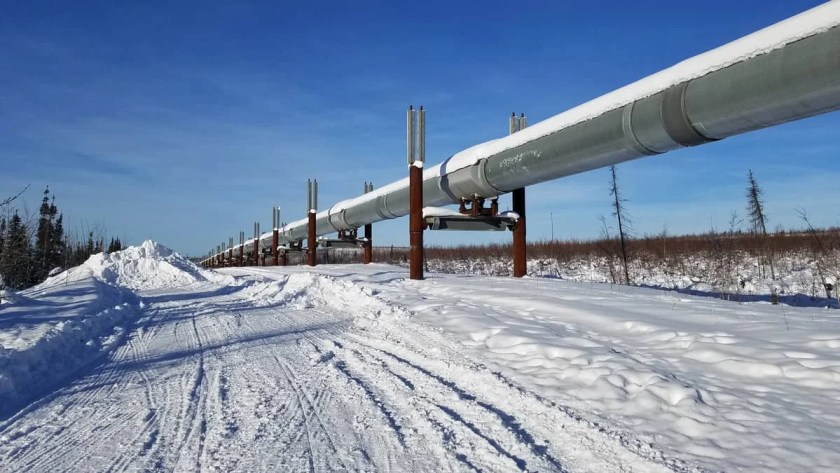
Over the past four years, Alaska’s economic potential has been stifled by the Biden Administration’s full-scale assault on the state’s vast resources. With President Trump back in office, there is a tangible shift in direction. In just his first few weeks, the administration acted decisively— signing an executive order designed to unlock Alaska’s “extraordinary resource potential” and appointing an Alaskan environmental commissioner to a pivotal EPA role. Notably, Japan is already considering backing the $44 billion LNG pipeline from the North Slope to Nikiski, according to industry reports.
Over the past four years, Alaska’s economic potential has been stifled by the Biden Administration’s full-scale assault on the state’s vast resources. With President Trump back in office, there is a tangible shift in direction. In just his first few weeks, the administration acted decisively— signing an executive order designed to unlock Alaska’s “extraordinary resource potential” and appointing an Alaskan environmental commissioner to a pivotal EPA role. Notably, Japan is already considering backing the $44 billion LNG pipeline from the North Slope to Nikiski, according to industry reports.
During my tenure as U.S. Secretary of Energy in President Trump’s first term, I witnessed firsthand an unwavering commitment to advancing Alaska’s prosperity. Alaska’s success is a linchpin for national energy independence, and if decisive action is taken now, the impact could be transformative.
A top priority must be addressing Alaska’s domestic natural gas shortage. The reality is stark: without prompt intervention, there is a near-certain risk of higher energy prices and perhaps even rolling blackouts. The Dunleavy administration is working on long-term strategies to harness Alaska’s natural gas resources, while recognizing the urgent need for immediate measures. In the near term, importing LNG to cover production shortfalls—particularly from Cook Inlet—is not merely a stopgap; it is a critical, strategic move that fortifies Alaska’s energy future. Data from the Energy Information Administration (EIA) supports the view that timely LNG imports can stabilize market fluctuations and ensure reliability.
Beyond these immediate supply concerns lies a broader market challenge. In Southcentral Alaska, Enstar Alaska—a Canadian-owned utility—is leveraging its market power to pursue legal actions that could lock consumers into inflated energy rates while hoarding scarce gas supplies. This is particularly concerning given that, two years ago, Enstar’s gas storage failed during one of the coldest winters on record, as documented by state energy reports.
It is essential to confront these challenges head-on, prioritizing robust, collaborative solutions over parochial self-interests. Supporting projects that provide immediate relief while laying the groundwork for long-term energy security is imperative. Investments in domestic production, strategic LNG imports, and ongoing innovation are not mutually exclusive; together, they form the backbone of a resilient energy strategy.
Additionally, the influence of extreme environmental groups in Alaska poses a tangible threat to progress. Although their clout in Washington, DC is diminishing, these groups are expected to intensify their efforts at the state level. Recent proposals for higher taxes on oil and gas producers serve as a warning—while the legislature wisely rejected those tax hikes, similar future attempts could derail key projects through litigation and lobbying.
President Trump’s second term represents a historic turning point—not just for Alaska, but for the U.S. as a whole. Alaska’s role in reshaping U.S. energy policy is undeniable. Unlocking the state’s full potential will ignite unprecedented innovation and pave the way for a more secure national energy future. The time to act is now.
The Honorable Dan R. Brouillette is a distinguished leader in energy, finance, and government policy, having served as 15th U.S. Secretary of Energy, 19th Deputy Secretary of Energy, President of Sempra Infrastructure, and CEO of Edison Electric Institute. With a career spanning public service and corporate leadership, he has played a pivotal role in shaping global energy strategy, advancing technological innovation, and managing large-scale infrastructure investments.
This article was originally published by RealClearEnergy and made available via RealClearWire.
Over the five years, they reckon a total cost of £242 billion.
Mere chicken feed!
As we will still need a full fleet of gas power stations, the only offsetting savings will be the fuel savings for them.
Government projections say that the price of natural gas will be around 70p/therm in the next decade, equivalent to £24/MWh. Given fuel efficiency of 53% at a CCGT, the fuel cost would therefore be about £45/MWh of electricity generated.
Currently they say generate about 84 TWh of gas power a year and the Clean Power plan will knock this down to 15 TWh. The annual fuel saving will therefore be £3.1 billion. However, the operating costs of offshore wind are estimated at £19/MWh, meaning that the net saving would only be £1.8 billion.
And we have not even looked at the cost of capital – ROC of, say, 8% would cost £19 billion a year.
The current fleet of CCGTs won’t last forever, of course, but Miliband will still need to pay to replace these anyway, whether like for like, or with CCS gas power or hydrogen. And in twenty years’ time, we would be facing another £200 billion to replace the worn-out wind turbines and solar panels.
It does not take a genius to work out that these numbers don’t stack up! Even if gas prices were to double, the equation would not alter.
Following the Paris Agreement in 2015, a series of global initiatives were pursued to reduce the impacts of climate change and reduce overall greenhouse gas emissions to “net zero” by 2050. The goal included a significant reduction in GHG emissions, but also utilized “offsets” that, through technology and protection of natural resources, would result in overall emissions being at a net of zero. This resulted in a carbon credit market that allowed high GHG emitting countries and businesses to purchase credits from underdeveloped countries that produce little emissions.
Following the Paris Agreement in 2015, a series of global initiatives were pursued to reduce the impacts of climate change and reduce overall greenhouse gas emissions to “net zero” by 2050. The goal included a significant reduction in GHG emissions, but also utilized “offsets” that, through technology and protection of natural resources, would result in overall emissions being at a net of zero. This resulted in a carbon credit market that allowed high GHG emitting countries and businesses to purchase credits from underdeveloped countries that produce little emissions.
On the financial side, a multi-prong approach was used to influence and regulate businesses. Large investment firms, like BlackRock, used their influence to drive ESG and sustainability. By 2021, it was standard practice for businesses to release annual ESG and sustainability reports. However, there was no standardization of the practice. Claims were unregulated and content was unclear. As a result, reports were focused on what the business thought mattered to investors and were little more than marketing pieces.
This became problematic in the highly regulated financial industry. Funds that claim to be ESG, green, climate friendly, or sustainable must back up those claims with data. As a result of demand and Paris Agreement based initiatives, international regulators began drafting standards for reporting, marketing, and investments relating to climate change and other green initiatives.
In 2021, the International Sustainability Standards Board drafted the International Financial Reporting Standards Foundation’s Sustainability Disclosure Standards. IFRS is an independent, nonprofit organization that develops financial reporting standards, including international accounting standards. IFRS is not used in the U.S., who uses generally accepted accounting principles, also known as GAAP, but is used in 132 jurisdictions. The IFRS Standards were adopted in June 2023 as the global standard for sustainability and climate change reporting, including greenhouse gas emissions.
The US Securities Exchange Commission Story Regarding ESG
In the U.S., the SEC proposed the development of climate-related reporting standards in March 2022. The final rule, adopted on March 6, 2024, required large publicly traded companies to disclose climate action, GHG emissions, and the financial impacts of severe weather events. The Climate-Related Disclosure Rule was initially set to go into effect in 2026. However, it was immediately met with legal challenges and the SEC delayed implementation indefinitelywhile the cases worked through the judicial process. Now it appears the delay will become permanent.
Rough Seas for Captains of Industry
Under the leadership of Gary Gensler, the U.S. Securities and Exchange Commission saw a wave of regulatory and enforcement actions relating to environmental, social, and governance; sustainability; and climate change. It was clear that his exit, effective the day President Trump took office, would significantly alter the SEC’s approach to those topics.
On February 11, acting SEC Chair Uyeda, a Biden appointee, effectively ended the Climate-Related Disclosure Rule. In the statement, Uyeda said,
“The Rule is deeply flawed and could inflict significant harm on the capital markets and our economy.”
“Both Commissioner Peirce and I voted against the Rule’s adoption. Commissioner Peirce said that then-existing disclosure rules were sufficient and that the ‘[R]ule’s anticipated benefits do not outweigh the costs.’ She argued that ‘only a mandate from Congressshould put us in the business of facilitating the disclosure of information not clearly related to financial returns.’ I stated that the Commission was ‘without statutory authority or expertise’ to address climate change issues and that ’this [R]ule is climate regulation promulgated under the Commission’s seal.’”
“The Commission’s briefs previously submitted in the cases consolidated in the Eighth Circuit do not reflect my views… I also question whether the agency followed the proper procedures under the Administrative Procedure Act to adopt the Rule.”
As a result, Acting Chair Uyeda has asked the court for a delay in the proceedings while the SEC takes action to roll back the Climate-Related Disclosure Rule. As a result, climate reporting at the national level is effectively dead. The focus now turns to the states and international actions.
Here is another example of a jurisdiction desperately trying to put a positive spin on their floundering net-zero transition efforts.
The New York State Energy Research & Development Authority (NYSERDA) has an important role in the Climate Act implementation. They publish “featured stories” that “take you inside the work to build a clean energy future in New York.” The term “propaganda” implies the dissemination of information, often biased or misleading, to promote a particular agenda. That description perfectly describes the February 11 Clean Energy Growth story “EVs hit record numbers in NY and the US”.
New York’s Climate Leadership & Community Protection Act (Climate Act) established a New York “Net Zero” target (85% reduction in GHG emissions and 15% offset of emissions) by 2050. It includes two 2030 targets: an interim emissions reduction target of a 40% GHG reduction by 2030 and a mandate that 70% of the electricity must come from renewable energy by 2030. The Climate Action Council (CAC) was responsible for preparing the Scoping Plan that outlined how to “achieve the State’s bold clean energy and climate agenda.” After a year-long review, the Scoping Plan was finalized at the end of 2022. Since then, the State has been trying to implement the Scoping Plan recommendations through regulations, proceedings, and legislation.
This article compares the numbers in the “EVs hit record numbers in NY and the US” story and the numbers in the Scoping Plan.
In 2024, New York saw 90,221 new EV registrations, bringing the total number of EV drivers to more than 271,000 at the start of 2025. EV registration in 2023 totaled 78,950, meaning that 2024 saw a 14.3% jump in electric vehicle adoption across New York State.
Of the new EVs registered in New York State, 54,664 were battery-electric models and 35,557 were plug-in hybrid electric vehicles[2]. Battery-electric EVs run completely on electricity, whereas plug-in hybrids have an all-electric range of around 20 to 50 miles and an internal combustion engine fueled by gasoline that kicks in once the battery power is exhausted.
Scoping Plan EV Numbers
The Scoping Plan is New York’s blueprint for meeting the Climate Act mandates. NYSERDA hired a contractor who developed a list of control strategies, estimated costs and emission reductions, turned a crank and conjured up three decarbonizing scenario “plans” for New York to meet the aspirational Climate Act schedule. Feasibility, accountability, and transparency are not valid descriptors of the results produced.
After no little effort I found the projected EV data. Table 1 lists the projected 2024 EV sales for the three scenarios compared to the observed sales. Scenario 1 (Strategic Use of Low-Carbon Fuels) was the most realistic projection, the other two (Accelerated Transition Away from Combustion and Beyond 85% Reductions) were based on fantasies from the beginning. For our purposes, note that battery electric vehicle sales were 10% lower than projected and plug in hybrid vehicle sales were 34% lower than Scenario 1 last year.
Table 1: 2024 NY EV Sales Comparison Scoping Plan Scenarios vs. Observed Sales
Comparing the Strategic Use of Low-Carbon Fuels scenario projections over time shows that 2023 was te only year when the observed Battery Electric sales exceeded the projections. The Plugin Hybrid vehicle sales exceeded projections only in the first year.
Table 2: EV Sales Comparison Strategic Use of Low-Carbon Fuels Projection vs. Observed Sales
The trends are shown in Figure 1. The Scoping Plan modeling projects that Battery Electric sales will increase sharply in the future. The modeling also projects that Plugin Hybrid sales will peak in 2026 and then tail off.
Figure 1: EV Sales Comparison Strategic Use of Low-Carbon Fuels Projection vs. Observed Sales
Discussion
Trying to estimate how every sector will be affected by changes in energy use and fuels in the NYSERDA sponsored modeling for the Climate Act implementation is a massive effort. The additional effort required to completely document the reduction strategies, emissions changes expected, and costs for each strategy undoubtedly led to the decision to not provide sufficient information for meaningful stakeholder review. Conveniently, the lack of transparency means that stakeholders have difficulty asking embarrassing questions. However, New York State is proposing a complete transformation of all facets of the energy system of the state at a likely cost of over a trillion dollars so in my opinion, the lack of comprehensive documentation is unacceptable.
Attempting to verify the Scoping Plan projections to observations is difficult. Given these results, the obfuscation is likely deliberate. In 2024 the Battery Electric vehicle sales were 10% less than projected. This is not a good result given that the projection was made three years ago. The model projects that sales will rapidly increase in 2026 and beyond. Note that Plugin Hybrids are not good enough for New York’s zero-emissions aspiration so the modeling projects that sales will peak and tail off.
My problem with the modeling results is that they are too convenient. I am convinced that the projections just interpolated between the Climate Act goals and current conditions to quantify vehicle sales. The rationale driving the sales is not documented. Why does the state expect that electric vehicle sales will increase as projected?
Up until Trump paused the program there was a Federal mandate that said all vehicles sold at a certain date will be electric. All the mandates and incentives for the manufacturers are fruitless if the public says no thanks. In this case there is no evidence that there is pent up demand for electric vehicles as shown by the result that Ford lost $5.1 billion in 2024 and $4.7 billion in its electric vehicle business. Common sense says the projected sales trajectory is wishful thinking.
Conclusion
New York electric vehicle sales are not meeting the projections necessary to meet the Climate Act mandates. NYSERDA’s reports describing “record sales” don’t bother to mention that fact. The lack of evidence that the electric vehicle transportation sector emission reduction plan will work is one more reason that New York State needs to pause the process and determine if the plans are feasible before more money is squandered. I suspect that this is a universal problem for all similar initiatives. No number of cheerful claims of record sales will be able to hide the facts much longer.
Roger Caiazza blogs on New York energy and environmental issues at Pragmatic Environmentalist of New York. This represents his opinion and not the opinion of any of his previous employers or any other company with which he has been associated.
“…In 2024, coal power construction activity surged to 94.5 GW, its highest level since 2015, reinforcing coal’s entrenched role in the power system. …”
“…In 2024, coal power construction activity surged to 94.5 GW, its highest level since 2015, reinforcing coal’s entrenched role in the power system. …”
PRESS RELEASE
China’s coal power expansion undermines clean energy progress
BEIJING, 13 February 2025 – Even as China’s renewables skyrocketed in 2024, with solar and wind surging month after month throughout the year, the country remains embroiled in coal, leaning on the dirty fuel to meet high energy demands.
China’s continued coal power expansion is undermining the country’s clean energy progress, according to a new report from the Centre for Research on Energy and Clean Air and Global Energy Monitor. In 2024, coal power construction activity surged to 94.5 GW, its highest level since 2015, reinforcing coal’s entrenched role in the power system. Meanwhile, the country approved 66.7 GW of new coal-fired power capacity, with approvals picking up in the second half after a slower start to the year.
While China is leading the world in renewable energy deployment—adding a record 356 GW of wind and solar capacity in 2024—the simultaneous expansion of coal power raises critical concerns about its ability to transition away from fossil fuels. Instead of replacing coal, clean energy is being layered on top of an existing fossil-fuel-heavy system, making it increasingly difficult to achieve the intended shift toward a renewables-driven power sector.
Despite the slow-down in previous years and early 2024, the coal power permit rebound in the second half of 2024, was not insignificant and contradicts policy commitments to curb coal consumption. The uptick in coal power permits threatens to lock in fossil fuel reliance at a time when China’s power system needs greater flexibility to integrate renewables.
In 2024, more than 75% of newly approved coal power capacity was backed by coal mining companies or energy groups with coal operations, reinforcing coal’s dominance even when market fundamentals do not justify expansion. Long-term coal power contracts, as well as local government justifications for new plants – often based on economic growth rather than grid reliability – and the strong influence of coal mining companies in financing new projects are further delaying the energy transition.Competition between coal and renewables is intensifying, with growing curtailment of wind and solar generation, particularly in the fourth quarter of 2024.
These trends challenge China’s climate commitments, including the targets set out by President Xi Jinping personally to “strictly control coal-fired power generation projects, and strictly limit the increase in coal consumption over the 14th Five-Year Plan period and phase it down in the 15th Five-Year Plan period”. The report warns that without urgent policy shifts, China risks reinforcing a pattern of energy addition rather than transition, limiting the full potential of its clean energy boom.
‘China’s rapid expansion of renewable energy has the potential to reshape its power system, but this opportunity is being undermined by the simultaneous large-scale expansion of coal power. The continued approval and construction of new coal plants—often driven by industry interests and outdated contracts rather than actual grid needs—risks locking China into fossil fuel dependence at a time when flexibility is crucial for integrating clean energy. Without decisive policy shifts, China’s energy transition will remain an ‘energy addition’ rather than a true transformation away from coal, said Qi Qin, lead author of the report and China Analyst at CREA.
‘Chinese coal power and mining companies are sponsoring and building new coal plants beyond what is needed to back up the country’s impressive growth in solar and wind power. The continued pursuit of coal is crowding out the country’s use of lower-cost clean energy, and is threatening to undermine President Xi’s 2021 pledge to strictly limit coal consumption and phase it down over the next five years’, said Christine Shearer, Research Analyst at Global Energy Monitor.
-END-
Contacts
Qi Qin, China Analyst, CREA qi@energyandcleanair.org
China team, CREA queries-china@energyandcleanair.org
Christine Shearer, Research Analyst, Global Energy Monitor christine.shearer@globalenergymonitor.org
Note to editors
The publication related to this press release is available here. About CREA The Centre for Research on Energy and Clean Air (CREA) is an independent research organisation focused on revealing the trends, causes, and health impacts, as well as the solutions to air pollution. We use scientific data, research and evidence to support the efforts of governments, companies and campaigning organisations worldwide in their efforts to move towards clean energy and clean air.
The Global Energy Monitor (GEM) develops and shares information in support of the worldwide movement for clean energy. By studying the evolving international energy landscape, and creating databases, reports, and interactive tools that enhance understanding, GEM seeks to build an open guide to the world’s energy system.
I see the hilarious spectacle of China building coal plants to firm renewables as a glimpse of what life must have been like in the imperial age.
Emperor Xi wants renewable energy plants, and the commands of the emperor are absolute. But you can still solve your energy problems by building coal plants. That way the emperor gets to see his Potemkin Village solar and wind installations, while hidden behind a hill somewhere the old tech coal plant produces the energy which actually powers provincial industry.
Update (EW): Is emperor Xi serious about green energy? We can’t know for sure, but Xi Jinping once accidentally shut down the Chinese economy because he imposed a strict carbon quota, so I think he does genuinely want to reduce CO2 emissions. Possibly for strategic / fuel dependency reasons rather than environmental reasons.
A giant gas field has been discovered under Lincolnshire that could fuel the UK’s entire needs for a decade, reducing dependence on imports and generating tens of thousands of jobs, an energy company has said.
A giant gas field has been discovered under Lincolnshire that could fuel the UK’s entire needs for a decade, reducing dependence on imports and generating tens of thousands of jobs, an energy company has said. The Telegraph has the story.
Egdon Resources, the business behind the discovery, is to formally announce its findings at an energy industry conference later this month.
Its preliminary work suggests that the field, centred on the market town of Gainsborough, is so large that it could benefit the whole UK economy, boosting growth through more jobs, increased tax revenue and cheaper energy.
If subsequent drilling confirms the scale of the find, it is likely to reignite the debate about fracking – and create a potential clash between Rachel Reeves, the Chancellor, and Ed Miliband, the Energy Secretary, as the Government attempts to chart a course between Net Zero and economic growth.
Fracking, the process of extracting gas by pumping ultra-high pressure liquid underground to crack the bedrock, is currently banned in Britain after previous work triggered small earthquakes.
Exploiting the field would mean ending this moratorium as well as lifting a ban on new oil and gas licensing introduced by Mr Miliband, whose own constituency of Doncaster North is close to part of the discovery.
It comes after Ms Reeves announced Labour’s support for a third runway at Heathrow Airport, despite longstanding opposition to the scheme from Mr Miliband. Earlier this year the Chancellor emphasised that growth, not Net Zero, was the Government’s “No 1 mission”.
Four years ago, Storm Uri caused Texas’s centrally planned wholesale electricity market (ERCOT) to buckle, vindicating warnings about the state’s wind/solar reliance. The mainstream media implicated natural gas instead, failing to explore the why behind the why. Rather than deregulation, Texas has chosen to add wind, solar, and batteries, while subsidizing natural gas plants to counter intermittency. This duplicated grid is now driving rates up in a state that could have relied on surplus natural gas instead.
Ed. Note: Four years ago, Storm Uri caused Texas’s centrally planned wholesale electricity market (ERCOT) to buckle, vindicating warnings about the state’s wind/solar reliance. The mainstream media implicated natural gas instead, failing to explore the why behind the why. Rather than deregulation, Texas has chosen to add wind, solar, and batteries, while subsidizing natural gas plants to counter intermittency. This duplicated grid is now driving rates up in a state that could have relied on surplus natural gas instead.
It was not so much the story of freak weather triggering a market failure writ large. It was a classic application of the political economy of government intervention: the seen and the unseen, expert/regulatory failure, and unintended consequences.
Don Lavoie, a preeminent thinker in the field of market-versus-government planning, once warned:
If the guiding agency is less knowledgeable than the system it is trying to guide—and even worse, if its actions necessarily result in further undesired consequences in the working of that system—then what is going on is not planning at all but, rather, blind interference by some agents with the plans of others.” [1]
Planned chaos, in other words.
The failure of governmental electricity in Texas humbled many electricity design experts (including technocrat Lynne Kiesling); the Public Utility Commission of Texas (PUCT); the Electric Reliability Council of Texas (ERCOT); and the Texas Legislature. Other players at a distance were the Federal Energy Regulatory Commission (FERC), North American Electric Reliability Corporation [né Council] (NERC); and National Association of Regulatory Utility Commissioners (NARUC).
Classical liberals can tie experience to theory to identify expert/regulatory failure. This should not be surprising given that electricity is the most regulated industry in the United States next to money & banking and the national-defense contracting.
Superficial View
The ‘mainstream’ view is that an “extreme tail event” caught the private-sector firms, most in natural gas, unprepared. The regulators, in the middle for the most part, did their job. I have challenged this interpretation in detail here and here. “Renewables, representing more than one-fourth of Texas’s generating capacity,” I argued, “all but disappeared at the peak.
But there is a very important second part of the story: the tax-break-driven pricing of wind severely compromised the economics of existing and new natural gas and coal plants.
But the rare event was not a market situation begging for market reform. It was a governmental situation where the inertia of intervention resulted in more intervention: continued wind/solar, battery storage, and even talk about demand-side responses (meter technology and incentives). The experts can solve this, in other words, with a lot of studies and planning.
Enron Analogy
This reminds me of the (superficial) Enron interpretation. Enron made bad investments, tried to cover them up, and lost the confidence of the market. They went bankrupt and ‘the market worked.’ Why the massive failure? Fish rot at the head, one book concluded. But why?
With Enron (as with the Blackout), I argue that something greater was at work. It was ‘contra-capitalism,’ the pursuit of the unearned, in the form of pervasive rent-seeking, strategic deceit (’philosophical fraud,’ short of prosecutable fraud), and imprudence that Adam Smith, Samuel Smiles, Ayn Rand, and Charles Koch, among others, have warned against.
For me, at least, getting to the ‘why behind the why’ to explain a ‘systemic failure’ like Enron opened up a lot of deep thinking that tested and expanded my theory. Capitalism was not to blame for Enron considering all the warnings from our side on bad commercial behaviors, and same for electricity in Texas in February 2021.
Reinterpreting the Backout
With Texas, the surface explanation of wind and solar all but disappearing at the peak is just the beginning. (‘This was expected by planners—can’t blame them.’) It was a pervasive lack of weatherization among natural gas companies from the wellhead to the power plant. But why? Reliability is JOB 1 with electricity, and this job was outsourced to regulators working with a very (regulatory) weakened/fragmented industry. Coordination issues aplenty!
The ‘why behind the why’ gets to a lot of regulation and political/social pressure that brought the worst out of private sector parties. Think about the intended and unintended consequences of government forcing of wind power in particular. Wind’s intermittency and negative pricing (from the federal tax credit) ruined the economics of conventional power plants.
Regarding (mal)coordination, federal and state regulation has disaggregated the natural gas industry in three phases, and the same for electricity in three/four phases. There are no ‘electricity majors’ or ‘natural gas majors’ that are vertically and horizontally integrated (regulation forced the disaggregation of the industry). We needed Majors, in fact…. (The business strategy of integration (“oil majors”), by the way, was part of the answer to the “commons problem” of oil and gas production under the ‘rule of capture.’ another story.)
Electricity is different, they say. Need large control areas because of the nature of electrons. A ‘commons problem’ says Lynne Kiesling. Okay, then who do you trust? Markets or experts/regulators? And no, there is no Hayekian/ central planning solution of private resources in the electricity ‘commons’.
The experts have been working hard on market design to find that right balance between reliability and price. Texas went virtually all price (thinking that peak pricing for several weeks of the year would compensate for not having ‘capacity payments’ for standing ready to meet peak demand). But the shortage during Storm Uri sent prices to astronomical levels, which now will result in a bunch of nonpayment, lawsuits, and probably socialistic cost-spreading among all customers. Total mess—and most all of the involved regulators have resigned and have court dates.
———————
On Facebook, Lynne had a revealing exchange with economist Steve Postrel:
Postrel: According to the data I’ve seen, ERCOT consistently plans for lower reserve margins than other grids. ERCOT now planning for 15-20%, but that’s still lower than surrounding grids.
Kiesling: Reserve margin: In contrast to your interpretation, I would argue that other RTOs (PJM in particular) have excessive reserve margins relative to supply requirements and relative to the ability of demand to respond to higher prices. Other RTOs (PJM in particular) are governed by generators, who clearly have an incentive to have higher than needed reserve margins. Again I say to you: what do you think the cost is of a reserve margin to achieve 100% reliability during a 1-in-20-year extreme tail event??????
Postrel: As I noted on your other post, the decision to just accept blackouts like these (in extreme freezes) as the cost of doing business cannot be ruled out as the optimal policy, given the cost of incremental reliability. Presumably, this would be a good subject for cost-benefit analysis with reference to the degree of public risk-aversion. But the “excess” reserves in other places, if adequate to mitigate the consequences currently being felt in Texas, don’t seem so burdensome as to be obviously superoptimal.
It is a huge planning issue: reliability vs. price. Experts (like Kiesling) must tell the regulators what to do. NO, we cannot let the market decide because it is a “commons problem.” But I say: deregulate to let the electricity majors into the market … And short of this, at least understand the ‘coordination problem’ as an expert/regulatory failure, not market failure.
It is time for an entrepreneurial discovery process in a true market, not a contrived market under mandatory open access. Firms must be allowed to internalize the reliability function with their Grade A corporate guarantee. Lots of laws must be repealed, another story.
———————
[1] Don Lavoie, National Economic Planning: What is Left? (Cambridge: Ballinger Publishing Company, 1985), p. 95.
China last year began construction on projects with the greatest combined coal power capacity since 2015, jeopardising the country’s goal to peak carbon emissions by 2030, according to a report published Thursday.
China last year began construction on projects with the greatest combined coal power capacity since 2015, jeopardising the country’s goal to peak carbon emissions by 2030, according to a report published Thursday.
The world’s second-largest economy is the biggest emitter of the greenhouse gases that drive climate change, but also a renewable energy powerhouse. It plans to reach net zero by 2060.
While coal has been a pivotal energy source in China for decades, explosive growth in wind and solar installations in recent years has raised hopes that the country can wean itself off the dirty fossil fuel.
But according to a report from the Finland-based Centre for Research on Energy and Clean Air (CREA) and Global Energy Monitor (GEM) in the United States, China began construction on 94.5 gigawatts of coal power projects in 2024 — 93 percent of the global total.
Although the country also added a record 356 gigawatts of wind and solar capacity — 4.5 times the European Union’s additions — the uptick in coal power risks solidifying its role in China’s energy mix, the report said.
“China’s rapid expansion of renewable energy has the potential to reshape its power system, but this opportunity is being undermined by the simultaneous large-scale expansion of coal power,” said Qi Qin, lead author of the report and China analyst at CREA.
The rise comes despite a pledge by Chinese President Xi Jinping in 2021 to “strictly control” coal power projects and increases in coal consumption before “phasing it down” between 2026 and 2030.
Coal production has risen steadily in recent years, from 3.9 billion tons in 2020 to 4.8 billion tons in 2024.
“Without urgent policy shifts, China risks reinforcing a pattern of energy addition rather than transition, limiting the full potential of its clean energy boom,” the report said.
A major storm system will pound the western states during the next couple of days and it will then trek across the nation and wreak havoc in the eastern states this weekend. In California, the rainfall in coming days will be heavy all along low-lying coastal sections from Oregon to the Mexican border, and snowfall will be measured by the foot in the Sierra Nevada Mountains.
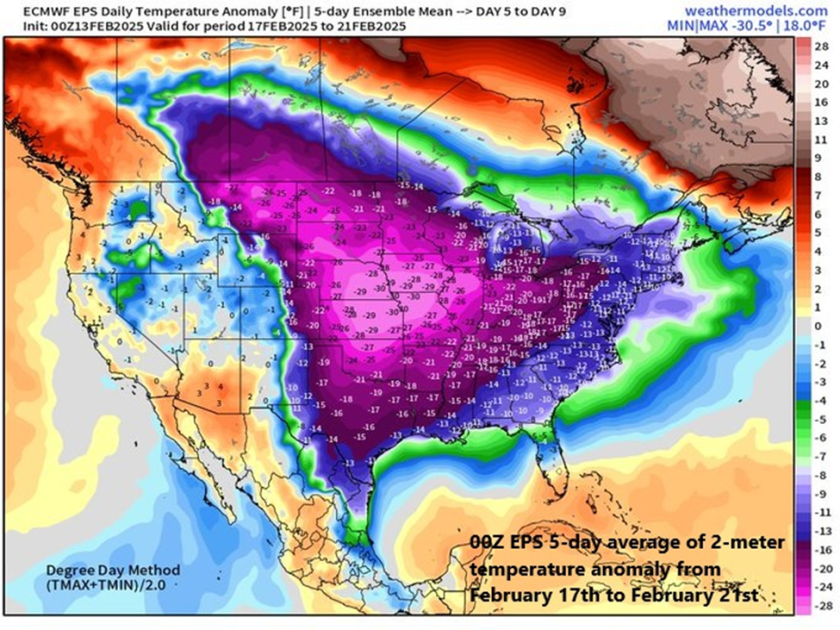
A very cold air mass will flood the northeastern states at the end of the upcoming weekend and next week looks very cold on average across the eastern 2/3rds of the nation. Map courtesy ECMWF, weathermodels.com (Dr. Ryan Maue, X)
Overview
A major storm system will pound the western states during the next couple of days and it will then trek across the nation and wreak havoc in the eastern states this weekend. In California, the rainfall in coming days will be heavy all along low-lying coastal sections from Oregon to the Mexican border, and snowfall will be measured by the foot in the Sierra Nevada Mountains. By the early part of the upcoming weekend, this same storm system will bring flooding rainfall to the Ohio and Tennessee Valleys and then significant snow is likely on Sunday across interior New York State and New England.
In the Mid-Atlantic region, there will be plenty of rainfall this weekend; however, it is likely to be preceded on the front-end by snow and accumulations are possible; especially, to the north of the PA/MD border. Cold air will pour into the eastern states following this weekend storm system and next week is indeed looking very cold across the eastern two-thirds of the nation. Low pressure is likely to gather strength in the southern states by the middle of next week aided by an influx of Gulf moisture and it could become a significant east coast storm threat by later Wednesday or Thursday.
A major storm will impact the western US during the next couple of days with significant rainfall in low-lying coastal sections and substantial snowfall in higher elevation locations. In fact, the snow will be measured by the foot in coming days across the Sierra Nevada Mountains of eastern California and substantial snow will fall in many of the Rocky Mountain States. Map courtesy NOAA, tropicaltidbits.com
Major storm crosses the country next few days
A strong storm system will pound California during the next couple of days with significant rainfall along low-lying coastal sections from Crescent City in the north to San Diego in the south. Substantial snow will fall across the higher elevations of the Sierra Nevada Mountains during this event with several feet in some spots by the latter part of the weekend. This same storm system will then cross the nation and reach the eastern states this weekend bringing flooding rainfall on Saturday to some areas such as the Ohio and Tennessee Valleys and significant accumulating snow to others on Sunday including interior New York State and New England.
The weekend will feature plenty of rainfall in the DC-to-Philly-to-NYC corridor; however, there can also be a quick thumping of snow on the front-end with accumulations on the table; especially, to the north of the PA/MD border. Any snow or sleet that does fall at the onset of the weekend event will change to rain by Saturday night and continue Sunday and some of the rain may be heavy at times. Map courtesy NOAA, tropicaltidbits.com
In the Mid-Atlantic region, the weekend weather event will range from cold and possible accumulating snow on the front-end to mild with plenty of rainfall in the middle and back-end. All of this will be followed by an influx of very cold air on Sunday night and Monday and the first half of next week will be very cold across much of the nation including the Mid-Atlantic region. On Saturday, precipitation may begin as a quick thumping of snow; especially, to the north of PA/MD border. Accumulations of a couple to a few inches are possible across eastern PA, central and northern New Jersey, and in the New York City metro area likely from the late morning to early afternoon hours. Even the DC metro region can experience some snow and/or sleet at the onset of the weekend event around mid-morning on Saturday and a coating or so is on the table. Later in the day, the precipitation will mix with and then changeover to rain and the rain will continue Saturday night and Sunday morning. Some of the rain that falls on Saturday night and Sunday morning can be heavy at times and a rumble of thunder cannot be ruled out. By later Sunday, strong low pressure to the north will drag a cold front through the region and temperatures are likely to plunge late Sunday/Sunday night from the mild levels achieved earlier in the day.
The Madden-Julian Oscillation or MJO is predicted to push through phase 8 and into phase 1 during the next couple of weeks (indicated by arrows, left plot) and these particular phases are typically correlated with colder-than-normal conditions across the central and eastern states (boxed regions in temperature composite maps, right). The colder-than-normal weather pattern that begins in earnest next week could last all the way into the month of March. Plot courtesy ECMWF, NOAA
Very cold next week…possible east coast storm threat mid-to-late week
The first half of next week looks to be very cold across much of the central and eastern US with particularly cold air centered over the central states. This outlook for colder-than-normal weather next week in the eastern half of the nation is supported by the movement of a tropical disturbance that is tracked by meteorologists using a teleconnection index known as the Madden-Julian Oscillation or MJO. Depending on its location (or “phase”) for the given time of year, it can provide clues as to the temperature patterns across the nation.
Next week is destined to be very cold across much of the nation and this colder-than-normal pattern could take us all the way into the month of March. The 2-meter temperature anomaly forecast map shown here for the 7-day period of February 20 – February 27 depicts much below-normal temperatures across the eastern half of the nation with a focus on the Midwest/Ohio Valley. Map courtesy ECMWF, Weather Bell Analytics
At this stage of the winter season, when the MJO moves into phases 8 and 1, temperatures are typically below normal across the central and eastern states. Indeed, it appears the MJO will push into phase 8 during the next day or so and then into phase 1 around February 22nd or so…this colder-than-normal pattern may even last right into the month of March.
The overall active weather pattern across the nation in recent weeks will continue through at least much of next week and one of the supporting factors has been powerful “jet streak” activity in the upper part of the atmosphere. This forecast map of 250 millibar winds for next Wednesday evening, February 19th, suggests strong surface low pressure may develop somewhere near the Mid-Atlantic coastline. Map courtesy NOAA, tropicaltidbits.com
By later Tuesday of next week, moisture will push northward into the Mississippi Valley resulting in snow to the north and rain down south. Low pressure over the northern Gulf region will then make a move to the northeast and head towards the Atlantic seaboard and it will encounter plenty of cold air across the Mid-Atlantic region. Exactly how far this system moves up along the east coast remains to be seen, but the threat is there for a significant impact in the Mid-Atlantic region by the middle or latter parts of next week…stay tuned.






You must be logged in to post a comment.