I Once Pushed for Strict Climate Targets as an MEP But I Changed My Mind: Here’s Why

What about Europe? We are still largely alone in our climate efforts. We never achieved a global deal. Our unilateral and expensive climate measures cannot truly be considered ‘climate’ politics. They can be described as the decarbonisation of production or the outsourcing of jobs or emissions, but despite the best intentions, the EU strategy has so far not tackled the global problem on a global scale.

From The Daily Sceptic

By Eija-Riitta Korhola

This is the ninth in a series of 13 articles challenging climate change orthodoxy commissioned by Professor Gwythian Prins. We will be publishing the articles at a rate of one a week (read the first article here, the second here, the third here, the fourth here, the fifth here, the sixth here, the seventh here and the eighth here). The hope is that they can be collected into a book for Sixth Formers and university students.

When I entered politics roughly a quarter of a century ago, human-induced climate change was my primary reason for running in the 1999 European elections and, at that time, I considered it the greatest threat to humanity. I began my journey in the European Parliament Committee for Environment as an active climate legislator and attended most of the UN climate COP (Conference of the Parties) meetings as a member of the parliamentary delegation. I also served on a temporary Climate Change Committee in 2007, aiming to influence all possible climate and energy related issues.

My years as a lawmaker and a COP attendee have significantly shifted my perspective. Over this period, I’ve observed the environmental movement – and consequently the COPs, the Greens and the Commission – alter their stance on nearly all key climate policy instruments. I’ve witnessed numerous pendulum swings, with efforts to try to correct policies pursued with equal fervour as the original measures. Biofuels and the attitude towards biomass energy use are prime examples. The result has been a bipolar approach, swinging from one extreme to another, which has decisively weakened Europe’s investment environment.

After witnessing our grandiose, expensive, yet ineffective policies, I even feel compelled to ask: which endangers our security more, climate change or current climate policy? Naturally, I must justify such an audacious question. I owe an explanation for what happened during my career as a legislator. I’ve addressed this in my doctoral dissertation, ‘The Rise and Fall of the Kyoto Protocol – Climate Change as a Political Process’ (2014), where I detail the mistakes made in the name of climate policy – errors that have, unfortunately, often harmed the environment.

For many, the fight against climate change is synonymous with the Kyoto Protocol and its UN framework. In my thesis, I analysed its most relevant elements and ideological assumptions. The climate problem has been presumed to be more one-dimensional than it truly is, leading to excessive simplification. The protocol has constrained leaders with climate puritanism and a politics of limitation, ultimately resulting in a series of failures.

Firstly, it’s fair to say that the success of climate actions has been disturbed by massive and unpredictable globalisation. Between 1997 and 2002, nobody anticipated that China, India and parts of South America would absorb industrial production so forcefully from Europe and the US. The emission share of Kyoto-target countries was marginalised, falling from 63% at the protocol’s entry into force to just 13% under Kyoto II.

The Kyoto Protocol proved ineffective in positively influencing this development. In the case of industrialised nations, no significant differences in rates of CO2 decline can be traced between countries that had undertaken Kyoto obligations and those that had not. The Kyoto Protocol’s ratifiers fared no better than non-ratifiers.

We need to question if there’s something inherent in the structure of the Kyoto approach that hampered its efficiency. According to many climate policy researchers, numerous factors are at play, from the analysis of the problem’s nature to its basic assumptions, flawed tools and remedies.

Ideology and power dynamics

The foundation for the Kyoto Protocol was laid in the 1980s and 90s. That entire era was characterised by the rise of the environmental movement and its ideological mindset, which is reflected in the Kyoto agreement’s toolkit and the nature of the COP process. This is clearly seen in the case of nuclear power. While COP3 in Kyoto in 1997 indicated that nuclear power would gain more support, by COP4, critical factions were better organised, gathering new opponents. The harmful results of nuclear power were eagerly listed, an attitude that dominated the COP culture for years.

From the very beginning, phasing out nuclear power has been the number one priority for the environmental movement. Their argument often appeals to future generations, claiming nuclear energy ‘hands the problem over to them’. However, this prioritisation has, in practice, significantly increased the world’s environmental problems: air pollution, forest destruction, the expanded use of fossil energy and the numerous accidents caused by it. These problems, too, are delegated to future generations. It is therefore noteworthy that the only form of energy with historical evidence of significant emissions reductions is shunned by those who demand an urgent reduction in CO2 emissions.

Adaptation was a similar taboo. For a long time, environmental organisations opposed measures promoting adaptation to climate change. Al Gore was one of the most impressive opponents of adaptation. In 1992, he stated that it represents “a kind of laziness, an arrogant faith in our ability to react in time to save our skins”. Emission mitigation and adaptation to climate change were seen as mutually exclusive alternatives in climate conference culture. The first option was considered the right way to solve the climate change problem, while the latter was seen as an undesirable policy reflecting a reprehensible attitude. Adaptation was only gradually accepted onto the climate conferences’ official agenda after less-developed countries began to demand it. The 2010 Hartwell Paper was one of the most prominent high-level policy documents to argue for ‘no regrets’ adaptation in contexts of imperfect knowledge and it was castigated by Gore and his kind for doing so. Yet the passage of 15 years has shown the Hartwellians to have been right all along.

The overemphasis on mitigation at the expense of adaptation has been an error stemming from fundamentalism, an error that has been responsible for many deaths, especially in developing countries. The actual prevention of damages and actual adaptation to change in the real world have been viewed as a threat to the viability of mitigation (reduction) policy.  Paradoxically, and from a political standpoint, this has significantly slowed down the process of making society more resilient to extreme weather events. In some sense, all societies have been poorly prepared for climate impacts. Therefore, it is necessary to develop technologies, institution, and practices to minimise risks, from weather-proof civil engineering to early warning systems. These are necessary in any case – ‘no regrets actions’, in the Hartwell phrase. It is immaterial whether the cause is human-induced or natural.

I also see unwelcome ramifications in the starting point of setting a ceiling for emissions. From my philosophical studies, I learned that it’s always useful to question things taken for granted. So I ask: why a ceiling? Why not a floor? Regarding greenhouse gas emission reductions, I no longer believe in a policy of restriction and emission ceilings.

Why? They produce results too slowly, and they mostly just pass problems back and forth in the planet’s atmosphere as they transfer emissions from one place to another. Moreover, by focusing mainly on carbon dioxide, other serious environmental problems have been neglected. It could be much more effective to pursue reasonable and necessary political measures: decarbonisation, pollution prevention, combating poverty and biodiversity loss, afforestation, energy savings, clean energy and adaptation. Merely fixating on binding ceilings can lead to self-delusion, interpreting emission reductions resulting from economic recession as a genuine achievement.

Another form of self-deception lies in the criteria of emission source. The basic problem of the Kyoto Protocol was that it did not pay attention to consumption, only to production. A country’s emissions cover all production that has taken place there; thus, the Protocol would punish countries with energy-intensive production, even if that production was generated with the lowest possible emissions. Instead, consumption, which should be decisive and could be a reasonable method for political steering, was practically not considered at all. We must remember that the consumer is the polluter, not the producer. It may come as a surprise to many that during our climate actions in Europe, we have actually increased our emissions.

COP meetings, the summaries of the IPCC’s reports and the media reporting brought a new kind of climate narrative based on catastrophe talk and the discourse of fear. This alarmist rhetoric cultivates words like ‘chaos’, ‘catastrophe’ and ‘destruction’, and its tone is often quite rushed. It exploits the quasi-religious vocabulary of doomsday. It also created a new kind of climate moralism with the measurement of carbon footprints; and as Mike Hulme has argued for many years, and in his article in this collection, it is both a pernicious distraction and subversive of trust.

Inciting climate panic and pursuing emergency policies is dangerous because it leads to short-sighted solutions and ill-considered actions – as we have seen in legislation that swings from one extreme to another. It has also resulted in power being handed over to environmental organisations in the hands of activists and constraining the authority of democratically elected governments. Climate emergencies created by green populism can threaten constitutional rights and justify the suspension of normal politics.

Paris agreement and geopolitics

After Kyoto I and II, we got the Paris Agreement 10 years ago. It was called a paradigm shift: a non-binding ambitious treaty. It was an oxymoron, to be honest.

It can be argued that the agreement does not impose any significant, binding substantive obligations on the parties. Yet, regarding the final goal, it sets the objective of limiting the global average temperature increase to well below 2°C or even 1.5°C in a context where we have no idea what coupling to global temperatures CO2 actually has. This means that, collectively, it obliges the ratifying states to the technically impossible, while the agreement does not bind them as individual countries at all.

Does this gap between ambition and obligation pose a problem? Will this paradoxical starting point produce results? And on what terms?

Many observers have called this combination of a tough target on the one hand and non-binding commitments on the other a form of self-deception. Is it any more binding than wishing everyone a Merry Christmas and a Happy New Year? So, why did all the stakeholders celebrate? Especially, why did the environmental NGOs celebrate and even shed tears of joy? Normally, after COP meetings, they publish press releases criticising the lack of ambition.

The Kyoto framework, being a single, massive, binding and integrated deal, was simply too unrealistic for countries with very different interests and capabilities. This time, stakeholders wanted to avoid the US Senate becoming an obstacle to ratification: a binding treaty would have required that.

It has been very clear for a long time that the EU climate strategy, based on the Kyoto framework, did not attract the major emitters, who favour multiple strategies and different climate clubs.

I return to my question about environmental NGOs. Why did they celebrate after Paris? By failing to close the gap between ambition and obligation, the Paris Agreement created a serious problem for governments, leaving a void to be filled by non-governmental actors. Here I quote a Dutch professor of international environmental liability law, Dr Lucas Bergkamp:

The ambition-obligation disparity creates a large arena for climate activism at international and national levels, effectuating a transfer of power… that is inconsistent with the fundamental principles of constitutional government. If the collective efforts appear to fall short of achieving the Paris Agreement’s objectives, the judiciary is likely to be dragged into climate policymaking.

In other words, here comes more ‘lawfare’; as indeed it has, usually riding on the spurious concept of superordinate an ‘international law’ of ‘human rights’. Great Britain is a world leader in such ‘lawfare’ under its present government of human rights lawyers, as witness the bizarre surrender of sovereignty over the Chagos Islands.

Thus, the Paris Agreement paves the way for the new international ‘climate governance’ movement. Its implicit reliance on political activism by the climate movement and the related non-hierarchical governance by courts constitute a threat to constitutional government, the rule of law and representative democracy. It risks an unconstitutional usurpation of power by activist groups and unelected and unaccountable judges that could undermine legislative power and the role of positive law in deciding legal disputes. This risk of subversion is not well understood by politicians and governments.

Europe’s position

What about Europe? We are still largely alone in our climate efforts. We never achieved a global deal. Our unilateral and expensive climate measures cannot truly be considered ‘climate’ politics. They can be described as the decarbonisation of production or the outsourcing of jobs or emissions, but despite the best intentions, the EU strategy has so far not tackled the global problem on a global scale.

The EU commits to a Net Zero target by 2050, while countries like Russia and China are bound by practically nothing. Compare and contrast: last year, China built a record amount of coal power while, according to European Commission estimates, the Net Zero target costs the EU €1.5 trillion annually.

I find this situation surrealistically insane. Only a special kind of stubborn orthodoxy prevents many from seeing and saying it aloud. We are starting to reinvest in deterrence and defence across Europe. At the same time, we are undergoing a drastic unilateral disarmament in the economic sphere in the name of ‘climate leadership’. This happens in two ways. First, China gains an economic competitive advantage for its products in the global market. Second, because of our energy policy, we in the EU have become increasingly dependent specifically on Chinese technology, much like Germany became dependent on Russian energy with its Energiewende. What is the sense in that, please?

Dr Eija-Riitta Korhola was an MEP from 1999-2014. She served as Chairman of the European Parliament Environment Committee, in which capacity she attended most of the COPs. She was also a member of the Hartwell Group.

The Myth of Chancellor Merz Has Collapsed

The Chancellor has no clothes.
Merz has always been just some loser. He’s a third-rate talentless politician and in this much like his predecessor, Olaf Scholz. Both are mere caricatures, what happens when you mimeograph overmuch the last century’s tired political styles.

The Chancellor has no clothes.

From The Daily Sceptic

By Eugyppius

Merz has always been just some loser. He’s a third-rate talentless politician and in this much like his predecessor, Olaf Scholz. Both are mere caricatures, what happens when you mimeograph overmuch the last century’s tired political styles. These kinds of Chancellors will continue to exist only so long as they can be sold to the geezers of the Federal Republic’s care homes by the amateurish marketing campaigns of a complicit state media as the incarnation of far-sighted competence and (more importantly) bourgeois respectability.

Merz just now: “On social media any anon can just say what he thinks and how he thinks. I find that unfortunate.” https://t.co/cO1eWVhsjY— eugyppius (@eugyppius1) April 30, 2026

Early in 2025, Merz had the chance to seize a measure of power for himself and make facts. He could have forged a deal with Alternative für Deutschland on the most important questions, established a minority government and set about force-marching the obese German state through necessary reforms. It might’ve torn his party apart, he might’ve failed, there would’ve been a huge fight, but whatever happened nobody would ever forget Chancellor Merz. Instead, the Pigeon Chancellor let a lot of deranged Antifa street protesters and screeching women with parareligious concerns about atmospheric carbon dioxide concentrations dissuade him from the only reasonable path. Instead of making history, he chose to spend the first year of his Chancellorship making the Social Democrats fat and happy at the expense of the nation. Most don’t even hate Merz, because hate like love has to be be earned. He inspires nothing more than mildly scornful indifference.

Everyone who was not a complete idiot knew that Merz’s mad coalition with the Social Democrats could never work. Yet the man has been lionised in the international press and even in centre-Right domestic papers like the Frankfurter Allgemeine Zeitung as a serious reformer. These people told us Merz would rebuild the Bundeswehr, reduce insane social spending, impose fiscal discipline, solve the migroid problem and restore economic growth. Even if the Leftoid half of the German establishment press didn’t embrace all these myths, they nevertheless worked hard to make Merz seem presentable, serious and viable. He was worth a shot, he would do his best, and after the crazy Scholz years Germany was back on solid footing.

Now, in the the space of about two weeks, the entire myth of Chancellor Merz has collapsed. Major papers that used to defend his government and praise his prospects are suddenly saying it’s over. They’re writing front-page editorials in the spirit of stuff I was posting here over a year ago. Merz appears at town-hall meetings where he gets asked how he’s made life better in Germany and before he can answer the audience just laughs at his stupid ass. His coalition partners say he’s doing a terrible job. Backbenchers from his own party are calling his political strategy a failure to his face and leaking it afterwards to the press so everyone knows what they said.

Still worse, people from the Chancellery are talking to the tabloids. They’re explaining that Merz’s Government has been hanging by a thread since at least last December; that his party thinks he’s a pushover whom the SPD constantly manipulates; that often Merz just absorbs the opinions of whatever person he last talked to and so his handlers have to limit his contacts to keep him from going off-message in insane ways; that Merz is now almost totally isolated, having burned through most of his close confidants; and that nobody has any solutions or ideas and increasingly everybody doubts that the Chancellor has the talents to save himself.

We have here before us the final stages of an inexorable, terminal process. In this story Merz’s role is but a late and a small one; Merkel wrote the early chapters, and regular installments will continue until the Federal Republic is destroyed or politically reconstituted. Every Chancellor is going to be a bigger joke, even weaker and more ineffectual and more retarded than the last one. Every government is going to be even more paralysed and ridiculous than the heretofore most paralysed and ridiculous government that preceded it. Our industry will waste away while new taxes sprout like weeds, rail will grow less reliable and tickets more expensive, health insurance premiums will increase and medical care will get worse, schools will just get shittier and shittier. There will be no answers, no fixes and no succour, until the devolution is complete.

The problem is not merely the demise of a single Chancellorship or a solitary party, but of an entire political world. Thus even longstanding Merkelian éminences grises like Peter Altmaier have begun to refer to our situation as a “crisis of the state”. Since its founding in 1949, the Federal Republic has been so closely identified with the two great people’s parties – the CDU and the SPD – as to be effectively inseparable from them. Other nations like France have extremely fluid political systems, but in Germany a combination of prior conservative cultural tendencies and a burdensome, deliberately enfeebling constitution has yielded one of the most inflexible political cartels Western parliamentary democracy has ever seen. The Social Democrats are already in a state of advanced decay, and now the Union parties are following them to a similar fate.

What awaits us at the bottom of our freefall is either a total reconstitution of the uniparty around Alternative für Deutschland and the Union in some dwarfed, reduced form; or an AfD ban and an institutionalisation of Leftist rule in a less dogmatic reincarnation of the German Democratic Republic. The former seems vastly more likely right now, but of course that could easily change. Because we don’t know what will happen when we try to run different political software on our slow, overburdened constitutional hardware, it’s impossible to say whether the Federal Republic can even survive this resolution, and in no scenario will more than a portion of the present political elite make the squeeze.

Other countries would’ve adopted half-measure reforms to head off the cataclysms that are coming for us years ago, but not Germany. It is in our ethnic character to do everything longer, harder and in more determined suicidal fashion than everybody else. We must take everything to the absolute extreme to demonstrate our moral commitment, in the process proving to everyone else how stupid our ideological persuasions actually are. In this way our worst politics will sooner or later become their own refutation and their own undoing. Unfortunately the whole process takes a long time and is both extremely destructive and eye-wateringly expensive.

This article originally appeared on Eugyppius’s Substack newsletter. You can subscribe here.

The Crash of London’s Latest LTN

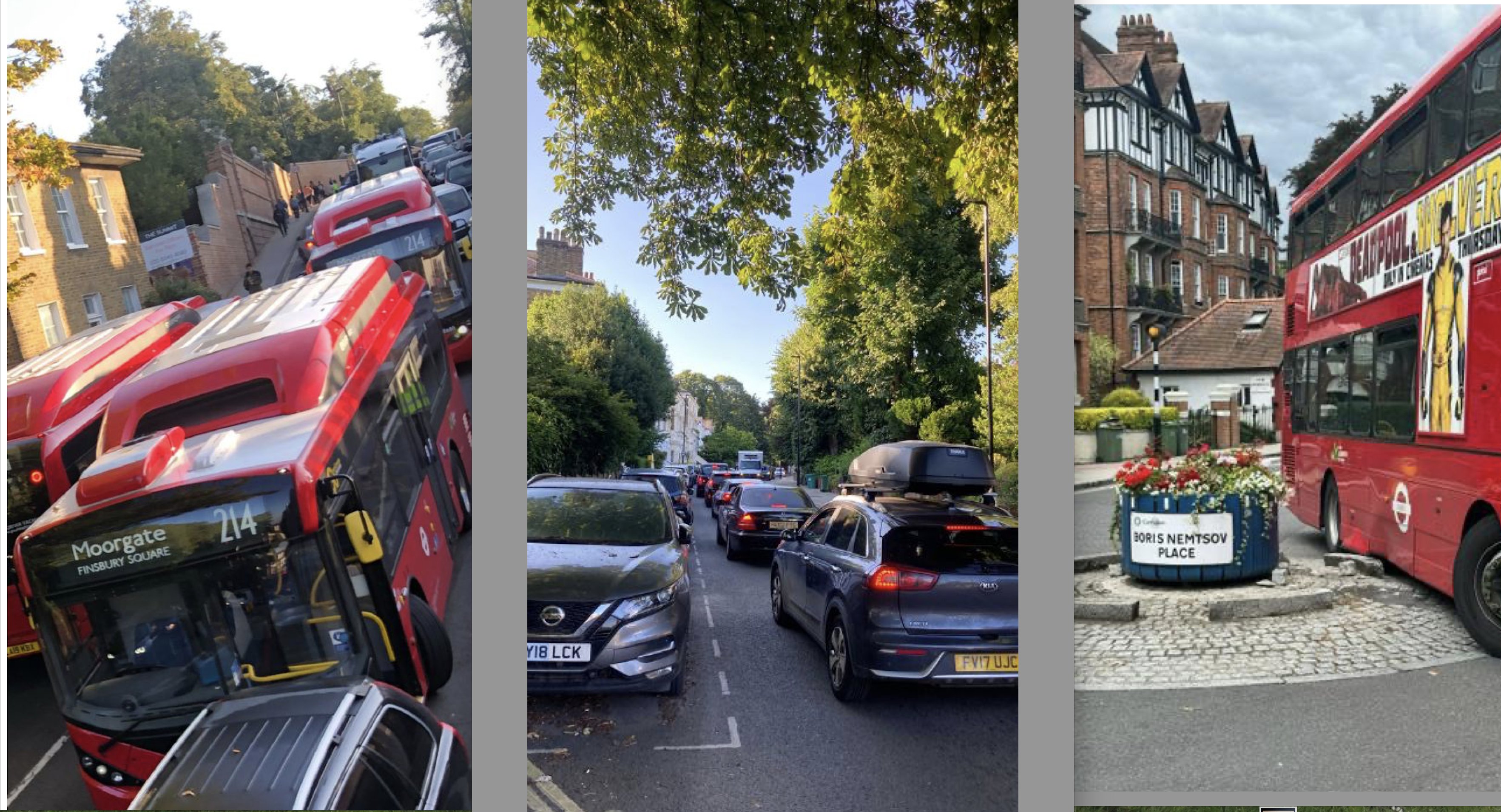
The Labour-run London Borough of Camden (LBC) has been forced to scrap a hugely controversial Low Traffic Neighbourhood (LTN) scheme centred on Dartmouth Park on the eastern edge of Hampstead Heath – home to Ed Miliband, Benedict Cumberbatch and numerous other Labour luvvies. The plan had been to impose an 18-month ‘trial period’ with the least possible public consultation.

Gridlock on Highgate West Hill, which the proposed LTN would make far worse (photos: dphnjointaction.com)

From The Daily Sceptic

By Mike Wells

The Labour-run London Borough of Camden (LBC) has been forced to scrap a hugely controversial Low Traffic Neighbourhood (LTN) scheme centred on Dartmouth Park on the eastern edge of Hampstead Heath – home to Ed Miliband, Benedict Cumberbatch and numerous other Labour luvvies. The plan had been to impose an 18-month ‘trial period’ with the least possible public consultation.

Attempting to put the best spin on it, LBC calls this a “pause”, but the scheme – a pet project of cycle-fanatic Cllr Adam Harrison, “Cabinet Member for Planning and a Sustainable Camden” and CBC’s Deputy Leader – was always unworkable. Uproar among locals, who discovered Camden’s brief ‘nonsultation’ was to be held during last summer’s holidays, was led by the Highgate Society which commissioned expert analysis of LBC’s dodgy metrics.

Locals packed protest meetings and deluged their council with complaints, not least about the scheme’s obvious potential for raising money by fines. With vehicle access from the north, east and south denied to thousands of homes in the LTN, voters demanded to know how ambulances, deliveries and visitors could reach them, or how anyone less than 100% fit would be able to get the shopping home?

Among many issues they highlighted were inevitable gridlock on Highgate Road, Highgate West Hill and other bus routes on the proposed LTN’s boundary, and increased air pollution on children’s walking routes to the area’s schools – ironically the same good schools which attract so many upwardly-mobile Labour supporters to leafy Dartmouth Park’s expensive homes.
 

Highgate West Hill is frequently disrupted by emergency repairs to water mains and flooding caused by natural springs (photo: dphnjointaction.com)

Having wasted vast amounts of TfL’s money on consultants while plotting Dartmouth Park’s LTN in secret, Camden’s Labour regime has been handed an expensive lesson in not annoying one’s diehard voters. Its problems include a private company called Commonplace, and an unusually articulate local population.

Commonplace Digital Ltd is a privately-owned “citizen engagement platform” which claims to “inspire thriving places, powered by data and collaboration”. On its touchy-feely website rows of smiley, young and casually-dressed “customer success managers” and “business development managers” promote the platform.

What Commonplace actually does is to sell machine-readable online surveys to councils and developers – relieving them of the trudge of asking local people what they think and reading the responses properly, while still getting the result they first wanted via an ostensibly democratic process.

The snag, as we in Bedfordshire know to our cost, is in the questions asked and the boxes you’re allowed to tick. Our council’s Commonplace survey on local cycling and walking issues produced 826 responses, of which over 100 tried to explain – only possible in the “other comments” box – that by far our worst problem is how to get across the A1 safely into Biggleswade without using a car: a walk/cycle underpass is needed, obviously.

Chancing the A1 at Biggleswade (photo: Mike Wells)
Waiting to cross the A1 at Biggleswade (photo: Mike Wells)

But in its published LCWIP plan, based on this “engagement”, Central Beds Council felt able to ignore the lethal risks run by locals trotting or wheeling their children across the A1 carriageways, because the online Commonplace survey had asked no machine-readable question about it. The metrics didn’t prove a need, which happily allowed CBC and National Highways to carry on ignoring the danger.

People are increasingly suspicious of the skewed questions asked in Commonplace surveys, and in the case of Camden’s proposed Dartmouth Park LTN, many refused to participate. Instead, 773 locals emailed their council direct, as well as emailing individual councillors. Here in Beds our ward councillor just leafleted over 800 locals about our Biggleswade problem, asking what they need to get onto town safely, and the scores of replies were a revelation.

Ask people what they really think, without leading questions or tick-boxes, and what you get is ‘quote gold’. Many said roughly what was anticipated, though in their own inimitable words; others made important points that hadn’t even occurred to campaigners. Analysing genuine replies like these – as opposed to machine-readable surveys – takes time and thought, and Camden is now having to go back to the drawing board and read its hundreds of non-Commonplace responses, acutely aware that having wound up the Highgate Society and Dartmouth Park’s vigilant locals, its cunningly-worded online “consultation” cannot alone justify imposing a disastrous LTN.

German Political Establishment Responds to Trump with Idiotic Constitutionally Anchored Pledge to Deindustrialise in the Next 20 Years

I’m hosting family, so this won’t be a long post, but the story of Friedrich Merz’s debt brake overhaul continues to be one of the greatest political farces I have ever seen, and I need to get this off my chest.

From The Daily Sceptic

By Eugyppius

I’m hosting family, so this won’t be a long post, but the story of Friedrich Merz’s debt brake overhaul continues to be one of the greatest political farces I have ever seen, and I need to get this off my chest.

Let us summarise, briefly, what has happened so far:

  • The CDU is the party of fiscal responsibility. His Triviality the Pigeon Chancellor Friedrich Merz presented himself throughout the campaign as an unusual fan of Germany’s constitutionally anchored debt break. He told everybody that he could not imagine ever borrowing in excess of 0.35% of annual GDP, so interested was he in limiting the tax burden of future generations.
  • All of the while, Merz and his advisers were scheming in secret about how they might overhaul the debt brake, firstly because they could not give the slightest shit about the tax burdens of future generations, and secondly because they spent the months since November 2023 observing what happens when a government that has no ideas is also deprived of money. “I have no ideas,” Merz said to himself during this time. “What happens if like Olaf Scholz I also end up with no money?”
  • Exactly two weeks ago, US President Donald J. Trump and Ukrainian President Vladimir Zelensky had a verbal spat in the Oval Office. This spat put the fear of God into the Eurocrat establishment, for whom the Ukraine war has become a sacred and essentially religious cause. Merz capitalised on the panic to unveil his massive debt spending plan. He and his would-be coalition partners, the Social Democrats, announced that they wished to spend €500 billion of debt on “infrastructure” and untold hundreds of billions of debts on defence. This would entail adjustments to the debt brake, in the same way setting your house on fire would entail adjustments to your living arrangements.
  • This massive spending package will require a constitutional amendment, which can only be achieved with a two-thirds vote of the Bundestag. In the newly elected Bundestag, Die Linke and AfD will be in a position to block this amendment and Merz will be stuck with the debt brake. Thus, Merz wants to break the debt brake in the final days of the old Bundestag – a strategy that has put him in the amazing position of grovelling before the election’s biggest losers. Specifically, Merz has spent the past few days feverishly negotiating with the Green Party, who will not even have any role in his Government, just to get it to sign off on his insane spending plans.

I wrote a lot here and on X about the election nightmare scenario I called the “Kenyapocalypse” – a hypothetical in which the Greens and the Social Democrats would each be too weak to give the Union parties a majority on their own, such that Friedrich Merz would be forced to negotiate a coalition deal with both of them at once. In the end, Kenyapocalypse did not happen; the CDU avoided it by a razor’s breadth. Merz, however, turns out to be such a monumental retard that he has managed to recreate a simulacrum of Kenyapocalypse for himself. The man has been on his knees kissing not only Social Democrat but also Green ass for days. He has been begging the Greens to sign onto his debt plan, and the Greens have finally agreed, in return for the following concessions:

  1. The “defence” funding that will be exempt from the debt brake is to be defined as widely as possible. All kinds of things will count as debt brake-exempt “defence” spending now, probably including various climate nonsense.
  2. The €500 billion “infrastructure” debt is to include €100 billion specifically earmarked for the “Climate and Transformation Fund” – the central financial instrument of the energy transition. This is basically infinity windmill money; you might as well set it on fire. Beyond this specific allocation, any projects that contribute to making Germany “climate neutral by 2045” will also be eligible for the €500 billion exception. This whole thing will be a massive wad of debt for Green nonsense and I would like to take this moment to laugh at everyone who told me how happy I should be that Merz was trying to fix Germany’s bridges with this debt bullshit. Nothing of the sort is going to happen.
  3. You will note that the explicit goal of achieving “climate neutrality” by 2045 is slated to be among the very few positive political points anchored in the German constitution. “Climate neutrality” is a more expansive concept than mere “carbon neutrality” or Net Zero. It describes a utopian state of affairs in which human actions have no influence on the climate whatsoever.

These are prizes the Greens could not achieve even at the height of their influence in the 2021 elections. Strictly speaking, the entire traffic light coalition fell apart over a matter of €3 billion. Now the Greens are getting €100 billion for free, all because Merz is determined to become Chancellor whatever the cost.

This deal is an abomination, and I despair that it can no longer be stopped. The constitutional court in Karlsruhe has rejected attempts to block this manoeuvre, which I expected – the old Bundestag, as long as it still exists, cannot be limited in its prerogatives. The best option now is for Alternative für Deutschland and Die Linke (the Left Party) to join forces and compel the new Bundestag to constitute itself, ahead of the scheduled vote by the old Bundestag. For this, we need a mere 25% of the new Bundestag to agree, but the Left Party is so far withholding its cooperation. There is but one true opposition party in Germany, and that is the AfD. Love it or hate it, it is on the right side of these issues again and again, and I hope it can bring Die Linke around.

This article originally appeared on Eugyppius’s Substack newsletter. You can subscribe here.

VP J.D. Vance Spanks EU Elites: ‘If America Can Survive 10 Years of Greta Thunberg’s Scolding, You Guys Can Survive a Few Months of Elon Musk’

Vice President J.D. Vance delivered his first major speech in Europe on Friday speaking at the Munich Security Conference in Germany.

During his speech VP Vance did not hold back – just like his boss!

From Climate Depot

By Marc Morano

by Jim Hoft

Vice President J.D. Vance delivered his first major speech in Europe on Friday speaking at the Munich Security Conference in Germany.

During his speech VP Vance did not hold back – just like his boss!

J.D. Vance, the former attorney, US Senator, and Marine Corps veteran from Ohio, blasted the EU elites who threaten Elon Musk and insist on ridding the continent of free speech.

J.D. Vance did not hold back reminding the Europeans about their nauseating record of lecturing Americans with bratty children like anti-Semite Greta Thunberg.

Vice President J.D. Vance: More and more all over Europe, they’re voting for political leaders who promise to put an end to out-of-control migration. Now, I happen to agree with a lot of these concerns, but you don’t have to agree with me. I just think that people care about their homes, they care about their dreams, they care about their safety and their capacity to provide for themselves and their children, and they’re smart.

I think this is one of the most important things I’ve learned in my brief time in politics, contrary to what you You might hear a couple of mountains over in Davos, the citizens of all of our nations don’t generally think of themselves as educated animals or as interchangeable cogs of a global economy. It’s hardly surprising that they don’t want to be shuffled about or relentlessly ignored by their leaders. It is the business of democracy to adjudicate these big questions at the ballot box.

I believe that dismissing people, dismissing their concerns, or worse yet, shutting down media, shutting down elections, or shutting people out of the political process protects nothing. In fact, it is the most surefire way to destroy democracy. Speaking up and expressing opinions isn’t election interference.

Even when people express views outside your own country, and even when those people are very influential.

Trust me, I say this with all humor, if American democracy can survive 10 years of Greta Thunberg’s scolding, you guys can survive a few months of Elon Musk. But what no democracy, American, German, or European, will survive is telling millions of voters that their thoughts and concerns, their aspirations, their please for relief, are invalid or unworthy of even being considered. Democracy rests on the sacred principle that the voice of the people matters. There’s no room for firewalls. You either uphold the principle or you don’t.

Vice President J.D. Vance is going to steal our hearts if he doesn’t watch it!
Bravo!

Only bad people get their news from social media and believe “conspiracy theories”

The trick in this “peer reviewed” propaganda is how they define civic values. You might think it means checking on elderly neighbors, donating to charity, or volunteering at the Scouts, but actually “Civic values were defined as an individual’s belief in democratic institutions “. So if you question parliament or universities you are not a good citizen. The institutions are sacred!

From JoNova

By Jo Nova

The Blob are afraid they will lose even more followers to social media…

Academics and the old dying media have produced a study that “shows” people who believe social media posts are bad people. The message here for believers is that only horrible people get their news from sites like X or TikTok.  Those selfish people score badly on civic values.

The trick in this “peer reviewed” propaganda is how they define civic values. You might think it means checking on elderly neighbors, donating to charity, or volunteering at the Scouts, but actually “Civic values were defined as an individual’s belief in democratic institutions “. So, if you question parliament or universities, you are not a good citizen. The institutions are sacred!

This transparent paper is just a get-out-of-jail free card for sloppy, self-serving academics. Mike Benz warned us that the Blob redefined “democracy” as “democratic institutions” in 2016, which meant people could be tarred with the “anti-democratic” brush if they criticized the “essential institutions” of democracy, like elections, insurrections, vaccines, or senile Presidents.

The left destroy the meaning of words to deceive their flock. The right let them get away with it.

Australians who get most of their news from social media more likely to believe in climate conspiracy, study finds

Amanda Meade, The Guardian

Those who believe global heating is a conspiracy get most of their information about news and current events from commercial and social media, according to a study by researchers at Monash University.

The study, led by Prof Mark Andrejevic and Assoc Prof Zala Volcic, found that those who relied on social media as the main source of news scored lower on a measure of “civic values” than people who relied on newspapers and non-commercial media.

Civic values were defined as an individual’s belief in democratic institutions and practices, as well as their openness to considering perspectives that challenged their own.

Of course, having redefined “civic values” they can also define “conspiracies” any way they want. Even if a Nobel Prize winner is not convinced about a wild hypothesis invented by B-Grade modelers, just call it a conspiracy…

For the climate change question, researchers asked whether “fluctuations in the climate are the result of natural cycles that take place regardless of human activity”.

Of those who got most of their news from commercial TV and radio, 37% agreed with the statement. Of those who got most of their information from social media, 25% believed climate change was a conspiracy.

To rephrase, nearly 40% of the people said climate fluctuation is natural, which presumably the team at Monash would call a “conspiracy”.  The Sun colludes with the moon-wolf or something.

But the social purity of the ABC radio audience is 98%. These publicly funded “journalists” are practically offering hypnosis. Obviously they never present both sides of the story. If they did that, the ABC audience would form more a bell curve of opinions, rather than a religious believer 98:2 split.

Conversely, those who disbelieved in conspiracies about climate change were more likely to get their information from public broadcasters ABC and SBS. Only 2% of those whose main source of information was public radio and 6% of those whose main source was public television believed the climate crisis was a conspiracy.

So 98% of public radio listeners all think the same thing on a complex topic, and this is supposed to be a sign of a healthy democracy?

But the good news is that 60% of Australians mainly get their news from social media sources. No wonder the Blob is aquiver. Only 34% got their news from Channel Seven, Nine and Ten, and just 6% got it from ABC or SBS public broadcasters.

REFERENCE

How the Blob Sneaks Net Zero Amendments into British Laws

The dark financial tentacles of the Green Blob help curate mainstream media, brainwash young children, fund large areas of climate pseudoscience, initiate and finance lawfare operations and bankroll countless ‘grassroots’ agitprop operations. But political influence is highly prized, so local government representatives and city mayors are prime targets. Alas, these people come and go at the fickle whim of local electors.

From The Daily Sceptic

By Chris Morrison

The dark financial tentacles of the Green Blob help curate mainstream media, brainwash young children, fund large areas of climate pseudoscience, initiate and finance lawfare operations and bankroll countless ‘grassroots’ agitprop operations. But political influence is highly prized, so local government representatives and city mayors are prime targets. Alas, these people come and go at the fickle whim of local electors. But not so the unelected members of the British House of Lords, who have considerable powers of altering proposed legislation from the elected House of Commons. It is hardly surprising that the noble lords and ladies have been targeted by the Blob given the potential for inserting Net Zero mischief into almost every type of legislation. Step forward Peers for the Planet (P4P), which claims a ‘caucus’ of 160 members, but was started as an activist body and is funded by sizeable contributions from the usual billionaire foundations.

The operation appears to have been set up around 2020 by Lynette Huntley, the former Chief of Staff at Channel 4 TV. In a recent podcast she explained that she was attracted by harnessing all the skills of members of the Lords to the complexity and scale of climate change. A number of Net Zero obsessives such as Baroness ‘Rosie’ Boycott are listed as Directors responsible for oversight while a cross-party advisory panel lists other hydrocarbon haters such as former Green Party leader Baroness ‘Natalie’ Bennett. There is a claimed ‘caucus’ of 160 members, although few are mentioned by name, and the group is run by a number of full-time employees with considerable expertise in promoting political causes.

None of this can occur without the help of large amounts of money and this comes from many of the foundations familiar to regular readers of the Daily Sceptic. Laudes and the Climate Change Collaboration are regular providers of green cash, but it is interesting to note the appearance of a couple of smaller funds operating at the more colourful end of the market. The Pickwell Foundation’s two interests are people displacement and climate. Support is given to migrants who have been displaced due to a number of reasons including “economic necessity”. The help is said to extend to people seeking sanctuary “through irregular routes”. According to P4P, its funders “have no involvement in the day-to-day work of the group”. Pickwell seems to take a different view. “As well as providing financial support, we also want to actively engage with the work and campaigns of our partners and to provide whatever advocacy we can,” it observes.

Another helpful cash fund, operating no doubt out of the goodness of its heart, is Gower Street. It sprays its largesse around a number of other Westminster activist operations including the Labour Climate and Environment Forum and the Conservative Environment Network. Meanwhile, Climate Emergency U.K. is helped to “inspire and organise local council climate action”, while Fossil Free Pride aims to “end the links between climate wreckers and queer culture”. Funding for a new Extinction Rebellion offshoot, run by old XR hands Gail Bradbrook and Stuart Basden, helps “make good on the potential of Extinction Rebellion”.

The P4P money obviously helps fund a considerable propaganda effort and shows how the activists attempt to change legislation reviewed in the Lords. The footling Football Governance Bill is attempting to introduce a new state-mandated regulator to oversee the privately-run and hugely successful football business in England. A recent note from P4P whined that there was nothing in the bill about climate change or the need for adaption and resilience planning. It was proposed that amendments be made to the legislation attaching “Net Zero measures” to club licensing conditions.

Backing up these invented and wholly unnecessary wealth-destroying regulations is the usual guff about bad weather. A climate model prediction from Zurich Insurance is noted and this claims that out of 92 stadiums in the top English leagues, 39 will face a high risk from climate hazards including flooding, extreme rainfall, drought and windstorms. In his annual review of the U.K. climate, Paul Homewood quoted data that showed sea level rises were showing no acceleration over multi-decadal scales, rainfall was not becoming more extreme, while storms have been less powerful over recent years. For insurance companies, flooding is bad news for the current bottom line but excellent marketing material to boost future premium income. In fact, given how much rain falls in England, the building on flood plains and the declining state of protection measures, it is surprising how few properties are actually flooded every year – around 5,000 to March 2024, and nothing out of the ordinary going back to the turn of the century according to a graph from the Environment Agency.

Elder worship is highly prized in many cultures but there is a marked difference between listening to a wise councillor and being forced to put up with intellectually challenged old nags with nothing better to do than cause trouble. Look at the damage these duffers could do if they started interfering in life-and-death subjects that really mattered.

A recent P4P briefing claimed that humans had disrupted the natural nitrogen cycle by taking it from its inert state and transforming its use across the economy in a number of areas including agriculture. Of course, you could make a similar statement about any natural element that humans have exploited to survive on Earth. In the case of nitrogen, human ingenuity has used it in a fertiliser process that has boosted world food supplies to levels unimaginable barely a hundred years ago. Yet it is suggested that “nitrogen pollution” was one of the biggest drivers of biodiversity loss in the world along with climate change and habitat loss – an unprovable claim missing only the usual ‘scientists say’ qualification. Of course, you don’t need a particularly learned scientist to state the undeniable fact that if the neo-nobility in the U.K. and elsewhere start banning nitrogen fertiliser, half the population of the world will be at risk of starvation.

Chris Morrison is the Daily Sceptic’s Environment Editor.

EU Parliamentary Elections: Belgian Prime Minister Resigns, Emanuel Macron Dissolves the National Assembly in France and Germany Inches Further Towards Political Crisis

The results of the European parliamentary elections are in.

As expected, they represent a repudiation of the centre-Left politics that has governed Europe for the past generation. The dominant Christian Democrats of the European People’s Party (EPP), the Right-leaning ‘soft’ Eurosceptics of the European Conservatives and Reformists (ECR) and the nationalists of Identity and Democracy (ID) all added seats. The big losers, meanwhile, were not only the liberal centrists of Renew but also – and above all – the Greens.

From The Daily Sceptic

BY EUGYPPIUS

The results of the European parliamentary elections are in.

As expected, they represent a repudiation of the centre-Left politics that has governed Europe for the past generation. The dominant Christian Democrats of the European People’s Party (EPP), the Right-leaning ‘soft’ Eurosceptics of the European Conservatives and Reformists (ECR) and the nationalists of Identity and Democracy (ID) all added seats. The big losers, meanwhile, were not only the liberal centrists of Renew but also – and above all – the Greens.

It is too early to say what this will mean for the future direction of the EU, except in very broad terms. As Green influence over the EU wanes, there will be less political capital to spend on climate insanity. The EPP, which has been a terrible collaborator in abominations like the Green Deal, will probably be forced to seek more support from the parties to its Right instead. There may be some shift in momentum, but I am pessimistic that we will see any great change from this election alone. The EU is by design well-insulated from the popular will, and the great centre-Right villain of the past decades, the EPP, has only grown in strength.

But that is less than half the story. The EU parliamentary elections are not only about the EU; they are also an informal referendum on national politics, and here the seemingly minor shifts in party representation have had astounding consequences. In France, the National Rally party of Marine Le Pen and Jordan Bardella bested Manuel Macron’s Renaissance party by 31.4% to 14.6%. In response, Macron has announced new elections and dissolved the National Assembly. In Belgium, where they hold elections for national and regional parliaments alongside the European election, Prime Minister Alexander De Croo has resigned in the face of strong gains by the New Flemish Alliance and Vlaams Belang.

We will not get new elections in Germany, but what is happening here is no less dramatic. The three parties of the coalition Government barely cracked 30% in Sunday’s vote, with the social democrats posting their worst results in history, and the Greens down a full 8.6 percentage points compared to their 2019 showing. It is a stinging repudiation of the traffic light coalition. Alternative für Deutschland, despite an endless string of media smears and manufactured scandals, came in at 15.9%, the second-strongest party in the Federal Republic behind the centre-Right CDU – and by far the strongest party in the East.

Graphic from Alpine Pravda: 2024 EU parliamentary election results for Germany by party (top bars), compared to 2019 (lower, faded bars). The Greens are by far the biggest losers, ceding a full 8.6 percentage points in just five years.

There are four points to make about these elections and their significance for Germany:

1. The Scholz Government has been Humiliated

As the election results rolled in and Macron announced new elections, the German Chancellor maintained a deafening silence. It took him a full day to acknowledge the defeat.

Chancellor Olaf Scholz first commented on his party’s performance on Monday evening. … “The election result were bad for all three governing parties,” he said.

“No one is well advised to simply go back to business as usual,” said Scholz. “At the same time, however, it is also important that we do our work to ensure that our country becomes modern and moves forward.”

Wolfram Weimer sums it up as follows:

With this European election, voters have… issued the coalition Government a death certificate. For months, the polls have shown that this Government is the most unpopular in history… Now the Germans have dramatically deprived their leaders of legitimacy. Any normal Government would draw the consequences and signal to the population: “We have understood.” … In France, President Emmanuel Macron is demonstrating in a particularly consistent way what this can mean with his decision to call a new election.

Scholz does not appear to have this courage. In fact, the Chancellor is apparently planning the opposite. Despite the result, which has been dubbed a ‘debacle’, a ‘lesson’ or a ‘disaster’, he appears unimpressed … In plain language: the Chancellor will not take responsibility, and he hopes to muddle through and sit out the crisis.

Whether he can do that is far from certain. His junior coalition partner, the liberal FDP, will use the election results as a reason to increase its intransigence in the ongoing budget negotiations for 2025. Being in Government has been a disaster for the liberals, and they face a serious chance of disappearing from the German Bundestag entirely in next year’s elections as they continue to bleed voters. Thus, as Weimer writes, “the budget dispute represents for them an opportunity for heroic resistance and even a last-ditch way out of the coalition”. It may be in the interests of the FDP to bring down the Government rather than continue to associate itself with this catastrophe.

Weimer further notes that the SPD has lost 40% of its voters between 2021 and today, and that in the coming elections in Brandenburg, Thüringen and Saxony it will be humiliated yet again. It is not beyond question, for example, that the SPD will fail to meet the 5% threshold and disappear from one or more eastern state parliaments entirely. The internal pressure on Scholz is only growing, in other words, and nothing would be more in keeping with the history of the social democrats than for his own party to bring him down before the voters get their chance.

2. The Greens are in Crisis

Above all it is the youngest voters who are leaving the Greens. Among those 24 years old and younger, 34% voted either for the CDU or the AfD. This is a stinging rebuke for a party that has presented itself as a youth movement and as the way of the future. The problem is both that climate politics are losing their salience for much of the electorate, and that the Greens have terrified everybody:

The decisive factor for the Greens… is that their issue of climate protection has not attracted voters, but rather deterred them. Since Economics Minister Habeck’s Heating Ordinances, the mood has increasingly turned against climate protection and more and more against the Greens.

“We have overestimated the willingness to change,” Green veteran politician Jürgen Trittin said …

The problem for the party is that it cannot hope that anything will change here… One way forward might be to distance themselves from climate issues, and rather to emphasise that they will not leave people to fend for themselves when it comes to climate change … and to ensure social balance. “We have to tell the story differently,” a leading Green politician says.

When the party leaders… appeared before the press… on Monday afternoon, it seemed as if they wanted to put this realisation into practice straight away. They spoke of “security” again and again. This kind of talk is otherwise familiar only from the CDU …

On Sunday evening, some admitted that this tactic had limited prospects. After all, the federal Government is currently negotiating an austerity budget. More social support is hardly possible.

The Leftist parties are caught in a trap of their own making. Their insane home heating ordinances merely accelerated the gradual decay of climate change as a political issue in the Federal Republic, and since the courts ruled against their budgetary wizardry last November, they have no money. A Leftist party that cannot increase entitlements and that manages to be more terrifying than its own sermons about the climate apocalypse has nothing to offer anyone.

This is one facet of a much bigger political shift that will mark the coming decades. Social democracy is already in long-term decline, not only in Germany but across Europe, and if indeed it is true that the Greens have had their moment and are facing a future as a marginal party too small to play coalition king-makers, you have to ask what will become of the Left more broadly. They have no successor movement waiting in the wings, and their own political clients – the migrants they have welcomed to Europe by the millions – have an entirely different illiberal political vision.

3. The Fight against the Right Amounted to Nothing

For months we have had nothing but one freakout after the other about “the extreme Right”. Chancellor Olaf Scholz called millions of people into the streets in January to defend democracy against the alleged fascists of the AfD. His Interior Minister and our constitutional protectors have issued proposal after proposal to harass and intimidate their political opponents and to realign the “thought and speech patterns” of ordinary Germans. They have denounced the alleged violent tendencies of AfD supporters and their general “contempt for politics” and demanded that the “silent majority” put the Right-wing extremists in their place.

And after all of that, the AfD is still the second-strongest party in Germany. Yes, it claimed only 15.9% of the votes, well below its polling high around 23% last autumn. Part of that loss, however, is down to competition from the new party of Sahra Wagenknecht, and in any case we must remember that the regime has thrown literally everything it has at the AfD for half a year now. Fake Nazi hysteria, strange stories about collusion with Russia and China, even the late-breaking scandal over Maximilian Krah’s interview with Italian media and the ensuing split with the Identity and Democracy faction – for months our media would talk about little else. The blitz was powerfully reminiscent of the Covid insanity, and in the end the AfD is still standing.

If anything, the attacks have only hardened the convictions of its core voters. Fully 95% of AfD supporters “think it’s good that the party wants to further limit the influx of foreigners and refugees”, 90% “think it’s good that there’s a party that wants to fundamentally reform the EU”, and 82% “don’t care that the party is considered partly Right-wing extreme, as long as it addresses the correct issues”.

Suddenly the press is singing a different, and much more measured, tune:

The affairs surrounding the AfD’s leading candidates for the EU parliament have clearly not harmed the party at all. Nor has it been harmed by the fact that the other Right-wing parties in the European Parliament have turned away in disgust from the Right-wing populists centred around Maximilian Krah. The secret meeting in Potsdam, at which AfD representatives (and also CDU members) pondered the mass expulsion of migrants, did not diminish the AfD’s success either. Neither did the categorisation of high-ranking party representatives as Right-wing extremists.

It is clear that the AfD has become a popular party in the East. And it has successfully immunised itself against criticism. It can now expect the votes of a core constituency, no matter how scandalous the party may appear. … This is also due to the fact that the party has created its own counter-public – primarily via social media. It reaches young voters like no other party via TikTok. Sixteen and 17-year-olds in Brandenburg can also vote in the state elections in the autumn.

4. The East-West Split

The German election results, colour coded by dominant party and broken down by district, yield a clear pattern:

Alpine Pravda: Black is CDU; blue is AfD; green is the Greens; pink is SPD.

Aside from the urban centres, German voters are no longer divided about whether the Right or the Left represents the best path forward for the nation. Instead, they are divided about which flavour of ‘the Right’ they prefer, with the Union parties continuing to command the plurality of support in the West, and the AfD becoming overwhelmingly the choice of the East.

This split has establishment politicians worried:

In light of these results, Thuringia’s Prime Minister Bodo Ramelow (Left Party) has warned of a growing divide between East and West Germans. “In social networks after the European elections, I now read sentences like: ‘Where is the gratitude of the East Germans?’ These are questions that we don’t need right now,” Ramelow said. …

“The East has nothing to apologise for. It should rather be seen as an opportunity. Instead, emotional unity is increasingly collapsing. And the fact that East Germans are expected to be grateful [for reunification] is fuelling this spiral,” Ramelow continued.

Hendrik Wüst, who is CDU Minister President of Nordrhein-Westfalen, wants more cultural exchange between the East and the West, apparently because he imagines that the easterners are just under-socialised or something:

“It’s time for a Unification Treaty 2.0 that not only brings formal unity but also brings people together better – for greater trust and cohesion between East and West,” Wüst said… “Because dialogue creates trust and opens up prospects for greater mutual understanding.”

What Wüst and many others like him are too stupid to realise, is that it’s the West that is the anomaly here. Consider France, where the ‘Right-wing extreme’ National Rally and Reconquest together claimed well over 30% of the vote in most districts. In Italy, the Fratelli d’Italia and the Lega together saw similar results. The preferences of East Germans in this context just look normal. It’s the Wessies who are outliers and isolated with their insanity in the broader European context, who are out of step with the political preferences of younger generations, and whose lectures for all of these reasons will only grow more strident and less convincing every day.

This article originally appeared on Eugyppius’s Substack newsletter. You can subscribe here.

The Government’s Boilerplate Reply to Net Zero Criticism

When more than 10,000 signatures are received on a petition on the Government’s petition website, the Government automatically replies. When that petition reaches 100,000 signatures, it triggers a debate in Parliament. A recent response from the Government to a petition calling for the repeal of the Climate Act 2008 and the Net Zero targets reveals the bankruptcy of Westminster’s favourite policy agenda.

From The Daily Sceptic

BY BEN PILE

When more than 10,000 signatures are received on a petition on the Government’s petition website, the Government automatically replies. When that petition reaches 100,000 signatures, it triggers a debate in Parliament. A recent response from the Government to a petition calling for the repeal of the Climate Act 2008 and the Net Zero targets reveals the bankruptcy of Westminster’s favourite policy agenda. But sceptics need to step it up a couple of gears if they want to expose the green agenda for what it is, and to topple green policy madness. 

The petition rightly argued that allowing only “one side only of a two-sided scientific debate is not an acceptable basis for significant legislation that could have major impacts on the U.K.’s economy and citizens”. The Government’s reply is a boilerplate reassertion of green political dogma of the kind that got us to where we are. The problem with this response, however, is that unpacking and fisking such concatenations of ideological presuppositions, appeals to authority (“the Science”) and hopelessly vague claims is hard work, and invariably produces 10 words for each of theirs. Challenging the notion that the Intergovernmental Panel on Climate Change (IPCC) represents the work of “thousands of the world’s top climate scientists”, for instance, requires hundreds of words of rebuttal because the IPCC is a complex organisation and its work is a complex process, which is routinely misunderstood, but always presented as a ‘consensus’. In fact, it as often as not shows the opposite: a lack of agreement between scientists. 

For those who prefer a longer-form debunking, I have attempted to address the Government’s reply on my Substack. Here I reproduce a handful of those rebuttals. I don’t say this merely to drive more traffic and subs – welcome though those would be – but to anticipate some green wag telling me that I’ve forgotten some key point, to devastating effect. That is how they roll. I haven’t forgotten… All of us, except climate trolls, have limited bandwidth.

If there is a theme to the Government’s reply, it is that, contrary to the petitioners’ claim, the IPCC and other scientific institutions and state agencies have settled any debate about climate change and its consequences. This is epitomised in the statement that “the Government’s policy to support ambitious action on climate change reflects the mainstream scientific consensus, and delaying action will only put future generations at risk”.

The main mistake here is that “future generations” are not an object of the “scientific consensus”. Science has nothing to say about “future generations” because (proper) science does not deal with things that do not exist, and things which are not material objects as such, such as society. If human society is a thing that can be understood as an object, then the problem for the green argument is that no metric of human welfare shows any sensitivity to climate change in the era of global warming, despite 2023 being the “warmest year on record” at “1.46°C above the pre-industrial baseline”. Put simply, far from making life more precarious, the industrial revolution, powered by the combustion of fossil fuels, has vastly increased human welfare, not least by reducing the life-threatening risks we’re exposed to. This diminishing of risks is quantifiable: reductions in infant mortality, increases in wealth and longevity, and a significant reduction in loss of life due to extreme weather and exposure to the elements.

Some climate researchers, who are categorically not on the climate sceptic side, such as Bjørn Lomborg and Ted Nordhaus, have tried to understand what the future will look like, given certain assumptions about economic, technological and social development, and under different future emissions and policy scenarios. Their simple argument is that if the past is prologue and society continues to enjoy economic growth, then human welfare will increase. The extent to which climate change is likely to limit this welfare can be estimated, and subtracted from the total. According to this analysis, a world which continues to power economic growth by using fossil fuels until the end of this century will be many times wealthier than today’s world – perhaps by 1,000% – but climate change in the form of nearly 4.86°C of warming will negate 5.7% of that growth. Similarly, a policy agenda in which growth is (we can hope) powered by a more ‘sustainable’ form of energy and resource use grows by a more modest 500% or so, will cause only 3.24°C of warming, and negate just 2.5% of that growth. In other words, policy has a far more devastating effect on the welfare of future generations than climate change can or will. 

With or without climate change, future generations are going to be vastly better off than we are, according to this analysis. They will be healthier, wealthier and safer. So, governments and scientists who claim to speak on their behalf, to put policies in place to protect them, at our expense, must, at the very least, face public scrutiny and answer this criticism. It doesn’t come from ‘deniers’. It doesn’t take issue with global warming or climate change ‘science’. It isn’t funded by oil and gas companies. The Government is wrong: there is a debate.

The Government’s reply goes on to boast about the success of climate and energy policy: “The U.K. is the first major economy to halve its emissions – having cut them by around 53% between 1990 and 2023, while also growing its economy by around 80%.” But these figures are dodgy. 

The Office for National Statistics (ONS) records three metrics for emissions data. If we count our emissions based on what we consume, then U.K. emissions have fallen by just a third, and not since 1990, but since 2007. (See the top line in the graph below.)

Second, though it’s true that U.K. GDP has grown by 80% since 1990, the population has increased, and U.K. GDP per capita shows far more modest growth. 

2007 is significant because it was the year before the financial crash and the year before the passing of the U.K.’s Climate Change Act. The reductions in emissions, therefore, beyond merely demolishing reliable forms of power generation, may well reflect little more than rising prices and economic stagnation. The climate policy agenda, far from creating a ‘green industrial revolution’, powering ‘green economic growth’ and ‘green jobs’ may have in fact prevented a recovery from the 2008 financial crash. On this claim from the Government, too, there is clearly a need for debate. 

Third, the Government claims that it “understands the importance of affordable energy bills for households and businesses and is focussed on delivering for energy consumers”. It adds that it is “taking a comprehensive approach to bring down future bills”, which “includes reforming retail markets to be more effective for consumers through the Review of Electricity Market Arrangements (REMA) Programme” and “investing across the energy system and supporting the progress of new technologies”. But these claims are false. 

Power prices in the U.K. are not expensive merely because of the shortcoming of the design of market regulations. Power prices are high because the Renewables Obligation and the successor Contracts for Difference subsidy schemes pumped (and continue to pump) vast amounts of cash from the consumer to green generators, and because emissions-reduction mandates closed existing and much cheaper forms of generation. Moreover, in terms of energy delivered, electricity is the smallest market compared to gas for heat and transport fuels. The “electrification of everything” required by Net Zero will thus increase the cost of heating homes and transport. And successive U.K. governments, with their European counterparts, have restricted exploitation of conventional energy resources and fracking, increasing dependence on imports, and thereby pushed prices up. 

“Affordable energy bills” are manifestly not a priority for the Government because such concerns have been put second to the climate agenda. The green agenda requires the creation of scarcity, necessarily, and for consumption to be prohibited by price. That is the point of the smart meter rollout, which the Government claims will produce a “smarter energy system”, and that such “energy efficiency” will “reduce costs for all consumers”. That is false. “Energy efficiency” is not equivalent to lower cost. Efficiency with respect to use of a resource may mean that you use less of that resource. But if the capital cost of obtaining that resource per unit of energy is higher – as is manifestly the case with renewables – then the costs of using that resource will rise. The Government conflates ‘efficiency’ and ‘cost’ because there has been no debate about costs in Parliament to confront such mythology, and MPs and ministers have been resistant to people making such observations, who have been denigrated as ‘deniers’. 

The Government and MPs, all political parties, and the agencies on which they depend, need to be told that there is a debate. They are not going to work it out for themselves without significant pressure. 

Petitions work. The Welsh Government’s blanket speed limit has been rolled back thanks to 441,288 Welsh signatures – nearly 20% of the electorate – on a petition that demanded it “rescind and remove the disastrous 20mph law”. But not all petitions attract so many signatures. At the time of writing this, just 11,801 people have signed the Net Zero petition. Yet Net Zero will mean an effective 0mph ban on roads throughout the country for millions of people, who will be confined to homes they cannot afford to heat, even if they have a job, and even if their smart meter hasn’t disconnected them. 

It is up to critics of the climate agenda – sceptics – to close that gap, and to put the case to the wider population. And there has never been, since the Climate Change Act became law in 2008, such an opportunity. The democratic torpor is lifting. In both houses of Parliament, a small number of peers and MPs, including former ministers, have begun challenging the Government on Net Zero costs. And ahead of a looming Labour Government, even unions are starting to find their voice. But it is not enough and not fast enough to stop the Net Zero agenda before it causes more harm. Sceptics should embrace the few remaining instruments of democracy left at our disposal. Meet your MPs at their surgeries. Send them letters. Sign petitions. And organise and support challenges to them when they fail to represent your views. 

You can sign the Net Zero petition here.

Subscribe to Ben Pile’s The Net Zero Scandal Substack here.

Time for MPs to Come Clean About the Green Blob

For years, perhaps decades, the cross-party Westminster consensus on climate change has been a suffocating orthodoxy that limited debate about energy and other policy agendas, leaving Britain under-resourced and facing the consequences of energy prices that are out of control. But then, just a year and a bit after the U.K.’s hosting of the COP26 meeting in Glasgow, and following energy price spikes caused by lockdowns the world over, a small number of MPs began to question green dogma.

From The Daily Sceptic

BY BEN PILE

In the wake of Boris Johnson’s exit from Number 10, Tory MPs, including former ministers, have created a sea change in the public conversation about U.K. climate policy. For years, perhaps decades, the cross-party Westminster consensus on climate change has been a suffocating orthodoxy that limited debate about energy and other policy agendas, leaving Britain under-resourced and facing the consequences of energy prices that are out of control. But then, just a year and a bit after the U.K.’s hosting of the COP26 meeting in Glasgow, and following energy price spikes caused by lockdowns the world over, a small number of MPs began to question green dogma. This new energy and climate realism is a long overdue and welcome development. But if politicians want realistic policies, they are going to have to go much further.

The number of critics of the U.K.’s green agenda in Parliament has until now been very small. In the final Commons vote on the Climate Change Bill in October 2008, just five MPs, including the two Tellers, voted No. Outside, snow lay on the streets of Westminster for the first time in October in 74 years, in an ironic gesture from Nature herself that brought chaos to travel and power networks. The Bill, now an Act, would lock criticism of green ideology out of British politics for the next 12 years because what MPs had agreed to was in effect to hand what decision-making power they had not already transferred to the EU to the Committee on Climate Change that the Act created. In 2019, the Climate Change Act’s 80% emissions reduction by 2050 target was upped to ‘Net Zero’. But our democratic representatives had yet to find their feet. It wasn’t until the beginning of 2022 that a formal presence of the Nez Zero Scrutiny Group (NZSG) took the form of open letters to the Prime Minister and other briefings to the press.

Between Boris Johnson declaring that the U.K. would soon be the “Saudi Arabia of wind” and the formation of the NZSG, natural gas prices on European markets rose by around 1,000%, that is to say, 10-fold. Britain should lift the ban on fracking, urged the disobedient MPs. But the Government, and nearly the entire British political class, was still glowing from the buzz of Glasgow. The then Chancellor, now Prime Minister, declared at COP26 that financial institutions with $130 trillion in assets under management had been brought into alignment. “Make no mistake,” said former Bank of England Governor Mark Carney to the assembled delegates, “the money is here.” The great and the good cheered. The following year, thanks to the lifting of lockdowns increasing demand, gas prices nearly tripled, leaving Britain’s households and industries facing ruin.

The rising prices and inflation were blamed on Russia, which wasn’t where the blame belonged. The real culprits were the lockdowns and various green policies, including a commitment to ESG, which the Bank of England and successive U.K. Governments had used their power to promote. Both lockdowns and many years of green policy failure had created scarcity, with Britain and many other European governments taxing, restricting and even prohibiting oil and gas production. Green ideological utopianism thus rolled on, but this intransigence has finally produced a response, the NZSG. Finally, it was PM Johnson vacating Downing Street and his Uxbridge and South Ruislip seat, thereby triggering a by-election, that would be the first test of green ideology and a boost to the significance of this group.

The contest to select the constituency’s MP became something of a referendum on London’s Ultra Low Emission Zone (Ulez) expansion, championed by the Labour Mayor, Sadiq Khan. Labour had signalled its even greater commitment to the green agenda. But it went down badly with voters, who in July last year narrowly returned an anti-Ulez Conservative candidate to Westminster – all the more surprising, given that Ulez was a policy introduced by Johnson when he was Mayor. Former Home Secretary Priti Patel became perhaps the most senior Conservative Party figure, albeit no longer in the Cabinet, to read the political runes. “Pause drive to Net Zero, the public are not ready,” she warned the new Prime Minister Rishi Sunak.

Patel was followed by former Secretary of State for Business, Energy and Industrial Strategy and Leader of the House of Commons, Jacob Rees-Mogg. Now a regular host on GB News, Rees-Mogg refers to Net Zero as a “fallacy” responsible for the U.K. having the most expensive energy prices in the world. The idea that Net Zero is “affordably achievable”, he argues, is a “fundamental untruth”.

These challenges to Net Zero have surely had a small but significant impact on Number 10’s decisions. The infectious realism has in the last year caused the Government to press pause, but not quite U-turn, on the gas boiler tax and the petrol/diesel car sales ban and to announce the commissioning of new gas-fired power stations. But though these are the first signs of the climate agenda suffering any meaningful setbacks in decades, they are clearly not enough. Worse, the next election is unlikely to be a referendum on Net Zero, and the Conservatives’ unpopularity is likely to bring in a Labour Government with a huge majority by default.

However, there is something that Conservative politicians with genuine concern for the future of this country can do to hasten the end of Net Zero. It may not save their Government or their seats. But it may change the debate far more radically than has so far been possible.

It is not enough merely to argue that Net Zero policies are wrong. What the public needs to hear is an explanation of how such bad policies, from Low Traffic Neighbourhoods and Ulez through to wind farms and car and boiler bans, came to dominate the political agenda, despite there being no clamour for them from the public and no test of the public’s willingness to accept the consequences. Regressive and anti-democratic policies have been imposed on the public through Westminster by what former Environment Secretary Owen Patterson a decade ago called the “green blob”.

Opposite the NZSG, but on the same benches, is a much larger caucus of green-ish Tory MPs, which includes the Secretary of State for Energy Security and Net Zero Claire Coutinho. The Conservative Environment Network (CEN) was founded by Ben Goldsmith, brother of Lord Zac (whom Boris Johnson made a peer when he lost his seat, so he could remain in Government). And it is funded through the European Climate Foundation (ECF) and the Clean Air Fund (CAF) – both philanthropic foundations controlled by British billionaire Sir Christopher Hohn. Ben Goldsmith is also a trustee of Hohn’s philanthropic outfit, the Children’s Investment Fund Foundation (CIFF), which is the major grantor to both the ECF and CAF. The Prime Minister himself was a partner at Hohn’s hedge fund, The Children’s Investment (TCI), where he, along with Hohn, was implicated in the collapse of RBS, with the public footing the bill for the £45 billion bailout.

The resources made available to green campaigning organisations by such billionaires are but a fraction of their net wealth, but well beyond what political parties or any other organisation can hope to raise from the increasingly hard-pressed public. In 2022, for example, CIFF made grants of £174 million to green organisations – a figure that vastly exceeds the total spending by all U.K. political parties each year, bar 2019 (as I point out here). And that’s just one billionaire. Another, Michael Bloomberg, spends about the same amount. Throughout the West each year, billions are pumped by the world’s wealthiest individuals into ersatz civil society organisations as seemingly diverse as Extinction Rebellion and the green-wet Tory caucus, but all in the service of the same agenda. It funds organisations like Carbon Brief – the green news outfit that came up with the lie that “wind power is nine times cheaper than gas“, which has been repeated in Westminster countless times.

Even the London Mayor is Chair of a Bloomberg-Hohn-funded outfit, C40 Cities, from where he and other politicians learn to put green ideology before the public interest and democracy, and no doubt secure future roles for themselves in the green blobocracy. Entire university research departments are funded by rich greens, such as Jeremy Grantham who funds the eponymous ‘institutes’ at LSE and Imperial College London, which enjoy direct working relationships with the Climate Change Committee. The effect of this money has been to make the Westminster parties ideologically indistinct and to align successive governments, state agencies and so-called ‘civil society’ with business agendas. The Deputy Mayor for Environment and Energy Shirley Rodrigues came directly from CIFF, where she managed grants. Last year, Rodrigues was caught by the Telegraph instructing scientists at Imperial College – itself the beneficiary of more than £5 million in grants from City Hall – to try to silence critics of the Mayor’s policies.

The scandal is not merely that Net Zero policies are wrong; the scandal is green politics. It is anti-democratic and corrupting. At all levels of government, from the parish council, through Westminster and the European Union, to the United Nations, the limbs of the green blob shape the agenda. ECF grantees organise local lobbying for LTNs and candidly boast that they drafted both the EU’s climate policy roadmap to 2050 and the 2008 Climate Change Act. Once this is explained to the public, the zombie-like persistence of failed green policies is far more easily explained. The fact that even Conservative Cabinet members have been far more interested in meeting Extinction Rebellion for a sit-down than in hearing from the public about green issues, as well as the absurdity of wind farms, boiler bans and wet car prohibitions, would be far more readily understood.

Tory MPs have helped to shift the debate. The last year or so has seen conversations in the public square that were almost inconceivable in the late 2000s or early 2010s. But in order to bring realism and democracy back to policymaking, MPs must take an even bigger risk. They must explain how democracy, civil society and institutional science have been captured by the ‘green blob’ – in reality, a handful of billionaires. They were there. They saw the lobbying. They saw constituents, businesses and industries’ needs being ignored. And they saw their colleagues being brow-beaten into green utopianism. They saw billionaires’ cronies use state agencies – such as the Bank of England – to further their ideological and commercial interests. Now, if they mean what they say, it is time for them to explain what they have seen.

Subscribe to Ben Pile’s The Net Zero Scandal Substack here.