Global warming, climate change, all these things are just a dream come true for politicians. I deal with evidence and not with frightening computer models because the seeker after truth does not put his faith in any consensus. The road to the truth is long and hard, but this is the road we must follow. People who describe the unprecedented comfort and ease of modern life as a climate disaster, in my opinion have no idea what a real problem is.
But my oh my how things have deteriorated. The leftists have not only taken over the country, but also even the once conservative CDU party.
First came the idiotic green movement and climate hysteria starting in the 1990s, followed by the election of stealth communist Angela Merkel in 2005, who let the country be flooded uncontrollably by immigrants from warring countries in 2015.
There’s something horribly wrong when you’re afraid to speak your own thoughts
When I first moved to Germany in 1990, the country, rich in culture and life, was a great place to live. Optimism was high in the wake of reunification and the collapse of the Iron Curtain.
But my oh my how things have deteriorated. The leftists have not only taken over the country, but also even the once conservative CDU party.
First came the idiotic green movement and climate hysteria starting in the 1990s, followed by the election of stealth communist Angela Merkel in 2005, who let the country be flooded uncontrollably by immigrants from warring countries in 2015.
Then came the Corona pandemic and all the censorship, government and media lies and restrictions on freedom and basic rights. Dissidents were jailed and/or persecuted.
Paragraph 188
But just when we thought things couldn’t get worse, they did after the election of the socialist-green-liberal government in 2021 which moved to demolish German industry and put the country in its worse recession since the 1949. All the demise of course led to a level of protest and criticism that the government refused to put up with. They hit back with the intensification of Paragraph 188 “Defamation and slander against persons in political life” of German Law, which went into effect in 2021.
Paragraph 188 now states:
(1) If defamation (section 186) is committed against a person in the political life of the people publicly, in a meeting or by disseminating content (section 11(3)) for motives connected with the position of the offended person in public life, and if the offense is likely to make his or her public activities considerably more difficult, the penalty shall be imprisonment from three months to five years.”
In other words, if your speech makes it more difficult for incompetent government officials to keep screwing up the country, you get your house raided, devices confiscated and possibly do jail time that is longer than what robbers, muggers and rapists do. Offending the Majesty is a terrible crime.
One person saw his home raided because he reposted a comment that called Minister Robert Habeck a “dimwit”.
The video above shows where this has all taken us. Notice how 60 Minutes admires the new law.
Designed to silence the opposition
The intent of the new law of course has nothing to do about creating a nicer place to live, but rather the very opposite. It is designed to make it really easy to raid homes of dissidents, spread fear and to silence opposing voices. It should be called The Tyranny Act.
Many among you, outside of Europe, may think this is a bit funny, but let me assure you that it’s not when you actually live here. It’s dangerous and you have to be careful expressing yourself.
The law also goes after people who spread false information. My blogging days are soon coming to an end, if I stay in Germany.
Elections slated for this coming Sunday aren’t going to change anything. Friedrich Merz (CDU), a former Blackrock executive, is favored to win, But he’s all in on it and will form a coalition with the Greens and/or Socialists. Dark times are ahead.
It may soon be time to pack up and leave after 35 years.
The study’s findings reveal a disturbing trend: not a single one of the 331 authors analyzed disclosed any financial or non-financial conflicts of interest. Moreover, the research found that funding from non-governmental organizations (NGOs) was a significant predictor of studies reporting a positive association between climate change and hurricane behavior.
The study’s findings reveal a disturbing trend: not a single one of the 331 authors analyzed disclosed any financial or non-financial conflicts of interest. Moreover, the research found that funding from non-governmental organizations (NGOs) was a significant predictor of studies reporting a positive association between climate change and hurricane behavior.
This revelation should prompt serious scrutiny of the integrity of climate science, particularly in areas with high policy relevance. Given the influence of climate research on regulatory frameworks, financial markets, insurance policies, and public perception, it is imperative that the same rigorous COI disclosure standards applied in other scientific fields be enforced here.
The Study: A Long-Overdue Investigation
Weinkle and colleagues analyzed 82 peer-reviewed studies on the relationship between climate change and hurricanes published between 1994 and 2023. Their objective was to determine whether author affiliations, research funding, and COI disclosures were associated with study outcomes or policy recommendations.
Their key findings include:
NGO funding was a significant predictor of studies reporting a positive association between climate change and hurricanes (odds ratio = 8.72, p-value = 0.03).
Studies published in 2016 or later were more likely to report a climate change-hurricane link (odds ratio = 9.19, p-value = 0.002).
Not a single author out of 331 disclosed a COI, a stark contrast to biomedical research, where COI disclosure rates range from 17% to 33%.
First authors with government affiliations were more likely to make policy recommendations (odds ratio = 9.6, p-value = 0.01).
These findings suggest a profound bias in climate change research, one that aligns suspiciously well with the interests of NGOs and policymakers rather than an objective pursuit of scientific truth.
The Role of NGO Funding: A Clear Bias
One of the study’s most critical findings is that NGO funding was a strong predictor of studies concluding that climate change influences hurricanes. This should raise immediate red flags, considering that NGOs often have clear political and financial incentives to promote catastrophic climate narratives.
Environmental NGOs and progressive philanthropic organizations have become major players in climate policy and research funding. Unlike industry funding, which is typically scrutinized for bias, NGO funding operates under an assumption of moral superiority. Yet, as Weinkle et al. demonstrate, this funding significantly correlates with specific research outcomes—suggesting a funding effect similar to the well-documented bias introduced by pharmaceutical industry sponsorship in biomedical research.
In other words, just as pharmaceutical companies fund studies likely to support their drugs, climate-focused NGOs appear to fund research that supports their policy agendas. The absence of scrutiny here is a glaring double standard.
The Stunning Absence of COI Disclosures
Perhaps the most shocking finding of the study is that none of the 331 authors disclosed any conflicts of interest. This is practically unheard of in other fields where COI disclosures are mandatory. For comparison:
In biomedical research, approximately 22.9% of articles disclose COIs.
In public health, COI disclosure rates range from 17% to 33%.
In contrast, climate science appears to exist in a COI-free utopia, despite clear financial and political entanglements.
Weinkle et al. found multiple instances of undeclared COIs, including:
Authors holding relevant patents and advising climate risk analytics and financial firms.
Authors serving as advisors for climate litigation.
Authors affiliated with insurance industry associations.
Authors collaborating with advocacy organizations to develop research for climate litigation.
These are classic COIs that should have been disclosed under any reasonable scientific ethics standard.
Policy Implications: Manipulating the Narrative
Beyond individual researcher biases, the study highlights a broader institutional issue: government-affiliated authors were far more likely to make policy recommendations. This finding challenges the perception that government-funded science is inherently neutral.
Climate research heavily influences public policy, and recommendations based on biased or financially motivated research can have immense societal costs. Policies driven by flawed or selective research include:
Carbon taxes and energy restrictions based on exaggerated climate risk projections.
Legal frameworks that enable lawsuits against energy companies.
Increased insurance premiums based on inflated hurricane risk models.
If climate research is influenced by undisclosed COIs, as this study suggests, then many of these policies are based on potentially compromised data.
The Urgent Need for Reform
The Weinkle study highlights an urgent need for climate science to adopt rigorous COI disclosure policies comparable to those in biomedical research. The International Committee of Medical Journal Editors (ICMJE) provides a solid template for financial and non-financial COI disclosures, which climate journals should implement immediately.
Further recommendations include:
Mandatory COI disclosures: Climate science journals must require authors to disclose all financial and non-financial COIs, with clear definitions of what constitutes a conflict.
Independent COI audits: An independent entity should oversee COI compliance in climate research to ensure transparency.
Centralized COI database: Similar to the U.S. government’s Open Payments database for physicians, a centralized system should track COIs in climate science.
Balanced funding sources: Governments and private entities should ensure diverse funding sources to prevent any single ideological influence.
If climate scientists genuinely care about maintaining public trust, they should welcome these changes.
The Weinkle et al. study is a wake-up call for anyone who still believes climate science is an objective, bias-free discipline. The overwhelming correlation between NGO funding and climate change-hurricane research outcomes, coupled with the complete absence of COI disclosures, exposes a deeply entrenched problem.
The fact that not a single author among 331 disclosed a conflict of interest should be viewed as a scientific scandal. If such a pattern were observed in pharmaceutical or medical research, there would be widespread public outcry and immediate reforms. Yet, in climate science, this level of opacity is tolerated—perhaps because it serves the interests of powerful political and financial actors.
At the very least, this study proves that climate science is not above bias. The question is: Will the scientific community acknowledge and correct these issues, or will it continue to operate under a veil of selective transparency?
The post below updates the UAH record of air temperatures over land and ocean. Each month and year expose again the growing disconnect between the real world and the Zero Carbon zealots. It is as though the anti-hydrocarbon band wagon hopes to drown out the data contradicting their justification for the Great Energy Transition. Yes, there was warming from an El Nino buildup coincidental with North Atlantic warming, but no basis to blame it on CO2.
The post below updates the UAH record of air temperatures over land and ocean. Each month and year expose again the growing disconnect between the real world and the Zero Carbon zealots. It is as though the anti-hydrocarbon band wagon hopes to drown out the data contradicting their justification for the Great Energy Transition. Yes, there was warming from an El Nino buildup coincidental with North Atlantic warming, but no basis to blame it on CO2.
As an overview consider how recent rapid cooling completely overcame the warming from the last 3 El Ninos (1998, 2010 and 2016). The UAH record shows that the effects of the last one were gone as of April 2021, again in November 2021, and in February and June 2022. At year end 2022 and continuing into 2023 global temp anomaly matched or went lower than average since 1995, an ENSO neutral year. (UAH baseline is now 1991-2020). Now we have had an usual El Nino warming spike of uncertain cause, unrelated to steadily rising CO2 and now dropping steadily.
For reference I added an overlay of CO2 annual concentrations as measured at Mauna Loa. While temperatures fluctuated up and down ending flat, CO2 went up steadily by ~60 ppm, a 15% increase.
Furthermore, going back to previous warmings prior to the satellite record shows that the entire rise of 0.8C since 1947 is due to oceanic, not human activity.
The animation is an update of a previous analysis from Dr. Murry Salby. These graphs use Hadcrut4 and include the 2016 El Nino warming event. The exhibit shows since 1947 GMT warmed by 0.8 C, from 13.9 to 14.7, as estimated by Hadcrut4. This resulted from three natural warming events involving ocean cycles. The most recent rise 2013-16 lifted temperatures by 0.2C. Previously the 1997-98 El Nino produced a plateau increase of 0.4C. Before that, a rise from 1977-81 added 0.2C to start the warming since 1947.
Importantly, the theory of human-caused global warming asserts that increasing CO2 in the atmosphere changes the baseline and causes systemic warming in our climate. On the contrary, all of the warming since 1947 was episodic, coming from three brief events associated with oceanic cycles. And now in 2024 we have seen an amazing episode with a temperature spike driven by ocean air warming in all regions, along with rising NH land temperatures, now dropping below its peak.
Chris Schoeneveld has produced a similar graph to the animation above, with a temperature series combining HadCRUT4 and UAH6. H/T WUWT
With apologies to Paul Revere, this post is on the lookout for cooler weather with an eye on both the Land and the Sea. While you heard a lot about 2020-21 temperatures matching 2016 as the highest ever, that spin ignores how fast the cooling set in. The UAH data analyzed below shows that warming from the last El Nino had fully dissipated with chilly temperatures in all regions. After a warming blip in 2022, land and ocean temps dropped again with 2023 starting below the mean since 1995. Spring and Summer 2023 saw a series of warmings, continuing into October, followed by cooling in November and December.
UAH has updated their TLT (temperatures in lower troposphere) dataset for January 2025. Due to one satellite drifting more than can be corrected, the dataset has been recalibrated and retitled as version 6.1 Graphs here contain this updated 6.1 data. Posts on their reading of ocean air temps this month are ahead of the update from HadSST4. I posted recently on SSTs Ocean Even Cooler December 2024. These posts have a separate graph of land air temps because the comparisons and contrasts are interesting as we contemplate possible cooling in coming months and years.
Sometimes air temps over land diverge from ocean air changes. In July 2024 all oceans were unchanged except for Tropical warming, while all land regions rose slightly. In August we saw a warming leap in SH land, slight Land cooling elsewhere, a dip in Tropical Ocean temp and slightly elsewhere. September showed a dramatic drop in SH land, overcome by a greater NH land increase. In October, ocean and land temps in both NH and Tropics dropped, pulling the global anomaly down. As was the case in November and December, now in January there was cooling everywhere, strongest in all ocean anomalies.
Note: UAH has shifted their baseline from 1981-2010 to 1991-2020 beginning with January 2021. v6.1 data was recalibrated also starting with 2021. In the charts below, the trends and fluctuations remain the same, but the anomaly values changed with the baseline reference shift.
Presently sea surface temperatures (SST) are the best available indicator of heat content gained or lost from earth’s climate system. Enthalpy is the thermodynamic term for total heat content in a system, and humidity differences in air parcels affect enthalpy. Measuring water temperature directly avoids distorted impressions from air measurements. In addition, ocean covers 71% of the planet surface and thus dominates surface temperature estimates. Eventually we will likely have reliable means of recording water temperatures at depth.
Recently, Dr. Ole Humlum reported from his research that air temperatures lag 2-3 months behind changes in SST. Thus cooling oceans portend cooling land air temperatures to follow. He also observed that changes in CO2 atmospheric concentrations lag behind SST by 11-12 months. This latter point is addressed in a previous post Who to Blame for Rising CO2?
After a change in priorities, updates are now exclusive to HadSST4. For comparison we can also look at lower troposphere temperatures (TLT) from UAHv6.1 which are now posted for January 2025. The temperature record is derived from microwave sounding units (MSU) on board satellites like the one pictured above. Recently there was a change in UAH processing of satellite drift corrections, including dropping one platform which can no longer be corrected. The graphs below are taken from the revised and current dataset.
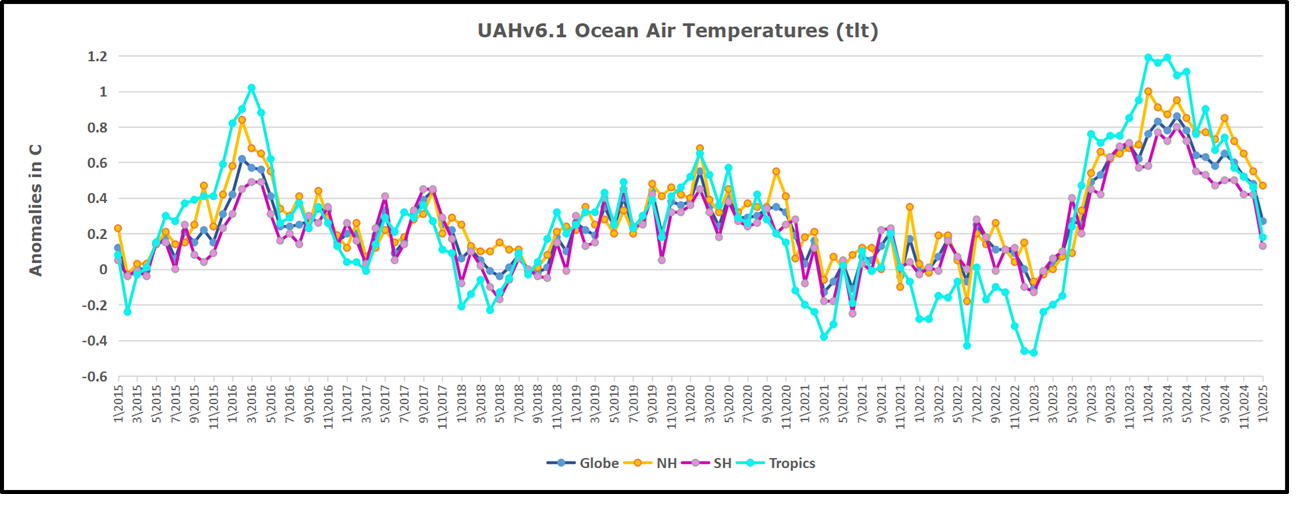
The UAH dataset includes temperature results for air above the oceans, and thus should be most comparable to the SSTs. There is the additional feature that ocean air temps avoid Urban Heat Islands (UHI). The graph below shows monthly anomalies for ocean air temps since January 2015.
In 2021-22, SH and NH showed spikes up and down while the Tropics cooled dramatically, with some ups and downs, but hitting a new low in January 2023. At that point all regions were more or less in negative territory.
After sharp cooling everywhere in January 2023, there was a remarkable spiking of Tropical ocean temps from -0.5C up to + 1.2C in January 2024. The rise was matched by other regions in 2024, such that the Global anomaly peaked at 0.95C in May. Since then, all regions have cooled down sharply, Global anomaly dropping in January to 0.3C, as well as SH dropping down to 0.1C in January.
Land Air Temperatures Tracking in Seesaw Pattern
We sometimes overlook that in climate temperature records, while the oceans are measured directly with SSTs, land temps are measured only indirectly. The land temperature records at surface stations sample air temps at 2 meters above ground. UAH gives tlt anomalies for air over land separately from ocean air temps. The graph updated for January is below.
Here we have fresh evidence of the greater volatility of the Land temperatures, along with extraordinary departures by SH land. The seesaw pattern in Land temps is similar to ocean temps 2021-22, except that SH is the outlier, hitting bottom in January 2023. Then exceptionally SH goes from -0.6C up to 1.4C in September 2023 and 1.8C in August 2024, with a large drop in between. In November, SH and the Tropics pulled the Global Land anomaly further down despite a bump in NH land temps. December showed an upward rebound in SH and Tropics land temps, now offset by a dropping temps everywhere, pulling the Global land anomaly downward slightly.
The Bigger Picture UAH Global Since 1980
The chart shows monthly Global Land and Ocean anomalies starting 01/1980 to present. The average monthly anomaly is -0.03, for this period of more than four decades. The graph shows the 1998 El Nino after which the mean resumed, and again after the smaller 2010 event. The 2016 El Nino matched 1998 peak and in addition NH after effects lasted longer, followed by the NH warming 2019-20. An upward bump in 2021 was reversed with temps having returned close to the mean as of 2/2022. March and April brought warmer Global temps, later reversed
With the sharp drops in Nov., Dec. and January 2023 temps, there was no increase over 1980. Then in 2023 the buildup to the October/November peak exceeded the sharp April peak of the El Nino 1998 event. It also surpassed the February peak in 2016. In 2024 March and April took the Global anomaly to a new peak of 0.94C. The cool down started with May dropping to 0.9C, and in June a further decline to 0.8C. October went down to 0.7C, November and December dropped to 0.6C. January down to 0.46C.
The graph reminds of another chart showing the abrupt ejection of humid air from Hunga Tonga eruption.
TLTs include mixing above the oceans and probably some influence from nearby more volatile land temps. Clearly NH and Global land temps have been dropping in a seesaw pattern, nearly 1C lower than the 2016 peak. Since the ocean has 1000 times the heat capacity as the atmosphere, that cooling is a significant driving force. TLT measures started the recent cooling later than SSTs from HadSST4, but are now showing the same pattern. Despite the three El Ninos, their warming had not persisted prior to 2023, and without them it would probably have cooled since 1995. Of course, the future has not yet been written.
Pharmacists in Wales are being expected to undergo training in climate change and ‘carbon literacy’ under the Welsh Government’s Net Zero requirements, despite having too little time to complete existing training demands.
Pharmacists in Wales are being expected to undergo training in climate change and ‘carbon literacy’ under the Welsh Government’s Net Zero requirements, despite having too little time to complete existing training demands. The Mail has more.
Pharmacists might seem busy enough doling out medications and getting to grips with the latest new treatments.
But they are now being expected to complete training in climate change and carbon literacy.
It comes as a body representing pharmacists say they already have too little time to complete existing training requirements.
Training on the extra, woke topics have been introduced in Wales, as part of a “quality and safety scheme” in line with the Welsh Government’s Net Zero Wales ambitions.
And chemists are expected to ensure the training is carried out by the end of next month to meet a target set by the Cardiff administration.
Community Pharmacy Wales has issued guidance to pharmacists, urging them to “provide an overview of climate change and sustainability in Wales/the UK and the world”.
They must also “evaluate the impact of climate change on health” and “explore good practice in sustainability as a global citizen”.
Community Pharmacies Wales added: “Pharmacy contractors can arrange for staff to access any training resource that at a minimum meets the learning objectives.”
Pharmacies can claim £642 from the cash-strapped Welsh NHS to cover the cost of the course.
Among the course modules listed is Carbon Literacy for Healthcare, which aims to foster a “deep understanding of the critical link between climate change and healthcare”.
The course description states: “Discover how climate change is putting the health of our patients at risk and explore the remarkable strides the NHS has made in leading the charge against greenhouse gas emissions.
“Learn how you can contribute and play your part in shaping a low carbon NHS that delivers exceptional care while safeguarding the health of future generations.”
The Welsh Government’s push for green policy comes as a lobby group representing pharmacists across the UK called for staff to be given more time for training to be “safe practitioners”.
Last week, the Guild of Healthcare Pharmacists (GHP) launched a campaign calling for NHS pharmacists to be given 10% of their contracted hours as “protected time for learning, development and training”.
The guild said there is currently “no consistency” in the UK or within the four nations in terms of how much time for supporting professional activities pharmacists are given. …
It added that many pharmacists end up doing unpaid work in order to catch up with the required training or end up completing self-learning in their own time.
President Trump’s executive order on wind turbines was a major leap forward, however as always, the devil is in the details. The EO may leave room for wind profiteers such as Virginia’s Dominion Energy to slip more monstrous turbines through the legal cracks and onto our coast.
“It is with a sense of real urgency we are writing to you today.” We wrote, “we much appreciate President Trump’s Emergency Order for temporary withdrawal of all areas on the outer continental shelf from offshore wind leasing. We count twenty-two projects that have been paused. However, eleven projects have already received approvals with four of those under construction. Leasing and permitting will be reviewed for these approved projects but may take time… We recommend the Interior Department work with NMFS to immediately revoke the Letters of Authorization and order an immediate cession of construction until a review is complete.”
Similarly, the Bureau of Ocean and Energy Management {BOEM) is in danger of mindlessly stumbling on with some of Biden’s most ridiculous wind energy policies like a zombie that doesn’t know it’s dead.
Big wind corporations are trying to erect floating wind turbines off California’s beautiful coast. CFACT readers and supporters know that we have been relentlessly pointing out the flaws and dangers of this floating folly for years.
We lay out to a detailed list of reasons why California’s “programmatic environmental impact statement” on California floating wind “is woefully inadequate. In fact it specifically avoids those issues that justify cancelling the Program.” We decisively conclude that, “the full Offshore Wind Program needs to be assessed for the entire West Coast before any project is approved for construction. This required assessment is missing in action. Based on this assessment the cumulative impacts then have to be minimized. Capping the authorized harassment of each threatened species may be the best way to avoid destructive.”
In recent years CFACT senior advisor David Wojick has been perhaps America’s number one star on offshore wind turbine analysis. David Wojick digs deep into the scientific facts and arcane policy documents the government has relied on and spotlights their flaws as does no one else.
David’s most recent post at CFACT.org lays out a simple, extremely daring approach to protect America from the dangers both wind and solar pose for our environment and electric grids. David proposes that the Federal Energy Regulatory Commission (FERC) make full use of its unique authority and prevent future hookups of intermittent / unreliable energy sources such as wind and solar.
Places such as Europe and Australia have wasted vast sums on wind and solar and have nothing positive to show for it. They have transformed places of natural beauty into sterile wind and solar deserts while radically raising the costs of energy for business and homeowners. They have destabilized their electric grids while doing nothing meaningful to alter the temperature of the Earth.
America has been provided with voluminous examples of what not to do on energy.
CFACT will continue to provide the Trump Administration with the facts it needs to avoid the energy mistakes so many others have made.
Hundreds of people, many of them opponents of a carbon dioxide pipeline, filled the Southeast Technical College auditorium Wednesday evening for a state Public Utilities Commission hearing regarding a second attempt by Summit Carbon Solutions to gain a permit for the project.
Guest Post by Makenzie Huber of South Dakota Searchlight viaESG University.
Hundreds of people, many of them opponents of a carbon dioxide pipeline, filled the Southeast Technical College auditorium Wednesday evening for a state Public Utilities Commission hearing regarding a second attempt by Summit Carbon Solutions to gain a permit for the project.
“We know this is an incredibly important issue to you,” said Commissioner Gary Hanson at the start of the three-hour meeting. “We are here today to learn and listen, and we appreciate each of you being with us today to give us your input.”
Hundreds of people fill the Southeast Technical College auditorium in Sioux Falls for a Public Utilities Commission hearing about a carbon dioxide pipeline proposal on Jan. 15, 2025. (Makenzie Huber/South Dakota Searchlight)
The Iowa-based company plans a 2,500-mile, $9 billion pipeline to capture carbon dioxide from 57 ethanol plants across five states, including eastern South Dakota, and transport it to North Dakota for underground storage. The project would capitalize on federal tax credits incentivizing the prevention of heat-trapping carbon emissions.
The commission rejected Summit’s first permit application in 2023, in part due to the pipeline route’s conflicts with local ordinances mandating minimum distances between pipelines and existing features.
The project has a storage permit in North Dakota and route permits in North Dakota, Iowa and Minnesota, while Nebraska has no state permitting process for carbon pipelines. The project also faces litigation from opponents in multiple states.
The Sioux Falls meeting focused on residents in Minnehaha, Lincoln, Turner and Union counties. The commission held another meeting in Mitchell earlier in the day.
Most of Wednesday’s attendees opposed the pipeline — evident by applause often filling the room after opponents spoke. The opponents who spoke primarily reiterated concerns about safety and impacts to farmland affected by the pipeline’s planned route, which were raised during the company’s initial attempt at a permit.
Opponents also spoke against efforts to designate the pipeline as a common carrier, which would allow the use of eminent domain to push the project through. The South Dakota Supreme Court ruled last year that the pipeline has not yet proven it should be allowed to take private land for public use. The high court sent the case back to a lower court, where the company is trying to prove its case.Subscribe
Betty Strom, whose property would be crossed by the pipeline, said it would be a “forever hazard across my land.”
“Summit is in it for the tax credits. They don’t care about property rights, safety, the damage to property, its value or the long-term consequences,” Strom said. “Please deny this permit again.”
Representatives from Summit explained why the route was selected and reviewed safety regulations and standards for the pipeline.
In a handout, Summit said the project would include $1.9 billion in capital expenditures in South Dakota, add 3,000 construction jobs while the pipeline is being built and support 260 jobs annually.
Project supporters said it would provide economic opportunities to South Dakota if implemented.
Al Giese, an Iowa farmer, board member for the Iowa Renewable Fuels Association and owner of a feed and trucking company doing business in South Dakota, told the commission that the “carbon sequestration train, locally and nationally, has left the station.”
“Yes, it is a South Dakota issue. It is a Midwestern issue. But we must move forward with sequestering carbon not only for the vitality of the ag sector but for all the economies in the Midwestern states,” Giese said. “There’s no other way to go about it.”
The next public hearings will be in De Smet and Watertown on Thursday, and in Aberdeen and Redfield on Friday.
Makenzie Huber is a lifelong South Dakotan who regularly reports on the intersection of politics and policy with health, education, social services and Indigenous affairs. Her work with South Dakota Searchlight earned her the title of South Dakota’s Outstanding Young Journalist in 2024, and she was a 2024 finalist for the national Livingston Awards.
South Dakota Searchlight is part of States Newsroom, the nation’s largest state-focused nonprofit news organization.
ESG University republishes their articles, features and stories online and/or in print under Creative Commons license CC BY-NC-ND 4.0.
California’s energy policies have been walking a tightrope for years, but now, the state is contemplating an extreme measure that could tip it into full-blown crisis mode: taking over oil refineries. According to a recent Los Angeles Times article, California policymakers are seriously considering state ownership of refineries to ensure gasoline supply remains stable as private refiners shut down operations. This move—if it happens—could create a cascade of economic and logistical disasters, exacerbating the very problems the state claims to be solving.
California’s energy policies have been walking a tightrope for years, but now, the state is contemplating an extreme measure that could tip it into full-blown crisis mode: taking over oil refineries. According to a recent Los Angeles Times article, California policymakers are seriously considering state ownership of refineries to ensure gasoline supply remains stable as private refiners shut down operations. This move—if it happens—could create a cascade of economic and logistical disasters, exacerbating the very problems the state claims to be solving.
California’s gasoline demand has been in gradual decline due to more efficient engines and an increasing number of electric vehicles (EVs) on the road. However, demand is still high enough that losing refineries without a reliable replacement strategy could create severe shortages.
Major refiners—including Chevron, Marathon, Phillips 66, PBF Energy, and Valero—are facing mounting pressures from the state’s aggressive environmental regulations and shifting market incentives. Some have already transitioned away from gasoline production, while others are contemplating permanent shutdowns.
The Phillips 66 refinery in Wilmington is set to close by the end of the year, and more refineries could follow. The result? A shrinking gasoline supply in a state that still heavily relies on fossil fuels. As Skip York, chief energy strategist at Turner Mason & Co., put it:
“Demand will decline gradually, but supply will fall out in chunks”.
This mismatch between supply and demand could lead to fuel shortages, price spikes, and logistical nightmares—none of which the state seems prepared for.
State Ownership: A Disaster in the Making
In response to the looming refinery crisis, the California Energy Commission has put together a list of possible solutions, including:
State ownership of oil refineries
State purchase or lease of ships for gasoline imports
Contracts with out-of-state and foreign refineries
Increased gasoline shipments via train
Changes to California’s strict fuel regulations
Encouraging neighboring states to adopt California-grade fuel standards
The most extreme option—state ownership—would put California in the company of countries like Venezuela and Iran, where government-run refineries are the norm. And we all know how efficiently those economies function.
The Western States Petroleum Association has already raised concerns about the feasibility of such a move:
“This is a very complex and hard business to run… There are commercial barriers and technical barriers that take a comprehensive and holistic understanding of the industry”.
The idea that state bureaucrats—many of whom have spent years waging war against the oil industry—could suddenly turn around and competently manage a refinery is laughable. Running a refinery requires expertise, efficiency, and adaptability—qualities not typically associated with government-run enterprises.
Why California’s Energy Plans Are Doomed to Fail
California’s regulatory framework has been hostile to the oil industry for years. Recent policies include:
Banning the sale of new gasoline-powered vehicles by 2035
Potential penalties on refinery profits
New minimum storage requirements for refiners
These policies are making it increasingly unprofitable to operate refineries in the state. Chevron, a California staple since 1879, has already announced plans to move its headquarters to Texas. In a statement, Chevron executive Andy Walz summed up the problem:
“Recent California policies… erode our confidence going forward”.
This should be a wake-up call. But instead of reassessing its approach, California seems determined to double down.
The Supply Chain Nightmare
Unlike other states, California is essentially a “gasoline island.” It lacks a multi-state logistics network to mitigate supply disruptions. There are no pipelines bringing gasoline in from neighboring states, and the antiquated Jones Act restricts ocean shipments from the refinery-rich Gulf Coast.
Right now, California imports only 8% of its gasoline; the other 92% is refined within the state. If more refineries shut down, the state will be forced to import significantly larger quantities of gasoline—most likely from Asia. That means:
Higher transportation costs
Increased vulnerability to global supply chain disruptions
Potential price volatility tied to international markets
And yet, while California regulators push for the closure of in-state refineries, no one seems concerned about the environmental impact of importing gasoline from across the Pacific. As Assembly Republican Leader James Gallagher pointed out:
“People freak out about the environmental impacts of crude oil shipments, but no one’s freaking out about the environmental impacts of gasoline imports”.
What’s the Endgame?
State Senator Brian Jones put it bluntly:
“The state has no business being in the oil refinery business”.
Yet here we are, discussing the possibility of California taking over one of the most complex industries in the world—all because its policies have made it impossible for private refiners to operate profitably.
The obvious solution would be to ease regulatory burdens, allow market forces to work, and support energy diversity rather than forcing an abrupt transition to EVs. But California’s leadership seems determined to force a radical transformation, regardless of the cost.
The result? Expect higher gas prices, more shortages, and a government scrambling to fix problems of its own making.
California is walking a dangerous road, and if state-owned refineries become reality, the fuel crisis could get far worse before it gets better.
China is the only country in the world that can seriously challenge America’s longstanding status as the globe’s top dog. And a rejuvenated United States is the only thing standing in the way of an ambitious China ascending to the peak of the heap. The reemergence of a bipolar world in the 21st century – replicating the old U.S.-U.S.S.R. rivalry of the Cold War era – is the no-longer-to-be-ignored reality of our time.
China is the only country in the world that can seriously challenge America’s longstanding status as the globe’s top dog. And a rejuvenated United States is the only thing standing in the way of an ambitious China ascending to the peak of the heap. The reemergence of a bipolar world in the 21st century – replicating the old U.S.-U.S.S.R. rivalry of the Cold War era – is the no-longer-to-be-ignored reality of our time.
However, unlike the late Soviet Union – sometimes referred to as “Haiti with missiles” – China is an economic powerhouse, one that puts is technological prowess in the service of its geostrategic aspirations. ”China has roughly nine times as many engineers as the U.S. and perhaps as many as 15 times as many science and technology graduates,” George Gilder recently noted in the Wall Street Journal. This gives China a decisive edge in a world where rapid advances in technology have far-reaching economic and military implications.
There are, however, things that Trump and his team can do, and in some cases are already doing, that can turn the tables on Beijing. With the departure of the geopolitically inept Biden administration, Washington can now harness its considerable geological assets to the disadvantage of its rival in the Far East.
Beijing was quick to realize the importance of gaining control of both the mining and processing of rare earths and other critical minerals, which it had largely done by the time the U.S. and other industrialized countries embarked on their climate-driven green energy transition. Beijing was not so foolish; to meet its own energy needs, it built hundreds of coal-fired power plants. Abandoning fossil fuels, which the United States has in abundance, and embracing green energy, the supply chain for which is largely controlled by China, could benefit only one country. And for a while, China’s bet looked to be paying off.
But China’s dominance of such sectors as electric vehicles, batteries that power EVs and serve to backup intermittent wind and solar energy, and the raw materials in wind turbines and solar panels makes the Middle Kingdom vulnerable to Trump’s renewed embrace of “American energy dominance.” One of Trump’s Jan. 20 executive orders titled “Unleashing American Energy” includes directives revoking the EV mandate, freezing unspent funds for green energy, expediting approval of liquid natural gas (LNG) export facilities, and streamlining the permitting process for oil and gas leasing, exploration, development, and production. It also speeds up the approval process for new pipelines and other critical fossil-fuel infrastructure.
Another, less-reported section of Trump’s order focuses on the mining of critical minerals. It instructs federal agencies to identify all regulations, policies, and orders “that impose undue burdens on domestic mining and processing of non-fuel minerals and undertake steps to revise or rescind such actions.”
The geostrategic case for promoting the mining and processing of critical minerals in the U.S. is compelling. “China now produces 80-90% of the world’s rare-earth minerals, according to the U.S. Geological Survey. Yet China has only about 37% of the world’s estimated reserves,” notes Greg Walcher, president of the Natural Resources Group LLC. “Relying on China for critical minerals is obviously not smart, not safe, nor necessary.”
Known to the public for their unpronounceable names, rare earths – which are actually quite abundant – have a variety of commercial and military applications. They include smartphones, MRI equipment, satellites, jet engines, night-vision goggles, sonar on submarines and other naval vessels, and real-time imagery and targeting for surveillance and reconnaissance flights by unmanned aerial systems – just to name a few.
Taking rare earths and other valuable minerals seriously means upgrading the nation’s hollowed-out domestic supply chain for these natural resources. This is the purpose behind Trump’s order to eliminate “undue burdens on domestic mining and processing” of these strategically important minerals. That, of course, will be easier said than done, because Trump’s initiative will be challenged by lawsuits launched by activists determined to cripple America’s industrial base.
Trump’s desire to acquire Greenland from Denmark must be seen in this light. The icy island where the North Atlantic meets the Arctic abounds in mostly untapped mineral resources. In bringing the giant island under American jurisdiction, in whatever form, Trump can deny China (and Russia) access to Greenland’s riches while solidifying the U.S. presence in the Arctic.
Another Trump executive order temporarily halts offshore wind leases in federal waters and pauses approvals, permits, and loans for offshore and onshore wind projects. Aside from signaling to investors that putting their money into capital-intensive wind projects may not be a good idea, the order undercuts Beijing’s investment in raw materials used in wind energy.
“Wind farms require 10 times the amount of critical minerals as natural gas power plants and 1.6 times as much as nuclear power plants,” writes the Heritage Foundation’s Austin Gae.
China is the world’s leading supplier of raw materials that go into wind turbines, including in the U.S. Trump is deliberately shrinking the U.S. market for wind turbines and for the predominately Chinese-supplied raw materials that go into them. The goal is to play to America’s strengths, which lie in fossil fuels and a rejuvenated nuclear-power industry, while lowering our dependence on China by turning away from wind and solar power.
Hydrogen. The first element in the Periodic Table and the most abundant element in the Universe. It is also the simplest element—the most common isotope has only one proton and one electron. It has been called the “Future of Energy”; after all, the Sun relies on hydrogen to keep emitting light and, if it is good enough for our Sun, why isn’t it good enough for us?
“Hydrogen energy will cease to become viable when the subsidies provided to it by governments of the world dry up. Hopefully, the new Administration will recognize that hydrogen embrittlement applies not just to metals, but to our economy as well.”
Hydrogen. The first element in the Periodic Table and the most abundant element in the Universe. It is also the simplest element—the most common isotope has only one proton and one electron. It has been called the “Future of Energy”; after all, the Sun relies on hydrogen to keep emitting light and, if it is good enough for our Sun, why isn’t it good enough for us?
No doubt you have heard all the clamor associated with a hydrogen-based energy economy. Jeremy Rifkin published a book entitled The Hydrogen Economy: The Creation of the Worldwide Energy Web and the Redistribution of Power on Earth. He claimed that “globalization represents the end stage of the fossil-fuel era” and that turning “toward hydrogen is a promissory note for a safer world.”
In his State of the Union Address, the President stated that “with a new national commitment, our scientists and engineers will overcome obstacles” to taking hydrogen-fueled automobiles “from laboratory to showroom so that the first car driven by a child born today could be powered by hydrogen, and pollution-free.” The Administration then announced a collaborative effort with the European Union to develop a hydrogen economy, including the technologies “needed for mass production of safe and affordable hydrogen-powered fuel cell vehicles,” and stated that this would “improve America’s energy security by significantly reducing the need for imported oil.”
The Chicago Sun-Times ran a story that proclaimed, “The first steps toward what proponents call the hydrogen economy are [now] being taken.” And the US House of Representatives held the first of two “investigative hearings on the subject of hydrogen—its production, utilization, and potential effects on our energy economy of the future.” The chairman of the hearing claimed hydrogen “has the potential of playing the same kind of role in our energy system as electricity does today.”
Thus, hydrogen is poised to be the silver bullet that solves the climate crisis and removes us from a fossil fuel-based energy supply.
But wait. You don’t remember all of this? Well, the Rifkin book was published in 2002. The Administration was not the second Trump Presidency, the Joe Biden Presidency, the first Trump Presidency, or the first or second Obama Presidency. It was George W. Bush’s State of the Union in 2003. The Chicago Sun-Times article came out in 1996. And the Congressional Hearing? Well, that was held on June 10, 1975.
But doesn’t the Sun run on hydrogen? Yes, but not in the same way. In the Sun, through fusion, hydrogen atoms are merged to produce helium with lots of energy given off in the process. Each second, about six-hundred-billion kilograms of hydrogen are fused into helium and about four-billion kilograms of matter are converted to energy. On Earth, that process of fusion is about twenty years off and, as the meme goes, always will be. And apparently, so too will hydrogen as a fuel source.
How Do We Get Hydrogen?
Is mining or drilling for hydrogen the problem? No. That isn’t how we get hydrogen.
Hydrogen is produced by separating it from other elements in various compounds. The most common methods are electrolysis—where water is split to form hydrogen and oxygen gases—and steam-methane reforming, where hydrogen atoms are separated from the carbon atoms in methane. The former is generally how hydrogen is produced in high school chemistry classes but has recently been touted as the only “clean” way to produce hydrogen; the latter is the process by which hydrogen currently is produced commercially in the United States.
But steam-methane reforming requires high temperatures (about thirteen hundred to eighteen-hundred degrees Fahrenheit) and high pressures (between three and twenty-five times that of atmospheric pressure). This allows engineers to use steam as a catalyst to produce hydrogen, carbon monoxide, and carbon dioxide. Thus, the production of hydrogen through steam-methane reforming uses methane, a fossil fuel, and generates carbon dioxide (the supposedly evil gas) and carbon monoxide (a truly deadly gas).
But there is something interesting about the laws of physics. Namely, there is no free lunch. We often talk about the Second Law of Thermodynamics and that a system becomes more disordered with time unless energy is added to it from outside. We say the entropy of the closed system increases over time. But there are other ways of saying this. For example, we can say one cannot create a heat engine which extracts heat and converts all of it to useful work. Interpreting this for our discussion, the energy contained in the steam and methane cannot be entirely transferred to the hydrogen—some of it goes to the production of carbon dioxide and carbon monoxide and some is lost as heat.
This means the production of hydrogen from methane results in less energy in the hydrogen molecules than existed in the original methane molecule. How much less?
The first hurdle of hydrogen energy is its energy deficit. To get enough hydrogen to produce two megawatts of energy, a total of three megawatts of electricity is required. This doesn’t include the loss of energy—or the intervention of the Second Law of Thermodynamics—in the production of this electricity from other sources. In the words of Robert Bryce, hydrogen energy is “insanely expensive, in energy terms, to manufacture.”
So, why aren’t we just sending these three megawatts of electricity down the power lines to heat and cool homes, cook food, and perform other tasks that make our lives better? Because hydrogen is supposedly a clean fuel source, even though the energy to extract it is usually produced by methane and yields our supposedly evil gas, carbon dioxide, as a byproduct. Moreover, hydrogen is green—not in the environmental sense, but rather, subsidies abound for companies that wish to pursue the hydrogen panacea.
Storage Problems
The second hurdle associated with hydrogen as an energy source is that it is hard to handle and difficult to store. Hydrogen gas does not play well with metals and something called “hydrogen embrittlement” occurs. As the name implies, hydrogen embrittlement causes metals to become brittle and crack over time, especially when the metal is stressed. Being a small molecule, hydrogen easily escapes from the smallest of cracks. In general, hydrogen embrittlement does not occur at temperatures above about three-hundred degrees Fahrenheit; however, it is not feasible to heat pipes and storage tanks to this temperature. At ambient temperatures and pressures found on Earth, hydrogen embrittlement is a significant problem for many metals, such as steel, iron, nickel, titanium, cobalt, copper, and aluminum, plus alloys that contain them.
Proponents argue that hydrogen can be stored as a liquid. While true, that would require compression to seven-hundred times atmospheric pressure and refrigeration to minus-four-hundred-twenty-three degrees Fahrenheit. And, of course, even more energy would be required to reach and maintain that level of compression and cooling.
If we cannot transport and store hydrogen in existing trucks, tanks, and pipes, how is hydrogen best used as an energy source? It can be blended with natural gas and consumed by turbines and reciprocating engines. But that involves two disadvantages. One is that we lose energy by storing it in the production of hydrogen—why not simply use the methane in the turbine rather than wasting energy by converting it to hydrogen? There is simply no advantage to that, and it costs us energy. The second is that by mixing in methane, activists are no longer able to tout the hydrogen source as “clean and green renewable energy,” because methane is still in the mixture. Sigh. Virtue signaling rears its ugly head again.
The best way to use hydrogen is probably as the fuel source in a fuel cell. But fuel cells already run on methane, and the loss of energy in converting methane to hydrogen precludes any utility that the use of hydrogen would provide. Except, of course, that activists and those in the hydrogen-production industry would not be able to tout their fuel cell as being “clean and green renewable energy.” In my home state of Delaware, however, the state legislature has declared that methane consumed by a Bloom Energy fuel cell is renewable energy. Ah, the all-powerful legislature that can simply alter physics by majority vote!
Dangers in Use
A third hurdle with using hydrogen as a fuel source is that it is dangerous to use. Like methane, it is colorless and odorless, and no doubt, for hydrogen to become a widely used fuel source, it would have to be mixed with a smelly gas—just as smelly mercaptan is mixed with methane so a leak can be detected. And, yes, hydrogen is highly explosive.
It is why the early twentieth-century dirigible fleet in the United States was built using helium for buoyancy, not hydrogen, even though helium is more expensive to produce and provides less buoyancy. If you don’t understand the explosive potential of hydrogen, the Hindenburg disaster should tell you all you need to know.
Not Cheap
Finally, the fourth hurdle should now be obvious. The use of hydrogen as a fuel source is expensive—in terms of production cost, expensive storage, and energy required to produce. Hydrogen as a fuel source will allow virtue signalers to claim they have developed and are using a “clean and green” fuel source that is “saving the planet from the evils of fossil fuels.” But in reality, it is only going to make energy more expensive and send a larger proportion of the planet back below the poverty line.
As we have often stated here at the Cornwall Alliance, inexpensive energy has been the solution to raising billions of people above the poverty line and increasing their standard of living. Hydrogen energy will cease to become viable when the subsidies provided to it by governments of the world dry up. Hopefully, the new Administration will recognize that hydrogen embrittlement applies not just to metals, but to our economy as well.
The list of climate change’s effects is long and Biblical: rising, acidifying oceans; fiercer forest fires and thunderstorms and hurricanes; spreading mosquitos and mosquito-borne diseases. But there’s a new potential plague, at least for our species. Climate change might make us spend more time on social media.
Bloomberg news: Climate change might make us spend more time on social media. In a new study in Psychological Science, researchers found that extreme weather — hot and cold — led to a significant uptick in how much people posted on Facebook and Twitter. Heavy precipitation did the same.
Nick Obradovich, a computational behavioral scientist at the Laureate Institute for Brain Research in Tulsa, Oklahoma, is one of the authors of the paper. He concedes that it’s a pretty intuitive finding: When it’s unpleasant outside, people stay inside, and when they’re inside they’re more likely to be scrolling and, perhaps, posting.
Put this together and a vicious cycle emerges: one in which worse weather drives us to spend more time inside on social media, growing more and more enraged and politically polarized. Our representative government responds to this by also growing more and more polarized and dysfunctional and, therefore, unable to deal with big problems like climate change.
It’s a symbiosis between two of the more pernicious things our species created. Social media wins, so does climate change. Humanity loses.
Bloomberg: Posting Through It: Climate Change Is Fueling Social Media Use February 17, 2025, By Drake Bennett
Doom scrolling
The list of climate change’s effects is long and Biblical: rising, acidifying oceans; fiercer forest fires and thunderstorms and hurricanes; spreading mosquitos and mosquito-borne diseases. But there’s a new potential plague, at least for our species. Climate change might make us spend more time on social media.
In a new study in Psychological Science, researchers found that extreme weather — hot and cold — led to a significant uptick in how much people posted on Facebook and Twitter. Heavy precipitation did the same.
Nick Obradovich, a computational behavioral scientist at the Laureate Institute for Brain Research in Tulsa, Oklahoma, is one of the authors of the paper. He concedes that it’s a pretty intuitive finding: When it’s unpleasant outside, people stay inside, and when they’re inside they’re more likely to be scrolling and, perhaps, posting.
The point of the research, he says, was to see if something we thought was likely to be true was, in fact, true, and to flesh out a broader portrait of what does and doesn’t shape people’s online behavior. A lot of science is like that.
“Nobody has measured this before, to my knowledge,” Obradovich says. “We have one of the largest corpuses of social media data that I’m aware of, and nobody has asked this question or measured it before.” (More on Obradovichhere:)
A sizable body of evidence links climate change to extreme weather of all kinds. Not just hot weather, but very wet weather. (There’s also some evidence that rising temperatures paradoxically cause brutal cold snaps, by destabilizing the winds of the polar vortex and thereby releasing Arctic air into lower latitudes.)
At the same time, waiting out the weather on our social media feeds probably makes us less happy – there’s evidence on that connection, too.
And social media consumption seems to harden political views and sectarianism for many of its users.
Put this together and a vicious cycle emerges: one in which worse weather drives us to spend more time inside on social media, growing more and more enraged and politically polarized. Our representative government responds to this by also growing more and more polarized and dysfunctional and, therefore, unable to deal with big problems like climate change.
It’s a symbiosis between two of the more pernicious things our species created. Social media wins, so does climate change. Humanity loses.
Bloomberg news: Climate change might make us spend more time on social media. In a new study in Psychological Science, researchers found that extreme weather — hot and cold — led to a significant uptick in how much people posted on Facebook and Twitter. Heavy precipitation did the same.



You must be logged in to post a comment.