Global warming, climate change, all these things are just a dream come true for politicians. I deal with evidence and not with frightening computer models because the seeker after truth does not put his faith in any consensus. The road to the truth is long and hard, but this is the road we must follow. People who describe the unprecedented comfort and ease of modern life as a climate disaster, in my opinion have no idea what a real problem is.
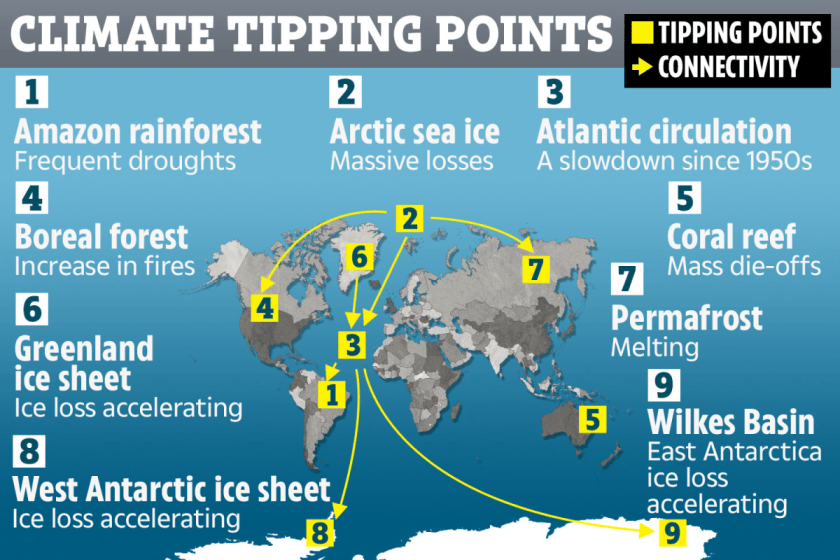
A recent article posted by The Guardian discusses funding given to UK research groups in an effort to track potential “climate tipping points” so forecasts can be made to warn about upcoming catastrophes. The premise that we are approaching dangerous and unprecedented climate tipping points is unsupported by history or present data. The planet has been through periods of massive change many times in the past. There is no evidence that there is a magic temperature at which positive feedbacks will spiral out of control, and none of the myriad conditions some researchers have pointed to as dangerous indicate a threat of” tipping” over some imagined edge.
A recent article posted by The Guardian discusses funding given to UK research groups in an effort to track potential “climate tipping points” so forecasts can be made to warn about upcoming catastrophes. The premise that we are approaching dangerous and unprecedented climate tipping points is unsupported by history or present data. The planet has been through periods of massive change many times in the past. There is no evidence that there is a magic temperature at which positive feedbacks will spiral out of control, and none of the myriad conditions some researchers have pointed to as dangerous indicate a threat of” tipping” over some imagined edge.
The article, “Early warning system for climate tipping points given £81m kickstart,” describes funding given to 27 teams of researchers by the U.K.’s Advanced Research and Invention Agency (Aria). According to The Guardian, this is an “attempt to develop an early warning system for climate tipping points will combine fleets of drones, cosmic ray detection and the patterns of plankton blooms with artificial intelligence and the most detailed computer models to date.”
The goal is to detect signals “that forewarn of the greatest climate catastrophes the climate crisis could trigger,” describing these conditions as climate tipping points which “occur when global temperature is pushed beyond a threshold, leading to unstoppable changes in the climate system.”
The two main tipping points that the program will focus on are the alleged approaching collapse of both the Greenland ice sheet and critical ocean currents in the North Atlantic.
Trends on both of these supposed harbingers of climate change have been regularly misdescribed or exaggerated by the media in recent decades.
To begin with, the so-called climate threshold is an arbitrary value in the first place. The most common threshold value for global average temperature is 1.5°C above pre-industrial temperatures, but this is not a scientifically derived value, despite being cited frequently by the U.N. Intergovernmental Panel on Climate Change. It was selected for political purposes by a political panel. Europe has long surpassed that value, with a temperature record going back to the 1700s showing warming of over 2.0°C since then, with no catastrophic results.
This being said, warming has occurred, and as a result of that of the Greenland ice sheet has experienced some melting, which should be expected as the planet transitions out of an ice age. Climate Realism has covered Greenland’s ice trends more than a dozen times, and the fact is that the ice mass loss is tiny compared to the full ice mass of Greenland, and what melts in the summer months refreezes over winter, amounting to a very low net ice loss over time. This is no sign or indication of a looming collapse, and neither physics nor research into ice dynamics indicate that there should be.
The collapse of the North Atlantic Ocean current is again another tipping point that is often hyped in the media while the full context is conveniently left out of the discussion. Indeed, researchers can’t even agree on what, if any, types of changes in the North Atlantic current are occurring. Some research suggests the current has slowed, other research that it has speeded up, and still other research suggests that there hasn’t been any significant change at all.
Last year around this same time, scientists and the media joined forces to warn readers that the Atlantic meridional overturning circulation (AMOC) was nearing collapse. This alarming warning was based on a computer model output that suggested the AMOC may collapse 1,758 years from now.
The Younger Dryas Climate Event occurred about 12,900 to 11,700 years ago. Many of the climate changes related to that event were likely a response to increased freshwater discharge to the North Atlantic and the reduction in AMOC strength. That basically signaled the end of the most recent ice age, beginning the time when Earth became more habitable for humans, and sedentary agriculture began. Shortly after that, in geologic time the blinking of an eye, the first nascent, large-scale civilizations began developing.
The Earth’s multiple climate systems are complex and connected by many mechanisms which are only poorly understood. Proof of this fact is made quite clear by the contradictory studies that seem to whiplash between predicting a slowing or speeding up AMOC, depending on what data is used and what assumptions are built into the modelling.
The main theme for all of Earth’s history has been change, continuously. Some of those changes, like transitions into ice ages, are large scale and harmful to life. The modest warming of the past century-plus is not in that category. Sadly, it is pretty unlikely that funding for climate alarm studies will result in anything other than more alarmist projections spun out of flawed computer models. However, if we are very lucky, data collected over the next decades will help to assuage the fears of researchers and The Guardian’s reporters, as it becomes clearer that climate change poses no existential threat to life or human civilization.
BP has lost a quarter of its share value in the last two weeks. The fall started when company profits turned out to be just $9 billion, down from $14b a year ago and $28b in 2022. As The Telegraph reports, “BP’s shareholders had realized that the green spending they supported in 2020 had halved their dividends.” But Shell, Chevron, and Exxon — the other oil giants — they were all doing much better.
The iconic 120-year-old company shares fall as rumors of a takeover spread
BP has lost a quarter of its share value in the last two weeks. The fall started when company profits turned out to be just $9 billion, down from $14b a year ago and $28b in 2022. As The Telegraph reports, “BP’s shareholders had realized that the green spending they supported in 2020 had halved their dividends.” But Shell, Chevron, and Exxon — the other oil giants — they were all doing much better.
Twenty years ago, BP changed its branding to “Beyond Petroleum” *. By 2020 the company was hellbent on getting there. Suicidally, the oil company pledged to reduce their own oil production by 40% by 2030, (which did nothing except help all their competitors) and promised to pivot into renewable power. BP set itself a target to increase renewables generation by a factor of twenty this decade. The media gushed — “BP Shuns Fossil Fuels“, said Politico. BP supposedly shone a light on “stranded oil and gas”!
Thus, and verily, in mid 2020, with exquisite timing, BP management leapt headlong in the magical energy pit. They were sure that after the pandemic the world would ‘build back better’ with renewables “so their economies would be more resilient” … CEO Bernard Looney actually said that (probably while reading from the WEF handbook of “What to Wear for Billionaires”).
So, BP flagged a write-down of $18 billion dollars in fossil fuel assets and talked of “accelerating” its green investments. Then everything went wrong. Just after BP bet the house on renewables, the Ukraine war broke out and everyone needed oil and gas, and no one needed another wind farm. There was a bonanza selling fossil fuels as prices lifted off (seen in the BP income in 2022) but suddenly no one could afford to buy real energy to make solar panels and turbines, and no one had much cash left to buy randomly failing generators either. It’s been all downhill in renewables ever since.
Prior to this, BP operated Australia’s largest oil refinery for 66 years in Kwinana, Western Australia until it closed in 2021. Until a few weeks ago, BP was planning to launch a $600 million biofuel project on the same site, and the Australian government was thinking of tossing $1 billion dollars at a hydrogen project there too. They were supposed to turn cooking oil into av-gas and renewable diesel and be a hub for hydrogen. It’s sadly pathetic and unravelling at warp speed.
The energy giant has vowed a ‘fundamental reset’ after its costly foray into net zero
Johnathon Leake and Ben Marlow, The Telegraph
Five years on from that speech in February 2020, the company is beleaguered by a ruthless activist investor, under pressure to boost its flatlining share price and considering a return to the oil and gas exploration that made it so successful to begin with.
The abrupt turn follows decades of crisis at one of Britain’s most venerable institutions. Today, its future is more uncertain than ever.
To win round doubters, he is expected to announce a major break with the last five years – shifting away from net zero and back towards its oil and gas heritage.
Pushed by analysts, Auchincloss, Looney’s replacement, confirmed a halt to all investment in wind and solar. “We have completely decapitalised renewables,” he said.
We can blame management, who had been on the fruity green path since 1997, and screwed up majorly, but oddly, 88% of BP shareholders also voted in favor of cutting oil and growing renewables which doesn’t make much sense. Not unless the rank-and-file votes were unknowingly cast-by-proxy through their hedge funds and pension accounts. Were 88% of British Petroleum investors really fooled into thinking oil was “bad” — or was BP quietly undermined by the big banker blob cartel who may have bossed all the pension funds into voting for Hari Kari? Larry Fink, head of BlackRock, pumped up the whole renewables bubble in 2020, and the bankers were known to boss around whole countries with threats of high interest rates if they didn’t behave.
Hypothetically if the Big Bankers were heavily invested in renewable stocks (which they were), then during a bubble, it would work out well for them if one of the largest oil and gas companies performed a large public flip to renewables. And as a bonus, if BP shareholders were stiffed in the process, the wreckage of a great company could be picked up cheaply a few years later…
So, management were crazy, but they probably had help from The Blob Bankers and the Blob Media to really screw things up.
*Correction: “name” changed to” brand”. Technically BP just “rebranded” itself “Beyond Petroleum”. h/t Robert Swan.
A newly erected art installation in the Melbourne suburb of Fitzroy has been heavily vandalised with graffiti.
The much-discussed artwork, titled Zone Red, is the creation of Melbourne artist and climate change campaigner Yandell Walton, and was first unveiled in November 2024.
WUWT does not condone lawbreaking and vandalism. Having said that, I doubt this graffiti attack had anything to do with our article, vandalism and graffiti are rampant in today’s inner city Melbourne. There was a murder in Fitzroy Gardens, the site of the statue, in 2023. Reasonably safe in daylight, but not the kind of place I would be comfortable visiting after dark.
Most Americans have probably never heard of the Endangerment Finding, however, this obscure rule has effectively allowed the federal government to label carbon dioxide a harmful “pollutant” that can be regulated under the Clean Air Act. This is a prime example of government gone wild. The Clean Air Act was never intended to allow the EPA to declare carbon dioxide to be a dangerous pollutant.
People deserve to know if their government plans to terminate their right to breathe clean air
Sierra Club Executive Director Ben Jealous released the following statement:
“The EPA’s mission is to protect human health and the environment, and any revocation or weakening of this life-saving action would endanger both. Denying both science and the Supreme Court to further unravel the Clean Air Act would be a slap in the face to the children and elderly suffering from asthma or COPD, the victims of extreme weather-fueled wildfires and floods,and to every person wanting clean air to breathe. The American people deserve answers from this administration on whether or not they plan to further ignore the law and science to put polluters over people. The Sierra Club is prepared to pursue all legal avenues and use every tool at its disposal to protect the American people and avert the very worst of the climate crisis.”
And then there’s the facts:
The origin of this insane mass delusion, it’s spurious codification into regulations and the necessity of dumping it once and for all is explained by Chris Talgo in his Town Hall article The EPA’s Endangerment Finding Belongs on the Ash Heap of History. Excerpts in italics with my bolds and added images.
Most Americans have probably never heard of the Endangerment Finding, however, this obscure rule has effectively allowed the federal government to label carbon dioxide a harmful “pollutant” that can be regulated under the Clean Air Act. This is a prime example of government gone wild. The Clean Air Act was never intended to allow the EPA to declare carbon dioxide to be a dangerous pollutant. Rather, it was designed to “address the public health and welfare risks posed by certain widespread air pollutants.”It is important to note that in 1963, when the Clean Air Act was initially passed, carbon dioxide was not listed as an “air pollutant.”
Figure 1. Change in Gross Domestic Product and Six Common Air Pollutants, 1980–2018
Source: Federal Reserve Economic Data | Federal Reserve Bank of St. Louis. *The index begins at 1 in 1980, with the exception of PM2.5, which was measured beginning in 2000. The index for each year is the actual value divided by the initial value.
Fast-forward to 1999. As the EPA notes, “On October 20, 1999, the International Center for Technology Assessment and 18 other environmental and renewable energy industry organizations filed a petition seeking the regulation of greenhouse gas emissions from on-road vehicles under the Clean Air Act.”
As happens all too often in our over litigious modern society, this “petition” eventually became a lawsuit. In 2007, the U.S. Supreme Court ruled in Massachusetts v. EPA that “greenhouse gases are air pollutants covered by the Clean Air Act and that EPA must determine whether or not emissions of greenhouse gases from new motor vehicles cause or contribute to air pollution which may reasonably be anticipated to endanger public health or welfare.”
Although this is the standard interpretation of the Supreme Court’s ruling, it is not necessarily the correct interpretation.
According to the majority opinion, authored by former Justice John Paul Stevens, “We need not and do not reach the question whether on remand EPA must make an endangerment finding, or whether policy concerns can inform EPA’s actions in the event that it makes such a finding. We hold only that EPA must ground its reasons for action or inaction in the statute.”
In other words, the Supreme Court decision did not determine that carbon dioxide is a harmful air pollutant. Instead, it simply stated that the EPA has the authority to decide whether carbon dioxide is a harmful greenhouse gas if and only if that is supported by unequivocal data.
A more recent Supreme Court decision in 2022, West Virginia v. EPA, provides even more grounds for the Endangerment Finding to be rescinded. In this landmark ruling, the Supreme Court decided that the Obama-era Clean Power Plan was unconstitutional because it violated the letter of the law under the aforementioned Clear Air Act. Specifically, the Court cited the “Major Questions Doctrine,” which clearly states “that if an agency seeks to decide an issue of major national significance, its action must be supported by clear congressional authorization.”
Incredibly, this is the first time the Supreme Court had cited the Major Questions Doctrine in a ruling.
The fact that the U.S. Supreme Court ruled in favor of West Virginia and essentially reprimanded the EPA to stay strictly within its constitutional guardrails, bodes well for those who believe the Endangerment Finding is unconstitutional and should be eliminated.
But if that is not convincing enough, consider that the Endangerment Finding is predicated on flawed science to begin with. Despite the insistence by the EPA that carbon dioxide is a harmful pollutant that is driving an existential climate crisis, the facts and data say otherwise.
Over the past few decades, climate alarmists and environmental zealots have been somewhat successful in fooling too many Americans into believing that carbon dioxide emissions must be eliminated no matter the cost.
However, the cost of demonizing carbon dioxide as a harmful pollutant is immense. By vilifying CO2 and attempting to regulate it to death, the EPA has absolutely harmed tens of millions of Americans with higher energy bills. Moreover, the EPA’s absurd notion that carbon dioxide is a harmful air pollutant has put the entire U.S. energy grid at risk.
As we enter the AI age, there will be an enormous demand for dependable and affordable energy. The only energy sources that can deliver reliable and cost-effective energy (aside from nuclear) for the United States to remain the global leader in the AI arms race necessarily produce carbon dioxide emissions. Put simply, if we do not eliminate the Endangerment Finding and free ourselves from its shackles, the United States will not be able to keep pace with the Communist Chinese Party in the worldwide battle for AI supremacy.
This is not about California’s nutty politics – but it could have been.
This is about Vertical Land Motion (VLM hereafter). VLM is the movement of the surface of the land further from the center of the Earth (up, a rise or uplift) or closer to the center of the Earth (down, a fall or subsidence).
This is not about California’s nutty politics – but it could have been.
This is about Vertical Land Motion (VLM hereafter). VLM is the movement of the surface of the land further from the center of the Earth (up, a rise or uplift) or closer to the center of the Earth (down, a fall or subsidence).
For many locations in North America, VLM is associated with Glacial Isostatic Rebound. Basically, as the massive weight of ice on the northern part of northern continents melted away, that portion of the continental that had been depressed by all that weight, had been rebounding, rising. At the same time, the southern part of that continental sheet, having been teeter-tottered or bulged upward during the Ice Age, is moving back down.
On the U.S. East coast, the land mass north of Boston, MA , which is approximately the hinge point, is uplifting and the land mass south of Boston is subsiding. On the U.S. west coast, parts of Alaska are uplifting and points south are subsiding, from the effects of Glacial Isostatic Rebounding.
Note that all the Relative Sea Level Rise arrows on the California coast are in the “0 to 1 foot per century” range – that is VLM + Absolute Sea Level. Absolute sea level is understood to be about 1.7 to 2.0 mm/yr – 7 to 8 inches per century.
The most obvious feature is the serious major subsidence in the Central Valley – the dark blue blotch that runs diagonally across the state. The coastal areas are generally neutral and pale blue-ish, indicating either no movement or slightly subsiding. But, it is important to look at the scales. There are two scales given. The top scale if for large scale subsidence – darker blues through greens to lighter colors. This scale is for +/- 100 to 200 (or greater) mm/year.
The lower scale is in single digit mm/year, +/- 4. This lower scale of subsidence, 0 down to -4 mm/yr, is equivalent in magnitude to the rise in absolute sea level.
And that is the important point. The coastal portion of the state of California is generally subsiding at a rate of 1 to 4 millimeters per year. At the same time, it is generally understood that absolute sea level, often called “global sea level”, is rising at about 2 to 3 mm/yr [when using global tide gauges for the calculation]. In effect then, Relative Sea Level Rise along much of the coast of California can be said to be ‘doubled’ by subsidence.
To be blunt, the Realtive (or Absolute) Sea Level Rise of 2 to 3 mm/yr is not an alarming or dangerous amount. In a century, 100 years, 3 mm/yr comes to 30 cm or 1 foot. Most areas have already seen that 1 foot of SLR over the previous century without disastrous effects. To counter-act that 1 foot , those 30 cms, of sea surface rise, a sea wall or dock curbing 16 inches (440 mm) high, made of two standard 8x8x16 inch concrete blocks (in the EU, 215mm x 215mmx440mm) suffices.
And if we double that amount of Relative Sea Level Rise, say to 6 mm/yr, half of that being subsidence, the total rise comes to 24 inches, 2 feet or 60 cm.
Now, 2 feet, that’s getting to be something to talk about for locales that have infrastructure built far too close to current sea level or too close to the sea level of the past, which is far more common. And for locales that have very little altitude above sea level altogether, such as low-lying lands, filled salt marshes turned into sea-level-plus-1-foot neighborhoods of houses with backyard docks on canals and other high-risk areas. Those low-lying areas are often spoken of as being “at risk from flooding by sea level rise and storm surge”. And they are, and they already were, even a century ago. They are more at risk today and will be even more at risk after another 100 years.
The reason they are at risk is their relative altitude above sea level. One foot, two feet, five feet, six feet – the same in meters – it doesn’t matter. Storm surge can be as high as 14 feet – over 4 meters. The surface of the sea will reliably rise about one foot – 30 cm – over the next century and to that must be added any local subsidence.
But what they are not at risk from is Climate Change. The best long-term studies of relative sea levels around the world show that sea level has had a long steady and slow rise since man has been actively measuring it.
The claims that melting land ice is a major contributor have not been shown to be true. Water from melting land adds to the absolute sea level rise that is caused by expansion of the sea water due to the gentle warming of the oceans as the world continues to come up and out of the Little Ice Age. By current rather vague calculations, melting land ice — glaciers, Greenland, Antarctica – may be adding up to 1 mm a year – few inches, 10 centimeters per century. The uncertainty stems from the absolute uncertainty of Antarctic ice mass: is it growing or declining, adding mass or losing mass? Even NASA, which measures Antarctic Ice Mass is not sure, it has two teams that find totally different answers, both answers derived from the same data sets.
To fight Climate Change the IPCC and the UN (and everyone else on the bandwagon) say we must decarbonize our societies, we must quit adding CO2 to the atmosphere regardless of cost.
Combating Climate Change may or may not be a good idea – I don’t think it is – but one thing it will not do is slow or stop sea level rise, not even the fraction of sea level rise actually caused by warming seas. Reducing CO2 emissions, atmospheric concentrations of GHGs or sequestering CO2 underground or in rocks certainly cannot change the portion of relative sea level rise caused by subsidence.
Spending tax payer’s money, or society’s wealth, to fight Climate Change will do nothing to prevent today’s or tomorrow’s problems stemming from rising seas. Those funds must be spent on adaption to and mitigation of any negative effects of rising seas.
Wild and alarming “predictions” of meters of Climate Change-driven sea level rise “by 2025” – in the next 30 years – are scientifically ludicrous as such a future is literally impossible.
It is however possible to drive very local Relative Sea Level changes by seemingly impossible amounts through human activities such as extracting water, pumping water out of aquifers below the surface, or pumping up huge volumes of oil, can cause substantial subsidence and conversely, forcing volumes of water or gases (such as in fracking) down into the Earth under pressure (causing uplift).
Bottom Lines:
1. The seas and oceans are rising, have been rising and will continue to rise until the planet again enters a period of cooling, similar to the Little Ice Age or a real full-blown ice age.
2. Current rates of sea level rise will not be changing much. If a locality is not currently at risk, it will not be at risk in the future – sea level rise is too slow.
3. Human infrastructure already at risk will continue to be at risk and that risk will increase in the future – slowly and steadily. Such localities should spend money and effort on adaption and mitigation.
4. Vertical Land Motion – up and down – are important factors for localities to consider when looking at risks from relative sea level rise. Nothing in the fight against Climate Change will effect VLM. Some of the VLM can be mitigated; such as ceasing to extract fresh water or oil close to the sea. Some of the VLM-caused Relative Sea Level Rise must be dealt with by adaptation – raising structures, building seawalls and otherwise protecting infrastructure.
5. Alarming projections of dangerously high near-future sea level rise are not possible, thus the dissemination of those projections must be seen as politically-motivated Climate Alarm propaganda.
# # # # #
Author’s Comment:
There is nothing particularly new in this essay, except for the very interesting study on California VLM – look at the Central Valley. Some of that subsidence may be self-correcting as atmospheric rivers bring lots of new water to recharge the underlying aquifers. But those aquifers have been being pumped out at tremendous rates to irrigate fields, orchards and vineyards for a long time.
But, in general, coastal California has little to worry about – most seafront areas are backed by bluffs, huge remnant sand dunes in some places like Manhattan Beach, that rise rapidly, like most of Los Angeles.
There are areas around the edges of San Francisco Bay that are just filled wetlands right at sea level and then you have the Sacramento River Delta. The surface of the Sacramento River at Washington Lake in Sacramento, 87 miles across the Bay and upstream, is only 6 feet above San Francisco Bay. They are potentially in trouble now.
Rising Sea Level scares are just that – scares. It is far past time to begin to adapt and mitigate.
In an Executive Order (EO) the President is asserting a new degree of control over what are called the independent federal agencies. There are about 100 of these some of which have tremendous regulatory authority.
In an Executive Order (EO) the President is asserting a new degree of control over what are called the independent federal agencies. There are about 100 of these some of which have tremendous regulatory authority.
Of particular interest is the Federal Energy Regulatory Commission (FERC). A central mission of FERC is maintaining the reliability of America’s electric power grid. This mission has clearly failed as the grid has become dangerously unreliable.
The question is whether the President will use his authority to lead FERC to restore reliability? There are several ways he might do this which are discussed briefly below.
But first there is a much deeper issue that needs to be kept in mind, which is the questionable Constitutional legitimacy of these agencies. What are they independent of? The Constitution only provides for three branches of Government — Congressional, Judicial and Executive.
Claims that these agencies are somehow independent of these branches suggest a murky fourth branch which may be unconstitutional. In fact Justice Scalia said they were unconstitutional and we now have a conservative Supreme Court. So anyone thinking of suing to stop the President should be careful what they wish for.
Getting back to FERC the question is whether the President will get them to take the steps needed to restore grid reliability. I have previously written about two approaches which might work.
The first is very simple in that FERC merely declares a moratorium on connecting to the grid those large generators that are unpredictably intermittent by design. The increasing fraction of grid connected generators that are systemically intermittent is a major factor in the loss of reliability. See my “A simple way to save the grid from more wind and solar” here:
A more elaborate approach is to activate FERC’s reliability regulation system in new ways. This system has failed to date but maybe it can be made to work.
The central figure in the reliability system is the North American Electric Reliability Corporation (NERC) which consists of eight regional reliability entities covering the interconnected power regions of the US, Canada, and Mexico. Other key figures are the Independent System Operators and Regional Transmission Operators as well as the numerous electric utilities.
NERC is authorized under the Energy Policy Act of 2005 and FERC rules to maintain and improve the reliability of the grid by issuing standards and procedures that grid users must follow. Clearly NERC has failed its statutory mission as grid reliability has declined to dangerous levels.
I analyzed NERC some time ago and while they have around 100 reliability standards and procedures there is nothing whatever on preventing intermittency from degrading reliability. Such standards are desperately needed to restore reliability.
See my “Constraining Renewables is a National Need” here:
So one approach is to simply stop connecting new intermittent generators to the grid. Another which might be more refined and could also apply to existing generators is for NERC to develop new standards to constrain the impact of intermittency.
Both of these approaches to restoring reliability require orders from FERC which the President might motivate under the new Executive Order. The present Chair of FERC which the President named to that position on Day One has been very vocal regarding the dangerous decline in grid reliability. Working together they just might put America on the path to restored reliability.
If the President wants to fix the grid FERC is the place to start. Stay tuned to CFACT.
The Great Texas Blackout four years ago triggered a social media debate that reconfirmed ‘classical liberal’ Lynne Kiesling as an advocate of centrally planned, highly regulated electricity. It also revealed a cadre of electricity planners who bristled at the argument that government failed, including Eric Schubert and Robert Borlick. The exchanges began a debate that led the author to write a free-market primer, Free Market Electricity, to resurrect the 1960s tradition of such names as Harold Demsetz, George Stigler, Milton Friedman, and Walter Primeaux.
Ed. note: The Great Texas Blackout four years ago triggered a social media debate that reconfirmed ‘classical liberal’ Lynne Kiesling as an advocate of centrally planned, highly regulated electricity. It also revealed a cadre of electricity planners who bristled at the argument that government failed, including Eric Schubert and Robert Borlick. The exchanges began a debate that led the author to write a free-market primer, Free Market Electricity, to resurrect the 1960s tradition of such names as Harold Demsetz, George Stigler, Milton Friedman, and Walter Primeaux.
Lynne Kiesling (above) came roaring out the gate on Blackout Day February 16, 2021. But ‘the queen of power markets‘ was wrong. The Electric Reliability Commission of Texas (ERCOT) was government–and at the center of the worst electricity crisis in history. Texas was blacked out, and dozens were dying in the cold by the day. It was not market failure but analytic (expert) and government failure (see here and here).
By facilitating decentralized coordination instead of imposing specific outcomes, the institutions designed in Texas became the most market-oriented in the country, and the most likely to be resilient and adaptive in the face of unknown and charging economic, technological, and environmental conditions. (p. 3)
In Texas, we like to say that electricity restructuring was ‘done right’…. How ERCOT addressed the challenge of “resource adequacy” and kept the lights on in Texas is the subject of chapter 4. (pp. xvi, 4)
Ouch!
ERCOT architect Eric Shubert joined Lynne on Blackout Day:
Writing as someone who has worked on ERCOT issues for two decades, lives in the Houston area, and was without power for 48 hours, the local press and Utility Dive have both highlighted that this had been an event largely caused by a natural gas shortage in Texas. Poor planning for a very rare, extreme weather event. Nothing to do with renewables vs. thermal generation or regulated vs. deregulation. Please put the ideological debates aside and give your prayers, thoughts, and help to those unfortunates in Texas who are suffering (not inconvenienced like yours truly). Thanks!
Ensuing Debate
I entered the debate at this point:
Bradley: Would quasi-governmental entity be fair? Franchised public utilities + munies + coops. The ‘boss’ of ERCOT are two government entities: PUC of Texas and the Texas Legislature. Certainly not a private institution to me….
Kiesling: Define your use of “boss”. There, I suspect, is where our perceptions diverge.
One hundred-and-twenty-nine comments followed, worth reviewing for the historical record.
Glen Whitman: “It sounds like ERCOT is basically a monopoly. Is that right?
Kiesling: Indeed it is. But not with the same regulatory structure that is present in traditional vertically-integrated utility regulation. Michael Giberson can probably say more about whether legal entry barriers exist to other competing wholesale power market platforms. And you want ERCOT to have a monopoly in transmission grid operation. The transmission grid is unlike the internet in that a decentralized operational architecture doesn’t really make physical sense, because electrons move at the speed of light and mistakes can kill you.
Whitman: So I’m clear on what you *don’t* think the problem is, but what *do* you think went wrong? It sounds like maybe you’re saying that the present outcome, while obviously bad ex-post, was probably efficient ex-ante because it doesn’t make sense to spend excessive resources on low-probability tail risks.
Kiesling: Well said. And I think the combination of this event with the falling cost of battery storage will lead to increased investment in storage capacity, which would attenuate a lot of the outage risk and make the overall system more resilient.
Postrel: So that’s clarifying, Lynne Kiesling–your position is that the costs of prevention exceed the benefits from preventing such rare events. (And then you think the cost of preventing them isn’t higher/will soon not be higher due to unreliable sources as a result of progress in battery technology.) Those strike me as highly contestable propositions, especially as the increasing penetration of the unreliables imposes strictly convex costs of storage.”
Kiesling: Does modularity relax convexity? I think it does. In any case, it’s an even more complicated analysis than that, because DERs do provide benefits other than energy. DERs can provide grid services like voltage and frequency regulation at the distribution level (what are called ancillary services at the bulk power level). Valuing those services in the absence of markets is of course difficult … which is why my collaborator Dave Chassin and I are working on building local markets with price-based automated dispatch for energy and for grid services.
Postrel: I just don’t see how one can [get] there from here given the vast storage gaps and the expense of filling them, as outlined in the EIRP paper I linked elsewhere (and repeat below). Using market mechanisms is like rearranging deck chairs on the Titanic–you can more-efficiently allocate the misery, but you’re still screwed by the contraction of society’s production-possibility frontier.
Brick and Thernstrom (2016) on the potential for storage in a very-high renewables system: “Wind and solar output exhibit seasonal episodes of both sustained oversupply and undersupply that overwhelm any conceivable storage strategy. Battery storage technologies may have a role in managing shorter-term imbalances but are unlikely to solve the very large seasonal swings in generation output under high-penetration IR scenarios.
Pumped hydroelectric storage (PSH) is the only available technology applicable to longer-term storage; however, storing the large seasonal surpluses produced in these scenarios would require much more PSH than could be reasonably installed. While some longterm storage may be feasible, wasted surplus is unavoidable in high-IR systems, and backup conventional generation remains necessary.”
Kiesling: I bet if you asked Jesse today he’d revise that analysis, given how the economics of storage production have changed over the past 5 years. There are a lot of materials, system, and market design experimentation going on right now in this space (including a research project proposal on which I am a PI).
Postrel: If he’s associating himself with projects like this one, I suggest Jenkins go back to working with Thernstrom. This is the kind of Laputan sunshine from cucumbers stuff, replete with false precision, that Swift had fun with. (I note that this article, aside from apparent accounting blunders, never addresses the storage problem, or how it would be affected by relying on solar and wind.)
I had to chime in:
The whole storage-to-save-renewables research area with all the experts and experimentation is a big red flag to me. Not sure that ‘second best’ describes my discomfort.
And:
Reading all the comments here inspires me to note two things. First, mineral energies have much more BTUs for the buck and come with their own storage. WS Jevons nailed it in 1865: no going back to renewables (which has a 100% market share of energy forever before coal, etc). Solar has a niche off-grid that industrial wind turbines hardly have (scale). Wind is an artificial government industry with no redeeming value that I can point to.
Second, the ‘architecture’ of electricity requires central physical control, but this does not mean that government should be involved. Classical liberals have forgotten the fundamental debate over public-utility regulation–we need to reopen it. Lynne (and Mike Giberson) are our folks here. ERCOT might be a different organization than it is now under private contracting without a government club in the closet.
Kiesling: I don’t know that we need to reopen the utility regulation debate. I strongly think we need to reframe it in Ostromian terms. Yes, electric networks require central physical control, but 1. there are different institutional ways of implementing that and 2. the more we think of grid management and physical control as Ostrom-eqsue institutions for defining and enforcing use rights in a common-pool resource, the better a job we’ll do of allowing a resilient, decentralized, heterogenous network of resources to emerge through innovation.
Bradley: Imagine that the parties were instructed by government to enter into private long-term ‘exit contracts’ from state and federal regulation. What would develop? How would consumers organize? Consumer interest groups, other parties. How might ERCOT change physically or operationally? How would third-party special interests fit in? Maybe this type of article with the influences above has been written. I sort of did it with natural gas regulation (FERC really) in my essay in the Ellig/Kalt book, “New Horizons in Natural Gas Deregulation.”
Reliability, Again
Kiesling: “EXTREME TAIL EVENT. I have been relentless on that point on Twitter for four.straight.days. EXTREME TAIL EVENT. Chris Knittel has also been good on this on Twitter.”
Diane Owen: But that’s the challenge, the legacy that Martin Weitzman has left us: if these 1-in-20-year extreme tail events are happening more frequently, then that means we have fat tails but we don’t have the cognitive-epistemic framework to be able to estimate how big the tails are, because we can’t measure a system when we’re embedded in it and its changing (that’s mashing up Weitzman and Hayek). In the face of that uncertainty, how do we make sensible reliability policy? Good investment decisions?
Owen: Challenge, yes; insuperable, no. I think other utilities and industries probably have principles for dealing with infrequent but high-impact events. Ask those who build and maintain dams, or anything fragile in earthquake country. Or ask utilities who deal with infrequent but high-impact heat events.
Kiesling: Exactly. Much of what’s going on in TX right now is a consequence of engineering design + market design focused on summer peaking, so mechanical devices that aren’t designed for these temperatures are failing, contractual arrangements for natural gas supply that are fine for normal winters and hot summers are failing. Now there will be a lot of updating of priors and analyses, and I expect more investment in storage at a range of scales as it becomes cheaper.
Christopher Lingle: Perhaps the question is NOT about private provision versus public provision … I remember reading that an accidental win by environmentalists came from a change in the legislation, perhaps during deregulation of the Texas electricity market … the gist was to require purchases from lowest-cost providers, a sensible economic concern … but of course, during normal times or sunny days that might be wind or power … that “beat the best” requirement supported already subsidized providers while putting a burden on conventional suppliers … if this leads to fewer conventional sources, there would likely be shortages during exceptional moments, like now … perhaps this shows there are high costs of short-sighted environmentalism … ???
Cost of Outages
Branko Terzic: Lynne, Aren’t there EPRI and other studies around showing that keeping extra reserve around is cheaper than the cost of outages?
Kiesling: I’m sure there are. But, honestly, engineering studies make assumptions about value of lost load that are not grounded in a solid understanding of consumer demand or the economic welfare/utility of reliability. Differently-situated consumers have different values of reliability, and people who value it highly and have the financial means install backups, from the small UPS battery in the house for the internet router and firewall to the gas-fired whole-house backup generator. This insight is also the foundation of demand response, but demand response requires allowing retail contracts where consumers can respond to price signals (ideally with their responses automated). Texas has all of these, BUT not enough to respond to such an extreme tail event.
Nat Treadway: Branko Dusan Terzic How much extra reserve? What types? Who pays? Will it work when it’s 10 degrees? Icy? 110 degrees? Withstand a cat 5 hurricane? Tornado? Flood? Earthquake? Fires? … Lynne Kiesling mentions the distributed solutions because the less costly solutions lie there, within people’s homes. DR is not well implemented. TX needs additional reforms to make its retail elec. market even more competitive. Market reform is an ongoing process, but the PUC of Texas is not working hard enough on it.
Bradley: Lynne: Let me ask you this directly. Why are economists like yourself working on ‘efficient designs’ or ‘market conforming’ designs for electricity? Answer: electricity is a thoroughly politicized industry where the technocrats are in charge. A ‘Hayekian’ or ‘classical liberal’ must revolt against ERCOT, PUCs, FERC, etc. to say: electricity needs to be run by entrepreneurs, not ‘experts’.
Kiesling: You and I have similar objectives, different strategies, and vastly different tactics. Also, as Michael Munger would say, you are a destinationist and I am a directionalist — I take the history and the institutional path dependence into account, and have had some considerable success by working within the system to move it in a more market-oriented direction. My regulator education work is, I flatter myself, helping to change mental maps, which is slow work but does contribute to change. My transactive energy work is very much an effort to incorporate Hayekian epistemology into the architecture and market design (yes, design is necessary) in the electric system.
Munger (to Bradley): Is it your claim then that ALL regimes, ranging from the Soviet Union in 1934 to the electricity utility in Florida in 2021 are IDENTICAL, in terms of their levels of repression? That’s a remarkable claim. You reveal your own authoritarian tendencies in giving other people orders about what they “must” do. It’s not that you think other people should do things; they MUST. Would you kill them if they don’t, or just put them in jail? A neo-Stalinist is scary, even if he is wearing a Hayek t-shirt!
Bradley: I take your criticism, Michael, but it is too harsh. I am frustrated that fundamental questions about initial regulation and climate alarmism/forced energy transformation are givens and not in the mainstream academic debate.
I have been in conferences with Lynne where these questions seem to be off the table. That is frustrating. Regarding getting regulators going in the right direction, I’m in the C3/C4 world and have disagreements with other libertarians about applauding the unprecedented energy/environment gains made by Trump, for example.
I’m all for incremental change and process reform in the right direction. I would end with this: in working to improve the edges, a classical liberal should imagine what a free-market world would look like and work backwards.
Destination back, not only status quo forward. And mention, just mention, what regulatory ‘exit contracts’ would look like. There is virtually no work being done, as far as I know, in the ‘Why Regulate Utilities?’ domain of many decades ago.
————————
Schubert: Grid reliability is or very comparable to a common pool resource where centralized dispatch in real time is needed to keep the lights on. As such, the ERCOT market and grid are governed in an overlapping three-tier pyramid that matches what Elinor Ostrom described as optimal for governing common pool resources. Lynne makes a similar point below.
Bradley: This is the mandatory open-access world in a sea of other regulation. Another approach is where horizontally/vertically integrated companies (power majors?) internalize the ‘commons.” The ‘commons’ can be a regulatory construct. Non-market planning is not avoided by EO’s description in the present setup; tough questions about pricing and reliability remain. Without public-utility regulation and federal regulations, if something results near the three-tier pyramid structure, that would say a lot for what we have today. But I believe the industry structure would be very different in a free-market world.
———————-
Kiesling then gets into a discussion about what the “right” reserve margin is. And she lets wind and solar off the hook for the failure of thermal generation.
Steven Postrel “ERCOT is overcommitted to solar and wind, runs lower reserve margins than is prudent, and this cold snap knocked out over half the wind turbines on the grid (as well as some natural gas flows) leaving the state facing blackouts.” Better?
Lynne Kiesling1. overcommitted to solar and wind — no, ERCOT’s supply stack is heavy in natural gas. 2. lower reserve margins than is prudent — no, unless you think TX electricity consumers should pay the costs of 100% reliability in the face of a 1-in-20-year extreme tail event. 3. they lost 4 GW of wind and 26 GW of natural gas capacity, so the wind capacity loss was small compared to the natural gas plants that couldn’t generate.
Steven Postrel1. According to the data I’ve seen, ERCOT consistently plans for lower reserve margins than other grids. ERCOT now planning for 15-20%, but that’s still lower than surrounding grids. I don’t see how “heavy in natural gas” is in conflict with “overcommitted to wind and solar.” Texas has the highest commitment to wind power of any state in the union, and the percentage is expected to rise. https://www.eenews.net/stories/10618398393. They lost a higher percentage of wind power than of natural gas power in this freeze. (Perhaps that wouldn’t happen in the future; I’m not sure how easy it is to winterize wind turbines vs. natural gas infrastructure.) But the implication is that if they now had more gas power and less wind power, the crunch would have been less severe.Steven Postrel1. According to the data I’ve seen, ERCOT consistently plans for lower reserve margins than other grids. ERCOT now planning for 15-20%, but that’s still lower than surrounding grids: https://www.eia.gov/todayinenergy/detail.php?id=39892… See More
Kiesling: Reserve margin: In contrast to your interpretation, I would argue that other RTOs (PJM in particular) have excessive reserve margins relative to supply requirements and relative to the ability of demand to respond to higher prices. Other RTOs (PJM in particular) are governed by generators, who clearly have an incentive to have higher than needed reserve margins. Again I say to you: what do you think the cost is of a reserve margin to achieve 100% reliability during a 1-in-20-year extreme tail event??????
Postrel: As I noted on your other post, the decision to just accept blackouts like these (in extreme freezes) as the cost of doing business cannot be ruled out as the optimal policy, given the cost of incremental reliability. Presumably, this would be a good subject for cost-benefit analysis with reference to the degree of public risk-aversion. But the “excess” reserves in other places, if adequate to mitigate the consequences currently being felt in Texas, don’t seem so burdensome as to be obviously superoptimal.
Appendix: Second Thoughts
I received a lot of criticism from the ERCOT bunch. (“‘Unintended consequences of government intervention?’ Are you f***in’ kidding me?,” stated Robert Borlick. “What just happened is a direct consequence of insufficient government intervention!”
“(oops!) There is now a need to revise the scarcity pricing framework in the light of recent events, and to reflect ever-changing market conditions.” (Lynne Kiesling, June 30, 2021)
“I have to admit, the ERCOT blackouts have shaken me. The amount of physical damage and human suffering they caused is astounding. Obviously, the ‘market’ failed to provide the service reliability that customers expected and deserved.” (– Robert Borlick, Independent energy consultant, here)
“You may be right. I have stated earlier that the ERCOT market’s reliance on scarcity pricing did not foresee an environment with high penetration of zero-marginal cost resources. Back in 2005 I generically simulated an energy-only market to demonstrate how scarcity pricing would work. I never anticipated the mass introduction of renewables at that time.” ( – Borlick, here)
“Our findings are unexpected: despite rising sea surface temperatures, global Eo [ocean evaporation/water vapor] has decreased in the most recent decade.” – Ma et al., 2025
“Our findings are unexpected: despite rising sea surface temperatures, global Eo [ocean evaporation/water vapor] has decreased in the most recent decade.” – Ma et al., 2025
A 2024 study published in PNAS again confirmed climate models fail to simulate what happens in the real world with regard to fundamental climate change variables like water vapor, Earth’s most significant greenhouse gas (due to its alleged warmth-enhancing “feedback” capacity).
Per state-of-the-art climate models, specific humidity (SH) should increase as a consequence of CO2-induced global warming. But 40 years of observations (1980-) show no increasing SH trend over arid/semi-arid regions.
Per state-of-the-art climate models, relative humidity (RH) should remain relatively constant, if not decline slightly as a consequence of CO2-induced global warming. But 40 years of observations (1980-) show not a slight declining trend, but a declining trend that is “about an order of magnitude more than the models on average.” In other words, the climate models are wrong by a factor of 10.
The authors did not understate the profundity of these climate modeling failures.
“This represents a major gap in our understanding and in climate model fidelity that must be understood and fixed as soon as possible in order to provide reliable hydroclimate projections for arid/semi-arid regions in the coming decades.”
Now, a new study has once again confirmed there has been an “unexpected” decline in ocean evaporation (which accounts for 85% of the derivation of global atmospheric water vapor) since 2008, the “turning point” (TP) year.
These robust results affirming a declining ocean evaporation (Eo) or water vapor trend across two-thirds of the globe – mostly in the Southern Hemisphere – can be found in all four satellite data sets used for the study.
It should be noted that in 2020 Dr. Koutsoyiannis published a paper indicating the lack of a model-expected increasing trend in global specific humidity has been observed not just since 2008, or 1980, but since the late 1940s.
Observations do not seem to be sufficiently cooperating with the “water vapor feedback” narrative.
Tellingly the report offers no detail on the number of jobs in each specific sector, but we do know that it includes conventional jobs, such as waste management, heating, and the motor sector.
According to the Guardian, the new ECIU report finds that:
Britain’s net zero economy is booming, CBI says
The net zero sector is growing three times faster than the overall UK economy, analysis has found, providing high-wage jobs across the country while cutting climate-heating emissions and increasing energy security.
The net zero economy grew by 10% in 2024 and generated £83bn in gross value added (GVA), a measure of how much value companies add through the goods and services they produce.
The analysis, by the Confederation of British Industry (CBI), found that 22,000 net zero businesses, from renewable energy to green finance, employ almost a million people in full-time jobs. The average annual wage in the businesses – £43,000 – was also £5,600 higher than the national average.
The analysis showed economic growth and climate action go together, said the report’s authors, and improve lives and livelihoods. The chancellor, Rachel Reeves, was criticised in January for suggesting economic growth was more important than net zero, but said more recently: “There is no tradeoff between economic growth and net zero. Quite the opposite. Net zero is the industrial opportunity of the 21st century.”
The figures contradict claims by Nigel Farage’s Reform UK party that “net zero is crippling our economy”. It has promised to “scrap net stupid zero”. The Conservative party, which put the 2050 net zero emissions target into law in 2019, now says it “leaves us economically worse off” and its new leader, Kemi Badenoch, has called it a “mistake”.
The number of direct jobs is 273,000, not “nearly a million”. They go on to claim an extra 678,000 jobs in the supply chain and “induced” spending in the wider economy, without any specific evidence for either.
You could, of course, use the same logic with every job in Britain, and you would end up with three times the number of jobs in existence!
Tellingly the report offers no detail on the number of jobs in each specific sector, but we do know that it includes conventional jobs, such as waste management, heating, and the motor sector.
None of these are new jobs, even though the CBI has decided to rebadge them:
As the ONS reported last year, there has been very little growth in employment in what might be termed “the low carbon sector”, ie renewable energy and so on:
In 2022, for example, there were just 27,700 jobs in the wind, solar and carbon capture sectors. And all of these are heavily dependent on government subsidy.
Simply switching jobs from, say, making diesel cars to electric ones does not create jobs at all.
Given that the report was written by CBI Economics, I am amazed they show no understanding of basic economics. Simply throwing government money at industry, or mandating what people can and cannot buy, might boost particular sectors of the economy. But they also drain money and resources away from other sectors.
The money that is wasted on subsidies means less can be spent elsewhere.
Worse still, subsidies and mandates lead to a misallocation of resources, which will likely lead to a smaller pot overall. Nowhere is this more evident than with wind and solar power, which have pushed up electricity prices and damaged industrial competitiveness.
The report has of course been specifically written to push the Net Zero agenda, as its conclusion makes clear:
“The net zero economy is not only driving environmental progress but also delivering transformative economic and social benefits across the UK”
It is not, but the CBI’s members would love to get their hands on those hundreds of millions of taxpayer money which will be doled out.
Six weeks ago, the BBC’s climate soothsayers were gazing into 2025 with their trademark blend of gloom and green idealism. Their January 7 piece, “From Trump to a ‘Game-Changing’ Lawsuit: Seven Big Climate and Nature Moments Coming in 2025,” sketched a year of UN lawsuits, lofty CO2 targets, and global summits—all set to “shift the dial” on warming. They gave Trump’s return a nervous glance, hinting his Paris exit might “hinder climate action,” but banked on technocrats and NGOs to keep the faith. Then the Trump juggernaut roared in, flattening their predictions in under two months. Now, with NGOs in the crosshairs, the rubble’s still smoking. What a difference six weeks make.
Six weeks ago, the BBC’s climate soothsayers were gazing into 2025 with their trademark blend of gloom and green idealism. Their January 7 piece, “From Trump to a ‘Game-Changing’ Lawsuit: Seven Big Climate and Nature Moments Coming in 2025,” sketched a year of UN lawsuits, lofty CO2 targets, and global summits—all set to “shift the dial” on warming. They gave Trump’s return a nervous glance, hinting his Paris exit might “hinder climate action,” but banked on technocrats and NGOs to keep the faith. Then the Trump juggernaut roared in, flattening their predictions in under two months. Now, with NGOs in the crosshairs, the rubble’s still smoking. What a difference six weeks make.
However, some experts say momentum is now on the side of the energy transition despite any actions Trump will take. “The result from this election will be seen as a major blow to global climate action,” Christiana Figueres, the former UN climate chief, told the BBC in November. “But it cannot and will not halt the changes under way to decarbonise the economy and meet the goals of the Paris Agreement.”
Global economics have changed significantly since Trump was last president, says Stientje van Veldhoven, regional director for Europe at the World Resources Institute (WRI), a non-profit based in Washington DC, and former environment minister of the Netherlands. “Whereas eight years ago, the economics worked against [the clean energy transition], now they very much start to work in favour of it. That is one thing that has really changed.”
Step one: the BBC’s pre-election bubble. In early January, they listed seven “big moments” for 2025—Trump’s term as a minor snag, followed by a UN climate court case, G20 greenwashing rules, UK CO2 cuts, Brazil’s COP 30, Arctic talks, and some tech fluff. They hedged on Trump, clinging to China’s renewable hype and Biden’s Inflation Reduction Act (IRA) as lifelines. NGOs, those tireless peddlers of climate dogma, lurked in the background, funded by agencies like USAID to amplify the narrative. The BBC figured the machine would chug along, Trump or not.
Step two: Trump swings the axe. By January 20, 2025, Inauguration Day ink still wet, Trump unleashed chaos. He re-ditched the Paris Agreement, declared an “energy emergency” to greenlight oil and gas, paused offshore wind, and froze IRA funds. But the real kicker? He’s targeting the NGO pipeline. Word’s out that Trump’s team is slashing climate propaganda budgets, especially to those previously depended on the now defunct USAID, which had funneled millions to groups preaching doom and pushing renewables. The BBC’s mild worry about “hindered action” didn’t foresee this bulldozer tearing up the roots.
Step four: NGOs take the hit. Here’s where it gets juicy. USAID and similar agencies have long been ATMs for NGOs—think Greenpeace, WWF, or lesser-known outfits lobbying for net-zero. Trump’s killing that gravy train, redirecting funds to energy independence over climate sermons. The BBC’s “big moments” relied on these groups to grease the wheels—lobbying for that UN lawsuit, hyping COP 30, guilt-tripping G20 stragglers. Without U.S. dollars, their megaphone’s muted. The impact’s seismic; propaganda doesn’t run on fumes.
Step five: global plans crumble. The UN climate lawsuit? Dead in the water if Trump tells the International Court of Justice to shove it—and he will.
Expected in early 2025, the ICJ ruling would be non-binding but could be cited in climate court cases around the world.
“Although non-binding, ICJ advisory opinions carry significant moral and legal weight,” says Setzer. “This advisory opinion has the potential to establish a global benchmark for climate accountability and reinforce the connection between human rights, sustainability, and environmental protection.”
The UK’s 81% CO2 cut by 2035? A quixotic quest when America’s drilling, not decarbonizing. Brazil’s COP 30? A tropical talk shop without U.S. heft or NGO hype. The G20’s greenwashing crackdown? Toothless when the world’s second-biggest emitter opts for coal and crude. The BBC didn’t game out a Trump who’d choke the NGOs keeping this circus afloat.
Step six: the green dream stalls. Biden’s IRA was the BBC’s ace—billions in clean energy handouts to outlast Trump. Nope. His 90-day funding freeze is a prelude to gutting it, with cash flowing to pipelines, not windmills. Solar and wind firms are jittery, their stocks wobbling as subsidies vanish. NGOs pushing renewables as gospel? They’re scrambling for new sugar daddies as the checks bounce. The BBC’s January vision didn’t account for a Trump who’d kneecap the whole ecosystem—propaganda and all.
This is a front-row seat to a rout. Six weeks ago, the BBC thought 2025 was set for climate crusaders—lawsuits flexing muscle, summits preaching unity, NGOs amplifying the panic. They didn’t see Trump’s juggernaut coming, least of all his aim at the NGO cash cow. From Paris to AR7, from USAID to COP 30, he’s not just slowing the train—he’s dynamiting the tracks and torching the wreckage. The BBC’s crystal ball? Smashed. The view of the debris? Priceless.








You must be logged in to post a comment.