Global warming, climate change, all these things are just a dream come true for politicians. I deal with evidence and not with frightening computer models because the seeker after truth does not put his faith in any consensus. The road to the truth is long and hard, but this is the road we must follow. People who describe the unprecedented comfort and ease of modern life as a climate disaster, in my opinion have no idea what a real problem is.
As executive director of the CO2 Coalition, I quite often present the facts of a prospering planet and the lack of an increase in extreme weather.
The Coalition supports the science, facts and data that show a slight decline in landfalling hurricanes, no increase in hurricane intensity, a decline in natural disasters and the deaths associated with disasters (supporting charts included).
You will be happy to learn that after experiencing two hurricanes and one tornado in less than two weeks, my skepticism about a dangerous connection between climate change and extreme weather remains fully intact. So, I won’t be calling for dumping trillions into the rathole of “green” energy to reduce atmospheric carbon dioxide.
A Pennsylvania native, I, along with my wife, recently settled near Tampa on the west coast of Florida at a location 10 feet above sea level — about 1,200 feet lower than a former home near Pittsburgh, where residents are more accustomed to frost warnings than forecasts of winds exceeding turnpike speeds.
The Sunshine State greeted us in a matter of months with two hurricanes in quick succession, Helene and Milton. Both left us largely unscathed but mostly by chance.
In the first instance (Helene), our house was spared as others a few miles away were destroyed by flood waters. Our CO2 Coalition bookkeeper and her husband lost virtually everything but their lives.
In the case of Milton, our home was squarely in the crosshairs of most models. As it was a Category 5 hurricane at the time, we made the same decision as millions of others in the area and evacuated ahead of landfall. Contrary to most evacuees who headed north, we made what looked to be a perfectly reasonable choice to head southeast across the state to our friends’ condo at Vero Beach on the east coast.
As it turned out, we evacuated to the most dangerous spot in Florida for this storm.
During late afternoon and four hours before Milton made landfall, a particularly brutish storm cell developed that spawned dozens of tornadoes. One of them touched down along the iconic Highway A1A, and a building next to ours in the complex had windows blown out and parked cars destroyed. It could have been worse. For some, it was much worse.
As fate would have it, I was doing a live video interview at the moment the twister struck, and continued with the discussion amidst howling winds, spectacular lightning and intermittent electricity causing the lights to flicker. In short, it was an epic interview.
When we ventured out the next morning, we discovered that the twister had left a two-mile path of destruction.
We were very fortunate, as our home to the west was spared with no damage and electricity was restored in less than 72 hours after the storm’s landfall. We are counting our blessings and looking to install a natural gas-fired home generator before the next hurricane season.
Since a coalition of the SPD socialists, Green environmentalists and FDP liberals took over the government in late 2021, the German economy has been declining and business confidence eroding.
Germany’s economy expected to dip into recession as Green policies backfire.
Since a coalition of the SPD socialists, Green environmentalists and FDP liberals took over the government in late 2021, the German economy has been declining and business confidence eroding.
Degrowth
Today Blackout News reports that the German socialist/green/liberal government has revised its economic outlook downward once again.
Recall that in 2021 the economy recovered strongly, with GDP growth reaching 2.7%. But at the end of the year, the socialists, greens and liberals took over, pledging to implement a green revolution. Almost immediately the economy slowed to a growth of 1.9% in 2022 and an anemic 0.1% in 2023.
But nothing to worry about, Germany’s economic minister Robert Habeck (Greens) insisted. The malaise was all Russia’s fault, and Germany only needed to stay his green course. The troubles, after all, have little to do with Germany’s skyrocketing energy costs and his green policies. Things will surely improve.
Economic minister Robert Habeck (Greens)
Back to recession
Well, they haven’t. And today, things are getting worse by the minute. According to Blackout News:
Germany’s economic situation has deteriorated drastically this year. Instead of the expected growth, Economics Minister Robert Habeck is now forecasting a decline in economic output. Originally a plus of 0.3 percent was forecast, now a minus of 0.2 percent is being calculated. These new figures reflect the serious situation of the German economy.”
Habeck promises growth – starting next year!
Now, Habeck, who has no financial or economic education at all – see below, wants us to forget 2024 and is promising 1.1% growth for 2025 and a ruddy 1.6% for 2026. Habeck said in a recent interview. “The growth initiative of this federal government is a necessary first step.”
Minister is confident that the German economy will be able to grow more strongly in the coming years if his measures are fully implemented.
Grim future for the Greens
Habeck’s promises haven’t panned out in three years. yet he expects us to believe they will beginning next year. The air is getting very thin for Habeck, his fellow Greens and Socialists. Next year federal elections are taking place and the polls look as grim as the economy.
The liberal arts economist
Economics Minister Robert Habeck studied German language and philosophy and received a Masters Degree in literature and philosophy in 1996. He was awarded doctorate in 2000 and joined the ALLIANCE 90/THE GREENS in 2002. Today he is Germany’s Federal Minister for Economics.
In a move opposite the direction of the global climate change agenda, India’s newly elected government has announced contracts for an additional 12,800 megawatts (MW) of thermal power capacity (coal and natural gas).
In a move opposite the direction of the global climate change agenda, India’s newly elected government has announced contracts for an additional 12,800 megawatts (MW) of thermal power capacity (coal and natural gas).
The announcement stands in stark contrast to India’s previous commitments to transition away from fossil fuels and towards wind and solar. This decision, coming on top of 28,400 MW already under construction, has reignited the debate on the unfair burden levied on Western taxpayers.
India’s energy demand is growing at an unprecedented rate. As the world’s fastest-growing major economy, with a population of over 1.4 billion people, the country’s hunger for power seems insatiable. The International Energy Agency projects that India’s energy demand will double by 2040, growing at 3% per year — three times the global average.
Given these factors, India’s decision to expand its coal-fired power capacity is not surprising. Coal remains the most readily available and economically viable option to meet this massive energy demand in the short to medium term.
India has the world’s fifth-largest coal reserves, estimated at 319 billion metric tons. This domestic availability ensures energy security and reduces dependence on imports. Coal plants provide baseload power, ensuring a stable electricity supply that is critical for reliable power, something that renewable energy sources cannot provide even when supported by batteries.
At the heart of India’s coal expansion lies a fundamental challenge: the urgent need to lift millions out of poverty. Despite significant progress in recent decades, India still grapples with widespread poverty. As of 2021, the World Bank estimated that 10% of India’s population lived below the international poverty line of $2.15 per day.
The Indian government argues that rapid economic growth, fueled by affordable energy, is the most effective way to improve living standards for its vast population. From this perspective, the expansion of coal use is a critical component of the country’s strategy to reduce poverty.
Enough With Excessive Energy Pricing
This situation raises questions about the effectiveness of carbon taxing and other pricing mechanisms in many developed countries, including the United States, the United Kingdom and Canada.
Energy-intensive industries such as manufacturing, mining and agriculture are critical to economies. Measures like carbon taxes that increase energy prices stifle growth and competitiveness, reversing decades of economic progress.
This abuse of Western consumers by a climate industrial complex obsessed with reducing emissions of carbon dioxide from the combustion of fossil fuels is unnecessary, being utterly unsupported by honest science. Moreover, even when emission reductions are achieved –often they’re not – they are offset by the increasing use of coal, oil and natural gas in developing nations like India.
In the U.K. and Canada, where carbon taxes are driving up energy costs, low-income households are disproportionately harmed because a larger share of their income goes toward essentials like heating and electricity.
According to a 2023 report by “Statistics Canada,” 18% of the poorest households had trouble keeping their home heated or cooled. Further, 2% of all “Canadian households reported that someone in their home needed medical attention because their home was either too hot or too cold.”
Likewise, the U.K. government’s own research notes that “around 13% of households in England were classed as fuel poor, 20% in Scotland, 14% in Wales, and 24% in Northern Ireland.”
“British Steel”says, “The average price faced by U.K. steelmakers for 2024/25 is 66 pounds per MWh (megawatt-hour) compared to the French price of 43 pounds/MWh and the German 50 pounds/MWh. (That means) we pay 37-50 million pounds more for our electricity this year than our European competitors.” This is likely to become worse as the U.K. government pushes for electrification of steelmaking.
This could soon be a reality in the U.S. too if Washington continues to damage the energy sector with a forced move to unreliable and expensive energy sources like wind, solar and hydrogen.
It’s time to stop making Western taxpayers sacrificial lambs at the altar of climate politics while countries like India and China burn huge amounts of fossil fuels to the benefit of their people.
This commentary was first published at Real Clear Markets on October 3, 2024.
Vijay Jayaraj is a Science and Research Associate at the CO2 Coalition, Arlington, Virginia. He holds an M.S. in environmental sciences from the University of East Anglia and a postgraduate degree in energy management from Robert Gordon University, both in the U.K., and a bachelor’s in engineering from Anna University, India.
A recent article in UnHerd by John Rapley, in the aftermath of Hurricane Milton, claimed that climate change has intensified extreme weather and increased the economic cost of weather disasters.
A recent article in UnHerd by John Rapley, in the aftermath of Hurricane Milton, claimed that climate change has intensified extreme weather and increased the economic cost of weather disasters.
To quote:
“The American economy is ill-prepared for the rising frequency and intensity of such compound weather events. Of the 10 costliest extreme weather events to have ever happened in the US, six occurred in the last decade, the result of climate change intensifying weather patterns.”
Is there any of evidence of this assertion though?
Far from Hurricane Milton being the storm of the century, as widely alleged in the media, it was no more than a middling Cat 3 storm, a run of the mill event as far as Florida is concerned. In terms of intensity, it ranked only 75th strongest in US recorded history.
It was the third hurricane to hit Florida this year, following Debby and Helene, but there is nothing unusual about this. Moreover, the official record dating back to 1851 provides no evidence of hurricanes becoming more frequent:
Also, the US National Oceanic & Atmospheric Administration (NOAA) concluded in their annual review of hurricanes earlier this year that “there is no strong evidence of century scale increasing trends in U.S. landfalling hurricanes or major hurricanes. “
So, if hurricanes are not getting more frequent or powerful, why are economic losses increasing?
Simply because as a society and as individuals, we have more stuff to lose. The population of Florida has exploded over the years, particularly in coastal areas, which are most vulnerable to hurricanes. That means more homes and infrastructure.
And as they become wealthier, people own more assets. They no longer live in wooden cabins, but luxury homes. They own cars, the latest electronic gadgets and designer clothes. On top of that, rising real wages mean that repairing the damage from a hurricane will now cost considerably more than in the past.
A weather disaster that may have cost $500 million thirty years could cost a billion now, even when the effects of inflation are allowed for.
Professor Roger Pielke Jr is one of the leading experts on the cost of disasters, having studied the topic for thirty years or more. A recent peer-reviewed study of his found that when changes in asset values are factored in, what he refers to as “normalised”, there is no long-term trend in losses from Atlantic hurricanes hitting the US.
Katrina stands out as the costliest in recent times, but even that did not compare with the 1926 “Miami” Hurricane, which effectively wiped the city off the map:
Pielke also looked at losses from floods and tornadoes in the US, and both show a marked decline in losses.
Another Pielke study analysed global weather losses, of which he reckons 60% are accounted for by US hurricanes! When measured as a percentage of GDP, the long-term trend is down:
Rapley makes the mistake of relying on NOAA’s Billion Dollar Disaster Database, which does not take account of increasing wealth and GDP. Instead, economic losses are only adjusted for CPI.
Indeed, another peer-reviewed paper by Pielke this year has described the NOAA database as flawed and misleading.
America has always been ravaged by hurricanes and other weather disasters. But it now has the resources, technology and money to bounce back from them.
A nation that had to deal with the Miami hurricane or Katrina can surely cope with a Milton.
Affordable, reliable, continuous, and emissions free electricity would benefit billions on this planet.
Ronald Stein, P.E.is an engineer, columnist on energy literacy at America Out Loud NEWS, and advisor on energy literacy for the Heartland Institute and CFACT, and co-author of the Pulitzer Prize nominated book “Clean Energy Exploitations.”
.
Oliver Hemmershas a Doctorate in Physics from the Institute of Radiation and Nuclear Physics at the Technical University of Berlin, Germany. He was a Researcher in Physics, the Executive Director of UNLV’s Harry Reid Center and C- level executive.
.
Steve Curtis has a Master’s degree in Health Physics from UNLV. He has spent decades studying spent fuel issues in Nevada and worked as a technical field team leader for nuclear search and characterization missions for the Department of Energy. He is currently engaged in education, speaking, and writing in favor of nuclear power returning to the United States, especially from recycling spent nuclear fuel in fast reactors.
Delivery of affordable, abundant, reliable, available, and clean, electricity to customers is paramount to modern quality of life. Recent announcements of the proliferation of data centers demanding double, and even triple the electricity supply will stress the current infrastructure. It’s time to stimulate conversations about unlimited electricity generation that is reliable, continuous, uninterruptable, and emissions free, to meet the needs of the end users.
Supplying such growth in demand for electricity is threatened by a vulnerable grid and the intermittency of low-density wind and solar electricity generation methods. The proven technology of nuclear power production is our only practical hope to keep up with the rapidly approaching demand.
Nuclear power has been providing electricity to the US Navy, France, and others around the world for almost 70 years. The technology is well-understood, and it boasts the best safety record of any industry (based on injury and death). The material left over from the current fleet of light-water reactors can be recycled to attain 30 times the electricity produced in the first time through. Such an advantage can provide energy security for billions around the world, greatly increase their quality of life, and relieve the fear of not having reliable and continuous electricity for all.
The Department of Energy’s (DOE) continues to advocate nuclear power to provide dispatchable electricity at the lowest cost for consumers.
The recent September 2024 report from the DOE, “The Pathways to Commercial Liftoff report” summarizes advanced nuclear that includes a range of proven and innovative technologies, and defines three size categories (large, small, and micro) for reactor designs:
Large: Fast breeder and Light Water reactors (generally ~1000 MW) are essential for bulk electricity production.
Small modular reactors (SMRs) are generally considered ~50 to ~350 MW provide choices for individual customers.
Microreactors could serve a variety of use cases where reliability, transportability, and compactness are highly valued.
Nuclear generated electricity is proliferating around the world:
France has more than 50 nuclear power reactors producing more than 70% of France’s electricity.
Today, about 440 nuclear power reactors are in operation in 32 countries and Taiwan, with 62 new reactors under construction. As of August 1, 2023, the United States had 54 nuclear power plants with 93 operating commercial nuclear reactors in 28 states. These plants generate about 20% of the country’s electricity. Nuclear power has the competitive advantage of being the only baseload power source that can accommodate the desired expansion of a clean electricity supply to the end users that is emission free, continuous, and uninterruptible and timely.
The nuclear power systems developed for the Navy have functioned well for over seven decades. All U.S. Navy submarines and aircraft carriers are nuclear powered. Other military services are now getting on board. The Navy’s seven-decade safety track record with nuclear generated electricity to support national security began before the formulation of the Nuclear Regulatory Commission (NRC) and all its regulatory roadblocks.
Filmmaker Oliver Stone released a movie called Nuclear Now. The movie is educational and entertaining. Oliver Stone points out several additional reasons for Nuclear Now:
The Navy’s 40+ nuclear powered submarines can stay submerged for months and travel thousands of miles without refueling.
During a 70+ year run, the Navy’s nuclear reactors have accumulated the equivalent of more than 6,000 years of nuclear reactor safety.
Nuclear is the safest way to generate emission free electricity. Using the official internationally recognized death statistics for Three Mile Island, Chernobyl and Fukushima, the combined loss of lives from the three major nuclear accidents is at most 32 people. According to the World Health Organization (WHO), the combined effects of outdoor and household air pollution cause about 7 million premature deaths each year.
Nuclear power currently produces the least expensive electricity available today, considering that folks pay extra taxes in subsidies for coal and natural gas electricity production and as much as 100 times more subsidies for wind and solar power than we do in subsidies for nuclear power.
Rather than pursue renewables of wind and solar that require huge land footprints, huge taxpayer subsidies, and even then, only generate electricity occasionally, we must focus technology resources on our nuclear power production industry that has the best industrial safety record among all companies and a track record of producing the cheapest non-subsidized zero-emissions electricity.
Our government has struggled for almost 45 years to fulfill their responsibility to “dispose” of our “nuclear waste”. Since this “waste” can be recycled, it is a valuable asset, so let’s call it slightly used nuclear fuel (SUNF) since only about 3% of the electricity potential is realized from this fuel. We are on the cusp of a revolutionary innovation in electricity production, held back only by our Federal Government.
The recycling technology is called “fast reactor recycling”, or “fast breeder reactors”. Surprisingly, this technology has been around since before the current light water reactor technology existed. It has worked well, has produced extremely low-cost electricity, and promises even better safety features than the existing fleet.
Meanwhile, despite the DOE’s continuous support of the movement toward nuclear, the United States remains delighted to keep its head in the sand while France and other countries use nuclear generated electricity that is reliable, dispatchable, and zero-emission. The USA seems focused on wind and solar generated electricity that is the most expensive (without subsidies), unreliable, and NON-dispatchable! It also requires new expensive transmission lines at additional costs to the ratepayers.
A “New Nuclear Posture” for the US, via recycling Fast Breeder reactors for large demands and SMRs, that offer competition to lower costs, for smaller demands, offers electricity that is emissions free, continuous, and uninterruptible. This seems to be more practical than ever before to enhance the quality of life of more than 6 billion on this planet in developing countries, as well as for reliable power for military remote sites around the world and various power hungry industries. If the US will not take the lead, our adversaries will.
Please share this information with teachers, students, and friends to encourage Energy Literacy conversations at the family dinner table.
It’s good enough for Google, but not for Mad Miliband!
Google has struck a deal to buy the world’s first private mini-nuclear reactors, as technology companies race to secure power for their data centres.
The US search engine giant has ordered a fleet of small modular reactors (SMRs) from California’s Kairos Power, with each mini-nuke capable of generating 500 megawatts (MW) of low-carbon electricity.
California-based Kairos said its first commercial reactor will come online by 2030, with additional reactors operational by 2035.
Google’s decision to embrace nuclear comes as the expansion of AI increases the tech sector’s energy requirements.
Michael Terrell, senior director for energy and climate at Google, said: “The grid needs new electricity sources to support AI technologies that are powering major scientific advances, improving services for businesses and customers, and driving national competitiveness and economic growth.
A fundamental change in K-12 science education has created a huge opportunity for large language models. Not today’s models but reasonable adaptations of them.
3385524 – human head emerging from a water and binary code surface. digital illustration.
A fundamental change in K-12 science education has created a huge opportunity for large language models. Not today’s models but reasonable adaptations of them.
Students now mostly do research investigations so they need to look a lot of stuff up, stuff they can understand. This is hard because today’s search engine cannot do grade level search, but LLM’s should be able to if properly designed.
First a bit of background. What is taught in American public school science education from kindergarten through high school (K-12) is specified by what are called science standards. The standards say what topics will be taught at each grade level, as it is called. These levels are typically kindergarten, grades 1 through 5, plus middle and high school, making 8 levels.
Standards used to be knowledge based, specifying in detail what basic scientific facts the student should learn. But over the last 10 years a new set of standards have taken over called the Next Generation Science Standards (NGSS). These standards are activity based so they instead specify investigations that the student must undertake. What they learn depends on what they find.
The National Science Teachers Association says 20 states have adopted the full NGSS while 29 others have adopted standards that are based on the Framework of the NGSS. A map showing this by state is here: https://www.nsta.org/science-standards.
By way of example here is how NGSS teaches about electricity in grades 3 and 4 (which is all that is taught on this topic until high school):
NGSS Thirds grade physical science – forces and interactions (3-PS2):
“3-PS2-3. Ask questions to determine cause and effect relationships of electric or magnetic interactions between two objects not in contact with each other.
[Clarification Statement: Examples of an electric force could include the force on hair from an electrically charged balloon and the electrical forces between a charged rod and pieces of paper; examples of a magnetic force could include the force between two permanent magnets, the force between an electromagnet and steel paperclips, and the force exerted by one magnet versus the force exerted by two magnets. Examples of cause and effect relationships could include how the distance between objects affects strength of the force and how the orientation of magnets affects the direction of the magnetic force.] [Assessment Boundary: Assessment is limited to forces produced by objects that can be manipulated by students, and electrical interactions are limited to static electricity.]”
NGSS Fourth grade physical science – energy (4-PS3):
“4-PS3-2. Make observations to provide evidence that energy can be transferred from place to place by sound, light, heat, and electric currents.
[Assessment Boundary: Assessment does not include quantitative measurements of energy.]
4- PS3-4. Apply scientific ideas to design, test, and refine a device that converts energy from one form to another.
[Clarification Statement: Examples of devices could include electric circuits that convert electrical energy into motion energy of a vehicle, light, or sound; and, a passive solar heater that converts light into heat. Examples of constraints could include the materials, cost, or time to design the device.] [Assessment Boundary: Devices should be limited to those that convert motion energy to electric energy or use stored energy to cause motion or produce light or sound.]”
Each of these tasks typically involves looking up a lot of stuff. But how does, say, a third grader find information on static electricity that is written at their grade level? Pretty much everything that a regular search on static electricity will return will assume a lot more knowledge than a typical third grader has.
Here is where AI large language models could be a great help because each grade level is also a language level. AI can be trained to recognize and deliver material written at a given grade level.
I used this fact some years ago when I developed a grade level search system for the US Energy Department. We were building ScienceEducation.gov, a central repository for federal agency educational materials along the lines of the successful science.gov. It was actually fielded but then the funding was pulled and it went away.
My Teacher Team cataloged all the technical language taught at each grade level. The computer ranked each document based on the highest grade language used. It worked well.
Grade levels are specific technical language communities. Students know the technical terms they have been taught but not the ones they have yet to be taught.
Mind you we would like to do without political bias in searches and that is something the States might be able to insist on, as they have done pretty well with textbooks.
There are roughly 50 million K-12 students in America which is a lot of potential users for an AI grade level search system. It would sure help them out under NGSS.
A recent article in Politico bemoans the fact that Republicans representing districts which recently suffered deaths, injuries, and severe damage from back-to-back Hurricanes Helene and Milton, have not blamed climate change for the dual event and embraced sharp restrictions on fossil fuels to prevent climate change and future hurricanes. The Republicans cited in the story are right to not blame climate change for the suffering their constituents are undergoing, since data show hurricanes have neither increased in strength or number during the recent modest warming.
A recent article in Politico bemoans the fact that Republicans representing districts which recently suffered deaths, injuries, and severe damage from back-to-back Hurricanes Helene and Milton, have not blamed climate change for the dual event and embraced sharp restrictions on fossil fuels to prevent climate change and future hurricanes. The Republicans cited in the story are right to not blame climate change for the suffering their constituents are undergoing, since data show hurricanes have neither increased in strength or number during the recent modest warming. Limiting fossil fuel use would hinder, not improve the situation in Florida and elsewhere where hurricanes have been common throughout history.
Two major hurricanes hitting the same region of the country just weeks apart are not moving the needle for most congressional Republicans when it comes to endorsing tougher action against climate change.
After Hurricanes Helene and Milton devastated huge swaths of the Southwest [she must mean Southeast] and continue to stress the limits of federal disaster relief coffers, Republicans are by and large still not ready to change the way they react and respond to natural disasters, which studies show to be growing in both intensity and frequency as global warming persists.
“As Governor [Ron] DeSantis noted … major hurricanes are a natural phenomenon that have been a part of Florida life dating back to the 1800s,” said Rep. Daniel Webster (R-Fla.), whose district was affected by both storms.
Webster was one of 42 GOP members of the House and Senate contacted by POLITICO’s E&E News this week, asking if they believed the severity of the storms were exacerbated by global warming and if those storms would motivate lawmakers to endorse reducing greenhouse gas emissions — many of them from burning fossil fuels — that scientists call the major cause of climate change.
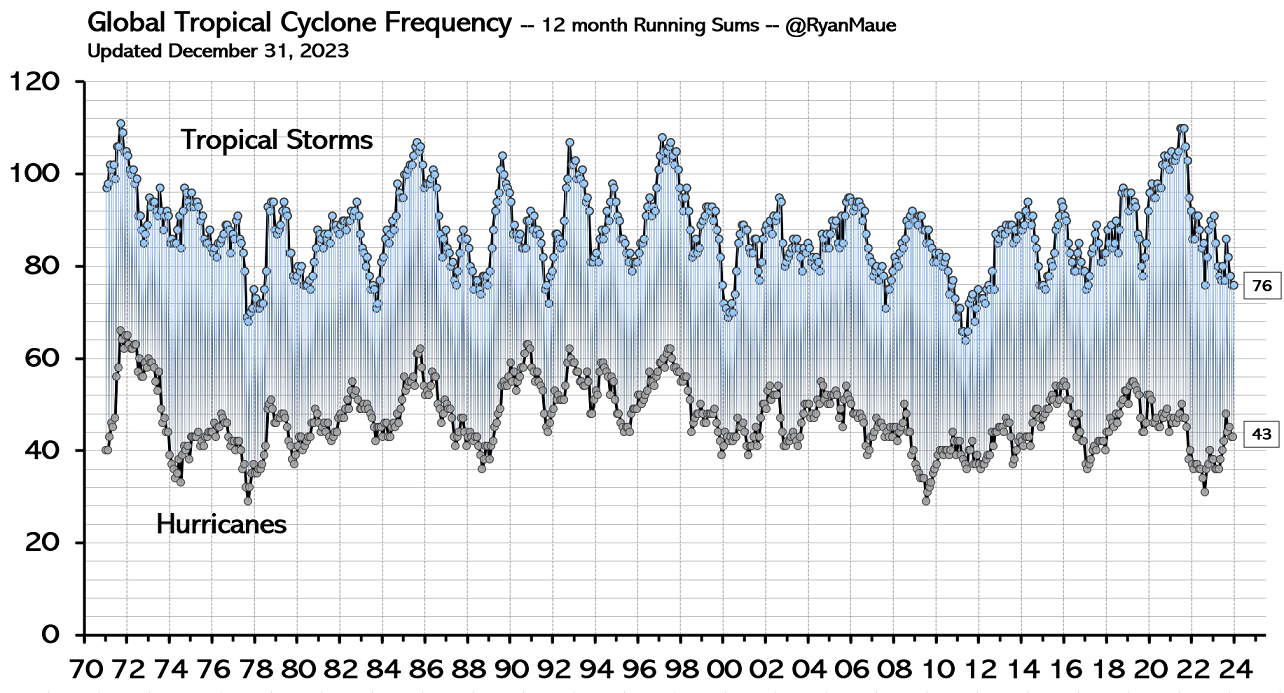
Politico is flat wrong concerning changes in hurricanes in response to climate change. As discussed at Climate at a Glance, measured data show that neither Atlantic Hurricanes nor Tropical Cyclones have increased in frequency or in strength. (See the Figures, below) In fact, multiple studies suggest that over the past century, the frequency and intensity of tropical cyclones have declined, with one report finding a 13 percent decrease in tropical cyclones between 1850 and 2012.
This figure shows that global hurricane and tropical cyclone activity is not increasing. Even with the slight uptick in the number of tropical storms in 2021, it is still below the peak recorded in 1971. Source: Ryan N. Maue, “Global Tropical Cyclone Activity,” Climate Atlas, accessed April 20, 2023, http://climatlas.com/tropical/frequency_12months.png.
Globally, the U.N.’s Intergovernmental Panel on Climate Change (IPCC) observes there is, “only low confidence for the attribution of any detectable changes in tropical cyclone activity to anthropogenic influences.” In fact, looking forward, the IPCC forecast no detectable impact of climate change on hurricanes/tropical cyclones under even the most extreme emissions scenario by 2050 or even 2100. (See the chart, below)
In the United States hurricane impacts have recently been at an all-time low. The United States recently went more than a decade (2005 through 2017) without a major hurricane measuring Category 3 or higher, which is the longest such period in recorded history. The United States also recently experienced the fewest number of hurricane strikes in any eight-year period (2009 through 2017) in recorded history, data from the National Hurricane Center shows.
Sorry, Politico, these are facts, not false assertions that hurricanes are getting worse from a left-wing media outlet.
Concerning the damage caused by the recent hurricanes, yes, it is high, but that’s not because the timing or the severity of the storms was in any way unusual, but rather because of the expanding bullseye effect. More people, with more, and more expensive, property and infrastructure live in hurricane prone areas than ever before. As more and more people move to, and communities and cities expand in, areas that are historically disaster prone, building ever more expensive homes, retail developments, and infrastructure, when natural disasters strike, naturally more people and structures are putting themselves in harm’s way. Thus, the higher costs aren’t due to climate change but simply because more, more valuable, assets are at risk from demographic shifts in where people live and the lifestyles they pursue.
Rep. Mario Díaz-Balart (R-FL) told Politico as much in responding to a request for comments for its story.
“We have all these false narratives,” Díaz-Balart told Politico. “It is true that disaster costs have been rising, but when you’re talking about economic losses — that’s not the increase of hurricane strength over time … Even the United Nations admits there is no evidence that human activity is increasing the strength and frequency of the hurricanes.”
Sorry, Politico, Diaz-Balart is right, and you are wrong when you write the evidence is “far from ambiguous.” Concerning hurricanes the evidence is clear. They have not become more powerful or more frequent as the planet has modestly warmed. Politico’s readers would be better able to make informed choices about where to live and who to vote for if Dumain and Politico’s editors checked the facts first before the outlet publishes its next story on hurricanes.
Alaska has no shortage of recommendations from local environmental non-governmental organizations (ENGOs) whose purpose is to implement global Malthusian degrowth. These plans come at great cost to our future and way of life as free Alaskans.
“Alaska’s ‘capitalism in transition’ requires one final piece of legislation before reaching, arguably, the point of no return: a Renewable Portfolio Standard (RPS).”
Alaska has no shortage of recommendations from local environmental non-governmental organizations (ENGOs) whose purpose is to implement global Malthusian degrowth. These plans come at great cost to our future and way of life as free Alaskans.
the potential for 100% clean renewable energy to replace fossil fuels energy in Alaska by 2050 and its attendant benefits including more jobs, lower energy prices, higher energy security and the potential for renewable resources to support the equitable transition to hydrogen-based fuels for the aviation and maritime industry.
Studies, studies…. Competitive energies need freedom; uncompetitive energies need studies and government.
Alaska’s Renewable Energy Future and Global Agenda Align
This plan highlights key strategies for the state to “accelerate the transition to a clean, renewable energy future,” including:
Undertaking a comprehensive statewide strategic policy and planning effort, an explicit goal of transitioning to 100% clean renewable energy by 2050, using the Integrated Resource Plan required by legislation that established the Electric Reliability Organization (ERO)
Enact legislation to require electric utilities to achieve 100% clean renewable energy by 2050 and to regularly measure and report progress toward that goal, including the adoption of reasonable Renewable Portfolio Standards, e.g., 80% by 2040
Seek Alaska Permanent Fund support for publication of environmental disclosures of its investments to ensure portfolio investments are assessing and addressing climate risks.
Green Bank – A Green Bank is a capital management program that leverages limited public dollars to attract greater private investment in clean energy.
An underlying theme of the report is to finance the “Just Transition to a Regenerative Economy.” But what does this mean? Since the global pandemic, the idea to upend and replace capitalism has become normalized and accepted. Chief among those calling to replace capitalism is the Trilateral Commission, which published a report in June of 2022 by the Task Force on Global Capitalism in Transition.
The report references a 2020 survey wherein 56% agreed “capitalism does more harm than good.” The survey contacted over thirty-four thousand people in twenty-eight countries, including Russia and communist China. The Trilateral Commission report goes on to state the growing concerns about whether market-based economies can handle major challenges, with the first on their list being climate change, stating climate change is the “greatest issue facing humanity in the 21st century” and the “climate crisis is primarily caused by the rise of fossil-fueled economies.”
The executive summary for the Trilateral Commission report states: “The time was right for this effort. Despite capitalism’s manifest positive impact on prosperity and well-being, many people are frustrated by its inability to handle some of the greatest challenges facing society. In particular, there are growing concerns about whether market-based economies will be able to adequately address climate change, the disruptions triggered by the digital revolution, and rising inequalities. Moving toward a more sustainable and inclusive capitalism is thus a defining challenge of our age.”
The up-front costs as listed in Alaska’s Renewable Energy Future are “on the order of $128B over 30 years, can be mitigated by federal and state co-investment.” Contrast this with the $3.5T additional annual capital investment required between now and 2050 to build a net-zero global economy, with investment totaling only $1.8 trillion in 2023, the inflation yet to be seen with exponential increased costs is unfathomable, with no expected real returns or metrics of success.
Faced with extraordinary costs to implement their experiment, our masters must throw away traditional capitalism and replace it with Marxism repackaged as the “regenerative economy.” Other terms for the rebranded theft include inclusive capitalism, stakeholder capitalism and sustainable capitalism.
The only way to get this much money into the system to pay for something that no one wants would be to steal it from unsuspecting citizens. Our economy, resources, supply chains, energy infrastructure, food production and agriculture must be stolen and fed back to us under their new terms and control. The Trilateral Commission’s recommendations to achieve net zero include “Establish new rules of the road” by “Accelerating green finance” and by use of the government where “Central banks should establish as standard practice regular and universal climate stress tests to assess climate risks across financial systems.”
Additionally, they state:
Establishing a price on carbon is an obvious path toward solving the green transition challenge from an economics perspective. Setting a price incentivizes firms, entrepreneurs, and researchers to innovate.
We already see this in the way that activist investors used Governor Mike Dunleavy by subjecting the state to carbon extortion in exchange for resource development.
There is a huge disconnect in what environmental activists see as an existential threat to humanity versus how everyday Americans are polling. In the latest Gallup Poll on the “Most Important Problem,” almost half of Americans at 44% list economic issues as the most important problem where Environment/Pollution/Climate change no longer even registers on the poll <0.5% in September, down from a consistent 2% in the 6 months prior. Their plans very clearly stated are to exacerbate the very issue most Americans are concerned about (economy), to try to solve the issue that doesn’t concern Americans in the least (climate).
A “Regenerative” Economy?
According to the World Economic Forum, “Only a regenerative economy can build sustainable, inclusive prosperity.” As covered previously, sustainability is a degrowth construct, and inclusive means equal outcomes for everyone. According to the Climate Justice Alliance “A People’s Orientation to a Regenerative Economy: “We have long advocated for climate justice through a Just Transition. The emerging Green New Deal (GND) has created an opportunity to deepen this work.”
If our current economy is producing climate change, pollution, and inequality, what kind of economy can provide good livelihoods that work both for people and the planet? This working group is focused on finding answers to that question that make sense for Alaska—we seek to redefine the goals of the economy away from maximizing income for the wealthy few towards achieving broad-based equity, community health, and ecological sustainability.
According to APlanet, a regenerative economy is “the economic model that represents an alternative to the current economic system in response to its environmental, social and economic shortcomings.” They go on: “To ensure environmental conservation and promote a universal improvement in quality of life, it is necessary to reduce both GHG emissions and the material footprint” and under “other relevant concepts to consider,” they list degrowth or degrowth theory, doughnut economics and a circular economy.
Enabling the Plan
It is interesting that they use the word “regenerative” while calling for net zero. There is nothing regenerative or environmentally friendly about the materials required for the so-called transition. To my oil and gas industry friends who believe we need to buy into carbon capture/sequestration, and that CO2 is something that we need to control, know that degrowthers mean zero.
Alaska Climate Alliance, ENGOs et al. have made great progress in getting laws passed to enable this plan. In 2020, SB 123 was signed into law creating the unelected regional Electric Reliability Organization. According to Renewable Energy Alaska Project
The new ERO will establish and oversee region-wide reliability standards as well as non-discriminatory interconnection standards that will make it easier for independent power producers to access the transmission system to sell renewable energy.
This legislation passed with only one Republican voting nay.
In May of 2024, HB 273 was passed establishing a state green bank as a subsidiary of the Alaska Housing Finance Corporation (AHFC) by way of amendment. Green Bank legislation was originally introduced by Governor Mike Dunleavy in 2021. While eleven house members voted no to the Green Bank amendment, final bill passage included only 3 nays in the house and 2 in the senate.
Who is Behind Alaska Climate Alliance?
The primary authors of the report are from the Pacific Environment and Native Movement. Native Movement is a member of Climate Justice Alliance. Senator Shelley Moore Capito’s office R-WV reported that in December of 2023, Climate Justice Alliance was granted $50M in Inflation Reduction Act funds by the EPA. In a statement by Climate Justice Alliance on receiving the funds “Climate Justice Alliance (CJA) was selected to receive a $50 million grant for its UNITE-EJ (United Network for Impact, Transformation, & Equity in Environmental Justice Communities) application and to serve as a National Grantmaker for EJ TCCGM to provide support to the Western United States (EPA Regions 8-10).” Alaska is in EPA region 10.
According to the Native Movement website:
Native Movement is a proud partner within the Alaska Just Transition Collective, a growing collective of Alaska based organizations with a spectrum of focuses working to support Alaska along a path toward a post-oil economy, an Indigenized Regenerative Economy.
The Alaska Climate Alliance is a group of 50+ organizations and more than 120 participants united by our desire to align Alaska’s climate action community with Just Transition principles, addressing the climate crisis head-on at all levels of society and shifting our state towards a joyful, interdependent and Indigenous-led future. And “Our alliance grew out of Alaska’s Just Transition movement, and is steered by a coordinating team including staff from Native Movement, The Alaska Center, Native Peoples Action, Fairbanks Climate Action Coalition, and the Southeast Alaska Conservation Council. The Alliance’s first statewide virtual gathering was in October 2020, and has happened monthly since that time.”
In a Q&A with Native Movement, on “What are 3 projects you are working on with your community?” They state:
This is a hard question to answer because of the breadth of our work. We are a statewide organization that supports multiple grassroots efforts across the state spanning issues of LGBTQ+ rights, missing and murdered indigenous women and girls (MMIWG), climate justice, environmental justice, and energy justice. We are supporting communities fighting multiple extractive projects across the state, including the Ambler mine, the Donlin mine, and the Willow oil and gas project.
We also support communities in their regenerative visions, including land back, food sovereignty, clean energy, and expanding broadband access. We hold trainings on decolonizing gender and untangling colonialism, among other things, and are fostering a cohort of community educators across the state.
Along with Pacific Environment, two of the non-profits listed under the Just Transition Collective, Alaska Community Action on Toxics and Fairbanks Climate Action Coalition make up half of the petitioners listed to dismantle the Trans Alaska Pipeline, which through the evil and oppressive extractive economy (capitalism) provides almost half of the revenue to fund our state.
Next Steps to Energy Serfdom
Alaska’s capitalism-in-transition requires one final piece of legislation before reaching, arguably, the point of no return: a Renewable Portfolio Standard (RPS), which would require our co-ops to achieve an increasing percentage of energy by renewable resources by a certain date.
First introduced in 2022 by Governor Dunleavy and introduced again by others in 2023, we were spared as the legislation died in committee this year. The Alaska Climate Alliance is clamoring for the mandate to require increasing percentage of energy to come from unreliable sources of energy, their plan is dead without the heavy hand of statist mandates. Due to the terrible business decision to adopt decarbonization goals, electric co-ops have adopted resolutions supporting an RPS.
Is it a fair question for Alaskans to ask – who are these self-proclaimed manipulators of Alaska’s economy? This upcoming election, it is critical to know where candidates stand on this issue. When they come to your door this fall, be sure to ask them.
The alert was withdrawn after 2 hours. An energy spokesman insists there is no cause for alarm.
Blackout prevention system mobilised as Britain battles low winds
First capacity warning in two years later withdrawn
Matt Oliver Industry Editor 14 October 2024 3:03pm BST
A backstop system designed to prevent blackouts was mobilised for the first time in two years asBritain’s power grid battles low winds and nuclear outages.
The surprise notice for the capacity market, which issues a warning to Britain’s electricity generators, was issued by the National Energy System Operator (Neso) just after midday on Monday.
It told generators to be ready for when demand spikes at 4:30pm, amid fears the amount of spare power capacity had grown unacceptably small compared to demand.
However, the notice was withdrawn just after 2pm.
A spokesman for the Neso insisted it was “confident that electricity margins are sufficient for this evening” and stressed the triggering of the original notice was automatic.
…
But Tom Greatrex, chief executive of the Nuclear Industry Association, warned that the notices risked becoming more commonplace as Britain’s ageing nuclear power stations were switched off this decade.
A plan by the British government to burn biomass imported from countries including North Korea and Afghanistan has been described as “bonkers”, with critics sayingit undermines the credibility of the UK’s climate strategy.
A bioenergy resource model, published in late summer, calculates that only a big expansion in the import of energy crops and wood from a surprising list of nations would satisfy the UK’s plan to meet net zero.
In a strategy document published last year and since seemingly adopted by the new Labour government, the Sunak government said it wanted biomass to play a “significant role” in decarbonising all sectors of the economy in the years leading up to 2050. Previous administrations have provided more than £20bn to businesses using it in the power and heat sectors over the past two decades.
Of course, the North Korean firewood will only be needed to keep the lights on if the flywheels run out of spin.
The alert was withdrawn after 2 hours. An energy spokesman insists there is no cause for alarm.
Blackout prevention system mobilised as Britain battles low winds
First capacity warning in two years later withdrawn
Matt Oliver Industry Editor 14 October 2024 3:03pm BST
A backstop system designed to prevent blackouts was mobilised for the first time in two years asBritain’s power grid battles low winds and nuclear outages.
The surprise notice for the capacity market, which issues a warning to Britain’s electricity generators, was issued by the National Energy System Operator (Neso) just after midday on Monday.
It told generators to be ready for when demand spikes at 4:30pm, amid fears the amount of spare power capacity had grown unacceptably small compared to demand.
However, the notice was withdrawn just after 2pm.
A spokesman for the Neso insisted it was “confident that electricity margins are sufficient for this evening” and stressed the triggering of the original notice was automatic.
…
But Tom Greatrex, chief executive of the Nuclear Industry Association, warned that the notices risked becoming more commonplace as Britain’s ageing nuclear power stations were switched off this decade.
A plan by the British government to burn biomass imported from countries including North Korea and Afghanistan has been described as “bonkers”, with critics sayingit undermines the credibility of the UK’s climate strategy.
A bioenergy resource model, published in late summer, calculates that only a big expansion in the import of energy crops and wood from a surprising list of nations would satisfy the UK’s plan to meet net zero.
In a strategy document published last year and since seemingly adopted by the new Labour government, the Sunak government said it wanted biomass to play a “significant role” in decarbonising all sectors of the economy in the years leading up to 2050. Previous administrations have provided more than £20bn to businesses using it in the power and heat sectors over the past two decades.




You must be logged in to post a comment.