Global warming, climate change, all these things are just a dream come true for politicians. I deal with evidence and not with frightening computer models because the seeker after truth does not put his faith in any consensus. The road to the truth is long and hard, but this is the road we must follow. People who describe the unprecedented comfort and ease of modern life as a climate disaster, in my opinion have no idea what a real problem is.
A new CFACT policy report, “Endangered Species Act Implementation Is Severely Flawed,” by David Wojick, Ph.D., examines several major problems with the way the ESA is administered today — from extraordinarily expensive permitting requirements to questionable federal spending priorities and ongoing legal battles over recovered species such as the gray wolf.
The Endangered Species Act was created with a worthy goal: protecting species at risk of extinction. But more than 50 years later, its implementation has strayed far from that original purpose.
A new CFACT policy report, “Endangered Species Act Implementation Is Severely Flawed,” by David Wojick, Ph.D., examines several major problems with the way the ESA is administered today — from extraordinarily expensive permitting requirements to questionable federal spending priorities and ongoing legal battles over recovered species such as the gray wolf.
Among the report’s findings, a Florida landowner seeking to build a home on five acres faced an ESA-related fee of $139,440, while federal ESA expenditures totaled more than $1.1 billion in the most recent year examined.
The report argues that protecting endangered species remains a worthy objective, but that the ESA’s implementation needs significant reform to better respect property rights, sound science and responsible government.
The regulatory machinery of the Endangered Species Act (ESA) is incredibly overdone, often making the reasonable use of regulated land impossible. Congress needs to fix this.
The regulatory machinery of the Endangered Species Act (ESA) is incredibly overdone, often making the reasonable use of regulated land impossible. Congress needs to fix this.
The law itself is pretty simple but the U.S. Fish and Wildlife Service (FWS) has interpreted it in an extreme way. The law says you cannot harm an endangered species. FWS has interpreted “harm” to include any change in the species’ habitat that might affect it. Cutting down a tree that an endangered bird might happen to nest in is considered harm.
The law actually allows for property development within an endangered species habitat. It is called an “incidental take” permit because every habitat change is considered a “taking” of the species. FWS has stretched this language to the limit.
The problem is that FWS has made incidental take permits so expensive that only rich landowners can afford them. Since most of us are not rich this incredible fee structure has made reasonable development impossible.
This taking fee overkill can be seen in an example from Florida. A landowner with a modest five acre plot wanted to build a house on that land. The incidental take fee was a choking $139,440 which made building impossible. The landowner has asked the Court to overturn this destructive fee structure but it is really Congress’s job to do that. See the case here.
This case is from Charlotte County, Florida, one of a number of American jurisdiction to do what is called a regional Habitat Conservation Plan, which is required to get an ESA incidental take permit. The County then sublets the take to local landowners who want to improve their property.
For anything over 100 acres, such as developing agricultural land, the ESA fee is a punitive $2,289,700. This pretty much rules out agricultural development. Ironically it invites things like malls and data centers that sterilize the land. Developing even the smallest piece of land, up to 0.22 acres, costs $2,032.
In most of America where there are endangered species about the landowner has to directly apply to FWS for an incidental take permit in order to develop their land. The required Habitat Conservation Plan (HCP) is very expensive and time consuming. So much so that doing HCPs for landowners has become a lucrative industry.
Even worse FWS has ruled that their approval of every HCP has to go through the laborious National Environmental Policy Act (NEPA) process. This is truly strange given that there are no direct impacts on the endangered species, just on its habitat.
In sharp contrast the National Marine Fisheries Service issues incidental take permits to actually harass and harm protected marine mammals without going through NEPA. The Dominion Energy offshore wind project is authorized to harass and harm almost 60,000 marine mammals. NEPA is not involved.
The situation is clear. The U.S. Fish and Wildlife’s Endangered Species Act regulations seriously distort Congressional intent. They make it almost impossible for anyone except the rich to develop land within the extensive habitat of an endangered or threatened species. Not just in Florida but throughout America.
The Endangered Species Act is not the problem; it is the extreme regulations that Congress must constrain.
David Wojick, Ph.D. is an independent policy analyst and senior advisor to CFACT. As a civil engineer with a Ph.D. in logic and analytic philosophy of science, he brings a unique perspective to complex policy issues.
His specializes in science and technology intensive issues, especially in energy and environment. As a cognitive scientist he also does basic research on the structure and dynamics of complex issues and reasoning. This research informs his policy analyses. He has written hundreds of analytical articles.
Often working as a consultant on understanding complex issues, Dr. Wojick’s numerous clients have included think tanks, trade associations, businesses and government agencies. Examples range from CFACT to the Chief of Naval Research and the Energy Department’s Office of Science.
He has served on the faculty of Carnegie Mellon University and the staff of the Naval Research Laboratory. He is available for confidential consulting, research and writing.
Upset young woman wearing winter scarf standing isolated over white background, shivering
U.S. mostly dodged disaster this time. What if Net Zero mandates aren’t adjusted or ended?
Winter Storm Fern (January 23-27) dumped heavy snow and ice on more than 240,000,000 Americans across 40 states and 2,300 miles, beginning in Arizona and wrapping up in Maine.
Scores died, including 20 in New York City, where Mayor Mamdani refused to close homeless camps or compel “unhoused residents” to move indoors, instead letting them rely on the “warmth of collectivism.”
Roads and highways were impassable, 11 states declared emergencies, 30 airports closed for a day or more, and many cities recorded 10-24 inches of snow.
The New York Times asked, “What’s up with this big freeze? Some scientists see climate change link.” Two years earlier its headline warned, “Weirdly warm winter has climate fingerprints all over it, study says.” Fossil fuel fearmongering clearly never ends.
Mid-twenties temperatures in Florida clobbered citrus groves and froze iguanas. The reptiles fell from trees, providing “tastes-like-chicken” meat for sumptuous stews, curries, gumbos, and soups and helping conservation officials to cull the rampant invasive species.
There were no widespread blackouts from power failures, though there were close calls. Texas gas lines were weatherproofed after Winter Storm Uri (February 2021) and other jurisdictions had kept coal and gas generators operational, instead of opting to rely on wind and solar that were virtually useless during Fern’s mostly windless and sunless onslaught.
However, ice on trees and power lines caused prolonged power outages that left millions of homes and businesses without electricity – or heat. Two weeks later, thousands still had no electricity.
In Memphis, a friend got her power back quickly, because her home is near shops, groceries, and restaurants. But nearby areas were still without power a week after Fern, despite the local utility deploying 1,800 line workers. Several homes caught fire moments after their power was restored, perhaps because they lacked surge suppressors or their old or inadequate electrical systems couldn’t cope.
Stories were similar all across Fern’s impact area. But the United States dodged a potentially huge bullet.
Modern early-warning, communication, building, electricity, and other technologies have made our lives far safer than in the past. But big winter storms across Southwest, Midwest, East Coast, or even much of the lower 48 states still strike frequently and recall deadly historic events like these.
The School Children’s Blizzard (January 1888) sent temperatures +35 to –20 and lower within hours, dropped several feet of snow, and killed 500 people, mostly in Nebraska and most of them children.
The Great White Hurricane (March 1888) buried New York City and much of the East Coast under mountains of snow, killed over 400 people, and became the impetus for NYC’s underground subway.
The real question: Will we learn lessons from Fern and heed warnings about the US grid and too-heavy reliance on wind, solar, battery, and related (heavily Chinese) technologies in time for the next Big One?
* The Midcontinent Independent System Operator’s territory had an extremely close call, when hourly nameplate capacity factors for its wind turbines plunged from over 60% before Fern to 7% a day later, well below MISO’s expected 29% winter capacity value, and didn’t return to 60% for two more days.
* US Department of Energy emergency orders kept three big Indiana and Michigan coal-fired generators operating (using coal stored onsite). Otherwise, the situation would have been dire in those states.
* New England has been forcing or subsidizing heat pump installations and built a $1.6-billion transmission line to bring electricity from New York and Quebec. During Fern, natural gas prices skyrocketed, coal power had been eradicated, reliable nuclear did its part, wind was minimal, and solar was MIA. Much-hated oil became the foremost electricity generator – because extreme and sustained cold air across Québec forced the Canadians to suspend power delivery to New England!
That raises an even bigger question. What happens if large numbers of states go Net Zero, mandate heat pumps, or electric home and water heating? If they’re all relying on nearly nonexistent “renewable” energy? Of if they’re dependent on sources like Quebec and a “Clean Energy Connect” transmission line? And they’re caught in a blizzard proportionate to Fern or other historic storms?
As Orr and Rolling asked: Where do you turn when you run out of other people’s energy?
* The huge PJM Interconnection (wherein I reside) perhaps had Lady Luck on its side, because comparatively mild temperatures across the region kept demand low enough to forestall emergency alerts and load shedding (deliberate, planned interruption, or rolling blackouts), and it hasn’t gone hog wild on “renewables.” However, its own gas winterization efforts also paid off.
* The Electric Reliability Council of Texas (ERCOT) may have weatherized its natural gas transmission system, but higher than predicted temperatures and thus lower than expected peak power demand may have saved the region – because its enormous wind and solar fleet was simply not up to the task.
Why ERCOT – covering oil and natural gas capital Texas – would add 31 GW of solar, 9 GW of wind, and only 3 GW of gas over the past decade is inconceivable. Maybe that lone star will keep bringing it luck during the next Winter Storm Uri or Fern. But responsible energy providers shouldn’t count on it.
Other harbingers of danger must also be addressed.
More than half of the entire U.S. electric grid will soon reach high or elevated risk of blackouts, due to growing demand, accelerating retirements of reliable coal, gas, and nuclear generators, and increasing reliance on unreliable, weather-dependent wind, solar and battery storage power, according to a new North American Electric Reliability Corporation (NERC) Long-Term Reliability Assessment.
Making the grid even more vulnerable, Carrington Events triggered by giant sunspots (like AR4366 on February 1, 2026) and solar flares can send coronal mass ejections into Earth’s magnetic field. A large enough CME can electrify the planet’s surface, send massive currents into high-voltage transmission lines, fry transformers and other equipment, cause widespread blackouts lasting months or years, shut down refrigeration, transportation, water systems and our entire lives – and kill countless millions.
We must also consider risks of sabotage, terrorism, and deliberate shutdowns by malevolent foreign or domestic actors. China is our primary source not only for rare earth elements and other critical minerals, but also for wind turbines, solar panels, transformers, and grid-scale batteries.
Beijing, Moscow, and their surrogates could them as strategic weapons: ban exports to impose political goals; use trip-switches or hacker backdoors already embedded in those technologies to close down limited or vast sections of our already vulnerable grid; engage in cyber or physical infrastructure attacks; or launch electromagnetic pulse attacks from high altitude or outer space to inflict the same catastrophic damage as a huge coronal mass ejection on our grid, infrastructure, and military.
If our politicians, judges, and regulators cannot end their obsession with climate change nightmares, renewable energy fantasies and other nitpicking topics – and our nation is plunged into widespread, prolonged, and deadly blackouts – “accountability” must come in much stronger forms than merely voting them out of office. Prosecution for gross malfeasance and dereliction in office will also be in order.
The Department of the Interior (DOI) unveiled its proposal Thursday to open broad swaths of coastal waters to oil and gas drilling in a move that has drawn bipartisan resistance.
The Department of the Interior (DOI) unveiled its proposal Thursday to open broad swaths of coastal waters to oil and gas drilling in a move that has drawn bipartisan resistance.
The DOI directed Bureau of Ocean Energy Management (BOEM) Thursday to take the “necessary steps” to eliminate former President Joe Biden’s 2024-2029 oil and gas leasing scheme. The Trump approved “expansive” replacement plan seeks to develop 1.27 billion acres of viable extraction sites.
After the Biden administration imposed a broad offshore drilling ban and set a record-low leasing schedule, the Trump administration is now pushing to restart development across federal lands and waters. The new proposal seeks to explore drilling off the coasts of Alaska, California and Florida.
Democratic California Gov. Gavin Newsom has staunchly opposed the idea of drilling in Golden State waters, and even some Florida republicans have also come out against the proposal, according to E&E News.
“Offshore oil and gas production does not happen overnight. It takes years of planning, investment, and hard work before barrels reach the market,” DOI Secretary Doug Burgum said Thursday. “The Biden administration slammed the brakes on offshore oil and gas leasing and crippled the long-term pipeline of America’s offshore production. By moving forward with the development of a robust, forward-thinking leasing plan, we are ensuring that America’s offshore industry stays strong, our workers stay employed, and our nation remains energy dominant for decades to come.”
Florida Republicans including Sen. Rick Scott, Sen. Ashley Moody, Rep. Gus Bilirakis and Rep. Vern Buchanan told E&E News they wanted the state to remain off limits to offshore oil and gas lease expansion. Scott and Bilirakis stopped short of condemning the DOI proposal, while Buchanan and Moody remain firmly opposed to any drilling off Florida’s beaches.
“The new maps released today by @SecretaryBurgum and @Interior outlining potential new offshore oil drilling sites in the Gulf of America are HIGHLY concerning — and we will be engaging directly with the department on this issue,” Moody wrote on X on Thursday.
President Donald Trump signed a day one executive order to “unleash American energy” and declared a national energy emergency. The One Big Beautiful Bill Act (OBBBA) went further, instructing the DOI and the Bureau of Land Management (BLM) to open more domestic energy exploration opportunities and “immediately resume onshore quarterly lease sales in specified states.”
Trump has emphasized boosting conventional energy sources, which contrasts with Biden’s stifling of the oil and gas industry. Biden froze liquified natural gas (LNG) exports, blocked the major Keystone XL pipeline and halted BLM lease approvals on his first day as president, instead championing a green energy agenda to the tune of billions in subsidies, loans and grants.
Energy sector insiders like American Petroleum Institute (API) President and CEO Mike Sommers celebrated the plan, stating that “after years of delay in federal leasing, this is a historic step toward unleashing our nation’s vast offshore resources.”
All content created by the Daily Caller News Foundation, an independent and nonpartisan newswire service, is available without charge to any legitimate news publisher that can provide a large audience. All republished articles must include our logo, our reporter’s byline and their DCNF affiliation. For any questions about our guidelines or partnering with us, please contact licensing@dailycallernewsfoundation.org.
A recent article in Florida Today (FT) “Invasive fire ants spread, get boost from climate change in Florida” is not just false—it’s a classic case of alarmist reporting that ignores decades of entomological and ecological data. Fire ants have been widespread in Florida for decades, the existing climate being conducive to their flourishing across much of the country. The climate has not changed in any meaningful way to make the spread of fire any colonies to new locations more likely.
A recent article in Florida Today (FT) “Invasive fire ants spread, get boost from climate change in Florida” is not just false—it’s a classic case of alarmist reporting that ignores decades of entomological and ecological data. Fire ants have been widespread in Florida for decades, the existing climate being conducive to their flourishing across much of the country. The climate has not changed in any meaningful way to make the spread of fire any colonies to new locations more likely.
An excerpt from the FT article states:
With temperatures rising and winters getting milder, invasive fire ants are finding it easier to expand their range across Florida. Climate change, scientists say, is giving the ants a leg up, pushing them farther north and deeper into the state.
It’s a tidy story for headline writers, but it glosses over the well-established reasons behind the spread of fire ants—namely, accidental introduction through global and regional trade, poorly regulated movement of nursery stock and soil, and the absence of natural predators in North America.
The science is clear: fire ants (Solenopsis invicta) first arrived in Mobile Alabama via South American shipping in the 1930s—not because of climate change, but thanks to lax port controls as documented by USDA’s APHIS website. Their spread consistently is tracked with expansions of highways and railroads, plus the movement of landscaping materials, not minor temperature shifts. Even the University of Florida’s IFAS Extension points to “human-assisted movement of infested sod, soil, nursery plants, and other materials” as the primary culprit. This becomes clear when you look at the timeline of fire ants in Florida based on multiple sources of data, including a peer-reviewed study from the University of Texas.
This table summarizes the timeline:
This timeline clearly underscores that the fire ant invasion in Florida has been overwhelmingly complicit with human-mediated transport and habitat alteration—not a result of minor climate fluctuations. Indeed, as the timeline shows, fire ants first landed in northern Florida, the portion of the state that experiences cooler, sometimes freezing temperatures, far more often than any other region of the state. The red imported fire ant’s rapid spread is attributed to its ability to adapt to new environments, its lack of natural predators in the US, and its accidental dispersal through cargo, soil, and nursery stock.
The facts show that fire ants spread explosively in the 1940s through 1970s northward from the coasts, during a period when the Earth was modestly cooling, decades before “global warming” became a household term. Nor is there any evidence the modest warming experienced in North Florida, or elsewhere in what is already fire ant range, has made the invasive pest more likely to flourish than it already does.
To claim otherwise, as Florida Today does, is journalistic malpractice. By promoting climate alarmism, while ignoring the data, Florida Today does a disservice to readers and local policy makers alike. One wonders whether the editorial staff even bothered to consult entomologists before greenlighting this copy-paste climate narrative, which is nothing more than misinformation.
Hurricanes Helene and Milton dealt Florida a potent one-two punch of high winds and storm surge. Helene’s dramatic rains flooded large areas of the American South.
The last thing people working to rebuild needed was unscientific posturing from the climate-Left and politicians playing for advantage, but of course that’s just what they got.
The ever-further-left Greenpeace asked, “as hurricanes from Beryl to Milton leave huge destruction in their wake, who do you think should pay to rebuild and recover?” You know their answer — businesses and taxpayers in the free world.
Vice President Kamala Harris used the hurricanes to go full-on “Selina Myers.”
The NY Post reports that Vice President Harris, after not engaging in hurricane emergency prep during previous storms, sought to generate video of her working hurricane Milton. Harris was miffed when Governor DeSantis was too busy doing real hurricane prep to take her call. President Biden was no help when he told the press that DeSantis need not bother with Harris as he “was talking to him.”
During a video briefing that appeared to serve no other purpose than to insert Harris into the hurricane, she “could be seen covering her mouth, appearing to relay a message to someone else through a microphone and earpiece. The V.P. mumbled, ‘it’s a live broadcast’ behind her hands.”
There are few things team climate loves to demonize as much as cars with internal combustion engines and the energy companies that fuel them.
If you had to flee over 500 miles, as so many Floridians did to escape the hurricanes, would you rather trust your family to a long-range, fast fill up gas-fueled car, or a short-range, long charge, electric vehicle?
It was automobiles that enabled millions of Floridians to relocate to the safe havens of their choice over just two days. It is cars that now see them rolling safely home.
Electric vehicles could not have evacuated Florida.
How about those who want to eliminate all of our cars and replace them with trains?
Can you imagine millions of Floridians trying to escape the hurricane’s wrath by queuing up for trains? Of course not, it would have been impossible.
CFACT’s Chris Martz has a unique talent for countering climate exaggerations with hard scientific data. When Alexandria Ocasio-Cortez tweeted that the hurricanes were caused by human-induced climate change, Chris whipped out a chart showing actual Gulf of Mexico temperatures and hurricanes over the years with nothing like AOC’s claimed climate impact. Take a look:
As Marc Morano said on the Joe Piscopo show, “every crisis is an opportunity to exploit the climate agenda.” They don’t want you to know, for instance, that hurricanes striking the United States are not only occurring at normal rates historically, but that we recently enjoyed long stretches of historically low hurricane activity.
Hurricanes are natural and frequently tragic. Our thoughts and prayers go out to those in Florida, North Carolina and other places recently hit by them. Shame on Kamala, AOC and others on the Green-Left for using such tragic events to score political points.
A recent article in Politico bemoans the fact that Republicans representing districts which recently suffered deaths, injuries, and severe damage from back-to-back Hurricanes Helene and Milton, have not blamed climate change for the dual event and embraced sharp restrictions on fossil fuels to prevent climate change and future hurricanes. The Republicans cited in the story are right to not blame climate change for the suffering their constituents are undergoing, since data show hurricanes have neither increased in strength or number during the recent modest warming.
A recent article in Politico bemoans the fact that Republicans representing districts which recently suffered deaths, injuries, and severe damage from back-to-back Hurricanes Helene and Milton, have not blamed climate change for the dual event and embraced sharp restrictions on fossil fuels to prevent climate change and future hurricanes. The Republicans cited in the story are right to not blame climate change for the suffering their constituents are undergoing, since data show hurricanes have neither increased in strength or number during the recent modest warming. Limiting fossil fuel use would hinder, not improve the situation in Florida and elsewhere where hurricanes have been common throughout history.
Two major hurricanes hitting the same region of the country just weeks apart are not moving the needle for most congressional Republicans when it comes to endorsing tougher action against climate change.
After Hurricanes Helene and Milton devastated huge swaths of the Southwest [she must mean Southeast] and continue to stress the limits of federal disaster relief coffers, Republicans are by and large still not ready to change the way they react and respond to natural disasters, which studies show to be growing in both intensity and frequency as global warming persists.
“As Governor [Ron] DeSantis noted … major hurricanes are a natural phenomenon that have been a part of Florida life dating back to the 1800s,” said Rep. Daniel Webster (R-Fla.), whose district was affected by both storms.
Webster was one of 42 GOP members of the House and Senate contacted by POLITICO’s E&E News this week, asking if they believed the severity of the storms were exacerbated by global warming and if those storms would motivate lawmakers to endorse reducing greenhouse gas emissions — many of them from burning fossil fuels — that scientists call the major cause of climate change.
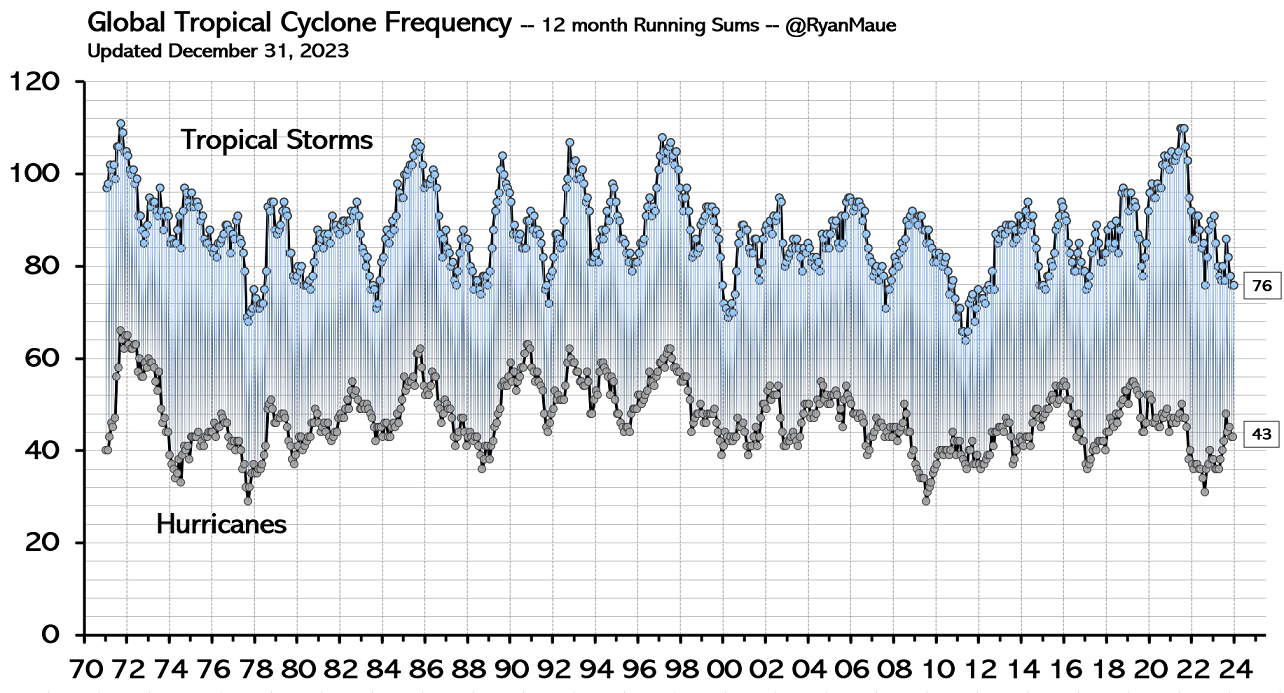
Politico is flat wrong concerning changes in hurricanes in response to climate change. As discussed at Climate at a Glance, measured data show that neither Atlantic Hurricanes nor Tropical Cyclones have increased in frequency or in strength. (See the Figures, below) In fact, multiple studies suggest that over the past century, the frequency and intensity of tropical cyclones have declined, with one report finding a 13 percent decrease in tropical cyclones between 1850 and 2012.
This figure shows that global hurricane and tropical cyclone activity is not increasing. Even with the slight uptick in the number of tropical storms in 2021, it is still below the peak recorded in 1971. Source: Ryan N. Maue, “Global Tropical Cyclone Activity,” Climate Atlas, accessed April 20, 2023, http://climatlas.com/tropical/frequency_12months.png.
Globally, the U.N.’s Intergovernmental Panel on Climate Change (IPCC) observes there is, “only low confidence for the attribution of any detectable changes in tropical cyclone activity to anthropogenic influences.” In fact, looking forward, the IPCC forecast no detectable impact of climate change on hurricanes/tropical cyclones under even the most extreme emissions scenario by 2050 or even 2100. (See the chart, below)
In the United States hurricane impacts have recently been at an all-time low. The United States recently went more than a decade (2005 through 2017) without a major hurricane measuring Category 3 or higher, which is the longest such period in recorded history. The United States also recently experienced the fewest number of hurricane strikes in any eight-year period (2009 through 2017) in recorded history, data from the National Hurricane Center shows.
Sorry, Politico, these are facts, not false assertions that hurricanes are getting worse from a left-wing media outlet.
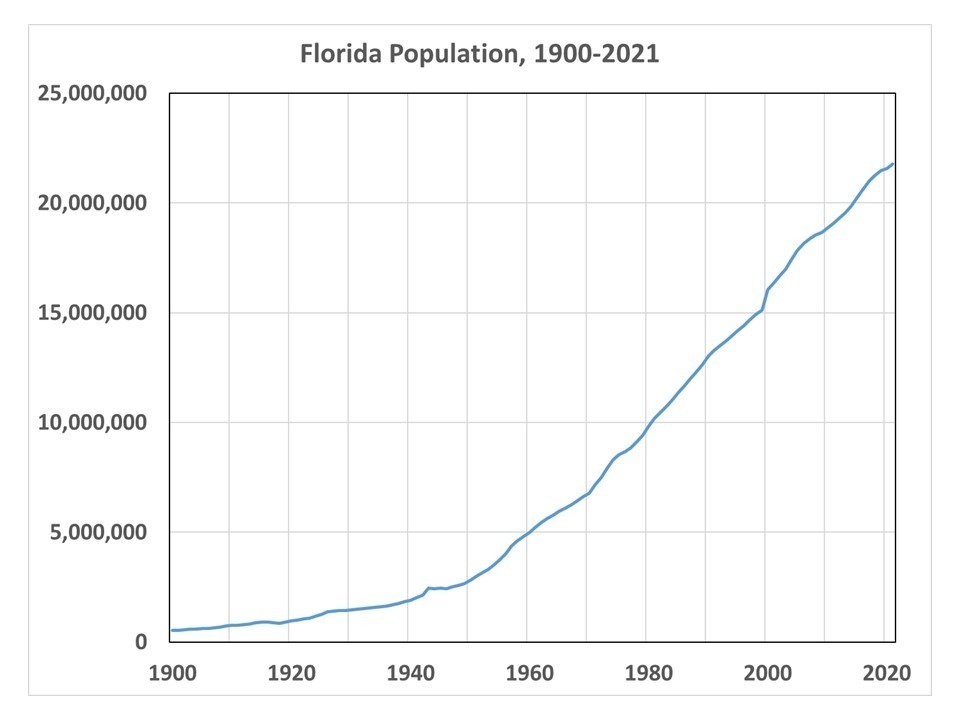
Concerning the damage caused by the recent hurricanes, yes, it is high, but that’s not because the timing or the severity of the storms was in any way unusual, but rather because of the expanding bullseye effect. More people, with more, and more expensive, property and infrastructure live in hurricane prone areas than ever before. As more and more people move to, and communities and cities expand in, areas that are historically disaster prone, building ever more expensive homes, retail developments, and infrastructure, when natural disasters strike, naturally more people and structures are putting themselves in harm’s way. Thus, the higher costs aren’t due to climate change but simply because more, more valuable, assets are at risk from demographic shifts in where people live and the lifestyles they pursue.
Rep. Mario Díaz-Balart (R-FL) told Politico as much in responding to a request for comments for its story.
“We have all these false narratives,” Díaz-Balart told Politico. “It is true that disaster costs have been rising, but when you’re talking about economic losses — that’s not the increase of hurricane strength over time … Even the United Nations admits there is no evidence that human activity is increasing the strength and frequency of the hurricanes.”
Sorry, Politico, Diaz-Balart is right, and you are wrong when you write the evidence is “far from ambiguous.” Concerning hurricanes the evidence is clear. They have not become more powerful or more frequent as the planet has modestly warmed. Politico’s readers would be better able to make informed choices about where to live and who to vote for if Dumain and Politico’s editors checked the facts first before the outlet publishes its next story on hurricanes.
So, just as I predicted yesterday, Milton only hit Florida as a Cat 3 storm, and not the monster, record breaking, once in a century, historic storm which we were told it would be, and which is even now still being reported. (To recap, hurricanes are graded Cat 1 to 5, with 5s being the most powerful).
So, just as I predicted yesterday, Milton only hit Florida as a Cat 3 storm, and not the monster, record breaking, once in a century, historic storm which we were told it would be, and which is even now still being reported. (To recap, hurricanes are graded Cat 1 to 5, with 5s being the most powerful).
Just check some of the headlines:
Florida has been hit by 41 hurricanes of Cat 3 strength or greater since the start of records, and in the US as a whole Milton only ranks the 75th most intense hurricane, in terms of minimum pressure.
Every hurricane can be potentially deadly, every hurricane brings damage and flooding, but there is no evidence that Milton is any more than just another run of the mill storm, either in terms of winds, rain or storm surge. Storm surge has been no more than 8ft, according to Sarasota’s mayor, which is consistent with a strong Cat 2.
As NHC notes, the highest sustained wind speeds measured were 78mph at Venice , which is on the coast only about 10 miles to the south of Siesta Key . Sarasota-Bradenton is a similar distance to the north and had only 40mph winds. They certainly cannot be called catastrophic.
This of course raises the question of why media reporting has consistently tried to portray Milton as something much worse than it actually was. As I reported yesterday, the official forecasts from the NHC have been predicting a weakening of the storm as it approached Florida for some days now.
And as is usually the case, warning intensities have been grossly overestimated in comparison with what the satellite data has been saying:
Hurricane forecaster naturally tend to guess on the top side, as they don’t want to be accused of underestimating a big storm.
But the media do not have that excuse. Partly this stems from the desire for scary headlines.
But there is definitely another motive at play here. By building up public expectations of a record, monster storm, the public then go on to believe that the film footage they see is confirmation of that.
They do not realise, and they are not told, that Florida sees hurricanes like this nearly every year.
If they want to know what exceptional really means, they should look back at hurricanes like 1926 one, which wiped Miami off the map. Or the 1928 Okeechobee one which killed 2500.
Or the most powerful US hurricane on record, 1935’s Labor Day storm, which hit the Florida Keys with winds of 185 mph and a 20ft storm surge, causing catastrophic damage there.
As Hurricane Milton bears down on Florida’s west coast, the state’s preparation efforts under Governor Ron DeSantis’s leadership have reached unprecedented levels of scope and competence. From the strategic staging of supplies to innovative traffic management, Florida’s comprehensive approach to hurricane readiness sets a new standard for disaster preparedness.
As Hurricane Milton bears down on Florida’s west coast, the state’s preparation efforts under Governor Ron DeSantis’s leadership have reached unprecedented levels of scope and competence. From the strategic staging of supplies to innovative traffic management, Florida’s comprehensive approach to hurricane readiness sets a new standard for disaster preparedness.
This level of preparedness ensures that even if supply chains are disrupted in the aftermath of the hurricane, essential resources will be available to affected communities.
Mobilization of Electrical Linemen
Recognizing the critical importance of power restoration after a hurricane, Florida has marshaled an unprecedented force of electrical linemen. Governor DeSantis announced that over 37,000 linemen are either already in Florida or en route to the state. This number is expected to exceed 40,000 by the time Milton makes landfall, significantly surpassing the resources deployed for previous hurricanes like Helene
The scale of this mobilization is particularly impressive given the ongoing power restoration efforts in neighboring states affected by Hurricane Helene. DeSantis noted that some linemen are traveling from as far as California to assist Florida. This massive deployment of skilled workers positions the state to rapidly restore power in the wake of the storm, minimizing the duration of outages and accelerating recovery efforts.
This hotline serves as a central resource for residents seeking information and assistance. Local governments and emergency management offices are utilizing various platforms to disseminate information. For instance, many counties are using their websites and social media channels to provide real-time updates on shelter locations, evacuation orders, and safety instructions. The Florida Division of Emergency Management maintains a comprehensive website (FloridaDisaster.org) that serves as a one-stop resource for hurricane-related information
Governor DeSantis has also been conducting regular press conferences, providing direct updates to the public and media. These briefings cover a wide range of topics, from evacuation orders to resource deployment, ensuring that residents have access to the most current and accurate information
Innovative Traffic Management
To facilitate smooth evacuations and prevent gridlock, Florida has implemented several innovative traffic management strategies. One of the most significant measures is the suspension of tolls on major highways in West Florida, Central Florida, and on specific routes like Alligator Alley and 595 Express. This action removes a potential barrier to evacuation and helps maintain traffic flow.
This forward-thinking strategy addresses the needs of both traditional and electric vehicles, ensuring that all evacuees can reach their destinations safely. To combat potential price gouging, the state has activated its price gouging hotline and is actively monitoring complaints. This vigilance helps protect consumers during a vulnerable time and maintains public trust in the evacuation process.
As Hurricane Milton approaches, Florida’s preparation efforts under Governor Ron DeSantis’s leadership stand out as a model of comprehensive disaster readiness. From the strategic staging of supplies and personnel to innovative traffic management and proactive fuel distribution, the state has demonstrated an unprecedented level of competence in hurricane preparation. The multi-faceted approach addresses not only immediate evacuation needs but also positions the state for rapid recovery in the storm’s aftermath. By leveraging technology, partnering with private sector entities, and implementing creative solutions to longstanding challenges, Florida has set a new standard for hurricane preparedness. As the storm makes landfall, the true test of these preparations will begin. However, the thoroughness and scale of Florida’s efforts provide a strong foundation for protecting lives, minimizing damage, and accelerating recovery. The lessons learned from this approach are likely to influence disaster preparedness strategies not only in Florida but across the nation and beyond.
Florida residents must feel like they have been taking a beating from major hurricanes in recent years, but what do the data show?
The problem with human perception of such things is that the time scale of hurricane activity fluctuations is often longer than human experience. For example, a person born in the 1950s would have no memory of the beating Florida took in the 1940s from major hurricanes (a total of 5). But they would have many memories of the hurricane lull period of the 1970s and 1980s, each decade having only one major hurricane strike in Florida. Then, when an upswing in hurricane strikes occurs, it seems very unusual to them, and they assume that “hurricanes are getting worse”.
Another problem is that any statistics for an area as small as Florida, even over 100+ years, will be pretty noisy. Landfalling hurricanes for the eastern U.S. would be a better metric. And statistics for the entire Atlantic basin would be even better, except that satellite coverage didn’t start until the 1970s and hurricane intensity in remote areas before then would be poorly measured (or not measured at all).
Finally, tropical cyclone statistics for the entire tropics would be the best (if one was trying to determine if climate change is impacting cyclone intensity or frequency). But satellite data for the global tropics is, again, limited to the period since the 1970s. Global tropical cyclone data before the 1970s is sketchy, at best.
So, keeping in mind that any trends we see for Florida are going to be strongly influenced by the “luck of the draw” and the quasi-random nature of hurricane tracks (hurricanes are steered by the large-scale flow of air in the mid-troposphere, say around 20,000 ft altitude or so), what are the statistics of Florida major hurricane intensity and frequency since 1900?
Florida Major Hurricane Intensity & Number
The following plot shows the intensity of major hurricanes (100 knots or greater maximum sustained wind speed) striking Florida since 1900, updated through recent (2024) Hurricane Helene:
As can be seen from the linear trend line, there has been no significant trend in the intensity of major hurricanes striking Florida since 1900.
But what about the number of hurricanes? The next plot shows there has been a weak upward trend in the decadal totals of major hurricanes striking Florida since 1900:
Note that the 2020s number might well increase, since the end of the current (2024) hurricane season will be only half-way through the 2020s. While Hurricane Milton has just been classified as a major hurricane, in 2 days time it is expected to be under increasing wind shear, so it is not obvious it will strike Florida as a major hurricane, and so I did not include it in the above charts.
Another feature of the second chart above shows that a native Floridian born in the 1960s or 1970s would indeed have experienced an increase in major hurricanes striking Florida during their lifetime. But their first couple of decades of personal experience would have occurred during a historic lull in hurricane activity.
Why Start In 1900?
There is reason to believe that the number and/or intensity of major hurricanes striking Florida in the early 1900s has been underestimated, which would bias the trends in the above plots in the upward direction, spuriously suggesting a long-term increase in activity. First of all, there were virtually no people living in Florida in 1900. The population of Miami in 1896 was 444 persons. The intensity of a hurricane is based upon its maximum sustained 1 minute windspeed, which usually covers a very small area. Even with people now inhabiting much of the Florida coastline, it is rare for a coastal anemometer to measure the intensity that the National Hurricane Center gives to a hurricane, because those winds cover such a small area. So, how could it ever be known how intense some hurricanes were in the early 1900s?
Evidence for Long-Term Hurricane Fluctuations Unrelated to Water Temperature
Modern concern centers on the possibility that warm sea surface temperatures from global warming caused by anthropogenic CO2 emissions is making hurricanes stronger or more frequent. But studies of coastal lagoon sediments along the Gulf coast and Caribbean deposited by catastrophic hurricane landfalls show large fluctuations in activity on centennial to millennial time scales, even in the absence of the unusually warm sea surface temperatures measured today. (Example here.)
It should also be remembered that not long ago the U.S. experienced an “unprecedented” 11-year drought in major hurricane strikes. That significantly impacts our perception of what is “normal”. When the lull had reached 9 years, a NASA study found such an event was a 1-in-177-years occurrence. As I recall, that was increased to 1-in-250 years when the lull reached 11 years.
The point is that there is a huge amount of natural decadal- to centennial-time scale variability in hurricane activity in Florida (or any other hurricane-prone state). But with increasing numbers of people thinking that the government is somehow influencing hurricane activity (I’m seeing a lot of this on Twitter), I doubt that actual data will have much influence on those people, and as I approach 70 years on this Earth I have noticed a long-term decline in critical thinking regarding weather, climate, and causation. I doubt that trend will change any time soon.



You must be logged in to post a comment.