Shocking Rise in Whale, Dolphin and Porpoise Strandings as Wind Farms Proliferate Around British Coast

Over the last decade as offshore wind farms proliferated around the U.K., there has been a disturbing rise in coastline strandings of whales, dolphins and porpoises. Since the turn of the century, strandings have more than doubled and are now running at over 1,000 animals a year. The slaughter has been largely ignored by the mainstream media that runs with the agreed narrative that offshore wind is environmentally friendly and is the key to achieving Net Zero by 2050.

From The Daily Sceptic

Byย Chris Morrison

Over the last decade as offshore wind farms proliferated around the U.K., there has been a disturbing rise in coastline strandings of whales, dolphins and porpoises. Since the turn of the century, strandings have more than doubled and are now running at over 1,000 animals a year. The slaughter has been largely ignored by the mainstream media that runs with the agreed narrative that offshore wind is environmentally friendly and is the key to achieving Net Zero by 2050. In fact, wind turbines, whether on or off the shore, are a clear danger to many endangered species and concerns are mounting about their widespread and harmful effects on the natural world. Years ago, the great cause in environmentalism was to save the whales, but these concerns seem to have abated of late, while the slaughter of millions of onshore bats, along with the destruction of many types of large raptors, is simply ignored.

Andrew Montford of Net Zero Watch has updated his graph on the stranding of U.K. cetaceans and compared it to the rise of offshore wind capacity.

Both totals have soared in recent years. Is there a causal link? Perhaps not one that would inconvenience Net Zero fanatics, but Montford says the suggestion of a causal relationship โ€œremains very strongโ€.

The Daily Sceptic has reported in the past about the mounting casualties of whales stranded off the north eastern coast of the United States in the wake of massive offshore windfarm construction. There have been around 300 fatalities in the last five years, and many suggest the extensive sonar soundings, pile driving and heavy concentrated vessel traffic is causing havoc with aquatic feeding, breeding and migration up and down the coast.

The latest U.K. stranding figures have been reported to Ascobans, a UN environmental conservation body for cetaceans in the NE Atlantic. Commenting on the โ€œshockingโ€ figures, the environmental writer and campaigner Jason Endfield called them โ€œa wake-up call to those planning to further industrialise our seas in the name of renewable energy, and especially offshore wind farmsโ€. In his view, it made no sense to increase ocean noise to levels that are โ€œliterally unbearable for marine mammalsโ€.

The great cover-up of this environmental disaster continues with massive industrial parks being erected around the coasts of many countries. In the U.K., the incoming Labour government is committed to a massive expansion with the Mad Miliband spraying around billions of pounds in additional subsidies to boost an industry that would not exist in a free market.

To the fore in blowing smoke over the issue is Greenpeace USAโ€™s senior oceans campaigner Arlo Hemphill who claims there is โ€œno evidence whatsoeverโ€ connecting wind turbines to whale deaths. โ€œItโ€™s just a cynical disinformation campaign,โ€ says another Greenpeace spokesman. The mainstream media often goes along with this narrative as shown by recent tweets from Agence France-Presse reporter Manon Jacob. He dismissed the focus on wind farms as a red herring โ€œwhen offshore wind remains thus far marginal in the U.S. and scientific evidence of large marine mammal deaths is lackingโ€. This is the same Jacob who wrote a recent โ€˜fact checkโ€™ of the Daily Sceptic that was so bad and misleading it should feature in future journalism schools as an example of how not to criticise well-sourced material.

The investigative science journalist Jo Nova has a different take on the matter: โ€œResearchers have known since at least 2013 that pile drivers were permanently deafening porpoises, leaving them presumably to die miserable deaths wandering blindly through dark or murky seas. Where were all the professors of marine science, paid by the public to know these things, and where was the BBC?โ€ Spread the word, she continued. Fifty years ago, environmentalists would have raised hell about a thousand dead whales and dolphins. Now they are part of the cover-up. โ€œThey donโ€™t want to draw attention to the blubber on the beach in case people start asking hard questions,โ€ she observed.

There are however some signs that the โ€˜nothing to see here, guvโ€™ line is starting to crack. A recent essay in Watts Up With That? suggested that an impact statement from the U.S. Bureau of Ocean Energy Management (BOEM) had finally acknowledged the harm caused by offshore wind farms. Examining leases off the New Jersey and New York coast covering over 488,000 acres, the BOEM hints that these developments are not entirely benign โ€œdespite being repeatedly framed as environmentally friendly solutions to the climate crisisโ€. Marine mammals, sea turtles, birds and fish could suffer due to noise, habitat displacement and changes in migration patterns, it is said. Even bats, says WUWT?, which are not typically associated with offshore environments, could be affected.

The essay noted that this latest BOEM work may signal a more cautious approach, โ€œperhaps influenced by increasing legal challenges, public backlash, and even emerging scientific research indicating that wind turbines are not as harmless as once believedโ€.

Chris Morrison is the Daily Scepticโ€™s Environment Editor.

Fear + Ignorance = Climateย Alarm

Weather is inherently mysterious. Multiple forces, such as wind, clouds, seasonal and day-night cycles, and air pressure are constantly interacting and causing continuous chaos. In the aftermath of two particularly destructive hurricanes, the fear-mongers are bloviating to the max over the catastrophic effects on the climate caused by human existence.

From Science Matters

Byย Ron Clutz

Mark C. Ross explains the syndrome in his American Thinker article Fear plus ignorance equals climate change.  Excerpts in italics with my bolds and added images.

Weather is inherently mysterious. Multiple forces, such as wind, clouds, seasonal and day-night cycles, and air pressure are constantly interacting and causing continuous chaos. In the aftermath of two particularly destructive hurricanes, the fear-mongers are bloviating to the max over the catastrophic effects on the climate caused by human existence.

And yet there is no discernible trend toward either more storms or more intense hurricanes compiled over more than beyond the last century. (This chart by NOAA was especially easy to find.) Thus far, the decade of the 1940s saw the most seriously intense storms. Being historical data, this brings to mind a modification of Santayanaโ€™s famous adage: when people are ignorant of their history, they make it really easy for demagogues to lie to them about it.

Rather than human consumption of fossil fuels, two other factors are mostly relevant when it comes to the damage wrought by hurricanes: the path they take and the development of infrastructure within that path. Out on the open sea, a hurricane may damage a few ships, but when one goes over a population centerโ€ฆwell, you know, it just happened.

What determines the path is largely chaotic.ย Go figure. Thereโ€™s this weird thing called the jet stream, which is sort of the result of the Earthโ€™s continuous rotation within a tenuous atmospheric envelope. Becomingย known to American aviators during World War 2,ย the particular details of the jet stream were kept as a military secret well into the mid-twentieth century. Ocean currents and surface temperatures are also involved.ย Early forecasts of hurricane paths are typically all over the map.ย As the time frame compresses, they tend to become more accurate, but not always.

Then thereโ€™s the โ€œatypicallyโ€ warm weather that sometimes happens in early autumn. We just had some of that, along with offshore winds and seriously elevated fire danger. In the olden days, this was called โ€œIndian summer.โ€ Back in 1919, Victor Herbert even wrote a song by that name. Maybe Iโ€™m just a cynic, but Iโ€™m expecting the fear-mongers to start pandering to the general publicโ€™s pervasive ignorance of earth science to cause panic over yet another routine weather event.

There areย three scientific disciplinesย that are especially useful when looking at weather and climate of the distant past:ย geology; paleontology; and tree ring analysis, known as dendrochronology.ย Geology shows us the impact glaciers have had on the Earthโ€™s surface. Paleontology shows us the now extinct life forms that thrived under previous environmental conditions. Dendrochronology shows us a preserved record of ancient weather conditions such as year-to-year rainfall and temperature.

How warm would the weather have to be for giant reptiles to flourish all over the Earth?ย Pretty warm, it seems. There is some work afoot to show that dinosaurs may have been warm-blooded. Good luck with that. Birds are the first known warm-blooded animals, and they evolved from reptiles and still tend to have scales on their legs. Mammals are also warm-blooded. Enormouslyย large mammals such as wooly mammoths were common during the last ice age, the Pleistocene. Having a large size is especially beneficial for warm-blooded animals in cold climates, since surface area of the outer skin increases much more slowly than the actual body mass, making the large animal significantly more thermally efficient than a smaller one.

But why is the blatant climate change hoax still being promoted?ย There areย twoย differentย reasons.ย The first is held among the true believers: humans are evil.ย Theyย recklessly continue to damageย the Earthโ€™s biosphere,ย just for trivial benefitsย and without the slightest concern for the consequences of their actions.ย The other is political:ย fear can be a terrific motivatorย but isย notย all thatย conducive to good decision-making.ย Thatโ€™s fine, too. The wannabe mega-state tyrants l-o-v-e to deal with fear and poor decision-making. How else can they effectively enslave the masses so as to fulfill their objectives?

And what are theseย objectives?ย Taking control of everythingย comes to mind. The evil players in politics are mostly after control. The rest of us just want to have the streets swept and the criminals pulled away from the rest of us. The termย Statist should replace Marxist in this dialogue.ย Absolute government authorityย should overcome the self-direction of the individual โ€” since so many among us are not really attuned to proper functionality in the modern world.

Why Technocrats Deliver Catastrophes

Socialism was already in the works when Karl Marx got involved. I like to say thatย a communist is an angry socialist.ย Marx injected class struggle into the quest for ownership of the means of production. Thus, theย USA was a tough sell for Marxismย since we are a particularlyย socially mobile society.ย The late, great Walter E. Williams would often say that the ranks of the one-percenters were constantly changing โ€” since new ones would rise up, while others would blow it and fall away.ย The โ€œOld World,โ€ by contrast, is littered with caste systems and other forms of enforced social order.

Back to Caddellโ€™s โ€œelite gentryโ€ โ€” their desires are in mortal conflict with the aspirations of just plain folks. Or as Lincoln said, โ€œGod must love the common man, for he made so many of them.โ€ To some, populism is a dirty word. To others, it is a path into the future. It can mean different things to different people. I like to use the term personal freedom. We can do what we want โ€” as long as we donโ€™t interfere with the freedom of others. But to others, โ€œfreedomโ€ is a dirty word.

See Also:ย ย Help For Those Alarmed About the Climate

Democrats Anti-Science Climate Extremism Failing โ€“ Fear of Global Warming & Climate Change Falls Further off Top 10 Fears Listing

The Orange County Register published a spreadsheet on October 27, 2024 (shown below) presenting results of Chapman Universityโ€™s 10thย annual update of their study โ€œOur Fears and How Theyโ€™ve Changedโ€ survey.

From Watts Up With That?

Guest essay by Larry Hamlin

The Orange County Register published a spreadsheet on October 27, 2024 (shown below) presenting results of Chapman Universityโ€™s 10th annual update of their study โ€œOur Fears and How Theyโ€™ve Changedโ€ survey.

The last year โ€œGlobal warming and climate changeโ€ made the top 10 fears list was for the years 2018 and 2019 where this โ€œfearโ€ was 9th on the list.

The year 2024 top ten fears listing has โ€œGlobal warming and climate changeโ€ as number 21 (falling below the year 2023 placement) on the list despite decades Democrat led anti-science government driven climate alarmist hype and propaganda.

The number 1 fear on the 2024 โ€œTop 10 fearsโ€ list is โ€œCorrupt Government Officialsโ€ which has led this list since 2016. 

The year 2024 top 10 fears listing is shown below.

It seems that the more the climate extremist media pushes contrived government climate alarmist propaganda schemes (unsupported by valid science data versus phony models) the more suspect the public becomes of their flawed politically driven alarmist hype.ย 

McKinsey Report: Large Net Zero Mineral Supply Shortfall

โ€œโ€ฆ current mineral supply meets between 10 and 35% of projected 2050 requirements โ€ฆโ€

From Watts Up With That?

Essay by Eric Worrall

โ€œโ€ฆ current mineral supply meets between 10 and 35% of projected 2050 requirements โ€ฆโ€

McKinsey: Clean Energy sees Critical Minerals Supply Crisis

By Sean Ashcroft
October 25, 2024

McKinsey clean energy report part 1: Mining faces long-term critical minerals supply shortfall as demand soars for raw materials to fuel clean energy drive

Ensuring sufficient critical minerals are available to support the deployment of low-emissions technologies will require significant scale-up of their extraction and refining, a new McKinsey report says.

The report โ€“ The hard stuff: Navigating the physical realities of the energy transition โ€“ stresses how the energy transition is in its early stages, with only an estimated 10% of required deployment of low-emissions technologies by 2050 achieved in most areas.

โ€ฆ

McKinsey says current mineral supply meets between 10 and 35% of projected 2050 requirements. This assessment comes under the consultancyโ€™s Achieved Commitments scenario, which models countries meeting their stated climate pledges.

The authors identify supply expansion speed as a primary constraint. They highlight uncertainties around material substitution technologies. Performance impacts of alternative materials require evaluation.

โ€ฆ

The consultancy forecasts nickel demand will increase by 100%. Dysprosium and terbium requirements could expand by 400%. Lithium demand faces a potential 700% surge.

โ€ฆRead more:ย 

https://miningdigital.com/sustainability/mckinsey-warns-of-critical-minerals-supply-crisis

Imagine commissioning a trillion dollar project without checking the logistics. Surely nobody could be that stupid.

Electric bin lorry bursts into flames in central London

An electric bin lorry burst into flames in central London on Monday morning, forcing roads in the West End to close.
Specialist crews were deployed to the fire after the ยฃ580,000 electric lorry caught fire.

Specialist crews deployed to fight fire, forcing road closures in West End

An electric bin lorry burst into flames in central London on Monday morning, forcing roads in the West End to close.

Specialist crews were deployed to the fire after the ยฃ580,000 electric lorry caught fire. The Telegraph has the story.

The lithium battery-powered trucks were recently launched by Sadiq Khan, the Mayor of London, as part of a Westminster City council initiative to reduce carbon emissions.

Oxford Street and Duke Street were closed following the incident as firefighting operations and investigations continued.

Photographs showed smoke rising from the stationary lorry, with rubbish and debris surrounding the vehicle as firefighters tackled the flames.

London Fire Brigade sent three teams from Paddington and a specialist fire rescue unit to the incident to deal with the risks posed by the electric vehicle such as potential reignition and toxic fumes.

Emergency responders used specialised tools, including disc cutters and saws, to create access points on the vehicleโ€™s side, allowing them to tackle flames within. All occupants of the truck escaped without injury.

Westminster City council has said it will be conducting a full investigation into the cause of the fire, focusing on possible electrical faults.

The council had introduced 45 battery-powered bin lorries last July. Initially rolled out as a part of a government-sponsored trial, the ยฃ20 million fleet is based at a specially designed depot in Bermondsey.

Cllr Paul Dimoldenberg, of Westminster City council, said last summer that the โ€œtrailblazing electrificationโ€ would improve air quality and reduce CO2 emissions by 2,000 tonnes per year.

The British-built vehicles were made by Warwick-based Dennis Eagle and are operated by the waste contractor Veolia.

Read the full story here.

Big battery fire regulation confusion in Washington State

Washington Stateโ€™s environmental agency, the Department of Ecology, recently took comments on dual draft Programmatic Environmental Impact Analyses (PEIS) for wind and solar developments. Unfortunately while each had a section on grid battery fires there was significant confusion as each cited a regulation that as I read it does not apply to grid scale battery complexes.

From CFACT

By David Wojick

Washington Stateโ€™s environmental agency, the Department of Ecology, recently took comments on dual draft Programmatic Environmental Impact Analyses (PEIS) for wind and solar developments. Unfortunately while each had a section on grid battery fires there was significant confusion as each cited a regulation that as I read it does not apply to grid scale battery complexes.

So I posted the comments below to help them develop the desperately needed regulations.

โ€œComments of David Wojick, Ph.D. on the Washington Department of Ecology โ€œdraft PEIS for wind and solarโ€ regarding the potential impact of grid scale battery fires

Submitted October 26, 2024

The wind and solar PEIS address the very serious issue of spontaneous fire in the huge battery complexes that often accompany wind and solar projects.

In particular section 3.6.1.1 of appendix G in both PEIS says this:

โ€œWAC 51-54A-0322 includes requirements for storage of lithium-ion and lithium metal batteries. Permits are required when more than 15 cubic feet of most battery types are accumulated. A fire safety plan is required and must include emergency responses to be taken upon detection of a fire or possible fire. Where required by the fire code official, a technical opinion and report complying with Section 104.8.2 should be prepared to evaluate the fire and explosion risks associated with the storage area and to make recommendations for fire and explosion protection. The report must be submitted to the fire code official and should require the fire code officialโ€™s approval prior to issuance of a permit. In addition to the requirements of Section 104.8.2, the technical opinion and report should specifically evaluate the potential for deflagration of flammable gases released during a thermal runaway event.โ€œ

Unfortunately it is highly likely that this regulation does not apply to wind and solar battery complexes. It covers battery storage while these complexes are batteries in use. Thus they are likely exempt under this exception listed in section 322.1:

โ€œ2. New or refurbished batteries packed for use with the equipment, devices, or vehicles they are designed to power.โ€œ

In this case the equipment being powered is the grid, including stabilization.

It appears that this regulation is either not applicable to wind and solar battery complexes or it is being ignored. In either case this raises the reasonably likely impact of a huge multi-battery fire. That impact needs to be properly assessed, not just mentioned in passing as these draft PEIS seem to do.

An example may be helpful. I recently wrote an article on the desperate national need for standards of design and emergency preparedness for grid scale battery complexes. The title is โ€œGrid scale battery fires loom large.โ€

By coincidence my example is the Washington State wind-solar-battery project at Horse Heaven. Lax permitting of a very dangerous project is my focus.

Here is the relevant excerpt :

โ€œNow letโ€™s turn to permitting these facilities where I have another example that speaks volumes. This is a facility that just got permitted by Washington State. It is a combined wind, solar and battery project with a proposed storage capacity of 300 MWโ€ฆ. It might have 200 huge lithium battery units. That number is not disclosed.

The project is named the Horse Heaven Wind Farm despite its massive solar and battery components. The name, usually shortened to Horse Heaven, is truly ironic because it will be no place for horses. Horse Hell might be better.

The permitting authority is the Washington Energy Facility Site Evaluation Council or EFSEC for short. The permit is called a Site Certification Agreement or CSA and Horse Heaven just got one, with a big push from the Governor.
The astounding point is that there was no discussion, or even recognition, of the fire threat posed by this enormous lithium battery facility. The CSA has numerous requirements for lots of issues, big and small, right down to the facility having water to keep the road dust down. There is nothing on having a million or so gallons to prevent a catastrophic conflagration, nor on the environmental impact of such.

This is wildfire country so there should be liability insurance for harm to others from a fire. Other potential sources of harm are huge amounts of contaminated water runoff as well as toxic air emissions, especially if the whole facility burns.

This neglect no doubt flows from the Horse Heaven Application. The App is over 500 pages long and I can find just one sentence about battery fires. Buried in a long paragraph on PDF page 366 we read โ€œLithium-ion battery storage may pose a risk of fire and explosion due to the tendency for lithium-ion batteries to overheat.โ€

This single sentence does not even refer to the project. For that matter there are only a few paragraphs about the battery facility in the entire App, mostly just describing it in general terms. There is nothing about the number of giant battery containers or that it is a huge project in its own right, posing an equally huge fire threat. In fact the App says they might double deck these container sized battery units which is absurd given the risk of setting off a chain reaction in the whole complex.

One can easily think from the Application that the batteries are of no significance and that appears to be exactly what has happened at the EFSEC.

This systematic neglect looks to be what is happening around the country. We desperately need a national code or standard covering this issue. The National Fire Protection Association says it is working on one, but it is up to the permitting authorities to make something happen.

The growing threat of grid scale battery fires is a very serious issue calling for equally serious action.โ€œ

See https://www.cfact.org/2024/10/01/grid-scale-battery-fires-loom-large/

To continue, Horse Heaven is in dry, wildfire prone country and I have read that 100,000 people live within 5 or 6 miles of it. Clearly there is a real threat of enormous property damage and even loss of life if a battery fire gets out of control. This potential impact needs to be included in the PEIS assessment as it is likely to be true for many battery complexes throughout much of the State. Most of the State is dry.

I therefore recommend as follows:

Washington State needs to quickly promulgate and enforce fire safety regulations specifically for grid scale battery complexes. These should cover emergency planning and preparedness, where the latter includes both facility design and material readiness. Design includes container spacing and other necessary engineering features. The material readiness includes having a supply and delivery system for water and/or fire suppressants as needed to prevent a chain reaction of container fires.

In closing I disagree with the PEIS statements that grid scale battery fires are โ€œvery rareโ€ as this makes it sound like the threat is not serious which it surely is. There are relatively few battery complexes in America yet there have been a significant number of fires. See for example

https://www.firetrace.com/fire-protection-blog/us-has-suffered-second-highest-number-of-major-storage-fires

A large number of grid scale battery complexes are presently proposed for Washington State and the scale of the threat is correspondingly enormous.

I am happy to discuss any of the above issues or to provide additional information.

Respectfully submitted,

David Wojick, Ph.D., exPE

Policy analyst and advisor to CFACT

https://www.cfact.org

Committee for a Constructive Tomorrowโ€

End of comments submitted.

Hereโ€™s hoping they listen.

A Demonstration: Low Correlations Do Not Necessarily Lead to Low Confidence in Data Regressions

In a recent post I used our new Urban Heat Island (UHI) warming estimates at individual U.S. GHCN stations having at least 120 years of data to demonstrate that the homogenized (adjusted) GHCN data still contain substantial UHI effects. Therefore, spurious warming from UHI effects is inflating reported U.S. warming trends.

From Roy Spencer, PhD

October 28th, 2024 by Roy W. Spencer, Ph. D.

In a recent post I used our new Urban Heat Island (UHI) warming estimates at individual U.S. GHCN stations having at least 120 years of data to demonstrate that the homogenized (adjusted) GHCN data still contain substantial UHI effects. Therefore, spurious warming from UHI effects is inflating reported U.S. warming trends.

The data plots I presented had considerable scatter, though, leading to concerns that there is large uncertainty in my quantitative estimates of how much UHI warming remains in the GHCN data. So, I updated that post to include additional statistics of the regressions.

A Simple Example: High Correlation, But Low Confidence In the Regression Slope

The following plot of a small amount of data I created shows what looks like a pretty strong linear relationship between 2 variables, with a regression explained variance of 82% (correlation coefficient of 0.91).

But because there are so few data points, there is large statistical uncertainty in the resulting diagnosed regression slope (21% uncertainty), as well as the regression intercept (which is diagnosed as 0.0, but with an uncertainty of +/- 0.94).

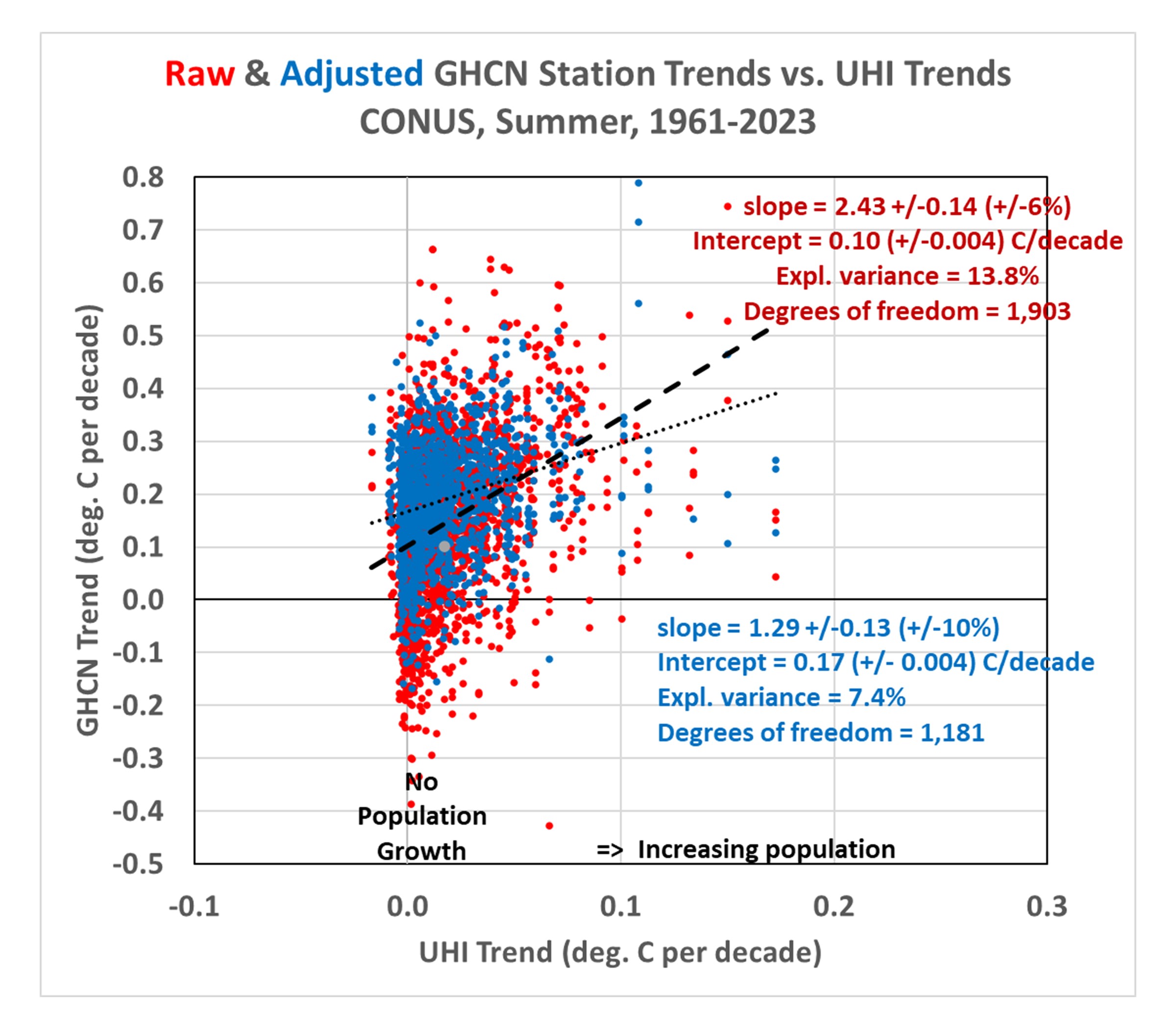
Now letโ€™s look at the third data plot from my previous blog post, which demonstrated that there is UHI warming in not only the raw GHCN data, but in the homogenized data as well:

Importantly, even though the regression explained variances are rather low (17.5% for the raw data, 7.6% for the adjusted data), the confidence in the regression slopes is quite high (+/-5% for the raw GHCN regressions, and +/-10% for the homogenized GHCN regressions). Confidence is also high in the regression intercepts (+/-0.002 C/decade for the raw GHCN data, +/-0.003 C/decade for the homogenized GHCN data).

Compare these to the first plot above containing very few data points, which had a very high explained variance (82%) but a rather uncertain regression slope (+/- 21%).

The points I was making in my previous blog post depended upon both the regression slopes and the regression intercepts. The positive slopes demonstrated that the greater the population growth at GHCN stations, the greater the warming trendโ€ฆ not only in the raw data, but in the homogenized data as well. The regression intercepts of zero indicated that the data, taken as a whole, suggested zero warming trend (1895-2023) if the stations had not experienced population growth.

But it must be emphasized that these are all-station averages for the U.S., not area averages. It is โ€œpossibleโ€ that there has (by chance) actually been more climate warming at the locations where there has been more population growth. So it would be premature to claim there has been no warming trend in the U.S. after taking into account spurious UHI warming effects. I also showed that there has been warming if we look at more recent data (1961-2023).

But the main point of this post is to demonstrate that low correlations between two dataset variables do not necessarily mean low confidence in regression slopes (and intercepts). The confidence intervals also depend upon how much data are contained in the dataset.

Investors Cut Mounting Losses By Ditching Grand โ€˜Greenโ€™ Hydrogenย Scam

Seems like only yesterday that billionaires backing โ€˜greenโ€™ hydrogen were falling over themselves to gouge subsidies out of taxpayers in order to create the next โ€˜big thingโ€™ in energy.

Then, all of a sudden, the big players started treating their โ€˜greenโ€™ hydrogen plans like diseased strangers.

From STOP THESE THINGS

Seems like only yesterday that billionaires backing โ€˜greenโ€™ hydrogen were falling over themselves to gouge subsidies out of taxpayers in order to create the next โ€˜big thingโ€™ in energy.

Then, all of a sudden, the big players started treating their โ€˜greenโ€™ hydrogen plans like diseased strangers.

One of Australiaโ€™s early movers, Andrew โ€˜Twiggyโ€™ Forrest talked a big game, for a long time. But, his grand green hydrogen project has fallen in a heap: hundreds of his workers have been sacked; hand-picked executives have bolted; and his prognostications about a green-hydrogen-powered future now sound even more delusional.

As Judith Sloan explains below, those outfits backing the โ€˜greenโ€™ hydrogen dream have finally caught up with reality. Or, perhaps, reality has finally caught up with them.

Why itโ€™s time to cut our losses on green hydrogen fantasy
The Australian
Judith Sloan
7 October 2024

It was meant to be the last piece of the net-zero jigsaw โ€“ green hydrogen. The renewable energy plus batteries pieces were (sort of) in place. Green hydrogen, using electrolysis powered by renewable energy, would be the means whereby hard-to-decarbonise sectors could achieve net-zero emissions. It would also enable Australia to become a renewable energy superpower by virtue of our advantages in wind, sun and land.

With the assistance of government subsidies to get the ball rolling, green hydrogen was going to be a large part of our energy future. Very soon we would be exporting green hydrogen as well as producing green steel, green alumina and manufacturing ammonia. The sky was the limit.

For the sceptics among us, the dream always looked like a fairytale that ignored the hard reality of physics, engineering and economics. Hydrogen might be the first element in the Periodic Table, but as an element that could power industry โ€“ indeed, the economy โ€“ it always looked like a nirvana, certainly in the next several decades. Letโ€™s not forget small-molecule hydrogen can easily leak, can ignite and cause embrittlement of pipes.

The announcement last week that Origin Energy would not be proceeding with its green hydrogen project in the Hunter Valley came as no surprise, apart from the timing. Origin Energy chief executive Frank Calabria is to be commended for pulling the pin when he did, thereby saving taxpayers, as well as shareholders, a whole lot of wasted cash.

According to Calabria: โ€œIt has become clear that the hydrogen market is developing more slowly than anticipated, and there remain risks and both input cost and technology advancements to overcome. The combination of these factors mean we are unable to see a current pathway to take a final investment decision on the project.โ€

In a nutshell, there was little customer interest, the costs are too high and itโ€™s not clear whether the technology will work. That pretty much sums up where green hydrogen has landed around the world, although our high energy costs and distance from markets puts us at an added disadvantage.

It was not always so, with then chief scientist Alan Finkel writing a whole report in 2019 about the potential upside of green hydrogen. He predicted that green hydrogen would be generating exports worth $9bn by the end of this decade.

He saw a role for green hydrogen in generating electricity, even though electricity is required to produce green hydrogen in the first place. The loss ratio (energy in, energy out) is close to 0.3. This never made any sense, although the point was made that hydrogen could be stored, unlike intermittent renewable energy.

The proposition that green hydrogen can economically be exported has also been debunked given the technical difficulties and extremely high costs of transportation. In any case, there arenโ€™t any customers at scale at this stage, notwithstanding the signing of various non-binding memorandums by overseas parties. Unless hydrogen can be produced at around $2 per kilogram โ€“ and we are nowhere near that figure โ€“ green hydrogen is not a going proposition. Transport and processing costs are on top of that.

The allure of hydrogen has in fact been around for a while. In 2003, US president George W. Bush announced the Hydrogen Fuel Initiative โ€œto accelerate the research and development of hydrogen, fuel cell and infrastructure technologies that would enable hydrogen fuel cell vehicles to reach the commercial market in the 2020 time frame. The widespread use of hydrogen can reduce our dependence on imported oil and benefit the environment by reducing greenhouse gas emissionsโ€.

In the end, very little came of the initiative although many billions of dollars were spent on this non-achievement.

The European Union has more recently become very enthusiastic about green hydrogen, establishing a target of 6 gigawatts of renewable hydrogen electrolysers producing one million tonnes of green hydrogen by this year. Last year, a mere 0.1 tonnes of hydrogen was produced in the EU, with 324 megawatts of electrolysers in place. A budget of close to โ‚ฌ19bn ($30.6bn) has been allocated to subsidising hydrogen, although this expenditure has been heavily criticised by the European Court of Auditors. Only Germany has a formal commitment to produce and use more hydrogen. The EU has also moved away from requiring green hydrogen, opting instead for low carbon hydrogen, which includes nuclear and gas with carbon capture as well as renewable energy.

What then is the realistic future for green hydrogen in Australia? While Origin and effectively Fortescue are now out of the game, there are still some government-sponsored projects on the go, though their fate remains highly uncertain.

The Malinauskas government in South Australia has allocated around $600m to create a green hydrogen hub in Whyalla to support the Whyalla Steelworks to convert to the use of an electric arc, thereby displacing the use of coal. To say this is a work in progress is to be kind. Itโ€™s not even clear that steel mill will survive the next few years.

There remains the challenge of getting the temperature at the plant to the required level for using hydrogen. There is also the close to insurmountable difficulty of securing enough renewable energy to produce the hydrogen in the first place.

The World Steel Association estimates that to replace coking coal with green hydrogen would require an electricity system with a capacity more than the current capacity of the entire EU. This simply cannot be done quickly, if at all.

A similar dilemma exists for the green hydrogen plans in the Gladstone area. To meet the aspiration of four million tonnes of green hydrogen per year, there would be a requirement for 110 million gigawatts of additional renewable energy, which is close to two times the existing capacity of the entire east coast grid. In turn, this will involve some 10,000 wind turbines and 2500 square kilometres of solar panels. In other words, itโ€™s not going to happen.

Of course, the electrolysis process requires water โ€“ some 4500 megalitres per year. At this stage, water is being pumped to the Gladstone pilot installations using diesel. There is a certain irony there.

The green hydrogen dream is quickly turning into a busted flush as more private sector companies decline to participate. It always sounded too good to be true, although those who understood the fundamentals saw through the fantasy. The shift in thinking to low-carbon hydrogen also undercuts most of the rhetoric of Chris Bowen, the federal Climate Change and Energy Minister.

There is a possibility that nuclear-generated hydrogen may take off in the US as a relatively cheap means of producing the element. Bear in mind that hydrogen is a critical component in fertilisers, explosives, ammonia and several other applications, so there will always be some demand.

Rather than waste more billions of dollars of taxpayer funds on trying to promote green hydrogen, the preferred policy should be for both the federal and state governments to cancel their subsidy arrangements. It is also time for the Coalition to reconsider its position on green hydrogen. The Morrison government had supported its development; it is now time for a change of mind.
The Australian

Ten Fundamental Climate Questions the Media and Climate Alarmists Canโ€™t or Wonโ€™t Answer

These ten questions below were compiled by Chris Martz and posted on his Twitter (X) feed. As weโ€™ve noted routinely at Climate Realism, the media is so incompetent at even basic science, theyโ€™d never be able to answer these fundamental climate questions. If they were able to, weโ€™d see balanced and accurate articles about climate issues rather than the usual doom-laden scare stories about a nonexistent โ€œclimate crisisโ€ that we see nearly every day.

From ClimateRealism

Editors Note: These ten questions below were compiled by Chris Martz and posted on his Twitter (X) feed. As weโ€™ve noted routinely at Climate Realism, the media is so incompetent at even basic science, theyโ€™d never be able to answer these fundamental climate questions. If they were able to, weโ€™d see balanced and accurate articles about climate issues rather than the usual doom-laden scare stories about a nonexistent โ€œclimate crisisโ€ that we see nearly every day.


Guest Twitter repost by Chris Martz

Here are 10 fundamental questions that climate alarmists never answer.

โžŠ You claim that the Earth is overheating. That itโ€™s โ€œtoo hot.โ€ So, what is the correct global mean surface temperature (GMST) for life on Earth and why?ย 

Please provide a numerical answer. Use units and round it to the nearest tenth of a degree Celsius. Then, explain why that value is ideal and cite evidence to justify your answer.

โž‹ What is the correct atmospheric COโ‚‚ level for life on Earth?

What is best to optimize our agricultural productivity?ย 

What COโ‚‚ level will make da weatha less scary?ย 

Give your answer as an exact value as a mole fraction or volume percentage, and then explain why that value is ideal.

โžŒ What exactly makes COโ‚‚ โ€œpollutionโ€?

The EPA considers COโ‚‚ to be a pollutant, legally speaking, under the Clean Air Act, and their scientific justification is simply that, it โ€œโ€ฆ๐‘๐‘œ๐‘›๐‘ก๐‘Ÿ๐‘–๐‘๐‘ข๐‘ก๐‘’๐‘  ๐‘ก๐‘œ ๐‘”๐‘Ÿ๐‘’๐‘’๐‘›โ„Ž๐‘œ๐‘ข๐‘ ๐‘’ ๐‘”๐‘Ž๐‘  ๐‘๐‘œ๐‘™๐‘™๐‘ข๐‘ก๐‘–๐‘œ๐‘› ๐‘กโ„Ž๐‘Ž๐‘ก ๐‘กโ„Ž๐‘Ÿ๐‘’๐‘Ž๐‘ก๐‘’๐‘›๐‘  ๐‘๐‘ข๐‘๐‘™๐‘–๐‘ โ„Ž๐‘’๐‘Ž๐‘™๐‘กโ„Ž ๐‘Ž๐‘›๐‘‘ ๐‘ค๐‘’๐‘™๐‘“๐‘Ž๐‘Ÿ๐‘’.โ€

https://epa.gov/climate-change/endangerment-and-cause-or-contribute-findings-greenhouse-gases-under-section-202a

Thatโ€™s pretty ambiguous.

Because by that measure, water vapor should also be classified as a โ€œpollutantโ€ because itโ€™s also a โ€œgreenhouse gasโ€ (GHG) โ€” itโ€™s also the most abundant and potent GHG; it absorbs a wider spectrum of IR wavelengths than COโ‚‚.ย 

So, what actually makes COโ‚‚ pollution?

โž Why are temperature departures from 1850-1900 climate conditions deemed as the human welfare control knob given that the overall human condition has never been better than it is today? How is was climate during the end of the Little Ice Age โ€” the coldest period in the last 10,000-years โ€” preferable to todayโ€™s? On what account was the weather more benign? By what measure? Be specific. Tell me how the climate was supposedly less dangerous in the 17-19th centuries.

โžŽ The Inflation Reduction Act (IRA) that President Biden signed into law in 2022 was popularized as the โ€œbiggest climate bill in history,โ€ but ever since the bill was signed, climate alarmists insist climate change has only gotten worse.

Why are we not seeing the bill work its magic?ย 

https://axios.com/2024/07/21/biden-legacy-election-2024

โž If we spend $75 trillion to decarbonize the economy by 2050, by how much will it reduce the GMST by the end of the century? Please provide your answer to the nearest tenth of a degree Celsius and show your calculations.

What does the perfect climate look like? How will we know when we get there? By what measure?

โž The estimated cost of net zero by the year 2050 in the U.S. is $75 trillion ($3 trillion per year), according to Treasury Secretary Janet Yellen.ย 

https://politico.com/news/2024/07/27/yellen-amazon-climate-change-00171522

Thatโ€™s a hefty price tag.ย 

And with ~260 million adult taxpayers, it would cost each of us $288,461.54 to get to โ€œnet zero emissionsโ€ by the target date. Thatโ€™s 3-6-yearsโ€™ worth of peoplesโ€™ salaries.

Are you willing to shell out that money, or do you just expect that everyone else will foot the bill for you?ย 

Secondly, if you donโ€™t know the answer to question six, then are we supposed to just spend that $75 trillion and see what happens?ย 

โž‘ If โ€œcombating climate changeโ€ is a global concerted effort, why do China and India get a free pass to continue emitting carbon dioxide without bound?

โž’ Why are you so vehemently opposed to the deployment of nuclear power? It is the safest, most sustainable โ€œcarbon-freeโ€ energy technology and without the compliance regulations, isnโ€™t expensive when compared to solar PV and wind, which are inefficient, intermittent, costly add-ons to existing electricity generation sources.

โž“ If humans are a parasite to the Earth since we are destroying it, why then are you worried that climate change could wipe us all out? Wouldnโ€™t that be better for Earth? Why donโ€™t you be the change you want to see and โ€œnet zeroโ€ yourself?

I guarantee not one person will give me a coherent point-by-point answer.

$650m in renewable energy didnโ€™t save Broken Hill from days of blackouts after a storm islanded it

The lights went out in Broken Hill. A storm blew seven transmission towers over disconnecting the area from the national grid on October 17th. About 19,000 people live there, and with a 200MW wind plant, a 53MW solar array and a big battery, plus diesel generators it was assumed theyโ€™d be OK for a while without the connection to the big baseload plants, but instead itโ€™s been a debacle. Theyโ€™ve had nearly a week of blackouts with intermittent bursts of power, barely long enough to charge the phone.

The fridges in the pharmacies failed, so all medications had to be destroyed and emergency replacements sent in. Schools have been closed. Freezers of meat are long goneโ€ฆ Emergency trucks are bringing in food finally and hopefully the schools will reopen today. But the full reconnection will not happen until November 6th.

From JoNova

By Jo Nova

Broken Hill Solar Plantย | Photo by Jeremy Buckingham

The lights went out in Broken Hill. A storm blew seven transmission towers over disconnecting the area from the national grid on October 17th. About 19,000 people live there, and with a 200MW wind plant, a 53MW solar array and a big battery, plus diesel generators it was assumed theyโ€™d be OK for a while without the connection to the big baseload plants, but instead itโ€™s been a debacle. Theyโ€™ve had nearly a week of blackouts with intermittent bursts of power, barely long enough to charge the phone.

The fridges in the pharmacies failed, so all medications had to be destroyed and emergency replacements sent in. Schools have been closed. Freezers of meat are long goneโ€ฆ  Emergency trucks are bringing in food finally and hopefully the schools will reopen today. But the full reconnection will not happen until November 6th.

Western NSW blackout โ€˜a green power warningโ€™

By Joanna Panagopououlos and Alexi Demetriadi, The Australian

Mayor Tom Kennedy said state and federal governments โ€œneeded to learnโ€ from the experience, and how wind and solar energy are โ€œalmost uselessโ€ in a crisis without baseload power.

โ€œ(Wind and solar) are worse than useless (in a crisis like this), because itโ€™s detrimental to having a consistent power supply,โ€ he said. โ€œIโ€™d hate to see what happens in the capital cities in a similar crisis.โ€

The bad news is that when there is no reliable 50Hz baseload supplier of electricity, the solar panel inverters just donโ€™t mesh well with the diesel generators. The frequency of the diesel generators varies slightly as the load changes, and these fluctuations cause issues with solar inverters, which need a stable frequency to synchronize properly.

Hence, in a blackout, the solar panels were not just useless, they were a threat to the system, so people were asked to switch them off:

Essential Energy on Friday was urging customers in Broken Hill to switch off their solar supply main switch to protect the 40-year-old backup gas-turbine generator providing power to the town and surrounds.

From within Broken Hill, a forlorn Jack Marx is dotting out his story in The Australian via his phone:

Broken Hill: Powerless and left to live like mushrooms

โ€ฆBroken Hill, has been in blackout for five days.

The power comes on from time to time, but goes out just as quickly. It gives us just enough time to power our phones and read emails from energy providers sent the day before, alerting us to the fact the power was about to go out. They also warn we donโ€™t have much time, and to avoid using unnecessary electrical devices โ€“ air conditioners, fridges or fans that need a power point.

The unreliable generators survived the storm but were still useless. Giles Parkinson suspects (fervently hopes) that this is just a bureaucratic issue, rather than a technical one:

Broken Hill has a wind farm, a solar farm and a big battery. So, why are the lights out?

Giles Parkinson, RenewEconomy

The fact that the wind farm and the solar farm arenโ€™t operating with the transmission line is understandable. But the big battery is supposed to be โ€“ and that could in turn have allowed the wind and solar to produce. No one is saying whatโ€™s gone wrong, but many suspect itโ€™s a matter of oversight rather than technology.

โ€œYou need to talk to Transgrid,โ€ said one. โ€œYou should talk to Essential,โ€ says another. โ€œAh, thatโ€™s AGLโ€™s asset, you better talk to them.โ€ And then. โ€œNo, Tilt Renewables own those. Give them a ring.โ€ And finally, โ€œwe donโ€™t have an official statement now, but we are trying to sort it.โ€

It certainly was mismanaged. But thatโ€™s just it, isnโ€™t it? A decentralized grid has a million moving parts, and thousand agencies that can all screw up together. Complexity has a cost. But itโ€™s not just mismanagement,a wind and solar system is not just expensive, but lacks inherent stability. Sure, eventually, if we hock the nation we can find a way, but why? To make storms nicer in a hundred years?

Solar power is not just superfluous, itโ€™s toxic

The big Broken Hill battery finally restarted on Saturday to help the town cope with the evening peaks in demand for electricity. But the intrinsic problem remains in these remote communities, erratic solar power doesnโ€™t work well with diesel gens, and everything needs to be fully backed up in any case. As we saw in Alice Springs, it didnโ€™t take much solar power, for one big cloud to cause a blackout. The Northern Territory was so scarred by that blackout in 2019, theyโ€™ve left 4 solar plants sitting there idle ever since, in fear theyโ€™ll crash the Darwin-Katherine grid.

So much money and so little to show for it:

Even with a price tag, our renewables future is already broken

Nick Cater, The Australian

The Silverton Wind Farm and Broken Hill Solar plant were supposed to produce enough electricity to power 117,000 homes. Theyโ€™re supported by AGLโ€™s 50MWh battery facility at Pinnacles Place, one of the largest in Australia. Yet Broken Hill, population 19,000, has been in a semi-permanent state of blackout since a storm brought down the transmission line connecting the town to the east coast grid.

Some $650m worth of renewable energy investment within a 25km radius of Broken Hill has proved to be dysfunctional. The technical challenges of operating a grid on renewable energy alone appear insurmountable using the current technology.

Instead of spending $650 million dollars on solar and wind and a battery, we could have bought two brand new useful diesel generators for every remote town in Australia, and then when transmission towers fall down, they wonโ€™t be left in the dark.